← Independent Americans with Paul Rieckhoff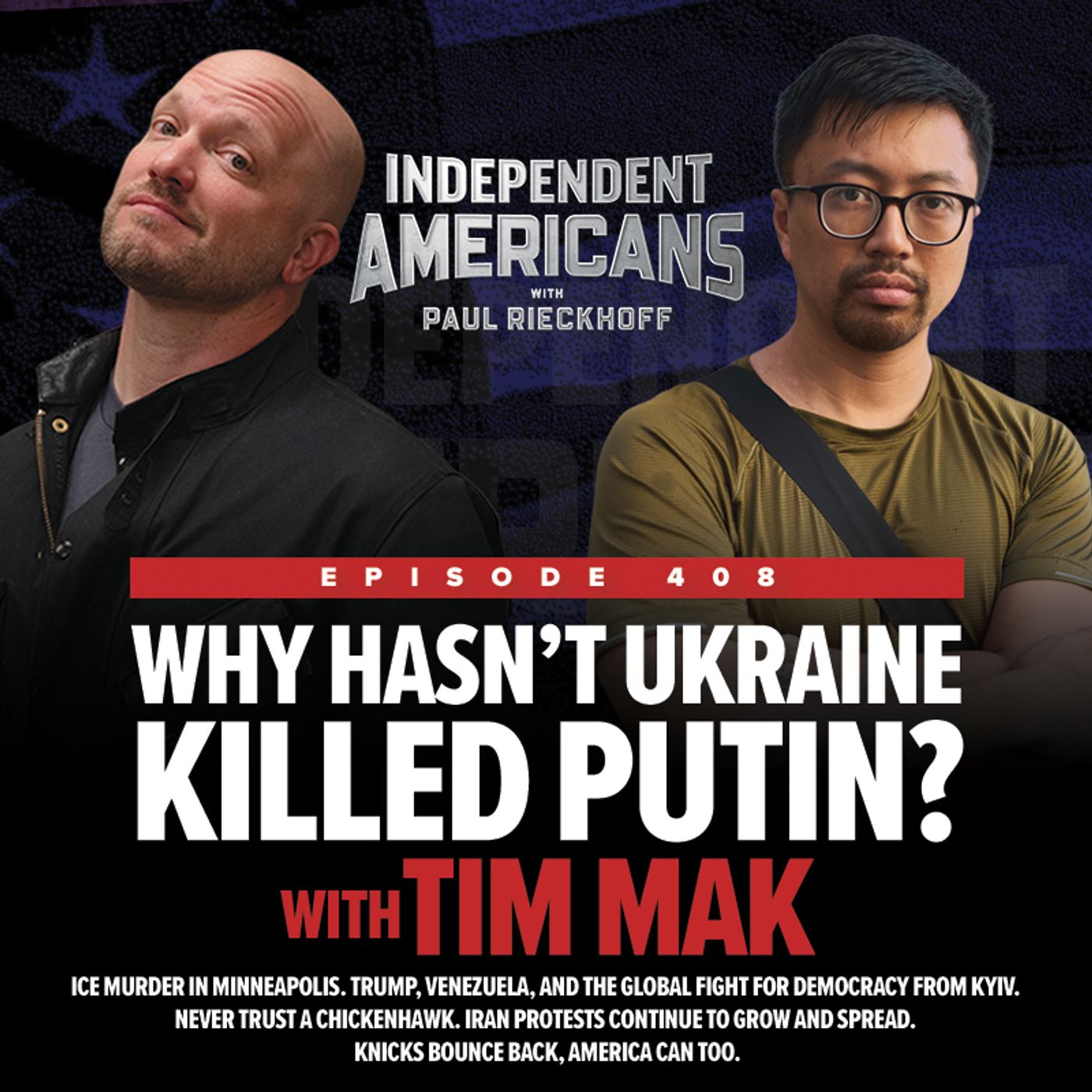
Independent Americans with Paul Rieckhoff
Why Hasn’t Ukraine Killed Putin? with Tim Mak.
00:52:40
In this all-new Independent Americans bonus pod, Paul Rieckhoff takes you from the streets of Minneapolis to the freezing front lines of Kyiv with fearless war correspondent Tim Mak. Together they connect Trump’s Venezuela “snatch and grabs,” ICE’s killing of Renee Nicole Good, and Russia’s winter assault on Ukraine to show why Ukraine is still the front line for freedom—and why this moment is a global test for democracy, American credibility, and the future of war.
Loading summary
Transcript36 lines
- [00:00]
A
But if I were to guess, I would guess that Putin wanted to get into Trump's head a little bit, like play on what Trump perceives to be their personal relationship and say, look at these Ukrainians, they're trying to kill me. Now, from the Ukrainian perspective, you're right to say, I don't think anyone's gonna be hesitating if they have a chance. But that wasn't what happened here. And what we're actually seeing is a one person psyop between Putin and Trump.
- [00:45]
B
Welcome to independent Americans. Welcome to episode four zero eight. I am your host, Paul Rykoff. It is Thursday, January 8th, and I am coming to you from New York City, usa, where the weather is sunny and warm. Holy shit. Boy, do we need it right now. Half the city's got the flu. Everybody is stressed. And I'm going to try to give you something to alleviate some of that. I'm going to try to share some light and some heat and some light and some warmth, especially on this day, and give you some perspective and some inspiration because I think we really need it. Especially after the news out of Minneapolis yesterday. Our guest today is gonna bring it. Coming up soon, we've got the great Tim Mack is returning to go deep on Ukraine, Venezuela, all things global and international security. He is the intrepid founder of the Counteroffensive. He's an investigative correspondent. He used to work at NPR. You've heard him on this show three times before. He was an army medic in the U.S. and a defense reporter. He's just a really smart, thoughtful guy and he's coming to us from Kyiv, Ukraine with the latest from over there as we continue to keep our focus on Ukraine always. But there is a ton happening today beyond that. Before we get to 10, Mack, obviously all eyes are on Minneapolis. We now know the name of the American citizen that was brutally shot and murdered yesterday. Renee Nicole Good, 37 years old. You've hopefully heard her name by now. I hope you will remember her name. She lived with her partner just blocks away from where she was murdered by ICE agents. She has a six year old kid. And as somebody with a six year old kid, that hits me particularly hard. The idea of that kid growing up without a parent is devastating. And I think we need to continue to most of all humanize it. The way she was just left there in that car slumped over a steering wheel is absolutely outrageous, disgusting and shameful and there is no defending that. I want to put a mark down on this because as someone who's been in the military who's worked with law enforcement. I don't know a single cop that's worth their salt. And I've got cops in my family. I've got folks in the military. I don't know anybody that would have just let that woman bleed out slumped over a steering wheel. They would have administered aid. They would have ensured someone else administered aid. We would have done that on the battlefield in Iraq, unless we thought that car was booby trapped to blow up. We would go in there and administer aid because it's what you're supposed to do in the Geneva Convention. So the idea that these ICE agents couldn't even do that just underscores how out of control they are, how undisciplined they are. And I want to stay on that because it's an issue I'm going to come back to. They are giving out $50,000 bonuses to a lot of folks who couldn't qualify for the military, who couldn't qualify for law enforcement, or who could, who just want to crack skulls and know that their hands are not going to be tied as much as they are in other places. So this is a manifestation of low recruiting standards, you know, a huge ramp up. And this is more of what they want to build in the years to come. So I think ICE is out of control. It has to get reined in. It is unacceptable. And nobody's giving law enforcement a worse name than ice. Trump and Nome are of course trying to tell you that you didn't see what you saw. There were no body cams on those officers. It's something I mentioned in a couple of my media appearances yesterday. I think there should be body cams on every single ICE agent. Obviously there should be independent investigations. And now we're hearing that local law enforcement may be blocked by ICE from administering a proper investigation. No surprise there. It kind of reminds me of when I used to work on checkpoints in Iraq and independent contractors, private civilian contractors would come rolling through from Blackwater and other places. If you served in the military in Iraq and Afghanistan, you know what I'm talking about, these dudes would roll in with unmarked vehicles, no identification, sometimes masks. And often they were helpful, sometimes they weren't. But more than anything else, it was confusing and they played by different rules. And that's a real challenge, especially for local law enforcement. When ICE rolls in without coordination. And it can not only get civilians killed, not only get American citizens and potential detainees killed, it can get other law enforcement killed. If you've got law enforcement units that aren't coordinating within a city block or within a region. It is dangerous for everybody. So it's all bad there. And we're going to stay on top of it and also try to bring some light and some measurement and ask people to continue to breathe. Don't respond to that violence with violence. I've been inspired by how peaceful and beautiful some of the vigils have been in Minneapolis and around the country. I think those will continue in the days to come. Nicole Goode is a name we will remember. And interestingly, this happened just a few blocks, I think, from where George Floyd was killed. So this is a really hard time, especially for the people of Minneapolis. I've been in touch with Tim Walts over the years, who's an old friend from his time working on the House Veterans Affairs Committee. I hope Governor Wallace will join us on the show and sometime soon. In the meantime, I'm sending my my support and my love to him, to everybody in Minneapolis, to the family of this person and to the ICE agents that didn't do anything wrong. Let's make sure we underscore that there are some ICE agents that are not doing the wrong thing. But from the higher levels and especially from the command climate from the president, this is out of control. All right. Speaking of the president, he's still trying to take over the Western Hemisphere. The latest on Venezuela is now that he's saying we could be in Venezuela for years. No shit. I've said that. You know, history doesn't always repeat itself, but it sure does rhyme. And a lot of what they're saying about Venezuela sounds a lot like what they said on Iraq. I talked about that in a lot of media last night, including on the 11th hour. I'll talk a little bit more about that later. If you saw it, you know what I'm talking about. But no new strikes that we know of. But now it looks like Hegseth and the boys have replaced strikes with seizing oil tankers. And they seized an oil tanker that was flying a Russian flag. That will accelerate the tension around the world, as if we don't need more of that. But they are continuing to board tankers. They boarded another one in international waters near the Caribbean. Looks like this is how they're using our special operations forces now. And let's look at how this looks to the outside world. It looks like Trump is snatching oil and he's using the American military as mercenaries. And that's not what we are. You shouldn't be using the Navy SEALs to scoop up oil tankers in support of Trump's demented agenda. But it's another example of how he is eroding the trust that not only the country, but the world has with our military. Most important story in the world is that Donald Trump can do anything he wants with the most powerful military the world has ever seen, and nothing is stopping him. It's also important because it also cuts to what he's not doing with our military, like supporting Ukraine more fully. We'll get to that in a minute. Other parts of the world, I wanna focus on Iran. We haven't talked about it much on this show, but what's happening Iran is really critical and historic. There have been hundreds of protests all across the country in the 31 provinces of Iran, where 340 protests, the death toll is over 40 now, thousands of arrests. And this could be a real tipping point for democracy in Iran. We will see. Is this the moment that Iran finally tips into a democratic future? We will see. But there are young people who are bravely standing up right now and are being brutalized by the regime. And Trump is threatening to hit Iran again. Don't take Iran off the table here because remember, it's one of the eight countries that he's hit just in the last year without congressional support, without the support of the American people. Remember, he bombed Iran along with Somalia, Iraq, Yemen, someplace in the Caribbean, probably St. Kitts, we don't know, Syria, Nigeria and of course, Venezuela. And don't forget about the New York Times reporting on the Navy SEAL operation in North Korea in his first term in 2019. And of course, the unprecedented deployments of National Guard troops from the border to LA to Memphis. So what's next? Could be Cuba, could be Colombia, could be Greenland, could be Iran. Iran is now on Trump's vision board for 2026. So keep an eye on that. Let's talk about Ukraine for a second. We're going to go much deeper with Tim Mack. But Today is day 1415 of Russia's full scale invasion of Ukraine. Trump has interestingly given his approval for Republicans to finally push ahead with a bill that's been languishing, sponsored by Senator Lindsey Graham, that would punish countries for buying Russian oil. This sanctions bill has been floating around for months. I and others have been saying it's long overdue. And now, unsurprisingly, because it's connected to oil, Trump says he will support it. He cites China, India and Brazil as the biggest offenders. And he says he wants to punish those countries who buy cheap Russian oil. Look, sometimes Trump can Do something that is done by him that still benefits the greater good. So if these sanctions go through and punish Russia, they should be bipartisan. They are way overdue. These should have happened during the Biden administration and I hope they will help Ukraine. Zelenskyy was in Paris this week as he continues to be the hardest working world leader I've ever seen and continues to inspire and try to build alliances in spite of America and in contrast to America, Zelensky, absolutely inspiring, dynamic. And we're gonna get into that much more deeply with Tim Mack coming up, who's in Kiev to explain to us how the Ukrainian people are looking at their president in this important time. All right. In politics, George Conway is running for Congress here in New York, just a little bit north of where I'm coming to you. He's running not as a Republican, but as a Democrat. I actually ran into him at the lobby at CNN the other day, I think maybe when he was announcing. But he's a former Republican, you may know. He's the former husband to Kellyanne Conway. He founded the Lincoln Project. And he's running in the 12th district of Manhattan, saying he's gonna lead by calling for impeachment, which I think is actually a really strong move. And frankly, I've thought about doing it myself, running for Congress here in New York and just saying I'm gonna do one thing, focus on impeaching Donald Trump. But this is, I think, a smart political move. I think it's necessary and, and I think it's why Trump fears losing the House next year and why he may not allow a free and fair election. But Conway joins a whole bunch of Democrats who want to take Jerry Nadler's seat. Among them are Nadler's protege, state lawmaker Mika Lasher, school shooting survivor and advocate Cameron Caskey, and Jack Schlossberg, the charismatic grandson of jfk. It's going to be an interesting race to watch, especially because a lot of it's going to pay out on social media and on cable news. And I hope that any of them will come join us on this show. I hope that Conway comes on. I hope that Jack Schlossberg would come on. I welcome to have this conversation and I hope an independent jumps in. We'll see. All right, rounding the bend in culture, here's some good news. I think Bruno Mars has a new album, his first one in nearly a decade called the Romantic. He's going to do a six month stadium tour across two continents launching in the spring. And I think we're gonna need some positivity and unity and Bruno Mars is gonna bring that and get us moving and dancing. And speaking of moving, a brand new Jackass movie is gonna be released in theaters on June 26th. Johnny Knoxville is back. Variety just confirmed it. So we have a new Jackass movie. I feel like every day at the White House is an episode of Jackass. And no word on whether Trump will appear in the movie or not. All right, finally in sports. There's a lot going on in sports. Thank God we have sports to distract us from the madness of what's happening in our politics. The Dolphins have fired Mike McDaniel after 7 and 10 season. A lot of coaches getting fired if I didn't mention it. The Baltimore Ravens have fired Jim Harbaugh after missing the playoffs. Giants, please don't hire him. I don't think that Harbaugh is the right fit for our team. I'm going to throw out a name that I hope the Giants consider. Steve Spagnola, who is now assistant coaching for the Chiefs, used to coach for the Giants. I think Spagnola should be on the board and is someone we should consider unless maybe we can get my old friend Bill Cower out of retirement. All right. In other news in sports, big one. The Atlanta Hawks are trading four time all star Trey Young to the Washington Wizards for C.J. mcCollum and Corey Kispert. Trae Young, who is despised across the city, maybe as much as Trump, probably more. Trae Young is controversial. No surprise that the Hawks want to dump his problematic ass. I'm glad the Knicks didn't take him and I'm sure he'll continue to get booed here in the Garden. Speaking of the Garden, my Knicks have broken their longest losing streak of the year and beat a red hot Clippers team at MSG last night. It was a fun game to watch. They won 123, 111, snapping a four game skid. And the Knicks have turned it around, which is what we need America to do right now after this last week or so to start the year. It's been rough. It was rough for the Knicks. They bounced back. It's been rough for America. We need to bounce back. The Knicks are rolling after adversity and so is our guest. Coming up, the great and powerful Tim Mack is here on this important Thursday. And now is most definitely a time to stay vigilant. All right, folks, and helping us stay vigilant at this very, very important time is a returning champion, one of, I think one of the most courageous one of the most important, one of the most effective, one of the most innovative reporters anywhere in the world and especially covering all things Ukraine. He is the founder of the Counteroffensive. He went into Ukraine as the initial invasion was happening. He's been a reporter for npr. He recently launched the Arsenal, which he describes as the most important military innovations of the decade are emerging from the Ukrainian battlefield. The Arsenal is a key based defense tech publication following that space. Very innovative, very smart, and always bringing, I think, the truth from the front lines of what's happening in Ukraine with a uniquely American understanding as well. The great and powerful Tim Mack is back on Independent Americans. Welcome back, sir.
- [15:30]
A
Thank you so much. Although I don't know how powerful. How powerful I am.
- [15:35]
B
Well, you say that every time. And every time I talk to you, you're getting more and more powerful. I think the Counter. I read that the Counter Offensive, correct me if I'm wrong, has become the most read publication in substacks international category. Right. You guys have really been hitting it hard and reaching a lot of people.
- [15:52]
A
Yeah, well, so the Counteroffensive, which is at Counteroffensive News, we focus on human interest stories. And I think you understand this, Paul. We understand it is that one of the real failures in modern media storytelling is the news is so devoid of humanity. And so what we try to do at the Counter Offensive is tell the news through a human interest lens, introduce you first to someone who went through the news items we want to highlight, get deep into their lives and who they are as people, and then use that as a venue through which to talk about what happened, what the news is. And so we've done that, not only from Ukraine, we've done coverage in Taiwan, in Venezuela, recently in and around Syria and so on and so forth. I mean, what we're trying to do is bring human inter storytelling to international news.
- [16:49]
B
You've been doing it very effectively. So important. So let's do that and focus on you and your story. I asked this of everyone, but it's always especially important and interesting to ask you, Tim, where are you and how are you? Especially now in what is such a tumultuous week in the world, in America, in Ukraine, where are you and how are you, sir?
- [17:11]
A
So I'm in Kyiv. How am I? I'm a little cold, but I'm doing all right. You know, I think the joke I've been making this week is that as a foreign correspondent that covers wars, there's not gonna be any shortage of work. You know, there's a lot of work to do. You know, things are not headed in the right direction. Which means I think for you and for me, the vision of how we want to see the world trying to fix the mess that's been created over the last few years or the last year or however long you want to go back, that's going to be a generational undertaking. So we could joke about how we'll have plenty of work, but there's a lot of good work to be done. And I know your audience is among that crew that just knows let's roll up our sleeves. Let's, let's figure out what it is that we can do to create better change in the world. And that's why I'm so excited to be on with you.
- [18:11]
B
That's what it's all about, man. And we've been trying to keep that focus on Ukraine especially. So often when folks have gotten distracted by other things. This feels like one of those moments in America. We've obviously got the snatch and grab in Venezuela with Maduro. We've got now the shooting in Minneapolis. I want to talk to you about, about those things, but I think it's important to get a temperature check from you on Kyiv. We become so navel gazing focused over here in America. What's it like in Kyiv this week? And especially at a time when I think folks in Ukraine know that we're probably more focused on Venezuela now than we are focused on Ukraine. And look, folks are, maybe not aren't saying it out loud, but sure, a lot of people in Ukraine are saying why didn't, why the fuck didn't you snatch Putin instead of snatching Maduro?
- [19:03]
A
Well, I'll tell you, I have a couple points to your questions. I mean, firstly, it's January, it's cold here. And the big issue here is that Russia has been targeting energy infrastructure in Ukraine. It's been targeting electrical power. It's been targeting, there's this post Soviet legacy heating system in a lot of Ukrainian cities where the traditional way to heat apartment blocks was to generate steam at these central locations throughout the city and then shunt them through pipes all throughout the city to keep the city warm. Problem is they didn't think that think about this in a wartime situation. And Russia has been bombing the places where they make the steam and heat the city. And so it's become very, very, very difficult to live with the temperature dropping. Next week it's going to be down to, and I can only do this in Celsius. I can't do the fahrenheit conversion in my head, it's going to drop down to negative 21 Celsius next week. And what we've seen in the past is that especially the weeks where there's a cold front moving through, where it's very, very cold, that's when Russia's going to strike. And so there's this sense of anticipation in the air. You mentioned Venezuela. And the thing about the war in Ukraine is that it's not. Some people want to dismiss it, and particularly in the Trump administration want to dismiss it as some regional conflict where in fact it's a very global conflict. We saw the seizure by the United States of what was eventually a Russia flagged vessel in the North Atlantic. But what we really understand is that oil and oil markets, they're global phenomena. And the late Senator John McCain used to quip of Russia that it was a. I'm gonna massacre his quote. But it was a gas station masquerading as a country. And that Russia depends for its budget and in particular for its war effort on global oil prices being high. The fact that oil is below $60 a barrel right now is devastating to the Russian war effort and its ability to continue to attack and kill people here in Ukraine. So the fact that Venezuela is in the news, the fact that shipments that are meant to.
- [21:35]
C
If you're an H vac technician and a call comes in, Granger knows that you need a partner, helps you find the right product fast and hassle free. And you know that when the first problem of the day is a clanking blower motor, there's no need to break a sweat. With Grainger's easy to use website and product details, you're confident you'll soon have everything humming right along. Call 1-800-GRAINGER click granger.com or just stop by Grainger for the ones who get it done.
- [22:04]
A
That are meant in one way or another to benefit the Russian state, state that's in the news. These are all interconnected stories.
- [22:14]
B
Tim, can you talk a little bit about the American angle here? I think that the Americans who served in the Ukrainian military haven't gotten enough attention. I think they should be celebrated as heroes. And we've tried to do that here and especially with our work with American veterans for Ukraine. But there have been times where there are waves of Americans coming into Kyiv. Can you talk about your sense of what that looks like, how often you see Americans in Kiev and especially how. And if you see the Americans who are in contrast to Trump and Vance and JD Vance, there are folks like you, that are there representing a better version of America, I think. But can you talk about what that looks like in Kyiv and across Ukraine right now when it seems like our president seems dug in on siding with Putin instead of siding with Ukraine?
- [23:07]
A
Well, point of curiosity is that J.D. one of J.D. vance's relatives, was actually serving in Ukraine on the Ukrainian side. But since that was that was made public, my understanding is that he's no longer in Ukraine. But, you know, it is a quite frequent site. I don't know if it's a frequent site because I'm American and, you know, I tend to be in the spaces where Americans appear in Ukraine. But it's not an uncommon side at all. From my personal perspective, there aren't, let's say tens of thousands of Americans fighting on the Ukraine side, but there is, at least for now, something called the International Legion, where Americans, and by the way, Latin Americans and Taiwanese soldiers, Japanese soldiers, all are organized to fight. And this, I think hammers home one of the points I was making earlier, which is that this is a global conflict and not some sort of Eastern European regional tiff, that what we're seeing in Ukraine is the battle for the future of democracy. It just happens to be taking place in Ukraine right now. It's going to be taking place in other places later. But it's a global conflict that has hugely, in some ways terrifying implications for the future of democracy.
- [24:43]
B
So let's go to what I think is the top topic for today with you, Tim, especially, and bear with me as I frame this up with what is a bit of a head cold here, like 3/4 of New York and probably soon to be 3/4 of America if RFK Jr continues on his quest. But eyes in America especially are focused on Venezuela. What could be next with Cuba, with Colombia, with Greenland? I've continued to say that the biggest story in the world is that Donald Trump can do whatever he wants with the most powerful military in the world and nothing is stopping him. That includes he can not do things with that military. And that means Ukraine, which I think, in my view, it's important to remind people that in the midst of all those fights, the most important fight in the world is still in Ukraine. Right? It is the front line for freedom. It is the front line against Putin. It is the testing ground for America's military. It's so many things. Let me ask you to kind of come on a specific point. Every time I watch Zelensky, I think he's the most stoic, dynamic, disciplined leader I've ever seen, especially on the world stage. And in such contrast to Trump, can you talk about his popularity in Ukraine, how he's viewed in Ukraine? Even last week when Trump said something like, putin wants Ukraine's best interest in mind, and it looked like an episode of diaper diplomacy with the AI babies where Zelensky's going like this, and. But he's keeping it together. And also, I think I want to remind people he's still fucking alive. Right? I mean, there's been this talk of Putin and whether or not Ukrainians are trying to kill him. I want to get into that. But the fact that this man is alive and especially given how much travel he does and how out in the open he is, I think is miraculous. But what is he? How would you describe what he looks like to Ukrainians now?
- [26:34]
A
Well, Zelensky has been sort of always more popular outside of Ukraine than he has been inside of Ukraine for the reason that many Ukrainians, particularly the ones that have matured post Maidan over the last decade into politics, they see as their birthright the right to complain, their right to protest the government, the right to. To. To. To rebel and overthrow the government if they go in an autocratic direction. So it's a very confrontational democratic system. I would say even more confrontational than the American one, because it's not just a matter of getting into the streets. Ukrainians are perfectly willing to overthrow their existing government if the government goes in a bad direction. But Ukrainians complain domestically, and they kind of rally behind Zelenskyy on foreign policy matters. For all the complaints about Zelenskyy, whenever Trump disrespects Zelensky, suddenly it's, that's our guy, right? But the attitude in Ukraine is, if anyone's gonna insult our elected officials, it's gonna be us. You're not gonna insult Zelenskyy, Morgan and Zalt Zelenskyy. So that's the way I try to explain it to people. It can kind of feel paradoxical at times. Right. But every time there's been some sort of confrontation between Trump and Zelenskyy, Zelenskyy's ratings go way up, right?
- [28:05]
B
Yeah.
- [28:06]
A
It's a rally around Zelenskyy effect. And then, of course, there is some fatigue, not only with the war, but the conduct of the war, domestic situations, like, you know, Social Security type stuff, you know, the provision of power. I mean, we have real, as I was talking about before, real, real issues with electricity in cities in Ukraine due to attacks by Russians. But also some Ukrainians are unhappy with how the government has responded to rebuilding and redistributing the existing stores of power. So that's how I would explain it. I would explain it as somewhat paradoxical. And with regards to foreign negotiations, Ukrainians, I think, believe in general that Zelenskyy is, is putting on a good face for them abroad.
- [28:57]
B
I, I, I, I think that that's so true and so important. I, I was with a Ukrainian friend over Christmas. I think it was the day after Christmas, and it was right before Zelenskyy was going to Mar A Lago. And I told him, I said, you know, he's going back to Mar A Lago. My boy's going back to Mar A Lago. He's my boy. You know, like, Zelensky is his boy. It's his guy. And I think, you know, just the, the confrontation in Mar A Lago was interesting, but it's also, as an American, it's shameful to me to see the way they make him come to them and the way Trump kind of makes him try to kiss the ring. But Zelensky continues to be dynamic and diplomatic and just very cunning and smart and strategic. And to that point, there's been a lot of change. In Ukraine, he just named a new defense minister, kind of like the equivalent of their Secretary of War. Oh, I won't say war, I'll say defense. Young guy, right? 34 years old or so. But also, there has been this discussion of attacks on Putin. And I want to just ask you something pretty directly. Why do they apologize? Or why does anyone apologize, except maybe to keep things operationally secure for trying to kill Putin. If I were a Ukrainian, I would want to kill Putin every single day. I'm American, and I think Putin should be killed. Right? And I think there's this, there's this idea that, like, we shouldn't want to kill Putin, right? Everybody wanted to kill, you know, bin Laden, Everybody wanted to kill Gaddafi. Everybody wanted to kill Saddam Hussein. But, but Putin has somehow manipulated people into thinking that for some reason, he's off limits while he continues to bomb hospitals and hit electrical grids and kill kids. So in Ukraine, I mean, what is that, what is that discussion like, right? Do they hold back on saying they want to kill Putin? Because if I were Ukraine, I sure damn would want to kill Putin every day.
- [30:49]
A
Yeah. I think we have to start from the very beginning on this story, which is that there was no attack on Putin. That during a conversation between Donald Trump and Vladimir Putin, Putin mentioned that he had been the target of attack you can speculate as to why he might have done that despite no evidence of the attack. And by the way, the American intelligence community has suggested that there is no evidence that he was targeted. But if I were to guess, I would guess that Putin wanted to get into Trump's head a little bit, like play on what Trump perceives to be their personal relationship and say, look at these Ukrainians, they're trying to kill me. Now, from the Ukrainian perspective, you're right to say, I don't think anyone's gonna be hesitating if they have a chance. But that wasn't what happened here. And what we're actually seeing is a one person psyop between Putin and Trump. I think Trump doesn't empathize about much, but I think he is very concerned about his own personal safety. And being the sort of egotistical individual that he is Trump, he can kind of get that sort of immediate alarm when Putin calls and said, they're trying to kill me.
- [32:12]
B
Yeah. Are you surprised? We've talked about this before, and I'm gonna continue to say I am surprised by the discipline of the Ukrainian military, of the Ukrainian people, of Zelenskyy himself, because, you know, you've got Trump who's saying, you know, if the bad guys hit us, we can, we can hit them, fuck around and find out. But for some reason, Ukraine's supposed to play by different rules. And you know, again, if, if this was going on and there was a scenario where America was being treated like Ukraine, there'd be shitloads of Americans going across the border to blow up their stuff. So, I mean, how do you, how do you, how do you explain that the Ukrainians aren't hitting Russia more often in ways that is, that, that hurts their infrastructure, that hurts their energy supply, that punishes. They're civilians. You know, it creates more of an accountability inside of Russia so that the Russian people can feel the pain. And if they're not, if the Ukrainians aren't gonna take out Putin, increase the pressure so that the Russians do well.
- [33:12]
A
The Ukrainians have been launching these long range strikes in which hundreds of drones will cross into Russian territory and particularly try to strike a blow back in terms of hitting oil refining capability. We talked about how Russia's revenues, the lion's share of it, depend on world oil prices. So hitting the Russian energy sector really hits them where it will hurt their ability to conduct war. But part of it is the reality that this is a war that is mostly being conducted at Russia's behest on Ukrainian soil. And so from that practical matter, it's a lot easier, particularly because the Russians are allied with the, with the Belarusian state to launch attacks into Ukraine than it is to go traverse the long distances through Russia to strike Russians and hit Russian infrastructure, hit Russian targets. So we have to consider that the Ukrainians from the very beginning have been attacked by a country that's much larger than them, with a lot more resources, a lot more people and much better weaponry at the beginning. The fact that the Ukrainians are able, over the course of a war, to develop their own long range strike capabilities and send hundreds of drones long distances, by the way, a capability that didn't exist at the beginning of this invasion in 2022, that's astonishing. That's astonishing. And the pace of defense technology innovation is incredible.
- [34:48]
B
I wanna go deeper on that in our next segment, but let me ask you this, and again, I'm not asking you to summarize how everyone feels, but I think Americans don't take Trump as seriously as the rest of the world does. I was in a very heated discussion, but a couple of them on cable news in the last few days, and I think there's a failure of imagination in America. People actually didn't think he was gonna hit Venezuela and I've been saying that for months. They don't think he's gonna hit Cuba, they don't think he's gonna hit Colombia. They don't think he'll try to take Greenland. And maybe Greenland is the one that's most important to Ukraine because of the impact on NATO, because of the disrespect to Denmark and because of the Arctic. Right. I said have written years ago that if my kids ever got drafted into a war, it would probably be for Venezuela or the Arctic. I didn't think it was going to be this quick, but here it is. How do you think Ukrainians view Trump's threats about Greenland specifically?
- [35:42]
A
Well, let me start with Venezuela because I think that the logic that Trump employs for Venezuela, that we're entitled, that the United States is entitled to control over Latin America, is very much mirroring some of the ideas and the philosophy of the Russian regime.
- [36:06]
B
And what they tried to do to Ukraine with the minerals deal as well.
- [36:10]
A
I think that the Trump administration's view of the world is pretty inherently imperialistic. It's about extraction. Not a particularly smart concept of extraction, because as we'll see in both critical minerals in Ukraine and in oil with regards to Venezuela, is that in order to take things you need to invest things you need to invest money, you need to invest time. You need to invest human capital in order to pull oil out of the ground, pull critical minerals out of eastern Ukraine. And who's going to do it? Who's going to do it in a world that's looking less and less safe by the day? If it's going to take tens of billions of dollars or even $100 billion of infrastructure and investment to increase Venezuela's oil production to what it was 10, 15 years ago, who's going to make that investment? Given that this looks like a very unstable world, one with rising anti American sentiment in all sorts of places, including Europe, in Latin America, how is that gonna happen? You don't just show up and take things out of the ground. It's a little bit more complicated than that, but it seems like neither in the case of Venezuela or in Ukraine. The Trump administration has done a lot of long term planning here. They just have this concept of a plan where they want to take and the details are left for the execution of what will be a failed plan.
- [37:48]
B
And similarly to Putin, Trump doesn't talk about the costs, only about the benefits. We're talking about what the oil production will be, but we don't talk about the human cost to provide that. How many American lives is worth oil at $60 a barrel? Right? And we were, you know, lucky that Americans weren't killed in this operation. It's a testament to our military and how incredible they are. But you, as an army, you know, veteran, know that, you know, any twist of the luck and that that operation could have been catastrophic. We all know that, any of us who've been in the military. So let me ask you to go below the radar a bit in an area that you've been uniquely focused on. You served in the army. You understand this global space. I think one of the untold stories of Ukraine is how much it benefits our military defense innovation. We used to have the National Training center and the sandboxes where we would test all this new weaponry. Right. And they do it in other places around the world. We have a real world sandbox, right? An actual combat battlefield where technology innovation is happening in real time at a speed and dynamism we've never seen before on everything from drones to cyber to everything in between. Can you talk about your view on that? Like why it's your area of expertise. You've got the arsenal now, but I'm just gonna give you the mic and run with the ball here. Talk about why this is so important for especially America's Defense innovation capability.
- [39:19]
A
Well, look, necessity is the mother of invention. And since that's the case and the Ukrainians had their back up against the wall, and as I mentioned, fewer people, fewer resources, smaller country, they had to figure out a way to edge out Russia in terms of technology, in terms of military technology. And so what they've been able to do is use what you've identified as this laboratory of innovation, this battlefield that's happening right now, and use that to develop in very, very quick succession new military concepts that didn't exist three years ago. Everything from the usage of drones at scale, both small fpv, first person view. Drones that are being used now to inflict 80% of battlefield casualties used to be heavily in favor of artillery. Now 80% of killed and wounded on the Russian side are being killed and wounded by first person view drones. To electronic warfare, which is used to disrupt these drones, to use signals, to either shoot down or disable incoming drones, to counter drone and interceptor drone capabilities that are being developed. There are so many different things that are being created overnight. It seems just over a short period of years through this decentralized effort by the Ukrainians to create new things and respond to battlefield problems. It's been astonishing to see. And where does this come in with the Americans? The Americans would be very, very poorly served if it wasn't paying close attention to the defense innovation that's happening here, because this is exactly what's gonna be used in the next conflict, either by the Americans themselves or by America's adversaries. So what's happening in Ukraine? From a perspective of understanding the technology to figuring out how it is that they innovated so quickly to how do we integrate drones into our tactics in the most effective manner? These are the things that, you know, it's a good reason to have allies for. And when we alienate people with expertise and smarts and are innovative, we lose out. That's one of the risks of abandoning Ukraine.
- [41:42]
B
You know, you know this old saying in the army, that the army is built to fight the last war and not the next war. And you know, Trump's talking about battleships and FPV drones are taking out 80% of Russians. And I will always continue to reiterate that if you told Ronald Reagan he could take out one third of the Russian military's assets without losing a single American life, he'd take that in a second. I mean, if you want to be transactional the way Trump is, let's look at the ROI for America's defense in terms of Degradation of the Russian military without losing American lives. I mean, it's stunning. And the drone innovation is a great example of where the Ukrainians are so far ahead of us. Now Hegseth is saying we're going to launch this 1 million drones plant. We probably need five times that. And you know, there used to be this reverence for Israel. Right? Israel used to be like the innovator in the military standpoint. Well, it looks like Ukraine is now the new Israel. Let me, let me go to the next segment. Let's stay on innovation. I got to let you go and go back to do good reporting, but I want to end with something good. Something good. You are great in personalizing what happens in Ukraine and in these other places. You've been really, really smart and thoughtful and, and I think human about it. So my something good is a counter offensive. I want to encourage everybody. If you don't already subscribe. The counter mention is a must read every single day. Everything that Tim and his team put out will connect you not just with what's happening in Ukraine, but what's happening in our world, in our humanity. And now he's got the arsenal talking about this military innovation. The innovation that's happening in Ukrainian society is not just military. And there's the old army saying, adapt, improvise and overcome. Tim Mack and the counter offensive are doing it every day. Shout out to the Kyiv Independent, to Saint Javelin, to so many other groups and organizations that are out there innovating as well and, and responding to this urgency of need. But Tim, you and your team, you've been intrepid, you've been innovative, you've been inspiring and you're my something good for today. Over to you, sir. What do you got from Keev? That's something good.
- [43:46]
A
Thank you, Paul. And if folks want to check out the counteroffensive, you can check it out at Counteroffensive News and where we're doing human interest stories related to the fight against authoritarianism all around the world. I gotta say, my something good relates to the small things, the little small things that I wouldn't have appreciated in non wartime settings. My lights are on right now. Okay. There are a lot of hours during the day when my lights are not on and the heat is not working. And I'm looking at a week where I'm probably gonna lose running water. It's gonna be negative 21 degrees Celsius here in, in, in Kyiv next week. And I don't know how off the top of my head to convert that to Fahrenheit, but I do know that at that number, at negative 21, or about thereabouts, down to about negative 30 Fahrenheit and Celsius converge. That's how cold it is.
- [44:44]
B
It's about negative 6 Fahrenheit, if my math is right. Yeah, it's cold.
- [44:49]
A
I mean, I don't know what. I don't know what's happening.
- [44:52]
B
Cold as fuck.
- [44:54]
A
And so the fact that right now I'm warm, the fact that I got the lights on, the fact that I got some drinking water and my faucet works, I gotta be grateful for that. And, you know, I think it's just a moment to reflect. I don't expect anyone to come here and have to experience, you know, the crisis or get squeezed by difficulty circumstances, but it's a moment to kind of reflect about how good we have it in general, how good Europe has it, how good the United States has it, but also a moment to think about, like, how exactly did the United States become prosperous to this extent and that we're able to enjoy the lives that we did. Who were the people who had to make the sacrifices for that to occur, and what geopolitical system permitted and encouraged it? And are we moving towards that ideal or away from it? You know, it's a moment of reflection. But all the same, I'm grateful for the little things. I'm grateful for the fact that I got a. You know, I got a light here. I'm not using a lantern like I often have to do, and I, you know, I'm not wearing, like, seven layers, like, when I'm, you know, cold and the. And the. And the heat's not working. So that's what I'm grateful for.
- [46:17]
B
Well, I'm grateful for your leadership, man. This is a time when leadership is required, and you've continued to show the best kind of American leadership. I mean, it. It always makes me feel good to know that there are people like you and there is you in. In Ukraine. We've had so many other guests on this show that are Americans or connected to Ukraine that I hope are showing the world a good side, a better side, a truer side of America that's more in line with our values. And you're doing that, man. You're a great success story. You're an inspiration to vets who've served in the military. You're pushing the envelope on journalism, and you're just really courageous, man. And I'm thankful for all you do. I'm thinking about you always. I'm like, damn, I hope that dude is fucking safe because we need to keep getting the dispatches. But my thanks to you and your team for your leadership and for your courage. I hope everybody will check you out on substack. Check out the counteroffensive, check out the arsenal. Follow Tim Mack everywhere you can. Thank you for all you do, my friend. And Slava, Ukraine.
- [47:16]
A
Hiram, Slava. Thank you, Paul. Really appreciate you.
- [47:21]
B
All right, folks, Tim Mack, awesome independent American. The best kind of independent American. Check him out, support him, rally this community around leaders like him that are stepping up. The best kind around of independent Americans. And we are daily now. You know it if you're here. If you're new, welcome. Great to have so many new folks here. Follow us Everywhere. Subscribe at IndependentAmericans US. You can follow us on all platforms on believe platform, Spotify, Apple pods, all that shit. And of course on YouTube. Our YouTube numbers are really blowing up. You can help us a ton by joining our Patreon community. Throw in a couple bucks. You can help us just as much by subscribing on YouTube and getting your whole crew to do the same. It's free. And you'll help us grow this audience and we'll be able to get some more advertisers and fuel this kind of independent content, which is so critical. I'm continuing to do lots of TV and traditional media and that's been kind of wild. If you follow me on social media, you've seen it. I post all of those interviews. We send them out on our substack. We also post them on our YouTube page. Tuesday, I was at CNN for Aaron Burnett. Yesterday I did my weekly segment at News Nation in Midtown with Connell McShane. We responded to the breaking news out of Minneapolis. And then I was on MSNBC with Nicole Wallace right before Senator Slotkin for a good conversation. I always enjoy talking to Nicole and thank you to all of you who watch and send feedback. And then I had a late one. If you didn't see it, I recorded it from here. My wife is working out of town and the boys were asleep behind me. And I went on 11th hour from my kitchen, which I thought was going to be, you know, another interview about Minneapolis and Venezuela, which turned into something very different, very unusual for msnbc. If you saw it, you understand why it was weird. But Hagar Chamali is an American political satirist. She's a writer, producer, personality and political commentator. She worked in the Bush administration and the Obama administration and she talks about national security from Time to time. And we got into it. If you follow me on social, you've seen it. It's in my substack. I just want to say I am not going to tolerate people pushing bullshit. I'm not going to tolerate people carrying water for this administration, especially when it comes to giving the idea that war in Venezuela or continued war in Venezuela is going to be easy, that it's not going to be without bloodshed. We are very fortunate that our military suffered no deaths in this snatch and grab around Maduro. But don't forget, casualties include wounded, and seven American troops were wounded in Caracas. And our military is still staged completely around Venezuela right now. A huge percentage of our navy, thousands of our sons and daughters, and anyone who wants to give the idea that this will be a cakewalk, that it'll be easy, that there won't be blood loss, especially as we talk about Cuba and we talk about Colombia. We have been lucky so far. And a danger of the success of the operation in Caracas is that now people might think that war is easy, war is simple. I'm gonna challenge chicken hawks like Hagar last night and anyone else who tries to spin on behalf of this administration and make you think, especially that wars should all be illegal, that we don't need congressional support, that we don't need popular support. I'm going to go back to the old line from Ross Perot where he said, first send the country, then send the military. Trump continues to send the military first and then talk to the country afterward. And I'm not going to have it. So I'm going to keep punching hard. I'll be back on MSN at 3pm today for my weekly segment with Katie Tur, as I am every Thursday. And thanks to all of you who've been reaching out on all of this stuff. And I hope that I'm bringing you a little bit of positivity. I hope that I'm giving you information. My mom told me that she learns a lot on my show. So in advance of my birthday tomorrow, I want to say happy birthday. Happy my birthday to my mom. I wouldn't be possible without you. I love you dearly. To my dad and the rest of our family. It's been a hard week and it's not even the first full week of the year, but tomorrow's Friday and my birthday. We've got college football tonight and tomorrow night. So you can look forward to that. And maybe it can bring us together because we need it right now. America's divided, but here at Independent Americans and Everything that I do, I'm working to change that. Bringing light to contrast to heat. So this is your movement. This is your show. If you're independent or you're not, our movement is something you can be a part of. And it's hope for the future. Country over party, people over politics, light over heat, busting up that status quo. And our movement is growing. And even in the hardest days, especially in the hardest days, we're bringing hope. That's the oxygen of democracy. You saw that today with our friend Tim Mack. If you feel it, share it far and wide. Let folks know about this conversation, all the work we're doing, and invite others to declare their independence from the parties, from the corporations, from the traditional media. And stay vigilant, my friends, because eternal vigilance is the price of freedom. And know you're not alone in your vigilance. We're all vigilant and we're all in this together. Even when we're feeling down, even when we're feeling beat up, even when you got a head cold like me. We are all in this together and we can pick each other up. I'm your host, Paul Rykoff. Thank you for tuning in to Independent Americans. I will be back tomorrow with another episode. Happy Almost My Birthday, Slava Ukraine. And stay vigilant, America. Power by righteous media.