← Independent Americans with Paul Rieckhoff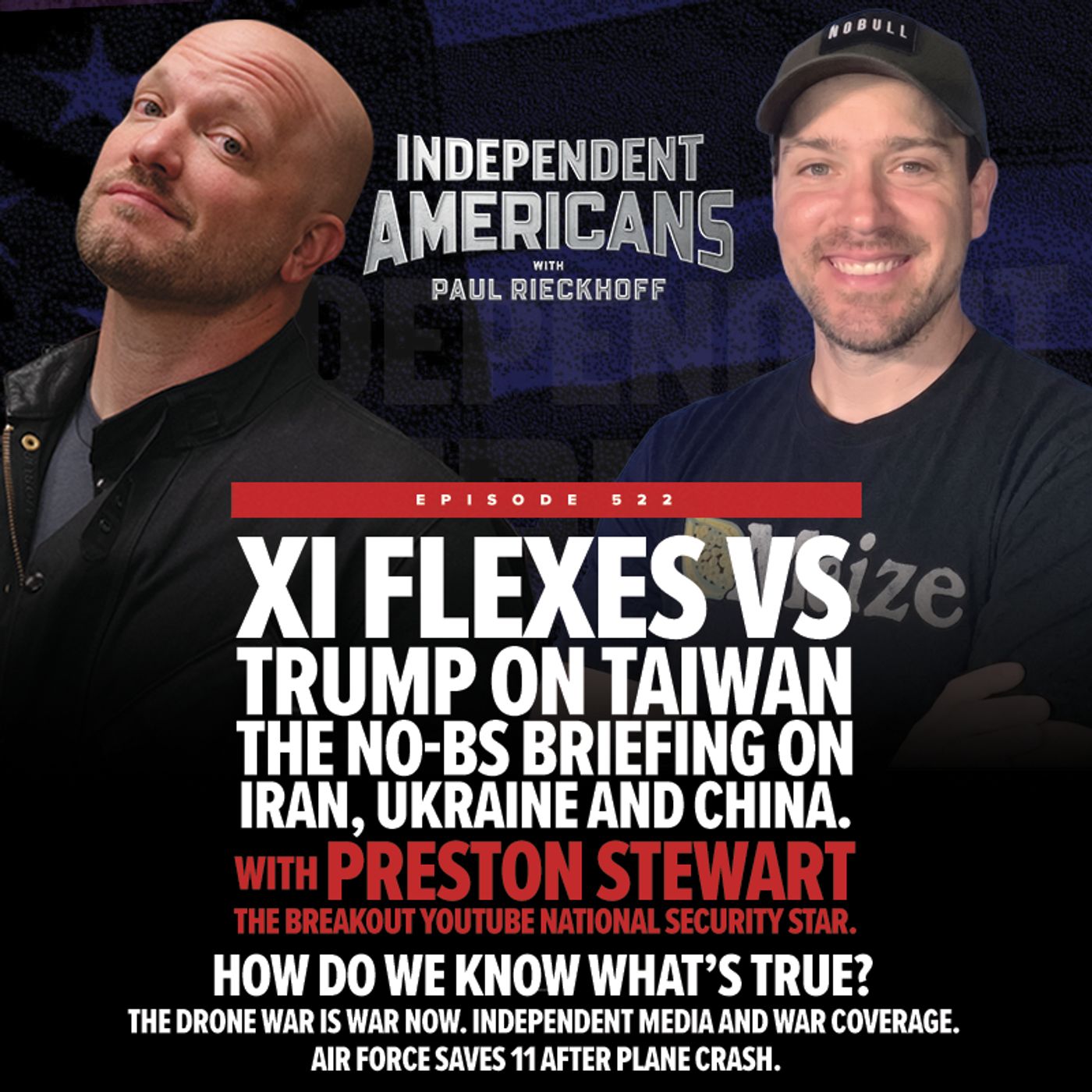
Independent Americans with Paul Rieckhoff
Xi flexes vs Trump on Taiwan. The no-BS briefing on Iran, Ukraine & China with Preston Stewart.
00:46:31
Who can we believe on national security? That's the question driving this conversation. Paul sits down with Preston Stewart — West Point grad, two-tour Afghanistan combat veteran, field artillery officer, and the independent national security analyst who has built a million-plus YouTube following by cutting through the spin. They open with Iran, where the ceasefire is buying time but solving nothing, where Iran's missile and drone capacity is far less degraded than the White House claims, and where the Strait of Hormuz remains a loaded gun aimed at the global economy. Then they widen the aperture to Xi Jinping flexing on Taiwan, a Chinese regime that plays a hundred-year game while Washington burns through munitions in months.
Loading summary
Transcript55 lines
- [00:00]
McDonald's Advertiser
Now with McDonald's, wake up to a $4 breakfast meal deal. Wake up to a sausage McMuffin or sausage biscuit to hash browns and wake up to a hot coffee. Get your $4 breakfast meal deal.
- [00:12]
Preston Stewart
Limited time only. Prices and participation may vary. Prices will be higher for delivery, but I would argue the drones are maybe more impactful right now given the quantity than the ballistic missiles. We weren't going to get rid of all of those. There is no scenario where we can get rid of all of those from the sky. So there's a number we're going after. 2%, 5%, 12%, but it's, it's still up there for sure.
- [00:50]
Paul (Host of Independent Americans)
Independent Americans around the country and around the world, who can we believe? What can we believe? Especially around the issues of national security. This is such an important time to try to find the ground truth, to find voices, especially independent national security voices who can help us navigate the chaos of the all of it. And I'm very, very happy to have a first time guest, a guy who graduated from West Point in 2009, studied international relations and terrorism. He was a field artillery officer in the army, did A Duty Assignment 100 first deployed to Afghanistan twice and is an Internet media juggernaut. He's a national security analyst. He's blown up on YouTube with now over a million followers because he cuts through the spin. He's a no nonsense, matter of fact common sense guy who's been on the ground and also can offer perspective in a way that the corporate and traditional media can't. And always with a focus on issues of combat, national security, military affairs, veterans issues. He gets it. He's been there, he's done that. I'm very happy to have him on the show. The great and powerful Preston Stewart is joining us for the first time on Independent Americans. Welcome, Preston.
- [02:02]
Preston Stewart
Well, thank you so much for the invite. That is the best introduction I've ever had. So I need to copy that down.
- [02:08]
Paul (Host of Independent Americans)
All right, man. Well, I hope it's the first of many. I hope you'll come back often because I love what you do, man. I told you when we were getting ready. I'm a big fan and really impressed by what you've been able to do. And it's happening at a really important time, man.
- [02:21]
Preston Stewart
It's crazy. Didn't you know it all kind of came together at the same time. I think people are, I mean, the nature of your show, people are looking elsewhere for sources of information. And the benefit of the Internet is they're able to dial into folks With a little bit, maybe more subject matter expertise in certain areas than you could find elsewhere. And I mean, I just think about a great example. Sal, over on Sal, what's going on with shipping? Is a shipping expert. And every single day or every couple days, he just rambles on about stuff that none of us would ever know. And he's making that available to the masses. So it's a great time.
- [02:54]
Paul (Host of Independent Americans)
So let me ask you the question I ask everybody, Preston, where are you in the world and how are you in these trying times? You've been a combat leader, you're an entrepreneur, you're a parent. Um, you know, where in the world are you and. And how are you?
- [03:08]
Preston Stewart
So I'm in Murphysboro, Tennessee, just south of Nashville. So flyover state, as we like to call it. We, we love it here though. And I'm doing well, still trying to find the balance. This is my first time kind of working on my own. And it's in a field that, as you and your audience knows, is changing about 17 times an hour. So trying to find the right balance of when to push, when to walk back. And then, you know, as this, as the content has grown and as it gets more eyeballs, there's. There's an added level of, of stress, kind of self imposed stress of making sure you talk about the right things and, and in the right way. So it's great. I'm good. I love it. It's been great for my family, but it's unique. Challenges keep popping up.
- [03:49]
Paul (Host of Independent Americans)
I think you're up for it. I want to talk about Ukraine. I want to talk about China. I want to talk about Iran. I want to talk about independent media, but I want to, I want to talk for folks that are watching on YouTube. You've got a massive following on YouTube. Ours has been really growing quickly. You had a dog behind you. Do you still have the dog behind you? Like she's hanging out. Tell us who that is behind you. Helly.
- [04:10]
Preston Stewart
How are we doing, girl? This is Helly. There she goes. All right, she's moving now. So this is helly. She's about 2. We just got her less than a year ago. So she's new to the family and spends most of her time hanging out in here. But usually I get ready to record, I show one of the doors and she's out. She's like, I want to be a part of this. So doesn't make a lot of appearances in the videos, but, you know, you
- [04:33]
Paul (Host of Independent Americans)
got some rear security handled there, right? How'd you come up with the name Helly. Where did she get the name Helly?
- [04:39]
Preston Stewart
Yeah, they. So we got her to shelter and her name was Helen, what they had been calling her. And crazy story there, man. They. They rescued her from a hoarder, I think is the way to describe it. And there was something like, my wife will catch me on this. I'm sure she'll listen and say that number was way off. But it was like 45 dogs and cats, like, just chaos. So she was there, had a couple litters there. They called her Mama Helen. And Helen just sounded like too much of a person name. But we also didn't know how long she'd been going. Going off that, so we didn't want to, like, change it drastically. So we went with Heli. Felt like it was close enough. It's more of a dog name than a person name. It's been good.
- [05:21]
Paul (Host of Independent Americans)
All right. We're going to need that kind of wisdom and leadership. I mean, Heli handling 45 dogs is kind of like what it's like hoarding dogs and cats in Congress right now and definitely in the national security space. So maybe that's a good pivot point for us to go off of. Let's talk about what I think is our top topic. Preston, I always say if you're not angry, you're not paying attention, but folks are trying to sort through China and Taiwan, Iran and what's next, and also what's real and, you know, the impact on the American military where there's a lot of debate and discussion about how deeply we're going into our stockpiles now. We find out the army has to make training cuts when we look across the landscape, and you're great at helping people cut through and bring in. Bring in experts. What do you think's most important for folks, especially who aren't from the veterans and national security community when they're trying to make sense of this flood of information. What do you think is the top priority for us to be thinking about and watching?
- [06:30]
Preston Stewart
I think it's Iran and I think it's Iran because we're on the verge of losing focus. There is. We've been in this ceasefire now for a couple weeks, not really sure what it's about, not really sure how we've gotten any closer to accomplishing objectives there. And. And it feels like we're in a window where we can just move on. We do that, we get very distracted very easily. I'm sure we'll talk about Ukraine here in a minute, but last night was the largest Drone and missile attack in Ukraine since the war began. I'm doing a video here in a bit. It's not on the New York Times, on cnn, Fox News, or the Wall Street Journal. So, like, we lose focus very quickly and I'm getting concerned that we're going to lose focus in Iran. And, and I think there's a lot of negative implications now with McDonald's.
- [07:14]
McDonald's Advertiser
Wake up to a $4 breakfast meal deal. Wake up to a sausage McMuffin or sausage biscuit to hash browns and wake up to a hot coffee. Get your $4 breakfast meal deal.
- [07:25]
Preston Stewart
Limited time only. Prices and participation may vary. Prices may be higher for delivery for the United States and for the world if we just find a way to walk away. And the longer this ceasefire goes without any progress, I feel like we're heading in that direction.
- [07:37]
Paul (Host of Independent Americans)
So I keep calling Iran a sucking chest wound, right? And I feel like that's what it's become now for our military. 40 plus percent of our Navy is there, you know, a couple hundred thousand troops. Now we see the economic impact. It's also become a sucking chest wound for our economy. They're now at 29 billion and counting, if we can even trust their numbers. You've been great about analyzing the military components of the Strait of Hormuz. I think we're in a weird place where we can't trust the Iranian regime and we can't trust the Trump regime, and we're somewhere in between. We need independent journalists and media experts like you and voices who can help us cut through it. What's your no shit on where we are on the Strait of Hormuz and what do you see as our options going forward?
- [08:19]
Preston Stewart
We're in a tough spot. There's no two ways about it. I, I disagree with the occasional assessments that say we didn't think about it or didn't prepare for it. Maybe those assessments were brushed aside or maybe they weren't listened to. But we both know that there's plenty of folks with a lot of experience, be it in the Pentagon or State Department or throughout government, that would have said, hey, just a heads up, the Strait of Hormuz is, is a sensitive area. So that has become kind of the center focus, which is strange in a way. Again, the strait was not closed when we began the war. Everybody kind of expected that was the direction we were going to go. But when you look at, you know, that was the reason for the ceasefire going into place was Iran was going to open the strait, not any of the wartime objectives. Of course, they didn't open strait, but we're in a tough spot. It feels like, from what I can tell, the publicly available information, Iran has dug in and they're asking for more now than they were in the negotiations prior to the war. Now, behind closed doors, they might be on their knees begging for this to be over, I don't know. But publicly, they're asking for more each time we see some of their statements. And, I mean, it's. We're in a unique spot because it's been very challenging, unfortunately. We expect Iran to exaggerate. I mean, they shoot down F35s, right, and they've sunk all these carriers. We expect that from the irgc. It's been very challenging because we're getting a lot of hyperbole from the US Government, and it's hard to sift through. The navy is a great example. Iran no longer has a navy. Well, that's awful messaging, because their surface fleet is gone, but they still have naval capabilities to shut down the Strait of Hormuz. I can't tell you how many comments I've had in recent weeks of people genuinely confused, saying, I could have sworn that we destroyed their navy. It's like, well, kind of part of it, and that is something. But we didn't take away their capabilities. So it's the way that we've chosen to message. Some of this, I think, has been, whether intentional or not, has been added confusion for trying to understand the conflict. But there's not a clear path right now. We need a lot of allies, and we need. I think we need an international effort to try to open the strait, and then we can get into the actual wartime objectives.
- [10:29]
Paul (Host of Independent Americans)
Admiral Stravidis has been out with a new book, and hopefully he'll come back on the show again. But he kind of simplified it and said there's like three options. Trump can go all in, right, and do a ground invasion and try to take over the whole country. He can pull out, which is also probably unlikely, or we can be somewhere in the middle, which is where we are now, which is potentially a slow bleed, you know, ups and downs, and the country doesn't seem to have the stomach for it. The popularity of the war continues to drop. Now they've run out of funding, essentially want to put it on the credit card and ask for an entirely new budget. But let me ask you, because I do think you're great at stuff like this. In the last 24, 48 hours, there's pretty widespread reporting now that says the missile capacity in Iran is Not as degraded as Trump said. Right. He said it was all wiped out or only 25% is left. But now it looks like they have as many, as much as 70% of their missile capacity, mobile launchers still available. And I think what is, what is not even debatable is they have enough to disrupt the strait. Right. And they don't need 100% capacity to disrupt the straight. Now, there's separately, we don't know where the rich uranium is and what the status of that is. But those two components in particular seem like a place where independent media, especially independent media run by a veteran who's a combat veteran like yourself, you have, you have good sources, you have a good perspective. You've been boots on the ground. What's your assessment as we sit here on Thursday about what the no shit is about their missile capacity and the enriched uranium?
- [11:54]
Preston Stewart
Well, Iran said it's at 120%. So when we're talking about the exaggerations, we know it hasn't grown since the war began. So we at least can start there as the, as the high point. It's one of those topics that I think we spend too much time on. And it doesn't really matter whether it's 70%, 40%, 5%. You mentioned it. They still have the capability to conduct launches. They still have the ability to conduct strikes. Now, that number might go down significantly going forward. It sounds like the Pentagon pretty heavily targeted the missile industry. We'll see. That's more of a medium to long term thing. But it also shouldn't be a shock that Iran found a way to defend against this. This is the war that they have been preparing for, for decades. It's like when we look at the Midnight Hammer and we went after their nuclear facilities. We only have certain types of bombs that can be carried by certain types of aircraft. We're the only ones that have them. That's because Iran built that for that purpose. Like they are protecting themselves against us. So it shouldn't be surprising that it's challenging to get rid of all of those munitions. Again, I don't think it was ever possible from the air. A number of these objectives were not accomplishable simply with air power alone. I kind of come back to we want regime change. We just don't want to use that word for some reason. I get it, it's a messy one. But to get rid of the entire nuclear, the entire nuclear program is a state of mind. And Secretary Hegseth said this recently during testimony on the Hill where he said there's still a desire, still an intent to pursue a nuclear weapon like bombs aren't going to change that. And then with the missile program, with. And we can add drones to it, which gets overlooked more and more. But I would argue the drones are maybe more impactful right now, given the quantity than the ballistic missiles. We weren't going to get rid of all those. There's no scenario where we can get rid of all of those from the sky. So there's a number we're going after 2%, 5%, 12%, but it's still up there for sure.
- [13:51]
Paul (Host of Independent Americans)
Anybody who listens to or watches this show knows that drones are important in many ways. Maybe the priority of what is not just a new normal, it's our current normal. Right. It just hasn't hit us yet. Right. And that's always the threat domestically. We see it now in the Middle East. It's kind of crept from Ukraine to the west and I think we'll continue to do that. And I think it needs to remain front and center because it's kind of reminding me of the war on terrorism. You can't kill your way out of the war on terrorism. Right. And we can't, you know, kill our way through their drone production. I mean, it's so plentiful, it's so cheap. It's the ied, right, or the VBIED of this generation. For those of us that served post 9, 11, let me ask you to hopscotch a little bit. Now that we've got the sucking chest wound in Iran, what it's compromising is our ability to focus on China. So Trump's in China this week with, in my view, a much weaker hand. China's just rubbing their hands, saying, you go ahead and punch yourself out in Iran. We've got a hundred year plan. So you guys go ahead and keep falling into the Middle East. We're just going to continue to build and take your friends because more and more the world hates you by the day and, you know, keep our finger right over Taiwan. Xi was not shy today about talking about the possibility of Taiwan. They've never been in a better position to take Taiwan than they are right now. And we've got so many of our resources diverted in other places. So, you know, what's your take here on the the current sit rep regarding Taiwan in particular? You know, do you see that as something that folks are focused on enough? Trump seems like he doesn't want to talk about it, maybe because he knows he's so vulnerable on it. But folks in Japan and around the Asian region are definitely concerned that at any day Xi can just push the button and go into Taiwan.
- [15:31]
Preston Stewart
I think the only benefit or the positive there is, I feel that they're much more patient than we are. And when we try to put these timelines on, like, well, what about 2027? Or it's going to happen by 2029. I just get the feeling just based off how China's operated for the last few decades, they're just much more, it's much more of a long term deal and we're probably going to see a lot of non military options rolled out. Soft power, gray power. I think one of the great examples unfortunately is Russia's incursion into the invasion into the Donbas and Crimea in 2014, where the entire world just went. I mean, we know those are Russians, but we don't really know what to do about it. Throw some sanctions on them maybe. That is an incredible. And we're seeing a little bit of that in China. They've got these, these, these camera, what they were being called, but naval vessels that are civilians and they're kind of massing in a military capacity. We don't exactly know how to handle that because we don't want to just shoot a bunch of fishing vessels out of the water. So there's a lot that China still
- [16:29]
Paul (Host of Independent Americans)
has off the coast of Venezuela, right?
- [16:33]
Preston Stewart
There you go. Yeah, yeah, those ones are fine. Those are different. Those are different. But there's still a lot that China can do. And I think that we would see to kind of exert pressure in that area before anything military. So that's the positive side. The negative though is we're seeing, you know, I think a lot of folks want to look at the magazine depth question how many munitions we've fired and say, well, now we're in a problem. And I think it's kind of just the cherry on top of like showing that we've had a problem for a long time and it's twofold. It's that if we can expend that many munitions against Iran that quickly, that's an issue like, I don't know that, like, because it, if it wasn't Iran and it was China right now, this would not have done the trick. We'd be having the same conversation except we're in a war with China running out of munitions. And then the other part is the stomach that the American people have for conflict. And that's a difficult one to gauge. But we are seeing pretty clearly and there's a number of Reasons and the American people are not on board with the war in Iran. I can't find. I mean, I think the only poll that I can find that says they're on board with it is when you isolate MAGA Republicans, but every other poll, including independents, are saying no. Now, maybe that required more conversations before we went in. Maybe it required more discussion with Congress. I don't know. Maybe it's the cause. Maybe we need to fight only reactionary wars. But if you're China and you're watching this, you're seeing the American people get fed up right away, it does kind of send a signal that we might not have a strong jaw if we do get into a fight with them or anyone else going forward.
- [18:04]
Paul (Host of Independent Americans)
Preston, you're good at identifying, you know, military movements that I don't know. 20 years ago folks would have said, hey, it's disclosing operational security, or it's something our enemies don't want us to know. But now, you know, you're one of the guys, I think, that has mastery of understanding how to sift through all the shit that's out there and cooking it down and presenting in a way that helps people understand. What else are you seeing militarily around Taiwan that corporate media, mainstream media, other folks are not covering, that you think Americans especially need to know about?
- [18:35]
Preston Stewart
Haven't paid a ton of attention as of late, to be honest. Been pretty focused on the Middle east and on Russia, Ukraine. One thing I would keep an eye out for, the unmanned surface vessels that we've seen Ukraine use heavily in the Black Sea. Ukraine has taken the Black Sea. They have shut off the Black Sea to the Russian Black Sea fleet. I would expect that we're going to see something very similar to that being used by Taiwan. If I were Taiwan, I'd be leaning pretty heavily on what they've seen in Ukraine with their drone development to stop anything coming in, interceptors to shoot down Chinese munitions, short range drones to down Chinese helicopters. All of that seems like it has a heavy use to make Taiwan very prickly of a target. I would expect to see a lot of that from the Chinese side. Not as much. That's something I need to dig into a little bit more. But hasn't been a. Hasn't been a focus area recently.
- [19:27]
Paul (Host of Independent Americans)
So a focus area that has been a top for you that I really, I appreciate. We appreciate on the show has been Ukraine. I mean, we've stayed on it before, during, and to where we are now. You know, last night was especially brutal, right? I mean, Putin asked Ukraine not to launch an attack on his military parade. Then he hit a wave on, on Kiev, civilians and across the country. I think I saw the last report. Over 1600 drones and missiles hit Ukraine in the last 30 hours or so. Dozens of people are killed, hundreds are wounded. This was a massive move by Russia in the last 24 hours. But you're right, Ukraine is not front center. I have to dig to try to find it. Most shows, especially on cable news, are not going to cover it at all. And if they do, it's going to be at the bottom. Give us an update on what you think is most important for people to know and your kind of overall situational analysis. You know, feels like Ukraine's got momentum. Zelensky continues to be tremendously popular. Putin's been out of sight and it seems like Ukraine has been able to hold them off despite the abysmal support from the US where we saw this week. You know, a hegseth can't even account for the $400 million that was supposed to be allocated in the latest budget. But what's your, what's your assessment of where we are and especially developments the last couple of days.
- [20:46]
Preston Stewart
So the Ukraine war is an interesting spot right now where I would argue for the first time since the fall of 2022. So Kherson and Kharkiv counteroffensive. Ukraine has the momentum in the war and the reason they've gotten here is we're not seeing a lot of progress in the battlefield. They've largely stopped any Russian advances that are Russia went from armored assaults to unarmored assaults, trucks and pickups and ATVs down to individual infantrymen trying to move across open terrain. Some get through, but it's just not. You're not talking about a large scale offensive breaking the lines. But in the course of the last probably six to nine months, Ukraine has rolled out something called Middle Strike where they're focusing their drones on this middle area that is essentially all of occupied Ukraine, we'll call it between 40 and 300 kilometers. And prior to this, Ukraine was hyper focused on stopping the Russians attacking because I get it, that's the immediate threat that is right there. They also developed a lot of long range drones to start to go after airfields and oil facilities and things like that. Deep inside of Russia, that middle area was being looked over and it was generally covered with HIMARS ATACMs and storm shadows. Great munitions do a lot of damage, but Ukraine doesn't develop those and they didn't have a ton. They've really Focused the last six to nine months on that middle area and they're causing a lot of damage. Russian air defense, I think was 40 to 50 air defense systems taken out last month alone. That's unsustainable. They cannot build them that fast. Nowhere near that fast. There was something like 10% of Russian Tor air defense systems destroyed in April. That's insane. So what we're seeing are gaps appear inside of Russia, which at baseline is a massive territory to try to cover with air defense. So Ukraine is developing more longer range drones. So they're pretty regularly firing hundreds of drones into Russian territory. And this is causing a headache for their logistics. They're having to move their headquarters. Artillery is borderline, not a thing anymore. The gun just can't get close enough to the front. So artillery is back, logistics is back, infantry headquarters are back. Everything is getting pushed back. We haven't really seen this situation in a while. So what we're seeing in some of the Russian channels is a little bit of, I'll say, panic, where they're saying we have to change something here because this is not going to continue. Like we can't take more territory, sending three soldiers forward every 12 hours. So there's a noticeable change now that's a long ways from Ukraine retaking territory. But I think we're going to see probably some small scale localized counterattacks here over the course of the next few months where they will be able to recapture select areas. It's not pushing Russia out of Crimea, it's not taking back all of the Donbas. But I think we're going to see Ukraine be able to take advantage of this situation. It's pretty unique for where we are.
- [23:39]
Paul (Host of Independent Americans)
Preston, let me ask you to take it to the next step on independent Americans, we often try to talk about not just what's happening now, but what's happening next. You talked about China's patience, which I think is the right way to describe it. I've been impressed by Ukraine's discipline, right, Their fortitude, their ingenuity, but especially their discipline. And one area in particular that I'm always watching is they've been extremely disciplined about not hitting deep into Russia. Now it seems like they're moving that front, right, they're hitting that middle area and they're pushing them backward. Do you see a next phase where they do hit deeper and more often into Russia to try to destabilize Putin, to try to remove public opinion and really hit him where it hurts? I mean, I, I can't imagine the American public, if we were facing a similar situation in Texas or Alaska that, you know, hordes of American veterans wouldn't be going in to try to hit them where it hurts. Right. But the Ukrainians have been extremely disciplined. I know there's been covert operations and other episodes, but they've been very deliberate about communicating that they're not hitting deep into Russia. Do you think that that is what could be next?
- [24:43]
Preston Stewart
Yes. And I think some of that is capability based. So I think for a lot of people inside of Ukraine, if you told them push this button, something's going to go boom in the ur, they'd be pushing that button until it broke. So, you know, it takes a long time. We're kind of, we're spoiled now. We see these drones. Ukraine is launching drones and missiles that fly 2,000 km and impact the target. And they develop this over the course of the last three years. That's insane. Right? That's. That's longer range munition than most countries have in the world. So they developed this in a period of wartime and are utilizing it now. We're seeing more and more of those. The Flamingo missile is one example. And it has a longer range than the Tomahawk with a bigger payload. We don't know how many they have. I mean, we just saw two or three fired a couple nights ago. But, you know, if you have five of those in the inventory, you gotta be very, very careful about when you use them. So we have seen a proliferation in the quantity of these quality drones. That's opened up a lot of targets deeper inside Russia. And there's a couple different. There's really, I would say three key things that's helping. One is what I love the term kinetic sanctions that's been going around. They're blowing up oil facilities that's huge. We should expect those to be carried out against refineries as well as any manufacturing facility tied to the war effort. So that has a direct impact on the war and a direct impact on the Russian economy. We also see that Russia has to stretch their air defense again. Massive country, man. I'm not given how many munitions Ukraine has right now, I'm not sure if Russia had all of the air defense at the beginning of the war, they could even protect everything now. Because that oil refinery in the Urals is not supposed to be a target. Like, you know, it's not and it is. And it's getting hit. So there's that having to spread out their air defense even more. And then the last one is the citizens of Russia at Some point. There's a breaking point. I don't know where it is. It's certainly a lot further along than I thought. But you're starting to see Russians complain and say, what the hell's happening here, man? Like, two ops. The oil refinery in southern Russia got hit four times in two weeks. Massive issue. It was raining oil on that city, and the citizens were saying, what's happening? Like, are you not defending us? Do you not? And this was great because it was at the same time as the Victory Day parade. So all the talk was, are you guys moving the air defenses to Moscow to protect the parade and letting your citizens get hit? So more citizens are seeing that the war is coming to more people in Russia. The challenge there is. I don't know what that line is to where they do something or it meaningfully changes the conflict. But you can't. You cannot ignore a burning fuel truck like we're seeing in Mario Pondanetsk. You can't. Like, you see it from now with McDonald's.
- [27:18]
McDonald's Advertiser
Wake up to a $4 breakfast meal deal. Wake up to a sausage McMuffin or sausage biscuit to hash browns and wake up to a hot coffee. Get your $4 breakfast meal deal.
- [27:29]
Preston Stewart
Limited time only. Prices and participation may vary. Prices may be higher for delivery miles and miles away. You cannot ignore a burning oil refinery. You can see that thing borderline from space. So it's letting Russia know that the war is still very much happening and it's coming closer and closer to them.
- [27:46]
Paul (Host of Independent Americans)
Yeah, I mean, I've long said that people need to, I think, come to grips with the fact that the road to peace is over Putin's dead body or over his removal. And I feel like we're moving closer to that point. Folks may not want to say it out loud, but. But I think we have to, because he's got such a grip on the situation. But it seems to be increasingly fragile. You can see that from the public statements, from the celebration parades that were not happening. Let me. And also, folks, this is why we want Preston Stewart here. Right? If you listen to this far, you get why I've been excited to have this guy on the show, why he's become so popular. Let me ask you, Preston, before we finish our tour around the globe, what is not on people's radar? You know, there's things like we didn't talk a lot about Venezuela. The Arctic is always something on my radar that I brought people's attention to. I've long said that if my kids get drafted for a war, one Day it was probably going to be Venezuela or the Arctic. I didn't think it was going to come this soon. But now that's upon us. What's on the map geopolitically and militarily for the US that you feel like is not getting enough attention that we
- [28:49]
Preston Stewart
didn't cover today, Terrorism in general, I feel like we shifted and this is, this is an army thing too, right? We go from we're fighting counterterrorism, COIN operations and then we shifted over into large scale combat operations and we kind of did the full thing. Like now we're over there and it lined up with the war in Ukraine and we're training, you know, brigade and division sized fights. Terrorism is still very much a threat around the world where there's an Al Qaeda affiliate on the verge of taking over Mali, like to have significant control over the Sahel. And it just feels very back burner. I'm surprised, fortunate in a good way, that we've not seen more Iranian inspired or directed terror attacks as the war has played out. Hopefully that was overhyped and the capability isn't there to the degree we thought. But that's a major concern is they have those tentacles around the world. So I feel like we want. Terrorism's tough, man. I mean, we're, you know, I don't know that we can figure that one out very easily. So I think it's tempting to put it on the back burner. And I feel like it's going to be one of those things that we ignore for a while and then something's going to happen. That doesn't mean, I mean, we've had numerous terror attacks already this year, none of them to the scale of 9 11, of course, but that is, that is a lingering issue.
- [30:05]
Paul (Host of Independent Americans)
I'm so glad you bring it up because I've talked a lot about it. And let me ask you, while I've got you to talk about the domestic situation and the deployment of US Troops on US Soil, we find out that part of the reason the army doesn't have enough money for training is because they've overspent 1.5 billion, I think on the National Guard deployment in Washington, D.C. we know that the 11th Airborne Corps was on standby. If Trump decided to invoke the Insurrection Act. In Minneapolis this week, Mark Wayne Mullen is talking about how DHS is not ready for what he called like 45 Super Bowls with the World cup happening. I feel like they're potentially telegraphing both messaging and potentially movements around the idea, hey, DHS doesn't have enough. The Democrats shut off the government. We have to put the National Guard or the military around the World cup sites in order to protect them and the people around them. Trump has said overtly that he wants Chicago and New York to invite him in to send the military in for World cup events. Can you talk about what you think is possible or probable for domestic deployments of both National Guard and federalized troops over the course of the summer and potentially even leading up to the election in the fall? That I don't think it's a foregone conclusion that we will have free and fair elections. Trump has said he might use ice or he might use the National Guard, but what's your assessment of that situation?
- [31:27]
Preston Stewart
Gosh. Tricky man at baseline, our you don't focus on guard over reserve. I know it gets a little bit confusing at times, but the National Guard people generally join the National Guard. They're defending their community. Right. They're the ones here in Tennessee. They get called up to help with hurricanes, and we don't have hurricanes, but tornadoes here in Tennessee, natural disasters, things like that. And it's incredible. We've. We've long used them more and more overseas. Even right now when we don't have very many troops deployed, we got a number of National Guard units overseas. I think it is an incredible and awesome resource that we should tap into when needed. Like if we've got, you know, a major event coming to downtown Nashville and the Nashville Police Department can't handle it. I love the idea that they could tap into the National Guard and say, hey, we just need you guys to help secure a perimeter. I think that is a great way and certainly do that over, you know, taking on additional risk. It makes. I do not like the mobilization of National Guard in other states. That makes me nervous. It just feels like we're starting to walk a very walk on thin ice. And we, I think we've done a poor job of this this year. But it can't be political. It can't be partisan in nature. It can't be because that, that paints the, the Guardsmen in a bad light. And we've seen this in a couple different areas where I feel like we've seen some good and some bad, but in areas where just average citizens have a different view of our military personnel because they associate them with a policy they don't like. And we shouldn't be putting the military in that. In that. In that situation, not here on the home front. So we'll see. I. If there's Genuinely a security issue and we just don't have the bodies for it. Tap into the National Guard, have the, you know, Georgia National Guard help out in Atlanta, keep them there. When we start sending them across state lines. That, that's, that may especially when we were doing the, what was it, Texas National Guard going to Illinois, like, get out of here. Come on. There's no, I can't. Not a good reason for that.
- [33:24]
Paul (Host of Independent Americans)
Yeah. And that's the danger point that Trump seems willing to cross and is threatening to cross again, where, you know, he wants National Guard troops deployed from a blue state. And if the blue state governor, like for example, Tim Wallace in Minnesota says no, he gets them from a red state governor and sends them in and we've got this balkanization and over politicization of our National Guard, the likes of which we've never seen. So I think it's entirely possible that we could have another conflict where, you know, Governor Pritzker in Illinois says I don't want them. And he's, and Trump says, okay, then I'm going to send them from Arkansas because the governor there will allow me to use her National Guard troops and I'll send them in and we'll have this conflict again like we had in Minneapolis, like we had in Los Angeles, like we've had in D.C. i think we're brewing for a fight this summer and all I can do is believe what they say. And Trump has said he wants to do it, so I got to believe he's going to do it like he has on so many other issues. But I think it's a really important fault line for the civil military divide that I don't think enough Americans understand. We're going to need your voice on it and others, I think, to help parse through it.
- [34:25]
Preston Stewart
Well, one of the things I hate with that, Paul, is the guys and girls that they're pulling to do this are not taking some ideological test and saying, I would love to go enforce some immigration raids in Minneapolis. It's guys that and I spent some time in the National Guard down in Texas. And one of the things I love about that component is the flexibility to help people out. We had guys that would take any orders they could get for three days, for five days, for three weeks, because they didn't make enough in their other job or they got we had a guy get laid off. We were able to find him a 30 day continuous kind of deployment to stateside to help us out, get gets pay, gets housing or whatever. All the benefits lined up were it's huge. So when you go to a state and say, hey, we've got this thing coming up, it's not really. Doesn't have to be artillery, doesn't have to be aviation. And you say, who wants to go? You're getting a lot of people that need that financial opportunity. They're not thinking twice. And I don't think they should have to think twice about is this politically charged. It's an opportunity for them to provide for their families doing something they love. And I just, I hate that in so many of those situations, it's kind of viewed in a partisan manner.
- [35:31]
Paul (Host of Independent Americans)
Yeah, I mean, we've seen it, you know, in D.C. had two National Guardsmen shot and. But you also see that, I think, the dangerous dropping of popularity of our military because Trump keeps talking about them as his military and deploying them for what he wants without congressional authorization, without congressional funding, without popular support. I mean, Iran is unpopular and he's still all gas, no brakes. And it looks like he will take on that same level of pushback potentially this summer around what he's always telegraphed he wants to do. Let me ask you to go and shift a bit. This is in your wheelhouse, but I wanted to talk to you about this. I think it's a perfect thing to go below the radar on. You are on YouTube, right? You're not on a major cable news network. You know, you are a West Point grad. You're an experienced guy, and you're putting out really good content, really insightful, independent analysis, and it's blowing up. You got a million folks on YouTube and it looks like there's no stopping. More folks are finding out about you every day. Can you talk about how that happened and why you think it's important right now? I mean, I'm asking you to toot your own horn a little bit. But it's not only you. And I think it's happening in a really interesting backdrop, too, where it's not just you. There's also kind of military adjacent folks who are veterans like Jocko or Sean Ryan. Right. Sean Ryan's a great blowing up. Right. Huge influence. You know, Rogan kind of sits on the side of that. But it's a really amazing time for especially the post 911 generation of veterans to meet this moment, but through an independent media aperture.
- [37:04]
Preston Stewart
Yeah, it's. I think the timing that worked out for me is kind of just the window of time that we're in here. So I was making content just for fun as a hobby. Hobby mostly military history and Then the war in Ukraine kicked off and there was an interest from Americans and people around the world of what is a rocket launcher, what is artillery versus air defense? And like, that wasn't a thing. I like international relations. I like studying terrorism. But, you know, the last time I was in Afghanistan, the last time in 2012, I came home and a friend said something like, I didn't know we were still there. So the audience wasn't really there when we were wrapping up Iraq, Afghanistan and in Syria. Not in this medium. That changed. I don't know if it was Covid that changed that, but around that period of time, people started looking more to TikTok and Instagram and Facebook and YouTube to get their information and that that opportunity was there. So I was making that content at that time and it's, it's created this opportunity now. I. I think the benefit is if you go over to any of these major publications, they don't necessarily have the, the time and the assets and the resources to dig into some of these issues, whereas independent creators do. So I know I'm pretty focused on the military, national security space, but we are seeing it with everything. You know, there's financial guys I listen to on Spotify that, you know, it's just very in the weeds on stuff that you would never come across in any other publication. So I think it's great. It can be challenging, can be risky at times. A lot of responsibility kind of deferred out to these creators. But I think it's a net positive. It's given a voice to what I think are overwhelmingly positive voices, people being able to present solid information.
- [38:49]
Paul (Host of Independent Americans)
I think that's a really important point because what you're adding is light to contrast to heat. I talk about that a lot in this show. Let me ask you, Preston, do you consider yourself a journalist? You called yourself, I think a content creator or some version of that. And what's the strategy? Talk about how you decide when to put out content and who you know your audience is. Is it the same as folks who are watching mainstream media? Is it folks who are pissed off? Is it younger folks? You know how you see that shaking
- [39:19]
Preston Stewart
out the audience is interesting. Everybody talks trash about traditional media in the comments section. I don't. I might again today. I'll probably pull something up to show how Ukraine's not getting coverage. But there are plenty of shows where all they do is bash Fox News or bash cnn. I don't do that. But you still see it in the comments section. So it's people that are pretty focused on getting their information from social media, from YouTube and from elsewhere. The audience is global. It's primarily in the United States and then English speaking countries in Western Europe, but it's all around the world, which is pretty crazy. What was the first thing you mentioned there? I'm sorry?
- [39:59]
Paul (Host of Independent Americans)
I think you called yourself a content creator or national security content creator. Can you talk about that at a time where frankly, some independent journalists, like Don Lemon was arrested by the Justice Department. Right. And then you've got these other folks like Sean Ryan, that are kind of have tremendous influence. I mean, when he said he was over Trump and he felt like Trump lied to him on regime change wars, I think that's had a tremendous amount of impact on the MAGA base and how especially veterans view this war. He was speaking for a lot of people, but in a very, I think, powerfully populist way that you couldn't have done 10 or 15 years ago.
- [40:34]
Preston Stewart
The term I come back to, and I don't know if this is a cop out, I don't mean it this way, but is commentator trying to break down the information that's already out there? So in just about every video, you're going to find multiple sources of articles that I'm talking about, of reports from the battlefield, of videos, podcasts, things like that. And I'm trying to dissect that and kind of put it together. So here's an event. Here's seven different accounts of what happened and here's an assessment of what that means. I wouldn't. It doesn't feel like journalism. My view of journalism is somebody that they're working on a story and they're just hammering away on that thing and nobody knows about it. And then all of a sudden they drop this big explosive piece. And I don't do that. It's more communicating what's happening and trying to, you know, take things that are out there and make them more approachable and more understandable to a broader audience. So I don't know if I don't know what the right term for that would be, but journalist doesn't. Journalist doesn't feel right for that.
- [41:29]
Paul (Host of Independent Americans)
I think, to use a military term, it's kind of like a pathfinder, like you're helping people figure out and navigate what is an increasingly complex battle space. I view my role similarly. I mean, I think I've got to help people make sense of this fucking madness every day. And I've long said that, you know, the world is more and more like a battlefield. We want to Help people navigate that battlefield, prioritize targets, keep yourself and your family safe, keep yourself sane. Right. And I think you're doing a tremendous public service. I mean, it's really, I gotta say, inspiring to see, you know, a veteran of my generation that's rising to meet this moment at a time when, you know, some of them have been pretty negative in the last few years, and a lot of it's been overtly partisan. And, you know, there, there are plenty of media success stories. One of them, you know, for better or worse, is Pete Hegseth. I mean, for a long time, he was the Most influential post 911 veteran in media, and now he's definitely the Most influential post 911 veteran maybe in the world, second only to JD Vance. Right. But we're seeing our generation of veterans kind of seize this moment in a lot of ways. And you just adding really important perspective and leadership is what I would call it, man. So I'm grateful for it.
- [42:33]
Musical Performer
Something good, Something sweet Feel the fire.
- [42:38]
Paul (Host of Independent Americans)
Let me ask you. Let's end on what we always end on. And welcome to all your listeners and viewers who haven't been here before. But I always want to end with something good because we, you know, it is a lot of shit coming at us, and we always want to try to add at least a little bit of positivity. And I'll go first, Preston, then I'll throw it over to you. You know, I think our military has been getting a bad rap lately, and a lot of it has to do with the politics, Right? They're doing a lot of good shit that has nothing to do with Iran. But all you see is Iran and drug boat hits and National Guard and troops in the streets. And yesterday, CBS had a story about an elite unit of the Air Force, in coordination with the, with the Coast Guard, came to the rescue of 11 travelers from the Bahamas that were stranded 80 miles off the coast of Melbourne, Florida, after their plane crashed. The plane's pilot got all his passengers out, got them in the life rafts. There's video of this. And Benavides at CBS had a piece about this. And then the 920th Rescue Air Rescue Wing arrived by helicopter, airlifted them, got them to the hospital. It was a miraculous rescue. The pilot had dished a plane. And I think it's really important because I think this is more of what our military needs to be doing and less of blowing up alleged drug boats. I always say, look for the helpers. I know that many, so many folks in our military are the helpers. They're running in when other folks are going out. And I always have a line that my friend Todd Bowers used to say. You know, everybody always asks you how many people you killed? They never ask you how many you saved. And this is a great example of how our troops are saving people every day. I'm inspired by it. We say, look for the helpers. This is an example, and I think it's something good. All right, Preston, over to you, man. What do you got today? That's something good?
- [44:13]
Preston Stewart
Well, Paul, could you imagine if we were not in a conflict, how much, like, people looking for the media around defense, they'd be talking National Guard and Coast Guard and Navy probably once a week around these crazy rescue operations they're conducting. You know, it just gets glossed over. Now. We're, you know, we're constantly in a fight. And there's. It's not just that. I mean, there's other wars going on that are getting our attention, but that stuff's happening a lot. It's just. It's just buried, buried, buried, buried. Right. All right, I'm going to bring mine a little closer to home. My daughter's in second grade today. She did a presentation on Georgia o'. Keeffe. So they had a wax museum thing, and they. It was just really cool to see all these second graders. They got assigned random people and they put up to, you know, their big. Their big poster board, and they had five interesting facts, and they. They put all that together, and it was just really cool to see them, like, excited and motivated and, like, confident enough to get up there and actually present something like this. So it's cool to see that bunch of. Bunch of kids doing good work.
- [45:11]
Paul (Host of Independent Americans)
That is awesome. That is something. I'm sure she's inspired by your example. You're standing up there every day presenting some really tough stuff, and I think, like I said, really, really providing a tremendous public service, man. You know, when I ran iba, we said for a long time that we wanted to show stories of vets rising, that we're not victims, you know, we're not villains, that we're trying to meet the moment. We're good dads, we're entrepreneurs, and we're teachers. And I think you're just a great example of all those things, man, to your kids and so many other kids. So I'm grateful for your leadership. I love what you're doing. I encourage everybody. Check out Preston on YouTube. It'll be linked in the show notes. We'll share in a collaboration. And I really appreciate all you're doing and keeping the focus on Ukraine when so many folks have moved off of it, that's been critically important and you're a go to source on that, man. So I hope you'll come back again and I Hope you hit 2 million viewers really soon, man.
- [46:02]
Preston Stewart
Awesome, Paul, thank you so much, man. Absolutely great talking with you today and I really appreciate what you're doing here.
- [46:07]
Paul (Host of Independent Americans)
All right, man. Folks, if you want to find out more, go find PRESTON Stewart on YouTube and everywhere else. Independent Americans is going to continue to try to bring light to contrast to heat, challenging the status quo. If you want to declare your independence and share it with others, please tell them to find us on Apple, on Spotify, and especially on YouTube where Preston is rocking it. We're trying to follow his lead. We're trying to bring people together every single day and especially in moments like this. So until next time, I'll see you or you will hear me tomorrow. We'll have a new show on Friday and close out the week. Until next time, stay vigilant, America.
- [46:41]
Musical Performer
He tells me the left and right are dreams for those without a cross clue and when you wake it's time
- [46:48]
Paul (Host of Independent Americans)
to grow and it's not cool to
- [46:51]
Musical Performer
believe in school but if I can say one thing I've seen the children of the revolution and the good trouble they can bring he says the red and blue are dead and independent is an attitude an island in the sea of rhetoric and I can probably go he tells me the left and right Our dreams for those without a clue and when you wait it's time to
- [47:11]
Paul (Host of Independent Americans)
grow Power by Righteous media.