← Industrial AI Podcast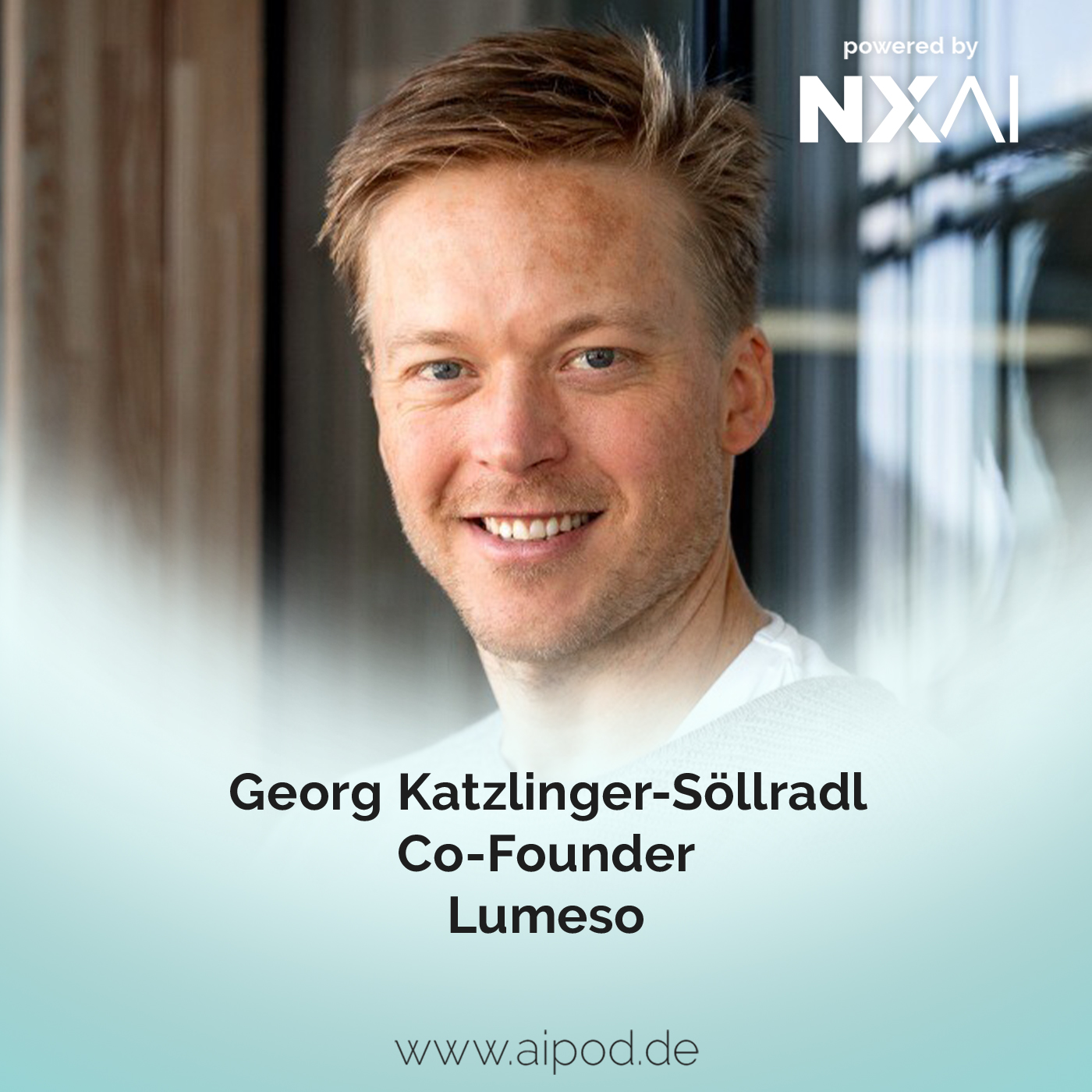
Industrial AI Podcast
AI for the Glass Industry
00:28:52
From manual chaos to smart automation—inside the future of glass industry workflows. Discover how AI is transforming custom orders.
Loading summary
Transcript95 lines
- [00:00]
A
This podcast is presented by nxai, your partner for time series, foundation models and physical AI.
- [00:19]
B
Hello everybody and welcome to a new episode of our industrial AI podcast. My name is Rod Viva and actually Agentix application LLMs or ocr. Topics are usually Peter's domain, but today we are broadening the topic and talking about a very specific industry. Very specific domain, the glass industry. My guest is Georg Katzlinger Zollrade. That's a typical Austrian name, difficult to pronounce. Welcome Georg. Welcome, George.
- [00:47]
A
Thanks for the invitation, Robert. I also want to offer it to you. Let's stick with George. Right away.
- [00:53]
B
Yeah, exactly.
- [00:53]
A
So everything else is too much of a tongue twist.
- [00:55]
B
Exactly. So once again, Katzlinger Solradel for our English listeners. Very interesting Austrian name, but we will stay with George. George, before we start talking about your approach, please introduce yourself briefly to the listeners.
- [01:10]
A
All right. Hey, my name is George and I work on an AI solution for the glass industry. We've been doing that now for the past, well, slightly over a year now and having a lot of fun in the topic as it's moving crazy fast right now.
- [01:25]
B
So what is your background?
- [01:27]
A
Well, if I go back back to university times, I'm actually more into business and mechanical engineering. Like I did industrial engineering masters at TU Wien. I then joined the company in international sales. They were producing everything a firefighter needs. Then I moved into intra logistics, doing after sales there. And now I'm in the glass industry.
- [01:50]
B
The glass industry. It's a very special industry, a very specific industry. Can you please explain a bit to our listeners? The glass industry you are focusing on?
- [02:02]
A
Absolutely. Actually I even have to narrow it more down. Robert. Okay, it's not even the glass industry, it's the flat glass.
- [02:09]
B
What is that? What is that?
- [02:11]
A
I mean, I guess glass is known to most of the listeners to this podcast. It's what you look through when you look out of the window. Pretty much the flat glass industry is focused on things around either the windows or glass doors or, I don't know, shower cabins. Like separate those glass walls that you have in your shower. Pretty much those elements where glass is more or less flat. I have to say more or less, because in a sense also the car industry could be counted into the flat glass industry, even though glass there is not perfectly flat anymore.
- [02:45]
B
Okay, so why did you choose the flat glass industry as a domain for your approach?
- [02:53]
A
I have to admit that was not your idea. Yes, okay. No, actually I joined in a bit later. The idea where it originally originated from was from Christian, Christian Kim. He was the Founder and he was the one to. He was working with a company in the industry for say 27 years, something like that. So he was able to gather a lot of experience when it came to flat glass, when it came to the industry, on how customers in this industry work. I joined a tiny bit later and actually before joining Lumeso, well, I knew glass as a consumer, but I didn't have the chance to do a deep dive on all the intricacies and specialities about glass. So that's when I started jumping into that.
- [03:46]
B
But can you explain a little bit the structure? Are we talking about big corporates or is it more mid sized companies? What are your typical customers?
- [03:57]
A
It depends a bit on the region, I have to admit. Like here in central Europe, the Dach region, there is quite a lot of companies that we can count in the small and medium enterprise area. So companies with somewhere in between 50 to 200 employees that do glass processing. There is also a few companies or quite a lot of companies below that, to be honest. But they are rather into taking this process, glass and mounting it at the customers. So the German term for it would be glaserii. The English equivalent is glaciers. We focus on this middle part. So we focus with our solution on the companies that take the huge glass as it comes from the glassworks and would take this huge glass and cut it down into smaller pieces or laminate it together to make special glass out of it, or build like this glass that goes into windows, insulated glass units. This is what we focus on, this middle step.
- [04:57]
B
Okay, so let's talk about your solution because it's all about inquiries and offers from the customer to the ERP system, right?
- [05:05]
A
Yes.
- [05:06]
B
Can you explain it doesn't sound like rocket science. It's ocr, technical drawings. Where are the pitfalls and where are the obstacles?
- [05:14]
A
Maybe if it only was Robert. If it only was.
- [05:22]
B
So it's rocket science.
- [05:24]
A
I wouldn't go that far. But say it's not an easy task.
- [05:28]
B
Okay, explain us when we start with
- [05:30]
A
it, you know, whenever you start the startup, whenever you focus on a topic, you look at it through the pink glasses, you see the problem, you have a solution in mind, you say, okay, this is what we are going for, let's do it. That can't be that difficult. And then step by step you realize the complexity. What is it that we are doing? What do we focus on? The process for most of our customers right now is that they get a lot of orders via email. This email can come in all kinds of formats with all kinds of attachments with all kind of context that is in the email itself. So when you open one of those emails and you scroll down, you'll see, I don't know, two months ago they started talking, there was quotations sent back and forth. And then finally the customer sends in the thing and says, this is what I want to order. And it's actually not that obvious what they now want to order. That's why for a lot of our customers, this is still a really, really manual process. So there is people, quite a lot of people sitting at our customers, companies that would take those orders that come in via email, they would either print them and like put the paper right next to their laptop and then go one by one, line item by line item to put them into the ERP system. Because in this process, like taking the custom order and putting it into the ERP system, they need to do quite a lot of data enrichment in that sense and data conversion. Because typically the customer who orders the glass, like imagine that you would order one of those glasses, you would write the words that you know to describe the product that you want and need. But it doesn't mean that this wording that you use is the wording that the producer actually needs to make sure that his system, his ERP system production, all the subsequent steps.
- [07:20]
B
Is it so specific what they are ordering? So it's not a catalog. They are going through a catalog and say, I want to order number wind, 1, 2, 3, 4, 5. Is it really specific products?
- [07:31]
A
Yes, it's a make to order industry.
- [07:33]
B
Okay, okay.
- [07:34]
A
So they get orders and the customers typically configure products as they need. They say, this time I need a glass that insulates a bit better. This time I need a glass that keeps more solar energy out. So has a different G value, has a different light transmission value, all those things. So it's a product that can be really configured as per the specifications of the user. Then the receiving party, our customers, they still need to add information of saying and how do we want to process it? You know, they need to assign internal material IDs, processing parameters, material parameters, all those things. They need to apply historical knowledge. They need to. And actually they do know, especially the experienced people that work at our customers who enter orders, they have all this historical context knowledge, knowing that if this customer uses this and that word, what they actually mean is they want this kind of product.
- [08:28]
B
Okay. So they're also doing a production planning stuff, right?
- [08:33]
A
Production planning, yes, in a sense. But this would already be the second step, the first step is basically to translate the customer language into what it means in their ERP system in the sense of identifying the correct IDs, like getting the build up. Right. And then the next step, after this is done, they will have to look at, okay, and when can we actually deliver it? Is this material on stock? Can we do it right now? Do we need to buy it from another supplier? Because we don't have the facilities to do the product ourselves. So a lot of complexity right now is bundled through the operator that puts the order into the system. And this is where we come in, this is where we support those clerks, those people entering the orders, because we say, you know, we can cover one step for you, one major step for you, which is to taking the input and preparing it as good as we can so your work becomes easier.
- [09:22]
B
How do you do that?
- [09:24]
A
Well, we kicked it off, I guess, like many would do. We just said, hey, cannot be that difficult. Let's write the smart prompt and let's get the input, convert it to the output in a structured way and all good. Actually, this is also what many of our customers tell us and not be that difficult, right? I mean, I take One of the PDFs that I get as an order. Yeah, well, not even ocr. They say, you know what, I just go to Claude, I go to ChatGPT, I go to wherever, and it gives me impressive results. We started in a similar way and then soon we realized, okay, if you want to do it on an industrial scale, you need to do it differently. Because actually what customers expect is deterministic outcomes, right? So they send in the order and they want to have the same result always again. And this is where I believe we can contribute and where we can make a difference. Because if you do that right now, or any, any listener can do that, ask a question to ChatGPT, Gemini, whatever, Claude, open three screens in parallel and see what the answer is. And they'll see that the answer is different three times in a row. So what we need to do and what we need to put in is to actually get this deterministic outcome. How do we do it? The difference is actually the learning part, like how we are able to add on to the base intelligence of LLMs, how we are able to create the workflow that enables the user to reduce workload.
- [10:56]
B
But how do you do that? What is technical in behind?
- [11:00]
A
I mean, I cannot give you the
- [11:01]
B
blueprint, but maybe you give us some hints.
- [11:05]
A
Yeah, I can give you, on a conceptual level, it is a multi agentic step that we apply in parts it's conventional code. Because whatever works really good in conventional code, we try to do in conventional code. Why not? When it then comes to the point where we see you cannot like easily do that in code anymore, it's actually smarter to use LLMs with calls. With we would do it in calls. What we soon realized is our prompts and how we talk to LLMs became bigger and bigger and bigger and the bigger the prompt got like, the worse the result became. So we then started splitting it. We started splitting it into multiple steps. And now with also how technology evolved over the past, especially months, that now became even a bit different in the sense that we start applying agentic systems to it, where we use skills in that sense to actually give a bit more freedom at the right point to the system so it can pull the tools and the functionality that it needs to get to a better result. That's like one path, the forward path. Equally important from our point of view, and this is now where we can make the difference, is deriving learnings from what we see that is correct from a user point of view. I believe this is an advantage actually in our setup that users are very eager and they are, they're very reliable in validating that the output is correct. Because actually what we present to the user, they edit and then they send it over to the ERP system. So our big advantage is that we get really good and accurately validated results.
- [12:48]
B
So there's still a human in the loop, right?
- [12:50]
A
Yes, yes. To be honest, right now in our setup, I don't see how that would work without the human. I'm actually convinced that in most of the AI use cases, the AI is to amplify the human and empower the human to create more productivity within the same time. I don't think that our solution necessarily forces human beings out of work. It's rather amplifying them and enabling them to work faster. I just wanted to jump back to what I said before. So having these validated results, that gives us a really, really, really good chance to derive learnings from that learnings in. I have to stay a bit high level here. Learnings in different dimensions. So it's not just, you know, one learning that will apply to all and every customer anyway, but it's the differentiation between customers regions where we can derive learnings that we can then in the next step, for the next round of order, apply this knowledge that right now sits with the operator where they say, hey, I know that when a customer writes this, they always mean that product. This is the learning that we can create. So in a way we're kind of building a dictionary, I guess.
- [14:08]
B
Yeah, or you're building an inquiry model for the flat glass industry.
- [14:13]
A
Yeah, you know, the thing is, you said the flagless industry now and we get that question also from customers. Hey, with what I do here, am I actually training the rest of the industry as well? So am I training the competitor? What we see, that's not the case because every company speaks their own language, right? Every company has their own behavioral patterns, uses their own words, uses their own information to actually get to a result. So what we do here is we basically our solution gives the framework to enable users to put this knowledge into data and to use that data to enable users to enable operators to be more productive. So actually the knowledge that we create for a certain customer of ours is not transferable to another customer because it's a dictionary that works for them and their customers, but not for anyone else.
- [15:00]
B
How accurate is your solution? Can you share some KPIs when it comes to your customer? How accurate are the results?
- [15:09]
A
First of all, I have to add though, it depends and it depends on the questions. Yeah, yeah. I mean, you sound a bit like a CEO to me, Robert.
- [15:21]
B
Like a customer CEO.
- [15:24]
A
Yeah. We also want to always have precise KPIs and precise dates and everything that's measurable and can.
- [15:31]
B
Yeah, maybe a flat class industry CEO is listening now to this episode and, and he wants to get in contact with you, George, and he wants to know now some KPIs.
- [15:42]
A
Yes. Let me give you one KPI. Let me give you two KPIs and it's. I just take one exemplary field that we are extracting. Let's take the width. You want to go for a guess first or shall I tell you right away, what do you think is the level of accuracy for width when we extract width? The width of an element like a glass in the height, how many times do you think we get width correct?
- [16:12]
B
80%.
- [16:14]
A
Okay. It's actually 99.
- [16:17]
B
99. Okay.
- [16:19]
A
Yes. And this already also includes when it's handwritten input. So. But here is some context and this is why I want to say it really depends on if the input is machine written. So if it comes in a form that can be easily extracted, there is no OCR needed or not too many conversion processes and the input file is not too large, its quality is really good, like really good. What decreases this probability is actually when there is a few factors at play that reduce quality of the input, say the document is scanned and maybe the document is tilted. This is where now models start to struggle a bit when there is handwritten annotations, when there is ambiguity in the input. So say that the party ordering an order or ordering a glass has a PDF attachment to it and then says in the email, but wait, element number two, you make a width of 1500. Because then the system needs to figure out, hey, what is the truth? Now how do I rank relevance? And this is where we go down from the 100%.
- [17:28]
B
Okay, and what's the second KPI?
- [17:31]
A
The second KPI? Which one can I give you? Let me think. I don't want to.
- [17:35]
B
Oh, you have even more. So we can go further. Yeah.
- [17:38]
A
No, no, no, no, no. I need to be careful here. What I tell you and our listeners, we also did the same analysis once for only handwritten documents. And we saw that actually we are getting closer to what you suggested before. So back then when we did the analysis and only looked at handwritten with it was somewhere in the area of 75%, 77%. And here, this is where it depends. It's really about the quality of input. Because as we all know, handwritten is not always handwritten. You might have a prettier handwriting than I do. So maybe the system will struggle less with your handwriting than it would with mine.
- [18:20]
B
Yeah. Okay. Can you explain us a little bit the implementation process at the customer side, where the big things get stuck at the beginning? What does the process looks like? Can you share a bit how difficult or how easy is it to implement the whole stuff?
- [18:38]
A
Absolutely. And I guess this is where it gets really interesting because we, I mean, we hear from Silicon Valley and from all the AI hotspots in the world all the time how cool AI is and how much benefit it gives. End. And the interesting part, what we are seeing is the reality of AI in a manufacturing setup. So our customers are typically, as I said before, somewhere in the area of 100 employees, typically in this size, there is maybe one person responsible for it, or maybe it's just half of maybe the CEO.
- [19:13]
B
Yes, in person.
- [19:15]
A
Yeah, responsible for it. So what we see is like a huge interest, we get a lot of demand and there is, we see an absolute willingness of the industry to move ahead. What sometimes a bit of a challenge is the internal availability of resources and maybe could be because it's such a niche, the ability to establish this end to end process. So to start in the email program of the customer, connect to our solution and then connect back into the ERP solution.
- [19:50]
B
But the standards APIs, or am I wrong?
- [19:54]
A
Not always APIs. In some cases we also have to go through conventional EDI import connections because there is nothing more up to date present yet. And this is, you know, in a sense this is also. It's a limitation and a chance at the same time, I believe. And what I'm seeing is that it definitely helps if the ERP supplier already has some kind of API implemented that we can easily connect to. That accelerates the process a lot. It's just not always like that yet. But we also see that the industry is headed in that way and on a higher level. I actually think it's absolutely necessary. I don't see how an ERP solution without API or like a proper API strategy can be successful in, I don't know, three to five years from now. Look at the cp, what they announced just recently. Look at Salesforce, what they are doing.
- [20:48]
B
Yeah, or Celonis or stuff. Yeah, yeah, yeah. But is it then running in the cloud, in your environment? Can you share a little bit?
- [20:57]
A
Yeah, our solution is running in the cloud we have right now for Europe. We provide data locally actually on a server in Germany. On cloud server in Germany.
- [21:06]
B
Is that a topic for your industry? Sovereignty?
- [21:10]
A
Data sovereignty. Customers from Europe definitely like to have their data in Europe. What we didn't experience yet is that customers insist on having it on prem.
- [21:21]
B
Okay.
- [21:22]
A
Actually I.
- [21:23]
B
But is it possible to run it on prem?
- [21:26]
A
Everything is possible at the end of the day. I guess it's a matter of price. Especially because we connect two powerful models in the background. And I'm not sure if any of the customers has the GPU power on prem to run all of that.
- [21:42]
B
What kind of models? Can you name the models?
- [21:45]
A
Actually, I do not want to do that, Robert. I hope you understand.
- [21:48]
B
Yeah, it's okay. It's okay.
- [21:51]
A
What I can tell you is it's a mix. It's a mix of different models of models with less parameters and models with larger parameters. Because what we also see is that cost, they should not be underestimated. You know, it's not just one call for a business case. It's actually, I think we are doing somewhere in between 20, maybe to 25 calls right now during one business case. And if you would go for the most performant models, it would also mean you'd go for the most expensive models. Then it doesn't really become a business case anymore.
- [22:22]
B
And your customers paying for the tokens or what is the business model?
- [22:26]
A
No, we translate it into a language that actually speaks to our Customers. In the beginning we thought about, okay, should we just charge customers by tokens? Because it would be like a back to back contract. What we pay is kind of what we charge our customers. We change that. We are charging customers based on how many line items run through our system because in a sense this is a degree for them to measure how much more efficient they can be. So basically they pay for reduction of workload in that sense and it's really well received. I have to admit the industry is rather familiar with conventional software pricing. I don't know receipt or you pay once and then you pay a yearly maintenance fee. We didn't receive any pushback. Actually. Customers kind of like it because they know they are going to pay if they are using it. If they're not using it, they don't pay. So it kind of, it fits their business model.
- [23:23]
B
Okay, that's good. You mentioned at the beginning that you support your customer at the first step, extracting the information from the email, from the PDF, from the Word document, from a picture, from a drawing. Is there a second step planned to help the customer to process the data now to the ERP system or to do planning or is there anything. You have a secret sauce or you have an idea what's coming next?
- [23:57]
A
Yes.
- [23:58]
B
Okay.
- [23:59]
A
We have actually great plans.
- [24:01]
B
Okay, share some ideas.
- [24:04]
A
What I'd like to talk about staying within the industry and focusing on what we do right now. What we want to cover first and we want to get right and running really, really smoothly is this first end to end process of orders. Getting orders from point A to point B from the email into the ERP system. If this can be done, if we can enable our users to become ten times more efficient with that than they are right now, this is already a huge step. What we added just recently is also we enabled them to do quotations in the same way because we got the feedback from our customers saying, cool, that works for orders. Why does it not work for quotes? We said, yeah, I guess we can do that. So we added quotes and a lot of our customers are now running quotes through Lumizo as well. So in that sense it's becoming quite a powerful sales support. And this is where we see ourselves, we see ourselves as a solution that can support customers a lot in sales. Especially with this dull work of, you know, taking a lot of data, preparing it in a certain format so it can go into an ERP system. We see ourselves as an add on, as a tool to interact with the existing ERP systems. This is where I believe we can contribute a lot. Some customers ask, hey, so you're kind of an ERP system. And I always have to clearly say, no, no, no, no, no. Okay, we are not an ERP system.
- [25:38]
B
We don't want to be an ERP system.
- [25:41]
A
We really want to connect to your existing ERP systems because we know that, you know, even thinking about becoming an ERP system and maybe being part of implementing a new ERP system, I did that in one of my previous jobs. We got SAP.
- [25:57]
B
You're a big fan of SAP, I can hear that.
- [26:00]
A
Yeah, no, I see the tool. The tool is immensely powerful, but it's a lot of work. It's, you know, like when you try to do heart surgery on a person while this person is running a marathon. That's what it kind of felt. And I prefer if we become this add on to an existing ERP system and make sure that we can support it with really good data. So for the customer, the process just becomes so much more smoothly and so much easier.
- [26:30]
B
Are they other domains comparable to the glass industry where you say, oh, this could be an interesting domain? Maybe. Same approach, same problems, same obstacles. Do you have plans to scale your solutions to other domains?
- [26:50]
A
We actually get a lot of interest from connected domains in that sense. Like, quite a few window manufacturers already approached us. For me, it's important to get one thing right before I jump into the next adventure. I think conceptually our tool can definitely do it. But, you know, step one, then step two.
- [27:14]
B
Okay, what is on your agenda in the coming weeks, George?
- [27:18]
A
In the coming weeks, customers keep asking and more of them keep asking. So I kind of need to be able to.
- [27:25]
B
You can send them the podcast now. Yeah.
- [27:28]
A
Yes. Maybe this is instead of the sales meetings that we are having. Next weeks for me are really busy, actually. I'm going to the UK next week to visit a few customers. I'm running in parallel a few demos with customers from pretty much all over Europe as well as the US because we get a lot of interest from there right now as well. And also, I didn't tell you that we have a customer in Australia already. So we're then spanning the whole world quickly and, you know, making sure that we are then actually also able to onboard those customers while at the same time keep adding functionality. What we see, and this is our big benefit, I would say as a startup, we don't have too much legacy in our backpack, so we can really quickly add new functionality based on the feedback that we get from customers. And this is what we will keep doing for the next weeks and months and maybe even years.
- [28:20]
B
George, I keep my fingers crossed for you and your team. All the best. Interesting approach. Thanks a lot. Excuse me for playing the CEO asking for KPIs, but I think your customer will like the questions. All the best. And greetings to Austria.
- [28:35]
A
Thank you very much, Robert. Talk to you soon. Bye.
- [28:37]
B
Bye.
- [28:38]
A
Bye.