← Industrial AI Podcast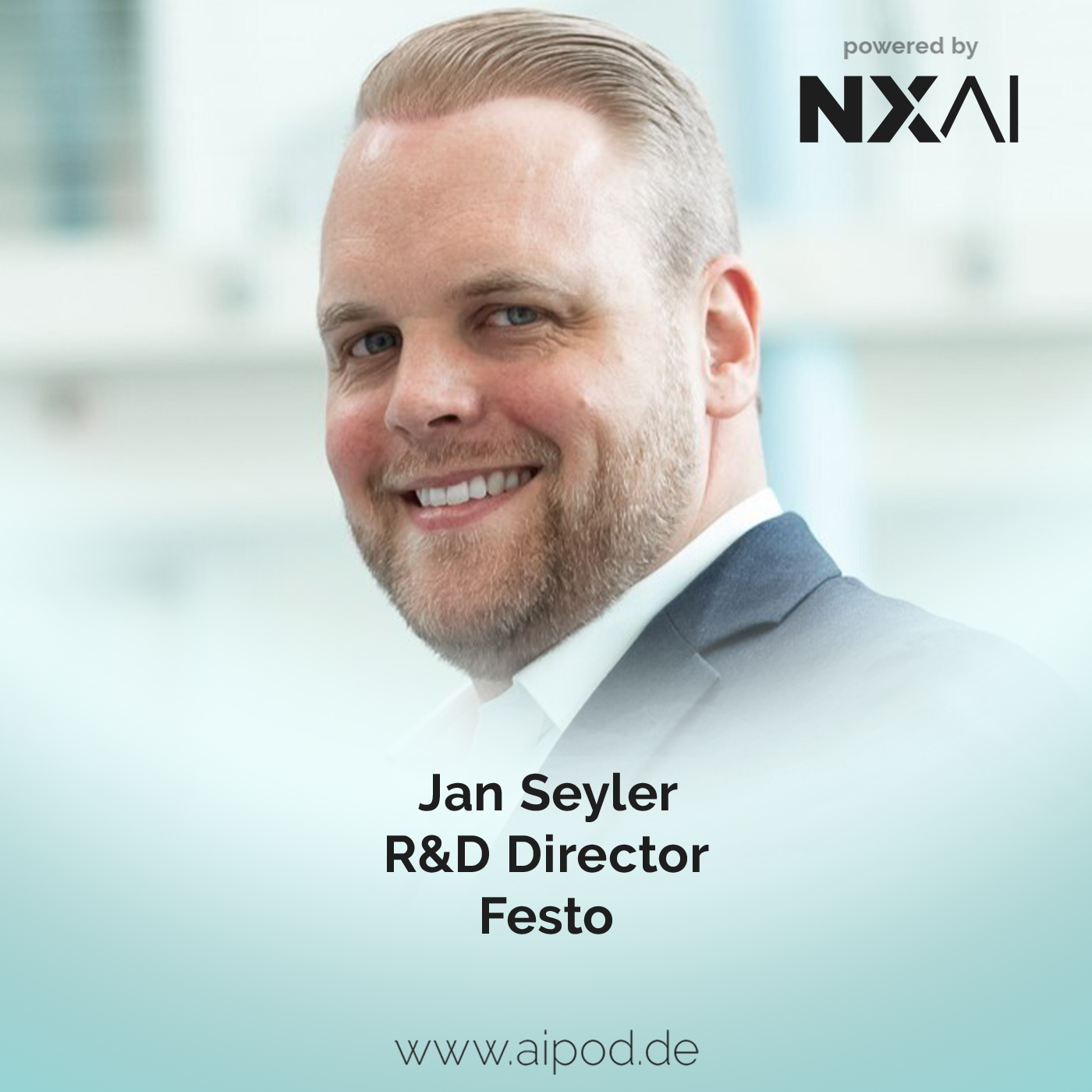
Industrial AI Podcast
From Sales to Spare Parts - Festo´s AI solutions
00:52:52
How AI is transforming every step of the industrial customer journey – from first inquiry to predictive maintenance. Discover the future with us.
Loading summary
Transcript144 lines
- [00:00]
Werner Reichelt
This podcast is presented by nxai, your partner for time series foundation models and physical AI.
- [00:19]
Robert Bieber
Hello everybody and welcome to a new episode of our Industrial AI podcast. My name is Robert Bieber and my guest today. No, it's not a guest. It's not a guest and I'm in the recording mode with our guest Peter. Peter, welcome.
- [00:34]
Peter Sieberg
What do you want me to talk about today?
- [00:36]
Robert Bieber
Robert, please introduce yourself briefly to the listeners.
- [00:41]
Peter Sieberg
Yeah, my name is Peter Sieberg, a co producer together with Robert Weber of the Industrial AI podcast. Good morning, afternoon, evening to all of you, dear listeners.
- [00:52]
Robert Bieber
Good morning, Peter. So what do you have Peter, in the newspot?
- [00:56]
Peter Sieberg
Well, the big thing is, and it's not news anymore, but maybe you and I chat about it two, three minutes. What we think the consequences may be of the United States forbidding non United States citizens. The Entropic fable Top level LLM. What's your first thought? Throw in two, three things.
- [01:17]
Robert Bieber
I have a recording today with Jakub Touk because I want to get the US perspective on the whole topic because I miss the whole US perspective on this topic topic in the European discussion. I'm not sure what's Jakob's opinion, but yeah, that's the world as it is, right? So that's geopolitics.
- [01:37]
Peter Sieberg
I did see, I do still read Andrew. Andrew did, of course. I mean he was the guy in charge of the team at Google, you know, bringing our Transformer, you know, and he's very happy and very proud of that. And so, and he was very negative, right? I mean very diplomatically negative about the complete play that they have been playing. He says, you know, it's, if you play it this way then that's what's going to happen. And of course he's very big on, on open source and he's very frustrated because you know, they didn't allow other companies, other builders to use their technology. And again, you know, he's the guy who, with our guy here from, from Germany, one of the guys of the team who brought our Transformer, you know, everybody using Transformer and these days, other technologies as well? Of course. And so he didn't like that at all. I think the big thing for me is this. Is there any CEO or any, you know, managing director of a smaller company who today now can decide that they're going to continue to use any, not just this, you know, any US based AI technology knowing that, you know, after having been doing that for a week or a month, so six months or a year, suddenly, you know, the next minute it can stop. I think that's, that's the big thing. Yeah.
- [02:59]
Robert Bieber
And it's an invitation to the Chinese models. Right. Because the Chinese are going a totally different approach. A lot of open source open weights models in the market. I see a lot of industrial companies using Deepseek in their own ecosystem. But there is a risk, especially when we talk about small and mid sized enterprises. Right. And I have not an answer yet. So we have not the capabilities here in Europe to build a model like this. We already tried this a few, but everybody failed. I don't know. There's an ongoing discussion with Mistrial that Le Grand Shot, the big fat cat. So there was a meme in the social media feeds about Le Grand Shot and I think they will show a new model or present a new model I think in a few weeks. But I don't think so that they will beat Anthropic or something like this.
- [03:54]
Peter Sieberg
But do they have to beat it like exactly now that's the question. Or is it perfectly okay to beat him half a year later or a year later? You know, isn't the quality of this one, of all the Chinese versions, and I do not know all of them, isn't that already good? 99 good enough. And it's really only the 1% or the 5% or the 10%. I don't care that that is always wanting to be using the very best that is out there. And I believe that there is very
- [04:25]
Robert Bieber
much room, especially when you talk about industrial use cases. Right. So you see the gap is getting smaller. Right. So you launch a new model and then an open source model is coming in the next four, six, seven months and the gap is getting smaller and smaller and smaller with the performance and the lead time between the leading model and then the open source model. So let's see. But I think when it comes to industrial applications you also can go. As I mentioned, I see a lot of industrial companies, big industrial automotive companies running deep SEQ models in the back and working with deep SEQ models.
- [05:03]
Peter Sieberg
Yeah, that's potentially again another vulnerability there. Right. I do very well recall. I'm not sure what has been the final decision, but it was years ago when we were using Hawaii. Is that the right way Telecoms pieces equipment that not supposed to. So that's, that's only, you know, building on them is only another potential. It's my first reaction to that. Right.
- [05:32]
Robert Bieber
But when I'm, when I visit companies, when I visit shop floors, when we have a discussion with our guys here in the podcast, I'm very surprised. I never hear anyone saying oh yes, I'm using Mistral models for this topic. That's interesting because I recorded an episode with for example with Jan Seiler from from Festo about their whole pipeline from the buying center at the customer until the spare parts and they are backed by LLM technology and it's not an a mistrial topic or something like this. So there is a potential LLM. Maybe it's not good enough. The benchmarks are not so good. But we know, everybody knows benchmarks are benchmarks and leaderboards are leaderboards. So it depends. But I don't see a lot of customers in the industrial sector using Mistrai and that's, that's interesting for me. Maybe it's had something to do with performance, maybe it has something to do with a, with a vendor lock in topic when it comes to the big US models. So it's easier to use them, it's easier to, to integrate them, et cetera, et cetera. Yeah, but that could be an interesting question. Also at AI in the Alps, why don't you use Mistrial models on your, on your devices and then we discuss
- [06:51]
Peter Sieberg
with Artemench maybe sometime or at least.
- [06:54]
Robert Bieber
Exactly.
- [06:54]
Peter Sieberg
Yeah, we're going to be going to Paris. I understand. And the, the area that you suggested, I believe Mistral is there as well. And maybe understand there is a potential that we are going to get a little bit of time from him.
- [07:05]
Robert Bieber
Exactly. Exactly. Exactly. We, we will do that in November with our guys from AI in the ops and AI on the volcano and AI in Amsterdam. So. And we will visit Paris. Exactly. So what else do you have?
- [07:18]
Peter Sieberg
Alps first volcano and then Paris.
- [07:21]
Robert Bieber
Exactly. What else?
- [07:22]
Peter Sieberg
Yeah, I have another one. I think it's, it's Federico Martelli. He seems to be making fun of humanoid startups. He says how to raise around fast. The answer is quite simple. Found a humanoid robotics startup. So I, I hear him laughing. Right. So he shares a playbook between brackets is the step one. That sounds very much like the robotics rules. That was also afterwards there was a step zero kind of have some in the field or build it between brackets. But step one is found a humanoid related startup. Number two, convince a few researchers from a famous lab. Number three, put AGI and General Purpose in the deck. Number four, invest in good CGI of one humanoid folding a shirt or walking. Step five, raise 50 million-plus without ever touching the hardware before.
- [08:11]
Robert Bieber
Yeah, that's the way to go. Now fake, fake it until you make it.
- [08:16]
Peter Sieberg
Don't, don't take this personal Dear listener, who if you and your team just did start one of the humanoids, you know, there's always the good ones and I don't say the bad ones. You know, it's everybody's good, right, to do whatever they want to do. But I think it's fair enough and we've suggested that before that with the amazing. I mean it's like when I go through my track here for hours, there's every day there's 10 you. Right. Every day there's that new. And I really hope that in the meantime there must be.
- [08:48]
Jan
I.
- [08:48]
Peter Sieberg
My best guess is around a thousand companies globally. Right. And then there's these people who make the split up and say, you know, and where's the actuators? And then they're from China but also from Germany. And then there's the. The brain is typically from the west or Silicon Valley and etc. Etc. Etc. So I hope that all of you are going to be right. Now let me see, there is one additional topic you can access. That's the Claude Founders playbook for building an AI native startup. So they share how founders are using AI at every stage right. Now of course that only works as long as you are allowed to use Claude. Right. If suddenly you're going to be cut off. Well, yeah, I need pun intended, of course. Now my personal opinion that you may have seen it a couple of times and I'm going to copy it or not copy it. Not going to share it more often but here for once, in case you want to have these humanoids work in factories. Well, in my humble opinion, scaling robots on the factory floors would mean going back to pre automation production. I was thinking of when did the automation production start? That was T Ford. T ford was what, 1901 or something? You know, you could, you could choose any color as long as it was black. You recall that one?
- [10:08]
Robert Bieber
Yeah.
- [10:09]
Peter Sieberg
With the only difference that there's going to be human humanoids standing there rather than humans. And somewhere else I've said, yeah, that's, that's only going to happen if. And then we go back another hundred years. It happens to be 100 years as well. The original story of the R U R where the word robot was invented, which is where robots get rid of people and then sure, they can decide whatever they're going to do. Right now I'm perfectly convinced that instead of the industrial robots and the industrial robots they are going to get an LLM interface or whatever, let's say AI integrated in whatever kind of form. And I'm Completely convinced that they're going to have a very, very good time and they're going to continue to scale in, in factories also and especially in countries with a low robot density. You know, like for example, United States. They want to do the.
- [11:00]
Robert Bieber
They are coming back.
- [11:01]
Jan
Yeah, sure.
- [11:01]
Peter Sieberg
So, but they're not going to do it without, I say without industrial robots. I don't see them do it with the humanoid. That's even more difficult. You know, if you need to restart your manufacturing and then restart it with humanoids. You're changing two buttons. Right? I don't see that happening.
- [11:19]
Robert Bieber
Okay, I have some news from Nvidia because you talked about robots. They presented Halos at Automate in Chicago, essentially applying the concept from the automotive industry now to robotics. And we already talked about safety and AI. And Nvidia and I have guests from Nvidia here to discuss this and they say it's the first full stack safety system for physical AI. And I will discuss this with them because I think that's what Tim Fisher told us. Nvidia is going directly into this topic. And now they presented the first concept at the, the Automate in Chicago, Halos. And that's interesting and I'm really looking forward to the episode because I don't really understand what they are doing because it's a lot of promotion, etc. But the full stack of safety systems sounds very interesting.
- [12:11]
Peter Sieberg
So when, when you talk to Tim, Tim from Sick, known for Safety, has he already shared at that time that they are going to be building on top of that stack? Or is that, I mean, is that an opportunity for them?
- [12:26]
Robert Bieber
No, it's a, it's a competitor stack.
- [12:28]
Peter Sieberg
Yeah, yeah, good answer. No, no, but it's, it's, it was really an honest question. I didn't, it's like, because you know, if there is a company like Sick who's been in this market for, I don't know, 50 years, probably, maybe even longer, all these typical hidden champions that nobody has ever heard of unless you know them. And then there's. They are Suddenly like whatever 2 billion companies that is no meaning anymore these days. But it has been at some point in time. Okay, good. Well then looking forward to hear from what you're going to be learning more there.
- [13:00]
Robert Bieber
Yeah, I' really looking forward to it. They were very open to discuss this topic. I really liked it. And I will invite Ricardo Mariani, he's a responsible guy for this topic at Nvidia and he's a, he's a professor I think, in, in Italy and let's see what we will get out of this episode because it sounds very interesting.
- [13:21]
Peter Sieberg
I stay with startups for a moment from a guy named Jeff, Jeff Bezos. What? Prometheus. Prometheus. Prometheus. And he said it's an artificial general engineer for designing, testing, simulating, you know, whatever the engineer does, building, designing, engines, spaying, scarf, all the things that you, dear listener do in your normal work. And he says the idea that you might build a set of tools that can actually do the engineering, you know, that sounds again very much like what I before mentioned. Claude Code founders book. Right. And he says an artificial general engineer. The dream we've had, he says for decades now. Who of you listeners then and asking you as well, Robert is going to be hearing from Prometheus. I mean where is what disruption going to take place? You know, if it's going to be sitting somewhere in the center of whatever the engineer does. Design, simulation, sourcing production and all the good things an engineer does from morning to late afternoon. Computer, edit, design, plm. So there's at least companies like Autodesk, Deso, Siemens, Altair, Rockwell, Honeywell and the thousand 10 to 100,000 of the smaller ones of which you are listening. So what is, what is your feeling there? Do you have another thought? Have you been thinking about what is going to happen? Is he going to be doing everything himself? If. Is he going to be buying?
- [14:58]
Robert Bieber
He's on shopping tour. Yeah, he's doing it. Yes, yes, yes. He has a lot of money. I don't know but he has a lot of money in the back. Billions of euros and billion of euros. And I think the really the idea is to build really a big company and I know some guys from JKU Linz working for Prometheus already.
- [15:22]
Peter Sieberg
Oh really?
- [15:23]
Robert Bieber
Yes.
- [15:25]
Peter Sieberg
When you say jku, it's from the university jku.
- [15:28]
Robert Bieber
University of Linz. Yes. He hired them for example, Benedict, he's a very smart guy. He worked for NXAI and then he worked quite a time for Emmy and then he went to Prometheus and he was one of the best students at jku. So he's hiring people, he's buying companies. And you are right. What also Boris told us engineering simulation software topics. PLM software topics are highly in the main focus, I would say. Yeah.
- [16:01]
Peter Sieberg
Is it the software he's interested in or is he really buying data? Are we going to go back to, you know, we started seven years ago and from, from day one or from day two we talked about industrial data. Right?
- [16:14]
Robert Bieber
Exactly.
- [16:14]
Peter Sieberg
And it's huge Topic and again this morning I saw it. Everybody's starting to understand that what happened, you know what Sam and his team, including then today's anthropic guy, what's his name, three years ago, really started five, four years ago and scraping the Internet and nobody knew it at that time that they were doing it. Now with industrial, you can't scrape. So that's why we, you listeners, you know, we, the complete industrial automation community, both providers as well as users, sit on the biggest mountain of data you can, you can ever imagine, you know, since whatever, 50 years that we've been gathering the data. But we did do it for a passive reason, just that if there was a problem somewhere in the field we could go back and look. That's all that we did from the beginning. Nevertheless, that's an amazing mountain. You can't give a number to it. And my feeling would almost be like that's, that's what is buying or must buy. Like all the other companies want to do something, need to buy, because you can't really, you can start building and some of them even do. I think it isn't. They have a gym, I believe. Right. I came from a gym this morning. You see, I didn't see robots sitting there, but that's maybe the other way and I'm not saying that's not a good way, but I think the general way for any other automation company want to do something in industrial AI, you can't do it without the data, right?
- [17:45]
Robert Bieber
Exactly. And in the moment you have a very interesting discussion. When it comes to Germany, for example, we have a lot of automotive supplier got bankrupt, etc. And it's very easy and it's very cheap to buy them. And normally you buy the chairs and the desk and the old machines, but there are companies that are not interested in old chairs and old machines, they are interested in old servers. Right. And so. Yeah, and old data. Exactly. And so they are really. I'm not telling that Prometheus is doing it, but there are companies outside that look exactly. Which companies got bankrupt and then they buy the data there and then they buy the old servers and the old PCs, Etc.
- [18:30]
Peter Sieberg
Yeah, very smart. Are you going to be talking to Jakub? Say hello from me. Yakub, Just one thing, I don't think that's your topic, but he says, what if AI could write the code but you could still drive? And he says ever since Vibe coding became a thing, he had this problem. He wanted to have more control and he built this thing. 5 Prompter maybe you're going to go into details. I just want to share that. I think it's an amazing thing because I think this approach could mean also for the non coders to tell the AI what they want, you know, in a structured fashion. And if it is like, you know, today sketching a process, you know, you can talk to the LLM interface and then maybe on the other side, whatever sits there, LLM understands you. Or maybe then there is a way. And if this is the way that Jakub found out, I thought it was very interesting even, or more so even for the non coders than the coders. Although Jakub is saying for him when he's coding, it's a very useful thing to do.
- [19:35]
Robert Bieber
Perfect. I will ask him.
- [19:37]
Peter Sieberg
Final thing. I have, I have many more things, but we do that next time is another word. Loops. Last time we talked about harness and when we had talked about harness, you recall, we also talked with Boris about harness. Oh, and by the way, I had a small story. And on the weekend again, there was a brewers day in Munich. Oh yeah. And this friend of ours, he thought, oh, whatever you're going to ask in the world, what is Munich to you? People say beer or Oktoberfest. Yeah, that was what it's all about. But then we have these, we call them cold blood huge horses. And they always have these cards right where the beer is on. And then I was standing with one of those horses, some of you may have been as tourists to Munich and seen them. They're wonderful. And then they have this harness on their head. And I was talking to a friend of mine who does something with, with steel. And he was explaining me what was around now idea being that, you know, the human is showing the horse to go left and right. But this time I was going to share the next word, loop. And the loop is introduced, I understand, by Boris Charney Czerny. He's the creator of Claude Code. And he said, I don't prompt Claude anymore. My job is to write loops. Now from my feeling, it's just like a higher level of telling the agent, the ll agent, whatever your interface is, to give it a goal at a higher level. Right. Rather than a single problem. So what I typically do, I must say I'm very easygoing guy. I typically do still the prompts. You know, I don't do the big things. But I strongly suggest each of you that are a little bit younger than myself to go into the next stage and always keep on using AI at the highest possible level. My feeling is It's a little bit like, I'm a little bit rusty in coding, but there is if then statements, right? If a value is not bigger than the certain value, then. And you keep on having a loop maybe a thousand times every second. If the temperature stays below 25 degrees, everything is okay. And it feels like that's a loop, but then at a higher level. And that's what they call loops these days.
- [21:49]
Robert Bieber
Perfect. That's interesting. That's interesting.
- [21:51]
Peter Sieberg
There is new jobs. Well, I don't believe that really. I mean, certain things, I don't think there's going to be a loop engineer or whatever, but there are certain ways of doing things and everybody's learning from each other. As long as we are open, open source kind of thing, we. We learn from each other. So I think there's certain terminologies that, that we see. And if there is, you know, coming new jobs out of it, like we said, the harness engineering, that's good. But at some point in time it's going to be integrated in, you know. What are you doing? Well, I work in AI. What do you do? Yeah, DevOps engineer.
- [22:25]
Robert Bieber
Loop engineer.
- [22:26]
Peter Sieberg
Yeah. That could be. Could be.
- [22:29]
Robert Bieber
Perfect.
- [22:30]
Peter Sieberg
I think that's it for the moment. From my side.
- [22:33]
Robert Bieber
Perfect. Let's move to the main part and we will prepare each other for the AI in the ops. Because next week it's AI in the ops. I'm really looking forward to meet you again, Peter.
- [22:44]
Peter Sieberg
Me as well. I hope the. Maybe we are lucky. And the temperatures here are the same. Which means if. If we go up in the mountains, they're a little bit exact.
- [22:55]
Robert Bieber
It's always like this. It's always like this. Yeah. Perfect. Peter, it was a pleasure. Thank you very much.
- [23:00]
Peter Sieberg
Thanks, Robert. Bye bye. Have a good day.
- [23:02]
Robert Bieber
Bye bye. Hello everybody and welcome. Today I have two guests, Jan and Werner. Welcome to the podcast. Jan. Hi.
- [23:12]
Jan
Great to be here again.
- [23:13]
Robert Bieber
Hi. And Werner, welcome to the podcast.
- [23:16]
Werner Reichelt
Thank you for the invitation.
- [23:18]
Robert Bieber
Hi. Yes. Jan, you have been our guest before. Back then the gen AI was just starting. Welcome back. Before we start talking about your projects at Festo, please introduce yourself briefly. Werner.
- [23:33]
Jan
Yeah.
- [23:33]
Werner Reichelt
My name is Werner Reichelt. 36 years now in the company Festo in the field of automation technology. And since five years now responsible for the global sales and business development of our software solutions. So I'm responsible for the complete go to market approach of Festo.
- [23:54]
Robert Bieber
You are responsible for making money and Jan is responsible for spending money. Is that right, Jan?
- [24:00]
Werner Reichelt
Yes.
- [24:00]
Jan
We are a cost center. I am heading our department for AI and Control theory here in Festo research and innovation. And we are customer facing. So we are developing solutions that actually should help our customer in the future.
- [24:14]
Robert Bieber
Okay. And we met at an event a few weeks ago and I really enjoyed your presentation because you met managed to integrate the topic of AI throughout the entire customer journey, from the initial inquiry all the way to the replacement part to spare part. Could you please explain us what you did and how you did it, Jan?
- [24:38]
Jan
Yeah, so we have been seeing since a while already that how online sales and also the customer approaches becomes. Especially for companies like Festo that have like many, many parts, like more than 40,000 parts in the catalog. And then you have the combinations, you have all the spare parts. And so it gets very complicated. And for single sales engineers, and also gets extremely complicated to understand all of this and to sell all of this. And then you additionally have software solutions like the ones from Werner, and it gets really complicated. So we focused on how can we from the customer idea, from the customer pain, describing that get to the solution and then even help while the system is running. So from the customer saying, I want to move a box of AA batteries for one meter. And then you ask questions back, how fast should that be, how high? Whatever, you can ask all of these questions, but you can also include world knowledge from things like an LLM that knows how much one AA battery is and that the box is made out of carbon. And then you can choose precisely the right components and combination of components such that the customer actually gets quickly to a solution. So the time to the solution to the offer is reduced drastically. And then afterwards, when the customer buys, of course, we then have things like predictive maintenance. We have the customer to actually get the right parts at the right time and have a very smooth experience. But in the end, our goal is to reduce the time to customer solution drastically.
- [26:16]
Robert Bieber
So imagine I'm a customer and when I have an inquiry to Festo. So the first touch point is now an AI or what is it?
- [26:25]
Jan
So the first touch point is our website. Sometimes it's also the sales engineer, but if you don't have a dedicated sales engineer, the first touch point would be our website. And there you quickly can go into our virtual assistant. And the virtual assistant can help you with Festo inquiries, be it I want to buy a new product or I have problems with the Festo product. Can you help me with that?
- [26:49]
Robert Bieber
And then it's a traditional LLM technology or am I wrong? Or is it a rag approach or how you did it?
- [26:55]
Jan
Yeah, so it's based on LLMs, of course, it's a rack based solution. We put all of our documentation, our public documentation that we already have into a RAC pipeline. We also added some additional knowledge that we have from our application engineers and from how we used to sell or how we still sell products to the customers and put this together into the back end of this assistant.
- [27:20]
Robert Bieber
Okay. And Werner, how reliable is that? How satisfying is that for the customer?
- [27:26]
Werner Reichelt
I would say in a scale from. From 0 to 10, I would say 8.
- [27:30]
Robert Bieber
8. Wow.
- [27:31]
Werner Reichelt
Because what we did already in the past without LLM was already that we provided to the customer little software tools where they could analyze the product whether it fits correctly to their application or whatever. So these have been single isolated little software tools, for example to dimensioning a cylinder in the right way and so on. And now with LLM we go the end in the next steps. That means LLM is in the background using these tools. And so far the need and the benefit for the customers is even higher because they do not have to jump into various software tools so they can just chat with an LLM and doing the right thing. But I wanted to add also a little bit the outlook because in the future it's not only that we help our customers in finding the right product in our huge catalog. We want to go a step deeper and say, okay, about AI agents, structures. We help him even to optimize his complete production facility. Also going down at the end to digital twin solutions to say, okay, how can he optimize the complete process, not only finding out the right product, but that's an outlook to the future. We will see what happens.
- [28:44]
Robert Bieber
We will talk about the outlook, I think in 20 minutes. Let's keep it.
- [28:47]
Werner Reichelt
Sorry.
- [28:49]
Robert Bieber
You're more than welcome. You want to end the podcast now or you still want
- [28:55]
Werner Reichelt
I hiring the podcast completely now?
- [28:58]
Robert Bieber
Exactly. Jan, you want to add something? Yes.
- [29:00]
Jan
So I just wanted to add that because we already have this long experience in the engineering tools and we use those in this multi agent platform, we can actually be sure that the outcome is right. So this is very important, especially for sizing what you want to find the right motor or you want to find your right pneumatic components, just guess out of like thin air, you actually have to do calculations, you have to do like a proper engineering. And because we use established and for a long time established engineering tools here, we can be very certain that we don't have any hallucinations there, but we have like technically grounded answers that we can give to the customer.
- [29:39]
Robert Bieber
Yeah, that was my Question. Because how do you manage to combine the powerful LLM technology with your engineering tools, with your engineering domain specific knowledge?
- [29:50]
Jan
Yeah. So as I said, we built this architecture.
- [29:53]
Robert Bieber
It's a knowledge graph. Am I wrong?
- [29:55]
Jan
Well, we have a knowledge graph in the background. So this has been there for quite a while to do combination of our components. Which component fits to which other component and why does it fit together? This is a knowledge graph that we have running in the background for this combination. Combinatory logic. And then now we basically have an orchestrator agent and we have the chat front end where the customer can say what they want. And then the orchestrator agent picks the right engineering tools. They infer from the input. Okay, now I need electric sizing, I need dramatic sizing, I need gripper sizing, O ring sizing, whatever. We have all of these sizing tools and as Werner said before they were on a page. You had like 50 different engineering tools and you had to select the right one. And now we have like a smart orchestration to pick the right ones and then the answer comes back and then we just display that and we even link the answer back to the tool itself. So you can jump into the tool and you can change parameters if you want.
- [30:53]
Robert Bieber
Before we start recording, Jan, we talked a little bit about Mistral and LLM technology in general. What kind of model do you use there?
- [31:02]
Jan
We are still using a GPD model, but we are kind of agnostic, so we can change the model. What we do extensively internally is test the quality of the models because we cannot just change the model and then the answers are not correct anymore. So we have to have a test set and let's say proven customer conversations that we already have or what we have from a sales perspective, this was the requirement and this is what in the end proposed as an offer, as a test set. So this is not part of direct process, this is not part of a customer facing, but we use this internally to validate, continuously validate the quality of different models such that we can switch quickly. So we're not vendor. There's no vendor lock in there.
- [31:49]
Robert Bieber
So imagine I'm now the customer, I found my cylinder and now I want to go further. Is it still an AI driven process
- [31:57]
Werner Reichelt
now, Werner, yes or no? I would say if the customer has then chosen the right product, the next step in the customer journey is crucial. That means he wants to simulate whether this product is the right one for his application. So we are now speaking about the phase of the final target of a digital twin solution and virtual commissioning. So the Full use of AI will become beneficial for the customer. If the full journey for the full machine is digitalized, that means he is simulating whether the machine is running later on correctly and then he is virtually commissioning and even programming. And there are some topics like coding agents coming into place in so far via the whole customer journey. We speak about AI driven tools, but the basis to use them is the complete from an automation market point of view, the complete implementation of digital twin for our customers in the machine building world. And that's the crucial part which I pointed out also in our presentation. This is still a jungle. This is still a little bit of topic where we say okay, it would have been nice if every component supplier in the whole world like Festo has all its products completely digitalized then.
- [33:21]
Robert Bieber
But this is the goal. Or am I wrong?
- [33:23]
Werner Reichelt
This is the goal. Of course this is the goal. But this is a huge, this is a huge challenge for the whole automation market because we have thousands and ten thousands of component suppliers all over the world and hundred thousands of machine builders. And so far this will take some time. Faceto is on a good way here, but everybody has to do its homework. Let's say it like this.
- [33:43]
Robert Bieber
That's interesting that you are combining the topic digital twin with a sales approach. Because looking back five years when the whole topic digital twin starts, it was always let's use the digital twin to get a better performance during the production. And now you are talking about using the digital twin in the sales process. That's surprising for me and to add
- [34:07]
Werner Reichelt
on this, that's correct. But sales process for us as a component supplier, but mainly for the sales process of a machine builder because at the end it's the crucial topic is time to market. That means a machine builder who is using Digital twins is first of all able to bring his machine faster to his end customer and get the money for it than in the past. And that's the crucial competitive advantage than against also our friends the Asian market, who are much more faster than us.
- [34:40]
Robert Bieber
Do we underestimated this topic a bit?
- [34:43]
Werner Reichelt
I think so, yes, I think so, absolutely. Because we always look to the oee, the overall equipment efficiency topic in production. But we forgot that machines have to be built first before they can produce. Because if they are ready to produce, the construction phase and the design phase of a machine is already open. But this is the big problem against the Chinese competitors, that machine builders in Europe and Germany are too slow in implementing their machines and bringing them to the market.
- [35:15]
Robert Bieber
Jan, coming back to the customer, Robert. So now I Decided the cylinder. Can you describe a little more the process, what's happening now?
- [35:23]
Jan
If you decided what you want to buy it in, you would need to generate an offer. And at the moment there, the customer journey as it is implemented would lead you to our Fox website, where you then can start to order and you have a bill of material and then you can basically buy it. And then as Werner said, the goal would be to actually take all the knowledge that you have from engineering, save it somewhere and include it into your project. This is not yet there, this is a vision. So at the moment there is a bit of a breaking point. You have all of this deciding what you want to put and then, then you buy it and then you get it delivered and you have to mount it. But then all the setting up and set up in minutes start. So this is another goal that we do in the customer journey, where we then also again use AI. For example, if it's not a cylinder, but an electric axis, you need to program it, you need to find the right control parameters. And there we have many little helpers included either in our tools like the Festa automation suite, or included in the component itself, such that they can auto tune to the rest of the environment. Because as a component supplier, we often don't know how our components are used. The customer buys it and then they put it in some machine somewhere. Sometimes we know it, very often we don't know it. And then it still has to work, it has to work reliable, it has to be set up as easy as possible. So we need all of these little tweaking and auto tuning models that help the customer to find the optimal performance for its use case.
- [36:59]
Robert Bieber
How do you do that? Can you give me an example about this auto tune model?
- [37:04]
Jan
Yeah. So one example for auto tuning, which we already have today, is if you buy a Festo motor, but you already have an other supplier axis and you want to optimize the parameters of that motor such that the axis moves smoothly and as you want, as fast as possible, path planning works. And so there are some parameters from the axis that we don't know, friction, we don't know the exact size of it. And so many things, if you just connect the motor is a mechanical connection, but there is not like no data connection. So we have to identify those parameters while the system is set up. And this is one example, we call it auto tuning. But the idea here is you have a faster motor but some external axis, you connect them, then you make like a training run, very simple training run. You identify the important parameters like your friction, your mask.
- [37:55]
Robert Bieber
So in context learning.
- [37:56]
Jan
Exactly. And then, and then you tune the control parameters of your motor such that you have an optimal movement.
- [38:04]
Robert Bieber
Okay, okay, that's interesting. When I have now a problem, when I need the spare part, I'm coming back to the AI. Or is it a typical service approach?
- [38:12]
Jan
Then there we have a hybrid approach. So there are two parts tasks that you can do. You can go back to the AI and say, I have a problem setting up, can you help me? And then it would again do the reg process. It would look into our documentation and point out the correct things for you to do. Either help you with the setup or if you say I don't know this LED blinks, what does this mean? And then it says, ah, this actually means that your can pull up does not work or something like that. So it links it.
- [38:36]
Robert Bieber
But this, this sounds not like rocket science. But it's still not solved very well. Or am I wrong? Yeah, because everybody is talking about this use case, right?
- [38:45]
Jan
I think we solved it pretty well. So we give out the answer together with sources and you can read where we found that information and then we have documentation together with our typical Q and A that we already had for typical customer questions. And I think this is actually the strongest use case of the virtual assistant today is this technical support and helping people when they have the components to
- [39:10]
Robert Bieber
operate them correctly, what else is possible? Werner, let's talk a little bit about your outlook when it comes to spare parts, when it comes to prediction, when it comes to predictive maintenance, still not solved from my point of view. What else do you think is coming to the Festo components?
- [39:29]
Werner Reichelt
Coming back to this topic, Digital Twin, it's mainly the topic of Digital Product Passport, which also has a legal background. And at the end, because you as a company component supplier, you have to declare 100% where does your spare part or where are your components coming from? So the whole value chain have to be declared. In so far, the Digital Twin sub model, which is called Digital Product Passport is at the end the crucial evolutionary step also for us, because we are able then to link our customers closer to us because from our component they get then all the information so that they do not just say, okay, I take this spare part from another supplier because they are faster at delivery or whatever. So at the end the Digital Product Passport gives also the chance to inform our customers proactively, for example about phase out of a product or technical new features coming with the product. And in so far this is a next step in customer binding I would say to using AI and digital twin for that.
- [40:32]
Robert Bieber
Jan, coming back to the AI topic prediction not solved yet or am I wrong?
- [40:38]
Jan
Well, there are very strong prediction models for predictive maintenance remaining useful. Life is still active research so there are some approaches but none that's established as like the one approach that works for everything. So there are definitely things to do. I think what what we are have been even before the age gen Dig and gen AI hype been pretty good in is predictor health stage Right. To say how good is this component still is something going wrong or is it looking normal like this anomaly detection but actually making good predictions and saying okay this in three weeks or in
- [41:17]
Robert Bieber
like 50 so making an NMLE detection on the forecast. Right?
- [41:21]
Jan
Yeah so that is still open. Yeah, this is interesting research work that we're working on.
- [41:26]
Robert Bieber
Okay, I want to come back because we already discussed this topic. What about KPIs about your customers AI driven customer journey. Can you share some KPIs Jan?
- [41:40]
Jan
Yes, sure. So one is how often do customers come back? If a customer uses the virtual assistant, does it come back to the virtual assistant? And there we have a return rate of 87%. So most of the customers that use the virtual assistant come back to it. So we assume that they found it useful. Of course there is the typical you can make thumbs up if this answer is useful mechanism. But very rarely people use that. Basically nobody uses that. So we have to assume a bit. If they come back they probably found it useful. And then the next step of course is from the answers that were generated. Did this actually lead to sales? This also looks promising but it is not yet completely there I would say so there we still have to improve. There are people that actually jump to it but but very rarely somebody from this solution directly jumps to I buy this. So typically you use this as a first like this is a good idea. But then try to get in call the sales engineer. Exactly. Then you get in contact with the sales engineer and they say okay, this is what I got. Can you improve it? Can you improve upon it? So there is still some room for improvement.
- [42:50]
Robert Bieber
Werner, you want to add something in sales.
- [42:53]
Werner Reichelt
The KPIs of course are very very simple. At the end it's turnover but good KPI to measure whether our journey is working is for example the turn rate from quotation to order. That means if we complete the process in an early stage and sending then the customer a quotation for the product he has selected or he wants to buy, then we can follow up this quotation also AI driven by the way, and say, okay, did he really order based on that quotation or not? And so far we can make your feedback loop. Then back to the customer's behavior.
- [43:29]
Robert Bieber
Jan mentioned the sales engineer and it's not all about technical issues, but also about the organization. Werner and I know sales engineers in the Automation business since 15 years and they are not so keen to sell digital products, software products. How did you get your people in the different departments on board on this AI driven approach then we have to
- [43:55]
Werner Reichelt
distinguish between business we are doing on a project oriented basis and business we are doing on a standardized basis. That means our principal approach is to sell software solutions like hardware solutions means a complete capsulated solution which has a part number and can be sold like a piece of cylinder or a piece of valve. In so far this is the one approach to come into a scaling business approach approach. On the other hand side, the digitalization market is still very much dominated by projects and trial and error projects on customer side and they want to try a little bit there. So our sales engineers and application engineers have to be trained systematically to handle such projects and that's a challenge in training them regularly in software solutions in data science, applications and whatever. But this is also, also ongoing. But we definitely do.
- [44:48]
Robert Bieber
They see the benefits, right?
- [44:50]
Werner Reichelt
They see the benefits of course. But at the end, coming back to our original business model is we are selling many, many components to many, many customers. So we see first of all as a software, as a part of our overall offer in the automation market, software is nothing else than a piece of tube. So that's the principal approach, otherwise we do not come into quantity. But on the other hand side we earn our money and in future also we will earn our money by selling hardware. So selling software is only serving the hardware sales more or less because the majority part of our turnover is done by hardware sales.
- [45:29]
Jan
Of course.
- [45:31]
Robert Bieber
Let's have a quick outlook. What is on your AI agenda, Jan,
- [45:36]
Jan
in terms of customer journey or in general?
- [45:38]
Robert Bieber
Yeah, customer journey. And then in general, okay, both.
- [45:42]
Jan
So for customer journey we are enlarging this multi agent framework so we're adding more engineering tools. We will also look into cross technological engineering tools. In the past we had like one for pneumatic and then one for electric and you can kind of cross reference them, but the calculations are still done separately. And as Festo is looking into to offering really seamless automation over all technologies, we need more of this cross technology engineering tools and then also looking into the components. This is then for the Troubleshooting that we said, like read out error codes, automatically derive tasks that can be done from that, and then maybe even make automatic maintenance tasks and put them in things like our smartenance tool. So you can automatically schedule your maintenance workers and say, okay, here, this is in your error code. You should exchange this at this spare part. And in general, in general, we are looking into making our components even better. So adding AI features in more of our components. VTUX will start very soon with the first AI features. Inside we have smart pressure control, we will have N position detection, we have system identification. And all of this to make a again the usage of our components easier. And what Werner said in the very beginning to make it possible that the whole system can optimize itself so that they can talk to each other and see, okay, here I have too much load or I could even move faster and things like that. And add that in the components, using our component knowledge to really embed it in the firmware and make our components even more useful for the customers.
- [47:30]
Robert Bieber
And for that you need standard application, standard APIs for the machine builders, Werner, or am I wrong?
- [47:36]
Werner Reichelt
Yeah, that's a crucial point. So as I said before, the problem is that a machine consists of festo components.
- [47:44]
Robert Bieber
Exactly. That's a dream.
- [47:45]
Werner Reichelt
Exactly. That would be the dream of every sales engineer. But at the end, several hundred component suppliers forming a complete machine. And the problem of the digital twin approach, which is the basis for all that. But also Jan pointed out, the problem is that a component from us cannot communicate with a component from somebody else if there are no standards. That means how is a simulation tool working with the other simulation model from another supplier? In other words, it's not a LEGO system. So the putting together of five simulation models will not form the simulation model of the entire machine. Okay, and that's still the big problem. So they have not the same language. As long as we are in our internal world festival world, that's easy. And this we will do. And we are for sure on a good way. But the machine builder has no benefit out of it if we doing our homework completely.
- [48:45]
Robert Bieber
Exactly.
- [48:45]
Werner Reichelt
And another component supplier is not doing so the workload is again on his shoulders, as it is today already. And so far it will take some time until this.
- [48:55]
Robert Bieber
So you need to enable the machine builders to use AI.
- [48:58]
Werner Reichelt
Yes, they do already use AI. But AI is only so clever as the data is coming from the single components, from the digital twins, from the sub models like the digital product Passport and so on. And then the AI can handle this data but if these data are in a different format or if they are not following strictly, e.g. a E class parameterization or whatever, then it's very, very difficult to put it just together. 5 or 10 or 100 different sub models and getting out the machine by mouse click. So that's not possible. So there is always a high workload on the machine builder size to use AI because the models do not speak with each other the right language. And that's at the moment the crucial part.
- [49:43]
Jan
Part.
- [49:44]
Robert Bieber
What is on your AI agenda from a sales perspective? Werner?
- [49:49]
Werner Reichelt
Yeah, we are working with AI also in different areas, also to train, for example our sales engineers. So we have done AI driven avatar solutions to train our sales engineers for different sales situations, different partners. So such things are running. Then we are using AI also in terms of marketing and preparation of our markets, analyzing the whole, let's say, user traffic on our homepage and bringing all these things together there we are doing a lot already. But also here the same problem. The last meter to close the deal is always the most important one. And they are still. Thanks God. Humans are crucial part.
- [50:34]
Robert Bieber
They want to negotiations with Festo.
- [50:37]
Werner Reichelt
Exactly. So if two AI agents are negotiating our products, that would be nice, but I think it will never happen.
- [50:47]
Robert Bieber
Okay, Jan, looking back last four to six weeks, what fascinated you when it comes to AI? What was something you said? Oh, this is interesting. I should share this tool or this idea.
- [51:02]
Jan
Okay, so four to six weeks, I think, of course everybody is looking into how scaffolding is evolving and all the new skills around it. So I think this is fascinating. But my personal interest is very deeply into differentiable simulations. See that this has been growing slowly but steadily. And if we look why AI is so successful that it is today, it boils down largely to that it is differentiable. So you can optimize over it, you can do back propagation over it. And if we use that logic in other fields like simulation, you can use that success maybe in other things like developing components or developing your solution or your control parameters. So this is something that my interest lies in very big. And then of course, T Rex was also very nice surprise to have the new release and pushing the time series a bit forward, because this is a big modality that we have in industry and I like that also very much.
- [52:07]
Robert Bieber
I keep my fingers crossed for you and your sales process. Very interesting. It's interesting what happened since two years we had the last recording. Jan, it was a pleasure to talk to you again. And it was really a pleasure to add, Werner, because. Because he is the guy who needs to sell all the stuff you are developing. And he's the proof at the end that the customer is happy. And thanks a lot, guys. It was a pleasure to talk to you. All the best. Keep our fingers crossed for Festo and your component. Thanks a lot.
- [52:37]
Werner Reichelt
Thank you.