← Industrial AI Podcast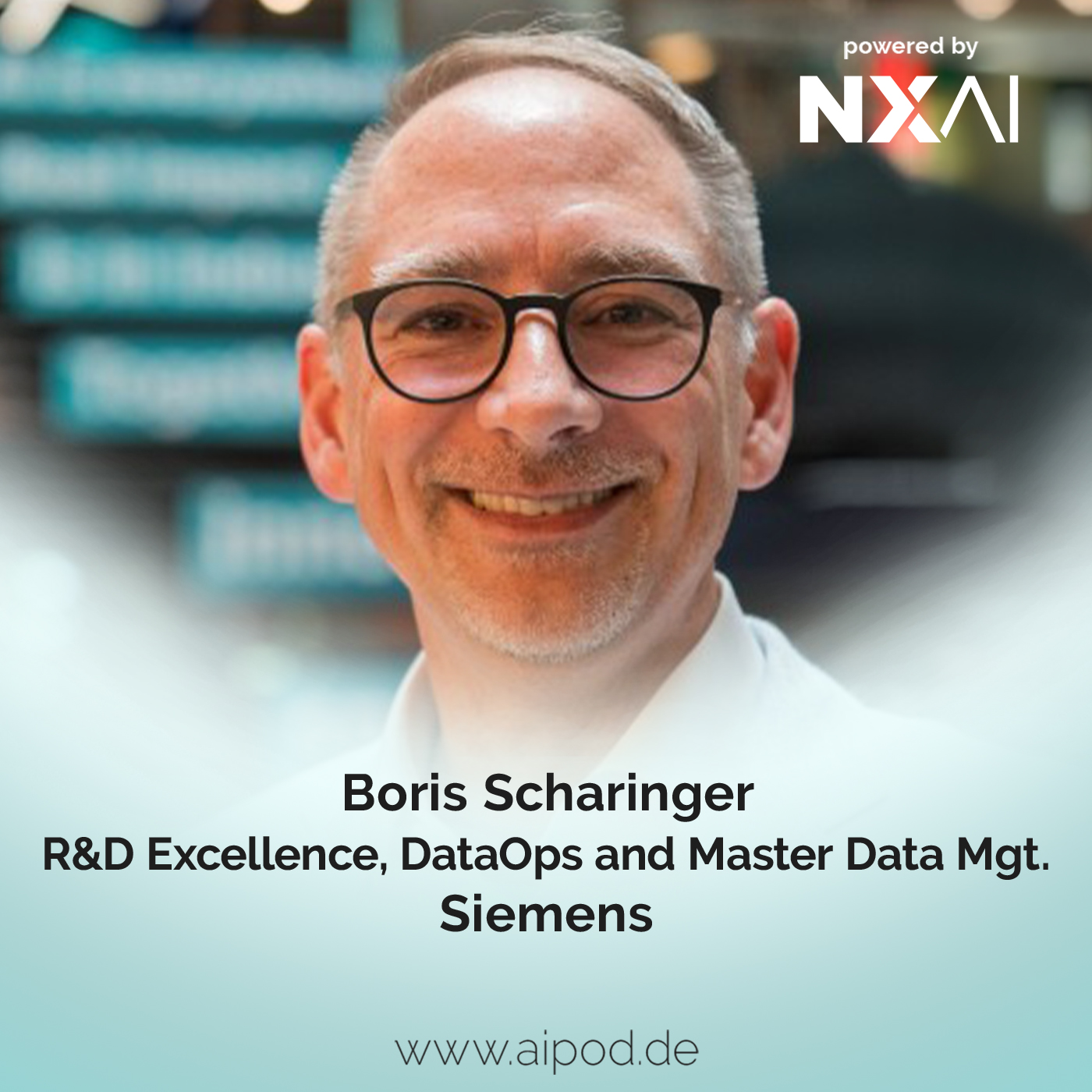
Industrial AI Podcast
Industrial AI: From Pilot to Profit
00:44:10
Meet Boris Scharinger and explore the real-world journey of AI in industry. Why expectations must meet reality for true transformation.
Loading summary
Transcript88 lines
- [00:00]
A
This podcast is presented by nxai, your partner for time series, foundation models and physical AI.
- [00:20]
B
Hello everybody and welcome to a new episode of our Industrial AI podcast. And this is a very special podcast. My name is Roald Weber and one of our biggest fans, biggest supporters, reporter from day one, Boris Schringer is our guest. Boris, welcome to the podcast. Yay.
- [00:38]
A
Thanks for having me. I'm so glad to be here.
- [00:40]
B
And I'm happy to welcome also my co host, Peter Sieberg. Peter, welcome to the podcast.
- [00:46]
C
Good morning, Robert. Good morning, Boris. Great to have you with us.
- [00:50]
B
Yeah. Boris, you are here today not in your capacity as a Siemens employee, but as the author of an important book. And the name of the book is Industrial AI From Pilot to Profit, Key Concepts, Success Factors, Use Cases and Market Mechanics. I'm very happy that you are here and will discuss with us your book.
- [01:14]
A
Perfect. Yes, I'm looking forward to it.
- [01:16]
B
But before we start, can you please introduce yourself maybe briefly in two sentences to the listeners?
- [01:22]
A
Two sentences. I started my career basically coming from IT management, IT service management, which is an interesting place to be in because that is already an area where you always need to balance innovation versus stability, Right? It must be robust and so on. But you also wouldn't like to innovate. And then I moved on. I did a little bit of work in data analytics for audit, and then I moved on into the area of Industry 4.0. Focused pretty early, long before there was this hype and this momentum in the space of AI. I focused on analyzing the technology and also startups in the space of industrial AI.
- [02:05]
B
Okay, so and now this book. Why is this book necessary to read?
- [02:11]
A
Yes, because it's all about also the core topic of your podcast, right? AI for industry.
- [02:18]
B
Listen to the podcast. Do not buy the book.
- [02:20]
A
No, you can do both.
- [02:21]
C
You can do both, you should.
- [02:23]
A
And both supplement each other.
- [02:25]
B
Exactly, exactly.
- [02:27]
A
It's all about why and how AI needs to be different from what we see in the consumer space, in the social media space, to industrial applications, the additional diligence that is needed, the additional planning and what we see. And that was a key motivator for me writing this book. What we see is really overhyped expectations coming from top management, personal experiences of how easy it is to use ChatGPT and so on and so forth. And then overhyped expectations and then the pressure that is put on people to get AI deployed in engineering environments and on shop floor environments and so on. And everyone is, you know, hitting those walls. We are all familiar with the Statistics on how many proof of concepts don't make it into productive deployments. That success rate is very low, but it is normal. This is normal, but not something that is not influenceable. We can work on improving and increasing the success rate, but then we have to diligently look at the different aspects of what it takes to make AI industrial gate, to deploy it diligently with impact on what is my proof of concept scope? What am I looking at? What, what are the gaps between proof of concept activities and what it really takes to deploy it in a productive operational environment? And the more I understand those differences, the scope of the proof of concept versus the scope of deployment, the more I can work on the details, address the gaps and also communicate towards top management what realistic expectations are. And in the end of the day, when we run AI initiatives in industrial enterprises, we need to set the expectations right, otherwise we will fail. It will not be a successful AI initiative if we fail on the very basic expectation setting. And then you are doomed to fail. And that is not fun. And this is why I decided to write this book. To inspire people what is possible, but also to give tools at hand to, to really prepare, properly understand those gaps, address those gaps, help a little bit with formulating an AI strategy in an industrial context, and then last but not least, providing many, many examples of solutions that are commercially available, partially from established players out there in the market and in many cases also from great and innovative startups.
- [05:10]
C
Boris, in 2020, that's six years ago, Robert and I wrote a book called. What was it called in GE and same thing in the industry. AI in industry. We actually have, I'm almost to say we had the same publisher because we've actually been asked just a couple of days ago to discontinue our book. So thank you very much for that, Boris.
- [05:34]
B
Yeah, thanks, Boris.
- [05:37]
C
You're throwing us out.
- [05:38]
B
Wow.
- [05:38]
C
There's huge differences. We did our one in German six years ago. Nevertheless, what would you say, assuming that you know exactly what it is that we've been writing about six years ago, but. And maybe not so specifically on comparing the books, but what has happened, would you say, in those six years in the area of industrial AI?
- [06:02]
A
It is interesting because 2020, 2019 was the period in time when I started to look into the technology area, AI for industry. So prior to the generative AI hype. Right. And momentum, and that has changed a lot. And when I was talking to different stakeholders, also within the community, within Siemens, within Siemens sales, everyone said, boris, our customers don't care what Technology is used to solve their business problem at that point in time. So stay away with talking about AI and stay away talking about the differences between consumer AI and industrial AI and AI quality. No one cares about what the technology ingredients are that are used to solve a business challenge. And then with 2022 and the arrival of ChatGPT and the momentum of generative AI, that changed a lot. That was turned upside down. Top management tells their direct reports, do something with AI. I don't care what use case it is, but we really need to deploy this AI thing. We still see that and we still see this, right? So now it is, it used to be focusing on the business problem, being absolutely technology agnostic and now we have a situation where everyone wants to introduce the technology and tries to find a proper use case.
- [07:35]
B
Yeah, that's an interesting point because from my experience, most companies fail to define a pain and what pain they want to solve.
- [07:45]
A
Exactly. And I would go even one step further. We have in industry a lot of AI initiatives that primarily dominated by the ambition to make the employee base learn, Right? So do something with it, because we all need to know and to understand how it works. And then we have use cases like, okay, you know, let's write an agent that crawls through my emails and sorts my emails according to priority. Now from a corporate perspective, having this learning curve is great and it's good. And I'm not saying don't do this learning curve, but this doesn't create any differentiation in the market, any moat. It does not help with your core processes to become more competitive as a company. And we see a lot, you know, we see use cases in procurement, we see use cases in accounting, we see use cases everywhere where individual employee productivity is marginally improved. Now we can discuss whether 10% productivity increase is marginal, but we are far away from the strong differentiating use cases that we see from a couple of thought leaders out there that are really kind of changing market dynamics and structures by the use of AI.
- [09:07]
B
Why?
- [09:09]
A
Because finding those differentiating use cases is not in the moment.
- [09:13]
B
So there's no killer application in the moment when it comes to industrial AI.
- [09:19]
A
You can look at it that way. I do believe, and some of you also your listeners have met me and heard me talking about that before. I strongly believe that the area of design space exploration is something that we all should invest in. And if we do that, you know, we have a solid chance to create pipelines, AI and data driven pipelines in the space of product development, of product design, product engineering that really create A differentiation in the market by solidly and quickly improving the quality of your products in the market. And I would have one or two examples if you'd like to hear them.
- [09:59]
B
Yeah, please share.
- [10:00]
A
So one of my favorite examples, also known to the community or many of you, is probably that Siemens Energy used AI in simulation. AI to accelerate a simulation. You even had a podcast episode. Yeah, a podcast episode with Peter Curtin and also Ben Am Nouri from Siemens Energy about it. So the gas turbine blade design was, in terms of their geometry, in terms of their materials, so significantly improved by this exercise of design space exploration, with the help of simulation and AI, that Siemens Energy became the new performance leader in large gas turbines. And that changed for years the market share that Siemens Energy could win in that space. Another example is naturally the way how Tesla approached automotive production. Most of you know about the giga presses, right? And the idea that the giga press creates the car body or the car underbody at least as one piece, where other automotive companies would have 70 different parts that need to be assembled and welded and so on and so forth. So Tesla really substantially changed the efficiency in car production by this giga press approach. Now, to make the giga press happen, you have to find the right material. And the right material must be found with two goal dimensions. The one goal dimension is the car must work. Yeah, the static of the car, the flexibility, all of that must work. It must be neutral to road chemicals that you use in the winter, for example, to melt the ice away. All of those attributes you need to fulfill with the material that you find for the car body. And on the other side, you need to find a material that you can inject in a very short time into this giga press. And then it cools down in a very short time. Because the faster it cools down, the higher is the throughput of the giga press. And to find that material, mix that Tesla, then after they have found it, actually they have patented it. Simulation and design, space exploration.
- [12:18]
B
I thought patents are for the weak. That's a quote by Elon Musk.
- [12:25]
A
That's a different discussion. And what he tells everyone and what Tesla truly does and the Tesla engineers truly do, that may be two different things, but they really developed a strong differentiating capability by the use of simulation in material discovery. And AI had an instrumental role. I know this from my Altair colleagues in that process. And of course, if you look at these types of activities, they are completely different from, you know, individual employee productivity increases. Because now my AI writes the marketing blocks for LinkedIn as opposed to me sitting down and sketching every text by hand. Right.
- [13:10]
C
How about podcasts? Is that still the real Boris? Are you leaving that to AI as well?
- [13:15]
A
No, it's my digital twin.
- [13:18]
B
But it's interesting because your two examples are engineering topics, right? So no operational, no shop floor topics.
- [13:27]
A
Well, this is also part of my book. And you know, you said it's about key concepts and success factors and market mechanics. And here's my point with the shop floor. The fact that shop floor is about physics and machines impacts the way how that scales. And I'm not talking about machines in need of physical AI to control them. So, you know, the laws of physics must be somehow injected into AI and immediately we are at the idea of humanoid robots. No, this is not the point. The point is physical assets on a shop floor follow the depreciation cycles of physical assets. So if I have a brownfield environment, if I have a production line, and in my production line I have, say, 10 machines, and the data scientist comes and says, I have this great idea, let's do this model. It's going to help us improving the yield of our production line. And then One of these 10 machines doesn't deliver, doesn't provide the data points that that data scientist needed. Then the data scientists need to trigger, say, an update, a version upgrade of the machine, or a replacement of the machine. And if he or she knocks on the door of the CFO saying, for my model, for my AI activities, I really need this machine to be replaced, the CFO goes like, are you crazy? This machine is depreciated over seven years, over 10 years, and now after four years, you want to replace it. That's not commercially possible. And that's the reality of working with physical assets. And so the data scientist goes into the suspension mode for three years, hoping that after four years, that machine gets replaced and he can continue with his idea and use case and project. And this is a huge part why the AI adoption on a shop floor is slowed down. That's the reality of a machine park that you have to work with and live with. And then you can use soft sensors or you can use retrofit sensors to collect the data points that maybe the machine doesn't provide. But we all know that this is tricky and, you know, isn't the ideal way of doing it, but that's the reality. So product engineering, you said, you know, your examples are really in the space of product engineering. Yes, AI scales a lot better in industry on the product design and product engineering side. Why because this is digital. You don't need to replace a machine to collect another data point. And this is why the potential of using AI and increasing productivity by AI in product design and engineering is a lot higher scales better than it is actually on the shop floor side of life.
- [16:10]
C
So who are you targeting then? Specifically who of our listeners should consider, in addition to continuing listening to our podcast, also saying, oh well, that could be interesting for me because. And I was thinking also as, as Robert suggested and you now talked about engineering, I recall turbine design. Ben Am, he joined us in Wurzburg AI at the monastery. For those of you that recall, he was there as well. But then you have a lot w at the same time of use cases. So specifically who would you. Who did you have in mind when you were writing the book and who should therefore consider reading it?
- [16:52]
A
A couple of different Personas. This book is also extremely helpful. At least that's first feedback that I have received for startups in the space of industrial AI because they understand a bit more the robustness and reliability needs and requirements of larger corporations in the industry. In a nutshell I would describe this book is meant for anyone who needs to balance the fragility brought by AI and innovation on one side, like how can we disrupt things and processes and the stability needs that you find in industry. And whether you are a startup working with a corporate, whether you are a production line manager and a data scientist knocks on your door, shockingly. Or whether you are data scientists and you plan to knock on the door of your production line manager or you are an engineer that works in product design or simulation, this book will help you to understand the other side better.
- [17:54]
C
Right? Yeah. If I may extend the question, I mean the book is. How many pages is it?
- [18:00]
A
350.
- [18:01]
C
There you go. 352. A big difference from the book we did, Robert. We had about what you were lazy.
- [18:08]
B
Lazy or.
- [18:09]
C
Yeah, lazy, Boris. I just look at one specific area. One, it's only very small point. I see data centers, AI, semiconductor, energy. I see geopolitical. So if I may extend the question, number one, are you thinking of an international, global audience? This book can be read by a Chinese person as well as by an American, as well as by a Dutch or European. And then secondly, maybe you can talk about, depending on how the answer is going to be, you know, where, where is Europe, where is Germany, in exactly this area of data center, semiconductor, et cetera.
- [18:47]
A
Yeah, so of course I wrote a little bit about the geopolitical situation, about the ingredients that you need for AI, whether it's talent, the talent side, whether it's the data center and semiconductor side, it's not a major part of the book, but it provides context. And that context is important because if you look at export control restrictions, for example, of AI semiconductors and you are a machine tool builder and you have to make up your mind, how do I sell my machines with AI functionality to China versus how do I sell my machines with AI functionality and AI acceleration into the US and can I use one technology stack or for geopolitical reasons, I have to create product variants. Right. Then this provides context for decision makers again, that need to balance the topics of innovation versus reliability and robustness. Because to kind of spin that thread
- [19:48]
C
further,
- [19:50]
A
funny thing, if you manage quality of AI, you will find out that a Huawei chip does floating point calculations differently from an Nvidia chip. So your models that you run on an Huawei accelerator, AI accelerator for your machine in China will actually deliver different results compared. Yeah, funny thing, not so funny if you are the product manager or the quality engineer for that solution. But you have to incorporate that into your thinking and testing concepts, which by the way, is never done in a proof of concept. So this is exactly one example where in the proof of concept you say, no, the model works, that's fine. It works perfectly on my laptop with a GPU card from Nvidia. Fine, let's deploy it. And then you hit the wall finding out that the model behaves differently on a different AI accelerator. And you haven't planned for the test concepts covering that. Right. So you can see immediately that there is a link between what's happening on the geopolitical side with some rivalry between the blocks and export control regulations impacting your technology roadmap and adding additional need for quality management. So AI becomes industrial grade or stays industrial grade.
- [21:10]
C
Robert, if I may, just one and then leave it to you, because my feeling is that we've now come to. I'm not sure you need to confirm if that is the big message that you are handing over, because for us, for me, I believe for Robert and me, you know, you have been Mr. Industrial Grade AI. Maybe it was Jay Lee who came up with the term industrial AI first. And I think we found that out. And but for us, since a couple of years you have been the person who. And we talked about that again, that's now a week or two ago, if you want to listen to that dear listener. And was that the. I think it was called the Harness Engineer. The AI Harness Engineer. And, and when we talked about That I suggests that, well, you know, if they would have asked Boris, he might have called it the industrial grade AI engineers. So tell us a little bit more about that. Because you were the first one from the beginning to say, in an industrial environment, things are different in, you know, whatever, in a consumer world.
- [22:16]
A
I guess in one way, yes, I started to look into this. That's correct. But we, when we look back into the famous infamous research paper by Google on hidden technical depths in machine learning solutions, you could already see a very clear indication by the Google colleagues how small the machine learning model part in the overall environment, in the overall system that uses AI is. And if you. Then, you know, there's a famous figure, you could almost see visually from that figure that maybe the AI component is, or the model itself is 2 or 3%.
- [22:58]
C
Yeah, exactly.
- [23:00]
A
Of the overall system. And I was, you know, when we all heard that there was this code leakage in the cloud environment, in the anthropic environment, and everyone was looking at it and then finding out, wow, you know, 1.5% of the code was actually about the model. And all the rest, the 98.5%, where the harness, what they now call the harness, right, which is basically all sorts of API routers and quality mechanisms and checking mechanisms, and of course, all the billing and configuration and so on of the overall system and the services belong to that harness. And so harness has been now the new term for the overarching system or the system that surrounds the AI model. But the message is still the same. The AI model itself is just a fraction of the overall solution. And all of that, including the harness, is desperately needed to manage the quality of what the model delivers in terms of results.
- [24:07]
B
I want to come back to your topic, engineering, because everybody's talking about embodied AI, physical AI, and now you came around the corner and say, yeah, but this is too difficult, forget it, concentrate on engineering AI. Or am I wrong?
- [24:25]
A
I'm at least saying that scaling the productivity and also maybe developing something that differentiates you from others as a company. The area of product design and product engineering is a very rewarding area to focus on.
- [24:47]
B
But there are a lot of pains when it comes to the shop. Shop floor that can be solved with AI. So there are a lot of cost factors can be solved by. So do you say, okay, if you want to build something new, you should focus on engineering, and if you want to solve pains, go on the shop floor with AI? Or is there, I mean, we have
- [25:09]
A
also two flavors on the shop floor. We have, of course, greenfield Projects where someone says, you know, let's build up this new factory and then we can really start from the scratch. We can select our machines and our machine models and our suppliers for machines according to their contribution to our new design and our data driven capabilities and our AI driven optimization capabilities. In a green field, you can really go full monty, so to say brownfield environments, as we all know, are really difficult. And this is why the adoption and scaling speed is simply slower. And I'm not saying don't do it, I'm just saying let's manage the expectations, right? Because it will be slower. And if the top management understands that it will be slower, then you can run an AI initiative being successful because the target setting and goal setting was realistic as opposed to, you know, the overhyped expectations. And, you know, then we come back to the humanoid robots, the overhyped expectations that very sure, you know, I'm very sure that they can't be met. And then everyone is disappointed in the end of the day.
- [26:28]
B
But what is your opinion on embodied AI? Because everybody's talking now about embodied AI.
- [26:37]
A
Let me put it that way, because if we are talking about embodied AI, we are immediately talking about autonomous systems and to a certain extent, autonomous robots. And then we can discuss form factors. The automotive industry spent at least $2 trillion in the last decade on developing the autonomous vehicle, right? And everyone spend a lot of money. And then if we look at the results, where are we? Well, we have a couple of technology leaders in that space, but not many. And I still have to drive to work, and I'm not being driven to work level. Autonomous driving level three, not even four, Right. Waymo does four. So there has been an incredible amount of money invested into that area. And the degree of true autonomy in this area is really limited as an output, it doesn't pay back, it doesn't pay off. It's just lost investment, if you will. Now let's compare quickly, an autonomous car and a humanoid robot. An autonomous car basically has four degrees of freedom that you need to be able to control. You drive left, you drive right, you accelerate, you brake. Yeah, that's kind of the space.
- [28:04]
B
Reverse.
- [28:05]
A
Yeah, you can go reverse. Yes. Okay, maybe we add a fifth one. So these are the dimensions that you need to manage. In a sense, if you look at an autonomous robot, you know, you are immediately in the dozens of dimensions it is. Right. An autonomous car is focused and developed to not touch anything. Autonomous robots and humanoids don't make sense if they don't touch anything, because they need to perform work, they need to be able to do machine tending. So the problem size and the problem complexity is by many, many, many factors higher in that space of autonomous robots. And in full appreciation of the venture capital that goes into those topics,
- [28:56]
B
the
- [28:57]
A
automotive industry has spent a lot more on autonomous driving. And I wouldn't say they haven't arrived anywhere. But the results are very sobering. And the financial results are more than sobering for many of the automotive companies that have invested heavily in these types of technologies. And I simply see the next hype cycle that can't ever bring back the money that gets invested in almost a greedy way.
- [29:26]
B
But your point is not. Please, machine builders do not integrate AI functionality in your machine. Right.
- [29:32]
A
So absolutely not.
- [29:33]
B
Yeah, yeah.
- [29:34]
A
This is not what I'm saying. No. And I think that there is a mandate. We really need to be on a mission. Every one of us needs to be on a mission to use AI as an optimization tool to improve production. Right. That we know. If you look at it from a. A grandchild compatibility perspective. Yeah. Do I do business, do I perform business in a way that my grandkids will appreciate and like what I did, we need to invest a lot into making production more efficient, consume less resources, less energy. Right. And that applies to any machine that we are using. One favorite example of mine, and, and to a certain extent that is still unresolved, is that in many cases, machines are so precise when they are operational, when they are warmed up, that you would never switch them off. Like a CNC machine of a certain type, you would never switch them off during off times. So if you are off shift, you still have a full powered machine because if the machine cools down, it will lose precision. Right. So we are consuming a lot of energy despite the machine not doing anything, because the recalibration process of the machine regaining precision is so cumbersome. Yeah. You know, let's use AI and maybe create calibration processes if possible, that allow us to switch machines off when they are not in use. Maybe we can do that. You know, this alone is an area where you could experiment a lot and do research a lot and improve the overall situation.
- [31:14]
C
Boris, by the way, autonomous driving was invented 40 years ago. Right? I know 500 meters from where I'm sitting at the Runway here, south of Munich, but that's a different topic for those of you that are interested, was by Professor Dieter, Ernst Diekmann's professor here at the university. Another professor, his name is Will van der Alst, Dutch like myself. Myself, he's A professor at the Aachen University and also the chief scientist at Celonis and he has written the forward to your book. Now for Robert and myself, Will is known as the, I would call him the process mining Pope, Godfather of process. You could say maybe better as well. So the question is what role does process mining play in what you have seen the last you started 2019, so to say the last five years or whatever, and what role does it play at the same time?
- [32:18]
A
Also in your book, process mining is a very interesting discipline, closely related to a data driven approach of business process re engineering, right. Business process improvements, no matter what business process you look at. And process mining had a great run. The first generation of process mining activities was really in, you know, very workflow heavy processes like in financial services, you know, where the creation of a financial services offering, say an insurance policy was heavily dominated by these types of call center interaction, workflow management tools and so on and so forth. Right. In industry to a large extent we always said, you know, we don't invest into workflow management systems, we just buy SAP. It will do the job in one way or the other. Right? And then we build all these workflows around SAP to manage our business and also ticketing processes, for example. Right. All of that was really easy to analyze and to improve using process mining. And the precondition for doing process mining in many cases was structured workflow information timestamps, activities and tasks being executed by certain users. And I would collect all of these log files and then use process mining to understand task waiting times, task issues, iterations unnecessary, and so on and so forth. And now AI comes into play. And from my perspective, process mining is a flavor of AI or a flavor of analytics. But with AI and generative AI we can even go into very unstructured information. We can go into emails and understand emails. And my favorite example is don't ask from what company. I do gain that experience. But we, you know, when we order something, a purchase, create a purchase order, we have an approver determinism algorithm in SAP and it determines the approver and the approver never knows what the purchase order request is about.
- [34:30]
C
We're not going to ask you again what company you work for.
- [34:33]
A
No, no, no. And then after that approval has been determined by the SAP system, there's an email sent out, you know, there's a task for you to approve this purchase order, please have a look at it, and so on and so forth. And then an email based process starts of one week, two weeks, six weeks, where people communicate to Each other, You know, what is this purchase order about, what is the project context, why does it have to be approved? And so on. And all of that happens by email. And then after that clarification, communication coordination has taken place. The approver goes into the SAP system and says, I now approve. Now when you just look into the log files of SAP, you just see approval request created, six weeks waiting time and then after six weeks it has been approved. Now, with generative AI you can even use email communication, if it's allowed and approved by our councils and so on, to look into the communication flow. You know, how are people interacting to solve that stuff, to communicate about it. So this is an example how AI and process mining now create an even more powerful analytical tool for both business process re engineering. Because now you can analyze that and say, how can we change communication patterns and maybe even how can we improve the approver determinism algorithm in our ERP system? But now something else is on the horizon. There has been a research paper quite a couple of years ago where they did experiments with using process mining to validate if a task sequence by a robotic environment. Yeah, a robot has been given a task.
- [36:15]
B
So a real robot or a bot?
- [36:17]
A
No, that was a real robot.
- [36:18]
B
Okay, so we are now back on the shop floor.
- [36:21]
A
We are back on the shop floor and we are back on task sequence planning. And the task sequence planning has done by some sort of algorithm. And then process mining was actually used to verify and validate whether the task sequence was of good quality. And that brings up a thought which is if we look into agentic environment, agentic AI environment, you know that they are dominated by an AI orchestration layer. And that orchestration layer interacts with the user, gets a complex task and breaks the complex task down into several different smaller subtasks for which it would talk to agents and say, you know, agent one, please start now. Agent three, you can take over. Once that agent one has finished, Agent two do something in parallel, Agent four, merge it all together and provide it back to the orchestration layer. And all of these agents, hopefully in an industrial grade AI environment, would lock their activities so you could audit it and then you could use process mining once again and say, thank you, AI orchestration layer for your task sequence planning. But actually I found a flaw. Agent 4's work started prior to Agent 2 having finished its work. So actually that's a sequence that we don't want to allow because we are really keen on agent two finishing fully. So agent four can work on quality input. So process Mining, you can write a sequence, a must sequence, a required sequence of task activities, of course, into a prompt. But then it's static. Right? You don't want to do that because you want the AI orchestration layer to have dynamic capabilities to use several agents in a certain sequence to secure a complex task. You don't want to write that sequence into a prompt. And process mining could become an important governance and quality assurance mechanism for agentic AI environments from our perspective.
- [38:28]
B
So your book, AI, the whole AI ecosystem evolves quickly. How will the book stay up to date, Boris, what is your strategy on that?
- [38:38]
A
I had a fantastic call this morning with Sylvia Hasselbach from the Hansa Verlag and we're discussing already what would be a good time pace to update the book and have a revision two and a revision three and so on. So from our current perspective, we see so much dynamics in the AI space, of course, but also in the startup landscape and in the use cases that we will be working towards an almost annual update. Yeah.
- [39:06]
B
Wow.
- [39:07]
C
Yeah, that's what, that's what we didn't do, Robert. Maybe that's why we're out of the market.
- [39:11]
B
Lazy authors. But we need to do a podcast weekly, Peter. So that's our excuse.
- [39:20]
A
Yeah. So I think there is no way in the actual landscape, also in the changes of regulation, in the geopolitical aspects of what's happening, there is no other way than keeping it updated in a fairly short pace.
- [39:35]
C
Right. So you're saying even if people wouldn't buy it now, but later you would try to make sure that they get like an up to date version. Which brings me to my final question. Combination probably. And of course, as always, I'm going to ask for some kind of outlook. Now I'm sure that is in your book, there's hundreds, thousands of topics. I have one specific one, but please extend it with the two, three things that you think even more important. The thing is that Robert and I talked two weeks ago about this crazy word joppo calypse and I suggested that nobody really knows how big the influence is going to be, although it's only 2% of the code, as we just heard. But I think at least we all agree it's rather powerful. But nobody knows exactly what's happening. But maybe, you know, what is your perspective? What do you want to share now with young people listening to us, but also maybe, let's say middle age generation that for whatever reason is considering if they should, you know, continue what they're doing? What, what do you tell them? What do you give them?
- [40:47]
A
Well, what I can certainly say is that the jobs with very repetitive activities will decline. So we see already significant job loss in shared services centers in nearshore locations right around Krakow in Poland and other places in Eastern Europe. We have nearshore centers executing very repetitive workflows. And we can see that the automation capabilities in those areas are really peaking. So that has job impact. We have other areas where more creativity is needed. And I'm looking at maybe software developers, for example, and Vibe code and all of that stuff. And then you could look at it and yes, maybe you are not writing your code anymore as a software developer in Python, but then you are writing the prompts that generate the code, right? So maybe the way how you program changes. But one of the bigger venture capitalists in North America said, looking at the fear of losing jobs in the space of software development, the ambition of mankind have always been bigger than its capabilities. So we shouldn't worry. Job profiles will change, yes, but there will be enough work to be done by humans because our ambitions always have been let's fly to Mars. And ones that we've done is maybe we fly to Jupiter, I don't know. But I'm looking at it optimistically. But the individual duty to stay tuned on what's happening out there and use trainings and other means and be ready and prepared to do maybe a switch of job roles as opposed to learning a job once and then staying 40 years within that job profile. That is definitely needed and that is definitely accelerating and requires more mental agility by our employment base than ever before.
- [42:48]
B
Perfect. Boris, it was a pleasure. Thank you very much. Once again, the title of the book, Industrial AI From Pilot to Profit Concepts, Success Factors, Use Cases and Market Mechanics. We will share the link in the show notes. We wish you all the best with your book annual update. That's the way to go. You have a lot to do, I think, and we keep our fingers crossed for you for your book and we are very happy to have you on board. Boris, thanks a lot.
- [43:16]
A
Thank you too. If I may add, Peter and Robert, without your podcast and without the community around your podcast and just mentioning that Marco Huber did an excellent job in reviewing my my draft manuscript. Without that, this book wouldn't have been possible. So thank you from the very bottom of my heart to the both of
- [43:38]
B
you, thank you, Boris, it was a pleasure.
- [43:41]
C
Boris, thank you very much. Also from my side, Robert and I will stay clear with another book for the next five years. It's your mark. And then we'll talk again in six years.
- [43:52]
B
This perfect, Peter. Thanks a lot. Bye. Bye.
- [43:54]
A
Bye. Bye.
- [43:55]
C
Thanks, guys. Bye. Bye.