← Inevitable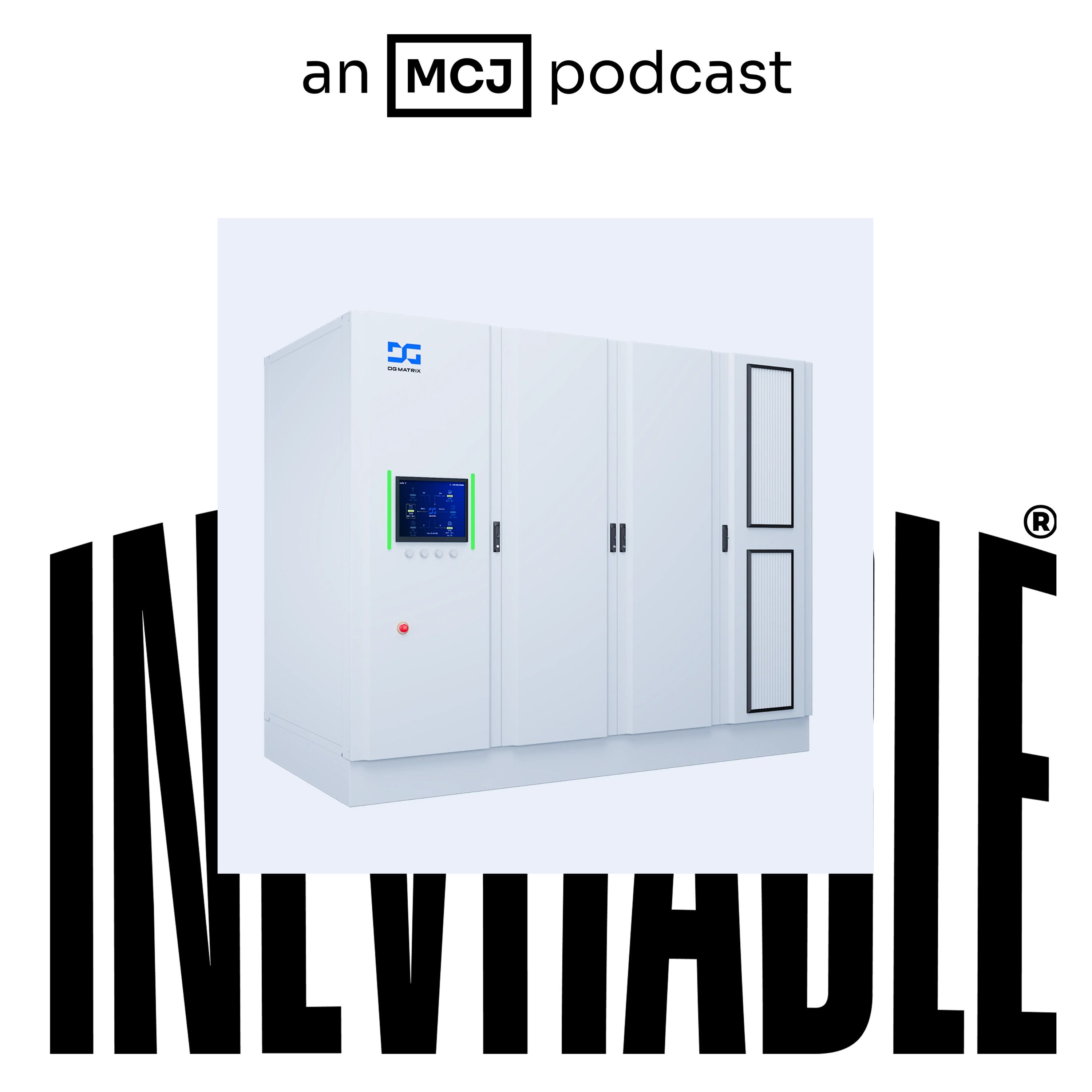
Inevitable
Collapsing 30 Feet of Power Infrastructure Into Four with DG Matrix
00:50:19
Haroon Inam is Co-founder and CEO of DG Matrix, a company that makes the world's most compact Power Router, aggregating distributed energy for GenAI datacenters, microgrids, fleet electrification, and associated systems. As AI workloads drive unprecedented electricity demand and legacy grid infrastructure struggles to keep pace, DG Matrix has commercialized the world’s first multi-port solid-state transformer to meet the energy needs. In this episode, Inam explains why transformer bottlenecks, distributed generation, and 800V DC architectures are reshaping the future of power delivery for AI infrastructure. He discusses DG Matrix’s product strategy, manufacturing scale-up plans, and the role of software-defined power systems in next-generation data centers. Finally, Inam shares his take on the future of distributed microgrids and “cellular power” and how to scale power electronics manufacturing. DG Matrix recently closed a $60 million Series A led by Engine Ventures that MCJ is p...
Loading summary
Transcript107 lines
- [00:01]
A
Today on Inevitable, our guest is Harun Inam, co founder and CEO of DG Matrix. DG Matrix is developing the multiport solid state transformer, a single programmable device that replaces more than a dozen pieces of conventional power equipment behind the meter at AI data centers and across the broader electrification economy. This matters because conventional transformer lead times have stretched to two to four years, just as AI data centers are accelerating the largest power buildout in decades. In January, Nvidia published an 800 volt DC architecture for AI factories that effectively named the solid state transformer as the future of of grid to chip power delivery. DG Matrix recently closed a $60 million Series A led by Engine Ventures that MCJ is proud to have participated in. Harun welcome to the show from McJ. I'm Cody Sims and this is Inevitable. Climate change is inevitable. It's already here, but so are the
- [01:21]
B
solutions shaping our future.
- [01:24]
A
Join us every week to learn from experts and entrepreneurs about the transition of energy and industry.
- [01:35]
B
Arun, welcome to the show.
- [01:38]
C
Thanks very much, Kodi. Very nice to be here. Thanks.
- [01:41]
B
Maybe start by taking us through your path to to building DG Matrix and in particular how you found Your co founder, Dr. B and backgrounds you each are bringing to this endeavor.
- [01:56]
C
Sure. I first came to the United States as a freshman at Duke University. By the way, loved the Triangle area. When I first arrived after getting a double E degree, I pursued power electronics at Duke. In those days it had one of the best programs in the world with a master's degree in hand in 1986. I've been practicing in the profession for about 40 years now.
- [02:22]
B
1986, the Duke Blue Devils beat my Kansas Jayhawks in the Final Four, which was a bummer.
- [02:28]
C
Yeah, and then they lost to Louisville, which was a bummer. Also.
- [02:32]
B
I was not yet in college myself, but that was about when I started tuning in and now I'm a lifelong fan. So I love college basketball.
- [02:39]
C
Since you've established that, I think it would be appropriate for you to call me Uncle Harry going forward.
- [02:45]
B
Okay, sounds great.
- [02:47]
C
Just kidding. So I started off. Power electronics in those days was actually not a hot profession. It was a profession with which you could always get a job. And it was just power electronics engineers have always been in short supply and I studied systems design. So systems design and power electronics together we were dealing with micro grids from an early age and microprocessor controlled grids, utility interface systems. So I just grew up in this world of power electronics and I've had a chance to work on the 787 Dreamliner and the Joint Strike Fighter Power electronics. I've had a chance to work on computer room power which was the predecessor of data centers solar inverters. Before the sun started shining on that industry, I worked on transmission power flow control at hundreds of megawatts of power flow, all done through very creative power electronics. One thing led to another and that's how DG Matrix came out to deliver better behind the meter power for concentrated loads. What are concentrated loads? Fleet electrification, building electrification. That's how DG Matrix came to be formed out. So that's the span of almost 40 years of work of developing multiple game changing tech.
- [04:13]
B
You took a prior company public which you glossed over.
- [04:17]
C
Yeah, I was a chief technology officer at SmartWires. That company did go public. I think SmartWires has got phenomenal technology and product and one day I hope it has far bigger offtake than ever before.
- [04:31]
B
And how did you meet Dr. B?
- [04:34]
C
So Dr. Bhattacharya, Dr. B and I met back in 2011 when I was working for, get this, a Khosla Ventures funded SST company in San Jose, California. And we were doing all sorts of interesting things including bringing medium voltage to the top of a data center rack. Something that nobody had been dumb enough to try before that. So we were also doing solid state transformers to replace AC to AC transformers. By the way, that is a real dumb thing to do because you will never manage to get to this reliability, cost and life of basic big fat iron and copper. So AC to AC replacement, we learned is not the smart thing to do. But that's where Dr. Bhattacharya and I first met and it's been a relationship for 15 years now.
- [05:25]
B
And as I was digging in on the two of you, I saw he started his career, at least it was early in his career was at Westinghouse, which I think takes us to the fun sort of historical look back when we talk about AC to DC and DC to AC conversion. Obviously we go back to the 19th century and the original transformer revolution that happened that helped solve that fight between Westinghouse and and Thomas Edison. Talk about how the grid is currently bottlenecked by the transformer and what role it plays in our power systems today.
- [06:02]
C
What model was necessary to deliver power economically 100 plus years ago? The question is, is that the right model? The model that was developed in those days was they needed centralized generation and centralized generation to spread. Like a bicycle wheel spoke arrangement, you have center and all the power goes out and flows in one direction. So that's centralized generation, although now you have multiple generators that are paralleled through the transmission grid. They feed substations and then substations feed feeders into residential neighborhoods and into commercial and industrial sectors. And that's how we end up getting power from multiplicity of generators in an area through the transmission grid to the distribution grid and then the feeder lines. But power flow is typically unidirectional. Now solar farms and battery in front of the meter, that's changing that game. But the utility model has always been that of a monopoly in a certain area and that's why they're regulated by public utility commissions to set rates and whatnot. But that's the general model that has worked so far. And the reason it's becoming bottleneck now is that these AI data centers Cody, require far more power than any ever before. So you're looking at multiple gigawatt loads going up in areas where gigawatt cannot be delivered easily over those distribution lines and over those transmission lines. This, that's what causes the bottleneck. It's much like you have multiple highways, but once you put a big load, the traffic is still going to get clogged up in the end roads. And that's what's creating the issue.
- [07:54]
B
And so does that specifically tie then to the need to have on site power generation as well as grid power consumption all in one package? Is that where the big issue lies?
- [08:08]
C
Smarter people with a lot more money have studied this problem at the chip companies, the ones that do AI chips and the ones, the hyperscalers, and that's pretty much the conclusion they've all come to, is that natural gas is a far better way to power. The augmented power behind the meter is the way to go. And you will need storage in order to mitigate some of the cyclic load nature of data centers as well as all the spiky loads. But yes, behind the meter, power through natural gas is the best way in the United States. And most of it will stretch from Texas all the way up to Pennsylvania. That's where the natural gas lies.
- [08:48]
B
How do DC native power technologies like solar and storage and the like come into play there?
- [08:55]
C
Solar is a very. Of course, they've ridden the cost curve way down and the levelized cost of energy of storage is a record low. The question is the density of solar power required. I think you need about what, a hundred thousand square feet or about two acres, two and a half acres to create a megawatt of power. So now if you're going to create 1,000 megawatts of power, which is a gigawatt, you're going to need 2,000 to 2,500 acres. That's a lot of land to try to find in a suburban area. And so the question comes out, will solar have the density that you need next to the data centers? And I think the answer is no. Now, will solar be used in spots to power up 5, 10 megawatts of data centers? Yeah, probably. Or you situate the data centers in remote areas like the southwest United States. That's where you have a lot of sun and you may have fiber going out there. So I think solar has a lot of promise. But in select areas, let's dig into
- [09:57]
B
some of the specific terms that come up around DG matrix, just because there's, I think, some vocabulary we need to establish before we dive into the episode a bit. So solid state, multi port and low voltage versus medium voltage. Can you take each of them maybe one at a time? Start with solid state. What does it mean? How is it different than the traditional means of doing things? And as much as you can paint the picture for us, actually describe physically what you're talking about here.
- [10:26]
C
I'm not sure how the term solid state transformer came out to be, but I'm going to take a guess. And there are multiple people who claim credit for that. A basic transformer is an iron core with copper or aluminum windings with insulation wrapped around two sides. You put voltage in on one side, alternating voltage. You get the same voltage on the other side. That's a legacy transformer, a workhorse of the industry. Trillion, two trillion. So traditional transformers are workhorses of the industry with this iron, copper, or aluminum winding scenario. On the other hand, the solid state transformer is a very small magnetic core, much smaller magnetic core aided by high frequency, very high frequency, very short pulses. So you can make the iron much smaller, but it has to be a different material, like ferrite or whatever. And now you wrap wires around it, but they're very different wires and much smaller wires. And that's what happens to the magnetic core portion. But you have to take what are called volt seconds, voltage times seconds of low frequency, and convert it to high frequency to pass through that transformer. So, so your transformer can be much smaller. And because you have to chop it up, that chopping up is done with solid state circuitry. Hence the term solid state transformer in
- [11:53]
B
my mind, is the same transformation that other electrical things we interact with have gone through over the last 20, 30, 40 years. Mainframe computers to computers powered by semiconductors. Same thing happening in our telecom systems as things have moved to cellular technologies. Maybe describe why it's taken so long to do this.
- [12:15]
C
In large power electronics, solid state transformers have struggled to find a market. And the fundamental mistake is that people were trying to replace AC to AC transformers with solid state ones.
- [12:28]
B
You were mentioning this was the startup you were working on over a decade ago.
- [12:32]
C
Yeah. And so the economics are not there. The reliability, the life. Now here's what is different. If you take that AC power coming in and you happen to want to convert it to D.C. and you look at what's upstream and downstream of that transformer and you combine it into that solid state transformer architecture. Bingo. Now you have the economic value proposition of a system that has better net balance of plant efficiency, better cost, and likely better reliability. But for the whole system.
- [13:08]
B
So does this take us to one of the other vocab words I wanted to make sure to cover, which is multi port.
- [13:13]
C
So we could talk about multiport first and then we'll talk about low voltage and medium voltage next on the multi port. So one port will take AC in, in our case, chop it up to high frequency and then take that high frequency across the transformer core and make it into dc. So that'll require two ports. We add multiple other ports to also chop up AC or DC voltages simultaneously in a synchronized fashion and add it around that magnetic core. It's like having six roads come into a traffic circle. There's traffic going in and out of every road into this traffic circle, which is our magnetic core. And we match all the incoming traffic with all the outgoing traffic on every road every millionth of a second. Every 20 millionth of a second. We do that 20 million seconds later. And that's how we created this multiport to allow us to mix and match AC or DC power, or multiple forms of ac, multiple forms of DC with the grid power and do it in a compact structure that eliminates 10 to 15 legacy components. That's multiport.
- [14:27]
B
Is it a dumb example to think of like the USB adapter on my laptop that can take in HDMI and take in USB C and take in traditional USB and an analog input as well and all make them work?
- [14:42]
C
That's an excellent example because you're taking multiple forms of signals and converting them from one to the other. And so the analogy applies that that's what we're doing for power.
- [14:52]
B
Yeah. And now maybe hit the low and medium voltage side of the equation as well.
- [14:56]
C
Sure. So I just want to touch one More thing on multiport because you're mixing and matching different forms of power. Each form of power behind the meter has its own characteristics. With multiport technology, you can pick and choose in fractions of a second which power to extract and how to extract it. You want steady power from the grid. You want nasty cyclic power to go to super capacitors. You want storage power to come and go out of the battery at a steadier rate. And you don't want to upset your fuel cells and turbines. Multiport has the economics to do all of that in one product. And that's why DG Matrix focused on multiport to start with. The economics of the solution are the most compelling. It is the smallest balance of plant. It has the best efficiency because it has the best powertrain, the least amount of components, and that's what will make it most reliable. So I just want to touch on it that we didn't come up with a tech and then we're finding a way to fit it in. It's like, no, this is where the economics are. That's what you have to develop. And it took us 700,000 engineering hours to figure out all the improvements we had to make it work.
- [16:09]
B
And we're going to talk about the market that you explored to get you to where you are now. There's so much attention on the data center market, but I know you all have actually started with a different market to begin with and have discovered this data center market along the way. We'll get to that in a minute. I think worth highlighting before we even jump into the third definition, which is low voltage and medium voltage on this multi port, you mentioned that it replaces multiple legacy components. Can you walk through what your transformer, actually your SST looks like? And if you were to visually side by side, put it against what it might replace, what some of those components themselves might look like, we are doing a deal.
- [16:49]
C
We've done a deal with this multibillion dollar EPC firm that installs micro grids and similar equipment behind the meter at sites all over the United States. And they have skids onto which they put legacy equipment. So our product at 1 megawatt is roughly 14ft by 4ft. The Legacy is two skids of 30ft by 4ft, two of them spaced apart with two large transformers in the middle. So you're occupying 30ft by 20ft at best with these large skids. And then on the other hand, you got four feet by four feet. There's no comparison. And the feature set that we bring Even with that Unbelievable density is 10x what the legacy does. That's what is creating the demand for the product.
- [17:42]
B
Now maybe talk through again the sort of the different voltage considerations here as well.
- [17:47]
C
So low voltage is standard voltage, industrial voltage. 480v AC in is considered low voltage. 600v AC in is considered low voltage. Anything underneath 1000v AC is considered low voltage in the utility language. And so we set off developing all solutions to accommodate four 8600 and then provide DC simultaneously at 400 to 800 volts out of one port. Actually our DC ports do 200 all the way up to 920,000 volts and we should be able to extend that to 1500 volts very soon. That's how we were born. And we have actually done work in medium voltage SSTs as I mentioned to you, all the way back to 2011. Bharat Churya, Dr. B, my co founder, has been doing medium voltage SSTs since 10 to 15 years ago. We have a lot of history in medium voltage SSTs. So why did we choose to release a low voltage SST first? Very simple reliability and certification.
- [18:50]
B
And I think of things like low voltage as things inside a building, an EV charger, a microgrid, that sort of thing. I think of medium voltage as being, you know, wires on a pole in a neighborhood, your sort of distribution infrastructure. And then high voltage would be big mega transmission where there's an incredible amount of danger and risk to these wires that are out there transferring power.
- [19:15]
C
That's right. The transmission grid are the ones with the very, very tall towers and the big insulators. The distribution grid is the poles that come into your neighborhood. The overhead wires, the household or industrial wiring rather is 480 and 600 in Canada, 480 in the US, 415 in Europe and the rest of the world. But that's right, that's considered low voltage. Medium voltage is more from the substation to the road outside your house and a hotel.
- [19:42]
B
Let's talk now about the world that you're moving into. Maybe starting about the idea that a transformer was, I would say, the boring part of the data center stack, the exciting part is these crazy chips that are super rare and very difficult to manufacture and creating all sorts of trade wars around the world. But now it feels like the transformer is becoming the bottleneck at the data center level.
- [20:08]
C
The grid delivery is the bottleneck. Right. And transformer is part of that grid delivery. It's the grid delivery, it's the insulators. It's the wires, it's the interconnection studies. The whole process of upgrading the grid is an issue. So to alleviate those lead times for transformers, when you add behind the meter power, those other transformers that convert 35kV to low voltage, they're not as they don't have such a bad lead time as the very high powered ones. But still transformer factories are running at capacity everywhere and the lead time is arguably multiple years now.
- [20:45]
B
I would say, you know, the incumbents are trying to respond in the transformer world. Hitachi is building a, I think the biggest transformer plant in the US right now in Virginia. Siemens is plowing money into new transformer development as well. Ge, Vernova, abb, et cetera, all of them are sort of moving into this space. But it feels like a lot of that capacity is going to come online over the next two or three years. Like how do you think about the window sort of between now and then?
- [21:13]
C
I think it's not just the window between now and then because let's say those transformers come in, they're still only going to deliver AC to AC power. You still need behind the meter power aggregation unless you miraculously upgrade all the distribution and transmission lines as well. It's a complex problem. The case for the next 10 years calls for behind the meter power. And that's where I think you need multiplicity of power. Natural gas running either turbines or natural gas gen sets or fuel cells aided with batteries and grid and other storage technologies. I think that's the way the data centers are headed.
- [21:52]
B
I think on that note, what was it earlier this year, I think January Nvidia came out with this big 800 volt DC sort of plan, like master plan if you will, maybe talk us through it. Basically anointed SSTs as the future of solving the vision of the data center that they think needs to be built to, to consume power as efficiently as possible and actually operate these AI data centers the way that ultimately they believe it will need to be operated. Walk us through what that plan unveiled and where you think DG Matrix fits into that vision.
- [22:32]
C
I can talk about what's publicly disclosed. So the 800 volt DC racks and the 800 volt DC distribution that Nvidia is now pioneering is driven by rack density. A rack is typically a 19 inch wide rack into which you put servers in, right? That's how the servers that provide us our email services, our YouTube videos of cats fighting with each other, whatever you watch, it's all provided through servers that go in these 19 inch racks. Typically these racks have consumed 6, 10, 20 kilowatts in a rack. But the Nvidia GPUs are consuming far more power. So you're looking at 600 kilowatts to a megawatt per rack. Good God. You have gone 100x in power. So first of all, no wonder you need liquid cooling to remove that heat or the chips are going to melt.
- [23:28]
B
That's a neighborhood's worth of power in one rack is sort of the way I think about it.
- [23:32]
C
Yeah, 1.5 or 1500 watts is what an average house consumption in the United States is. So you're looking at 600 houses, almost 1,000 houses. But in a 19 inch rack, imagine that. Good God, that's a lot of power. And so you can't deliver that power over standard 240v AC single wire architecture like you could 6kW. So that's where the bus bars will get way too thick at low voltages. So they raise the voltage to 800. And then by eliminating multiple power conversion stages, you don't go AC, DC, DC, AC, ACD. They just said we're gonna go from AC to DC in one go and deliver 800 volts straight to the rack. And then inside the rack, the power supplies will convert it down to what the chips need. That is much more efficient way of doing it.
- [24:22]
B
A medium voltage use case. To go back to our prior definitions for you for Digimatrix, you can do both.
- [24:28]
C
You can do medium voltage two different ways. We're doing both ways. With a team of about 400 engineers today, we have the largest SST team in the world. 24 PhDs in multiple disciplines. We are investing in low voltage SSTs. Multi port. We are doing multi port single in, single out, and we're doing multiport for medium voltage as well. And medium voltage for us is defined as 35 kilovolts AC. And we can take 35 in and convert it to 800v DC. Our differentiator is unlike our competition, who is doing single voltage in and single voltage out. We're doing multiple voltages in, encoding medium voltage all the way to 800v DC. But that's the advantage of eliminating one more transformer. That's one way to do medium voltage to 800. The other way to do it, which is our own competing architecture, is you use a standard transformer which doesn't have lead time issues to go from 35kV to 480v AC and you use that as one port of a multiport low voltage SST and then you combine it with super capacitors, fuel cells, natural gas turbines. You add up all that power in the SST and you deliver protected 800 volt DC power to the rack.
- [25:54]
B
It allows you to do that today essentially using legacy transformer architecture.
- [25:58]
C
We're actually doing that today with legacy transformer coupled with our LVsST. And what it's doing is Cody, you are doing the functionality of a statcom which is for grid support functions at the substation and we're doing collapsing the functionality of a statcom, a ups all behind the meter power equipment used to process power, all the 800 volt rectification, all the five nines of reliability, all the Genai server pulse routing. We're doing it all in one multiport low voltage SST combined with that transformer and the off take requests for that in just the next three years for us are in excess of. They're somewhere around $20 billion today. So the numbers are amazing. It's a multi generational opportunity to bring a new architecture with unprecedented scaling for those data centers. So I think both medium voltage SST and then this legacy transformer with low voltage sst, two different architectures, two different value propositions, both are very important. Both are going to go low voltage is available in shipping today. Both are going to go competing architectures and we think both have different pros and cons. But the fit of the low voltage is so strong that today the offtake requests that we're going through are between 10 and 20 billion dollars just in the next three years.
- [27:23]
B
It sounds like using the current low voltage solution in an 800 volt DC architecture is almost like a hybrid version for you that you can bring to market relatively quickly is what I'm hearing.
- [27:34]
C
We're shipping today. And you are right, it's a relatively quick thing because MVSST medium voltage will require more time on certification, much more time for reliability proofing.
- [27:47]
B
So you actually have names for these products? I think just want to make sure we hit on them. You have the low voltage version I think you call router, is that right?
- [27:55]
C
We used to, we have just gone through a rebranding exercise, so now it's called Interport. We have the Flex series, there's a Flex series that goes inside in the white space in the data center which converts low voltage AC to 800 volts DC. And then we have another medium voltage SST branded separately as a Flex medium voltage version. But it's all on our website.
- [28:18]
B
Yep, of those sort of three product lines, which ones are actively shipping?
- [28:22]
C
The Interport360 is shipping this year and all the low voltage SSTs are shipping this year.
- [28:29]
B
And the lowest voltage SST, which I think is 200 kilowatt scale SST, if I'm not mistaken, that actually started with more of a micro grid EV charger use case, which I think is still a very active use case for you. And you've discovered this, I guess as I described it, almost like a hybrid data center use case for it. In Given the market dynamics, can you maybe walk through that product evolution from a go to market for Digimatrix?
- [28:58]
C
Yeah, when we started, AI data centers were not hot. Nobody even knew that OpenAI would hit with ChatGPT. The power problem was showing up in fleet electrification fast EV charging. So if you had 5, 10 cars charging at the same time, you couldn't get multiple megawatts. So we said, boy, we got this multiport solution. The economics are the best and the biggest markets are building and fleet electrification combined. And we were doing pilots. And when we started demonstrating pilots and putting them on LinkedIn one day we got a call from somebody pioneering the 800 volt DC architecture and they said, have you thought about AI data centers and can your product really do this? We're like, yep, it's doing it today. And that's how we got pulled into the AI data center world and found it to be a massive concentrated opportunity with standardized designs.
- [29:52]
B
Now if we went the other direction and think even lower voltage, the neighborhood street corner transformer I think is the highest volume version of transformer, but that's AC to ac as you were sort of laying out. That's a game you don't think DG Matrix will try to play in, is that right?
- [30:12]
C
I think there are companies that are attempting to replace the distribution class transformer. It could be seen as a can that's mounted on a pole outside your neighborhoods and it might do 10 KVA, 20 KVA, something like that. But no, we're not interested in playing that game because it's a very commoditized, very high volume market. And I think the need for data centers with behind the meter fits in as a perfect entry point for our multi port SSD tech.
- [30:41]
B
Can you talk through some of the partnership ecosystem you've built around the company?
- [30:46]
C
First of all, we're building the ecosystem, we're finalizing a name for that alliance. Might end up being the Hyper Grid alliance, but we need partnerships with battery manufacturers today. We have multiple partnerships. We need them with generators, with turbine manufacturers. Mitsubishi Heavy Industries is an investor in the company and a partner. We need partnerships with companies that integrate all these solutions and deploy them. They're typically called integrators or EPC firms, engineering, procurement and construction firms. And so we have partnerships with multiple, not multiple, but a few very key large integrators and EPC firms that are doing billions today. And I think those are some of the most key partnerships that we have formulated.
- [31:30]
B
Are there any specific deployments that you can talk through that you're working on right now?
- [31:35]
C
Sure. We have done a deployment in Miami with a company doing, and I think we announced this with a company doing a concentrated solar combined with long duration
- [31:45]
B
battery exowatt, also an MCJ portfolio company.
- [31:49]
C
So Hanan, yeah, he's doing some very interesting things trying to lower that levelized cost of energy to $0.01 a kilowatt hour. I think DG Matrix, that's the product that's running one of the micro grids down in their test bay in Miami. We're talking about additional units for additional sites. We might be the reference architecture that they choose because we handle all the characteristics of their generators. We handle all the characteristics of the grid and of the data center and of batteries that will be needed to support this effort. And there are multiple other ones that have been installed. There's one installed at PowerSecure in Durham, North Carolina. There's some installed in a parallel operation that mimics a data center parallel operation outside of Charlotte. There are a couple running in UL labs and in a fuel cell company in California or have been tested and are being deployed as fleet chargers. And then there's one running in Northbrook, Illinois. And then there's multiple reliability units that we have running outside our own buildings in our offshore labs.
- [32:53]
B
Thinking about sales cycles today, you've been selling to fast moving EV charging fleets and the like. You're now moving up to startups like Exawatt or whatnot. You're selling to data center developers. Have you had to yet navigate the long sales cycle utility sales process? And if so, how are you navigating that as a company?
- [33:18]
C
So yeah, I would say that today if we look at the revenue potential, the EV fleet charging revenue potential is in single digit percentage for us, the most massive potential is in AI data centers and that's where we're looking at double figures in billions of revenue potential in the next three to five years, just to put a perspective on that.
- [33:38]
B
And that's EPCs mostly, I assume buying from you directly.
- [33:41]
A
Is that right?
- [33:42]
C
EPCS data center developers and neo clouds. Those are the ones. And behind a lot of this, the offtake may be hyperscalers, but that's where the strong interest in deals being worked out are. We're putting in multiple multi megawatt demonstrations this year into Texas, into North Carolina and in California. There may be one or two international ones going up as well. And we expect an explosive demand and explosive delivery, very good delivery cycles in 27.
- [34:14]
B
So on that obviously there's a big scale up of manufacturing that you need to do. What do you need to do to go from wherever you are today to I assume, thousands of units a year to service that demand?
- [34:27]
C
So yeah, when we first came up with this concept, we presented it to one of the top consulting companies in the world and they said if you ever get this product to work, you will have to hyperscale the company because you'll never be able to keep up with the demand. That's how hot this area is of distributed generation behind the meter. And so we designed a manufacturing system and a deployment system simultaneously with the product. Today we can replicate a 5,000 square foot work cell that can produce up to 400 megawatts a year in double shift with just 20 people. And we can create this cell in under two months. So if we get 100,000 square foot building, 100,000 square feet divided by 5,000 square feet is 20 such work cells. 20 such work cells can be put up in two to three months. So we can go to a 4 gigawatt capacity in a matter of three months before, after getting securing power and building, that's how fast this company is designed to hyperscale. We're negotiating the factory expansions, multiple ones simultaneously. We're also in chats with two of the largest contract manufacturers in the world to give us half a million to a million square foot each or more over 27, 28 and 29 because we see significant demand. Even if there's a bubble in AI, it's still going to be a massive demand because of the services AI provides to us. So yeah, that's right.
- [35:57]
B
Mostly manufactured in the US Mostly our
- [36:00]
C
goal is to manufacture final assembly in the United States where customers can come, they can touch the unit, they can see all the factory acceptance testing, they can run it through its paces. We are also looking at sub assembly factories in Mexico, we may be looking at some sub assembly factories in Southeast Asia and we have a China plus one sourcing strategy. So the electromechanical non microprocessor stuff that comes from China, we Can duplicate it and source it from other countries as well. That's our manufacturing and supply chain strategy.
- [36:35]
B
Obviously advanced magnetics are important to the product that you're building. There's been so much attention to rare earth materials and rare earth magnets from China. How dependent are you on that supply chain for Digi Matrix?
- [36:50]
C
Zero dependency on rare earth, as we say. There is no unobtainium in our product. That is by design. When we first started, the lead times on over 100 components were at a year. And when the engineers were done with the first iteration cycle, every component that we have can be sourced in about three months or less. And that's through deals with distribution and just the plain way that we designed the product. The only constraint we're facing now that we are solving is memory chips which have been sucked up by GPU server people. But I think we're solving that problem through some critical partnerships and otherwise it's a very low lead time supply chain by design.
- [37:32]
B
From a reliability standpoint, it strikes me that a traditional transformer or the suite of them that you need to fit on that 30 foot skiff that you were describing, I say this not in a negative way at all, is a relatively dumb machine in that it doesn't have software, it doesn't require programmability, and thus it's in theory not hackable, not subject to bugs, not requiring ongoing software upgrades and maintenance and firmware updates and all of that. These things are built to live in the field almost untouched for decades. How do you view that shifting landscape for your product, which is ultimately a software defined product?
- [38:17]
C
There are some skids with just transformers, There are some skids with inverters, rectifiers and transformers. And that's what we're replacing. We're replacing multiple products with one unified product that also goes on a skid. So comparing apples to apples, comparison for what we're displacing. The reason we're more reliable is we're far few parts and we do all that functionality together rather than have disparate manufacturers with disparate firmware that doesn't necessarily talk to each other well. So the second thing I want to mention is when we started the company, one of the first people we asked for advice is Dr. Michael Pecht. He's written 39 books on reliability and we asked him to come in and help our team understand reliability down to the core. We explored failures over the last 30 years in power electronics equipment for anything from components, even the bond wires inside the transistors to sub micron level films that are used to coat printed circuit boards that crack in the rain and in the humidity cycles and in the thermal cycles in a few years and then. So those are the characteristic failure modes that we went down into detail to study. And then Dr. Peck helped us develop the whole comprehensive reliability program that augmented even the aerospace reliability that I had learned. And that's how the DG matrix DNA today we shake every printed circuit board and design and we remove resonances. We will burn every printed circuit board from freezing to burning cycles multiple times over three days before we ship a product. We will do an approved vendors list that's very tight. We have a very tight fraka system failure reporting and corrective action system that when something goes wrong in the field and our very high speed telemetry spots it, our AI and ML engines tell you what's wrong. All the engineers verify and within three days we will have a relentless root cause analysis completed for every sev1 issue. That is why we need 400 plus engineers to bring a game changing product like this out. Because at the end of the day that customer doesn't give a damn if their site is down. And that's what you have to make sure that you have the reliability and the pedigree of design to do it.
- [40:39]
B
We've learned that in the EV charging space, right. Like you could have all the promise in the world, but if your product doesn't work, work reliably, nobody wants to buy it.
- [40:47]
C
Yeah, that's right. That's absolutely right. I think there's been a lot of firmware problems and hardware problems with EV chargers and the complexity is higher because the car has to talk with the charger and that's where a lot of interoperability issues came from. Here in the data center there's a simplified mechanism to talk to GPU servers when you do need to do that. And it is far more consolidated, uniform application. So I think the integration here is far less of a challenge.
- [41:17]
B
As power systems shift to these D.C. native architectures. What do you think are the bottlenecks that no one's paying attention to yet? We've talking about solid state transformers as one of them that DG matrix is clearly going after. Do you think there's another transformation that needs to happen in inverters, in substations, in solid state breakers? Where else should all of us who are watching this space be paying attention to?
- [41:44]
C
I think this is an interesting question. Of course I can only say so much because it's possible that some of the incumbents and Our competitors may be watching the same video, but there's only so much I can say. But I do think that there is an innovation required in DC switchgear. I think there's a massive innovation required to overcome some of the fault arc fault issues and fault issues of DC breakers. I think there's a lot of innovation required in eliminating stranded power in data centers because the economics are so compelling. So when by design you can't deliver all the power that you have available to the chip, you're throttling down the revenue generating capacity of that data center. You got 100 megawatts coming in, but only 60 megawatts is getting to a load where or you have a failure in one of the branches and now you've got another 10, 20 megawatts stranded. That's a big problem. So we are creating IP to solve that problem where all that power is delivered to the chip in a dynamic fashion. Let's just look at the economics. If you have 100 megawatt data center, you got 20% stranded power. That's 20 megawatts. The revenue from that 20 megawatts is 10 to $12 per watt per year. That's 20 would translate to 20 megaw. Translate to what? A quarter billion dollars a year? Good God. Why wouldn't you pay a premium to eliminate that stranded power? And that's what we're after.
- [43:13]
B
I think the efficiency side of the argument here is one that gets overlooked quite often, which is can you actually use more of the power that's generated to do the operation that it was ultimately generated for? It sounds like you believe there's a very clear efficiency argument to made here as you're not having losses going back and forth between AC and DC through unnecessary conversions.
- [43:35]
C
So efficiency is one, the one big one. And stranded power may be an even bigger one. And when you combine the two, that's what we're after at getting the maximum amount of compute available for the power.
- [43:47]
B
We didn't hit on your business model. Maybe just describe how you actually go to market with these products.
- [43:54]
C
So we're going to market by selling directly to the NEO cloud providers, the data center providers. We are working with select hyperscalers, we'd like to work with all of them. We are also working with the integrators to take our product to market so that they can deploy it and then through these partnerships where we help battery manufacturers and genset manufacturers with selling tools to integrate their products into behind the meter power applications. So it's through these partnerships that we're
- [44:23]
B
going to market presumably as a pretty clear hardware sales model.
- [44:28]
C
I would say, Cody, it's like if you will, an iPhone of electrification model. You need the hardware but you can't do anything without the firmware and the software. So we provide the full integrated stack and the software is exceptionally important, especially where it can program the same machine to be a fleet charger with one firmware and a data center product with the other firmware. And that requires creative also future licensing models. Our energy management system, which lowers your bill down to a third, could be down to a third of where you are today. That's clearly something that should be licensed to the customer. So they don't have a huge upfront cost. But it's a hybrid of a system sale and then a recurring revenue to keep the product fresh.
- [45:12]
B
Which makes sense as a software defined machine.
- [45:15]
C
That's right, it makes sense as a software defined machine. And I want to touch on one more point you brought up. Cybersecurity is a very critical point and I think some of the big incumbents watch out for that. They have IT departments. But product cybersecurity is also very important and in the past we had the chance to deploy a product on the transmission grid and the lessons we learned in how you deploy a product on something that could bring down an entire city or an entire state. The cybersecurity we learned to do cybersecurity proofing. We applied similar principles at DG Matrix from commonly based knowledge and that's why we've taken care to make the system reasonably robust.
- [46:00]
B
It feels like from where I sit, there's going to be a massive investment in operational security necessary for these data centers. If there's not already oot investment from a cyber perspective for sure.
- [46:14]
C
I think there's an interesting report I read on the COVID of Wall Street Journal that AI machines are coming up with faster and faster hackable ways. So it's very concerning for those of us law abiding citizens. We don't want to be held hostage to criminals like that. So absolutely this is going to be critical for critical infrastructure.
- [46:36]
B
A last question for you, which is if you Fast forward to 2030 well into your mass manufacturer deployment timetable there, who knows what the world looks like given what we've seen from AI models and change in the last two or three years. If someone were to say Harun, what do you think DG Matrix has proven? What do you hope that answer is?
- [47:00]
C
I hope DG Matrix proves by that point that the fastest way to add a gigawatt of Power for your AI data center is through distributed microgrids or cellular power as we call it. And I hope the world also realizes that the same model applies to electrification. That we could add a gigawatt of power to your country in under a year. Nobody else, no other form of energy can do that. And that's our goal to not only provide this for data centers, but ultimately provide it for the electrification market. That is also a multi trillion dollar.
- [47:35]
B
On that note, with the distributed microgrids, if you're off grid or primarily off grid with a multiport solution, does it make it easier to bring that interconnect into that stack at a later date? Assuming we don't want to create a world of balkanized power for the long term, we ultimately do want these power generation sources to be able to communicate with the rest of our power grid and be managed ultimately, I would think, by a utility who is a professional at managing power. Explain how that vision comes into the power grid that we have today.
- [48:14]
C
That's right, it pockets of micro grids all around. Let's say a city or even a state should be. If existing utilities adopt that model, I think they could get far more revenue. They could expand their business far faster and quicker. And so there's a win win there for the customer. Lower cost of power, faster power. It's what cellular phones did to plain old telephone service I think is what the DG Matrix concept of multiport SSTs enabling cellular power for data centers and then for the rest of the electrification world.
- [48:46]
B
And on that note, we forget that today we have Verizon and AT&T and T Mobile or whatever. But cellular used to be a bunch of small regional networks that then ultimately became big national networks. Verizon was a ton of small local cellular plans.
- [49:01]
C
So there could be. Of course there's always third parties that try to aggregate multiple microgrids and provide services or virtual power plants. There have been a number of those companies or network operation centers to manage these. There is a reason to give a lot of weight to utilities managing these because they have hundreds to thousands of service people all around their areas to go and service it when there's an outage. Right.
- [49:23]
B
Or yeah, actually live in a remote location and manage a gas deployment or whatever it may be a fuel cell deployment that's powering said data center.
- [49:32]
C
That's right. I hope in a few years we're powering up the race to superhuman intelligence by enabling power.
- [49:39]
B
Harun, thanks so much for your time. Congrats on what you're building and we're excited to see it continue to take root.
- [49:46]
C
Thank you for the excellent questions, Cody, and for the engagement.
- [49:50]
A
Inevitable is an MCJ Podcast. At mcj, we back founders driving the transition of energy and industry and solving the inevitable impacts of climate change. If you'd like to learn more about MCJ, visit us at MCJ VC and subscribe to our weekly newsletter@newsletter.mcj VC. Thanks and see you next episode.