← Inevitable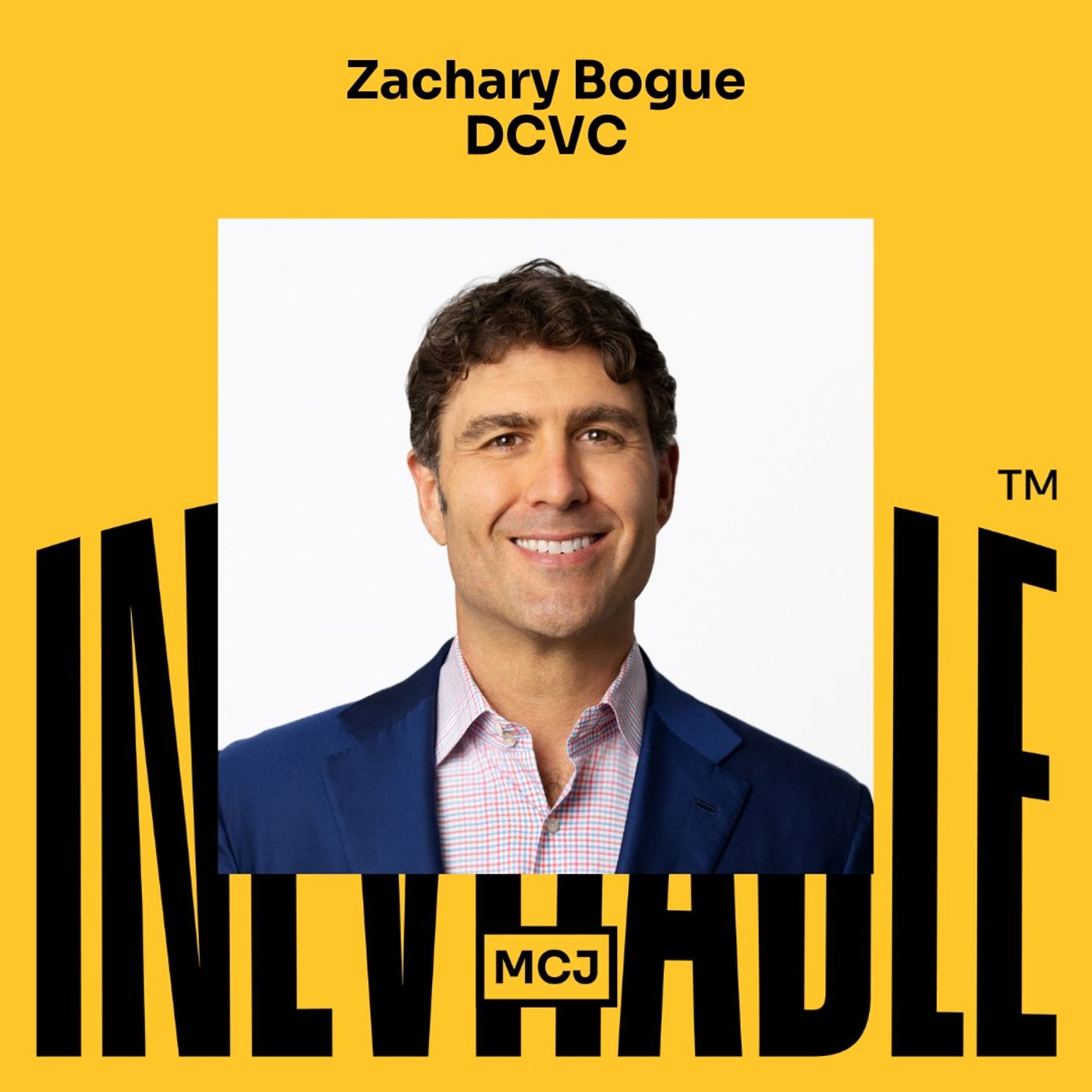
Inevitable
How a $4 B Deep‑Tech Fund Tackles Emissions with DCVC
00:41:20
Zack Bogue is co‑founder and co‑managing partner at DCVC, a $4 billion deep‑tech venture firm spanning 13 funds. In late 2024, DCVC launched DCVC Climate, a dedicated vehicle backing technologies that slash emissions in heavy industry, hasten the energy transition, and bolster climate adaptation. In this episode, Zack unpacks how the firm’s strategy evolved, how his journey—from Colorado outdoors‑kid to Harvard environmental‑science major to Silicon Valley deal‑maker—shaped his worldview, and what it takes to build a capital‑efficient deep‑tech portfolio that moves the climate needle.
Loading summary
Transcript92 lines
- [00:00]
Cody Sims
Today on Inevitable, our guest is Zach Bogue, co founder and co managing partner at DCVC. DCVC is a deep tech venture capital firm with $4 billion under management across 13 funds. In late 2024, they announced DCVC Climate, a dedicated vehicle focused on solutions to decarbonize high emitting industries, hasten the energy transition and contribute to mitigation and adaptation efforts. DCBC has been investing in climate solutions long before this new fund and yet I hadn't sat down with Zach to hear how their strategy has evolved with the new vehicle. I also hadn't spent time with him previously on his own Background and Story. We're honored to count Zach as an investor in our own venture fund efforts at mcj. And I feel blessed to have an opportunity to learn from him and about building a successful firm in this space from McJ. I'm Cody Sims and this is Inevitable. Climate change is inevitable. It's already here, but so are the solutions shaping our future. Join us every week to learn from experts and entrepreneurs about the transition of energy and industry. Zach, welcome to the show.
- [01:27]
Zach Bogue
Thanks for having me Cody. Excited to be here.
- [01:29]
Cody Sims
Well, I'm really excited for this conversation we've had Rachel from your partnership on the show a couple years ago, but excited to learn from you and hear about your story. And you all are truly a pioneering firm in this whole space of deep tech, which I would say climate tech is one part of that and I know you do a bunch of stuff outside of that and excited to hear how this whole story came together.
- [01:51]
Zach Bogue
Great. Well like I said, thanks for having me. Excited to be here and just at a high level, think about DC vc. DC vc. We're the world's largest exclusively deep tech venture fund. We're at 4 billion AUM. I co founded the fund with my partner Matt Oko about 15 years ago. As you mentioned, it's a broad deep tech mandate. We invest in everything from satellites to rockets to microbes to molecules and beyond. We like to say that deep tech means we back entrepreneurs solving some of the world's hardest problems using applied AI. And some of the world's most difficult problems are obviously problems in the now.
- [02:25]
Cody Sims
Obviously with that molecules focus. The name Data Collective one would think this is a software AI firm. Clearly you have made the name with intention. So talk me through that story and how that ties to how you think about your investment thesis.
- [02:41]
Zach Bogue
Matt and I came together at that time. One of the hard real world problems of the day 15 years ago was the scale out compute problem. Everyone's databases were Breaking Big Data was a largely unknown term. When I said Big Data the first time I met Matt and he knew what I was talking about, I got pretty excited. We liked it so much, in fact, we put it right into the name of the company, Data Collective. We also have this collective ethos where we had a broader network, all of whom had upside of the fund. So we wanted to be a collective so that if Data Collective did well, we all did well. Rather than being a fund or a firm or venture capital, we just wanted to be a collective. Fast forward 18 months. Big data became a horrible buzzword, eye rolling and we had to change our name. We already had the URL dcvc, so we shortened it and now we're just dcvc. And we're trying to distance ourselves from the Big Data moniker. Although truth be told, Big Data is kind of cool again, maybe. Or Data is cool again and AI boom. But we can leave that for another day.
- [03:40]
Cody Sims
Well, as a fellow firm who mostly goes by an acronym that has historical context to it, I appreciate the efforts you're making on the brand there.
- [03:50]
Zach Bogue
Indeed. Never easy on that stuff.
- [03:52]
Cody Sims
So tell me more about you and Matt came together. What were you doing before you jumped into starting a venture firm? One doesn't just set out and start a venture firm, by the way. There's definitely more to that story, but let's hear the background.
- [04:04]
Zach Bogue
It's interesting. It actually is the climate that pulled me into VC in the first place, which is why I'm excited to be here talking about our climate fund. But going way back to the beginning. I grew up in Colorado, just the suburbs of Denver. And Colorado's got this terrific outdoor culture. Hiking, backpacking, skiing, obviously terrific tourism industry. But the other main industry in Colorado is obviously the resource industry.
- [04:28]
Cody Sims
Yeah.
- [04:29]
Zach Bogue
So Colorado had its own gold and silver rushes and now is obviously a major, major fossil producer.
- [04:35]
Cody Sims
I spend my summers right at the base of Pikes Peak at my in laws place near Colorado Springs. And there's all sorts of gold mining and everything that still happens there, I think today.
- [04:45]
Zach Bogue
Yeah, exactly. Growing up in this dichotomy of beautiful outdoors. But there's obviously mine tailings everywhere and also understanding that energy powers the world. So this was the earliest time when I became interested in the climate. And then I'd say fast forward. I studied environmental science at Harvard back in 94 to 98 and I in that process, three big formative experiences. One, I studied under Professor Mike McElroy. He's a professor of atmosphere and Ocean sciences. And Mike McElroy was at that same time. And he would tell us about this, helping Al Gore, then vice president, figure out the dynamics of global warming, the CO2 in the atmosphere. And that was very cool. That was very early days. And it obviously went on to become an Inconvenient Truth, but it was. Mike McElroy was one of the major driving sources, so studying under him was cool. My intro chemistry course I took was under some of the core team that discovered that CFCs caused the ozone hole. And that was the big problem of the day. Yeah, it was that team, the broader team, won the Nobel Prize for that. This was an optimistic time. We were coming out of the Montreal Protocol, one of the most successful climate treaties of all time. We'd identified this problem in the ozone hole. And then the world came together, signed a treaty, and industry rose and invented new pathways to doing a cool time.
- [06:03]
Cody Sims
I still remember growing up, every time you went to McDonald's, it always came in Styrofoam. And then it just didn't anymore. And that for listeners who are younger than me, maybe don't appreciate what a difference actually that treaty made in changing even just simple things like that growing up.
- [06:19]
Zach Bogue
And it was also the time when 350 parts per million target was identified. And it seemed like that was going to happen. We're like, yeah, great. The scientists have said 350 is the number and looks like this will happen. And obviously that feels like point thinking at this point. But that was the optimistic. And we didn't really know at that time what the real climate problems were. Was it endangered species or pollution, deforestation? And ultimately, now we know that climate change and CO2 is going to predominate. But there was more of a mix at that time and also including the ozone hole. And then the third thing was studying advanced economics of the environment under the late Professor Marty Weitzman. He was famously passed over for the Nobel Prize. And two fun anecdotes that still inform my thinking. So he was really critical of just using simple cost benefit analyses for the climate. His example, and this was that whales in general, they have a reproductive rate that is lower than the interest rate usually. So if you use a cost benefit analysis, that would dictate that you just harvest all of the whales and put that money into the bank account and earn the higher interest.
- [07:25]
Cody Sims
Oh, my goodness.
- [07:26]
Zach Bogue
So obviously there's a lot more going on. There's real intrinsic values that are actually assigned, because I don't think anyone would do that. But it was really showing the limitations of these strict just pure economic that.
- [07:37]
Cody Sims
Does sound like some kind of doomsday AI scenario, to be honest.
- [07:41]
Zach Bogue
Yeah. No, it's a vivid example. Right? Yeah. And this other one, and this is one of my favorite ones. And it's pretty simple, but just coming from a distinguished professor like him is he just basically said, look, innovation is just combination. There are more combinations in a simple deck of cards than there are grains of sand. And he said, look, nuclear physics. And combine that with a submarine, and that gives us nuclear submarines, which then obviously went on to give us nuclear power, et cetera, et cetera. So these three things were really formational for me as I think about my investing in the climate.
- [08:12]
Cody Sims
And so you took that as your baseline of knowledge. Sounds like it was very influential to you in undergrad. And then I think you started your career in law before you jumped into venture, so maybe chart your path for us there.
- [08:22]
Zach Bogue
Well, coming out of college, I think 66.0percent of my class went into finance and investment banking. That was just the trend at the time.
- [08:31]
Cody Sims
That was what everyone did. Yep.
- [08:33]
Zach Bogue
Right. Yeah. This is a modification of Jeff Hamberbucker's famous quote. He said, the best minds of our generation went into investment banking. That was what you did. I had a number of investment banking job offers, which I ultimately turned down. And then I looked, what did my environmental science degree qualify me for at that time? And there wasn't much. And we did find one job, and it was in hazardous waste cleanup. So. Well, long story short, I went to law school.
- [09:00]
Cody Sims
I love it.
- [09:00]
Zach Bogue
I really enjoyed law school. And then after law school was the tail end of the dot com boom. So I came out, as everyone did at that time, to work for a big Silicon Valley law firm, Wilson Sonsini. And I was doing venture capital in, like, a terrific way to start. So that's that progression.
- [09:16]
Cody Sims
Amazing. I mean, similarly, I did not study environmental studies in school, but randomly studied Chinese in college in the late 90s and moved to San Francisco trying to find a job using my Chinese language skills, of which there weren't jobs. China wasn't in the WTO yet, and I fell into the dot com boom totally by accident and started a career in tech. And there you go. So anybody in the late 90s, early 2000s who found their way into the Bay Area, I think has had a good chance of building a career in tech, even if they didn't mean to do it.
- [09:45]
Zach Bogue
Exactly, exactly.
- [09:47]
Cody Sims
Okay, so you built this foundational background in venture capital at your time at Wilson Sonsini. When did you decide, hey, I'm ready to Go start my own firm. What did that look like?
- [09:57]
Zach Bogue
So I worked at Wilson for two years and I quickly realized I didn't want to work at Big Loft. Like I said, terrific place to work and terrific start to my career. So at that point I actually left. I started three different businesses, varying degrees of success. None of them represented a retirement for me. And then in 2007, I read the book Super Crunchers by Ian Ayers, who foretold and predicted the big data wave. And as I'm reading this book, and this book had terrific anecdotes, he basically said, American Express, predict up to two years in advance whether someone's going to get divorced. Because when you get divorced, you're a credit risk for the credit card. And I was reading this book, thinking back to Professor Weitzman, Innovation as a Combination, I was like, hey, I wonder if we can combine these new computational models with hard problems in the climate. It was also a time that was the beginning of the big data wave. This is when massive data sets were emerging in the building efficiency space, utility space and the energy space. I actually tried to do FOIA requests to PGE to get some of their data and see if we could start doing experiment. I was unsuccessful in that, but that was the time and it led me to this early big data inquiry that we talked about at the beginning.
- [11:08]
Cody Sims
And so you came into it with this notion of I want to invest in climate and the intersection of how big data might be changing how we think about building technologies that have environmental impact. And yet you were also coming into it right at the start of the Clean Tech 1.0 meltdown. Not great timing to be moving into that, I guess to some extent are my timeframes right there.
- [11:31]
Zach Bogue
We luckily were on the sideline for Cleantech 1.0, and that was just when DCBC was coming together and we were investing in a deep tech mandate at that time. We did a fair amount of scale out compute. But 2011 was our first AI enabled life sciences investment and 2012 was our first AI enabled climate investment. Even from the earliest days, we were backing companies that were applying these deep tech models in the climate.
- [11:57]
Cody Sims
And you guys have been early on a few trends in climate that I think have grown substantially. You were early in nuclear, I would say you were in oclo, I think fairly early. And now nuclear is all the rage. But it was an untouchable category in venture for a while. How have you approached these kinds of problems, particularly where you have gnarly or heavy regulatory burden or substantial amounts of Potential capex staring you in the face. What gets you over the hump on things like that when your peers in venture are often not wanting to engage?
- [12:34]
Zach Bogue
Sure. Well, let's take a step back. So what is the DCVC deep tech investment thesis? And it means that as I mentioned, entrepreneurs solving hard real world problems using applied AI and one layer down that means that if you can think of clever ways of using these computational approaches, whether it's applied AI or machine learning or deep learning, use those to approach some of these problems in a capex light way. So at the earliest stages we look for these deep tech models in play and that also applies in the climate, this applies in nuclear where you can approach this for a while on a very capital efficient way. And obviously you're investing in the climate and deep tech broadly. Ultimately these are very capital intensive businesses. They ultimately are putting steel in the ground, electrons on the grid, building wet labs. But the early days you can find these capex light models and that's what we gravitate to at dcbc, that's how we approach these things. Does that make sense?
- [13:30]
Cody Sims
Yeah, I mean it sounds like starting from there and that gave you more confidence over time to also find things that maybe did have some heavier capex requirements, but at that point maybe you knew those industries better. Is that the way to think about it?
- [13:43]
Zach Bogue
Yeah, I think so. And then also you can make a lot of progress as a startup with these deep tech models in a capex light way. And once you've made that progress you can and it's tough to fully generalize, but you can demonstrate to customers that you're likely to be able to deliver on a contract and that they're willing to sign a contract. You can demonstrate to investors that you've made this much progress and that there's potential contracts. It's really about making enough progress that you can unlock less and non dilutive funding in the future. Does that make sense?
- [14:14]
Cody Sims
Yeah, for sure. And sometimes I guess capex Lite might still have a decent amount of capex, but it's lighter than the incumbent version of the thing.
- [14:21]
Zach Bogue
Yeah, I mean for sure. I like to think of capex Lite means that a clever entrepreneur can figure out ways to do things 10x100x1000x better than the incumbents. And that's your only shot at disrupting an incumbent. Think of the energy industry. It's been around for hundreds of years. Trillions of dollars of installed fully depreciated infrastructure. How do you hope to compete in that environment as a Young startup, two guys, their dog in a backpack by applying these deep tech models in a capex way, in a clever way to make a lot more progress with a lot less capital than the incumbents.
- [14:56]
Cody Sims
And then recently you announced a climate specific fund share a little bit more about that.
- [15:01]
Zach Bogue
So yeah, look at dcbc we've been quietly and happily investing in the climate for over a dozen years as part of our main. We found other ways to describe it. Is it ag, is it energy? And I like to say up until a couple years ago it really wasn't socially acceptable to talk about investing in climate through your help. And obviously that investment thesis came into focus for a number of reasons. The boom in energy demand. Obviously there were some tailwinds from the administration and the IRA and it's also just the imperative of increasing global imperative behind finding solutions. So that led us to launching the first DC VC client. We're very reluctant to launch new strategies at DC VC at this point. We have our main fund, we have a biotech family that funds DCVC Bio and then when we launch climate and we feel that the time to launch one of these new strategies is when an area is burgeoning and that we've been happily investing in. But we can see that it will become sort of almost too big as to predominate in a fund and then it makes sense to have it in its own self contained fund. Does that make sense?
- [16:05]
Cody Sims
It does. Do you model a different return profile for your working climate relative to your general fund or your bio fund?
- [16:14]
Zach Bogue
We do not. And it's funny, none of my other funds do I need to say this, but over and over I find myself having to explain that yes, DCBC Climate is a for profit fund with the same turn, expectations and profile as our other funds.
- [16:27]
Cody Sims
Did you break it out? You mentioned a couple of the general trends that made it suitable to break out and have those conversations with LPs. Were you seeing an overabundance of deal flow in this category? Were you seeing an overabundance of LP interest in this category? Or did you just feel like these companies learned from each other enough that it merited having its own strategy?
- [16:47]
Zach Bogue
I think there were two or three main things going on. One, there's always been a lot of deal flow in the climate space, but we felt like there was just a lot more investable climate deal flow which was part of the decision making. And this is the answer to the question of what's different between cleantech 1.0 and cleantech 2.0. Is that a Lot of these real world computational models reach maturity. We actually were to a point where the AI and the data infrastructure and all of that reached a maturity level. And one of the ways I think about this is we've seen just to take a space that we don't spend a ton of time in. We have a little bit, but in the fusion space around that time, all of these fusion companies were starting to have real breakthroughs, even though they were using wildly different approaches, you know, very apples and orange approaches. And part of that was just indicative of the maturity of the computational models, that they were simulations. We're now able to be able to afford and be able to do these massive scale simulations in the cloud that was just reaching maturity around that time across the board. And it's tough to fully generalize. I'm sure you could find counterexamples, but that was really what's going on outside.
- [17:53]
Cody Sims
Of your climate fund. I would have to assume you're seeing that in synthetic bio, in your bio funds. Exactly where AI is transforming how biotech is done. And you could imagine how that could change also industry and energy, I would assume.
- [18:08]
Zach Bogue
Yeah, exactly. A terrific example of this is Fervo Energy. It's our geothermal company. And Fervo in addition to all the other good stuff that they do, and we can go into examples later, but they have a very sophisticated in well optic fiber sensing system where these are fully instrumented wells. There's a massive amount of data that comes off of that and they use very sophisticated AI modeling to understand what's going on subsurface in a way that just wasn't frankly possible in Cleantech 1.0, even though obviously fiber optic cables certainly existed back then. But what's different is the data infrastructure to be able to make sense of that.
- [18:44]
Yin
Hey everyone, I'm Yin, a partner at mcj, here to take a quick minute to tell you about the MCJ Collective membership. Globally, startups are rewriting industries to be cleaner, more profitable and more secure. And at mcj, we recognize that a rapidly changing business landscape requires a workforce that can adapt. MCJ Collective is a vetted member network for tech and industry leaders who are building, working for or advising on solutions that can address the transition of energy and industry. MCJ Collective connects members with one another with MCJ's portfolio and our broader network. We do this through a powerful member hub, timely introductions, curated events and a unique talent matchmaking system. And opportunities to learn from peers and podcast guests. We started in 2019 and have grown thousands of members globally. If you want to learn more, head over to MCJ VC and click the membership tab at the top. Thanks and enjoy the rest of the show.
- [19:45]
Cody Sims
You mentioned that when you're marketing the fund, you are not marketing it as an impact fund. You are not changing the return profile of this relative to other funds that you have. And yet you do publish an impact report, you do calculate impact metrics. Do you do that in other funds that you raise? And how have you thought about doing that with your climate fund in particular?
- [20:06]
Zach Bogue
Currently we've done only one impact report and that's for DCBC Climate. And I view successful climate investing and impact reporting as two sides to the same coin. And the way we think about impact at DCBC Climate is that it's our commitment, our investment intentionality, that we're only going to invest in companies that will have unequivocal large scale, positive impact on the climate at scale. This may be a tough metric number and we don't break that down because it's really tough to actually come up with specific metrics. But that's our investment intentionality. And if there's a deal that is on the border between being impactful or not as we define it, the nice thing is if we fall in love with that deal, we can still do that deal in our main fund. If it's not really an impactful climate, we see some climate esque deals that are more software or carbon accounting and we're not quite sure is that big enough impact. If we fall in love with one of those, those can go in the main. Let me get to the flip side of the coin is then the impact reporting and I view this more as a way of keeping ourselves honest that hey, we are really doing what we say we think we're. And also for our companies, they're really doing what they think they're doing and actually just putting more rigor behind it and reporting out. And that's why it's two sides of the same coin of that investment intention. Does that make sense?
- [21:22]
Cody Sims
Totally makes sense. I mean McJ, we also don't believe we compromise on returns for the things that we're investing in. And yet we hope that the things we're investing in have significant impact. One of the areas we've struggled with in that regard, and I'm really curious to hear your take on it, is a lot of impact reporting in climate tends to focus on emissions reduction. Specifically it's CO2 avoided or removed. And I noticed in your strategies you talk about reduction as being one of the strategies of your climate fund. But you also have resilience and you have something called enablement, which is basically how do you grow a data ecosystem that feeds continuous learning and companies that do that, I think, man, those ones are really hard to assign tangible impact around both resilience and this enablement category. And we run into this as well. Be interested to hear how you all think about that as you're trying to articulate impact.
- [22:18]
Zach Bogue
Yeah. So I think that at this point it's very hard to generalize. I think that's why everyone defaults to just CO2 emissions. But I think a terrific example of this is we do a fair amount of investing in water and water is incredibly important. And the old saying is that if climate change is a shark, water is the key. That's going to be the first thing that really bites us.
- [22:38]
Cody Sims
There's either too much or too little of it. Right. And depending on where you are.
- [22:42]
Zach Bogue
Right. We're talking a bit more about water abundance at this point right now. And I mean, as we're seeing Mexico City, one of the largest population centers on the planet, flirting with a zero day of literally running out of water, investing in water abundance that really doesn't lend itself to a CO2 was CO2 metric. And you could, you could just say, well, a desalination plant uses this much natural gas to produce energy and it equals this much CO2. But we didn't want to put ourselves into that box. So for each company, you need to establish and do the hard work, hey, what actual metrics are measurable and that the company tends to make progress against, and then we can use those in our impact report. Does that make sense?
- [23:23]
Cody Sims
It does. So you've taken the approach of you're doing a per company assessment of impact and you'll report that both to your LPs and broadly out to your public impact report. And I assume that's working hand in hand with the founders that you're backing when you make the investment, to maybe ask them, how are you thinking about this and either adopting their methodology or working with them to evolve their methodology? Would that be a correct assumption?
- [23:46]
Zach Bogue
For sure. And let's be clear, taking a step back, how do you have the biggest impact in the world as a climate venture capitalist? You put your money into and you help grow an enormous capitalist successful company that happens to be tackling a hard problem in the climate. So hopefully those climate metrics that you're wanting to track with the KPIs of the company, of them just trying to grow their business and do Their go to market and sell their product, whatever it is. Does that make sense?
- [24:12]
Cody Sims
It makes sense for sure. And actually, one thing I've been trying to share with a number of founders that I meet lately is not even lately, just in general. Always lead with your business value prop. The emissions problem you're solving is super important. It shouldn't be the first slide or two in your deck. It is the thing that you unlock at scale. But you have to have a business to have that impact. And you got to lead with how your company is actually going to be a successful business.
- [24:37]
Zach Bogue
Please don't show me pictures of polar bears or wildfires or CO2 curves, stuff that's just out there on the Internet. Please start with what's unique about your business.
- [24:45]
Cody Sims
That's right.
- [24:45]
Zach Bogue
I think you and I are in violent agreement there.
- [24:47]
Cody Sims
Yes. Let's pivot a little and talk about current events and how you think about a climate fund in the state of the world in 2025. That politically is a lot different from when you raised that fund. I was Talking to an LP at a con, not one of my LPs, an LP at a conference earlier this year and introduced myself and I was like, yeah, McJ, we invest in the energy transition and the impacts of climate change. And the LP was like, well, good luck with that. Right now it's like, ah, that is not fun to hear. And I tried to respond saying the cost curves on batteries and solar have dropped so low that there is a fundamental transform that's happening. And by the way, even given everything that's happening in Washington, there's still a lot of momentum on technologies like geothermal and nuclear and things like that. Obviously, data center AI boom is driving a lot of energy change along with it. And yet there is just this general sentiment in the world that the work that we do is not looked on favorably right now, which I don't agree with, but I'm curious how you view that.
- [25:55]
Zach Bogue
So look, as a climate fund and as a deep tech fund, broadly the high level, our underwriting and our mandate is that our companies need to and we need to be able to succeed regardless of who's in the White House. And that's what our underwriting reflects. Obviously the IRA that gave real tailwinds, but we did not rely on that. And our companies in fact seem to be doing quite well in the new environment. And these are just interesting anecdotes. But for my nuclear company, oklo, when that listed publicly, I jumped off the board, which is natural progression for early stage VC and Into my seat, the current secretary of Energy, Chris Wright joined the board. He's obviously in a sense had to resign to join the cabinet. And then similarly Fervo Energy, I would.
- [26:40]
Cody Sims
Say he was on the board of Fervo or an investor in Fervo. Right.
- [26:42]
Zach Bogue
He was not on the board. He was an investor and a close advisor. So those were well before we knew the result of the election. And that just shows that, hey, if you're investing in good companies and those companies are providing terrific sources of energy, they happen to be zero carbon sources of energy, but both of them, and I don't want to get into specifics at scale will be pretty inexpensive sources of electricity. So those are just good investment. And I also would say I think the converse is true where for the previous four years administration you wouldn't want to be too reliant on their policies. But now I'm scratching my head where I see other VCs that are now trying to be cozy with the administration and drive venture returns that way. And I feel like that's also a little myopic. And instead, like I said, I'll go back to the beginning. We just need to be able to work with whomever's in the White House and our companies need to be able to succeed in both types of inbox.
- [27:34]
Cody Sims
While you say you don't use policy to underwrite deals, policy can also create headwinds. Are there categories you were less excited about today than you were 12 months ago?
- [27:44]
Zach Bogue
I think that obviously a lot of the industries that were relating to hydrogen, I think there could be some real headwinds for that. But no, I honestly we're a little steady eddy on this. There's not a ton of areas that were on our shopping list 12 months ago that we've crossed off. Areas that will go more slowly is cross border risk. The tariff uncertainty is a real thing and there's an increasingly interconnected supply chains. You really need to understand that before wading into a deal. It's not an unmanageable risk, but that would be one good example. And then the flip side of that is what's now more investable? We've made a number of investments pre the election, but involve domestic production of critical minerals. Those obviously have some tailwinds right now from being domestic production as well as being critical minerals.
- [28:31]
Cody Sims
Sounds like tailwinds. But per your earlier point, just make sure you don't go over your skis on those tailwinds and rely on policy to drive outcomes. The companies have to be able to stand on their own two legs. Tailwinds are great, but they can't make a company happen for the most part.
- [28:46]
Zach Bogue
Another way I like to think about it is picture two companies. There's one company of really smart MBAs that are trying to figure out how to move carbon credits around in a clever way. Or there's a team of 20 scientists trying to commercialize a technological breakthrough. Obviously I prefer company B. And then I'm actually usually the one saying, hey gee guys, maybe we should be having someone spend a day a week figuring out if there's way to get free money from the government, because if they're going to give it out, we should take it. Obviously that's probably less relevant these days, but that's another way of thinking about it, of what types of companies we like to back in the climate.
- [29:21]
Cody Sims
I enjoy your metaphor there because one of the things I noticed on your website was that DCBC prides itself that you have more published scientists than MBAs on staff at the firm. So you're being consistent there, at least on your point of view, in terms of where value may be ultimately created.
- [29:38]
Zach Bogue
Well, think about it. I feel like a good deep tech deal broadly is kind of hard to define, it's hard to categorize. And unless you perceive the value of these good deals when they come across your desk, it's really hard to decide to dive in. And in order to perceive the value of some of these deals, you need to have a lot of different skill sets natively on your team. Everything from the fundamental sciences to environmental science just to large scale computational modeling. So those things need to be native on the team. And that's why we say that about the investment team makeup.
- [30:08]
Cody Sims
How have you built out that team around what you do? And I think it's not just the core team. You have a broader network around the collective. In your original vision of dcvc, what does that look like and how do you rely on those folks for really hard diligence on some of these technologies, especially when you're getting in very early?
- [30:28]
Zach Bogue
Our model is actually, I feel like a pretty typical sandhill road model where we have the core investment team as well as a cadre of folks we call operating partners. And operating partners have different names at different firms, venture partners, board partners. And these are often experts in a particular field or in a particular area of business. And then they can sit on boards, take some of the board work, and they also have deep expertise in those particular areas and help with diligence. That's the broader leverage that we get like I said, that is a fairly standard Sandhill road model which we replicated, which works pretty well for deep tech as well.
- [31:03]
Cody Sims
What should founders know about working with you? Where do you like to come in, what stage, how far down the technology deployment path or readiness path should they be? When do you like to come in early to get to know a founder and when do you like to really drive around to happen? What's the DCBC sweet spot?
- [31:23]
Zach Bogue
All right, well the headline is we don't like to use the TRL scale. I'm always just concerned that's a recipe for being really precise but not accurate and you somewhat need to do the work on each deal. But it's a terrific question. So our early stage fund, just the DCVC flagship funds, we like to engage at the seed in series A, we even do, we'll do some incubation so that fund engages early. By contrast DCVC Climate, we like to engage the series B. It's not growth, but we like to define that as the technical risk is largely retired, there's nascent commercial traction, is the company building something that people want to buy and that there's a real pathway to an unsubsidized parity with market pricing. Those are some really important key criteria in terms of the technical risk. The nice thing is that in our early stage funds we specialize in taking on technical risk that is old home week for us companies take it on and retire it. So we're actually really well positioned to adjudicate whether or not a company has largely retired as technical risk for the climate fund. And the nice thing about the technical risk being retired is that one it really helps manage time. For the most part most people are subject to a ten year fund life. So understanding the technical risk is largely retired can really, really make sure you don't spend years in R and D and really lets us focus on what we view as one of our core competencies is helping retire the industrialization. This is building a pilot plant or a sub commercial scale plant and really getting product out there into the hands of a paying customer and just really showing that this works doesn't need to be full scale but it is a reasonable industrial scale and that's one thing that we really like to help with the climate fund. So being the series B, we like to say that we're investing into the missing metal. So the missing middle is sort of a well known concept. They also call it the valley of death. I've also heard people try and rebrand it as the mountain of Opportunity. But it's tough. It is a tough period in the life of a company and that's because they've not really de risked themselves to access all of the capital. There's a bunch of capital that sits on the other side of the Valley of Death. There's these big growth funds that have been raised with impact mandates, with climate mandates. But it needs to be sufficiently de risked and we view that that is our job to help them bring them across that valley. And if we can do these things and help demonstrate the pathway to prosperity with market pricing and scale that nascent commercial traction, we view that we can unlock all of that, either dilutive or non dilutive project finance capital and the side of that process.
- [33:47]
Cody Sims
We started out the conversation with you saying you look for capital light or capex light approaches in these spaces. Often the reason that Valley of Death exists at Series B is because that's about the time that a company has to go from the pilot facility they built at their warehouse in whatever San Bruno, to needing to deploy something that can actually have a degree of commercial scale. They need to realize the offtakes that they've signed or this, that and the other. And yet they may not be bankable yet to go out and actually raise dedicated capital for that facility. They might have to still fund it off the venture capital balance sheet. How do you navigate that when you're looking to come in that some of this capital is going to have to go to put steel in the ground?
- [34:32]
Zach Bogue
That is exactly true. And you try and minimize that. But yeah, you ultimately do end up spending some VC dollars on that expensive capex. Sometimes you can make enough progress and then come back and refi that back out. So it's not that it's irrevocably gone, but this is a messy process and it's a little bit different for each company. But before we make our investment, we need to have an understanding with the company and just understand ourselves that there actually is a pathway to unlocking the capital in the near term in the next 6 to 12 to 18 to 24 months that this company really needs to scale. And that can't all be equity. It needs to be some form of project finance or debt financing or something that actually helps bring that nascent commercial traction to some reasonable scale.
- [35:14]
Cody Sims
Have you seen any indicators that this notion of first of a kind financing is going to emerge as its own asset class in any way that would be able to support companies at the stage at which you're investing?
- [35:25]
Zach Bogue
I've heard a lot of Folks talking about it and I think there's a bunch of groups working on new types of models to come into that space. Some of the best ideas I've heard is that hey, this is potentially has a more of an insurance feel to it and you can find various clever ways of spreading risk, which is obviously what insurance is, and think that there's some real work to be done in there. I haven't seen the silver bullet in that space, so to me it still.
- [35:50]
Cody Sims
Feels like an unsolved problem, which means there is probably opportunity there, but it feels like at least the current methods for solving it still are mostly reliant on balance sheet funding or corporate co development. A corporate coming in and helping to fund the initial facility off of their balance sheet with the hopes that it becomes something they can scale through some corporate financing mechanism they might have.
- [36:14]
Zach Bogue
And the easiest way that big companies can help facilitate this is just by signing offtake agreements with the company and that actually lets them leverage the credit of the big company in a little bit. Obviously there's still the risk that the company won't be around, that you have to ameliorate, but that actually is one of the easiest paths forward on this. I'd also say we're not sure whether this first of a kind funding is going to be solved by evolution or revolution. Is there going to be a new financial product created and that would be a revolutionary new thing or is it just evolution? I look back at the biotech industry 30, 40 years ago around Boston and I think those beginning days were a little bit analogous to right now in the climate tech sector where they didn't quite understand exactly how to take these promising molecules through this similarly very expensive capital consuming process of going through FDA trials and clinical phase one, phase two studies. And where does this money come from? It's not a perfect analogy, but then there's a low probability of success of a billion dollar drug coming out of the other end. It's similar. That problem was fixed not by new financing models, but just by an evolution and very sophisticated understanding of how to do that.
- [37:26]
Cody Sims
That's interesting.
- [37:27]
Zach Bogue
I can see one of the two pathways emerging to solve the first of.
- [37:31]
Cody Sims
Yeah, I'm hopeful it is, as you mentioned, some combination of insurance figuring that out. And then I think the notion of loan guarantees is still a little bit untapped in this space. In particular, if you can as a corporate do an offtake and issue a loan guarantee around your offtake or something that can help the startup raise money against that, it feels like there Are opportunities there for evolution as you said, for sure. Any areas right now that you are particularly excited about or spending time on?
- [37:57]
Zach Bogue
Current areas that we are most excited about are some of the ones we've already discussed. What sources of zero carbon energy we rapidly scale. And this is things like Purvo and the geothermal sector. We have a company called Radiant Nuclear.
- [38:12]
Cody Sims
Oh yeah, Doug was on the pod recently.
- [38:13]
Zach Bogue
Oh great. So yeah, we're commercializing micro reactors. These are one megawatt scale which is actually still very relevant for even data centers. People don't realize that some of the stat that's out there is that the average data center is currently 15 megawatts. It's not a gigawatt which all the hyperscalers are talking about the current in the world today. Actually if you can add a megawatt of power to that, that is actually a big unlock. So new sources of energy. And then Obviously our company 12 scaling in the SAF space, we continue to be excited about that. These are areas that we're continuing to look at. We're also continuing to support and E.
- [38:45]
Cody Sims
Fuels broadly on the E Fuels topic, one thing I have given that we're co investors in 12 and we also have an earlier stage, one that I think is not disclosed wholly yet. But how do you think about companies that are building products that ultimately are being sold into commodity markets? That is a hard cost curve to compete against. When we've done it, we have found companies that are maybe not going straight up into the commodities but have found a niche pathway within those markets. I'm curious how you've thought about it.
- [39:15]
Zach Bogue
Yeah, ultimately similar to you, we're reluctant to enter a market where it's just a pure commodity because that's when you're against the trillions of dollars of fully depreciated infrastructure. You're right. There needs to be different unique pathways I think in the SAF market. I think what's going on there and why we're excited is just that the airline industry is so carbon intensive on a perfect per capita basis. It is just one of the most per capita intensive thing. And I think the industry is. And I want to speak on behalf of the airline industry, but it feels like they've gotten real religion that in order to continue to have a social license to operate, they will need to decarbonize. And obviously there's. I think there's 30,000 commercial aircraft in the world average duty life of 30 years. So those aren't going away anytime soon. So I think the dot product of that is that it results in SAP. And so I think you need to have a true understanding of this pathway for one of these otherwise commodity products to win. Everyone can paint a rosy picture about tomorrow for their product, but unless you have the nitty gritty of how you get there from today and the actual go to market for a real market, then we stay away from these commodities.
- [40:26]
Cody Sims
Zach, I'm conscious that we're coming up against time here. Anything else that you want to share? Anything else we didn't cover that you guys have been thinking a lot about that you've been thinking a lot about, or just that you feel like we didn't touch on this?
- [40:36]
Zach Bogue
Covered it. I think this was a terrific conversation. We mentioned a few of our companies, but not overly so, and I enjoyed the chat today.
- [40:42]
Cody Sims
Cody well, thanks for making the time. Great to learn from you.
- [40:45]
Zach Bogue
Great. Thanks a lot.
- [40:47]
Cody Sims
Inevitable is an MCJ Podcast. At mcj, we back founders driving the transition of energy and industry and solving the inevitable impacts of climate change. If you'd like to learn more about mcj, visit us at MCJ VC and subscribe to our weekly newsletter at Newsletter MCJ vc. Thanks and see you next episode.