← Infinite Loops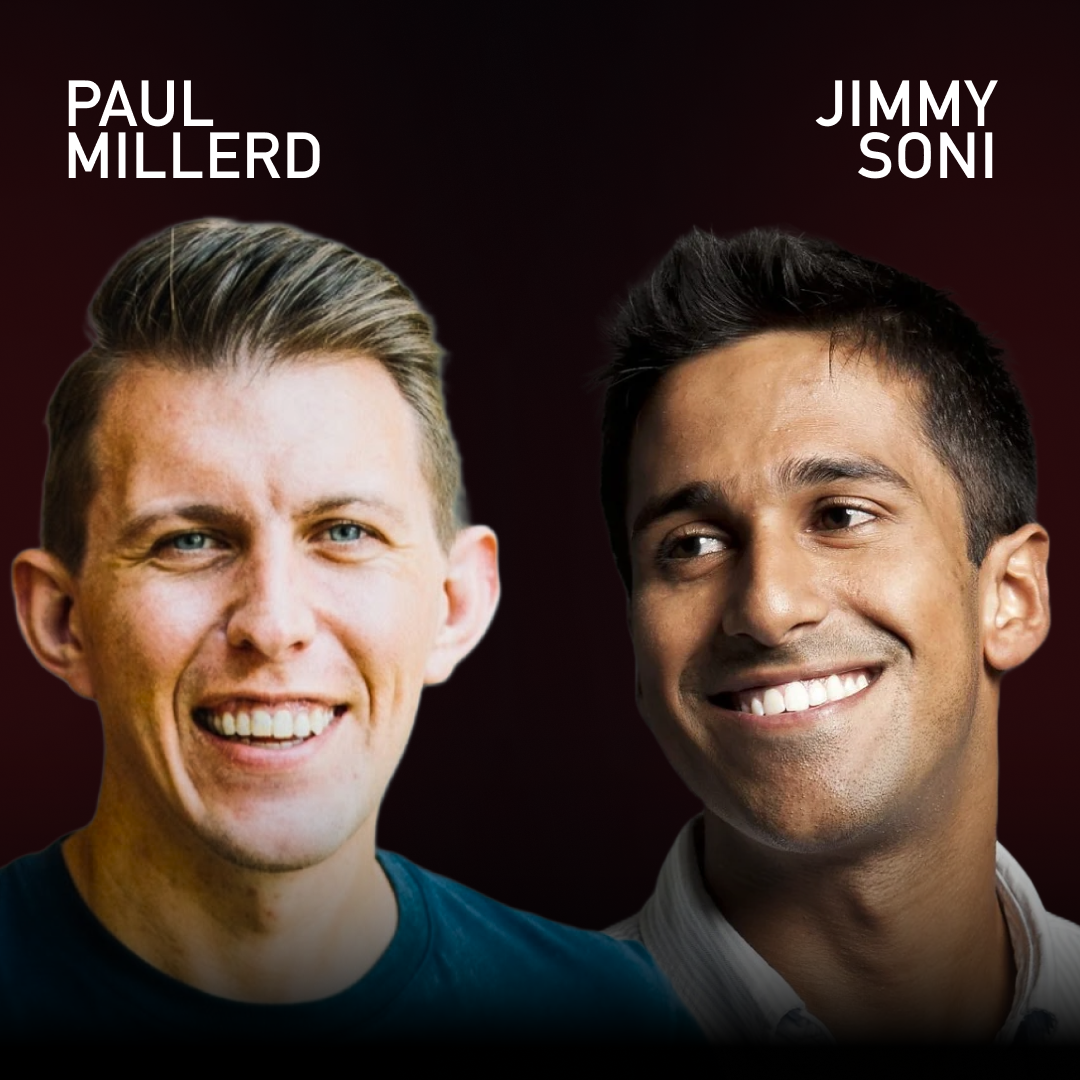
Infinite Loops
Paul Millerd & Jimmy Soni — The Creative Opportunities of a Boring Life (EP. 302)
01:30:08
Loading summary
Transcript140 lines
- [00:00]
Jimmy Soni
When publishers were like, well, you shouldn't really launch in the fall because you're competing against all the other fall books. I'm like, what are you smoking? What are you talking about?
- [00:08]
Paul Miller
My life is very boring. We have this weird cocoon of this alternate reality, but it totally just feels normal to us.
- [00:17]
Jimmy Soni
It allows you to have the discipline that creates the work product. Because if you are going to parties every night, you're going to be exhausted. I worked with really great individuals within traditional publishing, but I think the institutions have become a big problem.
- [00:34]
Jim O'Shaughnessy
Well, hello everyone, it's Jim o' Shaughnessy with yet another Infinite Loops tonight. I am very excited because you note I said tonight. It's tonight here, but it's a very early in the morning where my guest Paul Miller is. You are in a completely different time zone. It's your morning. We made you get up really early and this is just kind of easy for us. And I also have my colleague Jimmy Soni, the CEO and editor in chief of Infinite Books. Welcome guys.
- [01:07]
Paul Miller
Excited to be chatting books?
- [01:09]
Jim O'Shaughnessy
So, Paul, yeah, this is great. Let's start. Most people and those who don't know, let me give you the proper introduction. You self published a book called the Pathless path. You have 2.5 thousand reviews on Amazon for a net 4.5 star rating. Good for you. And your newest book is good. Reclaiming your inner ambition. You already have 170 ratings there on Amazon. You're doing something right. But you also, and I'm holding this up for people who are just listening and don't see this, you really are missing out because Paul just put out one of the most beautiful hardcovers I've seen, which we're going to talk about. Absolutely gorgeous. This is the kind of book that you really want to have on your shelf. Paul, congratulations. It is a thing of beauty.
- [01:59]
Paul Miller
Thank you, Jim. And you have copy number one. So if, if it becomes a collector's item in the future.
- [02:08]
Jim O'Shaughnessy
Yeah, we were talking. Jimmy, you weren't on yet. We were talking about that. Say I brought it to our OSB off site. But she had pre cleared it with Paul that it was cool for her to bring it. But I got to see it before Paul got to see it. So I did feel very, very special. But it's gorgeous. Paul, let's start with that. Jimmy and I are very aligned on this issue about physical books and making them really beautiful. Because books are beautiful and often when print on demand and things like that, you're just not getting a beautiful book. It's still Very educational and it's still really good for what you want the book for. But there really is something about a beautiful book holding it in your hand. Was that what motivated you?
- [02:58]
Jimmy Soni
Paul?
- [02:59]
Paul Miller
So his background. I self published a book, the Pathless Path, on my own almost four years ago now. I didn't really even think about marketing and selling it while I was writing it. It was just this extension of I like writing, let's double down and go deeper on books. I think through the process of writing it and launching it, I got into the world of other authors, the publishing industry, all these sacred beliefs about how you do a book and put things out, and found myself opposed to many of the ways of being and ways of marketing and sharing books. And I mean, my book was literally called the Pathless Path about sort of reimagining different paths in life. And so after my book was out in the world, started taking off, I just kept experimenting with different ways of sharing it, having fun. One of the big things I did was just gifting the book to lots of people because I found people like talking about it and gifting it to friends. And so about a year after I launched the book, Penguin reached out to offer me a book deal for the book that already existed. Long story short, I've written about this so you can look it up. They offered me 70 grand for the pathless path and 130 grand for a second book. They basically wanted me in their orbit and I was making about 10,000amonth in royalties from the book at that point because it just started skyrocketing. So after agents fees, they were offering me an advance of about four or five months of income. And their idea was to take it out of print, put a new cover on it, do something to it. They wouldn't give me details and then relaunch it. And so I just got a bit annoyed by this and frustrated. But also after the call, I was just so excited. I'm just thinking, wow, these are the best and I'm doing pretty good. What if I double down on self publishing? And people would say, oh well, self publishing people, you can't do a good hardcover. They just do it way better. And basically, I am a competitive person. I just said, hold my beer, let's see what we can do.
- [05:14]
Jim O'Shaughnessy
Well, Jimmy, I'm going to let you chime in because you and I have very aligned ideas about why we would go to all the trouble to start a more traditional publishing company. But we had a lot of the same reasons that Paul has, don't we
- [05:30]
Jimmy Soni
I was laughing and had to mute myself while you were explaining your story because you sort of gave the thesis for what we're trying to. And I think, I mean, look, it's funny. This is a rare podcast where I get to be one part audience member because I want to listen to you one part just like, asking you questions. So I guess I'm part host and I'm also a part contributor. So I'm going to try to balance those roles as best I can. But you experienced something that I obviously experienced as well with traditional publishing. And I think before we launch in, the disclaimer that's important is I worked with really great people, really great individuals within traditional publishing. But I think the institutions have become a big product, right? I mean, what happens is that you have these super talented editors, editors who would kill for their books and go the extra mile and do the work, and graphic designers who are doing incredible stuff, and copy editors that are just second to none, but they're locked in a system that is basically designed so that they can't do their best work either because they have so much of it to do, that there's no attention to quality control, or because the relationship between author and publisher doesn't. Like, for an author like you, who's entrepreneurial, you're like this entity they've never seen before. Like, wait, wait, wait, Paul, you know how to sell, market, create your own books, do everything. We've never seen that before. Right? And so when you justifiably ask a traditional publisher, well, where's the beef? Like, what exactly are you going to do with my book to make it so much better? And their answer is, well, just trust us. Right? That's not really a great answer for somebody like you. But I want to add the disclaimer of there are phenomenally talented individuals within that industry, but the entire industry, the entire process needs to be rethought for a digital age. Because in point of fact, like Paul Infinite Books, our publisher is, we have to offer something to you that you can't do yourself or cobble together with freelancers. And it has to be so good. And the royalties have to be in your favor because of what you just explained. And so that is the trick. And what I'm curious about is kind of there are probably people in your ear saying, take the deal with Penguin. What were you thinking about when you were having those conversations with them? Like, did it, you know, did you ever get to a place where you're like, maybe I should do this?
- [08:03]
Paul Miller
My story is 10 years in the consulting industry and then realizing the people above me are participating in committees and meetings and trading off creative choices for things they don't truly care about. And I quit that path because I really cared about creating and doing things that mattered to me. And so I had four years of doing that on my own or five years before I talked to a team like Penguin. And so it actually wasn't that hard to walk away from that. I also had played Prestige BINGO in my 20s, I like to call it. I literally worked at McKinsey. I went to business school.
- [08:44]
Jimmy Soni
I'm a McKinsey alum as well. Recovering McKinsey guy here, too. That's pretty funny. I didn't know that, actually.
- [08:51]
Paul Miller
Well, the funny thing is, I loved McKinsey. The people there were great and it pushed me to be better. But what I encountered. I had also worked at companies that weren't all that great. And what I encountered in talking to the publishing firm is I met people that just weren't up to my standard. And exactly like you're saying, though I spent nine years as a strategy consultant, it is not the people. The incentives do not enable the level of caring I wanted from the industry. And so looking from the outside in, it just, there's no way they can actually help me. The only way they could have helped me is if they offered me a big enough advance that they would then have internal pressure to actually deliver bold results for my book. And so it's really interesting being in some of these book group chats. Almost categorically the people who got enormous advances, their books are crushing it because they got the best teams and they got the best energy behind it from these traditional publishers. So they can really deliver, but they're not going to care about a book they spent 70 grand on.
- [10:06]
Jim O'Shaughnessy
Yeah, I think as far as disclosures, I am the first to also say I love books. I love everything about books. I've written four books. What works on Wall street literally made my career possible, and McGraw Hill published it. And I'm eternally grateful that that happened. But the more authors I would talk to, we all had the same complaints. And when I first met Jimmy and we were talking about it, I'm like, man, it sounds like, if anything, publishing's gotten worse from when I was doing my books in the late 1990s and early 2000s. And it just seemed to me that traditional publishers, again filled with really super talented people. But it wasn't. So the people aren't the problem. It's the design of the company. And the way that they do the things that they do that we think offers a huge arbitrage opportunity. And like every author that we talk to, it's just like, we kind of have met. Hello.
- [11:16]
Paul Miller
Because
- [11:18]
Jim O'Shaughnessy
Jimmy and I are both authors I've done for. Jimmy's a much better author than I am, but we have the same complaints. And then when we go and talk to others, it doesn't matter if you're talking like, I got one of the biggest advances for a personal finance book ever given in the late 1990s for how to Retire Rich. And yeah, man, they gave me. I was this featured speaker at the big conference at the publisher. They put me on the road. The book tour was grueling. They really threw all of their weight behind me.
- [11:55]
Jimmy Soni
And the book did.
- [11:56]
Jim O'Shaughnessy
Was a bestseller.
- [11:57]
Paul Miller
Yeah.
- [11:58]
Jim O'Shaughnessy
But then I got an opportunity to be on Oprah Winfrey, and my agent called and said, how many books do you have left? Because he's going to be on Oprah. You got to publish. You've got to print more books. And they were like, yeah, no, we earned out on that book. We don't need to do that. And I was like, are you insane? Literally, Amazon was like, I would go to Amazon after I was on Oprah. Only for five minutes, mind you. But afterwards it went to, like, number one on Amazon until it literally sold out. And I just saw it. What kind of analysis are they doing where they're just like, yeah, nah, we're done with that one. We're moving on.
- [12:43]
Paul Miller
Yeah. I think when you're talking to authors, you're winning people over because you have an optimistic vision. The thing I noticed about this industry, which I wrote about in the essay I put out called Reclaim the Book, is that it generates cynicism at scale. So the way I think about creative work is creative work should inspire more creative work. I'm so inspired by people like Jimmy. The most people, especially in the business world, don't know about the range of books he's done. Yeah, you've done books that are truly creative. You've done books just because you felt called to do them, and. And you're going to keep going. And so you're exactly the kind of person a theoretical creative industry would want to rally behind and partner with over the long term, because I guarantee you're going to continue doing more cool stuff. But what I find is all these authors. I was talking to somebody last week, I was like, we should partner on this small book. It would be great. We'd crush it. I don't know if I can do that. I'd have to ask for permission from my publisher. I'm just scared to ask because my book's not out yet. Another person said, my book didn't sell out. They're not even printing anymore. It's not even worth talking about. Another person said, oh, I. They gave me a weird subtitle and I feel awkward talking about it. So I just don't promote the book anymore. These are the most creative driven writers of our generation. What are we doing? And so part of this is I want to inspire more people to actually orient around decisions that maximize their creative longevity, creative bets, and doing things like this. We're not getting some of the best writing. Our best writers are choosing rightly to just stay on substack because they don't even want to engage with books because they see it as it's going to be too exhausting or it's just going to be draining. It's going to take too long and this is not good.
- [14:47]
Jimmy Soni
No, and I'll double down on this one. And I appreciate the very kind words, Paul. And likewise, I'm an admirer of yours and the way that you've literally lived the title of your book, like lived the pathless path, and then have inspired goodness knows how many people to do the same. This cynicism at scale thing is an important thing to combat because people, I think people underestimate the psychological toll it can take for somebody who submits a proposal or submits a piece of writing or has a novel. We had an author that we're still talking to. If I said his name, you would recognize his name. He's had multiple New York Times bestsellers, sold a lot of copies of his books, and he decided that he was going to do a book in a genre that was different from the one that he had had tremendous success in. I mean, made his publisher millions of dollars. And he went to his agent and he went to his publisher with this book in a different genre. And I'm being understandably very careful about the details here. And they said, well, you're really not that kind of writer. You should really stick to the way that the books you've been writing because those have done so well. And it actually, even for all of his success, it actually, I think it took an emotional toll, right? It actually like hurt him because it was, it was these people who he trusted with, with his creative, the fruits of his creative labor saying, no, we don't, we don't think this is very good.
- [16:18]
Paul Miller
Right.
- [16:19]
Jimmy Soni
Despite having no evidence that it's not very good. And having a lot of evidence that everything else he's done has been phenomenal. And I think people, when they, when they, when you're dealing with these things, people are like, oh, well, everybody could just do what Paul and Jimmy and Jim do and just like go off and be intrepid and do the thing and launch the thing. And I think there is this, this audience that we hopefully are speaking to where there are people who get that rejection and they're just gonna. That's. That's it. The project's dead, right? It. It sits there and it dies. And it's one of the reasons I really admire what you're doing, which is speaking directly to those people, to say there is a different way. Because that, that psychological, like jab is, is powerful. Like it can set people back decades in their work. And I think it's important to address it. I hate to say it, but this is one of the things that publishing does very badly. They say no to projects that have a lot of potential. And we see it again and again how there's so many successful books that they said no to or that they placed a $10,000 bet on or a $50,000 bet on. And then they go on to make million, like multi million copy best sellers out of those. Those authors are successful, but it's still so tenuous, even for them. And I think this is something you've identified that's really important to kind of talk about out loud, because if we don't, the industry doesn't change.
- [17:36]
Paul Miller
It's this industrial age mindset that says you have to fit into a specific job type, a market niche, things like this. And maybe that made sense in 1980 when there were just less distribution and you really did need to hammer specific marketing channels. But the Internet changed all of this. This and we're just pretending like it doesn't exist. The publishing industry still prices ebooks incredibly high, and they're not taking advantage of price discrimination and pretty basic economic principles to push different things to different audiences and maximize the scale of things. The Pathless Path was ultimately a niche book that resonated with a very specific kind of person. And through ebooks, I was able to sell a ton at a low price and then build a lot of interest to where people are now buying things like paperbacks and now my hardcover. And so you can bootstrap a career. But there are just all these things that are not factored into the traditional system. And a lot of people take those ideas and just assume them for work they're doing on an independent path too. And I'm still pushing the boundaries of what's possible and all the things you can do. It's still so early. There's so much opportunity and potential for doing different things and just hammering home like very specific niches and like delighting these people. And so I'm willing to burn a lot of personal capital and actual financial capital to figure this out. Mostly because it's fun. And so if it inspires other people to take weird paths, that's great.
- [19:24]
Jim O'Shaughnessy
Yeah. And your point about us being locked into a mindset that may have been appropriate for the industrial era is such a great point. Like one of the things I often say is, yeah, publishing is using best practices, but the problem they're from 1925, not 2025. And like a whole lot of incredible innovation has occurred over that time period that gives you so many different paths to go down to get a book in front of the right audience. We now have the ability to literally segment. You say you're a niche book, right? Well, the tools now exist to get that type of book in front of the very people who are going to want to read it. And this whole idea of using a shotgun approach or throw everything against the wall. Sure, I understand that. Before the Internet, before AI, before all of the various tools that you can have to really get a customized marketing plan that doesn't just last for two weeks, it lasts for years and years and years. Because that's the other part. Like the example I gave with my book, like, no, we earned out, we've moved on. And that is so short sighted because you are a testament to this. The public was able to read your much reduced in price ebook. You start building an audience and guess what? They start telling their friends and they're like, oh, I should check that out. And then all of a sudden, yeah, I'd really like a hard copy of that. And then, voila, you've got a real franchise. That I just. It offends me as a capitalist that they're leaving all of that just sitting there unaddressed.
- [21:23]
Paul Miller
Yeah. Imagine how many books I know you've purchased the rights from some books from the big publishers. There's so much potential and you don't need that many readers or fans. There might be 5,000 readers of a book, but they're maniacs and they want like 10 more books or 10 different versions. And so the real enemy is not actually the traditional publishers. It is the fact that the narratives and Propaganda around this industry have a psychological hold on people. And so because of that, authors don't even consider alternative paths, and people don't consider building new publishing houses and new options. However, I sense in the last couple of years, there has been a shift. I'm already seeing multiple firms like yours which are making the bold bet, and it's still such a challenging industry. It's really hard to make money at scale. The natural trend line of a book is maybe up, and then it either plateaus or goes to zero. That's incredibly hard to build a business. And there's a reason all these big publishers are making money off a long backlist and use that to fund the business. But if you start thinking beyond books and start thinking of writers as people who are creative people, there are just so many other avenues.
- [22:56]
Jimmy Soni
I think the other part of it is the natural graph on a book doesn't have to follow that trajectory. Right. That if you're a careful steward of a book, whether as an author or as a publisher, and you continue to do promotion, knowing that, like, there's an asymptotic limit, right, of potential readers, but you'll never hit it. And so you should just continue to promote and promote and promote in ways that are not smarty and weird. Just like, organically finding your audience, connecting with that audience, pushing it to that audience, and then finding new audiences. You know, like my. One of my. My last royalty check for the founders was bigger than the one before that one, right? And that's a powerful signal. It means that in the. In my latest, like, the latest six months or whatever, the royalty system itself is just so screwed up. And you get these, like, pieces of mail that they have hieroglyphics on them. You have no idea what they say.
- [23:49]
Paul Miller
Right?
- [23:50]
Jimmy Soni
I mean, it takes, like a PhD to understand a royalty statement from a big publisher. If someone's figured it out, drop me a DM on Twitter because we'll hire you. But the point is that I knew then that what I was doing was working because I had found a new audience for this book. Knowing that the book is evergreen, that there's going to be always, always going to be interest in a subject like this. And I think that is actually one of the things that you identified as well, that, like, you, you. You can make the business work. You just have to not spray and pray and publish a thousand titles a year and hope that a few of them are super successful and then write the rest of them off.
- [24:25]
Jim O'Shaughnessy
Right?
- [24:26]
Jimmy Soni
Which is a model that, like, it just doesn't work in this industry. And also you're taking people's like blood, sweat and tears that they pour into creative projects and saying, well, we've got 10 titles that we're going to make work this year. And the rest of you, good, good luck to you. You should be so lucky as to have published with us. Right. Which is just super unfair. And it's what you said, it's the, it's the myth making, it's the artifice, it's the kind of like, like it's the storytelling around the industry that, that has made this seem like, well, you should be so lucky that a publisher wants to work with you because there's no other way to do this. And then you're consigned to the dustbin and then authors get frustrated and they never come back and do another project.
- [25:05]
Paul Miller
Well, it's also just, it's sort of sad because there probably was a really cool win win offer. It looks something like, oh, we're gonna, we're gonna double down your book. We're gonna keep it in. We're gonna let you keep ebook rights. We're gonna release a workbook for you. We're gonna get that out in two months. We are going to release, release journals. We are going to like do some really cool stuff with, with the brand and help you double down on that and, and make money from it to help spread the meme. But they just have one move. And so the Internet really, I mean, Jim talks about this in every episode. The Internet changes the economics and dynamics and possibilities of literally everything. And we have not caught up yet mentally to actually build businesses that are thinking about that from first principles outside of the tech world. And a part of keeping my book was just betting on that future, knowing that, okay, my book is spreading. The emails I get from people are insane. They send me long essays about how it's changed their life. And seeing other models of books that have sold for a really long time and realizing, okay, I care about this book. The industry is going to keep presenting more and more interesting options. All I need to do is just wait and keep doing what I'm doing. But for them, my level of caring about the book is actually incidental. In their business case, it doesn't matter. And so for me, I valued the caring so highly. And I don't see it as a cost to talk about my book and promote my book because it's literally just part of my life. It's so fun. I love this so much. I love writing. I want to keep doing This. I want to keep living in this way. And so, yeah. And so if somebody came to me with creating an interesting, creative and interesting and bold, optimistic ideas, I'm down to collaborate with anyone. But those people are walking through this door. Yeah.
- [27:16]
Jim O'Shaughnessy
And the other thing that we know by studying both writers and the industry itself is, is like, you guys, you and Jimmy are the ideal authors because you're both. You think like entrepreneurs, you think in strategic terms, you reason for first principles, you love to promote your own work, etc. What we're hoping that Infinite Books can also unlock is the author who prefers to. They're not that aggressive as you or Jimmy. They're incredible thinkers, they're incredible writers, they're really creative. But they're, you know, they're a little more reticent about the whole marketing aspect. And for, for those types of authors, we think that the, the package of services that we are going to be able to offer them is going to, like, make it as fun for that type of person as it possibly can be. Right? Like, nobody, nobody wants to go on. As Jimmy said, it's spray and pray, right? Nobody wants to go on a podcast where the host has literally no idea about your book. They just, you know, they got it pitched to them. They're like, oh, yeah, this might be a good guess. And somebody else does the research forum, and they're reading the same 12 questions that they get on every other podcast. And like, that's. That's not a fun podcast to be on. A really fun podcast to be on is one where the author or the podcaster read your book, loved your book, knows like, to your book so well that he or she is going to ask you questions. You're going to be like, wow, nobody's ever asked me that about my book. And then the whole process is just far more enjoyable, far more fun. The author, him or herself becomes far more engaged. Because it's not just. I remember doing like the. The drive time radio on satellite. So I sat. I sat in an office in Manhattan and we started with east coast drive time and then we went west, Right. And I did, I don't know, 35 interviews. And it was just so obvious, with the. A couple of exceptions, it was so obvious that the radio person I was talking to had no idea who I was.
- [29:43]
Paul Miller
Yeah. And literally the same question quoted in my book. Jim.
- [29:48]
Jim O'Shaughnessy
Yes, I.
- [29:54]
Jimmy Soni
So, Paul, I have a question for you.
- [29:55]
Paul Miller
Yeah, go ahead.
- [29:56]
Jimmy Soni
What prompted the. Was the hardcover the natural. Like, how did you approach the hardcover differently than the paperback? So what were Some of the principles, the thoughts that you use as you were designing it because it's a beautifully designed, like it's an objet d', art. Right. Like it's actually like something that people would feel proud to feature in their homes. I'm curious like what that process was like for you that was distinct from doing just the paperback.
- [30:21]
Paul Miller
Yeah. So the paperback and ebook I just sort of put out. I think after I launched, I actually learned a lot about how to forward format and design a book. I definitely made a bunch of upgrades over the first year as the book started taking off and learned a lot through the process. I think it was always this question of okay, printing hardcovers is not super easy. You can do them through ingramspark. They're not. I think paperbacks are on par with the ones traditional publishers do, like through Amazon, unless they're investing more in a special paper or something. But the idea was, okay, how could I do something that's really interesting in hardcover? And it started out mostly with a question of how could I create something that's interesting and high end a bet on books itself. Because people have always said, oh, you should do speaking gigs, you should do courses, you should do all these things. And actually just wanted to make money from books. So it started with that. After I turned down the deal with Penguin, I saw this book from the Steel Brothers. It's this reimagined version of Walden and the front cover is just text and it had these bolded words and it was just beautiful. And I joked that I felt mimetic desire for a book instead of somebody else's life or something. And so it started with that and I started talking to people. After I talked to a couple hybrid publishers who were talking to me about print only deals. I eventually found Saia and as soon as I talked to her, she had a very similar vision and care about the book itself. Now when I first started it was I was very scared to spend money. I've been working on my own money and securities and going through a process on that. And so originally it was like, I'll spend like 10,000. And I think throughout the process, my goal from when we started is I want to create the sexiest book people own. And so in order to actually do that, I had to abandon business thinking through throughout the process and like I joke, MBA Paul was in my head like this, this isn't going to net out, this isn't going to be a smart decision. But part of the process was, okay, I do have some cash flows. I Could take money from my royalties. I did have this crazy year where I earned way more than I was spending. What if I just say screw it and go beyond the rational business model thinking of this to actually push the limit of something that is truly extraordinary, beautiful. And so saia will keep giving you options to spend more and more and do more beautiful things. And I just basically kept riding the wave and checking my bank account saying, okay, I'm not, not going broke. I can still fund this from cash flow. I had a huge moment of panic the two weeks before I launched it and announced it. But now that it's out there, I've sold, I pre sold close to 200 books and I'm feeling good about it. That's about probably 30, maybe 20 to 30% of my investment and I'm feeling a lot better about it. I think in the next couple of years it's sort of this idea. I'm going to pivot more to direct sales, continue to sell this. People are going to continue discovering the Pathless Path. My other book, I'm going to start selling Good Work and the Pathless Path direct through Shopify as well. So I can start experimenting with bundles, putting the audiobook on there. And so there's a lot of potential there. I can also sell this journal I created that's of the part. Part of it. And so it, it really is a pathless path on this journey. Will it work out financially? I don't know. But I think I can still win even if it doesn't turn out financially because I've now just basically made this crazy bet and people will be like, well, Paul's just this insane person that's going to do these things he cares about. And ultimately, yeah, as a branding exercises exercise, maybe it's expensive, but it can work. And there were also other people that have proved that this can work. Craig Mod with nonfiction books and Brandon Sanderson with fiction books. I don't have as big a reach, an audience or as impressive friends as these people. But my, my entire path has always been how can I do the thing before I'm theoretically ready? Everyone thinks, oh, I need more money or a bigger audience to do the thing. And I'm always just more curious about how can I do that now before it makes sense.
- [35:32]
Jim O'Shaughnessy
So what, what was the, what was the pivot point where you mentioned like you were really anxious about spending that amount of money? What was there a certain satori or aha moment where you're just like, it I'm going to do
- [35:50]
Paul Miller
was a Continued series of it. I think, I think I realized through this process I just. I care so much about the creative decisions and the delight of. I mean, as a writer, I don't think about making money ever really. I'm walking around all day and thinking about sentences and paragraphs and how do I pull together a paragraph and package that and how could I reword that? And it's hard to still make money. But that's how I felt about this book. It's okay. I want to get these texts on a page that's never been done. Hiring a high end illustrator is very expensive. But she showed me some of the first drawings. The COVID was one of them. And then it's just like, oh man, this is what I want to be spending my money on. I'd rather be spending my money on this than Amazon ads or any other growth strategy. Right. So I think for me it was one, just spending in the direction of my creative impulse and that gives me energy just as a human. And then two, I don't know if the fear fully went away. I think launching and getting people actually buying it is very energizing for me. I'm not a launch person. I don't like promoting stuff before it's actually out. It's way more fun once it's out and people can engage with it and talk to. Talk to other people and talk to me about it.
- [37:22]
Jimmy Soni
Yeah, that's it. I mean, you're speaking, you're speaking my language and Jim's language almost word for word, right? And I think, I think just to, to put, you know, a little bit of a message around it for people who are listening, you know, who might have a book project that they're working on or a writing project or it might be some other project. What I love about your story is it has all these like, echoes of other great creatives who, when they couldn't find the system that worked for them, built the system themselves, right? So it's sort of Steven Spielberg like, like being a renegade, right? Or it's. It's one of my favorite stories is, is Dr. Dre doing the Chronic where he recorded himself, did the art himself, did everything himself and nobody wanted it. And it became one of the best selling rap albums of all time. Right. This is Dave Chappelle walking away from the Chappelle show, right? One of the biggest show at that time on Comedy Central and I think one of the biggest on television, period. Walking away and coming back and having an even bigger second act, doing what he does now. But then Even then deciding to do it on his own terms. And I think what. One of the things that unifies you and unites you and those people is if you are a creative who knows that the creative impulse or the thing itself can give you that kind of energy, but the system hasn't quite fit itself to you. You just gotta blow up the system or find fellow travelers, you know, like us, who are actually willing to blow up the system with you. Because I think that that's, that's. That connects this part of the conversation with the earlier part of the conversation, which is if you don't protect that impulse, if you don't blow up the system, then, Then you end up, you know, doing. You end up looking back with so much regret all these years later that you didn't take that kind of risk. And I think that's. There's something to that that I think is bigger than just books. It is actually about, like, taking those systems and reconfiguring them to fit the creative impulse that you feel, which is exactly what you did.
- [39:22]
Paul Miller
Yeah. It's about living a life, essentially. And all these people will say these things like, oh, a publisher is the best chance to reach the most amount of people. And. And so my goal is actually not to reach the most amount of people possible. That's just sort of a cliche. People say, my goal is to reach the most amount of people possible while also protecting my energy to keep playing this game I enjoy so much. And that second part, we have systems and structures which do not fit that in on a spreadsheet. I know because I used to build the spreadsheets in Excel. There's no line item for the energy or capacity or desire to keep going on a path. It's literally incidental. It doesn't matter to the system. And so throughout history, every creative has battled this. The great thing about today is it's never been easier and cheaper to share your work with the world. People literally risked death even 30 years ago. People literally had to drive to the library to quench their curiosity. It's so easy now. And we shouldn't sell it out. It's such a privilege to make any sort of living from creative work. And I, I really take this so seriously. And I just can't imagine selling it out because I already sold out my desire for caring once in my 20s, and just. I don't know, I, I had a job once. I, I was working for other people that made me do stuff I didn't want to do. I, I don't Want to do that again? If I can help it.
- [41:15]
Jim O'Shaughnessy
Yeah. I think that that is a growing movement among creatives of all types where they're just sort of, like, looking like you've done, and, like, you know, that traditional system just doesn't fit me. And they just happen to be lucky enough. Like, I still say this all the time. I am just so happy that I am alive at this point in history, because this has the makings of a second Renaissance, in my opinion. This literally is an unlock for so much creative work to be done. And as Jimmy pointed out, like, in the old days, those people took real risks, you know? Yet Galileo, nevertheless, it moves right, and you're going to recant, or we're going to burn you at the stake as an apostate and a heretic. And, gosh, nobody today is going to get burned at the stake. They might get canceled, or people might be mean to them on Twitter. But come on.
- [42:28]
Paul Miller
I always think of these hypothetical conversations with creatives from hundreds of years ago. Somebody like Van Gogh, who died sort of in despair, didn't get to share his work with the world. And he would just be talking to you and saying, wait, you can just post your stuff to the Internet. That must be so expensive. No, you just post it for free. Wait, what do you mean? But everyone's scared of doing this. They don't want to do it. Wait, what do you mean? People are scared. It's free.
- [42:59]
Jim O'Shaughnessy
They can just.
- [43:02]
Paul Miller
They would freak out. Or even women throughout history, they would say, wait, I can just share my actual name and write and create as a woman. Like, yeah, people do it every day.
- [43:15]
Jim O'Shaughnessy
It's in that context I just find so meaningful. It's so easy to, you know, oh, this is awful. Or that's awful. Or. And look, I'm not minimizing. Of course there are a lot of problems in the world, but I think a. It's worthwhile to point out all of the incredible progress that's been made. We were talking about it the other day, like, my sister, when she got married in 1971, had to go to court to keep her maiden name. She had to go to court to keep her maiden name. And that same year was the first year that a woman could get a credit card without her husband's permission. They used to require the husband's permission in the United States. And, like, when you think about that, at least. I don't know about you guys, but that I. I was 11 when all that was happening. But that blows my mind that that was that short A time ago. And like, we have made real, real progress on a lot of issues that should be like, celebrated, that we should be just cheering on. And the point about like women in the prior all of history, if they wanted to write a book, they did it under a man's name for the most part because it just was not an option. So the optionality of the world that we live in today, I just don't think it's ever been this great. And I'm curious, Paul. I just had Ken Stanley on who adds the great book greatness can't be planned. And I agree with a lot of his philosophy. So on your path right now, are you seeing any pivots? Are you seeing any. You know you're going to. Ooh, that looks like some fresh ground. I. I'd like to start a path on.
- [45:22]
Paul Miller
It's pathless, Jim.
- [45:26]
Jim O'Shaughnessy
Yes, but the irony, of course, is that you now have quite a beautiful path as your book shows.
- [45:35]
Paul Miller
Yeah, I, as you were saying that I was just looking over. I have my Chinese traditional Chinese version here. This was published in Taiwan in July, which is, which is wild. And it's an important part of my story. My wife is Taiwanese. She's connected to this place. She's putting her book out in Chinese in Taiwan soon and then we're going to co translate it together in English. And the thing about this is a lot of these things are not rational ways to be spending my time. But the longer you're on a path like this, your income becomes separated from specific action. Right. I don't get a specific wage for putting in effort on a certain day. And so eventually you learn to just trust your instincts on things. And so my book was published in Taiwan. I don't really make much money by promoting this book. Maybe I'll make some money if it goes bananas here, but I'm doing all sorts of events here mostly because it's really fun and I'm connecting with all these people and it might lead to serendipity. I mean, it wouldn't be an Infinite Loops podcast if we don't reference moving from a deterministic world to a probabilistic world. And so moving to a probabilistic world.
- [46:59]
Jim O'Shaughnessy
I don't have to say it now. I know.
- [47:00]
Paul Miller
So thank you. I have my Infinite Loops bingo.
- [47:03]
Jimmy Soni
If you take a shot now, that's part of the drinking game, actually.
- [47:13]
Jim O'Shaughnessy
And repetition, repetition, repetition. When you say it for the 110th time, they're like, what? What you said. Go ahead.
- [47:27]
Paul Miller
I think the interesting thing about the probabilistic world is you can actually play that on nihilistic mode or optimistic mode. And the optimistic mode is when you're aligning it with your creative impulse and what you actually care about versus, like, oh, I'm just going to spray and pray podcasts and hope it goes off. And I don't care who I talk to. And so I try to lean into that second direction. This is a long way of answering. I think I am trying to lean more into books right now. I still do make some money from doing workshops, teaching consulting skills to corporations and running a course around that. I'm really good at it. I do enjoy it when I'm in that mode. But I think, when I think 10, 15 years from now, I want to write several more books, I want to do more experiments, and I've really just been following my energy recently. I've had several people reach out to me, talking to me about potentially being a book coach for them and even publishing their books. So that's a direction I'm thinking about. I don't really know, though. I think it's. It's hard for me to. I think I'm not wired to make all. All or nothing bets. This hardcover bet is sort of the biggest one I've made by probably a scale of 10x financially. But I suspect this is going to open a lot of doors, both in my own imagination, because I've sort of challenged myself and pushed myself to grow and then other people who might be inspired to work with me and do things like that. But yeah, I think books, I want to just keep doubling down on books, moving in that direction, trying experiments. And I'm not. I have no idea how I'm going to make money and fund this path two years from now. But I've so surrendered to that, to being okay with that, that I'm excited to find out. And the great thing about a writer is you can write about that. And then people are like, this guy is not. I'm going to just read his book to absorb this energy.
- [49:33]
Jimmy Soni
So I have a question about this, Paul, that is a bit of, again, bringing it to a domain that will speak to people who are listening. But it's something you said that I think is really interesting, which is you have a wife. I believe you're also a father. And so I'm curious. This game was different when I was doing it, and I was much younger and had nobody depending on me. And I could take these kinds of risks. And it was okay because I could get to ramen profitability on a book and it didn't matter. And if something failed, it didn't matter. And I knew I could always sort of pick myself up, dust myself off, get started again. But the stakes become higher in your situation and in the situation of other people who are listening. When you do have people who depend on you. What are. What's the kitchen table conversation like about creativity for you with the kinds of risks that you're taking creatively? Because I find that to be super interesting. There's that. There's a Cyril Connolly quote I hate that's like that. The greatest enemy of art is the pram in the hall. And I couldn't disagree more.
- [50:41]
Paul Miller
Right.
- [50:42]
Jimmy Soni
I think my daughter has been a huge, huge booster. Like the most rocket fuel for my creativity ever was my daughter being born. But I'm curious what it looks like when you're navigating a family dynamic and also trying to live a pathless path where somebody else in your life might say, well, we need a path here.
- [51:01]
Paul Miller
Yeah, so I didn't marry that person. My wife is probably more comfortable with the unknown and financial uncertainty than me. And so step one, marry the right person. I can't solve for somebody that. That doesn't support this path. I think too, like you said, once you have a kid, there becomes this sort of, I have enough resources and knowledge and background. I can make money if I have to. But the point of my path is not to just optimize for money. If my kids and wife need financial resources, I'll go do a consulting project. I don't care. But in the meantime, so I do a quarterly check in. My wife does not worry about money. She just sort of trusts the universe. But we do a quarterly check in. I send it to her. I started because I was saying we should probably talk about money a little. She just sort of trusts me and supports me in whatever I want to do. It's priceless to have that. But I do a quarterly check in and I'll do. Okay, business income minus cost of living. What are the savings? Okay. What is. What is the cash I have? And then maybe some money I'd be willing to tap into. How many months does that give me? As long as that's above 12. I'm going all in on my creative stuff. And so sometimes I am doing projects to make money. I still have that other business. I will do workshops for companies and my goal there is to design it around my writing life. So I price high around finite projects. So I'll do a two hour Workshop with a company I price high. If they're not interested, I don't do it. And so I'll do a series of those throughout the year opportunistically. But that's not where I'm spending my energy and helping trying to build that business. So the interesting thing after I finished my last book is that I basically stopped working for a year and took care of my daughter as my wife started writing her book. We decided as a family, I did have extra income from the pathless path coming in after my daughter was born that we would bet everything on the creative vision of a life we wanted. And so I was taking care of my daughter three to four days a week during the work week while my wife was writing her first book. And she had a lot of to learn. She had to level up as a writer. She had developed better practices. She had to grow as a person around her creative work. And it was a huge cost because I was not focusing on my work. I wasn't promoting my book book. I was struggling with a loss of connection to my work. But it just felt like the most interesting choice. And it. It's really hard to explain to somebody that maybe isn't a traditional job, but at the end of the day, the bigger risk is not doing this, not surrendering to these creative projects. I mean, the satisfaction from finishing my first book was so incredible that I sort of realized at the end of my life, if I can knock out 10 of these books, that will literally be a good life. And so I am just. Me and my wife just desire less material possessions than most people. We are living in Asia now, so we can basically live a really good life on way less money. And we're constantly designing and experimenting our life to fit our creative work being a priority over the paid work. How long can we make it work? I don't know. But I'm going to keep going as long as there's money to fund the journey.
- [54:48]
Jim O'Shaughnessy
You know what's funny is I just watched the documentary on Scorsese on Apple. I don't know whether you have seen that.
- [54:56]
Paul Miller
I haven't seen it yet, but.
- [54:57]
Jimmy Soni
But I haven't seen it yet.
- [54:58]
Jim O'Shaughnessy
You sound a lot like him. Like he. He just was completely driven by his passion to make movies. And there's a lot of stuff about him. I'm a big fan of his work, but there's a lot of stuff in that that I did not know. I did not know, for example, that asthma kept him inside. He grew up in a very working class lower east side of Manhattan in a time when it was a rough place to grow up. But what was really interesting about it was he just would not give in. There was a great line when he was showing the Departed. They had this group, all of those young directors who really changed America cinema in many respects. George Lucas, Spielberg, Coppola, they all got together and showed each other their work, and they kept that tradition up. And I was really taken by a remark that Lucas made to Scorsese after the end of the Departed, which has both Matt Damon and DiCaprio as its two leads, and they both die in the movie. I don't think it's such an old movie that I. Yeah, I don't. I don't think I'm spoiling it for anyone. And Lucas, the first thing Lucas did after watching it, he looked at him, he goes, great movie, but you do know that you could make 10 million more at the box office if you let DiCaprio live, because he was playing the good guy. And Scorsese was like, I thought about it, and I knew he was right. I knew he was right. And he goes, but I just couldn't do it. I couldn't do it because that would ruin the entire movie the way I had envisioned it. And so listening to you, Paul, it just reminds me a lot of that. But then I also have the question for you. What's been the reaction of your more traditionally minded friends and family? It sounds like you got super lucky with your wife and her attitude. But how about others? How about family and friends?
- [57:13]
Paul Miller
I don't have any normal friends anymore.
- [57:17]
Jim O'Shaughnessy
Preach.
- [57:22]
Jimmy Soni
My friends are all on this podcast, guys.
- [57:28]
Paul Miller
No, but. But really, I've. I've. I have intentionally sought out people on weird paths. I think it is vital for this kind of journey. You do need people. I call them digital mentors, too. When I hear Jimmy talking to David Perel on how I write about his journey, I'm like. I'm walking around and I'm like, hell, yes, this person exists. I love it. He makes coffee table books and weird books about carousels. This is the way, like, I'm. It's so important to have these inspirations in your life, and you don't even need to be really friends with them. You just need to know they exist. They give you proof that things are possible. And so, yeah, I've been lucky to have a lot of great friends. I think a lot of people in my family are from more traditional paths. My parents are definitely a little triggered by my path. I think they would still prefer I go back and just try to make more money in a traditional job. But I. I think there's also a nice thing about a lot of people in my family and maybe some of my friends not really caring about my path. And I can just sort of be Paul and not fully this creative person. I think a trap sometimes in the creative circles is that your work and your identity become fully as one. And so, yeah, I'm sort of grateful that, like, not everyone is just seeing me as. As this person that is this creative online person. But, yeah, I mean, I'm eight and a half years into this. The first few years are very hard. I really, really struggled with a lot of the insecurity, and I literally felt like a bad person. Like I had broken some sacred covenant that adulthood is supposed to be spent in employment and on this steady career trajectory. But that is ultimately what my art and writing is about. Sort of transcending that and finding this inner sense of contentedness and accepting that you may never fully fit in a track, but, you know, you can make choices that feel good. I feel way more grounded on this path than I did on my previous path, which doesn't make sense to people who haven't experienced this sort of contentment and alignment with a sense of work and the people in your life. But, yeah, it's very weird. I don't know I'm going to make money a couple years from now, but I feel way more secure about my life because I'm not spending it, my days doing things that are undermining my, like, ability to show up and care about my life.
- [60:14]
Jimmy Soni
You made a point.
- [60:15]
Paul Miller
I want.
- [60:16]
Jimmy Soni
I want to really, like, underline. And it connects two of the things we talked about. And it's funny, I'm in the middle of a book project about Kobe Bryant, and there's a moment in an interview that Kobe did with GQ where he has asked the question, do you have friends? And this would seem to be for one of the most famous people on the planet, somebody who is, well, you know, like, could. Could be picked out of a crowd in any crowd in almost any country in the world, would be an easy question to answer with yes. And he has to pause in this interview. And he looks. I guess he looked down and he looked up and he said, I have like minds. He said, I don't have friends. He said, I have. He's like, I. And he elaborates. He said, I'm very fortunate that I live in Los Angeles, because he said, what I am surrounded by are people who are as obsessed with their craft as I am with mine. And the benefit is that they might not be friends in the traditional sense of the word, but when we get together we have the best conversations you could possibly have. He said, am I the person that's going to remember that it's your birthday? No. Am I going to remember significant milestones in your life? Probably not. But if you are one of those people who are my friends who are one of these like minded people, we will have the best conversations you could ever have. Like they would last you, they would fill your cup up for a lifetime. And so that Paul really resonated with me because it's very similar for me. I do not have what people would regard as normal friendships. Right. We might get together once or twice a year, you might have one five hour conversation and then not speak again for a year and a half.
- [61:52]
Paul Miller
Right.
- [61:53]
Jimmy Soni
Something like that. And I think there is something about that that is part and parcel of this kind of life because you simply cannot connect with. At least I have a trouble connecting with people who have more traditional working lives or whose even whose working lives have an off switch. Because I'm sure that it's true for you that I'm like you, I sort of wander around the world and I'm like seeing books I could write or seeing paragraphs that need to be improved or seeing authors that I could work with to get their work out there. It doesn't stop, it doesn't ever turn off. And you have to actually find people who are willing to tolerate that. It's almost a tolerance for that kind of insanity. Right. Like, I am very fortunate that my girlfriend like can very is very similar and can very much deal with, okay, this is going to be an always on kind of thing and we're always going to be engaged in this kind of stuff. But you're right, it's very hard to find friendships and romantic relationships and even colleagueship that can support that kind of life.
- [62:49]
Paul Miller
Yeah. The. I was on a phone call with Billy Oppenheimer who's working on a book right now called the Work is the Win. And we were just talking about book structure for like two hours. And I got off the call and I was just like, how could I explain this to somebody that doesn't write? But I joke that writing is not a strategy as it has become popular online. It is an affliction.
- [63:19]
Jimmy Soni
Yeah.
- [63:19]
Jim O'Shaughnessy
I can attest to, to that having written more books.
- [63:23]
Paul Miller
Right. I have no choice. There's no strategy in it. It's like if I don't write. I become grumpy. Like, me and my wife, both of us, we haven't written for a week. We both just need to, like, go to our separate rooms and write some words so we can get back to normal.
- [63:40]
Jim O'Shaughnessy
Yeah. And it's kind of like, what. As the conversation is progressing, what I'm seeing is the uber structure of. It's just a different way of looking at the world and of looking at life, because I'm very much like you guys. I don't have an off switch either. And I've only worked for one other company that I didn't start or own, and that was Bear Stearns. Because I had this opportunity that was pretty huge offered to me, and I'm like, okay, I'll give that a try. But even when I was there, I had an exit strategy. And, like, it was so weird for me because that was really the first time in my life that I came into contact with the people who, like, did the Ladder, Right? And, like, wait a minute, you're a senior managing director and they just hired you? And I'm like, yeah, how'd you do that? I said, well, they asked me what title I wanted, and that's what I told.
- [64:40]
Paul Miller
But see, if I. If I had to go back to the workplace, that would be me, too. I'd be like, I'll. I'll be C level. I'll work three days a week remotely, four hours a day.
- [64:51]
Jim O'Shaughnessy
But. But. But I. You know, I haven't really ever given this a lot of thought, but it's so true. Like, when I started my first company, we just moved to Greenwich. The company was already started, but I was just trying to get it going. And we had dinner with this couple. Our kids were at the same school. And so the guy was from here, and he was saying, so, what do you do? And I said, well, I have this company which. Honestly, Capital Management. Oh, yeah. Asset management. I went, yeah. And he goes, well, so who backed you? And I went, what do you mean? And he goes, who backed you? And I said, nobody. I just started it. And he looked at me and he goes, no. He literally said, now this is 1991. And he's like, no, no, that's not possible. He literally said, that's not possible. And I went, well, it really is, because I did it. But the incredulity of it. And now as I'm listening to you guys, we must be a real massive pain in the ass to have to deal with by all the other people in our life.
- [66:03]
Paul Miller
Yeah, it's it's funny because at home I just feel so normal. Our daughter has a very basic routine for a toddler. We have a structured sleep schedule. Our father in law helps us with watching her. These days we cook, clean, change diapers. My life is very boring. But then I share some of the details of what I'm doing and how I'm living and people are just shocked. But to me and my wife, it's just. I don't know, it's just our life at this point. I met her in Taiwan seven years ago. I wasn't making any money at the time. I had no plan. I hadn't really committed to writing yet. And so we've sort of been able to build it together. And so we have this weird cocoon of this alternate reality, but it totally just feels normal to us.
- [66:55]
Jimmy Soni
Do you think that the normal parts of your life are part of what make the other parts of your life that are kind of wild and ambitious possible?
- [67:04]
Paul Miller
Yeah, I think I sort of joke that I'm the conservative lifestyle person in the broader creator economy. Like, I'm married, I never go out, I don't drink, I spend a lot of time with my daughter. I really care about family and community commitment. And then, yeah, I can just be a nut like shit. Posting on X and calling out the traditional publishers and doing all these things because yeah, my life is stable, my relationship is very strong, I have great friendships. And yeah, so I do think there is a balance there. I notice when some people in the creative world also have a very creative life, I might say it's. It can lead you to the ditch, it can. You can burn out, you can really lose yourself.
- [67:58]
Jim O'Shaughnessy
Yeah, I think that is kind of an internal balance. Right. As I was listening to you, I was just thinking, wow, this guy's like a natural daoist.
- [68:08]
Paul Miller
This is why I live in Taiwan. So all the Taoist temples I can walk around and see. Yeah, yeah, I. I love when you talk about Taoism because I think for me it really is like the, like the pathless path is the most Taoist phrase and totally. It really just resonates with me and it's such a. I think modern culture is very Confucian, but Confucianism, balance is Taoist. Right. The Taoists went to the woods and sometimes like they were poets who just got drunk and did nothing in the woods in China. And you need that balance. I think too many people are structuring their lives in ways which is essentially Confucian. Find the rules out and follow them. And I think many of us crave that Taoist mode and we're not giving it energy.
- [69:05]
Jim O'Shaughnessy
There's a story that I. That is apocryphal because I've not been able to locate the art. But I read a story about three, a triptych painting that was called the Vinegar Tasters. And it's Asian Chinese. And the first vinegar taster is tasting it and they're making a really sour base. And then the second one is tasting it, but looking at the label over here in his hand of the ingredients. And the other, the final guy is just tasting it and he's got this beautiful smile on his face. And the author said that this represented the three dominant schools in Chinese philosophy. The first guy was a member of the legalist tradition of China. The second guy was a Confucian. And the guy with the big smile on his face was the Daoist.
- [70:02]
Paul Miller
I love that.
- [70:03]
Jimmy Soni
The other thing that I think, and I'm. I don't know how old your daughter is, but I think that the other way to think about it, because there, there are a number of people who I think they see, let's say like a life like Truman Capote's, right, Or, or somebody that was, you know, that's a famous writer or a famous author. And they envision them basically going to like cocktail parties every night and like having these kind of high flying lives. And one of the things that you rightly identified and I think is true for me as well is that like most of my life is epically boring, right? Like epically boring. Like it's the reason there should never be movies made about most people who do writing. Like it'd be interminable to watch. I mean, it'd be awful. You sort of sit around on the thing and type away, right? But that, that boredom or that that appearance of sort of like non excitement of just a kind of basic boring life is actually what enables stuff to happen on the page that is epic and amazing and like lights up and hits all of our dopamine centers, right? Because the truth is like it does require. It allows you to have the discipline that creates the work product. Because if you are going to parties every night, you can be exhausted, right? If you are like trying to network with everybody, you end up having very shallow relationship with a lot of people who aren't going to enable you to do the creative thing you want to do. And so you're making an important point that's worth doubling down on, particularly for people who are listening more parents, because I think, like, you get a kind of a. Parenting gets a bad rap in its connection with creativity. When I became a parent, my creativity went on overdrive because my time had to be much. Like, I didn't just attend to it. I had to be much more judicious about it. And when I did that, like, I knew, like, there was one time where, like, I knew what a half hour's worth of writing could produce in total words, because I just didn't have that many hours to spare. And I just had to get very good at, like, putting things out in the world. And so there is something about that that's. That's super important for people who are listening, who say, well, this is great for Paul, Jim and Jimmy, but I have, you know, two kids, or I have this or I have a that. And it turns out, no, like, in some ways, like, the more boring or the more quote, unquote, mainstream your life, the more unconventional you can be with your artistic pursuits or your creative pursuits or your side hustle or your business or the risk you want to take, because you do get this foundation that actually allows you to then just, like, rest, recharge, and get back after it the next day.
- [72:38]
Paul Miller
Yeah, My second book I wrote Working three day, three mornings per week, nine to two. And to pull off writing a book, I had to basically cut everything out out of my life. I stopped socializing. I got really healthy and really got focused. Now. It was a challenge. I sort of lost some of my creative spark coming out of that, I think, because it was almost too much structure for me. But that's the great thing. I mean, I'm really glad I started this path before I had kids because I had more room to experiment and try different modes of living, because it's very costly to experiment with different ways of working and spend a month trying a different way. But, yeah, it's a really cool journey. And I wonder. People put up people like Bukowski. Oh, he just comes home, gets drunk, and spins out words. But was the art because of the drinking, or is he just drinking because it was so painful to be a creative in that era. Like, I think it's easier to be a creative in today's world such that you don't actually have this incredible pain of being such an outcast. And so you just don't need the drinking to cope anymore because there's enough people to accept you. And so part of me wonders if you just take all these people. I was saying to a friend the other day, I wonder if you took Bukowski today, he might heal his traumas, stop drinking, go like full Huberman, and just start pumping out more books. Because he was always at war against his publishers and editors, too. And he still did a lot of great stuff. But how much? Maybe there was more there.
- [74:29]
Jim O'Shaughnessy
Yeah, I think there's. I think Butowski is a special case here.
- [74:33]
Paul Miller
Yeah. Yeah, for sure.
- [74:35]
Jim O'Shaughnessy
I kind of put him in the Hunter S. Thompson category. I love his stuff.
- [74:40]
Paul Miller
I think people hold them up as, oh, you have to be this unhinged person to create.
- [74:46]
Jim O'Shaughnessy
No, absolutely.
- [74:47]
Paul Miller
It's artificially constraining. There were probably 10 other people that could have done great work in Bukowski or Hunter S. Thompson's time that were just like, oh, I don't. I don't want to be this reckless drunk that abandons my family, so I won't even. And take that risk.
- [75:02]
Jim O'Shaughnessy
And that is such an important point. And one of the things that motivates me and Jimmy and everyone at Infinite Books. You're absolutely right, Paul, that, like, in the 50s, like, it just wasn't. We didn't have the optionality there. I. I wasn't alive in the 50s, but, like, there was no optionality. And, you know, things like venture capital, for example, it sprung from this group of engineers who wanted to start their own company, and literally, that just wasn't done. They called them the Traitorous Eight, because,
- [75:42]
Paul Miller
golly, they weren't supposed to start a company.
- [75:45]
Jimmy Soni
Yeah, exactly.
- [75:48]
Jim O'Shaughnessy
And the original names for venture capital, I love, we actually call our venture division, one of them add to venture capital. But the one that I love was Liberation Capital. And it was such a new concept that it took some crazy New York banker who was like, yeah, I'll give you guys the money. And then they're like, shit, now. Now we've got to figure out how to actually run a company as opposed to, like, being just great engineers. But I think you are so right in the contention that there maybe were 10 other fabulous creatives back then that just didn't do it, because they're like, yeah, no way. No way. Because maybe my wife or my husband will leave me. I can't afford to take that risk.
- [76:43]
Jimmy Soni
And it's another one of these. And if this podcast has a title, it's the Puncturing of Dangerous Myths. Right? Like, another dangerous myth is this myth, and because it's perpetuated in all kinds of places where you see the documentary about the rock star, and the rock star has a total train wreck of a life, and you connect the level of, like, debauchery with the level of creativity.
- [77:07]
Jim O'Shaughnessy
Right.
- [77:08]
Jimmy Soni
There's a show that I love, Marvelous Mrs. Maisel, that, you know, had its moment on Amazon and there's an artist that she's connecting with in that show and the artist is just like reclusive. He's drinking at 9am, right. But he's this exceptionally talented artist and he takes her into the back and shows her this piece of art and he gives this big long speech about how the, what he had to do was blow up any kind of traditional life in order to create this beautiful piece of art that the world will never see. And, you know, all the rest. And it's just a bunch of gooey like, like honestly. And it needs, and these, these myths need to be punctured and because it keeps otherwise very talented people from, it keeps them from doing the thing they want to do because they look at shows like that or scenes like that or stories and documentaries and think, well, I'm not going to blow everything up, so screw it. I'm not going to write the book or I'm not going to make the, not going to make the film. I'm not going to take the risk. I think there are. I wish it were possible to tell the more boring stories of creatives who live perfectly humdrum lives, but then have these exceptional, like breathtaking works of creative achievement. Because the more we do that, the more it's okay to be boring in your day to day life and to take those kinds of creative risks. So I think this is like one of the other myths we need to puncture is that you need to have like a coke habit in order to be very good at making art.
- [78:33]
Paul Miller
Yeah. I think one of the reasons I share is because so many people reach out to and say that. I've always tried to put stuff out before, like successful already. When I published my book, I had like 3,000 followers on Twitter and Subsack. And so I actually wasn't, I didn't, I didn't even come close to half of my former salary at that point. And so I wrote a book about like living your dream life without having any outcomes or extrinsic success proving I could make it. And so I think for many people I was this normal example of just doing things. I do have some impressive background, but I was kind of struggling and working through my path still when I put that out, same idea with the hardcover. I don't have a massive million person audience. I'm not going to break even instantly on launch day. It's going to be hard. It's going to be challenging. And all my writing and talking about traditional publishing, honestly, I've probably hurt the feelings of some traditional author. Traditionally published author friends. I've noticed some people either like avoided talking to me or like engaging with me. And that is totally fine because the amount of people early on their path or the middle of their path or didn't think they were ready that say, oh, now I can write a book, now I can do these things. I love those people and I will support the underdog over the fancy impressive people any day of the week. And those people are so awesome. I get so many messages saying I'm starting a book because of you and it's just awesome. And those people are going to inspire even more people.
- [80:20]
Jim O'Shaughnessy
My friend George Mack, who's a young guy who is a really. Yeah, George, great guy. And his concept of just increasing the surface area of your luck. Right. And have you found that, have you found that by doing what you've done and what you're pursuing now, has this opened or expanded the surface area of luck for you in your life?
- [80:47]
Paul Miller
Oh yeah. I literally approached my first book as a Taoist. I didn't ask anyone to share it. This seems crazy. I literally did not ask a single person to review the book or share it.
- [81:02]
Jim O'Shaughnessy
Wow, I did not know that. That's really interesting.
- [81:05]
Paul Miller
I did gift it to people, but I never asked a single person to share it. Now I have asked a few people with this recent one, but still like not that many people. The idea is like the Light People network, let the universe take over. And so Ali Abdaal was a reader of mine.
- [81:22]
Jimmy Soni
Yeah.
- [81:23]
Paul Miller
Found my blog through his brother. I. He supported my pre sale with. He put like a hundred bucks on the gumroad pre sale. So I said hey, can I just send you a stack of books? So he started gifting my book. People loved it. He ended, he ended up quitting his job for medicine and he made like 10 small videos, posts, mentions in my book. I never once asked him to share my book. And so all these things keep happening. Mark Manson just shared my book recently. That was from a guy I met three years ago. He kept sharing my book. So I said let me just pay you to buy the books or send you a big stack. He ended up giving one of those two years later in an internship he was doing to Mark Manson. He's sharing it. And so this kind of stuff happens to me all the time. And now it's just sort of fun to just non do my path. I always ask myself the question what if I do less? What are the interesting things that could happen? And so I'm certainly leaving opportunities and financial upside on the table. But it's just fun. It's just interesting to find out what will happen. And so long story short on that too. Ali Abdaal wrote the foreword to this book. That's literally the first thing I asked him to do for me after four years of sharing the book. And it's just really fun to do these things in a very natural, long term way. It fits the way I can show up in the world and continue to stay energized.
- [83:02]
Jim O'Shaughnessy
Well, Paul, I think we. Oh, go ahead, go ahead, Jimmy.
- [83:06]
Jimmy Soni
I'm getting that. I'm getting. I just wanted to. No, no, no, I get it. And you know, you and I are up way past our bedtime. At least I am.
- [83:14]
Paul Miller
I'm not.
- [83:17]
Jim O'Shaughnessy
I don't go to bed, Jimmy. That's why we work so well together. I generally go into bed maybe two hours before you're getting up. That's true.
- [83:26]
Jimmy Soni
But what I was going to say is it is one of the things about the book industry that I love. So we, we started this conversation by talking about the problems in the industry and some of the challenges. Great people, bad dynamics, incentives. But the, but the broader business of books, the best thing about them to me is that they are like, win, win, win there. It's a positive sum business. Yeah, right. Like if what I love is like promoting my friends, books who are authors. Because I know that if there's like, even at the level of rank, self interest, if there are more readers in the world, there's more likely to be somebody that picks up something in mind. Right. So there's literally. No. It's why I always found it funny, by the way, when publishers were like, well, you shouldn't really launch in the fall because you're competing against all the other fall books. I'm like, what are you smoking? What are you talking about?
- [84:13]
Paul Miller
I read like 20, 30 books a year.
- [84:16]
Jim O'Shaughnessy
Yeah.
- [84:16]
Jimmy Soni
It doesn't make any sense competing against the fall books. This isn't like March Madness. It's not a bracket. It's not like the pathless path against the founders.
- [84:26]
Paul Miller
We should, we should do a bracket on Twitter though.
- [84:30]
Jimmy Soni
Yeah. We can call it September Madness. Right. To see which of the fall books perform best. But the point is that it's actually one of these rare industries where it's positive sum.
- [84:40]
Jim O'Shaughnessy
Right.
- [84:40]
Jimmy Soni
It's one of the best things about being in this business is like, it is, it makes me Feel great when more people speak highly of your work and it. And vice versa. Like, it. It really is the case that it's the rare industry where one person's win is not another person's loss. And I think there are actually precious few industries like that. Like, it's not competitive in the same
- [85:01]
Paul Miller
way we're competing against TikTok and Netflix. We're not competing against other books.
- [85:07]
Jimmy Soni
Exactly.
- [85:08]
Jim O'Shaughnessy
Yeah, totally agree. And, you know, I've been lucky in life that now I can do just like, as Jimmy knows, I will only do win, win type businesses. Right. Because I have that luxury right now. And like, that is such an important point. This is, as an industry, despite all of the problems and everything else, there are very few other industries where it really is win, win, win, win, win. Because the more readers in the world, at least it's my belief, the better the world. And like, the whole idea that you just outlined, the. Well, you can't release then because, goodness, the competition. Like, what are you talking about? Well, this has been.
- [86:01]
Paul Miller
A lot of people have been saying Ann Lore's book is like a perfect complement to my book. I've had five, six people reach out and say this. So it's like, this is great. I'm just going to promote Ann Lore's book because they'll then want more after they read her book and just keeps going.
- [86:18]
Jim O'Shaughnessy
Yeah, it's fantastic. Paul, you are an inspiration to us. We love the work that you are doing. The more of you in the world, I think the better the world becomes. Because a lot of times people just need that nudge, right? Like, okay, wow, I'm a lot like him. And look at him, he's having a blast. He gave up the fancy job at McKinsey and he enjoys life so much more. And the more of that energy that gets put into the world, it's my belief, the more people accept and absorb that energy. Talking about Bukowski is that great quote about a free soul, right? When you're with a free soul, what does he say? A free soul is very rare, but you know it when you're with one because you feel so free. Very, very good. And like, I always loved that line of his because it's true. If the. You know, a free soul in the world, when you meet him, you do feel so much better. And I think you're one of those, Paul. So I'm delighted with the path that you've. Your pathless path. I think this is one of the most beautiful hardcovers I've seen. You did a really really great job designing it, and I love everything about it. It's just super beautiful. And I recommend this to everybody. We'll sell you out yet. And you get an opportunity. You get two more inceptions. Paul, Jimmy, you don't get.
- [87:56]
Paul Miller
Oh, yeah, I forgot about this. I didn't prepare.
- [87:59]
Jim O'Shaughnessy
Yeah, I knew I was going to catch you on this one. Because people coming back on the podcast forget, oh, my God, he's going to give me the emperor of the world again. So we're briefly making you emperor of the world. The rules are you can't kill anyone. You can't put anyone in a re education camp. You can't force anyone to do anything. But what you can do is incept them. You can say, and we're not going to kill you at the end, we'll make the extra 10 million, because remember, at the end of the Departed, the star of Inception was killed. I'm just kidding around. So you are the emperor of the world. I'm giving you the magic mic. You could say two things into it, and you're going to incept the entire population of the world their next day, whenever that happens to be. They're going to wake up and they're going to say, you know what? Unlike all the other times when I had these great ideas, when I woke up and never acted on them, these two I'm going to act on. What are your two additional inceptions for the world's population?
- [89:04]
Paul Miller
I think one of my big ones is I need to take a sabbatical in midlife, ideally in my 30s or 40s, three to six months. A break from work, sort of to reset, reinvent, reimagine. I think it's sort of a cheat code to today's world. And then second one would be, I must own more beautiful books.
- [89:29]
Jim O'Shaughnessy
There we go. That's what I certainly like. And I know Jimmy is going to love that one.
- [89:34]
Jimmy Soni
Love it.
- [89:35]
Paul Miller
Infinitebooks.com, pathlesspath.com There you go.
- [89:39]
Jim O'Shaughnessy
There you go. I love it. Paul, thank you so much for getting up early for us. And Jimmy, thank you for staying up late for us.
- [89:48]
Paul Miller
Jimmy's got to start writing in, like, three hours, right?
- [89:50]
Jim O'Shaughnessy
Exactly.
- [89:51]
Jimmy Soni
In, like, three hours.
- [89:53]
Jim O'Shaughnessy
So really, really fun having you both on. Thanks a lot.