Loading summary
Transcript122 lines
- [00:00]
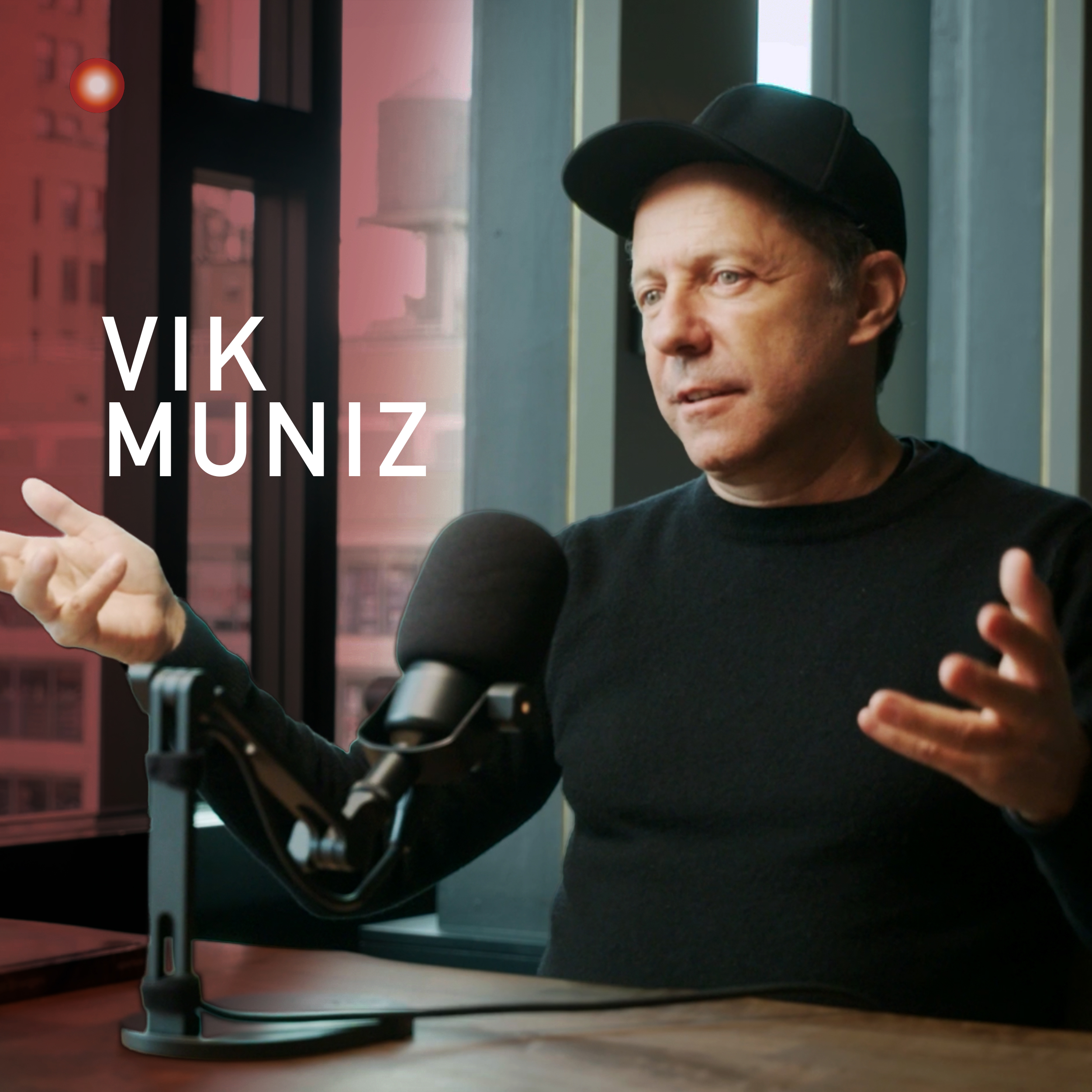
Vic Muniz
I think representation is the greatest invention after the control of fire allowed us to actually extend our experience beyond the reach of our senses. We take that for granted. The artwork starts happening when there's somebody in front of it and you realize what you're seeing is something that the person can be seen as well. And how do you have this dance with the audience when you're dealing with representation? This is probably the most interesting part.
- [00:35]
Podcast Host
I just had the most wonderful conversation with my guest this week, Vic Muniz. He is possibly one of the most creative artists working today. Vic's art is widely collected in museums like the Metropolitan Museum of Art, MoMA, the Whitney, and many, many international museums as well. Please enjoy my conversation with Vic Muniz. Vic, it is so great to have here. I am one of your biggest fans. I'll get that out of the way. We've been collecting your work for a long time. Most of it is at our house in Connecticut, but this one, we had a fight for that one. Well, because when we went to buy it, the gallerist came over and said, somebody a little more important than you is interested in this. And I'm like crushed. Right, because we just loved this piece and we ended up getting it, obviously. But let's start with your background. For people who might not know, tell us your superhero backstory.
- [01:46]
Vic Muniz
Well, there's not. Well, it's a long story though. That's a long life. Thanks God. I was born in Brazil, in Sao Paulo, the largest city in the southern hemisphere. And my father was a waiter. He worked as a waiter. He died this year and he worked as a waiter his entire life. My mother was a switchboard operator at the local phone company. And we lived in the outskirts of the city in a pretty much like a little bit more organized Islam area, you know. So I was born in the favela, basically. And then my father came from. Is an immigrant from northeastern Brazil. Very poor area at the time. And growing up I didn't really have my father. Neither parent had much of an education. You know, they had a. They didn't complete even like they didn't go to high school. But I was very fortunate to be raised by my grandmother, who also never had a single day in school. But she learned how to read just by looking at her kids books. Nobody knows how she did it. And I'm mentioning this because it has a lot to do with my becoming an artist as well. My grandmother is probably the most intelligent woman I've ever met. I remember the day my father brought the only Books that we had at home was a set of the Encyclopedia Britannica. He brought it on a wheelbarrow. He had won this on a pool game. And my grandmother and I, we spent days and days and all our afternoons looking at those pictures and reading the way she taught me how to read on an encyclopedia. And she read encyclopedia from A to Z several times because those the only things there was to read. She knew every capital, you know, if you ask her, you know, what's the capital of Malta, she'd go Valletta, Liechtenstein, like this. And she was. Or every bone in the human body. Although she never been to school a single day of her life. But she taught me how to read. The way she taught herself how to read is by memorizing the shape of the words. So I am a self taught dyslexic person so much that when I started going to school I could not write because I had to relearn how to read and write. And it was very complicated for me to do those things. And I was reading already chapter books. But I could not write a word on my own until the third year of school. In that period, I think is something very. Because I had kids. When you start learning about or actually having a different picture of the world through symbolic exchange, you know, so you start learning more words, you know, you broaden your vocabulary and then you have things that stand between you and the world. So they start this edifice of little symbols, you know, I think it's a very important, perhaps the most important part of your formation as an individual when you start creating the tools that will. May help you interface with the real world. Until then, your relationship is very direct. So I started. I could not write and I started drawing at that time. So I had the kind of like a shorthand that I developed, you know, that I would. If I would do dictation, if I didn't know a word, I would just make a short drawing like, you know, secretaries used to do in the past. And then. And my copy books look like the Egyptian section of the Net. So it's just. But I could read those things. And all of a sudden they started getting a little bit more refined. And eventually I learned how to read and write like everybody else. But I had a different relationship which is very. They were kind of ideograms. And those things developed. After some years they developed into more elaborate drawings. And by the time I was like 8 or 9, I was the kid that did the caricatures of the teachers and knew how to do perspective and I could draw things from nature, do pictures of the girls I liked and things like that. So my identity as somebody who dealt with representation drawing became who I was. And I was the guy who made drawings. And by the time I was 14, I was enrolled in. I represented my school in a. For it was a public school, obviously. And then I represent the school in a statewide. A bit of a contest, you know, art contest. You know, it happened exactly where the Sao Paulo Biennial actually happens in the Birapuera. For the first time in my life, I realized there were kids like me. I was a bit of a loner. I remembered that day. And I did things that were three dimensional. Kind of like that perspective and collage. Not very different than the things I do today. It's very strange when I remember. I think I've been doing this all my life. I thought that was the prize. And I won first prize. And it was two years of academic drawing training at school. A private school called. It's called Panamericana. So I would go there in the afternoons. So when I was 14, I was drawing naked people. And I never missed a class. The first naked person I saw in my life was during life drawing class.
- [07:38]
Podcast Host
That's a way to hook you in for life.
- [07:40]
Vic Muniz
Yeah, it was really exciting by the time then you get used to it. And I think there was also a moment. It's like weight loss. You make a lot of progress. And then it gets incrementally less as you drawing is the same. By the time you develop more and more technique. Your development becomes less and less visible. So I started becoming intrigued. Not about the fact that. About the drawings themselves, the technique of drawing, the ability to make reproduction. But I think I had to fulfill that lack of improvement, you know, with understanding and discernment about what a drawing really was. So I started thinking about representation in a deep, deeper, more wider sense. How do we see things in pictures? You know, when did it start? How did that develop? So when I went back to Paleolithic art. And started understanding how do we develop perspective and art history became something that fascinated me. And also psychology at the time in Brazil was during the military dictatorship. And it was interesting to assume the identity of an intellectual at that time. And I was into experimental theater. And the last generation of. The last generation of teenagers that lived through the dictatorship. But I wasn't a victim of the dictatorship, direct victim. I wasn't tortured or anything like that. But my understanding of society was a little bit shaped by that kind of environment. Which was a moment where you cannot Say what you think the way you want to say it. And all the information that comes to you comes from very biased sources. So you have to be very skeptical, get very cynical about the way you receive information. It's a bit of a semiotic black market. You just have to negotiate everything. I think that along with this interest that I had in representation makes up for what I do I've done all my life. You know, I tried to. Had a deep interest in psychology too. Liked science a lot. And for a moment I started reading these books by experimental psychologist names James, named James Jerome Gibson. He wrote several books on perception. You know, some of they had very rudimentary translations in Portuguese. At the time there was not that many books available. But I remember started reading about this and he was hired by the Air Force in the moment they were developing jets in the 50s to understand how the eye perceives depth or perspective. It was like they had to understand perception in a challenging environment. In order to improve its interface for the equipment and everything else. He had so many interesting ideas about how the way we move, there's not actually space, there is ambience is what we deal. Because as we move and everything moves with us. This consciousness of the visual space that was. It opened a huge set of ways of looking at things for me. And I thought maybe this is what I would like to do. I would like to be a psychologist, like an experimental psychology and work in the field of vision. And I tried for the vestibula, which is the exam for the private schools twice. But it was a very broad test and I wasn't very good at math and other things. So I failed twice. And I settled for a half scholarship in advertising communication studies. But with the major in advertising, which I did go for six months because I realized that my father was taking a second job in order to pay for expenses. Our grandparents lived with us. So I said I cannot afford that. I have to help at home. And I remember then that I was. Something really interesting happened. I could not read the billboards around the town. You know, I had an extreme. It was very hard for me to read the billboards. And I thought it was some kind of like it had to do with this self taught dyslexia, you know. But then I realized that nobody could read them. I drove my mom once to go to the bank and can you read that? She said no. What about if I go 20km an hour? Can you read that now? No, what about 10? Started making notes. And at the end of a couple of months I had Developed a chart that crossed the vectors of speed, angle of approach, and the number of size of text. And I went to one of the. There were two companies that did point of sale advertisement in Brazil. One was called Alvo Target. You know, and then I went to this guy and I said, listen, your. Your ads, your signs, outdoor billboards really suck. I mean, they're awful. You know, you have all these billboards on the side of the jockey, the. The. The. The horse racetrack, you know, and they're on the wall, and you have to be a person who can read three lines of text at 90 or to 100 kilometers an hour backwards to be able to buy what you're selling. You just have to change their position. I've done this. Look, I developed this chart, and I can help you do this. If you don't hire me, I'll go to your competitor. Well, he hired me. Very little pay. I was driving around with my Volkswagen bittle making notations. And then I worked for the. He gave me gas and some money, but it was enough for me to help at home. And I dropped out of school that year. At the end of that year, this chart that I wrote got published in an advertising magazine. Around the beginning of the following year, I was given a prize for young talent. So it was the day I went to pick up this prize. I rented the tuxedo, and it was a Plexiglas thingy. I never saw it again because I have to tell you what happened. I went to this thing, picked up this thing, and then on my way out, somebody, a woman, stopped my car, and she said, you have to help me out. They're killing my fiance. And then I looked, and in fact, there was a person. They're all dressed. They were all in the party. They were dressed with bow ties and tuxedos. And this guy was hitting the other guy with brass knuckles against the car. And I got out of my car, left the car in the middle of the road, ran, and I pulled the guy, the aggressor, and this guy ran away. And I hear people horns because I had left my car in the middle of the road. And I said, I'm going to park my car, and then I'll see what happened. Help this guy. On my way to my car, I hear an explosion. And then I'm on the floor, and I said, what happened? And then when I turned, the guy who I had just saved thought that I was his aggressor because everybody was wearing a tuxedo. You know, this looks like a James Bond Film and he grabbed a gun in the car and started shooting at me. So he hit me. And I just saw him shooting again and again and again. And I saw the bullets. I mean, I tell people that nobody believed when I saw the Matrix, you know, the bullets come like, yeah, I've seen that. You know, I was so. And then I somehow made it to my car and drove to the next, near the nearest hospital. And I even hit the car on a corner, and I don't remember anything anymore. Three days later, I wake up. The first thing I see is the guy who had shot me apologizing. He was full of bandages on his face. I thought I had died and go to. Gone to mummy heaven, you know, and then. Or mummy hell. And then I. This guy said, I'm sorry, I'm sorry. I had dislocated my jaw. I couldn't speak, so I was like. Couldn't even say, it's fine, you know. But so luckily he hit my leg, like half inch, half centimeter from my femoral vein. Although I wouldn't be telling the story here. And luckily also, he was rich, this guy who shot me. And then he paid for all the medical expenses and agreed to pay a sum of money that would help me go through a year without being able to work because I just. I couldn't walk, you know, with this money, I bought a ticket and I came to the United States in 19, in. In 82. So this is the reason we're having this conversation is because I got shot. You know, this is how lucky I am.
- [17:42]
Podcast Host
I. I love that story. I. I'm familiar with it because the. The serendipity, right, like this awful event, right, leads to this terrific and wonderful career. Now, you would have. I suspect you would have been as effective had you stayed right in Brazil. Because the thing that fascinates me about your work is, at least for me, I always get lost in it like this here. I can literally see. Stand in front of that for an hour, and I just literally get lost in it. And I'm really interested because I know you have a theory that you as the artist are only half the equation, that the viewer is the other half. And I find that so refreshing because, you know, we collect a lot of different artists, and I would say that's not a majority view for a lot of the artists that we interact with. Talk a little bit about that.
- [18:50]
Vic Muniz
I don't know. I think I am, as I mentioned before, I discovered books very early, and I was not ever good in sports or anything like that. I was always a little bit of a loner. And as a loner, you get sick of yourself, and you discover pleasure in interaction, in conversation. And that, I think, has shaped a little bit my relationship to the public. I think you only do half of it. The artwork starts happening when there's somebody in front of it. And you realize what you see is something that the person can be seen as well. And how do you have this dance with the audience when you're dealing with representation? This is probably the most interesting part. If you think that, you know, maybe 50,000 years ago, a guy walks into a cave, you know, and he sees in the cracks of the cave something that's shape that he seems to have seen it before. But it's not just a shape. It's a shape that, like, shapes like an animal. Not like. Not any animal. It's a bison, okay? And not any bison. He's the bison that he had hunted when everybody was hungry in his tribesmen. And then he remembers the hunt. He remembers the rush, you know, the adrenaline and the taste of the meat of the animal. And all of a sudden, he looks at that again. There's just some cracks on the wall. And then he picks up some kind of, you know, a little rock, and then he draws the missing eye, a little horn, a tail. And all of a sudden, all those memories come back. This is really interesting. But the most interesting part is when he brings his tribesmen, his fellow tribesmen, and shows it to them, and all of them see the same thing. And this is how magic it is. And he can bring the past into the present, and that hunt will be forever there, and future generations will be able to get access to that. So it transcends time and transcends space. I think representation is the greatest invention after the control of fire because allowed us to actually extend our experience beyond the reach of our senses. We take that for granted. I always do this. I have a school in Brazil, and sometimes I go there with the kids in the favela in Vizigao, near my house. And then you go, like. You just do like this. You know, what do you see when you do this? Just as a gesture. And people say, the sun. And I said, the sun is a ball of fire, you know, eight light minutes from here. You know, it's like it is. And you can bring it into this room just with a gesture. This is magic. And we forgot how magic it is. And because we are spoiled with easier or easy to digest forms of representation, we forgot this ritual, the power of this ritual. Of tools that we've created and how they have actually shaped our way of seeing things. I think it's the. There were moments, you know, in our history that we have an evolutionary relationship to the ambient, to the environment, to the visual environment, you know, but there are some revolutionary moments. You know, like I say, industrial revolution, probably in the invention of. Brought the invention of photography and serial production of images made the whole world different. And the relationship with people, to the world was so traumatic that it took two world wars for people to start learning how to deal with this new world again right now. And around that time of the industrial revolution, you have a complete shift in the way representation actually had to evolve and artists had to evolve with it. In 1839, when photography was invented, the next, all the newspapers celebrated the death of painting. And we can buy paint even easier today than we could then. And actually photography liberated painting from its duty to portray the world as it was.
- [23:28]
Podcast Host
Totally agree.
- [23:29]
Vic Muniz
After that, painters had the luxury of saying, what is painting? Then? Painting is something from the dream, like in surrealism or painting is a gesture, like expressionism. Painting is color.
- [23:41]
Podcast Host
Paul, like who you did in chocolate.
- [23:44]
Vic Muniz
Yeah, yeah. So you, You. You start questioning the medium, and all of a sudden it's very interesting. You know, right now, you know, we're in a. I think, in a much deeper state of adaptability, you know, because we. It's like the ghost of painting came back to haunt photography in the form of visual digital imagery. But it's not only that. I mean, we are. Our relationship to reality has been completely changed to the point that I think it's even more traumatic than it was, that all of a sudden you realize that the world extend beyond the city where you live. Like was almost 200 years ago. Because right now you have to think of all the tools that started with that guy that I explained to you, like the Paleolithic artists. He invented something that actually improved his relationship to the environment. People talk about artificial intelligence, but they did not question natural intelligence. Intelligence, for me, is the ability of any organism, no matter how small or simple, to feel and react. If it feels and reacts, it's intelligent. So that makes everything that is alive today intelligent. Otherwise, you'll be dead by the force of evolution. You won't be around us. So everything that is alive today is intelligent to some extent. We are different because we do not think, we believe. Yeah, that's believing.
- [25:25]
Podcast Host
That's something that's just about to go. The interesting thing that I've heard you talk about and agree with is that of all these living organisms, we humans, at least for as far as we know, are the only ones who have beliefs.
- [25:41]
Vic Muniz
Right.
- [25:42]
Podcast Host
And maybe dolphins do. I don't know. Maybe. I know elephants have great memories.
- [25:47]
Vic Muniz
Well, they shape them differently. Yeah, yeah.
- [25:50]
Podcast Host
But the. Also back to the cave paintings. I've watched all the documentaries on them and I've looked at all the books. I'm absolutely fascinated by that. Because you are absolutely right in that this was the first way for humans to not only understand their environment better, but to let their tribe understand it better, but also plan for the future.
- [26:20]
Vic Muniz
Seeing. Model making.
- [26:22]
Podcast Host
Yes, model making. And, you know, Korbinsky is the famous quote, the map is not the territory.
- [26:30]
Vic Muniz
Right.
- [26:31]
Podcast Host
And so many people, I think, sometimes confuse that. They don't really think that way, especially now. Yeah. And what do you think about that? What do you think about our current situation where the map is kind of becoming. We are so abstracting things and using symbolics and a variety of those things that I'm noticing some people are kind of forgetting that the map is not the territory.
- [27:00]
Vic Muniz
The fact that the. The person who made the bison, you know, it stood there, it. Everybody was amazed. And then two weeks later, another guy went there, and they say, it's missing a little color here. It's missing some shadow because it's floating in the middle. And it improved a little bit, you know, and then everybody go, oh. And then they got tired of it and somebody else did something else. And then the. The whole development of our relationship with the world through imagery has been this race between technology and skepticism. So it's always going a little bit. And that race has actually allowed us to know the weather that's coming and knowing things that are going to happen. It's interesting also to notice that the whole deal of art happens in the realm of the inconsequential, you know, is that we. Because we deal with possibilities, not real facts. You know, the fact that. But these are important because we shape futures. We shape. Or we actually shape the past, too, you know, as we. We know more and more. But the thing is, art not only say art, because art for me is a very broad term, but also representation is a set of tools that allowed us to actually see the world and understand the world beyond the reach of our senses. But it was always in the service of feeling and reacting, of intelligence. It allows us to know that there is a city called Tokyo, that I was there yesterday, you know, and that I can go there. And that allowed me to think that there was a guy named Napoleon Bonaparte and allowed us to think about it broadened. But it was all based on fact, some kind of evidence. Right? Right. What happens right now is that the image no longer tells you that something happens, you know, and then it has become an autonomous entity. It does not serve the process of feeling and reacting any longer. And it's actually. It is still the ground in which we're walking and feeling the world around us. So it's very dangerous proposition that you have something that is made to be believed, but it no longer serves its purpose. What's the alternative is to think is to actually create discernment. I find that we managed to do this before. To learn how to live in this new environment. And I don't think this is any different. I think we're just going to artists, creative people are going to start having to create understanding and discernment. But this is not going back to your question. This is not something you can do alone. Right. The artist has to have participation. And then I find it in the fine arts, you know, this the name fine arts already. It's a kind of. I find it very old, like 19th century. Yeah, I kind of like it, you know, fine art. I'm a fine artist. It's the only fine thing I am. I find it. It's very elitist. It's a privile, you know, and when it should be a right, almost a duty, you know, for people to be engaged into thinking about the way they deal with the world through the representation, the way the world is presented to symbols. You know, this should be taught at schools in a way that is not totally agree. I've been working with that. Developing, you know, programs that deal with. Even the help kids, you know, deal with technology, the technology of images.
- [31:14]
Podcast Host
Right. You know, Buckminster Fuller made a comment about the microscopic world in which he said, the microscopic world existed before we knew about it. We just weren't tuned in. We needed the microscope to get tuned in. And I look at art and by the way, I also have a very broad definition of art. Literature is art. Anything that can explore possibilities, I find is art. And I have six grandchildren. And I love watching them because we're born natural artists and then we have it beaten out of us. Right.
- [31:59]
Vic Muniz
But people ask me, when did you become an artist? I said, I don't remember when I became. I remember very well when everybody started. Stopped being on our. Around me. So, you know, I just kept going. You know, there's nothing really. It has to do with the idea of how you apprehend symbolic Language, some people, I kind of stayed there, you know, in this sort of pre linguistic thing still speaks to me very strongly because I was kind of a delinquent with my learning process. Maybe, I don't know. I'm still very curious about that. And having kids really helped me because I used them as gania pigs. I experimented on them quite a lot.
- [32:45]
Podcast Host
My wife wanted to put an end to me doing that with all of our kids.
- [32:49]
Vic Muniz
I think it's a fatherly thing, I guess, but to the point that I had to open a school. And I said, in Malu, My wife said to me, are you sure you want to do this? I said, listen, is it a debt or you're going to have to keep having kids? So we have four. So I said, I think I'm going to make a school. And then the school has become a very fertile ground for experimentation and for discussion. And it's quite wonderful because you're dealing with kids that very much like me, they live in an urban area where they're exposed to desire, to media, to a lot of the mediatic environments. Very, you know, it permeates every section of Brazilian society. People are very good with, you know, with the digital era. They really. Everybody has a cell phone, no matter where they live. They're very. And they're very good at it, you know, posting and sharing and these kids. But they don't have the means to actually acquire things, you know, and when you. So they're very similar to what I was when I was a kid. You know, I was exposed to ideas, but I wasn't, you know, exposed to goods, you know, to real things. It's fascinating to deal with image savvy kids that really represent probably the largest number of individuals in the world. The world is poor, you know, there's some people fail to also realize that. And we're very, very privileged people and have to be aware of our privilege and we'll have to do something with it. And I always go back to where I come from all the time. And especially when we're talking about accessibility to art. Is this something. I think I don't raise too many political flags in my work. I think it's a dangerous thing because I'm very wary of art that starts with good intentions. You know, I think good. Good intentions don't make. Necessarily make good art. I think curiosity and, and. And sincerity and. And investment, intellectual investment makes good art. And that art may become political as a result of how close you are to what you're trying to portray. It becomes A tool too. I think if I am, what I do is political in the fact that helps people see things or ask questions about what they're looking at, you know, which I think being a sort of a product of a society where this was not allowed, I think I valued that a lot. But also I think, you know, I'm very conscious of the fact that the first time my parents saw, stepped into a gallery or a museum was to see an exhibition that I did. They wouldn't venture into a space like it was very hostile, very exclusive, very, you know, it was not something that they would go to. And it's a pity because contemporary art, it has the power to unsettle, you know, the status quo. It makes you. Put you in a different kind of way of looking at things. And that is a healthy thing. It's like exercising your relationship to what you think, you know. Totally agree.
- [36:21]
Podcast Host
But also you, you mentioned the power of art. And like the various political operatives have always known that, right? Like the CIA, when we were in the Cold War with the Russians, had an operation they called Operation Long Le and basically it sponsored abstract expressionist exhibits all around Europe. And of course it contrasted against Soviet realism, right. The use of art, if you're familiar with Soviet realism, was all meant to glorify the state and everything. But when I learned about that, I was like, well, of course, right? Like on the one hand of the United States and the so called free societies, they're like, of course, look, abstract expressionism. We also sent because they said the United States was a very racist place. So they underwrote sending our best black jazz musicians all around Europe.
- [37:26]
Vic Muniz
Yeah, it's true.
- [37:28]
Podcast Host
But the thing that I particularly love about your approach is there's always a wonderful aha moment, at least for me. We have your. The birthday party, which is the collage. And again, like this piece, I just will sit and stare at it. And there's always something new for me, which gives me a new thing to think about. And I'm like, oh, yeah, I never thought about it that way. That seems to be the more I read about you and now chatting with you, that seems to be part of your intention, right? It's like you don't have political intentions, you don't have. Your intentions seem to me to be driven mostly by just wonder and curiosity and wow, look, look at this possibility. The other thing I love about your work is you work in so many different mediums and I love that about you because you refuse to be. This is your lane, stay in this lane.
- [38:42]
Vic Muniz
I think I get bored very quickly. Maybe that's the reason I work with different things. But. The idea of access, it's very important because I deliberately chose to work with simple materials. Things that people don't. They don't. Not part of a hierarchical. Things that don't inspire the idea of mastery. If you make something out of spaghetti, it's not like oil paste. That immediately creates a difference between. Between the artists. And so I try to make it approachable and try to make it common. When you think about the political influence of an artwork, you know, I feel that it's very pretentious almost. I don't. I don't think I can. I want to communicate with society as if society was a thing. Right. I don't believe that. So I think you're becoming older, you're becoming aware of the scope of your influence. And I think I can affect individuals better than I can affect a group of people, you know, And I think if you are effective, at least you're not going to change people. But, you know, you're on this line here. Oh, you want to do like a little, you know, a nudge a little. Yeah, so you go to that side. But if you can do that, that is, for me, my work is already done. In order to do that, you know, I have to be close to things that I involved, personally involved, and I try to be involved with. You know, I work, as Corey says, I love toy stores. You know, I love. I like to read and I like to. For instance, one thing like the piece that you described, the birthday party. I remember when I arrived in this country, I lived in Chicago, in the suburbs of Chicago for like a few months, you know, because I was initially, the idea was to learn English and then go back to Brazil. And I did something, you know, I did a mistake. I came to New York on the 4th of July, and I became infatuated with the city. And I said, I want to live here. So that. That. And it was a weekend before I was about to go back. And the weekend now is like 40 years, less than 40 years. And I remember, you know, when I was in Chicago, it's a northern suburb of Chicago, Northbrook. And when I was a kid, my mother's sister worked in the airlines, so she lived in between Miami and she worked as a stewardess. And she come to visit us every year, and she has a camera, so she takes a picture every year of me. And then she goes back and it takes me a year to see the picture. Now, when I told that to my daughter. She was like, why didn't she show you on the phone? No, no, no, it wasn't like that. So I had to explain it to her how it was. She was so sorry for me. But I. As a result, I had only nine or ten pictures of me as a child. When I saw on a garage sale, photographs being sold, I didn't understand how could those pictures become separated from the people they portrayed. They're like orphans, you know? Yeah. And I had no. Had very little money then, but I bought them, you know, I kept buying them. So for 40 years, I've been buying family pictures. And then I have to say, I never had a class. And I taught photography at Bard College, but I never had one class on the subject in my entire life. But everything I learned about photography, I learned from looking at family pictures. And it became more than a hobby because every picture is fascinating there. If you get, like, now I have like 250,000 photographs of people that I never met, people who are not here anymore. And you look at it, every single one of them is a moment that somebody thought it was important and it's beautiful, you know, and then these things are in boxes. I said, I have to do something. So I started making collages with them and bringing them back to life and to. Back to people's awareness, you know, but there was. I mean, there was so many amazing things from looking at especially bad pictures. You know, there's a. There's a one that's very funny. It's like the picture of the Eiffel Tower. You know, people go to Paris and they say, I want to take a picture with the Eiffel Tower. So. But there's a problem of scale. You know, there's. There's a discrepancy because the Eiffel Tower is a huge monument and the person is a small thing. So you try to make a picture. They go to the Eiffel Tower to take a picture with the Eiffel Tower. So they could never do it. So there's a little head and then the thing. There's like pictures of people with camels. Camels are very big, you know, but people don't realize until they are, because they're either. So if you get the whole camel, you don't know who it is. So it becomes a completely nonsense. But if you get the purse, you lose the camel.
- [44:15]
Podcast Host
Right.
- [44:15]
Vic Muniz
So how you get the parts and the whole. You know, and then when you're talking, maybe this is one thing that is always in my work. It's to think that everything that you see that's representing something is made out of other things, you know, and it's the transformation that actually makes it possible for you to. There's a moment of transformation that you actually. You reenact when you're making the work that is almost like the ritual that. How you get to connect to the world. I don't know if I'm being clear, but.
- [44:54]
Podcast Host
No, you are. And that sort of leads into the fabulous documentary wasteland that was made in 2010, I believe. And you help those people see themselves.
- [45:08]
Vic Muniz
I like to think so, yeah. Yeah.
- [45:10]
Podcast Host
Well, I think. I think you definitely did. But for listeners and viewers who aren't familiar with this, let's tell them a little bit about the project.
- [45:19]
Vic Muniz
Well, it always started when a group of. There was a director and a producer. They. They approached me for a documentary on my work, and I didn't want to make. I had already done that, a small documentary, and I. I thought it's. I wasn't interested in doing that. I thought, what about if you document one series? You know, because I work in series, and the way I do this, because it allows me to use what I learned from one work to the next, the next. And at the end, I'm not into making a masterpiece. I never. I do not think of art in that particular way. Making an amazing artwork, I make incremental pieces that actually make up a curve. The moment I become interested in a material and the way it interacts with a certain subject, I start putting these things together, experimenting with them, and then I get better and better and better at connecting this thing to the point that I get bored. And then I just filling up gaps. And the important thing, after almost 40 years working as an artist is how do you manage these creative flaws? And this curve is something that I hadn't really. I was aware of it, but I wanted to maybe document so I could understand it better. So I proposed that they would follow me through a series from the beginning, from conception to the moment I show it in a museum. Right. And then I had. I wanted to do these things with garbage, because garbage is a material that tends to. Invisibility is something that normally you hide. It's a part of our history that we always hiding, you know? And I thought maybe if you do something, it would be quite interesting because it would shake up, you know, the way we're looking at things. I had already done works like the one behind you with like, a. Pieces of, like, metal, scraps. Junk, junk, junk. Yeah. And. But Garbage is different. Yeah, garbage is in the state of the compulsion. So it's a. It's. It's something that is not. Doesn't have the usefulness of that, what it was made to do.
- [47:35]
Podcast Host
Right.
- [47:35]
Vic Muniz
But also it hasn't become material. Like it doesn't become.
- [47:38]
Podcast Host
It's. It's substance.
- [47:41]
Vic Muniz
So it's. I love anything that's in between, you know. I'm very interested in grays, you know, so I. These gray areas are very good. So I thought I had tried before to do this a few years before, but they were the place that I had to work with. Garbage was controlled by the narco traffic in Brazil. So they used to put weapons and it was a very dangerous environment to work. So I gave up. But I still wanted to do it. And I thought maybe I should try it. I can propose it to them. And they bought the idea. So we thought about doing this and we had some help from some other people had filmed this particular area. And we didn't know that this was the largest garbage dump in the southern hemisphere. When we went there. Grandmasho was the name of the site, you know. And I thought that I was just going to make these drawings using this material. And all of a sudden I see this workforce there. The people who actually do live, make their living from the extraction of recyclables. Brazil is the second country in the world that recycles more. Not because we're organized, it's because it's a lot of poverty that lives from it. And I became involved with these people and not for how different they were, but how similar they were to me. And I kept thinking that maybe if by some turn of events, if my father had become sick, I could possibly end up in a place like that. And it's amazing to think about that, right? I invited them to work on their own portraits using the material that. The same material that they do with everyday. Because that was what makes something change where you use. You work with something in a certain way, you work in a different way to actually create something completely different than what you're doing. These people, they had not seeing most of the representations of themselves. They were. That they had, were from cell phones that they were. They were found tiny little, you know, pictures of themselves. Sometimes in a document they'll see like a little, you know, identity papers and things like that. And all of a sudden they were. We had a whole like something the size of a basketball court where we make these portraits. They. And you cannot immediately see what they are because they are not they're elongated and they're trapezoidal. They are a number of. It's a number of forces. So. So when you're looking at that look just looks like junk. But when you go on top of a 10 meter tower, you see what it is. And so we had this in the film, this reveal. And it was very, it was very emotional because when they see themselves at that scale, it's. Something changes, you know, in the way.
- [50:55]
Podcast Host
When I was watching, I literally turned to my wife and said, he has unlocked something in them. Because you have to. I definitely recommend watching the movie if you haven't seen it, but that moment, like you could see on their face, faces like they, they saw themselves in a new and different way.
- [51:19]
Vic Muniz
But unlock something in me too.
- [51:21]
Podcast Host
Yeah, sure.
- [51:21]
Vic Muniz
Because you know what? I. When I make an artwork and I share it with people, you share the result, but it's sharing the process. It's also fascinating, you know, when you bring people into the studio and also made me become aware that I work with people. I'm always having people say something to me. I'm very porous. So I work with assistants, they say, oh, why don't we do this? I say, yeah, let's try. I don't have that kind of control authorship. I'm getting better and better at this. I'm also getting better at communicating the ideas. But this was like. Because at the end, if you work with people on a project like this, you don't end up with something you want, but you end up with something much bigger.
- [52:16]
Podcast Host
Right.
- [52:16]
Vic Muniz
You know, and it's something that reflects, it's more than you. I don't think I want that much control over what I do anymore. I mean, I. This is important when you're still acquiring a concept or a technique about what you're doing. But after a while, I mean, I think this is part of the way you become an artist. And I consider myself a successful artist because I can live from what I do and I can live very well from what I do. And I think there was a point that what you want to be is an artist. You do everything to be an artist. You want to be called an artist, you want to be important, relevant as an artist. So you play the game of the art world. Right?
- [53:01]
Podcast Host
Right.
- [53:01]
Vic Muniz
But after a number of years, you're an artist already, so what do you do? What is that for? So this question starts haunting you. And I think Wasteland was for me, what really changed is also I realized the art can be a lot more just a simple practice Something that you do and you test on people. And I mean, one thing for one thing is just. It made me realize that when you are dealing, you know, you're dealing with the world or the interface, you know, I think art, my concept of art is that my idea is that art is the evolving interface, you know, between mind and matter, between consciousness and phenomenon. And when you're dealing with that, you're already dealing with the world. But the fact that you can fix or change the world beyond the model. Yes, you see that. That is. I had the work. The film had an impact on these people's lives that extended beyond the simple fact that they were looking at something that. Or the fact that they actually were part of the process of doing their portraits, which was already something important. But we sold the works. We actually sold, gave them the money. We worked, we did many things. But I think the most. The greatest achievement of the film was it changed the perception of the entire Brazilian population. Because it was a big deal there about who these people are, you know, and dehumanizes that. Before, people didn't think of them as people, as workers, you know, as professionals. And now it allowed them also to organize better. And now these cooperatives, they're not in garbage dumps anymore. They get the recyclables directly on large events like the Olympics or the World cup or they were allowed to actually, now they're organized to actually pick up the recyclables directly when they are disposed, where they are disposed. And I think there was. Soap operas are big in Brazil, right? And there's this guy, Kawan Raymond, very good looking guy. And once I was having lunch with my wife and this guy just, hey, I want to talk to you because I'm going to portray catador guys, people who actually live from recycling. And I said, are you? Yeah, you are? He said, yes, yes, I said. And then you did the film. And I wonder if you could helped me out because I want to meet some people and actually learn. Because I want to do a laboratory. Because I want to know more about. To become. To be a. To do the character well. And when the best looking guy in Brazil is just doing a. Playing a catador means that we did something, you know, we achieved something. The perception is different. But for me, I think the biggest thing is just like I realized the power. And actually if I do something that is remotely political, which I think this film is, I think you have to come with a capital exchange. You have to transform that in something that actually helps directly the people you're not just illustrating a problem, you actually acting upon it. And I've been lucky with that.
- [56:34]
Podcast Host
You know, I put everything through a filter which I call Win win. And like, I don't do deals anymore that are not win win because they're just so much better for everyone involved, myself included. And when I was watching the film for the first time, we rewatched it recently as I knew I was going to be having the pleasure of chatting with you and. And I had the insight that you grew up in an authoritarian military dictatorship. I like you, I'm not a very political person, but I am fiercely anti authoritarian. And one of my insights was, what do authoritarians do? What did the Nazis do? They dehumanized people. They looked at them not as human at all. And when I was rewatching the documentary, I'm like, you know what his genius here is, is he is repositioning these people to the rest of other people. These are people. These are human beings. And so I love that story because that, like, what a great arc.
- [57:46]
Vic Muniz
It's a conclusion. I said, no, it could be you. Could be me, absolutely. You know, and the fact that I think this is the most important part. When you perceive something that is not right, you know, and the fact that sometimes you have the opportunity to act upon it and you end up winning more than giving. You know, I have always had this sort of, like, adept, I mean, depth to these people, to this project in general. But I think there was this because after Wasteland, I became very attentive, you know, like very aware. I'll give you an example. Between my house and my studio, there is a daycare center which is run by nuns. I got married at this church and I baptized my daughter in this church because by convenience, it's very close, right? They came to me one day, they said, we're about to close the daycare center. The daycare center attends all the poor people that live in Rocinha, all the favelas nearby my house. And the people, these people work in the south side on the houses of rich people, and they leave the kids there, you know, and there's one sound that I love from a safe distance. It's like when they go on breaks, they go, ah, I love that sound, you know, And I couldn't bear the fact that I wasn't going to listen to it a little more. And I said, well, what's the problem? Oh, you know, there's not many baptized people are not doing weddings here. And they were actually, we're about to Close. We're going to serious finance. And when we got married there, we actually got married in the parking lot because there's a garage. But my wife is very good at transforming spaces. So she turned it into sort of like a magic jungle. And I said to them, so, the month of December, and. And I said, oh, are you free? She said, yeah, we don't have anything going on. I said, oh, I'm going to give you this money just to help you this month, but I think I have a better idea. So I was working on portraits of saints for many, many years. And obviously it's very hard to show this in a gallery or show this to a museum. People say you study. When you study art, you study all the, you know, Caravaggio, Giotto. There's all sacred images a lot, you know, Catholic canon, you know, and then. And these images are supposed to be in a. In a palace or a church, you know, and you study this. And then when you. You get graduated and you're supposed to be atheist and communist, you know, so it's kind of like they're very confusing, you know. So I love religion in general. I'm very curious about it, and I think belief is something that sets us apart from any other living species, and you have to understand it. But also it's something that is a broad subject that deserves attention if you're an artist. And I had these pictures of saints that I didn't have a place to show them. And I said, well, what if it's a church and a convent there? It's a perfect place to have this show. And then I. Because I had. Before, they were superheroes, they were saints, right? They're very similar, you know. And you have to understand, there is a direct relationship between the Marvel superheroes and the saints. They perform. They do amazing things. They're superhuman, you know. And I thought, oh, this would be a. So I said, what if we do a show? And I showed the nuns, they really liked the idea. And we sold the works. And with the sale of the works, we managed. It's open right now, and we managed to keep it open. You know, things like this. Another example, the National Museum caught fire. The major museum in Brazil. The entire collection was burned. And this is the place where I took my kids. And I was working in a project in Holland, Holland, at the time. And I thought, oh, God, this is a place that all. They burned the. They had the skull called Lucia. 14,000 years old, you know, like the greatest. The oldest found, you know, skull of a humanoid. All These things. There was mummies, there were the Egyptian, There was a paleontology collection. There was several dinosaurs and things. There were. It was the largest entomological collection, I think, in the Southern hemisphere. You know, millions of little specimens. Butterflies, bugs and things like that. I love museums. You know, I am a museum rat. So I felt so bad that I realized that during the. You know, this happened during the Bolsonaro last administration, and they had. The funds for museums for institutions were severely cut, so they had no money to deal. They had a lot of 3D renderings that they have tomographies that they had done on some of these artifacts, but they needed to actually print them or use digital work. They had no funding for this. So I teamed up with them and actually they gave me the ashes of this specific artifact. So, like, for the Lucia, for the skull of the Paleolithic skull, they gave me the ashes of the skull, and I actually made the picture of it. And we made several of these because there's something very incredible. Normally, archeologists, they work in the field and they bring what they find to the museum. There were teams of archaeologists working in the museum, something completely unheard of. So they're very organized. They had little Tupperware with specific dust from specific things. They gave it to me, they lent it to me. So I made pictures of it. With the funding from the sales, we actually managed to keep the program of the rescue alive so that we actually helped them reconstruct many, many things because they were not having any other help from the government or anything. And now I'm going to have. This is an exhibition that I'm very excited to do because the museum is going to reopen the first wing. And they're going to reopen with this exhibition, the Museum of Ashes. And I never had the opportunity to show it before. So they're going to open with the sort of a memory of these artifacts, you know, that they were there before. And it goes on and on. You know, I've been able to actually do things. They had a practical, physical impact, you know, And I am very fortunate that I had the opportunity to do these.
- [64:58]
Podcast Host
Things, you know, and one of the things that I love about you is this idea of, like, I made most of my career in asset management, right? And that's all probabilities. I'm fascinated by possibilities, which is where I take such inspiration from you. And when I look at your work, I just. I always get a smile because, like, how did he think of that? And, of course, the famous spaghetti Medusa Weren't you reading a book on Caravaggio? And just like, huh, I might be able to turn this into a Medusa.
- [65:39]
Vic Muniz
I was just playing with it, you know, while I was looking at the book. I mean, it was like leftover pasta from the day before that I heat up wasn't very good. And I was doing a piece at the same time that was actually in Rio right now at the Museum Modern Art in Rio, which is the Descent from the Cross. But I did. I'd look at the Medusa, I look at the pasta, and I just changed it, put some oil here, and I looked at it, and then I looked good. So I just put it under the camera and took a picture of it. But a friend of mine had put me in a show that I was curating, but I was the curator. I didn't want to be in the show. It was a show about apparitions, you know, And I said, what about your work? I said, I don't have a work. I said, oh, you have to have work. Oh, I have something. And then I made a print, you know, and I put it on a round frame that I found around here, Union Square. And I found this print, this frame, and I made the print to size and I gave it to her. She put it under a vitrine like this. And funny enough, I got a review at the New York Times. And it was like, this was Monday when I made the piece on a Sunday, you know, arts and entertainment issue. There was a. Two thirds of a page was my plate of food, you know, and that makes sense. But, you know, it's funny that I did this in five minutes, you know, and I. At the same time, there are things that I spent four months making, like, with. Like working with dental tools, mask, gloves, like, working, like little grains. Pigment series.
- [67:20]
Podcast Host
Yeah, we have one of those four.
- [67:21]
Vic Muniz
Months working on that thing. Yeah. And I have to sell them for the same price.
- [67:28]
Podcast Host
And what that makes me wonder is, it seems to me that many people in the art world really attach the value to you, the artist, the human being, dead or alive. Two things made me really start thinking about that. One was this idea that if Andy Warhol found a dollar bill just lying on the sidewalk here near his factory, and if he took that dollar bill, did a little doodle on it, signed it Andy Warhol, and put a frame about, would become worth a hell of a lot more than $1. But then I was also watching. Have you seen the film the Last Vermeer? No, it's about the very famous Dutch Forger Van Meegeren.
- [68:22]
Vic Muniz
Oh, yeah, I'm familiar with him.
- [68:25]
Podcast Host
He did a lot of forgeries of Vermeer. And his backstory was very interesting because his own art was a big failure, and he was really upset about this. And so he did all of these fake Vermeers. And famously, he sold one to Goering, the Reichsmarschall, who was like, the truth of that man is stranger than you could ever make him fictionally. But the Dutch were very brutal in the way they treated any collaborator. Anyone who was found to be a collaborator was literally tied to a post in the public square and shot publicly. And they said by selling that to Goering, he not only took this wonderful Dutch art and sold it to this monster, but that he was actively collaborating with the Nazis.
- [69:28]
Vic Muniz
Actually, I saw the film now. Yeah.
- [69:30]
Podcast Host
Now I'm thinking about the end of it, though. To clear him, the man who was representing him had him do another forgery. He actually put his representative in court, his lawyer, into the painting.
- [69:46]
Vic Muniz
Yeah, yeah.
- [69:46]
Podcast Host
Nobody noticed. They had all of the famous authenticators, which said, yes, this is a Vermeer, et cetera. And then I think the film dramatizes this, but he splashes a solvent on the painting.
- [70:00]
Vic Muniz
Yeah, yeah, yeah.
- [70:01]
Podcast Host
And underneath it is Van Mee Grin's signature.
- [70:04]
Vic Muniz
Yeah.
- [70:04]
Podcast Host
And then Van Meegren has this moment where he says to the courtroom, isn't this fascinating? Not a single brushstroke on that painting has changed. Not a single image on that painting has changed. But with that reveal, it went from being priceless to being worthless. And I wonder what you think about that.
- [70:32]
Vic Muniz
Well, we live in a era of quantitative value, you know, like, I think it's very interesting that before, let's say, in a time where there was art, criticism was very important, you know, and people read about art and that had a sort of. There were movements, there were manifestos. You know, actually, people were influenced by each other. There was. There was. The. The flows in the art world were easier to identify. Sometimes the opinion of a single individual would just set, you know, things in motion in a particular direction. The idea of quality, you know, even though it was probably artificially developed, like you just mentioned, you know, there were other forces, you know, acting upon it. Like in the case of Abstract Expressionism or. Or even, you know, Russian pamphletary posters. And there's always, like, outside in forces that come and shape the taste or the market of art. But what seems like we live in a. In a digital era, you know, like, numbers sort of took over, you know, and you Mentioned, you know, possibilities and statistical value. All of a sudden, you know, great art is the art that sells for a lot of money, or great images are the ones that get a lot of likes on Instagram, you know, and everything became very numerical. But what is interesting, though, is that how do you tap into taste when it's just based on what everybody is looking at? And it's. How do you. How do you gouge? How. How do you control. How do you measure these flows when, you know, the. The game is clearly rigged, the algorithms are actually used, they're designed, they're biased, they're. They're not impartial, you know, so there is an enormous control over taste and fashion and the way opinions go around. And it's a very scary proposition, I think, because it is just focusing a lot of power in the hands of very specific interests. And people don't seem to be aware of this. And art is being part of this whole thing because it's also something very basic. It's something that it's very easy to, you know, it's something that. It's just like the plasticine. It's like the. What you shape. It's so primitive, it's so basic, you know, it's so. It's like how ideas, visual ideas come, you know, you think visual art is something that. It's what shapes the rest of it, you know, I feel like sometimes I'm working with clay, you know, in face of all the types of sophisticated media there is around it sometimes. My first film was called the Worst Possible illusion because I think I'm dealing with illusion in the sense that only through illusion that you understand what reality is. But I cannot compete with people who are at the end of the technology of the simulacrum. You know, like at the time was Steven Spielberg, now is, you know, OpenAI. And instead I work on the other end of the spectrum of illusion. It's just like we look at something, you go, how can I be fooled by this? That you try to get the simplest, the most crudest, because you're not just fooling people, but you actually showing. Giving people a measure of their own belief. You know, how. Why do they get fooled by that? I think there's one work, probably my first photograph, it's of something, and it's at the collection of the Museum of Modern Art. And I'm so happy that he made it there. It's just a picture of a nail on the wall. I've seen it hung by a real nail. Yeah, it's called Two nails. And then what I do sometimes with the pencil, I figure out the light, and I penciled a little bit the shadow to match the shadow. So when you look at it, you see two nails, but when you walk, only one nail moves. Right. I think all my works come from that piece because there's something that moves, something that doesn't, something that is physical, something that is not, something that is things that is like a puzzle that doesn't really fit. And it's up to the viewer to actually try to make it fit, even though it doesn't. You know, for me is the most important thing is actually to create something that is left to the viewer to complete.
- [75:36]
Podcast Host
And that is one of the central things that I think about all of your work. We collect a variety of artists, and your work in particular always invites my participation. It always. Like my grandchildren, I love watching my grand. They go in age from about one and a half to 11. And I love, especially the younger ones, when I take them around and ask them what they think about art and guess who's winning?
- [76:06]
Vic Muniz
Yeah, I'm big with children because I have. Yeah, it comes from testing on them too.
- [76:14]
Podcast Host
But there's a lot more, as far as I'm concerned, to that, because it is that invitation that gets you yourself thinking in terms of possibilities and opening your mind up and saying, wow, like, that's really cool. I'd never had that thought. And that's a real gift, in my opinion, because I met a lot of artists and I've dealt with artists all my life, because we love art, and there is a certain segment of artists who are the auteur, right? No, this is my work, and I do the. You said something really funny that I heard when I was going back over your career, and it was about an artist who said that she just did the work for herself. And this is why I felt such a connection with you, because you did what I would have done. Oh, and parenthetically, by the way, I grew up also reading the Encyclopedia Britannica. Anyway, you raised your hand and you said, well, then why do you make series?
- [77:26]
Vic Muniz
Yeah, yeah, yeah. And every time I think of that.
- [77:30]
Podcast Host
I just smile and laugh because you really just nailed it.
- [77:33]
Vic Muniz
Make additions. Yeah, because, yeah, some important artists, some artists that I really like, you know. But she was giving a lecture. She said, you know, I make work for myself. I don't make it for anybody. I said, look, so why do you make additions? To which she got really, really pissed. She didn't want to talk to me anymore.
- [77:58]
Podcast Host
But that's the other great thing about you, as far as I'm concerned, is you just have such a wonderful. Another thing that we seem to lose when they try to mold us out of what we kind of naturally are as children is the spontaneity, the curiosity, but also the of sense. Sense of humor.
- [78:20]
Vic Muniz
Right.
- [78:21]
Podcast Host
And. And I just love that about your work because it can be both at the same time. And I don't see a lot of other artists where you can see all of those various things at play at the same time and. And come away kind of with a different feeling.
- [78:39]
Vic Muniz
But humor is a strategy. You know, I use a visual illusion, for instance, something that is always somewhere there because ambiguity is something that you have to inject in the work in order for the image to be interesting.
- [78:55]
Podcast Host
Yes.
- [78:56]
Vic Muniz
Or to. To actually be engaging to some extent. Humor is also a technique which is very similar to visual illusion. You know, what? It is like we have a handicap, a short. A problem, because we have a little bit of a bottleneck in the way our thoughts are. The experience of the world is filtered through our inner self, you know, our thinking. So we can only have one idea at a time. And I have argued with neuroscientists that actually the fact that our eyes are so poorly designed. Yeah. You know, helped us create narratives. You know, we only see a little bit in focus, so we keep moving our eyes in movements called saccades. And that actually would develop the narrative thinking model that helped us develop ideas in a linear way and organize them and create memory threads. Maybe consciousness come from the fact that we see things poorly. There is a relationship to the size of brain in animals and how well they see. Crows, for instance, don't see very well, and they have huge brains and they're very intelligent. Well, you know, humor works in a very similar way because that. With visual illusions. But what it is, we have this bottleneck that only allows us to have a single idea at a time. And what happens is like when you're actually telling a joke, you know, you're focusing the attention of a specific narrative, and you're building a structure as you're giving elements to it, and the person who is listening to it is actually building it with you. And at a certain point, when this structure is at a certain level, you take a very important part of it, and the whole thing collapses. And when it collapses with the punchline, because your entire attention, the world, is based on that, that narrative will thread.
- [81:08]
Podcast Host
Right.
- [81:09]
Vic Muniz
All the logic collapses, and you have a moment of intense relief that is expressed through laughter, you have this spasmodic reaction. This is because you feel free from all these little constraints, all these little logical things. Yeah.
- [81:29]
Podcast Host
The logic box. It breaks up the logic box.
- [81:32]
Vic Muniz
It breaks up the logic box and all of a sudden you freeze free. It creates what Antonin Artaud said, it's a space for life. You know, laughter is something very, very important, you know, in that sense. Well, when you're looking in the comparison to visual illusion is that with visual illusion you're dealing with things that are. You learn how there are structures that you built at, you know, at your entire life. We're learning to look at things and all of a sudden there's something that doesn't work. But the fact that these are so inside of you because you lived with those cues for visual thinking for so long, makes a visual illusion work every time you look at it. And different than a joke, that if I tell you the joke a second time, it's not going to be as funny because you're going to know when I'm going to take that important part out of it. I mean, but these are all dealing. They're all structural exercises, you know, and humor. I think everybody who wrote about humor, Freud did, many people did, you know, they weren't funny, you know, and I think that. Yeah, Bergson did. It's a lot of texts about humor and they were. I think they got something wrong. Because in order to write about humor, you have to write it in a funny way too. You know, like there's a really interesting book about comic book by a guy named Scott McLeod, and he wrote it in a comic book format, which is brilliant. You know, I think you have to use the language of the subject you're dealing with.
- [83:12]
Podcast Host
Yeah.
- [83:12]
Vic Muniz
And I think this is the practice that I've never met a funny person who wasn't intelligent, nor have I, nor have I ever.
- [83:24]
Podcast Host
And in fact, I find myself using it as a litmus test.
- [83:28]
Vic Muniz
Yeah.
- [83:29]
Podcast Host
If they are not funny or if they don't appreciate humor.
- [83:32]
Vic Muniz
Yeah.
- [83:33]
Podcast Host
Thank you.
- [83:34]
Vic Muniz
Well, it takes. It takes a keen control of language to be able to subvert. Yes. You know, once you. Subversion is something that you need in order to do it successfully. You have to.
- [83:45]
Podcast Host
Incredibly subversive.
- [83:47]
Vic Muniz
Yeah.
- [83:47]
Podcast Host
Just by its very nature.
- [83:48]
Vic Muniz
Oh. You know that you're. You speak another language. When you can tell jokes in that language and people are laughing, you can tell jokes in it. People are laughing. It means it's okay, you're actually doing better.
- [84:00]
Podcast Host
And it's coming back to the authoritarian theme. Right. Hitler made it the death penalty for mocking him. So he didn't have a good sense of humor, but he understood the power of humor. So did Mark Twain, where Twain has that great quote where he says that laughter can destroy anything. It can bring down the biggest, you know, drags who want to be men of society. It can just rip through anything. And I think it was Billy Wilder who said, if you want to tell people the truth, you better be funny, because if you're not funny, they'll fucking kill you.
- [84:47]
Vic Muniz
Well, Dwayne said also that fiction is more difficult than reality because fiction has to make sense. Right.
- [84:54]
Podcast Host
But you know, I'm working on my. I've written four books, they're all nonfiction, and I'm taking a swing at a fiction thriller. And one of the things that's really coming true through doing the work is it's easier to tell the truth in fiction than it is in nonfiction.
- [85:16]
Vic Muniz
Well, that explains the success of comic satire in politics. That is incredible how when people are actually trying to tell you what's happening in politics, they seem suspicious. And when somebody's laughing about seems right. It's totally convincing. And you can tell, you know, the preoccupation with humor. It's something that's age old, as you in the example of Hitler, but still going on. Yeah. Oh, absolutely.
- [85:52]
Podcast Host
Absolutely.
- [85:54]
Vic Muniz
Humorists are being persecuted as we speak.
- [85:57]
Podcast Host
Exactly. And because they. I have never met a really funny person who is also not really intelligent because it's also. It's that. That's the key to a good joke. You do get them. You build a structure for them. And they are following along. They're following along, and then you pull that part out and it is this. I love the way you phrase it. It is a relief because it is life.
- [86:26]
Vic Muniz
We were talking about the idea there's something there, there's not something there. I think this is my thing with theater, for instance, comes from the fact that you mentioned something about before, about the ambiguity. The ambiguity immediately forces viewers participation. If you something that is complete, that is perfectly done, the viewer will look at it, will think of how good the artist is. I'm not interested in that because I don't even think I'm that good. I think I am good at creating connections, you know, and in. In a film, you see something that is happening, may happen. Before was edited, it was cut. But in the theater, you're seeing somebody becoming somebody else in front of you. Yeah. And you have the actor and the character sort of like, you know, negotiating a role. You know, how, you know, Sometimes in conceptual theater, like Braxton Theater, the actor has to appear as well. Stanislavski were completely opposite to that. But there's a very funny story that once I paid $40, I think, to see Anthony Hopkins to Lear. You know, he did it for a very brief period of time. And I felt robbed because when the moment the great actor became, you know, the dying king, he was Lear, he was not Anthony Hopkins. And I paid to see Anthony Hopkins, you know, and I didn't want to see. I've seen the King before, and I read about it. It's funny. But then a few weeks later, I paid like $5 to see a guy perform Otello in a place in Queens, was an abandoned fire station. And. And this guy, you know, he started out, he was a. His name was Joey. He was a Kanamator theater actor. And he started out, you know, he's an Italian guy with a face painted black. He was doing Otello. And then in the first five minutes of his performance, he was, you know, the Moorish general. You know, he was Otello. And then he. After five minutes, he became. He was a plumber. I talked to him. Then he became the plumber, and then he became the general and he became the plumber. Plumber. And then for $5, you know, I had two tragedies for the price of one. But this guy Joey, while Anthony Hopkins delivered a character, Joey delivered theater. And, you know, the pleasure that I had watching the amateur actor was the fact that I was trying to figure out exactly when the plumber became the general and when the general became. There's a moment like, and this is, for me, the magic of art is the sublime is when you are looking at something and it's a landscape and you approach a little bit more and it becomes just pigments, you know, minerals and, you know, paint, just material. And then you go back and it's a landscape.
- [89:48]
Podcast Host
Yeah. It's also like the Vermeers at the Frick, right? You get really, really close to the fur.
- [89:55]
Vic Muniz
Oh, the lady with the yellow cloak. I take students there. Because what's fascinating is not just that you don't know why you're seeing fur in something that looks like a gel when you look back. Yep. You know, the guy, not only he knew how to see fur in something that is just a. A glazed gel looking thing. There's not one hair painted individually. But he knew how to make it.
- [90:23]
Podcast Host
Yeah, well, he was a magician.
- [90:25]
Vic Muniz
Yeah. You know, and this is a funny thing. Why. Why would he. You try to fake Vermeers from all people, you know, very difficult to do. You know, try Dubuffet or mirror or something like that. Much easier.
- [90:38]
Podcast Host
Well, I think that was the reason Van Mee grand did it, because he was like, I can even fake Vermeer.
- [90:46]
Vic Muniz
Yeah, that's very pretentious. Yeah, very, very. But I think, you know, the idea of being able to just sense what glues, what connects, you know, the physical world from what's outside and inside. I think this is the most. When I think about my work as an artist, for me, the most important thing is to focus on this little fragment of a moment when the outside becomes inside, when something is physical, becomes something, an idea. These are the moments that we miss. Some people spend an entire lifetime without being conscious of this transition, you know. Yeah. Or because this is what really, really. This is what defines real consciousness. You know, when you fully conscious, you can slow down the process. Like, you know, the, you know, some in the. In the east, people do it through meditation. Right. And you create like a more porous space between the inside and the outside. But I find it fascinating when you do it like in an everyday life when sometimes just when you hold a cup and the heat from that cup becomes a sensation. And you are aware of that. I mean, these little things, they may be insignificant, but sometimes they start adding up and they become a weird soup in which you can create and think of things in a different way.
- [92:30]
Podcast Host
Which is, I think, the perfect place for us to conclude. We have a tradition here at Infinite Loops. We are going to make you, just for the day, the emperor of the world. But careful, there are rules. You can't kill anyone and you can't put anyone in a re education camp. I know, I'm sorry. I'm so not fun. But what I am going to do is I'm going to hand you a magical microphone and you can say two things into it. And it's going to incept the entire population of Earth whenever their morning is. The next morning they're going to wake up and the two things that you're going to incept will be in their minds. And they're going to look to whoever they're with. Or they'll say to themselves, if they're alone, you know, unlike all the other times when I had these ideas and never acted on them, I'm going to act on these two things. What two things are you going to incept into the world?
- [93:33]
Vic Muniz
Bec you are only a child once, but that can last a lifetime.
- [93:44]
Podcast Host
I love that you get another one.
- [93:48]
Vic Muniz
Another one oh, God. Now you got me. I think I only had one.
- [93:54]
Podcast Host
You got that one. Well, obviously, I think that kind of covers everything, doesn't it? I hope so, because that's that whole beginner's mind when you. When you break through to real creativity. I think you have to start looking at the world through the eyes of children again, because the. The wonder, we. We lose the wonder or we have it beaten out of us.
- [94:17]
Vic Muniz
Yeah, we start. I think we started out very. We started out right.
- [94:21]
Podcast Host
Oh, yeah.
- [94:21]
Vic Muniz
You know, I think we just. Education at. Oh, who. Who said that? I think it was Mark Twain. Oh, never. Never. Oh, yeah, it was Mark Twain. Never let education interfere with.
- [94:33]
Podcast Host
Yeah, never let. Yeah, yeah, yeah.
- [94:36]
Vic Muniz
That school. Interfere with my education. Yeah.
- [94:39]
Podcast Host
We'll make that your second one. All right, Vic, thank you.
- [94:44]
Vic Muniz
I never did so much for coming on.
- [94:47]
Podcast Host
I love your work, and this has been just so much fun for me.
- [94:51]
Vic Muniz
Thanks.
- [94:52]
Podcast Host
Cheers.