← Intelligence Squared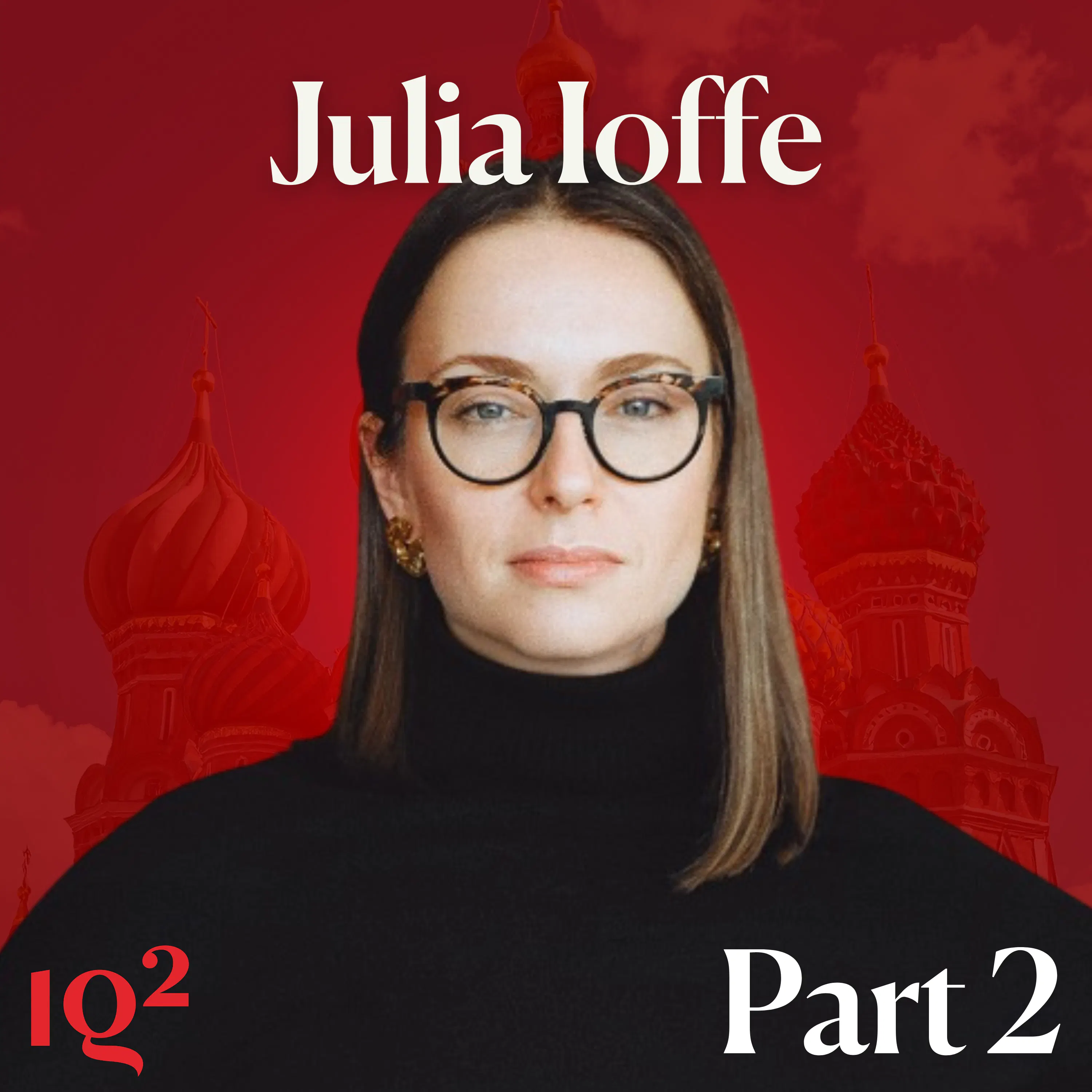
Intelligence Squared
Julia Ioffe and Clarissa Ward on Putin, Russia and the Women Fighting For A Better Future (Part Two)
00:37:28
Loading summary
Transcript56 lines
- [00:01]
Podcast Host / Advertiser
This episode is brought to you by Progressive Insurance. Most of you listening right now are probably multitasking. Yep, while you're listening to me talk, you're probably also driving, cleaning, exercising, maybe even grocery shopping. But if you're not currently operating some kind of moving vehicle, there's something else you could be doing right now that's easy and could save you money right from your Getting an auto Quote from Progressive Insurance Drivers who save by switching to Progressive save nearly $750 on average. Plus auto customers qualify for an average of 7 discounts. There are discounts for having multiple vehicles on your policy, being a homeowner and more. And just like your favorite podcast, Progressive will be with you 24 7, 365 days a year so you're protected no matter what. So multitask right now. Quote your car insurance@progressive.com to to join over 28 million drivers who trust Progressive, Progressive Casualty Insurance Company and affiliates. National average 12 month savings of $744 by new customers surveyed who saved with Progressive between June 2022 and May 2023. Potential savings will vary. Discounts not available in all states and situations.
- [01:16]
Advertiser / Sponsor Voice
I didn't even realize I was wasting $415 a month until I downloaded Rocket Money. I thought I had my finances under control until the app laid out all my spending and categorized it for me. Takeout shopping and unused subscriptions were quietly draining my account and as a result, my savings took a back seat. But Rocket Money doesn't just tell you what you're wasting money on, it takes action to save you money. First, the app looks at your income and monthly expenses and calculates how much you can safely spend each day to stay on your budget. Rocket Money also finds and cancels unwanted subscriptions for you and even negotiates better rates on your bills so you have more money in your pocket. On average, Rocket Money members can save up to $740 a year when using all the app's premium features. Users love the app with over 186,000 five star ratings. It's time to simplify your finances and take control of your Money. Go to RocketMoney.com Cancel to get started. That's RocketMoney.com Cancel RocketMoney.com Cancel welcome to.
- [02:17]
Mia Sorrenti
Intelligence Squared, where great minds meet. I'm producer Mia Sorrenti for this episode. We're rejoining for Part two of our live event with award winning journalist Julia Yofe. Yoffe joined us recently at the Kiln Theatre in London to discuss Putin, Russia and the women Fighting for a better future, she explored the history of modern Russia through the lives of its women, from the Bolshevik Revolution to today, and shining a spotlight on those who courageously defy the regime. She was in conversation with Clarissa Ward, CNN Chief international correspondent. If you haven't heard part one, we recommend jumping back an episode to get up to speed and a minor content warning that this episode does contain some strong language. Let's rejoin the conversation now live at the Kiln Theatre in London.
- [03:07]
Moderator / Interviewer
So the Soviet Union collapses. You have this kind of surge in the influence of traditional values of the Orthodox Church. Is that the mo. And I understand as well exactly what you're saying. There's kind of a backlash against this, like enforced emancipation, which basically is just adding another job without the support needed. Is that when you start to see the real shift? Because even when you're looking at the first ladies, and this is another part of the book that I really love, is these kind of portraits of the different first ladies who, who played very different roles. But the stark contrast between like Raisa Gorbacheva and Lyudmila Putina is it's like jaw dropping. I mean, Raisa is very much Gorbachev's equal, if not like even on a pedestal somewhat.
- [04:07]
Julia Yoffe
Lyudmila is his, as my editor put it, his first subject before he acquired 143 million more.
- [04:14]
Moderator / Interviewer
Yeah, yeah. So I mean, what's the impact of the collapse of the Soviet Union on all of this?
- [04:24]
Julia Yoffe
So here's the thing. The shift toward traditionalism and conservatism actually started in the Soviet Union. It started in the 80s. It started as the short food shortages and the good shortages started becoming more and more problematic. And it became harder and harder to feed and clothe your families. Your family, which fell almost exclusively on the women. And as the economy stagnated. And sociologists looking at this found that basically the youngest Soviet generation. So the, the people who were my parents age, who were just hitting their childbearing years in, in the 80s, didn't want any of this. They thought a woman's place is in the home, a man's places as an earner and a provider and a protector that a woman should. Because they were like, how do you propose solving these problems? And almost nobody said, hey, why don't both the man and the woman do equal amounts of. Of housework or equal amounts of child rearing? That position, I think got like 1% in their polls. It was like, just let the woman stop working and pay the man more. So that he said the family doesn't lose income, pay the man more so the woman can stay at home in her. And so that started during the Soviet era, and it was coming after lots of messaging from the top about how all this women's emancipation is hurting the men and that there's a crisis of masculinity and that the men are so lonely and sad and they don't. They can't find a place for themselves in society because the women are all doing so well. They're getting such good grades at school, they're getting good jobs. They're so responsible and detail oriented. They don't drink a lot, but the men, they're just. Oh, man, they're so lost. I mean, the Soviet government and the Soviet thinkers and writers are writing about this in the 1960s and saying, okay, we've done enough for the women. That's enough. Let's. Let's focus our energy on the men. The men have it much harder. And all of this together. By the 80s, people are like, can we just, like, why are we doing this? Can we just go back to natural roles? And gorbachev actually, in 1987, you know, even though he had a wife who had a PhD and who taught at a university until he became the general secretary in 1985. So even when he was on the Politburo and the Central Committee, she was still a College professor in 1987, because he knew that to revamp the Soviet economy, he would need to cut a lot of jobs. He would need. Because the, the government was the sole employer. There was zero unemployment, but it was a wildly inefficient economy. And so how do you get rid of all these workers? Well, let's save the jobs for the men and let's encourage women, as Gorbachev said, to return to their purely womanly mission. And that was 1987, and women were very excited for this. They were like, good, now I can only have one job.
- [07:52]
Audience Member / Questioner
And.
- [07:52]
Julia Yoffe
But then the Soviet Union collapses. And also around this time, Soviets are starting to see more and more images from the west of how Western women live and how Western families live. And they're like, that looks really nice. Then the Soviet Union collapses, and what happens? The factories shut down, the coal mines shut down. Everything starts shutting down. All these, the vast government bureaucracies start shutting down. People aren't paid wages for months and months and months. And people still have to eat. They still have to feed their families, have to feed their kids. And the women take on whatever jobs they, you know, who cares if you were a doctor before you, you'll wash floors now because you have to feed the family, the men. And this is something sociologists have observed, not just in Russia, but in all countries, male social status is seen as less plastic. And that if you take a hit to your status as a man, if you go from being, let's, a factory foreman or, you know, the head engineer at a factory to being a gypsy cab driver or a janitor, your social status will never recover, even if you get that high status job again down the line. Whereas a woman, it's like, well, I mean, work isn't the most important thing for her. Her family is. So if she goes from, you know, doctor to janitor back to doctor, that's fine. And so men basically just did nothing and they sat down and got very sad and started drinking a lot. I mean, alcoholism really takes off again in the 90s.
- [09:34]
Moderator / Interviewer
And what's the impact of that on women?
- [09:37]
Julia Yoffe
Well, the women had to step into the breach. Their kids still had to eat, you know, and domestic abuse, lots of domestic abuse, but also lots of early violent death for the men. So men start disappearing again. Divorce rates skyrocket. And a lot of Soviet or Russian millennials and kind of young millennials, early Gen Z are all products of. Are all, not all. Many are products of. Of broken homes. And the joke was always when the Kremlin and Putin started cracking down on gay propaganda and banning single sex families, everybody was like, wait, we all grew up in single sex families. We were all raised by our moms and our grandmothers because who knows where my dad is, right? So the men again disappeared. And women had just been promised this thing of like, you can finally take a break, you can finally rest and just have one job instead of 17. And then it was like, oh, wait, you can't again. So then by the time you and I get to Russia, when there's tons of money sloshing around and tons. And but who has all that money? Who has access to those resources? It's the men. The women are like, that's how I access those resources and that's how I can take a break. And so people have asked me, you know, oh, is this similar to the trad wife thing in the, in the US and in the West? And it's not because Russian women don't want to be trad wives. They don't want to homestead, they don't want to bake bread from scratch every morning. They don't want to make cereal from scratch because their kids are craving Cocoa Puffs, right? They want to be trophy wives. They don't want to be trad wives. They want to spend all their time and money relaxing, getting beauty procedures, getting massages, maybe opening an interior design business, maybe getting into yoga and going to yoga retreats in Goa. That's the dream. They don't want to be in the kitchen having seven kids.
- [11:42]
Moderator / Interviewer
And you contrast this towards the end with Nadia from Pussyright, but also with Yulia Navalnaya, the widow of Russian opposition leader Alexei Navalny. How many are there? Like, talk a little bit about Yulia and like, whether you see her as being a kind of emblematic of many Russian women or a kind of hope for what Russian women can be in the future or like, where does. How does she fit into this sort of picture?
- [12:15]
Julia Yoffe
Well, Julia is very unique. On one hand, she was much more traditional, and she and Alexei were quite traditional. Alexei was quite religious. I remember when I was profiling him for the New Yorker, we got in his car in his office in downtown Moscow and drove all the way out to the bedroom community where they were renting an apartment. And every time we passed a church, he would cross himself three times. He kept all the church fasts, etc. And Julia never worked. Julia, as soon as their first child, Dasha was born, she never worked. And she was, you know, didn't speak much in public. She was always there next to him, looking beautiful, holding his hand, whispering in his ear, being very supportive and being a good political wife. But she didn't, she wasn't kind of her own figure. She had. And of course everybody said, oh no, but she's his advisor behind the scenes, et cetera, which is like, okay, sure, but you know, the outward picture is a very traditional one. But then when he is poisoned, the first or not the first time, I don't know, the nth time in August of 2020, and his life is saved. He, you know, he falls away temporarily and it's just her on the world stage by herself. And suddenly a lot of Russians kind of saw her for the first time and who she was and saw how strong she was, how steely she was, how determined she was and how smart she was. And then as Alexei started recovering, people saw what kind of love story they had and how deeply and truly they loved each other. I mean, I remember writing the story in, because it was originally a story in Vanity Fair in the spring of 21, and I remember writing about it and talking to people who knew them and having witnessed it myself, you know, just how much they clearly enjoyed each other's company after 20 years of marriage and everything they've been through together, like, how they just make each other giggle still, and how they're just, oh, so they're still so in love. And I just remember writing and thinking, man, I like, what if I never get to experience a love like that in my life? And I know that so many Russians felt the same way. They were looking at them as like, wow, I want this kind of love story. But I think it's hard now with Alexei gone. She has a much harder task in front of her than he ever did. Yeah. Before the war, all his supporters were in one place. They were all in Russia. He was the brains. He was a generational talent, political talent. I mean, if you ever met him, if you're ever in a room with him, it's like you're like, oh, this. Is this what it was like with a young Barack Obama or young Bill Clinton? Just. I mean, he had the gift. She doesn't. And not to say she's a bad person or she's stupid. She just doesn't have it. And as somebody said, you know, you don't get a generational political talent twice in one family, twice in one generation, in one family. Yeah. I don't know how she does it. Everybody's scattered to the four corners of the world. Everybody who's still in Russia, who still supports her and Alexei's cause is so scared to speak up because the punishments and the repressions had become so draconian. And I don't think she. This was a goal. This was a role she ever wanted. She never wanted to be the politician. She was happy being, you know, backstage supporting him, just being the kind of picture perfect political wife and kind of rock at home. She didn't want to be on her own doing this.
- [16:23]
Moderator / Interviewer
I'm curious before we open up for questions like how you chose the women that you chose. So I was wondering, someone like Senya Sobchak, for example, who some of you may be familiar with, is a sort of mainstay of Russian life for many decades now. She started out as the Paris Hilton. Then she. She kind of flirted with being the opposition. Unclear what the degree of reality of the opposition is, but she's been very successful and very shrewd, and she's lived many decades to tell the tale.
- [17:05]
Julia Yoffe
I mean, it helps that her father was Putin's political mentor and godfather, and Putin is loyal to people who are loyal to him, even though he may.
- [17:14]
Moderator / Interviewer
Have killed his dad. Her dad.
- [17:16]
Julia Yoffe
Yeah. But I think he. I mean, she is untouchable And I think that has, we know that that has deeply frustrated and angered him because she has pissed him off repeatedly, but he knows he just can't do anything to her.
- [17:28]
Moderator / Interviewer
So I guess the question being though, how did you choose which women to pick? Because there are like, I mean, some of the more obvious choices are probably the earlier ones, but as you get closer to the present in the last 20 years, how did you choose?
- [17:45]
Julia Yoffe
Well, so I had this structure for the book that came out of a conversation with Nina Khrushcheva, Nikita's great granddaughter, who also helped me think of the title of the book. But she said something when I was interviewing her which was, have you noticed that the fate of the Russian first ladies or the Soviet first Ladies, the women at the top, always reflects the fate of the country at the time. And I thought, oh, that can be my way. Like I can use the Soviet first ladies or the wives, because they didn't use that term, the wives of the leaders to tell the kind of larger historical story that arc. And then down here I can talk about my great grandmothers and other kind of more ordinary, non famous Soviet Russian people. Ksenia doesn't neatly fit any of that. Like, she is not, she's not a first lady. Yeah, I also, I interviewed her for the book and I just, I continue to find her deeply loathsome.
- [18:47]
Moderator / Interviewer
That's sort of what I was angling for.
- [18:49]
Julia Yoffe
I mean, like, I just, like, I, I, there weren't there, there wasn't anyone that I wrote about that I hated. Like, I, it was hard, it's hard to write about somebody for me that you don't have empathy for. And I found myself really going like, going into these women's worlds and empathizing with them deeply. And Ksenia is just a revolting human. I mean, she is, she really is. And, and I interviewed her and I was like, God, you fucking suck. I can't. And I just like, and I'm like, I can't write about. I don't want to spend that much time with her. Right. You know, and, and also I didn't like, to me it was what would, what would be this. Also what would be the story she tells? Like, you know, I included Margarita Grachova to illustrate what happened when Russia decriminalized domestic abuse, because. Which is apparently now something the US is flirting with.
- [19:53]
Moderator / Interviewer
Spoiler alert. Her husband cut her hands off.
- [19:58]
Julia Yoffe
I mean, she becomes a kind of poster child for the failure of this reform. I included Svetlana Aleluja, Stalin's only daughter she's not technically a first lady either, but to me she was a stand in for first lady. Stalin often treated her like one and he called her his little mistress of the house. And to me she was such a fascinating character that very tragically embodied the fate of Russia, which was this kind of hurling itself first toward the West. And the west is going to be our salvation. No, the West, No. We're going back to traditional. No, fuck that. You know, like and that kind of bipolar almost like I thought she embodied that really well, but with Sapchak I was like, what is this? What does she embody? The cynicism?
- [20:57]
Moderator / Interviewer
The cynicism was the word I was gonna say.
- [21:06]
Podcast Host / Advertiser
So you're about to make a trade based on a friend's text, but which u do you listen to? Is it we could buy a house in Tulum, get optioning those options. We could lose everything. Or let's do a little research, get your head in the trade and make the investment decision that's right for you. Learn more@finra.org TradeSmart why do growing businesses.
- [21:35]
Julia Yoffe
Love working in Slack? Let's ask Christia Ari Bikes Running things in Slack saves me so much time. AI summaries save 97 minutes per week. What say you? Rocks from Slack helps us build community. It helps us build connection. Your partners, vendors and customers all in one place. Take us on home. Ashley from Carraway if we didn't have.
- [21:55]
Podcast Host / Advertiser
Slack tomorrow, I would explode.
- [21:57]
Julia Yoffe
Well, let's not let that happen. Visit slack.com podcast to get 50% off.
- [22:02]
Audience Member / Questioner
Slack business plus this is pro linebacker TJ Watt and I'm back with YPB by Abercrombie for another activewear drop. My second co design collection has new shorts and tanks that keep up with all my in season workouts. And their new Restore collection is a game changer off the field too, because even pro athletes like me need rest days. Shop YPB by Abercrombie in the app online and in stores because your personal best is greater than anything.
- [22:34]
Advertiser / Sponsor Voice
Right now. Get up to 20% off select online storage solutions put heavy duty HDX totes to good use, protecting what's important. The solid impact resistant design prevents cracking and the clear base and sides make items easy to find even when the totes are stacked. Find select online shelving and tote storage up to 20% off at the Home Depot. To organize every room in your home from your garage to your attic, visit homedepot.com how doers get more done New year Same extra value meals at McDonald's so now get two snack wraps plus fries and a medium soft drink for.
- [23:13]
Audience Member / Questioner
Just dollar for a limited time only.
- [23:15]
Advertiser / Sponsor Voice
Prices and participation may vary. Prices may be higher in Hawaii, Alaska and California. And for delivery.
- [23:25]
Moderator / Interviewer
The other woman you chose to include, which I really thought was interesting, and then I really promise I'm going to open up for questions, was this woman who was raped by the former head of the secret police, Beria Lialia Lyalia. And you have this great line where you talk about realizing that she was still alive when you were living in Moscow and working there as a correspondent. And you said, I wish I had known who she was and tried to interview her. But at the time, I too, was trying to write about serious things, that is topics that men took seriously. And that's something that I really found kind of beautiful about this book. It was like, these are all things that you've been so interested in and, like, had never really dared to fully delve into because it was seen as not frivolous, but, like, in the women's realm, let's say. And I can relate to that as a child.
- [24:21]
Julia Yoffe
But they're like the soft social future stories.
- [24:24]
Moderator / Interviewer
Yes.
- [24:25]
Julia Yoffe
And you can maybe do a few of those after you've done the stuff about the nuclear talks and the military buildup. Right. And the economy, you know.
- [24:35]
Moderator / Interviewer
Yeah. It's sort of a. It's sort of depressing how much that resonated with me. Anyway, who has questions for Julia about this book? We have microphones that are coming. We've got two over here. Let's grab them.
- [24:52]
Julia Yoffe
Thank you. You mentioned 1945, I think, when came back from war. And the female battalion who'd been right up at the front had been respected just sort of a minute before, if you like, with everything they'd done, they come back and immediately it's taboo. Any thoughts on why was it taboo then? Why suddenly. Because almost everything seems to start from that point. Thank you. So, basically, while these women. And it wasn't just a battalion, it was over 800,000 women who fought in active combat in World War II, which has no analog in the west while they were at the front. Stalin, who, like most of the other Bolshevik leaders, was not on board with a lot of these emancipatory reforms and, in fact, was incredibly traditional and patriarchal in his approach, had been since the 30s, kind of trying to claw back a lot of the early reforms that Kollontai had put in place. He Bans abortion in 1936. He makes it harder to get divorced while these women are at the front homec gets reintroduced. Sorry, what is it called?
- [26:13]
Moderator / Interviewer
Just cooking.
- [26:13]
Julia Yoffe
Cooking class. Okay. Home EC gets reintroduced. Women are barred from all these active duties. So he is slowly. And he also realizes that the human losses of the war have been so astronomical that they need to, as they said, replace the dead. And they come up with a plan to engineer baby boom in the Soviet Union, kind of like what was had in the west, but it was not. It was very cynically engineered. And.
- [26:51]
Podcast Host / Advertiser
They.
- [26:52]
Julia Yoffe
The bet was on the traditional nuclear patriarchal family. And women who had been fighting guns in hand didn't fit neatly into that. I will say, though, that male veterans. I mean, it's always hard to demobilize large armies after a big horrible war. Men had a hard time readjusting to society as well. This is one of the times that alcoholism, male alcoholism, really takes off in the Soviet Union. But there was an outlet for them in talking about the glory days and all that they did to defend the motherland and blah, blah, blah. But the women came home to a country that was denuded of men. There were almost no men left after the war. 21 million men didn't come home. And women are being told to have more babies, but there's no men around. So the competition becomes really, really fierce. And women who weren't at the. Look at the women who were at the front in these traditionally male spaces, and they were shamed for, you know, the question was always, what were you doing in the trenches with the men? Surely you weren't fighting. And so it became immediately sexualized and trivialized, and it became harder and harder for these women to talk about it, both at a personal level because of how society reacted, but also in terms of the cues and the signals and the incentives that the state was putting out there that women were mothers and wives, and yes, they worked, but that was their primary role. And so let's not talk about them with gun in hand. That's weird. Hi.
- [28:40]
Audience Member / Questioner
Yeah, firstly, I 100% agree with you about seeing a subject. Yeah, deeply bored of that. I just wanted to ask a lot of the things that you talked about in the form of how people reacted to feminism progressing and the ussr, you know, that it was kind of. We've done enough for women. Let's kind of look back at men now. They're struggling over there. It feels a lot like a lot of those things are currently repeating. You know, looking at Hollywood, where the pay gap, the gender pay gap has increased for the last couple years, for the first time in kind of over a decade, and literature, where we're all turning around and going, you know, finally, the men novelists are back. What lessons can we. What lessons can we take into our time in the present and the future?
- [29:27]
Julia Yoffe
I guess so The, The. The conversation around the crisis of masculinity in Russia was then again reprised at around the time that Clarissa and I were there, which is also why feminism was seen as a dirty word, because it was seen as man hatred when we need our men and they're also fragile and helpless. So why would we help. Why would we hate them instead of helping them and prop them up? I think what it comes down to. I think what it comes down to is that both the West, Russia, even when it was the Soviet Union and embarking on this radical emancipatory experiment was still a fundamentally patriarchal society, just as America is, just as the UK is, just as Europe is. And fundamentally, these systems are not. And the men who run these systems are not okay with fully emancipating women. We're okay with emancipating women, but not too much. Because what. What is implied when you say, like, okay, we've done enough for the women, or the women are getting better grades in school, they're getting better jobs after school, after university than men. What about the men? It's like the assumption is that the men still have to be on top. The men still have to have the most of the resources, most of the control, most of the political power. The women can have a little bit, but not 51% or more, and probably not more than 49%. And even 49% is really pushing it. Right. And I think that's the lesson there is that so far I have not seen that these systems are actually interested in our emancipation and in our equal participation, truly equal participation. Because the second we get close to equality, there's a crisis of masculinity, because apparently masculinity is premised on being in control and in charge of women.
- [31:35]
Moderator / Interviewer
We have a question from a gentleman here. Sorry to point.
- [31:39]
Audience Member / Questioner
Nice to be thought of as a gentleman. This book, I imagine, is in English.
- [31:45]
Mia Sorrenti
Yes.
- [31:46]
Audience Member / Questioner
And you imagine are bilingual. Yeah. Do you, did you think. Was there any linguistic difference when you spoke in Russian about all these issues, let's say to grandmothers and great grandmothers. And did that affect you in any way? Because I must. I imagine the way they used words, the way they expressed themselves would have just been very different from what you'd expect from American granny. Is that the case or is that I'm making it Up.
- [32:15]
Julia Yoffe
No, that's actually a very insightful question. And there's a part in the book about this where I'm talking about how feminism is now seen as a Western import and an invasive species. The feminism of the early Bolsheviks is all framed in class language, and it's all in the language that I know from my college studies of just. It's Bolshevik speak, and it's its own language, which I find, or used to find deeply amusing. The little bit of upswell of feminism, we saw this kind of online, like, deeply online, highly educated, urban, young audience start gravitating to some of the conversations we were having, I would say, up to the last couple years, until the backlash of, you know, CIS white heterosexual men and privilege and, you know, all of that stuff. I went to Russia a few times for this book, and I kept hearing people talking about, which is basically just all those English words said in the Russian accent, right? And I was like, you have also. What do these words mean in your context? When everybody is white, or almost everybody is white, but. But also, like, surely you can come up with your own words. But it was just. It was like, oh, these are faddish Western ideas.
- [33:47]
Moderator / Interviewer
Toxic masculinity.
- [33:51]
Julia Yoffe
So just. I mean, it's literally. And then, of course, it became taxi, which is a verb to toxic. Like, to be a toxic person. And it was so bizarre to hear all of these Western words and concepts and ideas just basically push through Google Translate. It sounded like an invasive species. And to me, it was like, guys, you have all this other stuff you could be talking about. You have a language here that you could be using. But then I realized no, because that was all Bolshevik speak, and that's equally outdated and would sound foreign to these young people. So that's actually a very astute question. Thank you. Thank you for coming.
- [34:32]
Audience Member / Questioner
My question is, how much of that change do you think is related both in Russia, but also in what we see going on with America and Trump, to basically the individual strongman that has taken over? Because obviously, as an outsider, I have a feeling that if Lenin had lived longer, the course might have been a bit different. And it is very obvious in your book how differently they treated their wives and women and their role in their party. And actually, my mother was telling me, I was discussing her about your book. And my grandfather happened to be a very learning kind of admirer and one of the first Greek Communists, and he was one of the first people in that part of the country after the Second World War that was really insisting that both his daughters go to school and have the same education and send my aunt and my mother to university in the big city because she felt that was in conjunction with Lenin's beliefs in communism. So I was wondering if Stalin was not Stalin with his, you know, upbringing and his Asian beliefs, whether that would have been a completely different story altogether.
- [35:44]
Julia Yoffe
I don't know. Counterfeit or. Yeah, these alternative histories are very difficult because it's not what happened. We don't know what would have happened. But we do know that Lenin was an outlier in this sense among the other Bolshevik men who did outlive him. They also were not fans of this and he also was like, oh, I don't know about this abortion stuff and you know, let's make sure women have enough babies because we need that. And then the, the other part was that it, it was also just so top down. This wasn't, you know, a mass cultural movement in pre revolutionary Russia. It was among, you know, the intellig and the educated classes, the bourgeoisie and maybe the aristocracy to some extent, but you didn't have a huge chunk of the female population organizing and demanding these rights. And so a lot of women actually also pushed back against a lot of this. They didn't want to be emancipated. They didn't know what the stuff was. I mean, I think that's also something that liberals in the US I don't know the UK system at all. But the, something that liberals run into in the US a lot like, oh the, you know, the working class always votes or the poor always vote against their economic interests. Why do they vote for these people who are not, not for their economic interests? Like, well maybe those aren't their priorities. Maybe they have other priorities and they don't, you know, they care more about identity and maintaining their in groups, social status and power and keeping their community looking like them and homogenous and they care about economics and it's dressed up as economics language. Anyway, I like the point is in, is in, in Russia it didn't get the kind of deep roots that it would have had if it was a kind of bottom up grassroots movement rather than a top down movement. So maybe if Lenin had stuck around longer, maybe, but he was also, he was also resistant to opening the Genadiel which was the women's win the Communist Party. So he wasn't, I mean he was better than the other guys, but he wasn't perfect either. It's hard to say.
- [38:06]
Moderator / Interviewer
Well, it's a brilliant book and ladies and gentlemen, please join me in giving Julia Yoffey a huge round of applause.
- [38:17]
Mia Sorrenti
Thanks for listening to Intelligence Squared. This episode was produced by Ginny Hooker and it was edited by Mark Roberts for ad free episodes and full length recordings. Become a member@intelligencesquared.com membership and to join us at future live events, head over to intelligencesquared.com attend to see our full events program. You've been listening to Intelligence Squared. Thanks for joining us.
- [38:49]
Julia Yoffe
Sam.