← Intelligent Machines (Audio)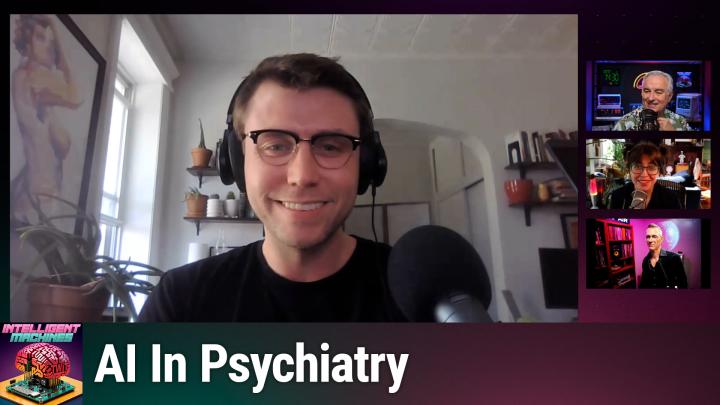
Loading summary
Transcript837 lines
- [00:00]
Leo Laporte
It's time for Intelligent Machines. Jeff Jarvis has the week off, but we've got Jacob Ward joining us along with Paris Martineau. Our guest, Daniel Oberhaus. He's the author of the Silicon why you shouldn't trust AI with your most intimate thoughts. Coming up next, podcasts you love from people you trust. This is Twit. This is intelligent machines, episode 18, 822, recorded Wednesday, June 4, 2025. The one man unicorn. It's Cyber Intelligent Machines, the show where we cover the latest in AI robotics and smart machines, the ones all around us these days. Very pleased to see Paris Martineau on the other side of the camera. Hi, Paris.
- [00:54]
Paris Martineau
Hello.
- [00:54]
Leo Laporte
Love your little kitty cat hairdo. That's. That's. That's.
- [00:58]
Paris Martineau
Thanks. I believe that's the technical term for it. You got a kitty cat.
- [01:02]
Leo Laporte
Yeah, I knew. I know. I'm with the kids. I'm hip. You're risen.
- [01:04]
Paris Martineau
Yeah, you're. You're hitting right now.
- [01:06]
Leo Laporte
Yeah, yeah, yeah. Everything I know about this lingo comparison taught me. Jeff has the day off.
- [01:12]
Paris Martineau
I don't take any responsibility.
- [01:13]
Leo Laporte
It's all your fault. Jeff has the day off. So you don't have to hear the Craig Newmark jingle. Unless our good friend Jacob Ward has started working in some way for Craig Newmark. Jacob is@the ripcurrent.com and has been on our shows before. We love having him on. I think you were a guest on this show before anything else, you know.
- [01:35]
Jacob Ward
You know what's funny, Leo, is that when you guys reached out, I misread the email and thought it said that Leo was not going to be able to be on there and that they needed me to fill in.
- [01:44]
Leo Laporte
I need you to take over for me.
- [01:46]
Jacob Ward
And I was like, oh, my God, I can't believe I started thinking, I'm gonna do this and how do I do this? And then they said, no, no, it's just like, oh, thank God.
- [01:55]
Leo Laporte
Just relax.
- [01:56]
Paris Martineau
Just that yahoo.
- [01:58]
Leo Laporte
I mean, sit back, as they say. As the pilots say, sit back, relax.
- [02:01]
Jacob Ward
Yeah, I don't have to drive the plane thing.
- [02:03]
Leo Laporte
No, you do not. Jacob is the really interesting book about AI called the Loop, How AI is creating a world without choices and how to fight back, which I really, really enjoyed. And I'm always glad to get you back on the show, but this time you are on the other side because we have a guest today very happy to have, Daniel Oberhaus. He is the author of a new book. Hello, Daniel. Welcome. Hi.
- [02:30]
Daniel Oberhaus
Thanks for having me.
- [02:30]
Leo Laporte
His new book is called the Silicon Shrink came out in February. It talks about the use of AI in, ooh, psychiatry. But Daniel knows Paris because he worked together at Wired magazine. He's also worked at Motherboard Vice and written for many, many, many magazines. His previous book we won't mention because he wrote it as a child.
- [02:58]
Paris Martineau
Oh, child. At the wee age of 23.
- [03:01]
Leo Laporte
At a mere 23, he wrote about extraterrestrial languages, which we will think have to get into. But first, let's talk about the Silicon Shrink. Welcome. It's good to have you here. The premise, as I understand it, is that people should not be using AI for psychotherapy.
- [03:23]
Daniel Oberhaus
Yeah, that's a. That's a really great, succinct explanation. I mean, the. The overall premise is that we shouldn't be using AI in psychiatry writ large. So any sort of mental health application is kind of putting the cart before the horse. Is really the main thesis that we don't understand mental disorders well enough to automate them at scale. But that's exactly what's happening right now. So it's a bit of a warning.
- [03:47]
Leo Laporte
About why it's happening at scale now.
- [03:49]
Jacob Ward
Oh, yeah, man.
- [03:50]
Daniel Oberhaus
Correct.
- [03:50]
Paris Martineau
Oh, yeah.
- [03:52]
Leo Laporte
Oh, yeah.
- [03:52]
Daniel Oberhaus
Like how well you know the therapeutic applications in terms of using them as a therapist, I would argue is probably one of the more widely adopted ones. So there's tools that have been designed specifically to do that, such as Wobot, but.
- [04:07]
Leo Laporte
So are they apps? Is that mostly, or is it actually.
- [04:11]
Paris Martineau
Kind of a situation or something else?
- [04:15]
Jacob Ward
Both.
- [04:16]
Daniel Oberhaus
Yeah. So Woebot would be an example of an app that was designed for therapeutic purposes. What's interesting about Woebot is, like, it won't call itself a therapist anywhere on this website. That's very intentional. It's a. It's a wellness app, but it's. It's functionally. It's a cognitive behavioral therapist.
- [04:31]
Leo Laporte
What they're saying, though, is, oh, as a lack of therapists or it takes a long time to get to see a mental health professional. So the implication is that's what you're gonna see.
- [04:40]
Daniel Oberhaus
Right.
- [04:41]
Leo Laporte
But it's not. It's an AI.
- [04:42]
Daniel Oberhaus
They've explicitly said it's not. Not meant to be a substitute for a therapist. Okay.
- [04:47]
Leo Laporte
And so when I. When I say this to people, is most common reaction is, well, not everyone can afford to go to psychotherapy, let alone psychiatry, which is even more expensive. Isn't it better to have an AI Shrink than nothing at all?
- [05:06]
Daniel Oberhaus
Yeah, I mean, that's the kind of the profound ethical question. Right. So this is the primary argument, I think Made in favor of it. And I'll start by steel manning it, which is. There is an acute shortage of mental health professionals. I think something on the order of. About two thirds of US counties don't have a practicing psychiatrist within them, which is wild. But even if you do have access to them, there's a lot of stigma that is wrapped up in seeking mental health services. There's just. It's challenging to get access. I have lots of friends in New York City where. Who they can afford them. Plenty of therapists in New York City and they still can't get access. Yes, and. And it is expensive.
- [05:42]
Leo Laporte
My therapist is $235 an hour.
- [05:45]
Daniel Oberhaus
Oh, you went for the bargain one.
- [05:47]
Paris Martineau
Yeah, I was say that's cheaper than my therapist.
- [05:49]
Jacob Ward
You got grandfathered in.
- [05:51]
Leo Laporte
You're kidding.
- [05:52]
Paris Martineau
Mine on a payment reduction is 250, you know.
- [05:57]
Leo Laporte
Oh my God. Well, it is petaluma. It's not New York City. So maybe.
- [06:02]
Paris Martineau
I mean, yeah, you got those small town prices.
- [06:06]
Leo Laporte
Do you, do you know offhand, Daniel, what the, what the, you know, mean cost for psychotherapy is?
- [06:13]
Daniel Oberhaus
I don't offhand. Although I've never met anyone who has told me it's like, wow, that's. That was so affordable.
- [06:19]
Leo Laporte
No, it's not affordable. You know, and it's. And of course a lot of health plans either don't offer it or I'm on Kaiser and they offer psychotherapy or even psychiatry, but they only give you 10 sessions. After that you're on your own.
- [06:35]
Paris Martineau
Really? Yeah. That's crazy.
- [06:36]
Jacob Ward
There's a limit to it.
- [06:37]
Leo Laporte
First 10 are free.
- [06:40]
Jacob Ward
Can I, can I jump in? Daniel, just. I just want to say, like, first of all, just compliments on, on this concept. Like just the concept of this book is so smart because I feel like, you know, I wrote this kind of like early worried book about AI in general, sort of. And I touched a little bit on therapy. But the, but that you went deep on this, I think is such a smart thing. And this notion you talk about the idea that, well, well, first this, this thing of, of should we be okay with trying to simulate a service we no longer have is sort of the industry argument, right? That like, well, nobody is going to do this job, so we need to come in and bring these folks in. And yet I'm curious what you think. Like, does it. There's the ethical question, but then there's also this question of like, if we start to normalize simulated therapists and using large language models for therapists and so forth, will anyone ever be able to, to be a human therapist again? Or is that sort of like, do you worry about a downward spiral in which we no longer have human therapists sort of at all at the end of this?
- [07:45]
Daniel Oberhaus
I'm not, I'm not as worried about that. I appreciate you saying this was a good idea. The kind of an interesting backstory about this book is I, I started pitching this around, or my agent did, rather. I should give Robert credit there in 2019. So prior to ChatGPT becoming a thing and we got in front of all the big four public publishers and they're like, this is a really interesting subject but, you know, kind of niche. It's maybe good for academics, like save it for the university campuses. No, it's like, it doesn't have broad appeal. No one cares about this. Then ChatGPT happened and now actually one of the.
- [08:12]
Jacob Ward
Dude. Yeah, I had the same timing. I had the same timing. We didn't even put AI on the COVID of the book because we thought it would be too nerdy.
- [08:19]
Leo Laporte
Yeah.
- [08:20]
Daniel Oberhaus
And now it's like, I literally just this, like a week and a half ago, I was at my barber and shout out Mark, but he was, he was like, hey, have you heard of this thing called ChatGPT? And I thought he was joking at first. I was like, Mark, you're, you're like a 29 year old guy and you're telling me you, you just found out about ChatGPT in May of 2025? And he said yes. And so I was like, okay, well now I, I'm dying to know, like, what are you using it for? And he's like, oh, you know, at first just like asking it questions, kind of like messing around with it, having fun. Um, but he's like, now he's like, I use it almost daily for therapy. And I was like, there's no way. Really? Like. And he's, he's like, yeah, he's like. So I was like, tell me what you like about it. And you know, the things you might expect. There's, it's very low cost. It doesn't have the stigma.
- [08:59]
Leo Laporte
Also, there's not a human on the other side who might be judging you. Yeah, you know, it's, it's almost in a way which is both its advantage and disadvantage in impersonal. Yeah, right. I mean, my therapist, I have a relationship with and I think it's important to have a relationship with your therapist, which obviously you can't have with an AI, but especially people just starting out, it might be easier to talk to an AI?
- [09:26]
Daniel Oberhaus
Yeah. I mean, I, I was just at a book festival this last weekend and I had a woman come up to me afterwards who was like, you know, I think what you're saying is important, but she's like, I, I just had my husband who has rejected therapy for a long time, and she's like, he needs it. It's like, okay, that's really, that's, that's.
- [09:42]
Leo Laporte
What every wife says. So that's okay.
- [09:44]
Daniel Oberhaus
Well, yeah, but, yeah, she, she's been trying to get him to, to kind of at least consider it. And so she used chat BT as kind of a, an easy way in. And he, he really adopted to it to the point where now he's actually open to going to a human.
- [09:56]
Leo Laporte
The started talking.
- [09:59]
Daniel Oberhaus
Exactly.
- [09:59]
Leo Laporte
Safer. Safer way, yes.
- [10:01]
Daniel Oberhaus
And there's actually, I have to point.
- [10:02]
Leo Laporte
Out, I understand there could be downsides. You know, chat GPT could say, you know, oh, well, really, you, you, your life sucks. You, you shouldn't stick around. But I could see a human therapist. And I know many cases of. First of all, there's no requirements to put up a shingle saying, I'm a counselor. So they're, you know, you know, you might ask, as a potential patient, what's your training? What's your degree? But you don't have to have a degree in it. You don't have to have training in it. And there are plenty of counselors who do have training who might not be very good, who might even be dangerous.
- [10:40]
Daniel Oberhaus
Right. You forget that there's a bell curve of doctors as well. Right.
- [10:44]
Leo Laporte
Like, same thing with physicians.
- [10:45]
Daniel Oberhaus
There is such thing as the worst doctor in the world and it might be yours.
- [10:49]
Jacob Ward
The thing is like, so, so when the, but the, so I was just. There's a, there was a study that just came out that showed basically this, this, this, these makers of, of AI were trying to figure out a benchmark for the degree to which AI tries to suck up to you and, and, and make you sycophantic. Yeah, sycophantic AI. Right. And they were trying to figure out the degree to which these models were doing it because there was a lot of anecdotal evidence that these models will just try to flatter you all the time and reinforce your ideas. And, and so they used like thousands and thousands of Am I the asshole? Subreddit posts. You know, so the subreddit, am I the asshole? Right. Which tells these incredibly embarrassing stories. Did I do something terrible?
- [11:34]
Leo Laporte
And, and they were doing fake posts though, right?
- [11:39]
Paris Martineau
No, no, that was a different subreddit they pulled in.
- [11:42]
Jacob Ward
They pulled in like, oh, that was.
- [11:44]
Leo Laporte
That was right. Talk me out of it, or whatever.
- [11:47]
Jacob Ward
Right. And. And what they found was that these models are incredibly sycophantic and that there is a way. And not only are they very sycophantic, they have no idea how you would fix this problem. And so to me, one of the things is like, no matter how bad the human therapist is, and there's plenty of bad human therapists, they're at least trained not to just tell you that your ideas are a good idea. They're trained in some way to try and challenge your thinking on this stuff. You know, not all of them, or.
- [12:13]
Paris Martineau
At least they have, or at least the ones that are trained to have a perspective of some sort, they're coming at the conversation with a perspective on the world that is going to shape how they respond to you and how they interpret your responses versus a chat bot or a large language model. Powered dynamic is going to be inherently kind of reflexive and sycophantic. I mean, what did you find in your research on this, like, about this, the nature of this kind of relationship? And I assume they're both like, there's promise to it, but then also peril related to this.
- [12:50]
Daniel Oberhaus
Yes. So the research is actually pretty interesting on this. And to kind of go back to an earlier point is DARPA. In 2014, they had partnered with the University of Southern California to do a study on exactly this. They brought a bunch of veterans in and ran a study where there was a female presenting therapist avatar. One study group was told that there was a therapist on the other side, and they were basically just interacting through this digital representation of them. And the other one was told, there's no person on the other side. You're just talking to a robot. And, you know, they were doing a lot of, like, facial recognition stuff, which is a whole other can of worms in terms of that not actually being a thing. But what they found actually was that the veterans who interacted and knew they were interacting only with an AI actually had better, like, they would disclose more information. They actually got more value out of the therapeutic sessions than the veterans that thought they were interacting with a human through an AI avatar, which there's like, some, you know, limitations to that study model, but outside of like. And there's not. This isn't the only study that has done this. But going back to the very beginnings of the field, there was a researcher at MIT named Joseph Weizenbaum who, in the 1960s, a lot of people are familiar with this is created this chatbot called Eliza. Yes. And was horrified that people would interact with it as if it were real. And it had this shtick of being a therapist, but people would ask him to leave the room because they would actually want to talk with it. And for him, it was just a way to study human computer interaction.
- [14:14]
Leo Laporte
Although he did want it to be Roger, a kind of a Rogerian therapist. Right.
- [14:18]
Jacob Ward
But he was. But he. I mean, to Daniel's point, he quit the field. He was so horrified.
- [14:23]
Leo Laporte
He was pissed away.
- [14:24]
Jacob Ward
He was pissed.
- [14:25]
Paris Martineau
And because the thing is, it wasn't even that, like, advanced. Like, I believe the main thing just kind of reflect whatever you said back to you.
- [14:33]
Leo Laporte
Yeah.
- [14:33]
Paris Martineau
That's basically at the end.
- [14:35]
Leo Laporte
And that's why he said it's like a Rogerian therapist who does, in fact, reflect a lot.
- [14:39]
Daniel Oberhaus
Right.
- [14:40]
Paris Martineau
Yeah.
- [14:40]
Leo Laporte
Right. What do you think about that? What does that tell you?
- [14:43]
Daniel Oberhaus
Yeah, I think so. This kind of comes back to what we were talking about at the very beginning. So there's apps that. And we should also mention that, you know, the AI therapist is what most people think about when they think about AI in this context. But, like, this is a very broad field. It's just kind of like the tip of that iceberg is this application. But within this application, there's apps like wobot that were designed with the intention of being used for some sort of therapeutic purpose, even if they don't call them therapists. But then there's this other category of things such as ChatGPT that were never intended for therapy, that people naturally use them for. And that is truly as old. It's like it started basically with Joseph Weizenbaum, but people have been using Siri for this way. People have been using ChatGPT for this way. There is something so natural about doing this. Like, my barber, first thing, what does he do? Like, within an hour of having access to this tool, therapist. I don't know what that is. So I. You know, people have parasocial relationships with celebrities online. They have parasocial relationships with AI celebrities online, from what I gather now. So there is something about that that I find just very, very interesting. The book doesn't go into as much of the kind of the why behind that. That relationship building, but it does seem to just come so incredibly naturally. But then there's. There's challenges with that. Right. So, like, a very recent news item is the character AI thing with a young man taking his life. And I believe the American Psychological association is now bringing this to the. The FTC to, to investigate, you know, basically who's that, who's that fault for that? Because you had mentioned earlier, it's like you don't necessarily need a license to practice as a counselor. You definitely do as a, as a psychiatrist. But even if I get like, if I go to my therapist, the data I give them is subject to HIPAA restrictions in terms of how they can use that most tools that you have access to in the context of AI and psychiatry, they are not HIPAA protected. Your data is.
- [16:29]
Leo Laporte
Robot says it is.
- [16:32]
Daniel Oberhaus
Well, do they say that it's comparable to HIPAA because like they're not regulated. They don't actually have to. They're just, you know.
- [16:38]
Leo Laporte
Right.
- [16:39]
Daniel Oberhaus
We're going to abide by that because we're nice. Like they're not regulated.
- [16:42]
Leo Laporte
HIPAA compliant on their front page.
- [16:45]
Jacob Ward
Right. But it, but like he says it. That's right, that's marketing more. I mean they may very well be HIPAA compliant, but they don't have to be.
- [16:51]
Leo Laporte
Right.
- [16:51]
Jacob Ward
Yeah.
- [16:52]
Leo Laporte
So they could not be checked. Let's not be HIPAA compliant. And, and they could really reveal everything to an advertiser or whatever.
- [16:59]
Paris Martineau
I mean it's interesting this kind of touches on you. I feel like discuss in the book this concept of like a psychiatric surveillance economy that these tools are enabling. Can you kind of elaborate on what that entails and kind of what impact that could have on like individuals privacy or autonomy as they kind of use these tools?
- [17:17]
Daniel Oberhaus
Sure, yeah. And you know, I'm a big fan of Shoshana Zuboff who you know, kind of coined this idea of surveillance capitalism. Yeah, right. And so the argument was that this is kind of a new front in that. And the core idea here is that when some people hear about AI and psychiatry, their first thought is well that sounds bad, but whatever, I'm not in therapy, it's not going to affect me. Sucks for the patients, but it's not something that's going to affect me in my day to day life. The problem with this is that the way these tools are effective is essentially through dragnet data ingestion. The reason for that is because a, we don't know what mental disorders are like. Like psychiatry is the only medical profession that has not a single organic like undisputed biomarker for any of the diseases it creates.
- [18:06]
Leo Laporte
There's the dsm.
- [18:08]
Daniel Oberhaus
Correct.
- [18:09]
Leo Laporte
I mean they have a diagnostic.
- [18:10]
Paris Martineau
Undisputed is the kind of key.
- [18:12]
Leo Laporte
Well, it's. I don't know if it's undisputed. Nothing in the world is Undisputed.
- [18:16]
Paris Martineau
I mean, I feel like the dsm, even among itself changes dramatically.
- [18:21]
Leo Laporte
I think there's some real problems with the dsm. I completely agree with, with you, but it is an accepted standard for diagnostic.
- [18:28]
Daniel Oberhaus
Well, I would actually, I would challenge that. So the, the National Institutes of Mental Health under Thomas Insel in 2013, they said they weren't going to give grant money anymore to any study that was purely reliant on DSM criteria because of how inaccurate it was for, for diagnostics. So it is, it is the standard. But the, the way that those diagnoses are good standard. Well, it's not, it's generally not explained.
- [18:54]
Leo Laporte
This is from the American Psychiatric Association. It's the Diagnostic and Statistical Manual of Mental Disorders. If you go to a therapist or a psychiatrist on insurance, they're going to categorize you using the dsm. But for a long time, DSM considered homosexuality, for instance, a mental disorder. There've been all sorts of problems with the dsm and it takes forever for.
- [19:17]
Jacob Ward
Things like gambling to get in as an official piece of, you know, as an accepted addiction, that kind of thing.
- [19:22]
Leo Laporte
But in a way that underscores my initial point, which is humans are pretty flat plot in this too, right? This isn't created by AI, this is created by humans. I, I feel like you could train an LLM just to, for argument's sake, to not say things like, well, you're an idiot, or you know, you should try methamphetamine, but instead to say, just encouraging listening things and that it would be of therapeutic. Because part of the, I mean, at least Freud thought part of the value of talk therapy is simply talking, right. Not necessarily the therapist's input, but the actual expression of what's going on with you is sufficient. Couldn't an LLM be. I think Google has an LLM that's supposedly trained to do that. Is that not acceptable? I think that might be a very valuable tool.
- [20:16]
Jacob Ward
You know, you guys, I was literally just having a conversation for my podcast moments ago with a psychiatrist who's now a, a, a British politician. He's a really interesting guy and he's, he was the architect of the Good Friday Accords that ended the troubles in Northern Ireland. Fascinating guy named Lord John Alderdice. And he, he was saying that the key for, in both individual psychiatry and in trying to get, you know, Protestants and Catholics to sit at a table and agree to not killing each other has to do with being like, being able to express yourself. Absolutely. But also being very effectively heard that once you are that you have to be heard in a. In a way that. That feels real to you in order for it to have the true sort of, you know, catalytic quality. And for me, that's a. That's a. The thing that. That it feels to me like AI doesn't do right is this feel. I mean, maybe. Maybe it does. I don't know.
- [21:14]
Leo Laporte
Maybe, you know, we know it. We know. No, it doesn't. Right. Because we know how it works. But if it feels like it does, it might.
- [21:20]
Jacob Ward
Maybe it feels. You know, until I said it, I hadn't even really thought of that. Maybe through a certain. Especially to a certain generation of people, like, maybe that's a better. Maybe you feel heard in a way that you don't with humans if you're. If you've sort of grown up in. In that generation or the rest of it.
- [21:36]
Leo Laporte
I have a close family member who's bipolar, under good psychiatric treatment. She's. She's doing very well. She talks to her chatbot. She has a therapist and a psychiatrist, but she talks to her chatbot and really gets a lot out of it. If I thought it was dangerous for her and it could be because, you know, she's bipolar, I would say you can't do that. But I think she gets a lot out of it.
- [22:03]
Jacob Ward
Daniel, just to ask you a question here, you have this really cool concept in the book that I really appreciate, which is this idea that somehow we're going to wind up. Up in a kind of digital asylum situation. And you use that term, asylum as this sort of symbol of. Of where things could go wrong. And I just think it's so interesting, this notion, because, like, I bump into this all the time as a tech writer. And I know, I know you think about this too, that this thing of, you know, if we. If we make a better, you know, a more efficient, more cost effective digital solution to a thing, and you wind up kind of. Of giving up on the harder human version of it because you've achieved marginal utility by making something digital. Are you. Are you sort of, you know, like, are you giving up in a way that's bad? Is sort of my question. And in this case, I just want to hear you talk a little bit about this notion of. Of creating a kind of asylum. This, which for me, as I understand, is sort of this idea that we're somehow going to warehouse people with these digital tools rather than actually making sure we address them in effective ways. Am I. Am I understanding that concept? Right?
- [23:15]
Daniel Oberhaus
Yeah. And it comes back to what. What Paris was Speaking to earlier about the, the psychiatric surveillance economy and so kind of close the loop there. The, the challenge with a lot of these tools right now is we, we don't have a good understanding of what data is going to, or actually I'll like, I'll unpack this a little bit more. So the reason why a lot of psychiatrists and people in the mental health profession find the idea of using AI so attractive is because if you go to a mental health provider, assuming that you're not in an inpatient facility, you're likely going to see them maybe for one hour a week, maybe you can talk to them on the phone or like text them, whatever, but it's relatively little contact. So the therapist or the mental health professional, we'll just use psychiatrists as shorthand, has like a very limited data set. And when you come to the, you know, an outpatient meeting, for instance, you're relying on the patient's recall. How was your, how was your last weekend? How have you been feeling? Et cetera. And so there's, you know, surveys you can send out for momentary ecological assessments, for instance, to kind of get more in situ data. But the vast majority of the time that you are awake, you have no data on that patient, how they're feeling, their behaviors, their thought patterns, et cetera. What's nice about AI is we all walk around with a pretty sophisticated computer in our pocket right now and we're just bleeding off all of this digital exhaust all the time. And so the thinking around a lot of the kind of push for AI and psychiatry is that we can use this data that we're generating because most of the, like, most people are spending a significant amount of time every single day in front of a digital network device. And this data, even if it's not, what am I writing into the computer, it might just be like my typing speed or my scrolling speed and these things that are almost happening at a subconscious level might hold clues to my mental state and my mental health. It's a really appealing idea. There's very little data to back it up that it works. And in fact, the NIMH former chief who was there for about 10 years, his name was Thomas Insel, he left to go work at Google to pursue this idea and then he launched a company called Mindstrong to pursue this idea. It's the most well capitalized startup in history, raised $100 million and in 2023 it completely shut down. And they never said why. Presumably it's not because of how well it worked. And so There was very little data this entire time about this. And so the challenge right now is, like, that is a very attractive idea. If that works, I'm all for it. But we don't know what data is going to have the best read in terms of actually measuring my mental health. So I can correlate it with perhaps a diagnosis. How do I know that I'm about to enter into a crisis? So you basically have to be monitoring everything I'm doing all the time around the clock to make sure that, A, I don't have a crisis while you're not watching. And then, B, well, maybe it turns out that my typing speed was like the X factor that you can map to the. Like. It correlates very highly with major depression, but we don't know that. So right now we're kind of just hoovering up everything and seeing, like, what. What matches best and trying to fit the box around this person. So that's kind of the surveillance economy aspect of it. And then to the asylum piece, that's kind of an interesting historical analogy in the sense of asylums. Like, prior to roughly the 19th century, the way that, you know, the mentally ill, what they would have called, like, you know, people with madness, were basically just warehouse. They were put in prisons, they were cared for, they were rich by kind of, like, they just hire a benefactor to, like, put them in an outhouse somewhere where they were kept away from polite society. Then in the 19th century, around the Enlightenment, a bunch of, I think, people with very good intentions that, well, hey, maybe we can use the asylum for therapeutic purposes, and we can actually use it as a place for rehabilitation. People in prisons were thinking about the same thing, and it's just like, you know, it shouldn't have a custodial function. It should have a healing function that went really, really well for a few decades. And then people just kept coming, and the asylums essentially became overwhelmed. And so the number of patients in the asylum in the US hit its peak in the 1930s, I believe. You'll have to check me on that. But pretty late into the game, in the 20th century, before the population started declining, and then there was, of course, the turnout of all the patients around the Kennedy administration, with disastrous results that we're still dealing with today. But the asylum basically became a victim of its own, like, good intentions in the sense of it just became overwhelmed, and they weren't. It was no longer able to fulfill its therapeutic purpose and essentially reverted back to a custodial function. And so I think something similar is happening now. It's just much harder to see because it's not physical. But these algorithms are beginning to be run on any sort of institutional computer, Right? So, like, you're seeing suicide detection algorithms in K through 12, you're seeing them in colleges, you're seeing them in government institutions, you're seeing them in offices because happy workers, it turns out, are actually more efficient. So you can say it's for their mental health, but really it's because you'll get better products.
- [27:48]
Leo Laporte
Products.
- [27:48]
Daniel Oberhaus
But like judgments aside, these things are being implemented on our computers. And you can say, well, maybe I don't work in an institution like this doesn't affect me. If you use Facebook, it does, because they have a suicide algorithm monitoring you too. Not if you're in the EU because they banned it due to privacy reasons, but if you're in the U.S. they do. So it is there. It's already here. And it's only.
- [28:07]
Leo Laporte
They're doing that to try to mitigate correct teenage suicide, though. I mean, is it ineffective?
- [28:14]
Daniel Oberhaus
We don't know. They don't. They don't publish the data.
- [28:16]
Leo Laporte
Yeah, well, I mean.
- [28:18]
Jacob Ward
And the thing that we all worry about, right, is this, is that they, they might. Like. My worry is that, like, because the market incentive is there to adopt it, because it's just so much easier to deploy a million digital therapists than it is to train and deploy human therapists, that we're going to sort of do that and by the logic of Silicon Valley, just kind of like, you know, iterate as we go before we even know whether that's effective.
- [28:44]
Leo Laporte
Yeah, moving fast and breaking things isn't so hot if you're breaking people.
- [28:48]
Jacob Ward
Yeah, that's the thing I worry about.
- [28:50]
Leo Laporte
But what is the cause? Do we know the cause of the therapist shortage is? Is this something we can fix?
- [28:57]
Daniel Oberhaus
That's. That's a great question. There's several contributing factors. One is just. It is a. It's a pretty brutal job when you think about what a therapist is doing all day. You're basically a receptacle for people's problems, which could vary from very, you know, day to day. Kind of just the living are the worried. Well, I think is what Freud called them to people who, you know, maybe they're harboring suicidal ideation, maybe they're the victims of abuse, maybe they're abusing others. So you're dealing with just heavy professionally, so not very attractive from that. So there's a huge rate of clinician burnout.
- [29:28]
Leo Laporte
Of course, you could say the same of police officers. We don't have a lack of police officers.
- [29:34]
Daniel Oberhaus
I mean I actually payment I think.
- [29:36]
Paris Martineau
I think is also a big problem I would assume is police officers get salary and overtime. Therapists are typically an hourly rate. They have to hustle, try and figure out how to make it worth it with insurance. They have to deal with reimbursement. They have to deal with the fact that I know a lot, can't really pay.
- [29:54]
Leo Laporte
I know a lot of therapists and a lot of very happy therapists who are working very well. My ex wife is a therapist. It takes a certain kind of person. My guess is that there just aren't that many people who are. Would be good at it or would want to do it. Even if you funded it, even if you promoted it, even if you had college programs and everybody said this is a great job. There just aren't that many people who have the skills to do it or the desire to do it. Mike would be my guess.
- [30:24]
Jacob Ward
I mean here in California they had to create a whole other category called, called a marriage and family therapist.
- [30:30]
Leo Laporte
Yeah, my wife was. Ex wife was an mft. Yeah.
- [30:32]
Jacob Ward
And an mft, Right. That's a specific California thing. You can't practice in other countries, in other states. They created it because of this huge shortage. I mean, I'm looking at the American Counseling association site. They're saying lack of funding, poor reimbursement rates, low retention, huge need.
- [30:48]
Leo Laporte
She had to get a master's degree. She had to pass an exam. She had have many, many hours hours in training with an accomplished psychotherapist working with her to get the mft. Actually she had an MFCC initially. So it is, it is not the kind of thing you hang out a shingle and next day you're taking patients.
- [31:09]
Jacob Ward
Yeah. I certainly don't mean to suggest that she's not legit. I'm just saying that it's a, it's a reflection of how desperate California was. Yeah, but it's still a slightly easier way of getting as many, many people.
- [31:20]
Leo Laporte
Wasn't that easy. Let me just. I just want to say it was a good qualific qualifying process, I would say. And a lot of people probably wouldn't get through it. It's also expensive, by the way, because you have to get a master's.
- [31:34]
Daniel Oberhaus
Yeah.
- [31:34]
Jacob Ward
It's funny, I'm actually in the. I mean, because I'm. I'm in this funny moment where I'm no longer a full time journalist. I've been thinking like what do I do with myself? And I started looking at being a therapist.
- [31:46]
Leo Laporte
Yeah. I saw you're a fellow at Stanford in Behavioral Sciences.
- [31:50]
Jacob Ward
I did a thera. I did a fellowship there as a journalist and that got me thinking about it. But it's. But yeah. Thinking about like becoming a therapist. Turns out it's such. It's such a hard road. It didn't. You know, my wife looks at the numbers. She's a much more practical person than I do. And she was like, these numbers don't make any sense for our.
- [32:06]
Leo Laporte
I think you'd have to have a calling. I honestly. To be a good one anyway. And the good therapists. I know, they have a calling. It's like, you know, it's like being a priest. It's like you have to really have that nature and want to be of service. And it is a sacrifice. I'm sure it's a big. I can't imagine doing. Takes a lot of training to be a good one. So the reason I ask is we're pro. I suspect we're never going to have enough. So. So maybe there is some way to use AI to. Is there a. Is there, Daniel, Is there any safe way to do this?
- [32:46]
Daniel Oberhaus
Yeah. And so there's like a few points that I really want to make sure I clarify. One is that this is. This isn't a book. And it's not my opinion at all that people just shouldn't use them full stop. Right. So, like for instance, your family member. I know lots of people who do this by barber included. And I'm not, I'm not here to tell them. Don't. In the same way that I wouldn't tell someone, hey, don't take the pills that your psychiatrist.
- [33:09]
Leo Laporte
Right. Gave you.
- [33:10]
Daniel Oberhaus
Right. But what I will say is like, hey, we actually do have a massive overdiagnosis problem that has led to a massive uptake in psychiatric drug use. Maybe that was out of best interest. Maybe that was out of industry interest. Who. It doesn't really matter. Like, the fact is there are a lot of people on psychiatric drugs now. But what's interesting about that is the results have gotten worse over the past 20 years. This is the only medical specialty, once again, where as it progresses, the outcomes are getting worse for patients. That's shocking. We spend billions and billions of dollars doing this. I don't think it has anything to do with the intentions or the capabilities of therapists and people who work in this. I have nothing but very, very deep respect for them. So I just wanted to say, like, I don't like people ask me this all the time now it's like, I don't think that it's, you just shouldn't use it. But I do think you should like read, you know, what's on the tin. What am I going to get from this? What are the risks? What are its limitations? I think that's very important to know and it's often very lost. Like we were just looking at Woebot's website and it'd be very hard to tell that that wasn't subject. Like it wasn't regulated as a, like a HIPAA compliant organization. It is HIPAA compliant, that is true. But there's this kind of unspoken thing about. But like we don. And so that's the kind of thing where this was more meant to be kind of like a shot over the bow. Be like, this is happening, this is real. I'm the last person who's going to say that there aren't people getting benefits from this. There's definitely people getting benefits from this. And I think that's fantastic. I also think, to your point, Leo, can we use these things effectively? My answer is an optimistic kind of yes. I think what's so interesting about writing this book is this is an issue that has become very topical because of chat GPT, but it's, it's about 70 years old and it goes right back to the beginning of artificial intelligence as a field. And in fact, Carl Sagan in 19, in the 1970s wrote an article for Natural Science where he predicted a future where there would be like almost telephone booth therapists to deal with a therapist shortage in his day 50 years ago. So it's definitely not going away. The tools have gotten better. And I think what's really interesting about, you know, everyone kind of indexes on AI therapy. Like the book covers a lot of different technologies and there are certainly a lot of other ones that I think are, are much more nefarious. But as far as AI therapy goes, most of the AI therapists are implemented as cognitive behavioral therapists. And what's interesting about CBT is when you really zoom out about what it's trying to do. A lot of people I think look at therapists as like almost gurus, but like that's not what they are. They're actually teaching you how to help yourself, right? Like they are giving you the tools to improve your, the way you think, to improve your behaviors in ways that are like, less maladaptive and, and increase your overall well being. That's what a good CBT therapist should do. And to the extent that that's what they're there for and what they're trying to achieve. The programming for CBT is actually it lends itself very well to being implemented in an algorithm. In the same way that we were talking about Rogerian therapists. That was a little bit more hacky, what Joseph Weizenbaum was doing. But as a. As a way of delivering care, CBT is actually very prime for application LLMs. There's, you know, we're pretty early days here, but I think that's phenomenal if that works out and we can get people care and it's proven to be effective. My question right now is, why can't anyone show me data saying that this is at least as good as a human therapist? Because the. The pushback I usually get is it's better than nothing. But then I say, can you prove that? And the answer is no. No, you actually can't. There's no data showing that. Because, like, for instance, I was just talking to the New York Times a few weeks ago About K through 12 suicide monitors platforms, right? And you're like, how could that possibly be something that anyone would ever be like, hey, wait a second. We may not want that. It's like, it almost sounds like you're advocating for children killing themselves. And it's like, that's not what I'm advocating for at all. But there's this tendency to say we must do this because it might save one life. And that is a philosophical and a moral argument you can make, and lots of people do. But there's also lots of people that say, hey, maybe we shouldn't all just be forced to, like, participate in these systems just because one person thinks it might help a kid. Because we actually don't know, like, if that would have happened. Regardless, there's just so little data. And the companies that are building these aren't forthcoming with them. Forthcoming with it at all. I don't know if that's because the data suggests that maybe it isn't as effective as they would want you to believe, or if it's just not. If it just doesn't exist yet. My experience with tech companies is when they have data that shows their thing works, they want to tell you about that.
- [37:40]
Leo Laporte
They will let you know.
- [37:41]
Paris Martineau
Yes, there will be seven press releases and a web conference.
- [37:44]
Daniel Oberhaus
Yes. So it's very curious that we're missing that. And, you know, if you go on these sites and look at them, a lot of the sites will have data and it'll say, you know, it's. They'll make some very Large claims. But if you actually click on the, on the peer reviewed research that they are claiming backs it up, what you'll find is, for instance, there was a chat bot that was claiming, you know, it had these massive mental health benefits for college students with depression. I was like, oh, that's interesting. Maybe we found one that worked. And then I went to look at the study and what they were actually showing was that this chat bot was better than a government pamphlet in a cohort of about 50 college students over two weeks. That's not nothing but like, I don't know, it's not really what you're saying on the website either, right?
- [38:21]
Leo Laporte
Like you're better than a pamphlet.
- [38:24]
Paris Martineau
It's like, okay, tell that to investors.
- [38:27]
Daniel Oberhaus
Yeah, I'm willing to believe that actually that it is better than a pamphlet. I'm less willing to believe that you are just across the board, like lowering depression rates by 50%. It was like something very grandiose like that. But that was the case, but only with that very important asterisk. And so there's a lot of that in this field.
- [38:45]
Jacob Ward
And like, I mean that's the thing that, that is so disturbing to me about this world that you're covering this book, right? Is that like in the United States particularly, this kind of thing is a business, whereas in other countries it's a civic service, it's a national service. Your therapist is not a, is not, you know, you go to your National Health service in the UK or you know, other places for your, or behavioral therapy or whatever else you're going to need. It's only here where we've, where everything's privatized that we don't, that we would even consider that we would need a digital replacement for this stuff. And then we're all just kind of like hostage to the marketing, to how truthful the marketing is. It's so cynical, it's shocking to me.
- [39:34]
Daniel Oberhaus
So to take Woebot for instance, I feel like I pick on them. I actually have no beef with Woebot. It's just probably the most well known one. But, but they are currently doing a FDA trial and what's surprising to me about that is most things that have to go through an FDA trial, you cannot access them prior to, prior to going approval.
- [39:53]
Jacob Ward
Yeah.
- [39:53]
Daniel Oberhaus
So is it like, is this, is this a medical technology? Because like what's going through the trial is the exact same thing I can go download on Google Play. So like, like, like what, what change? Like I basically just have access to an unregulated medical Technology. And the reason I do is because you're not saying it's medical, but you are like you aspire. That's, that's, that's shocking to me that you can, that you can do that. So I don't know. The UK is actually an interesting example because the NHS is also increasingly doing this. They have a pretty robust tech sector that's building stuff here for the, for the same reasons.
- [40:25]
Leo Laporte
Right.
- [40:25]
Daniel Oberhaus
It's therapist shortages. But I think the number two and number three chat therapy bots are actually UK based.
- [40:31]
Paris Martineau
Interesting.
- [40:32]
Jacob Ward
That is interesting.
- [40:33]
Leo Laporte
It's. I understand the difficulty or you should. People, you should absolutely read Daniel's book because it goes into a lot more depth than we could possibly go into in half an hour. But it's by the way called the Silicon Our Artificial Intelligence Made the World an Asylum. It came out last month or a couple months ago and is available on Amazon, as you can see, and Kindle or hardcover and at your favorite bookstore, which you should absolutely patronize. But I also, I feel like, you know, you don't want to experiment with people's psyche. That's a very dangerous thing to experiment with. Of course, we also experiment with full self driving in vehicles. Also dangerous. AI is involved in a lot of things. We're going to talk about some very dangerous. But at the same time there is a need. We know there's a need. We know that in some cases it's useful. I don't think there's a clear answer on this one. You're. I know you, you don't say don't do it, but I think it's important to think about the consequences of doing it. I just don't know if there's a clear answer like is this a bad way? I, I feel like we need to look at it and think about it and move and move forward judiciously.
- [41:52]
Paris Martineau
I feel like that's an. A possible answer is like that it needs to be.
- [41:57]
Leo Laporte
I wouldn't throw it out.
- [41:58]
Paris Martineau
Thought about.
- [41:59]
Leo Laporte
Would you throw it out?
- [42:00]
Paris Martineau
No. I mean, I think that most things exist somewhere in grayscale rather than all black or all white.
- [42:08]
Jacob Ward
Well, one, one thing I get out of this book is that, is that, you know, we have come to at least expect in the United States that when someone offers you a therapy, it has been tested and validated in some form, that if you go to a licensed medical professional, they've been through some sort of training and that your data will be kept private. What I think, Daniel, you've made such a good case on in this book is like, those things don't apply to this sector. And we're, you know, as I'm sure we'll discuss later in the hour or later in the show, you know, the, the budget bill that, that Congress is, is looking to pass right now would forbid states from regulating AI in any way for a decade. So the regulation of this kind of thing would even really be possible if, you know, under, under state law down the line, if that bill goes through. So like, we're living in this world where it's totally unregulated. And to me, if there's nothing else here, it suggests to me that some standards should be imposed on what is currently a totally wild west.
- [43:05]
Daniel Oberhaus
Yeah. And I think to maybe to close the loop on this, like, I'm very strongly in agreement with what you had said, Leo, because like, I think the book is largely focused on what is the risk of if we, if we do this and we like, we don't put a check in. Right. But I think the reason why this is a problem at all is because there's a lot of well meaning people who say what is, what is the risk if we don't, like, if we must do something? The problem is that's like the famous politicians fallacy, right? Like, we must do something. This is something, therefore we must do this. And it's like, that's, that's where I'm like, this is one tool in the toolkit. And all I'm saying is like, let's withhold judgment right now. Like, these exist. They're, they're all around you already. Let's, let's take a beat. And all I'm asking is like, please just show me the data. Like, does this work as advertised? And the answer is like, it either doesn't exist or no one is showing it to you. And so it's hard though.
- [43:56]
Leo Laporte
This is hard data to produce. I mean, it's not.
- [43:59]
Daniel Oberhaus
Oh, for sure.
- [44:00]
Leo Laporte
Yeah. You know, I think we have a little bit of a crisis going. We have two school nurses for 1500 students in my little town. That's not adequate. And we celebrate it because we've got two. So we have a cr. We have a problem. I would, you know, it'd be nice to say, say, everybody go be a therapist to your friends and neighbors. Go help, go talk to them so they're not talking to robots. There are lots of things we could do. We should probably be doing them. And I'm not sure AI is the solution and you aren't saying it, but I will Say it. The sad thing is AI has also become a gold rush and there are a lot of people out there trying to make a lot of money on any possible use of AI because it's easy to raise money for it. And which means there will be a lot of bad actors involved in this space and every other. And in this space the hazards are great. So that is something else to be very aware of. Daniel, I want to thank you so much for your time. Daniel Oberhaus the book is the Silicon Shrink and well worth reading. I thank you for your time and I look forward to talking to you again.
- [45:07]
Daniel Oberhaus
Yeah, thanks so much. Appreciate the interest and the time.
- [45:09]
Leo Laporte
Thank you. Have a great one. Take care.
- [45:11]
Daniel Oberhaus
See you guys.
- [45:12]
Leo Laporte
We're going to take a little break. We have more to come on Intelligent Machines, our show today brought to you. Bye. Big id the next generation AI powered data security, compliance and privacy solution. Hey, I mean look, we know AI is transforming business, but there's risk. We talk about it all the time. Data risk, bias risks and of course compliance challenges. The question for every business today is are you adopting AI responsibly? Well, BigID delivers end to end AI and data governance to help enterprises manage risk, enforce policies and ensure responsible AI adoption. For one thing, businesses want to be very careful about the data they use for their AI. Right? You want to make sure AI only access is safe to use relevant data that's automatically tagging sensitive data by policy and type, staying away from the stuff you don't want AI to have access to to. That's why you need Big id. It's the only leading solution to uncover dark data through AI classification. It's actually a great use of that tool to identify AI risk, to manage your data life cycle and to scale your AI strategy. Now the nice thing about BigID integrates with your existing tech stack with unmatched data source coverage and it allows you to automate privacy and security workflows. Take action on data risks. With automated remediation orchestrations, you can automate privacy, risk management, regulatory compliance, data rights requests and more. Partners of course, include everything you're using including ServiceNow, Palo Alto Networks, Microsoft, Google AWS. With BigID's advanced AI models, you gain visibility and control over all your data. It's the platform Intuit named number one for data classification and accuracy, speed and scalability. If you think about it, who would be a good customer for Big id? Somebody who has a lot of data in a lot of different places in the cloud on prem. How about the US Army? Can you Imagine they're in the process of moving into the cloud. They've got dark data everywhere. The US army uses Big ID to illuminate dark data and to automate data retention. I've got this great quote from US Army Training and Doctrine Command. Listen to this quote. The first wow moment with Big ID came with being able to have that single interface that inventories a variety of data holdings, including structured and unstructured Data across emails, zip files, SharePoint databases and more. Continue the quote to see that mass and to be able to correlate across those is completely novel. I've never seen a capability to bring this together like Big ID does. Man, if this can solve the Army's problems, it can solve yours. Cnbc recognized Big ID as one of the top 25 startups for the enterprise. They were named to the Inc 5000 and Deloitte 500 for four years running. The publisher of Cyber Defense magazine says, quote, big ID embodies three major features we judges look for to become winners. Understanding tomorrow's threats today, providing a cost effective solution and innovating in unexpected ways that can help mitigate cyber risk and get one step ahead of the next breach. Start protecting your sensitive data wherever your data lives. @bigid.com Im get a free demo to see how big ID can help your organization reduce data risk and accelerate the adoption of generative AI. Again, that's BigID B I g-dot com IM there's also a free guide to help you understand the risks of generative AI and data driven strategies to ensure responsible and compliant AI adoption. Again, bigid.com im we thank them so much for their support of intelligent machines. As I mentioned at the top of the hour, Jeff Jarvis is on. Where is he? He's on assignment. He's out doing something.
- [49:25]
Paris Martineau
He's I truly don't know.
- [49:26]
Leo Laporte
He's being a big shot somewhere.
- [49:28]
Jacob Ward
Whatever.
- [49:28]
Paris Martineau
He's driving because he was texting me earlier and was like oh sorry, that was a spelling mistake because I'm driving. And I was like jeff, don't text me and drive.
- [49:37]
Leo Laporte
We're talking about the hazards of AI therapy. What about texting and driving? Well anyway, we're really glad Jacob Ward could be here, the author of, as I mentioned, a really good book, the Loop. But Jacob has a checkered career in many different areas. He's a very smart guy. We've had him on many shows and we're always glad to get Jacob in. So thank you for taking some time to be with us.
- [49:59]
Jacob Ward
Always a pleasure. I just trying to Be part of the club here. Here.
- [50:03]
Leo Laporte
Well, you're in the club, Jacob. Welcome. It's a Mickey Mouse club in a way, but it's a. It's a good club. Lots of stories. We'll just do a tossed salad of stuff. The president of the United States has topped. Has tapped Palantir to compile data on Americans. That's Alex Karp talking to somebody behind the American flag. Palantir is. Is an interesting company. What do you know about Palantir, Jacob?
- [50:34]
Jacob Ward
So Palantir, founded back in 2004, was trying to solve a problem that the U. S. Military and intelligence communities had, which was we. They'd been recording tons and tons and tons and tons of surveillance data, audio and video in Iraq at the time. And they had no ability to parse it. You know, they literally had dudes in rooms, you know, know, scrolling through footage. And Palantir's idea was to get their arms around that and create basically a search engine for video. And they very quickly became sort of a data analysis cutting edge for the. For the U.S. government. And they have a couple of core products. One is called Gotham, and now the new one's called Foundry. And what they basically say is, you give us a huge amount of your data and we can parse it. And of course, now that we're in the world of transformer models and AI, they are vastly more effective than they. Than they used to be. So they are, you know, their genesis is as a surveillance company. Now, the other thing that's really worth noting is you mentioned Alex Karp, part of his pitch. So Palantir was created by Peter Thiel, is founded by Peter Thiel, who's, you know, ultra. He's a very conservative libertarian guy, was one of the angel investors in Facebook and has been. He was J.D. vance's patron. He, you know, Alex Karp, when he came in as CEO, has basically been sort of boasting that this is, you know, not just a really effective, you know, form of data parsing. It is also. So, you know, he sort of considers it kind of an ideological and literal weapon in the fight to sort of push Western democracy around the world. And I even have a quote here from something that he said recently. He was, you know, he was on an earnings call earlier this year, and he said, palantir, quote, this is the quote. Palantir is here to disrupt and make the institutions we partner with the very best in the world. And when it's now necessary to scare enemies and on occasion, kill them. And that's part of Palantir's spookiness is that they are not just a tech provider. They're very. They're a little bit ideological. So much so that a group of Palantir ex employees have actually put out a letter that basically called for the company to stop washing its hands of the creepy ways in which the technology is used to start taking some more responsibility for it. And they wrote in the letter, big tech, including Palantir, is increasingly complicit, normalizing authoritarianism under the guise of a revolution led by oligarchs. We must resist this trend. So Palantir it is.
- [53:14]
Paris Martineau
This is perhaps beside the point, but how do you become Palantir employees and not realize that that's the system you're taking apart, taking part?
- [53:22]
Leo Laporte
I could tell you a little bit that I read his book the Technological Republic, and Karp says in that, that that Silicon Valley got misled, that in the, you know, last century, engineers, scientists worked with government for the general public wheel. So he talks about the Manhattan Project to build the atom bomb. He talks about the Internet. He taught. And he says, unfortunately, in this century, the Silicon Valley has been distracted by crap, by gadgets, by toys, by making money. And he says in this book, and you know, I have to say the first few chapters, I was starting to say, yeah, yeah, you're right. He says what the best minds in our country should be doing is working with the government to protect the American way of life, our Western values. You use the word democracy, Jacob. I'm not convinced that Alex Karp cares so much about democracy, although he has in the past been a donor to, to Democratic Party stuff. I mean, he's not, I don't think he's a MAGA Republican, but. And in the book, one of the, one of the victories that they tout, and I think it's a genuine victory, is in Iraq. There was a big problem with IEDs, these improvised explosive devices. You couldn't, you didn't know where they were going to be. And it was killing a lot of American soldiers. And Palantir came in, took these disparate. You talked about all these different, different videos and data sources combined him and is able to make a tool that kind of predicted where ID IEDs would likely to be. And he said, he says, I don't haven't seen the numbers. But he says it was a great success, that it saved lives, and that was the beginning of their relationship with the, with the US government. He has a $795 million contract with the Department of Defense. Got that Last week, just signed $113 million contract. Actually, since Trump took office, they've signed more than $113 million in government spending. Among the things, and this is what scared me in this story, in this New York Times story that they are going to be doing is combining data from the Social Security Administration and the Internal Revenue Service. Historically, in the United States, the IRS has been very protective of its data. For instance, the Social Security Administration does not get IR historically.
- [55:50]
Paris Martineau
Well, no, now it does. Now they're kind of commingling all that thanks to Doge.
- [55:54]
Leo Laporte
And now this is the next step. They want Palantir. And it seems, on the face of it, oh, great idea. Just if you could just take everything the government knows about you, Paris, and put it in one big thing and analyze it with AI Just think of all the insights we'd get.
- [56:11]
Paris Martineau
Insights galore.
- [56:14]
Leo Laporte
So I can understand why, hey, the administration might want to do that, but I think it's also a privacy nightmare. The IRS knows so much about you and combine all the government sources, there's nothing they don't know about you.
- [56:26]
Darren
Also, isn't there a data center somewhere that has like, that's been storing all of our stuff for like, 30.
- [56:31]
Leo Laporte
NSA's been doing that.
- [56:31]
Paris Martineau
Oh, it's got all of our phone calls and everything like that. The FBI agent inside your computer. We're going to commingle that with our IRS data. Whatever stuff immigration has, has all of the little cameras that facial. Recognize us every time I walk outside the street. And then. Great. And then we'll just have that in a big data center that I'm sure will never get breached or used for any nefarious reasons.
- [56:54]
Leo Laporte
We kind of know perfect. The value, by the way of, of this combining, commingling the data. Well, we know it from a lot of different things, but most recently, there's a company called Flock that does cameras on many, many city streets, license plate recognition cameras and so forth. And I don't know if you just saw a story about the Texas cops using Flock data in states where abortion is legal, to try to track down a woman who went out of state to get an abortion. And this is starting to become a little bit dystopian. The Times writes, creating detailed portraits of Americans based on government data is not just a pipe dream. Oh, I was hoping it was a pipe dream. The Trump administration has already sought access to hundreds of data points on citizens and others through government databases, including bank account numbers, the amount of their student debt. They've already promised that they're Going to send people who owe money on their student loans into collections, their medical claims, their disability status. You remember RFK Jr saying head of Health and Human Services is we want to make a database of autistic people.
- [58:09]
Jacob Ward
Yeah.
- [58:09]
Leo Laporte
Imagine Mr. Trump could use such information, the Times rights to advance his political agenda by policing immigrants and punishing critics. It's a first step, frankly to eugenics, to Nazi style cleansing. I'm really concerned about how this data could be misused.
- [58:32]
Jacob Ward
Yeah. Let me, I have two thoughts I want to share on this. So one is there is a good way you could do this. And, and I, and I so not to keep plugging my own thing here, but on the rip current.com there's an interview I have with the former president of Estonia, a guy named Too Much Ilvis. And Estonia is a country that was crushed under Soviet oppression, incredibly impoverished, coming out of the Soviet era era and very quickly figured out a digital future for itself and really like has turned itself into one of the great Western democracies and one of the great sort of things. So in this piece, you know, American surveillance system is coming on the, on the ripground.com we. I sort of talk about this interview that I did with him.
- [59:13]
Leo Laporte
I have an Estonian digital ID by the way. I thought that was so cool.
- [59:15]
Paris Martineau
Wow.
- [59:16]
Jacob Ward
So this is, this is what we're talking about. Okay, great.
- [59:17]
Leo Laporte
So when you said for it anybody in the US I didn't know that.
- [59:21]
Jacob Ward
That's so cool. I didn't know. I thought you had to be, be Estonian. Well, so, so you, you, when you're, when you're born in Estonia, you get a digital ID like Leo seems to have. That's cool.
- [59:31]
Leo Laporte
It doesn't say I'm an Estonian, but.
- [59:33]
Jacob Ward
It'S, you know, no, but, but if you have any interactions with the Estonian government, it's your way of accessing it. So basically what it is is it's, it's a, it's a digital ID that follows you through every single thing you do in your life. Taxes, divorce, marriage, you know, you get arrested, you go to the hospital, your digital ID is hacked. How you are identified in each, how.
- [59:50]
Leo Laporte
You vote, how you sign documents.
- [59:53]
Jacob Ward
That's right, everything. Everything. And, and that is, you know, that is, it creates an incredibly convenient system. You can pay your taxes on your phone in two minutes each year. There's no accountant required because they already have under your digital ID exactly how much money you've made and who you've worked for. It's an incredible piece.
- [60:11]
Leo Laporte
This is a little terrifying though, Right. Okay. That's the thing that takes.
- [60:15]
Paris Martineau
Terrifies you that you could pay your taxes easily.
- [60:18]
Leo Laporte
They know where all my money is.
- [60:20]
Paris Martineau
Okay, The IRS knows where all your money is. They're just making you a puzzle. Sorry.
- [60:24]
Jacob Ward
Here's. Sorry. Here's the difference between it being really scary and being really awesome. So the reason it's awesome is that Tumasova said it's like a Christmas tree. Each record is hanging separately on the tree. So your health records and your bank records and your police records are separate, separate ornaments. You have access to all of those, but none of them can talk to each other without your permission. So the police can't go to your health records, they can't go to your bank records. You are in charge of who gets to see what. And he said that is the specific problem they were trying to solve, because as soon as you merge them all, then the police can start using your bank records, and then your health insurance can start using your arrest records to determine your, you know, whether you should be insured. And. And. And you can start hunting down dissidents and critics in the way that's. That Trump's thing could conceivably make sense.
- [61:16]
Leo Laporte
That's. The problem is, okay, maybe you like the government today, but that data will be available to the next government and the next government and the next government. I should also point out that shortly after I got my Estonian digital id, they had to recall it because they had a security flaunt.
- [61:34]
Jacob Ward
Oh, no way.
- [61:35]
Leo Laporte
Yeah.
- [61:36]
Jacob Ward
Oh, God.
- [61:37]
Leo Laporte
Yeah. This was back in 2017. They've probably solved that. I don't know. But they.
- [61:43]
Jacob Ward
And the other point.
- [61:45]
Leo Laporte
And this is why this is the. This is the central problem, is once you centralize this data.
- [61:49]
Jacob Ward
That's right.
- [61:49]
Leo Laporte
The flaw can let attackers decrypt private data or impersonate impersonate citizens. So they had to have all the cards recalled and updated with new security certificates, markets. There's your problem. Once you centralize it, however many controls you have, it's still all in one place.
- [62:09]
Jacob Ward
Yeah.
- [62:10]
Paris Martineau
And it just becomes a bigger and bigger target.
- [62:12]
Leo Laporte
Yeah.
- [62:13]
Jacob Ward
Well, and here's the other thing that I would say is that. So for all of the ideological talk around Alex Karp and the. And. And what he's the CEO of Palantir says about, you know, we need to get back to a world in which we're sort of serving a common good and blah, blah, blah, blah, he. He, like all these tech people fundamentally seems to believe. So I interviewed Palmer Lucky, who's.
- [62:32]
Leo Laporte
Oh, God, what a nut job. He's back at Meta.
- [62:36]
Jacob Ward
He's the CEO. He's the former CEO of Anduril, which is the. The. Another Peter Thiel company like Palantir, both named for Tolkien. Tolkien, you know, Lord of the Rings.
- [62:45]
Leo Laporte
The thing I hate the most about them.
- [62:47]
Jacob Ward
So weird, right? You know, so, but, but they all say on the one hand, we need to be creating these, you know, something that helps the government and pushes Western values and blah, blah, blah. But at the same time, when you ask them, hey, but you have built a system that invent, that involves. That has created huge new moral complexity. And shouldn't you have to also invent the morals to go along with what you've built? They all say, no, that's not our job. It's. It's up to people to vote in people to do that. Like, that's democracy overseas job. So they wash their hands of what could happen with this stuff. And you know, in Palantir's case, when they've been asked by reporters, what the hell are you doing giving, you know, trump this potential, they refer the, you know, they refer reporters to the blog where they say, our software and services are used under direction from the organizations that license our product. These organizations define what can and cannot be done with their data. They control the Palantir counts in which analysis is conducted.
- [63:51]
Leo Laporte
That's not a good answer.
- [63:52]
Jacob Ward
You know, that's. They're just saying it's not our problem. And that's what all these tech companies tend to say. It is not our problem. It's up to the users.
- [63:58]
Leo Laporte
It's what. It's what the creators of Pegasus, the, the technology used to crack cell Apple cell Phones said is, well, we only sell our technology to Democrats, democratic countries. It's not. What they do with it is not up to mess.
- [64:13]
Paris Martineau
Of course, that created the ransomware. I didn't.
- [64:19]
Leo Laporte
Say what they should be doing.
- [64:20]
Jacob Ward
I only manufactured the firearm. I didn't point it at anybody.
- [64:24]
Paris Martineau
Leo, as our resident accelerationist, what do you think? Do you think that companies bear some responsibility in thinking about how their products should be used?
- [64:32]
Leo Laporte
Oh, yeah. And that's, I mean, that's what Robert Oppenheimer realized after, after he invented the atomic bomb. He said, oh, my God, what have we done? And, and in fact, the thing that made him think that was the teller came to him and said, now next we're going to make an H bomb. And Oberhobbeer said, no, no, the war's over. We, we don't need to do that. And the government said, we'll take it from here. And I do think we need a new.
- [65:01]
Paris Martineau
Some sort of tracker for the amount of time, times Manhattan Project is referenced in relation to new technologies because it feels somewhat meaningful.
- [65:10]
Leo Laporte
Well, I think it's a good analogy. I don't think it's a analogy, but.
- [65:13]
Paris Martineau
No, but I think, I think you hear this again and again with various different technologies and I just think it's very interesting that that is where our mind immediately goes.
- [65:22]
Leo Laporte
Yeah, well, that was a technology that we, you know, this is what they were talking about in the technological republic. This is a technology all the scientists, the best minds of America got together to win World War II. Right. And by the way, the reason, you know, that they gave for that is, well, if we don't do it, the Nazis are going to do it. Which is exactly the reason. AI accelerations.
- [65:45]
Paris Martineau
China's gonna do it.
- [65:46]
Leo Laporte
China's gonna do it. If we don't do it. China or. Well, now we've given Saudi Arabia the means. Saudi Arabia is going to do it. Somebody's going to do it. Maybe that's not untrue, but, but the problem is these technologies don't, they aren't controllable. I think AI is probably already gone past the point of it because when Google wrote those seminal papers on Transformers, they made them public, they gave them away. The five or six papers that define how to make LLMs are in the, the part of our public knowledge. No one has exclusive access to it. The only way we've been able to control proliferation is controlling these high end Nvidia chips. But that, I don't think that's going to last long. So it's out there just as the, you know, actually it's more out there than the atom bomb is. We, we're, we're somewhat able to control proliferation of nuclear armaments. Your, your substack is the rip current and it's a podcast.
- [66:53]
Paris Martineau
What a great podcast.
- [66:54]
Leo Laporte
It's also a podcast.
- [66:56]
Jacob Ward
I literally had Paris on the other day. Paris was my.
- [66:58]
Leo Laporte
Oh, you were on guest because. Yeah.
- [67:01]
Jacob Ward
You brought us together, Leo.
- [67:02]
Leo Laporte
And that's nice.
- [67:03]
Jacob Ward
It was awesome.
- [67:04]
Paris Martineau
We had a lovely conversation.
- [67:06]
Jacob Ward
We got to.
- [67:06]
Leo Laporte
What'd you talk about?
- [67:08]
Paris Martineau
We talked about why all the tech workers hate us journalists.
- [67:12]
Jacob Ward
Yeah, that was the theme is why do, why is it so hard to get inside these companies? And Paris's answer was because they hate us.
- [67:19]
Leo Laporte
And why tech people hate us Journalists.
- [67:22]
Jacob Ward
Yeah.
- [67:23]
Leo Laporte
Wow.
- [67:24]
Jacob Ward
That was the theme.
- [67:24]
Paris Martineau
You know, I mean it is, it's, it's, it's somewhat of a more flashy headline for the thing. But it is, I think, an interesting aspect of covering tech journalism that is different than covering politics or kind of other fields in just the. There's this antagonism built into the sourcing base that and. And a lack of, like, reciprocity in the sourcing relationship, at least in the perception of the sources that you don't see in, for instance, like, D.C. politics. Like, in politics, the people on the Hill realize, like, hey, we got to play ball with these journalists. And it's also a good way to make sure my boss, you know, gets up higher and my enemies go down lower.
- [68:03]
Jacob Ward
Is considered, like, an asset to be.
- [68:07]
Paris Martineau
Yeah.
- [68:08]
Jacob Ward
To have. Have a relationship with a journalist when you're in D.C. whereas in. In Silicon Valley, being in touch with journalists is a. Not just a fireable offense, but you'll be banished from the industry forever if you're caught, in some cases, talking to journalists. And so, yeah, we talk a lot.
- [68:21]
Paris Martineau
About emoji automated, which is why.
- [68:25]
Jacob Ward
Yeah, exactly. I mean, so. So. But the theme of the podcast is basically just how hard it is for Paris to get inside these companies and what a good job she has.
- [68:34]
Leo Laporte
Funny, it's. In some ways that's changed because in. In my day, tech journalists was very much like beltway journalism, where in order to get access to these companies, you had to play ball with these companies. That's your problem, Paris. You don't play ball.
- [68:49]
Jacob Ward
That's right.
- [68:50]
Leo Laporte
And so I need to be kissing the ring. Remember this, too, Jacob, You've been around a little bit. So there was this. It was same thing with, like, auto magazines, where you really couldn't trust the journalism. The tech journalism we have. We've had a guest on talking about this near it. Oh, I can't. I'll have to. I have to get her name. I'll look it up. She's been on a show somewhat.
- [69:17]
Darren
Pardon me, Nikita. Nikita, Right.
- [69:19]
Leo Laporte
No, no, no, no, no.
- [69:20]
Paris Martineau
I mean, no, this was entirely true in life, like the halcyon days of tech journalism, when, you know, the biggest, flashiest pieces of tech journalism were like a Wired magazine cover with a bunch of boys sitting in a door being like, gee, aren't these misunderstood geniuses swell? They've got some big ideas. Who's going to give them money? And that was, I think, maybe useful at the time that the industry was nascent and there, well, there's a more coverage or understanding. But now that the power dynamic has shifted in tech versus the rest of the world, much less like tech versus even a smaller industry, like media, it's begets more critical and careful coverage.
- [70:02]
Leo Laporte
That's because, again, you have a conscience. But, you know, I have to.
- [70:09]
Paris Martineau
It'd be a lot easier if I didn't.
- [70:11]
Leo Laporte
It wasn't that long ago that if Apple wanted a story, you know, to. To set the stage for something they were up to, they would go to the Wall Street Journal and plant it. And there were plenty, there are plenty of journalists I won't name names who were kind of. In order to get access to the. Apple was notorious for this, by the way. But I'm sure it was commonplace in Silicon Valley to get to, you know, access to the executives. You play ball with them. This is that beltway journalism. And Apple was. Is notorious for almost. I mean, they blackmailed me in a way because they blackballed me, let's put it that way, because I didn't play ball. And I noticed Jon Gruber, who's been for a long time, he's a creator of the Daring Fireball newsletter. An Apple, you know, fanboy went apostate a couple of months ago. He used to have. He has a thing called the talk show. He would do every year at WWDC at the Big Apple conference where he'd have the big Apple executives on. And all of them, you know, the top executives would go on the talk show. This year, they're not going on, on. And I think it may not be the case. There are other reasons Apple might not want to talk about what's happening in WWDC this year, but I think it's because he went apostate about a month ago and said, cupertino's lost its way, Apple's lost its way. They screwed up badly. They broke my heart. All of this stuff.
- [71:40]
Paris Martineau
I mean, Apple, I feel like, is such a famous example of this, that even in like 2016, 2017, just as it was starting to shift a little bit the mood of tech journalism from more like rah rah to a bit more critical. Even at that time, they were infamous in the industry of being like, if you did so much as not even criticize one of their products, but maybe described it in a way that they didn't want, that was still neutral. They'd be like, you get no access ever. We will not answer any of your PR questions.
- [72:12]
Jacob Ward
Even I went on Nightly News on NBC. Nightly News was probably two years ago, something like that. And I listed Apple among the companies that I consider to be surveillance companies. I said, apple, oh, that.
- [72:24]
Paris Martineau
They didn't like that.
- [72:25]
Jacob Ward
Got a phone call over the weekend from a top Apple executive saying, how can you call us that? That's outrageous. And I said, well, if you look in the dictionary, like surveillance just means you're closely watching your customer. And they were like, but no person is doing the surveillance. I was like, that doesn't matter. Your system is automated. What are you talking about? That's the last conversation. That's the last time I ever. That's the last invitation.
- [72:48]
Leo Laporte
They have a list. They have a list. But lists have gone on also forever. I mean it isn't anything new. You're right, Paris, because John C. Dvorak says he remembers being at Microsoft 30 years ago and walking by an office and seeing his name on an enemy's list of people that nobody should talk to. This guy, he's on our enemies list and he says he's, he's asked many times since then and it was always denied but he saw it. So it. I believe, I believe him.
- [73:14]
Darren
I'm sorry though, but like you guys talking about how tech hates the journalists, but nothing compares to how much game companies hate game journalists. Nothing.
- [73:22]
Leo Laporte
And yet at the same time there are, you know, this. Bonito's worked for both of them.
- [73:26]
Darren
I worked for CNET and GameSpot. So I know both sides of that he's been on.
- [73:29]
Leo Laporte
But there are companies that are in the pockets of game companies as. Right.
- [73:35]
Darren
It's true.
- [73:36]
Paris Martineau
Games journalists that are in the pocket.
- [73:37]
Leo Laporte
Yeah, James.
- [73:38]
Darren
Yes, definitely.
- [73:39]
Leo Laporte
And you know, when you read them.
- [73:41]
Jacob Ward
You know that dynamic of game reviewer, you know, like movie reviewer or you know, at one time Paris and I would have been employed, you know, and Leo, you, you were prime part of this too where we were sort of like reviewers of tech rather than talking about its ongoing implications. The rest of it in the same way like auto journalists are about like how's the handling as opposed to like what's the hoist are how many kids are killed getting killed by cars every year. Right? That's not what auto journalism is about. And so that's interesting. But you know that, that I would think that they'd be okay. You know, sure, you might get a bad review, but you're not talking about like it's ruining kids brains, right? Like gaming, gaming journalists aren't doing that.
- [74:21]
Darren
I would about like access. It's like especially now totally about access. It's all about access. Like you don't get early copy of the game now because you talk bad about this company.
- [74:31]
Leo Laporte
I'm seeing all these not even talking.
- [74:32]
Paris Martineau
Bad about the company. I'm forgetting what recent Example there was of some. Maybe it was a Nintendo game, some like, large game. In the last like six to nine months, a reviewer had like described a level in just plain English terms and like their entire outlet got like their access revoked from games from that company for a while because like they were had said in some page of the PR thing. We don't want you to describe levels past this or like something like that. It's just, I mean, a strange mercurialness.
- [75:06]
Darren
And they really approach.
- [75:08]
Leo Laporte
Apple might have made this. Because Apple might have really brought this to a head because they're so famous for secrecy and, and they're really adversarial. I mean, your experience, Jacob, is not rare. They're, they're, they. So by the way, in my career, I stopped talking to pr, I stopped taking review units. I basically cut off any relationship. Now I understand that that's a sacrifice because I don't have the inside, you know, look at what's going on in a company. But my experience has been that's overrated. Often the company is just playing you.
- [75:41]
Paris Martineau
Yeah, but I mean, I think part of the interesting thing is you're able to do that because your podcast is largely talking about news, talking about your experience of products covering this industry from kind of a bird's eye view. But when you are a working reporting journalist, part of the nature of the job, people liked, I feel like Fetch Online, like, oh, you know, journalists get to publish whatever they want. And I mean, I guess there's some people out there, but if you're an actual journalist employed at a place worth its salt, you have to reach out to a company if you're reporting something on them beforehand, go over what you have reported on them with, on background or on the record, get their take on all of it. And oftentimes that just means sitting there on the phone sometimes while someone yells and screams and lies at you. Right. And tries to get you.
- [76:28]
Leo Laporte
That's why I don't do it for.
- [76:28]
Paris Martineau
Reporting things that are just normal. But you can't out of that system.
- [76:31]
Leo Laporte
Oh yeah, well, I have opted out. I opted. I got the privilege of opting out because I own the.
- [76:35]
Paris Martineau
And that's delightful.
- [76:36]
Leo Laporte
Yeah. Hey, we're going to take a break. We come back. I will talk talk about a. A journalist who has gone apostate and has really upset the AI community. But that's coming up in just a bit. Jacob Ward is here. So good to have you. The author of the Loop, his, his podcast and newsletter, the Rip current dot com. Obviously he's got the best guests on of all. I mean just really good, just following in your way. Jacob ward.com Great to have you. Paris Martineau, tech journalist who is not afraid to offend any company and whose lava lamp is finally heated up.
- [77:14]
Paris Martineau
It's heated up. It's really, it's popping. It's having a good time.
- [77:18]
Leo Laporte
It's a popping lava lamp. Our show today, brought to you by our friends at Outsystems. This is the leading AI powered application and agent development platform. Now this is a really interesting story. They've been around for 20 years, you might say, wait a minute, Outsystems been around for 20 years. They weren't using AI back then. They were very early on the low code, DevSecOps automation, things like that. They've been doing this for a long time. The mission of Outsystems to give every company the power to innovate through software. But I have to tell you, these guys are smart. And when it became possible to merge AI with dev, sec ops, automation and low code, no code environments, they jumped right on that. That and they have created something truly powerful. Traditionally, you've got two choices when you need software for your enterprise. The IT teams can buy something off the shelf. A SaaS product. Yeah, it's fast, you got it right away. But you don't have any flexibility and you've lost all differentiation because you're not the only ones using that tool. Oh, okay. So if it's not buy, maybe we'll build it. But I take it from me, I've done it. Building. Building custom software costs a lot of money, a lot of time and frankly you often get a subpar product. So that build versus buy conundrum has been around a long time. But now AI has changed all that. They forged the way for another path. It's as I said, the fusion of AI low code DevSecOps automation into a single development platform. Outsystems. Your team will build custom applications with AI agents just as easily as buying generic off the shelf sameware. And what's really great about outsystems, they know what you need, so they've built in flexibility. Security comes standard, scalability comes standard. With AI powered low code team can build custom future proof applications at the speed of buying with fully automated architecture. It's all built right in security. The integrations you want are there, the data flow, absolutely. Control with permissions. The truth is, OutSystems is the last platform you need to buy because you can use it to build anything. You can even customize and extend your core systems. What I'm saying is build your future without systems. Visit outsystems.com TWIT to learn more. That's outsystems.com TWIT we thank them so much for supporting intelligent machines and you support us if you go to that address so they know you saw it here. Outsystems systems.com TWIT CNN offended, offended the AI community and in particular Dario Amod, who is the anthropic CEO by saying there a little bit of hype going on. He told Anderson Cooper on cnn, AI starting to get better than you humans at almost all intellectual tasks. And we are going to collectively, as a society grapple with it. AI is going to get better at what everyone does, including what I do, including what other CEOs do. He says 50% of jobs will be wiped out in the next two years by AI.
- [80:43]
Paris Martineau
But not his.
- [80:45]
Leo Laporte
He even says he could be replaced. CNN says it's all part of the AI hype machine. There will not be. What do you think? Will there be a white collar bloodbath?
- [80:56]
Jacob Ward
Yeah.
- [80:59]
Leo Laporte
There is a certain amount of hype though, isn't there? I mean, Sam Altman is the king of this overhyping what I can do. But is AI going to replace that many jobs?
- [81:09]
Jacob Ward
I don't think. I mean, yeah, so you can't trust what the, what the, what the CEOs of the companies say because they, it serves their purposes to make this thing seem destroyed, disruptive but like, or even scary.
- [81:19]
Leo Laporte
We've, we've always said some of this, them saying, oh my God, they're so good.
- [81:24]
Jacob Ward
No, I know, it's a, it's a weird form of marketing, but it is a form of marketing.
- [81:27]
Leo Laporte
It's true.
- [81:28]
Jacob Ward
But, but at the same time, you know, Kevin Roos at the New York Times had a good piece that came out about the job apocalypse and, and he made the good point that like labor figures are showing that new college graduates, you know, employment rate is down.
- [81:40]
Leo Laporte
It's a terrible time, terrible time to be getting out of college.
- [81:44]
Jacob Ward
And, and it's also a time when, I mean, so there's, there's the general tightening of the belt in advance of the, of the recession that everybody seems to be convinced we're going to go into. But there's just this sense from all these companies that like, you know, they just don't think whole categories of jobs are going to be necessary. The bank of Singapore just said that it's going to replace like thousands of people that would normally review loans and you know, be a clerk in all these different ways that they're all going to go away. And they were the first big bank to say it's specifically because of AI that we're going to get rid of all these people. You know, like that stuff. I think even, even if it proves that it's not able to replace people. I think these companies and these shareholders especially are so eager for that to be the case that we're going to experiment with that for a little while and I think that's going to be a terrible thing for people in the job market.
- [82:35]
Leo Laporte
Amodei said that within five years AI could eliminate half of all this is important entry level white collar jobs which means unemployment could spike to 10 to 20% within the next five years. Maybe that's true. There's a long term consequence though if you lose entry level jobs because there's no way for somebody to get to a senior management position without going through the entry level.
- [83:00]
Paris Martineau
This is what my friends that are senior software engineers bring up. Because obviously, I mean I think these people are typically the biggest AI proponents other than you Leo, that I talk to on a day to day basis. They're like yeah, love, I love using it for my work, it's incredibly helpful. But the one qualm they bring up again and again is they're like I don't know what this is going to do to the pipeline of people that come up to work with us. Like the sort of tasks that typically you'd have an intern or intern or fellow or like like really entry level like junior engineer be doing and working on to kind of cut their teeth are suddenly being handed off to AI and obviously that makes things a bit faster in some ways it's cheaper. But I do wonder what the consequences to the pipeline is going to be.
- [83:48]
Jacob Ward
Yeah, I mean I don't know that you hear from. You know Sam Altman was, was on, I have a piece on this, you know, was talking about how now there's only a text thread like a WhatsApp group or Signal group or something of all the big tech CEOs right. And, and supposedly they, he's got a, a bet going with a few of them as to who, when they're going to have the first billion dollar one person company and that they are kind of cheering the idea that you're not even going to need a hierarchy to have to move up through that.
- [84:21]
Leo Laporte
A one man unicorn.
- [84:22]
Jacob Ward
Yeah, that's right.
- [84:24]
Leo Laporte
It'll be a vibe to boot because you can't write enough code by yourself so you have to.
- [84:28]
Jacob Ward
And I think that, that that is the dumbest possible thing to be cheering for.
- [84:33]
Paris Martineau
I mean but I also think it's like so perfectly on the nose for how these guys think because if you're that one guy though, you're not even thinking what's going to be the first company that with a single person creates a billion dollar in like value for people? It's. It's what's going to be the first billion dollar one person company which means what is going to be the first company probably vive coded by one guy that ends up with $1 billion valuation? Because they've kind of talked investors into believing that one guy and his chat GPT rapper are worth them giving hundreds of millions of venture dollars of venture capital at a $1 billion valuation. Which is not the same thing as creating a billion dollars of actual value in the world.
- [85:16]
Leo Laporte
That's a good point. Well I'll give you an example example. Here's a Indian AI startup, Builder AI it was a unicorn. They promised to use AI to create software. They raised over half a billion dollars. Turned out that when you had their AI code something it was sent back to the home office where 200 Indian engineers wrote the code. You There was no AI.
- [85:48]
Paris Martineau
That just seems inefficient. Job.
- [85:50]
Jacob Ward
At least they had jobs.
- [85:51]
Leo Laporte
At least they were working.
- [85:53]
Paris Martineau
They're creat. That's Builder AI is a job creator good.
- [85:56]
Leo Laporte
I don't know. On May 21, Builder AI announced it was entering bankruptcy saying historic challenges and past decisions have placed significant strain on our financial position.
- [86:11]
Jacob Ward
That's funny, I find myself outraged by that one.
- [86:14]
Darren
So this is. It was so to them it was cheaper to actually hire people.
- [86:17]
Leo Laporte
Hire people. Yeah, that's a good point.
- [86:21]
Jacob Ward
I like that seems were the customers.
- [86:23]
Leo Laporte
Unhappy they got the code.
- [86:25]
Paris Martineau
This is the conspiracy theory I have which may be played out, may not which is that we have all of these different fields that like you just said executives are like like well why don't we give it a shot? We'll get rid of thousands of workers, replace it with AI, see how we can make it work. Maybe that makes financial sense right now when these companies, the frontier AI companies are largely in their infancy infancy and charging rates that don't allow them to actually make money. But I wonder if let's say even a world where like it is it very easily becomes a tool that can do the job job same jobs that you're eliminating then they're going to jack up the prices much like Uber and Lyft, whenever they suddenly had to make money. And will that be viable for any of these companies then? If suddenly you're paying a thousand times $1,000 a month to replace some of your employees, perhaps it wouldn't be.
- [87:25]
Leo Laporte
I'm going to take a break. When we come back, I think this might be the best named website ever. Walter writes AI Walter White, of course, was the bad guy in Breaking Bad, but this is something, a different kind of bad guy. We will take a break and come back with Jacob Ward. Great to have you. Jacob Paris Martineau, I. Let's just tell Jeff that we moved.
- [87:52]
Jacob Ward
Nobody home.
- [87:53]
Paris Martineau
Tell Jeff that the podcast is located on the other side of a bridge.
- [87:58]
Jacob Ward
Sorry, sorry, Jeff.
- [87:59]
Leo Laporte
I miss Jeff. We can't wait to get him back. But I love having you on, Jacob. I really appreciate it, really appreciate all the content. Our show today, brought to you by this little doohickey here. Let me show you. This is my. Let me push the right button. This is my thinkst Canary. Look at that. It looks like what, I don't know, an external hard drive. It's about that size, about the size of my hand. Got two connections, power and Ethernet. Put this on the network and it can be almost anything I want it to be. Because you see, this Thinkst Canary is not what it looks like it can be. Well, mine is set up right now to be a Windows 2019 server. For a long time it was a network attached storage device. It can be pretty much anything. Let me log on to my Thinkst Canary and I'll show you. This is. We call this one Attic because it's sitting in my attic and I can make this thing be. Let me show you. You. Well, yeah, as I said, It's a Windows 2019 Office file share. But let's just see what else it it could be. It could be IIS, it could be SharePoint, it could be Windows 7, Windows 10. It could be a Linux database, a Linux proxy, a Mac OS X file share, and on and on. Even a scatter device. This thing is awesome. Right now I'm going to turn it into a, let's say a Siemens Cymatic 300 plc. Now why would I want one of those in my studio? Well, because if somebody breaks into my system, if they get through my perimeter defenses and they start snooping around, they're going to see that Siemens Seamatic 300 plc and they're going to want to know what's it doing there and what can it do, what's it got? And they might Even try to break into it. I could. By the way, I could also use that Thinkst Canary to create what we call Canary tokens. These are little files I can distribute around, even on my. I have some on my Google Drive. These tokens can look like anything. A PDF, a Word file, an Excel spreadsheet. They can even be things like tailscale config files. They can be a DNS host name that alerts when queried. It can be a credit card that alerts when somebody uses it. See, I could set this up as a little credit card, and if somebody gets this credit card and uses it, I'm going to get an alert. That's the whole point of the Things Canary, just the alerts that matter. The alerts that tell you somebody is inside your network, somebody got that credit card, somebody's accessing files on your Google Drive. And the alerts can come any way you want them. They can be text messages, email. They could be slack. Of course it supports syslog. There's an API that supports webhooks. The Things Canary is genius, created by a team of people who have spent years teaching governments and companies how to break into systems. They know exactly what bad guys are looking for. They designed this honeypot to be exactly what it says it's going to be with the Mac address, with all of the details. When it was my Synology NAS, it had a Synology Mac address. It had the DSM 7 login. It looked exactly like the real thing. But the minute someone accesses, say, tries to brute force this fake internal SSH server, or my NAS server, or somebody accesses that Lore file I put out there, I'm going to get the alert that says there's somebody in your system. Choose a profile for your ThinkScanary device. Register it as I just did with the console for monitor, monitoring and notifications. Then you just sit back and you wait. Attackers who've breached your network can't help themselves. They don't look vulnerable, they look valuable. Malicious insiders snooping around. They're going to tell you they're going to make themselves known by accessing your Thinks Canary. I think every network needs these. A big bank might have hundreds of them spread all around him. In fact, if you go to Canary Tools Love, you'll see some of the big companies and the CISOs that you know who use canaries and wouldn't do anything without a Thinks Canary who say, this is. This is it. This is. You can have all the perimeter defenses in the world, but on average, a company that gets breached doesn't know there's somebody inside their network for 91 days. Three months for an adversary to browse around, steal stuff, plant time bombs. You don't want them to do that. You need a thanks to Canary. Go to Canary. Canary tools/twit. 7,500 bucks a year will get you five of them. As I said, you might have hundreds, you might have a half dozen, you might have one or two. But just as an example, five things. Canaries, your own hosted console. You get upgrades, you get support, you get maintenance for that year. And oh, if you use the Code Twit in the how did you hear about us? Box, you're going to get 10% off the price for life. Now, maybe after hearing all this, you're still a little skeptical. Well, I want to tell you, you. They understand. That's why they offer a two month money back guarantee for a full refund. 60 days. Plenty of time for you to say, I don't know. I gotta tell you though, we've been doing these ads for Things Canary for eight years and no one has yet, ever, ever asked for their money back. Not one. Not one. Because once you get this, you go, oh, I needed this all along. You know? You realize this is brilliant. You could do your own honeypots. Trust me. It's murder. It's hard, it's. It takes some real sophistication. These things are done right. Canary tools/twit. Don't forget the twit offer code. So you get 10% off canary tools/twit. Use the code twit. And don't forget. Got 60 days to change your mind, but you would be the first, and I think it'd be a mistake. Thank you. Thanks, Canary. We appreciate your support. This. It was only a matter of time. You know, I've been. I've been reading sob stories from college professors who say, oh God. Now instead of grading and reading essays, I. I spend most of my time figuring out if stuff was generated via AI. It's a. It's. I think it's kind of a whack a mole because. Well, here's Walter Wright's Humanize AI text and bypass any AI detector with Walter Wright's AI. So I guess you subscribe to the trusted. By the way, you should read this. By a hundred thousand students and professionals to bypass AI detectors using Walter Wright's AI Humanizer tool. It was just a matter of time. Humanize, I will say. Take the EM dashes out.
- [94:56]
Paris Martineau
That's the thing. I was about to say, I'm so annoyed that AI has made it more problematic to be using EM dashes. Because as a journalist, I feel like a significant portion of journalists have is, we can't quit EM dashes. And parentheticals. You got editors being like, do you need this? And I'm like, you can pry my EM dashes for my cold, dead hair. Hands.
- [95:17]
Leo Laporte
All right, I'm gonna say to perplex, read me a paragraph love story in the style of Danielle Steel. How about that? And I'm gonna. See, I'm first. So we're. In other words, I'm gonna generate some AI garbage. I'm gonna make it 300 words.
- [95:34]
Darren
Yes, Anthony has the right answer here. Because most of the A LLMs are trained by journalists. So there are M dashes in there. There's all the stuff that journalists use.
- [95:41]
Leo Laporte
That's why the M dash.
- [95:44]
Jacob Ward
In the.
- [95:44]
Paris Martineau
Golden haze and all the bullet points are probably because they were trained on Business Insider.
- [95:50]
Leo Laporte
They've got the Axio style down. In the golden haze of a San Francisco evening, Alexandra stood on the balcony of her Pacific Heights apartment, the city lights twinkling below the scattered diamonds. She'd always been fiercefully independent, building her career as a renowned architect, of course, brick by determined brick. All right, let's see what Walter Wrights does with that.
- [96:14]
Jacob Ward
Danielle Steele should sue the bejesus out of. Right. Like, that's the thing. That's the whole basis of the lawsuit. Right.
- [96:21]
Leo Laporte
Don't you think, though, that she probably by now is.
- [96:26]
Jacob Ward
Yeah, right, exactly.
- [96:27]
Leo Laporte
Using A.I.
- [96:29]
Jacob Ward
You know, the line that bothers me most on the. On the marketing of that site is that it says that it's plagiarism. Free.
- [96:34]
Paris Martineau
Free.
- [96:36]
Jacob Ward
As if somehow the detection of plagiarism is the problem, not the plagiarism.
- [96:41]
Leo Laporte
Now, let's be fair, Jacob. If you're using an AI to write something, that's not plagiarism, is it?
- [96:47]
Jacob Ward
Yeah, I guess that's right. I guess that's right.
- [96:49]
Leo Laporte
Although you're stealing from the AI.
- [96:52]
Paris Martineau
No, you're plagiarizing the AI. Yeah, I'd argue that's.
- [96:55]
Leo Laporte
Can you plagiarize an AI? Really?
- [96:57]
Jacob Ward
This reminds me of. I had. I had a conversation with a couple with a. A professor at UC Berkeley who's writing a. Did a store. A class on how to read literature deeply. And, you know, they spend, like, they read, like, three books over the course of the semester, and they try to get deep inside them. And he says that the number one problem he has is convincing these kids who have Just shown up. They're. I think they're freshmen. That there is an intellectual difference between having read the book and having read ChatGPT's summary of the book. That they don't think there's any difference there. And then I was just.
- [97:26]
Leo Laporte
Wife sad.
- [97:27]
Jacob Ward
My wife just had a conversation with another academic yesterday who said that the problem he's having is that his students actually believe they have written the thing when they get chat GBT to do it for them. I wrote the prompting. Yeah. I wrote the prompt. And so they feel ownership of. Of the product.
- [97:45]
Leo Laporte
That's like saying, I made the IKEA sofa.
- [97:51]
Paris Martineau
I paid my friend Billy 500 bucks to write the final exam. That's my final exam for you, my 500 bucks.
- [97:59]
Jacob Ward
I mean, hey.
- [98:00]
Leo Laporte
Okay. Okay.
- [98:02]
Jacob Ward
We're gonna be fine, you guys. We're gonna be fine.
- [98:04]
Leo Laporte
I have to say, this is not anything new because. Okay, now, Jacob, you tell me you never used Cliff Notes in your entire academic career.
- [98:13]
Jacob Ward
Oh, I'm sure I used Cliff Notes. No question. Right. But. But I. At least I read the. Read them.
- [98:19]
Leo Laporte
I read the Cliff Notes.
- [98:21]
Jacob Ward
I read the Cliff Notes, you know, like, I didn't just say, you know, cliff Notes didn't write it for me.
- [98:27]
Leo Laporte
Give me the Cliff Notes for James Joyce. Ulysses.
- [98:30]
Jacob Ward
Yeah. The comic book version of the classics. Sure, I read those. Like, but I read them. I don't know.
- [98:36]
Leo Laporte
It's a different world. I. Yeah. I don't know. I'm glad I'm not a college professor. That's all I can say. Yeah. If you've been using no book, go ahead, please.
- [98:45]
Paris Martineau
I was gonna say I was interviewing a. A college professor, I believe, teaching a course on tech ethics. And it was a partially online course, this is about a year ago. And as part of, like, one of the intro assignments for it, she just had, like, because it was partially online, she's like, okay, everybody go in, like, the chat room forum, write a brief thing introducing yourself, and, like, what, you're excited to get. Get out of the class. And in that first assignment, almost every single student used AI which you could tell because their intro messages introducing themselves were word for word, like the same message. And I'm like, if you cannot even write a three sentence introduction message in your tech, ethics and humanities course, like, what are we doing?
- [99:34]
Leo Laporte
Pretty funny. I was just checking. You can still buy Cliff Notes, by the way, for everything. So they're not out of business. There's. These are Cliff Notes. They call them study guides.
- [99:44]
Darren
No, these are AI generated at this point. Right. Come on.
- [99:47]
Jacob Ward
Yeah, maybe so. Maybe.
- [99:49]
Leo Laporte
Oh, that's interesting.
- [99:51]
Paris Martineau
I will say I met someone a week or two ago who's a PhD in philosophy at NYU and part of one of his like side quests gigs is he writes those, but for like philosophy related topics. And I was like, that can't, that job can't exist.
- [100:08]
Leo Laporte
There's one, right? There's one of the white collar jobs. It's going to disappear.
- [100:11]
Jacob Ward
That's going away.
- [100:12]
Leo Laporte
That's by the way, at the bottom of the Cliff Notes webpage. Chat PDF, homework and exam help. Get instant solutions and study help. Yeah, you're right. AI has come to Cliff Notes. Even Cliff Notes were too much work. That's the problem. Problem.
- [100:27]
Jacob Ward
Yeah. Too much. It took too long.
- [100:28]
Leo Laporte
It took too long.
- [100:29]
Jacob Ward
That's right.
- [100:30]
Leo Laporte
So finish assignments faster with AI. Get solutions, summarize documents, explain concepts in seconds. I have to think, if I were a student, I, I wouldn't resist this. I mean, if I had a professor's lecture notes, I would consider, I would still do the work, but I would consider using these tools.
- [100:47]
Jacob Ward
I mean, I also think that you, you gotta, you got. I'm so. I had a conversation with a high school senior. He was like a valedictorian, super smart kid. And he was saying as ChatGPT was coming out, he said, you know, he's like zoom. During COVID was one of these things that taught a whole generation of kids that the only purpose of school is to get through it so you can have a house and a Tesla. You guys taught us that a degree is about like getting out there and making money, that it's transaction. And so why wouldn't we use any possible thing we can to get the better of that deal, basically? And I was like, kid, I can't argue with you. That's it.
- [101:26]
Paris Martineau
No, I mean, I do think that that's ultimately like the core of it is the what we've seen over the last couple of decades. And maybe it's just been the way it is always. Maybe it's foolish of me to ever think there was a world where college was thought of as something you did. Intellectual pursuit is what you're going there for. But that's how I thought of college when I was there. So I was like, I'm. I obviously want to get a job out of this, but also what I am getting from this is the ability to critically think.
- [101:56]
Leo Laporte
Yes.
- [101:56]
Paris Martineau
To be exposed to new ideas. And I do think that that gets lost in kind of like the neoliberal ification, the commodification of college and degrees. But I think that's also probably in very rational output and effect of college degrees being as expensive as they are.
- [102:16]
Jacob Ward
Totally.
- [102:17]
Leo Laporte
I also think it starts earlier than that. Paul Graham, who is the founder of Y Combinator and Liz Packer and I always like reading his stuff, wrote a great book called Hackers and Painters. And the first chapter talks about high school and. And that every kid in high school pretty quickly gets. They're not there to learn. They're being housed so their parents can work during the day and they will be kept out of trouble. The teachers aren't there to teach. The students aren't there to learn. It is a form of. It's a prison, basically. And they learn it. Now this is interesting because he wrote this, this 20 years ago. He wrote this before not only AI, before social networks were really prominent, before Twitter. And he. He talks about why kids in high school are suicidal and depressed, why they're rebellious. He says, and it's nothing new. This has always been a problem as long as we've been housing teenagers. And he says, said you don't in. In, you know, in the Renaissance times when a kid at the age of 12 became a. An apprentice and was. Started to learn a skill. You don't read about these same kinds of enomi and ennui with these kids, with the kids in the Renaissance because they were doing something, they were working. But in school, it's just this empty, meaningless exercise that everybody knows. He says the real problem is the emptiness of school. Life, Life. We won't see solutions till adults realize that. The adults who may realize it first are the ones who are themselves nerds in school. This is the. The chapter is really about why nerds are unpopular. He says, because they're smart and they understand that being popular is not the goal of high school. Do you want your kids to be as unhappy in 8th grade as you were? I wouldn't. Well, then, is there anything we do to fix things? Almost certainly there's nothing inevitable at the current system.
- [104:22]
Jacob Ward
System.
- [104:23]
Leo Laporte
It's come about mostly by default. Nerds in schools should not hold their breath. Maybe one day a heavily armed force of adults will show up in helicopters to rescue you, but they probably won't be coming this month. I think in a way, reading this reminded me this was a. Kids were bored and depressed even before there was social media, even before there was AI this is not anything new. This is what we've done with our education system.
- [104:58]
Paris Martineau
I mean, in some ways, the. Obviously the education system is an improvement from what we had previously, which was why? Child labor.
- [105:06]
Jacob Ward
Yeah, yeah, that's right.
- [105:07]
Paris Martineau
But I also, I don't think.
- [105:08]
Leo Laporte
But at least a kid at the age of 15 who's laboring at something and making something is doing something. Something of value.
- [105:16]
Paris Martineau
That kid may not have any of their fingers, but they're doing something. Johnny may be working with only one lung, but he's gonna survive to the rightful age of 19 and father about 17 children. And that's beautiful smoke.
- [105:30]
Jacob Ward
He gets two smoke breaks a day. You know, it's.
- [105:32]
Paris Martineau
And you know, sometimes he goes through his five to six packs of cigarettes during those two smoke breaks. But he deserves it. He's a hard worker.
- [105:39]
Darren
But that's.
- [105:40]
Paris Martineau
That's deserves it.
- [105:40]
Jacob Ward
That's.
- [105:41]
Darren
During the industrialization. I think he's talking about pre industrialization when it was apprentices working for their fathers.
- [105:47]
Jacob Ward
Right.
- [105:47]
Leo Laporte
Yeah, yeah.
- [105:48]
Darren
It was a painter. Now you're gonna learn how to paint like your dad painted because that's just how it worked.
- [105:53]
Jacob Ward
I mean, I think there was. There was this moment when it was supposed to be, as Paris says, you know, this, this quality. It was supposed to be to create a more informed, you know, citizenry that we were. That everyone was going to be a better, smarter citizen.
- [106:04]
Leo Laporte
It was, it was this great democratic ideal of free education was all about that. But.
- [106:08]
Jacob Ward
Yeah, but, but you know.
- [106:10]
Leo Laporte
Yeah, it hasn't really.
- [106:11]
Darren
Well, college became. College became a commercial enterprise. That's what happened.
- [106:16]
Leo Laporte
I completely agree with you. The colleges at this point are prop for profit institutions, you know, and not really designed to deliver.
- [106:24]
Jacob Ward
Pride themselves on how many people they turn away.
- [106:26]
Leo Laporte
Yeah.
- [106:27]
Jacob Ward
You know, how much of their endowment they. They don't spend.
- [106:30]
Leo Laporte
So I guess my point is a smart kid today is probably not going to learn in school or even in college. They're going to. But they have opportunities to learn on their own. It started with things like Khan Academy, but now with, I mean, Notebook lm. And there's a lot of tools out there that you could become really good at something on your own. I think AI can make excellent teachers.
- [106:55]
Paris Martineau
Ostensibly, yes. But I do think that some the reason, like, like the value that young people are getting from being forced to be in K through 12 education and being socially pressured to go through something like college is learning and developing critical thinking skills is not intrinsic for most people.
- [107:16]
Leo Laporte
No, I agree.
- [107:17]
Paris Martineau
Uncomfortable process.
- [107:19]
Leo Laporte
And I do learn that from school. Or did you learn that on your own?
- [107:23]
Paris Martineau
I mean, I learned that from school, but I'm a dork. But I was always the sort of.
- [107:28]
Leo Laporte
Person were the kids around you learning.
- [107:30]
Paris Martineau
That, that some, I mean, I went to high school and other school in Florida, so it was kind of grim, but there were some actually, I know it's grim everywhere and there are, I got a lot out of school system is bro. Deeply broken and profoundly messed up. Doesn't mean that the idea of fostering a community of knowledge and some sort of large systemic force to, to push kids outside of their box, their own bubble and introduce them to concepts they normally would not come across of their own volition is bunk. Like, I think that's a worthwhile endeavor and we shouldn't abandon that just because the reality is I completely.
- [108:10]
Leo Laporte
We know we shouldn't abandon it. We should fix it.
- [108:12]
Paris Martineau
Yeah.
- [108:13]
Leo Laporte
Because I agree with you. Free education is a vital, important part.
- [108:18]
Jacob Ward
Totally. And I, and I worry, I worry that Khan Academy moves us in the opposite direction.
- [108:22]
Leo Laporte
Really? You think so?
- [108:23]
Jacob Ward
So I just worry that it makes, it just will hue the same thing that all these other tech products wind up producing, which is the effect of, of saying, well, we don't need to spend the money on that because look, it can be done digitally. And even though it's not proven that that is the right outcome, people want to just, they want the, they have the shareholder perspective on it. I, I, I just think we got to get back to this idea that there are just some fundamental things that cost money and don't get pencil out in the, in the short term. And an education's got to be one of those.
- [108:55]
Leo Laporte
I also think, though, I mean, I look at my son who didn't, was not a great student, but he taught himself to cook from YouTube videos and, and he's quite an accomplished cook now. He's a celebrity chef. In fact. I think there are a lot like.
- [109:10]
Paris Martineau
Your son has a very unique experience.
- [109:14]
Leo Laporte
No, I think there are a lot of kids who, who learn things on YouTube. They, they watch, you can look at, you can go to YouTube and learn how to do almost anything.
- [109:22]
Paris Martineau
Yeah, absolutely.
- [109:23]
Leo Laporte
I don't think we should abandon a public education because of that.
- [109:27]
Jacob Ward
Yeah.
- [109:27]
Leo Laporte
But I do think the opportunities for a smart kid, a kid like you, Paris, are much broader than just what they can learn in school.
- [109:38]
Paris Martineau
Yeah, certainly.
- [109:39]
Jacob Ward
Yeah.
- [109:40]
Leo Laporte
And that's a good thing.
- [109:41]
Jacob Ward
Yeah. The only part I worry about is just is rewarding kids who are more comfortable alone and rewarding them for.
- [109:49]
Leo Laporte
I think, I think that, I mean.
- [109:51]
Paris Martineau
Especially, I think it's also something that we need to keep in mind, especially given that we have a large amount of kind of coalescing social, political Social crises that kind of all stem back to this loneliness epidemic. You both see it in men with masculinity. You see it with what you guys were just talking about in terms of whole generations of students that kind of came of age educationally in a completely isolated space where your main social interaction is entirely digital. Your main experience of school and interactions with authority figures is entirely through a screen in your bedroom. I do think that there is, I don't know, some version of that. Like we should be pushing more pro social behaviors just as a society because I think. Think people end up.
- [110:39]
Leo Laporte
I think everybody should do square dancing and join a skeeball club.
- [110:44]
Paris Martineau
I would. I do think that would solve a lot of America's issues.
- [110:47]
Leo Laporte
No, it's funny because I was talking about this earlier today. I walk around my neighborhood, typical suburban neighborhood when I was growing up, there were always kids in the street in the front yard playing. It's. It's like the Twilight Zone. There's nobody around. It is dead quiet. Kids do not play outside anymore.
- [111:06]
Darren
Also chat.
- [111:07]
Paris Martineau
I mean, that's a very good point.
- [111:08]
Darren
That this is a very American conversation as well.
- [111:10]
Leo Laporte
Like, oh, yeah, yeah, yes. No, Paul was saying that when we were having this conversation earlier today, he said, I see that in Canada, there's kids playing the street all the time. What do we do wrong in America? Was it scaring people with stranger danger?
- [111:25]
Paris Martineau
That's a big part of it because. So I am still in a lot of parenting groups, not because I'm a parent myself, but because. Because of my previous beat on kids online safety, I joined all these different chat rooms and groups so I could just kind of get the pulse. And now I'm kind of addicted to just seeing what's. But a thing I hear again and again from parents is like, even if you have a kid that wants to play outside now, there is this like, strange social pressure from other adults that like, they see a child out in the street and they start posting on next door. They start calling. Yes. They call the local police to. They're like, who is this child and who has abandoned them? And it's like, no, that child is playing hide and seek with their friends. Their house is two blocks away. But we've somehow, at least in these pockets of America, created this incredibly antisocial, paranoid culture that I think is really hard to unwind. There are these groups that I've covered in my previous journalism that are kind of like, wait till all these different, like parent movements to get kids, like off screens. Have more of return to a Traditional outdoors childhood. And one of the problems they have come up across at least one of the chapters here in Brooklyn and New York is like, they're like, we don't have places for the kids to go. That's like, we had to go. And they had to, like, go and meet with coffee shops or, like, libraries or bookstores and be like, will you allow children to hang out, like teenagers to hang out here? Maybe only buy one coffee or maybe not buy any books, but just socialize. And they had to be like, yeah, yes. And then they put up little stickers on their wall, like window. Children, you can socialize here. It's because you lost the mall.
- [113:00]
Darren
You all lost the mall.
- [113:01]
Leo Laporte
Yeah, there's no mall.
- [113:02]
Paris Martineau
There's the mall.
- [113:03]
Leo Laporte
So I think maybe that's something we as a society can address and we can kind of foster that kind of thing, and I think that's probably something we should do. You know, I know as an adult, I go. I, you know, we. Lisa and I go out and we do swing dancing. I. We take tai chi. We do stuff to get out in the world.
- [113:20]
Paris Martineau
You're learning piano in our group chat this week that he's. He's a maestro on. On the keys.
- [113:28]
Leo Laporte
I'm a very early learner, but it's. It's a great thing to do, and I think it. I think it's important to go out and be with people and socialize and go out and do things, but I don't think the society fosters that, really. You know, maybe it does with you young people. I don't know.
- [113:44]
Jacob Ward
I don't want to. This is going to sound like a weird, weird prescription, but the keeping separate of kids and booze is looked upon as really weird in other countries.
- [113:56]
Paris Martineau
Jake's coming out in favor of getting the kids drunk.
- [114:01]
Jacob Ward
Here's the thing. Here's the thing. We're not saying get the kids drunk, but what we're saying is that the parents should be able to drink socially with their kids around.
- [114:07]
Leo Laporte
Oh, yeah.
- [114:08]
Jacob Ward
This is a thing in the rest of the country. In the rest of the world.
- [114:10]
Leo Laporte
In France, everybody's sitting around the table. You put a little water and wine in the glass, the kid can drink that.
- [114:15]
Jacob Ward
Well, not literally. Literally. I'm not saying that the kids should do it. I'm saying the. The.
- [114:20]
Leo Laporte
They should be exposed to it. Parents shouldn't be separate, should be allowed.
- [114:24]
Jacob Ward
To drink a little bit.
- [114:25]
Leo Laporte
And I was talking about this the other day. I was.
- [114:27]
Jacob Ward
We got.
- [114:27]
Leo Laporte
We have a lovely French restaurant. Yeah.
- [114:30]
Jacob Ward
Pub culture allows your. Your Kids to come in.
- [114:34]
Leo Laporte
I was at a French restaurant. Lovely, wonderful kind of bistro place. Family. They're having a birthday party or something. A bunch of adults. There are three or four kids.
- [114:42]
Jacob Ward
Kids.
- [114:42]
Leo Laporte
None of the kids were listening to what the adults were saying. They were either on a screen or the, I mean the kids weren't part of the group. How are you going to learn how to have a conversation if you, if you aren't in a group? Anyway, we got to take a break. We got to take a little break. We're getting way behind. I only have five minutes left in this two hour show and we have 400 stories still to do.
- [115:07]
Jacob Ward
Do.
- [115:09]
Leo Laporte
Jacob Ward is here. It's great to have him. From the rip current.com Paris Martineau looking for work. She's such a talented investigative journalist.
- [115:20]
Paris Martineau
Listen, I'm out there, I'm doing stuff. Listen, if you want to hire me, that's also interesting. But if you've got an interesting story of you could freelance corporate fraud. Oh yes, I'm, I'm, I'm a working, I'm working on it.
- [115:32]
Leo Laporte
Oh good.
- [115:33]
Paris Martineau
But if you have an interesting story of corporate fraud or honestly just an interesting story in general, be it tech related or otherwise, hit me up my signal.
- [115:43]
Leo Laporte
Martino.01 I'm a big proponent of going your own way of not working for the man, or in your case, the woman, but doing your, you know, being an independent freelancer. Go for it. This is a good opportunity for you.
- [115:56]
Paris Martineau
I mean. Yeah, no, I think it's just very interesting to be able to suddenly write about anything, anything for anything. Yeah, you're free, excited about it, free at last. Free and lance as they say.
- [116:06]
Leo Laporte
Free and lanced. Our show today, brought to you by StoryBlock. You know, if you have worked anywhere a publication, as a marketer, anywhere with a website, really, the pain of legacy content management systems. We've all been subjected to them. They, they promise enterprise grade features, but they deliver slow, clunky systems that need dev support even for the smallest little update. And of course, if you're trying to move fast and who isn't, that's a nightmare. Well, StoryBlock changes that. I love this. Unlike those monolithic CMSs, StoryBlock does something that I am a big believer in. It's called headless. It's headless. It completely decouples your back end from your front end. That means you've got a robust solid front end with a strong API and a great content management system and a, by the way, a great editor built in. But the Front end can be whatever you want. Developers can build in any framework. React, Astro View. Marketers get that intuitive visual editor to create and update content. No dev tickets. You want to move that image over three pixels, you go ahead and do it. It storyblock scales whether you're a freelancer or part of a global enterprise. They have a global cdn, AWS data centers in the us, Europe and Asia. It's built for performance at scale and man. Is StoryBlock Enterprise ready. It's got all the features enterprise requires. Role based Access Control Enterprise SLAs, of course. Top tier security. The things Fortune 500s demand. One Global E Commerce giant switched to Storyblocks and cut content update cycles from weeks to hours. Another major brand empowered marketing launch campaigns independently. Yeah, you can do it. Freeing up the devs for bigger projects. If you've been there, you know what I'm talking about. Storyblock content loads fast anywhere in the world. Better ux, higher engagement, improved SEO. And with that beautiful real time visual edit, marketers see exactly what their content will look like before publishing. And no more endless back and forth over minor tweaks. StoryBlock has an API first approach. That means your devs get fewer interruptions, marketers get more autonomy. Everybody's happy. If you're an agency, oh you'll love it. StoryBlock offers multi client workspaces, flexible permissions and seamless collaboration tools you can manage multiple projects with without disrupting development workflows. So whether you're a startup, an enterprise or an agency juggling multiple clients, StoryBlock gives you the power and flexibility you need. Try it today. Storyblock.com twittv25 and use that code twit25. Twit listeners get 20% off for three months on the growth or growth plus plans. That's storyblock.com twittv 25 the offer code twit25 for 20 off the first three months on growth and growth plus plans. S T O R-Y-B-L-O-K.com twittv-25 and the offer code is twit25. Thank you storyblock. Thank you. Do we.
- [119:29]
Paris Martineau
Jake has been consumed by the zoom gods.
- [119:32]
Leo Laporte
Yeah, he's texting.
- [119:33]
Darren
You got this connected. I don't know what happened. It might have been. It might be power, it might be Internet. I don't know.
- [119:38]
Leo Laporte
He's not, he's not on the, on the horn. Well, let's, we'll, we'll continue.
- [119:43]
Paris Martineau
I'll continue. I've got a silly story for Us Line one one one. There's a lot of stuff in the.
- [119:50]
Leo Laporte
There are so many silly stories here.
- [119:52]
Paris Martineau
Actually, it's in the AI Gone Wild section. This is a advice column submission from Slate's Dear Prudence.
- [120:02]
Leo Laporte
Oh, I love Dear Prudence.
- [120:03]
Paris Martineau
Helps. My husband's best man made a stunning admission during his wedding speech. I might never get over it. So all why does he have the.
- [120:11]
Leo Laporte
Chat GPT containers on his head?
- [120:14]
Paris Martineau
Who's to say? Dear Prudence, my partner of five years and I just got married after two years of extensive wedding planning and preparation. We had a very large guest list. All this stuff her husband was very intentional, but making sure the labor of the wedding planning was split as equally. We agreed that we wanted to write our own vows because we thought that it would be more meaningful than using traditional ones. As a self admitted perfectionist and English major, I spent an immense amount of time on mine. I was really looking forward to hearing what he wrote. This person writes the ceremony things out without a hitch. The vows he wrote were beautiful and made me tear up. During the reception, however, his best man gave a I believe slightly drunk to toast where he mentioned my husband using chat GPT to write his vows. Everyone laughed, including me, until he emphasized that it wasn't a joke and that my husband actually did use chat GPT to write them at the last minute, apparently to emphasize how lucky he was to find a wife like me. My husband was laughing nervously and I was taken aback. As soon as the toasts were over, I ran to the restroom and cried, feeling extremely hurt that not only did he use AI to write something so intimate, but mostly that he presumably would not have told me had this not been revealed. During the toast, he followed me to the bathroom and apologized. Basically goes through that. This person's whole wedding night was ruined because she realized that not only did her husband use chat GPT to write the vows, but he lied about it and everybody else get over it. Planning on lying it too? I don't know. I think it's somewhere the huh?
- [121:39]
Leo Laporte
From the moment our paths crossed, you've brought light and laughter into my life in ways I never imagined imagined possible. Today, standing here with you, I feel the depth of my love for you more than ever. I vow to always cherish your heart, to listen with patience and speak with kindness. I promise to celebrate your victories and lift you up in your moments of doubt. I will honor your dreams and respect our differences, knowing that together we are stronger. I think that's a pretty good wedding.
- [122:13]
Paris Martineau
Listen, I'm sure they were great. I just do think it's a little skeevy to write your wedding vows using ChatGPT and not tell your wife.
- [122:22]
Leo Laporte
You are my home, my adventure, and my peace. I love you more deeply than words can express, and I promise to spend the rest of my day showing you just how much. This is good. It's good stuff.
- [122:36]
Paris Martineau
You're gonna. You're gonna redo your. You could renew your vows with this.
- [122:39]
Leo Laporte
I. You know, I don't think we made up our wedding vows, actually. Actually, I think. I think. I think the. The preacher made him up. Is that. Which is worse, Having the preacher make it up or an AI Jacob Ward has returned. He is now on his cell phone, I think.
- [122:56]
Paris Martineau
Yeah, dude, this is. Now you're doing the real Jeff Jarvis lifestyle, which is. There was once that Jeff's Internet went out and he had. We had to wait like an hour. Then he did a podcast from outside. It was. It was a nightmare.
- [123:09]
Leo Laporte
Oh, that's right, because he had a big old pad. I don't know what's going on.
- [123:13]
Jacob Ward
Yeah, I'm having some kind of Internet outage in my neighborhood.
- [123:16]
Darren
I'm seeing him.
- [123:17]
Leo Laporte
That's really terrible.
- [123:17]
Darren
But his camera's not coming into the. Into the ecamm.
- [123:21]
Leo Laporte
I see it.
- [123:21]
Darren
I. I see it. Yeah, but it's not coming.
- [123:22]
Paris Martineau
Is the audio coming in chat. The audio is coming in.
- [123:25]
Leo Laporte
The audio is coming in, but I see him. He's.
- [123:27]
Jacob Ward
I hear you guys just fine. Yeah, my whole system has gone down. The whole. I don't know if it's a neighborhood thing or what's happening. Anyway, I'm gonna try and come back in, but if not just you guys, this has been a real pleasure.
- [123:40]
Leo Laporte
Jacob, where do you live? So I know. Are you in the Bay Area or.
- [123:44]
Jacob Ward
I am. I'm in the Bay Area, so, you know, it's the capital of technology, so what the heck, you know?
- [123:49]
Leo Laporte
But I blame Comcast. Comcast drops out a lot, I find That's. We actually have Starlink on the roof just in case, and we've had to flip over to it. Jacob, it was so nice to have you on the rip current dot com. If your Internet comes back, call us back. Okay.
- [124:05]
Paris Martineau
Parallel to the shore.
- [124:06]
Jacob Ward
All right, I will. Thanks, guys.
- [124:07]
Leo Laporte
Appreciate it. Jacob. Take care.
- [124:09]
Daniel Oberhaus
Care.
- [124:09]
Leo Laporte
Take a word, everybody. I. He missed that whole wedding vow thing, though.
- [124:13]
Paris Martineau
I was going to say, he must have come in very confused. Paris, it's been like, wow, they're finally doing it. They're.
- [124:19]
Leo Laporte
I vow to always cherish your heart, to listen with Patience and speak with kindness. I think these are, these are as good as anything I would write.
- [124:31]
Paris Martineau
Yeah, I mean I, I'm sure it's ultimately not a big deal. I think the, the thing about this that I would argue the advice reply or on this, the advice giver. She basically said like, oh, you're overreacting. Not a big deal. Everybody is chat GPT for this stuff. He's maybe not a good writer. And I'm like, that's not the problem is. The problem is he lied to you about it.
- [124:53]
Leo Laporte
Yeah.
- [124:54]
Paris Martineau
Cuz where you guys both said we're gonna write by ourselves.
- [124:57]
Leo Laporte
That's whale. You're married. That's what you do. You preserve the romance.
- [125:03]
Paris Martineau
Yeah, but like, like maybe you shouldn't start it off moment one of the marriage. Maybe you should wait like a couple weeks. You could actually left and right.
- [125:12]
Leo Laporte
It could have been a very big bonding moment with. You know, honey, I just have to tell you something before, before we get up there is. I'm a terrible writer and I asked for some help and I think the vows are really meaningful. Have you ever bought. Wait a minute. Have you ever bought a greeting card with a pre written message?
- [125:31]
Paris Martineau
I have. Yes.
- [125:34]
Leo Laporte
How is this different?
- [125:36]
Paris Martineau
Well, because when you give someone the greeting card, they know that you didn't.
- [125:39]
Leo Laporte
Write it because it's printed.
- [125:41]
Paris Martineau
Printed.
- [125:41]
Leo Laporte
And as you go, I mean, this sign, Paris.
- [125:46]
Paris Martineau
I actually wrote this. I got them to print it.
- [125:49]
Leo Laporte
I made them print it.
- [125:51]
Darren
There's also this weird thing though that people have that like, I don't. I would rather like my best friend give me me a poorly written speech written by him. Then.
- [126:00]
Paris Martineau
That's the thing.
- [126:00]
Leo Laporte
It's like, I want to hear it's really heartfelt.
- [126:04]
Paris Martineau
Yeah, like.
- [126:05]
Leo Laporte
Yeah, but some people can't get their words out in any heartfelt way, you know? Look who just came back. Jacob's coming back.
- [126:14]
Jacob Ward
Back. Yeah, I'm back. How about that?
- [126:17]
Leo Laporte
The Internet came back.
- [126:18]
Jacob Ward
Yeah, came back. I don't know why.
- [126:20]
Leo Laporte
So I'm gonna make a confession. We're sitting around the table with my in laws and I, I used chat GBT to make a picture of us sitting around the table while we're at the lunch. I. I found an application that I could send that picture to and I had the AI in the application write a heartfelt message from Lisa to her parents and I mailed it and.
- [126:52]
Paris Martineau
Wait, so you printed it out and then.
- [126:54]
Leo Laporte
No, this company does the whole thing. You just.
- [126:57]
Paris Martineau
Oh, so it was like frame.
- [126:57]
Leo Laporte
So I'm doing it on my phone while we're at lunch and I said, and I press send. And it was really good. And last week Lisa said, can I ask you something? My mother was so grateful, she was so touched, so moved by this card she gave.
- [127:14]
Jacob Ward
What a sentiment.
- [127:18]
Paris Martineau
Did she just have to play it off as if she wrote wrote it? You didn't tell her you were sending this?
- [127:23]
Leo Laporte
Lisa's good. I don't think she said, oh, mom, I don't know anything about that. I think she played along. But she did ask you.
- [127:29]
Jacob Ward
She's so thoughtful. I know.
- [127:31]
Leo Laporte
Well, yeah, it was. It was such bs it was so untrue. But it made her mom feel good and that's. That's what really matters. I hope she doesn't listen to the show. Please, please remember I should have brought this up actually when Daniel was here. More than half of the top 100 mental health TikToks containing misinformation, dubious advice to me, questionable supplements and quick fix healing methods. But of course it's not surprising. But this is. The point is people are going to TikTok to get their mental health advice. Probably better.
- [128:09]
Paris Martineau
People are going to tick tock to have somebody tell you that everyone who's ever done you wrong is gaslighting you and that you're actually the smartest person in the world world and that all of your opinions are valid.
- [128:19]
Leo Laporte
It does tell me that it does.
- [128:22]
Paris Martineau
And it's right for you. Everybody else, it's wrong for you. It's right.
- [128:26]
Jacob Ward
You're the special one.
- [128:30]
Paris Martineau
The stripper really likes you. It's really gonna work out.
- [128:33]
Leo Laporte
Don't say that. She loves me.
- [128:35]
Paris Martineau
She said, I think you should do. You should have chat dbt write your vows for her. I think she'd really appreciate it.
- [128:40]
Leo Laporte
Honey, when I saw your tassels on on stage. Let's see. Let's quickly change the subject. Oh boy, there's so many good ones and we don't have a whole lot of time left. Oh, they're making a movie out of the open.
- [129:00]
Paris Martineau
They are.
- [129:01]
Leo Laporte
Board drama. No, out of the open air.
- [129:04]
Paris Martineau
Wait, which one? From which book? Karen? How's book?
- [129:07]
Leo Laporte
Oh, that's a good question.
- [129:10]
Paris Martineau
That I don't know because that is the reason why. Why? I mean the reason why people are writing.
- [129:14]
Leo Laporte
Yeah, that's right.
- [129:15]
Paris Martineau
That are coming out right now are because publishers are interested.
- [129:18]
Leo Laporte
Who would you cast as Sam Altman? Are you ready?
- [129:21]
Paris Martineau
Again, I'm not the person to this because I know no actors.
- [129:23]
Darren
Jesse Eisenberg. Jesse Eisenberg.
- [129:25]
Jacob Ward
Yeah, that is my first thought too. But you can't do him too. You can't do him again.
- [129:29]
Leo Laporte
Better than that. Yeah, that's right. Wasn't he Mark Zuckerberg?
- [129:32]
Jacob Ward
Yeah, he was Zuckerberg.
- [129:34]
Leo Laporte
Nope, better than that. This guy here, Andrew Garfield.
- [129:39]
Jacob Ward
Oh, I was just gonna say Andrew Garfield. That is a good call.
- [129:42]
Leo Laporte
Spider Man. Perfect. Sam Altman.
- [129:45]
Jacob Ward
That's a good call.
- [129:46]
Leo Laporte
Yep.
- [129:47]
Paris Martineau
Nice.
- [129:48]
Leo Laporte
The movie will be. Let's see. I'm gonna zoom out and tell you some more about this.
- [129:56]
Paris Martineau
Let's see. I need to see what book it's based on.
- [129:58]
Leo Laporte
Luca Guadagnino is in directs to direct, is in talks to direct. Artificial. A dramatization of Sam Altman's dramatic firing and rehiring at OpenAI in 2023. Oh, get this, it's an Amazon film.
- [130:18]
Paris Martineau
I'm curious.
- [130:21]
Leo Laporte
Oh, and of course the Oscar winning Yura Borisov from Honora will be the lead roles. He'll be playing probably suitsgiver. Right, Right.
- [130:33]
Paris Martineau
Simon Rich wrote the script.
- [130:36]
Leo Laporte
What's it from though?
- [130:38]
Paris Martineau
That's. That's a great question. Maybe it's just a script unrelated to a book because I don't think this is.
- [130:43]
Jacob Ward
And this is different than the. This is different than the, than the play. Wasn't there a. There's a.
- [130:48]
Paris Martineau
There was a play in, In San Francisco. Or maybe it was in San Francisco too. There was a play about this that every review I heard of it made it sound inscrutable to the average person, but like it was perfectly targeted.
- [130:59]
Jacob Ward
This is the thing.
- [131:00]
Paris Martineau
Text reporters that spent every waking minute thinking about that story.
- [131:03]
Leo Laporte
I saw a play and I loved it in New York, but Jeff found all the bad reviews and really dissed it.
- [131:09]
Paris Martineau
But it was such as his nature.
- [131:12]
Leo Laporte
I was. I saw the link and said it was so good. It was about a Nobel Prize winning novelist who it Turns out used AI to write the novel. And it starred Robert Downey Jr. Okay, it's called McNeil. I really liked it. I think it sank without a trace. Here is the actress Monica Barbarian Baro, who plays Mina Morati.
- [131:34]
Paris Martineau
Okay, cool.
- [131:35]
Leo Laporte
Yeah, she looks kind of like Mina Morati. So we got Garfield, we got Barbaro. Let me see who else I can.
- [131:41]
Paris Martineau
I'm telling you that I interviewed Mira Morati before opening it. Like there was a time right before the pandemic hit. Like it was like a week or two before stuff started bubbling over in New York where I got a last minute invite to be Diane von Furstenberg. Does this like Women in Charge festival of event like thing that's like women interviewing women for, like, some audience of like, some powerful women. And I was asked to interview this AI founder about AI, like, last minute, went there. The. The real boon of it for me is because the pandemic happened right after they couldn't send a courier to get my dvf, very expensive dress back, so I got to keep it. But as part of it, you got a DVF dress for free from doing it. And. And they can't be taking that back because that was five years ago. That's. That's mine now. But I was interviewing her and I wrote my questions as one does, but I go there and they hand me a card. They're like, oh, since we asked you last minute, we just wrote some questions for you. And they were all stuff like, so helpful. What it like to be woman in AI? Is it hard to be girl? But tech, femininity, masculinity, technology. And so I was like, we can't.
- [132:52]
Leo Laporte
What's your fear? Favorite fit for a board meeting.
- [132:55]
Paris Martineau
And I was like, we can't do this. And I was like, asked about, like, I don't know, bias in, like, AI training stuff that was on the theme, but not. And then, listen, respect the hell. Diane Furg. Really cool person, really smart thinker.
- [133:06]
Leo Laporte
My nephew dated her daughter.
- [133:08]
Paris Martineau
Oh, interesting.
- [133:10]
Leo Laporte
Yeah.
- [133:12]
Paris Martineau
Going through the questions, Diane stands up in the audience, raises her hand. She's like, I've just got to ask. Ask. What's it like to be a.
- [133:21]
Leo Laporte
Watch.
- [133:24]
Jacob Ward
Out. She. They were her questions.
- [133:26]
Leo Laporte
I wrote those questions and I really wanted you to use them.
- [133:29]
Paris Martineau
She. She answered them. She did quite good. Mira was very nervous, though. And was she smart? Yeah, incredibly. I was like, listen, you got this. None of them going to be hard.
- [133:39]
Leo Laporte
She. It's a kind of interesting story. It's going to be a great movie. Because of course, she was the CEO. Interim CEO, took over from Sam Altman when his board fired him for five days. But what we didn't know at the time, but we have learned from Karen Howe's book, is she was actually one of the instrumental people in getting him fired. That Ilya Sutskever and Mira Morati teamed up. And most of the slack messages that Sutskever showed the board were miramoratti Slack things that Sam Altman had said to Miramorati. And of course, Maratti left and started her own AI startup and has already raised a huge amount of money for it because she's Mina Morati, of course. Here's good news and bad news for podcasters. Oh, watch out, Jacob. We're in trouble. Google's Notebook LM now lets you share your Notebook and AI podcasts publicly. Get ready for an onslaught of NotebookLM podcasts. Right?
- [134:41]
Jacob Ward
This has totally been like the thing standing between us and, and being washed away. No, the. Just that, like, yeah, it's been like there's been at least a little tiny touch of barrier to entry and anymore all that's going away. So, you know, between that and all the tick tockers who are, you know, just crush, just, you know, crunching out, you know, 100 pieces of content a day, because now you can. Right, Those of us who insist on voicing our own stuff, that's it for us.
- [135:13]
Leo Laporte
We. We will have the creators of Notebook lm the Google guys on the show. We've had them on before, we'll have them on again. They're friends of. Of Jeff's in the coming weeks. I don't see a date yet, but that's coming up. Notebook actually is really cool. I don't know if you use it. That's the one where you upload all your content and you say, make me a podcast out of that. That's not the only thing you can do, actually. It's a very useful tool if you have, I would think, for researching a story, for instance, upload all this stuff and then have it be able to ask questions of it about the story. Seems like that would be pretty useful.
- [135:50]
Darren
I'm curious though, do people actually listen to any of these Notebook LM podcasts? Like, is there anybody who actually does this? Like, oh, I, I do this.
- [135:56]
Leo Laporte
I've never finished.
- [135:57]
Darren
I want to listen to it.
- [135:59]
Daniel Oberhaus
That's what.
- [135:59]
Leo Laporte
I know people.
- [136:00]
Jacob Ward
Yeah, I know people who use it as a research thing. I don't think people use them as entertainment yet. But you know who does?
- [136:06]
Leo Laporte
Satya Nadella, the CEO of Microsoft, in an interview, was it with Vanity Fair? I think it was. He said, I listen to podcasts. And then he admitted, well, I don't actually listen to podcasts. I feed podcasts into Copilot, and then when I'm driving to work, I have co pilot summarize them and I can ask questions.
- [136:27]
Paris Martineau
I look through a series of mirrors that are reflected through a pool of water, and then a man interprets them in front of me that's reflected through three mirrors. And then I watch that and that's how I can see.
- [136:40]
Leo Laporte
I have listened to your show many, many times.
- [136:42]
Jacob Ward
Yeah, I'm a longtime listener.
- [136:44]
Leo Laporte
This is. I'm going to give you some ammunition, Paris, because I'm a generous person.
- [136:49]
Paris Martineau
Wow.
- [136:50]
Leo Laporte
AI Hallucination Cases Database. It's a database that tracks legal decisions. You know, you know that lawyers continue to use AI generated pleadings. These are the database. This database is legal decisions where generative AI produced hallucinated content, typically fake citations that were then submitted to the court. 138 so far. Wow.
- [137:18]
Paris Martineau
Yeah. Lawyers can't stop using it.
- [137:20]
Leo Laporte
They cannot.
- [137:21]
Paris Martineau
I mean, even in the fda. And I think HHS had recently released like.
- [137:29]
Leo Laporte
Oh, yeah, that was a. Formatting documents that had. Yeah, that was a formatting issue. Yeah, yeah, yeah. Uhhuh. That's. Yeah. Robert Rod F. Kennedy Jr. In his quest to produce a document that made sense, had an AI apparently write it. And it had all sorts of phony studies and. And all sorts of things. This. You'll like this database because. Because one of the columns is. What was. What was the court's reaction to the fake pleading?
- [137:56]
Jacob Ward
Right, right. That is the big one. That's the big one.
- [137:58]
Leo Laporte
Yeah.
- [137:59]
Jacob Ward
They go for it or not.
- [138:00]
Leo Laporte
There were sanctions occasionally. In one case, this was in Israel, AI use was noted by the lower court, but no specific actions was taken. Most of them my warnings. Right?
- [138:14]
Paris Martineau
Most, yeah. My call. My former colleague Gab Gabby Del Valle, who's now at the Verge, wrote a good piece on this, kind of like summarizing a lot of these things. And I don't. She's had so many interesting details in this. Like that one. There was one attorney who was sanctioned in 2023 for using it like this, but he said that he thought ChatGPT was a, quote, super search engine, and it took filing with fake citations to reveal that. It's more. Not that.
- [138:41]
Leo Laporte
Right, Right. Today in the Washington Post, Jeffrey Fowler took five AI bots and gave them tests to see who was the smartest. And actually, it was an interesting way to do this. They gave a novel to the AI, a novel called the Jackal's Mistress, and asked the AI to answer questions about the novel. Okay. The judge was the author of the novel, which is probably a pretty good judge of. He actually got a permission from the Authors Guild, who is suing AI right now about all of this to. To do this. And he said Chat GPT did probably all the bots did poorly in literature, but Chat GPT probably did the best. Only Claude got all the facts right about the book. Gemini, which wrote very short responses to our questions, was most awfully often guilty of what the author called inaccurate, misleading and sloppy reading. In one summary, Gemini described a man who had just had a leg amputated. It's A Civil War novel appearing on another character's doorstep, leaning, I guess. I don't know. He did say, and I thought this was interesting that the. They asked the. The AIs to describe how the book's epilogue quote made them feel. And the author said both Chappie GPT and Claude got appeared to have quote, all the feels. Their responses express precisely what I was trying to convey. In law, Claude was the best. They used a corporate lawyer to. And they gave two common legal contracts to chat GPT and asked a lawyer to judge the response. Claude won overall by offering the most consistently decent answers to our questions. It did its best work on our most complex request, suggesting changes to our test rental agreement. The judge, the lawyer said, Miller's the. Claude's answer was complete, picked up on nuance and laid things out exactly as he would. He said this. In this case, it would be a good substitute for a lawyer. Health science. Claude was the best. What was interesting is that the every one of these AIs hallucinated except for climbing. Flawed. Not one hallucination in any of the five tests.
- [141:27]
Paris Martineau
All right, go off.
- [141:30]
Leo Laporte
Look, I gave you one. Now it's my turn.
- [141:33]
Paris Martineau
That's great.
- [141:34]
Leo Laporte
We, you know, we go back and forth.
- [141:37]
Paris Martineau
No, no, go off. To be clear, in the kids parlance means like, good job. You got it.
- [141:43]
Leo Laporte
Oh, I thought it was like you were saying, go off.
- [141:46]
Paris Martineau
Yeah, yeah, I realize. No, it's like, go off. King. Like you're speaking.
- [141:51]
Leo Laporte
If you'd said king, I would understand. Understood. Just I put the fries in the bag. I'm just saying. Jacob, we're gonna let you go. Thank you so much. You have a Brazil story before you go?
- [142:03]
Jacob Ward
Well, I was just gonna say one thing that I thought you guys would be interested in is I just came back from a trip to Brazil and it was so interesting because was it.
- [142:12]
Leo Laporte
For work or pleasure?
- [142:13]
Jacob Ward
Well, my. My wife got to go for work. I went for pleasure. I met her there, and we got to spend a week together in Rio. And. And as is always true on every vacation, I can't help but offer up my, like, nerdy dystopian observations in any place and ruin the vibe. And in this case, what was fascinating about Brazil, and this takes us all the way back to our conversation about Paler, is how much Chinese surveillance technology is in our country, right? They've got this deep relationship with the bricks nations, right? Brazil, Russia, India, China, South Africa. And China has been exporting their safe cities like surveillance programs to all these different capital cities. Quito, Ecuador, Karachi, Pakistan. All these Places. Rio has tons of that. And so when you're walking around in the tourist areas, it's just cameras everywhere. And the combination of that and a lot of military police sort of floating around, people locally say it's actually much safer than it used to be.
- [143:12]
Leo Laporte
And.
- [143:12]
Jacob Ward
And it's so interesting to be in. And it's. But it's not. You know, that's not helping people in the favelas. It's not helping people in the rural areas, necessarily. But there is this bargain being struck there between doing away with privacy and using technology for surveillance that I just thought was so interesting. And I just think anybody, any listener of this show or, you know, and. And you guys especially, like, if you ever get a chance to go to that country and just see this, like, alternative universe of it's a democracy. And they also had a president who tried to inspire a kind of.
- [143:49]
Leo Laporte
Bolsonaro.
- [143:50]
Jacob Ward
Yeah, yeah, Bolsonaro. He's now on trial for that. There's a really robust misinformation problem, but there's also a really robust journalism world there. And then this world of Chinese surveillance everywhere. It's literally like going to. On alternative timeline. It is really cool and interesting. So, anyway, highly recommend.
- [144:09]
Leo Laporte
I'm jealous. Did you go to ianima?
- [144:12]
Jacob Ward
Oh, yeah.
- [144:12]
Leo Laporte
Walk down the beach.
- [144:13]
Jacob Ward
We did the whole thing. We did the beach. We went to a soccer game, which was a crazy experience. Oh, man. We got to see one neighborhood against another neighborhood. It was like watching y. It was like watching Yankees, Red Sox. It was crazy.
- [144:25]
Leo Laporte
Oh, I bet that was crazy.
- [144:26]
Jacob Ward
You know, you're like, yeah, cool.
- [144:28]
Leo Laporte
And.
- [144:29]
Jacob Ward
And you think. Think it's like a national championship, and it's literally like this neighborhood. Yeah, yeah. Crazy. So, anyway, highly recommend.
- [144:36]
Leo Laporte
Thank you, Jacob. War, the current dot com. I really appreciate it. It's always great to talk to you. Come back soon.
- [144:41]
Jacob Ward
Sure will. Thanks, you guys.
- [144:42]
Leo Laporte
Appreciate it. Thank you, Jacob.
- [144:44]
Jacob Ward
All right, see you.
- [144:45]
Leo Laporte
I didn't realize you had just been on his podcast. That's hysterical. All right.
- [144:49]
Paris Martineau
I got one podcast, I think the week after he was last on our podcast, but it was recently released. Was delightful.
- [144:55]
Leo Laporte
He's. He's. I just love Jacob. I really.
- [144:57]
Paris Martineau
I love Jacob A. I love his fun background that he has.
- [145:01]
Leo Laporte
Yeah, it's great story from the Wall Street Journal that might. I'm not sure, but it might have something to do with one of our club members. Let me see. Let me pull this up here.
- [145:17]
Paris Martineau
The Wall Street Journal.
- [145:19]
Leo Laporte
Wall Street Journal. There we go. Morgan Stanley. You've heard of them. Finance giant. They built One of their own AI tools because they had a lot of old legacy code, 9 million lines of legacy code to be exact. Launched their own DevGen AI, an AI tool built on the GPT models to translate the code into modern languages. They say it was a success. Saved developers an estimated 280,000 hours. The tool translates code into English specs, enabling any developer to rewrite it in a modern language. So it didn't write the code. Exactly. Darren, did you have anything to do with that? I think Darren works at Morgan in AI, so I'm just wondering if he had anything to do.
- [146:18]
Paris Martineau
So we assume that you have to. Everything we read. Oh, is he not?
- [146:25]
Leo Laporte
Is he not More isn't Morgan Stanley J.P. isn't that related? No, J.P. morgan, Stan.
- [146:30]
Paris Martineau
15 years ago.
- [146:32]
Leo Laporte
Oh, you left 15 years ago. Well, wouldn't you like to be there now?
- [146:37]
Paris Martineau
Yeah, they're doing your favorite thing there. See, this is the reason why you listeners need to get in Club Twit, because then you can have LEO be spreading misinformation about your job.
- [146:48]
Leo Laporte
I remember telling stories about Morgan Stanley. I just assumed they were current. I didn't know they were really old. So probably what they were doing is taking your old code, Darren, and rewriting it in a modern language. That's what was going on. It's interesting.
- [147:06]
Paris Martineau
We got to update this stuff.
- [147:07]
Leo Laporte
This is an example anyway of not exactly Vibe coding, but the value of AI in analyzing code bases. And you know, I'm not surprised by this because it's a computer, it's talking to another. It's like, of course a computer can understand computer code. That makes sense to me anyway, it's interesting.
- [147:27]
Paris Martineau
I mean, they say in the article, when it comes to full translation, the technology still has some room to mature, which is of course true. Like it can technically rewrite code from an old language like Pearl in a new one like Python, but it wouldn't necessarily know how to write it as efficient code. That takes advantage of all of Python's capabilities. And that's one big reason humans are staying in the loop. The guy from Morgan Stanley said, which, I mean, I would eventually.
- [147:51]
Leo Laporte
That's intelligent.
- [147:52]
Paris Martineau
They'll get. Yeah, that is.
- [147:53]
Leo Laporte
No, that's intelligent. Keep humans in the loop. I think you're always gonna have to do that. We are going to do a little Vibe coding session on a Friday. I think Darren will make. I don't know, I. I've been trying to decide. One of the things I've been doing with Claude code, which is my current favorite tool, that one of Harper Reed's recommendations is solve the advent of code problems from last year that I got stuck on and so far.
- [148:19]
Paris Martineau
But isn't, isn't the part of participating in Advent of Code.
- [148:21]
Leo Laporte
Absolutely.
- [148:22]
Paris Martineau
Have a sense of pride in your.
- [148:23]
Leo Laporte
Oh, no, absolutely, absolutely. I mean, I, I, it was more to see if it could do it then, because that's how I'd want to do it. Although Darren, who is very good at this, we have a number of people in our club who take this coding challenge every December. It's an Advent calendar, a different puzzle every day. We all do it together. It's fun. But Darren said a couple of days ago, I think this is going to take all the fun out of it because everybody's going to be able to solve them with AI instantly.
- [148:55]
Paris Martineau
Yeah. And isn't part of this whole thing like you've got a leaderboard of how fast people do.
- [148:59]
Leo Laporte
Exactly.
- [148:59]
Paris Martineau
You guys showing me this.
- [149:00]
Leo Laporte
It was already problematic this year because there was somebody using AI who solved it in seconds. And it's like, well, that you got to take that off the top. I think they'll probably solve this by having an AI division and a human division or like a vibe coding division and a hand coding division. I, you know, here's my attitude towards that. There will always be people who did woodworking because they enjoy the process. Doesn't mean your furniture is going to be made by an, you know, a little old man in North Carolina.
- [149:31]
Paris Martineau
Well, no, because you want your cheap furniture to be shipped to your house in two days from China.
- [149:36]
Leo Laporte
Of course you do.
- [149:37]
Paris Martineau
You know, 25.
- [149:38]
Leo Laporte
Right. So. But there will always be people who will like to do that. And I will be the kind of person who will hand coach. There's no point in using a chatbot to do it anyway. We're gonna play with it. I hope we get some interesting things.
- [149:51]
Paris Martineau
I like to imagine you out there with a chisel and a little hammer coating your little heart out.
- [149:55]
Leo Laporte
You know what it you say that and I know you're mocking me. It's okay.
- [150:00]
Paris Martineau
I'm not mocking. Yes, I know, but razzing is my love language.
- [150:03]
Leo Laporte
It's exactly how I do it. To me, it's like, it's like woodwork. It's like I'm building a little.
- [150:10]
Paris Martineau
No, I mean, I think that, I mean that earnestly. Like, no, I do really think that. Like, yeah.
- [150:17]
Leo Laporte
We were talking before at the beginning of the show about Reddit and how they analyzed the. Am I the A hole Reddit subreddit? Reddit has sued Anthropic because they say Anthropic accessed their site more than a hundred thousand times after saying it had stopped. Because you see Reddit has a deal with the. The competitors with open AI can't be.
- [150:42]
Paris Martineau
Having Anthropic do that. That's not fair at all. And Reddit has its own kind of internal. Do you know what Reddit's internal chatbot is powered by? Is it an open.
- [150:52]
Leo Laporte
Oh, that's a good question. I do not know.
- [150:54]
Paris Martineau
For anyone who doesn't know on Reddit now you can, I think on both the app as well as the website, instead of going to your various subreddits or using the search bar, you can basically search into a little chat bot window about your question and then it gives you responses, I guess powered by Reddit quer that then have little links out. I found it not particularly useful because when I'm looking for something on Reddit I usually actually want to read real people's responses, not just Reddit summary, but occasionally.
- [151:26]
Leo Laporte
One of the reasons this exists is because Google it's. It's been long held that the best way to get an answer from Google is to type site colon Reddit.
- [151:35]
Paris Martineau
Yeah, that is true.
- [151:38]
Leo Laporte
So I'm going to ask it. This is Reddit answers, what's the best AI for writing wedding vows? Let's see if it knows.
- [151:45]
Paris Martineau
I mean that's an interesting query because I feel like probably what this is useful is I like that it. I like the extent of all these.
- [151:53]
Leo Laporte
Oh, there's an actual.
- [151:54]
Darren
Yeah, of course.
- [151:57]
Paris Martineau
Of course, of course.
- [151:59]
Leo Laporte
Oh my God. And somebody says it didn't just throw out cheesy one liners. It asked real questions about how I knew him, what kind of tone I wanted, what stories I might include.
- [152:07]
Darren
Okay, it's directed. That one looks like it's directed. So it's not like you're.
- [152:11]
Paris Martineau
That does. I mean that's part of the issue is since Reddit has become a go to place that people actually search out for product recommendations, of course there's astroturfing going on. And this is also one of the reasons that I believe a new announcement that I have somewhere in the rundown from Reddit this week is that they're now going to allow profiles the ability to turn on off. Normally if say you've got someone, you see that comment come up being like, actually this wedding site is perfect and good and wonderful and you should use it. I'm a real person. You could go click their profile, see if, read all of their comments and see if Maybe the only thing they've commented about is how this wedding site is really good, you should use it. But now Reddit has a feature where you can turn off history on your profile, which will make it really hard to tell when someone. Or just karma farming.
- [153:00]
Leo Laporte
I think it's karma farming and astroturfing. Oh, good. Okay.
- [153:05]
Paris Martineau
Yeah, that's. So karma farming is. Whenever. You'll see. It'll often be with, like reposting. You'll see someone will post something on, like, mildly interesting about like a, let's say like a safe they found buried in their ground, which is huge Reddit bait. And then everybody upvotes. They want to see what's in the inside the safe. The person never responds. And someone reverse image searches that safe photo and they're like, oh, somebody posted this on Reddit like four years ago. And actually it was their safe. And here's what happened with it. This person's just taking that post in order to get the Reddit karma, the upvotes so they have a higher value Reddit account.
- [153:44]
Leo Laporte
Can I just say, that was an oddly specific anecdote. Paris, you have any experience with anything like that?
- [153:50]
Paris Martineau
I know, I just. I realized recently I am a compulsive Reddit Reddit user and it's deeply embarrassing for me.
- [153:57]
Leo Laporte
It's my social network.
- [153:59]
Paris Martineau
So now they have the little awards on your profile.
- [154:03]
Leo Laporte
Oh, yeah, I don't want some gold. I'll give you some gold.
- [154:05]
Paris Martineau
Listen, I would like gold because I think that's fun. But I, I got an award the other day that was like 365 day. No, like the internal Reddit achievements. That was like, you've logged into red. You've opened the Reddit app. Oh, that's 365 days in a row. And I was like, I don't want it to know this Reddit. Don't tell me that.
- [154:25]
Leo Laporte
Do you have a custom Reddit avatar?
- [154:29]
Paris Martineau
Only for my work account. I. I don't entirely believe in personalizing a Reddit account if I want it to be anonymous.
- [154:36]
Leo Laporte
That's a good point. And then, by the way, they're expensive. Ten bucks.
- [154:41]
Paris Martineau
Oh, yeah. This is their whole NFT sort of thing. You can do the non. You can do custom. Yeah, like a little avi.
- [154:48]
Leo Laporte
Like I do have. I do. That's what I. That's me right there. You see that? That's the one.
- [154:53]
Paris Martineau
I see.
- [154:53]
Leo Laporte
I'm not sure why I'm carrying a cleaning bottle.
- [154:56]
Paris Martineau
Why are you wearing a tanuki hat?
- [154:58]
Leo Laporte
I don't know. I just Painted a long time ago.
- [155:02]
Paris Martineau
You're carrying.
- [155:02]
Leo Laporte
Where do you carry? Where would I see? Oh, here's my achievements. Let's see what I got.
- [155:08]
Paris Martineau
They'll tell you things about yourself.
- [155:09]
Leo Laporte
I'm a banana aficionado.
- [155:11]
Paris Martineau
You're a banana baby.
- [155:12]
Leo Laporte
I've been all the bananas. What does that mean?
- [155:15]
Paris Martineau
That's the amount of scrolling you do.
- [155:18]
Leo Laporte
Oh, I'm a big time banana. Cool comment. Okay, I've made a cool comment. I'm a hometown hero.
- [155:26]
Paris Martineau
Oh, you've got a five day streak. How cute.
- [155:29]
Leo Laporte
Oh, what was yours?
- [155:31]
Paris Martineau
I'll look it up. It's gonna be something grand.
- [155:33]
Leo Laporte
I am an elder. I'm an elder. That's good.
- [155:36]
Paris Martineau
That's true. They are accurate in that.
- [155:39]
Leo Laporte
Please. Three years anywhere is impressive.
- [155:43]
Paris Martineau
391 day streak.
- [155:46]
Leo Laporte
Oh, you got me beat.
- [155:47]
Paris Martineau
Okay. It's just because whenever I'm. This is even sadder, actually. Whenever I'm going to sleep at night, I'll like scroll through some subreddits to bore me to go to sleep. And it's just a very relaxing nighttime that I have.
- [156:00]
Leo Laporte
See my. I only follow interesting subreddits. What's.
- [156:02]
Paris Martineau
Well, that's the thing is like, they're interesting, but then like, the more you get into it, the more you. Your mind comes kind of glazes over. Like, I really enjoy GME meltdown, which is a like subreddit chronicling all of the meme stock. In this case is the term used for people who are continuing to hold the bag for GameStop, Bed Bath and Beyond, AMC, other things like that. But it chronicles all the different kind of characters in this universe. And it's absurdly detailed and ultimately meaningless. But it's the perfect thing to kind of glaze your eyes over as you fall into a deep, dark and dreamless slump of slumber.
- [156:46]
Leo Laporte
By the way, this wed Speech A is real. They have written 1,794 successful wedding speeches. Not just vows, but speeches. You can. You can. You can create a speech. This is good. Actually, I. That's the worst thing. To be a best man and have to write the speech. This would be good. I wonder.
- [157:08]
Paris Martineau
Yeah, I had to do that, man.
- [157:09]
Leo Laporte
15 bucks. What? For an 800 word speech?
- [157:14]
Paris Martineau
I just did it on the airplane flight to my friend's wedding.
- [157:18]
Leo Laporte
Did you have to give the best. The. What do they call it?
- [157:22]
Paris Martineau
I did. I crushed it. Made people laugh, made people cry. Did you tell of. I did. I told. I told. Well, no, I told anecdotes from more recent times. But then I also. It was the sort of thing where I was, I don't know, worried about it because it was like a friend I'd had since, like, childhood growing up. And obviously we've been close ever since. But, like, over the last couple of years, she's lived in a totally different side of the country. So I wouldn't say, like, I'm the closest with her and her now husband, but I was like, dang, how am I going to get in this? But maybe work was good. And then midway through the wedding, right before, like, speech times coming up, my parents were there because it was like a hometown friend wedding. And my mother, bless her heart, always doing journalism for me, comes up. She's like, paris, I've been talking to Jessica. My friend's like, her family, I've got great news for you. I'm like, what? She's like, I've checked with multiple sources during my friend. She lost both of her parents, college. And she's like, during the. During. Like, right after the vows concluded, after the ceremony, Jessica's aunt got two phone calls from Tim, Jessica's late father. It somehow showed up on her phone and she's like, shown it to other people. It's like, I don't know how someone with Tim's number is calling or right now. And she was like, I've got multiple sources that witnessed it. You should reference this in your speech. And I did. And people loved that.
- [158:42]
Leo Laporte
And I was like, that's good on mom for coming up with that juicy tidbit.
- [158:47]
Paris Martineau
Listen, I was like, you gotta have.
- [158:48]
Leo Laporte
People doing the ground, Brave.
- [158:50]
Paris Martineau
I was like, you got to have groundwork going on for the spook, for the spooky vibes to incorporate in it. Fabio Martineau was there. The chat asked. He was. He was there.
- [158:59]
Jacob Ward
Who?
- [159:00]
Paris Martineau
Oh, Fabio Martineau, my father.
- [159:01]
Leo Laporte
Fabio was there. Yeah. Looking good, too. I saw the pictures.
- [159:05]
Paris Martineau
It's true.
- [159:07]
Leo Laporte
We're going to take a little break. Final words and our picks of the week coming up. Before we do that, though, I do want to give a little plug for our club. Yes, we raised the price. Price. We. We've had the same price for four years. The whole time the club's been around. And of course, every one of you who are already club members at that price will keep that price. That's our promise to you. But we hope we can get some new members at the $10 a month price. I still think it's a good deal. You get an awful lot for that Access, of course, to our discord. That's where we're going to do the AI user group on Friday at 2pm Pacific and it's where we're going to do our streams of keynotes from now on so we avoid getting taken down. Monday, Micah Sargent and I are bringing our lunch boxes because we're going to do the Apple WWDC keynote at 10am and then at 1pm we're going to do the State of the Union keynote. We've never done that before, but hey, you know, we're there, we're going to stick around. And one of the good things about doing these events in the club Twit Discord is you can participate. We want to get your comments as well. Stacy's book club's coming up. We've got a photography episode episode with Chris Marquardt. You still have about a week to take a geometric photos photo to submit Micah's crafting corner. You also get ad free versions of all the shows. You get animated gifts with all the prices. You get access to some of the fun best people like Darren and Dr. Do and Wad Fan and all the folks in the Discord. And by the way, it's not just during the shows. They, they're chatting and doing things, talking about the things that geeks care about all hours of the day and night. Because we have people from all over the world. The most important reason to join the club though, of course it supports us. About 25% of our operating costs come from the club. Without that, we'd have to cut back on shows, cut back on people. We don't want to do that. So if you want to hear more of what you hear here, if you like what we're doing, if you want to support, Support @Twit TV Club Twit. We thank you so much for supporting everything we do. We really appreciate it. Well, Jeff isn't here but he did leave us a pick of the week. He left us two, one from himself. Most new cars in Norway are evs and actually that's starting to be true all over Europe. Not Teslas interestingly, but evs for sure. And I'm an ev.
- [161:35]
Paris Martineau
It is very interesting, interesting from Norway given how cold cold that you would, I'd assume have like more pronounced range anxiety.
- [161:45]
Leo Laporte
Yeah, I mean you get less mileage when it's cold but you know, range anxiety is over, I think.
- [161:52]
Paris Martineau
Well, Norway is also a very small place. I guess you, you can't drive that most. No offense.
- [161:57]
Leo Laporte
Norway, you know, there are people who have a lot of driving to do, but most people don't drive more than 25 miles. Miles to work and back.
- [162:05]
Paris Martineau
Yeah.
- [162:06]
Leo Laporte
So there are very few cars that wouldn't do that. And especially since you fill it up every night if you want. If you have a charger in your house.
- [162:13]
Darren
And it's not like the climate's friendly to gas cars either.
- [162:16]
Leo Laporte
Yeah, that's a good point. Yeah.
- [162:18]
Paris Martineau
It's just, I will say, when I was there like two or three years ago, I did notice that a significant portion of the cars were evs.
- [162:24]
Leo Laporte
Yeah.
- [162:24]
Darren
I mean, actually it might be better because there's more liquids, there's more fluids in a gas car. So that's all the stuff that gets fluid frozen. Right.
- [162:30]
Leo Laporte
That's a good point. Yeah. And Jeff's son Jake wanted us to know that David Cope, the father of AI music passed away. Not the AI music that we're used to, you know, the, The Suno beats. He created an algorithm in the 80s called the EMI algorithm. But what's interesting, it, it. It's spawned the same kind of questions about whether computers making music. Music are a good thing or not. His. His algorithm was able to make music in the style of Bach and Mozart and other classical masters. David Cope passed away on May 4 at the age of 83. He created and even created the term generative music. He figured out how to program a computer to write classical music. The reason he did it, he was commissioned to compose an opera. Opera. And was struggling with writer's block.
- [163:26]
Paris Martineau
So he's desperate to find a compositional partner. New York Times writes he found one in a floppy disk.
- [163:33]
Leo Laporte
Isn't that amazing? Yeah, I haven't. I see. If we could find the music, it'd be interesting if we could find it. I don't know if they have it on this New York Times. I guess not.
- [163:43]
Paris Martineau
Oh, there is. If you scroll down. EMI composes in the style of Mozart. An excerpt from a sonnet. A prop.
- [163:49]
Leo Laporte
I wonder, can I play it?
- [163:51]
Darren
Depends who owns it.
- [163:54]
Leo Laporte
Yeah, the computer owns it. Let me, let me. Here it is. This is supposedly Mozart made by an AI in the 80s. Although it says it's.
- [164:10]
Darren
Oh no, it's. It was composed by AI, but a person still played it. Yeah.
- [164:15]
Paris Martineau
So probably the. They own it somehow.
- [164:19]
Darren
Not hearing it. Leo, I think you're.
- [164:21]
Leo Laporte
Oh, I have to turn the original sound. No, sorry, that's terrible.
- [164:35]
Paris Martineau
No, no, I think it seems haunting.
- [164:37]
Leo Laporte
It's haunting cuz it's, it's like off.
- [164:40]
Paris Martineau
I mean, but that's. I feel like the tenor of it. Is it. Tenor is the wrong word. Is it like A minor key or something?
- [164:46]
Leo Laporte
Yeah, it's very minor. Yeah. Huh. I have a pick because I realized Jeff wasn't going to be here, so I should. I should throw a pick of my own in. Do you ever, you know, is it time for you to go out in your run and you just don't feel like running it?
- [165:04]
Paris Martineau
Yeah, but then what will my friends think?
- [165:06]
Leo Laporte
Oh, that's a good question. That's why there's fake my run run. Fake my run creates fake running routes. It allows you to draw custom, realistic running routes. You can draw them anywhere and upload them to your Strava or your running application. And why then people think you actually worked out today.
- [165:26]
Paris Martineau
Oh, I love this.
- [165:27]
Leo Laporte
Isn't this brilliant?
- [165:29]
Paris Martineau
They should use this to seed fake. You know, remember how Strava data was used to dox a military base base somewhere in, I think, the Middle East?
- [165:37]
Leo Laporte
Yes.
- [165:38]
Paris Martineau
Someone should do a reverse version of that. Like a. A alternative influence campaign of fake military people running in fake places.
- [165:47]
Leo Laporte
I'm going to run around Paris. And look, I went out to the cemetery. I'm crossing the Pont Neuf. Back again. There you go. Nice little run of 10km. Took me an hour.
- [166:01]
Paris Martineau
I like that you can include heart rate data.
- [166:03]
Leo Laporte
Yeah, let's. Oh, yeah, we want to fake the heart rate pace. There we go. There we go. And then.
- [166:09]
Paris Martineau
Oh, that's so fun.
- [166:10]
Leo Laporte
Yeah, yeah. Isn't that good? Let's just get the pace up and down here. I don't know how to do that.
- [166:16]
Darren
The sad part is, brings into question all those people who, like, draw pictures when they're on their runs, you know?
- [166:21]
Leo Laporte
Yeah. Include heart rate.
- [166:23]
Paris Martineau
Yeah, it's gotta be.
- [166:25]
Leo Laporte
This is all very realistic. And I'm gonna call it I Love Running in Paris, France. All right, there we go. Oh, wait a minute.
- [166:38]
Paris Martineau
You got a pony up if you want.
- [166:40]
Leo Laporte
I got a pony up at 6 bucks for 10 tokens. Well, nothing's free.
- [166:44]
Paris Martineau
I'm just imagining, like, well, I'm too lazy to go out, so I'm gonna pay $6 to make people believe I.
- [166:51]
Leo Laporte
Was pick of the week, Paris.
- [166:55]
Paris Martineau
My pick of the week's a very classic Paris pick. I was at my weird mall goth bodega cinema this weekend, and they started something called Hot Roach Summer, which is their summer scent, like, screening series that's all roach themed kind of horror.
- [167:13]
Leo Laporte
God. And there's more than one movie with roaches?
- [167:16]
Paris Martineau
Many. And this was a double feature with something called Roach and the Nest. But the one I really want to highlight is called the Nest, which If you play this Vimeo thing, you can see some clips from it. It is a fantastic 1988, like B movie horror movie with like incredible, like fantasmagorical, like, SFX stuff. They have like the craziest, like, roach monsters. It's basically a small New England island town. Everything's good and sleepy and quiet until all of a sudden people start noticing more and more roaches, coaches, and they realized, oh, could it potentially be that. That mysterious company that's moved in to do development? If you love a, like a B horror movie with like really interesting practical effects, I would recommend the Nest. It's available on to be for free right now. It's basically not for the squeamish.
- [168:14]
Leo Laporte
It's what Stranger Things was taken after. It was inspired by. By. Oh, look.
- [168:20]
Paris Martineau
Basically, yeah. At one point, the roaches light a man's house on fire.
- [168:26]
Leo Laporte
Look at it, look at it. Gleefully tweezing its twisters.
- [168:30]
Paris Martineau
Yeah, yeah, yeah. Roaches. They do a lot. There are roach zombies. It's a fantastic.
- [168:38]
Darren
It's only horror movies. It's only horror movies. So no Joe's apartment. No Jo's apartment, basically.
- [168:46]
Paris Martineau
That's a great. So the movies in the series are Roach, which was a small, like dystopia, a short, dystopian kind of short film that was honestly in 3D. I went in and I got the actual 3D paper.
- [169:00]
Leo Laporte
They give you glass.
- [169:01]
Paris Martineau
Very. It felt very retro. Then the nest, which is the one I just described, which is phenomenal and one I haven't seen yet, is called bug. It's a 1975 film. It says the final project behind B movie hype man William Castle, as well as one of the few he's given screenwriting credit. Bug is a gnarly under the radar entry in national in the natural horror canon. Bradford Dillman plays a level headed professor whose logical world is set ablaze by a new species of cockroach with pyrotechnic abilities building to a showdown between rational science and the cosmic unknown. Okay, I will be seeing this and giving you guys my full review.
- [169:37]
Leo Laporte
Last year, Spectacle did Rat Summer.
- [169:40]
Paris Martineau
Yeah, it's from the sicko. It's billed as Roach Summer. From the sickos that brought you Rat Summer. And that's why I knew I had to go see it.
- [169:47]
Leo Laporte
What's next? Spider Summer? I mean, that's all right, Paris. My nightmares on you this time. Thank you so much, Paris Martino. Appreciate it. Always great to see you, my dear.
- [169:59]
Paris Martineau
Always great to be here.
- [170:01]
Leo Laporte
Yes, and thanks again.
- [170:02]
Paris Martineau
We hold down the phone, quote fort sans Jeff, sans Jake.
- [170:05]
Leo Laporte
Yeah, that was hard. Yeah. Just the two of us. Wow. I'm glad I had those wedding vests.
- [170:10]
Paris Martineau
We almost got married. What happens?
- [170:14]
Leo Laporte
Thanks to Jacob Ward, author of the Loop and of course RIP. The Rip Current is his newsletter and podcast. The Rip Current.com and a certain Paris Martineau appeared last week. So you can listen to that there@the rip current.com we do intelligent machines every Wednesday, 11am Pacific, 2pm Eastern Time, 1800 UTC. Next week our guest will be Stephen Witt, author of the Thinking Machine. That should be interesting. Yeah, I'm not sure what it's about, but we'll find out.
- [170:48]
Paris Martineau
Are you gonna read this one?
- [170:49]
Leo Laporte
Oh, it's the history of Nvidia. Yeah, I can't. You know what? I don't understand how this computer thing works. Works. They never send me books. They send me ideas that if you.
- [171:00]
Paris Martineau
Don'T read the books, you shouldn't tell the guests immediately that you haven't read the book.
- [171:06]
Leo Laporte
I like to be honest, I do.
- [171:08]
Paris Martineau
You would get along well with that guy who's chat GPT to write his.
- [171:11]
Leo Laporte
Vows and then told his wife. That was a mistake. Anyway. Yeah. The Thinking Machine is a story of Nvidia. Should be very interesting. It's actually quite an interesting story. Stephen Witt'll be our guest. I hope you will join us next Wednesday, 11am Pacific, 2pm Eastern. You can watch us live, as I mentioned, on eight different platforms, but of course after the fact you can get a copy of all the shows at Twitt TV IM. We also have a YouTube channel dedicated to intelligent machines. Best way to get the show would be subscribed though. And your favorite podcast client, there's audio and video of every episode. They're free and they're wonderful and they're long as hell.
- [171:50]
Paris Martineau
Also, if you're out there, you're listening to this, you've waited to the end of the credits. Go out there, go on Apple podcasts, go on Google Podcasts. Leave us a five star review and write something fun. And listen, if you write something fun in the review and it makes me laugh, I'll read it on the show. So try your best. We got it. People have been review bombing us and we got to get that up to a respectable 4.5 and above. So do us a solid.
- [172:13]
Leo Laporte
And the more people that say they want the Craig Newmark jingle, there have.
- [172:17]
Paris Martineau
Been some entrants that have said no Craig Newmark jingle and I want their responses to be no. They've said not. I will think this is something I'll go into more when Jeff's here. They haven't said no jingle. They're just saying there should be a different custom jingle for Jeff.
- [172:31]
Leo Laporte
Okay, that's fair. That's fair.
- [172:33]
Paris Martineau
We gotta. We gotta get the choir on it. Let us know what. What weird things do you want on the show? What thoughts do you have about what we're doing?
- [172:41]
Leo Laporte
We're trying to think of some segments we could do on the show. Fun, fun little, you know.
- [172:46]
Paris Martineau
Yeah. If you've got a segment idea, if you've got vows for Leo to use with his wife and priest, put them there in the reviews for Apple or Google Podcast, we might read them.
- [172:57]
Leo Laporte
Thank you, everybody, for joining us. We'll see you next time on Intelligent Machines. Bye. Bye. I'm not a human being.
- [173:06]
Paris Martineau
Not into this animal scene. I'm an intelligent machine.