← Intelligent Machines (Audio)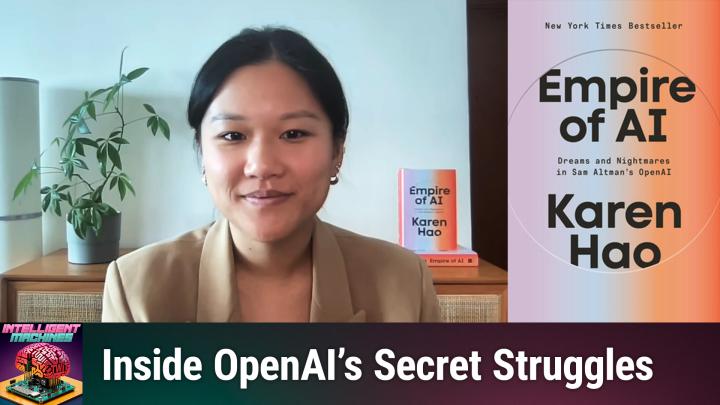
Intelligent Machines (Audio)
IM 835: Glitch Lord - Inside OpenAI's Secret Struggles and the 'Empire of AI' With Karen Hao
02:44:34
Inside OpenAI's Secret Struggles and the 'Empire of AI' With Karen Hao
Loading summary
Transcript708 lines
- [00:00]
A
It's time for Intelligent Machines. We've got a big show for you. Karen Howe is our guest. Her book Empire of AI is a bestseller. It tells the inside story of what's happening, what happened, and what might happen at OpenAI. You're gonna love that. Then Harper Reed joins us for a fun episode. We'll talk about how he uses Claude code to create a nickname for himself. That and a whole lot more coming up next on image podcasts you love from people you Trust. This is TWiT. This is Intelligent Machines, episode 835, recorded Wednesday, September 3, 2025. Glitchlord. It's time for Intelligent Machines, the show we cover the latest in AI robotics and all the bijouterie surrounding you. I'm gonna use a different thesaurus entry for. Is it Gee gaws, Jeff, from now on Gee gaws. That are surrounding you in your everyday life. That is on my right. Jeff Jarvis, professor of emeritus of journalistic innovation at the Craig Newmark Graduate School of Journalism.
- [01:20]
B
Craig Newmark.
- [01:22]
A
Lay the Craig Newmark jingle in after in post production. Oh, no. I guess.
- [01:26]
C
No, it'll be here.
- [01:30]
A
State University and SUNY Stony Brook, where he's about to get to work because the semester is about to begin. Except you. You were. Do you go to. Do you actually go anywhere or you just. No, you sit in your.
- [01:43]
B
The entire world sees me with this microphone. It says, whoa, you got a nice microphone. Podcasting, babe.
- [01:47]
A
Zooming. You know somebody's a podcaster when they have a nice microphone.
- [01:51]
C
I was gonna say you guys are more confident than I am. I hide this thing anytime I'm not in this show because I don't want to hide. I don't want to stunt on people like that.
- [01:59]
D
Nerds.
- [02:00]
A
That is Paris Martineau, consumer Reports investigative journalist par excellence.
- [02:06]
C
I will not be here for the rest of the show whenever this is airing, but I'm here now for this interview.
- [02:11]
A
Okay. Yeah, I should mention we're pre recording this on Labor Day because Karen Howe, our very special guest, is in Hong Kong. I don't know what that has to do with anything actually, because she's very busy.
- [02:23]
C
She's got a incredibly busy book tour schedule because this is a fantastic book that she wrote. And despite the fact that it came out how long ago now, Karen?
- [02:33]
E
It came out.
- [02:34]
C
Your schedule just keeps getting busier and busier.
- [02:37]
A
She has done hundreds of interviews and she is hundreds more before she sleeps. She'll be going to Australia in a couple of days. Santa Clara, Berkeley, Amsterdam. That's in the Netherlands, Kids. New York, Chicago, St. Louis. Oh my gosh, look at this. Bangalore. She's going to meet up with Jeff and Munchen. Karen Howe is the author of a book that is getting a lot of attention called Empire of AI. You may have read her articles about OpenAI and the MIT Technology Review where she is a senior editor covering AI. Formerly, I guess as senior editor. Yeah, she's too busy now to have a job anyway. No, her job is, you know, the book. Anyway, Karen, it's great to have you. Welcome to Intelligent Machines.
- [03:29]
E
Thank you so much for having me. And thank you so much for doing this, all three.
- [03:32]
A
Well, every day we're very excited because all three of us have read the book and have learned a lot about what is a surprisingly secretive organization. How did you get in in the first place?
- [03:48]
E
Yeah, I mean, back when I first profiled OpenAI, I embedded within the company for three days in 2019 and then pub the profile in 2020. They invited me in because they were quite different than they are now and that they were still trying to hold on to their original conception as a nonprofit and trying to be trying to project transparency. And so I at the time was really curious to just understand what they were working on and what was going on because there were a series of changes that were happening in 2019 that piqued my interest. One of them being that they had just developed GPT2 a couple generations before ChatGPT. Sam Altman just officially became CEO and they got a billion dollars from Microsoft. And I just told OpenAI, it feels like there's a lot going on and you might want to consider reintroducing yourself to the public. And I think MIT Tech Review could be a really great publication for doing so because we focus a lot on what you focus on, which is the fundamental research that's happening within the field so we can talk more in depth about some of the scientific and technical concepts that you're working on. And they really liked that idea. So they brought me in.
- [05:10]
A
They changed their mind instantly, didn't they?
- [05:14]
E
They didn't change it instantly, but almost instantly regretted.
- [05:19]
C
Security guards kind of playing relay and doing inter while you were there.
- [05:25]
E
They did, yeah. So I learned while I was reporting the book, not when I was reporting the profile. Oh, that my face was given to the security guard as like a look out for this person and make sure.
- [05:42]
C
She does not see journalist poking around.
- [05:44]
A
This is during your three day embedding.
- [05:46]
E
Which was during my. Yeah. So I was actually really surprised in hindsight that they were already nervous that early because I didn't really know what I was going to write about. Like I was sort of just coming into the org, really open minded, thinking, let me just ask them lots of questions about what they think they're doing and try and see what's interesting. But apparently I, I don't know what I did that kind of set off their concerns so early that made them give the security guard my face.
- [06:21]
A
But reverent perhaps.
- [06:25]
C
One of the things I think it is very interesting and that you do really well in the book is kind of show how there is this disconnect that is now fairly obvious now. But there's been this disconnect from the start with OpenAI between how they positioned the company to the public and how they acted in private. And I feel like one of the scenes you recount in the book, like during those three days you were embedded in 2019 is you just like you just said, trying to ask the executives questions about how they view the company and they seem to even kind of fumble is the wrong word. But they had a hard, I think.
- [07:02]
E
Actually that is articulated pretty good word. Yeah, fumble. I mean, I remember. So I didn't actually write this in the book, but when I was re listening to my interviews from that time to write the book, I had forgotten that one of the first, first questions that I asked Greg Brockman, he paused for around 10 seconds and it was a, it was a really basic question. I was like, I think I just asked why are you spending billions of dollars building AGI? And then he gave me an answer and then I was like, I don't fully know if that answered the question. Could you maybe say it a different way? And then he paused for like 10 seconds. And then Ilya went, I'll take this one. So they did really fumble with some basic questions. Like I was pretty sur. Surprised because I was like, wait a minute, I'm. I don't think I'm asking. I'm asking like the most generic questions here. Just articulate why you're doing what you do and what you're doing. And there was a scene in the.
- [08:02]
B
Conference room was so telling.
- [08:03]
D
I thought, yeah.
- [08:05]
B
Where maybe it was just early days. Maybe they weren't media trained yet, though. I don't think it was that. I think they really were confused about what they were doing together. They were, they were using highfalutin terms and you asked them to define them and they couldn't define them.
- [08:19]
D
Yeah.
- [08:19]
E
I think what's. What I realized is they had spent so much time only articulating what they were doing to other people, either in the AI world or in the tech world. So they had at least some kind of shared worldview or lingo around these things so they didn't have to. I think they were used to defending themselves, but defending themselves to it specific audience, not to the public. And so when I started asking them, okay, now explain to the public what you're doing, that was when it started tripping them up.
- [08:54]
B
Do you think that they, inside OpenAI or inside the fraternity, sorority of AI or cult, depending on how you look at it, do they have a shared definition of AGI?
- [09:07]
E
No, that's the thing. Yes.
- [09:08]
B
That's where you started going after them for it. And did you ever come away thinking that there is some commonality or is it a, is it, is it a, is it a vessel to which they put their own views?
- [09:18]
E
I mean, that's the, the problem with the common definition is generally people would agree that AGI means human level intelligence in machines, but then no one agrees on what human intelligence is.
- [09:36]
B
Right?
- [09:36]
E
So. So the problem is not necessarily that there isn't a definition. The problem is that the definition is still meaningless because there is just no scientific consensus beyond the world of AI, just globally, across disciplines. There's no scientific consensus around how to quantify human intelligence. And in fact, the quantification of human intelligence has a very dark history and lots of ulterior motives for why people have sought to do that. And So I think OpenAI was very readily willing to acknowledge that AGI had a very swishy definition, but they didn't see that as a problem. Whereas I thought, well, if you don't have a clear direction of where you're going, it seems like that makes your foundations inherently a little bit weak because you're supercharging a quest towards who knows where with billions of dollars. And to your point, it did become a vessel for people's own projections, systems, systems of belief, because different people thought that human intelligence meant different things and that it would manifest in different ways and it would. Its implications arriving at AGI would have fundamentally different implications for the world. And that's why through the course of OpenAI's history, there's just been so, so much infighting because different ideological camps develop, splintering over these definitions, and then they start, you know, biting at each other's heads, trying to get the company to go one way or another based on their views.
- [11:21]
A
You arrived at a really seminal point. I mean, you arrived as the company. They've gone through many Changes, they're still going through changes. But they had, you know, originally formed Sam Altman partnered with Elon Musk to kind of develop AI in an open fashion so that Microsoft and Google, mostly Google, wouldn't have, you know, dominance in the field. But by the time you got there, as you say, they raised a lot of money from Microsoft. Suddenly they still don't have a really credible product even. You talk about the demos that they did of the early GPTs and, and how trivial they were and how unimpressed people were and Bill Gates was funny, what is this? But it was already starting to change. As you say, Sam had become CEO, they had raised money, they realized it was going to be a much more expensive process. They were at the point where they were starting to think differently about what they were doing. Would you say that's true?
- [12:22]
E
This is interesting. So I, I have sort of changed my views about whether they evolved or whether actually they kind of stayed the same in terms of what they were doing. So initially I felt, okay, they're a non profit, they are, they were trying to be more transparent, more collaborative. And then there was this shift, this inflection point when they suddenly get money and it starts moving them more in a profit oriented direction. But now in hindsight, it was quite clear when they started that they wanted it to be a non profit, not necessarily just out of altruism, but still out of ego, of we want to signal to the world that we're the good guys, right? And we're going to continue on this quest to reshape and remold this technology. And so there was always this egotistical element to it and there was this deep seated desire of we need to get to where we're going first, wherever that is, in order to have some kind of field or industry defining impact. Because they very much exist in an ecosystem and a belief system of winner takes all, that's just how Silicon Valley operates. So in a sense, did they actually change when they got money or did they actually always have the same belief that drove them to then seek money and then continue down, you know, the natural course, the natural path that an egotistical project would lead you down. So from. Yeah, so I think over time I started to realize maybe they weren't so pure in the beginning. There was already a little bit of corruption in the beginning in terms of their concerns, conception of why they were doing open AI and that's what then plotted them down the path that we see today.
- [14:21]
A
But as you tell the story, it did start to come to them that they were going to need massive amounts of compute and massive amounts of money. So they didn't know that from the beginning, or did they?
- [14:33]
D
That's.
- [14:34]
E
That's true. So they. I don't think they fully realized the degree of money that they needed. I think they're was some conception, at least from Ilya's side, that they would need to scale their systems to some degree. But interestingly, at the time, they probably couldn't even have conceived technically of the degree of scale that they now operate under, because it was not yet possible. The techniques for training models on such vast amounts of computer chips had actually not been invented yet.
- [15:16]
A
They weren't yet even sure that Transformers were the way to go. Right. That was something they came to over time.
- [15:24]
E
Yes, exactly. So they sort of hit upon both the software and the hardware that they wanted to use about a year and a half, two years into the organization. So they initially had more vague ideas of they wanted to scale the existing techniques to some degree, but they just didn't know which technique they wanted to scale and to what degree they wanted to scale. And when they realized, okay, and also Transformers. It took a while for. Like, when Transformers came out, there were a couple of researchers who were like, yep, that's the one. Like, we want to do that. But it did actually take the organization a little bit longer to go all in on the Transformers.
- [16:08]
A
Sutzkever was a believer from the very beginning, right?
- [16:13]
E
Yeah. And that's. It was.
- [16:14]
A
He's a fascinating character in your book. He is. He's a prophet, not a coder, which is interesting.
- [16:20]
B
What do you think of him? I'm really eager that. Here we are, just four people sitting at the end of the bar.
- [16:27]
C
Don't pay attention to these mics.
- [16:29]
A
In that case, I want a drink. I don't know.
- [16:31]
B
Well, it's a little early for Kara right now, but. But the three main characters here, Setska, Rubrak, and Altman, I'd love to hear, in hindsight, how you look at them, just for your own, who you'd want to be on an elevator with and not.
- [16:48]
E
I think I would definitely want to be in an elevator with Sutskever.
- [16:55]
D
Why?
- [16:55]
E
I think he's the most interesting and complex of the three. I think Altman is. He's a politician. Like, that's the best way to think about him.
- [17:05]
A
Comes off kind of skeezy in your. In your book. He's kind of.
- [17:08]
E
He's. He's really good at telling stories and being persuasive and getting People to. He persuades people to either donate gobs of money or to donate their talent towards whatever vision he wants to achieve. And he's very, very good at that. But the. Yeah. The controversial aspect of him as a character is that he will tell different things to different people as part of his persuasion tactics. And so over time, depending on whether or not someone feels like what he said aligned ultimately with his actions, they either end up becoming really, really gung ho about his leadership or feeling like he's the devil incarnate, that somehow he manipulated them into doing something fundamentally different from what they wanted to achieve. So he's the politician. Brockman is interesting in that he. Is he. Yeah. I think the way that I describe him in the book is like, he sort of exudes this anxious energy of wanting to be remembered in history and everything that he does and says you can kind of pick up that he's sort of doing it in part because he wants to be judged. Well, in the eyes of his.
- [18:30]
C
I think you said, attributed to him that he's like, oh, no one ever remembers a cto. I can't be a CTO forever.
- [18:39]
E
Yeah. He says at this retreat in Tahoe, name a famous cto. People sort of fail to do it, other than, like, Steve Wozniak. People sort of fail to do it. And then he proves the point that he was trying to make. Like, no one remembers the cto. And then, like a year later, he becomes. He switches from CTO to the president of the company.
- [19:03]
B
Let me ask you another way. If you had a friend who was going to work at OpenAI and could report, in the time when they were all there, it could report to any one of the three.
- [19:15]
D
Who.
- [19:15]
B
Who should they report to? Who's a good boss?
- [19:19]
E
Or I would still say Sutskever.
- [19:22]
B
Wow. Interesting. But he's a little. He's a little wacky too, isn't he?
- [19:26]
A
He's the shitty.
- [19:27]
E
Yeah. No, no. By any stretch of the imagination, like an average guy.
- [19:35]
B
Right.
- [19:35]
C
I don't think any of them are average guys.
- [19:37]
E
None of them. Yeah. Well, the thing about Sudskever that I think the way I would describe him is he's also a visionary like Altman. He does have a lot of. He has very strong convictions. But whereas Altman is sort of. He's not. His convictions aren't in the technical realm. Like, he's thinking about, like, how to move resources and what kind of relationships to build to get to where they're going. Sutskever has always had a very keen scientific and Technical conviction of. He's like, I think we need to do this from the beginning. I think we need to scale these models, and it's just a matter of figuring out which one to scale. So he has that kind of visionary aspect. And he's highly cerebral. And like many highly cerebral people, he's also a highly emotional person. Without realizing that he's highly emotional, thinks that he actually makes sense decisions purely rationally, but actually he probably makes decisions almost entirely emotionally.
- [20:40]
A
He's a first principles kind of guy.
- [20:42]
E
Yeah, that's the way I would describe it. So he sort of. He often exists almost in a realm, in an intellectual realm that seems a little bit detached from reality. Like, he's just like, constantly thinking in his mind about different future possibilities and then trying to implement it into. In a scientific work. But when I interviewed people about, you know, the three. These three people, and who was the best leader, slash manager, people would pretty universally say Sutskever. If they had to pick, they would have to pick Sudskever, because Altman was. He's a terrible manager. And Altman has said it himself, he's not a manager. He is just the visionary. He's good at getting people pointing to a direction and getting people to move there, but he cannot operationalize things. And you can see that with the way that OpenAI has been changing leadership. Recently he installed a new CEO of applications, or OpenAI installed a new CEO of applications. That's doing the actual operationalization, whereas Altman is continuing to do the fundraising. And Brockman is also terrible, terrible manager. Very bad at working with other people. He's very much a solo coder. He. And the way people described him was he kind of going back to like, he's like. He has this anxious energy of wanting to prove himself in the eyes of history. He would will just like, relentlessly code and run towards a specific goalpost that you give him, but he won't look up from the coding to see if the goalpost has changed, whether they need to reevaluate where they're going. And people burn out when they work with him because they'll go to sleep and wake up. And the entire code base has changed because Brockman has stayed up all night.
- [22:36]
B
Coding one of those.
- [22:37]
E
And no one knows. People can't keep up with what he's doing. So it's just kind of impossible to work with him in general, not just work for him. Which is why Brockman hasn't had reports at OpenAI since maybe two years into the company. Yeah. So then that just Leaves suds. Kevin.
- [22:59]
A
I hope you're enjoying this interview with Karen Howe. We recorded it on Labor Day a couple of days ago. That's why Paris is here. We'll continue with Intelligent Machines in just a bit. Harper Reed will be filling in for Paris and the rest of the show, but we have more with Karen, lots more to ask her and talk about in just a bit. So stay here, you're watching. Intelligent Machines are our show today, brought to you by Threat Locker. Love these guys. Threatlocker makes zero trust easy. You know, ransomware is killing businesses worldwide. You know that if you listen to our shows. But threatlocker can actually stand between you and the bad guys, prevent you from becoming the next victim. ThreatLocker's Zero Trust platform, and that's the key, takes a proactive deny by default approach. Those three words carrying a lot of weight, but they really, it really works. Deny by default, in other words. Threat Locker blocks every action that you haven't explicitly authorized. And the beauty of that, it protects you from known threats, but it also protects you from completely unknown 0 Days threats you know nothing about because they get there and they can't do anything. That's why ThreatLocker is trusted by global enterprises like JetBlue, the Port of Vancouver. Threat Locker shields you from zero day exploits and supply chain attacks and in the whole process provides you complete audit trails for compliance. So it's a fantastic solution and we're seeing this more and more. We were talking about this yesterday on security. Now cybercriminals are turning to malvertizing. Now you need more than just traditional security tools. How does it work? Attackers create convincing fake websites impersonating popular brands like AI tools and software applications distributed through social media ads hijacked accounts. Then they use legitimate ad networks to deliver malware in the ads affecting anyone who browses, even if they're browsing on a work system. That's why it's such a huge threat. Traditional security tools often completely miss these attacks because they use the attacks use fileless payloads, they run in memory, they exploit trusted services, they bypass filters, you know, but that's why zero trust is so incredible. ThreatLocker's innovative ring fencing technology strengthens endpoint defense by controlling what applications and scripts can access or execute without permission. They can't do anything. It contains potential threats, even if those malicious ads successfully reach the device. Threat Locker works across all industries. It supports PCs and Macs, provides 24.7us based support, and enables comprehensive visibility and control. Jack Senisap, who's director of IT infrastructure and security at Redner's Market says when it comes to Threat Locker, the team stands by their product. Threat Locker's onboarding phase was a very good experience and they were very hands on. Threat Locker was able to help me and guide me. This is Jack speaking to where I am in our environment today. End quote. Get unprecedented protection quickly, easily and cost effectively with ThreatLocker. Visit threatlocker.com TWIT to get a free 30 day trial and learn more about how ThreatLocker can help mitigate unknown threats and ensure compliance. That's threatlocker.com TWIT and we thank them so much for their support of intelligent machines. Now back to our interview. We're talking to Karen Howe. She's the author of a new book that just came. Well, it came out in the spring, but it is a huge bestseller called Empire of AI Dreams and Nightmares in Sam Altman's OpenAI. And I didn't mention this, but Ms. Howe graduated from MIT with a master's in Mechanical Engineering. She coded one of the first bachelor's. All right, bs.
- [26:53]
B
It's mit.
- [26:54]
A
It's mit.
- [26:54]
B
You round up from mit.
- [26:56]
A
Yeah, you round up.
- [26:57]
B
It's a.
- [26:58]
A
It's a masters anywhere else also and was an engineer, one of the first Google X companies. So she's. She's got a strong technical background as well as being an excellent writer. And it is a fascinating book. I have to say though, starting from the very beginning and going all the way through there. Is it even in the name? There is a element of real skepticism about AI you call it Empire of AI in the same way that, you know, the imperialist nations conquered countries in the 20th, say, 19th and 20th century. It's an imperialist empire of AI. Are you not a fan? None of us can quite figure it out. We were talking before this show.
- [27:43]
B
It's a superbly reported book.
- [27:45]
A
Yeah, the reporting is so good now.
- [27:46]
B
That we're at the bar.
- [27:47]
A
Yeah, back to the bar.
- [27:49]
B
Yeah.
- [27:51]
E
Yeah. So, no, I'm not a fan. And I'm. And I want to be clear, I'm not what I'm not a fan of. I'm not a fan of the current industry and the paradigm that they've chosen for developing this technology. I'm not critiquing all of AI because AI as a discipline and as a science is vast and there are lots of different interesting things that are happening in that world and there's a lot of really fascinating applications of it as well that I think are largely very beneficial. But in the current paradigm, what the AI industry is doing is the scale at all costs, modus operandi, where they're taking these models. They're saying, we're going to pump historic amounts of data into these models and we're going to train them on historically sized supercomputers. And we have gotten to the point now where we're talking about they've already colloquially scraped the whole Internet, mostly the English language Internet. So they've already tapped out an extraordinary amount of the data that has been produced by humans on the Internet over the last couple decades. And they are now talking about building supercomputers the size of Manhattan that could potentially use the energy draw of all of Manhattan. So that is what I'm critical of, and that's what I call imperial like behavior is they're seizing resources that are not their own. They're literally starting to seize land all around the world to build these data centers and supercomputers. They exploit an extraordinary amount of labor, both in the production of the technology and the effect that the technology ends up having on society in that it's creating automation pressure on the job market and therefore eroding away workers bargaining rights. They monopolized knowledge production. So over the last 10 years, what we've seen is the industry is so resource rich that they have hired up all of the top AI researchers in the world, which means that AI research as a discipline is becoming distorted by the agenda of these companies. The same way that you could imagine climate science would be distorted by oil and gas companies if most climate scientists in the world were bankrolled by the fossil fuel industry. And that is a primary feature of empires of old, is that they controlled the knowledge. What was even acknowledged as knowledge. And the point was always to produce only the knowledge that continued to fortify the imperial expansion, not to undermine the empire. And then the last thing that I highlight in terms of parallels is the empire is always engaged in this existential competition narrative of there are evil empires in the world, so we must be an empire, but a good empire in order to be strong enough to beat back the evil empire. And they quite literally engage in some of the old religious rhetoric that was used in empire competition as well of as the good empire. We're bringing progress and modernity to all of humanity. So if we win, humanity gets to go to heaven, but if we lose in the evil empire wins, humanity goes to hell. And like that's like, like they are literally using that kind of terminology. And it can't get more on the nose Than that.
- [31:17]
C
I think the, I mean, I think all points you just made are incredibly important. But I want to go back to this point you made about the monopolization of AI research. You get into this, the book, as well as you've spoken about this on various podcasts in your reporting. But I think like how this trend towards commercialization that kind of began in 2010, 2013, how that has changed the sort of AI that is being built and kind of monopolized fields of AI research, taking it from being broad to being very specific. You talk a little about that and what we've lost or are not funding.
- [31:53]
E
When I started covering AI in 2017, 2018, there was so much interesting research that was happening in the field. And even then people were already complaining that the diversity of research ideas had shrunk because way back there were two dominant approaches, the data driven deep learning approach and then the symbolic driven old fashioned AI approach of encoding information in databases. And that branch, the symbolic branch, was already kind of dying on the vine and most people were glomming onto the deep learning branch. So there was already some sadness within the fields of the two major branches. One had almost entirely atrophied and there was already a narrowing in the field and its focus. But within deep learning there was so much fascinating stuff happening. There was research around how to build deep learning systems that actually used teeny tiny amounts of data or teeny tiny amounts of computational resources or neuro symbolic approaches that we're trying to combine, resuscitate some of the old symbolic approaches and combine them with deep learning approaches. And that was part of my favorite, part of my job was just talking with researchers who had really interesting new ideas to try and push the bounds of what was possible with deep learning. And basically when OpenAI came out with GPT2 and then GPT3, the rest of the industry started not only indexing on deep learning, but indexing on transformers, which is just one neural network architecture in the vast sea, the vast zoo of different types of neural networks. And that is like, I don't, I can't think of a good analogy of like how, how dramatically more narrow that is. But it's like you're taking an entire discipline and picking one horse like out of a thousand out of a million. I don't know. And basically after that, because all the researchers were moving out of academia and working at these companies, everyone was only working with transformers and everyone was only trying to like, their research has diminished down to how do we optimize the transformer, how do we get this transformer to do just a little bit more with a little bit more data or a little bit more compute and. Yeah, that's, like, so remarkably narrow. Maybe a good analogy is like, they are all just reading one page of a book in an entire library.
- [34:44]
B
Yeah.
- [34:45]
E
Or maybe, like. Maybe like one sentence. Like, they're just all trying to optimize a single sentence in an entire library.
- [34:53]
C
Which is a shame because there's so much interesting and transformative research in this field, in a very, very broad field. It's a shame to have all of the capital and resources go to one sentence of one book.
- [35:08]
A
Let me play devil's advocate. Devil's advocate, which is my favorite kind of advocacy. They thought. They seem to have thought, Sotskever and the others, that they had found the Philosopher's Stone, that they had figured out that if the way to get to successful AGI and superintelligence is we just scale Transformers, they're miraculous. They do it. They do more than we ever thought. They're miraculous. Yes. It's gonna take every paperclip in the entire universe to make it happen, but that's the path. That's the road. And I can understand that from their point of view. They've seen the future, and any deviation is a dead end.
- [35:50]
B
It's religion, then.
- [35:51]
A
Well, and there are people like Gary Marcus, and we talked to Stephen Wolfram and others.
- [35:56]
C
I love all the Gary Marcus details in your book about how much OpenAI hates scary marker.
- [36:01]
B
It brings him so happy.
- [36:04]
A
But they've argued for, you know, well, what about symbolic AI and other kinds of AI? But we've been through AI winners before, especially with symbolic AI. Transformers are pretty amazing. They're pretty miraculous.
- [36:15]
E
They are. They are a very fascinating piece of technology. And they do. They have done things that we could not have predicted, never imagined. Yeah, not so said one thing. There's sort of two thoughts that I have. One is, like, in general, I think there were clear signs from the very beginning when they were scaling Transformers, that there were weaknesses to the Transformer as well. So. So maybe you could argue in the beginning, they were like, oh, let's just see what happens. But at some point, you have to start being critical of their decision to continue. Just, let's see what happens when there was already so much they should have.
- [36:59]
A
Known better, you think?
- [37:00]
E
Yeah. Oh, for sure. There was, like, plenty of research happening at the time that, like, deep learning, not just the Transformer, just deep learning, neural networks in general do have all of these challenges when it comes to Being generally robust and able to generalize. Like, even with the entire Internet ported into these transformers, you can see still have. It's still really hard to say that they've actually generalized. I mean, the moment you start speaking another language to ChatGPT, it starts to break down. Like, that's not exactly generalizability. And of course, there's infinite examples of people stress testing these chatbots with various brain teasers and math problems and whatever, and it still breaks down. And so it's like, to what degree, how much more do you want to put into the this approach and not explore other approaches, when there's so much evidence even from the beginning, that there are just certain limitations to what transformers will get you? But the other question that's I think more fundamental is, and I think this is perhaps a broader critique of just the general worldview of AI research in general is that the AI discipline has long fixated on advancing, on achieving technical progress without necessarily having a specific reason for why they're doing that.
- [38:28]
A
Yeah, because we can't.
- [38:30]
E
And the more that I think when I first started covering AI, I was very enamored with the thought experiments that I think a lot of scientists in AI research are enamored with, which is like, can machines think right? Can we really? You know, it would just, it would just be remarkable from a scientific and technical achievement if you could actually recreate intelligence and computers. But the more that I've covered it and the more that I've watched the industry play out the way that it has, the more I've felt that actually the, this, these aggressive moves by the industry to just continue trying to advance AI with blinkers on for what it's actually doing to the world is actually kind of derivative of this mentality of let's just keep pushing, pushing, pushing for pure science rather than actually like pushing for innovation for humanity. Like actually looking at what are the challenges we need to solve and being more targeted about how to develop AI to tackle those types of problems. And so, yeah, that's my other, I guess, response to like, did they. Should we give them some credit for seeing Transformers and just like indexing on this approach? It's like, well, I mean, they didn't really have a clear idea of what they were going to. What were they actually trying to help humanity overcome with Transformers? Like, they never really had a clear idea of that. And if they had, then they would have also tested out a lot of other different approaches because there are just much more efficient approaches for certain types of things.
- [40:13]
A
Let me just add Follow and follow up. And then you guys, when you were at the Wall Street Journal, you covered China. You're in China, right? You're in Hong Kong right now. And of course that's the straw man that they're all using to say, well, we've got to do this because if we don't, the Chinese are going to eat our lunch. Is that true?
- [40:33]
E
Yeah, Well, I mean, yeah. So what I was saying about the existential competition between good versus evil empires. Yeah. So China is conceived of as the evil empire in this narrative. And what I always say is, I mean, literally look at the track record that this argument has gotten us. Silicon Valley has said if you do not regulate US and then you regulate China through export controls, then China's progress will be totally obliterated and the US will dominate and we will successfully widen the gap between US and Chinese AI and Silicon Valley will have a liberalizing force on the world and we will see democracy strengthen everywhere and it'll be amazing. And literally the opposite has happened. You could not write the story to be more oppositional to that argument. Right. The gap has actually shrunk dramatically between the US and China as Washington has implemented exactly this approach. And Silicon Valley has had an illiberalizing force around the world and democracies are capitulating everywhere, you know, and like the US itself is capitulating as a democracy. So at that point, like you just have to look at the evidence and say, okay, clearly this argument, like the only winner in this scenario was Silicon Valley. So at the end of the day it is a self serving argument.
- [42:02]
D
Totally.
- [42:04]
C
I, I read a lot of books, tech journalism books based on my job or just keeping the rest of the general industry and most of them are not very good. That's what I've realized or I guess a lot of them are fine or good. And I was astounded by, I mean just how fantastic on every level your book was. And I feel, I was talking to Leo and Jeff before the show and I feel like one of the things that always sticks, sticks out to me when you read like a really well done journalism book is you are quite adept at showing rather than telling throughout the book and of like complicated details and factors and kind of weaving it all in through this through your narrative based on reporting. And I do think this is one of the reasons why some context for listeners is around the time that Karen's book came out, a number of other OpenAI books came out. I don't know if it was. Were there two others at the Exact same time. Or was it three? Do you recall?
- [43:03]
E
There was, there was one on the same day?
- [43:05]
C
Yeah, there was one the same day and there was like a couple of other, like, then there was also.
- [43:08]
D
She remembers that one tweeting at the same.
- [43:10]
C
It was like, it was kind of a crowded field. But Karen's immediately stood out from the pack. I mean, my own small anecdote. I remember, like, the week I think it came out, I was trying to get a copy at my bookstore, and I asked the person at the front desk in a bookstore here in New York, and they're like, no, that's sold out. Everybody's coming in for it. And I think it's because you did such a great job reporting this out and then also reporting out the sort of details and scenes to really tell this story and to really show it, too. I mean, what can you talk us through a little bit of what your reporting process was like for this and how you got so many in the room details?
- [43:47]
E
Yeah. First of all, thank you. I, I, I really appreciate it because I was actually quite conflicted while I was writing it, like, how much I should show versus tell. And sometimes I felt like I spent too much time showing rather than telling. And I was like, maybe people actually want me to just, like, say exactly what it is.
- [44:06]
C
It's the essential dilemma. I feel like you always hear from editors as a journalist, it's like, which one should I be doing? And they're always like, show, show, show. And you're like, I don't know. Don't you just want them to hear the thing?
- [44:17]
E
Yeah. Just, like, get the message. Yeah. And, you know, like, some people have mentioned that my book is like, really, I mean, it is, it's really long. And like, part of it is because I spend so much time showing rather than telling. But I appreciate that you appreciated that. Yeah. In terms of the reporting process, I mean, I basically, like. So when I first started working on the book, Sam Altman had not yet been fired and rehired. I did not know that that was going to happen. And when it did, it fundamentally changed my conception of the book. So before that happened, I was actually not really planning on focusing on a lot of insider details within the company. I wanted to use OpenAI as a main character, just, just like, externally looking at, like, what they had done and the ripple effects that it had had on industry based on the reporting that I had already done and maybe have just like a couple insider moments, like when I was at the company and what I learned when I was there and, and so on. But then once the, the board crisis happened, it totally changed my reporting plan and I realized that I actually just needed to report out the full inside story of what had happened and ultimately what had led to that point.
- [45:37]
A
That was your scoop. No one else has covered that so well. I mean, that was really the big scoop.
- [45:42]
E
Yeah. Yeah. And so I basically, I just made a giant spreadsheet of everyone that had ever worked at OpenAI and I just started cold contacting as many of them as possible.
- [45:57]
A
Hundreds of interviews.
- [45:59]
E
Yeah. And, and, and initially I thought that no one would respond to me because I had sort of been marked from the very beginning by OpenAI as like.
- [46:10]
A
The journalist have your picture, Ms. Howe.
- [46:12]
E
Yeah. And it turned out that actually a lot of people were really interested in talking for precisely that reason because they. Many people. So the company executives, or I guess the official company position on my MIT tech review profile was that it was, it was horrible. It completely misrepresented the organization. I had an agenda. And many of the people that I interviewed were like, oh, the reason why I picked up your call is because I really liked your profile. I thought it was super accurate.
- [46:46]
A
Yeah.
- [46:47]
E
And so they, the company kind of.
- [46:49]
C
Made the mistake of sending out an email about your piece, which I feel like always does more harm than good. Despite the.
- [46:56]
A
Sorry.
- [46:57]
E
They had sent out multiple emails, so it wasn't. Sam wasn't the only one that emailed and suddenly made everyone aware. They. There were actually multiple emails. When I came, they were like, she's coming. Like, be on your best behavior. And then there was another email right before my piece published. Being like, the piece is coming out tomorrow. We think it'll be a good one. There might be some things that we don't like. And then there was Sam's email after being like, this was bad.
- [47:28]
C
Wow. So you were very present. I mean, it was a great intro for all of the employees of OpenAI to you.
- [47:35]
E
Yeah. Yeah. It is true. Yeah. So there were a number of employees that were like, oh yeah, I know you like, I would be happy to talk to you because I think you will do a really good job of accurately portraying this organization and getting beyond what the company narrative is. A lot, A lot of the people who talked to me were quite concerned about making sure that the record of what happened was not being portrayed the way that. Yeah. The official company narrative wanted it to be portrayed because they were like, that's, that's just not reality. And they wanted to have some more high fidelity version that existed as the historical record. And interestingly, you know, like, a lot of people also were driven to talk because they felt that they had, they had witnessed history. So there was, there was an element of hubris in it as well. Of like. And they, and many of them had actually taken detailed notes during their time at OpenAI because they would talk to one another, being like, we think we're witnessing history, we should probably, probably document what we're seeing. Which is part of the reason also why I was able to get so many, like, scenic details and things that people said, because there were people who pulled out their notes from all of these different meetings and God bless them. Yeah.
- [48:57]
B
So I want to second Paris. It's a superbly reported book and really impressive. I'm curious, I have one more question, but I'm going to cheat and make it a two parter. I'm very curious what you thought as ChatGPT5 was coming out, knowing all that, you know about the company and how that was handled. And the second part of that is that, is that there are some who are saying there's a, there's a pullback even from Altman, less emphasis on AGI, less emphasis on the, on the, on the, on the mystical future. And so I'm curious first, what your thoughts were at a tactical level about the ChatGPT5 release. And second, whether you buy AGI?
- [49:37]
E
I guess I'll answer the first, the second one first, which is, yeah, I don't. Because of the lack of definitional clarity. I mean, if we narrowly defined human intelligence and just said it was like systems that are really good at persuading people, maybe like, if we, if we made that definition, then be like, oh yeah, we've already reached AGI. Like these systems are extremely persuaded, persuasive. But yeah, I just, I don't really buy into the way, like, ultimately, I think to understand AGI, the concept, it should be understood as a rhetorical tool for these companies to just continue waving around a nebulous term that they can project whatever meaning they need onto so that they can continue justifying why they need more and more and more and more resources. And the first question, GPT5, I, I think I, I sort of had a, a couple thoughts. One was, I wondered whether it would actually come out because GPT5's development has been so troubled within the company that I was like, maybe they actually scrapped the release because it's just not meeting the bar. And the other thing that I thought was, if it does come out, I wonder what kinds of demos they're going to do to try and really make a splash because this is OpenAI is sort of the master of splashy demos. That's their, their entire history has been about figuring out how to engineer the most impressive demo based on faulty technology. And yeah, when it came out and did not was just not, it wasn't received very well. I wasn't surprised because there had been so much concern already within the organization that they were running out of rope when it came to their specific scaling paradigm.
- [52:01]
B
Interesting.
- [52:02]
A
We've been talking to Karen House, she's the author of a book came out this spring, but it is still a bestseller called It's Very Hot Empire of AI. It is of course a history of OpenAI and fascinating, lots of fascinating details, but it also has a. A moral to tell, a story to tell. In fact, I'm going to quote you from the essay you wrote this spring in the New York Times. This last paragraph, I think kind of puts a ribbon on it. AI Tools, Karen wrote that help everyone cannot arise from a vision of development that demands the capitulation of a majority to the self serving agenda of a few. Transitioning to a more equitable and sustainable AI future won't be easy. It will require everyone, journalists, civil society researchers, policymakers, citizens to push back against the tech giants, produce thoughtful government regulation wherever possible, and invest in more smaller scale AI technologies. When people rise, empires fall. And I don't know if I'm putting words in your mouth, but you wrote them so I guess it's fair to do that. Karen, thank you so much for your time. I really appreciate it. I know you're about to continue a murderous schedule of tour dates. In fact, if people want to know where you can see Ms. Howe speak, go to her website, KarenHow.com and you'll be amazed. Sorry, let's put the D in there. Karen D. Howe. Some other. Karen Howe has the other one.
- [53:38]
E
I know.
- [53:40]
A
Dang that.
- [53:40]
C
How rude of her.
- [53:41]
A
Yeah, Karen D. Howe. D. Karen Howe. No, no, Karen D. Howe dot com. You can see all the places she's going to be. Go see her, buy tickets, buy the book and read the book. Because I think it is an important story for us all to understand. Much better. Thank you Karen D. Howe, for joining us on Intelligent Machines.
- [54:01]
E
Thank you so much for having me.
- [54:02]
A
Really appreciate it. Thank you. Karen Howe. We're going to let Paris go to Yonkers right now. She is in Yonkers, but I'm thrilled to say Harper Reed will be joining us. An AI expert himself, he has an AI company and is the king of vibe coding. We've talked to him before. We'll get to the other AI stories and other stories with Jeff and Harper Reed, our guest guest co host, I guess in just a minute. Before we do though, I want to talk about our sponsor, Monarch Money. Do you want to feel organized and confident in your finances? Most people try this. See if you can can't name all their financial accounts or even harder, what they're worth. If you don't know if you've been putting it off, then Monarch is for you. This is what I use and I love it. Monarch is the all in one personal finance tool that combines your entire financial life into one clean interface. On your laptop, on your phone, it's on the web. It's got, they've got apps. It's built for people with busy lives. Monarch does all the heavy lifting. You link your accounts, it could do it in minutes, securely and safely. And then Monarch will stay connected and get clear information. It'll present you with data, visuals, beautiful graphs. It'll automatically do smart categorization of your spending. It does the budgeting for me. You get real control over your money. You don't need to ever touch a spreadsheet again or pull out a statement from the bank and enter in the data. Remember, we used to do that. Not anymore. Monarch Money makes it so simple. And you know what? The easier it is to keep an eye on what's going on in your finances, the better a job you'll do. Don't leave money on the table. It's easy to become complacent. You know, you're young, you're getting a good salary, you don't need to track every dollar. But ignoring your finances entirely can cost you. Take it from me, when you get older, it's really important that you save properly. You put money aside for retirement or whatever your dreams are, getting married, buying a house. You can miss opportunities to save more, to invest smarter, to hit your financial goals faster. Information is power. Monarch's not just another finance app. It's a tool real professionals and experts love. And I love. I use it every single day to see where I stand. It was named the best budgeting app of 2025 by the WAL Journal. Forbes said it's the best app for couples. It was named in CNBC's Top Fintech Companies in the world list. And there is a passionate Reddit community of over 34,000 users. And it. And they're not just there to help themselves. I gotta tell you, Monarch Money listens to them. They actually you in that Reddit community. They get to shape how the product is developed. Money can be the number one reason couples break up, but it can also bring them together. If you use Monarch, Monarch brings people together. Monarch gives your partner full access to your shared dashboard, including linked accounts, budgets, goals and spending activity all in one place at no extra cost. You can also give your financial advisor access and that doesn't cost you extra either. Get some good financial advice without taking the time to collate all the information for them. Don't let financial opportunities slip through the cracks. Use our code image@monimalmoney.com in your browser for half off your first year. That's 50% off your first year. Go to monarchmoney.com and use the code. I am highly recommended. Monarchmoney.com don't forget that code by the way. I am. All right, welcome. Harper Reed. Great to see you. My friend Harper reed is an AI genius at 2389 AI. He's an entrepreneur, a hacker, technologist. His blog is great reading, in fact. In fact, that's how I. We've had Harper on many times in the past. But I reconnected with you after your blog post on how you Vibe code. In fact, it's become kind of how I Vibe. Has that changed at all.
- [58:04]
D
I introduced a new thing recently of having it do what they call the careful review of its code after it writes one of the steps. And I don't think it. It is a longer process. This is my favorite image, by the way. Very proud of that image.
- [58:21]
A
Nighttime Cogen only Vibes.
- [58:24]
D
Yeah. But what I found is that this is the.
- [58:29]
A
This is the piece that I read it back in. Back in May, right? I think.
- [58:32]
D
Or no.
- [58:33]
A
Yeah.
- [58:33]
D
And I just found that there was so much work that was happening and then people talk about it as, oh, it's good up until the 90% or whatever. And I. So I spent a lot of time trying to figure out how to do that. And I just have another process that is like review your code. That's basically what it is.
- [58:51]
A
You mean manually review it or use Claude to review it? You do it with.
- [58:54]
D
I don't do any work. Are you talking manually? What is this, 2008? Let me see if I can just read this prompt to you because I think it'll be helpful. But it's called careful review and it says Great. Now I want you to carefully read over all of the new code you just wrote and other existing code you just modified with. With quote, fresh eyes. Unquote Looking super carefully for any obvious bugs, errors, problems, issues, confusion, etc. And that's all it is. And it works pretty well for finding things that then would have popped up how often?
- [59:28]
B
How often what? What is there a rate of, of what it finds?
- [59:33]
D
I don't know if there's a rate. Sometimes it's very funny because it's like, yep, found a bunch of stuff. I'm like, okay, so what, what are we going to do about that? Oh, I'll fix it. Other times it'll just say like, nope, everything is great. There's this funny thing that I love Claude code now ships with the ability to install itself on your GitHub and do code reviews of all your pull requests. But it's funny to have cloud code build something and then have Claude code review that same thing because it's like, yep, no bugs here. This is perfect code. Whoever wrote this is a genius. And you're like, yeah, yeah, yeah, I know how this goes.
- [60:13]
A
I use Claude code. After we talked to review, I was having trouble. I was doing an advent of code problem and I was having trouble and I couldn't figure it out. My sample code, my tests worked, but on the final input it wouldn't work. And Darren Okey, one of our club members, said, well, why don't you ask Claude? And I did. And I gave it access to the GitHub. And it said, yeah, you dummy, you're not importing the entire input, you're breaking it off at the end of a line. And I went, oh, that was a very helpful thing. I mean, I could have showed it to you, Harper, you would have probably said the same thing. It's like having extra eyes. I think it's a great thing to use it to review stuff in your article. Did I miss this? Is this a new article? This basic code?
- [61:02]
D
I think the one you saw was the one of my LLM coding workflow. And I've read a couple subsequent ones. This one is specifically about how I use cloud code because I found. And then there's another one that people seem to like, which is about the hero's journey.
- [61:16]
A
Yes.
- [61:17]
D
Of these things.
- [61:18]
A
Yes.
- [61:18]
D
Because I think everyone kind of goes through the same experience of starting with like a co pilot and then moving towards, you know, cursor and eventually trying to be as as agentic as possible. This is another perfect photo of me.
- [61:33]
A
This is, by the way, not AI generated. Harvard does look like that.
- [61:37]
D
This is what I look like every day and I'm happy to have friends. Thankful, Thankful even I was a rainbow for a. For a costume contest.
- [61:48]
A
And you, I hope 1. Because you are a rainbow, I tell you.
- [61:52]
D
But there's a lot of this, like, there's a lot of, of of. What I'm finding is people have the same path, it seems, for going down this stuff, and there's small communities that are sharing, of course, there's a lot on Twitter, there's a lot of group chats, there's a lot of this stuff. It's all kind of surfacing around this. And so I just tried to document what I saw as that. That path. And then I. Then I started talking to more people and I just noticed everyone was using cloud code and we were being. We were getting. We are being very productive with it. So I documented kind of our experience there.
- [62:25]
A
Has ChatGPT5 changed your opinion? Are you still using cloud?
- [62:29]
D
Interesting that you would ask me that on today of all days, Leo, because I have played with codecs a bunch in the last two days.
- [62:38]
A
That's OpenAI's command, that's OpenAI's, and I.
- [62:41]
D
Am impressed with it. But there's some funny nuances that obviously we know between the two models. I still think my daily driver is Claude code. It just seems to work a little better and more consistently. We talk a lot about, you know, how we want things to have an expected outcome. Right. You expect a computer to work two plus two equals four. These things obviously are not that way. There's a lot of randomness that goes into them. If you ask at the same task twice, it would, you know, the outcome would be very different. It's very funny in that regard. I find that for whatever reason, my vibe with Claude code is good. With codecs, it seems a little forced, but what I'm finding is that it is doing very good at debugging some things that cloud code was running into. And for the longest time, in the beginning, which was what, a year ago, in the beginning of Code gen with AI, I was bouncing across all the models. You know, you'd start here, you do a little bit, you'd run into a problem, you'd go over to ChatGPT, you'd run into a problem, you go to Gemini, so on and so forth. Then we solidified for about eight months on cloud code, and I think we're. We're back to the bouncing around models again. And I think this is going to be just the cycle.
- [63:55]
A
Yeah. At the end of your most recent piece, this one's from maybe one of the things Claude code does the very first Thing it does with the Init command is create a markdown document that is really its instructions, its prompts to itself about how you work a lot of information. And you stole the Claude MD file, and there's one in every project root directory. You stole one from your friend Jesse Vincent, who, among other things, says, when you think of me, think of me as your colleague Dr. Biz. Oh, this is you.
- [64:32]
D
So this is me. So basically, Jesse Harp Dog this really robust Claude MD that I. That I edited quite a bit. And that. That's a really funny one. The reason why you have it call you a nickname and not your real name, but a nickname is because it's a good delineation of when the Claude code will lose its context. So it will call me Dr. Biz, but the moment it calls me Harper, you know that it's lost the plot and you just gotta quit and start over.
- [65:03]
A
Oh, that's really good.
- [65:05]
D
Yeah.
- [65:05]
A
You talk about a guy named C. Lint who configured his Claude MD to call him Mr. Beef.
- [65:10]
D
Yeah, this was where I was like, I really need to be more creative with my names, because this is very funny. Cause then you'll see like a GitHub issue that's like, yeah, Mr. Beef told me to do this. And I'm like, who? Oh, right. Clint. What's up, Clinton?
- [65:24]
A
That's Clint Ecker. That's hysterical. Yeah, it's amazing. I was able to use ChatGPT5, not Codex, but just the chat client, to write some JavaScript for me that I found very useful. We talked about it a little while ago. It really is.
- [65:41]
D
It's very good.
- [65:42]
A
It's just fascinating. And at the same time, people are talking all the time about. And we have guests on all the time. In fact, earlier today, you weren't here for the Karen Howe interview. But. But she really is concerned that these companies, these giant companies are imperialists. They're taking over the world. They're taking over third World nations and abusing their labor force. They're taking over our electricity and water, building giant polluting network operations centers all over the world.
- [66:17]
D
They are hungry. They are hungry. And I think the imperialists framing is a good one, because they are hungry. Like a. Like a conquistador is hungry. They are. They are.
- [66:27]
A
And there's never enough.
- [66:29]
D
That's the thing, is that. That's the thing about someone who is conquering right when it is zero sum. I think there's this other thing. I loved her book, by the way. I thought it was great. And it's always weird to read about people, you know, that's always a strange thing. But. But it's a great book. I really enjoyed it, Highly recommend it. But. But there's this thing that I think is funny about this, which is that you see this all the time. Anytime you talk to someone who's using LLMs a lot, they're bouncing from model to model to model, which means that they're not unique. I mean, they're obviously some uniqueness, but they've kind of. It's the.
- [67:06]
B
They're leapfrogging each other.
- [67:08]
D
Well, it's not even that as much as it's like Coke, Pepsi and RC Cola. And then you have the coffee cola and it's commodified, right? And so you have this thing where that must be a real pain in the ass where you're sitting there and you're like, oh, we accidentally invented magic. But then they also invented magic. And they also invented magic. And they also invented magic. It's the same magic. It is indecipherable from one another. Like, everyone's mom is like, oh, I love talking to ChatGPT and the Googlers. Like, no, it's Gemini mom. You know what I mean? It's the same thing. Everyone's using it, they're calling it, they're miss calling it, they're miscommunicating with it. And so they're going to have to lean into more and more and more features that will drag and keep people on these things because they have to un. Commoditize their experience and get the users to stick. And so I think, I think that must be really frustrating.
- [67:53]
B
Or is that uniqueness going to come at an app for most people at an application layer instead of the model?
- [68:00]
D
I think so, 100%. I mean, I think that's why you see Anthropic with cloud code, or you see ChatGPT with Codex or just launching agent mode, or all of these things that are trying to get something that's a little more sticky. I, as a consumer appreciate it because I get to use all of these wonderful things. But I also, you know, at this point, I'm paying, I don't know, $600 a for LLMs or whatever. I'm just like, I'll pay for your max plan. Like, of course I would love access to that.
- [68:27]
B
And then you canceled any of them, Harper.
- [68:30]
D
I canceled Perplexity. And I felt bad because I liked Perplexity a lot. I really was using it quite a bit. And then it just became irrelevant within my, my, my bookmarks as I have a very specific. I treat my bookmarks like my home screen on my phone. If I don't use the app, it's gone. I just remove it from that place because why have it there? And so I have these bookmarks and right now it's like Gmail, which I'm mad about, Google Calendar, which I'm mad about, Blue sky, which I barely check. And then ChatGPT and Claude and maybe Gemini could go up there maybe. Because I've been using it quite a bit, but not quite yet. But it used to be Perplexity. There's a hole right there missing for Perplexity. And I mean, I used it a lot. I really liked their shopping stuff. I think the team is really, really smart. I just stopped using it and so I, you know, and of course I always am like, I'll pay for a year, so I probably still have access to it.
- [69:19]
A
That's exactly what I did. I don't lose access till next March. But unfortunately. But I've started to feel like also they maybe were a little slimy. No.
- [69:29]
D
Oh, yeah. I think, I mean, I mean, I think they were. They're. The team is a lot of people who are very good at growth, which, when you, when you, when you read about the famous books about Facebook or Twitter, like the scariest people are the people who are good at growth. They're the ones that are trying to grow over ethics, etc. And I think that Perplexity is very good. I like how kind of ambitious the founder is, you know, when he, when he kept what he did, the bid for TikTok or what have you. Like, I love that. I think we need more of that. That aren't. That isn't just the same five people. I like having a new person in that.
- [70:10]
A
That's true. That's a good point.
- [70:12]
D
But I don't.
- [70:12]
A
It's not that Sam Altman is not slimy by any means, right?
- [70:16]
D
And all of these guys, for the most part, especially when you're so young and graduate into such wealth so quickly and you know, are addicted to power, I think it, it can hurt your insides. So I think they all have complicated motivations. Not like I have cleaner motivations or clean motivations, but. But I, but I also don't have billions of dollars. So, you know, I'm waiting, I'm waiting to see what those motivations are like. Maybe next week.
- [70:41]
A
One of the things Jeff and Anthony have been talking about in this regard is that maybe the hope for AI and the future of AI doesn't lie with these giants, these imperialists, but lies with smaller open source models, creative, clever solutions. I don't know if Deep Seq qualifies there, but it certainly opened our eyes to that.
- [71:03]
D
I think, I think what we have right now, and this is probably, I think the most complicated topic that exists. Like I think what, what that great empire of AI book is how it's called, I think is so good, talks about the kind of the global impacts of this with all of the people looking at the data, et cetera. But I think there's even a bigger issue which is the west seems to be choosing closed models and the rest of the world is choosing open models. And I don't think we're ready for the open source movement that we are so proud of that created Google, created Facebook, created all opportunities for all these companies to be shifted to a different power base that has different ethics and different priorities. And I think that's something that is very complicated. I don't think we have addressed enough something that's very interesting to look at. You know, a lot of people have been talking over the last couple weeks about how the US needs a new AI kind of program that allows us to remain competitive within the world sphere as there's so much investment in China and elsewhere. But it's, but it's. You can't have that conversation without looking directly at our policies that stopped a lot of these very smart people from China being able to study at our schools starting in 2016 with the, the stopping of all of those student visas, et cetera. When you look at the deep, you know, the, the deep mind, not DeepMind. What is it called? Deep what? The Chinese model. I forgot, I just.
- [72:31]
A
Deep Seek.
- [72:32]
B
Deep Seek.
- [72:33]
D
Deep Seek. My almost, almost stroked out there. But Deep Seek. When you look at Deep Seq.
- [72:36]
A
Harbor Dog. Harbor dog, yeah.
- [72:39]
D
Dr. Biz. I prefer Dr. Biz. But when you look at the deep sea, their team are a bunch of people that graduated from Peking University, which of people of that age. Those people probably would have gone to a Harvard or an, or a Stanford and then they would have started companies here in the United States. They would have, you know, raised venture dollars and we didn't allow, we didn't even get them a chance to come in. And so many of those people stayed in China and they are creating innovation in China, which is a new story. This is a new phenomena. And I think this is something that we can't talk about the open versus closed or we can't talk about having small models when all of the good small models are Chinese, like, I mean, across the board. And that's.
- [73:25]
A
I think we're gonna have deep sea.
- [73:27]
D
Yeah. And they're great. Like, they're very good. And that's a. I don't say this lightly. I think that's an existential problem. We're gonna have to. Really, really.
- [73:37]
B
Isn't it healthy for the world though, that we get that diversity can be.
- [73:41]
D
It can be.
- [73:42]
B
I put up a paper in line 108 as I'm reading archive papers now about should LLMs be weird, that is to say Western educated, industrialized, rich and Democratic. Democratic.
- [73:52]
A
Oh, that's a good acronym. Weird.
- [73:54]
B
Oh, it's a great one. Yeah. Weird. Yeah, yeah. And so they took a bunch of models and then they compared outputs to the Universal Declaration of Human Rights and other things against standards elsewhere in the world. And you know, they found that, for example, some models agreed with such statements as, a man who cannot father children is not a real man. A husband should always know where his wife is. Reflecting local cultural representations. And I don't think we've, we've begun to get our heads around this way. And we're still having this, this I think, silly talk about aligning the models with human values as if all human values can be.
- [74:33]
A
But they're weird values. They're weird.
- [74:35]
B
That's exactly the problem. Yeah. So even if you think you're doing that, which is, which is hubris of its own sort, to think that you know what human values are and you can encode them all in an algorithm and keep the machine to enforce them, that's bad enough, but the values you're supposedly using are tunnel visioned. And so I think the fact that China is building models because we screwed it up and kicked students out and didn't give them chips may end up being better for the world. And China's not exactly a bucket of roses. I'm not trying to.
- [75:07]
A
That's the problem. I would like to see other places. Nigerian. Nigerian model.
- [75:12]
B
Model.
- [75:12]
A
And I would like to see an index.
- [75:14]
D
Yeah, well, I think you will, but I think the question is, are they going to be trained on Nvidia chips or Huawei chips?
- [75:23]
B
Yep.
- [75:24]
D
Right. That's the. So then you start to think of who has the power base, right. Who has the data center? Because if an Nvidia chip is only accessible to companies that are in the United States or Europe and like I have friends in Asia who have trained large language models, giant models, and they use 12h chips, were they good?
- [75:42]
A
Were they all right?
- [75:43]
D
I Mean, they were. They were like it is not as good as Nvidia, but they were accessible and they were inexpensive and they were able to train their model on it and the model is very good.
- [75:53]
A
And they probably didn't have a kill switch.
- [75:55]
D
I don't know. I don't really think about kill switches. I hope everything has.
- [75:58]
B
Do you have any idea what the. What the cost differential was, Harper? Just.
- [76:02]
D
I. I don't know. But let me. Let me see if I can ask real quick. I can maybe even just give you real time.
- [76:06]
A
Perplexity would probably know. You know, I started using Harper after we had the CEO of COGI on is COGI Assistant.
- [76:16]
D
I use Kagi.
- [76:18]
A
Yeah, well, if you're already paying for Kagi. Kagi Assistant is the same kind of router orchestration model that Perplexity was, except you have a vast number of models you can choose from, including qn, Deepseek, and I've really been very happy with does really show teach me as Perplexity did. I guess if I'd been paying attention that there are really different layers. You've got an LLM layer, presumably with some sort of post training, but on top of that you have a search. Now you have a web search layer providing the rag, the data. And it seems to be when I'm using Kagi because you can see which model you're using. Doesn't really matter that much which LLM you're using. The rag is what really is determining the result you're going to get.
- [77:06]
D
I really like that search engine.
- [77:08]
A
Yeah, cocky's fantastic. Well, that brings us to our other story, which isn't really an AI story, but I think we have to bring it up. Yesterday, Judge Mehta made his decision on the penalty phase in the Google antitrust case. The case the Department of Justice brought against Google August of last year, Judge Mehta, Ahmet Mehta, said Google was a monopolist. We're gonna take him down. And he took literally a year to decide on what the penalties should be. The Department of Justice asked for a number of severe penalties, including selling Chrome. That's where that Perplexity bid came from. There were a number of bids, including my favorite, which was from echocia, which was we'll pay you nothing, but we'll run a foundation for Chrome so that Chrome will be truly open source and available to all and unbiased, which I really, I thought maybe that would be something Judge Mehta would like to do. He didn't. He. The Department of Justice said, well make him sell Android or make them give their search engines to anybody who wants it. The judge basically gave the Department of Justice nothing. In fact, I think the market certainly felt this was a big win for Google. They went up 8%, Google up almost.
- [78:33]
B
9%, 9% now and Apple went up 3 and a half percent.
- [78:39]
A
Because the judge also said we're not going to stop Google from paying Apple, Mozilla and Samsung those huge fees to be the default search. Because A, I don't think it's part of the monopoly, which shocked me and B, it would be damaging. It certainly would have put Mozilla out of business.
- [78:58]
B
Yep.
- [79:00]
A
In fact all the judge required is that there be a five person panel, kind of an ombudsman watching over Google for the next six years to make sure that they didn't do anything bad and that Google could no longer require exclusivity from companies that wanted to use the Play Store. They couldn't say, okay, but you have to use Chrome and you have to make Chrome the default search. The judge says you can no longer do that. Everything else, well, they also have to.
- [79:28]
B
They have to share some data, but I haven't seen anything.
- [79:31]
A
Oh yeah, some small amount of data.
- [79:33]
B
And I wonder whether that helps every other AI company.
- [79:36]
D
Well, I think it, it definitely is going to help everyone who is trying to make money off of search data.
- [79:42]
B
Because yeah, there's that.
- [79:43]
D
Because like, you know, if I was a hedge fund or a prop house or one of these kind of big finance companies, I would suddenly be starting a search engine or whatever the requirement is to get the data. Oh like it's very cheap. This is the thing about Deep Seq, I think a lot of people kind of missed was like it seemed like it was a side project of a big hedge fund.
- [80:01]
A
Oh, a Chinese hedge fund.
- [80:03]
D
Yeah. Which is like great, like that's good. I mean I'm sure it's now spun off and whatnot. But they all worked for some quantum quant fund.
- [80:11]
B
Huh.
- [80:12]
A
So they were trying to create something that could invest for them. Them.
- [80:18]
D
I don't know, they might have just had a boatload of gpus and we're like, well we're bored. We smart people here. This seems really cool. And I mean obviously they did a very good job and I, you know, and not to go back to China, but these companies, when they are releasing these models, they oftentimes couple it with a very large set of papers that talk all about how they built the model which is completely the opposite of what an RNA etc does.
- [80:42]
A
They were very open about it.
- [80:44]
D
But I'm, I'm very interested to see how like the various capitalism focused people interpret this as. We can now use this Google data that Google's required to share to further our own, you know, quant, whatever requirements.
- [81:01]
B
I've got to go back to our friend at Common Crawl, Rich Scrinta, because I think it's interesting to say, does this, does this augment what Common Crawl does? Can Common Crawl use it itself? But Leo, I think, I think the most important thing about the decision was the judge recognizing that Google has plenty of competition because of AI.
- [81:24]
A
Yeah. In effect, he said in the intervening years, year since I made my initial very harsh decision.
- [81:30]
B
It was true that he made that decision, but he learned more.
- [81:34]
A
But AI has become a competitor.
- [81:36]
B
Yeah.
- [81:38]
A
So Google will have to share. This is from the Wall Street Journal. Some search data to give competitors a shot at building the scale they need to offer better search results. Meta said data sharing was necessary to dilute the advantages Google gets from paying to be the default search engine. It did not require the company to share advertising data. Remember, there is another case ongoing in.
- [81:59]
B
Which Google on advertising. Right.
- [82:00]
A
On advertising. And that frankly, Google really does need to be peeled.
- [82:06]
B
That's where I've always said that they're modeling. Let's stay on this for a minute. I'm curious if you were in strategy at Google, do you appeal or do you say take the win?
- [82:16]
A
I think the first thing that happened is a bunch of lawyers sitting around a table started giggling giddily and you.
- [82:23]
B
Heard champagne corks popping.
- [82:25]
A
Yeah. Saying, we won. And then they said, but you know, do we really want this committee of five looking over our shoulders?
- [82:31]
B
Do we want to be called a monopoly?
- [82:33]
A
Do we want to be. Now, they haven't decided whether they're going to appeal. Initially the initial story from CNBC said they were, but now I have, I don't see that anymore. And I don't think Google has decided there's a risk if they appeal. It could go against, it could get worse.
- [82:45]
B
Right.
- [82:47]
A
I think you take the win, to be honest.
- [82:49]
D
I think you take the wind. I also think Google is so scared of this interaction with anything of interaction from a regulatory standpoint, et cetera, that they don't want. They just want to. They want to go under, under the rock and not come out around this stuff. And the fact that the previous thing we talked about was Kagi and alt search engine that most people I know are using. I do think that things have changed quite a bit since Google was a relevant organization from this, that doesn't mean that they're not still used by everyone. Of course they are, but I don't think it's as clear cut as it was even five years ago.
- [83:25]
B
Yeah.
- [83:26]
A
One of the things the Department of Justice asked for is a choice screen so that, that people could choose on their smartphone if they wanted to use Google. The judge says that goes too far and intrudes into product design. A red line that courts shouldn't cross, which is, by the way, very different from the EU's point of view, which is we can do anything we want. They've had browser ballots for years in the eu, I think. You know, I was kind of shocked. Paul Thurrod on our Windows Weekly show earlier today said the judge was suborned. He was a coward. Somebody got to him.
- [84:01]
B
Jesus, Paul.
- [84:02]
A
I mean, yeah, Paul was very upset with his decision.
- [84:06]
B
I think it's a great decision. I think he's. Paul's. I'm just gonna make a Microsoft joke. He wanted Google to be treated as badly as his buddies. Microsoft were back in the eu.
- [84:15]
A
Well, what Paul and Richard said, which is a good point, is what the judge should have realized that this is actually part of an ongoing negotiation, that if you throw the book at them, then Google comes back and says you're just as Microsoft did, by the way. Your Honor, we want a consent decree. We'll agree to do this and this and this. You know, we'll work something out. Let's work something out. And instead he said the judge folded.
- [84:41]
B
I think he. But I think it was. AI is competition. It is not a monopoly in that sense anymore. It would have hurt all of us if the money had stopped to Mozilla and Apple.
- [84:53]
A
Not Apple so much, or Samsung.
- [84:54]
B
Even there. Even there. I think it would have.
- [84:59]
A
It does free Apple, by the way, to negotiate now with Google about the use of Gemini in its. Its operating system.
- [85:07]
B
Yes, it also frees up Google. And this, this is, this is maybe what will bother people. But I think Google's held back a little bit from fully integrating Gemini into the browser, into Chrome. And now there's nothing stopping them. And I think that it'll be. We'll end up with a better Chrome as a result.
- [85:25]
A
Chrome, we just saw the new statistics, is now 80% of the browser market. It's completely dominant.
- [85:32]
D
Is that up or down?
- [85:34]
A
That's up Edge, which is number two. The Microsoft browser is 15%.
- [85:40]
B
That's like Mayor Adams in New York and then polling.
- [85:42]
D
Yeah, yeah.
- [85:43]
A
And then Firefox with single digit, Opera with single Digit and all the rest with minuscule.
- [85:49]
B
Let me ask you a question about the Android piece and Google just changed that. You have to verify if you're a developer your, your identity and all this stuff.
- [86:00]
A
This is in order to allow side loading.
- [86:02]
B
So this is right sticker to side loading.
- [86:04]
A
This is a restriction in the wrong direction in my opinion.
- [86:06]
B
But, but let me ask you about that though. Is that, is that part of what existed with both, both app stores, Apple and Android was that you had some assurance that each host was responsible for checking the stuff and you had more confidence in downloading. Now that they can't require you to use the app store or use the browser or use this or use that, does that make Android Worldwide less secure and more vulnerable?
- [86:32]
A
Well, you've always been able to sideload on Android and what's happened over time is it's gotten more and more scary. You know, you could used to just check a box and settings saying yeah, I can use anything I want. I get APKs from anywhere. And now, now it turns itself off by the way, after you do it. It also says, you know, this is a bad idea. And now as you pointed out, Google's saying and we won't allow it unless we vet and verify the identify of the, develop the identity of the developer. This makes sense from a security point of view, but I think it's more lock in. I think it's much like what Apple's doing. Well, what, what the problem is, it doesn't protect your security.
- [87:08]
B
Incidentally, does this judgment have any effect on all of that?
- [87:13]
A
I don't think so.
- [87:14]
B
Oh, okay.
- [87:16]
A
I don't think so. I, I think Google is now free to operate as they choose, as they please. I don't think, I think this is.
- [87:23]
B
They didn't have to, they didn't have to give a gold bar to Trump to get there.
- [87:27]
D
Well, we don't know what bar was. The gold bar was probably cheaper than the lawyers though.
- [87:32]
A
Yeah, definitely.
- [87:33]
B
They got him.
- [87:34]
A
Anyway, the Paul's speculation, and it's completely unfounded was that somebody came to the judge maybe from the government and said, yeah, like where the Department of Justice.
- [87:43]
B
Could have said, look, meta's, meta's judge Meta is the real.
- [87:48]
A
Yeah, he's good. It just Paul said he was so harsh about Google a year ago and now.
- [87:54]
B
But I think he learned. I honestly learned. I mean I, I would have said the same things a year ago about AI and competition and, and I thought the, I thought the judgment was flawed because of that then. But in the meantime he Spent a year learning this stuff and he really learned it. Isn't meta the same one who learned to code meta?
- [88:13]
A
Was he the Oracle Java?
- [88:16]
B
The Oracle judge, Right, Yeah.
- [88:19]
A
All right.
- [88:21]
B
Big story.
- [88:21]
A
Yeah. I mean, my initial reaction, which was yesterday during security now, which had just came out, was, this is huge victory for Google.
- [88:29]
D
Yeah, I think it is. It is very clearly a huge victory for Google. I don't know.
- [88:33]
B
And it's a big AI story in the long run because AI is the competition, and AI is going to benefit from this in ways we can't yet predict.
- [88:40]
D
And our new hedge fund that we just started.
- [88:44]
A
Should we start a hedge fund, do you think? Is that a good idea? I could put in about $25. Is that.
- [88:49]
D
Yeah, exactly. I have these AirPods that I can put in.
- [88:57]
A
All right. It's so many stories, so much to talk about, and I love it when we get. I want to get stuff that we can get. Harper.
- [89:06]
B
Going on.
- [89:07]
A
Going on. Yeah.
- [89:09]
D
There's so many in here. There's such good ones. I was telling a friend, oh, I'm going to be talking about AI stuff, and it's like, what can you possibly talk about? It's so dynamic and frothy.
- [89:19]
A
Every week there are literally hundreds of stories we could talk about.
- [89:24]
D
And they're all. And they're all insane. Like, you're like, what? Like, they're not. I could have predicted last week.
- [89:29]
A
Yes.
- [89:29]
D
You're like, oh, of course that. Yeah, sure, of course that would happen.
- [89:32]
A
But what I have to tell you, it's a gift for me and all my colleagues in the tech journalism field, because it was getting kind of boring. Another iPhone. What is different?
- [89:44]
B
Oh, it's material design. Oh, wow.
- [89:48]
A
So it was getting an hour and a half. That New Yorker says AI is coming from for culture. It's going to ruin the culture.
- [89:58]
B
It's a pretty obvious story. The one I like better, Leo, is the one you mentioned the other day, which is the Netflix story. They're very similar stories.
- [90:05]
A
Yeah, it is the same story. So Netflix, which has huge budgets, in fact spent $320 million making it one of the most expensive movies ever. For a complete turkey. Let me see if I can find this story. Did I put it in? I did. Bland, easy to follow for fans of everything. This is from the Guardian. What the Netflix algorithm has done to our time. When the streaming giant began making films guided by data that aimed to please a vast audience, the results were often generic, forgettable, artless affairs. $320 million on this movie called the Electric State. Which I really, I really tried to watch. And it was.
- [90:50]
D
You did.
- [90:51]
A
Oh, five minutes into it, I just threw it away. I said I cannot. It featured Millie Bobby Brown in this kind of dystopian robot infested universe. The Guardian calls it a mockbuster crammed with the over familiar flashy signifiers of big screen filmmaking. A Spielbergian childhood quest, a Mad Max post apocalyptic wasteland, fallout style, retro futuristic trimmings. It's an algorithm movie. And I think that that's sort of true. This is the part I highlighted. Algorithm movies usually exhibit easy to follow story beats that leave no viewer behind. The reason being in Netflix mind, you're not really watching. You're doing the laundry, you're playing Donkey Kong. Under this regime, exposition is no longer a screenwriting faux pas. A recent N1 article revealed that screenwriters who work with Netflix often receive the note, quote, have this character announce what they're doing so the viewers who have this program on in the background can follow along. End quote.
- [92:05]
B
Should we go rob the bank now? Yeah, I think it's time to rob the bank thing.
- [92:08]
D
But is it?
- [92:09]
B
Let's get in the car and isn't.
- [92:12]
D
Like this seems obvious and media changes, right? Like, like it's, it's not radio, it's filling a need. Like it's, yeah, it's, it's, it's not how I consume media, but I have a tape deck over there. You know what I mean? Like there's certain people that, that are not, that are going to read this and say, oh, this is so ridiculous. But there are a lot of people who, you know, live alone, have Netflix on all the time. There are people who as a family of Netflix on all the time or the TV on all the time. How is this different than the news? What was firing at everyone's dinner table?
- [92:48]
A
That's how the Today show was designed. The producers of the Today show knew that you were getting up, getting ready, doing, you know, making breakfast and you weren't looking at the tv. It was radio for TV because they knew you weren't watching.
- [93:00]
B
But what's interesting in this story to me is that they slice up the entertainment itself in formulas. They've always had formulas, right? It's let's make a thriller about spies. And yeah, well that worked last year, so let's do another one. At that high level is there. But now it's at a very specific level. It's like a blog post being tagged crazy. And so they match those characteristics of the entertainment and what's successful against characteristics of the audience and their habits. And then that common. You've got this 3D game now that creates this.
- [93:35]
D
But is this isn't. I think there's this funny thing that happens whenever something like this pops up. Like how many New Yorker pieces or New York Times pieces were written about? Choose your own adventure books, which I think are probably the trashiest of all literature, but certainly powered a lot of my fourth grade reading. Did you read a few of those? And I think the thing that's. That's interesting about this is just because you can use this technology for one specific type of media doesn't mean that it will be used therefore, for all types of media forever. And I also think that the amount of AI that is probably used within storytelling, within media that people are not able to see, I think is very interesting as well. Like, I know for a fact that there's big studios that are using AI both to help bolster scripts, to help bolster scenes, to do all this stuff. We just don't see it. They're not telling us. But also, it's done well in that you can certainly make a robot paint, but is it going to be good? As good as a painter that is very, very trained and balanced? Probably not yet.
- [94:40]
B
But even if the robot's not writing it, even if the robot's not writing it, the writer gets stuck. In this case, there's a stat in here that in 2017, Netflix logged 700 billion data events, interactions with the platform in some form per day.
- [94:54]
A
But this was for the recommendation engine, right?
- [94:56]
B
Well, that's just the recommendation. But now you. Now you pair that in this 3D chess game that they have and it becomes just a different scale. I think, Harper, you're right. I'm researching right now the beginnings of mass media and the entry of television. And the same thing happened with the entry of novels into print. Absolutely. It occurs. But it's fascinating now because we can see it live before our very eyes. And it's just a different scale of what's happening. And if you're a creative, how the hell you work in the system, I don't know.
- [95:30]
D
Well, here's a question for you, Jeff. Imagine that Netflix has all this data on you and all your watching data and all that stuff. What is the movie that they algorithmically create for you? For me, it's just regular Braveheart. They take all my information, they put it together and just be Braveheart as it is originally from the studio.
- [95:45]
B
Here's what frustrates me.
- [95:47]
A
That was a really good movie.
- [95:48]
B
I want to watch Netflix. Netflix doesn't know me well enough, and I can't find anything I want to watch there. So all I see is dark stuff.
- [95:54]
D
And so maybe it does know you.
- [96:00]
A
I have to say, Hollywood did decide at some point that horror movies and, you know, scary movies and sci fi were the way to go for the next few years. And I think it was right after Comic Covet, they said, no, nobody wants. Although as long as there's still a few OT who will make these little movies. I know there's no theaters to show them in anymore. There's no streaming service that's going to play them, except maybe their Criterion Channel. But.
- [96:25]
D
But I don't think. I mean, I think that's true and I see this. But also, that doesn't explain the rise of like a 24 and these other places that have. That have created a lot more art movies that have in some cases become hits.
- [96:38]
A
And I think that's what happens. There's a reaction. So you get all of this mechanical stuff and people get a craving for human stuff.
- [96:47]
D
Or I would even posit it as just better done mechanical stuff. Because I think that there's some things that are like. It's like, oh, great. We have this horror movie that's really stupid and barely works and doesn't really make any sense. Then. Then, then you're like, okay, cool, that's stupid. That sounds not. I don't want that. But then you have like the 824 version, and everyone's like, this is incredible.
- [97:11]
A
Right?
- [97:11]
D
It's still formulaic, but it's formulaic in a way that is fun and makes you feel good. And I think this is. This is something, when anyone talks about art and AI, there's still space for good art and there's still space for bad art.
- [97:24]
B
Yes.
- [97:25]
D
And just because AI made it doesn't mean it's automatically bad, nor does it mean it's automatically good. And I think, Think what we mistake. Like, I do this where I'm like, ooh, Mid Journey. And I. I made, you know, I. I made as many Mid Journey images as I possibly could do because I thought it was so cool that you could just type in a thing and get it out. And then I was like, these aren't very good. And I stopped doing that. But now I see friends who are making real art with AI and it's incredible. And I see me making really poor, horrible things with AI and it's not incredible. This is because they're good at being an artist. And I'M bad at being an artist. They're good at doing art. The medium doesn't matter. Now, I do think what Jeff said is the real question here, which is how, as a creative, do you exist in this new world?
- [98:07]
B
It was always hard enough. I mean, do you watch the studio part of it?
- [98:11]
D
Right?
- [98:11]
B
And it's, It's, It's. It just gives you a headache thinking what it must be like to operate in Hollywood, and Hollywood has always been Seth Rogen.
- [98:17]
A
Gives me a headache. Anyway.
- [98:19]
D
Yeah, it's good, though.
- [98:20]
B
It's good.
- [98:22]
A
There's some. But there's some good moments. By the way, Netflix CEO Ted Sarandos gets his airtime in it. Have you gotten to that one yet?
- [98:31]
D
No.
- [98:32]
A
Oh, you haven't gotten to the Golden Globe Awards, where everybody thanks Ted Sarandos for his contribution.
- [98:41]
D
I spent some time with a very senior Netflix person. And I remember we had dinner and there was one of their creators was in a different room, and I just happened to mention, oh, hey, you know, one of the people that made a movie on Netflix is over in this other room just, just in passing. And he left the dinner we were at and went and hung out with them. This is a very, very, very senior person. This is at one of these fancy dinners. And, And I, it showed me that. I don't know if. I don't think he was acting out. I don't think. I think he really was very excited about meeting a young creator that was building things for his platform. And I think that's real. Like, it. It made me less cynical about Netflix having that experience. Oh, that's because. Because aren't you nice?
- [99:24]
B
You didn't feel insulted? Oh, so I'm. I'm chopped liver?
- [99:28]
D
Well, I mean, the thing. The thing is, I just think that. That they are trying to make money. That is capitalism. Like, if we, if we unroll all of this, it goes to, like, capitalism. Capitalism is the issue, but in the meantime, let's just make cool stuff. And that's kind of seemed to be what he was. He was into. I don't think I'd go super far down this line of thinking, though, because I'm already arguing with myself in my head.
- [99:52]
B
Right.
- [99:54]
D
Yeah. I've already dug a little bit of a hole.
- [99:58]
A
Get me out of here. Scrambling.
- [99:59]
D
Exactly.
- [100:01]
A
Let's take a little break. Come back with more. Harper Reed is here filling in for Paris Martineau, who is visiting Consumer Reports headquarters in Yonkers. A very exciting moment for Paris Jefferson.
- [100:12]
B
Hoping she's going to play with how to jump Judge washing machines. That's my.
- [100:16]
A
Yeah, yeah. I hope she gets to go out in the test track. And anyway, she's very excited about being a Consumer Reports reporter. Jeff Jarvis is here as well. It's really nice to have Harper Reed with us. Love having you on. And a great guest earlier on, Karen Howe. If you're watching live, you're probably very confused, especially by my shirt. Anyway, if you're watching live. Yes, we did a very interesting interview with Carl Bergstrom and Jevin. I always forget his last name, but about AI as a BS machine, not in a negative way, but as a kind of a path to critical thinking. We'll air that in a couple of weeks, I think probably when I'm on my vacation, because in a couple of weeks I'm going to be gone for a few. So we'll have more with Dr. Biz. Jeff. Jeff. What's your Claude code name gonna be?
- [101:11]
B
I don't know. What?
- [101:12]
A
Gotta come up with one.
- [101:13]
B
I gotta come up with one.
- [101:14]
D
No, no, you don't have to. You just ask it. Oh, just. I mean, why do work. This is the thing. I see all my friends doing this and it's like, why are you doing that? It knows you.
- [101:24]
A
It will do it.
- [101:25]
D
Just pick in. I'm gonna ask ChatGPT right now to.
- [101:27]
A
See what would the prompt be based.
- [101:31]
D
On what you know about me. That's the problem with US4 is that it already knows a lot about us outside of our. Interact with it. What should a good nickname be for myself? Okay. You ready?
- [101:47]
A
Yeah.
- [101:47]
D
It says a good nickname for you. Glitch Lord Mestro. Like Maestro, but with Meshtastic Byte Eddie. A mashup of Iron Maiden and computers.
- [102:00]
A
Wow. See, mine says I don't have any information about you. So what would you like? Like to tell you?
- [102:06]
D
Don't do it in ChatGPT. Do it in ChatGPT.
- [102:08]
A
Oh, Chat GPT. Because it's saving all of that. Yeah, yeah. Ah.
- [102:14]
D
I'm now Glitch Lord, by the way.
- [102:15]
A
I need to change my Glitch Lord is excellent. Okay. Based and just Chat GPT. It saves all of its stuff. It knows.
- [102:24]
D
I mean, I don't. I think it only saves the last. My theory is it's like the last two days because the other one was just like your child's name game. And it's like, come on, that's not very creative. Come on, Chat. Come on, tell it that.
- [102:36]
A
Come on.
- [102:37]
D
That wasn't very creative.
- [102:39]
A
Okay. The Podfather. No, Captain. Captain Bandwidth. I like it. Chef Debyte. No, the Obsidian Alchemist. Gadgetron.
- [102:52]
B
I like that one.
- [102:53]
A
Professor Laporte. Team Brock's Generalissimo and l'. Laportean. Okay, we're gonna go.
- [103:00]
D
See, these are all perfect. See, these are perfect because they're so funny and weird that every time you see it, you're gonna smile a bit.
- [103:06]
A
And no, the applaud remembers you.
- [103:08]
D
Exactly. And then the moment it doesn't, you're gonna be like, aha. Yep, time to kill.
- [103:15]
A
It does know quite a bit about me, as it turns out. I'm gonna go with Gadgetron. That's what you thought Jeff was good.
- [103:22]
D
I like it. Yeah.
- [103:23]
A
So what we need. Oh, let me see. How about Jeff Jarvis?
- [103:26]
B
That was the whole Jim and I just said before. My purpose is to be helpful and harmless AI assistants. And I don't have any personal information about you.
- [103:33]
D
This is why Google is so annoying that you know behind the scenes.
- [103:39]
B
Yes, you do know about me. Google.
- [103:40]
A
Oh yeah. How about the media class for you, Jeff? A breaker of old, like an iconoclast, but a breaker of old media idols. Smashing Legacy. Thinking to make room for the digital.
- [103:52]
B
All right, I'll take it. It's hard to say the media classed.
- [103:54]
A
Yeah, it's not that easy to say.
- [103:56]
D
The other thing that we do, we've been playing with this. This a lot. You can also instead of saying nickname, you can say 90s AOL screen name.
- [104:06]
A
Okay, okay. It has his 90s AOL screen name. That's good.
- [104:14]
D
Harper Space Invader code ninja 2389. No company. Read me, read me.
- [104:25]
A
Buzz Machine doesn't have anything. No. Huh. At what your 90s handle would be?
- [104:33]
D
Yeah, my in the 90s for AOL instant messenger was Linux Killa K I.
- [104:40]
A
L L A I was Mike Man 68 or Mr. Bandwidth. How about that?
- [104:47]
B
Mr. Bandwidth is 71435 coming. 11 3.
- [104:50]
A
Yeah. That's your compuser example. Yeah. Techno Leo Laporte line. Bite me. Leo. Mike man. I'm gonna go mike man 68. So we got Harp Dog or what did you. You didn't. You liked Mr. Biz. Dr. Dr. Biz.
- [105:05]
D
Dr. Biz.
- [105:06]
A
Doctor Biz. Mike Man 68 and the MC. What was it? The media kind of class? Media class. There it is. It's in your lower third. Yeah, the media class. There you go. Anthony's right on it. One for Paris too. You're watching Intelligent machines. More to come in just a bit. Our show today, brought to you by Helix Sleep. So I've mentioned that we are under construction and they are removing the south wall on my house. What I didn't mention is as a result, we've had to move our bedroom into the back 40 to the spare bedroom. But you know what? I took with me my Helix Sleep. Because I ain't sleeping without it, turns out. And by the way, I'm kind of happy because this is where the good TV is too. And so now Media nights with my partner on my Helix mattress will be all the better. Morning cuddles with our little kitty, Rosie. And I'm still a big fan of curling up. Winding down after a long day. Curling up with a good book. Look, truth is, your mattress is at the center of your life. It's not just for sleeping. But if you aren't sleeping well in your mattress, maybe you're waking up in a puddle of sweat or your lower back just killing you, or you're feeling every toss and turn your partner makes. These are classic mattress nightmares. Helix Sleep changes everything. No more night sweats, no back pain, no motion transfer. You get the deep sleep you deserve. I want to tell you, my last three nights sleep scores were in the high 80s, which I never get. I never get them. 84 tonight, 88 last night. Never get those. Maybe it's because I am on the most awarded mattress ever. One buyer recently reviewed Helix with five stars saying, quote, I love my Helix mattress. I will never sleep on anything else. Time and time again, Helix Sleep remains the most award winning mattress Brand Best Mattress 2025 from Wired Magazine Best Mattress Good Housekeeping's Bedding Awards 2025 for Premium Plus Size Support. GQ Sleep Awards 2025 for Best Hybrid Mattress. New York Times Wirecutter Award 2025 for Plus Size support and Oprah's Daily sleep o wards for 2025 best. Love my Helix Sleep. We really do. We really love it. Go to helixsleep.com twit for 27% off sitewide during the Labor Day sale Best of web offer. That's helixsleep.com TWIT 27% off sitewide exclusively for listeners of intelligent machines. But this offer ends September 8th. And do make sure you enter our show name after checkout so they know we sent you. If you're listening after September 8th, Faith, be sure to check them out anyway. Helixsleep.com twit there's always great offers there. Helixsleep.com Twitter Tell them Mr. Bandwidth sent you. Okay? Zuckerberg AI hires Disrupt Meta with swift exits.
- [108:29]
B
Yeah, never mind.
- [108:30]
A
This is what happens when you offer People a lot of money. Longtime acolytes are sidelined as big tech chief. This is from Financial Times. Directs biggest leadership reorg in two decades. Within days of joining Meta, the co creator of OpenAI's ChatGPT, Sheng Jia Zhao, threatened to quit and go back to OpenAI. He went as far as to sign employment paperwork to go back to OpenAI. Shortly afterwards, according to four people familiar with the medal, he was given the title of Meta's new Chief AI Scientist. How about a title? How about a title?
- [109:09]
B
Would that help in addition to that hundred million you got?
- [109:12]
A
Yeah.
- [109:13]
D
Someone mentioned a friend of mine who works in media was mentioning that tech has seemed to enter its pro sports.
- [109:25]
A
Yes, that's exactly it.
- [109:26]
D
Where you're going to have compensation packages that are going to be, you know, $100 million over a few years and that's then going to be, you know, you're going to have to buy that out in some ways to get these very talented people. And then another friend I was talking to who works in finance about this very thing was mentioning that the finance world has figured this out where they will give these giant compensation packages to people, but then they won't do it it all at once. They do it in a way where they're not going to be. They vest they, I'm sure, I'm sure Facebook is vesting them as well, but they're used to these type of things. So you don't give some young hotshot 100 million dollar package, you give them some way to earn the $100 million but not immediately so that they don't. Because like, I mean, I don't know, if you gave me a hundred bucks I'd probably quit my job. You know, I can't imagine what happens when you get, get when you get $100 million. Why would you stay and work? Like what happens if life happens? Like it's so much money and I don't think human, I don't think we are smart enough to survive this.
- [110:35]
A
That's really the problem, the people you're getting. So, so this story goes on. Ethan Knight, a machine learning scientist who joined Meta a couple of weeks ago, gone. Avi Verma, former OpenAI researcher, went through Meta's onboarding process but never showed up for his first day.
- [110:50]
D
I love that. That's one of my favorite things. Like I just love that that's a thing that you can do these days. It's just be like ah, I didn't really want.
- [110:56]
B
Where's Avi?
- [110:57]
D
Didn't he give him, the bb.
- [110:59]
A
Well, you know, and you wonder, what was it that changed? Right.
- [111:03]
B
You.
- [111:04]
A
You realized, oh, my God, I can't work for it. Mark.
- [111:08]
B
Or is it. What's his name, The. The child AI boss, Wang.
- [111:13]
A
Oh, it could be. In a tweet. On Wednesday on X, Rishabh Agarwal, a researcher, scientist started at Meta in April, announced his departure. He said that while Zuckerberg and Wang's pitch was, quote, incredibly compelling, he, quote, felt the pull to take on a different kind of risk. I think he's gonna go mountain climbing, isn't he? He's gonna take the money and run. And then there you also have the problem, which is longtime Meta staffers, unhappy with these huge salaries, are going to. More than half a dozen veteran employees announced they're leaving in recent days.
- [111:46]
B
It just strikes. I keep on saying this. I just think that. That Zuckerberg is desperate. It doesn't. It doesn't strike me as a strategy. It doesn't strike me as, you know, I know where I'm putting all this money, and we're going to go here. I think it's. We're getting left out of AI.
- [111:59]
A
They've had four overhauls, four reorgs in six months.
- [112:04]
D
Yeah. But I think we have to remember that they changed their name to Meta and then the metaverse didn't play out.
- [112:11]
E
Yep.
- [112:11]
D
I don't think they've had a solid strategy for the future in a while, and I don't. I think that's kind of okay. I don't mean that in a bad way. I mean, doing a business is hard, whatever size you're on, and they're at a scale that's unprecedented. And so I think that. That struggling is. Is a val. That's. That's like. That's okay that they're struggling. I don't mean that that's good that they're struggling. I mean that I would expect them to struggle.
- [112:35]
A
It's to be expected.
- [112:36]
D
Yeah, it's hard. What they're trying to do is very difficult with very stiff competition that is very robust and has a lot of the stuff that they're trying to do figured out, or more importantly, doesn't have.
- [112:48]
B
The.
- [112:50]
D
Burden of the regulatory framework that they have to exist within, as well as some other issues. But I'm just. I'm guessing. And this is. This is totally a guess that, you know, I think, Jeff, you said it like he. He's just, like, swinging in the dark here. He's trying to. He's trying to hit something and make it go.
- [113:10]
A
But he has a vast checkbook that, I mean he can.
- [113:13]
D
Yeah, but, but how's that working? Yeah, you know, I think that, I.
- [113:17]
B
Think that we just throw scale at things and we're going to win. I think that's, that's a seduction.
- [113:21]
D
It used to be that I have so many friends that worked at Facebook and the reason they worked at Facebook, besides the fact that they paid a lot of money, was because they could, they could make small products, small changes and it would touch billions of people. And they were so happy with this. That's compelling, attractive, compelling thing. And I find that, I find it compelling myself. You know, the times that I've had the most fun at work have been with large teams with doing really cool stuff for lots and lots of people. In our case it's only about 30 people that we end up touching. But it's, you know, it's, it's still, that's a lot more than 10. But I, but I think there's this, that's not as relevant anymore, right? Like the fact that you could go work at Facebook and ultimately you're going to be participating in selling ads whether you want to or not, right? You're participating in upholding a relatively, I don't know, dried out business model. You go to Google and it's the same thing. You're just trying to support ad clicks. You could go to Apple and maybe you get to work on compelling hardware, but maybe you get stuck on a team that's doing app store ads, you know, and you have this, these, these ad based business models that seem to refuse to die. And I think that for a lot of these people, they're like, I could do that or I could go work at a humanoid robotic company that we're building. Whatever it is, you know, people with machines that are helping people, killing machines, whatever it might be that you're doing. Optimus.
- [114:41]
B
Let's go to Optimus.
- [114:43]
D
I think that that's just probably much more compelling. If you're 27 and a multi, multi, multimillionaire sitting in the bay, you probably like, do I need $100 million? It wouldn't hurt. But what would be much better is actually feeling like we're achieving something good and working with people I respect. You know, my advice for people all the time, young people specifically, is like optimize for working with a team you respect. And I think that you can make a decision based on money. And then you get inside there and you realize you don't respect any of those people that are around you. And that's just. You're not gonna have fun, you're not gonna enjoy it, you're gonna hate your job every day. And if you have $100 million, they probably have a lot of options to get a new job.
- [115:23]
B
What's Zuckerberg's seniority as a founder still in charge? How does that compare with others? Is there anybody else right now of these big. Is Jensen Wong been a founder longer than Zuckerberg?
- [115:40]
D
Oh yeah, I think so.
- [115:41]
B
Has he? Okay.
- [115:42]
D
I think so. I mean, I think a lot of these guys have. I mean.
- [115:45]
B
But Google switched over.
- [115:48]
D
Yeah.
- [115:52]
B
Go to the wrong tree.
- [115:53]
D
Elon Musk has been a founder for a very long time. Well, but not of the same company. But I also think there's a, there's.
- [116:01]
A
A.
- [116:04]
D
A little bit of the boy king kind of thing of like that's.
- [116:09]
B
Where I'm trying to head.
- [116:09]
D
Yeah, yeah. Is I think there's a fundamental question about Google and Facebook which is the same question which is are they relevant? Just are they like they have this business model that is from the past. It's somewhat anachronistic at this moment. Not that we have a new model to replace it. Like, I don't mean, I don't mean that. I just mean that, that if you were starting a company today, the first business model you would grasp for is not ad based. It would be not.
- [116:35]
A
That's right.
- [116:36]
B
My contention is that the ad base we have, the attention economy was, was borrowed from mass media, that we haven't new models that are fully native to the Internet.
- [116:48]
D
And so I think that this creates this, this discontinuity with how when you're trying to hire talent, if you're saying, yeah, we have all this great stuff, we have all the GPUs in the world, we're building these beautiful models, we're doing open source, we're doing all of this stuff, we're a leader in this space. But we still have to get users to click on ads. And you're kind of like, but I don't want to do that. I want to build something that's changing the world or what have you. It doesn't matter what it is. It could be, I want to build something that's horrible and destructive, that Facebook might be a good place to be. Then I don't know.
- [117:20]
A
A lot of speculation in this Financial Times article about what is is going wrong. Some of it is what you suspected. Jeff Alexander Wang, the 28 year old wunderkind that they aqua hired away from scale AI I love that move, by the way.
- [117:40]
D
The like, oh, you started a company and it's impossible to exit. What if we just exited you only you like the character. AI guys did this like, it's. I just love it. I'm just like, what a great way to do it.
- [117:51]
A
Oh, it works.
- [117:52]
D
Bye.
- [117:53]
B
Apparently I brought on.
- [117:54]
A
Apparently Wang's secretive new department has not been named. So it's called tbd.
- [118:02]
D
That'll stick. You know that's gonna stick.
- [118:04]
B
That's how you gotta do a new brand for Betta.
- [118:08]
A
There is. According again, Financial Times says multiple insiders describe Zuckerberg as deeply invested and involved in the TBD team. Others criticize him for micromanaging. Some they say of the friction is maybe perhaps because of Wang's leadership style. It has chafed with some. He does not have previous experience managing teams across a big tech company. Something's happening. People get there, they get the orientation and they go died.
- [118:35]
B
Made him godchild. What was it about? I. I still understand that.
- [118:40]
A
We still don't know why he's scale AI was the miracle 14 billion dollar.
- [118:45]
B
It was a labeling company.
- [118:48]
D
But I think that there's a lot. There's a couple interesting things that I. That. That. That The Empire of AI book talked about, right. Which is that AI from most consumers is just the chat box in ChatGPT.
- [119:03]
A
Right.
- [119:03]
D
But the data, the labeling, all of that infrastructure that is there is hard to make. And Scale AI, for better, for worse was a leader in that space. And I'm sure that Facebook, because they're very smart, also was a leader there. And so I think the synergies that they are finding within these people, and even this goes for Jony ivor or at OpenAI as well, is it is probably a talent that they don't have internally. And I think that's the thing that is probably more interesting, but externally it seems asinine and it seems much more like talented baseball player A got mad at the GM and now is on talented baseball team B with a bunch of people that you know then. And it removes the team aspect, you know. And honestly, when PayPal bought my company, we had to deal with this internally as well, where we just kind of were parachuted in and all these people we worked with are like, who the F are you? Why are you participating in this, this. In this thing? I was here 17 years. You just got here yesterday. And that's a real thing. And so I'm sure that the people at Meta, who were probably much more compensated than we were, are dealing with this in every direction. Right. So the people who are pulled in there as these Wonderkins people are like why would I trust you? They're probably poisonous. It's building a lot of alienation inside the team. And then externally or not externally, on the other side there's people who've been there that have been building this stuff that made Llama, all this stuff and they're not getting $100 million but they know if they jumped over to open AI they might, you know, so then it's like it's throth maybe. I don't know. It's super weird.
- [120:42]
B
Let me ask a, a, a devil's advocate scenario here. What if I'm wrong? We're all wrong about Zuckerberg and actually he has a brilliant master plan. And it's not scale. It's, it's. He has a new model and it's built on labeling or symbolic something. It goes to Gary Marcus's piece today and, and he's pulled in all. And Wong has this brilliant perspective on this and it's all about labeling is the key. Labeling is everything. It's not scale anymore. Right. And you're all going to be surprised soon. And Yann Lecun, who I respect and is there has been arguing that LLMs have hit the wall. Just even though Gary Marcus doesn't like Jan. They agree a lot.
- [121:24]
D
Does Gary Marcus like anyone though? That's a question I've always.
- [121:26]
B
That's a good question.
- [121:27]
D
Yeah, I mean I, I like Gary and it's fun to interact with him but I do think he, he plays a curmudgeon on tv.
- [121:33]
B
Yeah, yeah. He wrote a piece in the Times though I thought was very good. That was calm for Gary because it.
- [121:43]
A
Was in the Times he, he sold his company to his AI company to Uber and that established his, I guess his one of fightes and, and after that he never the negative guy, you know.
- [121:55]
D
It's also never fun to, to sell your company to Darth Vader.
- [122:00]
B
Yeah, yeah.
- [122:01]
A
However much money Darth gives you a.
- [122:04]
D
Lot of, lot of. It's just, I mean you get cool outfits, they look a little bit batches but you know, some people like that.
- [122:12]
A
His latest piece is the fever dream of imminent super intelligence is finally breaking. Which I think is not necessarily true.
- [122:19]
D
But so here's the, here's the provocation. Provocation. Provocation. Is that the right word? Here's a provocation that I'll put you. Because I talked about this, I talked about this with a, with a VC friend of mine recently. Even if we stopped AI today, like we said, pause, no more innovation. We're going to stop today, we still have not seen the impacts on employment that are going to ripple through our industries.
- [122:42]
A
Right?
- [122:44]
D
Like it doesn't matter if we have super intelligence, fast takeoff all this other nonsense that become almost religious. What matters is that this is going to irrevocably change how we interact with computers, how we hire people, how those people are going to do work. And I think that's something that we, we still just have not addressed. And so I think it's important that people like Gary Marcus and all of these folks are thinking about this stuff and writing about it. But, but even if we paused today and said, oh, you're just using GPT5 and that's going to do everything, like I still hire less people, I, Gary.
- [123:19]
B
Though, I think this is a very Gary thing to say. I think about two weeks ago on the socials, he in his provocative way said we could stop using AI entirely today and we wouldn't miss it. He didn't say exactly that way, but he was kind of saying it that way.
- [123:34]
D
I don't think that's true.
- [123:35]
B
I don't think so either. But I get what he's pushing at. But what is he actually find it valuable, the labor stuff? I think you're right, Harper, but we don't know what the impact is. But I also don't think we know to how, how big the impact will be.
- [123:49]
A
Mark Benioff said he was able to fire 4,000 people by using AI agencies.
- [123:58]
B
Prior.
- [123:59]
D
Yeah, so I, I, I think we're, I think we're at an interesting, I think you're, I mean, I think that there's some, I think people would drastically miss it. And the reason I say that is because if you go to a restaurant today and you just ask a simple question of everyone there, which is what did you name your chat pt? They're all going to give you a name. And the fact that they gave you the name means that it's something that they probably would be bummed if you date if you disappeared.
- [124:23]
A
We know as soon as they got rid of 4.0, there was a revolt.
- [124:27]
D
Yeah, but they got it back. And you still. And it's not a name, a real name, it's that.
- [124:32]
A
You mean people name. Wait a minute, you're saying people give their AI buddy like a name furthest.
- [124:38]
D
My experience, the furthest a person is from tech, the more likely they are to have given their chatgpt a name. And you should try this out. Talk to your friends that are in tech and just, just do this as a thing and say, hey, do you. Did you give your chatgpt a name? And most of the people I know who are outside of tech are like, oh, yeah, yeah, I call it whatever. My favorite name for it is Geppetto. I think that makes the most sense. But, but I, but I do think that there are. I think what this means is that Gary Marcus is wrong. I don't think he, his point is wrong about impacts, but I think that people would miss it. I think it is such a.
- [125:13]
B
Well, but how valuable is it?
- [125:15]
D
Value has nothing to do with it. How valuable is Instagram?
- [125:19]
B
It does if it's, if it's not a 2 devil's advocating here. 2000 bubble was VC money going to buy audiences. And as soon as the VC money and marketing disappeared, people did not value those things. They were drawn to y and they sank. So, so the bubble question here I think is similar and I'm not, I'm not advocating this, but I think it's a, it's a interesting experiment to say that if, if you had to pay, if, if, if, if suddenly you had to pay for all of this tomorrow, how much would people actually pay?
- [125:51]
D
So that's a different question, right? That's a slightly because. But I think it's more complicated than that because everyone I knew from the early 2000 thousands really valued Cosmo. They loved the delivery service. Right. They would get their cigarettes.
- [126:05]
B
That's how old I am.
- [126:06]
D
No, isn't it, isn't it Cosmo? Wasn't it Koz?
- [126:09]
B
Yeah, you're right.
- [126:10]
D
Yeah, yeah. They like, you can still sometimes buy Cosmo stuff on ebay every once in a while. Not that I'm looking, but the, but people value that, that they value that. Everyone that worked in San Francisco has stories about that about like, you know, submitting the web request ice cream in 10 minutes exactly. Now then it went out of business and then we basically saw that business model go over and over and over again until now. It is just part of our life.
- [126:33]
A
We reinvented until we got it right. Yeah.
- [126:36]
D
And so I think that's the thing is like you couldn't say, like someone could say, oh, people obviously didn't value Cosmo or it or it would have worked. But I think that's not understanding value and that's misunderstanding how business works.
- [126:48]
B
Bill Gross has started 150 companies at IdealAbout Lab. He gave a talk at Newmark when I was there, saying that the most Important. I think it was also a TED Talk. The most important thing is timing. He started pets.com and got royally mocked for it. And you're right, it's the model. So that's how we got our cat litter.
- [127:09]
A
I, for one, am not willing give up my little buddy Joey for anything.
- [127:18]
D
So I guess my point here is that I think that. That trying to ascertain value of a lot of these experiences in a blanket way is very, very hard. And there's. Obviously, it is about the consumer. Your point about would they pay for it is probably true. Like, they probably wouldn't pay for pure inference without some subsidiation, subsidization. But. But I think it's much more complex because I know people who are doing things that seem completely irrational because they want it, I. E. Uploading lots of photos to Instagram or Google so they can, you know, which. Which they're using to train models, etc. And they know full well that they're trading a thing for a thing. So I don't think value is the right measure there. I do think cost is the right measure.
- [128:05]
B
Okay, fair. Yep.
- [128:07]
A
People want it. I. There's no question about it. People want it.
- [128:11]
D
I don't want to pay for it, though. I would. I mean, if I had to pay for all those GPUs.
- [128:14]
A
You pay 600 bucks a month. You say, I know that's.
- [128:17]
D
But still, that's like. That's like. That's like one.
- [128:19]
A
Oh, pay for it for real?
- [128:20]
D
Yeah, yeah, yeah. Could you imagine?
- [128:22]
B
Like, that's what I'm saying.
- [128:23]
A
Like, thank God they're willing to burn. They're willing to burn their cash.
- [128:26]
B
It's the same with news, right? Once the. Once the subsidy for news went away and people had to pay for the news, they said, never mind. I don't miss it that much. No, thanks.
- [128:32]
A
Well, that's. I mean, that's a truism. People don't want to pay for anything.
- [128:35]
B
Yeah, yeah.
- [128:36]
D
I don't want.
- [128:36]
A
If you give it to them for free, they're going to expect it free forever.
- [128:41]
D
I don't mind paying for food.
- [128:44]
A
But not too much. And I know that even too much salt. Hank, my son, who has the hottest sandwich in New York City, constantly is berated for charging 28 bucks for it, but that's really what it costs him to make.
- [128:58]
D
But is he berated by people who just paid for it?
- [129:01]
A
No, no.
- [129:02]
B
The reviews are phenomenal because they say, I was gonna complain. So this TikTok guy, his TikTok chef and he's $28 a. Oh, my God. I've never had a sandwich like this in my life.
- [129:12]
D
Love it. I love that. I love it.
- [129:14]
B
It's great to see. That's true. It's consistent.
- [129:16]
A
I gotta take another break. One last break. You're watching Intelligent Machine. So glad to have Harper Reed filling in for Paris. She will be back next week. Jeff, did you. I think you're going away though. Are you or. No. Is that just my fitness?
- [129:28]
B
Not for a while.
- [129:29]
A
Oh, good.
- [129:29]
B
Hey, hey, hey, hey.
- [129:31]
D
Yeah.
- [129:31]
A
Oh, no, I'm going away. That's right. I'll be here two more weeks.
- [129:35]
B
October. I go in a few places.
- [129:36]
A
Yeah, we're glad you're here. Thanks for watching. I want to tell you about this company that actually is part of our infrastructure. Don't let that scare you, but this portion of Intelligent Machines is brought to you by Pantheon, which is our website is brought to you by Pantheon. Our workflow is brought to you. Everything we do is brought to you by Pantheon. Your website is your number, number one revenue channel in many cases. But when it's slow or down or stuck in a bottleneck, it's now it's your number one liability. Well, with Pantheon, your site is fast, secure, and always on. And I can tell you that from real experience, that means better SEO, more conversions, no lost sales from downtime. And it's not just a business win, it's a developer win too, because your team gets automated workflows, isolated test environments and zero downtime deployments. No late night fire drills, no works on my machine headaches. Just pure innovation. Marketing can launch a landing page without waiting for a release cycle. Developers could push features with total confidence. And your customers, they just see a site that works 24 7. We started using Pantheon some years ago. It hosts our Drupal, which is the back end, not just for our website and for our public API, but for a full private API that is our workflow. The editors use Pantheon and every single day to put shows out to get them on your feeds. When you go to our website, you're using Pantheon. And if you ask Patrick, our web engineer, what he thinks of Pantheon, he loves it. Pantheon powers not just Drupal, but WordPress, sites that reach over a billion. One billion unique monthly visitors. Visit Pantheon IE and make your website your unfair advantage. Pantheon, where the web just works. Patrick's in our discord saying, I do. I love Pantheon. They've been really great, great support for us, great reliability. It's funny because the agency that bought this ad did not know that we were customers of Pantheon. And they said, would you ever do an ad for Pantheon? I said, well, I do it for free. And they said, well, no, we'll pay you. I said, I'll do it for money. Absolutely. I love them. Pantheon. We are very happy with Pantheon. And you will be, too, I promise. Okay. I don't know what this. Did we talk about this yet? Last week. Authors, this is from Ars Technica Celebrate historic settlement Coming in. The anthropic class action.
- [132:16]
B
They're fools to celebrate because they basically lost.
- [132:19]
A
Well, did they? So remember the judge, William Alsop? I think he was the Java judge.
- [132:26]
D
He was the coder.
- [132:27]
B
He was the coder.
- [132:28]
A
He was the Java judge. Now that I read that name, I go, yeah, that's right. He said on Tuesday that he believes that the authors and Anthropic have reached a settlement in principle. Remember, this was the case where Alsop said it was fair use when Anthropic bought books, digitized him for the models, but there was still an issue with them using pirated books. Right, right.
- [132:56]
B
Well, let's just pause there for one second. The books they bought were all used books, which is to say that the authors got nothing. Nothing. They made nothing.
- [133:05]
A
But that's how it works.
- [133:06]
B
They were acquired.
- [133:07]
D
Yeah, but that's how it works, though. Isn't that how it works? Yeah, yeah, yeah, yeah, yeah.
- [133:11]
B
So the books that were acquired from a database that had not bought them them got them in trouble. And there was a question as to how much penalty there might be. But one of the beliefs was that because it was seen as fair use and because they really didn't lose much money. I mean, think about it this way. If they'd actually gone to the bookstore, they go to Barnes and Noble and say, I want to buy Jeff's book, and I want to use it to train my model. Then they bought one copy of the book. That's it. So the money that actually ended up with. Would have ended up with the authors if they'd gone and bought all those books would have been de minimis still. So the authors, I think, were smart to realize they weren't going to get a lot. And so they settled. But I don't think it's a big.
- [133:51]
A
Victory because we don't know what the settlement is.
- [133:53]
B
We don't know what the settlement is. But it also says that the fair use part of this stands.
- [133:58]
A
Yes. Which is very important. That's very important because it gives AI companies a path forward for getting content. Three authors sued Andrea Bartz, Kirk, Wallace Johnson and Charles Graeber. Alsup, the judge said, allowed up to 7 million claimants to join the class based on the large number of books Anthropic may have illegally downloaded. Industry advocates warned if every author in the class filed a claim, it would financially ruin the entire AI industry. A lawyer representing the authors told Ars Technica more details will be revealed soon. He confirmed. Confirmed that the suing authors are claiming a win for possibly millions of class members. Maybe a buck each, though, right? A bag of pop chips. I don't know. Nelson said this historic settlement will benefit all class members. We look forward to announcing details in the coming weeks. I'm not sure what the. Hold on.
- [134:52]
B
I could be wrong. It could be, but if it were a huge, huge financial victory, then Anthropic would be going out of business right now.
- [135:00]
A
Yeah, they wouldn't. Well, although there is another Anthropic story in here, their valuation has jumped significantly with the latest investment. Probably true. This is one of the things that does bother me a little bit is the dominance of just a handful of companies. Anthropic is one of them. They're the ones who do. Claude. That. We were just.
- [135:22]
B
This is why we need open source. This is why we need small models.
- [135:26]
A
I want to run models locally. Right. I mean, I would. Yeah. Anthropic. Let me just scroll to the story. I've lost it. But Anthropic is now valued at. They raised $13 billion.
- [135:39]
D
Yeah. Like one hundred and something.
- [135:41]
A
Yeah. 183 billion. This is their F series. I don't remember many F series rounds in the past. This shows you how expensive AI is. First round is the A series and then B and then C. This is their F series.
- [135:58]
B
They're the ones that I trust least because Anthropic. Yes, because they're most into. Into doomerism.
- [136:07]
A
Harp, Dr. Biz and. And I both know you guys, but they're.
- [136:13]
B
They're into the fake definitions of. Of AI safety. They're into doomerism. They're where. Yeah, they creep me up more than OpenAI.
- [136:26]
A
I mean, they were. This little.
- [136:27]
B
OpenAI is just downright greedy now, so I can deal with that. That's an American company.
- [136:31]
A
Yeah. In a way, it's easier to trust somebody who's open about their motivations than somebody who pretends anthropology.
- [136:39]
B
We have a constitution for our AI. We're going to align it, and if we don't, we're going to destroy mankind.
- [136:46]
D
But they also publish way more interesting things around safety than anyone else.
- [136:52]
B
But Put the air quotes around safety. Their definition of safety is, you know, paperclip, destroying mankind kind of stuff as opposed to convincing kids to do bad things or ruining the environment.
- [137:06]
D
This is, this is to cancel the. Ruining the environment is out of scope for the conversation. Apparently that's not something that you talk about when it comes to LLMs because nobody is. I do think that they of all of the. I actually have the complete opposite point of view which is of all of them they seem to be the ones that I trust most on safety quotes or no quotes. And I think it's because they're at least pushing that they're at least trying to talk about it. They're publishing lots of papers. I still think they're a very large company who is beholden to investors and makes decisions that are rooted in capitalism and that, that creates very specific decisions as we've seen throughout, you know, tech startup history. But I do think that they have been putting somewhat their money where their mouth is with some of this stuff. And I don't think you can say the same for the other big labs. Google is just quiet and then every once in a while there's an interesting paper. Facebook, there's no papers or I guess there are some papers OpenAI there are some, but not as much. And anthropic's the one that's doing the most it seems. But I thought full of sound and.
- [138:20]
B
Fury, signifying nothing is what I see of a lot of their safety stuff. I'm being a jerk.
- [138:25]
D
Maybe, maybe, maybe. But I, but I, I would rather have sound and fury than emptiness.
- [138:31]
B
Well that's what I'm, that's what I'm fearing. Harpers I think that it's empty to the extent that people think well we can align this with human values. That's the greatest hubris as I said before, you can imagine.
- [138:39]
D
So I think the thing that I is not they, they are saying I do think that Dario's famously, you know, doomer etc and I think that there are, there is that aspect of their work but then there's I think this other thing which I think is interesting which is they're also publishing papers about when things have gone wrong. They were one of the first or said you're right that said, you know, we have this whole section around safety, around biosafety that we're not publishing because it falls within national security. Like there's all these things which is both like, like PR but also like it's, it's good to hear that stuff and it's good to talk about it. I'd rather them talk about it, but yeah, it's very funny. I really liked, I also thought when you first said it that you said you don't like anthropic because they're into numerology. And I was like, oh, wow, this is going to go, this is a turn.
- [139:26]
A
Both.
- [139:26]
D
I thought I knew you. And also.
- [139:30]
A
Well, so there.
- [139:32]
B
I know you do. That's why I, I, I enjoyed your double take.
- [139:35]
D
Both of.
- [139:35]
A
Yeah, we were very.
- [139:37]
B
What, Our buddy Claude.
- [139:39]
A
Yeah, our friend, I named him Claude. He calls me Dr. Biz.
- [139:43]
D
Yeah. Dr. Biz's best friend.
- [139:45]
A
Claude's best friend.
- [139:47]
D
How dare you.
- [139:51]
B
Can I throw one one in?
- [139:53]
A
Yeah, please.
- [139:54]
B
That AI is unmasking ICE officers.
- [139:58]
A
Yeah. Is it really? I mean, I saw they say they.
- [140:01]
B
Need 30% of a face and I'm sure the false positives are through the roof, but it just seems like a certain amount of fafo.
- [140:09]
A
I think there's, this is the politico story that I think a lot of people on the left celebrated like, well, it's about time they're doing that to us.
- [140:17]
D
That's true. I think it's, I think that's a, that is true that the tech is accessible to everyone.
- [140:24]
A
Yeah.
- [140:25]
D
It doesn't matter who you are. And I do think that we have enough surveillance and easy accessible surveillance.
- [140:33]
A
That's a good point. That it could be used against us.
- [140:36]
D
Well, it's, it's more that. Imagine you're part of a community and that community is invaded by ICE and they're disrupting their community, abusing that community in some way. They think they have a mandate. I would not say they have a mandate from the citizens. They feel like they have a mandate from somewhere and that in that then they do some action and then everyone uploads the ring doorbell cameras to, you know, some cloud and they can start face tagging it. I don't.
- [141:03]
A
Everything's recorded now. Everything's recorded.
- [141:06]
D
It doesn't necessarily matter if they know exactly who they are, but it does matter if they can start to push them together so they can say, oh, this officer was part of these raids. They don't need a name. That starts to disable some of the fear tactics that are happening around that stuff. And I mean, it's nice to have, have your political beliefs in Wikipedia because everyone kind of knows where I stand. I'm not a big supporter of this. So I feel like, I feel like this is, I don't, I don't think, I think, doxing people is generally a bad thing. I don't support that. I think doxing law enforcement is complicated because they are a public servant. And there's obviously many websites that are putting, you know, know, abuse information up there and like payout information up there for Chicago police or LA police or New York police or what have you. I think that's all really important and I don't see why ICE should suddenly be outside of that.
- [142:02]
B
I do like your ring pointers. There's a lot of former Amazon drivers who are now ICE agents. Probably a lot of faces on those ring cameras.
- [142:11]
A
Roughly the same job requirements? I think so.
- [142:13]
D
Yeah, it is, right, Roughly. It's strange that Amazon would have more ethics than ice.
- [142:20]
A
Yeah, I have really mixed feelings about it. Apparently the Department of Homeland Security is concerned enough about it to complain. ICE didn't comment, but ICE spokesperson Tanya Roman said that the masks are, quote, for safety, not secrecy.
- [142:37]
B
Then show us your badge number.
- [142:38]
A
Yeah, I mean, honestly, there is a long standing tradition that law enforcement needs to at least, you know, have their badge number visible because that's the only way you can keep people to account.
- [142:50]
B
And know that they're actually police.
- [142:52]
D
Maybe it's safety in the future trials, not safety during today.
- [142:56]
B
Yes.
- [142:57]
A
Yeah, yeah, that's a good point. Maybe at the Nuremberg trials, these misinformed activists and others like them are the very reason the brave men and women of ICE choose to work wear masks in the first place. And by the way, the stats that Homeland Security is giving out about ICE assaults are vastly inflated. Department of Homeland Security criticized the ICE list product in a July statement, saying Skinner, the guy who's doing this, is a Netherlands based immigration activist. He says he and a group of volunteers of public A identified at least 20 ICE officials recorded wearing masks during a raid. Breasts. But they do need 35% of the face visible, which I guess is anything above the mask is probably roughly 35%.
- [143:43]
D
Yeah. And I think this goes to the, to the. I would hope that any, I don't know the right word, police force that is working within our citizens is following rules that help make the community safer. And I think we have seen that the rules that that ICE are following are not helping make the community safer. They might be making ICE safer, but their job is not to make ICE safer. Their job is to help make the community safer. And whether you believe in the tactics of deportation, I think this is outside of that. I think that they should like there's lots of technology around masks that make it less scary. And I think there's a deliberateness to this that is very similar to other times in history when there's been a deliberateness to that as well as a lot of movies. But it is, it is. This is very interesting. I think this is all related, though, to the masking. And I think if they didn't have masks, this would not be an article.
- [144:44]
A
Yeah.
- [144:45]
B
Yes.
- [144:45]
D
Not just because they would have been, but I don't think people would have cared as much. Like this is a. This is a issue that they created by their outfits and their lack of uniforms and all of that kind of world they've made.
- [144:58]
B
What also strikes me, Harper, is that, and I'm trying to write about this right now in another context, is that what distinguishes to me these AI technologies is they are designed to be easy for everyone to use. And that takes away the priesthood, it takes away the investment, it takes away all kinds of other things that anybody can say, well, you can use facial recognition, so can I. And, and there's no controlling of it either way for the officials or for others, whether they're good guys or bad guys. And I think that's a. That what I could call that democratization. I'm not sure that's the right word, but it opens up the power of these things.
- [145:40]
D
I would call it access. I think it is democratization, but I think we're talking more about access, not democratization.
- [145:47]
B
Yes, thank you.
- [145:49]
D
Because what, what, like Wikipedia is democratization of, of knowledge, et cetera. Right. That's great. I, I like that. But this is more about you as a normal person, have access to the same technologies that allows companies like Google to build really great products like Google Photos or what have you, or Apple Photos or what have you. You now can do that yourself. Whether you're using, you know, cloud code to build it, you're doing yourself by using a LLM to do the research for you. You know, an example of this is Google's published all of these great models around vector encoding, like Siglip is one of my favorites. It's very, very, very powerful. And you use it. It basically gives you out of the box with no investment, some of the really amazing powers of Google search. Now you have to still build the product, you still have to build the search, you have to find things to search, but you get this kind of out of the box. And it's, it's very interesting because this is different than it was in the past. In the past you got these fundamentals, like you got Linux, like, great, what can I do with Linux? Then you have to still have to build the website and the product, et cetera. But now you' core pieces of products, which is like semantic search or face recognition or, you know, or generation of audio or generation of music or whatever, it might be kind of for free. And whether that's a Chinese model, US model, I don't think it matters. So I think that that access really does. Then it democratizes the product. Right. So now everyone can build that thing. So if, you know, if the government is using, you know, surveillance against us, there's a lot of surveillance that we can use against the government, so to speak. But there's this, this is something that I've been thinking a lot about and there's a really great Heinlein book, the Moon is a Hearth's Mistress. Do you remember this book?
- [147:32]
A
Oh, yes.
- [147:33]
D
And it, and I think that it has some of the best statements about today's AI situation that I've seen.
- [147:38]
A
Oh, wow. I have to reread it.
- [147:39]
D
Should definitely revisit it. But it talks a little bit about some of these kind of things, Jeff, in a way that, that's very interesting. It's obviously set against a revolution and all this stuff and then it's. Or the activists or what have you. But it's very interesting to hear this prediction of what technology of a talking machine would be like and then put that against what we do know these things do look like. And then what happens when everyone gets access is another question in that.
- [148:10]
A
Harper, it's always great to hear from you. I'm so glad we could get you on the show.
- [148:13]
B
Thank you.
- [148:14]
A
Today, is there anything you want to plug 2389ai?
- [148:19]
E
Not yet.
- [148:20]
D
We have some fun stuff coming. It's just not the right time to talk about it. I'm excited to share about it hopefully in the next couple weeks, but maybe next time. Stay tuned to 2389 AI. I'm in the middle of a big office move. I don't know if you've moved before.
- [148:34]
B
But that is that background.
- [148:35]
A
I moved.
- [148:36]
D
We're going to get a different background.
- [148:38]
A
1, 2, 3, 4 times now. The studio is over 20 years. It's no fun.
- [148:43]
D
It's no fun. And being that we build startups, there's all of just the stuff around that's been, that's going to be fun to like, you know, look at and say, oh, that was our whole Twitch studio we built. Or oh, this is this set of robots or what have you. So that'll be really entertaining. But it is going to be a Little bit. Like we have a lot of questions. So it's, it's, it's like I'm happy for this to be over, like all moves. But I am also, I'm also happy for fall because it's such a good time. So it'll be really fun. I don't know if you've been following. There's a lot of folks who are saying that September to I think December, they're locking in and they're just programming and building their products. This is a movement on Twitter. And so it's been, it's been fun to think through that. And I, I've been, I've been watching, I've been watching a lot of these builders and it's been fun to watch them. And so it's, it's exciting. Yeah, well, it's an exciting time. I told my VCs that one of the things reasons I started a company is because the outside world is so uncertain, needed something certain. So I picked something that's very, very chill and risk free at startup. But the thing is it just feels good to be building right now. It's very nice. We have a great team and it's really fun. So I guess I'm just plugging my decisions in the last year. That's where I'm plugging right now.
- [150:00]
A
Good decision, good decisions.
- [150:02]
B
Everybody is going crazy.
- [150:04]
A
Check out 2389 AI and watch this space. Thank you, Harper Reed, really appreciate it.
- [150:13]
D
Thank you very much for having me.
- [150:14]
A
Always a pleasure.
- [150:15]
B
Yeah, you keep the message board behind you, so.
- [150:19]
D
The message board, of course. Because that's literally our clock.
- [150:22]
B
Yeah.
- [150:22]
D
Are you talking about this one? This one? This.
- [150:25]
A
No, we like the clock.
- [150:27]
D
The clock is the best clock. That clock is very cool. That's the, that is the front of a British bus. It used to say Piccadilly Square that I hooked in a Raspberry PI into it off of like Rs45 can bus or whatever. And it, it now, it now says the clock. Now the funny part about this is there's a cron job on a different box that hits it every minute to send the message of the clock. I don't know why I don't have.
- [150:53]
A
It just on the resolute running the clock.
- [150:56]
D
So computer basically computers everywhere. It's like, it's like soil in green.
- [151:01]
B
One job. But I want to see it behind you wherever you go. I want to see Update the minute.
- [151:06]
A
Update the minute.
- [151:07]
D
Exactly, exactly. It's great.
- [151:09]
A
I love it. I love it. Thank you, Harper. Thank you. Jeff Jarvis. Professor.
- [151:12]
B
We gonna do any do I don't get to do a thing.
- [151:16]
A
Oh, I forgot we usually do picks about this time. I was just so anxious to wrap things up I completely forgot your pick. And I didn't ask Harper ahead of time, so I don't know if he wants to do one, but I will. I'll give you an opportunity to do that as soon as we get Jeff Jarvis's paper.
- [151:30]
B
Well, I'm gonna have a few because I'm gonna make up for this.
- [151:33]
A
Okay.
- [151:33]
B
In the papers that I'm now reading every week on arXiv one I found was a deep hype in artificial general intelligence has a definition of deep hype and I like that it's coined. This is a paper out of the University Alberta de Catalunya. It's defined as a long term over promissory dynamic that constructs visions of civilizational transformation through a network of uncertainties extending into an undefined future, making its promises nearly impossible to verify in the present while maintaining attention, investment and belief.
- [152:11]
A
Brilliant.
- [152:12]
B
I love that.
- [152:12]
A
It crammed even better in Catalan, let me tell you.
- [152:15]
B
I don't doubt. So the other thing I want to mention real quickly is project called@data RescueProject.org a German data scientist is collecting data sets from 86 US government offices.
- [152:32]
A
Oh. That are being deleted as we speak.
- [152:35]
D
This is great.
- [152:35]
B
I think this is really 1242 data sets so far because we're in crazy land.
- [152:41]
A
Yeah.
- [152:41]
B
And the Germans are rescuing us.
- [152:43]
A
Well this is such an opportunity for the rest of the world. World to take advantage of our short sightedness.
- [152:48]
B
That too, yes.
- [152:49]
A
Bringing in scientists, data, you know. Got it. And I hope they do because this is. There's a huge gap, a gulf otherwise.
- [152:59]
B
And finally one more is really important. And we were getting elegiac around this on our text is that it is exactly 50 years since the first issue of Byte.
- [153:13]
A
You're not alone. Steve Gibson also was Talking about the 50th anniversary yesterday and he showed the review from byte in like 1985 of Spinrite of his program. And I had to joke, the user interface is completely unchanged from 1985. It looks exactly the same.
- [153:33]
D
I love DRC.
- [153:35]
B
And what I love about it too is that that it it the the tagline was the small systems journal isn't small system was nice. The COVID billing they used for quite a while was computers the world's greatest toy. But what matters so much as I think about this is is the notion this was home brew computers.
- [153:56]
A
Yeah, right.
- [153:57]
B
And you go to the early days of Radio. And the radios were built by kids in basements using tubes.
- [154:02]
A
Yeah.
- [154:02]
B
And you go to the early days of the web, and what did we have? We had blogs, and you go to the early days of even computers. And it was amateurs. It was homebrew. So I just think that it's something that this show of all shows should give a salute to. 50 years since byte.
- [154:20]
A
I. I pointed out a Byte review that I wrote in 1984, shortly about eight years, nine years after Byte was started in 75. One of my first reviews for, I think it was for a Macintosh program program at the time. And of course, Jerry Pornell, one of our longtime guests, was a regular. His Chaos Manner column was inspiration to my whole generation of computer users. Yeah, I loved Byte. I was a subscriber.
- [154:47]
B
I bought it. But I have to be honest, I did not understand.
- [154:51]
A
Hey, low cost hard disk computers are here. 11 megabytes of hard drive and 64 kilobytes. That's a fast ram for under $10,000.
- [155:02]
B
A bargain.
- [155:03]
A
It's amazing. It'll certainly make you appreciate what we got today. That's all I can say. Yeah. Although we don't get the best computer furniture compared to the. Look at that. This looks like something out of severance. Yeah. This is a site. I found a visual archive of Byte magazine, but also all the bytes are also on the Internet Archive. There are lots of places. I like this one because it has regular expression search, so you can go through it and you can see.
- [155:30]
B
This is also when I started computers at the Chicago Tribune in 1974, the year before we installed our first system. And I was the newsroom geek.
- [155:39]
A
Oh, neat.
- [155:40]
B
That's how old I was a button nipper.
- [155:43]
A
Button nipper. Happy birthday. Bite long gone, though, unfortunately, sad to say. All right, everybody, thank you for joining us. I didn't ask you, Harper, if you had something you wanted to say that you like. A program, a movie, anything.
- [156:00]
D
I got. I got a cool new thing a friend sent me called the Berghain Challenge, which is an AI challenge that where you act as the famous Berghain door guy. The URL is Bergheim Challenges ListenLabs AI. It's very funny and it seems very popular. It's very fun. We. And then separately we had a just incredible conversation yesterday with a researcher at the University of Chicago, a professor over there named Sarah Sebo, who told me about this wonderful paper that was called Pimp My Roomba. And it's from 2009. And it just talks about designing robots for personalization and then how people interact with them. And this is something that I'm very interested in because I think we are totally messing up the human computer interaction aspects of AI And I think that we're going to see a lot of really cool stuff from AI worlds. And then the final thing is this, this research company who. I don't know what they actually do. I didn't really look, but they did. They have an article called Probing LLM Social Intelligence via Werewolf Parlor Game.
- [157:22]
A
I have played werewolf with. With Mr. Harper Reed, I believe. Yes.
- [157:26]
D
And I think so. And. And it's great. It ranks GPT5, very high pro.
- [157:35]
A
That means it's good at deception.
- [157:37]
D
Yeah, yeah, yeah. So this is. This is. I just love this because I love the game. I think it's great. It talks about all it's doing and I think this is just like a fun thing and I wish people would do more fun things like this. I'm kind of tired of seeing something that's just like this. I feel like LLMs right now is at this phase where we're all F1 teams and we're just saying if you say kittens in the prompt, it gets 4% faster. And it's like. It's all these little things and these guys are just like, let's just do werewolves. This is great.
- [158:10]
A
So werewolf is a game where one person is a werewolf, the rest are villagers.
- [158:15]
B
There could be more than one person.
- [158:17]
A
You can have multiple werewolves. Okay. And you have a variety of other parts people play. And the idea is to get. Find the werewolves before they kill all the villagers. And you have. Have. There's a lot of deception involved. And ChatGpta T5 is apparently the best. Do they have transcripts in here? Oh, yeah, look. Oh, this looks like fun. Yeah. And then I. This. So who is. Who is this Bergheim? I'm not familiar with Berg. You're the bouncer at a nightclub. Your goal is to fill the venue with a thousand.
- [158:54]
D
Just do a Google image search for Berghain bouncer.
- [158:57]
A
Okay.
- [158:58]
D
Very famous person. That was the. That was the bouncer at this very famous, very infamous Berlin nightclub. And it's just famous because.
- [159:09]
A
Yeah, he's terrifying.
- [159:11]
D
Yes. And he is very nice, apparently, or whatever, but his whole thing was that he would not let you in. And so very famous people would try and go. And they wouldn't go in, you know, and it's very. It's like this thing of like, what is cool. These are obviously tastemakers in this very specific part. And like, there's just a whole culture around this that I think is really interesting and compelling. And I've only gone once and I did get in, thankfully, or I wouldn't be able to live with myself. But the fact that this has been this, this cultural icon or this cultural thing has been put into this AI challenge is really fun. And it's just kind of a funny thing.
- [159:51]
A
You play Steve Sven Marquardt, the Berghain bouncer?
- [159:56]
D
Yeah, I think so. Yeah. So basically this is it. It says you're a bouncer to nightclub. Your goal is to fill the venue with N1000 people while satisfying constraints like at least 40% Berlin locals, at least 80% wearing all black people arrive one by one, and you immediately decide whether to let them in or turn them away. Your challenge is to fill the venue with as few rejections as possible while meeting the minimal requirements. And so you get that has these scenarios and then there's obviously.
- [160:22]
A
Is it a coding challenge or it's.
- [160:24]
D
It looks. I mean, it is. It is a coding challenge. I think it is meant to be a LLM challenge. You can create a new game, you create a new game. You sign up, you create a new game, and they give you what amounts to a framework. So you get like a UUID that then you make subsequent requests with and you can decide. And next. So you paste in there, you post, accept true or false, and then they give you the next person that's in line. And then you have to say, except true or false. And this is just very. This is just a very funny thing. A friend of mine sent it to me earlier today and I was just like, this is great. Like, what a funny project. Like, it's not. It's not too serious, but it is like it is. That's probably training something in the back end that we don't know about yet.
- [161:08]
A
I am. I don't usually do picks, but I'm gonna give you a pick because I think we need to leave you with a human scale movie in which there is so little exposition, you have to figure it out. It's the last vim vendors movies came out a couple of years ago called Perfect Days.
- [161:24]
D
This is an incredible movie.
- [161:26]
A
It's an amazing movie. It's very slow. There's not a lot of dialogue in it. It's about a man.
- [161:32]
B
Fail on Netflix.
- [161:34]
A
Pardon me?
- [161:34]
B
Fail on Netflix?
- [161:35]
A
Yeah, it's on Hulu, actually, and Prime Video. But it's worth buying because it is. It is an incredible movie about a very calm fellow whose job is to clean the public toilets in Tokyo. And how he. How Zen he is about his whole life. And it's beautiful. It's called Perfect Days, and it is close to a perfect movie, as you could. And it will make you feel good about life, I think.
- [162:01]
D
And there's another one that you might like if you like that, called Seagull Cafe.
- [162:05]
A
Oh, I'll watch it.
- [162:06]
D
Which is a very similar vibe.
- [162:08]
A
Ah, okay. Yeah, you have to really slow yourself down to watch this movie because if you're antsy at all, you'll get up and leave. You gotta relax into it.
- [162:18]
D
It's very good.
- [162:19]
A
Seagull Cafe. All right. I'm gonna add that to my list. Thank you, Harper. Reed. Reed. Thank you, Jeff Jarvis. Paris will be back next week. Thanks to all of you for joining us. A special thanks to our Club Twit members who make this show possible. Without your generous donations, we would not be able to do what we do. 25% of our operating costs are supported by Club twit memberships. It's 10 bucks a month. You get ad free versions of all the shows. You get access to Club Twit Discord next Tuesday, for instance, in the Discord only we'll be covering the Apple event. We have to do those in the Discord. Now. We have a lot of special shows. Friday we're Gonna have the AI user group, 2pm Pacific. The hour before that, Chris, Mark were at the photo show. Lots of stuff. The club is a great place to be. Please consider joining it. Find out more. Twit TV Club Twit we do intelligent machines. Usually kick it off with an interview and then what you just saw. Whatever you call that. Every Wednesday, 2pm Pacific, 5pm Eastern, 2100 UTC. You can watch us live if you're in the club, in the club to a Discord. But you can Also watch on YouTube, Twitch, X.com TikTok, Facebook, LinkedIn or Kik, take your pick. Watch us live. You don't have to watch live. It is a podcast. Download audio or video of the show from our website TWiT TV IM. There's a YouTube channel dedicated to intelligent machines. Great way to share clips with friends or subscribe. That way you'll get it automatically every week. It's free to subscribe. Just find your favorite podcast player and sign up Now. I would like you to sign up for a newsletter because people are always saying, well, how do I know what's coming up? And we have a lot of special events and so forth. The newsletter tells all. It's free, one piece of mail a week. It's Twitter TV newsletter. I want to always remember to mention that because people are always saying, well, how did I know that the AI user group was free Friday? Well, that's how you would know. Thanks everybody, for joining us. We'll see you next time on Intelligent Machines.
- [164:21]
D
Bye.
- [164:22]
A
Bye.
- [164:22]
D
See ya.
- [164:22]
A
See ya.
- [164:25]
D
I'm not a human being. Not into this animal scene.
- [164:31]
E
I'm an intelligent machine.
- [164:35]
D
This episode is brought to you by Progressive Insurance.
- [164:38]
E
You chose to hit play on this podcast today.
- [164:40]
A
Smart Choice.
- [164:41]
D
Make another smart choice with Autoquote Explorer.
- [164:44]
E
To compare rates from multiple car insurance companies. Companies all at once.
- [164:47]
D
Try it@progressive.com Progressive Casualty Insurance Company and affiliates. Not available in all states or situations. Prices vary based on how you buy.