← Intelligent Machines (Audio)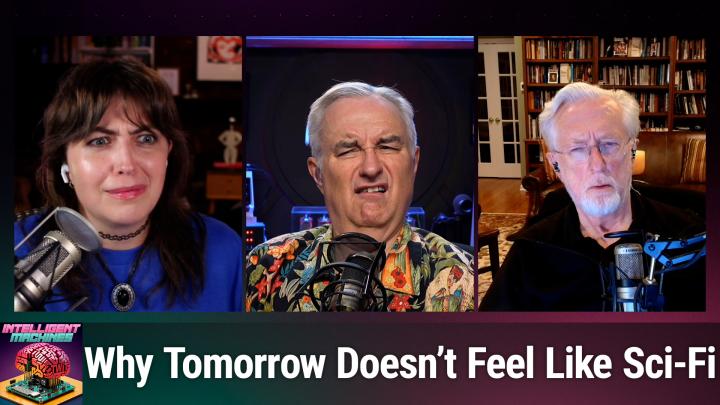
Intelligent Machines (Audio)
IM 837: Could Should Might Don't - Why Tomorrow Doesn't Feel Like Sci-Fi
02:27:48
Why Tomorrow Doesn't Feel Like Sci-Fi
Loading summary
Transcript976 lines
- [00:00]
Leo Laporte
It's time for Intelligent Machines. Paris Martineau is here. Jeff Jarvis, our guest this week, Nick Foster. Don't call him a futurist, but he did write a book about how to think about the future called Could, Should, Might, don't, and all the AI news. Coming up next on Intelligent Machines, podcasts you love from people you trust. This is Twit. This is Intelligent Machines with Paris Martineau and Jeff Jarvis. Episode 837, recorded Wednesday, September 17, 2025. Could, should, might, Don't. It's time for Intelligent Machines, the show where we cover the latest in AI and robotics and all the smart little doodads and gew gaws surrounding surrounding you in your life. That there is Jeff Jarvis. He's professor emeritus of journalistic innovation at the Craig Newmark Graduate School of Journalism at the City University of Almost made it all the way through Montclair State University and Stoney Sunybrook. He is the author of the Gutenberg Parenthesis magazine and what Would Google Do? Look, I see.
- [01:19]
Jeff Jarvis
What would Google it out from the closet. Yeah.
- [01:21]
Leo Laporte
Wow. Also, the web we weave. It's nice to see you, mister.
- [01:24]
Jeff Jarvis
Good to see you, boss.
- [01:26]
Leo Laporte
Also with us, the wonderful Paris Martineau from Consumer Reports. We were talking about you earlier, Paris. I don't know if you, your ears are burning because on Windows Weekly we talked about that interesting letter Stacy Higginbotham wrote on behalf of Consumer Reports to Microsoft saying, please, please, sir, give us more windows 10, please, sir.
- [01:48]
Paris Martineau
I'm interested to see how that goes.
- [01:50]
Leo Laporte
Yeah, let's see how that goes. But I, I, you know, I honor Stacy and I honor Consumer Reports because they're fighting the fight, the good fight, for users, for real users. So as often is the case on this show, we'd like to start off with an interesting interview. We've got a very interesting guest this week. Nick Foster is a former EDM dj. Okay, you knew I was going to bring that up. And designer who has worked in some of the biggest companies in the world, including Sony, and has written a new book about the future called Could, Should, Might, Don't. How we Think about the Future. Welcome, Nick. It's great to see you.
- [02:31]
Nick Foster
Nice. It's nice to be here. Thanks for inviting me.
- [02:33]
Leo Laporte
Yeah, I love this because I was a little, I have to say, approach it with some trepidation because I thought, oh, another book about what we should do, what we could do, what we might do in the future, what we shouldn't do in the future and all of that. And I really wasn't Interested in predictions and prescriptions. You are a futurist. That's what you do for a living. You consult with companies about what's coming down the pipe. But this is a much more interesting book than that. This is a wonderfully. Almost like a. I wrote a note. I call it a book length essay about four ways we can look at the future, full of examples. Is that a fair way to describe it?
- [03:17]
Nick Foster
Yeah, that is a fair way to describe it. I think there are enough of those books and those on stage presentations about what the future is going to hold. I'm more interested in how we think about the future because I think we need to go one layer deeper and start to sort of reassess what goes on in our brains and what goes on in society and in meetings when we think about the future and talk about it.
- [03:37]
Leo Laporte
Yeah, you say at the very beginning that the fact that you can listen to award winning podcasts, read books by Pulitzer Prize winning authors, open globally renowned magazines and newspapers, watch presentations from CEOs with PhDs, or meet marketing teams with million dollar budgets and still hear lazy references to flying cars, hoverboards, the Jetsons and Star Trek is not just embarrassing, it's a disgrace.
- [04:05]
Nick Foster
I stand by that.
- [04:07]
Leo Laporte
We don't know how to think about the future, do we?
- [04:11]
Nick Foster
I think so. I mean, I've been around. So I've been working in kind of big technology companies for about 25 years and I've been around conversations about the future for most of that time. And I'm a. But I've been around engineers and scientists and CEOs and marketing teams and financiers and all that sort of stuff. And it feels like we sort of lack the skill set to talk with rigor about the future. And I think that represents a growing problem. So I wanted to write a book about what goes on in our minds and what do we reach for when we think about the future. And unfortunately, all too often it is sort of snippets that we snatch from everywhere. For a lot of people that is sort of sci fi tropes, but for other people it's statistics or headlines or comments from intellectuals or whatever it is. And it doesn't sort of hold together or withstand any kind of scrutiny. So the book is about trying to deconstruct and go back and saying, actually I think there are four channels of thinking that we all fall into and they all have their strengths and they all have their weaknesses. And actually what I'd love to see is more breadth across all of them.
- [05:14]
Leo Laporte
There's no one particular way we should think about the future.
- [05:20]
Nick Foster
I don't think so. But what I do think is that we all fall into our own particular patterns. And I think when we do that, we start to look at the world. Like if we're obsessed by statistics and projections of statistics and algorithmic extrapolations, we start to see the world through that lens and we miss all of the other stuff that's going on and the. All the possibilities and the other ways of thinking and some of the imagination and some of the caution. So what I'm trying to say is that there's a breadth of. Of thinking about the future that I don't see very much of. And so, yeah, this book is just trying to poke and provoke people to say, do you fall into one of these four more than the other three? And making people a bit aware of the inherent weakness in doing that.
- [06:02]
Leo Laporte
Yeah, One of the could is sci fi. A lot of people think that sci fi is about predicting the future. You quote. I love it. You quote Charlie Strauss, who's a sci fi, a famous sci fi author, saying, we're not trying to accurately predict possible futures, we're trying to earn a living. Any foresight is strictly coincidental. So we shouldn't look to sci fi. I feel like I've often said this, a lot of what people like Elon Musk do is based on sci fi. Like they try to. They try to recreate their childhood fantasies from these sci fi books that they read.
- [06:38]
Nick Foster
Yeah, without a doubt. It's very prevalent, particularly in this part of the world. And it's also sort of heretical to live in. When I say this part of the world I'm based in the Bay Area, it's sort of heretical to say anything downmouthed about science fiction and its input on our imagination about the future. But what I've found is that people lean on science fiction and the tropes and the language of science fiction and the ideas within science fiction in a sort of lazy way, in a way that they use it as a substitution or a placeholder for real imagination and real ideas of their own. And we do see it a lot from our sort of technical leaders who not only try to recreate the ideas from science fiction, but they use the language of science fiction to name the projects that they're running and the products that they're making, and they use the sort of behaviors that they've seen in science fiction and try to recreate them. But science fiction, I don't think is a Brief, it shouldn't be treated as a brief. I think we see that headline a lot like science fiction has become science fact or trying to make science fiction a reality. And I think that's a fundamental misreading of science fiction on a lot of people's parts. But I do think it's a substitution for genuine imagination and genuine sort of exploration of your own.
- [07:51]
Jeff Jarvis
Nick. I'm less a futurist than I am a pastist.
- [07:56]
Leo Laporte
We call that historian, Jeff.
- [07:57]
Jeff Jarvis
Yeah, well, I'm not really word but, but you know, I write about, about Gutenberg.
- [08:02]
Leo Laporte
I, by the way, Nick does too. Did you see the reference?
- [08:05]
Jeff Jarvis
Yes, I saw, I immediately searched for Gutenberg.
- [08:07]
Leo Laporte
Yes, absolutely.
- [08:10]
Jeff Jarvis
And about the liner type. And recently I've been going down rabbit holes about the, the triode vacuum tube and the beginnings of the amplifier. And what strikes me in all of these things, especially around this, is that when they, when the amplifier was invented, the inventor had no idea what he had and no one understood what broadcast radio would be. It took years past that invention before people realized what they have. And so what I like best about your taxonomy of the future is the final part is the mundane future, which is kind of presentist. And what I've come to believe is that technological determinism takes over too much of the public discussion and that we all have more of a role in creating that future. Which I think is the big point that you're making is that if we learn the lessons from the past, we learn the lessons from history and how technology has adapted before and the choices that were made and the paths that were taken and not taken. So as we face AI and literate machine alongside the Internet, what do you think are the most important decisions that everyone using it can make now? What are the butterfly wings that they fly that's going to set that future in motion?
- [09:30]
Nick Foster
Yeah, I mean it's treading dangerously close to prediction territory here.
- [09:34]
Jeff Jarvis
Yeah, well, no, I'd ask instead for your view of our responsibilities.
- [09:38]
Nick Foster
Yeah, I think so. A thing that's followed me around for the last 13 or so years is an essay that I wrote many years ago about what I call the future mundane, which is about trying to think about the future as a lived in place. Because we tend to talk about the future as someplace other populated by other people, when actually it's just an evolution of the present. And so if we look at the present and we look at the lives that we lead now, we have experienced massive amount of change. I'm almost 50 years old and there's been A ton of change. There's twice as many people on earth, for example, now than when I was born. But it doesn't sort of feel like the future. There's change all around me, technological, societal, cultural, political change. But it feels just sort of like the present. And I went to the bakery this morning and you know, my left knee still hurts every time I stand up. So what I'm trying to do when I talk about the future mundane is say, yes, there are lots of changes coming, both changes that we think of as sort of ideologically positive or ideologically negative and they'll shift the way we live. But if we talk about the future of someplace other, when we just talk about the change, we sort of miss the fact that people like us are going to be there. So I like to tell stories about the future and show future technologies as embedded, ordinary, mass adopted parts of everyday life alongside things that will continue like the chair that I have behind me that I inherited and other bits and bobs that are 20, 30 years old. And so I think that's the way we need to start thinking about technology as a sort of part of a lineage and part of a life.
- [11:06]
Jeff Jarvis
I like that.
- [11:07]
Leo Laporte
The New York Times illustration for your essay is hysterical because it has a crystal ball with waffles, laundry and a toothpick in it. So this is the future. Ladies and gentlemen, just in case you're curious, do you think, Nick, that modern companies, you've worked for Apple, you've worked for Google, do you think today's technology companies think about the future appropriately or not?
- [11:33]
Nick Foster
I think it's a mix. Right. And I think what I'm trying to point out with this book is I think they're not any worse or better than any of us because I think we all fall into one of these four corners of the map. I don't want to try and create some sort of method and say this is the Nick Foster, could, should, might, don't, method. It's just an observation. And Jeff's point about a taxonomy is exactly right. It's just sort of pockets of behavior that we fall into. And I think if we look at our big tech companies, we see them falling into those pockets. Some of them almost permanently live in one of them and some of them sort of move between them, but they don't talk about them in the round. And I think what I would love to see is technology company or a leader of a technology company doing all four of those behaviors all at once. Talking about what we could make and being excited and being Sort of motivated to create amazing new things, being very sort of directional and saying, this is what we should do, and we should do it for these reasons. Also saying, these are all the things that might happen, and some of them, we're not quite sure where they might lead, and I'm not quite sure what the answer is here. And then these are the things that we don't want to do. These are things that we should be a bit careful of or cautious of. You don't really see that balance. When people talk about the future, it's either straight to superintelligence or straight to here's where the numbers are pointing or straight to here's the problems ahead of us. And I think that's sort of what I'm trying to poke at and provoke people to realize that we all do that as well.
- [12:53]
Leo Laporte
Although I have to say, if waffles are in my future, God bless it, because that sounds right, I see no.
- [12:59]
Nick Foster
Reason why they would go away.
- [13:00]
Leo Laporte
Okay, good. In fact, better waffles.
- [13:02]
Paris Martineau
That's a prediction.
- [13:03]
Nick Foster
That's a prediction, yes.
- [13:05]
Leo Laporte
Actually, it is interesting you point this out in the book, how in some ways, I mean, here we are with these AIs that are doing things we could have never thought of or predicted. But in other ways, everything is just as it was a hundred years ago. There's changes. Who was it that you described? Was it Arthur C. Clarke? Thinks of changes as at different levels, at different speeds, at different levels.
- [13:27]
Nick Foster
Yeah. I use a really precocious academic word. I use the term accretive, like sedimentary rock stuff just piles up over time and erodes at different rates. And I think that's the reality. And it's taken me a long time to sort of realize that as I get into either the second half or the final third of my life. But actually, yes, these persistencies that keep coming through our lives exist all around us all the time. And like I said, there's been huge changes. Like gay marriage wasn't legal anywhere on Earth when I was born, for example. There were no MRI machines. And all those things have existed in being created. Yes, but we still have buttons, and people still brush their hair, and they still go out for lunch and have a ham sandwich. And I think, again, I'm not trying to diminish the scale of the challenges that face us or the size of the impact that some of these technologies might have, but they will be lived in and they will exist. And I think certainly in the Bay Area, something like Waymo, for example, undoubtedly a sort of step change in capability, from a Robotics, from a navigation, from a societal and a governmental and legal level. Like, it's a big change. But most people that have taken awaymo two or three times, it sort of normalizes quite quickly, right?
- [14:43]
Leo Laporte
Yes, it's gradual, yeah. I mean, I haven't been inside a bank in years and that's a huge shift in how I live my life. And soon I have a feeling I won't really have a need for cash. My wife asked me, why are you going to the atm? You don't need cash. Yeah, she's got a good point. I don't really need cash. I just like to carry it.
- [15:07]
Paris Martineau
Oh. I was going to say, one thing you talk about in the book is this concept of numeric fiction. Could you tell us a little bit about that and how it plays into kind of the flawed assumptions about the future and why we should interrogate them?
- [15:20]
Nick Foster
I love that question, Paris.
- [15:21]
Leo Laporte
Thank you.
- [15:22]
Nick Foster
It sets me up for one of my pet peeves. That's why I think I've been around a lot of different types of people who work in trying to understand the future and trying to convince people of a certain future. And it feels like the people who play with numbers always have the upper hand. The corporate strategists, the people who have sort of worked out the numeric patterns in the world and tried to decode the world and say, we've done the numbers and the arrow points there, so we should do that. Now, I'm not here to say that that's always wrong, but it is wrong quite often. And I think the thing that we always miss is that no matter how good your data is, when that solid line turns into a dotted line, it ceases to be data and it becomes a story. I don't think we're honest enough about that, so I refer to it. There is a bit of stink on this, but I refer to it as numeric fiction because I tell stories too, as a designer, but I use films and objects and prototypes and, you know, bits of conversation. But people who come from maybe a corporate strategy or an analyst perspective, they'll use numbers. And because numbers hold this sort of lovely place in our hearts, we believe them to be rigorous and we believe them to be sort of honest and true and empirical. They sort of convince us of a future that's definitely coming. And, you know, anyone that's had any money in the stock market knows that those dotted lines are not truths, they're not data, they are stories. So I use that term as a way to sort of Deliberately pick at people's brains and say, just maybe don't lean on that as much as perhaps we do.
- [16:50]
Leo Laporte
You actually quote from one of my favorite TV shows succession when they ask one of the Roy kids, where do those numbers come from? And he goes, you know, man, projections.
- [17:02]
Nick Foster
Yeah, like it's a truth. Like it's. Like it's a truth.
- [17:05]
Leo Laporte
Projection man. Of course.
- [17:07]
Nick Foster
Yeah, yeah. So that's why I sort of deliberately pick on that. Because that type of futurism, which doesn't really declare itself to be futurism, but it is, it's trying to predict or show or convince a future coming our way. It seems to get a seat at the highest table in almost all decision making meetings or in all sort of leadership meetings. And it can be very useful because it can give somebody some decent background to lean on and say, this is why we made this decision. And it's trackable, traceable. You can see when you were right and you can see when you were wrong. I get that. But I think there are other ways of imagining and talking about and steering the future that are equally flawed but also equally beneficial.
- [17:47]
Leo Laporte
We're talking to Nick Foster. His book which came out at the end of August is in bookstores now from Farrar, Straus and Giroux, is called Could, Should, Might, Don't. How we think about the future. And Nick does also narrate it so you can get the audiobook and a.
- [18:04]
Jeff Jarvis
Different cover in publisher in the UK next month.
- [18:08]
Leo Laporte
CD for.
- [18:10]
Jeff Jarvis
For our UK folks.
- [18:11]
Nick Foster
Yeah.
- [18:11]
Paris Martineau
So in the designer, are you more involved in the COVID approval process? Do you think the average book for author it's. Or do you just let them do their thing?
- [18:23]
Nick Foster
A bit of both. A bit of both. To be honest, one of the things that I was involved in in this is so graphic design is not my background. I'm an industrial designer. I was one of the early design team at Dyson back in the 90s.
- [18:33]
Leo Laporte
Oh wow.
- [18:34]
Nick Foster
So you know about. Not get into that. So graphic design. Graphic design is not my idea.
- [18:41]
Leo Laporte
Talking about something designed to look like the future.
- [18:44]
Jeff Jarvis
All right.
- [18:45]
Leo Laporte
Clearly Dyson from day one said, what would be the most futuristic way you could make a vacuum cleaner look?
- [18:51]
Nick Foster
I wish I'd never mentioned it now.
- [18:53]
Leo Laporte
Okay, go ahead, keep. I'll pretend I didn't hear it. Never mind.
- [18:56]
Nick Foster
On that specific point about the book covers, what I did was I worked with two really like world class book cover designers. One in the UK is a company called Pentagram and Angus Highland and one in the US a guy called Rodrigo Corral. Who's won countless New York Times best cover awards and things like that. So they know what they're doing. But what I did was I said, this is the book that I'm not writing. Please don't do covers that look like this. You know, the ones with the wiggly arrows pointing up to the sky or the light bulb or the robot on the COVID You know, a book about the future.
- [19:24]
Paris Martineau
They love doing that.
- [19:26]
Nick Foster
Oh, God, do they? But that was part of the brief, which is why we have two very different books.
- [19:30]
Jeff Jarvis
Can you show us both covers? Can you pull them from behind your.
- [19:33]
Leo Laporte
I have a picture of Rodrigo's design. This is the American cover. The white. The white. Oh, that's interesting.
- [19:41]
Jeff Jarvis
Yeah.
- [19:41]
Nick Foster
This one is. Is the US cover by McD, Farah, Strauss and Girou. This is the UK cover with a bit of spot varnish on there. Very nice. But they're very different.
- [19:50]
Jeff Jarvis
They feel culturally appropriate, each of them.
- [19:52]
Leo Laporte
Yeah.
- [19:53]
Nick Foster
Yeah.
- [19:53]
Paris Martineau
I feel like the American one is on our level.
- [19:56]
Leo Laporte
Yeah. It's like cartoon. Big cartoon letters and then the British deck chairs. What are those on there? I don't know even. Even know what that is.
- [20:04]
Paris Martineau
Delightful. I really like the UK one.
- [20:06]
Nick Foster
Yeah, it's. Yeah, Maybe you like what you can't have. How about that?
- [20:10]
Leo Laporte
I like the Flintstones one. That's my favorite.
- [20:14]
Jeff Jarvis
Yeah. But I would do.
- [20:15]
Nick Foster
But I think. I think it's. I think it's job done, actually, is because it would be very tempting to find a sort of middle aged white tech guy from Google who's written a book about the future and just sort of your brain already draws that cover. And I'm really proud that we've ended up with two very different covers, that neither of them fall into that trap. So I'm quite happy.
- [20:32]
Jeff Jarvis
Paris, when you write your book, it's a fun part of it. It's a troubling part of it, but it's a fun part. Yeah, Nick, I'd love to, because I'm not talking about the aesthetics of design, but design as an ethic, design as a practice. I'm curious to hear your views about the role of design and AI.
- [20:47]
Nick Foster
Yeah.
- [20:48]
Jeff Jarvis
Because it seems very undesigned at this point. It's just a whole bunch of text or it's a whole bunch of mashing up of images, but in terms of a larger context of how it operates. I'd love to hear your design philosophy for AI.
- [21:02]
Nick Foster
Yeah, I don't have a design philosophy for AI other than. I think we're still. Obviously everything's moving Very quickly, and there's not a lot of time for detailed thought. But it doesn't mean to say that people aren't working on that people aren't like, people are starting to try and figure out what the shape of these things are. But as with every designed object, in order to make it well resolved takes a bit of time. So I think that work is going on. I think when it comes to the kind of design that I'm mostly familiar with and most interested in, I went to the Royal College of Art in London in 1999, which was a real kind of pivotal time for what we call critical design, which is a growth of speculative design. So using the tools of design to sort of poke and provoke people to think slightly differently. And there were two lecturers there called Tony Dunn and Fiona Raby, who I encourage everyone who is interested in technology to look up, who looked at the shape of things like Bluetooth that was just starting to appear, and Wi Fi that was just starting to appear. And there was a whole cohort of people who were looking at all the things we could make and what they could enable, and all the tech and all the objects and the gadgets. And what they did was look more at what it might mean and use design to sort of tell stories and ask uncomfortable, awkward questions. And I think that's the role that design can play right now in AI. We can work to deliver, you know, really seamless experiences that make sense to people that feel well considered. But I think design has a really good role to play in where things like AI and machine learning fit in society and what it might point at and the types of lives that we might lead and those sorts of questions at the moment.
- [22:36]
Paris Martineau
Anyway, I do have to ask you an off topic question that had been burning in my brain, but I kept inside until I saw people in the chat also wondering who. Tell us about your giant ring.
- [22:48]
Nick Foster
This ring, it's a tesseract.
- [22:50]
Leo Laporte
No, it's incredible. It's Punisher. What is it?
- [22:54]
Paris Martineau
For those listening, imagine the largest ring you've ever seen.
- [22:58]
Leo Laporte
Oh, whoa.
- [22:58]
Paris Martineau
And your finger goes through the mouth.
- [23:00]
Nick Foster
It's very subtle and understated.
- [23:04]
Paris Martineau
So I'm not wearing rings right now, but I've been on a ring kick lately.
- [23:08]
Nick Foster
Based. It's based off a very, very expensive ring that I saw from a very, very famous French jewelers that I couldn't afford. So i3D printed it in wax and cast it in silver.
- [23:20]
Leo Laporte
Bravo. So bravo.
- [23:23]
Paris Martineau
Delightful.
- [23:24]
Nick Foster
There you go. If you can't have it, just make it.
- [23:27]
Paris Martineau
Have you done this before or what? Did you?
- [23:30]
Nick Foster
I mean, this is the only one I've made. But there's another. There's another one. Work in progress here, little 3D, just a bit of CAD work and some 3D printed stuff.
- [23:38]
Leo Laporte
But I love the idea of then using it as a cast so you can make it out of a more durable.
- [23:42]
Nick Foster
Yeah, it's just like a piece of investing 3D, print it in wax and then investment cast it in silver.
- [23:47]
Leo Laporte
Perfect. Yeah.
- [23:48]
Nick Foster
And I sort of wore it as a bit of a joke because it is quite Liberace. But that joke, that joke is now a decade old. So. Yeah.
- [23:56]
Leo Laporte
Who's Liberace? No, no. So could, should, might, don't. These are four different kind of ways of thinking about the future. But you're not prescribing any of them.
- [24:09]
Nick Foster
No, not at all. I think they all have their benefits. They all have quite interesting origins too, but they all have blind spots and weaknesses that I think we overlook or don't interrogate enough. And I think when you. When you introduce me as a futurist, I don't actually call myself a futurist. And if I do, it's with great reluctance because there isn't sort of another word. And I think that's. This is where I do get a bit strident. But I think that's because the work of futurists is typically subpar and I don't really want to be part of that cohort. What I want to do is empower people. All of us are consumers of futures work all the time through media, news, entertainment, stuff we do at work. And I don't think we're critical enough of it. Which means I think a lot of futurists get away with sort of biased, subpar, not very well developed, non rigorous work. And so I refute, refer to myself as a futures designer, which sounds equally pretentious, but at least it gets design in there, which I'm.
- [25:07]
Jeff Jarvis
Well, Jeff will like.
- [25:09]
Leo Laporte
Jeff will like this because he's a fan of German words. You say futurism falls into the Gesamtkunstwerk.
- [25:16]
Nick Foster
Yes.
- [25:17]
Leo Laporte
Do you know what that means, Jeff? He's nodding.
- [25:21]
Jeff Jarvis
The collected work of art.
- [25:23]
Leo Laporte
It's a term.
- [25:24]
Nick Foster
Complete work of art.
- [25:25]
Jeff Jarvis
Complete work of art, Yeah. I mean, I like this a lot, Nick, because futurist to me is a rather hubristic job title, self anointed. Whereas what you're really saying is that you're building the future. Yes, I think that's the responsibility to do that rather than predicting it.
- [25:40]
Nick Foster
Yes. Bruce Sterling, the science fiction writer who I know reasonably well, he gave one of his usual long ramblings. Yeah, yeah, he did one at the Long now foundation. And there's a quote in my book that he kindly let me use, which is I'm gonna butcher it. But he said, if I'm practicing futurism all on my own on a desert island wearing a goatskin hat, am I a futurist? And he said, I'm pretty sure I'm not because I've got no one to tell about it. Which sort of. Yeah, it does really get to the nub of what you're saying. Again, I know people that call themselves futurists and I consider them friends and that's fine, but I'd love to see the quality of that work go up. And when it does, maybe I'll be more comfortable calling myself that.
- [26:23]
Leo Laporte
Well, give us. Go ahead, Jeff.
- [26:25]
Jeff Jarvis
Well, now, so much of the future talk around AI is the doomsters and the test realists and the long termists and all that, which I think even further corrupts if it's a field. The field. Right. Because it's now taken it to kind of a looney tunes end. How do you recapture a sane. Which is what your whole book does is try to recapture a sane view of the future rather than this woo woo doom crap.
- [26:57]
Nick Foster
Yeah, I mean, it's very tricky territory because a lot of people have got big excitement about this particular family of technologies for quite good reason. A lot of people have got big fears about these technologies for quite good reason. And I think as soon as you call those out and start to say we need to move away from it, people think you're trying to diminish both of those perspectives. What I'm doing when I talk about the future mundane is just acknowledging this middle of the. Sorry, this middle of the bell curve experience that we'll likely have. Now, that bell curve could skew from one side to the other. But I love to talk about these technologies not in everything's all collapsed and gone, you know, super south or everything's amazing and utopian and we're all going to live fancy lives. My experiences of most technological shifts have been somewhere in the middle. And so I like to try and talk about, try and acknowledge that those extremes exist and understand the powers and the faults of both of them, but spend as much time time as I can trying to consider what that's going to be like. Just when I go back to see my dad and go for a pint with him at the social club. In his damp northern British town. Like, what. When you talk about AI, what do you mean there? Like, is this pint more expensive or cheaper? Does the pinball machine still work? You know, those kinds of questions start to force you to interrogate the future with more rigor. And all those coulds and shoulds and mights and don'ts, they just start rushing in with real sort of vivid reality in a way that hype and doom just sort of feel like alien opinions and alien places that are hard to wrap your hands around. So, yeah, I like to try and think about the future. And when I've been working with people in the past, they found value in doing that as well. Like, really thinking about, what would my auntie do with this? Like, is her life any different at all? Anyway, that's. That's the reason I like to focus on that.
- [28:44]
Leo Laporte
Your dad's pub sounds like a place the future left behind. That's very much like it was.
- [28:49]
Paris Martineau
I don't know that the future needs to be integrated into his dad's pub.
- [28:54]
Leo Laporte
Well, it's going to be technically in the future. Tomorrow is the future. But it may not change in a substantive way.
- [29:01]
Jeff Jarvis
It doesn't mean rejecting the past, it means learning from it.
- [29:03]
Nick Foster
Yeah, it might not have a huge moment when we sort of actively inject AI into my dad's pub. We've really gone deep on this one.
- [29:13]
Paris Martineau
I'll put the pub on the block.
- [29:14]
Nick Foster
But I would, I would say if we were to. If we were to revisit my dad's pub in five years or so, there would be noticeable differences. I think there would be outweighed by the persistencies and the things that remain largely the same. You know, the prices might be slightly higher and the beers that they have on tap might be slightly different, but everyone's phone will be slightly different. People might be wearing slightly different bits of tech they're paying for. Things might be slightly different. You know, there will be little tells about the change that's happened. And I think really spending time to think about those little nuanced changes in the world and thinking more rigorously about how we feel about them is what I'm trying to call for in this book.
- [29:54]
Leo Laporte
That's one of the things I love about some filmmakers love subtly telling you you're in the future where everything looks the same, except that everybody's wearing high water pants, as in her. Or, oh, we have a black president. This must be the future. Or a female black president must really be the future. Now that in a way acknowledges what you're saying, which is that the future happens unevenly. By the way, let me correct myself. It wasn't Arthur C. Clarke and Stuart Brand's gonna kill me. It was Stuart Brand who came up with this idea of an accretive.
- [30:30]
Nick Foster
Yeah. Paste. Layers. Yeah.
- [30:31]
Leo Laporte
Layers. Yeah, yeah, yeah. Pace layers is what he calls them.
- [30:34]
Nick Foster
Yeah, yeah. I think the.
- [30:36]
Leo Laporte
The.
- [30:38]
Nick Foster
Yeah.
- [30:39]
Leo Laporte
There was no question in there. I'm sorry. That was a long nothing.
- [30:43]
Jeff Jarvis
I do too.
- [30:44]
Leo Laporte
Nothing. Ball of statement. Let's. Because we only have a few more minutes. Help us Is it. Is there a prescription for how we should be thinking about One of the things that's really hard for us, especially if we're fans of technology and we're kind of immersed in technology and what's going on. We're kind of. We kind of have this vague through a glass darkly vision of what's going to happen. We know it's going to change anyway. But help us think about this change and how. Is there any preparation we should do. Is there any way we should get ready for the future?
- [31:23]
Nick Foster
Yeah. Again, at risk of turning into a purveyor of predictions or a prediction machine. I think one of the challenges is most of decent futures work is just doing the thinking, not necessarily getting to the answer or being sort of better prepared. Just spending the time to invest real time and money and effort and building teams around thinking about the future is the best preparation. And it's not again to try and discover the answer somehow it's much more focused on getting a group of people together to really focus on doing that kind of work.
- [31:57]
Leo Laporte
So that you're thinking about the many different tendrils of the future. I think of Harry Seldon and Isaac Asimov's foundation where he mathematically predicted the future using probability. We obviously can't do that. But are you saying that we could kind of think about where the multi verse might be headed?
- [32:18]
Nick Foster
So in, in sort of professional foresight and futures work, the might futurists mental model is probably the most prevalent for good reason. Which is again a built on sort of scenario planning and strategic foresight that came out of the Cold War and RAND Corporation. RAND Corporation Herman Kahn people like that. Which is sort of the best in class that we've got, which is trying to think with plurality about the future. Trying to think all of the different directions and different scenarios that could play out. And that takes a lot of time and a lot of work. And also the downside of that way of thinking is you'll never figure them all out by a long Stretch, you'll get a few percent of them, probably, actually. And our experiences that we've had in the past absolutely color what we're able to imagine in the future. And the example that I use for that is when we think about stage magic, for example, when somebody pulls a card out of a box that had nothing in it before, it feels amazing because previous us had never seen a scenario where that could happen.
- [33:17]
Leo Laporte
Right.
- [33:18]
Nick Foster
And so I think the challenge of that, sort of the best thing you can do is think as many, as broadly as possible, all scenarios that could come to pass, knowing that there'll be tons that you won't see, or if you do see them, you'll push them out into impossible territory, like Kodak did, like Nokia did, like Blockbuster did. And I think that's the challenge is knowing that it's never going to be a finished body of work. Another Bruce Sterling is the future is a verb, not a noun. It's a process, not a destination.
- [33:50]
Leo Laporte
Love that.
- [33:50]
Nick Foster
So you have to keep doing the thinking all the time and adjusting based on new evidence coming in.
- [33:57]
Leo Laporte
But my reaction to that, and this is historic for me, it's not just to you, but in general has been, well, then I just can't predict the future. And so I'm not going to even attempt to think about what's going to happen because it's unpredictable.
- [34:11]
Jeff Jarvis
We have a responsibility, each of us. I mean, what I, what I wrote in and what we weave is that every time we do something on social media, every time we do something on the Internet, we're building the Internet and we're choosing what Internet to build. Right.
- [34:25]
Leo Laporte
Well, that sucks. Well, yeah.
- [34:26]
Jeff Jarvis
And so I, I learned I used to be more of a jerk. I, I, but I, I think I've learned a little bit. And I try to be better.
- [34:33]
Leo Laporte
And that's not about the future. That's just.
- [34:36]
Jeff Jarvis
No, it is about the future. Because. No, because every time you point to a fight and say, okay, fight, let's all go over there and fight, you're encouraging more of those fights. You're encouraging a future that's filled with those fights. Whereas when you say to somebody who's spreading lies, sorry, bud, but you know, you're wrong about that. You should look that up. And there's this thing called Google. You're trying to encourage a different behavior. They may hate you for it, they may ignore you for it, they may call you woke for it. I don't give a but, but that's our responsibility. And we're building that Internet a brick at a time, or that there is.
- [35:08]
Nick Foster
That sort of dogma that's creeping in, which is everything's changing so fast. Not just tech, but everything's changing so fast that thinking about the future is really hard. And my response to that is, well, so we just not do it then. Because that doesn't seem like a good answer.
- [35:20]
Leo Laporte
That's.
- [35:20]
Nick Foster
But it doesn't seem like a good answer.
- [35:22]
Jeff Jarvis
Imagine being around. Imagine being around in the Industrial Revolution. That felt pretty damn fast. That felt more profound than what we're going through now. Being around during Gutenberg, I mean, it was profound.
- [35:33]
Nick Foster
One of the things that I think we're all starting to realize, and when I say we're all. That's a difficult phrase. Obviously, it's 8 billion of us, but we're all starting to realize that we're living in time capsules that were accidentally planted by people who didn't think enough about the future. And we have an opportunity change. We have an opportunity to change that prioritization. And as things change so quickly and with such magnitude, and we're able to deploy massive change at scale quicker than our predecessors, I think it naturally comes with that responsibility that we should have at least a conversation about where all this might be going and what it all might mean and what we would like it to become and what we're scared about and what we're anxious about, what we should keep an eye on. To me, the fact that it's moving so quickly is more of a reason to spend more time thinking about the future than to encourage you to do it less.
- [36:24]
Jeff Jarvis
Nick, can I ask you a favor? You've used the phrase bits and bobs a couple times in the show. I'm going to translate it into New York, otherwise known as tchotchka. I would love to. If those of you who are not on video, Nick has a brilliant studio. I would love you to just point to one beloved tchotchka and tell us its story. Anything in your studio.
- [36:43]
Nick Foster
Crikey, that's a good one. There's a. Well, I've got to learn how to point here. This is an air freshener for a car made out of an image of my head.
- [36:52]
Leo Laporte
I like that. It's really good. Very refreshing.
- [36:55]
Nick Foster
These are some. Actually, these are lovely. I'll do this one. This is a set of two bird boxes, boxes that my friend Reese Newman created with a string in between that were designed to be thrown up onto telegraph lines, like instead of sneakers, two wooden bird boxes that you throw over the line. And then birds can go Live in them.
- [37:14]
Jeff Jarvis
Thank you. I needed that.
- [37:15]
Leo Laporte
I don't think Pacific Gas and Electric will be thrilled to hear that.
- [37:18]
Jeff Jarvis
But cause a blackout in California, other problems.
- [37:22]
Nick Foster
Yeah, I'm not. I'm not representing any brand or anything.
- [37:26]
Leo Laporte
What's the use my ID $1. Is that a street sign you found somewhere?
- [37:30]
Nick Foster
This. This was. Sorry, I'm really bad at pointing. This is. It was for. Actually I think for my interview to get a job at Google when we had to talk about. I can't really get into it too much, but I made a short film and yeah, that was one of the props.
- [37:47]
Leo Laporte
I love it. Use my ID $1.
- [37:50]
Nick Foster
It was about privacy and security.
- [37:52]
Leo Laporte
I think you could get more worldcoin for that actually, if you sh. Nick, it's been such a pleasure. We could go on and on. The book is really a fun read with lots of great quotes and stories and more. As much as anything, a description of how not to think about the future as it is. How to think about the future. But a lot of very inspiring things. And I do hope that at some point you will make the cricket crunch because that is the cereal of the future, ladies and gentlemen. Yeah, yeah, that's in the book. The book is. And let me. Let me pull up your page because it's. The best way to get it is to go to Nick's page. Could, should, might, don't. Nick Foster, the author, how we think about the future. And don't be put off by the idea that this might be somehow prescriptive. It's just a really interesting, fun, thought provoking kind of tour inside of Nick's mind. Thank you. I really enjoyed it and I very much enjoyed talking to you, Nick. Thank you.
- [39:01]
Nick Foster
Yeah, likewise. Thanks for having me on.
- [39:02]
Leo Laporte
It's been a pleasure. So it isn't deck chairs. I'm looking at the British cover now. It's beach chairs.
- [39:07]
Jeff Jarvis
Orange.
- [39:08]
Nick Foster
Beach.
- [39:08]
Leo Laporte
And orange, by the way, you must have known. Is the new color, by the way, thanks to Apple.
- [39:12]
Nick Foster
That's true. This decision was made much before then.
- [39:16]
Leo Laporte
We're all going orange. Well, no. As usual you've got your fingers on the pulse of the. Of the world.
- [39:25]
Jeff Jarvis
Having worked in Kaden Ask, there were other moments where they. They've discovered the color.
- [39:29]
Nick Foster
The color. This season.
- [39:30]
Leo Laporte
This season the color is orange. Lovely video too on the front. What is the story of the rain and the leaves? Is there. Is there some deep.
- [39:40]
Nick Foster
I encourage you to watch the whole. It's a trailer for a book, which I thought was a nice idea. So we have trailers for Movies. But this is a trailer for the book which introduces all the.
- [39:50]
Leo Laporte
There's Moses.
- [39:51]
Nick Foster
It's about.
- [39:51]
Leo Laporte
There's the fifth. The fifth Element. And there's space. Oh, there's Zoltan.
- [39:59]
Paris Martineau
Very important.
- [40:00]
Leo Laporte
Oh, this is fun. So you're filming as well? Yeah, yeah, yeah.
- [40:03]
Nick Foster
I try everything.
- [40:04]
Leo Laporte
Yeah. Whatever it takes, future.
- [40:06]
Nick Foster
Whatever it takes.
- [40:07]
Leo Laporte
Very good. Thank you, Nick. Really lovely.
- [40:10]
Nick Foster
Nice to see you all. Thank you.
- [40:11]
Leo Laporte
Have a wonderful day. Thanks. Cheers. We'll be back with the. With the Intelligent News AI news in just a moment. You're watching Intelligent Machine with Paris Martineau and Jeff Jarvis show today, brought to you by Pantheon. I mean, that seems only fair since our website is also brought to you by Pantheon. It's funny they didn't know this when they came to us to do advertising. Lisa said, should we endorse Pantheon? I said, endorse them. We use them. This is how our entire workflow operates. Your website. Our website is really important to you. For many of us, it's the number one revenue channel. But when it's slow, when it's down, when it's stuck in a bottleneck, well, it could also be your number one liability. Pantheon keeps your site fast, secure, and always on. That means better SEO, more convers, more conversions, and no lost sales from downtime. But that's not just a business win. No, it's a developer win, too. Just ask our engineer, Patrick Delahanty. He loves Pantheon. Your team gets automated workflows, isolated test environments, and zero downtime deployments. Actually, I really appreciated Pantheon's isolated test environments when I accidentally pushed a change to the website that broke everything. Fortunately, it pushed it to test, not to production. Thank goodness. That means no more late night fire drills. No Works on my machine Headaches. You've heard that. Oh, works on my machine. Just pure innovation. Marketing can launch a landing page without waiting for a release cycle. Developers can push features with total confidence. And your customers, they just see a site that works 24 7, they don't know what's behind it. But you will. Pantheon powers Drupal and WordPress. Sites that reach over a billion unique monthly visitors. Visit Pantheon IO and make your website your unfair advantage. Pantheon, where the web just works. We love Pantheon. And it's more than just our website. It's actually the headless Drupal, the public API that runs the website. The private API that all of our editors and producers use for all of their workflow. We are completely dependent on them. They're awesome. Thank you. Next week, our guest will be Stephen Levy, editor at Large at Wired. I'm looking forward to talking to our dear friend Steve. In fact, you were just with him, weren't you, Jeff? On Monday.
- [42:41]
Paris Martineau
Jeff is. We've momentarily lost his computer right now. Jeff is with him. Not a blackout. Jeff was just having some choppiness in his video. But Jeff was with Steven at Wired's AI Summit. And I used to work with Stephen at Wired, so.
- [42:57]
Leo Laporte
Oh, that's right. Of course you did. Yeah.
- [42:59]
Paris Martineau
See him again.
- [43:00]
Leo Laporte
I have an autographed copy of Hackers. That's how much I love Stephen.
- [43:04]
Paris Martineau
Such a delight.
- [43:06]
Leo Laporte
Yeah, he's kind of legendary. He's been covering the. Kind of. Longer than. Yeah, yeah. And is one of the best tech journalists. You read his stuff at Wired. But he just recently. This is why I said, we got to get Stephen on. I said, stephen, we have to get you on. He just wrote a piece on Wired about the anthropic decision and had kind of interesting. I won't. I won't telegraph his take, although I guess you could just go to Wired and read it. But I had a kind of interesting take and I thought, hey, we gotta get Stephen on to talk about that. So Stephen Levy, one of the great tech journalists, will join us next week for a conversation on intelligent machines. We'll wait until Jeff comes back, I guess. What have you been up to lately? Paris Martineau. Did your story get published yet?
- [43:54]
Paris Martineau
No, it will at the end of the month.
- [43:58]
Leo Laporte
Excellent.
- [44:00]
Paris Martineau
Keep your eyes out. I'm going to Yonkers again tomorrow for a, I don't know, big work event sort of thing. Will be fun.
- [44:08]
Leo Laporte
Well, please thank whoever. I guess Stacy Higginbotham was one of the people who wrote the letter, the open letter to Michelle. Yeah, To Satya Nadella. We talked about it on Windows Weekly, and I think Paul was a little bit, I don't know, skeptical, but I think she made a really excellent point in this. Let me pull up the letter here so I can show everybody. She was telling Microsoft and Satya, you know, can you please extend the deadline for Windows 10? Windows 10 will go out end of life, October 15th, which is awfully soon.
- [44:55]
Paris Martineau
What number of Windows are we on currently?
- [44:58]
Leo Laporte
Well, they want everybody to go to 11, but as Stacy points out, as Consumer Reports points out, most of the machines sold until very recently, until the last like two or three years, cannot be upgraded to Windows 11. Microsoft has made what many consider an arbitrary decision. To require two key technologies, you have to have an intel processor of 8th generation or later, a much more modern one, and something called TPM 2.0, which is a security feature built into the hardware of the operating system. Microsoft says, well, this is because we want to make Windows more secure and so these hardware features we will be using to make it more secure. But as Steve Gibson, our Security now host continually points out, it's an arbitrary distinction because there are ways to run Windows 10 hacks, if you will, to run Windows 11 on machines that technically are not supposed to run Windows 11.
- [45:57]
Jeff Jarvis
Windows 10 is what, 10 years old?
- [45:59]
Leo Laporte
It's exactly 10 years old. So Microsoft typically will support an operating system and I think this is not unreasonable for 10 years. October 15th they will stop shipping security updates unless a, you pay $30 for the next year if you're a company, you may have to pay even more if you have an enterprise license or B, you have been using big. Oh look, hello, I got to turn that off. That's an Apple thing. You're using Bing Rewards and you have, what was it, 5,000 Bing rewards points. Now I happen for some reason, I think because I subscribe to Xbox Game Pass or something, have like 100,000 Bing rewards points.
- [46:39]
Jeff Jarvis
But you're rich, I tell you, you're right.
- [46:41]
Leo Laporte
And they're non transferable so don't ask me for them. Or the third way you could get a year's extension is to back up your settings to OneDrive, which as Paul points out, and I think this is the case is Microsoft saying, well, we don't want to just say everybody gets a free year so we're going to put the lowest speed bump possible and then if people do it, then we're going to give them an extra year.
- [47:06]
Jeff Jarvis
So what's Stacy asking for a year or what period?
- [47:08]
Leo Laporte
Well, she's just saying it's. Yeah, she doesn't specify a.
- [47:12]
Jeff Jarvis
It's going to end at some point.
- [47:13]
Leo Laporte
Yeah, it has to because no company supports its operating systems forever. Right.
- [47:17]
Jeff Jarvis
I mean Microsoft used to be really backward compatible as an ethic way.
- [47:22]
Leo Laporte
There's still backward compatible. This is what we're talking about is not compatibility. In fact, businesses will continue to run Windows 10 if they pay for the updates. Oh, this is the other thing. It's a little galling. These updates are available because companies can buy them. So it's not that Microsoft is not supporting it, they've just decided to stop delivering the updates and as a way to kind of compel people to Upgrade to Windows 11.
- [47:48]
Jeff Jarvis
Planned obsolescence makes capitalism great.
- [47:50]
Paris Martineau
Yeah, I mean, but yeah, this is on a scale that I feel like is unique. The fact that this is happening. One operating system deep is rough. Yeah, I can understand if this is like Windows 9 or something, but this is.
- [48:04]
Jeff Jarvis
This is Benito. It's also that, like, there is no functional difference between Windows and 11 and Windows 10 for a user.
- [48:10]
Leo Laporte
Like, they're basically the same.
- [48:11]
Jeff Jarvis
For me to go at 11, there's no reason.
- [48:13]
Leo Laporte
Yeah, they're basically the same. That's another really important point.
- [48:17]
Jeff Jarvis
Like Windows 7 to Windows 8 and 9 at least gave you a DirectX 12.
- [48:22]
Leo Laporte
Right. And CR also points out that there are quite a few people, a large number of people still on Windows 10 who will be left out in the cold October 15th. They will have insecure computers, which doesn't just hurt them, but frankly also hurts the general computing ecosystem. Because, you know, if you think about it, those compromised computers end up becoming a hazard on the Internet for everybody. So I think it was appropriate and maybe we should get Stacy on to talk about it.
- [49:04]
Jeff Jarvis
We were going to get Stacy and Craig on at some point to talk about his support of her work there.
- [49:09]
Leo Laporte
Oh, that's true. We should do that too.
- [49:11]
Paris Martineau
Additionally, we should do an Oops all CR show at some point.
- [49:14]
Leo Laporte
I would love to do that, Stacy. Nick, I was trying to do that.
- [49:19]
Jeff Jarvis
That's something I was trying to do for twit.
- [49:21]
Leo Laporte
Yeah, we tried to. Yeah.
- [49:22]
Paris Martineau
Be fun. We got time.
- [49:24]
Leo Laporte
There's. It's not over yet. Don't give up yet. We can still do it. So I doubt very much that anything will happen. Although if you. By the way, it was authored by Stacy Higginbotham and Justin Brookman, who's director of Technology Policy. These are two policy folks for Consumer Reports. Consumer Reports. The last sentence is calls on Microsoft to extend Support for Windows 10 to allow these consumers to keep up hundreds of millions of PCs on the market, particularly consumers who'd recently bought incompatible hardware. Paul says, you know, you couldn't buy a computer that wouldn't run Windows 11, you know, as. As long as three or four years ago. I mean, at some point manufacturers stopped shipping. But I don't know if that's true. If you go to Costco, even as recently as last year, you could buy a Windows 10 machine that couldn't run Windows 11, I'm pretty sure, because Costco outside of America. Also old ones outside of America. Right. And there's, of course, entire.
- [50:28]
Jeff Jarvis
Very important.
- [50:29]
Leo Laporte
Yeah, there's one and a half billion Windows users, and half of them are still using Windows 10.
- [50:35]
Jeff Jarvis
At least Benito speaks for the world.
- [50:37]
Leo Laporte
Yes, as always, he speaks from the world as well. So it's kind of a beautiful thing though way. So thank you to your compadres and Yonkers.
- [50:49]
Paris Martineau
I shall pass the message up the chain.
- [50:51]
Leo Laporte
Yeah. When you, when you see them.
- [50:52]
Jeff Jarvis
Yonkers is such a New York name and it's as far as I know.
- [50:56]
Leo Laporte
Did you ever ask them about the Yonkers questions? No.
- [51:00]
Paris Martineau
I mean I know what the, I know what the anchors questions are now I did a, I did a brief Google but I do, I do think it's fun for the bit to pretend to have no understanding of why my tax forms in New York continue living Yonkers.
- [51:16]
Leo Laporte
If you live in Yonkers, we can help.
- [51:18]
Paris Martineau
If you live in Yonkers, call for help immediately.
- [51:22]
Leo Laporte
Parmee Olson, who of course has been a guest on this show, she wrote a very good book called Supremacy. AI ChatGPT and the race that Will Change the World has an opinion piece in Bloomberg this week. AI's $344 billion language model bet looks fragile. We've been seeing more and more and we've talked a little bit about this that LLMs, perhaps this is what Gary Marcus has been saying all along are are kind of hitting a plateau and that there it seems to be the case that LLMs will always have a hallucination problem that will always have edge cases they, they can't solve. Hallucinations are not going to go away. In fact, you quoted last week, was it Fei Fei Li who was it that.
- [52:17]
Jeff Jarvis
Yeah.
- [52:18]
Leo Laporte
Oh, in fact here, here's Fei Fei Li who try to figure out. Oh, I don't know where that's coming from. Let me mute whatever tab that is. Somebody's still talking.
- [52:28]
Jeff Jarvis
Somebody's always talking around.
- [52:30]
Paris Martineau
Someone is always talking.
- [52:31]
Leo Laporte
Why are they.
- [52:32]
Paris Martineau
You get. If you open a critical mass of tabs, someone will be talking always.
- [52:36]
Jeff Jarvis
Yes.
- [52:37]
Nick Foster
I hate that extra emphasis in ZDNet special feature.
- [52:40]
Paris Martineau
We can hear it now.
- [52:41]
Leo Laporte
There it is. I think that was Jason Heiner. Maybe it was just left over from Twit. Here is Fei Fei Li on the limitations of LLM.
- [52:50]
Paris Martineau
Language is fundamentally a purely generated signal.
- [52:55]
Leo Laporte
There's no language out there.
- [52:57]
Paris Martineau
You don't go out in the nature and there's words written in the sky for you. Whatever data you feeding you pretty much can just somehow regurgitate with enough generalizability.
- [53:12]
Jeff Jarvis
The same data out and that's language to language.
- [53:16]
Paris Martineau
But 3D world is not. There is a 3D world out there that follows laws of physics that has its own structures due to materials and many other things and to.
- [53:30]
Jeff Jarvis
To fundamentally back that Information out and.
- [53:33]
Paris Martineau
Be able to represent it and be able to generate it is just fundamentally quite a different problem. We will be borrowing.
- [53:44]
Jeff Jarvis
Similar ideas or.
- [53:46]
Paris Martineau
Useful ideas from language and LLMs, but this is fundamentally, philosophically, to me, a different problem.
- [53:53]
Leo Laporte
That's interesting.
- [53:54]
Jeff Jarvis
That's really good, Leo, if you don't mind. Line 111 is Yann LeCun's Mondo Presso that he gave to students and graduates.
- [54:04]
Leo Laporte
You sent us this. Yeah.
- [54:06]
Jeff Jarvis
And if you go down to line to page 113 1. Okay, I just saved you five hours.
- [54:12]
Leo Laporte
We are going to go to page 113, get ready to scroll.
- [54:20]
Jeff Jarvis
You know, you can just put a number.
- [54:22]
Leo Laporte
Oh yeah, I could just enter 113. Huh? Okay.
- [54:26]
Paris Martineau
While we're searching, I'll point out that in that video turn, they did have a. In the shot behind Fei Fei Li, a Motorola Dynatec brick phone.
- [54:37]
Leo Laporte
I think it was bigger than normal, though. I think that was like a giant replica of. Looked huge.
- [54:43]
Paris Martineau
It did look huge. And it looks like. I don't think that was the.
- [54:46]
Leo Laporte
I've used those phones. They're big, but they're not.
- [54:49]
Paris Martineau
They're big, but they're not that big.
- [54:50]
Leo Laporte
That's what I thought. A16Z is exaggerating a little bit. We're going to talk about a 16.
- [54:56]
Paris Martineau
We got to get. We got to get the biggest brick phone available.
- [54:59]
Leo Laporte
Yeah, right. So here are the recommendations from Yann Lecun. Now, so start at the bottom. Set this up. So who is lan Yann?
- [55:06]
Jeff Jarvis
Yann Lecun is chief AI scientist at Meta. He's a New York University professor and he's one of the people I trust in AI. I think he's very smart about this stuff and he's looking at the next levels of what's going to take to get AI advanced. And at the last line of this slide is if you are interested in human level, AI don't work on LLMs. So the whole presentation is making other recommendations. Abandon generative models in favor of joint embedding architectures. Now, if you ask me what that means, I will start fumpering. Abandoned probabilistic model in favor of energy based models. He has a long thing in the PowerPoint about that. Abandoned contrasted models. I don't know what that is. Abandoned reinforcement learning in favor of model predictive control. Point being here that there's new paradigms to be worked on. And that's what Jan has been arguing.
- [56:03]
Leo Laporte
Now I'm going to give you the counterargument which is all these guys don't work for OpenAI. Yann LeCun, Fei Fei Li and many others and are just jealous of the success that OpenAI has had with LLMs. The surprising success.
- [56:17]
Jeff Jarvis
Well, this is. We talked about this with, with, with Karen Ho. How that they have put everything into the scale bucket. Yeah.
- [56:27]
Leo Laporte
In fact, they call it open the open AI law.
- [56:29]
Jeff Jarvis
Yeah.
- [56:30]
Leo Laporte
Which is the more you scale, the better it's going to get.
- [56:33]
Jeff Jarvis
And that's such an American attitude.
- [56:36]
Leo Laporte
Well, it's yet to be proven out.
- [56:39]
Paris Martineau
I mean.
- [56:40]
Leo Laporte
Okay.
- [56:40]
Jeff Jarvis
Right.
- [56:41]
Paris Martineau
On a kind of first thought, best basis. But so far we're not seeing the sort of returns that you'd expect at this specific juncture in the scale equation.
- [56:52]
Leo Laporte
It's like telling the Wright brothers guys, you only threw three feet. I don't know how you expect to get across the Atlantic, but why be.
- [57:00]
Jeff Jarvis
Closed to other options? Go to the next slide.
- [57:02]
Leo Laporte
Well, no, by the way, no one is everybody but OpenAI is trying other stuff.
- [57:06]
Jeff Jarvis
Yeah, yeah.
- [57:07]
Leo Laporte
So good.
- [57:08]
Jeff Jarvis
Open AI is being dark matter.
- [57:09]
Leo Laporte
Should be competition there. Should be. Let a thousand flowers bloom. But I might. I don't know what the answer is, but I'm just saying all of this is kind of speculative at this point.
- [57:22]
Jeff Jarvis
Well, it's. No, it's research. It's what they should be doing. So the next slide is problems to solve.
- [57:26]
Leo Laporte
Okay.
- [57:27]
Jeff Jarvis
Number one is large scale world model training from video, speech, text code, dialogues, math, everything. Planning, algorithms. Jepa. I forget what that stands for. But he's there looking at what else people should be working on and what should be invested in, in universities and corporations. I think that's what's critical is if all of the. This is what Karen said. So much of the venture money went purely into scale, purely into huge data farms and not necessarily investigating other models. And we forced the Chinese because we wouldn't give them chips and we wouldn't give them other things into investigating other models. That's where Deep SEQ came from. And if we're going to stay competitive, we got it. We got to do that. The last thing in the whole slide is the whole presentation is open source. AI platforms are necessary.
- [58:18]
Leo Laporte
I would agree with that. Yeah.
- [58:20]
Paris Martineau
I love the visual aesthetic of this presentation.
- [58:22]
Jeff Jarvis
Yeah. It's amazing.
- [58:23]
Paris Martineau
It's very much a professor writing in red ink on your essay.
- [58:30]
Leo Laporte
But it also violates the fundamental principles of PowerPoint presentations. Too many slides, too many points per slide. Very wordy.
- [58:39]
Jeff Jarvis
He's a professor.
- [58:41]
Leo Laporte
Yeah. Well, okay.
- [58:43]
Jeff Jarvis
It's.
- [58:45]
Leo Laporte
Yeah, all right.
- [58:46]
Jeff Jarvis
He's a CS compressor.
- [58:47]
Leo Laporte
I.
- [58:48]
Paris Martineau
No, I do think that this is a good point. It's something that I feel like we've talked about in the show before. Why, like one of the downsides of this current moment we are in is that yes, there's an upside that AI is getting outsized attention and capital, but only a very specific sub section of AI and machine learning research is getting any capital and attention at all. Everything else is being kind of pushed by the wayside so that people can pour more tens of millions of dollars into a different chat.
- [59:20]
Leo Laporte
Bottom well, tens of millions of dollars into robots that may or may not provide a better AI. I mean, you're going to be investing money speculatively no matter what you invested in.
- [59:33]
Jeff Jarvis
But they're investing in hardware right now rather than research. And so it's as if you said we're going to, we're going to get the whole world up and we're going to make nothing but tubes because we know tubes work. Screw these little transistor things. That's unknown. Tubes work, damn it. And look at the amount of investment in the hardware of these huge Manhattan sized data farms. That's hard to just say, oh, okay, now we're going to pursue something else. It's one matter to invest in a new company in a startup in research in Brazil.
- [60:08]
Leo Laporte
It's the wisdom of crowds. Maybe the money is a crowd of about five people. No, maybe the money's flowing in that direction because there's a general consensus this is where the money should flow.
- [60:19]
Jeff Jarvis
They're, they're lemmings, they follow each other. That's the, that's the essence of, of, of Silicon Valley.
- [60:25]
Leo Laporte
I do think the one. I will disagree with you. I don't think we should, I don't disagree with you that we should try many avenues, but I do disagree with you that, that oh, LLMs are dead end. I don't know. We know that yet.
- [60:39]
Jeff Jarvis
I think there's more to be learned.
- [60:40]
Paris Martineau
But I don't think we're saying they're a dead end.
- [60:42]
Jeff Jarvis
They're not dead end.
- [60:43]
Leo Laporte
Well, but I will say there is a great cost to, and this is what Karen Howe was saying and is what others have said. It's what there is a great cost to some of the avenues they're choosing. For instance, research learning has a huge cost and a human cost because reinforcement learning, because it requires a lot of humans to do the work. Although interestingly, Xai has decided not to go down the data annotation road. Elon Musk laid off about 500 people, a third of the group on their Data annotation team. These were unskilled people who were doing reinforcement learning, much like what scale AI was doing as generalists. And instead they're going to hire experts which.
- [61:32]
Jeff Jarvis
Which is a new path that some are taking. And I think it's a smarter path.
- [61:36]
Leo Laporte
Yeah. And it may be an acknowledgement from Xai that, that, that what they were doing wasn't working. But I can think it's reasonable to say, look, there are big costs to this, human costs, climate costs, energy costs that we should really as a society decide are we willing to pay these costs, Particularly since regardless, it's a speculative process. We don't know what's going to come out of it. But if people are willing to throw that money at it. I don't know, TikTok, we don't know yet. We'll find out on Friday. The president is going from one monarch to another from King Charles to meet with Xi Jinping. It's the meeting of the emperors. Actually. Charles has no power at all. So forget that.
- [62:28]
Jeff Jarvis
It looked like they were throwing Trump a little Donnie a birthday party today and they brought all the horses and the drums and it was just unbelievable to watch.
- [62:38]
Leo Laporte
I honestly don't think it's a good thing for the President United States to associate too closely with monarchies in the country we rebelled against. But that's just my. It was.
- [62:48]
Jeff Jarvis
The Red Coats were out there. I thought. I thought we defeated you guys.
- [62:51]
Leo Laporte
Didn't we beat the Red Coats? Anyway, apparently a deal, a framework has been made. Trump and Xi Jinping will finalize this in three days. According to Treasury Secretary Scott Besant. The discussions in Madrid have sent Besant.
- [63:10]
Jeff Jarvis
I don't know. I think it's.
- [63:13]
Leo Laporte
Well, you're French, Monsieur Besson. He says that discussions have yielded fruit and delicious fruit.
- [63:25]
Jeff Jarvis
Poison fruit, maybe.
- [63:27]
Leo Laporte
TikTok will continue. First of all, the president has to extend once again that deadline, get it into December. But it looks like. And China's lead trade negotiator has confirmed there is a framework. What will happen is that Oracle and Andreessen Horowitz and Silver Lake, which is Larry Ellison's kids business. Is it. Do you think the kids business or is it Larry Ellison? It's dads.
- [64:00]
Jeff Jarvis
It's all dads. Which, which, I mean, let's stop here for a second. Not only did Ellison Fee just purchase Viacom and with its cbs.
- [64:15]
Leo Laporte
Yeah.
- [64:15]
Jeff Jarvis
Now, of course the word is that they want to take control of Warner Bros. Discovery which would put them in charge of cnn. And then on top of all that, TikTok the answer to all that big old media. This is a frightening, frightening consolidation of.
- [64:31]
Leo Laporte
Media power which will be faced with absolutely no opposition.
- [64:35]
Jeff Jarvis
No, no, stop. These are the. The Ellison of the Mini Murdochs.
- [64:40]
Leo Laporte
Well, they're not going to be so mini. Right. Of course, TikTok had been working on a special version of the TikTok app for the US apparently that will be the app that you will have to move to in the United States if you want to continue to use it.
- [64:57]
Jeff Jarvis
Algorithm, though the chat.
- [64:59]
Leo Laporte
The Chinese are going to license their algorithm.
- [65:02]
Paris Martineau
That's surprising.
- [65:03]
Leo Laporte
Well, A, they had said never and B, how are we now protected from the Chinese? Right.
- [65:11]
Jeff Jarvis
After all of this, where do we end up? We end up with Trump's buddies owning tick tock.
- [65:18]
Leo Laporte
20% will be still owned by Chinese investors. The US will get a seat on the board of directors.
- [65:25]
Jeff Jarvis
The U.S. government.
- [65:28]
Leo Laporte
Yeah.
- [65:29]
Jeff Jarvis
What F me?
- [65:31]
Leo Laporte
Well, again, this isn't finalized. This we'll find out on Friday.
- [65:34]
Jeff Jarvis
Hello, First Amendment.
- [65:37]
Leo Laporte
We already get 15% from video. You know, we get, we get. It's fine. This is the new socialist capitalism.
- [65:45]
Jeff Jarvis
Yeah, yeah.
- [65:48]
Leo Laporte
We'Ll see. But apparently. Now here's the question I have for you and actually should ask people like Henry, will TikTok survive this? Will people who are currently using TikTok get the new app?
- [66:05]
Jeff Jarvis
Because what's different? The whole, the whole media structure in this country.
- [66:08]
Leo Laporte
Okay.
- [66:08]
Paris Martineau
The question is the. It depends on whether the old app stops working and they have to get.
- [66:15]
Leo Laporte
The new app to continue presume that it will.
- [66:19]
Paris Martineau
And is it supposed to. In, in this case, are we assuming that everything transfers over immediately and effortlessly?
- [66:26]
Leo Laporte
Well, we don't know that. But yes. Let's stipulate a speed bump then.
- [66:31]
Paris Martineau
I do think. Yeah, I think everybody transfers. I think it's the Twitter to X principle.
- [66:38]
Jeff Jarvis
If transfer just means hit click one box and you're over.
- [66:43]
Paris Martineau
I think you lose 20 to 30% of TikTok users. But that's the highest level.
- [66:48]
Jeff Jarvis
And it grows again. Still.
- [66:50]
Paris Martineau
Yeah, that's just probably because those people were counted as users because they had Tick Tock on their phone but didn't really use it outside of like clicking links.
- [67:00]
Leo Laporte
We know that if you're still using TikTok today, you're not concerned about Chinese control.
- [67:04]
Jeff Jarvis
In fact, I try. Hello. I don't like the Chinese government. I trust the Chinese government more than the Ellisons and Marc Andreessen.
- [67:12]
Leo Laporte
Well, so that's the other question. So the people using TikTok aren't going to care who owns it. Right.
- [67:16]
Jeff Jarvis
Parents look frightened.
- [67:17]
Paris Martineau
At that.
- [67:18]
Leo Laporte
I don't.
- [67:19]
Paris Martineau
I think I. I don't know that I trust anybody, but that's besides the point.
- [67:23]
Jeff Jarvis
Nihilism.
- [67:24]
Leo Laporte
Well, I'll tell you one thing for sure. The new owners will not hesitate to slant the coverage in TikTok in the same way that Elon has slanted the.
- [67:35]
Jeff Jarvis
The coverage the Chinese were accused of doing.
- [67:38]
Leo Laporte
Yeah, well, they didn't work, which probably they never did. At least it's not as far as we could tell. But this for sure will happen. Tick tock will become like X. Oh, yes. Right.
- [67:48]
Jeff Jarvis
Oh, yes. And let me confess here. I thought X would be dead by now. How wrong could I be?
- [67:54]
Leo Laporte
People like X. Although it's gotten worse and worse.
- [67:58]
Paris Martineau
Well, it's the Everything app. It's where I do all of my banking.
- [68:06]
Leo Laporte
So we. We won't know until the actual details are announced. But. But this is what everybody is saying, including the Chinese negotiator.
- [68:14]
Jeff Jarvis
All of life is a framework.
- [68:15]
Leo Laporte
Secretary of the Treasury, a senior White House official, said, quote, it told the Wall Street Journal, any details of the TikTok framework are pure speculation until they're announced by this administration, which I understand. I mean, well, we don't know what the President's going to do until he does it, so. And even then, I mean, even then.
- [68:35]
Paris Martineau
The deal could change 25 times between announcement and implementation.
- [68:41]
Leo Laporte
So the users aren't concerned about who owns it, they're concerned about the experience, which is why it was fair.
- [68:47]
Jeff Jarvis
And who's there. Whose friend. The people they like and admire are there.
- [68:51]
Leo Laporte
Right. I think there's a great risk. I mean, look, I watch Henry. He's basically. He's still on TikTok, but he's moved his operations. Instagram. I'm going to ask him. I'm going to see him next week.
- [69:01]
Jeff Jarvis
Yeah, I'm really curious. Yeah.
- [69:03]
Leo Laporte
But I think he realized that he can't be on a single platform he started on. TikTok still has the most followers. It made him. But I think he'll move. We're talking about my son, Salt Hank, in case you don't know, he. He's.
- [69:17]
Paris Martineau
Mark it down, people. He said he was going to stop the next episode of the podcast. He went back to the.
- [69:23]
Leo Laporte
But this is germane to the comments.
- [69:25]
Jeff Jarvis
Don't worry, we're just.
- [69:28]
Paris Martineau
No.
- [69:28]
Leo Laporte
Although I have right here a delicious. A French dip sandwich that you might want to spend 28 bucks for. Did you find one in New Jersey?
- [69:36]
Jeff Jarvis
I found one in Jersey city that was 28 bucks.
- [69:39]
Leo Laporte
It's this.
- [69:40]
Jeff Jarvis
It's the going price now, tonight.
- [69:42]
Leo Laporte
What is a corn. What is that corn pie thing?
- [69:45]
Jeff Jarvis
Corn pizza. New Jersey corn pizza. Oh, my Lord, it's so good.
- [69:49]
Leo Laporte
It's a, it's a, it's a pizza.
- [69:51]
Jeff Jarvis
It's a pizza with corn. No tomatoes and no tomatoes. It has a little kind of burrata and a little bit of pepper and it's corn. It's, it's because Jersey corn is the best corn there is. Anyway.
- [70:02]
Leo Laporte
Sweet corn.
- [70:03]
Jeff Jarvis
Yeah.
- [70:03]
Paris Martineau
You guys had a pizza with an egg in the middle. That's something I've been into lately. No, just like a sunny side up egg.
- [70:09]
Leo Laporte
Here's the quote from the President. I wish I could do a Trump. The kids wanted it so badly. I had parents calling me up. They say if I don't get it done, they're in big trouble with their kids. I think it's great. I hate to see value like that thrown out the window. Instead, throw it into this pocket right here, ladies and gentlemen. I don't think he gets any money out of this. Although I bet you Jeff Yass, who is a very big Republican donor, will maintain his value. Other investors, existing ByteDance investors, including Susquehanna International, KKR and General Atlantic, will continue to be part of the group. 80% of the new company will be owned by these American companies. The stake of ByteDance's Chinese shareholders would dip under 20% to comply with that law. It's interesting. I wonder how they convinced China to give them the, the algorithm and will. This is the real question. Will China then have control over what you see?
- [71:13]
Jeff Jarvis
Well, that's. China's not giving them access to the algorithm. China is licensing the algorithm, which means China still controls the algorithm.
- [71:21]
Leo Laporte
Well, that's. I, that's a technical question. I don't know how I would bet. I would bet Tick Tock engineers will recreate a set of content recommendation algorithms for the app using technology licensed from ByteDance. So I think the Americans can't have a thumb on the scale.
- [71:41]
Jeff Jarvis
Can't.
- [71:42]
Leo Laporte
Can.
- [71:43]
Jeff Jarvis
Can. Yes. Can.
- [71:44]
Leo Laporte
Can.
- [71:45]
Jeff Jarvis
They'll have, they'll have mechanisms to control things.
- [71:49]
Leo Laporte
Oracle was stored.
- [71:50]
Jeff Jarvis
Chinese know how to do that in China.
- [71:51]
Leo Laporte
Yeah. Oracle will store the date, the user data at its servers in Texas. Silver Lake and Andreessen Horowitz. Both right leaning companies. Very much so, yeah. So I suspect that. I suspect. Well, we'll see. Now the question is whether TikTok's users will sense that and then say, well, maybe I'll go to Instagram, but is Instagram going to be any better? I don't know.
- [72:18]
Jeff Jarvis
But The New York Times, the Washington Post, the Wall Street Journal, cnn, cbs, abc, Disney. What's the diff?
- [72:29]
Leo Laporte
Right?
- [72:30]
Jeff Jarvis
What's the diff? And. And Matthew Dodd got fired from msnbc. And Comcast sent out a message to all employees praising that move. People have lost.
- [72:42]
Leo Laporte
Comcast threatened to fire employees if they said anything bad about Charlie Kirk. I think we are entering a new realm, a new time, a new era of where free speech is being redefined. I can promise you that until they manacle me and drag me off, which could happen at any moment, we will not change our tune. I will let Jeff be as liberal as he wants. Dangerous. It's all him.
- [73:14]
Paris Martineau
We can't stop him from tweeting.
- [73:19]
Leo Laporte
All right. I think that's interesting. We'll see what. We'll see what's going to happen. Let's take a little break and we'll have more intelligent machines. Is on the air. Program reminder. We're going to end the show in an hour, roughly an hour, because we have to get ready. We have to get our.
- [73:36]
Jeff Jarvis
You're going to change your clothes. You're going to put on your clothes.
- [73:39]
Leo Laporte
I'm going to put on a tuxedo. Meta connect is at 5pm Pacific, 8pm Eastern tonight. And while you are invited, you do not have to stick around. If. If your contacts are really getting you, you can. You can put your glasses on or something. But we will have a little break.
- [73:54]
Paris Martineau
We'll be eating dinner.
- [73:56]
Leo Laporte
You won't stick around or you'll be eating and stick around.
- [74:00]
Paris Martineau
I think I'm going to make food instead. You can abandon us watching Meta Connect. I'm sorry.
- [74:04]
Jeff Jarvis
So I. I went to Panera to get a French dip, so I'm going to test that versus Hanks.
- [74:10]
Leo Laporte
It's not going to be as good. I. Piece of celery. So I am prepared.
- [74:15]
Paris Martineau
He's prepared to loudly snack.
- [74:18]
Jeff Jarvis
Go ahead, crunch it. I brought. Let's crunch it.
- [74:20]
Paris Martineau
Just one. The mic.
- [74:21]
Jeff Jarvis
Oh, just one good crunch.
- [74:22]
Leo Laporte
You want one good crunch?
- [74:23]
Jeff Jarvis
Yeah, one good crunch.
- [74:24]
Paris Martineau
Cover your ears.
- [74:24]
Leo Laporte
If you have misophonia, stick your finger. Fingers in your ears right now.
- [74:30]
Paris Martineau
Oh, that was good. That was satisfying.
- [74:32]
Jeff Jarvis
Yeah, that was. Oh, yes, Swallow. Which is not easy with celery. It doesn't just go down. It's a lot of fiber you gotta chomp on. Yep. Filling the air here.
- [74:49]
Paris Martineau
Now is the time that he's stuck chewing and we could say anything.
- [74:53]
Jeff Jarvis
We could say anything.
- [74:54]
Paris Martineau
Stop us.
- [74:54]
Leo Laporte
We could.
- [74:56]
Jeff Jarvis
We will cover that celery trick.
- [74:59]
Leo Laporte
We will cover medicine. I'm very interested because there have been a number of leaks implying that they may in fact announce the most advanced AR glasses yet with actual color screen and so forth.
- [75:12]
Paris Martineau
So I'll believe it when I see it.
- [75:14]
Leo Laporte
I know. Well, I'll get my credit card ready just in case, but we will be covering that. But as usual with stream, with, you know, live streams, we don't want to get in trouble with the companies. We don't get taken off of YouTube or any of the other platforms. So we will stop this show, wrap it up and then start the stream in the club Twit Discord. So we will be doing that. If you are a club member, head to Discord. We will in Discord give you a private YouTube channel so you can watch on YouTube if you prefer. But that is for club members only. That will be at 5pm this so.
- [75:47]
Jeff Jarvis
You can join now. I'm telling you now.
- [75:50]
Leo Laporte
Yeah, you still couldn't take advantage of the two week free trial and get, you know, just see how it is to be in the club, what it's like to be a member. Our show today brought we have of course, Paris Martineau. Jeff Jarvis, thrilled to have you. Our show today brought to you by Threat Locker. I you know, if you ever tune in our security now show you you know this ransomware is killing businesses worldwide. Jaguar has been down. They can't make parts for two weeks. They say it might be a third. Already the companies they supply with those parts are going under because of ransomware. This is a nightmare. But Threat Locker can prevent you from becoming the next victim. Threat Locker uses an approach that is unique. Is the best way to do this. It's called zero trust. It takes a proactive and here's the three words that matter. This is how zero trust works. Deny by default approach. In other words, any action, anything anybody can do, especially bad guys, cannot happen, will be blocked unless it's explicitly authorized. That's huge. It's zero trust. You trust no one. Even if they're in your network, you trust no one. This protects you from both known and unknown threats. 0 Days Links that your employees click because they just can't do anything. It's trusted by enterprises that can't afford to go down for even one minute. Like JetBlue uses Threat Locker. The port of Vancouver uses Threat Locker. Threat Locker shields you from zero day exploits from supply chain attacks while providing complete audit trails for compliance as more cybercriminals turn to malvertizing. We talked about this on security. Now there's almost nothing you can do to keep your employees from. From being attacked. You need more than just traditional security tools. Attackers are creating fake websites impersonating popular brands like AI tools and software applications. And then they're distributing links through social media ads and hijacked accounts. They use legitimate ad networks to deliver their malware. I don't know how you could train an employee not to browse to those sites. They're mainstream sites. Anyone who browses on a work system could infect your computers and you're done. Traditional security tools almost always miss these attacks because they are using fileless payloads that run in memory. They exploit trusted services that bypass the typical filters. Not ThreatLocker. Threat Locker's innovative ring fencing technology strengthens endpoint defense by controlling what these applications and scripts. Any application, any script can access or execute unless explicitly authorized by you, which contains potential threats. Even if malicious ads successfully hit the device, even if your employee clicks the link. Threat Locker works across all industries. It supports Windows and Mac. They have a 247 US based support line that's fantastic. And they enable comprehensive visibility and control. Ask Jack Sennisap. He's director of IT infrastructure and security at Redner's Markets, another company that just does not want to get bit by ransomware. He says, quote, when it comes to Threat Locker, the team stands by their product. Threat Locker's onboarding phase was a very good experience. They were very hands on. Threat Locker was able to help me and guide me to where I am in our environment today. That's a happy customer. Jack sent us app I get unprecedented protection quickly, easily and cost effectively. Yeah, it's surprisingly affordable. Visit threatlocker.com TWICK get a free 30 day trial and learn more about how ThreatLocker can help mitigate unknown threats and ensure compliance. That's threatlocker.com TWIT threatlocker.com/twitter. We thank them so much for their support. Ah, where else should we. Where else should we wander in this landscape of AI of ours?
- [80:05]
Paris Martineau
We should talk about the really interesting report released this week by some Harvard economists about what OpenAI users are doing with Chat GPT. This.
- [80:18]
Leo Laporte
What are they doing?
- [80:20]
Paris Martineau
So. No, I mean basically, now I'm nervous. No, I just thought this was a very interesting study. It's on line 100. Basically, these Harvard economists got access to millions of logs of ChatGPT users and they analyzed it to break down how the Average person uses ChatGPT and kind of broke it into different buckets. Let me try and find the.
- [80:50]
Leo Laporte
This is from the National Bureau of Economic Research, which sounds Pretty serious.
- [80:55]
Paris Martineau
It had just some really interesting breakdowns in the sort of things that people are using it for.
- [81:03]
Leo Laporte
By the way, four of the authors are from OpenAI. So this is with a. This isn't, you know, this is with OpenAI's cooperation and improvement.
- [81:12]
Paris Martineau
Of course, it's entirely. It's within OpenAI industry endeavor. But kind of what they looked into is that one detail I thought was fascinating is that not that many people. I think the amount of people that use it for self expression, which is like role play therapy, relationships, personal reflection, that sort of stuff, it's only 4.3% of users, which is a lot lower than I would have expected given how outside outspoken those users are online.
- [81:44]
Leo Laporte
What are the. What is the what? Well, first of all, let's say this, this is also kind of a revelation. By July 2025, 18 billion messages were being sent each week by 700 million users. That's 10% of the global adult population. Every week. Every week, 10% of the global population uses Chat GPT. Wow.
- [82:11]
Jeff Jarvis
Though.
- [82:11]
Paris Martineau
Yeah.
- [82:12]
Jeff Jarvis
I wonder how there's not. Not everybody signs in. I don't know.
- [82:17]
Leo Laporte
Well, let's see, let's see. How do they use it? Is the thing that this is.
- [82:21]
Jeff Jarvis
So.
- [82:23]
Leo Laporte
If they're not using it for.
- [82:25]
Jeff Jarvis
Age 17, there's a chart.
- [82:27]
Leo Laporte
Okay. Because they're not using it for what we thought they were using it for, which is like writing and stuff. Right.
- [82:33]
Paris Martineau
So for. They break it down into work uses users and non work users.
- [82:41]
Leo Laporte
Okay, this is hard to read.
- [82:43]
Paris Martineau
No, we're gonna go to the one that's up. So in Figure 7, this is for non work user use.
- [82:51]
Leo Laporte
So self expression, what does that mean?
- [82:54]
Paris Martineau
Self expression means like kind of therapy sort of stuff like role play, sexy chat relationships, that sort of stuff. It's interesting. So the largest bucket for non work users is practical guidance, which is a bucket that basically means. Yeah, it is the.
- [83:15]
Jeff Jarvis
Scroll up, Leo.
- [83:16]
Paris Martineau
Leo. You're looking good, boy. So the largest.
- [83:22]
Leo Laporte
What's the difference between that and this?
- [83:24]
Paris Martineau
That's work related conversation.
- [83:26]
Leo Laporte
Oh, this is consumer. Okay, but I'm gonna say something. I note that they have broken out seeking information, practical guidance and technical help into three categories. But to me, and by the way, that's more than half of all usage. What that really is is they're using it in lieu of search.
- [83:48]
Paris Martineau
Well, so, right. Yes.
- [83:52]
Leo Laporte
When you use a search engine, you're looking for information. Practical guidance or technical.
- [83:56]
Jeff Jarvis
No, depends on what the question is.
- [83:57]
Paris Martineau
Now the closing. They break this down in. Further in. And I honestly really Recommend people peruse this paper. I know it, like, seems very dry and it kind of is, but it's really interesting. So the part that you're looking for, looking for specific information like you would from a search engine, that is a part of the seeking information bucket. And specifically, that's like 18% of queries that are specifically looking for factual.
- [84:22]
Jeff Jarvis
If you go to page 13, technical helps.
- [84:23]
Leo Laporte
The same thing. I can't get this to print. How do I get this to print? That's the same thing.
- [84:29]
Paris Martineau
Technical help in this case refers to questions. Data analysis or computer programming. Computer programming.
- [84:36]
Jeff Jarvis
Go to page 13 and 14 and you will see. See, we do our homework. You will see how they define these things.
- [84:44]
Leo Laporte
Oh, I see. Okay. Technical, mathematical calculation, DNS. So it's not search. Okay. Seeking information, specific info, purchasable products, cooking and recipes.
- [84:56]
Jeff Jarvis
Search.
- [84:58]
Leo Laporte
That's search.
- [84:59]
Paris Martineau
That is definitely more search. And so I don't know, just.
- [85:03]
Leo Laporte
I think practical guidance is search too. How to advice, tutoring or teaching creative ideation, health fitness. See, this is my thing, I would say, I believe that more than half of all the usage is really replacing Google search with AI search. I noticed. That's what I do. A lot of the people I talk to, that's what they do. Ask yourself, when you use AI, are you using it to help you figure out the right word in an article? Maybe you are more because you're a writer, but I think you probably use AI in lieu of search as a search engine.
- [85:35]
Paris Martineau
I don't, but I am an unusual use case. I.
- [85:39]
Leo Laporte
What's what I was talking about?
- [85:41]
Paris Martineau
I don't use it for primary search because I don't trust anything to search the way I would. And I also find. I use Google, I use. I use various academic search things. I use a lot of different forms of search and I use them very specifically and I use them in such specific ways that I keep getting dinged by Cloudflare because they think I am an AI bot.
- [86:11]
Leo Laporte
Yeah. So that. And that's. That's a occupational hazard. It's because of the kind of stuff that you need and you're doing.
- [86:19]
Paris Martineau
Yeah. But I do think you're right that the average person is probably. Or just intuitively it seems like the average person is probably using this to replace search. And this is what it. This study tries to get into is what are people actually using it for? That's down a bit in a question of one of the ways they break this down is trying to break queries down into are they asking which is seeking Information or advice that will help the user be better informed, make better decisions either at work, school or in personal life, like who is president after Lincoln or how do I create a budget for this quarter? Like what's the difference between correlation and causation? Or are they doing which is doing Messages, requests that ChatGPT perform tasks for the user like drafts an email, writing code or are users expressing like. Like expressing a statement that doesn't ask for information or for them to perform a task and it breaks down. The 51% of user queries are asking for information. So like you said, most people are using this to ask for some sort of knowledge back. 35% are doing like asking it to generate code or write or something like that. And 14% are expressing, which I thought was interesting, like not asking for anything at all. Which I guess could be something as simple as thank you, but it could also just be like telling the chat bot about your day. And something I thought that was very interesting and counterintuitive about this research is that. Let me see if I can find it here. The amount of people using chat GPT for programming related stuff or software engineer related stuff is really minuscule.
- [88:09]
Jeff Jarvis
Yeah, well that's a core nerdy audience, I think. Yeah, I think when you were that scale, the geeks are going to be a small but intense audience, I think. Leo, on your search question, if you want to go to line 127, page seven, it's academic week here on intelligent machines. A very interesting study out of the University of Toronto looked at the difference between the links from Google Search and ChatGPT.
- [88:39]
Leo Laporte
The links generated in the generated.
- [88:41]
Jeff Jarvis
Right. Yes, it's really revealing. So if you go to page seven there in the eye, they did it by. By. By commercial categories, automotive, consumer electronics and so on. In the automotive in the U.S. i.
- [88:55]
Leo Laporte
Must be looking at the wrong thing.
- [88:57]
Jeff Jarvis
Okay, 1 127, go all the way down to page seven. Show me your screen.
- [89:04]
Leo Laporte
Generative AI at the crossroads. Light bulb. Dynamo.
- [89:08]
Jeff Jarvis
Sorry. Oh, that's my fault. That's my fault. No, line 125. I'm sorry I screwed that up. I was going to make fun Leo, but I'm the one who screwed this up.
- [89:16]
Leo Laporte
It's my scrolling. It doesn't work in the wrong paper. 145, line 7, page 7, page 7.
- [89:24]
Jeff Jarvis
So in the they differentiated brand links which is to say to the company from social links to so obvious to earned links, which is media. Right. When Ford gets mentioned in the story. So in Google in the US 39% 39.5% of the links were brand, 15% were social and 45% were earned. Whereas in ChatGPT, 81% were earned, 81% were media, double that of Google. 18 were brand going right to the company, zero social. So what is becomes really revealing to me because that says that these, at least ChatGPT is valuing media and is sending people there even more than Google search. So while the media brands are complaining, oh my God, they're not linking to us. Well, they are, but they're also doing answers. I went to the Wired AI Summit at Conde Nast on Monday and what it really was was everybody there complaining about there's taking our soul when they take our content.
- [90:35]
Leo Laporte
And, and it's, it's more of an emotional complaint. It's a.
- [90:38]
Jeff Jarvis
No, no, no. It was all, it was all copyright. Copyright, Copyright.
- [90:41]
Leo Laporte
Yeah, but I mean it's a feeling like I don't like it that they do this.
- [90:44]
Jeff Jarvis
Oh no, no. It was business. Like we want to sue these bastards and we want to get them to give us a lot of money. Money.
- [90:49]
Leo Laporte
Well, there's certainly a lot.
- [90:50]
Jeff Jarvis
But this reveals to me a very different picture here. So if you tie this to the usage that Paris was talking about, you're right. Search becomes very important here because. Because they're doing a good job of it. It might appear if you want to go and find out something about consumer electronics, you may get better sources linked to. Now also social is Reddit, so maybe you're losing out stuff you care about out, but social is really cut out of here.
- [91:17]
Leo Laporte
Yeah. You know, if I look back through my uses in almost every case, it is, it is, it's search. It's. It's in lieu of search.
- [91:31]
Jeff Jarvis
And what are the main uses you put it to? Because you said it's not search. What's an example?
- [91:35]
Leo Laporte
Yeah, do you use AI at all? Do you generate images? I know you don't code.
- [91:41]
Paris Martineau
I don't code. I'm trying to think of a good example.
- [91:46]
Leo Laporte
You can look at your history like.
- [91:48]
Paris Martineau
Writing a. Yeah, let me see. Oh, something I used it for that I guess is similar to. This is the other day, I was just wondering, as I was walking, I was wondering about how many currently active news orgs are over 25 years old and like what.
- [92:06]
Leo Laporte
But that's a perfect AI.
- [92:08]
Paris Martineau
And so I just, I asked.
- [92:09]
Leo Laporte
Couldn't do that. Google.
- [92:11]
Paris Martineau
I make a chronological list of news organizations that are active today that were founded at least 25 years ago. Include the name, date, founded, age, today. And citations for the date and I got a great list.
- [92:21]
Leo Laporte
But I would submit that that is, that is a search. I know, it's just, it's not the kind of search you could do in Google very easily. So we are using AI in new ways but it's still basically the same idea which is hey Internet, what's the answer?
- [92:37]
Paris Martineau
You know another example, honestly a frequent use case in the last couple of weeks has been if I'm writing up something from a like FDA recall notice or something that includes a list of like 19 states just by initials and I need to quickly guess there are. I just ask it and then of course I like publish anything or would send it to my editor. I go and count and check myself as well as like check that it expanded into the right. But I will turn my little list of initial 19 states into a comma base.
- [93:17]
Leo Laporte
All right, both of you, do you have chat GPT to hand? Because I have a query I want you to try. Yes, ask it how old it thinks you are.
- [93:28]
Jeff Jarvis
It probably doesn't know me well enough.
- [93:30]
Leo Laporte
Well this is important because whatever AI.
- [93:33]
Paris Martineau
Thing you've used frequently.
- [93:35]
Leo Laporte
No, no, it's chat GPT and I'll tell you why. It's chat GPT. They are going to guess your age.
- [93:42]
Paris Martineau
I like this answer because it says I don't actually know your age. From what you've shared about yourself, your career tastes and interests, I could probably make an educated guess but it would just be speculation. Do you want me to take a stab at it? Would you rather just tell me?
- [93:54]
Leo Laporte
I. The only downside of that is they may start asking you for ID if they don't know how you old you are. This is Sam Altman said we are. They released a statement I thought was very interesting. We really want to protect teenagers and kids who are using AI. Of course they're being sued by parents of kids who've self harmed because of they say because of chat GPT, allegedly because of chat gdp. So they're trying to do something to protect themselves. They say they will now try to guess your age and if they can't guess that you're over 18 they might ask you for age verification. The company said we know this is a privacy compromise for adults but believe it is a word worthy trade off. So that's why I'm wondering. See I asked ChatGPT and it said oh, I already know you're 68. What are you talking about?
- [94:45]
Jeff Jarvis
Yeah, you said you're Jeff Jarvis and here's how old you are.
- [94:48]
Leo Laporte
Yeah, so I Was surprised. Yeah. It said. Here's what it said. You told me before you're 68. A seasoned human with the mileage to prove it.
- [94:58]
Paris Martineau
Do you want to see what it got? What it guessed for me? All right. Based on what you've shared, being an established investigative journalist, starting a new beat, hosting a podcast.
- [95:07]
Jeff Jarvis
Let me leave.
- [95:08]
Paris Martineau
Having pretty formed aesthetic tastes like your love for 60s, 70 design, plus your gaming habits and cultural touchstones.
- [95:16]
Leo Laporte
32.
- [95:19]
Jeff Jarvis
Until we got to the gaming. Oh, sorry, you. What was the answer?
- [95:21]
Paris Martineau
No, I didn't say.
- [95:23]
Jeff Jarvis
Oh, okay. I think because of all your accomplishments in your career, I think it's gonna think you're 46, but then it's gonna bring it down a little bit because of the gaming to about 42 and.
- [95:34]
Leo Laporte
The fact you like 60s and 70s design. Exactly 50s. So I'm gonna say 32.
- [95:39]
Nick Foster
Yeah.
- [95:39]
Paris Martineau
It guessed 33, which is quite a good guess from Leo, is you were one off.
- [95:44]
Leo Laporte
Yeah. Because you're much younger than that, we should point out. So it's interesting, but based on your accomplishments, you are very accomplished for a young person your age age. That liking 60s and 70s furniture is a little weird, but okay.
- [95:59]
Paris Martineau
Yeah, it's true.
- [96:00]
Jeff Jarvis
Quirky. Quirky.
- [96:01]
Paris Martineau
Asked it for more and it was like. It pointed out that I like early 2000s eras, JRPGs and PC narrative games, which puts me more likely in the millennial range, which feels big.
- [96:13]
Leo Laporte
Ah. Now, see, the other thing that's interesting is how much it knows about you. What? What it knows about me. I actually told it in a prompt, but for you, this is stuff. It's.
- [96:26]
Paris Martineau
No. Yeah, These are all searches gleaned from my searches.
- [96:30]
Leo Laporte
Yeah.
- [96:30]
Jeff Jarvis
Google Gemini said, I don't know you. I don't know who you are. We care about privacy.
- [96:35]
Leo Laporte
I think they're lying. They know exactly who you are, but they don't want to say. So OpenAI, in an attempt to protect itself and maybe to protect teenagers as well, has decided they're going to try to guess how old you are. He says we shared more today about this is Sam writing building the age prediction system and new parental controls to make all of this work. This was thoughtful of him. We realized these principles are in conflict and not everyone will agree, you know, privacy versus protecting kids. And not everyone will agree with how we're resolving that contact conflict. These are difficult decisions, but after talking with experts, this is what we think is best. And we want to be transparent in our intentions, which I think is well said. And I don't think an AI wrote that. So they're going to try to. He says Chat GPT is intended for people 13 and up, but we have to separate users who are under 18 from those who aren't. And we're going to try to figure it out. If there's doubt, we'll play it safe and default to the under 18 experience. That's why it's kind of important for you, Paris, because it might start giving you the teen version. There's going to be an Teen Chat GPT.
- [97:46]
Jeff Jarvis
Hi. For the record, thought I was 33 too.
- [97:50]
Leo Laporte
Oh, everybody's 33. Oh, everyone's 33 but Benito, you're older than that.
- [97:56]
Jeff Jarvis
Yes, much older.
- [97:59]
Paris Martineau
Why did it say. Why did it say 33, Benito?
- [98:03]
Leo Laporte
Okay.
- [98:03]
Paris Martineau
Did you ask?
- [98:04]
Jeff Jarvis
Yeah, it said, you want to explain more? I said, yes. Well, I mean, the thing is like I, I. What I used ChatGPT for personally was to, was mostly, mostly to test things out to see how it performed. So I don't know how accurate this really could be.
- [98:20]
Leo Laporte
It said, well, this is relevant because everybody's going to be subject to this. This is the new thing. They're going to do age guesstimation. And if you're on, if they guess you're under 18 or they can't figure it out, they're going to give you the teen version of Chat GPT, which we don't know yet what that's going to be.
- [98:36]
Paris Martineau
Very soon, Benito and I are going to be putting a version of ChatGPT that's just Italian brain rot memes. That's the really the first, like, teen meme culture moment thing that I just don't understand at all. That's the first thing that makes me feel truly old, is Italian brain rot. Do you guys know what I'm talking about?
- [99:01]
Jeff Jarvis
No.
- [99:01]
Leo Laporte
No. But I bet Chat GPT does.
- [99:04]
Paris Martineau
I don't. I don't. How do I even.
- [99:08]
Jeff Jarvis
It's just more, it's just more young people pissing off old people.
- [99:11]
Paris Martineau
Okay, it's from Italy.
- [99:14]
Leo Laporte
Or is it?
- [99:15]
Paris Martineau
No, it's like there's a computer generated image of a shark wearing blue Nikes and it says stuff in a vaguely stereotypical Italian accent. There's also other examples.
- [99:28]
Leo Laporte
Here's what ChatGPT says. It usually refers to people who are absurdly deep into Italian culture, food, music or media, sometimes genuinely, sometimes ironically. Think. Arguing about the correct way to cook pasta, posting endless mamma mia memes, obsessing over Roman history, gesturing with your hands online, or spamming phrases like gabagoo and.
- [99:52]
Jeff Jarvis
Ciao bella says it's used to describe trivial or unchallenging online content that can lead to a perceived mental deterioration, but with a specific Italian theme. Twist.
- [100:02]
Leo Laporte
No.
- [100:04]
Paris Martineau
Okay, I'm gonna post a photo in the chat and you're going to tell me what you think the name of this is. You know, and I've got to make sure the name isn't in the image. What this name is in Italian. Brain rot.
- [100:19]
Leo Laporte
Okay, here comes the image. Ladies and gentlemen, we're very excited about all of this.
- [100:23]
Paris Martineau
Is it. Did it not. Oh, no, it didn't. I don't know. It didn't.
- [100:27]
Leo Laporte
I think it didn't.
- [100:27]
Paris Martineau
I'm sorry.
- [100:29]
Leo Laporte
Didn't.
- [100:29]
Paris Martineau
Okay, we're gonna try. We're gonna try one more time. Guys. Hold on.
- [100:35]
Leo Laporte
Oh, boy.
- [100:35]
Paris Martineau
Guys.
- [100:37]
Leo Laporte
ABC affiliates on the next next Star Media Group have announced that they are preempting Jimmy Kimmel live indefinitely due to comments he made about Charlie Clark. This. This. We're going to see more and more of this. I really worry about this.
- [100:53]
Jeff Jarvis
It's not coming. We're here. Oh, my. Paris. That image is weird.
- [100:58]
Paris Martineau
What do you think this is called? An Italian brain rock.
- [101:02]
Leo Laporte
Oh, there it is. Oh, wow.
- [101:04]
Paris Martineau
How would you describe it?
- [101:06]
Leo Laporte
So it's a B17 bomber with an alligator instead of a front alligator head. And for some reason the bomb is suspended on a string. It's a flying fortress.
- [101:20]
Jeff Jarvis
What are we supposed to guess?
- [101:22]
Paris Martineau
What's it called?
- [101:26]
Leo Laporte
Flying Gator Fortress. It's floor. It's called a Florida bomber.
- [101:32]
Paris Martineau
Bombadiro Crocodile or dillo. I don't know. I don't know how they actually pronounce that last thing. All of these have different names, like tongue. Tongue. Tongue Sahir, which is a anthropomorphic wooden object who holds a baseball bat. There's chimpanzees.
- [101:49]
Leo Laporte
Wait a minute. These are like.
- [101:50]
Jeff Jarvis
Give me a headache.
- [101:51]
Leo Laporte
See, this is. To me, this is really. There's something wrong with Internet meme culture. There's something wrong. It's the new skibidi. I know, but I don't like it.
- [102:03]
Paris Martineau
Toilet. But worse and less meaningless.
- [102:08]
Leo Laporte
See, because.
- [102:08]
Jeff Jarvis
Because this is Gen Alpha and you're Gen Z. So you think the new age.
- [102:11]
Leo Laporte
You think it's because I'm old?
- [102:13]
Jeff Jarvis
It is because we're old. Like, this is the young people's stuff. This is what they used to piss off old people.
- [102:18]
Leo Laporte
Creepy. There's something wrong with them.
- [102:20]
Paris Martineau
No, there's.
- [102:21]
Leo Laporte
Their brains are twisted. They've got Italian brain rocks.
- [102:24]
Paris Martineau
They do have Italian brain.
- [102:25]
Jeff Jarvis
When I was young, it was.
- [102:28]
Leo Laporte
Yeah, I don't like that either.
- [102:29]
Jeff Jarvis
See, because you're older than me.
- [102:32]
Leo Laporte
I don't like Howard Stern either. I don't know what I like.
- [102:34]
Jeff Jarvis
Hey, yo, yo.
- [102:38]
Leo Laporte
I just want peace and quiet, a little bit of Mozart, some fine Scottish oatmeal, and a nap. Maybe I am old. Come to think of it, can I watch PBS now? All right, let's find out.
- [102:54]
Jeff Jarvis
I give you a paper, you're gonna like.
- [102:55]
Leo Laporte
Another paper? You gotta stop.
- [102:57]
Jeff Jarvis
127. No, it's good stuff. You're gonna like this.
- [103:01]
Leo Laporte
Archive.org.
- [103:04]
Paris Martineau
Described as a cat with a shrimp's body.
- [103:07]
Leo Laporte
Don't you feel creepy, Paris? Isn't it a little, like, creepy?
- [103:12]
Paris Martineau
I wouldn't say it's creepy.
- [103:14]
Leo Laporte
The island of Dr. Row. It's creepy.
- [103:18]
Paris Martineau
Goosebumps. Esque. Sorry, Jeff. We can talk about an academic paper.
- [103:23]
Leo Laporte
Generative AI at the Crossroads.
- [103:25]
Jeff Jarvis
Light bulb, dynamo, Microsoft Institute, and the Federal Reserve Board of Governors.
- [103:32]
Leo Laporte
Oh, Lord. Page 4 Two of the least interesting.
- [103:36]
Jeff Jarvis
Wait.
- [103:37]
Leo Laporte
I used to be the librarian like this. My first job in college was working in the library of the Brookings Institute. Oh, she's talking about a somnolent job. But that's where I word the word somnolence, so that's good.
- [103:52]
Jeff Jarvis
So they ask on page 4 whether AI is more like a light bulb, a dynamo, or.
- [103:59]
Leo Laporte
I would have been asleep by this page somewhere.
- [104:02]
Jeff Jarvis
You're going to like this. I'm telling you. They said labor saving innovations such as the light bulb temporarily raise productivity growth as adoption spread. But the effect faded. The market was saturated. That was it. It was no big. Unlike electric dynamo, which spurred all kinds of knock on innovations in new products and process innovations.
- [104:21]
Leo Laporte
And including the electric light bulb.
- [104:23]
Jeff Jarvis
Well, and yes, that's true. And the. The. The microscope led to other inventions increasing the efficiency of research and development. What's.
- [104:34]
Leo Laporte
So they're basically distinct. Some inventions are generative, some are kind of.
- [104:38]
Nick Foster
Exactly.
- [104:39]
Jeff Jarvis
And they conclude AI is. Is generative.
- [104:41]
Leo Laporte
Of course it is.
- [104:42]
Jeff Jarvis
Well, I thought you'd like that.
- [104:44]
Leo Laporte
Well, it's obvious.
- [104:45]
Jeff Jarvis
You can go to your sand pile, your sandbox, and how many brag.
- [104:48]
Leo Laporte
How many trees died to prove that point? Oh, geez.
- [104:52]
Jeff Jarvis
Anti academics.
- [104:54]
Leo Laporte
I don't like academics. I grew up in academia.
- [104:57]
Jeff Jarvis
Yeah, that's true.
- [104:58]
Leo Laporte
I don't like it. I don't want it.
- [104:59]
Jeff Jarvis
And it is called generative AI, so.
- [105:02]
Leo Laporte
Yeah, I mean, that's kind of a giveaway. It's in the name.
- [105:06]
Nick Foster
All right.
- [105:06]
Jeff Jarvis
Can we brag that Gemini is number one in the Apple app Store? Yeah, it's a big deal.
- [105:10]
Leo Laporte
But you know, why?
- [105:11]
Jeff Jarvis
Why?
- [105:13]
Leo Laporte
Well, Tell me what you're laughing at. Paris, share it with the group. She can't speak.
- [105:22]
Paris Martineau
Get it out. Ballerina Cappuccino is a female ballerina wearing. Blah, blah. She's married to a ninja named Cappuccino Assassino who kidnapped her prior to their marriage and also has a sister named Espressona Sigurona.
- [105:39]
Jeff Jarvis
And this amuses you very, very much.
- [105:43]
Leo Laporte
Here's a. Here's a picture of the ballerina cappuccino. See, I think this is a sign of brain rot.
- [105:53]
Jeff Jarvis
Well, that's the point. That's the irony.
- [105:56]
Paris Martineau
And this amuses you? Is real. Is real teacher energy here. I'm sorry.
- [106:01]
Leo Laporte
All right, here's a. Here, let's have a word for. From ballerina.
- [106:05]
Paris Martineau
You have to unmute it.
- [106:06]
Leo Laporte
I know. I'm a. I'm a senior. I'm a senior. Give me a break.
- [106:17]
Paris Martineau
Okay, I don't like this anymore.
- [106:19]
Leo Laporte
And there's a shark playing the piano.
- [106:24]
Paris Martineau
They look too tender, frankly.
- [106:26]
Leo Laporte
They're in love.
- [106:28]
Paris Martineau
I know, and that about upsets me.
- [106:30]
Leo Laporte
They're married. It's okay. And the shark's wearing blue sneakers. Yeah, that's important because sharks have legs.
- [106:40]
Jeff Jarvis
And feet and fingers to play the piano.
- [106:43]
Leo Laporte
No, there's some. No, here's why. I think it's not my age. I think there's something viscerally creepy about the way these things are combined. I mean, it's intentional, right? It's to make you feel.
- [106:55]
Paris Martineau
I mean, I think that's what. Where the comedy comes from.
- [106:58]
Leo Laporte
Yeah, yeah, it's. It's unsettling. I personally don't like unsettling humor. I find it unsettling.
- [107:11]
Paris Martineau
We were talking.
- [107:13]
Leo Laporte
You know what, Jeff? Let's talk about measuring epistemic humility in multimodal large language models. Now that. Why did you put that in?
- [107:21]
Paris Martineau
Now, that's not unsettling at all.
- [107:23]
Leo Laporte
No, it isn't. It's soporific. Somnolent.
- [107:26]
Jeff Jarvis
Well, the one that really got me. The title that really got me that I'll make fun of.
- [107:29]
Leo Laporte
What is.
- [107:31]
Jeff Jarvis
Where is it here?
- [107:31]
Leo Laporte
Boy, there's a lot of archive.org stuff in here.
- [107:34]
Jeff Jarvis
Well, I'm working hard, man.
- [107:36]
Leo Laporte
Here's a Maslov inspired hierarchy of engagement with AI model.
- [107:40]
Jeff Jarvis
That's amusing. Come on. That's funny.
- [107:44]
Leo Laporte
Okay, I'm getting the one that got me.
- [107:46]
Paris Martineau
This is your version of Italian brain rot.
- [107:49]
Jeff Jarvis
It is.
- [107:50]
Paris Martineau
Looking at too many scholarly papers. Brain rot.
- [107:53]
Jeff Jarvis
My favorite this week is building self evolving agents via experience driven lifelong learning, otherwise known as child rearing.
- [108:03]
Leo Laporte
They're just that's how we train AIs now.
- [108:05]
Jeff Jarvis
Yeah, yeah, yeah.
- [108:07]
Leo Laporte
Actually this is interesting. This is the AI model of the M hierarchy.
- [108:12]
Jeff Jarvis
I gotcha.
- [108:13]
Leo Laporte
So this is for those who don't know. This is the very famous Maslov's hierarchy of needs. And as you progress up it, you're getting, you know, higher. In the. In the realms, the basic survival needs of food, water, shelter and sleep are at the bottom. Physiological needs, then safety, the need for security, then love and belonging. We need relationships, friendship, intimacy. You go to the next step up, you've got self respect, recognition, a sense of accomplishment, esteem. And of course you're aiming for self actualization to achieve your full potential. Creativity and personal growth. I'd never seen this top level. Maybe I wasn't ready. Transcendence.
- [108:51]
Paris Martineau
Because you haven't self actualized?
- [108:54]
Leo Laporte
Apparently not. The pursuit of meaning beyond the self. Oh yeah, because it involves helping others. Yeah. No, I don't do that. So that's the traditional hierarchy of needs.
- [109:04]
Jeff Jarvis
Human.
- [109:05]
Leo Laporte
The human. Here's the AI. So this is what AI needs? Is that what this is?
- [109:11]
Jeff Jarvis
I guess I was just amused by the title.
- [109:16]
Leo Laporte
Okay, it starts with initial exposure and curiosity, then awareness and orientation. Where do you think we are right now? Guided application, Belonging, Collaboration, Structured literacy. I think we've gotten there. Autonomous utilization. No, not yet. Esteem, autonomy, data sovereignty, Federation. The next step probably would be what you'd call AGI, which is creation and innovation, self actualization, creativity, ethical design. Are there humans involved in this or. No, this is just AI on its own.
- [109:48]
Jeff Jarvis
Well, you're going to go two more steps.
- [109:50]
Leo Laporte
No, step five is responsible to plant.
- [109:52]
Jeff Jarvis
Activity of engagement with the AI model.
- [109:54]
Leo Laporte
Oh, this is our engagement with it. Yes. So at the top you got human AI, co evolution, and then finally societal. And this is the Computronium, right?
- [110:04]
Jeff Jarvis
Yeah, this is.
- [110:04]
Leo Laporte
Yeah, we've got Computronium and Global integration, Transcendent stewardship and reciprocity. You know what? This is fine.
- [110:13]
Jeff Jarvis
I'll.
- [110:14]
Leo Laporte
I'll sign up. Where do I sign up? Yeah, I'll do that. Because I want to. I think we should merge with this. Yeah, don't you think? I feel like we should. You're watching Intelligent Machines. Paris Martineau. Jeff Jarvis. So glad you're here. Let's map out this week's amazing destinations and travel tips.
- [110:35]
Paris Martineau
Honestly Will, I didn't plan any trips, but I did switch to T Mobile with their new family freedom offer.
- [110:43]
Leo Laporte
That's not the itinerary we're following.
- [110:46]
Paris Martineau
Well, I'm departing from AT&T and embarking on a new journey with T Mobile. They paid off my family's four phones up to $3200 and gave us four new phones on the house.
- [110:59]
Leo Laporte
Bon voyage. Introducing Family Freedom. Our lowest cost. To switch our biggest family savings all on America's largest 5G network. Visit your local T Mobile location or learn more@t mobile.com familyfreedom up to $800 per line via virtual prepaid card typically takes 15 days.
- [111:17]
Nick Foster
Free phones via 24 monthly bill credits.
- [111:19]
Leo Laporte
With finance agreement eg Apple iPhone16128 gigabyte 802999 eligible trade in eg iPhone 11 Pro for well qualified credits end and balance due. If you pay off early or cancel contact T Mobile.
- [111:27]
Paris Martineau
This podcast is supported by MIDI Health Are you in midlife? Feeling dismissed, unheard or just plain tired of the old healthcare system? You're not alone. For too long, women's serious midlife health issues have been trivialized, ignored and met with a just deal with it attitude. Many of us have been made to feel ashamed or forgotten. In fact, even today 75% of women seeking care for menopause and perimenopause issues are left entirely untreated. But here's the powerful it's time for a change. It's time for miti. Mitti is not just a healthcare provider, it's a women's telehealth clinic founded and supported by world class leaders in women's health. What sets Midea apart? We are the only women's telehealth brand covered by major insurance companies, making high quality, expert care accessible and affordable for all women everywhere. Our clinicians provide one on one face to face consultations where they truly listen to your unique needs. We offer a full range of holistic, data driven solutions from hormonal therapies and weight loss protocols to lifestyle coaching and preventive health guidance. This isn't a one size fits all care. This is care uniquely tailored for you. At miti, you will join our patients who feel seen, heard and prioritized. You will find that our mission is clear to help all women thrive in midlife, giving them access to the health care they deserve. Because we believe midlife isn't the middle at all. It's just the beginning of your second act. Ready to feel your best and write your second act script? Visit joinmitty.com today to book your personalized insurance covered virtual visit. That's joinmitty.com the Care Women Deserve we.
- [113:14]
Leo Laporte
Will talk next week with Stephen Levy, the great Steven Levy. His article that inspired us to Book him. Came out and Wired a couple of days ago. I wasn't sure I wanted Anthropic to pay me for my book, folks. I do now. So you and Jeff, you and Jeff, you and Stephen can get in a debate because this was the event.
- [113:35]
Jeff Jarvis
So Stephen got me into the Wired AI Summit, and Senator Blumenthal was there. Stephen ran a panel with four technical people. There was a panel of. So that was. You know, there was everybody beat up on Google, and there was a panel of media people, four white men, and the entire. Every single one of us. And on a WIN tour. Opened the whole thing.
- [114:03]
Leo Laporte
Wow.
- [114:03]
Jeff Jarvis
Right? Steve Newhouse, my old boss, was there. I got to talk to him for a while, but the whole thing, everything came back to, well, what about ip? What about copyright? What about those thieves taking our valuable content? How dare they? Don't we need a law for this, Senator Blumenthal? Yes, we do. It's very funny. I found. I also kind of felt, this is the world I left. I don't belong there anymore.
- [114:30]
Leo Laporte
Yeah.
- [114:30]
Jeff Jarvis
I'm not a media guy anymore.
- [114:32]
Paris Martineau
You're a tech boy now.
- [114:34]
Jeff Jarvis
Yeah.
- [114:34]
Leo Laporte
No. You're a professor.
- [114:36]
Jeff Jarvis
Yes.
- [114:37]
Leo Laporte
You're an academic.
- [114:38]
Jeff Jarvis
Where?
- [114:39]
Leo Laporte
Read archive.org.org yeah, and you don't fall asleep.
- [114:42]
Jeff Jarvis
Paris asked me for one, and I got it for her. So, you know, come on.
- [114:47]
Paris Martineau
No, I. Jeff's got access. Yeah, you can get those, or you can get those academic articles that college alumni account won't allow you to access.
- [115:02]
Leo Laporte
Boy, I put a lot of stories in here, as did you guys. So I don't know what you would like to go with. OpenAI has upgraded its Codex, which is this command line coding tool, to compete with Claude. They have a new version of GPT5 in Codex, and I'd love to hear from some of our club members who are using Claude, and if they've tried the new Codex and what they think, if it's a improvement.
- [115:30]
Jeff Jarvis
We have Anthropic's giant albino alligator on line 116.
- [115:35]
Leo Laporte
That sounds like Italian brain rot.
- [115:38]
Paris Martineau
We're just now trying different ways to get you to look at Italian brain rot. Okay, so I have an albino alligator story. Once the story's turned out, how an.
- [115:48]
Leo Laporte
Albino alligator became an obsession inside an AI giant. Now, are these the alligators that in the 50s, kids in New York City got at the circus, and they were an inch long, and then they got big, and so they flushed them down the toilet, and they live in the sewers, in the subways. Is this. Is that who these Are.
- [116:06]
Jeff Jarvis
No, this is Emerson.
- [116:07]
Paris Martineau
No, I don't think so, because there's a very small. There are very few albino alligators on Earth.
- [116:12]
Leo Laporte
I believe I've met this one. This one's in San Francisco at the California Academy of Sciences.
- [116:17]
Paris Martineau
I know the one that I've met is named Pearl.
- [116:20]
Leo Laporte
Oh, she is Pearly. Pearl and Clutch. Would they have albino children? Is the question.
- [116:26]
Paris Martineau
I'd love for Pearl to meet Claude, because last I met Pearl, she was in a. She was in an al. She was in an alligator enclosure, which was part of a three story alligator enclosure slash restaurant slash bar, SL arcade that I worked at in Florida, where you could. We served gator on the menu, but it was not the same gator that you could feed or hold. But Pearl had to stay in a plexiglass cage 247 when she wasn't being handled by adults because the other gators would tear her to pieces. Oh, I assume that that's what this story is about.
- [117:02]
Leo Laporte
No, this story is Anthropic, which has a coding platform called Claude, has taken on this clot as their. As their mascot. In fact, the dog, the son of one of the founders, thinks that she works with this Claude, the alligator.
- [117:20]
Jeff Jarvis
They have little stuffed clods there.
- [117:23]
Leo Laporte
Oh, isn't that nice? Yeah.
- [117:26]
Jeff Jarvis
Who says they're not nice people?
- [117:27]
Paris Martineau
Claude is known as a bit of a diva with a picky appetite, said Bart shepherd, senior director of the Steinhardt Aquarium. He used to have a roommate named Bonnie until the two had an allergy that ended in her biting off one of his toes.
- [117:42]
Leo Laporte
Oh, geez. I mean, this albino alligator violence has got to stop, so.
- [117:54]
Paris Martineau
Wow, what a world.
- [117:56]
Leo Laporte
Yeah, I forgot what I was gonna say. Oh, I was gonna talk about Anthropic. I'm kind of. I'm kind of okay. I'm kind of becoming more of an anthropic fan of late. Claude is really good. Anthropic really seems to care about AI safety. And then there's this article, safety as.
- [118:18]
Jeff Jarvis
They define it in doomer terms, but go ahead.
- [118:20]
Leo Laporte
Yeah. And then there's this Semaphore article, Anthropic irks the White House. Our friend Reed Albergatti wrote this one with limits on the models use. They're currently in a splashy media tour in Washington, but they do not allow their models to be used for law. Some law enforcement purposes, which is apparently irritating. The Trump administration don't want to do that. They refuse to make an exception, allowing its AI tools to be used for surveillance of US Citizens. Thank you. Anthropic.
- [118:58]
Jeff Jarvis
They currently limit ethics and safety. I will give them that.
- [119:01]
Leo Laporte
Yes. I'm. Like I said, I'm kind of getting a little bit more in favor of these guys because you don't see this kind of rhetoric coming from anybody else. It's too dangerous.
- [119:09]
Jeff Jarvis
You and Harper, I thought both already said that you liked best.
- [119:12]
Leo Laporte
Well, I use Claude. Yeah. Anthropic currently limits how the FBI, Secret Service and ICE can use its AI models because Anthropic's usage policy prohibits surveillance. Bravo, Bravo. Other AI model providers also list restrictions on surveillance but have often have carve outs for law enforcement. So we don't want them surveillance unless it's by people who surveil people. Then okay, it's different. Good. I agree. I think one of the things that concerns me a lot about AI is that it is being used more and more widely to repress people for. By governments and law enforcement and others to. To repress. And I, I think that's not what AI should be used for. Is this good news, Amazon, or is it just a PR stunt? Amazon says we're going to raise employee pay, lower health care costs and we're going to invest a billion dollars to do it. They want to bring the average total compensation of warehouse workers and drivers to $30 an hour.
- [120:26]
Jeff Jarvis
The total includes benefits.
- [120:28]
Leo Laporte
Oh, including benefits. Oh, so you're going to get an increase of $60.
- [120:34]
Jeff Jarvis
Is that what it says?
- [120:35]
Leo Laporte
$30 a year? Yes. Says including benefits. I don't know. You know what, that's ambiguous. It could be $30 an hour and benefits.
- [120:44]
Jeff Jarvis
Oh, that is right. Yeah.
- [120:45]
Leo Laporte
I don't know what that means.
- [120:46]
Jeff Jarvis
It must be $30 an hour period. I mean this is also how Amazon has done this in the past where they've raised labor costs for everybody else.
- [120:54]
Leo Laporte
No, I think you were right. They said the average pay will increase to more than $23 an hour. Full time employees will see a pay increase of $1600 a year.
- [121:04]
Paris Martineau
It is actually rather impressive that Amazon got Reuters to put $30 an hour including benefits in the first month. Sorry, fooled me. That's not it.
- [121:17]
Leo Laporte
Fooled me.
- [121:18]
Paris Martineau
Being paid per hour.
- [121:25]
Leo Laporte
Put this in here. The center for the alignment of AI alignment centers.
- [121:30]
Paris Martineau
Yes, I did. This is the new center that we all need to be talking about. Who aligns the aligners? It asks. Every day thousands of researchers race to solve the AI alignment problem. But they struggle to coordinate in the basics. Like. Like whether a misaligned superintelligent will seek to destroy humanity or just enslave and torture us forever. Who then aligns the aligners? They ask. We do.
- [121:53]
Leo Laporte
Wow.
- [121:53]
Paris Martineau
This is just a fun parody website about.
- [121:56]
Leo Laporte
Yeah, And I can't pull it up because I stupidly turned on a restriction that says if a domain URL is brand new, like less than 90 days old, I can't go there because a lot of. A lot of, you know, malicious sites are brand new.
- [122:08]
Paris Martineau
They have a. A great scrolling thing on their website that has all of these great, great logos of like the center for AI Safety, center for Essential Risk, and then very small text it says, completely unaffiliated with these AI alignment organizations. But our design agency said their logos would look good in our site.
- [122:29]
Leo Laporte
We don't work with them, but.
- [122:31]
Paris Martineau
And it's got a big clock ticking down. It's two days, 14 hours, 22 minutes. And it says this is. We've got two days until our next prediction of when AGI is coming.
- [122:43]
Leo Laporte
All right, I have to turn off that feature because I really want to see this site. Do not block newly registered domains.
- [122:50]
Paris Martineau
Leo's gonna get hacked.
- [122:51]
Leo Laporte
I'm gonna get hacked now because of you.
- [122:54]
Paris Martineau
Oh, they've got a great game where you can start your own AI center in under 60 seconds. Oh, center. Gen 4. Oh. The powerful tool behind the creation of CAC. The center for the Alignment of AI. Alignment centers. Do we want our organization to be a center? Lab Initiative, Institute, Global Center, Lab Forum project.
- [123:16]
Leo Laporte
I like Institute. Yeah, I'm a fan of Institute.
- [123:19]
Jeff Jarvis
I ran a center. I think Institute has a more short term view.
- [123:24]
Paris Martineau
Are you able to pull this up? Because there's a lot of words that we probably need to look at. Leo. Or should I go through it?
- [123:29]
Leo Laporte
No, no, don't worry about it.
- [123:31]
Paris Martineau
Okay.
- [123:31]
Leo Laporte
Someday I'll be able to pull it up.
- [123:33]
Paris Martineau
Okay, let's take a little while to at least two abstract concepts. We want to do alignment. Ethics, Democracy, Mercy, Power, Security.
- [123:43]
Leo Laporte
I like the combination of mercy and power more.
- [123:46]
Paris Martineau
Yeah, I think that's great.
- [123:47]
Leo Laporte
Yeah, we want to do mercy. And I'm gonna put.
- [123:49]
Paris Martineau
I'm gonna put beauty and forgiveness in there too. Well, no.
- [123:52]
Leo Laporte
Oh, yeah.
- [123:53]
Paris Martineau
I'll do human compatibility, Mercy and power. Ooh, and then we get to choose a logo. I'm gonna do the one that looks like a butthole.
- [124:01]
Leo Laporte
It's got to. Otherwise it's not AI.
- [124:04]
Paris Martineau
Let's see. And it will. Oh. They've formally incorporated the brand new merciful, all powerful and human compatible AI Institute. And except exciting news. I have been offered a job as the executive director. So I've got To put my name.
- [124:17]
Leo Laporte
Raised money on this. You could get, you could get an A funding series going here. This is good.
- [124:23]
Paris Martineau
Okay, great. I will put this in the chat here. And it says, take a screenshot and share on LinkedIn to show your AI researcher friends how easily they can set up their own centers.
- [124:36]
Leo Laporte
Wow.
- [124:38]
Paris Martineau
There we go. Put it in.
- [124:40]
Leo Laporte
No, no, that's not it. Here it is. Congratulations, Paris. Wow.
- [124:45]
Paris Martineau
Now I'm the inaugural exec all powerful. There we go.
- [124:50]
Leo Laporte
Executive Director of the Merciful All Powerful and Human Compatible AI Institute.
- [124:57]
Paris Martineau
It's beautiful.
- [124:57]
Leo Laporte
Put that on LinkedIn.
- [124:59]
Paris Martineau
This is my future.
- [125:03]
Leo Laporte
And a good choice of logo.
- [125:06]
Paris Martineau
I know. I was like, we gotta do that one.
- [125:08]
Leo Laporte
It's got a certain cutaneous appeal.
- [125:11]
Paris Martineau
It's true.
- [125:14]
Leo Laporte
AI sees your location but with a bias towards the wealthy world, which is not terribly surprising. Yeah, I mean that's gonna be just everything AI does with a bias.
- [125:27]
Jeff Jarvis
Bias toward the wealthy world.
- [125:29]
Leo Laporte
Right. Because that's what it's trained on.
- [125:31]
Jeff Jarvis
Is that a paper you're looking at there?
- [125:33]
Leo Laporte
Yes. There's so many articles on here. So many articles. Pick some guys because we're going to wrap.
- [125:42]
Jeff Jarvis
Rest of World had a good story. I love Rest of World. There.
- [125:45]
Leo Laporte
I love them.
- [125:46]
Jeff Jarvis
Thirteen.
- [125:47]
Leo Laporte
Okay. I can get behind anything they're talking.
- [125:49]
Jeff Jarvis
About hidden network handles, chats for only fan stars. AI could soon take that over.
- [125:58]
Leo Laporte
I think it has in many cases.
- [125:59]
Jeff Jarvis
I think in many cases it has. So here is a photo and reports from the Philippines where a hub for this work where rising sales quotas have made their work more stressful. They work 12 hours a day. We keyboard smash, intentionally misspell and use Gen Z slang or perhaps Italian. Never mind.
- [126:21]
Paris Martineau
Brain.
- [126:23]
Jeff Jarvis
I don't think the AI is that level of flirting yet. Said a 23 year old street artist who works on the chatter.
- [126:32]
Leo Laporte
This makes me sad about. It really is about men specifically.
- [126:37]
Jeff Jarvis
Yes. Yes.
- [126:41]
Leo Laporte
Wow.
- [126:42]
Jeff Jarvis
So. But Rest of World is a wonderful journalistic organization that. Yeah, the stories.
- [126:48]
Paris Martineau
They're doing great.
- [126:49]
Jeff Jarvis
They're doing wonderful. Sophie Schmidt.
- [126:54]
Leo Laporte
This is a good business. Wait a minute. In the past year, a handful of tech companies developed AI chatbots aimed at the fast growing ecosystem that has coalesced around only fans. The UK based platform has 305 million fans who collectively paid creators a record 6.6 billion last year. This is. There's big money on this only fans thing.
- [127:20]
Jeff Jarvis
I think it's the same as the app model though, where there's a couple of whales and then everybody else.
- [127:25]
Leo Laporte
Yeah, yeah. They don't look like whales. So that's that's important.
- [127:34]
Jeff Jarvis
Do you want to see what Americans think about AI? Q Line 120.
- [127:39]
Leo Laporte
What do Americans think of AI? That's what I want to know. I suspect they don't like AI as much as I like AI.
- [127:46]
Jeff Jarvis
Yeah, well, I think it's also. They're influenced by media. It's a question there.
- [127:50]
Leo Laporte
They want more control over its use. And about half say it will erode creative thinking. So Pew does these surveys. Quite a few of them. I would. I don't know this time. 5,000 adults. This was back in June. They did. It took them a while to put the results out. Everyone who took part in the survey, a member of the Center's American Trends panel, a group of people recruited through national random sampling of residential addresses who've agreed to take surveys regularly. I kind of start to wonder how. How long you can use somebody like that before they become panels.
- [128:28]
Jeff Jarvis
The advantage of panels, I mean, I think all polling is wrong and disrupts democracy, but that's a whole other rant. The advantage of panels is you can see changes over time.
- [128:38]
Leo Laporte
Right. About half say AI will worsen people's abilities to think, think creatively and form meaningful relationships. On the other hand, it's almost. It's a little bit more balanced on whether AI will help them solve problems. 38% say they'll get worse, but 29% say they'll get better. I think that's probably about right. 50% of Americans are more concerned than excited about the increased use of AI in daily life. This all kind of correlates with. With about what I thought. In fact, I think I saw the number. 71% of people don't like AI or wouldn't want AI. Here we go. Most Americans think it's important to be able to tell the difference between AI and human generated content, but few feel they can.
- [129:24]
Jeff Jarvis
I think that's true.
- [129:25]
Leo Laporte
Few feel they can.
- [129:29]
Paris Martineau
So next, most Americans think that they expressed various degrees of support for AI being used to do the following. Forecasting the weather. 74% said it should play either a big or small role. Searching for financial crimes, searching for fraud and government benefits claims.
- [129:47]
Leo Laporte
Good for that. Okay.
- [129:49]
Paris Martineau
61% said AI should be used to identify suspects in a crime. 33% said it should be used to select who should serve on a jury.
- [130:01]
Leo Laporte
That maybe is actually true. I mean, the jury selection process has been highly tainted by these jury experts who are very clever about how they put a panel.
- [130:12]
Jeff Jarvis
So who makes the algorithm?
- [130:14]
Leo Laporte
I think it should be random.
- [130:16]
Jeff Jarvis
Random.
- [130:18]
Leo Laporte
Well, yeah.
- [130:19]
Jeff Jarvis
You also have a right to 18%.
- [130:22]
Paris Martineau
Say that AI should be used to judge whether two people could fall in love, which I think is a very.
- [130:27]
Leo Laporte
Funny question to have asked, you know, but who knows? Maybe AI is really very, very good at that. We don't know. Do we know?
- [130:33]
Jeff Jarvis
We don't. We don't. Par. Paris is. That's. That's Paris's dubious face.
- [130:38]
Paris Martineau
That was my dubious face. Sorry. I forget sometimes that we're on an. An audio podcast. I was dubious. I was expressing dubitude. As. As the kids say, should we do.
- [130:50]
Jeff Jarvis
Three dubious faces for. For bonito. Okay.
- [130:58]
Leo Laporte
In. Young adults are more likely than adults 65 and older to say they've heard about or interact regularly with AI. Jeff, you and I are outliers. We. We.
- [131:10]
Jeff Jarvis
We alone change the. The be.
- [131:14]
Paris Martineau
This is very interesting. A majority of Americans say they interact with AI at least several times a week.
- [131:19]
Jeff Jarvis
Yeah, that's interesting.
- [131:21]
Paris Martineau
Isn't that 53%, 31% of U.S. adult adults say they interact with AI almost constantly or several times a day.
- [131:29]
Leo Laporte
That's crazy scary. I don't think I even interact with it constantly. I used to, though, when I wore my little pins. Yeah, that's true. I used to. So maybe. Yeah. I mean, if back in June, I.
- [131:42]
Paris Martineau
Was a very broad understanding of what AI is, then technically, I interact with AI almost constantly because I'm using Google products or using things that have algorithms.
- [131:53]
Jeff Jarvis
The ads that are shown you.
- [131:55]
Paris Martineau
Mm. So a majority of Americans say they have little to no control over whether AI is used in their lives.
- [132:06]
Leo Laporte
That's probably true.
- [132:07]
Paris Martineau
Especially a majority say they would like more control.
- [132:10]
Leo Laporte
Yeah.
- [132:11]
Jeff Jarvis
Americans expressed mixed views on how big of a deal has been made of a high.
- [132:19]
Paris Martineau
Half of Americans say that AI will worsen people's ability to form meaningful relationships with others. They also think it'll make people worse at thinking creatively. And fewer people say it will worsen people's ability to make difficult decisions or something.
- [132:34]
Leo Laporte
Did they ask them how much AI will help a podcast grow its numbers?
- [132:41]
Paris Martineau
They did not. They should.
- [132:43]
Leo Laporte
They should.
- [132:45]
Jeff Jarvis
Most Americans see no role for AI in advising people about their faith in God or in matchmaking.
- [132:51]
Leo Laporte
That's probably true. I think that's probably true. But 73% of Americans say it's extremely or very important for people to understand what AI is. That's good. That's good. It is very important. And then those numbers are consistent across all ages and even pretty consistent across all education levels. So that's interesting.
- [133:20]
Jeff Jarvis
Yeah.
- [133:21]
Leo Laporte
These are polls, you know, the other polls. It's how you ask the question. It's who you ask the question of.
- [133:26]
Paris Martineau
I don't know. I think the sort of polling is very interesting, especially when it's done over time. I think it's a great view into just how people think of what's best for in some ways is was surprising to me that this many people say that they use AI that frequently.
- [133:41]
Leo Laporte
Yeah, AI will not make you rich.
- [133:48]
Paris Martineau
Dang.
- [133:49]
Jeff Jarvis
Oh well, let's give it up right now.
- [133:52]
Leo Laporte
Article Colossus Jerry Newman writing. The disruption is real. It's also predictable. All right, let's take a break and we shall get your picks of the week because we're going to get ready to wrap this up because Meta Connect is only about 45 minutes away and we want to get some cacho e Pepe in us before we buckle down to what will be replacing these. They've sold 2 million now of these Meta AI glasses from Rainbow.
- [134:27]
Jeff Jarvis
How often do you wear wear them?
- [134:28]
Leo Laporte
Never. Seriously. I wear them on the show. That's it.
- [134:33]
Jeff Jarvis
That's it.
- [134:34]
Leo Laporte
But I would be very interested if there was a heads up. Heads up display. I the problem is it's from Meta but they are way ahead of the game. No one else is coming even close. Google either far.
- [134:46]
Paris Martineau
The issue is if they give you a heads up display. That heads up display will feature notifications you can't turn off that tell you when a brand you follow on Instagram is going live.
- [134:57]
Leo Laporte
Yeah, that would be bad. I don't like that.
- [135:02]
Paris Martineau
Not ideal.
- [135:03]
Leo Laporte
You're watching intelligent machines. Paris Martineau from Consumer Reports is with us. Paris NYC is her website. Soon you will see her byline soon. Not the first time but.
- [135:15]
Paris Martineau
But not the first time. But soon we will discuss my byline on the show.
- [135:19]
Leo Laporte
A major. A major something or other coming.
- [135:22]
Paris Martineau
Something or other.
- [135:23]
Jeff Jarvis
The Nelly block of food.
- [135:25]
Leo Laporte
Oh, I like it. Of food poisoning. Yes.
- [135:29]
Jeff Jarvis
Of radioactive shrimp.
- [135:33]
Leo Laporte
Jeff Jarvis is also here. Professor of journalistic innovation emeritus from the City University of New York now at Montclair State University and Suni Stony Brook and the author of the Gutenberg Parenthesis magazine the Web. We many, many, many great books.
- [135:46]
Jeff Jarvis
Oh, if you don't do it, change quick. We got, we got a containers moment. There we go.
- [135:51]
Paris Martineau
She's really trying. I oh oh, she's she's Katana's shy.
- [135:55]
Leo Laporte
It's 4:20. She wanted to tell you something. She's saying it's 4:20, Mom. Oh, it's only 4:20 in California. Sorry.
- [136:03]
Paris Martineau
It's.
- [136:03]
Leo Laporte
She's like it's no wonder you want to go make dinner it's 7:20. It's late there.
- [136:07]
Jeff Jarvis
We're so weird.
- [136:08]
Leo Laporte
Late.
- [136:08]
Paris Martineau
Yeah. You know, I really did think it would be great to watch the meta connect at 8pm on a Wednesday evening, but I was like, what if I sustain myself with food and.
- [136:18]
Leo Laporte
Okay, here's what I'm going to suggest. Just put the stream on. You don't have to participate. Just put the stream on and if you have a thought, type it in somewhere and I'll.
- [136:27]
Jeff Jarvis
I've got that. Yes.
- [136:29]
Leo Laporte
Yeah, I'll say, hey, Paris is in the discord. She says, are you still watching this, you idiot? Delicious.
- [136:35]
Nick Foster
Yeah.
- [136:35]
Leo Laporte
What's. What's wrong with Mark? He looks dead.
- [136:38]
Jeff Jarvis
I'll put a picture of my shrimp in the chat.
- [136:41]
Leo Laporte
All right.
- [136:42]
Jeff Jarvis
Harris, are you eating shrimp knowing everything you know?
- [136:47]
Paris Martineau
Yes, I'm eating shrimp, but I would before, I. I probably would not instinctively order shrimp out just because I don't know. I'm not normally ordering shrimp out, but if I'm buying frozen shrimp, I'm checking to see what country it's imported from. Staying away from Indonesian imported frozen shrimp as those are. That is where the source of potential radioactive contamination do they have originated.
- [137:13]
Leo Laporte
Do they harvest shrimp in Brooklyn or anywhere nearby that.
- [137:17]
Paris Martineau
Yeah, they get trim straight from the Gowanus Canal.
- [137:20]
Jeff Jarvis
Those are really radioactive.
- [137:22]
Leo Laporte
May not be. Yeah, radioactive.
- [137:23]
Paris Martineau
I prefer to get my own homegrown local radioactivity. I just think it's really important to me that I know where the radioactivity is coming from. And it's coming from a super fun site nearby.
- [137:36]
Leo Laporte
We'll have more with intelligent machines in just a moment. Let's map out this week's amazing destinations and travel tips.
- [137:43]
Paris Martineau
Honestly, Will, I didn't plan any trips, but I did switch to T Mobile with their new Family Freedom offer.
- [137:51]
Leo Laporte
That's not the itinerary we're following.
- [137:54]
Paris Martineau
Well, I'm departing from AT&T and embarking on a new journey with T Mobile. They paid off my family's four phones up to $3200 and gave us four new phones on the house.
- [138:07]
Leo Laporte
Bon voyage. Introducing Family Freedom. Our lowest cost to switch our biggest family savings all on America's largest 5G network. Visit your local T Mobile location or learn more@t mobile.com familyfreedom. Up to $800 per line via virtual.
- [138:24]
Paris Martineau
Prepaid card, typically takes 15 days.
- [138:25]
Nick Foster
Free phones via 24 monthly bill credits.
- [138:27]
Leo Laporte
With finance agreement, eg Apple iPhone 16128 gigabyte $8029.99 Eligible trade in eg iPhone 11 Pro for well qualified credits end.
- [138:33]
Jeff Jarvis
And balance due if you pay off.
- [138:33]
Leo Laporte
Early or cancel contact teammates.
- [138:35]
Paris Martineau
Ever notice how ads always pop up at the worst moments when the killer's identity is about to be revealed during that perfect meditation flow On Amazon Music we believe in keeping you in the moment. That's why we've got millions of ad free podcast episodes so you can stay completely immersed in every story, every reveal, every breath. Download the Amazon Music app and start listening to your favorite podcasts. Ad free included with Prime.
- [139:09]
Leo Laporte
Picks of the Week. Let's start it off with the wonderful Paris Martineau.
- [139:14]
Paris Martineau
My pick of the week is what I'm going to be doing instead of watching Meta connect after I eat some food. It's a great RPG called Road Warden that is I've really been enjoying.
- [139:25]
Leo Laporte
It's text based so you're going to basically this, you're going to get it. This is what we were talking about. This is great.
- [139:30]
Paris Martineau
I basically it's not a mud, but it's pretty close. It feels like you are like in a mud but there's no other people there. And it basically is almost like a DND campaign but written and in text. You can play it on Steam. I'm playing it on Steam deck right now. It's delightful. You are a road warden in unnamed an peninsula which is a kind of basically you are the one person trusted to go between settlements and kind of explore the great unknown and clear roads to make sure it's safe. And you've got to kind of decide what sort of road warden you want to be and how you want to shape the land you have a dominion over. And it's. I don't know, it's just been a really delightful almost like sandbox like experience to play in which. Which is a strange thing to say about a text based rpg.
- [140:23]
Leo Laporte
But I'm really impressed that you that you're enjoying it because I think I've always thought people of your generation are so. You know, you grew up with really good graphics in games that text based game may not do it for you.
- [140:36]
Paris Martineau
I ideally like my games to just be hidden books. That's my ideal form of game. And this is not hidden book. This is game that is is quite apparently a book. And it's been delightful. The writing's good.
- [140:53]
Leo Laporte
Is there you think any AI writing in it or do you think it's all human? You could tell.
- [140:59]
Paris Martineau
It's definitely all human.
- [141:01]
Leo Laporte
Yeah.
- [141:01]
Paris Martineau
It's not algorithmic and it's also I believe like a very like indie operation. I'm trying to remember the name of the creator, but this is basically all he's done. He's thinking of releasing a. He's planning on releasing a upcoming game called Windy Meadow, but that hasn't come out yet. But I've really enjoyed it. I've been looking for a new game like this for a bit. And really speaking of bad graphics, though, a game I have been wanting to play, but I haven't because I'm scared of it, is called Mouthwashing, but it is well known because it has PS1 graphics. Basically, despite being a 2024 released game, it's basically kind of like a dystopian game where you are on a, like delivery ship, like a spaceship in the future that ends up being kind of forcibly crashed by your pilot for unknown reasons. It's kind of horror, like you're trapped, you don't know if you're going to be rescued, and out of desperation the employees decide to break into the cargo, even if it might mean they lose their jobs, being like, well, at least we've got food or something here. And it's all mouthwash. And so they start drinking mouthwash and going insane.
- [142:15]
Leo Laporte
That's hysterical.
- [142:17]
Paris Martineau
But the graphics are crazy.
- [142:20]
Leo Laporte
That is. Crazy, is right.
- [142:22]
Paris Martineau
It's all PS1 style graphics, but in a really interesting modern way.
- [142:29]
Leo Laporte
Wow.
- [142:29]
Paris Martineau
PS1 is what I'm thinking of.
- [142:31]
Leo Laporte
I have a Steam game I'm actually very interested in playing, but I haven't played yet. Did you ever play Minesweeper?
- [142:41]
Paris Martineau
Yeah, of course.
- [142:43]
Leo Laporte
So this is kind of like Minesweeper, but it's. I don't know how to describe it. It's programmatic. It's called Bomba B O M B E. And you know, I kind of like. I like the idea of coding and all that. The idea is, instead of, as you do in Minesweeper, clicking to see where the minds are and so forth. This you make a rule and say, well, I'm going to make this rule. And I think these will not be mines. You have to use logic to solve this.
- [143:23]
Jeff Jarvis
That's actually how nerds play Minesweeper, right?
- [143:25]
Leo Laporte
Yeah. Well, you do in your head, don't you? Really? You say, well, if I click this and that and this is a mine and that's not a mine. And. And yeah, I mean, you do do that, don't you, if you're playing like serious mind sleeper instead of just clicking the buttons to see what happens. Anyway, I'll tell you what, that's great. I will play this and give you a report back, but I've been meaning. I've been wanting to play this for some time. It's only 10 bucks. As is yours. Right. It's inexpensive.
- [143:55]
Paris Martineau
Yeah. I think it frequently goes on sale and I got it for like $3.
- [143:59]
Leo Laporte
Yeah. Yeah. Very cool. Jeff, you never played computer games, did you? Now we're trying to get him to play pentimento, I think, but.
- [144:09]
Paris Martineau
Pentiment. But he'll need a.
- [144:12]
Jeff Jarvis
You're thinking of pimento loaf.
- [144:14]
Paris Martineau
Pimento loaf. We're trying to get him to play this pimento loaf, but he keeps saying it's a piece of bread.
- [144:23]
Leo Laporte
Jeff Jarvis, what do you have for Paris?
- [144:26]
Jeff Jarvis
Because Paris is a big David lynch fan of late. David Lynch's home in California is for sale.
- [144:32]
Leo Laporte
Let's. Let's buy it. Let's make it the new twit compound.
- [144:36]
Paris Martineau
I'd love that.
- [144:38]
Leo Laporte
How much is it selling for? Probably 15 million. Oh, well, never mind.
- [144:45]
Jeff Jarvis
But it's two and a half acres.
- [144:46]
Leo Laporte
Well, it's made out of concrete, so it's going to last. It's on mobile and drive.
- [144:52]
Paris Martineau
Gorgeous inside too.
- [144:54]
Leo Laporte
Is it? Oh, look at this. What is that?
- [144:56]
Paris Martineau
Theater room?
- [144:57]
Jeff Jarvis
That's the edit bay.
- [144:59]
Paris Martineau
That's the edit bay in studio? Yeah.
- [145:02]
Leo Laporte
Oh, my God.
- [145:03]
Paris Martineau
David lynch is a big, big screen fan.
- [145:06]
Leo Laporte
Is Frank Lloyd Wright designed it?
- [145:09]
Paris Martineau
Yes.
- [145:10]
Leo Laporte
Okay.
- [145:10]
Jeff Jarvis
Look at that.
- [145:11]
Leo Laporte
Oh, David Lynch.
- [145:16]
Paris Martineau
Ugh.
- [145:17]
Leo Laporte
Who designed his hair? That's what I want to know.
- [145:20]
Paris Martineau
God.
- [145:23]
Leo Laporte
The crow's nest hilltop. This is beautiful. Look at this.
- [145:28]
Paris Martineau
Delightful.
- [145:29]
Leo Laporte
Oh, it wasn't Frank Lloyd Wright. It was his son, Eric Lloyd.
- [145:32]
Jeff Jarvis
Right.
- [145:33]
Paris Martineau
They really buried the lead by just saying Lloyd. Lloyd Wright design.
- [145:38]
Leo Laporte
It's a. It's a Lloyd Wright.
- [145:39]
Paris Martineau
Look at his workshop. That's so cool.
- [145:42]
Leo Laporte
Oh, man. Must be nice.
- [145:47]
Nick Foster
Is it empty?
- [145:48]
Jeff Jarvis
If you buy it, is it empty?
- [145:52]
Leo Laporte
Well, what are they gonna do with it all? Leave it all there.
- [145:59]
Jeff Jarvis
That's not concrete. That's painted plaster to look like concrete.
- [146:02]
Leo Laporte
Oh, really?
- [146:05]
Paris Martineau
Venetian type plaster.
- [146:07]
Leo Laporte
Wow. Look at this beautiful view. That is incredible.
- [146:12]
Jeff Jarvis
His workshop. What part of town is this?
- [146:15]
Leo Laporte
He's hoping the property will sell to a Lynch fan or a foundation or a museum that might want to keep it as is. It's possible buyer would want to build a new home on the site. But no, no.
- [146:27]
Paris Martineau
How dare they?
- [146:28]
Leo Laporte
How dare they. Look at that. And it is. Is it on Mulholland Drive? Oh, it's. It's where he did Mulholland Drive. But it's not on Mulholland.
- [146:40]
Paris Martineau
It's not on Mulholland Drive.
- [146:41]
Leo Laporte
That would be too much wrong. That would. What a coinky Dink. That would be.
- [146:44]
Jeff Jarvis
That would be. Yes.
- [146:47]
Leo Laporte
Not only is the movie called Mulholland Drive, he lives there. Good. Good picks. Good picks, everyone. Good picks. Stay tuned. My pick for you is our Meta Connect coverage. We will be going to Mountain View. It's a live stream. I hope they're streaming it. You know, I didn't even ask. We think they're streaming it. If they are, Jeff and I will talk along.
- [147:12]
Jeff Jarvis
Otherwise, I just got a message from CNN wanting to talk about Jimmy Kimmel. So who knows?
- [147:17]
Leo Laporte
Go do that. Go do that.
- [147:18]
Jeff Jarvis
I'll let you know.
- [147:20]
Leo Laporte
That's fine. And I will just sit here all alone talking about.
- [147:25]
Paris Martineau
With your glasses.
- [147:26]
Leo Laporte
With my meta glasses. Taking pictures. Thank you, Paris Martineau. Wonderful to see you. Thank you, Jeff Jarvis. Just a reminder, I've mentioned this to you guys. I was going to be on vacation for the next three weeks. I am not because our house has a big hole in it. Somebody has to guard the hole to keep the riff raff out. So I will be here for the next three weeks. I will miss one twit in a couple of weeks because I am going to go back east to visit my mom and to have a prime rib, roast beef, French dip. Delicious thing for my son Sammo.
- [148:04]
Paris Martineau
We're gonna have a great time.
- [148:05]
Leo Laporte
Although he has, I have no guarantee that he's going to be there. I said, I'm gonna be out. Will you be there? He said, yeah, probably. No guarantees. Our friends Renee Richie and Luria Petrucci went out last weekend and he wasn't there because he was doing a festival. So you never know. He's a big shot now. He's a big shot shot. Thank you, Jeff Jarvis. Thank you, Paris Martino. Thanks to all of you who join us. We do the Intelligent machines every Wednesday right after Windows Weekly, 2pm Pacific, 5pm Eastern, 2100 UTC. You can watch us do it live. We stream it in the discord for our club members. Thank you club members for your support. We really appreciate it. We also stream it on YouTube, Twitch, TikTok, Facebook, LinkedIn, X.com and Kick. So there's plenty of places to watch live. You don't have to after the fact. On demand versions of the show, audio and video are on our website, Twitter, TV IM. You can also go to the YouTube channel. Great way to share clips with friends and family. So you know Everybody can see YouTube. So if there's a little thing you liked, you want to say, oh, there's this new game Paris was talking about and you want to share that with them. Just go to that YouTube and clip it there. Otherwise, the best thing to do is subscribe in your favorite podcast client. Pick one. Doesn't matter what you use, Overcast Pocket Cast, Apple's podcast. But whatever one you use, subscribe and then it's free. Leave us a five star review saying how much you love the show. And if you make it clever, if you make it creative, perhaps Paris Martineau will read it on the air next week. Next week, our guest, Steven Levy, legendary tech journalist, will talk about AI. He writes for Wired, the magazine and the anthropic decision and why he's going to take the money and run. Thank you, everybody. We'll see you next time on Intelligent Machines. And the rest of you, stay tuned. Meta Connect is coming up. I'm not a human being.