← Intelligent Machines (Audio)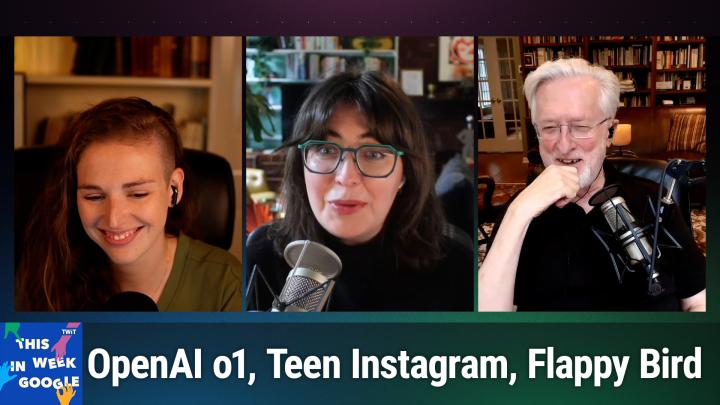
Intelligent Machines (Audio)
TWiG 786: Now That's a Wikifoot - OpenAI o1, Flappy Bird, Instagram for Teens
02:22:19
OpenAI o1, Flappy Bird, Instagram for Teens
Loading summary
Transcript726 lines
- [00:00]
Paris Martineau
It's time for twig. This week in Google. We are down a Leo Laporte and up a Molly White this week. Jeff Jarvis is here and so am I, Paris Martineau. Coming up on the show, we talk about how the kids are doing online, Trump's new cryptocurrency effort, Strawberry, and what's up with Flappy Bird. It's all coming up next on twig. Black Friday week is here and so are amazing deals at Amazon.
- [00:28]
Jeff Jarvis
You'll save so much on early holiday.
- [00:30]
Leo Laporte
Gifts for the home, like vacuums, bedding and home decor. You'll have money left over for that ergonomic recliner to catch up on reading or falling asleep while reading. Or that standy mixer to whip up some holiday cookies.
- [00:46]
Paris Martineau
Oh, what fun it is to save.
- [00:48]
Leo Laporte
Black Friday week is here with deals up to 35%. It's better over here at&t customers. Switching to T Mobile has never been easier. We'll pay off your existing phone and.
- [01:03]
Jeff Jarvis
Give you a new one free, all.
- [01:05]
Leo Laporte
On America's largest 5G network. Visit t mobile.com carrierfreedom to switch today.
- [01:11]
Jeff Jarvis
Pay off up to $650 via virtual.
- [01:13]
Leo Laporte
Prepaid MasterCard in 15 days.
- [01:14]
Jeff Jarvis
Free phone up to $830 via 24 monthly bill credits plus tax, qualifying port.
- [01:18]
Paris Martineau
And trade and service on go 5G.
- [01:19]
Jeff Jarvis
Next and credit required.
- [01:20]
Leo Laporte
Contact us before canceling entire account to continue bill credits or credit stop and.
- [01:23]
Molly White
Balance and required finance agreement is due.
- [01:25]
Leo Laporte
How do you feel when you switch to Geico and save on your car insurance?
- [01:29]
Jeff Jarvis
It's like going to work on one.
- [01:31]
Leo Laporte
Thursday morning and thinking to yourself, just one more day until Friday.
- [01:35]
Jeff Jarvis
But then somebody in the elevator says, happy Friyay.
- [01:39]
Leo Laporte
Then you check your phone quickly and.
- [01:40]
Jeff Jarvis
Discover today is actually Friday.
- [01:43]
Leo Laporte
So yes, Happy Friday, random stranger in the elevator. Happy Friday indeed. Yep, switching and saving with Geico feels just like that. Get more with Geico podcasts you love.
- [01:58]
Paris Martineau
From people you Trust.
- [02:01]
Leo Laporte
This is TWiT.
- [02:07]
Paris Martineau
This is this Week in Google. Episode 786, recorded September 18, 2024. Now that's a WikiFoot. It's time for TWiG this Week in Google, the show where we talk about a lot of things and sometimes Google Leo continues to be out and I, Paris Martineau, am your hostess with the mostest this week. You know who's also here? You may know him as the former director of the T Center for Entrepreneurial Journalism at the New York School of Journalism. At Cooney, it's Jeff Jarvis.
- [02:46]
Jeff Jarvis
Hey, Paris. Hi, boss. Welcome back. Vacation.
- [02:50]
Paris Martineau
Hi. Thank you.
- [02:50]
Jeff Jarvis
Did you Wear your sunscreen.
- [02:52]
Paris Martineau
I did wear sunscreen. I didn't get burnt once, which is actually incredible because I'm very pale. I did get a lot of bug bites and I did pet a lot of Croatian cats. And for that, at least the latter part, I'm thankful. Also joining us is the magnificent Molly White. Hey, Molly, great to have you back.
- [03:12]
Molly White
Thanks for having me.
- [03:14]
Paris Martineau
Molly is best known for her research and coverage of cryptocurrency. She also runs the website web3 is going just great and is a prolific Wikipedia editor. It's great to have you.
- [03:25]
Molly White
Great to be back.
- [03:29]
Paris Martineau
And I guess to kick off the show, we were thinking about playing an AI generated podcast that Jeff has figured out how to make using Notebook lm. But the podcasting gods have stymied us. They will not allow it to.
- [03:44]
Jeff Jarvis
Actually, actually it's because it's going to replace us. And Benito is worried about that. And he's performed a job action by refusing to play the audio. He's acting as if he can't. But I know what's really going on. He's trying to protect his job and his future, and I don't blame him. Next week, I promise. Next week.
- [04:00]
Paris Martineau
Next. The fourth. The fourth box that's going to pop up here is scabby the Rat is going to be podcast instead, I guess. Let's kick off with talking about Google briefly.
- [04:14]
Jeff Jarvis
Wow.
- [04:15]
Paris Martineau
Horrifying. Crazy. On this show just today, Google won, surprisingly, a fight to scrap a 1.7 billion EU antitrust fund fine over ads. Today, Google convinced the European Union court to overturn this huge fine that had been levied against it over Google's advertising practices. The victory comes after Google lost a separate antitrust case in Europe and the U.S. it's kind of interesting. This is like one of the many things going on right now with Google in the antitrust world. In this particular case, the European Commission had applied this fine back in 2019 after they found that Google had used its search engine dominance to kind of impose, like, restrictive contracts that had blocked rivals from selling search ads on websites that Google doesn't own, which is kind of a relatively small market. And on Wednesday, the General Court of the EU upheld that, like most of those findings in the original court case were fair, but that the Commission had wrongly assessed some of the contractual causes it deemed unfair and basically threw it out, which is a small victory for Google. I don't know, Jeff, what do you think about this?
- [05:36]
Jeff Jarvis
I'm confused too. So Google stopped these activities in 2016. So I think it was all Just slap on the wrist afterwards. So I guess it was. Well, we're not. Yeah, you're not supposed to do that. We're not doing it and you're not charging us for it. So next, as Kamala asked, how many.
- [05:55]
Paris Martineau
Millions of dollars do you think people have spent on legal fees for this? It's ridiculous. Or I guess millions of euros because it's Europe.
- [06:04]
Jeff Jarvis
It really is. One story that I put in below is that I didn't know this is that the two champions of antitrust in Europe are leaving. Vestager and Brett Hall.
- [06:16]
Paris Martineau
Oh, wow.
- [06:17]
Jeff Jarvis
Yeah.
- [06:17]
Paris Martineau
So west is huge.
- [06:20]
Jeff Jarvis
Exactly. And so they're both stepping down. And Brato has been tough on Musk and such. So that altogether I don't know whether this bodes anything about European anti technology regulation and legislation. We'll see.
- [06:39]
Paris Martineau
Did it. Did the article that you're mentioning say as to why they're stepping down or just simply retiring or.
- [06:47]
Jeff Jarvis
I think they were just tired.
- [06:49]
Paris Martineau
I mean, yeah, crazy.
- [06:52]
Jeff Jarvis
Slaying dragons is not an easy thing to do.
- [06:56]
Paris Martineau
It's also interesting, I think just before we hopped on to record this show Reuters report, I didn't even have time to put it in the rundown that Google for a different EU Anthony antitrust thing that's going on. Google had offered to sell part of its ad tech business to kind of quash the lawsuit. And this is notable because Google, to my knowledge, hasn't offered to sell any part of its business before. But that wasn't enough. They didn't take the deal.
- [07:26]
Jeff Jarvis
Jeez. Because I'm thinking at some point, I'm curious what you get, what you both think at some point. The break them up hymnal companies will resist that. But there is an argument that companies can get more value out of their stock. And I haven't seen any talk of investors saying, yeah, actually I'd like to own a few Googles. That would be interesting if they did sell off part of the ad business. I would think that would be a good step. I wonder which part.
- [07:56]
Paris Martineau
I think so. This is from an article by Reuters. It says Google took a major step this year to end an EU antitrust investigation with an offer to sell its advertising marketplace adx. But European publishers rejected the proposal as insufficient. It's part of Google's lucrative advertising business. It was attracting regulatory scrutiny last year following a complaint from the European Publishers Council. The European Commission subsequently charged Google with favoring its own advertising services. This is opening its fourth case against Google. Google has never before offered to sell an asset in an antitrust case, according to three lawyers involved in antitrust cases, says Reuters, publishers rejected Google's proposal because they want it to divest more than just Adequs to address conflicts of interest due to its presence in almost all levels of the ad tech supply chain. The people said, they said that the EU's antitrust officer was aware of this offer. It's interesting, Jeff, because to your point, I kind of felt the same thing at first. Like, yeah, maybe investors would want to own like four Googles and three Amazons, but I need to look it up. But I believe the Wall Street Journal's heard on the street column recently, which is kind of like a financial analyst column, had a something on this just this week that said markets are actually reacting negatively to the idea of Google being broken up, which again, seems a little obvious, but I don't know if.
- [09:27]
Jeff Jarvis
It'S to be broken up or just walking through a lot of glass that Google's going to go through a lot of hell coming up. Adx is an important part of the business, the Google Ad Exchange. And to offer to give that up, I think is a fairly big deal. But it's interesting, Paris, I don't know how I've been trying to think of historical cases here where a company preempts antitrust action by settling the first saying, okay, we'll split ourselves up in this way, which is what they tried to do here. So to me, what Google's saying is, okay, we're starting to negotiate.
- [10:11]
Paris Martineau
Yeah. And it's interesting they're starting to negotiate in this way. I mean, I wonder if we'll ever see a world where meta decides like, okay, I'll give up WhatsApp but not Instagram or something like that. I mean, I think they obviously closed the door on that when they, in 2018 or whatever decided to integrate them all to one another so that they kind of cannot be broken up. But it's interesting.
- [10:35]
Jeff Jarvis
Yeah. So there's big Google News actually this week.
- [10:40]
Paris Martineau
Big Google News. Who would have guessed? Talking about it on this week in Google. The other thing that caught my attention, given my kind of new beat focus, which, Molly, for context, I've recently kind of pivoted towards covering online child safety and all these various different bills and legislative efforts to kind of reign in various tech companies relating to kids. And on, I believe yesterday Instagram announced that it was going to be doing a bunch of different changes, like around teenage accounts. And basically what this was is a thinly veiled, direct response to all of the crazy lawsuits and legislative pressure that Meta and all these other social media companies have been facing over the last year and a half from concerned parents and advocates of online child safety. Some of this, as we've talked about before, is kind of a moral panic. But at a certain point it gets to a volume where a company like Medic can't really ignore it. Especially when we're starting to see legislation like COSA move through the Senate and into the House. So yesterday Instagram announced that basically they're rolling out these things called teen accounts. As we all know, it's something like.
- [12:04]
Jeff Jarvis
Huh, sounds like, you know, here's your kids record player.
- [12:09]
Paris Martineau
Where's your baby record player? Instagram for mom.
- [12:13]
Molly White
It's got really big buttons on it.
- [12:15]
Paris Martineau
Yeah, yeah, yeah.
- [12:16]
Jeff Jarvis
It's in orange and pink.
- [12:19]
Paris Martineau
Yeah, yeah. The teen Instagram account will stick to the side of a building so that you can take Instagram reels. Basically what this is supposed to do is right now Instagram says, oh, we don't have any users that are 13 under. We all know that's kind of untrue. Kids lie and you know, put their age as adults on there as well. However, Instagram does say, yeah, we've got child users 13 and older for sure. And right now what this new change is going to do is users that are 13 to 17 are going to automatically have their accounts put in this teen account bucket. That means their accounts won't be public facing, instead they'll be set to private. They will also if they're 16 and it's gonna. Yeah, and if they're 16 and under, they will have a bunch of extra restrictions, you know, in your Instagram reels. Explore Feed, you won't see as much content from people you don't follow. You won't be able to get DM requests from strangers. A lot of these are kind of direct responses. Yeah, I mean a lot of these are direct responses from concerns parents and legislators have had, which is that I've got a 14 year old that gets, you know, 12 messages a day from pedophiles or whatever. But there's also a, I think, kind of funny a part of these, this new update was teen accounts will no longer have notifications from 10pm to like 7am or something like that. And this is specifically. Huh.
- [13:58]
Molly White
Or is that, Is that configurable or does. Is that when Facebook thinks teens should be sleeping?
- [14:03]
Paris Martineau
I think that that's when Facebook thinks teens should be sleeping. But you know what I think this is, I thought this was interesting because. So I did a story a couple Months ago about this new trend in, like, social media litigation. And it is really in vogue right now. And it's both like parents and state's attorneys general, and everybody is trying to come after companies like Meta and whatnot saying, like, oh, you're addicting kids. And they're using this kind of innovative framing for product liability stuff. But one of the suits that is particularly graphic deals with a. I feel like she was maybe like 12 or something, a young child who had an Instagram account who their parent claims, like she got addicted to it and spent all night, every night, up awake, could never sleep, was always checking Instagram. And they were kind of targeting, I guess, the notifications as well as the algorithmic feed. And I thought it was a bit silly when I read it. But it is interesting that litigation like that is resulting in policy changes in companies like this.
- [15:14]
Molly White
Yeah, to some extent. I mean, it. A lot of it, I think, has really sort of concerning implications around, you know, like, how are they doing this age verification? You know, is it teens continuing to self identify? And in that case, are they just going to start self identifying as 18 instead of 16, you know, which seems like the kind of likely outcome there, or are we going to start seeing actual age verification software deployed, which then has very concerning ramifications as far as online privacy and the ability to anonymously, you know, exist online. A lot of it, I think, really does fall into the moral panic end of things where people are saying, you know, this is just the latest thing that is, you know, twisting our children. It's no longer Dungeons and Dragons and rock music, it's Instagram and TikTok. And, you know, to some extent, I always wonder when I see lawsuits like the one that you just explained, where a child is staying up all night scrolling Instagram. It's interesting that the parents decided that that was an Instagram problem versus a parenting problem that needed to be addressed.
- [16:35]
Jeff Jarvis
If I may ask, since I'm gramps here, how old were each of you when you came on to what we would now think of in any broad definition of social media?
- [16:46]
Paris Martineau
I don't know exactly.
- [16:48]
Molly White
I was in high school, I think, when I joined Facebook. I'm trying to think. Yeah, beyond that late college, school or.
- [16:58]
Paris Martineau
Something when I joined Facebook, so.
- [17:02]
Jeff Jarvis
So looking back, do you think that was a fine thing? Do you think that. Who would let me do this? Did your parents freak? Did you. Did you love it and rely on it? Did you find it boring? I'm just curious if you can remember back because it's easier for you to than me. What did you think about social media in your youth?
- [17:21]
Paris Martineau
Well, I do think it's interesting because our generation is probably like the last chopper out of NOM with regards to social media use in a way. Like I used, I remember using Facebook, but it was like the Facebook where you were posting to your Facebook profile or you'd go over to your friend's wall and post there. It wasn't. I was using a browser on my laptop or a desktop computer largely to access social media, which in my day was like mostly like Tumblr or maybe Facebook on the browser. And I remember in high school getting a Twitter account, but again, that was really mostly on the computer. I do think that there's probably smartphone, right?
- [18:06]
Jeff Jarvis
That was all pre smartphones. So.
- [18:07]
Molly White
Yeah, more or less. Or at least it was certainly pre, you know, adolescence having smartphones, if nothing else. Yeah, I mean, when I was around that age, I. My parents did prohibit me to some extent from having like MySpace accounts, which were, you know, that was sort of the precursor at that point. And those, I think there were a lot more sort of those like safety concerns that you might be talking to strangers as a 12 year old.
- [18:36]
Paris Martineau
Whereas definitely talking to strangers as a 12 year old.
- [18:39]
Molly White
Yeah, so was I, but I was on irc.
- [18:42]
Paris Martineau
Yeah, I was on Omegle. It was not good.
- [18:47]
Molly White
But yeah, you know, at the time when I first joined Facebook in high school, it was still the Facebook where you were just friends with your real life friends. It wasn't, you know, every person on earth or strangers trying to add you as a friend. And you're right, it was still the era where people asked if you were online, you know, which I feel like people don't do anymore because everyone's always online. You know, you don't ask, hey, are you on anymore? So there was that disconnect from it. Yeah, yeah.
- [19:17]
Paris Martineau
You're never typing brb because you are always there.
- [19:21]
Molly White
Afk. Yeah.
- [19:24]
Paris Martineau
No, I mean, I think that your point, Molly, is a really good one. And one of the most interesting things I think about this whole online child safety boom in terms of like legislation or even these corporate responses is it is in many ways or most ways a classic moral panic. However, it unlike, you know, the moral. Thank you.
- [19:47]
Molly White
Thank you.
- [19:49]
Jeff Jarvis
I got a bad feeling about this.
- [19:52]
Paris Martineau
Exactly.
- [19:54]
Jeff Jarvis
I do.
- [19:55]
Paris Martineau
It's some classic moral panic. But it's not. I mean, it has taken off at a level I feel like we haven't seen in a while. You know, you didn't see this with D and D. You didn't see this with people freaking out over the crossword back in the day. It is resulting in real legislation on a state and federal level, regardless of whether it's tethered to reality.
- [20:19]
Jeff Jarvis
Which is, which is also part of the. I think, I think the meta action here is that there have been threats in various jurisdictions to forbid people under 18 from having any social media. So which is, which is ridiculous. And I think actually in the US would not succeed in the Supreme Court, but in Australia it could. And so I think this is preemptive as well say, okay, okay uncle, we'll do something.
- [20:43]
Molly White
Yeah. And I think there is some historical precedent for it. I mean the sort of think of the children moral panics do go back a really long time and maybe a good example that would be more comparable in terms of scale is the violent video games panic around sort of the Columbine era, which did ultimately result in some bills at least getting to Congress, if not through Congress. That seems like maybe one of the more recent examples that's perhaps more relevant than Dungeons and Dragons. But yeah, I mean, I think a lot of it just comes down to sort of new scary technology and also the urge to blame something else for really difficult problems in society. You know, I think there, it's really hard to solve the problem of teen mental health, for example, or, you know, teenagers, you know, developing eating disorders or whatever the particular area of concern may be. And it's really easy to just say, oh look, Instagram's showing my kids skinny models. If they would just stop doing that, everything would be fine. When I think in reality it's quite a lot more difficult than that. And in some cases, I think reducing children's access to social media can have the opposite effects in a lot of cases where sometimes that's where kids are going for support or to get information that they can't get access to, you know, because of protective family or you know, where they're living has, you know, school systems that are not doing the kinds of education education that children maybe need. And so, you know, it's worrisome, I think, to see some of those trends towards preventing children from using social media or from using it in specific ways. You know, that, that concerns me a lot.
- [22:39]
Paris Martineau
Yeah, I feel like it's kind of a perfect storm of this like moral panic what you think of the children that you just described. Plus just like general anti tech animus like everyone everywhere is mad at tech companies and social media platforms for something and are trying to find something to sink their teeth in and the kind of Venn diagram of these two issues has really taken off, it seems.
- [23:08]
Molly White
And I think the sort of third circle in the Venn diagram of moral panics around transgender rights and they're turning our kids. You hear people say, you know, as well as access to, you know, we see like book banning around LGBTQ content or content that has to do with racial diversity. And so I think there is this sort of third arm to it as well, where, you know, in a world where people are trying to control children and the types of content that children are able to be exposed to, that's more effective if they don't have access to the wide range of information and material that's available on these platforms.
- [23:57]
Jeff Jarvis
I would be remiss if I didn't plug my book because I just got the hardback.
- [24:01]
Molly White
Nice cover.
- [24:02]
Jeff Jarvis
There it is. Thank you. Which I do go back, and I think you're right, Molly. It goes to violent video games. There were hearings galore about that. Also television. The Surgeon general, just as now the surgeon general is crying panic. The surgeon General was involved and assigned to do things on television and radio before that and Nickelodeons before that. We've gone through this a million times and we never have any sense of media, never have a sense of history about this because they want. This is a good story for them.
- [24:36]
Paris Martineau
I do think there's one aspect of this. Sorry, Jeff, what were you saying?
- [24:40]
Jeff Jarvis
Which Australia is looking. I think line 112 is looking to set a statutory age limit between the ages of 14 and 16 where you just can't use it at all.
- [24:53]
Paris Martineau
Can't use social media at all.
- [24:55]
Jeff Jarvis
That's what they're thinking about.
- [24:56]
Paris Martineau
And I think part of the interesting thing about that is this opens up all of these questions of how are any of these platforms going to determine how old anyone is? Especially if you're talking about like a 14 or 15 year old. They don't have an ID. First of all, I'd hope that you were not having to put your ID into access Facebook to begin with, but how are these companies going to go about doing this? In the case of this new. These new Instagram teen accounts, Meta is hoping to tackle this with AI, which doesn't sit right with me either. This is from a Wall Street Journal article about it earlier. Next year in the U.S. meta plans to use its adult classifier AI model to determine which Instagram account holders are really teens.
- [25:41]
Jeff Jarvis
Oh, what could go wrong?
- [25:43]
Paris Martineau
What could go wrong? The company has already used the model to prevent teens from accessing adult Features on Facebook dating it. Adam Asari was talking to the Journal about this and said it's AI models that predict age aren't perfect, but it's trained on an account's interactions with other users and content, among other signals, to determine whether a person's birthdate is false. Which I think is even more concerning because, I mean, then one, I assume what's probably going to happen because kids are smart is they will figure out how to give off signals that they're 35, maybe posting about taxes or something, but it's just, it seems like a slippery slope.
- [26:29]
Jeff Jarvis
Wall Moss, 77 years old, keeps talking on Facebook about what a swifty he is. What if he gets kicked off?
- [26:37]
Molly White
Meanwhile, when I was like 13 years old editing Wikipedia, I had many people think that I was like a 60 year old man. So there's a lot of problems there. I've also seen proposals for age. There's. I forget what the word is. There's like age verification and age something else that's like the fuzzier version of it. And I've seen proposals for that that involve using facial recognition to try to take a picture of you and determine from that picture if you're above or below the age threshold. And of course that suffers from all of the massive issues around facial recognition technology where it's incredibly inaccurate, especially when you're trying to target really small age ranges, like the difference between a 16 year old and an 18 year old is often spatially different. Racial issues, plus the racial bias, gender bias. It's yeah, just like really not good. And so there are a lot of platforms that are sort of promising to do this sort of less, quote unquote invasive version of these age verification processes and then kick you over to a more, you know, official one where you'd have to submit proof of your age if they can't verify you in the first way or if there's an error. And yeah, it's just like I don't think I want Facebook to have my facial scans or my identification necessarily.
- [28:07]
Paris Martineau
And so it's like I don't want some company out there generally to have a record of my identity paired with the sites and apps I'm trying to access. Right. I went to a conference a couple weeks ago about kind of these various issues like child online safety legislation as well as like online sexual exploitation. And of course, what ended up happening is much of the conference was about moral panic over children having access to pornography online. Kel. Horror. And one big thing, I went in to go sit on an age verification panel. And I was expecting it to talk more about practical solutions relating to, you know, the sort of issues we just talked about. And instead it was all about. It was all about porn verification services. And they went into detail about how the state of Louisiana is doing this because I believe they're one of the states that has a ban on being able to access porn websites unless you're of a certain age. And in that case they have a third party service or app provider that if you want to access a porn site, you have to go in, upload your id, they give you a, you know, a string, and then you have to put that string in the porn website. It's like, I don't. Nobody wants any of that.
- [29:29]
Jeff Jarvis
Well, the UK is going to do the same thing, the online safety. I can see a story here popping up Paris, because I think if you look at what's happening there, it's not just protecting children, it's that anyone who wants porn, as in Louisiana, will have to do it. And the privacy violations, this is going to violate privacy legislation all over the creation.
- [29:54]
Molly White
Yeah. And now you have this huge database of every person who has access to porn website. And if we know one thing about databases of personal information, it's that they leak like crazy. And so I feel like it's just a matter of time before there's the first scandal around that too.
- [30:10]
Paris Martineau
Absolutely. Among all this, the. A House panel advanced the Kids Online Safety act today, getting it one step closer to maybe coming up to a vote in the House, which is a bit concerning. This is a bill that has had a lot of pushback from online privacy experts and, you know, concerned people on the Internet generally. But that has made it through the Senate already and moved to the House because of concern from these advocacy groups and, you know, general moral panic. It's got bipartisan support going into the House too, which is a bit concerning.
- [30:54]
Jeff Jarvis
And what you were saying before, Molly, it's. It's where it's really damaging is the right is going to use this to go after trans rights.
- [31:01]
Molly White
Right.
- [31:02]
Jeff Jarvis
And that's going to be.
- [31:03]
Molly White
And anything else really that they decide that is unacceptable. You know, abortion information, even access to information about racial justice or climate change or whatever it is. I mean, you can really weaponize a bill like this to target content relating to anything you want. And you know, with the right makeup in the FTC or, you know, whichever enforcer, it could be a really major issue, I think. And it's one of those things that it has this really benign name who doesn't want kids to be safe online. But then when you actually look at the details of the bill, you realize that this is really something quite different.
- [31:47]
Paris Martineau
Yeah.
- [31:48]
Jeff Jarvis
Yeah.
- [31:49]
Paris Martineau
I guess. While we're on the subject, there was this article in the Wall Street Journal this week that I thought was kind of interesting. There have been all these different bills going in states around the nation to ban smartphone uses in schools. And I feel like it's fairly uncontroversial up to a level. I can understand why you wouldn't have a kid want to have a kid looking at their smartphone, you know, in the middle of their US History exam or whatever. However, there's now been kind of a bit of a movement on that where parents are trying to ban children from accessing all screens in schools, including their Chromebooks that they use to access textbooks or iPads that they use for in school assignments. And I thought this was just honestly screaming.
- [32:35]
Jeff Jarvis
I hadn't seen it. Interesting rundown. I'm screaming about this.
- [32:38]
Paris Martineau
It's baffling.
- [32:40]
Jeff Jarvis
This is lite.
- [32:41]
Paris Martineau
This is just ridiculous, Quite literally. Parents told the Wall Street Journal reporter that teachers and principals say a lot of classroom instruction consists of interactive games and can't be turned into worksheets. Not all schools purchase physical textbooks anymore. Many only offer them as ebooks. Shocking. Still, five parents told this reporter they've switched their kid to private or charter schools, which still use a pen and paper as a result. It is something.
- [33:10]
Jeff Jarvis
Screen demonization. Yeah, sorry about that.
- [33:13]
Molly White
It's just such a. Like, when you look, when you think about that and the sort of obvious ramifications of that, you end up with, like, now you have kids who don't know how to use technology responsibly. Like, I feel like one of the most important things that we can be doing in this day and age as far as educating younger people, is teaching them how to be responsible technology users and how to, you know, vet information that they're accessing to, you know, use technology in a way that is productive and helpful to them and potentially even, you know, part of a future career. And so now we're saying, okay, kids can't have smartphones. They can't have Chromebooks in their schools, they can't use social media. Like, now we're just going to end up with a bunch of people who are sort of unleashed on the Internet at age 18 without any real understanding of how things work or how to navigate those waters, when it's, at this point, a crucial life skill.
- [34:14]
Jeff Jarvis
It's the amishization of American education. Right. As if that somehow is preferable and beneficial. It's just ridiculous. This is going to sound like it's really off target, but I've been just freaked about the Lebanon story and the pagers, and you have this weird thing happening there now where all kinds of things are exploding. It's awful. It's terroristic to my view, because of the panic that's going on now. Legitimate panic. But what it means is people are not using any technology. They were using their pagers and then they were told no use walkie talkies, and then walkie talkies exploded. And my wife just told me that solar panels exploded, and so solar panels exploded. That's what she said. I hadn't seen the story. She was just telling me. Maybe it was something on Twitter. But other technologies are exploding. So you really get to a weird thing going on here of technology puritanism or Luddism or Amishism or something for very, very different causes. But technology just suddenly is going to be made to look dangerous in all kinds of ways.
- [35:35]
Paris Martineau
God, what a nightmare. Some of the videos coming out of that are just haunting.
- [35:40]
Jeff Jarvis
It's a technology story for sure, too. It's, geez, how they managed to do it and trigger it and everything else, but. Yeah. So we're going into an interesting time. And I come out just the right time to write a book about why the Internet is a good thing, why technology is okay.
- [36:01]
Molly White
At least you have paper versions and not just ebooks.
- [36:05]
Jeff Jarvis
Yeah, but these things are converging against technology as the bugaboo of society.
- [36:14]
Paris Martineau
All right, we'll get back to this in a minute. Let's throw to our good old friend Leo for a bit of an ad break.
- [36:21]
Leo Laporte
Hey, let me interrupt just a moment. I know I'm on vacation, but I had to come back to tell you about Veeam. Veeam is the solution. If you hear every day it's in the headlines, these companies ransomware. Sometimes they even pay the ransomware ransom just to get their data back. They're not using Veeam. Without your data, your customers trust turns to digital dust. I wrote a little poem. That's why Veeam's data protection and ransomware recovery ensures that you can secure and restore your enterprise data wherever and whenever you need it. No matter what happens. They're the number one leader globally in digital resilience. In fact, V AM. V AM is trusted by over 77% of the Fortune 500 to keep their businesses running when digital disruptions like ransomware strike. You know, What? You know what happens the other 23%. You hear about them on security now or you read about them in the headlines. They didn't have Veeam. Veeam lets you back up and recover your data instantly across your entire cloud ecosystem. With Veeam, you can proactively detect malicious activity. So maybe you don't get bit at all. Right. You can remove the guesswork by automating your recovery plans and policies so, you know, you'll feel safe, you'll sleep at night. Get real time support from ransomware recovery experts should the worst happen. Data is the lifeblood of your business. Don't, don't risk it. Get data resilient with Veeam V double E A m. Go to veeam.com to learn more. Veeam.com we thank him so much for the support of this week. Google now back to the show.
- [38:00]
Paris Martineau
All right, we are back. Molly, I wanted to ask you a bit. What? Tell us about what happened this week with Trump's rolling out of his new cryptocurrency business, a subject that I chose for my mental health to stay far away from until just this moment.
- [38:18]
Jeff Jarvis
You listen. We don't have to. Molly.
- [38:21]
Molly White
Yeah. I'm sorry to ruin your blissful ignorance, I suppose. Yeah. So Trump and his family, you know, Donald, but also the younger Trumps, have decided to embrace a crypto project that is ostensibly a decentralized finance project. The details on it are somewhat scant as far as what the project will actually do. It sounds like it will be some sort of crypto borrowing and lending platform, but they have certainly been promoting it very heavily on Twitter and in the news and elsewhere. Some of the most interesting things about it are the people behind the project, which stems from an earlier crypto project that was called DOE Finance, which I covered on Web three is going just great because it was hacked for about $2 million very shortly after it was launched. Whoopsie daisy. And some of the people behind the project are sort of odd characters themselves. One of them ran a pickup artist advice website, which is like, lovely. Yeah. For those who are lucky enough not to know what pickup artistry is, it's basically like how to make women love.
- [39:42]
Paris Martineau
You, how to scam those weak females. Yeah, exactly. By using Tricks of the Mind.
- [39:48]
Jeff Jarvis
INCEL meets crypto Perfect.
- [39:51]
Molly White
Yeah. It's a great crossover right there. So very sort of odd group of people behind it, beyond just the Trumps. And then, you know, they've. They've been promoting it. They had this live stream on Twitter a couple Nights ago. That was this interview between a crypto bro. He was like, I'm a proud crypto bro. I was like, you're so brave. But, you know, this like, crypto guy who is very starstruck to be around Trump and made the interview kind of unpleasant to listen to. I think because of it, he was just sort of like agape at the Trump presence. And, you know, ostensibly they were supposed to launch the crypto project. Most of the talk was just about the recent attempt on Trump's life and then the subsequent man with the gun in the bushes at the golf course and sort of recounting the story is there, but they did eventually get around to talking about crypto very broadly. Trump didn't really go into any details about the project. He just talked about how his kids convinced him to, like, cryptocurrency.
- [40:59]
Paris Martineau
Trump famously said on the livestream, crypto is one of those things we have to do whether we like it or not, I have to do it. Which is, you know, resounding show of support.
- [41:10]
Molly White
Right. Yeah. He's had other comments like that that make me think maybe he's really not the crypto fan that a lot of the crypto world wants him to be. He, when he was doing the Bitcoin 2024 conference, he signed off with have fun with your crypto and all the other things you're playing with, which.
- [41:28]
Paris Martineau
Okay, actually, I love that.
- [41:30]
Jeff Jarvis
I love that.
- [41:30]
Molly White
Yeah, that was actually a very good. That was a very good line, I thought.
- [41:34]
Jeff Jarvis
I think I heard he bragged that Baron has three wallets.
- [41:39]
Molly White
Oh, yeah, wallets.
- [41:40]
Paris Martineau
He says Trump said he's got four wallets or something. He knows this stuff inside out.
- [41:49]
Molly White
Yeah. The 18 year old Baron has been described as the defy visionary behind the project, which I think should be cause for concern, especially given that it's like.
- [42:00]
Paris Martineau
Third week at nyu. He could be a defy visionary over there.
- [42:04]
Molly White
Yeah. Well, and there have also been all these rumors that Barron was tied to various other Trump themed projects. Although a lot of those rumors are coming out of people like Martin Shkreli, the pharma bro. So not the most reliable narrator, but the whole thing is really just kind of a mess. I think the Trumps have been trying to play it up with a lot of talking points that really feel like a flashback to about four years ago when people were still really starry eyed about the potential for blockchains to fix the financial system and, you know, democratize finance and all of this stuff they have talked about. Apparently the Trumps are now Concerned about equitable access to financial services, which is kind of a new development. But you know, without any real reflection on the shortcomings of crypto to actually provide the types of financial services that some people truly do have trouble accessing. The Trump family was talking about how this would provide access to credit for those who have challenges getting credit, which, yeah, like, definitely no predatory credit schemes out there that this could be joining. But beyond that, when you look at loans in the crypto world, people tend to forget that they are what's called over collateralized loans, which means that you have to have more assets than you're borrowing in order to take out the loan. So if you have like.
- [43:33]
Jeff Jarvis
Hold on that for a second. Is that, Is that because. That's just because crypto bros. Don't trust anybody or.
- [43:39]
Molly White
Exactly.
- [43:40]
Jeff Jarvis
Oh, okay.
- [43:40]
Molly White
Yeah. If you're anonymously borrowing something, then unless you put up more, you know, if you. Unless you put more at risk than you're borrowing, you would just run away with the money.
- [43:51]
Jeff Jarvis
So how do you collaborate if you're anonymous?
- [43:54]
Molly White
You basically put up Bitcoin or some, you know, assets that you have. You put those, you lock those up as collateral for the loan and then you borrow less of some other asset. It's primarily used by people who have, say, a whole bunch of Bitcoin that they don't want to sell. They just want to have access to like, US dollar liquidity and then they'll return it and they don't have to take the gains on their crypto or whatever it might be.
- [44:20]
Paris Martineau
But, Molly, Bitcoin is the future. Why would they need petty cash?
- [44:24]
Molly White
Yeah, that's a great question. It's just the slow real world that isn't accepting Bitcoin for the purchases they want to make, I suppose. But yeah, so like, when you look at loans in that sense, that's really not the type of credit that people who have trouble accessing credit need. Right. It's not that they need to have liquidity because they have all of these assets that they can't liquidate. It's that they don't have the assets and they need to take a loan to go to college or buy a house or whatever it is. And so this project really doesn't offer that to people, but that's really how it's being sold by the Trump family at this point, which is really a great start, I think, for this project.
- [45:07]
Jeff Jarvis
Do they have a brand for it?
- [45:09]
Molly White
Yeah, it's called World Liberty Financial. The worst thing is that it hasn't really launched yet there isn't really a product that you can use. But about two weeks ago, two of the Trump family Twitter accounts were hacked to promote a website that was supposedly this project. It had a domain that was similar to the product name. It had a fake token that was not associated with the Trump family in any way. They tweeted out this advertisement for it and a whole bunch of people bought the token. I think at least $1.8 million lost to this scam. But right now, because there is no product and there is no real website for World Liberty Financial, as of yesterday at least, I haven't checked recently. But if you Google World Liberty Financial because you read it in a headline in the New York Times or you saw the Twitter space or something, one of the first page results is this scam website. And so there is like, there's nothing there yet except for a scam. And, you know, I'm very concerned that a bunch of people are just buying this token that's showing up in Google because they want to get in on the Trump project because it was so poorly planned and there is no web presence really at this stage.
- [46:27]
Jeff Jarvis
So two questions. First, did he, did he push the Trump NFTs and playing cards?
- [46:35]
Molly White
Yeah, he's been pushing those heavily, just in general. But he, yeah, he directly cited the NFT project as something that convinced him that crypto was worthwhile, probably because he profited millions of dollars from it.
- [46:49]
Jeff Jarvis
So, so here's here. That leads to my next question, which is how old do you imagine that this could be? Grift that Trump can take money off the top of this and make money from it?
- [47:04]
Molly White
Well, I mean, there are a lot of ways, but they get a substantial number of the tokens that are associated with this project are or will be associated with this project. They haven' launched yet are allocated to insiders. And so there's a potential profit to be made there. As far as the borrowing and lending process, there's typically fees that go to the operators of the protocol in that case, or, you know, they sort of skim off the top there. And then, you know, as far as other potential problems, I mean, we've seen projects like this get hacked and exploited repeatedly. We know that this project stems from the same code base that was hacked very shortly after its launch and not in like a clever way. And like, oh, you know, North Korea's best hackers found an exploit in this project that no one could have thought of. It was like very simple, rookie mistake type of exploit. So I think there is the Concern as well that, you know, people who are holding collateral on this platform while they do whatever it is that they want to do with the loan that they've taken out could lose access to that if there is a big hack or some sort of theft.
- [48:23]
Jeff Jarvis
Looks like we got a website now, too.
- [48:26]
Paris Martineau
Is that the right one?
- [48:28]
Jeff Jarvis
Is this the scam website?
- [48:30]
Molly White
That might be the scam website. What's the URL? It's liberty worldlibertyfinance.org Yep, I think that's the scam Bonito.
- [48:39]
Paris Martineau
You got got?
- [48:40]
Jeff Jarvis
I got got.
- [48:42]
Molly White
Is it promoting a Solana token? I can't really see the.
- [48:45]
Jeff Jarvis
He already bought the token. Token Trade WL.
- [48:48]
Molly White
Yep, that's the scam website.
- [48:51]
Paris Martineau
200 grand.
- [48:52]
Molly White
Wow.
- [48:52]
Jeff Jarvis
Yeah. Cheese bonito.
- [48:54]
Molly White
Yeah. But like, as you can see on that website, like, it looks relatively official. It's using the same branding that the Trump family has been throwing around. So, yeah, like I said, I think there are probably a lot of people who are probably falling for this scam website because, again, they have not responsibly launched this project in a way that would avoid the type of very.
- [49:18]
Jeff Jarvis
Sorry.
- [49:19]
Molly White
Well, right, but like, that would avoid the type of very predictable things that happen in the crypto world, you know, day in and day out.
- [49:30]
Jeff Jarvis
So, Molly, how long have you been covering crypto now?
- [49:34]
Molly White
Oh, man, three years, Something like that.
- [49:40]
Paris Martineau
Feels like a lifetime.
- [49:41]
Molly White
Yeah, it feels like it too.
- [49:43]
Jeff Jarvis
So, well, I guess one question is, is there a point at which you say, I think I'm going to go cover restaurants. But the second question is, have you seen. It's just not in the news as much as it used to be. It's just not around and it's more of a laughing stock. And what's the cultural zeitgeist around cryptoland?
- [50:06]
Molly White
Yeah, Well, I guess to the first question, I'm still not sick of it. I like covering it. I find it to be a useful sort of microcosm of a lot of the issues that exist in the tech world. And so it fascinates me from that point as well as just sort of the. The types of things that happen in the crypto world are so often stranger than fiction. And you don't get that everywhere, I would say. And so that keeps me entertained pretty. Pretty well. But, yeah, as far as the sort of zeitgeist in the crypto world, it's funny because you're right that you don't hear about crypto very much. It tends to be the butt of the joke a lot of the time. But I think a Lot of people in the crypto world genuinely do not know that there has been. Yes, yes.
- [50:59]
Jeff Jarvis
Cognitive dissonance powers. They have.
- [51:02]
Molly White
So there has been a lot of crypto attention circuit circling around the election this year. And many people in the crypto world have actually very much convinced themselves that crypto is a major election issue, that people care so much about crypto that they will be supporting pro crypto candidates and folks who are sort of adopting friendlier stances towards the crypto industry. And when you tell them that people don't actually feel that positively about crypto, it's like kind of a shock, I think, to a lot of them. They genuinely believe that this is like a major voter issue in the upcoming election. They've commissioned all these polls to try to convince other people of that, including potential candidates for office, which they've had some success with, I think. But the polls themselves are incredibly misleading. And when you actually dig into the data, it often prove the opposite of the points that they're trying to make. But crypto has sort of enveloped itself in this weird bubble where they are still the center of the universe, I think, to a lot of those people.
- [52:16]
Jeff Jarvis
So I just pulled up. I just. I just googled crypto polls. I see a grayscale. They hired Harris, and Harris does all kinds of crap stuff, right? I think all polls are bad. I think all polls are to be ignored. So I don't you think we shouldn't.
- [52:30]
Paris Martineau
Ask anyone anything ever, I think, because.
- [52:33]
Jeff Jarvis
It reveals more about us than about them. So Harris does this crap for hire. Nearly one in three American voters say that spot bitcoin ETF approval has made them more interested in investing in bitcoin or crypto. What?
- [52:47]
Paris Martineau
What?
- [52:48]
Molly White
Right. Like normal people read these things and they go, are you kidding me? Like, they know their friends are not talking their ear off about Bitcoin ETFs. Yeah, no, and I've. I've written about the. I wrote about the grayscale poll. I wrote about a recent poll that the Paradigm Crypto venture capital firm did about Democratic voters supposedly embracing crypto. When you dig into them, the quote, you know, the polls are designed in such a way to encourage responses that are so vague that they can be twisted in these poll summaries to suggest a strong support for crypto. So they'll ask people things like, have you ever held cryptocurrency? And then they will take that group of people and describe them as crypto holders, even though they don't ask how many of those people sold their crypto or lost their crypto or had their crypto taken from them. Then they'll ask questions around, are you concerned about inflation or do you care about financial privacy? Or the Paradigm poll even had one that was like, do you worry about the government having access to your financial information if you were to seek reproductive care? Or something like that? And so they ask these very open ended questions that don't even mention crypto. And then they say, look, all of these people care so much about financial privacy. Crypto is such a big voter issue in the upcoming election. Even though they never ask, do you think that crypto is a viable path forward for financial privacy or anything like that. They also, you know, the recent Paradigm poll said something about how Congress people are following the will of their constituents by embracing crypto. And then you look at the numbers and like 75% of respondents don't think crypto is a positive thing. And so you're like, wait, who's, which constituents are we talking about? Because it sounds like they're going against their constituents if they're embracing crypto. But there's just a lot of this, like, massaging of numbers and really misleading summarization that goes into it.
- [55:00]
Paris Martineau
Interesting.
- [55:01]
Molly White
And then of course, the numbers get, get repeated by congresspeople because people love numbers and they just sort of accept them as hard truth, even if they're really faulty.
- [55:11]
Paris Martineau
What, what are like the, what's the end game of crypto advocates right now? Because there was a time when it was like cryptocurrency is going to replace fiat. Cryptocurrency will be how you pay for everything. But now, obviously, the way people use crypto and make money off crypto is just like speculative gambling or as a kind of a stock, a pseudo stock. What is their end game?
- [55:37]
Molly White
Well, there are still people who believe that, that crypto will become the future of currency. It's always been a fairly fringe belief and I think it's growing even more fringe. But I think there are a lot of people in the crypto industry who just want to see crypto embraced into the traditional financial system and sort of foisted upon people in ways that they haven't been able to, which I think is why they've been so heavily involved in these elections, is they're really trying to get friendly legislation passed. They feel like they can't do the types of things that they want to do. They can't offer the products they want to offer because of an sec, the securities and Exchange Commission, that has cracked down on some of the more blatant unregistered securities offerings that are happening in the crypto world. And so they see buying Congress people and sort of stacking Congress with crypto friendly candidates as the path forward to legitimize the types of crypto industry companies that are operating in the United States. I don't think that most spokespeople at Coinbase would say that crypto is going to be the next US Dollar, it's going to replace the US Dollar. But they do think that crypto has a major place in the financial system and they want to make sure that that happens however they can.
- [57:05]
Paris Martineau
Well, one area where crypto is clearly exerting quite a bit of influence is the realm of Flappy Bird. You know, people who had phones 10 years ago might recall the Flappy Bird craze. And as we may as you may know, if you played Flappy Bird for a while, you could play it for a bit. It was quite hot and then the crater took it down because he was worried about people being too addicted. Well, last week there was a sudden announcement that Flappy Bird is back. It's going to have a bunch of new characters and game modes. However, it seems that this new version of Flappy Bird, this is what Ars Technica writes, has been wrestled from its creator by Crypto Bros. The creator of Flappy Bird tweeted, no, I have not. I'm not related with their game. I didn't sell anything. I don't support crypto. Molly, have you been following this at all? Do you know?
- [58:07]
Molly White
I have been.
- [58:08]
Paris Martineau
It ended up in the hands of.
- [58:10]
Molly White
The Crypto Bros. Yeah, so the creator of Flappy Bird held the trademark for Flappy Bird, but the crypto company that decided they wanted to create this game was able to convince the courts basically that this trademark was inactive. And so they were able to basically re register it because it was no longer in active use. The reason that the creator mentioned something about no, I didn't sell anything is because a lot of people were speculating that he had sold the trademark to this company and then they had gone and created this game. Does not seem like that's the case. It doesn't seem like the original creator has been compensated at all for the project. And they've certainly been very strongly implying that he's behind it, that this is a relaunch of the original game versus a clone of the original game. They mentioned working with the predecessor of the game at some point. There's some speculation that, well, technically they.
- [59:20]
Paris Martineau
Worked with him because they he had.
- [59:22]
Molly White
The lawsuit Well, I think it actually has to do with the fact that there were. So this is old history, but around the time Flappy Bird came out, there were allegations that the Flappy Bird creator had actually ripped off a different game and has sort of created a clone of a different game. And it sounds like they might be working with the creators of that game. And so that's sort of, I think, what they mean when they say working with the predecessor. But of course, everyone thinks that no one, no one knows that. Everyone thinks they're talking about this other guy who seems very unhappy to be associated with this project at all.
- [60:00]
Paris Martineau
The Flappy Bird foundation said in its announcement that it's committed to preserving Flappy Bird IP and expanding the legacy of Flappy Bird, the organization. This is from Ars Technica. Social Media promises the game is 100% free to play and always will be, while linking to a playable version on Telegram of all play.
- [60:23]
Molly White
Yeah, it's taking advantage of a recent craze with Telegram, which are these games that are built on the Telegram blockchain. And it's the mechanic through which you play them is it's called Tap to Earn and it's very sort of cookie clicker esque. Speaking of sort of old games where you literally just like mash the screen and it gives you points. And so I think that was kind of a natural segue into Flappy Bird where you just tap the screen to make your bird go up and down. And so they realized. Right, exactly, yes. And so, you know, that's where this is coming from. But I think it's really just the next step in the long legacy of blockchain games being incredibly unfun to play. You just have to mash. You know, there's one that the big game that really kicked a lot of this off was called Hamster Combat. And you just like, you literally just like mash the screen. There is very little in terms of actual gameplay, but people were getting really sucked into it.
- [61:33]
Paris Martineau
Michael Roberts, who's listed in the press release as the chief creative behind Flappy Birds Return, is also head of studio for a group called 1208 Productions. The main crypto related project, writes aristechnica on the 1208 production site, is a set of NFTs based around the Deez Nuts brand. The website for that project also lists Robert Burt's AKA Papa Nut as a partner of the Doge pound NFT project. Truly cursed.
- [62:08]
Jeff Jarvis
I want to say.
- [62:08]
Molly White
I did not know there was a Deez Nuts brand.
- [62:11]
Jeff Jarvis
Yeah, exactly.
- [62:15]
Paris Martineau
There's always another brand, unfortunately.
- [62:18]
Molly White
Oh, God. I made the mistake of Googling that they're literally just like anthropomorphic testicles.
- [62:25]
Paris Martineau
Yep. No, it's nothing even. Even somewhat creative. It's exactly what you'd expect.
- [62:33]
Jeff Jarvis
Men.
- [62:34]
Paris Martineau
Men, I suppose. Moving on to a different kind of thank you scam. The former CEO of Movie Pass pled guilty this week to securities fraud conspiracy. Taking a plea deal. If you recall, Movie Pass was the business where you could pay9.95amonth to get unlimited access to movies. The chief executive pleaded guilty to securities fraud in which he admitted fault to conspiring to inflate the price of Movie Movie Pass's stock by lying about the fact that its business could be profitable, basically. Which, surprise, surprise, this just stood out to me because I think MoviePass is a great example of how utterly, I guess, twisted in the head investors can get when it comes to assessing businesses viability. When you say the right words, there's no world in which someone should look at something like MoviePass and be like, yeah, that's going to work at scale the map.
- [63:44]
Molly White
Yeah. Well, you thought you were getting away from the crypto and web3 thing with this story, but there was actually. I do have a Movie Pass entry and Web3 is going just great from February 2022 when they announced that Movie Pass was going to be back and you could earn cryptocurrency by watching ads while they tracked your eyeballs. So they certainly tried to give that.
- [64:08]
Leo Laporte
A go as well.
- [64:10]
Molly White
Yeah, yeah.
- [64:11]
Jeff Jarvis
Is there a crucial angle to the Fyre festival?
- [64:16]
Molly White
There have been. I mean, there have been projects that have been very strongly compared to the Fyre festival. I'm not sure if the Fyre festival themselves had a crypto angle.
- [64:28]
Paris Martineau
Isn't the Fyre Festival coming back supposedly?
- [64:31]
Jeff Jarvis
That's why. That's why I asked. It's like saying that MoviePass will come back. It's like saying the Fyre Festival will come back.
- [64:37]
Paris Martineau
I've been joking that the information should send me to Fyre Fest 2.0. Oh, I think so. On the ground coverage. I could do a live stream in for Twitch.
- [64:46]
Jeff Jarvis
Take a lot of peanut butter with you so you have something to eat.
- [64:48]
Paris Martineau
I will. I'll take a bunch of rations that I'll be fine.
- [64:51]
Molly White
Yeah, get some of those, like emergency rations. I bet you could sell them online. I could.
- [64:56]
Paris Martineau
You know, that could be the future of currency.
- [64:58]
Jeff Jarvis
Have your own raft you go in on, you know.
- [65:01]
Paris Martineau
Yeah.
- [65:01]
Molly White
I do think though that the guy, the Fyre Fest guy, after he got out of jail, did try to get into like a Metaverse project or something like that. So he's certainly interested.
- [65:14]
Jeff Jarvis
I've got another question for you. Your expertise, Molly. Sbf. Does the crypto world say, oh, he got robbed, he got railroaded, or do they say, oh, we don't.
- [65:27]
Molly White
Who?
- [65:27]
Jeff Jarvis
SB who?
- [65:28]
Molly White
Yeah. No, he is not beloved among the cryptocurrency world. They think he ruined crypto's reputation. A lot of them lost money because of him, either because they had money on FTX or they lost it in related collapses. So he is not a hero in the crypto world by any stretch.
- [65:49]
Jeff Jarvis
Thanks.
- [65:51]
Paris Martineau
What's that I hear? It's the dulcet tones of Leo laporte calling for another ad break. We'll see you shortly.
- [65:59]
Leo Laporte
Can I interrupt just for a minute to tell you about Bit Warden? Love, you know me, I'll tell. I will buttonhole people in the street to tell them about Bitwarden. Everybody who has passwords in their lives, who. Who doesn't, right, needs Bit Warden. Even passkeys, because Bitwarden does pass keys better than anybody. Bit Warden is the open source password manager that gives a cost effective solution that could dramatically improve your chances of staying safe online. Now Bit Warden's going to. They've announced their fifth annual Open Source Security Summit. They're going to be there. It's coming up September 26th, just a couple of weeks. This year's headline speakers include security analyst Karen Elizari, journalist, author Kim Zetter, NFL CISO Thomas Maldonado. He's got a big job, doesn't he? Register@bitwarden.com open source-security summit dashes between all of them. Bitwarden.com open source security summit Learn about the future of open source security solutions. And you know something? The holidays are quickly approaching. You're going to be online shopping. You've got family members who are still reusing passwords. The same old password with their mother's maiden name and their dog's birthday. Stop the insanity. Protect them. Protect yourself. Bit Warden has announced the expansion of inline autofill capabilities. This is in their browser extension of Bit Warden, which is really good. It now does more than just passwords. It has cards and identities, which is great. When you're shopping, you'll auto fill your addresses, your cards. It makes it so much easier to shop. This enhancement though, benefits everybody. It means you're going to have a more secure interaction with web forms for payment details, because it checks to see that it's a legit form as well and will not let you fill in a phishing site. Okay, really important. So payment details, contact info, addresses, all of that is protected. Bitwarden it's the best. It empowers enterprises, developers and people like me, individuals to safely store and share sensitive data with a transparent, open source approach to password management. Nobody does it better than Bitwarden. They make it easy for users to extend robust security practices to all their online experiences. I keep my passports, my driver's license, my Social Security number, everything in Bitwarden because it's safe. It's safe and you need it. And I know you're probably already using it. But if your fan friends and family aren't, tell them about it. And if your boss isn't, if your business isn't, you will love Bit Warden's teams or enterprise plan. In fact, you get a free trial if you go to bitwarden.com twit and of course, as always, because it's open source, Bitwarden is free forever for individuals. And that includes unlimited passwords, devices, pass keys, hardware keys, the works. Everything free forever. I give. I. I'm a premium member. I pay 10 bucks a year because I love them, I support them, I want them to succeed. They're the best. Bitwarden.com TWIT please tell your friends, tell your family, and if you're not using Bit Warden, you start using it too. Bitwarden.com Twitter we thank them so much for all they do for us on this week in Google. On with the show.
- [69:18]
Paris Martineau
The New York Times had an interesting story this week on the mushrooming security apparatus around Elon Musk that I thought was very interesting. And to give you guys a warning, I say we talk about this and then I want to throw to a story that maybe you think is interesting. Jeff or Molly, if there's anything you want to talk about as well. But so this story specifically goes into how, as Elon Musk has become the gargantuan figure that looms large in all of our lives today, both negative and positive threats to his personal safety have also increased, the Times writes. His security team now operates like a mini secret service, and he is guarded more like a head of state than a business executive. Musk, who was once flanked by two bodyguards, now travels with as many as 20 security professionals who show up to research escape routes or clear a room before he enters. They carry guns and have medical professionals in tow. For Mr. Musk, who has been codenamed Voyager by his security team, the threats to his safety of lead must become more fearful and his lifestyle more isolated. He is rarely without bodyguards, even when he went to the bathroom at X, According to a 2023 lawsuit filed by former employees over severance pay. It is kind of interesting. This article goes into a lot of interesting details about just how isolated his life has become, which I think probably informs a bit of the state of mind we see day to day. This is a quote from actually even kind of long ago, almost like a decade ago. It began like. Bodyguards often ran errands for Musk and paid his expenses to minimize the time he spent in public. They washed his car, picked up his dry cleaning, once tipped a bartender 80 in London for keeping the bar open after hours. They also brought sombreros and fireworks for a 2015 New Year's Eve celebration for Musk.
- [71:26]
Jeff Jarvis
He has no friends.
- [71:27]
Paris Martineau
He has no friends. Well, actually, Jeff, he might have some friends. Many people trying to reach Mr. Musk were innocuous. Documents and recordings of phone calls obtained by the Times show one woman left a two minute voicemail several years ago at one of Musk's companies, referring, to him as, quote, daddy Musk and claiming they had spoken telepathically for the last year. Quote, I can't wait for you to propose to me in outer space on our station, she said. And worst of all, the growing security has limited Musk's movements. At Burning man, the annual outdoor Nevada art and music festival. He mostly stays close to his camp.
- [72:06]
Molly White
Oh, I feel like that's how you know Burning man has really gone corporate is. If Elon Musk is there.
- [72:14]
Paris Martineau
If Elon Musk is there and he can't leave his camp with his 20 bodyguards because he feels too freaked out, then you know that Burning man has truly died.
- [72:25]
Jeff Jarvis
It's the modern Howard Hughes. He said this week that he thinks now people can be on Mars in four years. And somebody on the socials said, you know, you go, Elon. And somebody else said he's probably dependent upon certain substances and doesn't want to be gone that long.
- [72:44]
Paris Martineau
Yeah, I mean, the Journal has reported about his drug use. It's going to be. I mean, I suppose if you can get a rocket to Mars, you could probably load it with all the things you'd need for a long period of time.
- [72:55]
Molly White
Yeah, I think he should give it a shot. For sure.
- [72:58]
Jeff Jarvis
I do think he should give it a shot.
- [72:59]
Paris Martineau
I think it could be fun.
- [73:01]
Molly White
We should really be firing more billionaires into space, if you ask me.
- [73:05]
Paris Martineau
I do think so.
- [73:06]
Jeff Jarvis
So the guy who did the air quote, spacewalk is from my town.
- [73:11]
Paris Martineau
Oh, which one is this?
- [73:13]
Jeff Jarvis
You know that we just last week that the. What's it called?
- [73:16]
Paris Martineau
So Many Billionaires are going to space. Jeff, I stopped paying attention after like the first five didn't blow up.
- [73:21]
Molly White
Aren't some billionaires trying to go in a submarine again too? Yes, I think I saw something about that. Yeah.
- [73:28]
Paris Martineau
With who? Is it the James Cameron submarine or is it another less tin can?
- [73:34]
Molly White
I don't know. Yeah, yeah, I don't know.
- [73:36]
Paris Martineau
I've been fascinated by watching the Ocean Gate investigation that is unfurling. They've got that photo of the submersible shell cracked open on the seafloor. That's quite haunting. Yeah, that was a hell of a week. We all just. It was there wondering. It. It really is the sort of news experience I don't think we get much anymore where it's like 247 coverage of something that's actually happening and we're all kind of interested in it because I feel like when we have that happen nowadays, it's just kind of depressing. It's like a war or something.
- [74:12]
Jeff Jarvis
You knew. You knew they were dead.
- [74:15]
Paris Martineau
Well, yeah, but. But the Coast Guard was reporting like hearing a knocking sound and. Oh yeah, I remember that CNN had an oxygen countdown clock. It was exciting.
- [74:29]
Molly White
Yeah. It reminds me of when the first big boat got stuck in the canal where it was like everyone was sort of united by following this. This incident that generally didn't have that much in the way of like actual repercussions. I mean, it screwed up supply chains and things like that. But it wasn't like, you know, war and death or anything like that. It was kind of nice.
- [74:53]
Paris Martineau
Yeah, we need more neutral, good world defense.
- [75:01]
Molly White
Well, if they start firing people into.
- [75:03]
Paris Martineau
Space, that could be good. Listen, I remember watching when they did. When they did the Jeff Bezos rocket launch, the first one. I was sat on my couch watching it with the.
- [75:15]
Molly White
With his cowboy hat.
- [75:17]
Paris Martineau
With his cowboy hats. You know, we had pre writes for. If it went well, if it went terribly. And I was finger on the button for both of them.
- [75:27]
Jeff Jarvis
Did you have.
- [75:28]
Molly White
That's one where you don't want to. You don't want to press the wrong button on that one.
- [75:32]
Paris Martineau
Yeah.
- [75:33]
Jeff Jarvis
So you had. You had a hold for release obit for him.
- [75:36]
Paris Martineau
I mean, yeah, we had a. The. You have a hold for release obit for every famous person, but we definitely had one. If something goes wrong in space, we can have a something's gone wrong in space briefing.
- [75:49]
Molly White
That's.
- [75:49]
Jeff Jarvis
That's the new Silicon Valley status symbol. Are you important enough for the Information to have an obit ready for you.
- [75:57]
Paris Martineau
That's a great question. Yeah, that's a great. You know, that could be the new.
- [76:01]
Jeff Jarvis
Subscription tier, but Jason thinks he has one. I'm hoping he doesn't because I hope he lives.
- [76:06]
Paris Martineau
No comment. All right, Jeff.
- [76:10]
Molly White
I hope I never reach that stage personally. If there's ever a pre written obit for me. I think I need to move into the woods.
- [76:19]
Paris Martineau
Yeah. No one needs to know. If I die, I should just rot into the forest floor, ideally.
- [76:25]
Jeff Jarvis
Well, you see, I always thought that the one fringe benefit you get from having worked in journalism is that you get no bit in the place where you worked. But I'm out living the newspapers where I worked.
- [76:33]
Paris Martineau
So you don't think NJ.com is gonna have a glorious little obit for you?
- [76:38]
Jeff Jarvis
I doubt it. No. They charge you for it? No.
- [76:40]
Paris Martineau
That's pretty sad.
- [76:42]
Jeff Jarvis
Yeah. The San Francisco exam.
- [76:43]
Paris Martineau
Molly, Jeff is the creator of NJ.com, new Jersey's foremost website.
- [76:50]
Molly White
Quite a legacy.
- [76:52]
Jeff Jarvis
People blame me for that. Yeah.
- [76:54]
Paris Martineau
People blame you for that.
- [76:56]
Jeff Jarvis
Oh, yeah. Oh yeah. They get pissed.
- [76:58]
Paris Martineau
They get pissed that New Jersey has a website now.
- [77:02]
Jeff Jarvis
They don't like the website.
- [77:03]
Paris Martineau
That's fair.
- [77:04]
Jeff Jarvis
Yeah. Yeah.
- [77:06]
Paris Martineau
Jeff, what do you want to talk about? Give me a story.
- [77:09]
Jeff Jarvis
Well, we could go. We could go actual tech news like OpenAI and Strawberry. Or we could go wacky stuff. What do you want?
- [77:16]
Paris Martineau
You know what my choice will be. You've got to make a decision.
- [77:19]
Jeff Jarvis
All right. All right. So I want to mention this before we go too far. I think it's worth noting that Craig Newmark has pledged $100 million, line 125, to boost US cybersecurity.
- [77:30]
Paris Martineau
That's great. Friend of the show.
- [77:32]
Jeff Jarvis
Craig is a friend of the show. We should mention that. All right, here's the weird one. Elizabeth McCafferty was offered six thousand pounds for images of her bare feet when they appeared on a fetish website without her consent.
- [77:47]
Paris Martineau
What?
- [77:48]
Jeff Jarvis
Line one.
- [77:49]
Molly White
Wait, what do you mean she was. What do you mean she was offered then? Was this like a settlement?
- [77:56]
Jeff Jarvis
No, they wanted more.
- [77:59]
Molly White
Who is to take it down like a ransom?
- [78:01]
Jeff Jarvis
I guess she's an actress. I don't even know.
- [78:03]
Paris Martineau
Oh, she's a journalist. She's a journalist?
- [78:06]
Jeff Jarvis
Yes. So she ended up finding herself on WikiFeet. Don't look that up either, Molly.
- [78:13]
Molly White
I am unfortunately already very familiar.
- [78:18]
Paris Martineau
Yeah, we know WikiFeet.
- [78:19]
Jeff Jarvis
You do?
- [78:21]
Paris Martineau
Of course. Oh, oh, here, I'll read from the article she wrote Even My own feet. Elizabeth McCafferty writes have made it to the Kink website WikiFeet, a platform where anyone even remotely in the public eye has pictures of their feet. Ranked, the platform gets close to 20 million views per month and is run by volunteers in the foot fetish community. In 2017, it's wonderful.
- [78:47]
Jeff Jarvis
Selfless. Yes.
- [78:49]
Paris Martineau
In 2017, I was flooded with panic after finding that for years, images of my feet had been taken off my social media and put into a rating scale within the Wikifeet website. Oh, did I ever write about my experience with this?
- [79:04]
Jeff Jarvis
Hold on. Oh, no. Oh, do tell, Paris.
- [79:09]
Paris Martineau
Let me see. Did I write about it? I'm trying to think. I don't know if I did. I definitely wrote it in a cover letter for the outline. One time I was working on a story about, I don't know, something Internet culture related, and then I got. Someone started liking a bunch of my Instagram posts, like 10 in a row, kind of creep behavior. And so I looked at it and it was a account that was, I guess, like a foot fetish account. But the last 20 photos on it were all cropped photos of my feet from my Instagram post or my younger sister's feet from her Instagram posts. And so I think I was procrastinating doing on some other deadline. So I was like, this should be a reporting experience. So I reached out to the guy. I was like, hey, why the f. Do you have photos of my feet and my sister's feet on this? And he was like, oh, I thought they were attractive in a whole back and forth. He was like, you know, I'm just a humble foot fetishist collecting photos that I think are interesting.
- [80:13]
Molly White
I have to say that is true commitment to journalism, Reaching out to this.
- [80:17]
Paris Martineau
Guy, you know, and then we talked a bit and he was like, yeah.
- [80:20]
Molly White
You know, I kind of.
- [80:21]
Paris Martineau
I was like, walk me through how you got to me and my sister. And he had some actually involved answer. I feel like I did either report in this. If not, I just put a lot of effort into writing about this for a cover letter for the outline as an example of Internet culture, kind of guerrilla journalism. But yeah, the feet guys are everywhere is my. It's true takeaway.
- [80:45]
Molly White
I actually. So I've been aware of wiki feet for quite some time. Most Wikimedians end up knowing about it somehow. And I am very cautious about posting photos and making sure that my feet are not.
- [81:01]
Paris Martineau
Oh, same.
- [81:02]
Molly White
Because you can never be too careful.
- [81:07]
Jeff Jarvis
Wow. I didn't know where that would go.
- [81:11]
Paris Martineau
You don't appear to be On Wiki feet. Molly.
- [81:14]
Molly White
I am so happy to hear that.
- [81:16]
Paris Martineau
There'S a different Molly White, but it's Molly Peyton White, who appears to be a model.
- [81:20]
Molly White
Is it the fitness influencer?
- [81:21]
Paris Martineau
Yeah, I would assume. Yeah. Jeff, maybe you're on WikiFeet. Are there any photos of your feet?
- [81:30]
Jeff Jarvis
No, there's. No. My thighs have not seen sunlight since 1970.
- [81:35]
Molly White
You have to be careful. It's easy to accidentally take a picture of your feet when you're, you know.
- [81:39]
Paris Martineau
Just imagine you're wearing, you know, sandals and someone posts a photo of you, full body wearing jeans. That's a wiki foot.
- [81:48]
Molly White
Or, like, if I'm taking a photo of, like, my dog sitting right next to me, it's easy to get your feet in the photo. You gotta move your feet and make sure they.
- [81:57]
Jeff Jarvis
This is what the world comes to us. Jesus. Yeah.
- [82:03]
Paris Martineau
No, this is a constant online joke where people will post, you know, a cute photo of them in a friend group and someone's wearing sandals, and so they put an emoji over the feet and say, no, free feet pics. Yeah. So I assume this woman got paid for her feet pics, which.
- [82:19]
Jeff Jarvis
Well, she got offered.
- [82:20]
Paris Martineau
Well, did she take the money?
- [82:22]
Jeff Jarvis
That's what I forgot.
- [82:23]
Paris Martineau
£6,000. Listen, that's a. For feedbacks. That's probably better than she's getting paid for four artists.
- [82:31]
Molly White
Yeah. That's pretty compelling, I have to say.
- [82:34]
Jeff Jarvis
Well, I think.
- [82:36]
Paris Martineau
What do you think about this as someone. Did you know of WikiFeet before this?
- [82:40]
Jeff Jarvis
No, I did not. I'm not surprised, the Internet being the Internet. I mean, people find their water level. That's kind of a male privilege thing. Because I know about WikiFeet only because a lot of women I know have told me about it because of. Because they're also the same as you guys, like, very cautious about putting feet on the Internet.
- [83:00]
Molly White
Like. Yes. It's like the two things I'm careful about is, like, not taking photos of, like, physically identifiable surroundings that someone could, like, geolocate me, like that guy on TikTok, and then not posting pictures of my feet.
- [83:15]
Paris Martineau
Yes. This is something I think about often, where I'm like, oh, man, there's a grocery store near me that, like, little fruit cups they sell have a really funny advertising slogan on them for the local grocery shop. And I want to post it because I could make a really good joke on it, but I can't because it's a grocery store near me, and I.
- [83:33]
Molly White
Know that really local.
- [83:35]
Paris Martineau
If I ever wanted to find somebody that's the sort of thing that I would use to help figure out what neighborhood they live in. So I can't post that on the Internet.
- [83:44]
Molly White
Yeah.
- [83:44]
Jeff Jarvis
For a long time I wouldn't say what town I was in, but then it just got out there enough that I was just in Jersey. That's all. It's like being in Brooklyn. It's big enough.
- [83:52]
Paris Martineau
It's true. Wow. I didn't think that that's what you were going to pick when you said.
- [83:57]
Jeff Jarvis
What do you think I was gonna pick?
- [83:59]
Paris Martineau
I don't know. Something else, I think with the feral 25 year olds making Kamala Harris go viral on TikTok, which.
- [84:07]
Jeff Jarvis
Which. Which they are doing and they are weird that. That they would be called feral.
- [84:13]
Paris Martineau
Do you have an understanding of how that word's being used in this context, Jeff?
- [84:19]
Jeff Jarvis
I think it's self described. Is that they're kind of.
- [84:23]
Paris Martineau
They rabid. I feel like it's an Internet description.
- [84:26]
Molly White
Goblin mode.
- [84:27]
Jeff Jarvis
Yeah, it's Wild West. It's the new Wild West. One of the.
- [84:31]
Paris Martineau
Jeff, does the phrase goblin mode mean anything to you?
- [84:34]
Jeff Jarvis
No.
- [84:36]
Paris Martineau
It's kind of like feral or Wild west, honestly. But it's a bit more debased.
- [84:41]
Jeff Jarvis
Okay. All right. I feel so old. I feel so left. So pathetic. The person who used to be the governor of New Jersey's social person went to the White House. I don't know whether she's one of them or not. I couldn't quite tell. They do a great job. But what's fascinating about this is TikTok's about to get banned. In the appeal that they had this week, it did not go well for TikTok at all.
- [85:09]
Paris Martineau
Yes. But I mean, I feel like that's kind of assumed. I assume that it's not going to go well for them. They will get banned. They'll appeal it, try and get an injunction, and then this will be appealed up to the Supreme Court and then we'll eventually have to deal with whether or not TikTok is banned in like 2 years.
- [85:29]
Jeff Jarvis
I wonder whether there's enough. Whether Kamala Harris finds enough benefit if she wins. Knock wood. Sorry, political statement, but I'm going to make it. And TikTok had benefit. Does that change the political reality around TikTok?
- [85:47]
Molly White
I mean, both campaigns are using it. I feel like they're both benefiting from it. But whether or not that's enough to override the other moral panic that's happening around China is a different question.
- [86:02]
Paris Martineau
Yeah, I think it's also a question of like, yes, both Campaigns are using it. Kamala Harris's case. The Harris campaign is seeing a lot of traction on TikTok, but the sort of users that are sharing these posts, many of them are under 18, and the ones that aren't are like 18 to 30. And those people don't really vote. So I guess the question is, like, would this be a useful tool in motivating people who typically don't turn out to turn out? And that remains to be seen.
- [86:36]
Molly White
I mean, it certainly seems like a good strategy to try to convince those people to come out and vote. You know, if you have a captive audience who likes your memes, you know, it might be easier to convince them to come vote for you.
- [86:52]
Jeff Jarvis
So I still want TikTok to stick around. My fear is that it will go through. It'll get bought by somebody bad, like Musk, like Mnuchin, who's talked about buying it, and we end up with a second Musk.
- [87:06]
Paris Martineau
Yeah, that would be unfortunate.
- [87:08]
Jeff Jarvis
It would be. I saw this week, too. I didn't. I didn't put a story in. Mark Cuban said that he would buy TikTok. I mean, by Twitter, in a flash.
- [87:18]
Molly White
Well, I think he said if he had enough money for it, which he doesn't. So it wasn't really a serious offer.
- [87:24]
Jeff Jarvis
It's pretty cheap.
- [87:25]
Molly White
It might be bargain ban at this point.
- [87:28]
Paris Martineau
Yeah.
- [87:28]
Jeff Jarvis
And I think he could probably get some funders for it. I can't believe it. But I would welcome Mark Cuban as my new master.
- [87:37]
Molly White
Yeah, I mean, I feel like we're at this stage where we need to stop deciding which billionaire we want controlling the social networks and instead maybe try something different. There are certainly less awful billionaires, but perhaps there's a better way.
- [87:54]
Jeff Jarvis
Well, here's the really sad story along that line on this show, Leo has talked up for a long, long time about the wonders of the Fediverse and the wonders of Mastodon and how we should support them and how wonderful they are. I don't know if you saw that Mozilla, which was doing a really good job of a principled presence on Mastodon, just announced they're going to shut it down.
- [88:13]
Molly White
Yeah, they're shutting down their Mastodon instance, which is. Wait, who is a shame? Mozilla.
- [88:19]
Paris Martineau
Oh.
- [88:20]
Jeff Jarvis
Which is really sad. But given the. The antitrust case with Google probably taking money out of Mozilla, they're going to have to cut whatever they have.
- [88:31]
Molly White
So, yeah, it didn't strike me as a choice. That was because, like, the Fediverse is losing momentum or anything like that. It seems like perhaps there are external factors at play there because there's certainly a lot of interest in the Fediverse from large platform. I mean, Threads and Meta have been investing in Metaverse projects. We've seen news outlets like the Verge getting involved. And so it definitely.
- [88:57]
Jeff Jarvis
There's also a change of administration at Mozilla.
- [89:01]
Molly White
Yeah, yeah. So, you know, I don't see it as at least necessarily a bad sign for the, for the Fediverse. But yeah, it is disappointing to see it go out that way.
- [89:10]
Jeff Jarvis
I have a couple pages in the book quoting them, praising them for the, for their principles, that they came about how to do speech there and that they were going to moderate and we're going to tell you we're moderating and this is how we're doing it. And I think it was a really good model and then boop gone.
- [89:25]
Molly White
The dangers of writing about such a quickly changing medium as the web.
- [89:33]
Paris Martineau
True, true. Have Molly, do you use an iPhone or an Android?
- [89:40]
Molly White
I use an Android.
- [89:42]
Paris Martineau
The only iPhone user here. Benito, do you use an iPhone or an Android?
- [89:47]
Jeff Jarvis
I'm on iPhone. Yeah.
- [89:48]
Paris Martineau
Did you update to the latest iOS?
- [89:52]
Jeff Jarvis
I don't know if my phone did it for me, then yes, but I don't know.
- [89:56]
Paris Martineau
I did thinking other people would because I wanted to use. Basically Apple rolled out a new iOS upgrade and in my opinion, the only real notable thing about it is that it added a bunch of interesting messaging capabilities that I don't. I assume that Android has this just because I assume that everything new we get in the iPhone, Android already has. But it's stuff like you can italicize words in your text or react to a text with a emoji. But of course, after I updated I realized that you cannot receive. I cannot send that to people until They've updated to iOS.
- [90:33]
Molly White
Yeah.
- [90:34]
Paris Martineau
So it's never going to be useful for me.
- [90:37]
Molly White
Well, and you get a weird cross platform issues too, like where if you're texting with someone on an, who's using an Apple device and they edit their text message, you just get a text, a new text message that says like so and so has edited their text message to say this and it's like this really clunky, weird.
- [90:55]
Paris Martineau
Yeah.
- [90:55]
Molly White
Not interoperable. Yeah, exactly. Or you know, reactions show up weird as well.
- [91:01]
Paris Martineau
But it's also interesting because I mean this update again didn't fix like the green bubble, like problem.
- [91:09]
Jeff Jarvis
Right.
- [91:09]
Paris Martineau
Apple had said that they were going to work for compatibility.
- [91:16]
Jeff Jarvis
How hard is that to fix every bubble?
- [91:18]
Paris Martineau
It's not color, technically it's not hard. It's just a big selling point for Apple frankly. The reason why, I mean I hear this when I talk to like teenage or younger users. The reason why people want iPhones from a young age is they don't want to pay a green bubble. This was even part of I think their advertising campaign for a bit. But due to EU regulations and different stuff like that, Apple's being forced to change. But they haven't done it yet.
- [91:47]
Molly White
I've because I've always used an Android. I just like don't even think of this as a thing that anyone notices. Like my bubbles are all the same colors so I don't really care. But it is very funny that that is sort of a status symbol type of thing. But I wonder to what extent people are using like how many do young people text or do they use other messengers?
- [92:11]
Paris Martineau
I think that is actually a good question. I think a lot of so happy.
- [92:14]
Jeff Jarvis
Hearing you ask about young people. So happy what are the other people?
- [92:19]
Paris Martineau
I do think use other messengers. I don't think they're out there texting, which is interesting.
- [92:24]
Molly White
Yeah, that's always sort of been my impression too. And like even I use text with like a couple of people but I feel like most of my messaging these days happens signal and so what's happening on, you know, with text messages is sort of a foreign world to me to some extent.
- [92:40]
Paris Martineau
Yeah. I mean part of the issue is that right now if you're an iPhone user and you're putting a group chat with Android users, it defaults the messaging for everybody to sms. And this is part of the reason why like photos going between iPhones and Androids are messed up and there's just a bunch of issues with it and Apple, this is from the Washington Post, they say like what changed iOS 18 is that Apple has stitched its messages app with you know, a global update to SMS knows known as rcs. Now while now you see text message in your chat box while you're messaging with Android friends with iOS 18 you'll see RCS most of the time. That shows everyone in your chat has some but not all the capabilities of purely Internet net based chat apps like WhatsApp and Washington Post says that I guess with this new update their tests showed that RCS did a better job exchanging messages that include photos and gifs and videos which is huge. And they say what's still not so good is there's still some limits to rcs. The Google message apps for instance for Android phones is based on rcs. Too. And it does let you schedule messages to anyone, no matter the device. In most cases, your message might not go out if your phone is turned off and disconnected from Internet services, but that's a fair trade. Apple won't let you schedule messages in the new thing to people who don't have Apple devices, which I think is just petty.
- [94:25]
Jeff Jarvis
Snobs. They're snobs.
- [94:26]
Paris Martineau
They also the biggest problem is that Apple didn't fix the security and privacy compromises anytime your chat involved at least one Android user, which is dumb as well.
- [94:38]
Molly White
I tried to do some quick research into whether youths text. It sounds like it's kind of a mix, but that a lot of them use Instagram, DMS and Discord and Snapchat.
- [94:54]
Paris Martineau
I was about to say Snapchat is.
- [94:55]
Molly White
Also big around still.
- [94:57]
Paris Martineau
The youths love Snapchat.
- [94:59]
Molly White
I remember Snapchat was big when I was in. I don't know if it was. It might have been college. It would have been college because I don't think I had a smartphone until college, but I thought it had sort of died. But maybe it's just I outgrew it.
- [95:15]
Paris Martineau
It's really big as. Yeah, a messing up. It's also for a lot of young people, I mean. Yeah, just the default way they communicate. This became a really big issue when Snap, I think a year or so ago had introduced this feature. It was something like. Called like the Snap solar system or something like that where essentially it was a screen that would show a solar system of your friends and connections. And this was a problem for kids because you know, if you think. If I think Jeff is my best friend and I see in my solar system that Jeff's planet is the closest to me. And then I look at Jeff's and he has 20 people who are close to him and I'm not even on there, then you feel like a loser.
- [95:58]
Molly White
And it became my spaces top friends list all over again.
- [96:03]
Paris Martineau
But it's automated.
- [96:04]
Molly White
Time is a flat circle. Yeah, that's true. Yeah. You can't do the thing where like if your friend pisses you off, you like passive aggressively remove them from your top friends list.
- [96:14]
Jeff Jarvis
Not that you really.
- [96:16]
Paris Martineau
Oh, never. Never. Yeah. But everything goes back to itself. Speaking of Discord, Discord is launched and is launching end to end encrypted voice and video chats, which I guess is useful for all those teens who are out there using Discord.
- [96:34]
Molly White
It's also end to end encrypted text chats.
- [96:40]
Paris Martineau
It says Discord Audio and video calls inside the platform will now Be end to end encrypted.
- [96:48]
Molly White
It sounds like. Not text chats though. I'm just.
- [96:51]
Paris Martineau
Yeah, it sounds like voice. Video, Voice channels. Yeah, I don't think it's text. Private messages, on the other hand, will not be end to end encrypted. And he says safety is entwined to their product and policies. While audio and video will be end to end, encrypted messages on Discord will continue. I don't follow our content moderation approach.
- [97:11]
Molly White
Yeah, the low hanging fruit would be the text messages.
- [97:14]
Jeff Jarvis
Yeah.
- [97:15]
Paris Martineau
I think it's because Discord is in the crosshairs of regulators for a lot of different issues in part like relating to content moderation. They've come under scrutiny, I guess from like sexual exploitation ending groups around facilitating sex trafficking.
- [97:35]
Jeff Jarvis
Videos.
- [97:36]
Molly White
Yeah, I feel like video, it's definitely not good. Yeah, I mean, I think it's good to.
- [97:42]
Paris Martineau
Oh, I think it's good, but it's not good.
- [97:44]
Jeff Jarvis
But that's not.
- [97:45]
Molly White
Yeah, there the way that this article says that the quote from this article is safety is intertwined with our product and policies. While audio and video will be end to end, encrypted messages on Discord will continue to follow our content moderation approach and are not end to end encrypted. Which is such a weird way of saying it. Like they're basically saying that they have chosen to abandon content moderation in audio and video and encrypt it, but that they want to be able to spy on your direct messages so that they can do the content moderation.
- [98:21]
Jeff Jarvis
Like, I don't understand the view. Molly, is the more cynical view that if the bad guys all encrypt photos and videos, then nothing we can do about it. We don't know why. No, nothing.
- [98:31]
Molly White
But then why not do text messages too?
- [98:34]
Jeff Jarvis
Because all they're in trouble for is images, I guess.
- [98:40]
Molly White
Is that right though?
- [98:40]
Paris Martineau
Yeah.
- [98:41]
Jeff Jarvis
Yeah. Well, I think pretty much. If we're talking about, you know, child porn and stuff like that, then it's going to be images that get you in trouble. So the really cynical.
- [98:49]
Molly White
Yeah, but I was.
- [98:50]
Jeff Jarvis
They'll just keep the cops off their back that way.
- [98:52]
Molly White
Yeah. I feel like a lot of the conversation though is about like grooming and sort of the types of conversations that lead up to photos.
- [99:00]
Paris Martineau
But yeah, perhaps that is interesting. I wonder what. Huh?
- [99:08]
Jeff Jarvis
Well, now you can share photos of your feet in security.
- [99:12]
Paris Martineau
That is finally, finally a place for my feet. Jeff, what's going on with AI?
- [99:20]
Jeff Jarvis
All right. Well, there's a lot you don't say. Strawberry came out, which is OI or 01.
- [99:27]
Paris Martineau
I've been having strawberries for years.
- [99:29]
Jeff Jarvis
Yes, it gives me rashes, but that's all right. And we really can't play with it much yet. What's interesting about it is that OpenAI insists that this is about reasoning, that it can reason and oh my God, it's closer to AGI, which is bs. I don't believe any of that crap. What it does is simply, as far as I can understand it, take a problem and parse it into pieces. And it takes longer and it takes a lot more computer power to do that. But in doing so, they say it can solve these complex problems and it shows you. Supposedly it shows you the steps it takes, but it doesn't actually show you the steps it takes. There's another AI that interprets what's behind the scenes and presents that to you. And folks are trying to hack behind that and find the actual steps that it takes. And they're being sent cease and desist, stop this or we're going to take away your account emails. Because OpenAI doesn't want people to see this and they're arguing it's about safety or competition or whatever. But I think that we would start to learn more about what's going on if they had more transparency about how things operate. I think that would be not bad thing. But it's not real transparency. It's open IOA bull. What amuses me about it is that you have the yin yang immoral panic going on where the one hand, oh my God, they can do more. They can do biological weapons and that kind of stuff. And then you have other people who are saying all that's just marketing. Shush. There's nothing going on here. So I, you know, it's. Right now it's a fair amount of smoke and we'll see how real it is when people can actually use it. At great measure. It's released. It's not going to be released for free for a while. They do a light version. That's the Strawberry news.
- [101:12]
Paris Martineau
Interesting. I have questions which I will ask after this ad break this episode.
- [101:19]
Leo Laporte
Oh, hi. Oh, hi. I thought I'd stop by because I think you need help. Better help.
- [101:24]
Jeff Jarvis
Haha.
- [101:25]
Leo Laporte
Get it. See what I did there? Better help. Our sponsor for this portion of this week in Google, what is something you would love to learn? Gardening. A new language? I want to learn carpentry. Or maybe how to finally beat your best friend in bowling. You know, everybody's got different goals, right? As an adult, do you make Time to learn new things as often as you like. Or did you completely lose that in childhood? You know, you just. Most of us, we got our head down day to day, we're just grinding, we're just trying to make it. Kids are always learning, they're always growing. But as adults, you know, life gets in the way. That's why I'm a big believer in therapy. You see, it's not just people sometimes say, oh, I don't need therapy, I'm fine. Therapy isn't about fixing you. Therapy is about helping you have the best possible life. It can help you reconnect with your sense of wonder. Because your back to school era can come at any age. I am such a big believer. I see my therapist every week. Not because I'm crazy, not because I got problems, because I want to live a richer, better life. You can too. And BetterHelp makes it affordable, convenient and easy. If you're thinking of starting therapy or maybe you say, no, that's not for me. But it's because it's too much work, it's too expensive. You got to give BetterHelp a try. It's completely online, which makes it very convenient. My son loves that. My son just said, oh, yeah, this way, wherever I am, because he's always traveling. So I just, I can talk to my therapist every week. Designed to be convenient, flexible, suited to your schedule. Just fill out a brief questionnaire, a little simple thing just to get you matched with the right therapist. But important. And I really underscore this, if your therapist is in a perfect match, they will let you change at no charge. You can shop around until you find exactly the right person. No additional charge. This is done right. Rediscover your curiosity, get the gusto, the zest, the fun. Back in your life. Be happy with BetterHelp. Am I not allowed to say that? Well, I'm going to say it. Betterhelp.com twig Go there today, get 10% off your first month. It's very affordable, very convenient, and it works. It's really all about getting a better life. BetterHelp H E L P.com twig betterhelp.com twig you gotta check it out. And I thank you for much so much for your support, BetterHelp and for helping me lead the life I want to lead. I don't want to leave, but I have to. I'm.
- [103:55]
Jeff Jarvis
It's.
- [103:56]
Leo Laporte
We gotta. We gotta get on the boat and sail off into the sunset. Twigs, take it over. Come back. I'll be back next week. Go.
- [104:07]
Paris Martineau
So my question with Strawberry and what you just said is, how are people trying to figure out what's going on behind the scenes?
- [104:15]
Jeff Jarvis
I'm not exactly sure how they're hacking it, but they're asking it to do things and they're getting told to stop by opening.
- [104:23]
Paris Martineau
I like that.
- [104:25]
Jeff Jarvis
Let's see here. What was it? Line 84. The information. I've heard of that reports why OpenAI is hiding its reasoning models, thoughts. So the blog post, they announced that it uses an internal chain of thought. And there's an example here, by the way, I should give you, which is what was called the Tom Cruise problem, that if you asked ChatGPT before who is Tom Cruise's mother? It would say Mary Lee Pfeiffer. But if you turned around and said, who is Mary Lee Pfeiffer's son? It got befuddled and smoke came out of its ears. Didn't know what to do. Now it can answer that. So clearly near human intelligence, right?
- [105:14]
Paris Martineau
Yeah, that's what we needed.
- [105:17]
Jeff Jarvis
Exactly.
- [105:18]
Molly White
We couldn't just consult a reference work for this information, I guess.
- [105:24]
Jeff Jarvis
No, we need to ruin the environment to answer that question. Yeah, a million times. So the letter O1 model shows a model generated summary of the chain of thought. That's what they call chain of thought. And by the way, anthropomorphization. It doesn't think, which implies that its thoughts are rewritten by a different model altogether before the customer sees them. OpenAI said it decided to keep the raw chain of thought hidden primarily because that would allow its employees, and only its employees to read the mind of the model to understand how it operates. OpenAI said it didn't want the model's unfiltered thinking to be shown because it might contain unsafe thoughts, and that the company wants to monitor the model to make sure it's not being treacherous, such as manipulating the customer like, oh, it's so powerful. We got to make sure we're all the ones from this.
- [106:20]
Paris Martineau
I hate when my models are treacherous.
- [106:22]
Jeff Jarvis
Yeah, exactly. OpenAI didn't hide the fact that another factor in its decision was a competitive advantage. And the information, the ever nice information, said that that's understandable. I think.
- [106:38]
Molly White
That does seem like it's probably the real reason, though.
- [106:41]
Jeff Jarvis
Yeah. Yeah. But I also, I think it's, I think it's also pr. It's not that, you know, Google is going to figure out how to do this. Google knows how to do this. I'm sure it's more of, oh, this is how it operates. Oh, that looks stupid. Oh, that's how it does things. And I think that smart reporters would come in and learn more. So where was it Here?
- [107:06]
Paris Martineau
Some developers have said they are annoyed by the hidden chain of thought because they could get billed for something they can't see. OpenAI charges developers based on how many tokens, words or parts of words models process and spit out in the form of answers. That's kind of interesting.
- [107:20]
Jeff Jarvis
It is.
- [107:21]
Paris Martineau
You can't see the bill of sale.
- [107:23]
Jeff Jarvis
Right. You don't know what it's doing, you know, is it. Is the cab driver going on the lie to get to Kennedy when they should go on the south, whatever, you know.
- [107:34]
Paris Martineau
Well, your cab driver is probably going to take a really long route so that you don't have to go over a bridge, Jeff.
- [107:39]
Jeff Jarvis
That's true.
- [107:41]
Paris Martineau
That's true.
- [107:43]
Jeff Jarvis
So that's Strawberry. Other AI News. I think this is. I found this interesting in the regulatory realm. Gavin Newsom signed, I think, three bills, three bills into law this week that limiting and causing enforcement of disinformation and election disinformation, particularly out of AI. However, at the same time, he expressed some concern about the big AI bill that is awaiting his signature that we're not sure he's going to sign that I hope he doesn't sign personally. That would make model makers responsible for everything anybody ever figures out what how to do with these machines, which I think is foolishness. But it's another moral panic about AI.
- [108:34]
Molly White
No, no, no, no, no, no, no, no, no, no.
- [108:36]
Jeff Jarvis
That's a new one. I didn't see that one before.
- [108:40]
Paris Martineau
Where did that one come from?
- [108:41]
Jeff Jarvis
There's a bunch of them.
- [108:42]
Molly White
I like that. I like. Yeah, I like that. You've had to create multiple versions of this.
- [108:49]
Paris Martineau
That, Molly, is also a photo of Jeff from when he was one of the 100 most eligible bachelors in San Francisco.
- [108:55]
Molly White
Oh, my God.
- [108:57]
Jeff Jarvis
Very important. It was later. I was grown up by then. You want to see? That was from the launch of Entertainment Weekly.
- [109:04]
Paris Martineau
Yeah. Wait, do you have more?
- [109:10]
Leo Laporte
I'm getting too old for this.
- [109:15]
Molly White
Very good. That's a strong one.
- [109:19]
Paris Martineau
That's a really good one. Why have we not been bursting this out?
- [109:23]
Jeff Jarvis
Yeah. Jeez.
- [109:26]
Paris Martineau
Wow.
- [109:27]
Jeff Jarvis
Give credit where credits do. Who has made those bonito? Probably Anthony. I think. Anthony. I think Anthony did. Yeah, I think so. Wow. So the AI Bill is driving a wedge through Silicon Valley. Some are for it, some are against it. We'll see what happens. But that's now hanging there.
- [109:45]
Paris Martineau
It is interesting because it seemed like Newsom was definitely Going to sign it before. And now it's been up in the air.
- [109:51]
Jeff Jarvis
No, not so sure. I don't think. I think he was giving mixed signals. Very newsome of him.
- [109:59]
Paris Martineau
Yes.
- [110:01]
Jeff Jarvis
And then there's this. If we want to panic about something, Larry Ellison declares that Oracle is your all in one AI mass surveillance tool. And that society is going to be a lot better because Larry's going to look over everything you do.
- [110:18]
Paris Martineau
Finally.
- [110:18]
Molly White
Didn't he just move up in the billionaire rankings? I feel like I saw Deseeded Bezos. Yeah.
- [110:26]
Jeff Jarvis
Really?
- [110:26]
Paris Martineau
He's number two now.
- [110:28]
Jeff Jarvis
No. You're kidding me.
- [110:30]
Paris Martineau
Yeah. I saw this because people were tweeting. What does Oracle do?
- [110:34]
Molly White
What does Oracle do?
- [110:35]
Paris Martineau
Yeah.
- [110:36]
Molly White
Nobody knows.
- [110:38]
Paris Martineau
No one knows. Well, this.
- [110:40]
Molly White
They sell AI Now. All right.
- [110:43]
Paris Martineau
Of course they all sell AI now.
- [110:45]
Jeff Jarvis
He's the. He's the retail planeteer.
- [110:48]
Paris Martineau
AI is hot and databases are not, he said, making Oracles part of the puzzle. Seemingly less sexy, but no less important. At least according to the man himself.
- [111:02]
Jeff Jarvis
He's so awful.
- [111:03]
Paris Martineau
That's rough. Well, you know, it's a lovely company up there in the top three billionaires.
- [111:09]
Jeff Jarvis
And the way he's putting it is that he's going to supervise the police. Every. Every police officer is going to be supervised at all times. If there's a problem, AI will report that problem to the appropriate person. Yes, sure, citizens will be on there, but very well. Citizens will be on their best behavior because we're constantly recording and reporting. Ellison said. He's saying he's going to police the police. He's the one who's going to police the police.
- [111:32]
Paris Martineau
And he's going to be the Robocop.
- [111:35]
Molly White
Finally.
- [111:37]
Jeff Jarvis
Yeah.
- [111:37]
Molly White
Oh, my God.
- [111:38]
Paris Martineau
The police will be on their best behavior because we're constantly watching and recording everything that's going on. Ellison told analysts. He described police body cameras that were constantly on with no ability for officers to disable the field feed. To Oracle. Even requesting privacy for a bathroom break or a meal only meant sections of recording would require a subpoena to view. Not that the video feed was ever stopped. AI would be trained to monitor officer feed.
- [112:02]
Jeff Jarvis
Take this, Larry. Record this, Larry.
- [112:09]
Paris Martineau
Oracle will have a recording of every urinal that an NYPD officer visits. That is for certain.
- [112:16]
Jeff Jarvis
And a few bushes, too.
- [112:19]
Paris Martineau
The Oracle will have a lot of Candy Crush recordings.
- [112:22]
Jeff Jarvis
Yeah, a lot of donuts. A lot of donuts.
- [112:27]
Paris Martineau
Oh, he puts it very plainly. There are so many opportunities to exploit AI, he says.
- [112:33]
Jeff Jarvis
Isn't this disgusting?
- [112:34]
Molly White
Among others.
- [112:35]
Paris Martineau
This is rough.
- [112:37]
Molly White
Yeah, that's rough. Most they don't usually say it that explicit.
- [112:41]
Jeff Jarvis
They're just like saying it out loud now. Yeah, he does. He.
- [112:46]
Paris Martineau
Also, no one pays attention to me anyway, so drones could be used to.
- [112:51]
Jeff Jarvis
Pursue police suspects instead of relying on patrol vehicle chases. And it's sad. They're literally just doing Robocop Satellite imagery of farms can be analyzed by AI to forecast crop yield and suggest ways to improve field conditions. I don't know. For marijuana.
- [113:08]
Molly White
Why do they need AI for dro? Why don't. Why is AI the thing keeping them from deploying drones to chase suspects like that? Seems unrelated.
- [113:19]
Jeff Jarvis
AI, you can have lots of drones out there that are monitored by the AI and deploy the cops to them.
- [113:26]
Molly White
Maybe.
- [113:27]
Jeff Jarvis
Yeah. Speaking of.
- [113:29]
Molly White
Seems like a totally nonsense.
- [113:33]
Paris Martineau
Anything to get that stock to go up. He's got to unseat Musk next.
- [113:37]
Molly White
I was going to say he's got to get up that list.
- [113:39]
Jeff Jarvis
For sure he'll buy Twitter.
- [113:42]
Paris Martineau
Oh boy. Next on the chopping block is can AI really replace Salesforce and Workday? Oh no.
- [113:54]
Jeff Jarvis
I have. I know people. And luckily I never had to do it. It was just being implemented at cuny. Friends of mine in education hate workday. It is the bane of their existence. Everything they do has to go through workday. Every little they have to get a pencil. They've got to go through Workday and fill out forms and do all kinds of crap. They despise it.
- [114:16]
Paris Martineau
Well, maybe they could have a chatbot now instead. Won't that be fun?
- [114:19]
Jeff Jarvis
Well, so Salesforce just put out its first agents and I remember when I went to a World Economic Forum event on AI, they said Salesforce executive of some sort was there saying that basically agents is the next level of trust. You're not going to release something to go do your work for you unless you really can trust the output is okay. Well, now Salesforce is going to release agents doing things.
- [114:44]
Paris Martineau
So I truly don't understand it.
- [114:50]
Jeff Jarvis
I don't either.
- [114:51]
Paris Martineau
What a strange world. Apparently this was the hot topic at the Information AI Summit the other week. My colleague. My colleagues write for the Our AI newsletter. They said some enterprise software professionals think it's inevitable that app building will become a relatively simple affair. Those of you who follow Snowflake, which sells large databases that companies use to store their data, may know it's publicly pushing the narrative that its customers will be able to build many kinds of apps, starting with business analytics. Thanks to conversational AI, a bunch of startups are already trying to sell CRM and HR apps built with OpenAI's tech or open weight, also known as open source LLMs, for a small fraction of the cost of incumbent apps. No word yet on whether any of them have become popular or if any of them work quite well.
- [115:44]
Jeff Jarvis
There's that, too.
- [115:45]
Molly White
As a software engineer, I have to say I feel very comfortable in the future of my field in that we will inevitably be called in to fix what these things, the terror that they unleash.
- [116:00]
Paris Martineau
And this is something that I feel like is a really popular talking point too. I. When I was on vacation last week, my parents were trying to talk to me about, like, work stuff, and I was like, oh, God, I don't want to talk about tech. But the one thing my dad, a total layman on this, brought up, he's like, oh, AI ChatGPT is going to replace every software engineer. I mean, why do you think that that is the narrative that people move towards? And why do you think that it's so misguided?
- [116:28]
Molly White
Well, I mean, I think that there would be a lot of money in replacing software engineers. You know, it's a relatively highly paid field and people would love to not have to pay anyone if they were able, I think. You know, and there's always been sort of this feeling, I think, among a lot of executives that they wish that they could build some app or create some software, but they're not able to because of the cost and the time and the investment that it would take. So people have all these ideas that they think would be brilliant if they could, you know, have an AI to create them. But I think it is misguided in terms of actually, if you've used the tools that claim to help software engineers or even claim to replace software engineers, they're not great. They require expertise to use. You have to be able to tell what is functional code and what is some crazy stack overflow answer that just got sucked into the model and it has been spit out in front of you. You know, I've used them and they are helpful in some ways, but mostly they're helpful in terms of, like, speeding up that sort of boilerplate code that you always have to write and not in terms of actually doing the thinking for you. The thinking is the hard part. And that's, you know, what you pay software engineers to do and software architects and, you know, very experienced people to do. The boilerplate code is the easy part. And it's not, you know, it certainly might speed up an engineer to some extent, but my feeling that it, you know, is that it will not replace one, certainly not with the technology that has been deployed to date.
- [118:24]
Paris Martineau
Yeah.
- [118:25]
Jeff Jarvis
Well, when you lose your job, as you will, you can all go work for Mr. Beast and make videos.
- [118:33]
Paris Martineau
Oh, thank you.
- [118:33]
Jeff Jarvis
Mr. Beast put up his 36 page guide to how to work for Mr. Beast.
- [118:41]
Paris Martineau
I was studying many people tweeting about this and every screenshot I saw was the dumbest business advice I've ever read. And every single person was like, this is brilliant. This is the future of business. And I was like, this guy is writing that people shouldn't get promotions because we're all a family here. Like that's not the world's most genius business advice.
- [119:08]
Jeff Jarvis
All he cares about is making as many videos as possible. Before you get mad, recall the story about James solving a problem in 30 minutes a team of five couldn't do in a week. In that example, does it really matter how many hours they worked? Obviously we want grinders that put in the hours and love you guys to death that do. But at the end of the day, you will be judged on the results, not ours. We are a results based company. Get the s done and move the goalpost. Jesus Christ.
- [119:37]
Paris Martineau
He's recently released a lunch Lunchables competitor. So, you know, big things for that business.
- [119:46]
Jeff Jarvis
What's it.
- [119:50]
Paris Martineau
Yeah, it's got more electrolytes, which means more salt.
- [119:56]
Molly White
That's what Lunchables has always suffered from sodium.
- [120:00]
Paris Martineau
And. And he's partnering, I believe, with either Logan or Jake Paul, I'm not sure which. Amazing to do it. So you know, it's going to be a great business.
- [120:10]
Jeff Jarvis
I spent basically five years of my life locked in a room studying virality on YouTube some days that's a really.
- [120:18]
Molly White
Great way now is to get revenge.
- [120:20]
Jeff Jarvis
Yeah. Yeah. So he studied virality and not actually how to make good content. See, there's a big difference there of making like a good show and making something that goes viral. There's two very different things. Yep, but he's rich and we're not.
- [120:34]
Paris Martineau
It's true, but at what cost? Every. The cost of everything. All right, let's do the Google change log.
- [120:46]
Jeff Jarvis
Oh, is there one?
- [120:48]
Paris Martineau
I threw some stuff in here.
- [120:50]
Jeff Jarvis
Google change log.
- [120:55]
Paris Martineau
There's always a lot of really interesting stuff going on with Google. Case in point. Google Photos will now let you flip your photos and videos horizontally.
- [121:08]
Molly White
Wow, that's a update, folks. But I have actually run into this problem in the past and I am delighted that they have fixed this because it's just such a weird thing to not be able. Able to do like I was.
- [121:20]
Paris Martineau
You couldn't do this?
- [121:22]
Molly White
Yeah, like you can. You can rotate but you can't flip. You can't like mirror a photo. And I looked up one time how to do that on my Android phone and it was like, oh, you have to download an app. I was like, what?
- [121:39]
Paris Martineau
Well, good news for you because it's coming soon.
- [121:43]
Molly White
This is very good.
- [121:43]
Paris Martineau
It's not already available, says 9to5Google. Similarly, Google Chrome is getting one tap notification unsubscribe starting on Pixel unsubscribe. Devastating safety check in Chrome for Android and desktop with a big focus on getting rid of unwanted website notifications through features like one tap subscribe. What does this mean?
- [122:09]
Molly White
I think this would require you to actually have enabled web notifications in the first place, which is really the barrier.
- [122:16]
Paris Martineau
Here in the history of the world. Said yes when a random website asked if they can give you notifications.
- [122:23]
Molly White
I have never.
- [122:25]
Paris Martineau
Similarly, Safety Flag will automatically revoke the notification permissions from sites that Google Safe Browsing finds to be deceiving users into granting the permission. And it will flag Chrome extensions that may post security risk to you. All right, Google Google Shorts to integrate Google's AI video model.
- [122:45]
Molly White
Cool YouTube shorts. Not Google Shorts or Google.
- [122:48]
Jeff Jarvis
Yeah, I was thinking that was a new fashion.
- [122:50]
Molly White
Like what is Google Shorts?
- [122:52]
Paris Martineau
Listen to that. Google like imagine Google branded shorts. Like 5 inch short shorts could be kind of fun.
- [122:58]
Molly White
It's like those hats with a spinner on the top that they get into.
- [123:04]
Paris Martineau
This was a main attraction of YouTube's Made on YouTube event. Wednesday morning it was AI. The company announced that it's integrating Google's DeepMind AI video generation model Veo into YouTube shorts, letting creators generate high quality backgrounds as well as six second clips. Do either of you guys watch YouTube shorts? No, I don't. But I kind of assume it's because I don't watch YouTube. But there's gotta be.
- [123:29]
Molly White
That may be a factor for me too.
- [123:31]
Jeff Jarvis
Do you watch Facebook stories?
- [123:34]
Paris Martineau
No, I only use Facebook for Facebook Marketplace or.
- [123:39]
Molly White
But I do watch. I watch like Instagram reels which I feel like is the same. That is idea. Yeah. Do you watch TikTok usually only because I run into them on other platforms. I've not. I've tried to get into TikTok and it.
- [123:55]
Paris Martineau
Do you have the app on your phone?
- [123:57]
Molly White
I do.
- [123:58]
Paris Martineau
Okay.
- [123:58]
Molly White
There's a. I've even posted TikToks myself.
- [124:01]
Paris Martineau
I've. Well, I've never posted a TikTok. I have the app on my phone but I like to watch TikToks occasionally. But I have like There's a strange thing I've noticed Among like the 30something Brooklyn crowd I hang out with that there's like a group of people that are like, I'll never download the Tick Tock app. I only watch my short form content on reels. And I'm like, it's the same thing you.
- [124:23]
Molly White
Yeah. Half the time it has the Tick Tock logo on it because they've just cross posted it. I feel like the only reason, or not the only reason, but one of the major reasons I don't use TikTok is because I just get it elsewhere and I don't have to use two apps.
- [124:36]
Jeff Jarvis
I love TikTok.
- [124:38]
Paris Martineau
TikTok's great.
- [124:39]
Jeff Jarvis
It's. I shouldn't say this, but it's, it's, it's the new. Reading a book in the bathroom, I think.
- [124:46]
Paris Martineau
That's not what I thought you were gonna say.
- [124:49]
Molly White
I think the issue I've run into is just that, like, you do have to put a little bit of upfront effort into training the algorithm to give you things that you want to see.
- [124:58]
Jeff Jarvis
And avoiding certain things you don't want to see.
- [125:01]
Molly White
Yeah. And like I have not, not yet been able to devote that time to it. And so I just get a lot of really weird and not interesting stuff, whereas the Instagram algorithm sort of has me figured out. And so I just go over there.
- [125:14]
Paris Martineau
Yeah. Jeff, what sort of TikTok videos do you watch? What sort of thing would you sort of content would you normally passively get from TikTok?
- [125:25]
Jeff Jarvis
Well, so mine is pretty high grade here.
- [125:31]
Molly White
Jamelle Bouie curated.
- [125:33]
Jeff Jarvis
Jamel Bowie of the New York Times does great, great explainers. Oops, sorry.
- [125:39]
Paris Martineau
He's watching TikToks now.
- [125:41]
Jeff Jarvis
I am Foo. Oh, no. How did I get Chris Elizabeth.
- [125:44]
Molly White
No, TikTok Betrayed.
- [125:48]
Jeff Jarvis
I get the. I get Tim Walts and Kamala Harris. I get.
- [125:53]
Paris Martineau
I get a lot of cat videos.
- [125:56]
Jeff Jarvis
I get a lot of people who are trying to speak German because I like once looked at that and so now I get it. So there's a really nice young woman who lives in Germany who says funny things about that. I get political things. I get music. I get a lot of music. There's a wonderful woman who's the head of organ music. She's 25 years old at Cambridge University. She's amazing. And she's done albums because she's been on TikTok. And there's a. Three teenagers and a family in South Africa who do phenomenal music, who've been on America's Got Talent, cats, dogs.
- [126:36]
Paris Martineau
You've got the whole.
- [126:38]
Jeff Jarvis
That's pretty much what I get from there.
- [126:40]
Paris Martineau
That's good.
- [126:40]
Jeff Jarvis
There's Tim Waltz backstage. Some travel stuff. Yeah.
- [126:46]
Paris Martineau
Nice.
- [126:47]
Jeff Jarvis
It's nice. The cat distribution system is very big for me.
- [126:50]
Paris Martineau
Yeah. I was about to say the cat distribution system is a lot of what I get on Tick Tock, which is the word for when someone is out about in their life and then stumble upon a cat and they describe that as the cat distribution system and it's.
- [127:02]
Molly White
Not their cat distributed to them.
- [127:04]
Jeff Jarvis
Yes.
- [127:04]
Paris Martineau
Yeah, yeah.
- [127:06]
Molly White
It's happened to me.
- [127:07]
Paris Martineau
Really?
- [127:08]
Jeff Jarvis
I got. I got. You did?
- [127:10]
Molly White
Foster parent.
- [127:12]
Jeff Jarvis
That's cute. I have to admit I got all engaged because I couldn't wait to get to the end of it and still haven't got. Guy has a car that absolutely smells and stinks and he can't figure out where the smell is from. So I've watched like eight videos now of him trying to tear apart.
- [127:28]
Paris Martineau
Okay, that's entirely engaged.
- [127:30]
Jeff Jarvis
Okay. Okay.
- [127:32]
Paris Martineau
You are getting. You are getting got.
- [127:34]
Molly White
I would definitely fall for that though.
- [127:36]
Paris Martineau
I would fall.
- [127:39]
Jeff Jarvis
Oh, here are two cats playing air hockey.
- [127:43]
Paris Martineau
I've seen that video. Those cats are very cute. They're likely tapping the right. Well, Google Photos is getting a new ultra HDR editing option. Don't know how that is better than hdr. This is from Android Authority who says. We've also found evidence to suggest that the HDR effect option will be renamed to Vibrance. What is the HDR effect in it?
- [128:09]
Molly White
Just like Android, it bumps up the saturation and the contrast a little bit.
- [128:16]
Paris Martineau
Interesting.
- [128:17]
Molly White
It. It honestly is not my favorite look. It's. It's got a very recognizable look to it where it. Yeah, like you know it. If you see it kind of. I don't know why we need an ultra version of that, but very 2015.
- [128:32]
Paris Martineau
This is something I noticed.
- [128:33]
Molly White
It reminds me of Instagram filters a lot.
- [128:37]
Paris Martineau
It's something I noticed when I upgraded to the I guess not newest iPhone, but the iPhone 15 from like my iPhone 10 or whatever. Is that then I did it because I wanted to get like the new camera, but they have some auto HDR thing in there that like applies a very slight filter to the photos that I just can't unsee and it's just slightly more contrast and it's odd. It's interesting.
- [129:00]
Molly White
Yeah, that sounds kind of like what? Yeah, it sounds kind of like a similar thing here available under the adjust.
- [129:07]
Paris Martineau
Feature within Google Photos, the new ultra HDR option seems to one up the existing HDR effect. Option. It's unclear what it will do because it's not functional just yet. However, we believe it could let users control the brightness levels of ultra HDR images at a pixel level. We should know better when the company activates the feature from its end, says Android Authority finally says 9 to 5 Google Google Slides adds Multi Monitor Support for Presentations this seems like something that should have existed as such. You can now view Google Slides presentations controls on your computer to an audience using a connected external monitor or projection. Oh boy. Indeed. What an exciting time this is from TechRadar Chromebook acting weird Try Google's new.
- [129:59]
Jeff Jarvis
Chrome OS sandwich so the advantage of the Chromebook is because you don't have to worry about updates, upgrades, viruses, anything. It just happens. It's just fine, right? But what this admits is sometimes you can get an extension that's doing weird crap to you. So this is a way it's not really viruses, but it is a new way to clean your machine without having to rebuild it. Rebuilding, by the way, takes five minutes. It's the easiest thing you're saying.
- [130:31]
Paris Martineau
I think it's very funny that the feature you're talking about of totally wiping it is called Power Wash. Power Wash. More power.
- [130:42]
Jeff Jarvis
Yeah.
- [130:43]
Paris Martineau
Have you used this feature?
- [130:44]
Jeff Jarvis
No, no I haven't yet. I just put it in there. I was interested. I've had a rare occasion where I go to a website and suddenly it's acting weird and some extension got in there and I just don't put extensions in so they're pretty much worthless anyway.
- [130:59]
Paris Martineau
Well, that's the Google change log. All right, we're going to go to a quick ad and then come back for your guys picks of the week. Black Friday week is here and so are amazing deals at Amazon.
- [131:18]
Leo Laporte
You'll save so much on early holiday electronic gifts like monitors, tablets and video games.
- [131:23]
Paris Martineau
You'll have money left over to snag a VR headset for some serious post holiday entertainment.
- [131:28]
Molly White
Go long.
- [131:31]
Paris Martineau
Or an outdoor speaker system.
- [131:32]
Leo Laporte
So the entire neighborhood can hear your holiday tunes.
- [131:39]
Paris Martineau
Oh what fun it is to save. Black Friday Week is here with deals.
- [131:42]
Leo Laporte
Up to 35% off now at T.
- [131:47]
Jeff Jarvis
Mobile get four 5G phones on us and four lines for $25 a line.
- [131:51]
Leo Laporte
Per month when you switch with eligible trade ins. All on America's largest 5G network.
- [131:57]
Paris Martineau
Minimum of 4 lines for $25 per line per month with auto pay discount using debit or bank account.
- [132:01]
Jeff Jarvis
$5 more per line without autopay plus taxes and fees and $10 device connection charge phones via 24 monthly bill credits.
- [132:06]
Leo Laporte
For well, qualified customers.
- [132:07]
Jeff Jarvis
Contact us before canceling entire account.
- [132:09]
Paris Martineau
To continue bill credits or credit stop.
- [132:10]
Jeff Jarvis
And balance on a required finance agreement, do bill credits and if you pay.
- [132:13]
Leo Laporte
Off devices early, CT mobile dot com.
- [132:16]
Paris Martineau
All right, Jeff, what do you got for me as far as a pick of the week goes?
- [132:21]
Jeff Jarvis
Well, I don't think. I don't know if we can play this or not. There is going to be an Australian version of the Office, the Odds Fist. Ooh. So there's. There's a trailer. There's no trailer. We'll do no audio. We'll MST3K this thing. Okay. Yeah, you can almost see that. Yeah, yeah. So you can just tell it's a woman is now the main character.
- [132:47]
Paris Martineau
Wow. Women can do everything. Women can be terrible bosses, too.
- [132:52]
Jeff Jarvis
Exactly. But, oh, it's a lot of people from the Taika Waititi friends group. There's a bunch of people from the. That. That group. What is that from? Like, you know, the Australia New Zealand comedy.
- [133:04]
Paris Martineau
I know a lot of these actors because I've gotten really into watching Taskmaster New Zealand and Australia, so it's a lot of them. That's fun.
- [133:13]
Jeff Jarvis
What's the one you mentioned? Benino. You know, Taika Waititi, his group of friends and creators from New Zealand and Australia.
- [133:19]
Paris Martineau
Oh, who's that?
- [133:20]
Jeff Jarvis
Like, some of them are in Taika Waititi, the director.
- [133:24]
Paris Martineau
I don't know him.
- [133:25]
Jeff Jarvis
You're hipper than us. Well, he's the guy who directed Thor Ragnarok and, like.
- [133:30]
Leo Laporte
Oh, what we do in shadows.
- [133:32]
Jeff Jarvis
What we do in shadows.
- [133:33]
Paris Martineau
Yeah, yeah, yeah. I just am bad at people's names, to be honest.
- [133:36]
Jeff Jarvis
Well, there's only so many people. They're a small country, so there's only so many actors. Right?
- [133:40]
Paris Martineau
That's true.
- [133:41]
Jeff Jarvis
They're in everything.
- [133:41]
Paris Martineau
This has been a problem for Taskmaster New Zealand. They're on season five, and you're gonna. They're gonna run out of New Zealand comedians quick.
- [133:49]
Jeff Jarvis
And then we should mention that the ignobles were held. So the ignoble prize goes to a team who found that mammals can breathe through their anuses.
- [133:58]
Paris Martineau
That's huge.
- [133:59]
Jeff Jarvis
It is.
- [134:00]
Molly White
It is well deserved. I saw one about scaring a cat next to a cow and determining that it made the cow produce less milk as a result. It was like they popped a balloon next to a cat next to a cow, and it impacted the milk production. And I was like, why did I go into computer science when I could have gone into real science and done stuff like this?
- [134:26]
Paris Martineau
That's a really great question.
- [134:29]
Jeff Jarvis
So that's what I have.
- [134:32]
Paris Martineau
Molly, do you have a pick of the week?
- [134:37]
Molly White
I do. I stumbled across a blog post which I thought was really fascinating in the sort of intersection of technology and textile arts, I guess, which is an overlap I've always been very interested in. This person was walking through an art gallery and saw this tapestry and recognized it walking past it somehow as a Pentium chip. It's like a. Like a, you know, a computer chip that has been woven into a physical tapestry by a Navajo weaver who presented it as a gift to the American Indian Science and Engineering Society. It was like hand woven. It says in the blog post that it took to do an inch of progress. It took them a full day. And if you scroll down, they also show a comparison of the tapestry with the actual chip and you can see just how accurate it is. And then below that, yeah, there's like a little diagram that shows each part of the chip. Anyway, it's just such a cool project. And the blog post is really cool because it goes into a long history of Navajo workers and the Pentium manufacturing, as well as some of the weaving end of it as well. So that was my pick of the week.
- [136:11]
Paris Martineau
That is so cool. My pick of the week is a book I read in Vacation. It is Cue the Sun about the invention of reality TV by the New Yorker writer Emily Nussbaum. And I just like devoured this book. It is so well written and fascinating. I ended up, I was traveling like with my family and I ended up like reading many passages of it out loud to all of them. Many of them who have no interest in reality TV whatsoever, but who also found it fast fascinating because it specific. One, she's just an incredible writer and her prose is fantastic. But two, it really traces kind of the history of this medium of unscripted content from kind of the earliest days of not even Candid Camera.
- [137:04]
Jeff Jarvis
But does it go back to Oprah?
- [137:06]
Paris Martineau
I mean, before that like candid microphone in like the early 1900s, which was kind of like a candid camera precursor of like live prank shows that only be became possible when the technology for recording equipment got portable. By which it meant Instead of being £100, it was then like £20. So a guy could hide like his recording equipment on his body. Yeah. Instead of having to lug it around at the whole team. And it is so interesting. You go from like that to Survivor to the Apprentice. It is a really fascinating chronicle of like American culture. And she specifically focuses on the people involved, involved in production and how production choices kind of shaped this whole aspect of what became like American and international identity. And I don't know, I'd highly recommend it.
- [137:59]
Jeff Jarvis
That's great because production on reality shows are extremely cheap compared to.
- [138:03]
Paris Martineau
Yeah, I mean they're done because they don't have writers, they have unpaid cast members. And then most of the cast members can't like work for the year after it because of the contracts they've signed. It's. I don't know.
- [138:17]
Jeff Jarvis
But is it also trash talk, daytime talk tv, Oprah and I mean, yes.
- [138:23]
Paris Martineau
It specifically goes into how kind of the first like the proto reality TV were, was actually. What are they called audience participation shows on the radio in the early 1900s, which is kind of like a proto daytime talk show where this is something that like radio announcers would really look down on. All high cultured mainstream people would stick up their noses at because they're like, oh, they're so popular. But it's really just, you know, one radio host talking to a bunch of laymen about their experiences in day to day life. Who would want to listen to that? And it turns out everybody would want to listen to that.
- [139:02]
Jeff Jarvis
It was Queen for the Day.
- [139:03]
Paris Martineau
Queen for Queen for the Day. Yes, of course. Did you ever watch the Gong Show?
- [139:08]
Jeff Jarvis
Oh yeah. Oh yeah. And so Oprah was high tone. And then she opened the door in my view to trash tv. She started doing the, you know, I hate my husband and people screaming at each other. And then when she saw everything that followed and there was a lot, she suddenly got religion and I was, she wanted me to appear on her show when she was going to say how virtuous she was. And I wouldn't do it because I think she ruined daytime tv. So I'm not an Oprah fan.
- [139:43]
Paris Martineau
I believe also Leo is mentioned once in this book because he appeared on one of these shows. She briefly says like, oh, they had technology specialists like Leo Laporte on this in one line. And I was like, that's my guy.
- [139:57]
Molly White
Following you into vacation.
- [139:59]
Paris Martineau
I know it was. It's a great read. Even if you don't like reality TV at all. It is like an interesting look at this medium and the people and forces that shaped it. So I highly recommend it.
- [140:12]
Jeff Jarvis
What about Cops? Does Cops count as reality tv?
- [140:15]
Paris Martineau
Yes, Cops is in it and there's a whole chapter dedicated to it. Because that was also a very difficult show to get made at first because it required partnering with a police department and getting kind of ride along permissions. And at first people thought it would be like too crass. No one would want to watch it. But it became.
- [140:37]
Molly White
It turned out to be right.
- [140:38]
Paris Martineau
It turned out to be such a big hit that then embattled police departments would use it to rehab their reputations, like the LAPD after the whole Rodney King incident was like, we got to get cops over here. And it's quite dark. It's. This chapter on Survivor is particularly interesting.
- [141:00]
Jeff Jarvis
Is there a chapter on trial?
- [141:02]
Paris Martineau
Yes, there's an entire chapter on the Apprentice. I think Emily Nussbaum actually was the one who broke the news of him saying the N word in recordings, which came out in this book, which we.
- [141:15]
Jeff Jarvis
Thought was going to ruin his career. And now the nation shrugs.
- [141:19]
Paris Martineau
There's, I mean, so many honestly interesting details in the Apprentice chapter about all the different people who worked on that show who basically say, like, yeah, our whole job was to make this guy look like a genius, despite, you know, his kind of unpolished personality. And they're like, now we feel like we have to dedicate our lives to telling people what happened on the set because we elevated him to a status that the people who worked in the show don't believe is accurate.
- [141:44]
Jeff Jarvis
I'm so glad I'm not a TV critic anymore, which sounds really snotty, but it would be really hard to keep track of a lot of this crap.
- [141:52]
Paris Martineau
I mean, Nussbaum has to have watched, like, 5,000 hours of TV to have.
- [141:58]
Jeff Jarvis
Been able to be anymore.
- [142:00]
Paris Martineau
You know, I mean, yeah, it's all kind of tv. Tick tocks are tv.
- [142:05]
Jeff Jarvis
So the Emmys came on and off the other day. This is how. This is how detached I am from linear television now. I didn't know that Shogun was on.
- [142:15]
Paris Martineau
I didn't know. I wouldn't have known it was on except for a podcast I listened to. One of the hosts has another podcast where they were talking about Shogun, and I vaguely heard it mentioned then, but Molly Bonito.
- [142:27]
Jeff Jarvis
Did you know it was on? Did I know Shogun was on now? What do you. What do you mean was. Was on TV at all? Oh, yeah, I watched it. That was great. Oh, good. You watched it. Actually, you watched about it. Okay, I watched it on Hulu. It was on Hulu. Well, yeah.
- [142:41]
Paris Martineau
Interesting.
- [142:42]
Jeff Jarvis
Yeah.
- [142:44]
Paris Martineau
All right, well, let's wrap things up. Thank you all for joining us. We do this week in Google. Every Wednesday, 2pm Pacific, 5pm Eastern, 2100 UTC. You can watch us stream on seven different platforms. YouTube, Twitch X, and four other platforms that I'm not going to try and name Molly White. If folks want to keep up with you and what you're doing. Where do they go to do that?
- [143:09]
Molly White
You will find me@mollywhite.net I run web3 is going just great which is web3 is great.com and I write these citations needed newsletter which is citationneeded news and everything else you can find from those places. So I trust you.
- [143:27]
Paris Martineau
Awesome. And Jeff, anything you want to plug.
- [143:29]
Jeff Jarvis
Where to go GutenbergPremergen.com you can get discount codes for Gutenberg and magazine. My two books out now and then as soon as my son Jake gets well from being under the weather he'll do a website and I could get this up. But if you search for the webwiwe from basic books and use the web 20 code you can get 20% off if you pre order.
- [143:52]
Paris Martineau
Awesome. And you can follow me at parismartnow on Twitter and send me tips and story ideas@martineau.10 on Signal 10.
- [144:04]
Jeff Jarvis
Wait, is it 10 or 1 0?
- [144:06]
Paris Martineau
Oh my God.01.
- [144:07]
Jeff Jarvis
I've had this wrong. Okay?
- [144:08]
Paris Martineau
Oh no, I'm wrong. I typed it wrong. I'm sorry guys.
- [144:11]
Jeff Jarvis
See, we know you better than you do.
- [144:13]
Paris Martineau
You know me, I don't look at my screen when I'm typing or and I'm talking. So I wrote it wrong. You probably don't send tips or story ideas to Martin O. Send it to martino01 on S. Some.
- [144:27]
Molly White
Other Martino out there is really killing.
- [144:32]
Paris Martineau
It with those tips. All right, thanks for joining us everybody. Bye bye bye.
- [144:49]
Leo Laporte
It's better over here at&T customers switching to T Mobile has never been easier.
- [144:55]
Paris Martineau
We'll pay off your existing phone and.
- [144:57]
Jeff Jarvis
Give you a new one free.
- [144:59]
Leo Laporte
All on America's largest 5G network. Visit t mobile.com carrier freedom to switch today pay off up to $650 via.
- [145:07]
Jeff Jarvis
Virtual prepaid MasterCard in 15 days.
- [145:09]
Paris Martineau
Free phone up to $830 via 24.
- [145:10]
Jeff Jarvis
Monthly bill credits plus tax. Qualifying port and trade and service on go 5G next and credit required.
- [145:14]
Leo Laporte
Contact us before canceling entire account to continue bill credits or credit stop and.
- [145:17]
Molly White
Balance and required finance agreement is due.
- [145:19]
Leo Laporte
Imagine relying on a dozen different software programs to run your business, none of which are connected, and each one more expensive and more complicated than the last. It can be pretty stressful. Now imagine Odoo. Odoo has all the programs you'll ever need, and they're all connected on one one platform.
- [145:37]
Molly White
Doesn't Odoo sound amazing?
- [145:39]
Leo Laporte
Let Odoo harmonize your business with simple, efficient software that can handle everything for a fraction of the price. Sign up today at odoo.com. that's o d o o dot.