← Intelligent Machines (Audio)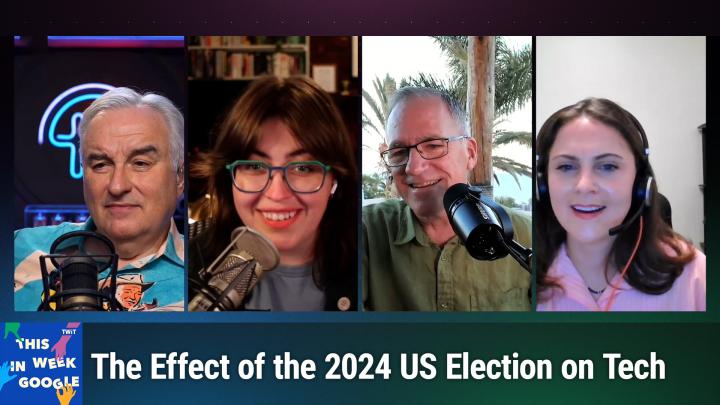
Intelligent Machines (Audio)
TWiG 793: The Aftermath - The Effect of the 2024 US Election on Tech
02:13:35
The Effect of the 2024 US Election on Tech
Loading summary
Transcript710 lines
- [00:00]
Leo Laporte
It's time for Twig this Week at Google. Jeff Jarvis has the week off. No, it's not what you think. He's actually in Germany right now. Can't join us. But we do have Paris Martineau. Also Mike Elgin joining us from Mexico. And Emily. Her new name is Forlini, but you might know her as Emily Dry Belbus from PC magazine. Now, I have to warn everybody, it's the day after the election. We have a new president elect and the entire topic of this show is how a new administration is going to work with Silicon Valley. What's going to happen to the tech? We're interested in AI EVs big tech in general under a Trump administration. That's the topic for the day. If you don't want to hear any politics, you might want to skip this show. But if you're interested, we're not taking a point of view. I think we're really talking about what's going to happen to cryptocurrency and others in a Trump administration. That's next on Twig. Podcasts you love from people you Trust. This is TWIG. This is TWIG this Week in Google. Episode 793, recorded November 6th, 2024. The Aftermath. It's time for TWIG this Week in Google. Shall we cover the latest in the Google verse? Really? We're going to cover today and I guess I should give you a content warning the impact of a new United States administration. We are the day after election day on the tech sector and I think there will be a massive impact. Don't worry. Jeff Jarvis is not here. He took the day off to get drunk. No, he is. He is at Cancon or Con. Con Con.
- [01:48]
Paris Martineau
Not French.
- [01:52]
Leo Laporte
He is traveling and not able to be with us. But yeah, Paris Martino's here. It's nice to see you. Paris Martino, from the information, she writes for the weekend covering youth issues. Hi, Paris.
- [02:05]
Paris Martineau
Hi.
- [02:06]
Leo Laporte
Hi. Lovely to see you. Also with us to replace Jeff, Mike Elgin, who is in Mexico, in El Sargento, Mexico. His newsletter, Machine Society, AI Gastronomic, is his website and he is of course on mastodon at Mike Elkin. Hi, Mike.
- [02:25]
Mike Elgin
Hey, Leo. Thanks for having me on. This is a wonderful day to have me on to complain about all things.
- [02:32]
Leo Laporte
You are in Mexico and it looks like the ocean is quite blue where you are.
- [02:37]
Mike Elgin
And I'm just going to stay here.
- [02:39]
Leo Laporte
On the Baja Peninsula. It's very nice. Turn your mic up just a little bit if you can.
- [02:43]
Mike Elgin
Okay, we'll do.
- [02:44]
Leo Laporte
Mike, give us as much as you can Okay. I want to welcome Emily Forlani to the show. You may remember her as Emily Dry Belbas. She's been on the show many times before from PC Magazine now with her. That's your married name, Forlini.
- [02:57]
Emily Forlini
Yep.
- [02:58]
Leo Laporte
Congratulations.
- [02:59]
Emily Forlini
Thank you very much. Happy to be here. Interesting topic, for sure.
- [03:03]
Leo Laporte
Well, I know one of the things you cover is EVs, and I. You know it. So just in case you slept through yesterday, the President elect Donald Trump will take office January 20th. And that, I think, is going to make a big difference in a lot of things. But of course, our focus is the tech sector. EVs for sure. He is. In fact, in his, in his victory speech, he actually name checked Elon Musk, called him a genius. And I think Elon Musk is going to have a huge role to play in the new administration. So that's going to change things quite a bit. Plus, and I don't think that. I think this might be a little bit underreported, but not only is Trump now pro bitcoin, I'm sure JD Vance is, but the crypto industry donated a lot of money to down ballot contests. And I think I saw the number 153 new members of Congress who are pro cryptocurrency. So now you have. No wonder bitcoin went up to $75,000 in the last couple of days. Now you have a very pro crypto government. When, when President Trump was speaking to the bitcoin conference, he said, I'm going to fire Gary Gensler, the head of the sec, who has advocated for regulating bitcoin as a security, to do a standing ovation. So much. So he said it again. He liked the sound of that. Uh, so did they. So I don't know. I don't know where to start. Maybe we go through you one, one by one, and just your overall impressions. A Trump administration, while it would be bad, I think, for a great number of constituencies, is it good for technology? Paris?
- [05:00]
Paris Martineau
I mean, I think that's a broad question. I think that there are a number of tech leaders that have bet quite a lot of money and time that it will end up being good for them. I mean, chief among those is Elon Musk. Musk, who's poured tens of millions of dollars into this race, if not hundreds of millions at this point, and it seems to have paid off for him. You also have seen an outpouring of support from venture capitalists like Andreessen and Horowitz. Sean McGuire at Sequoia has been a staunch Trump supporter of the Boys it all in, chief among them, David Sachs have been huge Trump supporters. And it seems not, not entirely unlikely that someone like David Sachs could end up with a cabinet position or an ambassadorship out of this, which I think will be interesting to see how that shapes U.S. policy.
- [05:55]
Leo Laporte
Yeah. Sachs spoke at the Republican convention. He's the host of the all in podcast. And so it's nice to see a podcaster in prominence. He, but he also, he also Trump will have a Republican Senate, so cabinet member, cabinet confirmation will presumably be automatic. So anybody that the president puts on the cabinet will probably get in. And that means David Sachs could walk right in. So it sounds in general like it's not too bad for tech. I think it's probable that we'll see less antitrust regulation. You think, Elon, I mean, I mean, Mike Elgin.
- [06:42]
Paris Martineau
Elon Musk comes out of.
- [06:44]
Mike Elgin
The side because we both have a space program. Yeah, I think, you know, it's, I think it'll be interesting at least in one dimension, which is that if the new administration is very pro AI, removing regulatory shackles from AI and very pro Bitcoin and other cryptocurrencies, then the server shortage, the sort of, you know, we have tech companies talking about and investing in nuclear power plants to deal with all the energy, all the energy saving for those of us who turn off the lights and try to avoid using too much electricity, be washed away by the enormous demand for power for these massive data centers that are going to be required to, you know, it's going to, that's going to happen anyway even with a less, a less tech friendly administration. So that's one dimension that we have to be concerned about. We also, in the area of energy, Donald Trump is very anti wind energy.
- [07:53]
Leo Laporte
Yes. Unaccountably, yes. It causes cancer and kills whales.
- [07:58]
Mike Elgin
Something. Yeah. And so could be a problem. So, so I see, I see a sort of a, a coldness toward, to, toward renewable energy sources and a friendliness toward things that gobble up massive quantities of energy. So that could end up being a bit of a, a problem in the, in the long term. That's not necessarily directly a tech story though. So I, you know, who knows, who knows what, what, what is going to happen? Because one thing we do know, take TikTok, which is on the, on the rundown and I hope I'm not putting that cart before the horse, but tick tock is something that Trump was very much against and while he was president made moves to get rid of it. Then when he was running for office, he saw that they, that the Biden administration was anti Tick Tock. So he thought, maybe I can pick up the Tick Tock vote by being pro TikTok. So TikTok itself, by dance, the company is thinking, okay, we have a, we have a pro TikTok president. But I don't think that's necessarily the, the case. I think he is pro TikTok stance was a campaign tactic. And I don't think that says anything about whether he'll be pro Tick Tock or anti Tick Tock once in office.
- [09:11]
Leo Laporte
The information exclusive. Tick Tock sees Trump victory as apps best hope the clock is ticking. I think it was January 9th talking or talking as well. It was January 19th that tick tock had to resolve this by selling themselves.
- [09:30]
Paris Martineau
Something I think is interesting here is one. I feel like the January 19th date has always had kind of an asterisk near it because of course, Tick Tock is going to challenge this law, as they have, as they have, and they're hoping to kind of get an injunction or something along those lines. But something I think is interesting about this reporting from my colleagues Juro Osawa and Kaya Uref are, is they reported that TikTok executives were hoping to discuss with Trump's administration about alternatives to a sale or a ban. But they've also floated that they think Trump could take other steps that would blunt its impact if he isn't able to, you know, convince Congress to repeal the ban. Such as just Trump could tell the Justice Department don't enforce it. And I guess that's a viable strategy. I hadn't really considered that as a way to get around it, but I suppose that would work if the Department of Justice isn't going to come after TikTok for not complying with this rule.
- [10:30]
Emily Forlini
Well, it was a bipartisan like this is one thing Democrats and Republicans did agree on is that TikTok's data collection is an issue, a national security issue and a privacy issue. So are we thinking that he's just going to come in and continue to change that perception and that everyone was just spineless on that?
- [10:48]
Leo Laporte
Well, and I asked the question, if TikTok is so powerful, did they actively promote a Trump election? I mean, it's probable that Kamala Harris would have done the same Kamala Harris would have done the same thing as Biden has done, which is to, to ban Tik Tok. So look, Tik Tok's supposed to have this great influence on the American electorate. Is there any evidence they tried to, to push a Trump election? I Don't think so.
- [11:15]
Emily Forlini
Well, they've been fighting for their life a little bit, trying to. Everything is a PR move now. And so what I've seen on TikTok is I'm getting like ads from TikTok that say, you know, we provide accurate information for this election, like your election source. So they're trying, they're always trying to rebrand and trying and I mean we did. Trump's campaign was on TikTok, Kamala's campaigns on TikTok, and of course there's a million people talking about politics on TikTok. So it's a very politically active and TikTok's trying to be seen as a reputable place to have that discussion. So that's what I've seen.
- [11:50]
Mike Elgin
The beauty of social networking algorithms to the owner of the social networking company is that the, there is no evidence to be found because the algorithm is a secret. Nobody knows who, how many people saw what. But I think the larger picture is that friction between the United States and China is a near certainty. With Trump in office, he was talking about imposing 10% or 15% tariffs on all goods entering the United States. It seems unlikely that he would do that because that's crazy. That would decimate poor people in the United States who rely on imported, low priced imported goods. But he's talked about that, he likes tariffs. He calls himself Mr. Tariff. So if there's tariffs for imported goods, it's going to be a trade war with China and Tick Tock will be an easy and available pawn in that, in that game with China. So I, I just think there's almost no chance that, that, that Trump won't hammer or get rid of or ban or force a sale of Tick Tock, given the, the likely friction between China and the United States that's coming, that.
- [12:58]
Leo Laporte
He'S already gotten what he wanted out of being on TikTok, which.
- [13:01]
Mike Elgin
Right.
- [13:02]
Leo Laporte
A young, younger vote.
- [13:04]
Mike Elgin
That's right.
- [13:04]
Emily Forlini
He'll do whatever he thinks people want him to do. Is kind of my perception on this, just given that he did completely flip on the Tick Tock issue and nothing changed.
- [13:15]
Leo Laporte
When you say people want him to do. I don't know if it's what people want him to do. I think it's what's going to get him the most advantage at any given time.
- [13:23]
Emily Forlini
Better way to say it. That's a better way to say it. What do you think?
- [13:26]
Leo Laporte
But he influences him. I think he's so, he's in a.
- [13:29]
Mike Elgin
Really, he's in a really interesting position now because Assuming that this is his last term, he's got, he's got Republican Congress completely. He's got a, he's got a Republican leaning Supreme Court and he's going to be the president. So there's like he has reason to please anyone.
- [13:47]
Leo Laporte
Right?
- [13:48]
Mike Elgin
Yeah.
- [13:48]
Emily Forlini
And he can't run it again. Right. He's maxed out as this is our last Trump term. So it'll be interesting to see how he takes that because there's no, there's no running again.
- [13:59]
Leo Laporte
Right. What about antitrust regulation? One of the things that was interesting, I think everything, by the way, the way things were or even are today is up in the air, is gone. Because it used to be that you had both the left and the right going after big tech for different reasons, but they at least agreed that big tech's too big now with, with I think a Trump administration, I wonder if antitrust actions are just going to disappear. Obviously Lina Khan is going to disappear. The FTC will probably not be encouraged to go after big companies now. But, you know, Trump doesn't like Google very much.
- [14:46]
Mike Elgin
Yeah, I think, I think antitrust action may be based on Trump's past actions as a political tool. So he has gone after Amazon because of Jeff Bezos and the Washington Post. This is probably why the Washington Post didn't have a, didn't endorse Kamala Harris out of fear of retribution through antitrust action. So I think we can look forward to antitrust action that's somewhat selective and based on, you know, who's kissing the ring and who isn't.
- [15:22]
Leo Laporte
Bezos congratulated Trump today for, quote, an extraordinary political comeback and decisive victory, which isn't saying anything, but it is, it is currying favor and not, I would, you know, look, I wouldn't expect any business leader at this point to do anything that's going to harm his or her business. And so you probably could make the case that people like Jeff Bezos and Elon Musk were betting that Trump would win for sure.
- [15:53]
Mike Elgin
And also Jeff Bezos has his rocket company, which, you know, the government would be his customer. So he's got to, he's got to worry about that one, too.
- [16:00]
Emily Forlini
Yeah, I had an interesting perspective on this. So, yeah, I used to work at Amazon when Jeff Bezos was CEO and I had a lot of respect for him at that time. I saw him in person many times at like all hands meetings and things like that. And he earned my respect in the way that he approached issues and I had no real reason to like him. Other I Mean, he was this distant CEO and I just naturally was like, I think he's smart. And I remember at one all hands meeting when he was sparring with Trump. These meetings, by the way, took place in a stadium in Seattle, like a huge stadium. And so they would have like, Amazon, Amazon, Amazon going around the lights. And it was nuts. They'd have bands and like people. It was just crazy. And there was one where he directly talked about Trump and he, he was very confident and a little antagonistic that like, oh, if Trump wants to criticize us, go ahead. Like in democracy, you criticize, you accept criticism. And you should never be afraid of that if you're doing what you want to do. And I definitely felt like he was confident to stand up to Trump in that moment in a very public way. So I'm a little less personally convinced that he was doing this just to curry favor with Trump. I just, I'm not sure if he's completely changed, but a lot of people have, A lot of people in Silicon Valley have gotten more right leaning or kind of gotten more interested in Trump. So, but that's just my personal opinion when I did hear him speak directly about Trump in a way that I don't think that's on the Internet or anything.
- [17:31]
Leo Laporte
Andy Jassy said, current CEO, congratulations to President Elect Trump on a hard fought victory. We look forward to working with you and your administration on issues important to our customers, employees, communities and country. I'm sure this is, I don't know if Tim Cook did the same thing, but, or Satya Nadella or Sundar Pichai, but I'm sure this is, I believe they did. This is the smart thing to do. Right? Yeah.
- [17:54]
Paris Martineau
I do think that Andy Jassy's announcement deserves a little bit of an asterisk here because he has a particularly unique experience when it comes to sparring with Trump and the Trump administration. Under the last Trump administration, Amazon Web Services, which at the time was what Andy Jassy oversaw, was awarded a like $9 billion pension contract to the pen. And then Trump basically took it away because he was mad at Jeff Bezos and the Washington Post and Amazon generally. So I do think that Andy Jassy, of all of these CEOs is the one that probably has the most experience with the potential ramifications of angering a President Trump.
- [18:42]
Mike Elgin
Yeah, and CEOs like, you know, Tim Apple and, and, and Jassy, of course, Bezos is not no longer CEO of Amazon, but CEO types and, you know, company owners are not at liberty to, to exercise their own personal, you know, opinions about these things. They have to represent the shareholders and the, in the, and the value that they hold in the company. And so, you know, congratulating Trump doing all this stuff is just, it's just what a CEO has to do.
- [19:12]
Leo Laporte
I think you're talking about the joint, it's the Jedi, the joint enterprise Defense and infrastructure contract, which is a $10 billion over 10 year deal with the Department of Defense to kind of update their cloud computing it Oracle. It was originally considered gift wrapped for Amazon until Oracle contested it, citing the National Defense Authorization Act. And then August of 2019, weeks before the winner was expected to be announced, President Trump placed the contract on hold so that Defense Secretary Mark Esper could investigate complaints of favoritism towards Amazon. It was then awarded to Microsoft. But as far as I know, it's, it's, the judge then halted Microsoft's work on it and it's still kind of up in the air. Yeah. So the Department of Defense did not get its Jedi cloud at all.
- [20:12]
Emily Forlini
And they're still like, will a Trump administration make any difference? Like it's just this classic run around where it's like this big hubub and then in the end it's like nothing happened.
- [20:21]
Leo Laporte
Yeah, yeah, I mean, that's a good question. It is a different time. And I think in 2016, Trump maybe not even expected to win, but now has had a lot of time to prepare.
- [20:35]
Mike Elgin
The other thing, I, yeah, the other thing is that I think Trump cares about the things he cares about and he'll sort of offload the stuff he cares less about to other people and it depends on who those people are and, and so on. So we don't, we don't know what the Trump administration looks like yet. I mean, we have some general idea, but we don't know, you know, for example, military contracts and things like that. How involved he's going to be in those sorts of things, we just don't know.
- [21:00]
Leo Laporte
And you're right, he doesn't care about the things he doesn't care about.
- [21:03]
Emily Forlini
I think broadly we know he's a fan of big business, so whereas maybe Kamala Harris, yeah, he's a businessman, or at least he was on tv and he has some businesses, not as big as Amazon, but yeah, he's a fan of big business. He'll probably cut tax breaks to businesses which will make Amazon and others very happy. He probably won't do things that Kamala Harris talked about in her campaign, which is more about funding startups or maybe some other players in tech. We could see, I think we definitely, the cast of characters we have now that I write about and we talk about all the time, we will definitely have the same cast of characters unless something random comes out of the woodwork like ChatGPT and. But the government is probably not going to support smaller tech. I mean, that's, that's kind of my opinion. Probably just continue to support the big guys. So it, maybe it'll be some continued golden age for big tech.
- [21:58]
Mike Elgin
Well, we live in a. We also live in an age. I mean, the future is coming upon us very quickly and everything's changing very, very, very quickly. And we're entering into an era of supranational oligarchs like Elon Musk who have, who are individual people who have power that's, that's comparable to a nation state. They have their own space programs that control electricity grids. They have incredible power. And you know, that one, one approach that Trump could take now that he's in it, you know, in his hopefully final term, is that he may see these external, powerful people as kind of threats to his own power and may seek to sort of kneecap them the way Putin did in, in R. And so again, I think we're in completely new waters now and we really don't know what's going to happen. But I have the feeling that his love affair with Elon Musk is going to be temporary because Elon Musk himself, I agree, is just too powerful. He just controls too much. And Elon Musk's power is much more global and exercisable. Of course, the President of the United States has enormous global power, but to exercise that power is much more difficult and consequential. Whereas Elon Musk can just send an email and shut down every Tesla in a country, or they can use their satellites, SpaceX satellites, to cut off satellite Internet for a country or whatever.
- [23:27]
Paris Martineau
I do think we're also going to have to reckon with, as tech industry participants or critics, with the reality of a, the owner and operator of a major social media platform being an arm of a highly political, politicized and polarized government.
- [23:49]
Mike Elgin
Yeah, yeah, yeah.
- [23:51]
Emily Forlini
I do think social media played a big role in the election. It plays a big role in the way that we consume information. And now it's potentially going to be playing a big role in government through Elon Musk. And something I'm concerned about is that people are not consuming nuanced information and there's a lot of algorithmically fed content that is not that natural discovery process where people can find, see different viewpoints. And that's the one thing I really would like to change in this country is the quality of information and education. And I am. This type of thing makes me concerned that it's just going to continue and become cemented as an even deeper reality where we can forget that there might be an alternative, that you don't need to learn everything on social media.
- [24:33]
Mike Elgin
Yeah, I mean, there's news out there, I think this week that Meta has actually got a lot of increase their numbers for engagement by using AI as part of their algorithm to increase engagement. And so the application of generative AI to increase engagement means the sort of tiktokification of everything. Where I mean, TikTok differs from other social networks mainly in the fact that it's mostly algorithm generated. You follow people, but really what most people see on the feed is what the algorithm is feeding. It's a very, very good algorithm. It's very strong and it really shows you stuff that you just makes you want to keep consuming those pellets like a rat in an experiment. And I think, I think that all social networks are going to get a lot more like that, even though of course they've all tried by emulating the feed. Right. Or the. Whatever they call it, they all have a TikTok like feed. But I think all the other parts of those social networks, the text parts will get AI based sort of engagement algorithms. It's going to make the problem worse and not better, unfortunately. So I think the only hope is that we have to, you know, raise our own kids to stay off. And on the plus side, a lot of, a lot of school districts are banning phones in school. So that'll help a bit.
- [25:52]
Emily Forlini
That is positive.
- [25:54]
Leo Laporte
Yeah. I don't see any way a government can fix that. I think it's going to be, it's up to us at this point to fix that. If you were the CEO of a tech company or if you were a venture capitalist or if you were thinking about doing a startup right now, how do you plan the next four years? How do you think about it? What is anything changed? Do you go ahead and do the same old thing? I think one of the problems that we have, and it's going to be a general problem, is President Trump's somewhat unpredictable. Right. You don't know exactly where he's going to come down on something. Elon, you raise a really interesting point that Elon's kind of playing with fire here because we've seen Trump do this before. Turn on somebody that he was in love with minutes before. And I think you, you raised a good point, Mike, that that could easily be Elon in his X brief X stream that he did an election naive from his plane said that he has.
- [27:00]
Paris Martineau
On the way to Trump, on the.
- [27:01]
Leo Laporte
Way to Mar a Lago. This by the way, it didn't work, I guess and he was having technical difficulties so we went back to playing his video game. But he said he formed of course a pack the America PAC with $118 million according to the Washington Post, of his own money. He said it's going to keep going after this election and prepare for the midterms and any intermediate elections. He is. He's going to aim to weigh in heavily, which tells is really Elon saying I have political aspirations. Now he's not a U.S. citizen, so he can't or wasn't born in the U.S. i should say so he cannot run for president. And there was a theory, powerful friends.
- [27:45]
Mike Elgin
In government who might overturn that particular thing.
- [27:48]
Leo Laporte
Oh, it could be.
- [27:49]
Emily Forlini
No way.
- [27:50]
Leo Laporte
I don't think he wants to be president. Honestly. That seems too limiting.
- [27:53]
Mike Elgin
Yes, exactly.
- [27:54]
Emily Forlini
Right.
- [27:55]
Mike Elgin
He's got bigger aspirations than that.
- [27:57]
Leo Laporte
Yeah.
- [27:57]
Emily Forlini
Like what is his end game? Because it feels like he's taking his eye off the ball a little bit with tech. I mean, if you look at Twitter and Tesla specifically, like Twitter's in a weird moment where it's declining and users ad revenue is not coming back. So where is that going? I don't know. Tesla's at this weird moment where he doesn't want to make any new car types. I mean there was a cybertruck, but before that we've seen the same Model 3, Model Y for years. They've been refreshed slightly. The S and X are declining in sales, so we've just the lineup is what we have. He doesn't want to make the $25,000 EV. All he wants to do is solve self driving, which is going to take years and is not an immediate product release. So with his own companies, there's a little bit of a stalling out feeling to me. And then he wants to spend all this time and money on politics and I don't know where he wants to go with that either. So to me he's a little bit of a question mark. Just being part of the Trump administration doesn't really answer that question mark.
- [28:58]
Mike Elgin
Well, I think, yeah, I feel like.
- [29:01]
Leo Laporte
He has ambitions, there's no question about that.
- [29:03]
Mike Elgin
Are they ambitions though, or is it a compulsion? Is it is it is. It narcissistic personalities run amok as, as.
- [29:11]
Leo Laporte
The president, isn't he?
- [29:12]
Emily Forlini
So that's what I'm saying. Like, where is this going? I mean, I, I don't think he really has respect for government in the sense that he would be a mayor of a city. You know, that's not cool enough.
- [29:21]
Leo Laporte
No, I don't think he wants to govern at all.
- [29:24]
Emily Forlini
He just wants to influence the opinion, I guess. Which is why he bought Twitter. Right.
- [29:29]
Leo Laporte
Don't you think the election of President Trump is good for X? That X has a future now?
- [29:35]
Emily Forlini
I think it's getting more and more niche and I don't see.
- [29:39]
Mike Elgin
Because it's too conservative, it's slowly morphing into parlor. And yeah, you know what?
- [29:46]
Leo Laporte
To Trump, Trump's truth social went. Got a significant burst in the stock market after the election. That's a meme stock though. They've never made any money. Well, I guess Twitter is not exactly famous for profit.
- [29:58]
Emily Forlini
I don't think Twitter is really keeping up with the video situation on TikTok.
- [30:03]
Leo Laporte
Interesting. As much as, say, Instagram and Facebook are.
- [30:07]
Emily Forlini
Yeah. Because there's Instagram reels, which isn't okay. Like, you know, there's, there is some content sharing between those things. I don't, I think it's just a different philosophy.
- [30:16]
Paris Martineau
I.
- [30:17]
Emily Forlini
And it has not really responded to TikTok.
- [30:19]
Leo Laporte
I have to say, the, for you content I see on X has very much looks like TikTok. Now it's almost all video.
- [30:26]
Emily Forlini
Mine's not. Maybe it's just.
- [30:28]
Leo Laporte
Yeah, see, that's the other thing is X is different for everybody, isn't it?
- [30:32]
Emily Forlini
I'm a big nerd on Twitter. Like, I just use it for work and you know, I use it. It's almost like LinkedIn for me. So maybe that's why.
- [30:40]
Leo Laporte
Yeah, yeah. And I wonder. I mean, this is. First of all, Elon can easily afford to lose his stake in Twitter. It's not $44 billion because he got banks to pony up $18 billion. So he only has. Whatever the difference is. It is potentially problematic because it's, it's, it's based on his stock holdings, particularly on his SpaceX and Tesla holdings. So he can't afford to destabilize those stocks. I think.
- [31:12]
Mike Elgin
Yeah, I think that, you know, the X is not a big deal for Elon Musk's own personal financial portfolio. He's got, he convinced some, some other people to throw in and he's probably concerned about, about, about that part of it. But I think it's mostly a means to an end. It's a way to, it's a way to have more, more influence over the national con or international conversation about various things he cares about. And, and again, I think, I just, I think he's, he's a narcissist and I think the end game is he just wants everybody talking about him all the time. And so, you know, I think Trump is that way too. So I think, I think we, that's.
- [31:52]
Leo Laporte
Why you see a head to head conflict. So it gets more.
- [31:56]
Paris Martineau
Obviously we don't know the answer to this, but I do wonder, when do you guys think Elon Musk and Trump are going to break up? Because there's no way that, there's no way that this happy friendship can last very long. I mean, maybe I'll be totally proven wrong, but they both seem historically to be kind of mercurial people who I'm.
- [32:18]
Emily Forlini
Going to be like Kim Kardashian and Kris Humphries. Like they're going to get through the TV wedding and then three days later, later they're going to break up.
- [32:25]
Leo Laporte
How many, how many Scaramucci will it be is the question.
- [32:28]
Mike Elgin
Yeah.
- [32:29]
Paris Martineau
How long was the Scaramucci again?
- [32:30]
Leo Laporte
Was that like pretty quick?
- [32:31]
Mike Elgin
A couple weeks or something?
- [32:33]
Leo Laporte
Yeah.
- [32:35]
Mike Elgin
One disincentive for Trump to break up with Elon is that is X, Right. So he.
- [32:43]
Leo Laporte
Access is powerful, isn't it?
- [32:44]
Mike Elgin
Yeah. Yes.
- [32:45]
Leo Laporte
And amongst everything he could to get Trump elected, I mean, that was a very valuable asset.
- [32:51]
Mike Elgin
Yeah.
- [32:53]
Leo Laporte
What happens? One of the things that puzzled me about Musk's support for Trump was I don't think Trump is interested in EVs at all. I think he wants to promote gas cars. So Emily, I mean, this is your beat. Why would. I don't understand. You're saying he's, is he given up on Tesla?
- [33:13]
Emily Forlini
Well, Trump did not like Musk initially. Yes. And he has campaigned against EVs. Two audiences that want to hear that. And to other audiences he'll say things like EVs are okay. I just want there also to be hybrids and other options. So he has. Yes, he has used the word hybrid. He has endorsed it. And these things with Musk, he realized that was his single biggest tool to get voters out and to activate young men. He is not happy that LeBron James or Ariana Grande or all these celebrities just come out of the woodwork for Kamala Harris. And Musk was really his biggest celebrity by far. So he leaned into that. Probably where they can net out is that Trump says, I'll repeal, you know, the tax credit for EVs and Musk says fine, you know, we don't need government subsidizing things.
- [34:03]
Leo Laporte
I don't think you get them anymore for Tesla's anyway. Right. They've sold so many that you can.
- [34:08]
Emily Forlini
That's actually a common misconception that expired like years ago. I don't. I keep hearing that. But yeah, you can. That cap, it doesn't exist and hasn't existed for a couple years.
- [34:17]
Leo Laporte
As long as it's made in the US you can get your 7,500 bucks.
- [34:21]
Emily Forlini
Yeah. So as long as it's made in the US with also a domestically sourced battery is a big issue. And one thing I think that Musk is happy the tax credit will be repealed is that their batteries are from China. So they've spent the better part of this year being eligible and ineligible, depending on their supply chain. And if their packs come from China for this and that model and this and that trim. So repealing the tax credit removes the spotlight on Tesla that not all of its cars are from China and so it can source the cheapest packs possible. So that's a big incentive for Tesla.
- [34:54]
Mike Elgin
Wow.
- [34:54]
Emily Forlini
Yeah.
- [34:55]
Leo Laporte
Wow. I. We are. You're watching this week in Google, Jeff Jarvis, who would probably be a little bit more upset right now. It's not with us.
- [35:07]
Mike Elgin
He.
- [35:08]
Leo Laporte
He's at cancon, which is. Where is that? Paris? Where is he?
- [35:11]
Paris Martineau
It's in. It's con Con and it's in Germany somewhere. It's not in Cannes. It's not in Cannes. It's ConCon. But I think it should be at.
- [35:20]
Leo Laporte
In can if you're doing it. Well, anyway, it's a conference of con Con people. No conning going on.
- [35:28]
Paris Martineau
Maybe a little conning.
- [35:30]
Leo Laporte
Okay. A little bit. Anyway, Jeff will be back next week where I'm thrilled to have Mike Elgin here. And of course, Emily is always welcome on our shows. So we got a. We got a pretty good panel. And I'm sorry if you don't want to hear anything about politics, but really I think we do need to talk about. And this is the perfect show.
- [35:49]
Paris Martineau
It would feel dumb to be talking about anything else today after the election.
- [35:54]
Leo Laporte
And I, you know, I don't. I think we're doing it in as. As best we can, a nonpartisan way, talking about what it's going to look like in 2025 for tech companies and, you know, the pros and cons of it all. Do you want to pick a date for Elon and Donald's breakup I think January 28th.
- [36:20]
Paris Martineau
That would be less than a mooch.
- [36:22]
Mike Elgin
That would be a mooch.
- [36:23]
Leo Laporte
It might be the new standard.
- [36:26]
Emily Forlini
Maybe I'm going to write it down. Everyone say a date. I'm going to write it. And then on that date, I'll check in.
- [36:31]
Leo Laporte
I feel like even at the rally where Elon made his debut, jumping around like a crazy man behind Donald, stealing focus, I think that that actually even then was. He was. The president was a little annoyed.
- [36:47]
Mike Elgin
Here's the other thing is that, is that when's the last time Elon Musk was an employee taking orders from the boss?
- [36:54]
Leo Laporte
Right.
- [36:55]
Mike Elgin
And if he's going to be part of the government, then he's going to have to answer to a superior in the form of Donald Trump. And I can see that some sorts of friction there, because usually Elon Musk does his own thing. On the other hand, Trump may just say, hey, do whatever you want with the U.S. government. You're the expert at cutting. Cutting people.
- [37:14]
Leo Laporte
Turn the government into Twitter is not a very good selling point.
- [37:18]
Emily Forlini
Also, Elon might be critical of Trump's work. He'll be like, why is that still inefficient? Or why are you focusing on this and that? And that might at some point become annoying and distracting for Trump. I mean, that's.
- [37:28]
Leo Laporte
I'm going to adjust my date, Emily.
- [37:30]
Emily Forlini
All right, what do you got?
- [37:31]
Leo Laporte
I am going to say by June 1st, I'm going to give him a few months.
- [37:35]
Emily Forlini
Do you have any rationale for that? Like, any.
- [37:37]
Leo Laporte
Just by summertime. I think once, once the, the, the white shoes and white belts come out. Right. Right after, it'll be right.
- [37:45]
Emily Forlini
I think, like, it's a good time to be single and maybe, you know.
- [37:48]
Leo Laporte
Yeah.
- [37:49]
Emily Forlini
Enjoy the warm weather.
- [37:50]
Leo Laporte
Going to be. It's going to be a hot Trump summer. So I think it. That sounds not so good.
- [37:59]
Emily Forlini
There might be some babies out of.
- [38:01]
Leo Laporte
That one with this hot, musky summer. So I'm saying June 1st, right after Memorial Day.
- [38:10]
Paris Martineau
Just the idea of that plus the words. All I'd say I'm not going to put any definitive date on a breakup or anything, but I will say I think we should check in by summer and see how tensions are, whether they're warm or not.
- [38:24]
Leo Laporte
Yeah. Dead pirate in our discord says mid February.
- [38:31]
Emily Forlini
Everyone gets depressed in February.
- [38:33]
Leo Laporte
Yeah.
- [38:34]
Emily Forlini
Moody.
- [38:35]
Leo Laporte
What do you. What do you. What do you think, Paris, you want to make a token bet in our pool here?
- [38:42]
Paris Martineau
Oh, I just said let's check in.
- [38:45]
Leo Laporte
You don't want to give a date? Okay. Now there's no. There's no payoff, so I guess it's okay. Mike, what do you think? How long will Elon last?
- [38:54]
Mike Elgin
End of next year, I think. The end of next year, I think it may take a little longer because, I don't know, they've both got a big mallet hovering over each other's heads.
- [39:06]
Leo Laporte
It's true. I mean, it's. Yeah. There might be a kind of a tense frenemies situation.
- [39:12]
Mike Elgin
Yeah.
- [39:13]
Leo Laporte
Emily, what do you think?
- [39:14]
Emily Forlini
Yeah, I'm trying to think of how we could actually develop a real opinion on this. Like, is there any event coming up or policy that's expiring anyone in the discord?
- [39:24]
Mike Elgin
No, it depends when the next game releases. The next game that Elon wants to play.
- [39:30]
Leo Laporte
What is. What was he playing?
- [39:31]
Paris Martineau
Elon claims that He's a top 20 Diablo 4 player worldwide, which would require him.
- [39:40]
Leo Laporte
That's a lot of work.
- [39:40]
Paris Martineau
Voting hundreds of hours.
- [39:42]
Emily Forlini
Yes. How could he possibly have time for that?
- [39:44]
Leo Laporte
He paid for that.
- [39:45]
Mike Elgin
Come on.
- [39:46]
Emily Forlini
Yeah, I guess.
- [39:48]
Leo Laporte
I mean, there's more people in China who will grind out the. The gold for you.
- [39:51]
Emily Forlini
Yeah, I'll lean more towards Mike. I think it might take a little over a year to kind of get into it, especially because at this point, their reputations are kind of linked and maybe they'll be incentivized to keep up the charade for a little bit longer.
- [40:07]
Leo Laporte
And I can't speak for Elon, but I know Donald Trump knows perfectly well that he. That nothing. There's no memory, gold, goldfish status. You could. Yeah, you can basically do anything you want, say anything you want. There's no memory. So I don't think. I don't think Elon, Donald, will be in any way constrained by this sense of. Well, I. I called him a genius.
- [40:33]
Mike Elgin
Yeah.
- [40:33]
Leo Laporte
They're all geniuses until they're not.
- [40:35]
Mike Elgin
Yeah.
- [40:36]
Leo Laporte
I don't. All the incentives change, and Elon is just. I don't. I think Elon is not very rational at this point, to be honest. I don't think he's rational at all, so.
- [40:45]
Emily Forlini
Well, maybe that'll be kind of spurring the next pendulum swing, politically or even in tech. Like, they're aligned now. They're going to fight like rare, like cats. They're going to break up and then kind of develop new starters.
- [40:58]
Leo Laporte
Yeah.
- [40:58]
Paris Martineau
Yeah.
- [40:58]
Emily Forlini
Maybe he'll decide to go in a certain direction that will take the country in a certain way.
- [41:02]
Leo Laporte
There is a conspiracy theory, which I admit, and I've mentioned it before, is a pure conspiracy theory that. That the people of the tech community like Peter Thiel and Elon Musk knew that President Trump didn't really want to govern. He, he likes the being the president, but he doesn't want to do the work of governing and figured let's get our guy JD Vance, who's definitely Peter Thiel's boy in there. JD Will end up taking off, taking some of the role of president and we will be able to create a technocracy. That's what I wonder if that's what Elon is thinking that it's about. I know he is and I know it's what Peter Thiel is thinking and what Mark Andreessen is thinking. It's about time we got the politicians out of here and let the smart guys in Silicon Valley run the place because we can do a better job because we're data driven.
- [41:54]
Emily Forlini
It's true. But they don't make data driven political arguments. I mean, where was data in any of the conversations about the election, which I was really disappointed by? I would like policy to be informed more by that. I would agree in this case with technocrats or whatever we're calling them. I don't know if they just have this smoke and mirrors of how they present themselves and ultimately they want AI to take over or something, but that would be a huge shift.
- [42:19]
Leo Laporte
AI is going to be the kind of wild card in all this if it does anything more than it's done so far. I mean, it's right now it's kind of a shell game. But if AI really gets smart, we'll take a break. When we come back, we could talk about AI regulation, what the future of. Is Sam Altman happy about what happened last night? That's the question. Think about it. Great panel, lots to talk about. The impact of Trump administration on technology is kind of our subject for the day on this week in Google. And it's, you know, one of the things we're talking on Sunday with Amy Webb, futurist, and she consults very big companies and governments about planning, about strategic planning. It's one of the things she said is if it was the title of the show, you have to embrace uncertainty and as a leader, you have to plan for uncertainty and have a strategic plan that makes sense in a variety of outcomes. So I think probably that's what Silicon Valley is doing right now as best they can. It's not like you know what's going to happen in the next four years. Our show today brought to you. I can tell you one thing. I know what you should be doing with your Microsoft support. Our show today brought to you by US Cloud. They are amazing. The number one Microsoft unified support provider replacement really US Cloud is the global leader in third party Microsoft enterprise support. Supporting 50 of the Fortune 500 switching to US Cloud could save your business 30 to 50% on a true comparable replacement for Microsoft unified support. US Cloud supports the entire Microsoft stack 24, 7, 365. They respond faster, they resolve tickets quicker. For clients all over the world, you're always going to talk to real humans and not just real humans, really smart humans, expert level engineers with an average of 14.9 years. And that's for break fix or DSE. So you know, yeah, it's cost less but it's also better support. It's better quality support from 100% domestic teams. So your data never leaves the US. And here's something Microsoft never has done. Financially backed SLAs on response time, a guarantee. Initial ticket responses are averaging under four minutes. And you know what? When when everything's on fire and your hair is burning and every the network's down and never nothing's working, every minute counts. So four minutes makes a big difference. In 2023, 94% of US Cloud's clients reported saving 1/3 or more. When switching from Microsoft unified support to US Cloud, you do have a choice. From Fortune 500 companies, large health systems to major financial institutions, even federal agencies, US Cloud ensures that vital Microsoft systems are working for over 6 million users globally every day. And I'm talking the biggest brands, big brands like Caterpillar Trust, US Cloud, HP, Aflac, Dun and Bradstreet, Under Armour, KeyBank. I mean really big brands. Even the IT folks at Gardner have chosen US Cloud for their Microsoft support needs. I saw an interview with the Director of Information Technologies talking about US Cloud, he said, and within an hour US Cloud responded with I want to say four engineers. So not only did they bring the right guys to the call, they brought the cavalry. I just felt like, wow, that was amazing. That was unlike anything I'd experienced with Microsoft in my eight years of being with Premier. We made the right choice with US Cloud. And when it comes to compliance, no one gets it better than US Cloud. ISO, gdpr, esg, compliance. Not just regulatory requirements for them, but they are strategic imperatives that drive operational efficiency, legal compliance, risk management and corporate reputation. These standards foster trust and loyalty among customers and stakeholders, attract investment and ensure long term sustainability and success in a competitive global market. I want you to check them out. Visit uscloud.com book a call today. Find out how much your team can save. That's uscloud.com get on the line with them. Talk about what they can do for you. Get faster, better Microsoft support for less US Cloud dot. We thank them up so much for their support. This week in Google from PC Magazine, Emily Forlini is here. Mike Elgin from Mexico is Sargento. Where Sargento cheese comes from?
- [47:19]
Mike Elgin
I doubt it. I don't think. I haven't seen a cow at all here.
- [47:23]
Leo Laporte
So you're on the Baja Peninsula, so.
- [47:25]
Paris Martineau
Maybe you should try mooing.
- [47:27]
Mike Elgin
I should try that. Yes. No, we're sort of north of Cabo San Lucas, kind of on the.
- [47:34]
Leo Laporte
It's a pretty area.
- [47:35]
Mike Elgin
Yeah, really, like Sea of Cortez side.
- [47:37]
Leo Laporte
Are you doing a gastronomad adventure in that area?
- [47:41]
Mike Elgin
No, no, just on vacation. Just hanging out. Yeah, just hanging out with the family.
- [47:47]
Leo Laporte
Nice.
- [47:47]
Mike Elgin
Yeah.
- [47:48]
Leo Laporte
I'm glad you're having a good time. It's great to see you. Machine. His newsletter is now at MachineSociety AI and well worth a subscription. Really great stuff. Also here, Paris Martineau. You can subscribe to the information.com and read Paris's work on the weekend. Every weekend.
- [48:07]
Paris Martineau
That's true.
- [48:08]
Leo Laporte
Every weekend. What was the Information's reaction to this election cycle?
- [48:14]
Paris Martineau
I mean, we're a nonpartisan organization, so no particular partisan leaning. We are, however, have reporters working to chronicle how this is going to impact the tech world.
- [48:28]
Leo Laporte
Right.
- [48:28]
Paris Martineau
I know a lot of my colleagues are making calls and trying to figure out how Silicon Valley is reacting with this and what this is going to mean for companies like Tick Tock, Meta.
- [48:39]
Leo Laporte
You know, Elon Musk, you linked to a Business Insider story that said Silicon Valley is officially grieving over Trump, but quietly gleeful over.
- [48:53]
Paris Martineau
I will say I've been, I've been making some calls today, and the thing that strikes me is how different now is from 2016 for Silicon Valley. In the wake of Trump's first victory, we saw tech companies big and small having outsized reactions. There was famously all hands where Google's top executives expressed their grief and frustration over Trump's victory. You had, you know, companies granting workers time off and things like that. It could not be more different this year. You don't have this time around. As we talked about before, the CEOs of all these major companies are congratulating Trump on his victory. They aren't sending out emails to their employees reaffirming values that they think will be threatened by a new Trump administration. It's kind of business as usual.
- [49:48]
Leo Laporte
Yeah, I have to think that in their heart of hearts, as, as Emily was saying, this is a pro. Going to be a pro business administration. I think there will be less regulation for sure. I think there will be less antitrust prosecutions. I think mergers and acquisitions are going to boom, and I would imagine venture capital funds will loosen up as well. The stock market's initial reaction was very positive this morning.
- [50:18]
Emily Forlini
Well, on AI regulation, I do think there's probably less of a prospect that there will be some kind of bill. I mean, I think he said he wants to remove the executive order that's kind of tackling bias in algorithms and just responsibilities for what the chatbots produce that probably it either could go away or he'll just do nothing on AI. That being said, I do think that we've been doing basically nothing on AI and if you guys followed that bill in California, Gavin Newsom and Nancy Pelosi, who are both Democrats, kind of put the kibosh on it. So it seems like both parties have been unclear what they want to do with AI Although Biden had that executive order. Now there's probably even less chance that we will do anything to make sure that AI develops responsibly. They think that will help innovation. The CEO of Anthropic put out a big post last week that says he don't think it will help. He doesn't think it will help innovation because it will just create this out of control, free for all. So I don't know, what do you guys think on that? You want AI to regulate?
- [51:26]
Leo Laporte
Elon Musk was the signatory to that letter last year that said, halt AI for six months. It could be an existential threat to humankind.
- [51:36]
Emily Forlini
Right.
- [51:36]
Leo Laporte
Ironically, he has his own AI Grok and has spent a lot of money on AI. I kind of think a little cynically that Elon just wanted everybody to stop for six months so he could catch up.
- [51:49]
Mike Elgin
Well, that's, that's the cynical version of what lots of companies are likely to do, which is to see regulation as a barrier to entry to startups. So if you're, if you're anthropic, if you're open AI, you really want to make it expensive to deal with regulatory requirements for small startups that couldn't ever afford it. And by the way, we, we haven't mentioned the O word, the Optimus robots.
- [52:14]
Paris Martineau
You know, Elon's Elon, classic O word.
- [52:18]
Mike Elgin
He wants to make a 10 billion of them. Those are AI, but, but like with legs and arms and, you know, to mow Your lawn and babysit your kids and walk your dog. So, so that's another thing that's we're going to see. I mean, he think he's pretending like this is imminent, this, that the, these army of robots is imminent. It's a few years off, but still.
- [52:41]
Leo Laporte
He thinks we're going to Mars next year. I mean, he's not.
- [52:44]
Mike Elgin
Yeah.
- [52:45]
Leo Laporte
Rational.
- [52:45]
Emily Forlini
Take a little longer.
- [52:47]
Mike Elgin
But again, back to the Trump administration. Donald Trump as a person is non ideological and he doesn't have strong feelings about AI.
- [52:55]
Leo Laporte
That's what I.
- [52:56]
Mike Elgin
Or the cyber, as he calls it. And so, and so he's gonna, he's going to basically hand that policy over to people who do care about those things. And again, I think J.D. vance and Peter Thiel and crypto czar Baron Trump. Yes, exactly. Right, exactly. So good with his laptop that he's going to put him in charge. So, so anyway, that's. It's not about trying to reverse engineer Donald Trump. It's trying to, you know, sort of figure out who the people are who are going to be in those positions.
- [53:27]
Leo Laporte
Yeah, I guess because AI at this point is spending money, not making money, they're less of a interest to Donald Trump.
- [53:39]
Emily Forlini
Should be an interesting.
- [53:40]
Leo Laporte
Should they? Should they?
- [53:41]
Emily Forlini
Yeah.
- [53:42]
Leo Laporte
I'm thinking Trump got elected.
- [53:46]
Emily Forlini
I just want Sam Altman to tweet with a capital letter just once.
- [53:51]
Leo Laporte
I mean, I think, I mean if I think about it, he's got to be, congratulations that Kamala Harris did not get elected because.
- [53:59]
Mike Elgin
Right.
- [53:59]
Leo Laporte
That most likely would have led to more regulations of some kind and taxation of wealthy people.
- [54:06]
Mike Elgin
So, so I mean, that's the other part of it is that these very wealthy people are, are going to be, are going to believe that Trump is going to lower their taxes. And so it's all, I'm sure they just see it as a win. Win. Less regulation, lower taxes. For me personally. Beautiful.
- [54:22]
Leo Laporte
I didn't even mention.
- [54:22]
Emily Forlini
I don't think that, I don't think there's any clear path to federal AI regulation for either administration. Like maybe we're seeing more on the state level like California, but I do not see any evidence that we are any closer or would have been under Kamala Harris to actually passing something.
- [54:40]
Leo Laporte
One of the reasons though, that Gavin Newsom vetoed it is because if California does it unilaterally, all the AI companies just move to Texas. So he didn't. He did. He even said this explicitly. I don't want to do anything to chase these guys out of California. A federal law doesn't have that, you know, problem.
- [54:58]
Emily Forlini
Yeah. But if you're in. It's an interesting point because if you're in any state, that tech company will still operate with users in California. So it would have to comply. It's kind of like gdpr.
- [55:10]
Leo Laporte
Right. So this particular law, though, was, is, you know, was things like if you're of a certain size, you have to have a kill switch. If you're not operating in California, I don't think you would have. You would be bound by that. Maybe you would. I don't know.
- [55:26]
Emily Forlini
Yeah. But I guess I just say that because people think that it's going to be this unregulated utopia under Trump. And I just, I don't actually think there's a lot of evidence that it would be that different in terms of AI regulation.
- [55:38]
Leo Laporte
Yeah, I think with AI, he doesn't have a opinion at this point.
- [55:41]
Emily Forlini
Absolutely not.
- [55:43]
Mike Elgin
He may have an opinion about, about the rivalry between the United States and China. And he will, if he hasn't been told already, he will be told that, you know, China's nine months to 11 months behind the United States in AI progress and if we overregulate our industry, they're going to catch up and surpass us and then China will have bigger AI than we are.
- [56:02]
Leo Laporte
And he doesn't want that.
- [56:03]
Mike Elgin
He'll be opposed to that. So, yeah, I think that, that that's the dimension he will respond to, probably.
- [56:09]
Emily Forlini
I worry about his ability to compete with China and technology. Just based on what I've seen with EVs, China is blowing us out of the water, running laps around us on not only just the cars, but the batteries and battery technology, which is very important for the future of energy supply. Running every kind of device from an iPhone to a house to a commercial building like this is very important. And he has just torn down any momentum towards that, while not acknowledging how far behind the US really is. And it's somehow not part of his MAGA agenda. So there's a real disconnect to me on his actual ability to compete with China.
- [56:50]
Leo Laporte
Although I imagine he will continue the CHIPS act, which is. Has been a fairly successful Biden administration initiative to, although they haven't spent much money yet, but at some point fund a US Chips industry and to keep US chip technology out of China, actually Taiwanese chip technology out of China as well. The technologies developed by tsmc.
- [57:17]
Mike Elgin
If you recall, in his first term, he went through every Obama initiative and undid it because it was an Obama initiative. And for the things that were favorable, like nafta he just created a new one and put his name on it. So he will be. If history is a guide, he will be undoing that. Whether he replaces it with something identical.
- [57:41]
Leo Laporte
Is reasonably likely, but he will undo it.
- [57:45]
Emily Forlini
I feel like he mostly, and correct me if I'm wrong, just kind of governs by either tearing things down or signing an executive order or issuing a tariff. Have there been any major bills like the CHIPS act or the IRA that came out of his administration?
- [58:03]
Paris Martineau
Hey, never forget about infrastructure week, guys. Some say it's still happening to this day.
- [58:10]
Leo Laporte
Someday. You know who is happy is the crypto industry because they have money, right? And they were not unwilling to spend it. New York Times says the crypto industry spent over $130 million on the election, more even than Elon. It paid off a string of victory for congressional candidates who had expressed support for cryptocurrencies. Bernie Moreno, who's a crypto executive, beat Sherrod Brown in Ohio. It helped that he got a $40 million donation from the cryptocurrency industry in the weeks before the election.
- [58:46]
Mike Elgin
Yeah.
- [58:49]
Leo Laporte
The crypto army is striking, says Tyler Winklevoss. A spokesman for the leading crypto super PAC blasted out the Ohio results in an email with a subject line. Crypto's big bet pays off.
- [59:06]
Emily Forlini
Am I, am I crazy or is 130 million not that much money in politics?
- [59:10]
Mike Elgin
It is, let's say it's amazingly cheap to buy government.
- [59:12]
Leo Laporte
In the down ballot ones, I mean, it's a billion dollars to get elected president.
- [59:17]
Emily Forlini
Right.
- [59:18]
Leo Laporte
But in the down ballot, because they're local, I think you don't have to spend quite as much.
- [59:22]
Mike Elgin
But 130 million is a big, is a big percentage of 1 billion. I mean, that's a lot of additional money. I actually, I mean, I think if you want to look at how the US Will be under Trump, I think we just need to look at El Salvador. Right. Bukele there, of course, they legalized bitcoin.
- [59:47]
Leo Laporte
As a, they made it their currency. They didn't want the dollar anymore.
- [59:52]
Mike Elgin
No, they still use the dollar mostly. Most Salvadorans don't, aren't really.
- [59:56]
Leo Laporte
That's a measure of its failure. Right. I mean, that wasn't Kaylee's plan.
- [60:00]
Mike Elgin
Right. But, but I mean, just a, it's a, it's the most bitcoin friendly country. And also the other thing about El Salvador that's, that's notable is the roundup of all the gang members without, without any trial, with no representation, with, with no hope of, you know, an appeal and just a massive human rights violation that also was very, very, very popular in the country because it basically went from the murder capital of the world to one of the safest countries in the world overnight. So I think, I think, I think I, I fear that the treatment of, of immigrants, undocumented immigrants, is going to be not as draconian as rounding them up and putting them in prison, but the pretty draconian. And so I think that we're going to kind of look a bit like El Salvador, possibly combination of bitcoin and heavy handed.
- [60:56]
Emily Forlini
Long term.
- [60:57]
Leo Laporte
I know you spent a lot of time in, although.
- [61:05]
Paris Martineau
Accidental moral panic.
- [61:08]
Mike Elgin
That's what a moral panic sounds like.
- [61:12]
Emily Forlini
What's the interest in crypto? Because it has been objectively bad business. I mean, my crypto wallet is not looking good. I didn't put that much in it. It was experiment, but it's still not recouped.
- [61:23]
Leo Laporte
You just didn't put your money in the right crypto, that's all. Actually Bitcoin, $75,000 right now.
- [61:32]
Emily Forlini
Yeah, I mean I, I guess I was like that hype when everyone was talking about it. It hasn't recovered though. It has not been a steady up and up and up. It has not been a consistently good business, which is like a little surprising to me that it's back in the conversation in such a big way.
- [61:46]
Leo Laporte
Well, there are people who made quite a bit of money and they're making sure it stays in the conversation. Like the Winklevoss twins. There is a tracker, according to the New York Times called Stand With Crypto, an industry group that vets politicians. They say 253 pro crypto candidates have been elected to the House of representatives compared to 115 anti crypto candidates. That's a pretty good majority in the Senate. Sixteen pro crypto candidates like Bernie Moreno were elected. Twelve anti crypto candidates. So you for sure got a Congress that's pro crypto. You've got us a President elect who as I mentioned, said, let's get rid of Gary Gensler. We don't want that, you know, any regulation of crypto, basically, I think is what he's saying, sounds like we need.
- [62:34]
Emily Forlini
To rebrand Congress as the Crypt.
- [62:39]
Leo Laporte
Well, it's good for crypto, although again, Mike, you're right. A lot of the established people say let's have some regulation because they don't want upstarts to come along. But I think they'll get what they want. They have, they have the best congress money can buy.
- [62:59]
Emily Forlini
Yeah, well, countries that embrace crypto have A lack of trust in their national financial institutions and, and often a reason to not trust it. It could be serious corruption or it's very difficult for the average person to have a bank account or to transact regularly. I mean, the, you know, what's it called, Fiat money could be collapsing. So we just don't really have that here.
- [63:25]
Leo Laporte
And I hope we never see in the world.
- [63:28]
Emily Forlini
Yeah, I hope we would never get to that point. So it's this, some people interpret that crypto push is kind of eating into the stability of our financial system and just being more unregulated. What do you guys think about that?
- [63:44]
Mike Elgin
Yeah, absolutely. I mean, it's supposed to be a currency. You're supposed, theoretically, proponents would tell you that it's for buying and selling things, but really people use it as an investment. It's a kind of investment, speculative, speculative investment. And in my opinion, it's an objectionable kind of investment because you're not really feeding anybody. Like, if you invest in a, you know, some, some company that sells things or makes things or something like that, you're, you're contributing to goods and services that people need to live their lives. Whereas Bitcoin's like the whole, you know, cryptocurrency in general, the whole point of it is that there's no benefit to anybody except the data centers they're using to mine the stuff or whatever. And so it's, it's really, it's really problematic in that sense. It's great for money laundering.
- [64:34]
Leo Laporte
Ransomware has gone through the roof because of the availability of cryptocurrency.
- [64:38]
Mike Elgin
Right. And, and, and, and it has to be said, and I, I hate to, to, to say this because, because I know that there are a lot of people listening who, who, who voted for Trump, no doubt, but, but Donald Trump himself is in fact a money launderer. He laundered money for the, for the Iranian, what do they call, Revolutionary Guards. There's an incredibly detailed New Yorker piece on that from a few years ago. And he laundered money through his hotel, his buildings and stuff like that. So that brought, that bugs me a bit.
- [65:13]
Leo Laporte
Well, he probably loves this. He, The Biden administration says the New York Times spent years pursuing crypto companies for violations of security laws. President Elect Trump has vowed to end that crackdown and make the United States, quote, the crypto capital of the planet, end quote.
- [65:29]
Emily Forlini
That's what Wyoming tried to do. They were like, we're going to be the most, yeah, crypto friendly state. They were accepting startups, you know, telling People move in, probably giving tax breaks on crypto startups. It just flat out did not work.
- [65:43]
Leo Laporte
One of the problems, of course, with crypto is you can donate to a political campaign anonymously, which our election rules prohibit.
- [65:50]
Mike Elgin
Yeah.
- [65:52]
Emily Forlini
You do have to pay taxes on crypto. Now. The IRS was like, no, no, no, we are.
- [65:56]
Leo Laporte
That may not last long either. Right. We don't know.
- [66:02]
Mike Elgin
But all these transactions can happen outside the US Theoretically. Right. So I don't know. It's the murkiness of it that is so problematic, I think, again, I don't think.
- [66:16]
Emily Forlini
Is it going to happen? Who knows?
- [66:17]
Leo Laporte
I don't think that it's Trump's ideology. I don't, I don't think he has that much of an ideology. I think he just sees that as a money tree that he can shake or could shake during the campaign.
- [66:28]
Mike Elgin
Yeah. He may want his very own. Or didn't. Wasn't they, Weren't they talking about the.
- [66:32]
Leo Laporte
Trump's talking about cryptocurrency. Yeah. Started by two really skeezy characters.
- [66:40]
Mike Elgin
But.
- [66:40]
Leo Laporte
Again, it's, it's, it's just another way of making money.
- [66:44]
Emily Forlini
Maybe he'll pardon Sam Bankman fried.
- [66:47]
Leo Laporte
Yeah. If Sam Bankman fried. By the way, one of the things he went to jail for was campaign finance violations because he did in fact try to influence the midterms in 2022, donating millions to candidates on both sides of the aisle.
- [67:04]
Mike Elgin
Yeah.
- [67:04]
Leo Laporte
So.
- [67:05]
Emily Forlini
Well, it's probably worth it for people who have systematically removed all crypto information from their life to get up to speed on that. Maybe. Look at how it works like this is. We need to understand these things so we can properly guide them.
- [67:19]
Leo Laporte
Yeah. Among incumbents who are out, Katie Porter, who was running for Senate in California, Adam Schiff beat her in the primary. The Times said a super PAC spent $10 million on attack ads against her. She was a crypto skeptic. Schiff has demonstrated support for crypto and digital assets. According to Stand With Crypto, John Tester lost. He expressed skepticism about crypto and Fair Shake said that they were going to donate money to his to run against him. Apparently they didn't ultimately do that, but Tester did lose his seat. So. Yeah, I mean, I get that. I worry a little bit about that. I mean, I'm not anti crypto per se, but I do worry that it is bringing a bunch of people into play. You know what the real problem is? Money in politics. That's really the problem.
- [68:18]
Mike Elgin
Yes.
- [68:19]
Paris Martineau
And I think money in politics. And also it's just never A good idea, I think, to have completely unregulated securities. We have rules around investments in the US Typically to protect investors. And I think it's not generally a good idea to have a completely unregulated investment vehicle.
- [68:39]
Mike Elgin
I also think people need to understand the nature of US Power globally. One of the biggest, most powerful things about the United States is our control of the international monetary systems. And so, for example, if you look at, look at the ongoing sort of like what they call in Cuba the blockade, it's not a blockade at all. It's mostly US Control of financial, you know, systems that prevents them from, from functioning like a normal country financially. And I oppose the ongoing Cuban embargo. But it, but it's, but that's the nature of it. And the U.S. has, that's how the U.S. you know, U.S. sanctions is how we sort of like punish Russia for its various deeds and so on. And again, I think crypto kind of weakens that if you, if any sort of attention that goes to these alternatives, financial systems over the, the, the, the mainstream regulated global financial system is, does not work in our favor as a country. So I don't know, it's, it's just, we're in, again, we're in new territory now. If we really go all in on.
- [69:48]
Leo Laporte
Bitcoin, it did not help Trump Coin, which is now pretty much underwater. But what is that?
- [69:55]
Emily Forlini
Who knows?
- [69:57]
Leo Laporte
There's, there's more time for that, you know, but. Yeah, I know. I, I think the biggest risk, of course, is people, you know, you can now buy crypto in Your, in your 401k. You can invest in crypto. And I, I worry about people who are naive investors falling for the big gains that some have made. And of course those gains are at the cost, at the, at the cost of the investors who put money in and got out.
- [70:24]
Emily Forlini
Yeah, I mean, you hear things like people, you know. Yeah. Converted their whole 401k to crypto or a big portion of their portfolio. And yeah, it's definitely a very risky investment. You can wipe out what you and your family are relying on real quick. So you definitely need to tread lightly if crypto is reemerging in a big way.
- [70:43]
Paris Martineau
Yeah, yeah, because the thing is that you're not investing in anything. You are investing in a boom and bust cycle that exists purely in a world of its own making. There is no investment underlying it.
- [70:57]
Mike Elgin
Yeah, exactly.
- [70:59]
Leo Laporte
You're watching this week in Google. Paris Martino is here, Jeff Jarvis is not, but Mike Elgin filling in. And it's so Great to have you along with Emily and I. And I want to keep calling you Drab Elbis, but it's Forlini. Is that's your. Your married name? Your new name. Yeah. Congratulations. BC Magazine.
- [71:17]
Emily Forlini
Do you want.
- [71:17]
Leo Laporte
You didn't want to hyphenate Dry Belbus Ferlini.
- [71:21]
Paris Martineau
Could be fun. Could be a lot of syllables. Syllables.
- [71:24]
Emily Forlini
If you grew up with my last name, you would know how it is. Unacceptable to add more letters to it. Yeah. The conversation, the name change topic is a very interesting one. I don't suspect many people in the tech industry have gone through that since it's male dominated, but, you know, it's. It's a big thing, so I appreciate.
- [71:43]
Leo Laporte
I know, Embracing it from my wife. It's a lot of work to change all your documentation and it's a. It's a big process.
- [71:51]
Emily Forlini
Yeah. I mean, everyone has their own reasons to do it and it is a process.
- [71:57]
Leo Laporte
Yeah. Have you completed it? Are all your documents in the proper form?
- [72:02]
Mike Elgin
No.
- [72:02]
Emily Forlini
I just went to the Social Security office today, for example, and requested a new card, so.
- [72:08]
Leo Laporte
How fun.
- [72:09]
Emily Forlini
Yeah.
- [72:09]
Leo Laporte
Yeah.
- [72:10]
Emily Forlini
So that guy at the office told me he was up all night watching the election because last time he's part of the government, Right. So it's like who he's working for. And he said last time the Trump administration had long periods of shutdowns where he didn't get paid, so he was eagerly trying to see who would win to see if he was going to have payment blackouts in the next four years. I was like, oh, geez.
- [72:31]
Leo Laporte
Oh, my God. I think now with the Republican House and Senate, you're not going to have those problems, but may. But who knows? Maybe I'm true. Maybe I'm being a little over optimistic.
- [72:46]
Paris Martineau
Has the Republican House been called yet?
- [72:48]
Leo Laporte
No, I'm calling it right here.
- [72:51]
Emily Forlini
Wow.
- [72:52]
Leo Laporte
It's breaking news.
- [72:53]
Mike Elgin
Everyone heard it here first.
- [72:54]
Leo Laporte
It's pretty obvious that that's what's going to happen. But no, no, I'm not going to say anything. I don't. I'm not calling it.
- [73:02]
Mike Elgin
But there's a chance that such people will be eliminated. So there's a stated desire to dramatically reduce the size of the government, so.
- [73:12]
Leo Laporte
Right. Yeah. He may lose his job, but at least he won't lose his paycheck.
- [73:16]
Mike Elgin
Get paid as long as he's still working.
- [73:19]
Leo Laporte
Still working, yeah.
- [73:20]
Paris Martineau
Elon Musk has said he wants to lead the newly created Department of Governmental Efficiency, or the Doge Office.
- [73:28]
Emily Forlini
Right?
- [73:29]
Mike Elgin
Yeah.
- [73:29]
Leo Laporte
Oh, you're kidding. He's calling it the Doge office.
- [73:32]
Paris Martineau
Of course he is. Of course he is, Leo.
- [73:35]
Mike Elgin
He loves.
- [73:35]
Paris Martineau
What else were you expecting?
- [73:38]
Leo Laporte
I think Donald Trump might be our first meme president.
- [73:43]
Emily Forlini
Well, he already was.
- [73:45]
Leo Laporte
Oh, too late. Too late. Yeah. No, it has. It is still. The House is still up in the air, but it. I don't know, it could take a long time before we know it's not. It's going to be close. And this will be interesting to see how united Republican House and Senate really are, because remember, the House has been a little contentious, even though they. It's controlled by Republicans now. It's not been an easy thing to do to get a bill through the House.
- [74:15]
Emily Forlini
So there's more infighting. It's like the Must Trump breakup. We're now all just wondering how. How are these people going to do when they're all together? They've been fighting a different enemy. Now they're just going to be fighting each other because we have to fight someone. Right. Or maybe not be happy.
- [74:29]
Leo Laporte
Maybe they'll all be unified. There's one advantage of having a strong leader is he can set the agenda and say this, you're going to do this, and that's that. And I think they are fairly scared of him.
- [74:42]
Emily Forlini
They are, yeah.
- [74:43]
Leo Laporte
Yeah.
- [74:44]
Mike Elgin
He'll be in a great position to, you know, take all of his fans and move them against anybody who, you know, goes against him to. What do they call it, where they get him in the primaries, how primary.
- [75:01]
Leo Laporte
Them is the verb. How important is social media to that for Elon Musk, for Donald Trump? How does he mobilize? How does he get him. Yeah, I know.
- [75:15]
Mike Elgin
He called me Musk, too.
- [75:17]
Leo Laporte
Everybody's Elon Musk to me, but Elon Musk now, I think it's huge.
- [75:22]
Mike Elgin
I think people are getting their news from social media, so I think they're getting their. There's a huge chunk of the country that gets their news from Trump. Rallies, social media, and nowhere else. So I think reality is shaped.
- [75:36]
Leo Laporte
Podcasters.
- [75:37]
Mike Elgin
Yes. Right. And radio, if you go into the rural areas, there's some pretty crazy radio that's been going on for 20 years. And so that's where the information comes from. So I think it's. To answer your question, I think social media is very, very large to that constituency. And. And it gives President Trump a huge amount of power over Congress.
- [75:58]
Leo Laporte
And he knows, I mean, if nothing else, he's media savvy. He knows exactly how valuable that is and how important it is to his business.
- [76:08]
Emily Forlini
I just hope. I mean, we're just talking so much about everyone's going to fall in line. They're all going to be, you know, sheep to him. Everyone's going to be, you know, just going off self interest. I mean, that's like what we're talking about. And I think it would just be such a shame if everyone just became a follower, fell in line. Like if there's one thing that Donald Trump tried to do was to emerge with a different narrative. And I feel like we need more than ever now a lot of diverse narratives. Like it cannot just be this era where all the tech companies and all the people in Congress and the whole public on social media just kind of like fall in line with whatever's being said. It's just a great disappointment.
- [76:46]
Mike Elgin
I don't think that's going to happen socially, you know, in society in general. But I think that's absolutely going to happen within the Republican Party.
- [76:54]
Emily Forlini
Business and tech. It's already with tech, though. I mean, that doesn't help innovation in my opinion.
- [77:00]
Leo Laporte
No.
- [77:01]
Emily Forlini
Creative thinking, yes.
- [77:04]
Mike Elgin
It's going to be problematic.
- [77:06]
Leo Laporte
You're watching this week in Google, kind of a political show today, and I apologize if that's offending you. We'll be back to our usual flim flam and jib jab next week with Paris and Jeff Jarvis. It's usually a lighter show, I have to say, but these are important things to talk about and I think to understand, even though it's very difficult to predict honestly what's going to happen. Yeah. Our show today, brought to you by 1Password. I know you know the name 1Password, one of the best password managers out there. But this is a new product from them and it's for business. It's called Extended Access Management. Let me ask a rhetorical question because I know the answer. Do your end users always work on company owned machines and phones and they always use IT approved apps on those phones? No, of course not. You got all sorts of stuff inside your network. So how do you, how do you keep your company's data safe when it's sitting on all those unmanaged apps and devices? Well, 1Password has figured out a great solution to this question. Extended Access Management. 1Password Extended Access Management helps you secure every sign in for every app on every device because it solves problems traditional IAM and MDM just can't touch. Imagine your company's security like the quad of a college campus. There are nice brick paths leading between the beautiful ivy covered buildings. Those are the company owned devices, the IT approved apps, the, the managed identities, the employee identities on your network. But then there are the paths people actually use, the shortcuts that are worn through the grass, that are the shortest line from building A to building B. Those are the unmanaged devices, the things people actually use, right? Shadow IT apps, non employee eddies like contractors. The problem is most security tools only work on the happy brick path, so. But a lot of the security problems, they take place on the shortcuts. 1Password Extended Access Management is the first security solution that brings all these unmanaged devices, apps and identities under your control. It ensures that every user credential is strong and protected, every device is known and healthy, and every app is visible as security for the way we work today. Now generally available to companies that use Okta and Microsoft Entra and in beta for Google Workspace customers. What a great Solution. Check it out. 1Password.com twig that's the number. 1p a s s w o r d 1Password.com/twig we thank him so much for supporting this week in Google. Oh, I don't know. I think we've kind of mined this subject sufficiently.
- [80:08]
Mike Elgin
You want to.
- [80:08]
Emily Forlini
I have one more question. It's not necessarily techie per se, but I have people in my family who voted for different parties. So we're kind of split and mixed. Like that's challenging. How do you guys handle that? Or how are we going to think about that for the next four years?
- [80:26]
Paris Martineau
I've experienced something similar in my family. Honestly, this is a practical advice. I have. I've found it helpful to erect a firewall. Just don't talk about politics.
- [80:39]
Leo Laporte
Your parents didn't call up and gloat.
- [80:43]
Paris Martineau
I mean, I'm not saying any specifics of who or what.
- [80:50]
Leo Laporte
He told us.
- [80:51]
Paris Martineau
I told you, Leo.
- [80:53]
Leo Laporte
Oh, you know, I didn't for. I don't know. I have no idea.
- [80:58]
Paris Martineau
But I apologize.
- [81:02]
Leo Laporte
But I, I will say that pretty much everybody in Lisa's family voted for Trump. In fact, her, her folks had Trump 2024 flags for the last four years and bumper stickers and signs and stuff. And yeah, we did the same thing. Firewall. You know, her father would wear his MAGA hat into the house. And I never said anything. I just treated him as a dotty old man. But Lisa said, please don't wear that in the house. And I think that that was appropriate. So we agreed. No signs, no clothing in the house. It is a challenge, but I think, honestly, I feel like now that the election's over, it should be, or it is in fact a less of a challenge. I graciously say, hey, congratulations, you know, your team won. Well done. If, honestly, if Trump hadn't won the popular vote as well, I might have been a little salty about the Electoral College, but that's had nothing to do with it. It was a. It was a fairly resounding victory. And so my attitude is we should be gracious in defeat as we would be in victory. And I will be watching with interest over the next four years. If I were gay, transgender, a female, I might be a lot more worried. If I cared about reproductive rights, I might be very concerned. Immigrant, if I were brown, if I were. Whether I were documented or not.
- [82:40]
Emily Forlini
Well, it's kind of hard to find a family that doesn't have one or multiple people in those categories. I would imagine that this is really hitting a peak today for a lot of people who are listening.
- [82:53]
Leo Laporte
I mean, there's a lot of tears being shed.
- [82:55]
Mike Elgin
But what do you.
- [82:56]
Leo Laporte
You don't. Emily, you don't go to your other family, your Republican family members, and say, oh, I hate you?
- [83:05]
Emily Forlini
No, I definitely. I really prioritize family, so I would always go keep the relationship. But my family, growing up, we were just fierce debaters. Like, I'm one of four kids and around the table like it was dog eat dog, and I was the youngest, so, like, I had to come triple prepared. You know, like, that was just how we were. And that doesn't go away. You know, you want to engage with other people and, like, what do you really think? So we still do some of that, but with. We're adults now, so, you know, with more understanding, I think it's an opportunity.
- [83:35]
Mike Elgin
For us to re. Embrace constructive, friendly debate and to sort of revel in the quality of the debate, to be respectful, listen to each other, and to have debates and leave the debate with a good feeling, even if there's strong disagreement. That used to be the case. And the problem is when everybody gets so freaked out and so angry that you start resenting each other and that that's a problem. So one of the things that we can all work on is to understand when we're going in that direction, cut it off, no more politics, talk about something else. And, And. But if we can have these conversations as constructively as we can for a long time, it's been very popular in Silicon Valley and elsewhere to embrace stoicism. Right?
- [84:20]
Emily Forlini
Yeah.
- [84:20]
Mike Elgin
And. And I would encourage people to drop stoicism and embrace epicureanism. Epicurean philosophy predates stoic stoicism and basically goes something like this. The Purpose of life is happiness, and the source of happiness is friends and family and food and drinks and forgetting about all the stressful things in the world. And that's something we're very bad at because of social media. The whole world's ills come crashing in on us all day, every day, and it stresses everybody out and divides everybody. And if to a certain extent, we want to take action politically and do everything we can for people through politics, but then at the end of the day, we need to let go of all of that stuff and just have some nice Mexican beer.
- [85:06]
Leo Laporte
Yeah.
- [85:07]
Emily Forlini
Well said. And I also try to.
- [85:09]
Paris Martineau
That's a great point.
- [85:10]
Emily Forlini
I try to not just be a walking algorithm. Like, I'm just everything I saw on social media, like hurling into the debate, like, sometimes not regurgitating arguments you see online or forgetting, like, hey, my. My house is fine. My neighborhood is fine. Like, what's happening in my community or my state, just, like, grounding it in real examples, not just like, what this and that person posted. I also try to do that. It's more just thinking for yourself, really, at that point.
- [85:36]
Mike Elgin
Yeah. And seek out opportunities. We were talking about RFK Jr. And, you know, he may be involved in health policy, and, you know, if he's going to ban some. Some. Some. Some artificial colors that are bad for kids, then I'm in favor of that. And we can all agree about stuff like that.
- [85:53]
Emily Forlini
Yeah.
- [85:55]
Leo Laporte
He said, why is it that our Froot loops in the U.S. have 19 different ingredients, where in Canada they only have two or three?
- [86:02]
Mike Elgin
Well, that's. That's just one example. If you. If you go through the ingredients of junk food like McDonald's and Kentucky Fried Chicken, if Europe, they have different ingredients. They're. It's slightly healthier there. And of course, the obesity rates, they're starting to fall in the US Actually, partly because of oic, but we are too. We have been too lax about regulating dangerous food additives. And if we can.
- [86:26]
Leo Laporte
Well, it's funny because that's what RFK Jr. Was all about for early in. Early in his life. Yes. Till the brainworm.
- [86:33]
Emily Forlini
Well, I ate a whole bowl of pasta while I was watching the live coverage last night, and I probably need a beer tonight, so I'll probably work in on my own obesity.
- [86:41]
Leo Laporte
Pasta is my comfort food. I can dig that. That's.
- [86:45]
Emily Forlini
That's got to still be allowed.
- [86:47]
Leo Laporte
Yeah.
- [86:47]
Paris Martineau
I made a giant chicken soup from scratch at the beginning of the week, and I've been going through that all week.
- [86:53]
Leo Laporte
That's delicious.
- [86:53]
Mike Elgin
Yeah.
- [86:54]
Emily Forlini
The little.
- [86:54]
Leo Laporte
We Have. Thanksgiving is coming. This is in the United States. This is going to be a real opportunity to practice your Epicurean philosophy.
- [87:01]
Mike Elgin
Yes.
- [87:02]
Emily Forlini
It's a good time to put our focus on food, for sure.
- [87:05]
Leo Laporte
Food and family and love and not worry about politics. It's hard for some of us because we've so demonize the other side to drop that.
- [87:18]
Emily Forlini
Well, sometimes it's hard to feel like you're actively engaged and working to make things better and also somehow not caring.
- [87:25]
Mike Elgin
Yeah. Yeah.
- [87:25]
Leo Laporte
How do you do both?
- [87:26]
Emily Forlini
How do you do both?
- [87:28]
Leo Laporte
Yeah.
- [87:28]
Mike Elgin
The frustrating.
- [87:29]
Leo Laporte
You can, though. I think you can.
- [87:31]
Mike Elgin
The frustrating thing is we all, we all understand that the others, that our political people who oppose our positions politically are getting totally different sources of information. They don't know the things we know and we don't know the things they know because they're two channels of information. And so we should be encouraging everybody to change that and to broaden our source of information. And I would encourage everybody to go to allsides.com allsides.com is a. Is an independent organization that will take a news story and say, here's what the left says, here's what the right says, here's what the center says. And instead of getting one story about every topic, you get three stories about every topic from the whole perspective. So you say, oh, that's what, that's what Breitbart is saying, this is what MSNBC is saying, and here's what AP is saying. Right. So it's really nice to, you know, it's really nice to be able to. And they also have matrices for not only left and right, right, center, and, you know, moderate, left of center, right of center, but they also have them for fact checks, not fact checked. So there are sources of information on the right, for example, that are fact checked and many that are not fact checked and vice versa. So if you, you can narrow your information sources down to the fact checked and you also get the spectrum. And I think if, if more people were getting their news like that, I think we'd, we'd be in a better position to, to understand each other.
- [88:53]
Emily Forlini
It's like an automatic version of what I do. Like, I always go, and anything happens, I go to CNN and Fox and I compare the headlines. And if something is huge on one side and nowhere on the other, I know it's falling flat with the other audience and it's not a real point. Right. So that's, that's a super cool website. It seems like it just does it in a better way. Better way.
- [89:13]
Leo Laporte
Somebody in our club a few days ago recommended another similar site, Mike, called Ground News, that does almost exactly the same thing. In fact, it shows with a story, a bar showing how each different media reported it. And it also has something really interesting, which is a blind spot feed, which is stories that if you are on one side, you might not see. So these are for the right stories that had a little to no reporting on the right. And for the left, Prince William and biodegradable sneakers. Okay, yeah, the right didn't really cover that.
- [89:50]
Mike Elgin
I did not hear about that. What a great site and what a great feature. That sounds really fantastic.
- [89:57]
Leo Laporte
And for stories on the left that have little note reporting on the left, for instance, West Virginia voters approving a constitutional ban on physician assisted suicides. So I think this is really, actually fantastic ground News. So there's two different places you can go to try to get a more balance in your life. I like that idea. I subscribed to Ground News, but I'll have to take a look at all sides as well. I think I did it before the election, but I wonder, do you think there'll be less of an issue that we were very worried about disinformation, Russian attempts to submit, suborn our democracy and so forth. It doesn't feel like that had a lot to do with this.
- [90:47]
Mike Elgin
Well, we had the. You had the Russians spreading disinformation for Trump and you had the Iranians spreading disinformation for Harris, and they kind of balanced each other out. But in 2016, it was all on Trump's side. China's also chimed into a certain extent. So there's, I think what's happening is that the different disinformation is, is more balanced, actually. And the other thing that the Russians were apparently preparing is if Harris had won, they were going to try to foment a lot of violence between the election and the, the, the inauguration and they were working on all kinds of ways to do that. But it's.
- [91:29]
Leo Laporte
I feel like it didn't change. I feel, honestly, I feel like this was a very. Maybe I'm weird, but an honest vote. I think the people who voted voted their genuine feelings not because they were misled or slide to or.
- [91:45]
Emily Forlini
You never know.
- [91:45]
Paris Martineau
I mean, I think that's the case every year.
- [91:47]
Emily Forlini
Yeah, a lot of misinformation or disinformation comes from within also, like, we have tons of people I see posting things just to get likes or reposting things. It's.
- [91:59]
Leo Laporte
We all play a role, but it's often confirmation Bias. Right. I mean, you kind of pass on the thing that you agree with and others agree with you, and it's just. It reaffirms your belief rather than changing anybody's mind.
- [92:14]
Mike Elgin
I think. Yeah, I think we're more affected by a lack of information than misinformation or disinformation. You can talk to your average American voter, and they just don't know. Know anything about anything. It's just. It's. It's. It's really phenomenal. They have. They have perception. They have, you know, feelings about. Maybe they don't like, immigration or, you know, maybe the. The left is too woke or, you know, whatever. Whatever the feeling is. But. But when it gets down to policy or how the Constitution works or how the electoral college works or how foreign policy works or what America's alliances, what their function is, or how the world economic system works, no clue. And so I think that's the biggest, you know, education and self. Education is. Or the lack thereof is the biggest, bigger problem than disinformation.
- [93:06]
Leo Laporte
Yeah. Although I'm of the opinion espoused by people like Jonathan Haidt and Kahneman that we really are driven, are led to our beliefs by emotion and then later use our reason to justify our feelings. And I think that this was very much a feeling election that people voted their feelings.
- [93:32]
Paris Martineau
I mean, I think a lot of exit polls were showing that one of the top issues for voters was the economy. And I mean, if you look on paper, the economy is technically good, but people feel the economy is bad. That matters way more.
- [93:45]
Leo Laporte
Right?
- [93:46]
Mike Elgin
Yeah.
- [93:46]
Emily Forlini
Yeah. I think that emotions are generated by information. Like, I don't think it's completely divorced in any way. Like, if what Paris just said or how many people are amped up about immigration that have just never even seen a migrant or transgender people who have no one in their life who's transgender. It's like they're seeing information online and deciding about it and voting on it and getting a reaction from it. So it's. The emotions are coming from the information. Oh, it's.
- [94:15]
Mike Elgin
Yeah, I think you're right. And from a futurist point of view, I think we're entering. It's a. It's an early indication that we're entering into a world where things are. We live in kind of reality, and we also live in virtual reality. We live in augmented reality. We live in artificial reality. People are following influencers that are CGI people, you know, and. And we're just in the early days of all that, and we're entering Into a world where there are multiple layers to the reality that people live like you say, they have never seen, they've never seen a migrant. They walk around the neighborhood, everything's peaceful and quiet and pleasant and nice. But in their minds, based on their media exposure, the world's on fire. And it's just, everything's a nightmare. So I don't know what we can do other than encourage everyone to live their actual lives and get good information and also live your actual life.
- [95:10]
Leo Laporte
You know, the use of transgender people in the campaign, by the Trump campaign really bothered me because I think you're right, Mike. I think very few people know very many transgender people. And if they do, they're probably okay with them because they're family members. But it played on a very strong emotion that people have of disgust or revulsion. And it got people to think, you know, I mean, Trump was saying things like, oh, they're going to. Your child's going to go to school and it's going to come home a different gender, like, and no one could possibly believe that's the case, but it triggered a very strong emotion in people. And that's kind of what I mean. It was possible in a way to pass along this information that created a perception that there is bad inflation or, you know, even though gas prices and food prices were going down, or that that your school's gonna send your boy home as a girl triggered something in people, very visceral, that, oh, I think overwhelmed any rational sense. But, but that was, you know, I think that's a lesson, unfortunately, a bad lesson that our campaigns have learned that we're going to see more of in future campaigns.
- [96:32]
Mike Elgin
Well, and again, I think in general this ties into technology because I think that the overriding anxiety is things are changing too fast.
- [96:41]
Leo Laporte
Yeah.
- [96:42]
Mike Elgin
And trans, trans people are part, are part of that. Immigration is part of that. All these things are changing.
- [96:49]
Leo Laporte
I don't get it.
- [96:49]
Mike Elgin
What's. Our lives too fast. And people want things changed to be slow or non existent. And it, And I think that's stressing people out. And I think we in the tech industry, so, you know, the stuff I write about, I write about the stuff that changes culture. So my, the basic formulation for my newsletter is basically it's cyberpunk, nonfiction. I think late 20th century cyberpunk is the best description of where we're at now in technology and where we're going.
- [97:15]
Leo Laporte
We love that stuff, but we're unique.
- [97:18]
Mike Elgin
But it, but it's. I can imagine that my newsletter would be super stressful. With people, because I'm talking about chip and brain implants and like, you know, AI, artificial limbs and like all this kind of crazy cyberpunk type stuff, which is the world we're living in. So the world is. The change that we go through is going to keep accelerating and this will keep stressing people out because a lot of people don't like the pace of change. That's the biggest stressor, I think.
- [97:47]
Emily Forlini
I think people don't understand. And there's. What's that? I saw something. It was like everything is a conspiracy theory when you don't know how anything works, right?
- [97:56]
Leo Laporte
Yeah, yeah.
- [97:57]
Emily Forlini
And I think all magic, right? It's just ripe to use or wield. Like you said, Leo, about trans people, you don't understand it. I will wield that in my campaign and I will so fear and mistrust rather than understanding. And so if you approach every change that way, of course you're going to be kind of dominated and ruled by it. You don't know even what you're talking about and you're going off fumes.
- [98:22]
Leo Laporte
Right, Right. You're watching this week in Google with a very fine panel. I appreciate the support we get from our fans, especially from people in the club. I want to encourage you to join Club Twitter if you're not already a member. It's $7 a month. We try to keep the price really affordable. You can give more, by the way. You don't. You don't have to stop at $7, but that's the. That's kind of the base. Although we have added a few features to make it more enticing. For instance, your first two weeks are free. So if you're wondering what's it like in the club, this is a great way to find out. Your first two weeks free. Also, you'll get a little code when you join that you could put on your social media or give to friends or make a bullet. A billboard that you put up on the highway. And for everybody who joins the club, from that code, you get a free month. So a club could be less than seven. It could be free if you do it right, if you use all your skills to promote it. We want you to be in the club for a number of reasons. First of all, it really helps us keep the lights on. We've had to shrink as the podcast industry has kind of rejiggered. It's the celebrities and the influencers are getting the ad dollars these days. The YouTubers, not so much. Shows like ours that have been around for a long time that are long and thoughtful and boring though we don't get the ad dollars that those do and as a result we need to go to you. If you like what you hear on the not maybe not this show in particular, but if you like the shows, if you like the content we're producing. If you want to join a really great community of smart people in our club to a discord, you do get ad free versions of all the shows. So that's another reason to join. You don't ever have to hear another ad like this. You also get the Twit plus feed, which has events that we do in the Club Twit Discord. We stream those live often so everybody can watch like our coffee episodes, Stacy's Book Club, Micah's Crafting Corner. But they also go on the Twit plus feed for people who can't watch live and our club members get access to that. So there are a lot of benefits. There's more even. I want you to go to Twitter TV club TWiT. Take a look and see if it sounds like something you'd like to do. You can try it for two weeks free Twitter TV Club Twitter. I do want to encourage you to consider it though, because it's what's keeping us going and we'd like to keep going.
- [100:45]
Mike Elgin
And if I can chime in, if you're a club member as I am, you don't have to get the ad free version. You could get the ad version as well because I like the ads. The advertised products are great. You learn new things about 1Password, for example, new products and so on, so you can get the ads too. The other thing is, don't call it shrinking leo. Call it the department of Podcasting Efficiency Dope.
- [101:10]
Leo Laporte
After investing billions to light up our network, T Mobile is America's largest 5G network. Plus right now you can switch. Keep your phone and we'll pay it off up to $800. See how you can save on every plan versus Verizon and at and@tmobile.com KeepAndSwitch up to four lines via virtual prepaid card. Allow 15 days qualifying unlocked device credit service ported 90 plus days with device ineligible carrier and timely redemption required. Card has no cash access and expires in six months.
- [101:38]
E
How do you feel when you switch to GEICO and save on your car insurance? It's like going to work on one Thursday morning and thinking to yourself, just one more day until Friday. But then somebody in the elevator says happy Friday. Then you check your phone quickly and discover Today is actually Friday, so. Yes. Happy Friday, random stranger in the elevator. Happy Friday indeed.
- [102:02]
Mike Elgin
Yep.
- [102:03]
E
Switching and saving with Geico feels just like that. Get more with Geico.
- [102:08]
Leo Laporte
We have. We had Elon Musk come and he said this has to go and this has to go. And that studio. What do you. It was true. I mean, it's kind of crazy to have a studio in this day and age when you can podcast from your laptop anywhere. Mike's sitting outside on the balcony.
- [102:22]
Paris Martineau
Twitter is now hardcore.
- [102:24]
Leo Laporte
Yeah, we've gone hardcore. That's it. And you should be here, Leo.
- [102:28]
Mike Elgin
You should be here doing the show. What are you doing up there?
- [102:31]
Leo Laporte
I wish I were. We have a team of 11 people who work very hard to make it happen. And Gizmo, that makes it 12. Hello.
- [102:39]
Paris Martineau
And one cat who I'm trying to get to meow into the microphone.
- [102:42]
Mike Elgin
He looks so excited.
- [102:44]
Paris Martineau
She's upset that I made her sit up instead of stay on my lap. She's going to show you her butt now.
- [102:49]
Leo Laporte
She really is a cuddle munchkin. I'm. I'm kind of amazed.
- [102:53]
Paris Martineau
She is.
- [102:54]
Leo Laporte
Yeah.
- [102:55]
Paris Martineau
She just knows it's after 6pm Where I am and that this is the time in which I should be playing with her. So she's gonna bother me until I do it.
- [103:05]
Leo Laporte
We're. I'm ready to wrap this up so that Gizmo can get lunch or dinner. Is there anything.
- [103:11]
Paris Martineau
All of the above.
- [103:12]
Leo Laporte
Ideally all three at the same time. Is there. Before we get to our picks of the week, is there anything more that we should. Do you think we should talk about till in our. In our. Look ahead to January 2025.
- [103:29]
Paris Martineau
I mean, this isn't really, I guess, January 2025, but I was sad to see that the Mozilla foundation laid off 30% of staff.
- [103:37]
Leo Laporte
Oh yeah. You know, I worry about that so much. I use the Firefox browser. I really think we need to have a non Google browser in the world.
- [103:47]
Paris Martineau
Even if it's funded entirely by Google.
- [103:50]
Leo Laporte
Well, that's. I mean, that's the beauty of it.
- [103:54]
Emily Forlini
Mozilla.
- [103:56]
Leo Laporte
The Mozilla using that. I use Firefox. Yes, Firefox. It's very good. You don't.
- [104:03]
Paris Martineau
Yeah, people like Firefox.
- [104:06]
Emily Forlini
If Firefox left the planet.
- [104:11]
Paris Martineau
The Firefox boys are gonna come at you once.
- [104:15]
Emily Forlini
You logged into your browser. That's what you use. So I couldn't care.
- [104:20]
Leo Laporte
Google, huge power because everything else is based on Chrome. As an example, Google has decided to deprecate their manifest V2 and move to manifest V3 for ostensibly security reasons. But what it ends up doing is. Makes it very difficult for ad blockers to run.
- [104:37]
Paris Martineau
Yeah, that's why I'm going to leave Google Chrome.
- [104:40]
Leo Laporte
Honestly.
- [104:41]
Emily Forlini
Where are you going to go? Where are you going to go?
- [104:42]
Leo Laporte
Firefox.
- [104:43]
Paris Martineau
Firefox.
- [104:43]
Leo Laporte
That's why you need an alternative, because Brave is Chromium based. Edge is Chromium based. Arc, which I really like, is Chromium based. And so they really are going to have to do what Google says. Not to mention that Google's real business is ads. And so their browser is always going to be better at collecting information about you.
- [105:06]
Emily Forlini
I'm just going to do everything in Microsoft Paint after the election.
- [105:09]
Paris Martineau
I think that's really smart. I think Clippy should just have us do everything. We should have a full Clippy browser.
- [105:16]
Emily Forlini
When I'm feeling hardcore, it'll be Notepad.
- [105:20]
Leo Laporte
Anyway, it's sad to say here, the Mozilla foundation, which is the nonprofit arm of mozilla, laid off 30% of its employees. They say they face a, quote, relentless onslaught of change. I know how that feels. They're reorganizing teams. The Mozilla foundation said they had 60 employees a couple of years ago, although according to some people with knowledge of the matter, says TechCrunch, it was closer to 120. The times have left. So honestly, if they went in three years from 60 to 120, they doubled in size. Cutting back to 90 isn't necessarily. I mean, I feel bad for the 30 people who are affected, but.
- [106:07]
Paris Martineau
Yeah, I mean, I think it just also shows that they're changing the way they're operating a bit.
- [106:13]
Leo Laporte
Right.
- [106:14]
Paris Martineau
It's no longer a world where they see themselves continuing to expand at this rate.
- [106:20]
Leo Laporte
I do believe it's important that Firefox succeed and continue just as an alternative to a world that's Chrome based.
- [106:30]
Emily Forlini
Well, I'll. I'll eat my words.
- [106:32]
Leo Laporte
Yeah, you don't, you know, you don't want to. For instance, do you use an ad blocker, Emily?
- [106:38]
Emily Forlini
I do sometimes. I actually turned it back on to support all the publications that I surf all day because, like, I'm writing articles and researching all day. So I felt you're out there just.
- [106:49]
Paris Martineau
Raw, dogging the Internet.
- [106:51]
Emily Forlini
Yeah, it's rough. It's rough.
- [106:53]
Leo Laporte
I have to admit, my excuse for using the ad blockers because I'm showing pages on the screen like this TechCrunch page, and I don't want a bunch of ads cluttering up what I'm showing. But I also continue to use it when I'm not on the air, so maybe that's.
- [107:08]
Emily Forlini
Well, it just makes. I just really appreciate a physical book or I even have print magazines. It is the most pure calming experience. I could not recommend it enough. Another good. Probably fodder for soothing post election. Just to get off the Internet.
- [107:23]
Leo Laporte
Yeah. Yeah. I have a very large, long science fiction book I started just because I knew I would need. I would need some distraction. Video games are good for that too, I think. Yeah. What was Animal Crossing? I used Animal Crossing to relieve the rentless monotony of COVID The COVID quarantine. And I think I might go back to it, I imagine.
- [107:48]
Paris Martineau
Leo, we've got to do our Baldur's Gate 3 run. Oh.
- [107:51]
Leo Laporte
Oh. There was some thought about doing it tomorrow. I was telling me. Well, no, we wouldn't do it without you. You're our team leader. I don't know if I'm ready.
- [108:03]
Paris Martineau
Well, I can't do it tomorrow.
- [108:05]
Leo Laporte
Okay.
- [108:06]
Paris Martineau
But if I've given advance notice.
- [108:08]
Leo Laporte
Is Thursday a bad day for you to do that? To do something like that?
- [108:11]
Paris Martineau
I mean, any weekday you have a job during. I do have a job, but I can. I can find some time. We'll see.
- [108:18]
Leo Laporte
Jessica, I have to go.
- [108:20]
Paris Martineau
Just let me know. I have to go play Baldur's Gate 3. I don't know.
- [108:23]
Leo Laporte
No.
- [108:23]
Paris Martineau
Probably not gonna work, but I do. I am gonna be off a couple days around the holidays, so I don't know.
- [108:28]
Leo Laporte
Yeah.
- [108:28]
Emily Forlini
Are you guys gonna live stream this? You could probably make some.
- [108:31]
Leo Laporte
Yeah.
- [108:31]
Paris Martineau
Yeah.
- [108:32]
Leo Laporte
So that was the idea. Well, we don't need to make money money. We. We have the club. That was the idea to do a club event. All of the club shows are moving or the ones I do are going to move to Thursday at 1pm Pacific, 4pm Eastern. And because of staffing and we do a lot of little things in the club like that, like the coffee show and stuff, so. And Paris is a big Baldur's Gate 3 person. I find it difficult, I think. Wasn't Anthony Nielsen going to join our party? And then Joe from the Discord and Benito too. Oh, how big a party can you have?
- [109:09]
Paris Martineau
I don't. I think four.
- [109:11]
Mike Elgin
Yeah.
- [109:12]
Leo Laporte
So.
- [109:12]
Paris Martineau
So we'll have to. We'll swap some people around.
- [109:14]
Leo Laporte
Wait, no. We can have Aunt. Aunt Nielsen, Bonito, you and me. How about that? And then should I be the healer? Because somebody needs to be the healer and I want to be the healer.
- [109:27]
Mike Elgin
Absolutely be the healer.
- [109:28]
Leo Laporte
Nobody wants to be the healer.
- [109:29]
Paris Martineau
You can Be a cleric.
- [109:31]
Emily Forlini
I really just also stirs the pot.
- [109:34]
Leo Laporte
Yeah, right.
- [109:36]
Emily Forlini
Creates things to heal.
- [109:37]
Leo Laporte
I'm not fixing you. Yeah, I. I'm not fixing you. I'm sorry.
- [109:40]
Mike Elgin
Yeah.
- [109:41]
Emily Forlini
Only fixes issues.
- [109:42]
Leo Laporte
This is.
- [109:43]
Paris Martineau
I've got one spell slot. I do think we need to get Leo a controller if he's going to play because I think he'll be confused trying to play it on Mac.
- [109:53]
Leo Laporte
I think that I've been trying to play it on the keyboard and Mac.
- [109:55]
Paris Martineau
The controls on. On the keyboard are con. Are less intuitive than the controller.
- [110:01]
Leo Laporte
I have controllers. Should I use an Xbox joystick sty controller? Okay. Okay. I have plenty of those that I can use with the max.
- [110:09]
Paris Martineau
Oh, yeah, I forget you're a gamer.
- [110:13]
Leo Laporte
Gamers would say I'm not a gamer. Although I have a game I like to play, but that doesn't count. What are we doing next? Mike Elgin on the. On the gastronomad tours.
- [110:25]
Mike Elgin
Well, next is Oaxaca again in December.
- [110:28]
Leo Laporte
And I'll never forget, we have some.
- [110:30]
Mike Elgin
We have some new ones coming up, which is sicily. We have two Sicily experiences in 2025. And it was funny because Amir, we were talking about election stuff and politics and how everybody's upset and all that kind of stuff. And Amir was saying, you know, the world needs us now more than ever.
- [110:47]
Emily Forlini
Yes.
- [110:48]
Mike Elgin
What people really need is to go on an extraordinary journey of food and wine and go back in time to where things are simple and you're sitting around a table with people in some beautiful foreign country having delicious food. Pasta, for example, in the Italian experience. And so. Yeah, so. So we've got. We've got a full deck with experiences. I would encourage people to, if you've thinking about it for a long time, to sign up soon because we're getting to the point where there's so much word of mouth on these experiences that they're filling up, like, way in advance. So I would encourage everybody to sign up. Don't worry. Wait, send me an email if you're just even thinking about it, because the gastronomic experiences are just. You need this. You deserved it. And you should. You should join us.
- [111:35]
Leo Laporte
So where in Sicily are you going to be?
- [111:37]
Mike Elgin
It's. We're going to be mostly centered around Etna, which has a spectacular wine country around the eastern half of the volcano, like halfway up the volcano, so that there's this half ring of wineries and the food and the wine culture around Aetna is spectacular. And then, you know, we'll go a little bit further from that. But that's another world. And I would encourage everybody. It's a bucket list item. And you really, you really deserve to experience that. It's beautiful there.
- [112:07]
Leo Laporte
I can endorse it. Lisa and I did the Oaxaca experience when you did it during the Day of the Dead.
- [112:13]
Mike Elgin
Yes.
- [112:14]
Leo Laporte
And it changed our lives. We had an, a friend for the Day of the Dead.
- [112:17]
Mike Elgin
This fantastic.
- [112:18]
Leo Laporte
Wonderful. And I printed out pictures of some of our ancestors.
- [112:23]
Mike Elgin
Yeah, wonderful.
- [112:24]
Leo Laporte
It was really nice.
- [112:25]
Mike Elgin
That's a great concept. And we should, we Americans should embrace Day of the Day.
- [112:31]
Leo Laporte
They do in Petaluma. We have Day of the Dead is a big deal in Petaluma, which is fantastic. All right. Good Sicily. Let's all meet there next.
- [112:40]
Mike Elgin
Yes.
- [112:41]
Leo Laporte
Great.
- [112:42]
Emily Forlini
See you there.
- [112:43]
Leo Laporte
We're going to take a little break. When we come back, picks of the week. You're watching this week in Google. After investing billions to light up our network, T Mobile is America's largest 5G network. Plus right now you can switch keep your phone and we'll pay it off up to $800. See how you can save on every plan vs Verizon and at&t@t mobile.com Keep and switch up to four lines via virtual prepaid card. Allow 15 days qualifying unlocked device, credit service ported 90 days with device and eligible carrier and timely redemption required card has no cash access and expires in six months.
- [113:20]
E
How do you feel when you switch to GEICO and save on your car insurance? It's like going to work on one Thursday morning and thinking to yourself just one more day until Friday. But then somebody in the elevator says happy Friday. Then you check your phone quickly and discover today is actually Friday. So yes, Happy Friday. Random stranger in the elevator. Happy Friday indeed. Yep, switching and saving with GEICO feels just like that. Get more with Geico.
- [113:51]
Leo Laporte
9 Road. Emily, do you know about the picks of the week? Have we talked about? Have we happy to have had that conversation?
- [113:57]
Emily Forlini
I don't think so, but we'll run with it. What is it?
- [114:00]
Leo Laporte
Think about something. I'll give you some time. Mike and Paris will do theirs. And just think about something doesn't have. It could be a book, a movie.
- [114:07]
Paris Martineau
It's something you want to stump for a minute or two. It's something like I've done every pick from like a website I like to a product I'm using to going to a corn maze with your friends, to you know what I'm going to. I have a two parter this week. My first one is this website the New York Times Tech Guild put together. They're on strike right now. But. And they've asked people as part of it to pause your use of New York Times games because they're the ones that maintain that. And they're currently on a protected labor strike because they've been trying to get a contact for a lot. But in order for you to get your fix while also standing with workers, they've put together their own strike versions of New York Times games that are updated every day. They've got strikele the wordle one. They've got connected a connections version. You know, they've got a whole word search. It's all little fun stuff and it updates every day.
- [115:09]
Leo Laporte
Good for them. Yeah. They went on strike right before the election. And I have a friend of mine, Daniel, who is on our microblog said I have a. I can't remember what. Daniel had like 700 day wordle streak and he was going to break his streak just to support the Guild. So good on him. Yeah, but you don't have to. You can break your streak but not give up your. Your jones.
- [115:35]
Paris Martineau
You're gaming.
- [115:36]
Leo Laporte
They have connected. They have word search. They even have Frogger 8th Avenue where you can jump across 8th Avenue trying to get to the Times building. Not. Not.
- [115:46]
Mike Elgin
Yeah.
- [115:46]
Paris Martineau
Which is frankly a game we all need. Yes. And the last thing I want to plug is. Is the Florida Access Network. It's a group that provides financial and logistical support to women seeking abortion services in Florida who just declined to pass a bill that would have extended the right for abortion access.
- [116:10]
Leo Laporte
This really frustrated me because they got 57% of the vote for.
- [116:15]
Paris Martineau
But in Florida you need 60% for it to be ratified.
- [116:18]
Leo Laporte
Yeah.
- [116:19]
Paris Martineau
Yeah.
- [116:19]
Leo Laporte
And so this was be. Would have enshrined the right to abortion in Florida where of course it is illegal. And it.
- [116:28]
Paris Martineau
After six weeks.
- [116:30]
Leo Laporte
After six weeks. Yeah. It failed because they didn't quite get. But I mean you. 57%.
- [116:36]
Paris Martineau
I mean they still got. Yeah, more than half.
- [116:39]
Leo Laporte
So.
- [116:42]
Paris Martineau
Well, I figure one way to, you know, support people who want to accept to express their right to choose legally in a legal state is by supporting organizations like this that help them do it.
- [116:57]
Leo Laporte
So Florida Access Network at fla.flaccess network.org and yeah, it's. It's about access to reproductive health. I don't think that that's too much to ask.
- [117:13]
Mike Elgin
Good, good.
- [117:14]
Leo Laporte
Thank you. And I'm glad you could promote that Guild site. I didn't know about that. That's great. I'll have to tell Daniel punk ass about that. Mike Elgin, your pick of the Week, my friend.
- [117:26]
Mike Elgin
Well, so I am enjoying this site called WebCheck, which basically is designed for open source intelligence. It reveals every possible thing that can be known about a website site all at once in just a few seconds. All the information can be found if you use a combination of other services. But to the best of my knowledge, this site is the most thorough in exposing every single thing there is to know. And we need open source intelligence in journalism now more than ever, or even among the technical lay public because there's a lot of shady dealings going on and you can get clues and information about a website. Now put it in the address.
- [118:12]
Leo Laporte
Like for instance, I didn't know our server was located in Dublin, Ohio. That's quite a revelation.
- [118:19]
Mike Elgin
Yeah, so it's a great site, it's a fun site and it's shocking how much information it just wow. Reveals on a single page. So it's a lot of fun. And so I encourage everybody to check it out.
- [118:32]
Leo Laporte
Web check, dot, X, Y, Z.
- [118:37]
Mike Elgin
That's it.
- [118:38]
Leo Laporte
And it's just fun to do it. Yeah, frankly that's cool. All right, Emily, by now you have some idea of what we're talking about. Emily Forlani from the fabulous PC magazine, your pick of the week.
- [118:54]
Emily Forlini
All right. Well, these are very altruistic and lovely picks.
- [118:59]
Leo Laporte
No, pick something really self centered here. Pasta.
- [119:01]
Emily Forlini
Pick something stupid. Something really self centered and stupid. So I am going to solicit some feedback on a social media account that I'm thinking about starting. I would like to know what you guys think about it.
- [119:15]
Leo Laporte
Okay.
- [119:16]
Emily Forlini
So what Mike was saying, I like, my kind of guilty reading pleasure is like explorer firsthand accounts like from throughout history. Like people who explored and like did something crazy.
- [119:29]
Mike Elgin
And I love them. I love them so much.
- [119:31]
Emily Forlini
Yes. So like a historically focused Explorer Tales account basically that just kind of like sparks people's imagination and has like little excerpts from those writings.
- [119:44]
Leo Laporte
This is what the Internet is so great is just some weird obsessive thing that you're really into and sharing it with people and they go, wow, that's great. Now where would you put this? On Threads, on Blue sky, on X? Where would you put this?
- [119:59]
Emily Forlini
That's the really hard question. It's like so much easier to just put it on Twitter or something because it's text, just paste the text. Right. But I don't feel like that's the right platform. I, if I can get it together.
- [120:11]
Paris Martineau
Blue sky would like it.
- [120:13]
Emily Forlini
Really.
- [120:13]
Leo Laporte
Here's what I'm going to suggest. I got a, I got a tip for you.
- [120:17]
Emily Forlini
Yeah. Please.
- [120:18]
Leo Laporte
If you use an iPhone.
- [120:19]
Emily Forlini
I do.
- [120:20]
Leo Laporte
There is an app called Croissant. It is a buttery smooth app that lets you post to Blue Sky, Mastodon and Threads.
- [120:29]
Emily Forlini
Oh, cool.
- [120:30]
Leo Laporte
All of the same time. I would suggest doing it on Mastodon too, because there are a lot of history nerds on Mastodon.
- [120:36]
Emily Forlini
Yeah, that's why you defined. Yeah, yeah.
- [120:38]
Leo Laporte
And the nice thing about this app, which is I. I can't remember, it's five bucks or something, I use it all the time, is you can post the same content, exact same content once on all three sites. So it's very nicely done. It does allow you to attach images, create threads. You can have multiple accounts. I use it to pass post to all three. Notice no X. Probably because more having to do with the cost of the X API than anything else.
- [121:09]
Emily Forlini
Yeah, well, I want somewhere that's just more. Yeah. For pleasure. For interest. Like, I don't. It doesn't need to be in the mix on the politics or anything. It's meant to be escapist for sure.
- [121:19]
Leo Laporte
You know, it's always a challenge. I asked Corey doctor why he's still on X and he says because that's where all my friends are.
- [121:28]
Mike Elgin
Right.
- [121:29]
Leo Laporte
He. He likened it, this was on Twitter a couple of weeks ago, to the town in Fiddler on the Roof. What is that Anatevka? Because he said, you know, every few years the Cossacks would come and beat the crap out of everybody, but they wouldn't leave because that's where their family and friends were. But that's the sad thing about Fiddler on the Roof. At the end. End, the Tsar actually throws them out and forces them to leave. But they like uneven till they had to.
- [121:58]
Emily Forlini
Yeah, yeah.
- [121:59]
Mike Elgin
I mean, so I guarantee you that all his friends are not still on X. Most of.
- [122:03]
Leo Laporte
Most are not.
- [122:04]
Mike Elgin
But still it's a slow bleed of our friends on and I won't use the thing. But why not? Why not on substack Medium or like Ghost or something like that?
- [122:14]
Leo Laporte
Oh yeah, that's interesting.
- [122:15]
Mike Elgin
If you're good at something, don't never do it for free. According to the joke.
- [122:19]
Emily Forlini
Yeah, yeah.
- [122:20]
Paris Martineau
He's only made great choices.
- [122:22]
Emily Forlini
Don't you need to have like some advertising on social media and then drive them to the substack?
- [122:27]
Mike Elgin
Do both. Yes.
- [122:28]
Emily Forlini
Yeah. So be like snippets. But then the substack would be the full writing and then like comments on it. Because there's also interesting stuff like problematic narratives about, you know, the quote natives and there's like all kinds of Stuff that pops up. So that could be.
- [122:43]
Leo Laporte
Here's something in between a ghost blog and social media, which is called Micro Blog. I don't know if you're familiar with Micro Blog. Manton Reese made a really cool site. It hasn't had the uptake that I would like to see. My blog's on there, but there's also a timeline of short posts put on there. So you could write long, as I do long posts.
- [123:08]
Emily Forlini
Microblog.
- [123:08]
Leo Laporte
All right, micro.blog. so I write long posts there, but also you can have short posts. And it is a mastodon or. I'm sorry, Yeah, I guess Mastodon. It's a. It's an activity pub endpoint. So you also get a Mastodon account and you can. People can follow you from Mastodon, which means they can follow you also from threads. So Microblog is kind of interesting. The real problem with all of this is discovery. And that's where Twitter, I'm sorry to say, still has the advantage.
- [123:40]
Emily Forlini
Right.
- [123:41]
Leo Laporte
I find you on Twitter.
- [123:42]
Mike Elgin
I have, like, I don't know, I have. I have tens of thousands of followers on. On X and I have, I don't know, 11,000 on Macedon. And the engagement is vastly higher on Macedon.
- [123:52]
Leo Laporte
Isn't that.
- [123:53]
Paris Martineau
That's interesting.
- [123:54]
Leo Laporte
Our web engineer, Patrick has posted in Discord that Twits posts get much better engagement on Blue sky than X, even though we have a fraction of the followers.
- [124:04]
Emily Forlini
I mean, my posts on Twitter get very little action. I get tons of views on Tik Toks, tons of likes, and they're like, not even that great. I mean, some platforms, it's like, it feels like you're giving it out for free. If everyone's there in the right community, you don't even have to work hard.
- [124:17]
Mike Elgin
I mean, if you, if you kind of sort of want to get off X. The way to get off X is go into the things that you've promoted of your own writing and look at how many. How many. How much traffic it drove to those links. And you'll see that it's three or five. It rounds to zero. And you're thinking, think. And then you come to the conclusions like, why am I doing this? Why am I holding my nose and being on Elon Musk's platform when I. When it's not driving any traffic.
- [124:45]
Leo Laporte
Yeah. Yeah.
- [124:46]
Emily Forlini
Well, the other thing I need for my idea is ideas about stories to cover. So if anyone wants to message me on Instagram or TikTok or X with your favorite Discovery Explorer stories, I will write them down. And put them on this future account.
- [125:03]
Leo Laporte
Nice.
- [125:03]
Emily Forlini
Exciting.
- [125:05]
Leo Laporte
Yeah, we. Well, I. If we. So we follow you on Twitter and then you would announce it there, would that be a good way?
- [125:11]
Emily Forlini
Yeah, I mean, I don't know if I want to do it anonymously. I kind of like the idea of like pretending I'm some kind of historical.
- [125:17]
Leo Laporte
Oh, you want to be like horse. E. Horse. Horse ebooks. Right? You just want to be.
- [125:21]
Paris Martineau
Yeah.
- [125:21]
Leo Laporte
No one knows.
- [125:22]
Paris Martineau
Everybody wants to be horse ebooks.
- [125:25]
Emily Forlini
We'll see. It's. I'm still. I mean, this was a big step. I. You know, I have some interest. Maybe I'll do it.
- [125:32]
Leo Laporte
Yeah, but. And you're not.
- [125:33]
Paris Martineau
I think that's a great idea.
- [125:34]
Leo Laporte
You know, there's no way to monetize it. You're not. It's not going to promote your.
- [125:37]
Mike Elgin
Make it a book. Make it a book.
- [125:39]
Emily Forlini
I do think it could be a compilation ebook.
- [125:43]
Mike Elgin
Yes.
- [125:44]
Emily Forlini
I could probably easily self publish a compilation of all my favorite and why not and why that I can't swear. Not f. Not.
- [125:53]
Leo Laporte
Steve Martin, who was a very active Twitter user and very funny Twitter user, actually did make a book out of his tweets. And there's a little bit of a tenuous twig connection because when he was trying to compile all of his past tweets, you know, he's good at the one liner. They're hysterical. He asked for help and our former host helped him out. I forgotten her name now, which is terrible.
- [126:26]
Paris Martineau
Oh no.
- [126:28]
Leo Laporte
Talking about the election brain before Stacy. Gina Trappani.
- [126:34]
Paris Martineau
Gina.
- [126:35]
Mike Elgin
Yeah.
- [126:36]
Leo Laporte
She had written a tool that in the old days of Twitter could. Could track all your posts and stuff and congregate the API broke that very quickly. But Steve.
- [126:47]
Paris Martineau
Steve on twig. Yeah.
- [126:51]
Leo Laporte
I can ask. I can ask. I wonder if he. He's kind of busy with his. This TV show. He does.
- [126:58]
Paris Martineau
But yeah, it doesn't seem as important as talking about Google and other things.
- [127:03]
Mike Elgin
But he plays a podcaster, which I wonder if isn't that fun.
- [127:06]
Leo Laporte
Yeah.
- [127:07]
Paris Martineau
He's got to do some work in the content minds to get into scene.
- [127:11]
Mike Elgin
It's research for him.
- [127:13]
Leo Laporte
The. The book came out in 2012 so it's been a while. It was called the 10 make that 9 habits of very organized people. Make that 10 the tweets of Steve Martin. And it was very, very funny. Gosh, I can't believe it was so long 12 years ago. Wow.
- [127:31]
Emily Forlini
Well, that's a lot cooler of a book than my proposed book. But.
- [127:35]
Leo Laporte
Well, but that's the point is that you can do that right. You can, you can make something out of it.
- [127:39]
Emily Forlini
You can do it. I'm going to partner with Mike and we're going to give out the book for free to your gastronomad participants.
- [127:45]
Mike Elgin
Yes, absolutely brilliant.
- [127:48]
Leo Laporte
Because they are explorers, all of them.
- [127:50]
Emily Forlini
They're explorers. They want the best, the best, the best stories. They want to make them their themselves. So we'll team up.
- [127:57]
Leo Laporte
Celebration.
- [127:58]
Mike Elgin
That's right.
- [127:59]
Leo Laporte
Emily Forlini. It's so great to have you on with your new name. You may remember her as Emily Dry Belbus, but we still think you're fantastic. Either way, PC May. She is now Emily Forlini on X and soon will be. Look for a. I know you call, you call yourself Amazon tweets or something like that.
- [128:21]
Emily Forlini
Yeah, I don't know. We'll have to figure it out. That's the next step. So next, next time we meet, we'll do a name brainstorm.
- [128:28]
Leo Laporte
That's a great idea. Thank you, Emily. It's great to see you.
- [128:30]
Emily Forlini
Yes, it was a lot of fun.
- [128:32]
Leo Laporte
Hey, Mike. Elgin. Man, you always make me jealous. The sun is going down in Baja. Yes, it's a beautiful day.
- [128:40]
Mike Elgin
We have margaritas.
- [128:42]
Paris Martineau
But you're having a Baja blast.
- [128:44]
Mike Elgin
That's right.
- [128:45]
Emily Forlini
Every time you left the camera. Have you been sipping margarita?
- [128:49]
Mike Elgin
No, I started with beer and then somebody brought me a margarita and it's.
- [128:54]
Emily Forlini
It happens. I gotta get way more chill on these.
- [128:57]
Mike Elgin
Yes.
- [128:57]
Emily Forlini
What are we doing?
- [128:58]
Mike Elgin
Well, we're gonna be here for another week, so come, come join us. We got plenty of room here.
- [129:02]
Leo Laporte
Oh, how wonderful.
- [129:03]
Mike Elgin
We're all invited.
- [129:04]
Emily Forlini
Site sources.
- [129:06]
Leo Laporte
Doesn't it look beautiful? Look at that. Machinesociety aigastronomad.net and I would be remiss if I didn't mention hello, chatterbox.com because.
- [129:18]
Mike Elgin
That is Kevin's company, which, it's a smart speaker that children build eight years and up. A lot of adults build it too. And then it has plugs into OpenAI, it has plugs into WolframAlpha, it has APIs into all kinds of information sources and you can basically teach it to anything. It's very private. It's the only COPPA compliant smart speaker for schools. And if you're interested in learning about AI, learning about smart speakers, Want a smart speaker, Have a child that wants to do a really intelligent project. It's the perfect product. So I would encourage that. Thank you for letting me plug that.
- [130:00]
Leo Laporte
Oh, I, you know, I love Kevin and I'm really glad we could.
- [130:03]
Mike Elgin
Yeah. And he's, he's doing great. With it it's it's selling to into a lot of schools around the world.
- [130:08]
Leo Laporte
So it's such a good idea. Such a good idea especially now that generative AI is all the rich. It's good.
- [130:14]
Mike Elgin
You don't want AI to be a black box no kids to understand it and to understand how to control it.
- [130:20]
Leo Laporte
It's exactly right. Paris Martino and Gizmo we thank you so much for being here. Paris writes for the information. She's always looking for a juicy scoop. You can send them to her signal but don't use your work phone martino.01.
- [130:38]
Paris Martineau
Subscribe and a mild call out do you if you work for a major tech company or a minor one reach out to me in my signal martino01 I'm kind of looking into how tech companies are responding or not responding to the election this year in comparison to cycles past. So kind of trying to get just.
- [131:02]
Leo Laporte
A broad view from inside after 2016 I wrote a long thing that I sent we sent to all the team that wasn't I should see if I could find it it's probably in our slack somewhere but that was saying look we're going to take the high road and we're not going to get political on this but you know we but we have the right to defend ourselves against racism or bias of any kind. And this year this time I don't know if it's a smaller team I think we all understand that but Lisa said you should you should say something so I guess I'll have to put out a little bit of a smaller post.
- [131:46]
Paris Martineau
I mean that's what I think is interesting is many companies are not that said something it's not our first years ago are not doing it now which.
- [131:54]
Emily Forlini
Paris I would you could find some examples of tech companies especially major tech CEOs who are not as happy as they appear because I feel like that that's the narrative is like people were more left in 2016 or in the past and now Silicon Valley has gone right and so I don't know if I 100% believe that yet. So I think there's a lot of truth to it but if you could find any counterpoint I would be very interested.
- [132:20]
Leo Laporte
Yeah that's an interesting question. Of course if they're not going to say it in public maybe they'll say.
- [132:24]
Emily Forlini
That'S why we got to get juicy.
- [132:26]
Paris Martineau
DMs hey reach out to me me you know where to find me signal martino01 get over there if you got.
- [132:35]
Leo Laporte
Something to Say I'm more injudicious than most. Most company executives. I don't give a damn. That's why we did this show. So there. What are you gonna do to me, Donnie? So thank you all for being here. No, I think we. I think it's good to take the high road to talk like a doctor results and discuss it and do what we can and live the epicurean life.
- [133:00]
Mike Elgin
Yes.
- [133:00]
Leo Laporte
I'm gonna go. I'm gonna go get a burrito. Thank you, Paris. Thank you, Mike.
- [133:05]
Mike Elgin
Thank you.
- [133:06]
Leo Laporte
Thank you, Emily. Good. Julia, wonderful evening. And we'll see.
- [133:09]
Paris Martineau
Thank you. Burritos.
- [133:11]
Leo Laporte
Yes, burritos are good.
- [133:12]
Emily Forlini
Like we're ending on a. Like rainbows and sparkles and.
- [133:15]
Mike Elgin
Burritos.
- [133:16]
Emily Forlini
And burritos.
- [133:17]
Paris Martineau
Burritos.
- [133:18]
Leo Laporte
You're all stars in the darkness.
- [133:21]
Emily Forlini
Burritos still exist. They're non partisan.
- [133:24]
Leo Laporte
Burritos actually happen. I've been eating one the whole show.
- [133:28]
Paris Martineau
Oh, you.
- [133:31]
Emily Forlini
Wait, you've been eating a burrito and Mike's been drinking.
- [133:35]
Leo Laporte
You didn't know that was drinking option, did you?
- [133:38]
Emily Forlini
I mean I have this.
- [133:40]
Leo Laporte
What are you drinking? Paris is drinking straight vodka.
- [133:43]
Paris Martineau
No, I'm drinking red vermouth. Originally rocks, but. But she's a hipster now.
- [133:49]
Emily Forlini
It's such a rookie. Like what am I doing?
- [133:53]
Paris Martineau
Listen, I don't normally drink during this show, but it felt like it was called if I was gonna have to talk about the election for God knows how many hours, I was like, well, well, your.
- [134:05]
Leo Laporte
Your long nightmare is over. Thank you, Paris. Thank you, Mike.
- [134:09]
Paris Martineau
The perfect way to end a podcast.
- [134:11]
Leo Laporte
Your long nightmare is over. We do twig every Wednesday, 11, no, 2pm Pacific, 5pm Eastern, 2200 UTC. Because we are now on standard time, you can watch us live on eight different platforms. We stream live to discord for our club members, of course, but also YouTube, Twitch, Tick Tock, LinkedIn, Facebook, X.com and Kick. You pick, pick the one that matches your political persuasion and watch us there. That's fine. But that is only during the show after the fact. You have to watch by downloading a copy of the episode. Whether it's from our website, Twitter, TV slash twig, or there is a YouTube channel dedicated to this week in Google which is a great way to share clips. If you see something you want to tell somebody about, you could clip it on YouTube. That's a very easy way to share it. But best way to listen to show, I think or watch, we have audio and video is to subscribe in your favorite podcast player. That way you get it automatically the minute. It's available links at the website Twit TV Twig. Thanks for joining us. Thanks to our club members for making it possible. We will see you next week on this Week in Google. Bye Bye. After investing billions to light up our network, T Mobile is America's largest 5G network network. Plus right now you can switch keep your phone and we'll pay it off up to $800. See how you can save on every plan vs Verizon and at&t@t mobile.com Keep and switch up to four lines via virtual prepaid card. Allow 15 days qualifying unlocked device, credit service ported 90 plus days with device ineligible carrier and timely redemption required. Card has no cash access and expires in six months.
- [136:05]
E
How do you feel when you switch to GEICO and save on your car insurance? It's like going to work on one Thursday morning morning and thinking to yourself, just one more day until Friday. But then somebody in the elevator says Happy Friday. Then you check your phone quickly and discover today is actually Friday. So yes, Happy Friday. Random stranger in the elevator. Happy Friday indeed. Yep, switching and saving with GEICO feels just like that. Get more with GEICO.