Podcast
Interconnects
Hosted by Nathan Lambert · EN
Audio essays about the latest developments in AI and interviews with leading scientists in the field. Breaking the hype, understanding what's under the hood, and telling stories.
www.interconnects.ai
www.interconnects.ai
27episodes
Episodes
Newest firstAll episodes
Dean Ball on open models and government control
Mar 600:35:36Tap to summarizeWatching history unfold between Anthropic and the Department of War (DoW) it has been obvious to me that this could be a major turning point in perspectives on open models, but one that’ll take years to be obvious. As AI becomes more powerful, existing power structures will grapple with their roles relative to existing companies. Some in open models frame this as “not your weights, not your brain,” but it points to a much bigger problem when governments realize this. If AI is the most powerful technology, why would any global entity let a single U.S. company (or government) control their relationship to it?I got Dean W. Ball of the great Hyperdimensional newsletter onto the SAIL Media weekly Substack live to discuss this. In the end, we agree that the recent actions by the DoW — especially the designation of Anthropic as a supply chain risk (which Dean and I both vehemently disagree with) — points to open models being the 5-10 year stable equilibrium for power centers. The point of this discussion is:* Why do open models avoid some of the power struggles we’ve seen play out last week?* How do we bridge short term headwinds for open models towards long-term strength?* The general balance of capabilities between open and closed models.Personally, I feel the need to build open models more than ever and am happy to see more constituencies wake up to it. What I don’t know is how to fund and organize that. Commoditizing one’s compliments is a valid strategy, but it starts to break down when AI models cost closer to a trillion dollars than a hundred million. With open models being very hard to monetize, there’s a bumpy road ahead for figuring out who builds these models in face of real business growth elsewhere in the AI stack.Enjoy and please share any feedback you have on this tricky topic! Listen on Apple Podcasts, Spotify, and where ever you get your podcasts. For other Interconnects interviews, go here.Chapters* 00:00 Intro: is the Anthropic supply chain risk good or bad for open models?* 04:03 Funding open models and the widening frontier gap* 12:33 Sovereign AI and global demand for alternatives* 20:55 Open model ecosystem: Qwen, usability, and short-term outlook* 28:20 Government power, nationalization risk, and financializing computeTranscript00:00:00 Nathan Lambert: Okay. We are live and people will start joining. I’m very happy to catch up with Dean. I think as we were setting this up, the news has been breaking that the official supply chain risk designation was filed. This is not a live reaction to that. If we get any really, really interesting news, we’ll talk about it. I think one of the undercurrents that I’ve felt that this week where everything happened is gonna touch on is open models, but there’s not an obvious angle. I think I will frame this to Dean to start, which is how does-- Like, there’s two sides of open models. One is that there’s the kind of cliche like, not my weights, not your weights, not your mind, where like somebody could take it away if not an open model, which people are boosting like, “Oh, like Anthropic’s gonna take away their intelligence.” But the other side is people worried about open models existing that the Department of War can just take and use for any purpose that it wants. And I feel like both of these are a little cliche. And the core question is like, is this type of event where more control is coming towards AI and more multi-party interest, like is that gonna be good or bad for the open weight model ecosystem?00:01:12 Dean Ball: My guess is that in the long run, this is probably profoundly good for open weight AI. And like the whole reason I got in, like, so I became interested in frontier AI governance. I did something totally different with my time before. I wrote about different kinds of policy and studied different kinds of policy. And the reason I got into this was because it immediately occurred to me that the government was gonna... I was like, okay, let’s assume we’re building super intelligence soon or whatever, like very advanced AI that seems like really important and powerful. That’s gonna be something that I depend on, like for my day-to-day life. I’m gonna need it for all kinds of things. It’s gonna profoundly implicate my freedom of expression as an American and my exercise of my liberty and all that. And yet it’s also gonna profoundly implicate national security. And so the government’s gonna have its hands all over it, and they also might not like me using it because I might use it, and others might use it to challenge the status quo in various ways, to challenge the existing power structures which the government is a part of. So we have a political problem on our hands here, in my view.00:02:36 Dean Ball: It immediately occurred to me that we’re gonna have this huge problem of like, this is gonna be a conflict because this is something that’s gonna enormously implicate American speech and liberty, and also it’s gonna have legitimate national security issues, and also the government’s gonna want it because of bad power-seeking reasons. And so that’s always a part of the picture. And my view was this is just a fight that’s gonna play out over the coming decades, and I wanna be a part of this fight. But number two, in that fight, you have to have an insurance policy, and open weight is the insurance policy. Open weight is the way we can always say yes, but we can build the open ecosystem. We can do that. And so I think in the fullness of time, this is gonna be beneficial, but the problem is there’s a lot of coordination and economic problems that have to be solved here. It’s not just a matter of hoping that Google and Meta or whomever else, or the Chinese companies, by virtue, out of the goodness of their hearts continue to open-source things. That’s not scalable. There has to be a reason to do it. So what are the institutional dynamics open weight gonna look like in the long term? I don’t really know, but it feels deeply under theorized.00:04:03 Nathan Lambert: I think it’s hard to fund is the thing. I mean, we saw Qwen had their turmoil this week, which is timely, and I’m not that surprised because the stakes for these companies is so high, and they all are trying to make sure their companies win in it. And people will say like, “Oh, Meta should commoditize their complements and release open models.” But no one’s ever commoditized their complements with something that costs a trillion dollars to make. Like, that’s a line item. Like, is Apple gonna commoditize... Apple commoditizing their complement would be them doing the... They could spend just as much as all the other tech companies are on CapEx and spend hundreds of billions of dollars, but they’re choosing not to. And I just like, I agree that long term it should be better, but if we never bridge that gap, does it actually materialize? Like, the crank is being turned of these models getting better and better. GPT 5.4 released today, excited to try it.00:05:02 Nathan Lambert: But like, where does it go? Like, what I’m working on is totally falling behind the frontier. We’re the foundation of research, but it’s like I see it already slipping.00:05:13 Dean Ball: So I kinda think, yeah, I mean, look, I think it’s gonna get bad in the short term, it’s gonna be bleak, right? There’s just no doubt about that in my view. Because we’re in this period, like I think the pace of frontier progress is gonna continue. My own view is that, like, just ‘cause I peer in and use the open weight Chinese models on a fairly regular basis, and I kinda just feel as though the gap has widened between the US frontier and the open frontier. Unfortunately, it’s so sad that US frontier and open frontier are increasingly distinct things. But I do feel as though that probably is true. And that’s probably gonna continue because in the next, like, in the early stages of a new technology, you would expect for the vertically integrated players to be the ones who do the best. And over time, the modular players can win, and part of that is ‘cause eventually you do get to good enough, right? Like, eventually, I think most people think the iPhone is good enough now. There was a time when every year the iPhone upgrade was like, “Oh my God, this is so much better.” Intelligence is maybe different, but maybe not for a lot of things.00:06:37 Nathan Lambert: Well, like, there’s no iPhone that you can buy from anyone. Nothing you can buy from anyone but Apple is nearly as good. That’s the concern. It’s like, is it gonna be Anthropic that like, yeah, it stopped getting better, but you can’t rebuild it. Like, you can’t make the open source version.00:06:51 Nathan Lambert: I also think I had a later question, which is like, the weights are so much less of a concern for me. So like, somebody dropping a two-trillion-parameter model that’s open weights and way better than anything else that somebody has built and released in the...
Transcribe →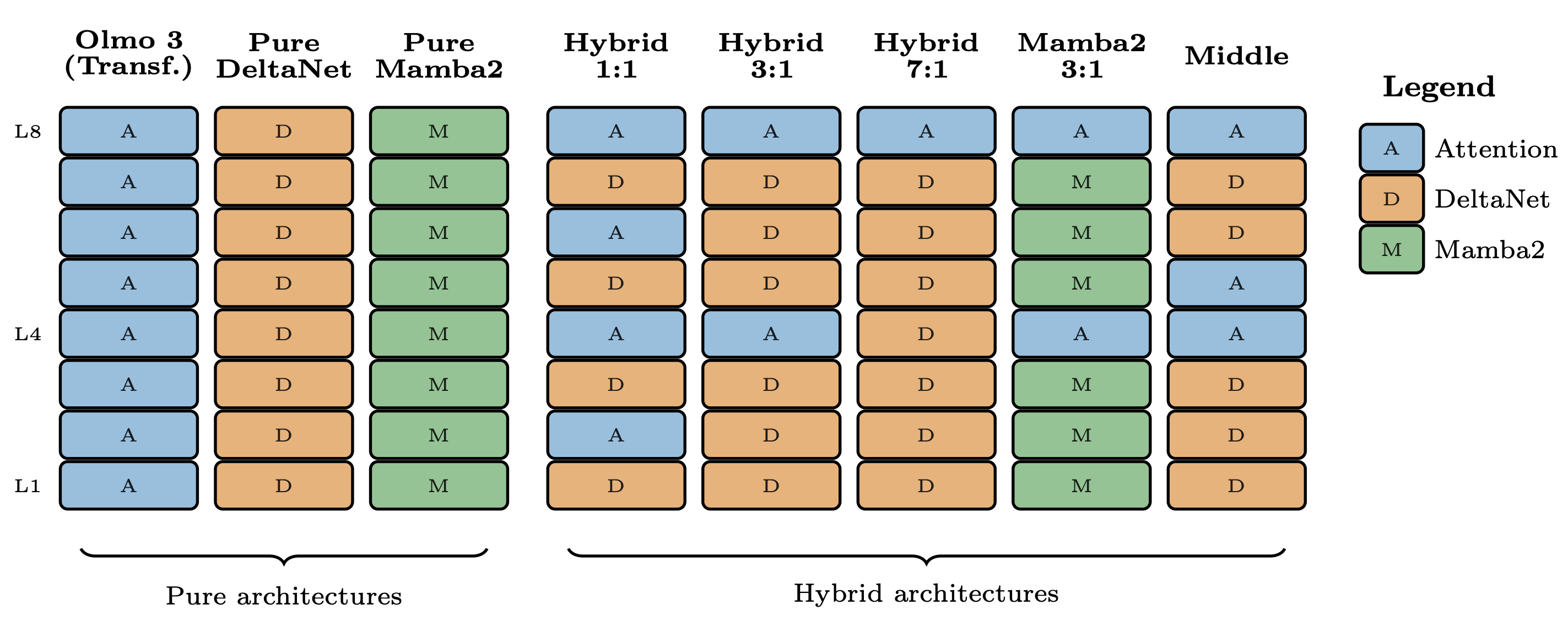
Olmo Hybrid and future LLM architectures
Mar 500:11:21Tap to summarizeSo-called hybrid architectures are far from new in open-weight models these days. We now have the recent Qwen 3.5 (previewed by Qwen3-Next), Kimi Linear last fall (a smaller release than their flagship Kimi K2 models), Nvidia’s Nemotron 3 Nano (with the bigger models expecting to drop soon), IBM Granite 4, and other less notable models. This is one of those times when a research trend looks like it’s getting adopted everywhere at once (maybe the Muon optimizer too, soon?).To tell this story, we need to go back a few years to December 2023, when Mamba and Striped Hyena were taking the world by storm — asking the question: Do we need full attention in our models? These early models fizzled out, partially for the same reasons they’re hard today — tricky implementations, open-source tool problems, more headaches in training — but also because the models fell over a bit when scaled up. The hybrid models of the day weren’t quite good enough yet.These models are called hybrid because they mix these new recurrent neural network (RNN) modules with the traditional attention that made the transformer famous. They all work best with this mix of modules. The RNN layers keep part of the computation compressed in a hidden state to be used for the next token in the prediction — a summary of all information that came before — an idea that has an extremely long historical lineage in deep learning, e.g. back to the LSTM. This setup avoids the quadratic compute cost of attention (i.e. avoiding the incrementally expanding the KV cache per token of the attention operator), and can even assist in solving new problems.The models listed to start this article use a mix of RNN approaches, some models (Qwen and Kimi) use a newer idea called Gated DeltaNet (GDN) and some still use Mamba layers (Granite and Nemotron). The Olmo Hybrid model we’re releasing today also falls on the GDN side, based on careful experimentation, and theory that GDN is capable of learning features that attention or Mamba layers cannot.Introducing Olmo Hybrid and its pretraining efficiencyOlmo Hybrid is a 7B base model, with 3 experiment post-trained checkpoints released — starting with an Instruct model, with a reasoning model coming soon. It is the best open artifact for studying hybrid models, as it is almost identical to our Olmo 3 7B model from last fall, just with a change in architecture. With the model, we are releasing a paper with substantial theory on why hybrid models can be better than standard transformers. This is a long paper that I’m still personally working through, but it’s excellent. You can read the paper here and poke around with the checkpoints here. This is an incredible, long-term research project led by Will Merrill. He did a great job.To understand the context of why hybrid models can be a strict upgrade on transformers, let me begin with a longer excerpt from the paper’s introduction, emphasis mine:Past theoretical work has shown that attention and recurrence have complementary strengths (Merrill et al., 2024; Grazzi et al., 2025), so mixing them is a natural way to construct an architecture with the benefits of both primitives. We further derive novel theoretical results showing that hybrid models are even more powerful than the sum of their parts: there are formal problems related to code evaluation that neither transformers nor GDN can express on their own, but which hybrid models can represent theoretically and learn empirically. But this greater expressivity does not immediately imply that hybrid models should be better LMs: thus, we run fully controlled scaling studies comparing hybrid models vs. transformers, showing rigorously that hybrid models’ expressivity translates to better token efficiency, in agreement with our observations from the Olmo Hybrid pretraining run. Finally, we provide a theoretical explanation for why increasing an architecture’s expressive power should improve language model scaling rooted in the multi-task nature of the language modeling objective.Taken together, our results suggest that hybrid models dominate transformers, both theoretically, in their balance of expressivity and parallelism, and empirically, in terms of benchmark performance and long-context abilities. We believe these findings position hybrid models for wider adoption and call on the research community to pursue further architecture research.Essentially, we show and argue a few things:* Hybrid models are more expressive. They can form their outputs to learn more types of functions. An intuition for why this would be good could follow: More expressive models are good with deep learning because we want to make the model class as flexible as possible and let the optimizer do the work rather than constraints on the learner. Sounds a lot like the Bitter Lesson.* Why does expressive power help with efficiency? This is where things are more nuanced. We argue that more expressive models will have better scaling laws, following the quantization model of neural scaling.All of this theory work is a great way to go deeper, and frankly I have a lot more to learn on it, but the crucial part is that we transition from theory to clear experiments that back it up. Particularly the scaling laws for designing this model were studied carefully to decide on the final hybrid architecture. The final performance is very sensitive to exactly which RNN block is used and in what quantity.In scaling experiments, the results showed that for Olmo, the hybrid GDN (3:1 ratio of layers) > pure GDN (all RNN layers) > standard transformer (all attention) > hybrid Mamba2 > pure Mamba2. The crucial point was that these gaps maintained when scaling to more parameters and compute. A visual summary of the different types of architectures studied is below.In terms of this specific model, the pretraining gains were giant! Relative to Olmo 3 dense, it represents an about 2X gain on training efficiency. When you look at evaluation performance for pretraining, there was also substantial improvement in performance, particularly after long context extension (the final 2 rows of Table 2 in the paper, highlighted below).The journey to post-training Olmo HybridMost of the experience in post-training Olmo models has been climbing up a steep curve in base model capabilities with minor tweaks to architecture. Our recipes from Tulu 2, Tulu 3, and the Olmo 3 reasoning work (building substantially on OpenThoughts 3) all worked in a fairly straightforward, off the shelf manner. Olmo Hybrid is our first experience in post-training a substantially different architecture, and the results were mixed. 1. Benchmark performanceFollowing the Olmo 3 recipe, we got some substantial wins (knowledge) and some substantial losses (extended reasoning) relative to the dense model. All together these still represent a very strong fully open model — just that the pretraining gains didn’t translate as obviously. The results are below.The exact reason why this happens is a research question. Our best guess is that the Olmo Hybrid base model is just a sufficiently different student model, where most of our post training data at early stages is learning from stronger “teacher” models (a recap of this method, called distillation, appeared recently in Interconnects). There is a lot of other research ongoing in the community around what makes a strong teacher model — generally, the best overall model is not the best teacher. In other words, training on data outputted from the model with best evaluation scores today is unlikely to unlock the ceiling in performance for your new base model. A second factor, which is even less explored, is how different base models likely need different teachers to learn from. This is why Olmo Hybrid could perform very differently, where it’s behavior is downstream of an architecture-based learning change, where the pretraining data is almost identical.There’s A LOT more work to dig into here, some empirical work in generating better data and other work in understanding how <a target="_blank" href="https://x.com/_emliu/status/2026359480363913531?s=46&t=0Enn1cSa9nnKjGPrLHWf...
Transcribe →
How much does distillation really matter for Chinese LLMs?
Feb 2400:11:20Tap to summarizeDistillation has been one of the most frequent topics of discussion in the broader US-China and technological diffusion story for AI. Distillation is a term with many definitions — the colloquial one today is using a stronger AI model’s outputs to teach a weaker model. The word itself is derived from a more technical and specific definition of knowledge distillation (Hinton, Vinyals, & Dean 2015), which involves a specific way of learning to match the probability distribution of a teacher model.The distillation of today is better described generally as synthetic data. You take outputs from a stronger model, usually via an API, and you train your model to predict those. The technical form of knowledge distillation is not actually possible from API models because they don’t expose the right information to the user.Synthetic data is arguably the single most useful method that an AI researcher today uses to improve the models on a day to day basis. Yes, architecture is crucial, some data still needs exclusively human inputs, and new ideas like reinforcement learning with verifiable rewards at scale can transform the industry, but so much of the day to day life in improving models today is figuring out how to properly capture and scale up synthetic data.To flesh out the point from the start of this piece, the argument has repeatedly been that the leading Chinese labs are using distillation for their models to steal capabilities from the best American API-based counterparts. The most prominent case to date was surrounding the release of DeepSeek R1 — where OpenAI accused DeepSeek of stealing their reasoning traces by jailbreaking the API (they’re not exposed by default — for context, a reasoning trace is a colloquial word of art referring to the internal reasoning process, such as what open weight reasoning models expose to the user). Fear of distillation is also likely why Gemini quickly flipped from exposing the reasoning traces to users to hiding them. There was even very prominent, early reasoning research that built on Gemini!This all leads us to today’s news, where Anthropic named and directly accused a series of Chinese labs for elaborate distillation campaigns on their Claude models. This is a complex issue. In this post we unpack a series of questions, beginning with the impact, and ending with politics. The core question is — how much of a performance benefit do Chinese labs get from distilling from American models.Interconnects AI is a reader-supported publication. Consider becoming a subscriber.To start, let’s review what Anthropic shared. From the blog post, emphasis mine:We have identified industrial-scale campaigns by three AI laboratories—DeepSeek, Moonshot, and MiniMax—to illicitly extract Claude’s capabilities to improve their own models. These labs generated over 16 million exchanges with Claude through approximately 24,000 fraudulent accounts, in violation of our terms of service and regional access restrictions.These labs used a technique called “distillation,” which involves training a less capable model on the outputs of a stronger one. Distillation is a widely used and legitimate training method. For example, frontier AI labs routinely distill their own models to create smaller, cheaper versions for their customers. But distillation can also be used for illicit purposes: competitors can use it to acquire powerful capabilities from other labs in a fraction of the time, and at a fraction of the cost, that it would take to develop them independently.Much like the models themselves, the benefits of distillation are very jagged. For some capabilities, particularly if you don’t have a full training pipeline setup for it, quickly distilling some data from the leading frontier model in that area can yield massive performance boosts. This can definitely help the lab distilling from the API catch up much more quickly than they otherwise would. Most distillation is rather benign, using many tokens of an LLM to help process and refine existing data — putting a lot of compute into getting a few, high quality training tokens out. This sort of raw data processing work can be done on many different APIs, but one tends to be best.When we go into what Anthropic says the three Chinese LLM builders actually used the Claude API for — as an aside, Anthropic didn’t confirm that the attack was done through the API, the chat app, or Claude Code — the actual impact of the operations is very mixed. It’s hard to know how much untracked usage these labs deployed for other projects (or other American models).To start, Anthropic puts DeepSeek first in their blog post because they’re the household name in the US for Chinese AI. The extent of their use is actually quite small, showing how this post is more about the big picture than the details:DeepSeekScale: Over 150,000 exchangesThe operation targeted:* Reasoning capabilities across diverse tasks* Rubric-based grading tasks that made Claude function as a reward model for reinforcement learning* Creating censorship-safe alternatives to policy sensitive queriesIn the scale of training a language model, 150K samples is only scratching the surface as a substantive experiment. It looks like they were experimenting with some rubrics, which could’ve been for an online RL run, but that’s extremely unlikely with how distributed the access was, and then some minor stuff on completions for sensitive queries. This usage of Anthropic’s API will have a negligible impact on DeepSeek’s long-rumored V4 model (or whichever model the data here contributed to). This was also very likely a small team at DeepSeek and unknown to much of the broader training organization.The other two labs, Moonshot AI (makers of the Kimi models) and MiniMax reflected much broader usage.Moonshot AIScale: Over 3.4 million exchangesThe operation targeted:* Agentic reasoning and tool use* Coding and data analysis* Computer-use agent development* Computer visionMiniMaxScale: Over 13 million exchangesThe operation targeted:* Agentic coding* Tool use and orchestrationThe role of distillation is constantly changing. Distilling from Claude today for its agentic behavior is much more valuable than versions of Claude have been as a teacher in the past. Claude Opus 4.6 has a well-rounded agentic navigation that none of the other models quite match. Why not try training on some of the model outputs to see if your model absorbs it? Over the next few months, that’ll be less differentiated. It’s sort of like how all the models are way better at math today than most people need — there are plenty of places to distill from.Estimates will vary, but if each response had 10-25K tokens per exchange, the total tokens across these two labs, mostly with MiniMax, would be 150-400 billion tokens. This is a substantial amount, which could meaningfully improve a models’ post-training. For example, in Olmo 3 we had an SFT dataset of 20 billion tokens that could be built like this, and increasing it by 10X would be very reasonable.These numbers are just scratching the surface of total synthetic data generation across APIs hosted by US companies. At the same time, quantity is a pretty crude way to measure impact. Just taking the outputs from Claude and figuring out how to add them to your model pipeline isn’t easy. The research community has seen many cases where taking outputs from a certain teacher model unexpectedly makes the student worse — subtle interactions between the data make it variable and tricky to do this type of distillation. It’s fundamentally a research problem.This is what I’m sure the Chinese labs are innovating at. There’s an argument that Chinese frontier labs are substantially more efficient than their Western counterparts — this is misleading.The labs operate under different constraints. The Chinese labs are likely slightly more efficient out of necessity in being lower on resources, but overall the picture of talent access is very similar. The Chinese labs also approach benchmarks differently, making it appear that they’re a bit closer than they really are (and appearing as if they’re potentially surpassing). This is needed to get momentum and brand recognition in the AI market.The Chinese labs likely innovate greatly on distilling from leading API models, due to their restricted access to GPUs. GPUs could be used to construct synthetic data, but for organizations with more funding than they can spend on research compute (being supply limited), using API-based models is one of the few other options...
Transcribe →
Opus 4.6, Codex 5.3, and the post-benchmark era
Feb 900:08:09Tap to summarizeLast Thursday, February 5th, both OpenAI and Anthropic unveiled the next iterations of their models designed as coding assistants, GPT-5.3-Codex and Claude Opus 4.6, respectively. Ahead of this, Anthropic had a firm grasp of the mindshare as everyone collectively grappled with the new world of agents, primarily driven by a Claude Code with Opus 4.5-induced step change in performance. This post doesn’t unpack how software is changing forever, Moltbook is showcasing the future, ML research is accelerating, and the many broader implications, but rather how to assess, live with, and prepare for new models. The fine margins between Opus 4.6 and Codex 5.3 will be felt in many model versions this year, with Opus ahead in this matchup on usability.Going into these releases I’d been using Claude Code extensively as a general computer agent, with some software engineering and a lot of data analysis, automation, etc. I had dabbled with Codex 5.2 (usually on xhigh, maximum thinking effort), but found it not to quite work for me among my broad, horizontal set of tasks.For the last few days, I’ve been using both of the models much more evenly. I mean this as a great compliment, but Codex 5.3 feels much more Claude-like, where it’s much faster in its feedback and much more capable in a broad suite of tasks from git to data analysis (previous versions of Codex, including up to 5.2, regularly failed basic git operations like creating a fresh branch). Codex 5.3 takes a very important step towards Claude’s territory by having better product-market fit. This is a very important move for OpenAI and between the two models, Codex 5.3 feels far more different than its predecessors.OpenAI’s latest GPT, with this context, keeps an edge as a better coding model. It’s hard to describe this general statement precisely, and a lot of it is based on reading others’ work, but it seems to be a bit better at finding bugs and fixing things in codebases, such as the minimal algorithmic examples for my RLHF Book. In my experience, this is a minor edge, and the community thinks that this is most apparent in complex situations (i.e. not most vibe-coded apps). As users become better at supervising these new agents, having the best top-end ability in software understanding and creation could become a meaningful edge for Codex 5.3, but it is not an obvious advantage today. Many of my most trusted friends in the AI space swear by Codex because it can be just this tiny bit better. I haven’t been able to unlock it.Switching from Opus 4.6 to Codex 5.3 feels like I need to babysit the model in terms of more detailed descriptions when doing somewhat mundane tasks like “clean up this branch and push the PR.” I can trust Claude to understand the context of the fix and generally get it right, where Codex can skip files, put stuff in weird places, etc.Both of these releases feel like the companies pushing for capabilities and speed of execution in the models, but at the cost of some ease of use. I’ve found both Opus 4.6 and Codex 5.3 ignoring an instruction if I queue up multiple things to do — they’re really best when given well-scoped, clear problems (especially Codex). Claude Code’s harness has a terrible bug that makes subagents brick the terminal, where new messages say you must compact or clear, but compaction fails. Despite the massive step by Codex, they still have a large gap to close to Claude on the product side. Opus 4.6 is another step in the right direction, where Claude Code feels like a great experience. It’s approachable, it tends to work in the wide range of tasks I throw at it, and this’ll help them gain much broader adoption than Codex. If I’m going to recommend a coding agent to an audience who has limited-to-no software experience, it’s certainly going to be Claude. At a time when agents are just emerging into general use, this is a massive advantage, both in mindshare and feedback in terms of usage data.In the meantime, there’s no cut-and-dried guideline on which agent you need to use for any use-case, you need to use multiple models all the time and keep up with the skill that is managing agents. Interconnects AI is a reader-supported publication. Consider becoming a subscriber.Assessing models in 2026There have been many hints through 2025 that we were heading toward an AI world where benchmarks associated with model releases no longer convey meaningful signal to users. Back in the time of the GPT-4 or Gemini 2.5 Pro releases, the benchmark deltas could be easily felt within the chatbot form factor of the day — models were more reliable, could do more tasks, etc. This continued through models like OpenAI’s o3. During this phase of AI’s buildout, roughly from 2023 to 2025, we were assembling the core functionality of modern language models: tool-use, extended reasoning, basic scaling, etc. The gains were obvious.It should be clear with the releases of both Opus 4.6 and Codex 5.3 that benchmark-based release reactions barely matter. For this release, I barely looked at the evaluation scores. I saw that Opus 4.6 had a bit better search scores and Codex 5.3 used far fewer tokens per answer, but neither of these were going to make me sure they were much better models. Each of the AI laboratories, and the media ecosystems covering them, have been on this transition away from standard evaluations at their own pace. The most telling example is the Gemini 3 Pro release in November of 2025. The collective vibe was Google is back in the lead. Kevin Roose, self-proclaimed “AGI-pilled” NYTimes reporter in SF said:There's sort of this feeling that Google, which kind of struggled in AI for a couple of years there — they had the launch of Bard and the first versions of Gemini, which had some issues — and I think they were seen as sort of catching up to the state of the art. And now the question is: is this them taking their crown back?We don’t need to dwell on the depths of Gemini’s current crisis, but they have effectively no impact at the frontier of coding agents, which as an area feels the most likely for dramatic strides in performance — dare I say, even many commonly accepted definitions of AGI that center around the notion of a “remote worker?” The timeline has left them behind 2 months after their coronation, showing Gemini 3 was hailed as a false king.On the other end of the spectrum is Anthropic. With Anthropic’s release of Claude 4 in May of 2025, I was skeptical of their bet on code — I was distracted by the glitz of OpenAI and Gemini trading blows with announcements like models achieving IMO Gold medals in mathematics or other evaluation breakthroughs.Anthropic deserves serious credit for the focus of its vision. They were likely not the only AI lab to note the coming role of agents, but they were by far the first to shift their messaging and prioritization towards this. In my post in June of 2025, a month after Claude 4 was released, I was coming around to them being right to deprioritize standard benchmarks:This is a different path for the industry and will take a different form of messaging than we’re used to. More releases are going to look like Anthropic’s Claude 4, where the benchmark gains are minor and the real world gains are a big step. There are plenty of more implications for policy, evaluation, and transparency that come with this. It is going to take much more nuance to understand if the pace of progress is continuing, especially as critics of AI are going to seize the opportunity of evaluations flatlining to say that AI is no longer working.This leaves me reflecting on the role of Interconnects’ model reviews in 2026. 2025 was characterized by many dramatic, day-of model release blog posts, with the entry of many new Chinese open model builders, OpenAI’s first open language model since GPT-2, and of course the infinitely hyped GPT-5. These timely release posts still have great value — they center the conversation around the current snapshot of a company vis-a-vis the broader industry, but if models remain similar, they’ll do little to disentangle the complexity in mapping the current frontier of AI. In order to serve my role as an independent voice tracking the frontier models, I need to keep providing regular updates on how I’m using models, why, and why not. Over time, the industry is going to develop better ways of articulating the differences in agentic models. For the next few months, maybe even years, I expect the pace of progress to be so fast and uneven in agentic capabilities, that consistent testing and clear articulation will be the only way to monit...
Transcribe →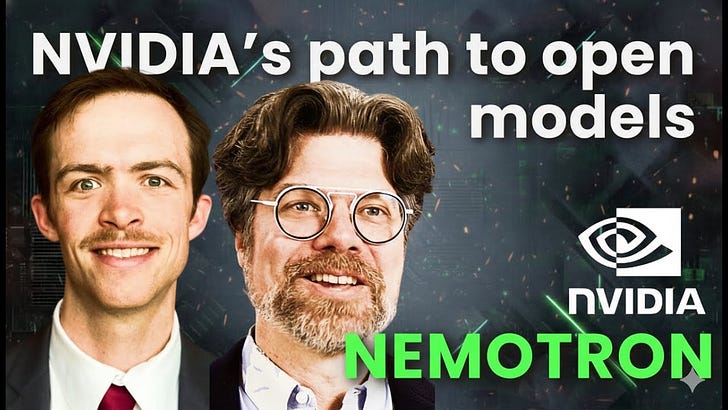
Why Nvidia builds open models with Bryan Catanzaro
Feb 401:07:42Tap to summarizeOne of the big stories of 2025 for me was how Nvidia massively stepped up their open model program — more releases, higher quality models, joining a small handful of companies releasing datasets, etc. In this interview, I sat down with one of the 3 VP’s leading the effort of 500+ technical staff, Bryan Catanzaro, to discuss:* Their very impressive Nemotron 3 Nano model released in Dec. 2025, and the bigger Super and Ultra variants coming soon,* Why Nvidia’s business clearly benefits from them building open models,* How the Nemotron team culture was crafted in pursuit of better models,* Megatron-LM and the current state of open-source training software,* Career reflections and paths into AI research,* And other topics.The biggest takeaway I had from this interview is how Nvidia understands their unique roll as a company that and both build and directly capture the value they get from building open language models, giving them a uniquely sustainable advantage. Bryan has a beautiful analogy for open models this early in AI’s development, and how they are a process of creating “potential energy” for AI’s future applications.I hope you enjoy it!Guest: Bryan Catanzaro, VP Applied Deep Learning Research (ADLR), NVIDIA. X: @ctnzr, LinkedIn, Google Scholar.Listen on Apple Podcasts, Spotify, YouTube, and where ever you get your podcasts. For other Interconnects interviews, go here.Nemotron Model Timeline2019–2022 — Foundational Work* Megatron-LM (model parallelism framework that has become very popular again recently; alternatives: DeepSpeed, PyTorch FSDP). * NeMo Framework (NVIDIA’s end-to-end LLM stack: training recipes, data pipelines, evaluation, deployment).Nov 2023 — Nemotron-3 8B: Enterprise-ready NeMo models. Models: base, chat-sft, chat-rlhf, collection. Blog.Feb 2024 — Nemotron-4 15B: Multilingual LLM trained to 8T tokens. Paper.Jun 2024 — Nemotron-4 340B: Major open release detailing their synthetic data pipeline. Paper, blog. Models: Instruct, Reward. Jul–Sep 2024 — Minitron / Nemotron-Mini: First of their pruned models, pruned from 15B. Minitron-4B (base model), Nemotron-Mini-4B-Instruct. Paper, code.Oct 2024 — Llama-3.1-Nemotron-70B: Strong post-training on Llama 3.1 70B. Model, collection. Key dataset — HelpSteer2, paper.Mar–Jun 2025 — Nemotron-H: First hybrid Mamba-Transformer models for inference efficiency. Paper, research page, blog. Models: 8B, 47B, 4B-128K.May 2025 — Llama-Nemotron: Efficient reasoning models built ontop of Llama (still!). Paper.Sep 2025 — Nemotron Nano 2: 9B hybrid for reasoning, continuing to improve in performance. 12B base on 20T tokens (FP8 training) pruned to 9B for post-training. Report, V2 collection.Nov 2025 — Nemotron Nano V2 VL: 12B VLM. Report.Dec 2025 — Nemotron 3: Nano/Super/Ultra family, hybrid MoE, up to 1M context. Super/Ultra H1 2026. Nano: 25T tokens, 31.6B total / ~3.2B active, releases recipes + code + datasets. Papers: White Paper, Technical Report. Models: Nano-30B-BF16, Base, FP8.Nemotron’s Recent DatasetsNVIDIA began releasing substantially more data in 2025, including pretraining datasets — making them one of few organizations releasing high-quality pretraining data at scale (which comes with non-negligible legal risk).Pretraining DataCollection — CC-v2, CC-v2.1, CC-Code-v1, Code-v2, Specialized-v1, CC-Math-v1. Math paper: arXiv:2508.15096.Post-Training DataCore post-training dumps (SFT/RL blends):* Llama Nemotron Post-Training v1.1 (Apr 2025)* Nemotron Post-Training v1 (Jul 2025)* Nemotron Post-Training v2 (Aug 2025)2025 reasoning/code SFT corpora:* OpenMathReasoning (Apr 2025)* OpenCodeReasoning (Apr 2025), OpenCodeReasoning-2 (May 2025)* AceReason-1.1-SFT (Jun 2025)* Nemotron-Math-HumanReasoning (Jun 2025), Nemotron-PrismMath (Apr 2025)NeMo Gym RLVR datasets: CollectionNemotron v3 post-training (Dec 2025):<a target="_blank" href="https://hugg...
Transcribe →
Thoughts on the job market in the age of LLMs
Jan 3000:10:41Tap to summarizeThere’s a pervasive, mutual challenge in the job market today for people working in (or wanting to work in) the cutting edge of AI. On the hiring side, it often feels impossible to close, or even get interest from, the candidates you want. On the individual side, it quite often feels like the opportunity cost of your current job is extremely high — even if on paper the actual work and life you’re living is extremely good — due to the crazy compensation figures.For established tech workers, the hiring process in AI can feel like a bit of a constant fog. For junior employees, it can feel like a bit of a wall.In my role as a bit of a hybrid research lead, individual contributor, and mentor, I spend a lot of time thinking about how to get the right people for me to work with and the right jobs for my mentees.The advice here is shaped by the urgency of the current moment in LLMs. These are hiring practices optimized for a timeline of relevance that may need revisiting every 1-2 years as the core technology changes — which may not be best for long-term investment in people, the industry, or yourself. I’ve written separately about the costs of this pace, and don’t intend to carry this on indefinitely.The most defining feature of hiring in this era is the complexity and pace of progress in language models. This creates two categories. For one, senior employees are much more covetable because they have more context of how to work in and steer complex systems over time. It takes a lot of perspective to understand the right direction for a library when your team can make vastly more progress on incremental features given AI agents. Without vision, the repositories can get locked with too many small additions. With powerful AI tools I expect the impact of senior employees to grow faster than adding junior members to the team could. This view on the importance of key senior talent has been a recent swing, given my experiences and expectations for current and future AI agents, respectively:Every engineer needs to learn how to design systems. Every researcher needs to learn how to run a lab. Agents push the humans up the org chart.On the other side, junior employees have to prove themselves in a different way. The number one defining trait I look for in a junior engineering employee is an almost fanatical obsession with making progress, both in personal understanding and in modeling performance. The only way to learn how the sausage gets made is to do it, and to catch up it takes a lot of hard work in a narrow area to cultivate ownership. With sufficient motivation, a junior employee can scale to impact quickly, but without it, it’s almost replaceable with coding agents (or will be soon). This is very hard work and hard to recruit for. The best advice I have on finding these people is “vibes,” so I am looking for advice on how to find them too!For one, when I brought Florian Brand on to help follow open models for Interconnects, when I first chatted with him he literally said “since ChatGPT came out I’ve been fully obsessed with LLMs.” You don’t need to reinvent the wheel here — if it’s honest, people notice.For junior researchers, there’s much more grace, but that’s due to them working in an education institution first and foremost, instead of the understatedly brutal tech economy. A defining feature that creates success here is an obsession with backing up claims. So a new idea improves models, why? So our evaluation scores are higher, what does this look like in our harness? Speed of iteration follows from executing on this practice. Too many early career researchers try to build breadth of impact (e.g. collecting contributions on many projects) before clearly demonstrating, to themselves and their advisors, depth. The best researchers then bring both clarity of results and velocity in trying new ideas.Working in academia today is therefore likely to be a more nurturing environment for junior talent, but it comes with even greater opportunity costs financially. I’m regularly asked if one should leave a Ph.D. to get an actual job, and my decision criteria is fairly simple. If you’re not looking to become a professor and have an offer to do modeling research at a frontier lab (Gemini, Anthropic, OpenAI is my list) then there’s little reason to stick around and finish your Ph.D.The little reason that keeps people often ends up being personal pride in doing something hard, which I respect. It’s difficult to square these rather direct pieces of career advice with my other recommendations of choosing jobs based on the people, as you’ll spend a ton of your life with them, more than the content of what you’ll be doing. Choosing jobs based on people is one of the best ways to choose your job based on the so-called “vibes.”Working in a frontier lab in product as an alternative to doing a Ph.D. is a path to get absorbed in the corporate machine and not stand out, reducing yourself to the standard tech career ladder. Part of what I feel like works so well for me, and other people at Ai2, is having the winning combination of responsibility, public visibility, and execution in your work. There is something special for career progression that comes from working publicly, especially when the industry is so closed, where people often overestimate your technical abilities and output. Maybe this is just the goodwill that comes from open-source contributions paying you back.If you go to a closed lab, visibility is almost always not possible, so you rely on responsibility and execution. It doesn’t matter if you execute if you’re doing great work on a product or model that no one ever touches. Being in the core group matters.This then all comes back to finding the people hiring pipeline.There are many imperfect signals out there, both positive and negative. For individuals building their portfolio, it’s imperative to avoid negative signals because the competition for hiring is so high. A small but clear negative signal is a junior researcher being a middle author on too many papers. Just say no, it helps you.The positive signals are messier, but still doable. It’s been said that you can tell someone is a genius by reading one Tweet from them, and I agree with this. The written word is still an incredibly effective and underutilized communication form. One excellent blog post can signify real, rare understanding. The opposite holds true for AI slop. One AI slop blog post will kill your application.The other paths I often advise people who reach out asking how to establish a career in AI are open-source code contributions or open research groups (e.g. EluetherAI). I’ve seen many more success cases on the former, in open-source code. Still, it’s remarkably rare, because A) most people don’t have the hardware to add meaningful code to these popular LLM repositories and B) most people don’t stick with it long enough. Getting to the point of making meaningful contributions historically has been very hard.Doing open-source AI contributions could be a bit easier in the age of coding agents, as a lot of the limiting factors today are just bandwidth in implementing long todo lists of features, but standing out amid the sea of AI slop PRs and Issues will be hard. That’ll take class, creativity, humanity, and patience. So, to be able to run some tiny models on a $4000 DGX Spark is an investment, but it’s at least somewhat doable to iterate on meaningful code contributions to things like HuggingFace’s ML libraries (I’ve been writing and sharing a lot about how I’m using the DGX Spark to iterate on our codebases at Ai2).Back to the arc of hiring, the above focused on traits, but the final piece of the puzzle is alignment. The first question to ask is “is this person good?” The second question is, “will this person thrive here?” Every organization has different constraints, but especially in small teams, the second question defines your culture. In a startup, if you grow too fast you definitely lose control of your culture. This isn’t to say that the company won’t have a strong or useful culture, it’s to say you can’t steer it. The culture of an organization is the byproduct of how all the individuals interact. You do not want to roll the dice here.Interconnects AI is a reader-supported publication. Consider becoming a subscriber.Personally, I’m working on building out a few more spots in a core post-training methods team at Ai2. Post-training recipes have gotten very complicated, and we’re working on making them easier to run while doing research on fundamentals such as post-training data mixing and scaling laws. To be a little vague, getting the post-training recipes done for both Olmo 3 and Olmo 2 was... very hard on the team. At the same time, post-training hasn’t gotten much more open, so hiring through it and doing the hard work is the only way.Ideally I would hire one engineer and one researcher, both fairly senior, meaning at least having a Ph.D. or a similar number of years working in technology. Junior engineers with some experience and the aforementioned obsession would definitely work.This callout serves as a good lesson for hiring. It is intentional that people should self-filter for this, no one likes when you way overreach on selling yourself for a job. I also intentionally make people find my email for thi...
Transcribe →
Contra Dwarkesh on Continual Learning
Aug 15, 2025Tap to summarizeDwarkesh Patel’s now well-read post on why he is extending his AI timelines focuses on the idea of continual learning. If you ask me, what we have already is AGI, so the core question is: Is continual learning a bottleneck on AI progress?In this post, I argue that continual learning as he describes it actually doesn’t matter for the trajectory of AI progress that we are on. Continual learning will eventually be solved, but in the sort of way that a new type of AI will emerge from it, rather than continuing to refine what it means to host ever more powerful LLM-based systems. Continual learning is the ultimate algorithmic nerd snipe for AI researchers, when in reality all we need to do is keep scaling systems and we’ll get something indistinguishable from how humans do it, for free.To start, here’s the core of the Dwarkesh piece as a refresher for what he means by continual learning.Sometimes people say that even if all AI progress totally stopped, the systems of today would still be far more economically transformative than the internet. I disagree. I think the LLMs of today are magical. But the reason that the Fortune 500 aren’t using them to transform their workflows isn’t because the management is too stodgy. Rather, I think it’s genuinely hard to get normal humanlike labor out of LLMs. And this has to do with some fundamental capabilities these models lack.I like to think I’m “AI forward” here at the Dwarkesh Podcast. I’ve probably spent over a hundred hours trying to build little LLM tools for my post production setup. And the experience of trying to get them to be useful has extended my timelines. I’ll try to get the LLMs to rewrite autogenerated transcripts for readability the way a human would. Or I’ll try to get them to identify clips from the transcript to tweet out. Sometimes I’ll try to get them to co-write an essay with me, passage by passage. These are simple, self contained, short horizon, language in-language out tasks - the kinds of assignments that should be dead center in the LLMs’ repertoire. And they're 5/10 at them. Don’t get me wrong, that’s impressive.But the fundamental problem is that LLMs don’t get better over time the way a human would. The lack of continual learning is a huge huge problem. The LLM baseline at many tasks might be higher than an average human's. But there’s no way to give a model high level feedback. You’re stuck with the abilities you get out of the box. You can keep messing around with the system prompt. In practice this just doesn’t produce anything even close to the kind of learning and improvement that human employees experience.The core issue I have with this argument is the dream of making the LLMs we’re building today look more like humans. In many ways I’m surprised that Dwarkesh and other very AGI-focused AI researchers or commentators believe this — it’s the same root argument that AI critics use when they say AI models don’t reason. The goal to make AI more human is constraining the technological progress to a potentially impossible degree. Human intelligence has long been the inspiration for AI, but we have long surpassed it being the mirror we look to for inspiration. Now the industry is all in on the expensive path to make the best language models it possibly can. We’re no longer trying to build the bird, we’re trying to transition the Wright Brothers’ invention into the 737 in the shortest time frame possible.To put it succinctly. My argument very much rhymes with some of my past writing. Do language models reason like humans? No. Do language models reason? Yes. Will language model systems continually learn like humans? No.Will language model systems continually learn? Of course.Interconnects is a reader-supported publication. Consider becoming a subscriber.Dwarkesh writes “Rather, I think it’s genuinely hard to get normal humanlike labor out of LLMs.” This is because we’re still early on the buildout of the technology. Human labor takes an immense amount of context and quick thinking, both of which we’re starting to unlock with our language models. On top of this, human labor may not be what we want to create — we want to augment it. Using LLMs as drop in replacements for humans is not a requirement for AGI nor is what Dwarkesh describes a fundamental limitation on AI progress. Francois Chollet cleverly poked at this weakness in his recent conversation with Dwarkesh at an ARC-AGI event:Well, how do you define the difference between the ability to adapt to a new task and learning on the fly? It's, it sounds like the same thing to me.Language models can already pick up subtle context extremely fast. ChatGPT’s memory feature has gotten far better for me. When we’re using the far more powerful models we can expect in the next 18 months this’ll already start to appear magical. Language models are extremely apt at inferring context even without us giving it to them. Soon we’ll be unlocking that subtle connection engine by providing immense, explicit context. I don’t know of anyone who has actually thoroughly digitized all the relevant context of their job and formatted it in a way that is easily readable by an LLM. GPT-5 Pro estimates that all of the writing on Interconnects would be only 500K tokens. That would fit into an existing LLM with no extra system, but I’ve never tried it.The problem that Dwarkesh is facing is that we’re still using LLMs primarily in a single generation manner, which got far better with the introduction of reasoning models, but the economically useful way to use current tools in more complex intellectual domains will require a deep-research style approach over all of your recent work interactions. No one is giving language models that kind of context. None of the tools we use are set up properly to accumulate this type of context.I expect this to change rapidly. ChatGPT, Claude, and the likes are all adding memory features across chats and countless connectors to other pieces of information in your professional life. These memory features will be omnimodal and essential to extracting the type of value Dwarkesh wants. Without them, I agree language models in their current form are hopeless at solving continual learning.This is what I would expect the rumored $2000/month ChatGPT level subscriptions to work with. Each of these bespoke tasks needs to absorb a ton of context and reasoning tokens in order to make a directionally right output. If someone built the Claude Code equivalent for my Substack, with every post tagged by topic and performance metrics, I bet the AI could easily make useful suggestions on how to format my content.Continual learning in how Dwarkesh presents it is a systems problem rather than a learning problem. I expect better context management over my information ecosystem to exist in 2026, but more work to be needed for the AI companies to know how best to reference it and unlock in-context learning that feels like rapid adaptation. Call that 2027.The models that have been released in 2025 will make this far more tractable in the near future. Reasoning models have made in-context learning far more powerful, resulting in rapid progress on held-out and complex domains such as ARC-AGI. These models also have come with massive improvements in context length. Claude and Gemini have 1M+ token context lengths and GPT-5’s is at 400K — they’re all growing steadily. What is important with the context length numbers is that evaluations are showing that these are meaningful improvements that the models can leverage intelligently.With these reasoning models and smart retrieval of context, the systems we are building will look indistinguishable from continual learning. This will definitely be multiple LLMs working together and will operate very differently than the first versions of ChatGPT we were given (and often still use today).The path to continual learning is more context and more horsepower. This is directly in line with the direction AI investment is going. This doesn’t feel like a bottleneck, rather another product problem that we are going to solve. This sort of continual learning may not enable the type of raw intelligence and autonomy that many vocal leaders in AI describe as “superintelligence.” Training models to be smarter on even more complex tasks — e.g. novel biological research — requires mastering agentic behaviors that need to be learned from scratch, as discussed in my post on “What comes next with RL”. There’s no internet scale pretraining data for such agentic tasks. My point is that not all jobs that require continual learning will require the frontiers of intelligence. I’m excited to write blog posts with the bliss of my ChatGPT 6 co-editor.This technology coming soon will not be without its challenges. My first reaction to the continual learning post was more in line with “society isn’t ready for this” rather than commentary on its feasibility. I’ll repeat my warning:For a long...
Transcribe →