
Podcast
Intersect Ed
Hosted by Raise Your Hand Texas · EN
Where the stories of Texas public education policy and practice meet.
15episodes
Episodes
Newest firstAll episodes

Rethinking the STAAR Test
Aug 7, 202300:17:48Tap to summarizeHow we measure success in Texas public schools? Right now, standardized testing and an A-F accountability system that assigns grades to campuses is used almost entirely to grade our schools. Accountability, and the transparency it brings, is essential. We need to make sure the 5.4 million students in Texas public schools are provided with the tools they need to eventually enter the workforce, and that taxpayer money is being put to good use. But what if we had a system that looked at more than how students do on one test on one day? What if we decided that what makes a “good school” goes beyond test scores and we evaluated how districts prepare students for life and career through things like early childhood education, dual language, fine arts, and extra-curricular programs? Or the many crucial resources public schools provide to ensure the well-being of their students, like meals, mental health services, and campus security?This is a wholly achievable idea — and one that had momentum and bipartisan support during the most recent legislative session. But, like so many other worthy public education issues, accountability and assessment reforms went down in the battle over private school vouchers during the 88th Session.In this episode, hear from Lori Rapp, Superintendent at Lewisville ISD; Jacqueline Martinex, Former 4th grade teacher at Canutillo ISD; Daniel Saenz, CEO of Nieto Technology Partners; Paola Gonzalez Fusilier, School Board Trustee at Pasadena ISD; and Dr. Libby Cohen, Senior Director of Advocacy at Raise Your Hand Texas, each discusses assessment and accountability from their unique perspectives.
Transcribe →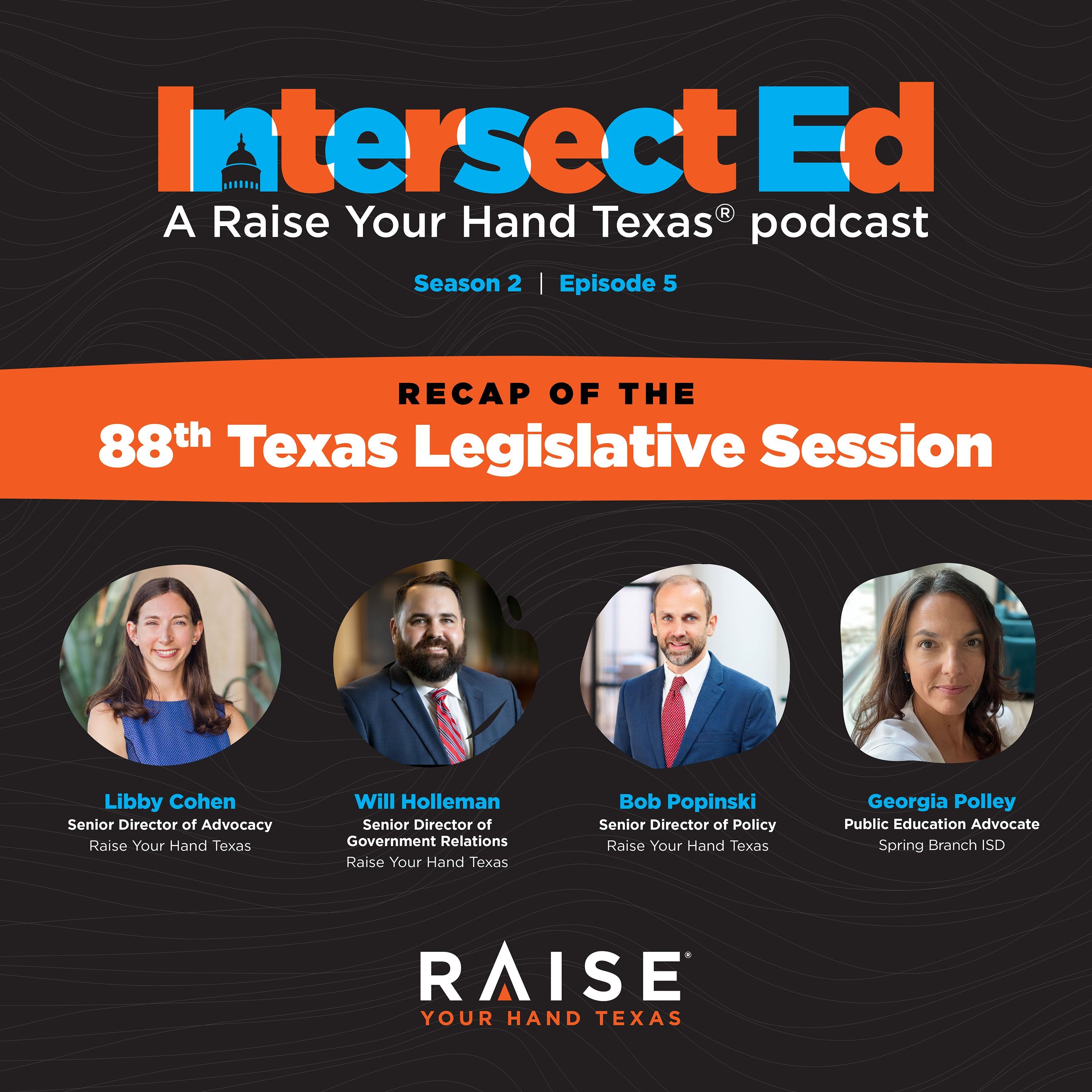
Recap of the 88th Texas Legislative Session: A Session Out of Balance
Jun 30, 202300:20:42Tap to summarizeThe 2023 legislative session started with a lot of promise. Lawmakers had a historic $33 billion dollar budget surplus, and there was energy and consensus to address a number of public education issues. Instead, lawmakers failed to give Texas public schools enough funding to even keep up with inflation, much less provide teacher pay raises to help stop the exodus of educators from the classroom. They lost efforts to improve our accountability system so that teachers could focus on their students’ learning instead of their performance on standardized tests. They did not pass any policies to help recruit and retain high-quality teachers. There was one tentative win for public education advocates. Thanks to a bipartisan group of determined House lawmakers who withstood enormous pressure from Gov. Greg Abbott — no private school voucher program passed. In this episode, hear from Raise Your Hand Texas’ Libby Cohen, Senior Director of Advocacy, Will Holleman, Senior Director of Government Relations, and Bob Popinski, Senior Director of Policy, alongside Georgia Polley, public education advocate from Spring Branch ISD, as they discuss their views on the 88th Legislative Session, and why a victory to stave off vouchers is far from certain, and came at a great cost to Texans.
Transcribe →
Mentoring Teachers to Create High-Quality Classrooms
May 18, 202300:13:36Tap to summarizeMorgan Smith: Welcome to the Intersect Ed Podcast, where the stories of public education policy and practice meet. I’m your host, Morgan Smith.Today we are talking about something that could make a positive difference in the lives of many Texas teachers and their students: high-quality mentorship.The formalized practice of having more experienced teachers coach those newer in the profession could help with a major challenge facing Texas public schools — teacher shortages. It also benefits everyone involved — from the experienced teachers acting as mentors who now have a chance to learn new skills, to the newer teachers they are supporting, and to the students who now have confident, calm educators in the classroom.So why aren’t high-quality mentoring programs more common in Texas public schools? Well, as is often the case, the reasons for that mostly come down to time and money.Right now in Austin, some lawmakers are trying to change that by expanding an existing pilot mentorship program. Two proposals to would do that — House Bill 11 and Senate Bill 9 — have both passed their home chamber but are currently stuck in limbo waiting for hearings in the second. With less than two weeks left in the legislative session, time is running out for either of these bills to make it.Morgan: While teachers can sometimes find peers to reach out to organically, research shows formalized, high-quality mentorship programs deliver the best results — especially when it comes to teachers working with vulnerable student populations. And those programs have specific characteristics.Mario Piña: A high-quality mentorship program has a lot of components. I think first of all, it has time for teachers to reflect with their mentors, and usually this really needs to happen during the school day. And it needs to have the time for the mentor to observe their mentee and vice versa, because if they're not being able to see what's happening or how something can be done, they're not going to be able to execute that in the way that's most effective.Morgan: Mario Piña is a Regional Advocacy Director with Raise Your Hand Texas. Before joining them in 2022, he spent nine years in Austin ISD as an elementary and middle school teacher, and instructional coach. Mario: And I think definitely making sure that we're paying people. A lot of times in school districts, people are being asked to be mentors and are not being compensated and not giving the time to mentor their mentees, and so it becomes really difficult for them to find the time during the day to really help each other out, and so it becomes more of a chore rather than a real mentorship process.There's so many other things that teachers are worried about. They're worried about grading. They're worried about making sure that their students are okay. They're making sure they have high-quality lessons. And so having time to go talk to their mentor is probably at the very bottom of their list a lot of times.And I think the other part of it is training for the mentors themselves. A lot of times, teachers are being asked to be mentors but are provided no training, and we have this idea that just because you're a really good teacher, you're going to be a really good mentor, and that's not always the case. I know that when I was a teacher, a lot of the times my mentor would come and ask me, "Hey, what do you need help with?" And unfortunately, as a first- or second-year teacher, you don't know what you need. And so asking me what I need help with or how am I doing isn't always the most helpful, because I don't know what I don't know. And so we really need teachers to have that training of how to ask the questions, setting those goals and working on those goals together, and really guiding that novice teacher.Morgan: A high-quality mentorship program can provide much-needed time for collaboration and support during the early days of teaching, which can be a trial-by-fire for many new educators. Mentors are also around to help new teachers figure out the simple everyday logistics that anyone who’s ever started a new job knows can be quite daunting — like making sure they know how to use the copier, or that there’s a bathroom in the teachers’ lounge. Most importantly, they help their mentees hone their instructional strategies and master classroom management – all skills that translate directly into improving students’ academic outcomes, which also makes mentoring programs an excellent financial investment for the state.Jerome Johnson: It's like that famous Mike Tyson quote, that everybody has a plan until they get punched in the mouth, metaphorically speaking. And so that's what teaching is like that first year. You have this idea of how your day's going to go, and then boom, a student does something totally not planned. You can imagine the things that we've seen.Morgan: This is Jerome Johnson, who is in his sixth year teaching English Language Arts in Channelview ISD, a school district of about 9,000 students on the Gulf Coast. He grew up a few miles down the road from where he now teaches – and entered teaching in his mid-thirties after he felt a calling to work with students like the kids he grew up with.Jerome: The calling kind of hit me and I was like, “I wonder if I can do this and be great at it, and be able to serve the underserved in a way?” I just always wanted to be a great educator in a place where they probably wouldn't get good teaching, more than likely. I think those personal challenges are what drew me originally to teaching.Morgan: For Jerome, having mentors during his first years in the classroom provided invaluable feedback — both positive and negative — that helped him grow as an educator.Jerome: I think as a mentee coming into the profession at such an older age, it was important that I got that confirmation like, "You are equipped for this." I remember being in a hallway and my mentor, one of my mentors at the time, just came to me and was like, "You have what it takes to ..." She said, "You have that thing that teachers have to reach and connect with students." And I had no idea what I was doing. I had no barometer, no way to measure it. I think that meant the world to me, just not knowing what to expect or am I on the right path…Because you're in a silo, unless you are in a different culture where collaboration is welcome. But if you are the professional in the room, and you are with a bunch of younger people, younger individuals, you just need those outside eyes telling you both good and bad. Because my colleagues have checked me on some things of like, "Yeah, that's a little above what they're talking about. You're missing them with that language," or, "You need to have this structure in your class to reach them."So both the critical and the compliments make a difference when you have those relationships. And I think mostly it took me a while, maybe three years in, before I realized amongst teachers it's really a people business, really about investing in individuals and people so they can reach their maximum potential.Morgan: Most importantly, when teachers feel supported and encouraged, they can provide that same support and encouragement for their students. So in that way, high-quality mentoring ends up providing a safety net for students with new teachers, who are also often the students with the greatest needs. Here’s Mario again.Mario: Our Title I schools are the ones that have the most revolving teachers, and I can think of, at the last school I worked at, more than half the campus is new. And so how are we going to continue to mentor these teachers when our veteran teachers are still in need of mentors themselves? And so our most vulnerable students are the ones who are suffering the most, and I don't think we talk about that enough – and it's hard to fulfill a high-needs classroom when you're just struggling to stay afloat yourself.Morgan: If you are feeling overwhelmed, it’s going to be very difficult for you to be an effective teacher. If you don’t know how to pace your curriculum, it’s going to be very difficult to be an effective teacher. If you can’t figure out how to manage behavior in your classroom, you aren’t going to be an effective teacher. High-quality mentorship shrinks the learning curve for new teachers on all of those things, while increasing student achievement and decreasing teacher turnover.Jennifer: Most people want to be given an opportunity to help somebody do more, or better, or bigger, or see things through a different lens, or whatever it is in that situation. That's certainly been my experience. Then on the flip side, because I have benefited from mentors in my life, and mentorship opportunities, I also like being a mentor. So I think of it as the same as teaching actually. It's just that you are helping guide a peer versus a student or a child, but the meat of it is still the same. That you are helping someone accomplish something in their life and that's special, that's meaningful.Morgan: Jennifer Cook is heading into her 10th year in the classroom. She teaches 7th grade English Language Arts in <a href="https://dashboard.simplecast.com/accounts/323a91e1-2666-4ebd-88fe-749c375ce61d/shows/0c3e1fcf-ec5f-45a3-8a3f-ed7f9d0f8f6d/episodes/59c52955-30c2-419b-9d16-e0644a534ba5/" target="_blank...
Transcribe →
Teacher Pay: Texas Teachers Deserve a Real Pay Raise
May 8, 202300:20:52Tap to summarizeMorgan Smith: Welcome to the Intersect Ed Podcast, where the stories of public education policy and practice meet. I’m your host, Morgan Smith. Today we are talking about Texas teachers, and how much we pay them. Or I should say: how much we don’t pay them. What started as a slow drain — as stagnant pay forced teachers out of the classroom during the hardships of COVID, the economic downturn, and inflation — has now accelerated into a crisis. Texas public schools simply can’t keep the teachers they need in the classroom. It’s hard to overstate the urgency of what’s happening. School districts, already operating on skeleton crews, are dropping advanced and elective courses because there are no teachers to teach them. They are combining classes — sometimes even recruiting parents to fill in — because there are no substitute teachers. And the teachers who remain are working second and third jobs just to pay basic household expenses. All of this has led a heartbreaking number of Texas educators to say they are seriously considering leaving the profession. Right now in Austin, lawmakers are deciding how to spend a record-breaking $33 billion surplus, with tens of billions more in estimated growth in revenue over the next two years. And, as the hours creep closer and closer to the last day of the 2023 legislative session, they are not deciding to spend it on teachers.Yes, you may have seen headlines about some major legislation — Senate Bill 9 and House Bill 100 are two of the proposals out there that would increase teacher pay. But here’s what you need to know about those bills: they don’t come anywhere close to moving Texas teacher pay in line with the national average OR bumping their salaries enough to keep up with inflation. JoLisa Hoover: I think there's been a moment where some people in society have said, "Teachers, if you don't like it, you can leave," and our teachers have left. Morgan: This is JoLisa Hoover, who spent 26 years as a teacher in Texas public schools before joining Raise Your Hand in 2019. She was named the organization’s Teacher Specialist in 2022. JoLisa: In the beginning of the pandemic, our teachers just pivoted overnight, and redesigned their entire career. They were making sure kids got fed. They were distributing technology out into the neighborhoods. They were checking in on families, and they were really just lifted up as heroes, only for a few short years later to be villainized for a variety of things and their pay has just been very stagnant. Morgan: As a part of Raise Your Hand’s work developing policy recommendations for the 88th Legislature, their statewide team of Regional Advocacy Directors met with Texas educators ahead of the legislative session. They heard from over 697 teachers from 79 different school districts. During the legislative session, JoLisa and the team brought more than 75 teachers on a weekly basis to the Capitol to speak with their lawmakers.JoLisa: The teachers are talking about how their money just isn't going as far as it used to, and in particular, that's hit teachers hard because their pay had already been stagnant before some of the recent inflation has hit all of us. And so they're already in a job that penalizes them for choosing teaching, financially, and then to have the pay stay quite stagnant, it's been really hard for our teachers. Morgan: JoLisa says there’s one word that keeps coming up over and over again, when teachers talk about the state of their profession: stress. The stress of not being financially independent. The stress of working a second job, and still not being able to meet the needs of their families. The stress of not being able to pay for medical procedures, home repairs, or make their rent. The stress of driving long distances to work each day because they can’t afford to live where they teach. JoLisa: I heard teachers talk about that they're doing what they need to do to make ends meet, but it can be embarrassing to see your students while you're working your second job, and yet our teachers are purchasing their own supplies because they need them to do their job. They are buying extra snacks for kids who are hungry, buying coats for kids who don't have them, and so they view their job as being part of the essential bills that they have to pay, is keeping their students supported.Morgan: If you don’t have any public school teachers in your family or your social circle, you may be surprised to know just how many of them work second jobs to pay the bills. Teachers will tell you that on any campus, you never really have to ask who's selling what, because any brand you can think of that can be sold by a person is represented somewhere on campus.Laura Marder: So in our particular district, I don't know a single school teacher that does not have some sort of side hustle or second job that they work. Either that or a very supportive spouse who is able to contribute to the finances of the home. And unfortunately with them doing those things, it takes away their energy because they're drug in different directions. They're not able to fully utilize themselves and put that effort into their kids. These teachers are doing everything from working retail, they're tutoring students on the side. I know some teachers that wait tables, and several teachers that own small businesses and work different company roles outside of teaching. And so they leave here from school and they go straight and they do that and then they do it all over again the next day. Those people should be leaving work, going home, taking care of their families, and taking care of themselves, so that way when they come back to work, they're energized, ready to go, and ready to put all that energy back into their students.Morgan: This is Laura Marder. She is a high school biology teacher in a small, rural district in northeast Texas (Mineola ISD). She’s been teaching for nine years. Laura: So the beauty of being in a small rural school is that I have the honor and privilege of teaching just about every student that comes through our doors at the high school. And so not only do I get to build relationships with those students, but also have connections with those families as well. And so we get to kind of walk through their lives together. And I have such a huge impact on so many people's lives, and it's just very satisfying and very rewarding work.Morgan: Laura also told me about the double bind that Texas teachers face. It’s not just that they don’t make enough to pay their own bills, they are often using their salary to pay for classroom supplies. To make her classroom materials go further, Laura has students double or even triple up on lab experiments. But the small stipend she gets from the district doesn’t cover everything her students need. So she pays out of pocket to keep stocked with much-needed basic items like school supplies, cleaning products, and provide something that’s become increasingly common in Texas classrooms — a food pantry.Laura: There’s other things that teachers do all the time that people don't even think about. We know the importance of making sure that our students' social and emotional needs are met. And part of that is making sure that they have what they need to be successful. I know teachers here that make sure that kids have clothing, that they have shoes that have, like myself, for example, I have a mini fridge in my classroom, and I know that there are a handful of kids that on the weekend don't have food to go home with on the weekend. And they know that when they leave my class on Friday, they go in and take what they need. And I just keep it stocked and we don't ask questions. It's just one of those things that we do because we love and we care for our students, and it's just so important that those needs are met so that way they can be successful at school.Morgan: Another common theme when you talk to Texas teachers: they aren’t in it to get rich. They chose their profession because they knew the joy they got out of being in the classroom meant more than being able to take lavish vacations or even shop at the fancy grocery store. Eva Goins: In all reality, we just want to be compensated for what we do. I know that I will never see six figures as a teacher, and money isn't everything. I always tell my students, "I don't do this job for the summers, and I don't do this job for the money. I do it for you. I do it for you because I care about you and your future, and I want to make sure that you have the best opportunities ever. You can rest assured, I am going to fight for you. I am going to advocate for you, and I'm going to give you my best always."Morgan: This is Eva Goins, who’s been in the classroom for 22 years. She’s an 8th-grade teacher in Northwest ISD, in suburban Fort Worth. You can hear the enthusiasm in her voice when she talks about her kids, and what she’s willing to give up for them. Over the years, that’s included waking up at 3:50 a.m. each morning to teach English to children in China before h...
Transcribe →
The School Voucher Debate: Texas Rural Communities
Apr 27, 202300:21:02Tap to summarizeMorgan Smith: You're listening to the Raise Your Hand Texas Intersect Ed Podcast where the stories of public education policy and practice meet. I'm your host Morgan Smith, and today, we're taking on a topic that has become a marquee fight of the 88th Legislature, private school vouchers. On one side, we have our state's two most powerful elected officials, Governor Greg Abbott and Lieutenant Governor Dan Patrick, who say every parent should get the freedom to decide how to use taxpayer money in educating their children. On the other, we have every public education advocacy group in the state, including Raise Your Hand Texas, who say that vouchers will do nothing but harm students, teachers, and communities.To help us dive in today we have superintendent Randy Burks of the Hamlin Independent School District, and Bob Popinski, the senior director of policy at Raise Your Hand Texas. Dr. Burks and Bob Popinski, thank you both so much for being here. So first, let's define what we're talking about. There are a lot of different terms we might have heard to describe vouchers, school choice, education savings accounts, and tax credit scholarships. It gets even more confusing because school choice is also used to describe the array of options already available to Texas public school students, like charter schools and magnet programs.Right now, a plan known as an education savings account is what's gaining the most traction at the legislature. The basic gist is that the state gives parents a certain amount of money, $8,000 in Senate Bill 8, the main bill that we're watching, to use for our private school tuition or other educational expenses. On its face, maybe this doesn't seem like a bad idea. Bob, is this proposal, the education savings account, is this a voucher?Bob Popinski: Don't be fooled. No matter what they call them, whether it's an education savings account or a tax credit scholarship, or a virtual voucher, they're all the same thing. Vouchers are a scheme that’s used to divert public funds to private schools and vendors, and the keywords there are private schools and vendors, with no accountability, such as public schools have. And then they will continue to undermine traditional schools, including charter schools, in the future because those funds are taken from public schools to invest in our teachers, to invest in our students, and they're investing them into a program that has no accountability whatsoever. So it doesn't matter what you call them – education savings accounts, special education vouchers. They are bad public policy for the state of Texas.Morgan: Dr. Burks, your district is about 40 miles northwest of Abilene in Jones County, Texas. You've been a superintendent there for six years, though, you've worked in public education for more than four decades. Your district is rural and small, with just over 400 students and those students are primarily from economically disadvantaged backgrounds. Give us a little sense for your community. What are you most proud of there? What are you struggling with?Dr. Randy Burks: Well, Hamlin was what might commonly be referred to in some circles of school finances as a CTD district –“circling the drain district,” declining enrollment and loss of some industry that was here previously, and so the district has seen better days definitely. And the city itself is probably typical of a lot of rural Texas, crumbling infrastructure and substandard housing is pretty common here. And, you know, I grew up in a background that's not too different from a lot of our kiddos. And so I really felt like I had something to offer the school and the community because I had a background in school finance.So we moved to a collegiate model early on in my time here, because we just felt like that, so many of our kiddos were struggling with finding a pathway that would be better than the pathway that they could see. They couldn't really envision a better life than what their parents had. So, we're a P-TECH school, early college high school, we have Montessori Elementary School, and we have college and career pathways available for our kiddos. And so we try lots of innovative things, and we fail fast and dust ourselves off when we do and get up and try again, because we think that's what's best for our kids and to help improve our school and, in essence, lift the community up as well as we move forward.Morgan: Now, it's no accident that we're featuring a superintendent from rural Texas today, because that is where Governor Abbott has decided to wage his fight for vouchers, too. Since the start of the legislative session, he's taken the pro-voucher message to the road, stopping at private schools in three to four towns a month around the state. Let's take a quick listen here to the Governor speaking at a private school in Tyler in March. Governor Abbott (audio from an “Education Freedom” March 2023 event in Tyler, TX): I cannot stand alone in getting this across the finish line. I need you standing with me, every step of the way, to make sure we empower parents to educate our kids, better than any state in America.Morgan: Dr. Burks, we just heard the emphasis on parental freedom as an argument for vouchers, and I want to get your thoughts on what that means for rural schools in a second. But Bob, first, can you give us an idea why we're seeing this strategy of targeting rural communities from the Governor? And as we're seeing the conversation evolve at the legislature, we're hearing more discussion about vouchers and special education students. What's the strategy here?Bob: I've always run up to a problem in rural school districts, and rural communities are the center of their communities. And, so what happens is, in the past, you've had Republicans and Democrats alike in the House stopping vouchers. There's an amendment offered, usually during the state budget debate that says, "Our public dollars cannot go towards private schools or vouchers." And that's typically what's known as the Representative Herrero Amendment. And that was a few weeks ago here in the Texas House and passed 87 to 51.And it's an important moment for the House because it sends a signal that we believe in our public schools. They keep saying that overwhelmingly, Texans believe in a voucher program. But I think what's actually happening out there is that Texans really don't know what a voucher program is. When you actually say, "Hey, if a private school or a private vendor actually takes public dollars, are they held accountable?". And in a recent Charles Butt Foundation poll put out at the beginning of the year, it says, “If private schools and private vendors actually take public dollars, what kind of accountability would you like to see?"And overwhelmingly, 88% said, "Yes, we'd love to see how they're actually spending our public dollars." "Yes," 84% said, "We want to see that they provide special education services to all students and not just a select group of students, and that you have to accept students with all special education needs, you have to follow the state curriculum guidelines, you have to administer state standardized tests, and you have to kind of accept all students, even if they have a discipline problem."And so overwhelmingly, when you look at Texans, whether they're from rural Texas or urban and suburban Texas, they want a voucher program that's held accountable underneath all of those standards. I think at that point, what you have is a public school system. And so I think we should take some time to invest in our public schools. Right now, public schools are funded $4,000 below the national average when it comes to per-student funding. We're $7,500 below the national average when it comes to teacher salary.And I think we need to kind of focus on that before we start spending a billion dollars on a voucher program that doesn't accept all students, and it even says within the bill, that parents have to be notified that private schools and vendors don't have to provide the same special education services, under state and federal law as public schools do. There's a lot to unwrap in here. And I think as more Texans actually understand the linkage of what's going on in this voucher program, the more they're pushing back against it.Morgan: And so we've seen that rural communities have been out of this firewall against vouchers in the past and this session, it seems even this main bill, SB8 that we're looking at, it includes a carve-out for rural schools as possibly a way of getting around this opposition that we've seen. And rural school districts like yours, Dr. Burks, they make up about 40% of Texas districts, they educate about 180,000 students in the state.Under SB 8, they would actually get paid if they lose any students to a voucher program. So currently, that amount is $10,000. So all in all, school districts under 20,000 students, the state would be paying $18,000 a year for five years for students to take part in this program. That's $8,000 that goes to the family and $10,000 to the school district. What would a program like this mean in your district, Dr. Burks?Randy: I would say first of all, things are really on a high note financially in Texas right now. And because I've done this for a long time, we know that there are lean years and there are prosperous years. And this is a time t...
Transcribe →