
Podcast
Israel from the Inside with Daniel Gordis
Hosted by Daniel Gordis · EN
Israel from the Inside is for people who want to understand Israel with nuance, who believe that Israel is neither hopelessly flawed and illegitimate, nor beyond critique. If thoughtful analysis of Israel and its people interests you, welcome!
danielgordis.substack.com
danielgordis.substack.com
101episodes
Episodes
Newest firstAll episodes

These elections are without doubt critical. Are they also Israel’s last chance?
Yesterday00:17:10Tap to summarizeThis is a free preview of a paid episode. To hear more, visit danielgordis.substack.comFor reasons I explain in today’s video post, above, there’s been quite a bit of discussion among some Israelis of whether or not the claim that these elections are “Israel’s last chance” is really true. I’ll explain why so much is at stake and yet why, at the very same time, I hesitate to say that. And then we’ll come to this photo above, which I took a…
Transcribe →
These young Israelis believe that what we need is not unity, but serious disagreement over profound ideas — and a new covenant of service.
6d ago00:17:16Tap to summarizeThis is a free preview of a paid episode. To hear more, visit danielgordis.substack.comAt a time when despair and despondency seem almost natural, it is good for the mind and for the soul to meet young Israelis who are not only not giving up, but who believe that it’s up to them to change the direction of Zionism and the Jewish State. Here is what their website has to say: Outdated Divisions.The data is clear: by Israel’s 120th Independence Day, the country’s social fabric will have changed completely. Projections show that less than half of all citizens will be left to carry the shared burdens of the economy, military service, and mutual responsibility.This is an existential threat.The old definitions no longer reflect the reality on the ground. They blind us to the true partnership being forged right now, both under fire and in our daily lives. For decades, we have grown accustomed to splitting Israeli society into rigid camps: “Jews” versus “Israelis,” Right versus Left, religious versus secular. This paradigm is leading us straight into the abyss. The danger is not that it divides us, but that it draws the lines in entirely the wrong places.The Covenant of Service.To secure our future, we must return to the central ethos of Zionism and replace old divides with a new alliance: the Brit HaMeshartim, the Covenant of Service. This is a pact among all who are actively building the State of Israel: those who serve in the military and the reserves, those who drive our economy, and those who embrace this country as their national home and personal responsibility.Our goal is not to exclude those who stand apart, but to draw them in. This covenant does not demand uniformity of thought; it demands an absolute commitment to Israel’s survival and prosperity.This alliance may not be organic, but it is absolutely essential to prevent the dangerous burnout of the serving public.If you would like to share our conversation about what Israelis are feeling and expressing at this unprecedented moment in our history, we invite you to subscribe today.Itay Margalit is the Head of Business Development and Partnerships at the Ribo Center. He is currently a student at Shalem College in Jerusalem, pursuing a dual degree in Liberal Arts and Strategy, Diplomacy, and Security.In his previous roles, Itay worked to strengthen the connection between Israel and the Diaspora, including his service as a Jewish Agency emissary (Shaliach) to the Jewish Federation of Cleveland (2021–2023), where he cultivated a vibrant and deeply engaged community of young adults. His professional background also includes coordinating pre-army programs for lone soldiers from around the world, alongside roles at the World Zionist Organization and the Ministry of Diaspora Affairs.A graduate of the Kol Ami pre-army leadership academy (Mechina), Itay commanded the Air Traffic Control course in the Israeli Air Force, leading and training hundreds of soldiers for operational roles. Today, he serves as a board member of the Jewish Agency’s Shlichut Alumni Network.Shahaf Dvir is the Chief Operating Officer of the Ribo Center, a think-and-do tank promoting the ideas of a “Covenant of Service.” She is currently a student at Shalem College in Jerusalem, pursuing a dual degree in Liberal Arts and Strategy, Diplomacy, and Security.Dedicated to advancing public leadership, political education, and social resilience in Israel, Shahaf previously worked in the Director General’s Office at the Ministry of Diaspora Affairs and Combating Antisemitism.During her military service in the IDF’s Education and Youth Corps, Shahaf accrued over five years of command and management experience, specializing in at-risk youth and complex populations at the Havat HaShomer base. She concluded her active duty as a Company Commander for the Education and Command Course, where she led and trained hundreds of soldiers and educational staff.As an active reserve officer (Company Commander), Shahaf recently served as a facilitator for the “Omdim BaSha’ar” program, leading processing and reflection seminars for over 50 reserve battalion commanders returning from combat deployments.For those interested, here are some additional resources available online: * The Ribo Center Website: https://ribo.org.il/en/* Ribo on Substack: https://substack.com/@ribocenter* Support the Ribo Center’s work: https://ribo.org.il/donate/* The book We Who Serve (in Hebrew only): https://ribo.org.il/book/* Op-Ed in The Jerusalem Post: “The war exposed Israel’s broken politics, resilient society“ by Ari Tatarka (Ribo English Director) – outlining the need for a new civic blueprint centered on the common good.* Contact & Inquiries: Itay Margalit, itay@ribo.org.ilThe link at the top of this posting will take free subscribers to an excerpted portion of today’s conversation.For paid subscribers, the link at the top will take you to the full conversation; below, paid subscribers will also find a transcript for those who prefer to read, as always.
Transcribe →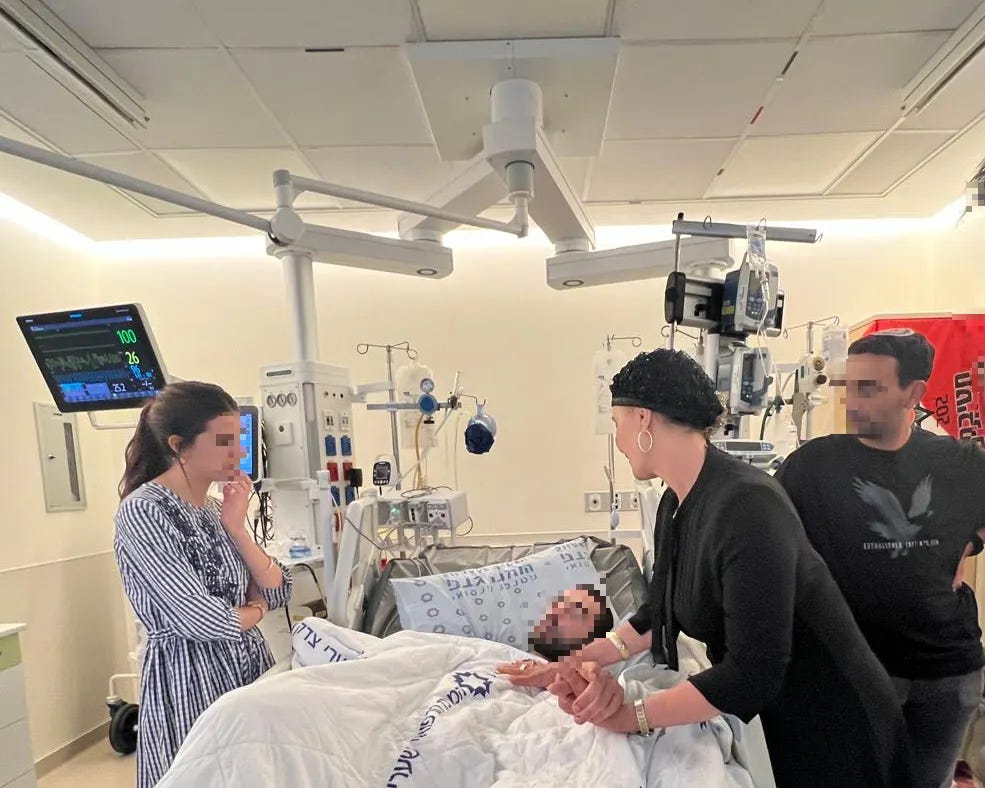
A "lioness mom" whose son was grievously wounded finds strength in helping others whose lives have also been upended.
1w ago00:22:14Tap to summarizeWe’re doing something today that we’ve never done before, having a guest on IFTI tell her story in Hebrew. When I heard about Michal Asaban’s son and Michal’s work with the mothers of other grievously wounded soldiers, I was reminded that in these complex, life-changing, and family-altering events, heroes emerge in many different forms. To make it possible for Michal to share her story with us, she tells it in Hebrew and we’ve provided English subtitles. This conversation is available in its entirety to all our subscribers. Tomorrow, Wednesday, we will hear (in English) from two young Israelis who believe that to heal Israel, what we need now is not unity, but profound conversations about and disagreements over the most important issues in Zionism. The Ribo Center, which they have helped create, is meant to revitalize Israel’s conversation about the ideas at the core of Zionism — and like many initiatives we’ll see in the coming weeks, it’s all coming from young people in their 20’s and early 30’s — the generation that has truly saved the State of Israel. The headline above, translated from this Hebrew article, is the kind of article we read, feel good about, and turn the page. But of course, between the life-altering moment of the terrible wound to the young man being able to get engaged, there is a world of endless surgeries, supporting the patient, caring for his siblings and friends and, as we’ll see, even supporting other parents who are in a similar situation. We hear today from Michal Asaban, Yotam’s mother, on how her life changed after her son’s injury, and how her response changed the trajectory of her life’s work. If you would like to share our conversation about what Israelis are feeling and expressing at this unprecedented moment in our history, we invite you to subscribe today.For the “Lioness Moms” website, click here. For those who would like to offer support, click here. This is a public episode. If you'd like to discuss this with other subscribers or get access to bonus episodes, visit danielgordis.substack.com/subscribe
Transcribe →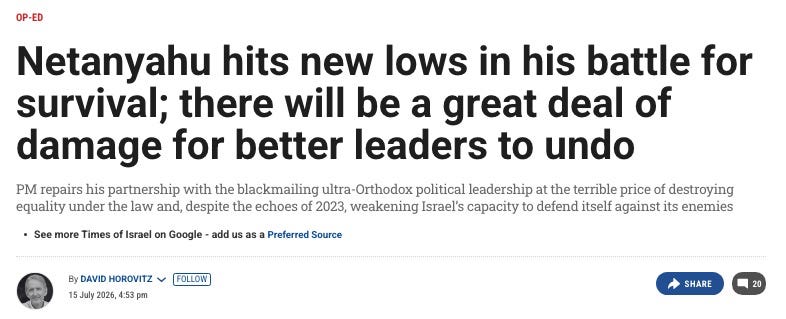
It's under 90 days to go ... and election season is in the air
1w ago00:00:19Tap to summarizeNow that Israel is less than three months away from elections, things are beginning to heat up. Are Israelis thinking about and voting on the same issues that people abroad believe they are, or think they should be? If people here are “one issue” voters, what’s the issue? And given that it’s the blocs that matter and not the parties, how is one to choose? Glimpses into Israel’s campaigns from the inside … David Horovitz and the Times of Israel called it weeks ago, in what now seems like an almost prophetic headline … now that elections are upon us and the polls are showing that Netanyahu (for the moment, at least) has but bleak prospects of forming a coalition, he is likely to get more desperate and things are like to get ever uglier as we grow closer to October 27. Israelis got a taste of the new lows that are likely soon to follow (other parties might do the same, and we’ll point to those, too) with the video above, which much of the Israeli press referred to as an “own goal” — meaning that it was so gross that Israelis far beyond Eisenkot’s supporters voiced their disgust. Even some Likud voters were shaking their heads in disbelief. Netanyahu, of course, said he’d known nothing about the video prior to its being posted (of course) and the Likud promptly issued a revised version. What was wrong with the video? It ends with the following two screens: ON THE LEFT: [Gadi] Eisenkot has no chance of forging a government ON THE RIGHT: without Yair Golan and the Arab parties. OK, fair enough, right? Yair Golan, who runs what is left of the old Labor Party (Ben Gurion’s party, mostly of blessed memory), has stepped in it a few times, and we’ll see the references to that below. And having Arab parties be in the coalition? That’s controversial for many Israelis, not because they’re racists, but because many of the people on the Arab party lists are explicitly opposed to Israel’s being a Jewish state. Mansour Abbas, the head of the main Arab party who appears in this video (when Eisenkot runs to hug him) has explicitly stated that Israel is a Jewish state and will always be one, but many of those below him on the list are very different. So what’s wrong with the video? The video, clearly, is an AI creation. That’s obvious. As Eisenkot runs (seemingly) to embrace a young man wearing a T-shirt that says אחדות ישראל, “Israel’s Unity,” Eisenkot actually ignores him and goes on to embrace Abbas. So what? Well, the young man in the video (again, an AI creation) looks a LOT like Eisenkot’s son who was killed in the war; 25-year-old Master Sergeant Gal Eisenkot was killed in Gaza in December 2023. The suggestion that Eisenkot would “ignore” his own son and his son’s values to embrace Abbas was so gross that the video evoked expressions of disgust almost across the political spectrum. The video has been taken down, replaced with a new version a young woman (instead of the young man) who bears no resemblance to anyone. This was likely merely “coming attractions” for what we’re bound to see ahead … What, then, is the problem with Yair Golan, or with Eisenkot forming a government with him? Golan is, by all accounts, a genuine hero. He has a long and stellar military CV and rose very far up the ranks of the IDF. On October 7, even though he was already in his sixties, when he woke up to the news of the attack, he grabbed his gun and helmet and raced from his home to the Nova site, where he rescued numerous people and participated in several battles. He was widely praised — across the spectrum — for his heroism on that day. So why does he figure so prominently in the video? Because despite his impressive record, he has said some fairly stupid things since then in his rose as the head of the Democrats party. One of the main moments is the one referred to in the ad at the bottom of the front page of Makor Rishon this past Friday. The key to the anti-Golan/Eisenkot ad is the wording in WHITE in the middle, which says, “A sane country does not kill babies as a hobby.” Golan said that in opposition to some of Israel’s policies in Gaza during the war, but it was obviously way, way too far to go. Israel killing babies as a “hobby”? That’s what Europeans say. Israelis were disgusted with him, too, and like the Likud with the video, he’s tried to walk it back. But it was record-breaking stupid, and it’s sticking. Hence the wording in the YELLOW on the left: “Eisenkot [who will clearly need Golan’s seats to form a coalition] will create a government that is dangerous for Israel.” And in the middle in the box, “It’s dangerous!” Will it do damage? It won’t sway Democrat voters to abandon him. But that’s not the issue. This entire election hinges on the question of how many right-leaning voters, who are disgusted with Bibi for one reason or another, can be pried away to vote for the center? With Eisenkot himself, few have a major problem. So the way to get them not to abandon Bibi is to focus the campaign not on Eisenkot, but on those with whom he’d almost certainly have to form a coalition. Hence the focus on Golan. If you would like to share our conversation about what Israelis are feeling and expressing at this unprecedented moment in our history, we invite you to subscribe today.Who’s the youthful looking kid in the photo with the Galil rifle? Without looking below, can you identify him? It’s Naftali Bennett. Early in the campaign, Naftali Bennett, the former PM, was the front-runner to take on Netanyahu. But as he’s been losing ground to Eisenkot, who now leads among opposition parties, Bennett is wisely doing everything he can to restore the sheen to his image and his campaign. The following just appeared on his Facebook feed: Over the photo above, he wrote the following: Exactly 36 years ago today I enlisted in Sayeret Matkal [DG - Israel’s most elite commando unit]. And it started badly. (A few personal words from me to the August ‘26 draftees):**The first weeks of basic training were very hard for me. I was the exception. Most of the guys around me had a father or brother or friend who was a Sayeret graduate, or at least an infantryman, but I didn’t know anyone like that. I came from a different world, the son of two new immigrant parents who barely knew anyone in the country. A bit of an outsider. I felt like everyone else in the platoon understood more, was more prepared than me, and I constantly had to ask in order to understand what needed to be done and when. I got a lot of punishments and extra guard duty because of mistakes. Back then they called it “shell shock from basic training.” Today they simply call it “burnout.”The beginning was hard for me, but what followed was better. I pushed myself and completed the Sayeret Matkal course, and I went on to serve as a squad commander and platoon commander of fighters in the Maglan unit. Those years made me who I am today.I’m telling you this, dear draftees, because it’s clear to me that some of you will also have a hard start. And it matters to me that you know: that’s okay. That even a bad beginning can have an excellent ending. And one day the hard period will end, and you’ll look back and be very proud of yourselves.I love you all very, very much, and I pray that God watches over all of you.Naftali Bennett August ‘90, Giora TeamIt’s all there. Reference to his stellar military record. The fact that he made it on his own, as the son of immigrant parents and as a young guy who hadn’t grown up here. And of course, wishing the new draftees well on the day of the the traditional massive August draft is a reminder that not everyone who should be is getting drafted this month. Who’s not? Well, the Haredim, obviously. And why not? Bennett’s post is how you mention Bibi without mentioning Bibi. It’s all just beginning to get interesting, and the coming weeks and months are likely to be action-packed on the. political front. We’ll share more about all this in the days to come. This is a public episode. If you'd like to discuss this with other subscribers or get access to bonus episodes, visit danielgordis.substack.com/subscribe
Transcribe →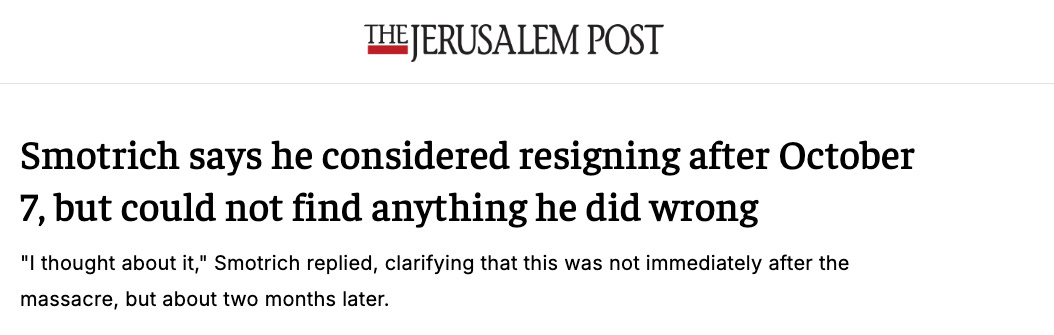
After all we've been through, how many of us are prepared to say, "I was wrong"?
2w ago00:11:29Tap to summarizeThis is a free preview of a paid episode. To hear more, visit danielgordis.substack.comThere was an item in the news yesterday about Bezalel Smotrich, in which it was reported that when asked if he’d ever considered resigning after October 7, he said that he couldn’t think of anything that he had done wrong. Today’s presentation is not at all about Smotrich, but about the larger issue that his now much-quoted comment raises: given everyth…
Transcribe →
In a darkened study lined with ancient books, you can feel the soul of the Jewish people
2w ago00:10:51Tap to summarizeThis is a free preview of a paid episode. To hear more, visit danielgordis.substack.comWhen S. Y. Agnon received the Nobel Prize for Literature in 1966, he became the first Israeli to receive a Nobel, and to this day, he is the only Israeli to have been awarded a Nobel Prize in Literature. The opening paragraph of the speech that he gave upon receiving the prize has become iconic, and in ways that he likely did not intend, resonates in our own troubled times no less than it did in his: As a result of the historic catastrophe in which Titus of Rome destroyed Jerusalem and Israel was exiled from its land, I was born in one of the cities of the Exile. But always I regarded myself as one who was born in Jerusalem. In a dream, in a vision of the night, I saw myself standing with my brother-Levites in the Holy Temple, singing with them the songs of David, King of Israel, melodies such as no ear has heard since the day our city was destroyed and its people went into exile. I suspect that the angels in charge of the Shrine of Music, fearful lest I sing in wakefulness what I had sung in dream, made me forget by day what I had sung at night; for if my brethren, the sons of my people, were to hear, they would be unable to bear their grief over the happiness they have lost. To console me for having prevented me from singing with my mouth, they enable me to compose songs in writing.It is quite possible that Agnon did not intend this, but here is what he says to us: “I am descended from a world that had been destroyed, and was raised and educated in one that was rooted in memory and yearning.” He composed “songs in writing” to survive. He composed “songs in writing” to imagine, to create – even if only in his mind on his pages – new worlds. We, in our own day, are going to have to do something similar, though what that will be still remains to be seen. With the Jewish world as we knew it fading rapidly before our eyes, as we think about renewal, Agnon’s speech almost invariably comes to mind. The house where Agnon lived and worked is but a couple of small neighborhoods away from ours, and I pass by it regularly. Of late, I noticed that there’s construction going on, and I turned to my friend Rabbi Jeffrey Saks, who is a widely recognized expert on Agnon and deeply involved in the work of Agnon’s home. Rabbi Saks suggested that we discuss Agnon, his legacy, his home and the plans for his home — and that we do it in the very study where Agnon wrote. So, this is a very different setting for our conversations than we’ve used in the past, but I will confess that having our cameras and microphones on Agnon’s actual desk, surrounded by the very books that he collected and studies, was powerful in a way that words cannot describe. Today, we re-encounter one of the great Jewish writers of all time, in the very place where his pen shaped Jewish literature forever. Below, Agnon’s home, which we learn more about in today’s conversation, and Israel’s 50 Shekel bill, on this Agnon’s image appears. For those who would like to explore Agnon a bit further, here are some places to start: * For the S.Y Agnon house website in English, click here.* For translations of Agnon to English available online at the S.Y Agnon house website click here.* For Hillel Halkin’s translation of Agnon’s “A Simple Story” published by Toby Press, on Amazon, click here.If you would like to share our conversation about what Israelis are feeling and expressing at this unprecedented moment in our history, we invite you to subscribe today.Jeffrey Saks is a Modern Orthodox rabbi, educator, writer, and editor whose work focuses on Jewish thought, education, and Hebrew literature. He is the founding director of ATID (The Academy for Torah Initiatives and Directions in Jewish Education) and co-founder of WebYeshiva, the world’s first fully interactive online yeshiva. Saks also serves as Editor-in-Chief of Tradition: A Journal of Orthodox Jewish Thought and is Director of Research at the Agnon House in Jerusalem. An internationally recognized expert on the writings of Nobel laureate Shmuel Yosef Agnon, he has edited and translated numerous works on Jewish thought and literature while teaching at several educational institutions in Israel.The link at the top of this posting will take free subscribers to an excerpted portion of today’s conversation.For paid subscribers, the link at the top will take you to the full conversation; below, paid subscribers will also find a transcript for those who prefer to read, as always.
Transcribe →
On Tisha B'Av three years ago, we could not possibly have imagined ...
3w ago00:09:48Tap to summarizeThis is a free preview of a paid episode. To hear more, visit danielgordis.substack.comIt was a ping on my phone yesterday that led me to hunt down the video we’re sharing today. A few hours before Tisha B’Av began last night, I got a text (sent to many thousands) from one of the people who had led the anti-judicial reform protest movement three years ago, and who was calling on Israelis to mobilize for the coming elections. “Three years …
Transcribe →
"Who is the most important historical figure in the history of Zionism? I would say Menachem Begin."
4w ago00:07:24Tap to summarizeThis is a free preview of a paid episode. To hear more, visit danielgordis.substack.comOn a summer Sabbath in 1913, in the Polish town of Brisk (otherwise known as Brest-Litovsk, in Yiddish, as Brisk) a son was born to Ze’ev Dov and Chasia Begin. It was four days after Tisha B’Av, the annual fast day mourning the destruction of the Temples in Jerusalem and the exiles that followed them, on the Sabbath known as Shabbat Nachamu, the Sabbath of Comfort. So the Begins named their son Menachem, “The Comforter.” Though those words are the opening of my biography of Begin, today we hear from the author of another Begin biography, Professor Avi Shilon. Shilon’s Menachem Begin: A Life, is a superb biography, and I heartily recommend it. OUR PREVIOUS CONVERSATION WITH AVI SHILON Avi Shilon was our guest on Israel from the Inside not long ago when he spoke about how both sides of our conflict ironically imitate each other in how they conduct war: Today, Avi Shilon joins us to discuss Menachem Begin. Since we’re not going to post on Erev Tisha B’av or Tisha B’av, this is our final Wednesday before Begin’s Hebrew birth date, so we’re posting Avi’s conversation today. If you would like to share our conversation about what Israelis are feeling and expressing at this unprecedented moment in our history, we invite you to subscribe today.Avi Shilon is a lecturer at the Institute for Israel and Jewish Studies at Columbia University. His course, History of Modern Israel, is regularly exceptionally well received. He has been the Visiting Scholar and Israel Institute Fellow at the Taub Center for Israel Studies at New York University, as well as a postdoctoral fellow at the Ben-Gurion Research Institute for the Study of Israel and Zionism at Ben-Gurion University of the Negev, Israel, and at Tsinghua University, China. He is the author of The Decline of the Left-Wing in Israel: Yossi Beilin and the Politics of the Peace Process (2020), Ben-Gurion: His Later Years in the Political Wilderness (2016), and Menachem Begin: A Life (2012). His articles have appeared in Middle Eastern Studies, The Jewish Quarterly Review, and Middle East Journal, and he is a contributor to Yedioth Ahronoth (YNet). Dr. Shilon earned his Ph.D. from Bar-Ilan University, Israel, in 2015.The link at the top of this posting will take free subscribers to an excerpted portion of today’s conversation.For paid subscribers, the link at the top will take you to the full conversation; below, paid subscribers will also find a transcript for those who prefer to read, as always.For Hebrew speakers, a panel about an article I just wrote for HaShiloach, on the intellectual roots of American Jewish anti-Zionism. Panel includes Minister of Diaspora Affairs Amichai Chikli, Dr. Masua Sagiv (previously on our podcast) and Dr. Sagi Barmak, Editor in Chief of HaShiloach. July 21 at 630 pm in Jerusalem. For tickets: https://hashiloach.org.il/american-jewry/ Many Israelis could not travel for months this past year, because the skies were closed, or if they were open because it was not clear that they would stay open so it felt risky to leave, or because we didn’t wish to leave our children and grandchildren when war could break out again.So with things quiet(er) for the moment, many Israelis are traveling more than usual this summer.We, too, will be away the weeks of July 5th and July 12th. Podcasts will continue on schedule, as always, for our paid subscribers. But other posts will come at a slower rate during that period.
Transcribe →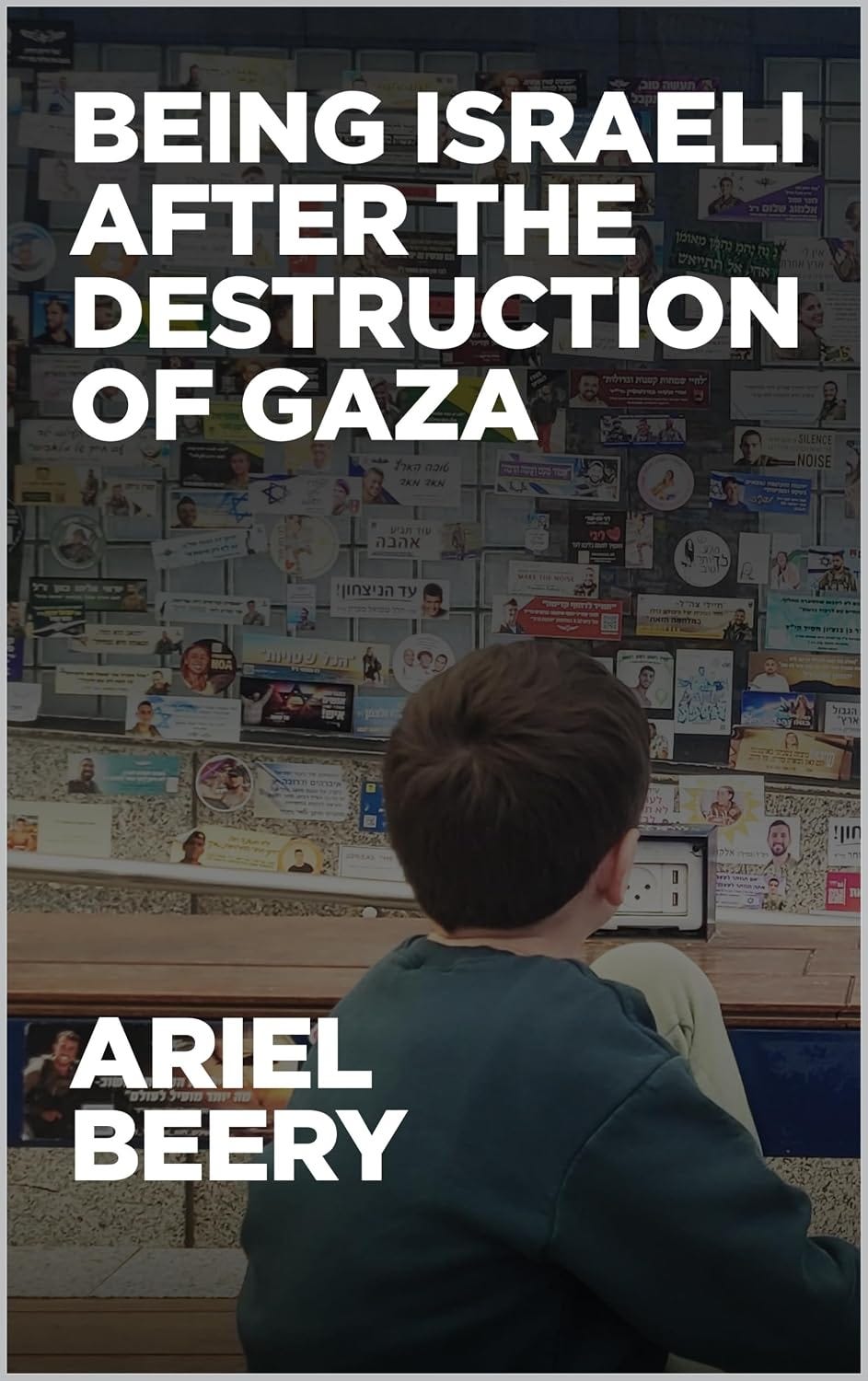
"BEING ISRAELI AFTER THE DESTRUCTION OF GAZA"
4w ago00:05:41Tap to summarizeThis is a free preview of a paid episode. To hear more, visit danielgordis.substack.comIt’s well known by now that Peter Beinart, no friend of the Jewish State (or to my mind, of the Jewish people) wrote a book not long ago called Being Jewish After the Destruction of Gaza: A Reckoning. Beinart wrote that book (which I confess I have not read), as has been widely noted in the reviews, without ever so much as coming to Israel after the 7th to interview Israelis who’d actually been here or who actually live here. Makes sense — why complicate your theory with reality? The book we’re going to hear about today, Being Israeli After the Destruction of Gaza: Reflections and Visions, is also about moral and political reflections in light of the terrible suffering on both sides of the border. But unlike Beinart’s book, it is written by people who live here and who have committed their lives to the Jewish state. The book is composed of many essays, and is a fascinating read. We’re very grateful to these three authors for taking the time to share their thoughts with us on what it means to be a morally-nuanced Israeli at such a fraught time. If you would like to share our conversation about what Israelis are feeling and expressing at this unprecedented moment in our history, we invite you to subscribe today.Ariel Beery was born in New York and made Aliyah at the age of 19 in 1998. He holds a B.A in Economics and Political Science from Columbia University, a MPA (master’s in public administration) in Management, and an MA from in Jewish Studies, both from NYU.Ariel is dedicated to solving problems facing humanity with sustainable and scalable solutions and has founded and led multiple ventures on every side of the innovation ecosystem. He is the founder and CEO of the PresenTense Group (founded 2005), a global accelerator franchise for social ventures, and the co-founder and CEO of MobileODT (founded 2012), a mission-driven, VC-backed medical technology company to address women’s health challenges across low-resource settings.Ariel Beery advises government officials and foundation executives on how to best support mission-driven innovation, and has lectured broadly on social entrepreneurship, its opportunities and challenges.Mike Berman is a Consultant and Venture Partner at Rivervest. A medical device entrepreneur, Mike works with a select group of high-potential, early-stage companies. As a consultant to RiverVest, Mike provides the firm with advice on existing and potential portfolio companies, especially as it relates to technology being developed in Israel.Mike was the President of the Boston Scientific Corporation Cardiology business from 1995 to 2000 and is a co-founder of eight medical technology companies including Velocimed, LLC, a former RiverVest Fund I portfolio company acquired by St. Jude Medical, Inc. In addition, he was a founding director of Lutonix, Inc., a former RiverVest Fund II portfolio company acquired by C.R. Bard, Inc. He currently serves as a board member of a number of private and public medical technology companies.Mike earned an M.B.A. and a B.S. from Cornell University.Meredith Rothbart is Co-Founder and CEO of Amal-Tikva. Meredith brings almost 15 years of leadership experience with Israeli and Palestinian NGOs. She holds an MA from Hebrew University in Community Development and a BA in Politics, Philosophy and Economics from the University of Pittsburgh. Meredith has addressed the United States House Committee on Foreign Affairs, the White House, the Delegation of the European Union to Israel, the UN Security Council and continues to be a strong voice for civil society peacebuilding. She lives in Jerusalem with her husband and children.The link at the top of this posting will take free subscribers to an excerpted portion of today’s conversation.For paid subscribers, the link at the top will take you to the full conversation; below, paid subscribers will also find a transcript for those who prefer to read, as always.For Hebrew speakers, a panel about an article I just wrote for HaShiloach, on the intellectual roots of American Jewish anti-Zionism. Panel includes Minister of Diaspora Affairs Amichai Chikli, Dr. Masua Sagiv (previously on our podcast) and Dr. Sagi Barmak, Editor in Chief of HaShiloach. July 21 at 630 pm in Jerusalem. For tickets: https://hashiloach.org.il/american-jewry/ Many Israelis could not travel for months this past year, because the skies were closed, or if they were open because it was not clear that they would stay open so it felt risky to leave, or because we didn’t wish to leave our children and grandchildren when war could break out again.So with things quiet(er) for the moment, many Israelis are traveling more than usual this summer.We, too, will be away the weeks of July 5th and July 12th. Podcasts will continue on schedule, as always, for our paid subscribers. But other posts will come at a slower rate during that period.
Transcribe →
Some things are forever—like European anti-Semitism, and, it seems, Israel’s ongoing war
Jul 1200:02:28Tap to summarizeIt was only a five-minute drive, at the very most, from the Oslo train station to our hotel, and we could have walked it. But we’d been traveling all day and our suitcases weren’t small, so we decided to hop in a cab. “Where are you from?” the driver asked. “New York,” I answered. This, after all, is Europe, and I wasn’t in the mood. In Bergen and in Flåm, I had said “Israel” when people asked. My wife and I had agreed that we weren’t going to do that, but somehow, hiding where we live felt cowardly, so I found myself saying “Israel” and not “New York” in those places (my “coming out of the Israel closet,” as my wife called my repeated faux pas). But that was there and this was here. It turns out that “New York” was a good call. “Where are you from?” I asked the driver. “Somalia,” he said. “How long have you lived in Norway?” I asked. “Thirty years.” That, I assumed, would be the end of the conversation. After all, about 2 minutes of our five-minute cab ride were already behind us. But, no …“Norway very good country,” our driver continued. “People here very nice. Very kind. Is very democratic.” “Yeah, people here do seem very nice,” I said. That wasn’t entirely true (perhaps because I’d come out of the Israel closet a few times), but whatever. “America, terrible. Donald Trump is the face of the real America. Terrible man, terrible country. He’s with i-Pak and the Sionists.” He’d said AIPAC as if it rhymed with iPad. I was deliberating whether to respond, but the feeling of my wife’s fingers digging into my thigh, rapidly cutting off circulation to my leg, no doubt contributed to my decision not to get into it. I didn’t say anything. But he wasn’t about to let the pregnant silence continue. Did he suspect we were Jewish? I still don’t know. My wife says definitely yes. “Do you know i-Pak?” he asked. Now, I could have said that yes, I know quite a bit about i-Pak, probably a lot more than he does, or I could have mentioned that the President of i-Pak is one of my dearest friends (said friend and I don’t agree about everything, but I’m old school, and believe that you can adore people who might see things differently than you do). But there was still that circulation problem in my thigh; I said, “No, I don’t know i-Pak.” “You should. Terrible people. Sionists.” He went on a bit about the Sionists. Never have the words “Here your hotel” brought such relief.Norway is in World Cup frenzy, not surprisingly. Everyone’s wearing t-shirts with Norwegian flags, scarves with Norwegian flags, hats with Norwegian flags. All good. Late Thursday night, when France beat Morocco, we were already asleep; I thus can’t vouch for what was happening on the streets of Oslo, most likely with our taxi driver’s kids’ generation. But what happened in other places, we do know. I didn’t see this in the English press, though it may have been there — I’m trying to stay away from the news this week. But in the Hebrew press, it was all over. “Chaos” in London after Morocco fans riot; in Holland, cries of “Hamas! Jews to the gas.” A couple of years ago, we had a very long layover at the Amsterdam airport, so we went to the lounge. It was morning, and I had to say shacharit. I found a really out-of-the-way corner around a bend in the room where virtually no one could see me, and the lounge was pretty empty anyway. I put on my tallit and tefillin and was doing my thing, when a staff person (very blond, as Dutch as one can be) in that light blue KLM outfit came out of the bowels of the back area, saw me, and erupted.The details of his disgusting tirade don’t matter for the moment. Back then, though, I decided that I would, indeed, get into it with him.In the course of our “discussion,” he said something about “these are the rules.”I said, “No one can even see me here. I’m not bothering anyone.”“These are the rules.” He’d missed his calling as a German.“It has nothing to do with the rules, and everything to do with Europe,” I said.“It has nothing to do with Europe,” he said.I was still in my tallit and tefillin, which made the whole exchange rather surreal. I was tempted to tell him that he clearly didn’t know very much history, but somehow, a conversation about high school curriculum seemed ill-timed.Suddenly, though, he backed off. I imagine that in his mind, he heard his mother saying, “Jan [or Pieter, or whatever his name was], it’s not worth losing your job over this. Leave the Jew alone.”So he did. But it was ugly—the fuller details perhaps for a different time.Were the Dutch rioters who were shouting “Jews to the gas!” on Thursday night African immigrants, like my Somali taxi driver friend in Oslo? Perhaps.But very definitely, perhaps not.We’d had plans to go to Chabad over Shabbat (which, incidentally, ended at 1:21 a.m. Sunday morning). In the end, we didn’t. But in my exchanges with the rabbi—who only gave me the address of Chabad after we’d sent him scans of our Israeli IDs—he reiterated that under no circumstances were we to reveal the address to anyone. Fair enough, but wow.As I said to Jan (or Pieter, or whoever), it’s just Europe. This has always been Europe, and this will always be Europe. Until it gets worse. Which it invariably does.If you would like to share our conversation about what Israelis are feeling and expressing at this unprecedented moment in our history, we invite you to subscribe today.If “Jews to the Gas!” is Europe’s default setting, it appears that so, too, is war where we live. People can disagree about how Israel has conducted the war, people can disagree as to whether we’ve accomplished much. People can disagree about what Israel did or didn’t do in Gaza. But it’s hard to argue with the widespread sentiment in Israel that whatever one thinks about this war, it’s not about to end. Not now, not soon.Will it end, ever? Well, it started in the summer of 1929. So ….Which is what makes the little clip (at the top of this post) that I came across on Facebook cute, but also sad. It’s a brief Kan 11 clip, to which we’ve added subtitles. It’s meant to be comedic, but it captures something about the sentiment in Israel that’s far more telling than mere comedy. Note that in the clip there’s not a lot of bitterness about the endlessness of the war. To say that Kan 11 is not hugely supportive of Netanyahu would be a dramatic understatement, but the clip isn’t political. The situation just is what it is. Will we eventually get the upper hand? Will it impact the election results? We shall see. Will young Israelis decide that forever-war isn’t for them? I’m sure that some will. I imagine that, perhaps, many will. But how many? A few years ago, I would have been more worried. But now, Europe gives me hope. After all, where are they going to flee to? Amsterdam? Oslo? New York? In the end, I suspect, most Israelis are going to decide that if they have to live in a war where they can defend themselves, or cower in their homes as marauders on the streets yell “Jews to the Gas,” …… war is going to be the more attractive option. Many Israelis could not travel for months this past year, because the skies were closed, or if they were open because it was not clear that they would stay open so it felt risky to leave, or because we didn’t wish to leave our children and grandchildren when war could break out again.So with things quiet(er) for the moment, many Israelis are traveling more than usual this summer.We, too, will be away the weeks of July 5th and July 12th. Podcasts will continue on schedule, as always, for our paid subscribers. But other posts will come at a slower rate during that period. This is a public episode. If you'd like to discuss this with other subscribers or get access to bonus episodes, visit danielgordis.substack.com/subscribe
Transcribe →