Loading summary
Transcript4 lines
- [00:04]
A
Welcome to It's a Good Life with Brian Buffini, founder of America's largest business coaching company. Here's a short classic cut from one of our all time favorite episodes.
- [00:18]
B
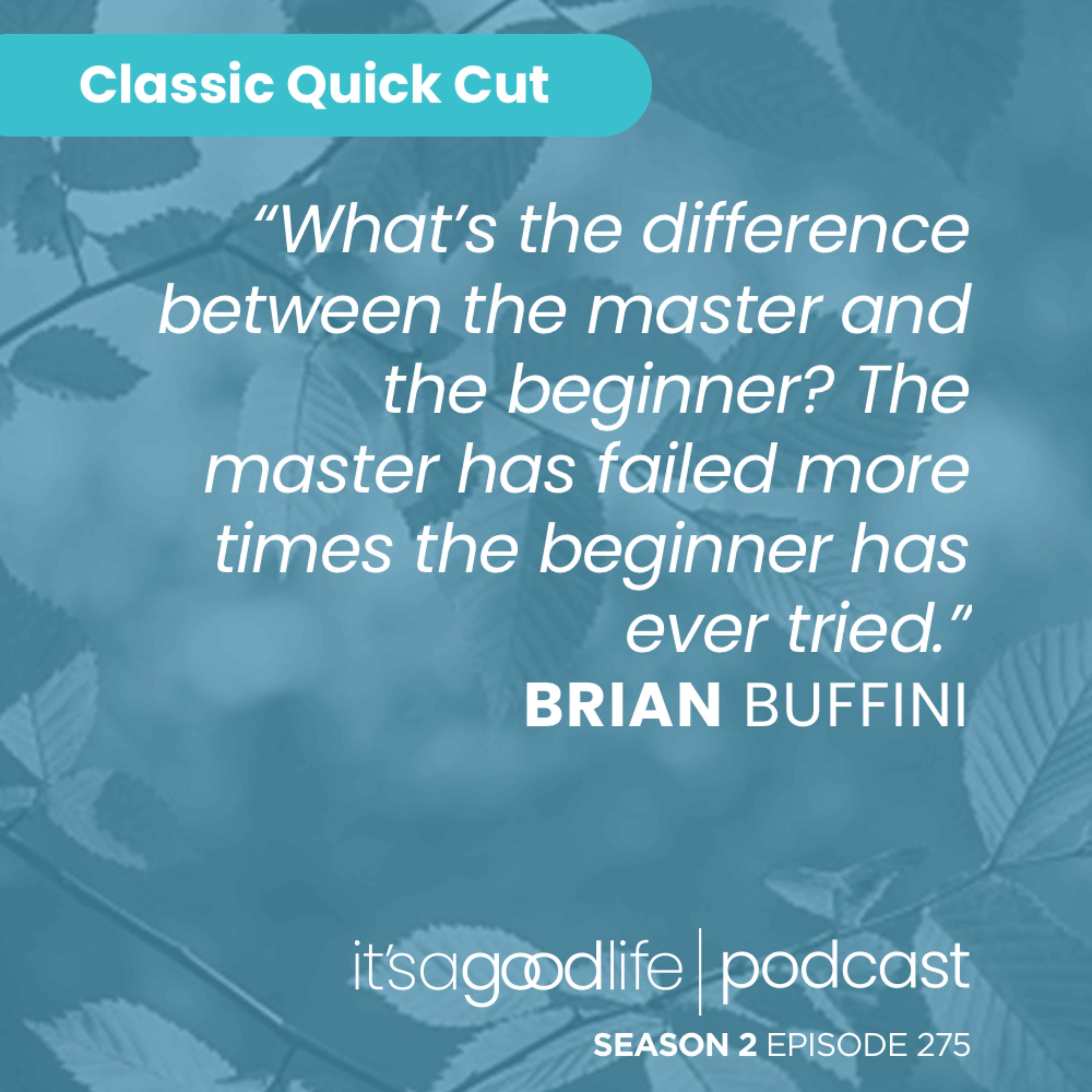
You want this talent to come out. You want this inner Stravinsky to come out, and it's there. You've seen flashes of it, you've seen signs of it, you've had moments of it, you've had seasons of it, but you want to live in that more and more. Then mastery is the way to get there. Is everybody with me? Yes or no? Does everybody understand why we're covering this topic? It's to bring that out. Here's what mastery is. It's the mysterious process, which means it's not fully logical. It's the mysterious process during which what is first difficult becomes progressively easier and more pleasurable through practice. That mysterious process that that which is difficult at first becomes progressively easier and more pleasurable through practice. Through practice, that which is difficult becomes easy. That which is challenging becomes pleasurable. So what is mastery? Let's go through it real quick. First of all, it's a journey. It's a journey. George Lonard himself in the book Mastery said this. Mastery is a journey. And the master must have the courage to risk failure. You got to be willing to risk. Don't be willing to look bad. You got to be willing to receive judgment from others who don't understand mastery. And oh, by the way, most people in this culture don't understand mastery. They understand quick fixes. Mastery is a lifelong commitment to honing your skills. Lifelong commitment to honing your skills. Michelangelo to the Italians, we know him as Buonarroti. He said, if people knew how hard I had to work to gain my mastery, it would not seem so wonderful at all. Next, mastery is realizing that the ultimate goal is the path to mastery itself. And this is going to sound extremely Zen to a Western audience, but the path is it. George Lonard said this. At the heart of it. Listen, mastery is staying on the path. At the heart of it, mastery is staying on the path. Staying on the path sounds about as boring as there is. Would you guys agree? Sounds about as unsexy as it is. Sounds about as unfulfilling as it can be. Staying on the path is mastery itself. That's very un American. Would you guys agree? Practicing even when you seem to be getting nowhere. Mastery. You know the difference between a master and a beginner? The master has failed more times than the beginner has ever tried. The master has failed more times than the beginner has ever tried. Mastery is counterintuitive. It is counterintuitive, which means it's not your first instinct or your first reaction. The culture is at war with. With mastery. It's at war with this process because it's all quick fixes and so on and so forth. So marketing culture tends to communicate quick fixes and instant gratification. Don't become arrogant in your knowledge. Don't become, oh, I have this guy at the office. He just doesn't get it. He doesn't understand the path to mastery. You know why? Because he's trying to make his mortgage payment next month. And that's why it's very important as you grow, that you grow in your compassion. Okay? You really want to be a master? You're going to grow in compassion. You're not going to judge people or ridicule people. You have a greater depth of understanding, but you'll also know how long the journey takes. Okay? One of the reasons for it is we're living in a western culture. And a Western culture, by its very nature is linear. So that's how we think it's supposed to go. It's supposed to start at the left and it's supposed to go up. And anything that doesn't do that is a problem. So it communicates it being linear or instantaneous. It's not linear and it's not instantaneous. Oh, by the way, I'm a rapid person. Is this fun for me to say? I want it now. I want to go. I want to fast. And so here's what I found, and this is great. How many of you are kind of rapid and the world moves a little too slow for you? Let me see your hands. Nice and high. See how quick those hands went up? Here's the word for you. Listen, if you want to go fast, you got to slow down. It's the same with business. Buffini and company's growing, reaching more people, great opportunities for the future, many different applications, and one of the things we have to do constantly slow it down from a standpoint of the strategy and the planning and the process. You guys with me? Anti mastery behavior. Here it is. Identify these things, and we're going to get close to home before we leave here. Is it okay to have the eye on the prize? Yes or no? Is it? Of course it is. Of course it is. When you have only eye on the prize. Here's what happens. Results are everything. Results are everything. And I'm going to say this to you, on the path to mastery, results are not everything. The process is everything. Next, the quick fix mentality, which is gimmicks and gadgets. But I'm going to say this to you. Gimmicks and gadgets are where the tech world lives. And shiny object syndrome is alive and well. And even those who think they are talking against it are actually communicating for it. And then instant gratification. You can have it all. And you can have it all when. Say it again. You can have things now, but the good stuff takes a while. Okay, pitfalls along the path. Let's point out what we're going to face along the way in ourselves and outside of ourselves. So, first, obsessive goal orientation. Are goals good things? What's the problem? What's the pitfall? Obsessive. Here's what obsession is. An image, thought or influence which continually fills or troubles the mind. A compulsive interest or preoccupation seemingly beyond one's will to control. Next, poor instruction. You got to get good instruction. We all do. A poor teacher complains. An average teacher explains. A good teacher teaches. A great teacher inspires. That's what we want. Next, laziness. And in our world today, it's easier to be lazy than ever before. And by the way, a lot of the stuff we're involved with today and a lot of the innovations today facilitate laziness. Next, prizes and medals. When we obsess on the outcome, here's what happens. There's an interview done with Brett Favre. Any Green Bay Packer fans. This is the picture of Brett when he was on the stage with Terry Bradshaw. That is the super bowl trophy being presented to him. The confetti's coming down, and here's what he said. Is that it? Is that it? Is this all confusing? Is it good to achieve yes or no? Is it good to have goals? Are prizes fun? Do you guys like winning? Does the good life cost money? Okay. But if it becomes your all in all, you'll find out that it's the emptiest of all time and there's never enough of it to fill the void. Are you guys hearing me? So mastery is not that. What's the path to mastery actually look like? You know, there's gaps. There's times when you stop. Have you ever gone backwards? Have you ever stopped? You know what great success is, is here's what the gap was, and then you get back on the horse, and now this gap's smaller. The way you get good at golf is you improve the quality of your bad shots. You can't improve the quality of your good shots. Your good shots going four feet from the hole and making a birdie. So you hit it three feet from the hole and you still make a birdie. Doesn't make any difference. What happens when you get good at golf is your miss becomes less so. You hit a big miss, goes out of bounds. Now you have a little miss. It's in the rough. Does that make sense? Difference between 85 and 75. And that's what happens on the path to mastery. And that happens with consistency. The last thing here is perfectionism. Perfectionism does not have anything to do with mastery because mastery enjoys the process of getting better. And perfectionism listen is the mother of procrastination. 1978 5% of people surveyed said they suffered from chronic procrastination. With all the tech and all the innovation and all the great innovations we've had in our world, it's now up to 26%. I'm going to say to you in many ways, and I'll show you stats on this, I believe we're more unproductive today than ever before, especially in our industry. The key is to love the plateau. Love the plateau. Peak plateau, Peak plateau, Peak plateau, Peak plateau as the path to mastery. So here's the key. You find joy in regular practice. Find joy in regular practice. Say the word joy. Practice for the sake of practice itself, not just for reaching a certain level. So when you start getting into it, you realize the joy is in doing it and you get better in the doing of it. Practice for the sake of practice, not just for reaching a certain level. Next, appreciate what is more essential and enduring in your life.
- [09:17]
A
Well, we hope you enjoyed this. Quick cut. Head to the show notes to listen to the full episode. If you'd like to elevate your business to achieve your goals, talk to one of our experts on a free business consultation. Visit it'sagoodlife.combc to schedule yours today.
- [09:35]
C
May the road rise up to meet you, and may the wind always be at your back. May the rain fall soft upon your fields and the sun shine warm upon your face. And until we meet again, may God hold you in the hollow of his hand. See you next time.