Loading summary
Transcript28 lines
- [00:04]
A
Welcome to It's a Good Life with Brian Buffini, founder of America's largest business coaching company. Here's a short classic cut from one of our all time favorite episodes.
- [00:17]
B
Well, the top of the morning to you and welcome to It's a Good Life. I'm your host Brian Buffini and today I have a very, very special guest for you. His name is David Rubenstein and David's co founder and co chairman of the Carlisle Group, which is one of the largest, most successful private investment firms. So talk to me, how does a boy from Baltimore end up billionaire investor with the Carlyle Group? How'd you do it?
- [00:38]
C
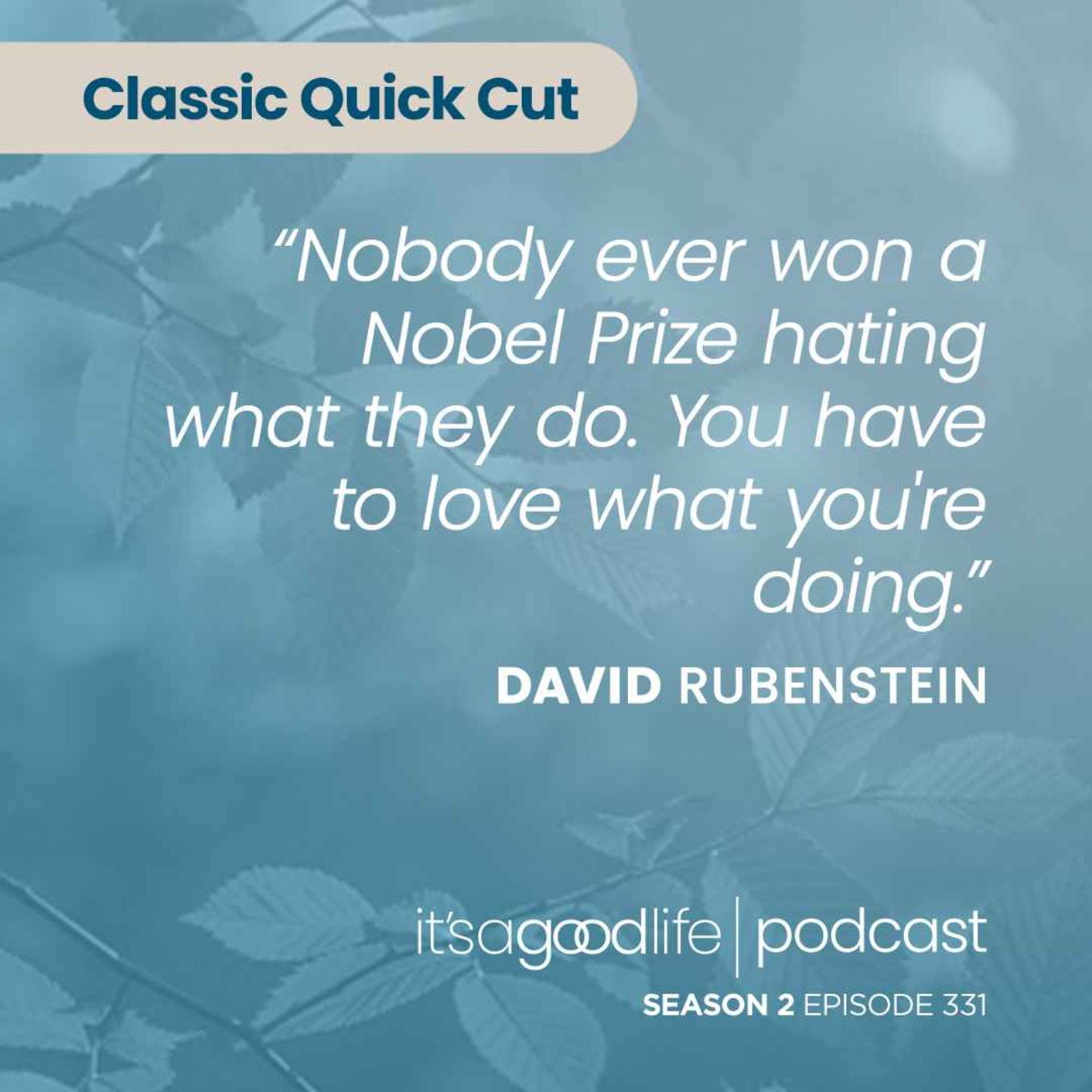
Luck is the most important word. I guess what happened was I was interested in government and politics. When I was growing up, there were no billionaires to speak of the United States. There were no private equity firms, hedge funds, tech startups. So if you were, if you were Jewish, you'd say, okay, I'll be a lawyer or doctor. And I didn't think I was going to go to medical school. I didn't think I could get through the science courses. So I went to law school. I was interested in politics and ultimately I wanted to work in the White House. So I ended work in the White House for Jimmy Carter. I was inspired to do that by a man who was Irish in his background, John Kennedy. When I was young, he was a dashing young president, United States. And I didn't think I could ever be a candidate, but I thought I could be an advisor. So I did ultimately get a job working at the White House for President Carter. After we lost the election in 1980, I had to go back and get a real job, which was working as a lawyer. I wasn't very good at it. And so if you're not good at something, you have to find something else. Nobody ever won a Nobel Prize hating what they do. You have to love what you're doing. And I didn't like practicing law and my clients didn't like my practicing law either. They didn't think I was very good. So I started a firm on a whim in 1987 with no money. I recruited some people and told them I was going to get some money, but I didn't really know where I was going to get it. And then we grew up to a firm that's now managed about $400 billion. So it's been, it's been successful.
- [01:54]
B
No doubt. No doubt it. Let me ask you this question because it's a huge deal to say I'm not good at something Especially like you say in Ireland, you're either gonna be a pop star or a priest. You know, that was our deal. So here it is. Your mom and dad get a good job, get your degree. You went to law school. It takes an awful lot of guts to say, you know, this isn't the highest and best use of my life. This is not my calling. This is not what I'm gifted at. How did you make that decision? Like, that's a lot of chops, a lot of chutzpah, as you would say.
- [02:23]
C
Well, I'm an only child, so my mother was very attentive to what her only child was doing. When I was practicing law after I left the White House, I didn't realize. I realized I wasn't that good at it. I didn't enjoy it. So I told my mother was to start an investment firm. And she got horrified because she said, you don't know anything about business, so do this. Keep your law license. Make sure you stay a member of the bar. You have something to fall back on. So to honor my mother, I'm still a member of the D.C. bar.
- [02:45]
B
You know, my mother told me, because I did accounting, my mother said, hey, if this seminar malarkey doesn't work out, make sure you keep your accounting credentials.
- [02:53]
C
Same situation.
- [02:54]
B
God bless them. God bless them. They meant. They meant good stuff. So how did you go about building it? I mean, how did you go about actually getting the people to invest?
- [03:01]
C
What I did is this. I said, there's an old saying in Washington, D.C. when you're getting kicked out of town, get out in front and pretend you're leading a parade. What does that mean? It means take advantage of the situation you find yourself in. You're getting kicked out of town, pretend you're leading a parade. I was living in Washington. I wasn't credible enough to go to New York and start an investment firm. So I said, I understand companies heavily affected by the federal government better than those guys in New York. Sounded good. I'm not sure it was true. And then ultimately I began in the beginning to bring in some government people. I brought in former Secretary of State Jim Baker, former Secretary of Defense Frank Carlucci.
- [03:35]
B
So you had relationships?
- [03:37]
C
Yes, George Herbert Walker Bush. They were better known. Nobody would want to hear me make a speech at dinner. But if I said, jim Baker is going to make a speech, people would show up. But I did two things that changed the face of private equity with my partners. One is private equity was a small cottage business, and we basically. You had one fund and you did one fund and four years later you raise another one. I decided to have multiple funds, a buyout fund, a growth capital fund, a real estate fund. And so have an institutionalize the business by having multiple funds. And I could have afford a back office, a fundraising team, accounting team that would take care of all the funds. And secondly I decided to globalize it. So I went around the world to make a team in Europe, Eastern Europe, Latin America, Japan, Asia and so forth. So we had a global business and a heavily institutionalized business and that's how we grew it. And we also obviously had a good.
- [04:23]
B
Track record, no doubt. And that sounds a little more than look to me. That's pretty brilliant. That's great strategy, good promotion and then building relationships. And I want to talk about that later on because one of the things I admire so much about you today is how you build relationships. You do this work with the political characters. You might be the last moderate left in America. Will you bring all the characters together?
- [04:44]
C
That's true.
- [04:45]
B
Connect them, get them to eat and hang out together and get the Republicans and the Democrats together. You're the last of the. You're Switzerland.
- [04:52]
C
Well, what you're referring to is I host a dinner once a month for members of Congress only and I interview a great author there and members come most recently I interviewed Bill McRaven who was the man who led the search warning the capture of Osama bin Laden. And we had two hundred and fifty members of Congress there.
- [05:09]
B
Brilliant. And I know they love it and I've heard feedback for I have relationships on both sides of the aisle and they go, you know, Rubenstein's is the one place we're all allowed to get together and hang out. Congratulations to you as you know.
- [05:20]
C
Thank you.
- [05:20]
B
You've come a long way. You've come a long way from that row house in Baltimore, my friend in your book and it's how to Invest by David Rubenstein. Those are watching the YouTube here. It's a great read. I've gone through it a couple times. You talk about the three different categories of investing that you learn and that you use. And then also from investing you got the mainstream, the alternative and then the cutting edge.
- [05:40]
C
Right.
- [05:40]
B
It spend a few minutes. There's people here want to invest. They'd love to be the next David Rubenstein.
- [05:45]
C
Historically there are investments were in a category that we now call mainstream. It was stocks and bonds and some real estate. And that's what people mostly did stocks and bonds and some real estate. In the 1970s, a new Eric area came along and it was now called alternatives, but that includes buyouts, venture capital, growth capital, distressed debt, opportunistic real estate, which is higher, I would say volatility, real estate, and maybe higher return. And so that's what people did to get higher rates of return. And now we have things, I call it the cutting edge, which are very, very risky. Potentially great upside, but not for everybody. Example of that is cryptocurrencies. I interviewed a person for the book who made a lot of money in cryptocurrencies. He's obviously made less recently, but still he's way ahead. Or another thing might be esg. ESG is a type of investing. We focus on environment, social and governance kinds of concerns. So there are different kinds of things. For the average person, the average person, the best thing probably is to buy an index fund because if you're a doctor, you're a dentist, you're a real estate person, you don't have time to. To really follow the markets minute by minute, hour by hour, and give your money to somebody really knows what they're doing. I'm not in the business of taking that kind of money, but I'd say somebody that does stock investing or fixed income investing, an index fund with very, very modest fees, there are plenty of those out there. For somebody who wants to be an investment professional and younger, I encourage people to do it because it's a good profession and also you're doing something good for society. If you're the venture capitalist who put money in Moderna and Moderna came up with a COVID vaccine, you've done something useful for society. So I think investors get a bad rap when people think they're just greedy. They actually are doing something useful if they do a good job.
- [07:27]
B
Especially if you get real good companies who've done a good job and continue to do so. I know you just recently interviewed Warren Buffett and he's had such a big impact. What did you learn from him?
- [07:37]
C
Well, he's a lot smarter than I am is one thing I learned. I also wish I could have his genes. He's in his 90s and he's in good shape mentally, very sharp. But what he also preaches is buy something that you know something about and hold on to it. When you sell repeatedly, you are basically doing a lot of transactional costs, kinds of things, and you're also paying a lot of taxes. If you hold on for the very, very long term, things will appreciate and you're compounding more money more efficiently.
- [08:03]
B
Well, he's Definitely been a foundation for, I think, establishing a lot of reason into the market. You know, invest in what, you know, invest for the long haul. When people get nervous, I get greedy. When people get greedy, you know, I get nervous. All those kind of great principles, right?
- [08:18]
C
Great.
- [08:18]
B
You talk about in your book, successful investors and those who do a great job predicting the future, then act well on those predictions. You're talking to a bunch of entrepreneurs here. We try to give them great data, you know, whether there's a recession coming, whether the market's down, interest rates are up. What did you learn personally interviewing these people who've been great investors?
- [08:40]
C
Well, what they have in common is they go against the grain the most. Everybody can go and say, it's a recession coming and I'm going to get out of the market. The people that do well are people that go against conventional wisdom. Conventional wisdom today is the market is coming, is soft, and we're going to go into recession. So people are selling. I think the best thing to do is be buying now. Things are relatively cheap now, and they're going to come back. The world always comes back. And so while you may not hit the bottom of the market, you don't need to be at the bottom or the top of the market when you're making investments. And you need to basically believe in what you're doing. And right now, I think, is a good time to be buying, because I think the economy will come back. You should give your money to people that know what they're doing and let them do it. And don't be obsessed with market oscillations every day because you'll drive yourself crazy. And so don't try to, you know, get in the market when you think it's going up or get out when you think it's going down. Find good companies, good managers, and listen to the managers. And I put in my book some of the things I think you should do when you're picking fund managers, the kind of criteria you should have. So in the end, don't be obsessed with the market oscillations every day. It's going to drive you crazy.
- [09:46]
A
Well, we hope you enjoyed this. Quick cut. Head to the show notes to listen to the full episode. If you'd like to elevate your business to achieve your goals, talk to one of our experts on a free business consultation. Visit it'sagoodlife.combc to schedule yours today.