Loading summary
Transcript22 lines
- [00:04]
Brian Buffini
Welcome to It's a Good Life with Brian Buffini, founder of America's largest business coaching company. Here's a short classic cut from one of our all time favorite episodes.
- [00:17]
Well, top of the morning to you and welcome to It's a Good Life. Today we have a remarkable guest, Guy Kawasaki. And Guy is the chief evangelist of Canva, which if any of you use that design platform for your social media or websites, you're very familiar with it. He's the host of the Remarkable People podcast and adjunct professor at the University of California, Santa Cruz. Guy has written 14 books. The very first one I read was the Macintosh Way, which talked about when he was the chief evangelist at Apple during their Think different campaign. And today we're going to talk to Guy about a brand new book. I'm holding an advanced copy in my hand called Think Remarkable, the nine paths to transform your life and make a difference. You know, diving right in here. I love the fact your book has these three pillars. I'm a big fan of the three major points framework, and it's probably maybe three of my favorite words in the English language, growth, grit, and grace. And I read that and I went, man, you know, this Guy's been there and done that. And I'd love you to walk us through that. I'd love you to talk to us about growth. I'd love you to talk to us about grit. And I love to talk about grace. And what does it mean in ultimately this concept of think remarkable.
- [01:29]
Guy Kawasaki
All right, so I have a podcast called Remarkable People. It's about five years old. And I've interviewed truly remarkable people from Stacey Abrams, Jane Goodall, Steve Wozniak, Bob Cialdini, Angela Duckworth, Ronnie Lott, I mean, you name it, athletes. And Andrew Zimmern, chef. And I started noticing these patterns about their career development. And it became pretty obvious that every one of them had a growth mindset, that they believed that they could learn new skills and, you know, take on new challenges. And the flip side of a growth mindset, in my humble opinion, is the grit mindset. Because if you have a growth mindset, you're going to try new things and you're not going to be immediately successful. So you have to be gritty in order to keep pursuing that while you're experiencing difficulty and failure. And then the final thing that I've noticed about these remarkable people is that towards the end of their career, they believe that it's no longer about them, but it is about paying back society and training the next generation, helping the Next generation. So I happen to love tricolons, and I also love alliteration. So growth grid and grace, they're tricholine. And then not just the alliteration with the first letter, but the first two letters. Yeah.
- [02:56]
Brian Buffini
And very nice.
- [02:57]
Guy Kawasaki
And if I ever write a, an update to this, you know, right before I die, I'm gonna call it growth, grit and grave.
- [03:08]
Brian Buffini
So tell me how growth has shown up in your own life. I mean, you've kind of had a remarkable path and you've done a lot of very interesting cool things.
- [03:15]
Guy Kawasaki
Yeah.
- [03:16]
Brian Buffini
How have you grown yourself?
- [03:17]
Guy Kawasaki
Yeah, so listen, I, I have a growth mindset, and I think I got it because of my work at Apple. And I saw Steve Jobs in action and I saw how he grew and how he grew the personal computer market. And that was such a formative time for me. And I will, though, I will use an athletic example. So at 44, I took up ice hockey, which is like, you know, 34 years too late. And at 60, I took up surfing, which is 50 years too late. And I offer that as tangible proof of a growth mindset because, you know, Most people at 44 or 60 are not taking up hockey and surfing. I mean, you know, maybe they, they switch from CNN to Fox, but they haven't done much more than that. So that's the growth mindset. And this is based on the work of Carol Dweck.
- [04:17]
Brian Buffini
And have you gone about it, like, what things do you do to cultivate growth in your own life?
- [04:22]
Guy Kawasaki
Well, a lot of it is just the realization that there is this. There's this distinction between people who have a growth mindset and people who have a fixed mindset. And when you are aware of this dichotomy, you start noticing that, yeah, you know, some people, they just don't try anything new. They're afraid or, or maybe they're even successful. And, and they don't want to risk their image, self, exterior, image, trying anything new and, you know, failing. And people are thinking, oh, maybe that guy, maybe that gal wasn't as brilliant as we thought. And so that's. I read Carol Dweck's book, and I read another book called if you want to write by Brenda Uland. And those two books just sort of opened my eyes to the fact that, you know, you're either growing or you're dying. And that was key for me.
- [05:16]
Brian Buffini
That's brilliant. So talk to me about grit. You've been through the wars. You know, one of the beautiful thing about those of us that have a little snow on the roof. We've been there and done that, you know, and. Sure. So talk a little bit about the role grit has played in your own career path and your own success and then the observations of others.
- [05:33]
Guy Kawasaki
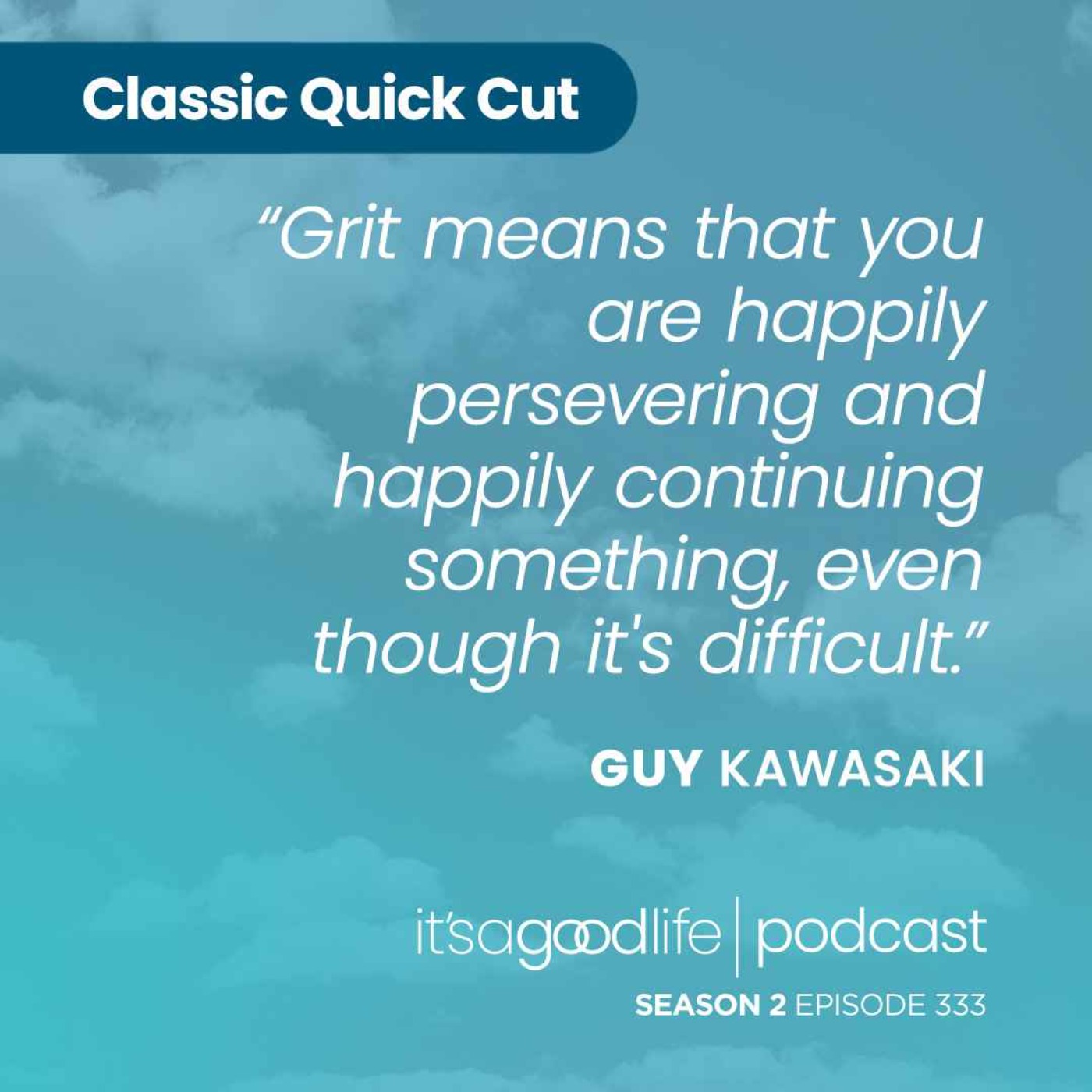
So I, I, well, I could go back to sports, right. So I've been surfing for 10 years now, and I surf almost every day. And you know, I can't tell you I'm a good surfer yet. But it's pure dedication and gr. And I think that grit means that you are, you are happily persevering and happily continuing something, even though it's difficult and it's not just a layup, it's not just, you know, come naturally to you. Because I think that, you know, anything that worth, that's worth doing, you got to do it well and you have to pay the price. And a lot of, you know, Gen Z, Gen X millennials, they have this concept that they want have work life balance, you know, and, and I tell them, listen, over the course of your entire lifetime, God bless you if you have work life balance, you know, you had, you had such and such amount of work and such and such amount of life and pleasure, but at any given moment, it's not going to be 50, 50, right. When you're young, it's going to be 90, 10 the other way. Now, when you're old like I am, then it's 10, 90, but, you know, so it evens out. But at every given point, you know, I don't want you to think that you're going to succeed in life and you're going to be a successful entrepreneur. If you are living in Bali and having zoom calls three hours a day, that just ain't going to cut it.
- [07:07]
Brian Buffini
Yeah, you know, I get all the time. Oh, you know, because I do big conferences and you know, I have thousands of people there and people go, oh, Brian, I just want to do what you do. I just want to do what you do. And I go, well, are you prepared to do what I did? You know, because what I did wasn't sexy at all. I mean, I talked to ballrooms at that. We had 800 chairs and seven people showed up. You know, you're here today and there's 5,000 and everybody thinks I'm God's gift. I go for a long, long time, many, many years, I was a schmuck that people are like, who is this guy? I think it's okay for people like us that have been around the block a bit.
- [07:40]
Guy Kawasaki
Yeah.
- [07:41]
Brian Buffini
To let people know how bloody hard work it is, like you got to work hard and you gotta grind. And you know, I put in a lot of work and a lot of effort and a lot of energy to build something. And then once you build it, then it has a compounding effect. You know, Steve Jobs, everybody's, oh, Apple. And he just sat around and he wore black T shirts and he came up with ideas. This guy got fired. This guy had failure after failure, right? He came back over and over and then over time, then, now look at Apple today. It's his. One of the biggest companies in the history of the world, you know, you.
- [08:10]
Guy Kawasaki
Know, I'll give you an insight into Steve Jobs. So whenever he had to do a Macworld Expo or a wwdc, a Worldwide Developers Conference presentation, you know, you would think, oh, Steve Jobs, he's such a natural. He can just go up there and butter, bing, bada bang, do this great keynote and great demo. If they only knew that he worked for weeks on his keynote speeches. And, and you know, so, so people have this thing like, oh man, it's so easy. It's natural and it's not it. You have to pay the price.
- [08:46]
Brian Buffini
I love the concept of grace, which is this, the sage season in a person's life. They've gone through all the growth, they've gritted it out, they're still productive and active. And you think the natural projection is then it's to uplift, inspire, mentor, teach, give back. Has that been the pattern you've seen with a lot of successful people?
- [09:04]
Guy Kawasaki
Well, I think in that third part of your life, you realize that the way you keep score is changed, right? So it's no longer the, the net worth or the cars or the houses or the fame or the glory. I think in the third third of your life, you, you change score and the score you want is how do you want to be remembered and how can you pay back society? Because if you are honest, no matter how much growth and grit you personally account for, there have been people and institutions that helped you along the way. It could be an elementary school teacher, a college professor, it could be your first boss. You know, it could be a lot of people, a lot of people helped you. And then there's luck. And when you realize that, you know, maybe it's not just you're such a remarkable person, but forces lined up, you figure, you know, I think you should, you should even out the karmic scoreboard and pay back society.
- [10:07]
Brian Buffini
How does Guy Kawasaki want to be remembered?
- [10:10]
Guy Kawasaki
I want to be remembered in two words, empowered people. I want people to say that I empowered them with my book, with my podcast, with my writing, my speaking, my investing, my advising. And I empowered them to change the world.
- [10:28]
Brian Buffini
Well, we hope you enjoyed this. Quick cut. Head to the show notes to listen to the full episode. If you'd like to elevate your business to achieve your goals, talk to one of our experts on a free business consultation. Visit it'sagoodlife.com bc to schedule yours today.