← The Brian Buffini Show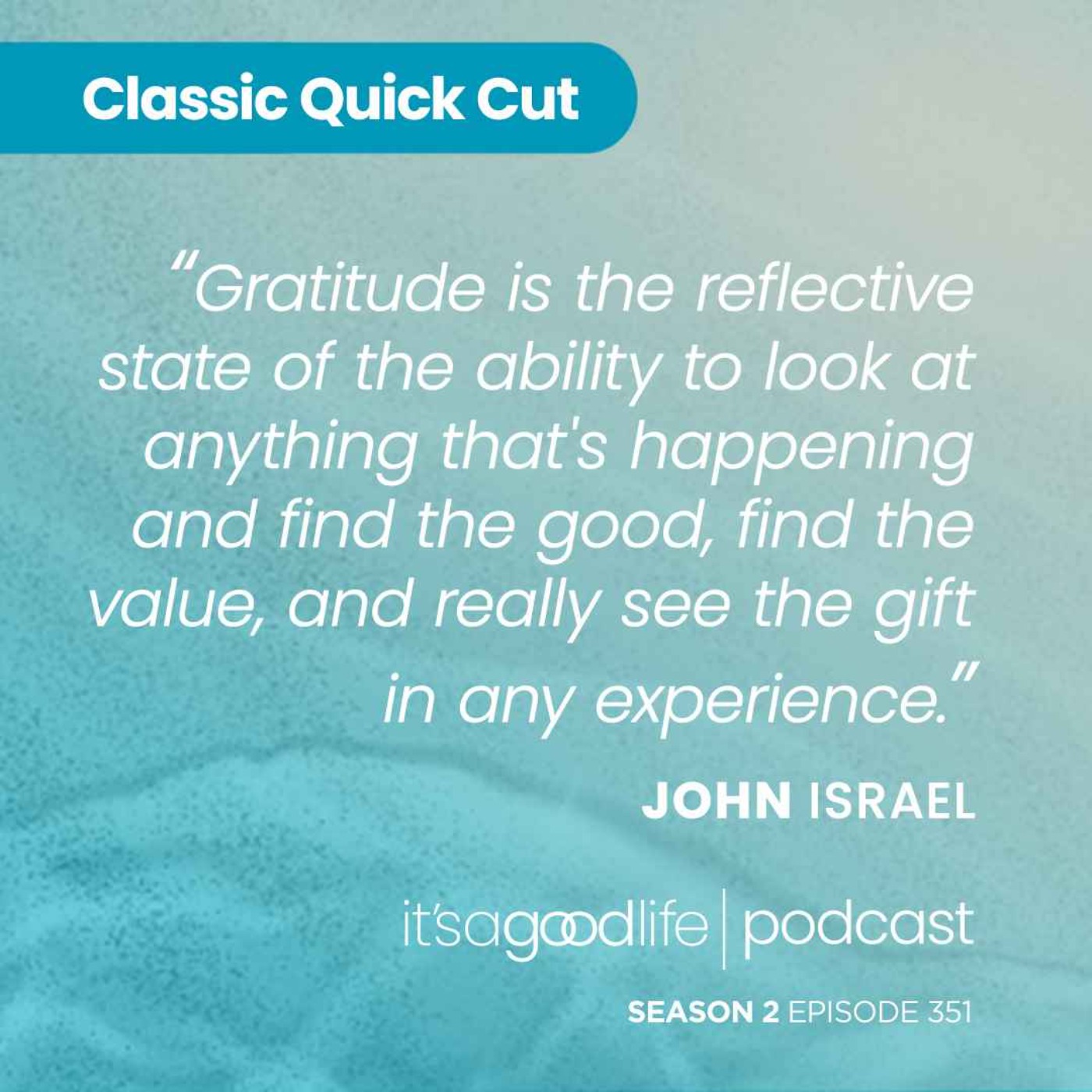
The Brian Buffini Show
Quick Cut: S2E351 Don't Just Say Thank You, Write It - a Conversation with Mr. Thank You
00:10:17
Loading summary
Transcript12 lines
- [00:04]
A
Welcome to It's a Good Life with Brian Buffini, founder of America's largest business coaching company. Here's a short classic cut from one of our all time favorite episodes.
- [00:17]
B
Well, the top of the morning to you and welcome to It's a Good Life. I am very grateful to introduce our guest to you today. His name is John Israel, otherwise known as Mr. Thank you. So you can tell we might have something in common. I'd love to dive right in with, give our listeners a definition of gratitude and what that means to you.
- [00:37]
C
Yeah, well, the best definition I found of the word gratitude is from Dr. Robert Emmons of UC Davis. And here's what he says. Gratitude is the emotion one feels when you receive a gift or experience something as a gift. And it makes a lot of sense when you think about it. Receiving a gift unexpectedly, you didn't do anything for it. That emotion, that joy, that surprise, that delight, that in its own way is gratitude. The other part that I think is more relevant very specifically to what you said is the experience of something as a gift. And that's really where we both talk to a lot of entrepreneurs, a lot of salespeople. And when you live in a world where you eat what you kill and you're responsible to put food on the table, that every deal, every conversation is important. And so if it doesn't go your way, it's easy to feel stress, it's easy to feel anxiety. You know, you add on top of that everything that is on social media, the news, just forcing us into our negative bias, which we're prone to look for what's wrong before we look for what's right. So gratitude is really just the reflective state of the ability to look at anything that's happening and find the good, find the value and really see the gift in any experience.
- [01:56]
B
I don't know if you're aware of this or not, but we actually produce for our members. We have 10,000 members who receive the notes from us every month. We provide 6 million notes every year to our members and we say, hey, the goal is 50 notes a month. That's your goal. See if you can get it done. Now you came up with this challenge, the project, as you call it, and you have four rules of the game and I think it will be so helpful. And again, you're going to be speaking to a home crowd here, John, but I'd love to hear you have these rules for the game on how to stay consistent with writing the notes.
- [02:27]
C
Yeah. So for me, what the rules were that I would Commit to handwrite five thank you notes every single day for 365 days in a row. Had to be handwritten. Couldn't be a text, couldn't be a video. Not that there's anything wrong with that, but handwritten cards were something I needed to make consistent. Rule number two. Every day resets at zero. So in this case, if I miss a day, I don't do 10 the next day. It's just every single day, same habit, no matter what. So I couldn't skip three days and then do 15 in a day, which.
- [02:58]
B
Is what I just confessed to. Yep.
- [03:01]
C
And if you make the commitment, that's where we wind up. And then you. You illustrated it beautifully, because you could do 100 in a day. But where's the heart of it? The heart is an obligation. And that, I think, is really where handwritten notes can actually become ineffective, is when it's coming from obligation versus a heart of gratitude. Arguably the hardest part and also the most transformational opportunity. Okay, those were the two rules. Third rule was I could write a max of 3 cards per any one person. Now, that was an important one because I know myself, and if I couldn't think of who to write a card to, I might write the 75th thank you card to my mother, which, who knows, maybe she would have appreciated that. But I thought they would also start to lose their impact if they were to the same people all the time. Fourth rule was kind of the interesting one, and I credit my coach to this. He says, john, I love this idea, but what happens if you miss a day? And I thought I had a good answer. I said, okay, if I miss a day, I will donate $100 to charity. Felt pretty good about that. And he looks at me and says, add a zero. And I said, you want me to donate $1,000 just for missing five thank you cards in a day? That's absurd. And he says, john, I don't want you to have to donate any money, but let me ask you this. How likely is it you're going to donate 100 or several hundred dollars to charities this year anyways? And I said, yeah, we do that with our church all the time. He's like, then you're giving yourself a way out. If what's at stake every day is $1,000, how many days are you going to miss? And of course, I said, zero. And then he asked me, okay, then what would you like to do? So that's the fourth rule. The fourth rule was $1,000 to charity for any and every day. That I missed writing my five thank you cards.
- [04:44]
B
I'd love to know for you, what do you say is the key element to an amazing personal note?
- [04:50]
C
Yeah, that's a great question. This is how I end every single keynote I do is by giving what we call the ABCs of a legendary thank you note. So attitude, behaviors and challenges. So this is want to distinguish something called recognition versus acknowledgement. Recognition is saying thank you for what you did. Acknowledgement is saying thank you for who you are. So it's the difference of being able to tell. I'll give you a great example. One of the stories that I kind of got famous for is writing thank you cards to the pilots on my plane. And there's two ways to do that, right? There's being able to just say, hey, thanks for getting us to the destination safely. Really simple. But I was really challenging myself during this project to explore my capacity to experience and express gratitude, to really make every single card meaningful and impactful. And so this whole ABCs came about from writing so many different cards and noticing which ones were the most impactful. And the A stands for attitude, which is the character qualities about the person that they're loving, that they're generous, that they're patient, that they're trusting. B stands for behaviors, which is what did they actually do? Maybe what have they done for you consistently that is often ignored or not acknowledged and appreciated. And then C is the challenges that they overcome or deal with and still show up and do what what they did for you. So let me give you an example. This was day three of the project. I go to the airport and I'm racking my brain. Who am I going to write my cards to today? And I see the pilots of my plane sitting at the Chick Fil A and I think, oh my gosh, the pilots of my plane. I never write, I've never formally thanked them. Let's do that today. But I didn't know how to do that. So I decided to walk up and simply have a conversation with these pilots. And I was asking them all sorts of questions. Hey, what's it like to be a pilot? What's the best part about your job? How did you get into this? What's the hardest part about what you do? And just asking those couple of questions gave me the data points to know how to actively appreciate these people. So here's what I wrote in my note. I said, dear pilot, I'm sure it's strange to receive a thank you card from a passenger, but as I was boarding the Plane today, I was thinking about how much I'm going to miss my family on this trip. And then I realized, this is what you do every day for your job. I can't imagine how many birthdays, anniversaries, and special events you've sacrificed for your work, not to mention the hundreds, if not thousands of hours you spent in the cockpit training for your job. Because nobody becomes a pilot by accident. All of that, to have some bad weather, a slightly bumpy landing, and then have people complain about it. So whether you hear it enough or not, I just want to say thank you on behalf of myself and everybody on our flight. Now, here's what was crazy. Brian. I don't normally do this, but at the time, I only had my business stationary with me, which has my name, cell phone number, and email physically printed on the card. This is what was crazy. I had two legs on this trip going from the east coast, west coast to the east coast. So two different flights, four different pilots, right? Two on each. When I landed, within 24 hours, three out of those four pilots personally contacted me to say thank you for the card that they received. One went on to say, you know, John, in my 20 years of flying, I have never received a thank you card from a passenger. And I thought, that's crazy. How is it possible? These guys with such a big, significant job, and no one's even taken the time to say thank you to them.
- [08:25]
B
Especially their bosses, especially the companies they work for.
- [08:28]
C
Yeah, so that was really, you know, that taught me, I think probably the pillar point there, which I call the curiosity principle, which is that curiosity is the precursor to appreciation. And appreciation is the birthplace of empathy. With empathy, we develop compassion. And when you have compassion, you have the ability to literally connect with anyone. And I think that became the catalyst for the entire project, because every day, it wasn't just, oh, let me think of, I got to get my notes done. What's a short thing I can say? No, it was, who is this person? What are their values? What are their character qualities? What are their fears? What are their concerns? What are their goals in life? And if I don't know those things, I need to have a conversation. By the way, how powerful is that, as a salesperson or a business person, to do with everybody you meet anyways, you know them at a deeper level. And then when you take the time to acknowledge it, it takes that relationship deeper from the conversation, and it demonstrates to them that you're paying attention, that you're listening. It creates a high level of trust and I think ultimately every at the end of the day, there's a lot of real estate professionals, there's a lot of business professionals who do what all these listeners do. But at the end of the day, we want to go to the person that we have the highest level of trust. And so I think if we do them right, a thank you card can actually be the opening of the door to a great business relationship.
- [09:50]
A
Well, we hope you enjoyed this. Quick cut. Head to the show notes to listen to the full episode. If you'd like to elevate your business to achieve your goals, talk to one of our experts on a free business consultation. Visit it'sagoodlife.combc to schedule yours today.