← The Brian Buffini Show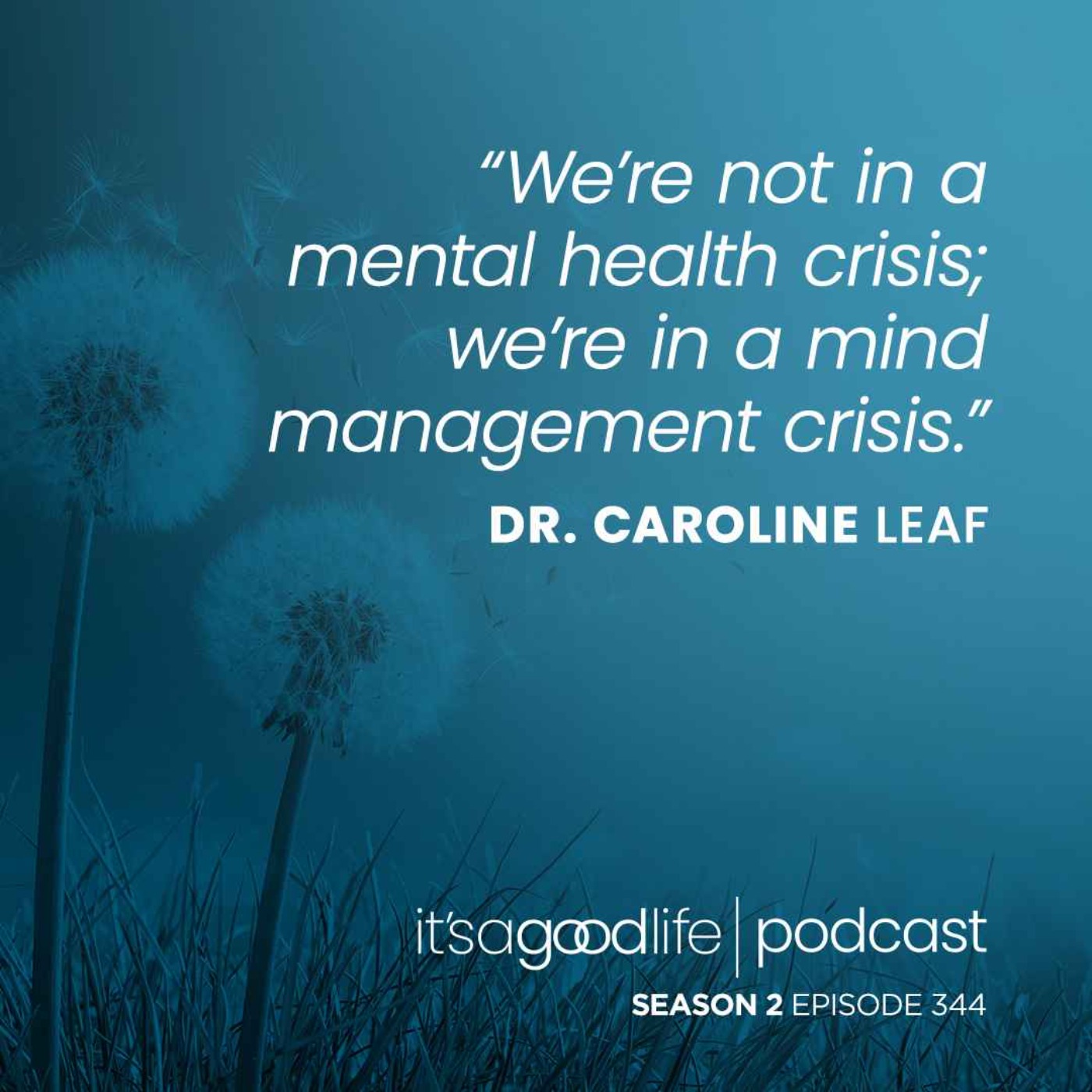
Loading summary
Transcript90 lines
- [00:03]
A
Welcome to It's a Good Life, the podcast for entrepreneurs where it's all about growing yourself and your business. Here's your host, founder of America's largest business coaching company, Brian Buffini. Well, the top of the morning to you and welcome to It's a Good Life. I'm your host, Brian Buffini and we have a very special guest for you today. Her name is Carolyn LEAF, in fact, Dr. Carolyn Leaf. And she is a cognitive neuroscientist, bestselling author and an expert on how to manage your mind when life gets messy. And our new book, which I'm holding in my hand, which is absolutely terrific, is called Help in a Hurry. And we're going to dig into some science based tools today to bring calm to the chaos. Dr. Leif, welcome to the show. This audience is somewhat chaotic in a chaotic industry. We need your help.
- [00:54]
B
Oh, thank you, Brian. So great to meet you and to be on your show. And I think we only, I think I wrote the book for myself. How can I hurry? We all need it. Yes.
- [01:02]
A
Give us a little background on where did Caroline Leaf come from and how did you end up in this world?
- [01:07]
B
Oh, that's so funny. Okay, well, I come from my, my mom's Irish, as you were talking before. Yes, that's Italian. And you've got the Italian background too. I grew up, I was born in Zim, grew up in South Africa and been in the States for the last 16 years. And I've been in the field of clinical and cognitive clinical research, neuroscience and psychoneurobiology for the last 40 years and still do research, write books, do clinical trials, help people and trying to help people to understand the most important thing which is the mind.
- [01:37]
A
No doubt. I mean we're a coaching company so we have all these great techniques to help people grow their business and so on, so forth. So we have all these how to's and all these things that if people follow, you know, our average client does 10 times out of their competitors.
- [01:48]
B
Incredible.
- [01:49]
A
But I'm going to say this. 60% of our coaching is helping the person with the person.
- [01:56]
B
I get that. Totally. That makes so much sense.
- [01:58]
A
It's the self sabotaging that goes on the family of origin, stuff that shows up be shock and how fear of success is such a bigger deal than I ever realized. And so all these things. So I'd love you to. You wrote this book Help in a Hurry. What was the background for that? What drove you to write the book?
- [02:18]
B
So for, as I mentioned, for 40 years I've been in the field of in therapeutic world, but also the research world of trying to help people understand myself, understand what is the mind, what is the brain, what is a thought, how do thoughts. We are thoughts, even created, what are they? And if we create these thoughts, what is a network? And all these things that people talk about and can we reverse that? So that's been the goal of my research. And what I have shown is that there is literally a formula that one can apply in understanding how information gets from my mouth into yours head and into your body and into your mind, your mind, brain, body, network. And everything that we experience in life becomes part of us into this triple network, this mind, brain, body network that we call psychoneurobiology. And how it gets in and forms a thought that drives us and how we reverse that. That has been the goal of helping people to understand that. So whether it's applying, like you mentioned, people, things that can stop people achieving their goals is traumas from the past and perceptions that they develop, these are all thought patterns. People ple imposter syndrome. Getting irritated, rushing around, getting caught up in not using technology correctly. These are all mind management or leadership of the mind issues. You talk about teaching people to be entrepreneurs and lead their businesses. And you've already said something very key, that in your years of experience, that mind is playing the major role. Most people don't even understand what the mind is. Most people think that the mind is the brain. I mean, I've got a little model of the brain over here. And this is what the mind is not. The mind isn't the brain. And the current sort of philosophy is that the mind is the brain. And that's not correct. For 2000 years we've known. It's not. It's only in the last 50 years that it's been. And that's linked to all kinds of problems. So, yeah, that's kind of the background to what I do now is help people really understand mind and how to manage their mind.
- [04:13]
A
Well, let's dive there for a second. I mean, so from a theological standpoint, I align the mind with the soul almost. You know what I mean? There's the body, the soul and the spirit. When you say, you know, you have that image there in front of you of the brain and the matter of the brain. And you've always heard that in Western culture everything is so logically driven. Right. That we can miss out on a lot. Oh, we only use 10% of our brains and things like that. So tell us, you're talking to an Irishman you know, there's no Irish space program. You know, your mother would agree to that. What is the mind, Dr. Leif?
- [04:45]
B
Okay, so the. So the mind, first of all, we use our whole brain. We don't use 10% of our brain. So that's incorrect. And we use 10% of our brain. Incorrect statement. We use 100% of our brain. We use. What am I saying there? We use. That's mind. The we using. The ability to have this conversation, the ability to connect with each other, the ability to appreciate life, the ability to teach someone, to coach someone, to enable them to run a business, the ability to fall in love, the ability to think, feel, choose. That is all mind. That's all that psychology. That is mind. Mind is 99% of who we are. And your mind runs the brain. So the brain is simply like a receiver or a transducer, as is the body. So every experience we have is processed by the mind. A thought is created from that, and that thought is placed into the brain, a duplicate of it, because it's like an energy field. It's placed into the br. The brain then gets activated. All these chemicals and electricity and all that kind of thing, electromagnetics, genetics happen, and proteins form that hold the network. Now that's happening as we talking now at 400 billion actions per second. So translated into something simple to understand. All the things that you experience go from energy in your mind into networks between your mind, brain, and body. And those networks are flexible. I did some of the first research back in the late 80s on neuroplasticity, which is this whole study of the mind, mind and the brain, and how the mind can change the brain. So the brain doesn't think, the brain responds, the mind thinks. So the mind drives all our psychology, Brian, and it also drives all our physiology and our neurology. So the fact that your heart's beating right now, the fact that you're breathing, the fact that you're making 800,000 to a million new cells every second that you and I are speaking, that's all driven by your mind. When you die, your body disintegrates, but your mind doesn't go away. We have more research confirming the eternal nature of mind and that the mind is actually separate from the brain and the body. But it works. It uses the brain and the body than we do on research on the brain. It's fascinating. So you spoke earlier on mind, spirit and soul. From a theological perspective, mind is a word that's a very ancient word. It's over 2,000 years old. And it's used to represent spirit and soul. So you can think mind, spirit and soul, two different levels. And then you've got your body and brain, which is the other part, spirit, soul, body. So you can see it like that. A modern word for mind is consciousness. Hear a lot of that word, consciousness. So we're talking about this power that has eternal value, that is thinking, feeling, choosing. And it's got different levels. At its most basic level, it is kind of messy and it's kind of just dealing with all the data that's coming in. It's like a toddler learning. And a toddler needs a parent. The parent would be the equivalent. So the toddler is the conscious mind. The parent would be the subconscious mind guiding the toddler. Then you get the non conscious. And that's the power, that's the spirit level. That where we have our logic, reasoning, intelligence, insight, intuition, wisdom, all the good stuff. And as a human we need to tap into that level in order to function, which is the level you're pretty much teaching your clients to be able to function. You're tapping into that level.
- [08:07]
A
This is just brilliant stuff. And again, the old motivators, the Zig Ziglars and the Jim Rohns, they were on the cusp of this and they would lead into the researchers and they would come up with 80% of our actions come out of our subconscious or unconscious mind. And I don't know what the data actually is. I'd be curious to get your take on that. But it seems like until you get that part right, you know, the conscious mind can say, yeah, I want to be successful, I want to go to a seminar, I sign up for coaching. But if the unconscious mind is I'm unworthy, I don't deserve it, I'm really an imposter. It doesn't matter how many events you go to, it doesn't matter if you sign up for coaching. Until we work on that unconscious mind where we're kind of one foot on the gas and one foot on the brake.
- [08:46]
B
Totally, 100% everything you said, except for one thing. It's not the unconscious mind, it's the non conscious. No N massive difference. And the reason I'm being making that distinction is because the unconscious mind is. It's actually the brain. It's a brain state. So if you're asleep or if you are under anesthesia or anything like that, that's unconscious. So the brain goes into sleep would be unconscious. But non conscious. N o n. That's the big deal. That's the hugest biggest part of us never goes to sleep. Beyond space and present, past and future wisdom. It's where we've got, where every single experience you've ever had has clustered into memories that form thoughts. Because thoughts are made of memories. Memories are the details. They're all in your non conscious. And the non conscious not only has the problems that we've created, but also the solutions, because that's wisdom. Wisdom is solutions. So it's all in us. And if one believes in a theological approach, whatever source, universe, God, well, that all wisdom is connected to the source of wisdom. But we've got to do make the effort of tapping in. So you said something very valid and accurate scientifically earlier on, that if we just get stuck in the conscious mind without tapping into the non conscious. You said unconscious, but it's non conscious. That part's totally correct. You can't function if you get stuck in the messy mind, which is the conscious mind, which is not bad, but it's on its own. It's like a toddler. It's dangerous. If you get stuck in that, you're going to have messy mind, messy brain, messy body, messy life. But if you train your conscious mind to listen to the subconscious and the non conscious, now you're tapping into that wisdom that makes the entrepreneur success, that helps us embrace the pain of life and grow from it, helps us not be fearful of anxiety and depression, recognize that they're messages and you can grow from them, all that kind of stuff. If that makes sense.
- [10:32]
A
Yeah, look, I mean I always like talking to people who are smarter than me and as an Irishman that's not a very big task. But I'm not used to talking to somebody this much smarter than me. This is brilliant stuff. And again, I'm in a student of personal growth and development for 40 years, you know, came from Ireland. Personal growth and development was not really part of our culture back then.
- [10:51]
B
Yeah.
- [10:52]
A
And I found it was the making of me. And you just defined and refined something I've shared for decades. But there's no doubt like I have retrained my non conscious mind to see myself differently, to approach things differently. I grew up broke and poor and became successful in many other ways. What are some of the ways that you see? Because I look at the social media world we live in, where basically it seems like Massey is now on nuclear time. It's like people start the day the scrolling. I mean one of the great gifts that I think Apple has given the world unconsciously is that they've given us here's how many hours you spend scrolling your phone every day. I don't know that they want to do that, but I know this when I see those numbers. It checks me every time. I'm like, okay, I put the phone in the other room. I started doing a Sabbath with my phone, which is Sundays. I don't look at the phone, I go, somebody dies, they'll call Beverly. The world we live in is so hectic. And you talk about this messy mind, which I want to dive into, but it just seems like whatever has gone on for thousands of years is now on steroids for the messy mind because of social media, because of the algorithms that are being thrown at us that are designed to keep us just interested enough in what we're interested in. So how do you see the messy mind in the modern world that is actually seems to be pursuing us to make us more messy?
- [12:12]
B
Brilliant question, brilliant question. So essentially we love technology. Obviously you do too, and there's nothing wrong with technology. The key issue, Brian, is management of the technology. You teach people to be entrepreneurs, entrepreneur is a leader, they're managing things. We need to manage our mind. We need to be leaders of our own minds. And that means that I don't just get stuck in the messy stimulation that I'm consciously aware of, but I actually stand back and judge it and question it. That element, that metacognitive element, that self regulatory element that is being really radically reduced if the mind is not managed. And that stimulation from technology, if not used correctly, will suck you into that conscious mind, physical brain, body loop without really tapping into the parent mind and the wisdom of the non conscious mind. And people get stuck in that loop. And so that's what's happening with the. Because the brain doesn't think, as I mentioned, it just responds and stores data. So if you just keep packing it with data by doom scrolling and all that kind of thing, but you don't evaluate the data, you're just loading the brain, draining the brain, draining the body. So then we see that it has a physical impact. I mean, the statistics are crazy. We are living now in an era where people are dying 8 to 25 years younger from preventable lifestyle diseases. And a lot of it is contributed to how people are seeing themselves. In other words, there's two things happen. We've got the technology hitting us at the same time. We've had a move away from mind and focusing on the soul and developing the spirit and Socratic talk, you know, deep thinking. We've moved away from that into quick Fix productivity, hustle, culture. And that means we've actually created a lot of toddlers. We've got a lot of toddlers running around out there without listening to any parents and without listening to the wisdom of. Because a parent will say, let's do more research. How can I be a better parent? How can I get more wisdom? So see the tod, the messy mind, the parent as the subconscious mind and the wisdom as the spirit level. As your non conscious, we have to have all of those levels working all the time, and they always are working. But with our conscious mind, we can choose to close the door to the parent we can choose to ignore. And that's what happens when we get overstimulated and we get into that loop. You just keep feeding the brain. Now the brain is designed to receive and to grow data. That's its structure. So if you pack it full of data, but without analyzing the data, you land up with mental health problems, you land up with physical problems, you break down the biology, it literally collapses the immune system, the things like telomeres. I've shown Brian with my research that telomeres are the ends of chromosomes. If I cross my fingers, my fingernails are my telomeres. Telomeres are a proxy for our emotions or mental health. Very strong indicator. And there's a lot of other things too. But this is just a very powerful quick example to show you. So what we know from the research is that we're making new cells all the time. 800,000 to a million new cells. And to do that we need these telomeres. These telomeres, as you make new cells, they get used up so that you can make new cells. That's very simple version of what happens. So they've got to, if they're used up, we need more to make more cells. Now those cells make your organs, make your systems, make your body. So we keep renewing our. We keep renewing our body. So if we don't capture our thoughts, if I can steal that quote from the Bible, and we don't renew our minds, what we are doing is we are. This messy mind is actually driving the telomeres ability to make new cel. We don't manage our mind. Those telomeres will shorten and get sick. So what we see is that people's biological age, their body and brain are older than what their chronological age is. I mean, when you get that mismatch, you get a lot of stress and anxiety and blah, blah, blah, toxic things happening. We can reverse that. And I showed with my work, you can reverse that in nine weeks if you are deliberate and intentional about that.
- [16:11]
A
This is some of the best stuff I've heard on the subject. I candidly, I don't play an amateur psychologist, but in order to grow myself as a person, I realized that I had to work on this part of my life as much as I did the actual physical work to progress. And I became an amateur student of everything that was out there, of all the personal growth and development people. But I've never heard the stuff so succinctly put as you have. And it's so great in the world we live in today. We're in a world that's drowning in information and starving for wisdom. You just have so much insight research and then wisdom on top of it. This is just a delight to talk to you.
- [16:46]
B
Thank you.
- [16:46]
A
I'll give you a couple things here. One of the things, there's two experiential things in my own life. One is I have six kids which, wow, good job.
- [16:54]
B
I've got four. That's great. Six kids, that's good.
- [16:57]
A
It's a good life. And I've got 33, down to two 23 year olds. Okay. And our home has always been the hub, right? So Mr. Mrs. B's home. Every weekend for 20 years, there will be more than a dozen kids and on some occasions a lot more than that hanging out at our house. It's always been a welcoming place. We love feeding them, little Irish hospitality.
- [17:20]
B
Love it.
- [17:20]
A
But we love the conversations. And the thing that's kind of shocked me in the last few years is some of these young folks who many of them have achieved things in sports and in life, who are taking these mental health breaks. And I would say the symptoms of the conversation are symptoms I felt in my life when I was in my late 40s, early 50s. And I'm like, these kids are young to be experiencing this. So I see that on one hand. And then on the other hand I do a couple things for my well being. I do a meditation in the morning. It's like a. It's called a contemplative prayer. And I was taught this by Father Thomas Keating. It's been very powerful dynamic for me. Me and I like to go for hikes and I go for hikes and walks. And if I can't get out that day, I'll get on the treadmill. And I don't listen to music, I listen to nothing. And I've thought, man, am I just getting older or what's going on? My inner thought life is like buzzing compared to what it was before. And it seems like whether it be the contemplative prayer or the daily hike walk is almost like a decompression from all the stuff I'm getting exposed to on a daily basis. And it just seems to be that it's easier to have a messier, cluttered mind today than ever before. And I just love to know your thoughts on this messy mind. And what are some, just some practical things some people could do. I mean, the book is essential. It's just a brilliant book. I love the fact that it's again, it's practical, it's scientific, it's heartfelt, it's from a wisdom perspective. But what are some of the things people can do from like the. To get rid of the messy mind into a more calmer state and to kind of make a little more sense of it all?
- [18:58]
B
Well, first of all, thank you. Great question. So first of all, great that you're doing that, the blanking your mind and letting your mind rest with the hikes. We also do hikes every day, taking that time out, these are essential because what you're doing is you're creating the space for you to just get your physical brain and body, your neurophysiology to calm down from all the stimulation that we live in. So it is really important. And then it just gives you the chance to then step back into the parent mind and the wise non conscious. And when you do that, that's when there's so much in you, there's so much wisdom, there's so much intelligence, there's so much logic, reasoning, creativity that is inside of you as a human, by you doing what you're doing, you are releasing that. So these extra thoughts and these insights that you're gaining and it's like, wow, is you allowing that to happen, you allowing yourselves to dig deep. And that's what we need to get our kids and our youth. And that's the goal of a lot of what I do, is to teach people how to get back into the non conscious mind. So your two tools are very, very, very good, very important. So what I've also done, Brian, is work on in 40 years ago, I developed a theory which is what scientists do. And then we spend the rest of our life trying to understand what we developed in that process. All that stuff in science and everything that all the work is there's a theory. From the theory I developed practical application. Because here I am working with patients, working with people with traumatic brain injuries, extreme trauma, neurological issues, you Name it. And then also just life, being a mom, seeing people, whatever, wanted to know, how can I take this fabulous science that I am obsessed with and make it very practical. So that's where I created and said there's got to be steps involved in how we can redirect how we can get into the toddler, out of the toddler, you know, get the mind levels working. So the brain and body, and that's where the neuroplasticity and the neurocycle came in. So I developed this concept called the neurocycle and it's had extensive clinical trials and 40 years of research and it's now in an app format. I referenced it in this book, help in a hurry. We've actually just released a course as well with this, the help in a hurry book to help you to manage it. And so that's the explanation. So there's two levels of help that I can offer people right in this moment. The first thing is the reason I wrote this most recent book was something I worked it with my patients and with millions of people that we've reached now, but in a more like lecturing level as opposed to and therapy level as opposed to a book and program was to help them manage the moment. The, the formula of the neurocycle, which is extremely important to rewire the brain that I've had going for years. And that's in my book actually called cleaning up your mental mess. And we've got an app called the neuro cycle app, which is literally me giving you therapy, helping you to use the formula of the neurocycle daily, which is how you rewire your brain daily over 63 days. Because it doesn't take 21 days to build a habit or to rewire a habit, it takes at least 63. And there's all the science behind that. But what I found is that, that before you can get into that, because people think, 63 days, I can't even manage the moment, it was that comment that made me realize, you know what, I need to write a book that helps people manage the moment because I'm teaching it. And that's what help in a hurry is. So what I showed from the science is that in 63 seconds, more or less in a minute, you can learn to self regulate. You can learn to step back from the messy mind and clean up the messy mind. Listen to the parent mind getting to that wisdom of the non conscious. And you can do that in 60 seconds. And that's literally what the techniques in this book are doing. And so that is key is if I can manage this moment, I can manage the next moment, I can manage 10 minutes, I can then start seeing the patterns in my life and whatever's a pattern to have it, then I can start putting those to the 63 day neuro cycle. So just for the sort of theological side renewing of the mind would be the 63 days, every 63 seconds is capturing every thought. So quite literally.
- [22:51]
A
So holding every thought captive, which is a great biblical principle there.
- [22:54]
B
Exactly. And that is. Exactly so it's in the Bible. It's also in most religious texts. You'll find a concept of we've got to catch the moment. So in catching the moment I train myself to be this person who's able to stand out of myself and regulate. So for example, let's say that you're sitting in a meeting and someone says something and they've been in meetings before with you and you know what they like and you know that you get triggered by them and they. And lo and behold, that look on their face, that tone in their body and the tone in their voice, the way they're holding their body will already hit you and worked you up and you were already triggered and about to explode. And we know what happens with those kinds of things. It just gets worse during the day and whatever. I think we can all relate to something like that. So what do we do in that moment? That moment, that 63 seconds is critical. The first thing that we need to do is stand back and observe. Okay, I'm about to do all of this. So let me break this down. Let me acknowledge with compassion, no judgment. Because I'm not that irritability, I'm not that anxiety, I'm not depression, I'm not frustration, I'm not people pleasing people. I'm not it. I am showing up with that behavior because something is going on in my life. There's a source. You said it right at the beginning of this interview. You show people how to they must find there's a reason why they have this negative view that they can succeed or whatever. Whatever we're talking about that. So in the moment, 60 seconds, first 10 seconds, you need to calm down your neurophysiology. And there we do the good old fashioned. There's a ton of different things you can do. I give lots of examples. But just breathing, we always hear it. But let me tell you the science, the science, why breathing? Don't just take a deep breath. Worst thing you can do because you'll actually do the wrong thing.
- [24:38]
A
Didn't know that.
- [24:39]
B
Yeah. And because you will lift your shoulders and you'll actually make it worse. What you need to do is breathe in for three counts. Just breathe in. And as you breathe in, think of yourself, stomach moving out. Now, what that does is it tells your mind, tells your brain and your body by the level of oxygen and changes blood flow, changes chemistry, and it sends the message to your brain and your body that it is going to be okay. Not, it's okay, it's going to be okay. So it activates you, and it sends a brainwave through your brain that we would call a gamma wave, and it changes your neurochemistry. And I can go on for hours about what it does, but that's enough. Then you breathe out for seven counts and you force that out. Now, the exhale changes the physiology so that your body actually goes into a relaxed state. You'll hear things like vagal tone, and you'll hear sympathetic and parasympathetic, all those very trendy things that are going on at the moment that you'll hear those words all over. But essentially, the exhale will put yourself into a calmer state. Now that I've done that, what you've actually done is you've stepped out of the 1%. Your brain and body are 1%. Your mind is 99%. But if our brain and our body are going crazy, the 1% percent becomes the 100%. I can't think straight. I'm going to still be irritable. I'm still going to whatever, but if I can get out of that. So my body's now in a state where I don't have to be consumed by it. Now I can actually get into the messy mind, and I can see, okay, messy mind, what are you thinking? With no judgment, lots of compassion, because this is okay. We all do it. And you say, you ask yourself four questions. You gather awareness of your emotions. How am I feeling? Second question, where am I feeling it in my body? Third question. Third question is, what am I about to say and do? Fourth question, how's this affecting my perspective in this moment? The breathing took 10 seconds. Those four questions can take you 10 seconds, maybe 20. You answer them simplistic, so it could be irritated. My shoulders are tensing, I'm about to snap, and, oh, this person irritates me. I mean, it's as simple as that. But by doing that, those two steps, you've now activated the network from the mind to the brain through the body, energy to proteins, et cetera. That is now and it's activated. It's like a spotlight shining on it. So it's weakened. Now you're in control. You're in the driver's seat. The messy mind has now got the guiding parent. The toddler's been told, don't stick your hand down the dog's throat. That's what we're doing now. Silly analogy, but it works. But you've got kids. You know what I'm talking about. Okay, so now we're in that state where you. Oh, okay, I've observed and now you've changed all your neurophysiology, the neuroscience kicking into action. And that opens the door to getting. Looking at the. Going a little deeper. Now you can say to yourself, why? Why is this happening? Who, what, when, where, why? Okay, I'm doing this because this person triggers me. There's something about this. Whatever. You'll get some who, what? Little bit of who, what, when, where, why? You don't have to solve it. You just have to ask yourself a few who, what, when, where, why questions. Then you go into the third step, which is, okay, what else does this bring up? Maybe one or two thoughts come up. Oh, this has happened so often and it's got to change. Fine, whatever. Now you get to the fourth step, which is called the rech. Now you say, okay, this is what's happening in this moment. This person is driving me crazy again. What can I do about it? Now I know there's a reason. Maybe they're having a bad day. Maybe I need to look at myself. But what am I going to do now? Because if I choose, I choose to let them irritate me or I choose not to. They can't make me irritated. No one can make you irritated. You choose to be irritated. In choosing to be irritated, you use up the limited energy that your physical brain, body and your conscious mind have in one day. Your non conscious mind and subconscious mind have an unlimited source of energy. But your conscious mind, brain and body will get that. That energy will get used up. So now you take good energy and throw it off to bed. And now you're going to be tired, panicky, irritable, whatever, and it's just going to go downhill from there. So all I say to myself, well, I choose not to let this irritation get to me. I'm going to stay calm. I'm going to keep peace as my fuel so I can have wisdom in this meeting. And that's what I'm. That's how I'm going to reconceptualize this at I don't get irritated. Now what I've described in about three minutes you can learn to do in 60 seconds. And the techniques at each of those stages for the different scenarios, like if it's getting irritated, you want to punch someone in the face. You people pleasing self critical talk. There's 18 sections in this book and in the course there's 18. I cover those 18 sections and I walk you through these exercises. So I explain it in there and I give the tick. But the framework I've provided is in there. But the techniques to slot in are directly in there. So you'll find an actual ideas. Let's say it's self critical talk that's inhibiting. I think a lot of the people that maybe come to you and learn how to be successful, they are saying things to themselves. You said it earlier on, I'll never get this right. That's self critical talk. So now they're in a course with Brian, Brian saying hey, you can do this and you can apply this and you can be whatever. And they saying, oh, this is really nice. Messy mind is saying, yeah, but then in the messy mind what pops up from the past is I can't do this. I'm not Brian, I'm not. Or two ever. And now what you can do is immediately apply this. Okay, let me stop, let me breathe. In for three, out for seven. Let me quickly say, okay, what am I saying? I'm saying I can't do this. What's making me feel frustrated and upset. You go through the four questions. I'm getting a gut ache. I'm looking at life like this will never change and my behaviors, I'm about to just get apathetic and give up and then I can quickly go into the next thing. What else does this bring up? You know what? This reminds me of something from the past. I did this at school and someone said something to me that you'll never achieve. Whatever. And then you go to the next step. Okay, this is happening right now. I need this information to be successful in my business. So for a moment I'm going to imagine that that self critical talk is an ant on the stage. It's a tiny little ant. And I'm going to stand back and I'm going to say, okay, ant I acknowledge. But I'm going to close the curtain because right now I need to learn what Brian's telling me because I need my business to succeed. So I choose now to ignore the ant. And it's just, that's one of the, the Techniques.
- [30:48]
A
That's crazy. We, we in coaching call it the mouse with the megaphone.
- [30:52]
B
There you go.
- [30:52]
A
So it's even more dramatic to call it an ant because an ant is tiny and puny and. But it becomes like. We call it the mouse with the megaphone because it's this small thing with a giant big voice.
- [31:03]
B
There you go.
- [31:03]
A
And you think about it. You know, nobody really tells you how to manage your mind.
- [31:08]
B
No, they don't. It's a. My. We were in a. Brian, we were in a mind management crisis, not a mental health crisis. The mental health crisis is a result of mind management not being treated, being worked. You have the biomedical model works for the body, heart, lungs, diabetes, but it doesn't work for the experiences of life. So we are in the era where we've been immersed in the biomedical model telling us the wrong stuff, telling you that if you anxious, you've got a mental illness, you've got a broken brain, no science behind that, not good, medicated, damaging, etc. That's not helping people. And the tiktokification of mental health has made it worse. Then we also living in an era of, of excess technology and not being taught how to manage it. And then we're also living in an era. So just those two, just those two together create such a mess. Who's teaching about mind management? Who's teaching how to manage the technology? How to read that. If I'm scrolling through that someone's Instagram feed that's curated and it's making me feel all these emotions, that little neuro cycle I just did those five steps, who's teaching them to do that? I can guarantee I've taught thousands of people. If you feel that emotion, as you're looking at that, that feed, that Instagram post, you, you stop, you do this, it won't affect you, you'll move on. You've stepped into my. Brian, no one's teaching mind management. It will result in a physical and mental health crisis, which is what we're facing today.
- [32:30]
A
Amazing. Well, there's so much to this and you know, I would just say this is a critical book.
- [32:36]
B
Thank you, I really appreciate that.
- [32:38]
A
Well, look, I've been at this game 40 years and again there's a million pop psychologists, right? Oh yeah, but you have the research, you have the insights sight, you've done the clinical work, but then most of all you have the intuition and the wisdom that goes with it. What I take from your work, just even today, is holding every thought captive, how to manage the moment. And then the moment turns into minutes. And then over time, you can reprogram this. And again, we have training programs called A Hundred days to greatness.
- [33:07]
B
Right.
- [33:07]
A
We have all these dynamics of what it takes. You know, I think if executed perfectly, it's probably 63 days. The science is right. I create a lot of wiggle room for people because I find that people don't do it that perfectly.
- [33:18]
B
Yeah, life happens.
- [33:19]
A
But we typically break things up in a hundred day increments because we're in a deal where we coach people. So we roll up our sleeves. Like, I don't do talks where I sell stuff and people get programs or whatever else.
- [33:32]
B
It's.
- [33:32]
A
We bring people home with us. And we've coached hundreds of thousands of people, one on one, into transformative behavior. I just sat down in my office before I came here today, and I'm writing anniversary notes. Right. So we give out awards to people who are with us 25 years.
- [33:46]
B
Incredible.
- [33:47]
A
And I've got dozens and dozens of these people just for the month of October. How many people have been with us 25 years? And to see the transformation that takes place. I've been at this a long time. I've never heard anybody who understands it the way you do. Let me ask you. Obviously, the book is called Help in a hurry. Her name is Dr. Caroline Leaf. And I'm sure you've heard something today. Where you go, boy, I need some help with managing my mind. Where can they get the course, Dr. Leif?
- [34:13]
B
They can just go to my website, drleaf.com and then they'll see if they get the course. The book's included in the course. So they can buy the book on its own or they can do the course and get the book in the course. And then the app is called neurocycle. And there they can get. We have a web version.
- [34:27]
A
Spell that for us. Neuro cycle. Just like a bicycle.
- [34:30]
B
Exactly. So N E, u R O and then C, Y, C L E. And it's available in an iTunes, Google Play and there's a web version and that's in that. That combination of those two. It helps you manage the moment, manage everything we've taught. That's a really powerful combination.
- [34:45]
A
Well, you just said something there that has hit me because one of the things I keep hearing from younger people is my brain is broken and it's not true. It's a lie.
- [34:54]
B
No, not true.
- [34:55]
A
And for me, it's a lie of the devil. It is not true.
- [34:58]
B
And if it is damaged. If it is damaged, because if we use the Technology incorrectly, we will damage back to like taking our computer and throwing it on the floor or not looking off. You can re. You can fix it. That's the beauty of neuroplasticity. Your mind is the power. So therefore you can rewire. So it may feel broken, but it's not broken. It can be rewired.
- [35:19]
A
Well, I'd love your take on this. So one of the things we started doing earlier this year, it's been a great innovation inside our coaching department where we decided to give something back. A lot of people in our industry were struggling. The rate's been down. It's been kind of the worst year in real estate for 30 plus years. So we developed this thing called a free business consultation. So what we do is we take 30 minutes and one of our coaches sets it aside and people just call in, they go to our website, it's a good life.com and they get this free business consultation. We just ask a bunch of questions. I'm curious to get your take on it. We ask a bunch of questions so we can help them with their vision. We ask them a bunch of questions to find out what's holding them back. We share with them what's working for others in their local area area and then kind of lay out some next steps. I'd be curious to know from your perspective how you would see the mind management in in. Because this thing has been unbelievable. I'm shocked at what it's done for people. We did it as a gift. People have been taking advantage of it en masse and I have gotten more letters and more feedback and more just good vibes than I've seen in almost 30 years of business. Why do you think that is working so well for people? What do you think that's doing for them?
- [36:24]
B
Well, there's a couple of things going on. Their perception is already they've come into this situation thinking, well, you are such a success, your company is a success. So they have hope. So they come into the conversation with hope. And that means that whatever they hope immediately opens the door to the unconscious. When you have hope, you already are operating in wisdom. So then what they're doing is they are hearing the wisdom that's loaded in those questions. They're not missing it. They're not just questions, they are pieces of wisdom. And that's why you literally are helping to activate the hope is key. They look at you with tremendous hope and then the content is wisdom. So they taking it someone who doesn't have much hope or they don't Know anything maybe about you or someone just could. They could maybe read some similar questions on the Internet or something. Wouldn't have the same impact. But it's the whole vibe that's created.
- [37:16]
A
Interesting.
- [37:16]
B
Which is interesting. So that's definitely mind management. But they're coming in there with their mind. I know this guy's good. I know what he's saying is true. He's a success. He's a nice guy. And hope it's a whole different attitude. So whatever you say is going to be wisdom. And even if it's not those words, you know, you've got you written. You wrote out some questions to me. But Brian, what they hear is not those words. They hear something else. They hear what they need and that's what we want to deliver to. When we. When we as. As. As leaders or whatever operate in that. As parents, whatever, operate at that intuitive level. Our words are heard, people hear what they need to hear. So we saying stuff, but people hear what they need to hear.
- [37:58]
A
Well, I will say this. My. My audience knows me pretty well. This will not be the last you guys hear of Dr. Carolyn Leaf. And again to all of our, we have thousands of fans down in South Africa. I know you've probably loved hearing that beautiful accent today. As a gift to you, Dr. Carolyn, we. We do a little thing we've asked everybody who comes on. We ask them just a few questions to get to know them a little bit better. We've enjoyed your gift today. People are going to run out and get your course and your book for sure. I'd just like to ask you a few questions if you're game for it.
- [38:27]
B
Sure.
- [38:28]
A
I ask every guest, first and foremost, what's the single best piece of advice you've ever been given?
- [38:32]
B
Oh my gosh, there's so much of it. But honestly, the one of my professors, when I was back doing my master's degree, because I've got quite a few degrees, she said to me, always pursue. Stick with one thing and pursue it. It was the best advice I ever had. And this mind, she said, don't get sucked into a million different things. Pursue it and see where it takes you. And that's what I've done for 40 years. It was a really, really, really good piece of advice.
- [38:56]
A
What was the professor's name and what college was that?
- [38:58]
B
This was a University of Pretoria in South Africa and it was Professor Isabel Ace. And she.
- [39:04]
A
You'll never forget Isabelle, never forgive that piece of advice.
- [39:07]
B
She said, pursue one thing. Don't get caught up in everything. The concept one. And it was this mind brain thing. She said just pursue it.
- [39:13]
A
Great. What's the one talent or gift you wish you possessed that you currently don't?
- [39:17]
B
Oh, gosh, that's. You're putting me on the spot here. I wish that I had probably more entrepreneurial skills. It could be a little bit. I'm very scientific and research based. But maybe some more entrepreneurial skills.
- [39:32]
A
Okay, doc, well stand by. We can help you with that.
- [39:34]
B
No, I know we are called the.
- [39:36]
A
Millionaire makers, so we produce more entrepreneurs than anybody else. We are going to help you. What book has been most instrumental in your life?
- [39:42]
B
There's so many. It's so hard for me to actually pick one I would really battle. I read so extensively and I read so much and I read so many.
- [39:50]
A
What books has in writing. What book have you written that's really changed you the most in the writing of it? Which one was as an author?
- [39:58]
B
I would say probably these two. These two books.
- [40:01]
A
So help in a hurry and cleaning.
- [40:03]
B
Up the mental mess.
- [40:04]
A
It really Cleaning up the mental mess.
- [40:05]
B
And I'm writing another one at the moment that's really challenging me and it's taking me into the depths of who I am, which is really, really, really great.
- [40:13]
A
That's what I find. I find when I go do that kind of work, if you do it right, it empties you out and that's it.
- [40:18]
B
Totally. Yeah.
- [40:19]
A
That's basically great. I don't know if you're much of a moviegoer, but if you're. You're sitting down at home and you're watching through the channels, what's the one movie you've watched over and over again?
- [40:27]
B
Oh, I love things like any medical programs. I love Grey's Anatomy and. And then the other one. It's so. It's so whimsical with Down Downton Abbey. I love that.
- [40:36]
A
I just think, oh yeah, that's great. Love Downton Abbey. Okay, last but not least, Dr. Carolyn Leaf. What does a good life mean to you?
- [40:45]
B
Managing your mind. Honestly, you manage your mind. You have peace that fuels you and you can enjoy despite. It just gives you managing your mind and gives you a view of eternity. It's. You see life differently.
- [40:57]
A
Managing your mind gives you a view of eternity. That might be the quote for the day. I've read a lot of books on the subject. I've really worked on myself. I'm a immigrant house painter who had a rough start to life. And I become who I've become because I've changed the mental picture And I didn't know at the time it was mental management until today. But I'll say this, you're very gifted. You have a lot of wisdom and you have true, true wisdom, which is, like I say, we're starving for that. The book is called Help in a Hurry. You can go to drkarenleaf.com and you can go find that course@drleaf.com is it?
- [41:32]
B
Yes.
- [41:32]
A
Drleaf.com been a blessing having you here today. So I'm going to leave you with the blessing I mentioned to you.
- [41:37]
B
Yes.
- [41:38]
A
About my great mother, my 94 year old, who, by the way, I think she managed her mind pretty well. She was a wise woman. She championed six great kids and, and dozens of grandkids and she's made an indelible mark on me. And she used to be finishing off our podcast at the end of it and I do it today. So I'm going to leave you, Dr. Leif, with this as I leave all our listeners today with a little Irish blessing. May the roads rise up to meet you and may the wind always be at your back. May the rain fall soft upon your fields and the sunshine warm upon your face. And until we meet again, may God hold us all in the hall of his hand. We'll see you next time.
- [42:12]
B
Time.