← Jay'sAnalysis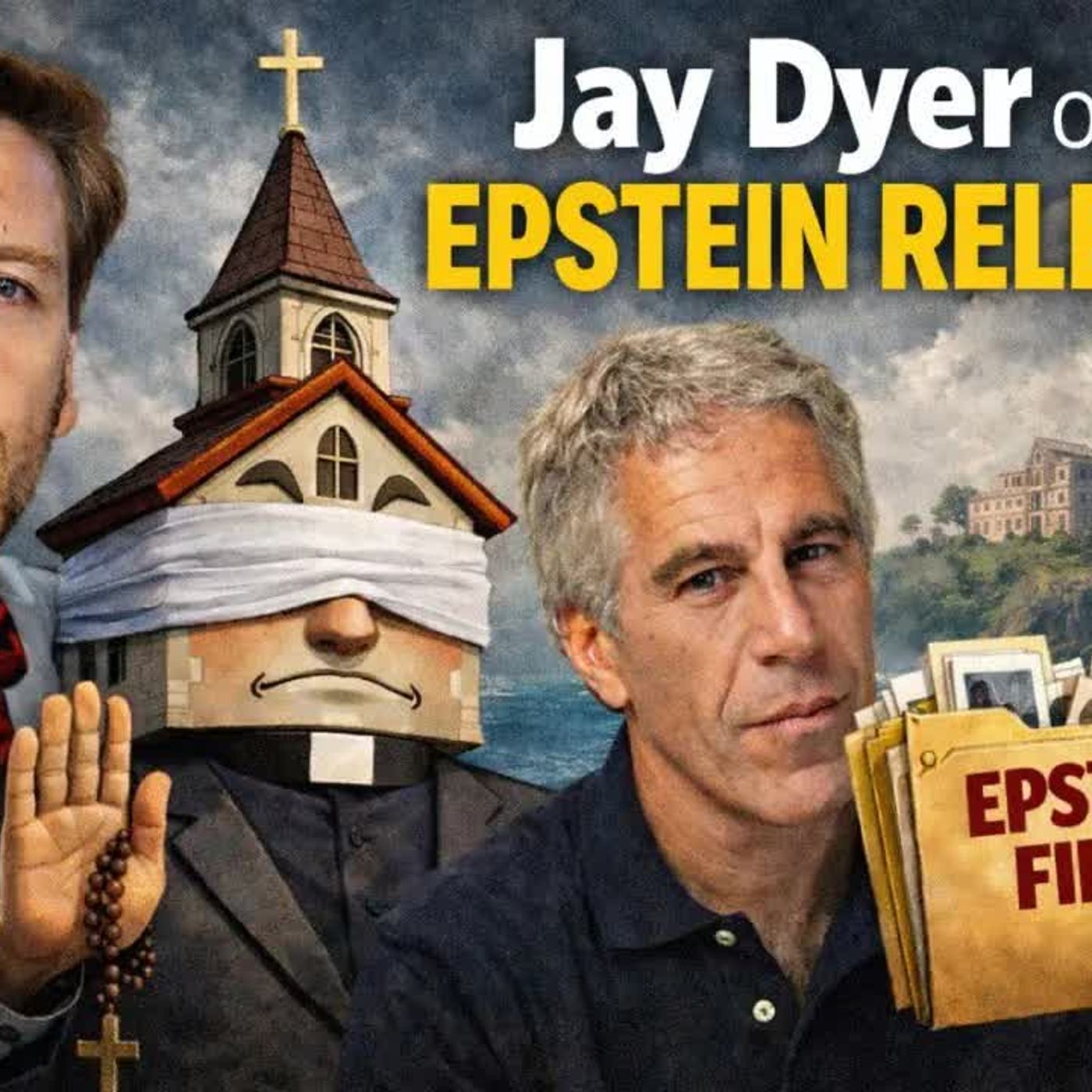
Jay'sAnalysis
Jay Dyer on the Epstein Release, and the Muted Christian Response -JSLAY Podcast
01:12:55
Send Superchats at any time here: https://streamlabs.com/jaydyer/tip Join this channel to get access to perks: https://www.youtube.com/channel/UCnt7Iy8GlmdPwy_Tzyx93bA/join Order New Book Available here:...
Loading summary
Transcript81 lines
- [00:00]
Natural Cycles Advertiser
If the birth control pill isn't feeling like the right fit anymore, you've got options. Natural Cycles is the only FDA cleared birth control app that's 100% hormone free. It works by tracking your daily temperature to pinpoint your fertile days so you'll know which days you can and can't get pregnant. No hormones, no side effects, just science that works with your body. Millions have already made the switch and you can too save 15% when you sign up today with code radio15@naturalcycles.com foreign.
- [00:40]
Jeremy
Ladies and gentlemen, thank you for joining me today on J Slay usa. I'm so glad you're here. We have a very special show for you today. Very special guest, Jay Dyer, somebody I've been following for a while at a distance and just he's going to be the perfect guy, I think, to cover the material that so badly needs to be covered today. And this is a subject being Epstein, the Epstein files and the Christian conscience about it, as well as the Christian conundrum, especially in with the Christian Zionist crowd, you know, what are we seeing from them? What are they doing and, and why. So Jay Dyer is a YouTuber, a Christian apologist, author and public debater who's known for his sharp analysis and fearless engagement with controversial topics. He is a former, I believe he's a former Protestant who converted to, to orthodoxy and he brings a deep theological, historical and philosophical lens to everything he does. He's been featured on many major platforms and is respected for his debating ability and research skills. I discovered Jay seeing him debate this weird way to discover him. He was debating the misfit patriot, all right. And this was a guy who just, I think he just badly wanted attention and, but he was coming out strong with all the major Zionist talking points. Even though he wasn't really good at the Hezbollah, he still did it strongly. So he was being featured on like rabbi shows and these Christian Zionists would have him on their shows. And Jay basically put him to bed pretty quickly. I actually think that this guy did not complete the interview, if I remember, or the debate. So what was clear to me though, that was Jay was not just a guy who argues well or debates well. He studies, he knows the background to things that he's talking about. So there's some credibility and substance. There's so we could probably come on and talk about a whole lot of topics that affect the Christian world. But based on where we're at right now with this whole Epstein thing, I thought who better to come on my show and do a deep dive into the Epstein files and the reaction to it, especially among the Christian world, than Jay Dyer. So with that, Jay, thanks again for coming on. Glad to have you.
- [02:50]
Jay Dyer
Thanks, Jeremy. Glad to be with you. Do I need to repeat what we. I don't mind.
- [02:55]
Jeremy
You don't know. Not at all.
- [02:57]
Jay Dyer
Earlier.
- [02:57]
Jeremy
Don't worry about it a bit. I think what you were giving was a background and you said this is actually the way that it's worked ever since Old Testament days.
- [03:04]
Jay Dyer
There you go.
- [03:04]
Jeremy
Yeah. And yeah, and we will, we will, I'm sure, cover it in, you know, as we talk here. But let's start with this. Jay, I want to start with you because I really have not had this conversation with you. Can you give us the high level background of your journey from I think you were an evangelical Protestant to orthodoxy? And I'll say I have people in my feed all the time saying, jeremy, will you please try your local Orthodox church? You know, because they know the problem I'm having, really. So anyway, fire away, man.
- [03:32]
Jay Dyer
Yeah, I was raised Baptist. I come from a military family. So my family moved a lot when I was young and we ended up in California for a while, San Diego. My dad was in the military. Then we moved back to Tennessee and I went to, was originally going to go to Bible college when I graduated high school. So I went to some Baptist schools for a while and ended up kind of questioning a lot of the Baptist stuff because I was really into church history and reading about the formation of the biblical canon, how it came together. And I was really young. That was in my, my early 20s, maybe 20, 21, when I was doing a lot of that reading. And I bought the, the Church Father set here that you see behind me. So that, that kind of got me all focused on early church and the patristic era and had a lot of questions. This is back in like 2001, 2 and 3. There weren't a lot of whole, a whole lot of, you know, Internet resources on this stuff back at that time. So I ended up kind of in the Catholic Protestant debate world, not myself debating yet, just kind of consuming a lot of that and trying to work through that content. I spent a little bit of time at a evangelical seminary and while I was in the midst of those classes and doing a lot of reading, I just couldn't reconcile the biblical case for tradition and the biblical canon with what I had been assuming was just sort of the de facto given position of sola scriptura and whatnot. So long story short, that led me into a Long period throughout my twenties of being a Roman Catholic. So all of my twenties I was a traditional Catholic, went to the Latin Mass, got very into Thomas Aquinas and Catholic apologetics. But I was also at the same time really interested in philosophy. Ended up leaving Baptist Bible College and I went in seminary and I went to a just four year standard state university and I did my undergraduate in philosophy and history and then did grad work in English and philosophy. That a cognate discipline there. Long story short. So I was studying film, I was studying philosophy, I was studying semiotics and symbolism and film and I was doing grad work on Ian Fleming at the same time as being really interested in theology and the Bible and apologetics. And I would say around 20 I was interested in Orthodoxy by 2007 and 8 and started reading the Eastern Church Fathers, reading a lot on orthodox theology. But I held off and it didn't end up becoming Orthodox until about 2016. 17 I was getting more serious about it and then I think I came in about 2018. So I've been Orthodox since 2018. But I think the weird part is a lot of people on the Internet, I'm not speaking about you, just in general. People usually think of people as like doing one thing, you know, oh, he's the guy that does the debates. Actually we were doing on my channel, my sphere, we were doing a lot of movie, film stuff way before I even had the idea to do a debate that just kind of happened accidentally. Somebody said, hey, would you debate this atheist guy? And then that led to another atheist debate. And then so I said, hey, will you debate this Muslim guy? And then that led to a bunch of Muslim debates and then that just snowballed on its own. But we were doing a lot of film analysis, for example. I just thought this was funny. I was writing film analysis stuff that was coinciding with my grad work. And so in 2016 I published a book, Esoteric Hollywood. And I just want to note that in the first chapter I talked about the Rothschilds and sex cults and networks and, and espionage. I talked about how films were actually telling us this. And I got a lot of flack from that.
- [07:19]
Jeremy
What year was that, Jack?
- [07:21]
Jay Dyer
Well, the essay was written in 2014 or 15 and then the book was published in 2016. So. But I. The first book I read on ritual stuff was actually 2004 and it was William Kennedy's. It's a really rare text now. You can't really find it. William Kennedy's book, Lucifer's Lodge that came out in 2004. It's the first journalistic work on the history of the PDF scandal in the Roman Catholic world and the abuse going on there. So, anyway, I've been into this kind of stuff for a long time. But you mentioned this journey. For me, it wasn't just theological, it was also the geopolitical conspiracy world, too. I kind of came out of the Christian Zionist stuff back even when I was a Protestant. So at Baptist Bible College and then at the seminary I was at, I was under the influence of a lot of Calvinists and a lot of people like Greg Bonson, and they had already written some stuff back in the. In the late 90s that I was reading in the early 2000s that kind of got me out of the evangelical dispensational perspective. So I. I got into, you know, post millennial type theology in the early 2000s, reading David Chilton and Bonson and Rush Dooney and all those guys. Yeah, Ken Gentry. And then I kind of, you know, that partially transitioned me. Not it wasn't just eschatology, but that some of that theology is kind of what propelled me as well to, you know, leave Christian Zionism and dispensationalism and all that, which I was raised with. So. But I also, you know, was starting to realize that there's stuff going on in the geopolitical realm, which at that time I just thought it was conspiracy stuff. I was watching Alex Jones's stuff back in 2002 or three was the first time I saw some of his material. And he was talking about Skull and Bones and Bohemian Grove and this. And I remember heard about Anthony Sutton had a book on Skull and Bones, and I bought that book. And then I watched Alex's documentaries and got really heavy into the conspiracy world. And then I started realizing I think I was in a unique position. And I'll shut up here in a second because I don't want to bore you, but I was in a unique position because I think a lot of people, you know, when they get into this kind of stuff, they're. They're getting into it through the Internet and as was I. But this was back in the early 2000s, and I was also studying this stuff, right. So I was taking philosophy classes, I was taking film classes. And I started noticing that there's a real parallel between what I was seeing in the conspiracy world on the Internet and what I was seeing in movies. And I've always been really into film and always been a film buff. And so, yeah, I just started focusing on the relationship between Hollywood and intelligence agencies, between cults and Hollywood and cults and intelligence agencies. And I just kept finding these overlaps and certain books would come my way and academic journals and things and oh yeah, of course, this director, this Hollywood person, they worked for the CIA, they worked for the oss, they were confidential informants. And you would find these details about a list actors and producers and people that like, how come I never heard this, that this person was a spy in real life? And so that was its own rabbit hole and so forth. So anyway, long story short, I eventually put it into a book and then, you know, that led to hosting for Alex for the last six years on most Fridays. So I've been able to do that. And then, you know, so it's sort
- [10:44]
Natural Cycles Advertiser
of like if the birth control pill isn't feeling like the right fit anymore, you've got options. Natural Cycles is the only FDA cleared birth control app that's 100% hormone free. It works by tracking your daily temperature to pinpoint your fertile days so you'll know which days you can and can't get pregnant. No hormones, no side effects, just science that works with your body. Millions have already made the switch and you can too save 15% when you sign up today with code radio15@natural cycles.com.
- [11:14]
Jay Dyer
a bunch of separate things that we do, writing for Sam Hyde, doing comedy, that kind of stuff. But, but they all kind of overlap because you know, in the Internet world, all of these seemingly crazy areas, they all kind of like merged together in one, one infinite scrolling feed of insanity. So yeah, anyway, yeah, that's, that's got to where we are now. You know, debates, comedy, writing the books on movies, all that kind of stuff.
- [11:42]
Jeremy
Yeah, you know, it's interesting people that spend the years that it takes and I would say I'm, I've spent years now researching. We all come at this from our own angles. But if there's one true story that is being told and there's, there's, if there is objective truth, then when we detach from the stories we were told, which made sense to us when we weren't smart enough to ask the question questions, okay, then you detach and then you feel like a girl called me this morning and she was, she's in this, she's like, I feel like I'm in a dizzy bat race. I feel like I've detached from all these people that I thought because she worked heavy. I'll tell you exactly what it was. She worked in the heavy pro life industry with Lila Rose and did all these things with these various Catholic 501C3s. But these people won't touch Epstein. They won't touch, you know, the genocide in Gaza, the amount of kids that have died over there. They won't touch it. And it's driving her insane. And she's like, I now don't know what to do. I don't know what to believe other than. She's like, I believe in Jesus. But I feel so disoriented because all the leaders that I'm supposed to trust and respect have gone silent on the biggest issue of our times. And I was like, tell me about it, you know? But what I was going to say is people detach, they get dizzy. Then they start finding some of these threads that make sense. And it's a long process, but then eventually you come to a place where, when you figure out what's going on and who's pulling the levers of power, it starts to make a whole lot of sense again. And so I just want to encourage the people watching. Like, man, I'm confused. If you stick around and you really care about the truth and you tell me, Jay, if you agree with this, if you really care and you are seeking God and seeking truth, you are going to come back to a firm foundation where life and the stories around us make coherent sense. That's that. That's what I believe. What do you think, Jay?
- [13:34]
Jay Dyer
Yeah, you know, the existence of this extreme form of evil, you know, in all. In all capacities, pretty much everything that you could think of is the most evil. I mean, I think this kind of triggers a lot of people to also realize that, well, if there's this much evil, then there probably is reality to the good. And I don't. I don't mean that in some kind of weird Gnostic way. I'm just. I'm just saying that I think that this is what happens to a lot of people. And I've seen so many comments of people saying, man, if this kind of evil stuff is real and this is what's going on, then there's got to be a God. There's got to be spiritual good and not just spiritual evil. So, yeah, you know, in regards to the Roman Catholic Church, you know, that's a world that I was in for, you know, about a decade. And I know. I know it very well. Have. It's been many years since I was in that world. But, you know, since leaving and seeing it, you know, I don't hate Catholics, I think, because I do a lot of Debates with Roman Catholics. People think that I hate them or I'm opposed to the people more.
- [14:31]
Jeremy
So.
- [14:31]
Jay Dyer
The corruption is from the institution, from the top down. And it's not just a matter of espionage and, you know, compromising the Vatican at a geopolitical level to promote, you know, UNESCO or Davos agenda. It's. It's more than that. It's also a spiritual corruption. It's a. It's a networking infiltration that goes back to the Middle Ages, particularly in the 11th century, when you had what's called the Gregorian reforms. And during that period, the papacy took on a new approach to being a geopolitical world power. Prior to that, most of the churches, even though some of the patriarchates and the important bishoprics of the Church in the first millennium, they had a lot of power. There were specific canons in Chalcedon and other ecumenical councils that forbade the church from taking on a civil state role. And what the Roman Church did after the formation of the Papal States, etcetera, Was to claim for itself more and more political power until eventually in the 11th century. You have documents like Dictatus Pape under Pope Gregory, and then you have later on Unum Sanctum under Pope urban in the 1300s, 1382, I think, 11th century to 1382, you get this rise in the papacy. Again, just focusing more so on geopolitical stuff, standing armies. If you're not accepting what's called the temporal supremacy of the Roman bishop, then you're no longer able to be saved. And I think that was a key moment for the departure from the orthodox perspective. That's that century of 1100s to the 1300s. That's really the key point when Rome deviated from what the Church of the first thousand years east and west agreed upon.
- [16:15]
Jeremy
Am I. When you say that, am I understanding this correctly? You're saying that was the moment where the Vatican said, basically, the Pope's word is equivalent to God's word.
- [16:26]
Jay Dyer
Yeah. Dictatus Pape has this phrase in it, which now is admitted even by the Vatican to be a forgery, even though it's still in some of their canon law. No one judges the first circumstances, so no one can judge or criticize or come against the first C, because he's supreme in all matters. So basically, it sets the groundwork for the autocratic view of the papacy, which then gets confirmed at Vatican 1, which happened in the late 1800s. That was one of their. Before Vatican II, in the 1960s, the last Roman Catholic dogmatic council was Vatican 1, which confirmed the doctrine of the infallibility and indefectibility of the Roman Bishop. So, yes, eventually that meet Natural Cycles,
- [17:07]
Natural Cycles Advertiser
the only FDA cleared and CE marked birth control app that's built around your body. The Natural Cycles app pinpoints your fertile days by tracking shifts in your temperature so you can plan or prevent pregnancy naturally. It's easy to use. Simply take your temperature in the morning with our free Bluetooth thermometer included with our annual plan, or sync with your Oura ring or Apple Watch. The app analyzes your data and tells you daily whether it's a fertile or non fertile day. Natural cycles is 93% effective with typical use and 98% effective with perfect use. But beyond effective birth control, the app helps you understand your body and cycle better than ever. And unlike some period tracking apps, Natural Cycles provides an advanced data protection program to keep your information private and secure. Ready to go, hormone free. Sign up for the Natural Cycles annual plan and get a free Bluetooth thermometer plus 15% off your subscription with the code RADIO15@natural cycles.com culminates you could say in that perspective.
- [18:09]
Jay Dyer
And then all of that sets the stage for Vatican II in the 1960s, which ironically, there was a. I think his name was Gregory Baum, was the author of the document called Nostra Aetate, which is the Decree on Ecumenism. That's part of the Vatican II document. And it specifically states that Roman Catholics, Muslims, Jews, even Hindus, we all kind of worship the same God and we can now have these sort of ecumenical gatherings and practices where we pray together because it's all the same generic deity that was at once a spiritual and a geopolitical maneuvering to turn the Roman Catholic Church into an instant, into a form of soft power. So it's extending the American attitude during the Cold War. This is a declassified document called the Doctrinal Warfare Program. CD Jackson was one of the people that had that up. And they recruited John Courtney Murray to be kind of their representative and their attache. So Gregory Baum, who wrote no Certate, which completely changed the Roman Catholic Church's perspective on the Jews, which previously had a very negative sort of antithesis position to Judaism, Rabbinic Judaism. Now that completely flipped into the opposite to where we're all sort of on the same path, the same journey. I think Francis a few years ago created the Abu Dhabi Faith center, which is Muslims, Christians and Jews all worshiping together.
- [19:32]
Jeremy
Isn't it specifically Catholics?
- [19:35]
Jay Dyer
What's that?
- [19:36]
Jeremy
Isn't it specifically Catholics, though? Like Muslims, Catholics and Jews?
- [19:41]
Jay Dyer
Well, yeah, I mean, the Language of Vatican II kind of says both because it'll say Catholics, Muslims and Jews and Hindus, it's all the same God. But then other places they'll say all Christians all share in the same. The whole thing is really just to catch, to cast this really broad watered down net which denies John 14:6. You know, Jesus says I'm the way, the truth and the life. No one comes to Father but through me. Well now all the other religions can also be pathways to God. In fact, Francis even said this a few years ago, eclipsed it got a lot of views on that clip. Before he passed away, he was reaffirming that what Vatican 2 means is that you can be saved in any religion. Right. And this is again a denial of the fundamentals of Christian theology and the tradition of, of the Church. So even, I mean, nobody in the first thousand years of Christianity taught anything like that. So these are really clear indicators of just specifically where the Roman Catholic Church went off. But separate from that, the reason I'm bringing in people like Gregory Baum is that he was explicitly working at the best of Jewish interest to change the Roman Catholic Church's attitude and make it more of an ecumenist approach, a syncretist type of approach. And that's why you see the Roman Catholic Church being so different than it was even in the 1940s and 50s. It's almost night and day, but there's a geopolitical motivation behind that. Gregory Baum was, was, he was, he was a gay Jewish man who changed the theology of the Vatican. Explicitly, this is admitted.
- [21:13]
Jeremy
I need to look, I need, I need to read on that guy. That, that, that's, that's important. That's.
- [21:18]
Jay Dyer
Yeah, he was then defrocked and then left the priesthood because he had done it, he had completed his mission. So. Okay, but that's within the Roman Catholic world. I mean, you get similar types of things within evangelicalism where you have the promotion of the Schofield Study Bible, of course, which promoted the idea that the present day nation state of Israel, which was oddly enough a creation of atheistic sort of Hegel influenced Zionists like Moses Hess and Heim Weitzman and Theodore Herzl. I mean, I've got Moses Hess's books up here. So he explicitly says we're going to use Freemasonry as a way to teach a new religion. He says we're going to change Christianity, we're going to move these religions into focusing world religion on Tel Aviv. So Moses Hess was very explicit about it. It's not totally atheistic. It's not really theistic. It's more of a political position that uses a generic theism for political means. And they were very explicit about how they had convinced in the 1860s the Rothschilds to support this venture. And I have the Rothschilds biography. And in the biography they talk about going in and sort of buying up the Holy Land and places and sites in the Holy Land from the Turkish sultans who had previously had control of that area. Now people will say, well, political Zionism doesn't come on the scene until, you know, the early 1900s. Yeah, but it was formulated in the 1850s and 60s. Right. By people like Moses. S. In fact, Moses says that he brags about how, you know, early on and how he had been meeting with the Rothschild brothers in the 1860s to plan a new homeland for the Jews. And other places were discussed as well. They talked about New Zealand, they talked about Austria, they talked about other places to create a homeland. But it was ultimately at the behest of the Rothschilds who brag about the Balfour decoration being one of the ways which prepared the way for the eventual 1948. What is it? Recognition of the nation state of Israel, which only happened because of World War II. So interest. It's interesting that even tiny mustache man fits into that as a justification for the nation state of Israel. And all the evangelicals in America are duped then into thinking that not your fulfillment of prophecy. We gotta support the atheist socialist kibbutz nation state of Israel. It's a fulfillment of prophecy. No, it's not. The fulfillment of prophecy is the church is the kingdom of God. Jesus said, the kingdom of God is among you, it's within you. He said he would bring the kingdom. He says to the apostles that they will be princes and judges of the kingdom. That means that the kingdom is established at the first advent, not at the second advent. Now it comes to full fruition, we would say, at the second coming. But all of that rapture dispensational theology is a psyop. It's all a very late invention by John Nelson Darby. Guy who was a schismatic of the Anglican Church, created his own cult, his own group, and they came up with this prophecy theory that then spread to America via Oxford Press Publishing, the Scofield Study Bible. Yeah. So when you get into the history of all that and you understand the geopolitical motivations, it makes perfect sense why that was pushed in America prior to 1917. And the Balfour Declaration, like, yeah, it was clearly by design to get American Evangelicals especially, you know, to support the geopolitical designs of what Quigley calls the Atlanticist establishment.
- [24:53]
Jeremy
You know, it's. It's interesting. I was always taught when I studied Christian apologetics that I thought it was a deep level. It was probably, you know, pretty pedestrian level. But, yeah, I was reading all the, you know, the Ravi Zacharias books for Christian apologetics or John Lennox or whatever, you know, and that's why I'm traveling as a ballplayer. So I thought I was doing pretty good. You know, maybe I was. But the key phrase was always, the truth is not afraid of being questioned. The truth's not afraid of being questioned. You know, we can handle it. Ask us your questions. But it was within a certain sphere. And now looking back, it's like, you know, there were so many things they never talked about. I'll give a few examples right here. You mentioned. Even though I was trained under the wing of the fourth largest. This is by the Jerusalem Post. The fourth largest Christian Zionist pastor in America is Alan Jackson out of Murfreesboro, Tennessee. And he pulled me under his wing when I was a young college athlete during an off season. It was right after, on the heels of 9 11, we're at a cracker barrel. He broke out a map of the Middle east and Israel was in blue and all those other big bad bullies were in red. And he's like, look at this miracle. Look. You know, just that they exist even one day. It's a miracle every day now. I didn't know we were giving them billions and billions of dollars a year of support. I know. I didn't know what AIPAC was. I didn't know the word Christian Zionism. I didn't know the word Zionism. I didn't know the word dispensationalism. I never heard of Scofield. I never heard of Darby. Yet I became, over a period of 10 years, the biggest Christian Zionist that I knew. I mean, I was ready to blow all those other countries off the map because I thought, well, they're just leading their kids right to hell anyway. It'd be better for them not to even be there. Because the Jews are a passive people. They're a simple people. They don't have any power. They just want to be left alone. That was what I was taught. And I'll add one more. Growing up, being taught the history of theology, Jesus, the church, the Temple. We knew the temple fell, but did I ever hear anything other than, yeah, the prophecy came true. The temple fell. Fell in 70 A.D. i had no idea how big of a deal this was for the Jewish nation. I didn't know the way that it scorned them and I didn't know about the Talmud. So that to me is just a average intelligence thinking guy tells me if the majority of the evangelical church, and maybe the Catholic Church too is purposely obfuscating and not talking about giant swaths of historical fact, we have a serious problem. And my audience is mostly evangelical or former evangelicals who are starting to get these things. So you know, to me I kind of went on a rant there, but that's that that was one of my big awakenings was all the things they didn't teach me that all I've got to do is pick up a book and read about. I'm like, how, how is this? Never said, you know. So I'll ask one more question along these lines and we'll move on to Epstein. Now that you're Orthodox and you've been through the Catholicism, you know, 10 year phase, you started out as a basketball Baptist, so you know that theology, I think you said you were in Baptist seminary.
- [27:58]
Jay Dyer
Well, well, I went to a Baptist Bible college and then I did a semester of Bonson Seminary which was a non accredited school that focused on the apologetics and the theology of Greg Bonson and the Christian Reconstructionist. So but that was right when I was converting out of Protestantism is when I left that, that school.
- [28:17]
Jeremy
Okay, what are the biggest gaps that are filled for you by the Orthodox Church that Catholicism didn't have or the Evangelical Church didn't have? And there may be a different set of things for both of those. But why did you land on Orthodox?
- [28:36]
Natural Cycles Advertiser
You buy organic, you read ingredient labels, you care about what goes into your body. So why not think about birth control the same way? Natural Cycles is the only FDA cleared birth control app that's 100% hormone free. It's based on science and uses your body temperature to identify which days you can and cannot get pregnant. No synthetic hormones, no side effects, just science you can trust. Save 15% with code radio15@natural cycles.com.
- [29:07]
Jay Dyer
well, there's a lot of different things I'll just try to boil it down to. Like I said earlier, you know, when I got into studying the formation of the biblical canon, that really got me into looking into the Church Fathers and the ecumenical Councils and what was the attitude of the Christians immediately after the death of the apostles. Right. So this is called the post Apostolic Fathers. So I started reading Clement and Ignatius and Cyprian all These bishops of the early church. And then, of course, even as a Baptist, I remember, you know, well, we believe the Council of Nicaea because it taught, you know, the deity of Christ. And I went to actually read Nicaea and the church fathers who were there and, you know, Saint Athanasius and these. These guys. And I realized, okay, they believe a lot of stuff that I don't believe. And I read City of God, which was Augustine's gigantic apologetic. I read the whole thing when I was at Bible College. And I took. I wrote down a bunch of questions for the Baptist professors. I went. Took it. My questions that I said, can you guys tell me, like, why does he believe in the real presence? Why does he say he believes in absolute succession? And why does he talk about relics and why does he talk about all this stuff that just doesn't really make sense with Baptist theology? And I didn't really get good answers. And so that kind of led me gradually out of Baptist stuff into Covenant theology and then into, you know, I didn't even know about Orthodoxy back then. It was like 2004 or 5. I just knew about Catholicism and Protestant debates. And I think when you're Protestant, if you're a young person and you are looking into this stuff, especially in the 2000s, where there's a lot fewer resources online, you didn't really. I didn't know about Vatican II yet. I didn't know what it taught. I just thought, okay, I'm looking at what's the historic church? And it's either going to be something like, you know, Anglican, or it's going to be something like, you know, Lutheran maybe. And I gave all of those a lot of. A lot of chances. I read about six of Luther's commentaries and works. I read several Anglican texts, Peter Thune, people like that. And I just ultimately didn't find a lot of those arguments about the church from those church's perspectives very convincing. So that was always in the back of my head, even as a Protestant or even when I converted Catholicism, I was like, okay, this has got to be it. And then when you get into the Roman Catholic documents, as I've got like a bunch of Vatican II and all the ecumenical councils and the papal encyclicals over there, like, you just start to notice, okay, Rome has changed its theology. So what do I do with this? And for me, it was just because I had such a love for church history. I want to know then, okay, well, the true church, if it's not any of those, it's got to have the same teaching as the church in all those early centuries. So I'm looking for a church that didn't change its fundamental doctrines. What church still teaches what, for example, the canons of Nicaea say? I'm not talking about the Nicene Creed, some of the canons that accompany the creed, because the canons also give us an insight into the mind of the church fathers and the people who compose those creeds. And people might say, well, yeah, I don't really care about the church fathers, though. I'm just really interested in what the Bible says. Well, the problem with that is that as I was reading evangelical scholars like F.F. bruce on the Canon of Scripture or Lee MacDonald formation of the Biblical Canon, they were admitting this important role of tradition and even knowing what texts were apostolic. So certainly apostolic authorship is a key point when it comes to the canon. It's not the only thing, but it's a very important point. Well, if we don't know who Matthew, the author of Matthew, was, other than the church saying in different bishoprics and sees this is the text that Matthew wrote, and if we're having to rely on, for example, Irenaeus or Cyprian to reconstruct a lot of early manuscript evidence for the Bible itself, in other words, we're looking at, say, Irenaeus in his voluminous writings. He cites many, many, many New Testament passages and Old Testament passages, and those are other witnesses to the veracity of the New Testament text and the Old Testament text in the second century. So that's very early. And none of these people have Protestant views on anything. I don't believe in sola scriptura. They don't believe in sola gracia. They don't believe in memorialist view of the Eucharist. They don't believe in a symbolic view of baptism. I mean, they believe in all these things that I thought were, you know, really problematic teachings. And so, you know, why would I trust those people to put the Bible together when I think that they have heretical, you know, fundamentally wrong theology on the Gospel? And so it just really caused me to reevaluate everything. But then in the Roman Catholic world, you know, you have all these problems as well with innovations and changes. And so eventually, in about 2015, 16, I just came to the position that the only church that really maintains the essential fundamental core, not just theology, but also the praxis of the church, no changes in the liturgy, no revolutions like Vatican II did with Novus Ordo Mass and all that, is the Orthodox Church. And so the more I studied the more I spent time in the Orthodox world, the more I was convinced that, you know, for Christianity that's really all there is. That's the, that's the only authentic expression of Christianity. That's not to say that there's not problems in the Orthodox world. It has its own problems for sure. But I really felt like there was no more fundamental systemic level problems and contradictions like I had in the Protestant world and in the Roman Catholic world. So that was the long story as to why I ended up there.
- [34:24]
Jeremy
You know, this may seem like a cheap question, but I think it's a question a lot of people like myself would have who have never been to an Orthodox church. You know, UJ is your regular guy dressed normal and all that. Do you wish that the, would you call them priests? Okay, so the priests of the Orthodox, do you wish that they dressed like you and I or do you care?
- [34:48]
Jay Dyer
No, this comes out of. When Christianity permeated society. It made sense for them to, even in the day to day world have themselves marked out as unique. Because in our view, you know, it's not a, a weekend profession. It, it's a, it's every day. I mean, in the Orthodox Church, priests, priests have to do things every day, all day. So they're basically 24, seven ministers. Now. There's obviously flexibility there. Like a lot of priests have jobs as well, so they might be working a, you know, I mean, they have families. And the Orthodox Church priests are married.
- [35:24]
Jeremy
I'm glad to hear that they have
- [35:26]
Jay Dyer
families and they have kids. So there might be situations obviously where they're not all the time dressed up. One of my best friends is a deacon. And in the Orthodox Church the deacons a lot more important role than it is say in the Catholic Church or even the Protestant church. Deacons are right next to priests. They're, they're ordained, they're, there's who, that's who's ordained to the priesthood is the, is the deacon. So.
- [35:46]
Jeremy
Okay.
- [35:47]
Jay Dyer
And they do a lot of the teaching, a lot of the theology in the Orthodox world. And you know, my, my buddy, Father Deacon Ananias, he's always going skiing, but he doesn't ski in his cassock. So I mean, it's not like you have to always dress it, but I think again, a practical thing that comes out of, you know, the early Middle Ages to delineate within a Christian society who the minister is because, you know, there, it's a 247 job. Yeah.
- [36:13]
Jeremy
Okay, well, hey, we could do a whole show on that. But the title of this show is has to do with Epstein. So I'm going to let you insert knowing kind of generally what my audience is. They're all seeing what I'm seeing. Most of them are from an evangelical background background or they still are in it, but they might be asking questions. They know about the Epstein files. They've heard generally what's in it. I'll let you just start this conversation with, you know, high level what do you think people need to know first? And then let's dig into some of the responses and reactions.
- [36:45]
Natural Cycles Advertiser
Meet Natural Cycles the only FDA cleared and CE marked birth control app that's built around your body. The Natural Cycles app pinpoints your fertile days by tracking shifts in your temperature so you can plan or prevent pregnancy naturally. It's easy to use. Simply take your temperature in the morning with our free Bluetooth thermometer included with our annual plan, or sync with your Oura ring or Apple Watch. The app analyzes your data and tells you daily whether it's a fertile or non fertile day. Natural cycles is 93% effective with typical use and 98% effective with perfect use. But beyond effective birth control, the app helps you understand your body and cycle better than ever. And unlike some period tracking apps, Natural Cycles provides an advanced data protection program to keep your information private and secure. Ready to go hormone free. Sign up for the Natural Cycles annual plan and get a free Bluetooth thermometer plus 15% off your subscription with the code RADIO15@naturalcycles.com I think the simplest way
- [37:47]
Jay Dyer
to make this palatable is if everybody saw Spectre, the James Bond film with Daniel Craig that came out a few years ago. Right? I mean, basically that's real. That's the easiest way I could think to explain it. Maybe everybody can immediately relate to in some kind of recent recent movie. And if you saw, you know, movies like Kubrick's Eyes Wide Shut, you know, that's another movie that I think was really pivotal for explaining to the mass consciousness, you know, in a movie way. Because everybody can relate to movies, especially from our generation, you know, that that kind of stuff is it's not 100 real. Obviously James Bond's a fictional character, but it's based on composites of what these people knew and saw in their real life. And so, you know, Epstein might not be the top of the, you know, villain hierarchy in terms of real power and control because he had a limited amount of wealth. He was more of a mid tier kind of fixer, controller, consultant person, but he was definitely a Blofeld kind of person. You know, if you remember, Inspector, when James Bond is trying to infiltrate and figure out who's running this criminal syndicate that's responsible for terrorism, responsible for wars, responsible for all this, you know, he infiltrates this meeting that's kind of like a World Economic Forum, Davos Bilderberg meeting. And you've got these, you know, specter villains they're talking about. Yes, this year we have increased human trafficking 40%. You know, we have stolen $33 billion in, you know, mortgage lending. So they're basically listing all of their crime stats at this giant meeting. So I would say that's pretty much kind of how it is. And, you know, with Epstein, what we have is a person recruited into an operation early on through Bill Barr of the OSS and into what would be something adjacent to the CIA. This is why he has multiple passports. For example, as Whitney Webb points out in her book, that operation ends up funneling, funneling him into Wall Street, Bear Stearns. He's an insider trader there. He gets busted for that. And ironically, he has a partner. His partner is the one that does time. So I think that's a key indicator that early on, Epstein didn't do any time for the insider trading at Bear Stearns, but what he was learning was criminal organizations in relation to high finance. So then Maxwell and Ghislaine bring him into their operation, which we know was a Rothschild front, and that's where he was taught corporate takeover procedures, viper corporatism there, and then also the blackmail stuff. Right. So this would then suggest that Robert Maxwell, who was British Intelligence and Mossad, was also then sort of grooming and teaching Epstein how to run that operation.
- [40:25]
Jeremy
Let's park on Maxwell on. On Robert for just a second, because a lot of people have not read the book, the Super Spy and all that. I have not read it myself, but I do. You know, I was very surprised. I knew that Jeffrey Epstein was Jewish. I did not know Maxwell was. And later on I found out she was. And I was like, well, I wonder where, when her father had that weird death, where's he buried? Because that sometimes tells a lot about where somebody's loyalties lie. And I find out, wow, he was given a state funeral in Israel attended by both state leaders and religious leaders, and then buried on the Mount of Olives.
- [40:58]
Jay Dyer
Like, wow, he's buried in Israel. Because most of his lifetime of service was to the nation state of Israel for espionage. But then we had that really curious email where Epstein said, yeah, I'll tell you the Real story of what, what happened to his, to him in his death. And it was that he was sort of playing both sides in the Cold War. He was also passing and selling secrets to the kgb, to the Soviets, which is interesting because I have a friend who's a specialist in that area and he translates old KGB communiques and, and documents. And one of the articles that he translated about 10 years ago on his website was about Robert Maxwell from the vantage point of the kgb. And what's funny is that they actually said, okay, we think he's playing both sides and he's selling us secrets as well. So they kind of knew what he was up to. And that was confirmed. Assuming that Epstein is telling the true story in this recent email, because it says that what he did was he sort of took it upon himself to say that he was going to be the attache to the Soviets for Mossad. And they didn't really want him to do that, but he did it anyway. And then he tried to extort Mossad for £400 million. And that is important, according to Epstein, what led to his untimely demise falling off the boat. But they still apparently gave him a, you know, a hero's burial in Israel. So another person kind of like that is James Jesus Angleton, the Cold War person who was very closely in, in the JFK files when that came out, also liaisoning with Israel. And of course that shows a degree of backdoor telecommunications and, and messaging with Mossad and then partly, I think, motivation for Mossad and the CIA and organized crime to have a role in jfk.
- [42:47]
Jeremy
So, yeah, you know, I'm glad you brought up jfk, because that, that was another eye opener for me when I came to the knowledge. And I don't know where you land on who's at the top of this world power structure, but I do know, and I think it's a new kind of hit term is Pax Judaica. There is definitely a rise of what's happening in Israel according to their eschatology, that they're pushing forward, be it political or religious or both, it's happening. Okay. And everything that springs forth from that. Where was I going with that? Oh, regarding jfk, though. So you got that going on. You've got JFK back in the, the late 50s and 60s doing, you know, he's writing angry letters with David Ben Gurion. He's not letting them do what they want with their nuclear testing. He's not wanting to give what was previously known. Before aipac, it was just Israeli intelligence I knew all that stuff already. All right. And then they redacted, I think most of it. Of course, it's, you know, 50, 60 years later, so people don't care quite as much. But what shocked me was this. Most of the redactions that had been. I'm sorry, the unredactions that had been redacted for decades had to do with. Anything to do with Jewish intelligence, Israeli intelligence. There was a whole line about, you know, we've got the Jewish money now, like, all that. All this stuff that would be highly embarrassing to Christian Zionists and their platforms. And I was still. It was the first time I was shocked by this, where it's like, this has been one of those conspiracies that people have been asking about for decades. It finally comes out, and I remember guys like Eric Metaxas and others, if they tweeted about it, they were like, oh, so it was the CIA? Yeah, it was the CIA. It's like, I just. I was. I was dumbfounded. And I guess maybe you wouldn't be dumbfounded by that because you'd already seen through a lot of the way that those people operate. But it kind of told me also why today, with something as dark and deep as this Epstein release and the things that it's alluding to, why they're just able to ignore it and not have to pay the price for that?
- [45:03]
Jay Dyer
Well, yeah, it's. That's. There's a complicated connection and intertwining of a lot of interests. And I've always thought, going back a year now, that the reason that Trump wasn't so eager to release these was that, like Alex said, he was asked, I think, on the. On behalf of, you know, British intelligence and Israeli intelligence and the CIA to not do this because it would be too devastating and destabilizing. Right. So that. That makes sense to me, and that's because I think with Epstein, especially if you look into the money managing and the. The Mega group and Les Wexner and the. The. The billionaires that are involved, this would be the upending of a lot of the existing financial structure, the fiat system. That's why it was so, I think, amazing that you had the very beginning of the Bannon interview. Epstein says, well, I was also brought in through Bear Stearns and what I learned there to Rockefeller's networks of the Trilateral Commission, because I understood high finance and fractional reserve banking, the fiat debt system that we have. He said, I understood that so well that I was able to explain that to a lot of Them. So they recruited me into trilateral, which again shows that it's not, well, is it the Rothschilds or is it David Rockefeller, is it Brzezinski or is it Kissinger or who, who's a Bilderberg. They're all part of the same steering groups, networks and committees. And the Rothschilds and the Rockefellers work together. They're banking empires that are joined at the hip and have been for a long time. For example, in the United States, JP Morgan has been for a long time a front for Rothschilds. So they did have a presence here. It just wasn't called Roto, it was called J.P. morgan and J.P. morgan Chase and Chase bank. And they've all been working together because at that level, if you look at something like the bank for National Settlements, which is the global Federal Reserve, right, American America has its Federal Reserve private bank and the world has its Federal Reserve of Federal Reserves, which is the BIS that was all set up post World War II by the entities that we're talking about like JP Morgan bank and, and Alan Dulles out of Schroeder bank, et cetera. So that's who's really running the system. And the sex stuff and all that, it's, I mean it matters, but it, it plays a role in compromising those powerful people. Right? That's the blackmail side of it. And right. Maxwell was doing that kind of stuff too back during the Cold War. So this is not a new thing, it's, it's an old thing. We've lectured, for example, on my channel for, for a long time out of a bunch of books just from historians about the history of sexpionage or sex blackmail. I mean this is, this is a long time state practice. Nothing new there either. In fact, for example, Japan was able to have a lot of success in the, in the Japanese Chinese War back at the turn of the century because a figure named Kenji Doihara, he was Japan's Epstein and he was able to figure out how to set up a network of brothels throughout China, put flood China with opium and then compromise them and get the prostitutes to be spies. And China basically was unable to, to fend off Japan's attacks during that war. So I'm not trying to deflect off of Epstein and, but sure, I'm just pointing out that this is, this is, if you get into history, like this is a pretty well known thing. But again, I mean, Epstein understood the Vatican bank, he understood that it's a secret bank, he understood shadow banking. And a lot of that comes out in the Bannon interview. So that's the real, I think, crux of, of how they, they know how to game the system by shorting markets on the basis of advanced intelligence. And that's really important because there's that famous story about Waterloo and the Rothschilds having advanced intelligence and then buying up the, the market and the, the UK stock market when it collapsed. Well, turns out in the Rothschild authorized biography, there's a whole section where they brag about that being true. They say, yes, of course, we were able through advanced intelligence to buy up the stock market. There it is right there. And so what I'm getting at is that you fast forward 200 years from the 1800s to now and Jeffrey was doing the exact same thing as the representative of the Rothschild saying, yeah, we have advanced intelligence, we collapse through chaos and then we buy up on the fire sale out of the chaos.
- [49:33]
Jeremy
Yeah, it's an old system, there's no doubt about that.
- [49:37]
Natural Cycles Advertiser
Meet Natural Cycles, the only FDA cleared and CE marked birth control app that's built around your body. The Natural Cycles app pinpoints your fertile days by tracking shifts in your temperature so you can plan or prevent pregnancy naturally. It's easy to use. Simply take your temperature in the morning with our free Bluetooth thermometer included with our annual plan or sync with your Oura ring or Apple watch. The app analyzes your data and tells you daily whether it's a fertile or non fertile day. Natural cycles is 93% effective with typical use and 98% effective with perfect use. But beyond effective birth control, the app helps you understand your body and cycle better than ever. And unlike some period tracking apps, Natural Cycles provides an advanced data protection program to keep your information private and secure. Ready to go, hormone free. Sign up for the Natural Cycles annual plan and get a free Bluetooth thermometer plus 15% off your subscription with the code RADIO15 and NATURAL CYCLES.com I wish
- [50:38]
Jeremy
I had the different emails in front of me. I'd like to get your take on what should people believe, you know, because anybody can say, oh my gosh, they were. There's emails about satanic torture rituals, child murder. I mean the worst things, like you just, just think it in your mind how horrible it could be. And I don't want to say it because I don't want to get kicked off of YouTube, but bad, bad stuff with small, small children. And it's alluded to in emails, there's a lot of the symbolic language. I'm not just talking about the Pizzagate language, but I'm Talking about even more clear stuff. There's also a hatred of Christianity there. There's making fun of little girls that are saying, I knew Jesus would be with me and stuff like that. That's just like really dark and can lead people into. Well, if they believe in the evil that much, there must be a God, Jesus must be real. You know, my question in all that, Jay, is this. What do you believe people should, should believe about this when they read the emails about the really dark stuff, what is true, what is not, and how do you know?
- [51:43]
Jay Dyer
Yeah, the ones that have been fake I think are pretty obviously fake, common sense wise. You know, some of those clipped together AI pictures of Trump with little kids, and I'm not just trying to defend Trump, just to defend Trump, but I mean, that was obviously fake. The email between Epstein and Maxwell about creating bitcoin was obviously fake. It had two different twos up at the top. So that was obviously a fake email. The other thing too.
- [52:13]
Jeremy
Let me clarify my question. I'm not talking about. I shouldn't have said fake or real. I meant what is a joke where they're haha. Like, to them it's really dark, but it's locker room humor to them versus no, they're really engaging in this stuff.
- [52:27]
Jay Dyer
Yeah, good question. I mean, some of that is a little hard to decipher. Like, you know, that's why I put a tweet up today asking the question. Like when he says the thing about shrimp and you cut the head off and you keep the body like. I mean, is he talking about seafood or is he talking about something else? Some of them are ambiguous, it's hard to say. But I would say that given the, the, the multitude of references, it's really odd that they would be so obsessed with beef jerky pizza and these weird sort of code words and the fact that they're redacted. Why would you redact a bunch of things and names if they're just talking about junk food and seafood?
- [53:10]
Jeremy
True.
- [53:11]
Jay Dyer
So I think that's very suspect and probably is the case. Because if you think about it, if you read C.S. lewis's Space Trilogy, the third volume, it has this scientific institute called NICE, which is supposed to be funny because they're like a satanic scientific entity like the Tavistock Institute, basically. And one of the things they do is that when they recruit people into nice, and CS Lewis is writing about demonic international control structure in that book, the aliens are actually demons. At nice, they have a ritual where you're initiated, but you have to degrade yourself and you have to do the most degrading things to join because then they know that you've made your bones, like in the Mafia. Right. So they have the dirt on you, so you're never going to rat them out because you've done the worst imaginable thing. And I think that that's what's going on here, is that for those people, it is kind of a satanic joke. Hard to know exactly how many of them took Satanism seriously. But you don't have to take theistic Satanism seriously to be under the control of Satan. I mean, you can be atheist and you've been atheist to me, engaging in this. I mean, some of the emails between biologists and people like that talking about how you can do worse things with kids. I'll just leave it at that. Like that suggests that these people are. I mean, you can be an atheist and be completely degraded.
- [54:37]
Jeremy
Yeah, There were two Christians who are well known who were mad at me for things that I was saying, tying Epstein to the Talmud or to Israel or Judaism or whatever. And both of them, the route they took was to say, well, he worked for Arab nations as well. And there's just as much, just as much evidence that he was being funded also by. I think one mentioned Qatar. You know, it's like I've read. I've never met an Arab or heard of any mom that uses goyim as a phrase in like multiple emails. I've never seen anybody of any other faith. Have the prime minister come, like the Israeli prime minister come visit a whole bunch and talk about the Jew. It's the Jews versus the world. Presently, Jews are winning. Like, how do you tie him or do you tie him to religious Judaism? Or. I think from my own research, it's not as much the nation of Israel itself, but it's more like he was proud of his Jewish heritage and spoke of it often alongside of these really dark emails.
- [55:50]
Jay Dyer
Well, Judaism has a lot of ways that you could. Can take it. I mean, you have people who are Jewish who have basically no beliefs atheistic. And you have, you know, people who are extreme rabbinic Jews who, when you get into Talmudic and rabbinic philosophy and theology, I mean, it's. It's basically just like a cult and doesn't really differ in any way from other weird cults in terms of the practices, the irrational rules and, and legalities. But also within other world religions, even Islam, at a very high level, you can have people who are in an inner core. Click. That don't act or Profess what the public, profane members of the religion in the masses have. Right. So there's. There could always be these kind of inner clicks. For example, if you read Ezekiel, you'll remember that Ezekiel is shown a vision at one point where he sees that behind what's going on in the temple worship, they have a secret compartment where they're engaging in abominable practices on the down low, in the tunnels. So there has always been this tradition, I think, within any religion, and that includes Talmudic Judaism too, to have an inner secret approach and a secret religion that practices all kinds of who knows what. And that again, this is what even the prophets themselves talk about. Jeremiah talks about the Jews practicing human sacrifice, while on the face of it, they pretend that they're righteous. So this goes back to the Old Testament, this goes back to the ancient world. It shouldn't be surprising that there would still be these kinds of traditions. And one of the things that Epstein seems to refer to, especially in the Bannon interview, is Kabbalah, which is medieval Jewish mysticism, which can range from speculations about numerology and gematria, all the way over to ritual magic, creating sigils, invoking and trying to control dybbuks or demons. And it's interesting that Leslie Wexner himself has said in interviews that he does believe, and he's not joking, that he's possessed by a dybbuk, which is the Hebrew word for a devil. So there is absolutely a component of Kabbalistic mysticism in terms of Epstein's philosophy so far, from what I've seen from the interview. And that's the public Bannon interview.
- [58:10]
Jeremy
Yeah, go ahead.
- [58:14]
Jay Dyer
Well, there was also that picture too, where it's hard to tell exactly. It could just be an old set of encyclopedias. But it does look like there's a picture with him with the set of the Talmud. Yeah. Behind him. So I wouldn't be surprised if he didn't have, obviously some Talmudic influence. And you don't have to go into buying a 50 volume Talmud set. I mean, you can get academic texts like Peter Schaefer, who himself is a Jewish scholar. He has a book called Jesus and the Talmud. There's a whole chapter on how blasphemous the Talmud is. So.
- [58:45]
Jeremy
Yes, I've got it right over there. It was very enlightening. And he wrote it in such a way. I mean, I did not know he was Jewish. I actually thought he was German. But he. I mean, he's a Princeton professor and yeah, he's Very, very respected, even by. Among Jewish people. Yeah.
- [58:59]
Jay Dyer
Well, I mean, evangelicals just need to come to grips with the fact that rabbinic Talmudic Judaism is nothing like the Old Testament proto Christianity. Right. Old Testament Hebrew Christianity is what prepares the way for the church.
- [59:14]
Jeremy
Yes.
- [59:14]
Jay Dyer
And that's not what today's rabbinic Jews teach. In fact, Rabbinic Judaism even says, you don't read those texts. You don't read the Torah, you read the Talmud. And that tells you what the Torah means.
- [59:25]
Jeremy
Yes, absolutely. There's a really weird thing, and I deal with this all the time because again, I'm still in this world and maybe I still respect these people too much, and it drives me nuts. It's probably a personal flaw, really, and I need to consider them a little bit more irrelevant. But you've got all these evangelical leaders that are leading their flocks to do service trips in Israel, to kiss the wall, to work, to love Israel, to the. They would never call it worship, but that is actually what it is. I've just seen that they turn a blind eye to every evil, and it's. It's crazy. But yet if I show them a video of the most celebrated Talmudic kabbalistic wizard of the, you know, 20th century, would be the Rebbe Menachem Schneerson. And people would say, these same leaders would say, well, that's an outlier. That's a marginal thing. No, it's not. That's where Mike Huckabee and Trump will go, symbolically, at the minimum, to pray and to throw their little prayers at his grave. And it's just super weird. And then I could show these same people, okay, what did he preach in his synagogues? And translate his weird Yiddish Hebrew to English. And he's speaking straight Kabbalah. He's straight up saying, our souls as Jewish people, we're the chosen ones of God. We have different souls from the sphere of light and the goyim. They have souls of darkness. And through our tikkun alone, we're going to save the world. And he believed in the Noahide laws. And that gets into Jewish eschatology, which I was never taught. And you see it happening. It's like for that little country with so few people to actually accomplish what they would need, they would need to fool the biggest, most powerful countries in the world. Well, which wall are all these countries leaders kissing? It's that little wall over there, whatever it is. And I just. I am. Every day, Jay, I'm bothered by this because I can't stand for Christian Leaders who should see something so clear that's so obvious to completely just be blind. I don't know if they're blind to it or if they know what's going on and it just pays too well. I just don't know what it is. Can you help me with that?
- [61:33]
Natural Cycles Advertiser
Meet Natural cycles, the only FDA cleared and CE marked birth control app that's 100% natural hormone free and side effect free. Here's how it works. The app analyzes daily changes in your body temperature to find your fertile window so you can plan or prevent pregnancy naturally. Natural Cycles is a clinically proven non hormonal birth control option that's 93% effective with typical use and 98% effective with perfect use. No synthetic hormones, just science. And if you're ready to start family planning, switching from preventing to planning a pregnancy is as easy as tapping a button. Plus, the Natural Cycles app makes tracking fertility easy. You can measure your temperature trends using an Oura Ring, Apple Watch or our Bluetooth thermometer, which is free when you sign up for an annual subscription. Join over 4 million registered users who are taking control of their fertility naturally. Save 15 when you sign up with code radio15@natural cycles.com that's radio 15 for 15 off today.
- [62:34]
Jay Dyer
Probably all the above going on because, you know, I remember when I was a Christian Zionist, you know, when I was younger, I've still got my Scofield Bible and I got my John Hagee prophecy study Bible over there that I had when I was 19. So yeah, I mean, I remember what it was like to, to think in that way. And I think the things that began to really kind of make that crumble for me was I started realizing there's all these New Testament passages which are very clear, that at the first advent, Jesus brought the kingdom and brought the church and fulfilled what the nation state of Israel in the Old Testament was a type of. So if Israel is a type, it doesn't really make any sense to continue to think of what has been fulfilled as this future reality to yet be fulfilled. So in other words, when Galatians 6 says that the church at Galatia is the Israel of God, when, when Paul says in Galatians three that you're in Christ through faith, you're. You're the seed of Abraham through faith in Christ. There's no other seed of Abraham. In fact, in Galatians 4 when he gives the allegory, he says, those who serve at the temple are of this world and they have no right to eat our flesh. Our Christ our Eucharist. Compare that to Hebrews 13 where he says, we have an altar which we eat the sacrifice and what the church that those who serve at the tabernacle have no right to eat. So Judaism is presented as an Old Testament thing that is now fulfilled. It is done. And evangelical Zionism is a form of Judaizing heresy which doesn't recognize in Matthew 21:43 when Jesus gives the parable of the vine dresser, he says to the Pharisees and to the Jews he says, you reject the the message of the prophets, and then when the Son comes, you reject him. Therefore the kingdom of God is taken from you and given to a nation, producing the fruits of thereof. Predicting the largely gentile church. And that's exactly what we see in the Book of Acts. The church shifts from largely Jewish in the first 10 chapters to largely gentile. Now that doesn't mean that Jews can't be saved. And I do believe Romans 11 does predict a future conversion of the Jews. But Judaism as such, or the nation of Israel as such is not what those texts are talking about. The church is Israel.
- [64:48]
Jeremy
Where would your eschatology as an Orthodox person land today? Legit generally 10,000 foot level. You don't have to get into every
- [64:55]
Jay Dyer
nuance there's for orthodox Christianity, premillennialism is condemned by the second Ecumenical Council. So you cannot be a Killian. You can't believe in a literal thousand years because the thousand years is equated to the kingdom and to the church. And so if Jesus brought that at his first Advent, no Orthodox Christian can affirm any kind of millennialism in a literal sense. So post millennial or amillennial would be the norm amongst every church, father and everybody for the first thousand years of Christianity.
- [65:25]
Jeremy
Would you hold two post or amillennialism?
- [65:30]
Jay Dyer
I tend to favor a post millennial view. Uh, but I'm not hard set on that. I think it's, there's, there's flexibility there.
- [65:37]
Jeremy
Yeah, I would favor it too, just because it's the winning I like as an athlete. Athlete man, like I hate, you know, fighting for something. I remember going to a Charlie Kirk event where I was, I was a donor back in the day when I first kicked all this off. So I went down to, to Phoenix and I met with his teams and you know, did the whole thing you do as a, for a donor invite thing. And I remember reading his mantra for turning Point and it was going on the offensive to win the culture war for Christ. And I'm thinking, but Charlie Kirk's own premillennial dispensationalism says he's really going to lose this culture war and be raptured, and then it's going to get really awful, and then Jesus is going to come back at the end of that and save the day, which is great, but it's like it was a weird juxtaposition between you got this guy who's full of energy and wants to do the right things, but really within his own theology, he's building a tiny pyramid of success within a much larger pyramid that he believes in that is going to count him out. You know what I'm saying? And that just that that conflict really bothered me. And that's actually the avenue with which I discovered the truth about Scofield and Darby and even some of the Jesuits before that. It was maybe a strange way into that knowledge, but where I began to learn the truth about some of those eschatologies. So what else do you have to say on the Epstein thing, man? Because I feel like we're leaving some things on the table here. I should have written more questions down before we started. What are some other things you feel that people need to know about it?
- [67:17]
Jay Dyer
Well, I think, you know, again, it really vindicates the. The hunch that a lot of people in the conspiracy world had. They didn't know all the details, maybe they couldn't fill everything in, but just how wide scale and wide scope this. This operation actually was. And, you know, I think that at the top of the pyramid, on the earthly plane, I guess you could say you have Rothschilds, Rockefellers, banking and corporate elites. There is a large, you know, Zionist component to that, for sure, but it's not exclusively that. For example, one of the emails that even surprised me was that Epstein had. Had been scheduled to meet with like 15 heads of state across the world. He had this, like, planned out. He's going to go to all these different countries. And I think we see that a lot of say, you know, Saudi or Islamic countries, you know, really at that level of heads of state, it's. It's an international networking of elites. It's not tied to a nation state. Right. So we might think that, oh, well, the Muslims hate the Jews, actually. And I've. I was. I was very ignorant of Islam even back in the 2000s. As a Christian. It's only been in the last seven or eight years that I've really gotten heavy into studying the history of Islam and debating all the top Muslims, except for Muhammad Hijab, who won't who won't agree to a debate. But Islam is Talmudic. This is what people don't understand. Like people think, oh, well, if Christianity is true and Judaism is actually the thing that's subverting Christianity and the rabbinical Talmudic philosophy is evil, then the Muslims must be good because they're not as blasphemous as the. The Jews. Well, what people don't realize is that many scholars who are fairly neutral on the subject, they're not committed to any position. They've been reconstructing the actual origins of the influence on Muhammad for many, many years, many decades. It turns out that Muhammad was very influenced by the Talmud. Many, many, many hadiths and many, many sections of the Quran are directly out of Talmudic traditions. So what I think we get with the early phases of Islam as a person who was illiterate in the case of Muhammad. And so he was hearing these. These traditions and these stories about the prophets, and he was hearing about Jews and he was hearing about this Jesus character, and he, he crafts his own religion, which he says originally, early on is, I want this to be a way to reconcile Jews and Christians with my philosophy that is ultimately a religion for the Arab peoples. So it begins as something as the revelation to the Arabs because Muhammad thought that Judaism was God's revelation for Jews and Christianity was Allah's revelation for the Christians. And then he would bring the revelation for the Arab peoples. So he saw it in a very ethnic way early on. And then he gets more and more radical and warlike in the later phases of the Quran to where he conceives of it as a jihad that's also literal. So I think we have to be very careful because I see a lot of evangelicals and I'm a big fan of Tucker. Tucker's had me on a show, a whole segment with him, and I like Tucker, but I think he's also kind of leaning into this position that the Hodge twins and others are thinking, well, hey, maybe Islam's not that bad. Maybe they're actually on our side. No, no, it's not true at all. They're absolutely anti Christ. When you get into the real meat and potatoes of what Islam teaches. And in fact, Muslims, many people have said this, and even rabbis say Islam is the broom of Judaism. So if you're a Christian in the west, that's how to understand that. And no, the imams are not your friends. Their Islam is not your friend at all. Just because they don't have as blasphemous language. Well, it doesn't matter. John says in 1 John. Anybody who denies that Christ is the son of the Father and flesh is of the spirit of Antichrist, and that is fundamental to Islam. To deny the deity of Christ. Whole religion is predicated on denying the deity of Christ and it is rabbinically influenced heavily. So nobody should be misunderstanding this. And it doesn't make. Don't fall into the low IQ dialectics of thinking that if you're against Islam then you must be a Zionist or if you're against Zionism, you must be pro Islam. I can be. I think we're both of those.
- [71:37]
Jeremy
Yeah. Where Tucker and others in the Hodge twins would be coming at this is they didn't know anything about Islam. They thought they did. And then they found out that when you talk to an actual.
- [71:45]
Jay Dyer
That happened to me, this is me in the 2000s. I was in that same boat. I didn't know about anything about Islam. And I thought, oh well, maybe the Muslims are. Because they're patsies on 9, 11, maybe they were innocent. It's way more complex than that. But the religion is actually Talmudic.
- [71:57]
Jeremy
How would you. When you say it's Antichrist, but yet I will have a Muslim, two or three that I know they will bless Christ in the way they talk about him. They will tell me that they don't believe that he is the Messiah in terms of a deity being the son of God. They do not believe that. But they do say very kind things about him. Now I know that that's, that's still denying him as the Messiah, that's a big deal. But in comparison, and this is why I'm saying Tucker and, and Hodge twins and many others would say, well, at least they're a little closer because they have good things to say about Jesus. In fact, one Muslim person, when he knew I was really into a difficult conversation about Zionism with another Christian of mine, friend of mine, he told me he's like, treat them like Christ would treat them like Jesus Christ. He was using that as a way for, you know, so I don't know. What would you say to that?
- [72:49]
Jay Dyer
No there. I mean it's actually in the Quran to despise them in your heart and smile with your face. That's one of the lines in the Quran. So they do believe in the principle that you can lie to for the sake of jihad. You can lie to those who are not Muslims because they're actually guilty of shirk. So if you believe in the Trinity, Muslims already believe that you are guilty of idolatry. And you are liable to, to be put to death when Muslims have the power to do so. And that is absolutely true. In fact, we've compiled many imams, especially Salafi and Sunni imams. They actually say this in their sermons. They just say, befriend them until you have the upper hand and then you subdue them and subject them. And yes, it is. They are liable to be put to death. Now, there can be different situations under Islamic law or what's called fic, where in some situations they might tolerate you and, but that doesn't mean that they're, they're going to put a tax on you. They're going to make you submit to Sharia law, They're going to make you submit to. And you have to understand that there's, there's a, there's as many Islamic sects as there are almost Protestant sects. So there's different ways of approaching this because when you bring this up, some Muslim will say, well, Assad protected Christians. That's true. Assad is a sect of Muslims, Alawite, that has a more positive attitude. And that might even be true in Iran. Right. But that doesn't mean that the rest of the religion is in any way ultimately compatible with Christianity because there are these sectarian examples. I mean, you could find Christian sects that are pacifist. Well, that doesn't make Christianity pacifist. Right. So in the same way, Islam in terms of its fundamental tax and its hadiths is a very crazy, it's a crazy cult, it's insane. And you only have to get into. Just go watch some of my debates with the Muslims and you'll see this very, very quickly. I think.
- [74:41]
Jeremy
Okay, I think one, one last thing I'll say on this and then we're going to move on to a subscriber only thing for about 10 more minutes. The problem for the average mind who has broken out of worshiping the Jews as having a second covenant running in the background. So now we're seeing it clearly and we're like, well, the Muslims didn't kill JFK. The Muslims didn't attack the USS Liberty. The Muslims might have had a hand in 9 11, but it seems like Israel did too. So, you know, the Muslims probably didn't have anything to do with Charlie Kirk's death, but Israel might have. You know, you go down the line and it's like the Muslims, Jeffrey Epstein wasn't Muslim and he wasn't, he was calling us goyim, which is a Jewish thing. So all these things are Stacked up. And then you've got every single Glenn Beck out there just chanting all day long about the evils of Islam, the evils of Islam. But yet there's this awakening happening where all of us Christians are like, okay, but we hear you, Glenn. But we've heard that our whole life. And you're not talking about all this stuff like when the truth came out about jfk, you're just ignoring it. And oh, on top of that, it's not all of our politicians are not going to Mecca and kissing that cube. They're going and kissing the wall. And, you know, kind of doing this, what I think is a humiliation ritual where they're saying, we're subservient to this future, whatever this plan is. And just the same way you described Jay of Islamic eschatology and where they think all this is going to and how, you know, they'll be kind to your face until they can subdue you and kill you or whatever, the Jewish eschatology is exactly the same. So I think that's why Epstein wrote Jews vs. The World Jews currently winning.
- [76:21]
Jay Dyer
Yeah, again. And both of those principles for both of the religions are Talmudic. It's a Talmudic dual ethic principle that's in Judaism and in Islam to have one ethic for the outsiders and a separate ethic for the insiders.
- [76:34]
Jeremy
I learned the other day from Yana Bennoun and her husband who lived in Israel for a long time, and they discovered they were Christian Zionists. They discovered what you're talking about and left. They told me that. And this lends credibility to what you're saying. They said that under Jewish. What is it? Halakhic law. Is that the right word, that a Jewish person can pray in a mosque?
- [76:58]
Natural Cycles Advertiser
Ask.
- [76:58]
Jeremy
And it's a valid prayer, but they cannot pray in a Christian church.
- [77:04]
Jay Dyer
Yeah, many rabbis have that ruling. But remember, Judaism is very flexible because in traditional Jewish practice, you don't ask a bunch of different rabbis. You just ask your rabbi. And in their system, typically, God is giving you your answer through whatever rabbi that you ask. So you don't, like, go check, fact check a bunch of, you know, rabbis to find the true rabbinic position so you can have a Judaism again, that's atheistic or that's haredi or that's. It's all over the place. So. Yeah, but I've heard many rabbis give the ruling that to pray inside of a Christian church would be idolatry because they don't worship the Trinity. But because Muslims worship the one God, it's it's not idolatry.
- [77:55]
Jeremy
Yeah, okay, that makes sense. Well, to everyone watching on Substack, Keep watching. To everyone else, come on over to jslayusa.com and you can watch this full feature with Jay Dyer. What is your take on Trump's involvement with Epstein? What? What you've seen of his name in the files. What? Just in general. I'll lay it out there. What's your. Your opening take on that?