Podcast
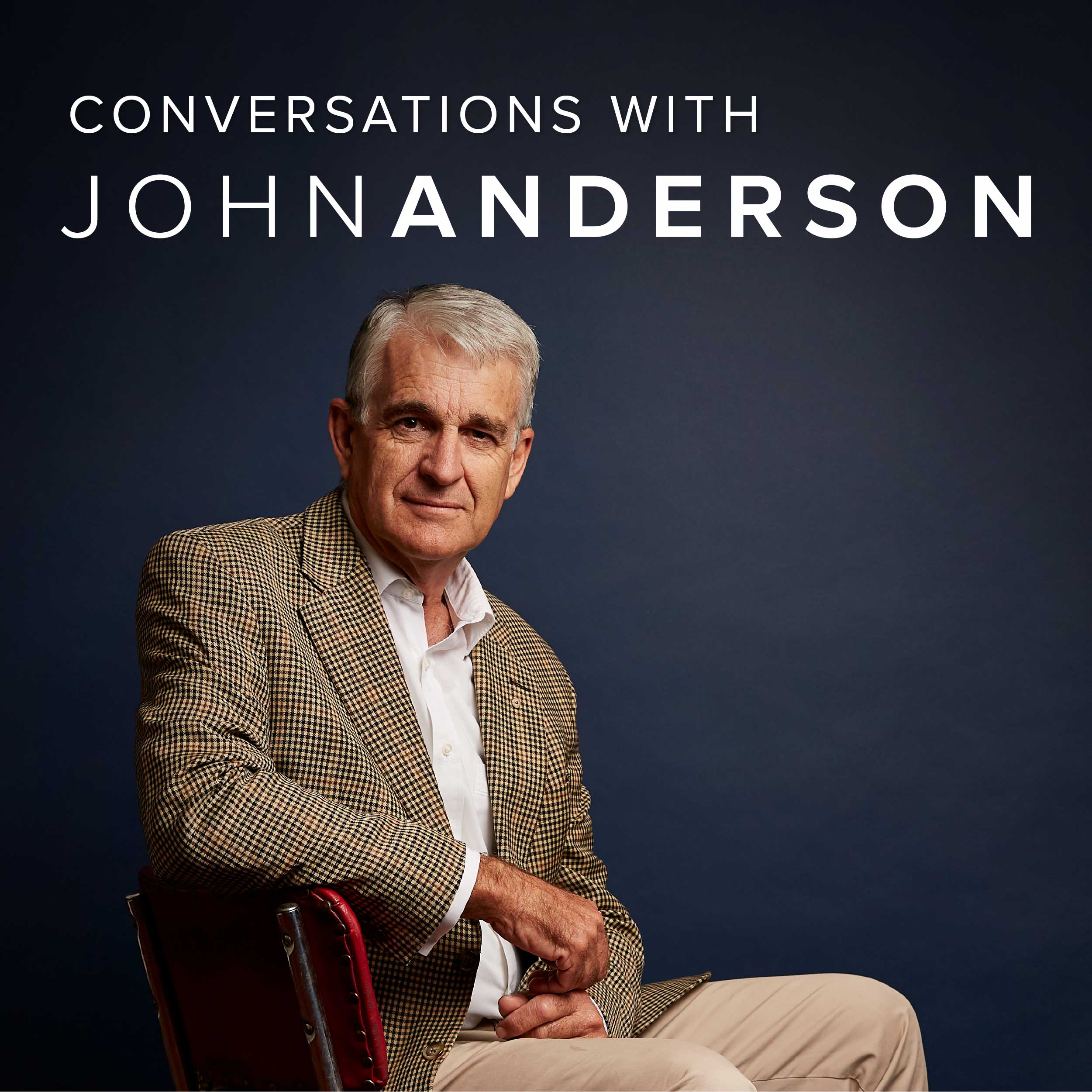
John Anderson: Conversations
Hosted by John Anderson · EN
Former Deputy Prime Minister of Australia John Anderson sits down with world-leading historians, economists, politicians, and thinkers to examine the ideas shaping our society. Drawing on decades at the highest levels of government, John brings rare depth and civility to conversations that mainstream media won't have.
This podcast covers everything from Australia's political future to faith, freedom, and the fragility of Western democracy. Thoughtful, rigorous, and genuinely independent.
30episodes
Episodes
Newest firstAll episodes
“The Politics Of Gaslighting”: Why Britain Won't Face Its Own Decline | Konstantin Kisin
4d ago00:39:14Tap to summarizeKonstantin Kisin argues that Britain is poor and getting poorer, and that almost nobody knows it. He points to polling showing most Britons believe they are as rich as Switzerland, Singapore or Australia, when on a per capita basis Britain sits far down the table and is close to being overtaken by Poland. Konstantin also examines the grooming gangs scandal, which he describes as organised crime run through kinship networks, and rejects outright the idea that Britain can accommodate two legal systems. Konstantin Kisin is a writer, social commentator, comedian, and co-host of the free speech podcast Triggernometry. He is a regular on British and American TV and radio shows including Question Time, Good Morning Britain, BBC Breakfast, Daily Politics, LBC Cross Question, The Joe Rogan Experience, and many others. He is also the author of An Immigrant's Love Letter to the West.
Transcribe →What The Census Gets Wrong About Religion | Mark McCrindle and Dorian von Freyhold
1w ago00:39:55Tap to summarizeJohn Anderson sits down with social researcher Mark McCrindle and measurement researcher Dorian von Freyhold to examine whether Australia’s Census is giving an accurate picture of the country’s religious identity. They explore how changes to the wording and structure of the religion question may influence responses, why “no religion” does not necessarily mean atheism, and what their research suggests about the true scale of secularisation in Australia.The conversation also looks beyond the Census to the broader cultural picture: the changing relationship younger Australians have with Christianity, the difference between religious affiliation and active belief, the enduring influence of Christian institutions and values, and the growing search for meaning in an increasingly fragmented society.Mark McCrindle is an Australian social researcher, demographer, author and founder of McCrindle, a research and communications agency specialising in social trends, generational change and demographic analysis. He has spent two decades researching how Australian society is changing and is the author of five books. McCrindle is also widely known for coining the term “Generation Alpha” and regularly contributes to public debate on demographic, cultural and generational trends.Dr Dorian von Freyhold is a researcher and strategist specialising in consumer psychology, data science, survey design and business analytics. He holds a PhD from the University of Queensland, where he also lectured in business analytics, consumer psychology and marketing research. Von Freyhold has applied experimental and behavioural research methods across consulting, polling and commercial analytics, and is Managing Partner at Compass Polling. His recent research includes a 5,000-person experiment examining how the wording and structure of the Australian Census religion question can influence responses.
Transcribe →The End of an Empire: Britain's Self-Inflicted Fall From Glory | David Starkey
2w ago01:04:30Tap to summarizeDr. David Starkey sits down with John Anderson to discuss the breakdown of Britain, arguing the crisis is not merely a run of bad prime ministers but a system deliberately broken. He contends that from 1997 the Blair government reinvented British governance on a continental model, displacing the supremacy of Parliament with human rights law, supreme courts and an alien legal architecture.Starkey warns that the sovereignty of the British people has been quietly inverted, and that the country is only now waking up to the consequences. He points to the 440 quangos accounting for roughly a third of state expenditure, a £100 million bat tunnel, and judges who now determine wage rates and fuel policy. Yet for all Starkey's pessimism, he implores Britons to recall their duty and find the courage to fight for a civilisation that is worth preserving.Dr. David Starkey CBE is a British historian, broadcaster and commentator, best known for his work on the English monarchy. Starkey was presented with the Norton Medlicott Medal for Services to History by Britain's Historical Association. He is Honorary Fellow of Fitzwilliam College, Cambridge, and the author of historical non-fiction including Elizabeth: The Struggle for the Throne and Monarchy: The History of England and Her Rulers from the Tudors to the Windsors.
Transcribe →How China Is Using Iran | Michael Doran
3w ago01:03:11Tap to summarizeGeopolitical expert Michael Doran argues that Middle East stability depends on the U.S. winning its long war with Iran. He warns the “rabid dog” regime remains a paused but persistent danger.Doran also unpacks how China is using the Middle East as a laboratory to test how America defends against missiles and drones before any move on Taiwan. He warns that anti-ship ballistic missiles supplied to Iran and the Houthis exist for one purpose: sinking American aircraft carriers.Michael Doran is a Senior Fellow at the Hudson Institute and director of its Center for Peace and Security in the Middle East. A former George W. Bush administration National Security Council director, he is the author of Ike's Gamble and a leading voice on Iran, Israel and U.S. strategy.
Transcribe →Treasury Insider: How Ideology Beat Common Sense in Australia | David Pearl
4w ago01:22:53Tap to summarizeFormer senior Treasury official David Pearl argues that Australia's decline is not fate but the product of bad choices made by the people running our institutions.He contends that Treasury, once feared for its razor-sharp scrutiny of policy, has been captured from above by secretaries who treat emissions reduction as a moral imperative rather than a trade-off, and who withhold the true cost of the energy transition — a figure he puts as high as $1 trillion.David Pearl is a former assistant secretary of the Australian Treasury and now a full-time writer and commentator on economic and cultural policy. He spent some three decades in the federal bureaucracy, with postings to the OECD in the late 1990s and a period as the Treasurer's representative in the United States, working across taxation, fiscal management and energy policy. He writes regularly for The Australian and The Spectator Australia and appears frequently on Sky News, where he has been among the most persistent critics of Treasury's modelling of the renewable energy transition.
Transcribe →Iran, Trump, And The Weakening Of The West | Melanie Phillips
Jul 1701:33:07Tap to summarizeIn this conversation, Melanie Phillips joins John Anderson to discuss the crisis of Western resolve and moral decline. Drawing on her decades as a commentator, Phillips argues that Iran's perceived strength reflects Western weakness and hesitation. She also explores how anti-Zionism and elite failure have hollowed out Western valuesA pre-eminent voice in British public discourse, Melanie Phillips possesses a storied journalistic pedigree. Having established her reputation at The Guardian and the New Statesman, she now provides sharp political and social analysis for The Times, The Jerusalem Post, and The Jewish Chronicle. A familiar and formidable presence on the airwaves, she has long served as a regular panellist for BBC Radio 4’s The Moral Maze and BBC One’s Question Time. Phillips was honoured with the Orwell Prize for Journalism in 1996 during her tenure at The Observer, and her extensive bibliography includes her candid memoir, Guardian Angel: My Story, My Britain.
Transcribe →“Climate Change Is NOT An Existential Threat” | Steven Koonin
Jul 300:43:25Tap to summarizeSteven Koonin joins John Anderson for an in-depth conversation exploring the science, engineering and economics behind today's climate debate. Drawing on decades of experience in physics, energy research and public policy, Koonin argues that while climate change is real, many public discussions fail to capture the uncertainty, nuance and trade-offs contained within the scientific evidence. Together they examine what climate models can reliably predict and why careful analysis matters when shaping long-term policy.The conversation also explores Australia's energy future, the challenges of maintaining reliable electricity grids, the potential role of nuclear power, and the balance between affordability, energy security and environmental responsibility. Koonin reflects on scientific integrity, technological innovation and why societies benefit when evidence, rather than politics, remains at the centre of public debate.Steven E. Koonin is the Edward Teller Senior Fellow at Stanford University’s Hoover Institution. He served as the undersecretary for science in the US Department of Energy under President Obama from 2009 to 2011, and was the lead author of the US Department of Energy’s Strategic Plan (2011) and the inaugural Department of Energy Quadrennial Technology Review (2011). His recent book is called Unsettled (Updated and Expanded Edition): What Climate Science Tells Us, What It Doesn't, and Why It Matters.Sign up to John's substack here: https://www.ourcivilisationalmoment.com/Sign up to John's newsletter here: https://johnanderson.net.au/contact/
Transcribe →Why Modern Education Is Producing Activists, Not Thinkers | Prof. Simon Haines and Dr. Fiona Mueller
Jun 1901:18:35Tap to summarizeIn this conversation, John Anderson sits down with Prof. Simon Haines and Dr. Fiona Mueller to examine how Australia's schools and universities stopped teaching children how to think, and what a genuine restoration of education would look like. The results are measurable in falling literacy, rising school refusal, and a curriculum that has prioritised ideological formation at the expense of knowledge.From the classical roots of Western education and the Trivium to the ideological capture of teacher training and university management, Haines and Mueller expose the ideas driving the decline and the institutions already proving a better model is possible. What is at stake is not just educational outcomes, but the capacity of the next generation to reason clearly, to govern themselves wisely, and to pass on what they have inherited.Prof. Simon Haines is the Distinguished Professor of Liberal Arts at Campion College Australia, Adjunct Professor at the Australian Catholic University, and a founding Fellow of the Hong Kong Academy of the Humanities. He previously served as the inaugural CEO of the Ramsay Centre for Western Civilisation and is a Director of Humanities for Life.Dr. Fiona Mueller served as Head of ANU College at the Australian National University and as Director of Curriculum at the Australian Curriculum Assessment and Reporting Authority (ACARA), and was named among the five most influential people in Australian education by the Australian Financial Review in 2019. She is an Adjunct Fellow with the Centre for Independent Studies, a Senior Fellow with Advance HE (formerly the Higher Education Academy), and currently serves as Director of Research at the Page Research Centre.
Transcribe →The Renewable Lie: How Australia Was Sold a False Promise | Aidan Morrison & Chris Uhlmann
Jun 1201:40:35Tap to summarizeJohn Anderson joins energy analyst Aidan Morrison and journalist Chris Uhlmann for a forensic examination of Australia's energy crisis. Together, they expose the broken promises behind the renewable transition, the CSIRO modelling built on figures no operating wind farm has achieved, and the legislative blunder that turned the New England Renewable Energy Zone into a multi-billion dollar infrastructure disaster. Drawing on international comparisons, primary documents, and on-the-ground testimony, the panel reveals how Australians were sold a false economic promise — and what the true cost to the nation's bills, industry, and security will be.Aidan Morrison is a leading researcher into Energy Systems and currently the Director of Energy Research at the Centre for Independent Studies. In 2023 he exposed how the famous CSIRO report “GenCost” excluded vast costs required to integrate and firm renewables by treating them as “sunk” costs. In 2024 he was amongst the strongest voices calling for nuclear energy in Australia and was a leading critic of the ‘Integrated System Plan’ (or ISP): Australia’s blue-print for a transition to an energy system dominated by wind and solar. Chris Uhlmann is a Walkley Award winning Australian journalist and news commentator. His career in the media spans over 35 years in radio, print and television. His latest documentary is The Real Cost of Net Zero: The shocking truth of the renewable energy push.
Transcribe →How the State Became the Enemy of the English People | Carl Benjamin
May 2901:22:36Tap to summarizeIn this interview, podcaster and political commentator Carl Benjamin joins John to explore the accelerating collapse of English identity and the political crisis that has followed.Carl argues that Britain has sleepwalked into a civilisational emergency: mass immigration without a vote, a bureaucratic state that has outgrown democratic accountability, and a native population that has been deliberately disconnected from the culture and heritage it was supposed to carry forward. Carl Benjamin is one of Britain's most followed independent commentators. Widely known online as Sargon of Akkad, Benjamin is the director of the conservative political podcast, Lotus Eaters. He is known for his outspoken criticism of modern feminism, identity politics, Islam, and political correctness.
Transcribe →