Loading summary
Transcript110 lines
- [00:00]
Host 1
Jokerman podcast is brought to you by Distrokid and their new Direct to fan tool. Allowing any artist to sell merch. Distrokid Direct allows artists to create a merch store in minutes without any upfront costs or any technical skills or know how they'll take care of all the logistics and the nitty gritty. And as with distribution through Distrokid, they never take a cut of the proceeds. You, the artist, keep 100% of your earnings. Once again, that's Distrokid Direct. Open a store today@distrokid.com direct.
- [00:40]
Evan
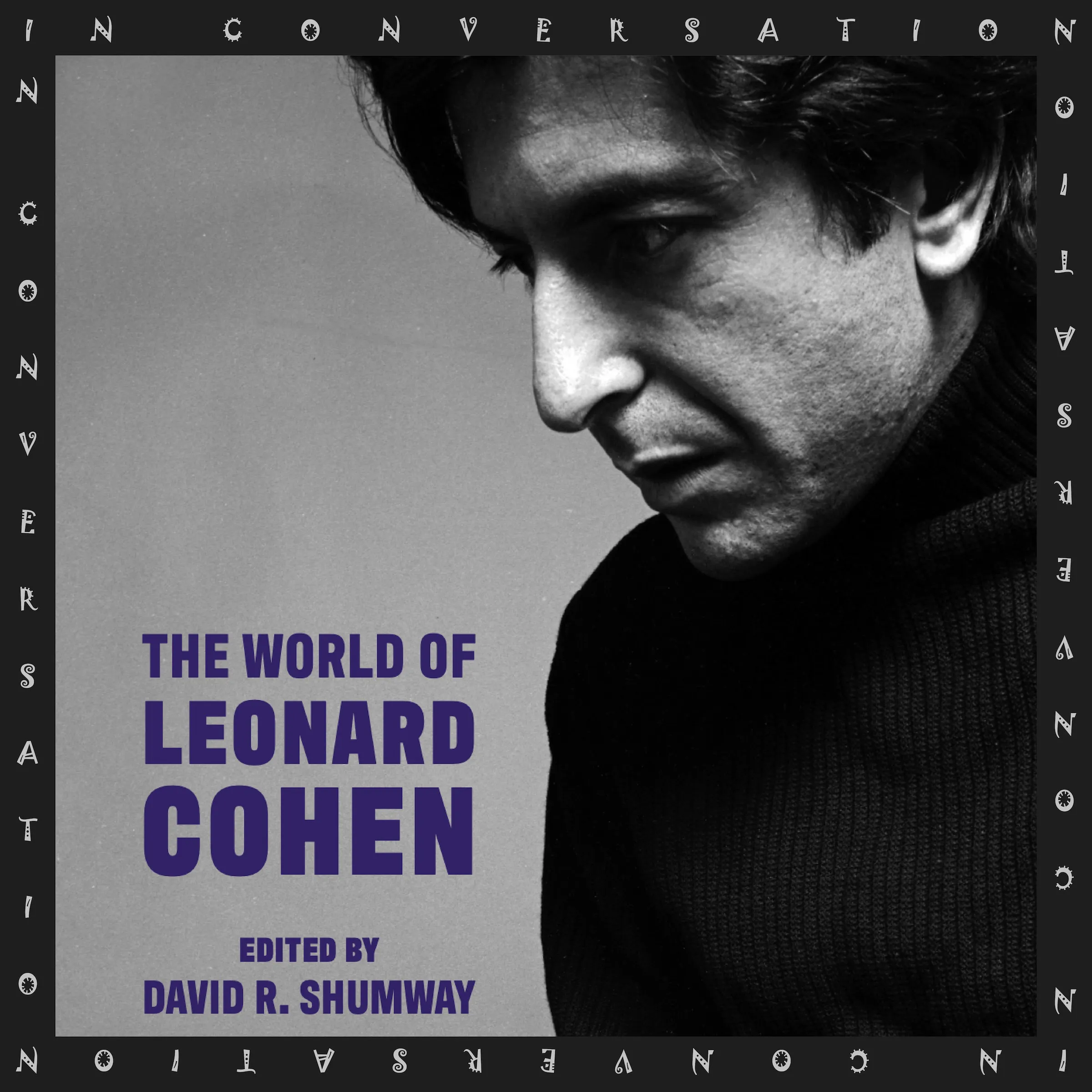
Welcome back to Jokerman. I'm Evan. And today we have an auspicious occasion. It is the first time ever that we've discussed a certain artist on this program who I can say I am confident we will revisit in a considerable way in the future. Today we're talking with Professor David R. Shumway, the editor of an extensive new collection of essays, the World of Leonard Cohen. It's a very comprehensive and multifaceted compendium and a great place to start playing plumbing the considerable depths of the man and his art. Here's the interview.
- [01:58]
Song Performer
Dance me to your beauty.
- [02:06]
Host 1
Well, thanks for. Thanks for joining us. We're, of course, gathered on the occasion of a new book, the World of Leonard Cohen, an essay anthology that you contributed to and also edited. Before we, you know, kind of get into the details, can you just maybe give us a run through of what exactly this book is?
- [02:27]
Professor David R. Shumway
It's a. A collection of essays that tries to cover very broadly the cultural, musical, aesthetic connections that Leonard Cohen had, his influence, what influenced him. It's a very. A very broad, capacious take on the artist.
- [02:54]
Host 1
Capacious, I think is the word indeed. A lot of different subjects, a lot of different kind of angles in on Leonard. I don't want to spoil things too much necessarily, although I'm sure everyone out there can just look at the table of contents. But it's looking at obviously the musical context in which Leonard occurs, the literary context in which his work is situated, religious contexts, cultural context, political context, just basically anything and everything you could ever think about the man, which. I got several questions along those lines here in a moment, but before we get there, I would love to just maybe hear. David, what's your experience reading and listening to Leonard?
- [03:39]
Professor David R. Shumway
Well, I've been listening to him for a very long time. I mean, I. I began listening to him in the 60s, but it was really a couple later moments that made me realize his significance. The first was his release of 10 new songs around 2000, demonstrating that he was still an artist who was innovating and developing. Many great artists have long careers, but it seems towards the end of their career that they don't do anything new. I mean, I would say the Rolling Stones, for example, you know, have been great performers for 50 years, but they probably haven't done innovated anything since the 1970s. But Cohen, it seems to me, is an artist who has continued to develop and create new material. And so that that moment with 10 new songs made me realize that. And then even more important is when he started to Tour again in 2009. I was just struck by the renewal of him as an artist. I mean, this is someone who had always been a great songwriter, but he became in those last tours a great performer in a new way. And so I really began to be interested in him in a much more serious way at that moment.
- [05:22]
Evan
The idea in particular about an artist innovating, finding, I think most importantly like finding new territory for themselves. I don't know how much you know about our program, but we've kind of made it our bread and butter to get into those types of records. Like those records, you look at the later part of an artist's long career.
- [05:45]
Host 1
Where the really good ones, they've been working all the way up until that final moment and that's when they can finally get really good.
- [05:53]
Evan
The ones where potentially maligned, sometimes middle late career records. And then I think, yeah, we've always banged the drum for a lot of these records toward the end of an artist's life, sometimes the most interesting. And we did that with Bob Dylan, we did that with Lou Reed and John Cale. And we're in the midst of doing that as much as one can with the Beach Boys. With Leonard Cohen, I really feel like he's kind of maybe the most dramatic example of that.
- [06:28]
Host 1
Well, particularly when you consider that you want It Darker is maybe the ultimate late era release in many ways. That and Blackstar perhaps kind of go together both in the sense that they came out right around the same time. And both of them came out almost as soon as those records came out. Their creators departed from the world basically. There's something kind of magical and spiritually significant about that. As if like he kind of Leonard and Bowie on Blackstar kind of put their entire artistic essence into these final releases before exiting this mortal coil.
- [07:01]
Professor David R. Shumway
It's very unusual for two great artists to be aware that their time on this earth is short and to be able to create an artistic statement to respond to that.
- [07:16]
Evan
Fact, it seems like Leonard Cohen was working his. Like, every time he made a record, he was getting closer to that. Like, that was his. Seemed like a goal, almost like to articulate that thing of life being fleeting and. How can I put this in the most succinct way? And, of course, he's turned out to be pretty good at that. By the time he got around to his last record, he'd had a little practice. It seemed like he was always working toward that from the very beginning of his career, even as a writer, as a poet. I think something that the book of essays does that's great is kind of lay all that out, the connection between his work as a writer and his work as a lyricist.
- [08:04]
Professor David R. Shumway
Yes. Well, I'm glad you. We certainly hoped that that was what the book would convey, that writing songs and poems are not exactly the same, but in Leonard's case, there's an absolute continuity between them.
- [08:16]
Host 1
Yeah. I wonder if you can maybe speak to that a little bit. There's several essays that are focused on Leonard as a po and then Leonard as a songwriter. You know, there's also a couple that are focused on kind of his personal history. And much is made of the fact that he obviously begins as a poet, has a pretty. As far as poet careers go, like, very successful start to his career, you know, in Canadian literature circles, and then sort of doesn't throw it away, necessarily, because he will continue to write poetry on throughout the rest of his life, but definitely pivots and decides, you know, I think the phrase that comes up in many of the essays is like, I'm gonna be the Canadian Bob Dylan. You know, he's obsessed with bringing it all back home in Highway 61. Those records. I wonder if you could just maybe sort of set the scene for.
- [09:04]
Professor David R. Shumway
What.
- [09:05]
Host 1
Was going on, you know, what was kind of motivating Cohen first as the poet, and then as he becomes whatever you want to call him, musician, rock star, folk singer, singer, songwriter. These terms are all contested, but, you know, moves towards the musical field.
- [09:20]
Professor David R. Shumway
So, I mean, Leonard was a golden boy in. At McGill. He was the teacher's favorite. The poets whom he studied with there saw him as someone who would represent their legacy. And. He saw himself clearly from his days as an undergraduate as someone whose vocation was literature in a way that, you know, of course, most people, even people who turn out later to be great writers, don't necessarily understand at that early age, but. But he did. And probably because he was connected to the most important people writing poetry in Canada at the time. His first book of poems was published quickly. It received reviews. It was noticed. He continued to go on to write poetry and a couple novels, all of which were taken seriously. He was the subject of a laudatory and important CBC documentary in the mid-60s. So all of that suggests that he was very successful. But he did not feel that way. He felt that he was not reaching the audience he wanted to reach. He was not making the money he felt he deserved, to be frank. And so he thought that writing songs and singing them might be a way to rectify both of those deficiencies. Now, the story that he asserted he was going to be the Canadian Bob Dylan is one that's told in one of the biographies about him. It's actually not repeated in. In the other big biography of him. There's a different sort of story. But clearly Dylan had an influence on him. There's no question about that. But of course, Leonard had been connected to music since he was an adolescent. He learned to play guitar from someone who taught him the flamenco guitar style. He learned traditional folk songs. The Partisan is one that he recorded later, but he learned to perform those earlier. And then in high school and college, he performed with a group called the Buckskin Boys that did country. Country music.
- [12:07]
Host 1
Right.
- [12:08]
Professor David R. Shumway
So, I mean, music was not a new thing for him. But taking it seriously and trying to become a recording artist, that was a new project in. In 1966 and 67.
- [12:23]
Evan
That's really, I think, the point at which the Bob Dylan part of that story is really important, I think, to. To note, like, when he says, I want to be. Whether he said that literally or not, I want to be the Canadian Bob Dylan. It seems like what happened with Bob Dylan was someone like Leonard Cohen could look at this guy and recognize, as Allen Ginsberg is noted to have said, like, this is the passing of the torch moment from that bohemian poet world to something else to a. It's an evolution of the same tradition.
- [13:09]
Professor David R. Shumway
Yeah. Because Dylan, unlike most other popular music performers at that moment, understood himself as an artist in the broad, traditional sense of that term. He wrote songs that borrowed quite clearly from the poetry of the 20th century. And I think that's what Cohen heard in Dylan. It's not just that Dylan was a musician who was compelling as a singer. The lyrics that Dylan was writing were not June Moon Croon love songs. This was a new kind of songwriting that really didn't exist in American popular music, at least before Dylan.
- [14:00]
Host 1
And I think what's remarkable about it, too, is the age gap, you know, which I Think this. There's another term or idea that comes up in a couple different essays like don't, you know, the defining ethos of a lot of people, you know, countercultural types at this moment in time is don't trust anyone over 30. And Leonard is 33. You know, he's. What is he, seven, eight, nine years older than bomb? Something like that. Which, you know, the grand scheme of things is not an enormous amount of time. But like, when you're a young man, that's a pretty, you know, that's a pretty big, pretty big difference. I'm 33 right now, so, you know, thinking about Bob in 1965, he would have been 24, you know, what do I think of a 24 year old, you know, not necessarily overly impressed with many of them. So I. There is something sort of daring, I think, about Leonard choosing to take Bob seriously, buy into it as well. He should have, of course, as well. The whole world should have and ultimately did. But at this time, when there is this stronger, more, more, I don't know, solid barrier between rock music, you know, rock lyrics and stuff like that and what you typically think of as like high literature, poetry, prose or whatever.
- [15:14]
Professor David R. Shumway
Well, and especially in the world of Canadian poetry that he grew up in. I mean, that scene that Ira Nadell describes in the biography, all of the other poets who he plays Dylan's music for, I think all but one think it's awful and can't figure out why he's interested in it at all.
- [15:38]
Host 1
What is this racket?
- [15:39]
Evan
Well, there is the folk music connection there. It's like that songwriting that Bob Dylan exemplified, it didn't exist. The closest thing was folk music. Like that's. That's the common ground, it seems like. And then they had that shared interest, maybe. It seems like Leonard Cohen maybe was able just to see that connection for that reason which maybe people who are just poets and poets only weren't really interested in music, might have not been as readily able to clock.
- [16:14]
Host 1
Yeah, the terminology, I think the genre. That's another major focus of several of the essays here that are lined up one after the other. Leonard Cohen is a folk artist. Leonard Cohen as a singer, songwriter. Leonard Cohen as a rock musician. All of those terms apply to him to some extent, some more than others at certain times. But at the same time none of them is quite right. And I come away from this collection of essays kind of confused about where I even sort of situate Leonard in terms of like, is he a rock artist, is he a folk artist, is he a Singer songwriter, Is he something else entirely? Can you sort of map that contested territory for us a little bit, David?
- [16:55]
Professor David R. Shumway
Yeah, so Leonard clearly has a significant background in folk music. It was important to him even before he began his career as a professional songwriter and singer. But at the very moment that he begins to write songs and perform them, folk music as a commercial category is tanking. There's a folk revival in North America beginning in the late 50s and running through the early 60s. Dylan is part of that. He's heterodox, but he certainly in that milieu. But folk rock, beginning with the Byrds and Buffalo Springfield and bands like that, take the kind of commercial steam away from pure folk music. So when Cohen begins to record, his recordings are in a kind of odd place commercially. While they're not generically rock, the people who are listening to them, the context in which they find themselves is a rock context. And Cohen himself quite quickly comes to recognize that. I mean, there are all kinds of interviews and stuff which show that he perceives the fact that even though he's not performing the same kind of music as the Rolling Stones or the Beatles, he's still attracting largely the same kind of audience that they are now. The singer songwriter thing is really what emerges out of that kind of moment of vacuum. The singer songwriters step into the place that commercially, that folk has kind of.
- [18:51]
Host 1
Abandoned the Paul Simons, the James Taylors.
- [18:55]
Professor David R. Shumway
James Taylor, Joni Mitchell, Carole King, et cetera. Yeah, Jackson Browne. And Cohen is very, very important to them. I mean, he. He strongly influences Joni Mitchell directly. I mean, they were briefly a couple. Joni wrote at least four songs about him. But Cohen is also not exactly a singer songwriter because that formation is strongly connected to the idea of confessionalism of people who are presenting their music as autobiographical. Cohen draws on his own life, but his songs don't seem to be mainly about him. They seem to be about more kind of the general condition of life. He's more of a philosopher than someone who's interested in self revelation.
- [19:46]
Evan
Yeah. The sort of universal and ultimately religious aspect of his music, I think, is another thing that sets him apart. And there is a section in this book of essays about focusing on the various religious perspectives.
- [20:03]
Professor David R. Shumway
Yeah, So, I mean, of course, Cohen is an interesting figure because he's personally deeply involved in two religious traditions. He was raised in a household where one of his grandfathers was a rabbinical scholar. I mean, not just a rabbi, but a. But a significant figure in Jewish thought. The family itself had established the first temple in the neighborhood in which he lived in Montreal, so he always considered himself Jewish at practicing the Jewish religion, but he also became a Zen monk. Now, he said that he didn't think of Buddhism as a religion. In fact, when he, you know, he said, I have a perfectly good religion. I don't need another one. But he did see it as an important practice, a way of a method of discipline. Something that, although he finally did leave, it clearly seems to have done him significant good. I mean, it was the years that he spent a long time at the Zen center in Mount Baldy that he finally ended up reducing his dependence on substances. I mean, he had been drinking very heavily prior to that, at various times, used a lot of drugs. Zen seems to have helped him to be able to control those habits. I don't think he ever gave up drinking, but he certainly drank much, much less towards the end of his life. In fact, that's one of the explanations that people have offered for why he sounded so much better in 2009 and after than he did on his previous tour when he described himself as drinking three or four bottles of Chateau Margaux before every concert.
- [22:11]
Host 1
Quite a writer.
- [22:13]
Professor David R. Shumway
Yeah.
- [22:16]
Evan
Yeah. The. The album you mentioned, 10 new songs, specifically is pointed out in one of the essays as being maybe, maybe the most directly influenced by his time with really intense Zen study and practice. The tone, the kind of the feeling, being a bit more playful in a way or lighter in certain ways than before.
- [22:49]
Host 1
Well, especially when you compare it to like, I mean, the record that was like the Future, which is like such a jaundiced, kind of like, you know, like black hearted release.
- [23:01]
Evan
Some of the best and bitterest. Yeah, to look at that, like to see that place that he's in, then 10 new songs and then what comes after it. You do see, I think in the final record, it. It's back in full, like Judaism is more there at the center. But he's come to a. What seems like a kind of understanding about it and a way of writing about it that maybe he only could have gotten to that through that other practice.
- [23:37]
Host 1
On the note of jaundiced, black hearted, dour type of music, that's sort of an image or a series of adjectives, I think, that followed Leonard throughout many eras of his career, often maybe unfairly so. I wonder if you can talk a little bit about the discrepancy between the general public view of who Leonard Cohen was and what his music was all about, versus, by all accounts, you know, an individual who seemed not only to be, you know, very sort of attractive to the opposite sex and sort of compelling as an individual but also kind of like happy and clever and like fun to be around at least at certain points in his life. What to make of that?
- [24:25]
Professor David R. Shumway
Yeah, that isn't. It's an interesting paradox. I mean, I think Cohen is really is a kind of figure who, who really just is contradictory. There are some things that we can't really sort out. But it's true that, that the idea of him as dark and depressing seems to begin with his second album and kind of get more intense with his third and not then really be relieved by subsequent albums. It doesn't seem to crop up in the criticism of the songs of Leonard Cohen, his first album, but. But after that it certainly appears in the criticism and I think it does have to do with several aspects of, of the songs. It's not just their subject matter. I mean, there are very dark songs on a few very dark songs on some of those albums. But there's also the way in which they're presented, which, you know, they're not. They don't tend to be upbeat, they're not. They're not going to make you dance, they're meditative. And again, I mean, this is not necessarily depressing, but it. If you put it in the context of what people expect from popular music, then it seems as though it's not doing what most popular music does, which is for many people to energize them rather than to make them think or provide occasions for meditation, which I think is what Cohen is often trying to do.
- [26:07]
Host 1
I wonder also, like, to what extent his sort of like literally like his appearance has to do with things, you.
- [26:15]
Evan
Know, one of the best dressed people in history.
- [26:19]
Host 1
Absolutely, there's no question about that. And like never even like, you know, even like Bob Dylan, I would say also one of the best dressed people in history but, you know, went through some choppy territory.
- [26:30]
Evan
One of the most dressed people in history, certainly. Yeah.
- [26:33]
Host 1
But like Leonard, like even as he aged, you know, you know, never really went through a choppy. Like he always had a suaveness and a. Just a complete command of his visual appearance and his projection to the world. But I think that also sort of set him, set him apart certainly in the earlier days when you've got the hippies and the folk rockers and stuff and the bell bottom jeans and the bandanas and tie dye or whatever. And here's this guy in a suit. He's just a guy in a suit showing up. You know, he almost looks like, you know, he looks like the man, basically, to use a bit of outmoded terminology.
- [27:09]
Professor David R. Shumway
Yeah. So, I mean, you know, his family, his father's family owned a clothing company. Right. And to some extent, Leonard never escaped that. This is his dress, I think, is where his age difference with the contemporary musicians stands out most distinctly because people who. Who came of age when he did in the late 50s in the middle class dressed the way he dressed.
- [27:57]
Host 1
Sure.
- [27:59]
Professor David R. Shumway
And all of that changed in the. In the early 60s in. In North America. But. But Leonard's habits were already fixed and he never really gave them up. I mean, it's true. He's in a suit basically in every photo we'd ever see of him. Occasionally he doesn't have a tie on, but that's his major concession to informality. He did grow his hair out a little bit in the 70s. He tried to look a little less straight, but he gave that up pretty quickly.
- [28:34]
Evan
I forget where I heard. Maybe it was in. In the Songs For Drella album. I think it's a quote like attributed to Andy Warhol about if you dress older when you're not as you really age, you'll look the same. It just really seems like there's a gravity that he is comfortable with, projecting with this sense of seriousness that I think people are drawn to at a younger age because it seems like he's maybe knows what he's doing. And then at an older age that that impression lasts.
- [29:09]
Professor David R. Shumway
One critic, whom I quote in, in my essay in the volume, describes Leonard as having a kind of early lateness, that even when he was in his 30s, he already seemed older even than that. Partly it had to do with his voice, which was always deep. It got deeper as he aged. And also the quality of the voice, I mean, in not just the literal pitch, but the timbre, all of that suggested an older man actually than he chronologically was. And that again, distinguished him significantly from his peers in the music business at the time. I mean, he just seemed like a more mature person, regardless of his chronological age.
- [30:02]
Host 1
Yeah, early lateness perfectly sort of distills, I think, something about who Leonard was, sort of along those same lines. One of my favorite chapters in the book is one of the ones that you wrote, actually, David, towards the end, and aligns directly with the topic of our program here in terms of interest in late eras. I think the chapter is called how to Be an Aged Rock Star. When you engage with the concept of old Leonard Cohen, and that seems to me like a specific individual. Old Leonard Cohen is a distinct person from Leonard Cohen himself.
- [30:41]
Professor David R. Shumway
Yes.
- [30:42]
Host 1
Can you tell us about this individual, old Leonard Cohen?
- [30:45]
Professor David R. Shumway
Well, so what struck me about Leonard in those late performances beginning in 2009 is that he embraced old age, which distinguished him from most other of the older musicians. As, as I was writing this beginning several years ago, it was a moment when lots of people were returning to the road after having been off of it because of COVID And so there were lots of old rock stars out on the road. And what struck me about most of them is that they were still trying to inhabit the Persona, the Personas that they had created when they were younger men. So Mick Jagger, who once said, of course, that he would never be performing satisfaction at 35, I think, or something like that, continues basically to perform in the same way as he always has, and God love him, I mean, that he can do it is astonishing.
- [31:55]
Host 1
Incredibly impressive.
- [31:56]
Evan
It's a miracle unto itself.
- [31:58]
Professor David R. Shumway
Yeah, absolutely. But it's a very different thing than what Kohn was doing, which is basically coming out there and saying, look, I'm in my 70s and this is what it's like to be in 170s for most people. Most of us are not ageless. And that seemed to me very important. And particularly in the context of rock and roll, which of course began as youth music and really continued to remain as such. I mean, it. I'm not sure it exactly still is at the moment. It's a little bit different thing in 2026. But for a very long time, rock and roll was what several generations listened to when they were young. I mean, I can remember walking across campus in the 1990s, listen to students playing Led Zeppelin and the Beatles pretty much exactly as my Cohort were doing 30 years. No, no, 20. 20 years earlier.
- [33:21]
Evan
Sure.
- [33:21]
Professor David R. Shumway
And it's very different from the situation that I found myself in in the early 70s. I certainly was not listening to the music that was popular 20 years before that.
- [33:37]
Host 1
And that's what I think makes. Makes those late era records and tours, you know, that Leonard was on the tours, you know, partially motiv, obviously, as we know, but I think used as maximally as they could and really turned into one of the richest chapters of his career. That's what makes those so significant. And that's why I really only. We've already talked about Bob a little bit in this interview, and he comes up all throughout the book. But in a sense, I really think that Leonard is really Bob's only peer in many ways. Certainly when you think about these late tours and acknowledging the reality of being in your 70s or in Bob's case, your 80s, he's going to be 85 this year, and he's about to go back out on the road once again. I don't know. I don't have anyone else to compare it to other than the two of them.
- [34:30]
Professor David R. Shumway
I think you're right. It is hard to think of a peer other than Dylan, maybe Joni Mitchell. But I would go a little further and say that Leonard really grew more in his late years than I think Dylan has. I think there's a certain repetitiveness to Dylan's work over the last ten years or so. I'd have to think a little bit more carefully to make this argument cogent, but I really feel that there's. Cohen's last years are almost unmatched in their productivity and genuine musical significance. I mean, Dylan's career is also in some ways unmatched. He continued to produce important, interesting records much longer than almost anybody else. And he doesn't have what I would describe as a sort of fallow periods that Cohen did have in moments of his career. I mean, Dylan had pretty much consistent, interesting output for a very, very long time. But I think at the kind of very late moment, I believe Leonard is unrivaled.
- [36:03]
Evan
When you say repetitive, there is some degree to which that is completely undeniable.
- [36:08]
Host 1
Shadows of the Night and Fallen Angels and triplicate Repetitiveness was his chief concern for those couple years.
- [36:16]
Evan
And now he's going on, what, the fifth year of touring one album.
- [36:22]
Host 1
The hottest album of 2020 and the hottest album of 2026. Rough and Rowdy ways.
- [36:26]
Evan
Yeah, I think that Leonard Cohen. It seems like there were, like, kind of subtle maybe, but like some revolutionary shifts from album to album. And even in the latest, especially maybe in the latest examples, yeah, I would.
- [36:44]
Host 1
Tend to say that Leonard was more interested, just my own rate on things, more interested in the record, the records, the albums as the. The objects than Bob, you know, at the end of his career, Bob has always been sort of, you know, devil may care about his albums for the most part. And so I do think that in terms of productivity and literally just the albums, the songs that he's able to write, record and kind of get out into the world. Leonard has got Bob there, you know, to the extent that this is even a competition.
- [37:18]
Professor David R. Shumway
It's interesting that you should say that because I agree particularly about the late albums, but it's kind of the opposite reputation that Leonard has had. People talk about the albums as really just collections of songs, which I think is wrong. I mean, Christophe Lebold has written a recent book, he's in the World of Leonard Cohen, but he has a separate book that came out in. First in French and then recently in English. He makes a very strong case in that book for the unity of most of Leonard's albums, which is very much contrary to the typical critical take on them. I'm not sure. I think Christoph pushes it a little further than I would take it. But I do agree that Leonard thought very carefully about his albums and something that most people don't recognize.
- [38:17]
Host 1
I wonder, you know, we haven't really spoken too much about music, you know, specific songs, you know, specific works of. Leonard's been more of a, you know, high level conversation, which I think is great and perfectly the right way to go about this. Read the book, folks, if you want to, you know, read about specific songs. But I wonder, I mean, in popular culture, of course, to the average person on the street, if you ask them to name a Lynard Cohen song, well, most of them probably wouldn't be able to name Leonard Cohen's song. But if you ask them, do you recognize any of these songs? And Hallelujah was one of the songs you played, that would be the song they recognized. Probably not even the Leonard Cohen version of Hallelujah, but, you know, that's the one. That's a song that sort of seems to have taken on a life. Don't even qualify it. Don't say sort of. That has taken on a life above and beyond Leonard himself. I wonder, just what are your feelings?
- [39:12]
Professor David R. Shumway
What is your.
- [39:13]
Host 1
A relationship to the song Hallelujah at this point, David?
- [39:16]
Professor David R. Shumway
Well, I think it is a magnificent piece of work. It is a song that in some respects embodies the contradictions that we've been talking about. I mean, it is a kind of hymn, which is a very odd thing for a popular song to be. It is a song that clearly expresses religious thoughts and feelings, and yet many of the verses are entirely profane in their concern. And of course, that combination, the sacred and the profane, runs throughout Cohen's body of work, literature and songs. It could be argued that he really thinks that you have to get to the sacred through the profane. It's certainly not a completely original idea with him, but it's not the public's general idea of the holy. It's such a powerful song because it conveys this conflicting sense of, you might call it both victory and defeat or defeat, victory in defeat, we might almost say. Every verse describes a situation in which there is both a kind of failure. There might Be failure and triumph. But there's. It's never triumph alone, you know, that complexity again. It's very rare in popular music. There's another thing about the covers that I think are worth noting, or at least one cover that John Cale's version of the song, I think influenced Leonard's reinterpretation of it later in his career. If you listen to the Various Positions version, Leonard's original, and there's something kind of flat about its presentation. And I hear John Cale in the later performances from the tours after 2009.
- [41:36]
Evan
Our two time guest on the program, Larry Ratzo Sloman, is, I believe, a missing piece of that story. He worked with John Cale on an album in the 80s and as I understand it was kind of part of the conversation between. About editing that song down.
- [41:59]
Host 1
Oh yeah, didn't he say he was like the go between song? Because I know Leonard faxed John reams and reams of Verses of Hallelujah and Yeah, I think maybe Jon and Ratso like sort of assembled them together as they saw fit for Jon's cover. Yeah, yeah, I think that's what he was saying indirectly.
- [42:16]
Evan
There sort of was a. A collaborative, like a second edit of the song that like, I guess is as close to like the official second 2.0 version that happened through that.
- [42:31]
Host 1
Well, and that version of the song, of course, is the one that Jeff Buckley ends up hearing and that's the one that like the world probably knows if they know of one. So like, it's a little bit, you know, similar to Go back to Bob again. It's a little bit along the same lines of like Hendrix recreating All along the Watchtower.
- [42:49]
Professor David R. Shumway
Absolutely.
- [42:49]
Host 1
All the later Bob watchtowers are Bob.
- [42:52]
Evan
Or Adele doing make youe Feel My Love.
- [42:55]
Host 1
Make youe Feel My Love. Yeah, I don't know that that one is quite the same.
- [42:59]
Evan
I think your point is better about Watchtower.
- [43:01]
Host 1
Yes, it's. It's, you know, it's sort of a similar, similar concept.
- [43:07]
Professor David R. Shumway
On the other hand, I mean, the song has become so ubiquitous that one often feels people should give it a rest.
- [43:16]
Host 1
Right.
- [43:17]
Professor David R. Shumway
That it should be played maybe less frequently and reserved for more important occasions. I know exactly how. I mean, Cohen himself did suggest at some point that it might be the one song he wished maybe people should stop recording.
- [43:35]
Evan
Right.
- [43:36]
Host 1
Well, that's kind of what I was like getting at or curious about is this song has. I mean, it is just an extraordinary piece of work, just one of the great artistic achievements of the 20th century. And yet it's In Shrek, and it's in that shitty Watchmen movie and stuff. It's like there's something sort of sickly ironic and kind of humorous to an extent about one of his greatest compositions ever becoming this almost like cheap sort of cultural punchline due to its just like endless use and reuse and covers and stuff. I don't know. I'm still wrestling with it myself.
- [44:21]
Evan
The sacred and the profane. I mean, it's Leonard Cohen's great song in Shrek.
- [44:26]
Host 1
Yeah, no, that's true.
- [44:27]
Professor David R. Shumway
So Jim Shedden and Laura Cameron in the book make a very good case for the really profound use of that song in track.
- [44:36]
Evan
Let's hear it. What are the key points on that take?
- [44:39]
Professor David R. Shumway
Well, that it is revealing the deep emotions of the character at different points in the film. That the song allows the audience to.
- [44:52]
Evan
Understand.
- [44:55]
Professor David R. Shumway
The character of Shrek in ways that you would not otherwise be able to perceive, given merely the plot and the animation. I mean, I actually have always thought Shrek to be, as films of that kind go, a pretty great movie.
- [45:19]
Host 1
Pretty good. Yeah.
- [45:20]
Evan
You're not alone. I think there's a reason why Shrek has had an enduring presence. There's going to be a fifth one. I understand. And it's not a coincidence. I think that the first film in that series features that sequence with the John Cale version. I think in the original release, a clear case to be made that the way it's deployed, it's a major asset to the film and very effectively compels you, the viewer, to emotionally invest pretty deeply in this character.
- [45:56]
Shrek Character
I talked to her last night. I know you talked to her last night. You're great pals, aren't ya? Now, if you two are such good friends, why don't you follow her home?
- [46:05]
Host 1
Shrek, I want to go with you.
- [46:07]
Shrek Character
Hey, I told you, didn't I? You're not coming home with me. I live alone. My swamp, me. Nobody else.
- [46:15]
Host 1
Understand?
- [46:16]
Shrek Character
Nobody. Especially useless, pathetic, annoying, talking donkeys.
- [46:22]
Host 1
But I thought.
- [46:23]
Shrek Character
Yeah, you. You know what? You thought wrong.
- [46:29]
Host 1
Shrink.
- [46:37]
Evan
I heard there was a secret chord.
- [46:40]
Song Performer
That David played and it pleased the Lord. But you don't really care for music, do you?
- [46:51]
Evan
I mean, there it is. That's why Shrek has a lasting cultural impact, boy.
- [46:58]
Host 1
Well, wherever Leonard is, I hope he's smiling, knowing that this extremely knowledgeable and wide ranging conversation with an absolute expert on his work has ended with you uttering the words, Evan. That's why Shrek has such a lasting cultural impact. Okay, I think we can probably leave it there. Fantastic book. It'll be available now as of when this episode episode runs. We're recording it a little bit in the future, but we'll have links to purchase pages in the episode description. Again, the world of Leonard Cohen. Fantastic stuff in there, including a contribution from our good buddy Ray Padgett writing about COVID songs appropriately. So everyone out there listening, give it a spin. Pick it up. You will enjoy it. Thanks again, David.
- [47:48]
Evan
Thank you, David.
- [47:49]
Professor David R. Shumway
Thank you so much. Great conversation.
- [47:53]
Song Performer
In my secret life? In my secret life? In my secret life? In my secret life? I saw you this morning? You were moving so fast? Can't seem to loosen my grip? Down the path? And I miss you so much? There's no one insane? And we're still making love? In my secret life?