← Julian Dorey Podcast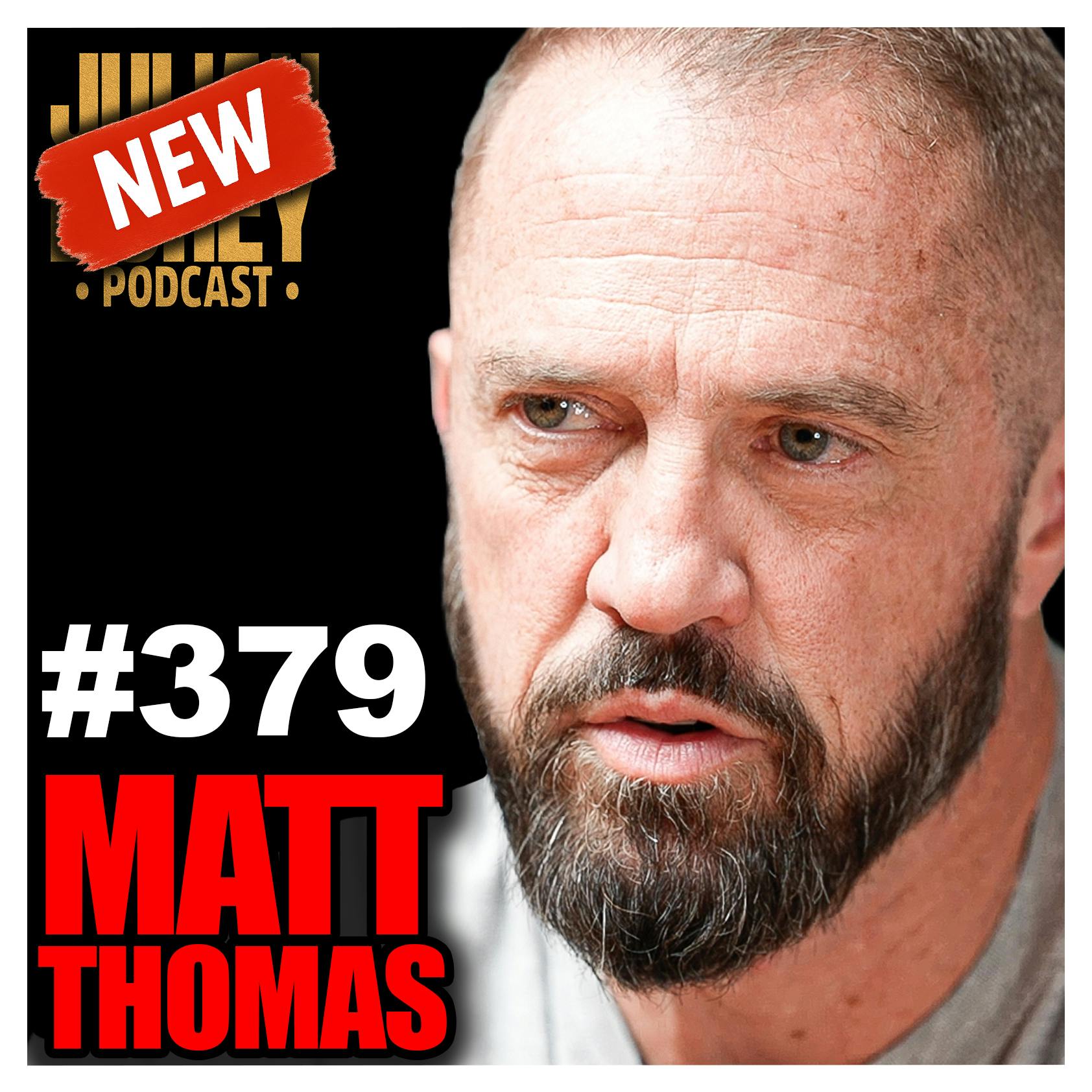
Julian Dorey Podcast
#379 - “Sinister!” - Cartel Cop on Cartel Occult, “R*pe Tree” & Life-Changing Cure | Matt Thomas
03:00:29
Loading summary
Transcript612 lines
- [00:02]
A
I'm a hunter, right? I'm going after the worst of the worst. Hunting bad guys, hunting men, is the ultimate hunt. We're not right on the Mexican border, but just below our county is wide open desert. It is literally unpoliced, becomes the goal line for the cartels building the battleground for us. The dude we were going after had killed his boss to take that spot. I was anticipating getting shot or blown up on, so he was known to carry grenades and he always had an AK with him. And we were hitting his house, we were under night vision. Hiked in all the way to get there in night vision. Yeah, yeah. As we got to that door, I heard, go, go, go. Kick the door, go in. As I clear the living room where we anticipated him to be, I figure out that I'm alone. The bad guy is not where he's supposed to be. We go hauling ass to the back of the house thinking, okay, he's still in the back bedroom. The house is empty. So then I'm really thinking, it's a setup. We got to get out of here. They're going to blow the house.
- [00:53]
B
Hey, guys, if you're not following me on Spotify, please hit that follow button and leave a five star review. They're both a huge, huge, huge help. Thank you. That's also one of the best shirts anyone's ever worn on this podcast. I don't, I don't know where you got that, but I might need one.
- [01:18]
A
Nice. So this is a dude out of San Diego, former Marine.
- [01:21]
B
Keep that mic in, by the way, but go ahead.
- [01:23]
A
Oh, yeah, former Marine. And I, I, you know, came across him on Instagram and I saw it and I was like, gotta have it.
- [01:29]
B
Right, Got it.
- [01:30]
A
Because this is what the. The Mexicans call me all growing up, Right? Like, I'll just embrace that shit.
- [01:35]
B
Yeah. Embracing it. They're usually pretty angry when they call you that, I would imagine.
- [01:39]
A
Well, if it has other words with it, then yeah.
- [01:42]
B
But it's just.
- [01:43]
A
Yeah, yeah, yeah. If it's just straight up green. Oh, yeah, Gringo. Hey, we're cool.
- [01:47]
B
Yeah. So you just, you just did like three decades where a lot of that career was obviously because you're from Arizona and you're towards the border, a lot of that care focused on literally going to war. From a law enforcement perspective with, in particularly the Caloa cartel, is that fair to say?
- [02:04]
A
Yeah, yeah. Caloans kind of control Arizona. So, yeah. Spent majority of my career of 32 years with the sheriff's office fighting those guys.
- [02:13]
B
How the Hell, are you alive?
- [02:15]
A
Well, I don't know. I mean, I feel like God had a plan for me. Right. And I'm a true believer in that. Our number is already kind of selected. So, you know, I just. People always ask, like, aren't you afraid of those dudes? And. Not really. And, and not to sound like a tough guy, but a lot of the, like, especially when, when you're talking bosses, right, it's business and, and like, we were talking a little bit offline about bigger organizations and. Yeah, I never, I never. Yeah. Were there guys that wanted to kill me? Yeah. Were there guys that tried to kill me? Yeah, but it's all kind of part of the job.
- [02:56]
B
You know, cop needs the criminal, criminal needs a cop kind of thing.
- [02:59]
A
Yeah, that's it, man. It's, it's all, you know, ebb and flow and, and circle of life kind of thing. And so fighting these guys, it was. And I don't think I ever really thought of it while we were doing it. You don't really. I don't think you, you want to think about the death part of it, right? Because that could jack up your job or you doing your job. I think you just get with it and go to work.
- [03:21]
B
Did you. I mean, you know, I, I don't think a lot of kids, like, grow up when they're like 6, 7 or 8 and dream of like, hunting the cartels because you probably can't think of what that is. But you grew up in Phoenix, right?
- [03:32]
A
Yeah.
- [03:33]
B
So you grew up in an area where cartels had significant power at the time, so.
- [03:39]
A
Yes and no. So I grew up in South Phoenix. South Mountain Avenue and First Avenue is, is right where my neighborhood was. And so as I grew up, cartels weren't really a thing. Yet you had back then, we called them mafiosos. Right. And everybody kind of knew who they were. They looked the same. They, they wore the, the real tight cowboy hats, the real pointy boots, all leathered out silk shirts, all that kind of stuff. Right. They, they looked that part. But cartels weren't really a thing. They were just mafiosos. So you had, like, where I lived with street gangs that were run by prison. And then the mafiosos were kind of removed from that because they're, they're straight out of Mexico and so kind of the same but different as street gangs. But you always knew that they were on a different level. Right. Like street gangs were here. These were major league dudes. Ran into very few of them growing up. Only one That I ever knew was, like, a legit mafioso. And that was an ex girlfriend. And the only reason I knew that her. Her dad was a mafioso is because he got killed while we were dating. And so from that I learned, like, oh, he was. He was connected to the dudes down south. And so kind of knew that that was there as a kid, but really didn't see cartels until I got into law enforcement, like in the 90s.
- [05:01]
B
Yeah, I keep forgetting you said you're like, 53. I'm. I'm thinking you look good.
- [05:05]
A
Thank you. I'm trying, man.
- [05:06]
B
I'm trying. I'm trying. Like, I keep thinking you're younger. And, like, with the cartels, at least the way I understand the history is they really, like, started to. And talking about Mexico more than anything right now. They started to rise to prominence in that, like, circa 1980 area.
- [05:22]
A
Right.
- [05:22]
B
So I guess when you're talking about, like, when you're a really little boy, that's just before this era, which. Which would make sense. But, like, did you, you know, when you're 13, 14, 15, was there a real drug presence on the street you noticed? Not necessarily even from the cartels, but if there was, like, did you know where it was coming from?
- [05:43]
A
So I don't think so. As a kid, yes, there were drugs, right. And I would say back then it was probably cocaine. And, like, cocaine was the hard stuff. Heroin was the hard stuff. And marijuana. Those three, like, seem to always be around. All growing up, cocaine was probably the most prominent thing on the street. Well, weed, obviously, was, like, everywhere. But for hard drugs, cocaine was the most prominent. Um, so, yeah, you knew that stuff was around. But no, I. I think as a kid, I always associated it with either the local street gang or the prison gangs. Those. Those two I never really looked at, like, it's this outside entity from another country that's shipping it in. I don't think that ever really hit me as a kid.
- [06:31]
B
The prison gangs would be getting drugs on the street.
- [06:34]
A
That's kind of. Yeah, because the prison gangs run the street gangs. I mean, you know, when you look at, like, in. In our state, you have the Mexican mafia. So if you have a Mexican street gang, ultimately they're getting their orders from the prison yards. Most of the time. That's what's going on. So prison yard shot callers are given orders, who can sell, where, who pays what taxes, all that kind of stuff. Right. So it's all. And it's like a hierarchy because, you know, I grew up in it. And I saw some of my friends go into that realm. And so you're. You're on the streets, and it's kind of a recruiting ground, right? And you're going through life, and some guys make decisions that take them on the criminal route. And as they commit crimes and do different things, they start to be watched by the heavy hitters that are in the prison yards. And so as they go into county jail and maybe they get a prison sentence and they hit the prison yard, then it's a recruiting ground for those prison gangs, right? And then they start moving up that hierarchy, too. Because I had a couple of dudes that I grew up with that ended up in some of those gangs. And so there's always a hierarchy. And so it seems, you know, to me, as I was growing up, you would see guys start on the streets, commit crimes, get locked up, graduate up to those levels of prison gangs, and then they would come back out on the streets and they would sit on a different level than just the normal street gangster. So if you had a dude that was never locked up hit a prison yard, he was automatically outranked by the dude that had hit a yard and is now back on the street. That guy carried a little more reverence and had a little more power.
- [08:14]
B
It's always been wild to me, regardless of what, you know, ethnic group we're talking about. You name an ethnic group, they all have a mafia. Right. It's always been wild, though, when you hear about the power that particularly like the guys in prison would have, because you would think you're locked up behind closed doors. It's a criminal organization. Everyone's in it for themselves, and now you have no leverage back there. Right, but what you're describing describing is essentially like the dons were sitting in a cell and telling everyone out in the street what to do, and they were like, sir, yes, sir.
- [08:44]
A
It's pretty wild. It is crazy. And it's you. When you think about how do they have that power? Well, I don't know. I mean, it's just. It's their system, and it works in their favor when they work it, right? And they. Those dudes, Dudes on a prison yard directly affect the streets every day. Like green lighting people for hits, taking out competitors, you know, all the stuff they. I don't know. I don't know how they do it, but. And they run the prison yards, too. Yeah, you're right. It's.
- [09:11]
B
It just doesn't. It's never clocked for me. But I mean, even like the Italians, they still have guys who are legit, like serving as the boss, serving life sentences.
- [09:18]
A
Right.
- [09:19]
B
You know, maybe they have someone in name only as a street boss, but, like, dude sitting in Leavenworth, right, being like, yeah, how those poker machines doing?
- [09:26]
A
Well, and I think a lot of it has to do. Like, when you look at the Italian mafia, I think it's the same for the Mexican mafia. And I can tell you from my neighborhood growing up, you all grow up together, right? So I think there's a. Almost a family loyalty to that. And so maybe I get locked up and I'm sitting in a yard for 25 years, but I have my crew that's loyal to me. Some of it's out of fear, some of it's out of pure loyalty. And I think that carries over and they're able to still do what they do.
- [09:57]
B
You said some of your friends when you were growing up went the wrong way.
- [10:00]
A
Yep, yep.
- [10:01]
B
Did you ever commit crimes when you were growing up?
- [10:04]
A
Yeah, you know, I did stupid stuff. Like, I think, and some of it was, like, with my. With my own family, for instance. Grandpa had a big yard, had a bunch of cars and stuff. And these are. These are stupid kid crimes. It's not like anything crazy, but for whatever reason, you know, 10, 11, 12 years old, whatever, I'm in a destructive nature. And he has a bunch of cars because he. He was in cars, right? He has a bunch of cars, some junk car, some good cars. And I go, and I'm busting headlights and busting tail lights just. Just to break. And, you know, I don't know what I was thinking.
- [10:41]
B
I got a Louisville out there.
- [10:44]
A
Well, then, my grandpa was no joke, dude. He was a World War II vet, Old Texan. So, you know, I got an ass whooping for a couple of those, but stupid stuff like that. And, you know, I. I experimented with weed when I was a dumb youngster. I. I drink underage.
- [11:01]
B
So experiment out there.
- [11:03]
A
No, no, man, I'm good. And I. It's been a long time, and I'm. I don't think I'm. I don't think I'm going back. I have joked about, like, when I'm done with law enforcement, maybe rolling up a fatty.
- [11:14]
B
But, I don't know, after everything you've seen, you know, I don't know if I would.
- [11:19]
A
Right.
- [11:20]
B
Just. Because I will say the one thing that's really scary. Even with all the legalization these days with weed, you know, people still buy street weed and everything. And now, you know, 15 years ago, he didn't have to think about, like, oh, did someone, like, drip some fentanyl in that?
- [11:35]
A
Right?
- [11:35]
B
In that weed right there and now, I'm not saying that happens that often, but it happens sometimes, and it's. It's terrifying, man.
- [11:42]
A
Yeah, yeah. You can't. Yeah, there's. There's no honor in what they do these days. And. And specifically the cartels, dude, they lace that. And we know that just, you know, for the addictive factor and. Yeah, yeah, no joke. And. But I have done, like, for the psychological. I've done ketamine.
- [11:59]
B
How was that? When did you do. How was that for you, man?
- [12:04]
A
What year are we in? We're in 26, so 23. Early 24. Yeah.
- [12:11]
B
What made you want to do that? Or how did you get encouraged to do that?
- [12:14]
A
So it was a little bit of a trip, no pun intended. So as you do this job, right? And you see the things you see psychologically should happen, see just naturally, right? And so I was at a spot where I had seen a lot of death. So one of my buddies ultimately was like, bro, you need help. We're on a hunting trip, and we had this good, long talk. And so psychologically, he was like, I know where you're at. And I had the same type of problems, right? You need to go get some help. So I go to therapist, right? And I start seeing a therapist, which in my profession, still somewhat taboo, right? We're trying to break through a bunch of that crap. But anyways, that leads me down a road, as I talk to this therapist, leads me down a road of, like, are all these things connected? Things that I. I'm going through, right? Things like. And some of these things are kind of weird to admit, but all of a sudden, claustrophobic out of nowhere, right? Never claustrophobic. And all of a sudden I start noticing, like, why am I freaking out? Because I'm on an elevator, right? And I. So talking that through with the. The shrink, and she's tying it back to a bunch of the stuff, right? The death that you see, the cumulative stress, the acute stress, all that stuff, right? The sleep patterns that suck. So breaking all that down, and I'm trying to make myself better because as I talked about with you, statistically, we die within five years of retirement, right? And so I am trying to beat that statistic. And so as I'm looking at all this stuff and I'm looking at how do I make myself better, stay ahead of the curve or get ahead of the curve and not be the guy that like has a heart attack at 55 or a stroke or diabetes or all the stuff that goes along with the job. So holistically I'm trying to look as as many modalities as I can to make myself physically and mentally well.
- [14:15]
B
One of the things I'm always self conscious about and double checking before I leave the house is whether or not I smell good right there. And really anywhere for that matter. That's why Mando has become such a go to Mando is a whole body deodorant safe to use anywhere on your body, whether it be pits, balls, thigh folds, belly buttons, butt cracks or feet. Mando was created by a doctor who saw firsthand how normal Bo was being misdiagnosed and mistreated. So he created a product proven to block odor all day and control odor for up to 72 hours. You can do the solid deodorant stick which is formulated and powered by mandelic acid to stop odor before it starts to or you can use spray deodorant which is aluminum free and ideal for hard to reach places. And the scents are also great. There's bourbon, leather, clover woods, Mount Fuji, or even a simple classic pro sport. Mando is also clinically proven to control odor better than a shower. With soap alone. Twelve hours after a shower, the average man's grundle odor level was a 5 out of 10. With Mando the average was a 0 out of 10. You got to try this stuff. Some men master Bo with sense. Mando men get the job done right. It don't mask it. Mando it. Mando is available in retailers near you. Or better yet, head on over to shopmando.com that link is in my description below. Because for a limited time new customers are going to get 20 off site wide using our exclusive code Julian. So use code Julian@shopmando.com Link in my description below for 20 off site wide and free shipping. That's S-H-O-P-M a n d o.com Please support our show and tell them we sent you.
- [15:48]
A
So I'm working on the mental piece as I'm doing that. I I talked to a dude that is a retired SEAL and in our county they would come out and jump a lot, right? So there was a couple of spots where they would jump in our county do their practice stuff. So he was out jumping. There was two of them jumping that I got introduced to. We went out to lunch. As we're having lunch he's talking about psychedelics and he's talking about his journey and what it did for him. And I had kind of heard some chatter, actually. The dude that invited me out to meet him had swore by ketamine. And I was like, whatever, dude. At that point I was like, you're just trying to do dope legally, right? And so I was a no go. Sit down with the seal. He kind of tells me the same stuff. And so he really opened up my eyes to. Especially when he got into why he did it. So I'm like, I got to look further into this. So then I hit up my shrink, and she's a super good gal, and she's cop specific, right? She does psych for cops. And I asked her, hey, have you heard about ketamine? And she's like, yep. And she says, I can't prescribe it because I'm not that kind of doctor. But I will tell you that in my profession, that is being called a miracle drug. And she says, and I've seen some of the results of that, and I would tend to agree. Right? And I'm like, holy. Okay. So I start looking more into it, and then I find out that in our state specifically, firefighters can do it, but cops can't because. Yeah. So I know, dude. I know. Jesus Christ. I know. It's all the time, man.
- [17:24]
B
They give them drugs and calendars.
- [17:26]
A
I know, dude. They get to make chili and sleep and play Xbox. It's all these things I got in the wrong line. But I find out that. So our governing board that holds our certifications basically said, well, that's this type of drug. And if you do that type of drug, whether under medical care or not, that's a violation of our rules and will revoke your cert. Essentially, you won't be a cop anymore in Arizona. Right? And I'm like, okay, well, that's. That's stupid. And so I start fighting that battle. And Mark Lamb was my sheriff at the time, right? And I'm his number two.
- [18:00]
B
That's a big sombrero guy.
- [18:02]
A
Yep, that's him. Big cowboy hat, big smile.
- [18:04]
B
Yeah, yeah.
- [18:05]
A
So cool. He is cool.
- [18:07]
B
I've seen. I don't think I've sat down and watched one of his podcasts, but I've seen a bunch of clips of him talking.
- [18:12]
A
Yeah.
- [18:12]
B
Not a guy to be with.
- [18:14]
A
No, no, he's a. And. And a God fearing guy and just a solid human being. One of the. He is the best boss I've ever worked for.
- [18:22]
B
He was the one. And you were the number two.
- [18:24]
A
Yeah, he was one. I Was too. Yep, yep. He brought me up and to be his number two, but I'm working for him. And I tell him like, hey, man, this is what I want to do. And he's like, let's do it. And I said, well, they said they're gonna jerk my cert and. And so I won't have a certification anymore. And he's like, ah, we'll work through it. And I'm like, all right, so he's willing to go. And I said, I. But I want to try and like, I don't want to just do this to. To do it. I want to be able to set a standard here. I said, so my plan is to kind of go to war with the governing board. To say, like, hey, this is really none of your business and you should stay out of it. Right? So I'm talking to the guy who runs the governing board at that time, and I'm trying to explain to him why I think we should be able to do this too. And so a lot of the old head cops are same, and I was one of them are. Are of the mentality, no, no, no, this is just, you know, you're just trying to do drugs legally. And so show them all the data, have discussion with them. And I. There was one discussion that I had where I was like, dude, let me run a scenario by you. I said, so I got in a fight, got my nose broke, and it was bleeding pretty bad, and they couldn't stop the bleeding. And I said, so they had to do surgery because I had screwed up my septum. So before they did surgery, they shot medical grade cocaine up into my nose to restrict all the blood veins so that they could get up there and cauterize some stuff.
- [19:49]
B
Whoa.
- [19:50]
A
Said so the doctor shot cocaine into my nose. And he told me, hey, you're going to test positive for like 24, 48 hours. So you need to let them know, you know what happened if they drop you, drop a drug test on you in the next a couple days. And I'm like, okay, so go through that. Have my surgery. Everything's good, right? I said, would you guys take action on that? And he's like, well, no, that was a medical procedure. And I said, so is this right? I said, I'm under the care of a doctor. He's administering the drug in his office, but it's for this, not this. And he was like, I don't know if that's a valid argument. And so to his credit, he went and researched it more. He comes back and so let me back up a little bit. He goes to research it. While he's researching it, I ask our county attorney. I'm like, how do I fight this board? Like, how do I fight this thing that I just described to you? He says, oh, we're gonna have to go to the attorney general and fight them to give a ruling in our favor. Like, cool, could you get ready to do that? And he's like, yeah. He says, has Mark given his blessing? I said, yep, he's good to go. And Mark was good to go. So he says, well, the sheriff's good, I'm good, and I'll start preparing a case to fight the. Go to the attorney general to fight this. Like, okay. And so then I check with our personnel, too, and I'm like, hey, if I do this, will I be violating county policies because there's policies against drug use, right? So they look into it, and they said, well, no, because it's under the care of a physician. They're prescribing it. You're good, right? So I'm good with county policy. Now I just have this one piece outstanding. So shorten the story a little bit. We go through the process of getting ready for that fight. The director comes back and he's like, I've changed my stance. He said, I looked into it. I looked into a bunch of the material you gave me. He says, you're right. This is a medical procedure. I've talked to the board, and essentially, it's none of our business. It's. It's medical. And he said, so our stance is that if you do that under a doctor's care, you're good. Like, cool. Can I get that in writing? And he's like, yeah, you would have.
- [22:01]
B
Made a good lawyer.
- [22:03]
A
And he gives it to me in writing. He sends me an email. Because I knew at the agency. What I didn't tell you is Mark and I had this discussion that it's not just going to be me. Right? The agency, My agency, my.
- [22:16]
B
Are you referring to, like.
- [22:18]
A
Yeah, yeah, sorry.
- [22:19]
B
You gotta be careful.
- [22:20]
A
Yeah, yeah, yeah, yeah. Oh, yeah. Not that agency. Not that.
- [22:23]
B
Damn it. Another one.
- [22:25]
A
Not that agency. No, we're not going to Venezuela. So I. I tell him that for my agency's purposes, what I wanted to do was I. I knew that there were other people that had to be in the same boat I was in. Right. That just weren't talking. So I knew that once I go through this process, I'm going to talk about it and I'm going to let all My people know that I did this because I want other people to understand it's cool to talk about it. It's cool to have a shrink and have those discussions and that we are on the forefront of this and we're trying to figure out things. And as a leader, I felt like, hey, if I go through it first, then I can talk about it, right? And I can tell you guys what's cool. And I actually have a friend today's. He's. He just went through another session yesterday and I kind of walked him through what it's going to look like. But I knew I could have those discussions, right? So as part of that, I knew cops would be like, wait a minute, are we really allowed to do this? And so I wanted all the definitive answers so that when I went and talked to my troops, I'd be able to say, not only that, but here it is in writing, right? Here's all the yeses and why and all that stuff. So went through that whole process, did the ketamine. The doctors were super cool. It was micro doses, right?
- [23:43]
B
Where did you do it?
- [23:44]
A
So there's a place in Arizona there that works through. We have what's called the 100 Club in Arizona. The 100 Club is a not for profit and they take care of first responders. So like when one of us gets killed in the line of duty, the 100 Club immediately steps in, cuts a check to the spouse or the kids or whatever to get them through that. Because it's that first couple of weeks when one of us gets killed that's really rough for the family. Like, they have a lot of decisions to make. They have no guidance. So the 100 Club has everything. They got counselors, they cut the check to like, let's take out or take care of house payments for the next few months. So you don't have to worry about that and you have some time to grieve and go through this, right? So 100 Club is absolutely phenomenal. And the other thing they do is wellness for officers and firefighters. And so the 100 Club had a scholarship program where a philanthropist stepped in and said, I will give money specifically for this if guys want to go through this, right? And so it's about 5k to do the ketamine treatments. And so I put in for a scholarship. They give you the scholarship, minus, I think it's about 10% that has to come out of pocket, right? So they said, hey, you have a scholarship for X amount. You have to pay the 10% because you have to have some skin in the game. And I'm like, cool, let's go. And they said, but in this case, the doctor wants to talk to you before we do this. And I'm like, in just this case, like, why me? And he says, well, the doctor wants to talk to you. And I'm like, okay. So anyways, 100 club connected to this doctor's office that does ketamine treatment specifically. And they do a bunch of other wellness stuff too, but they're connected. So the scholarship led me to this doctor's office, have a meeting with the doctor. And he's like, look, dude, I'm happy that you're choosing to go through this. I'm going to cover your fees. And I said, well, why are you covering my fees? He goes, because someone like you is going to move the needle and that's what we need.
- [25:42]
B
Oh, wow.
- [25:43]
A
He said, so the fact that I have a leader at your level in the state coming in willing to do this, that's going to pay dividends for me because we are going to be able to move the program as a whole in the law enforcement realm because it's been stuck for a while and we've been fighting the same battles that you ran into. And I, I think that this is going to help that. So I'm like, well, cool, man, you know, that's fantastic. And, and so I go through the treatments. It's six separate treatments over a two week period.
- [26:12]
B
And what happens at each one of them? Like, what's it like?
- [26:16]
A
So it's very, to me, very hippie ish. So I, I go to this office.
- [26:20]
B
I think anything's hippie ish to you. You walked in here like, God damn.
- [26:23]
A
It, bro, I can't wait to grow my hair again like.
- [26:29]
B
You can.
- [26:31]
A
Hey, I, I, you know, I'll show you a picture in a little bit. I had some long flowing locks, dude, they were so beautiful.
- [26:37]
B
Hey, listen, if you're like the top dog now, you should be able to do what the you want. That's all.
- [26:40]
A
There's still some standards I gotta follow until I retire. Retire?
- [26:43]
B
But we don't have standards around here.
- [26:45]
A
I'm sorry. It's all good. Hey, it's Jersey, bro.
- [26:47]
B
That's right. Wait a minute. You were doing well.
- [26:53]
A
So anyways, I, the treatments, the doctor's office is a normal doctor's office, right? You walk in, check in, in the lobby, all that kind of stuff that all looks normal. What happened next was not normal doctor's office stuff. So I check in the ambiance is very, like, spa ish. Yes. Right. So go in. It's kind of spy ish. They're like, hey, here's your selection of crystals. And I'm like, what? They're like, these. These are your selection of. It's crystals and stones. And I'm like, like, what am I doing here? And they said, well, you just pick one that you like, and that's your grounding device. Like, okay, you're talking to me like, I know what's going on, bro. Like, oh, okay. So you're going to grab one of the. They all have these points on them, right? So they've. They've all been worked into points. And so you hold it in your hand and you have a little point that you can rub on. So they explained this to me. They said, just pick one that you like. You're going to hold it in your hand, point up so that you can touch the point with your thumb, and that's going to be your grounding device. I'm like, okay, so I pick one, not knowing exactly still what that means, right? And then they're like, now pick a scent like spearmint lavender. And I'm like, what the. Okay, so I pick a scent. Note to anybody thinking of doing ketamine out there. I was one of the ones that ketamine gets extremely sick. So I. I get nauseous, puke kind of sick when. After the treatment, if you're that person, pick a scent that you never want to smell again. Because from that point forward, every time I would smell lavender, I would get a little nauseous, right?
- [28:36]
B
You know how close I was to opening up the new lavender Febreze earlier? And I was like, well, I still got some left in this other one. After spraying that, dude, I would have been in here. Like.
- [28:51]
A
It'S a little better now over time, but especially, like the first six months, man, lavender just really got my stomach going. But anyways, I picked my scent, which is lavender. They put a little cotton ball, they tape it to your, like, back your hand. So I have a cotton ball and I have a crystal with a point on it. And we go into the room and the doctor kind of tells me what to expect, right? And he's basically like, look, dude, here's what's going to happen. Your brain is going to do what your brain needs to do to repair itself. And so what that equals is different for every person. Typically, what it's going to look like is this, right? You're going to. You're going to go in you're going to start the medicine. You're going to kind of drift off into what feels like a in between sleep and awake. And then you will have some psychedelic experiences, right? And we don't know what that looks like because every person's different and, but nothing should feel out of control. And if you get to any places where you are starting to freak out a little bit, that's your grounding device, right? You start rubbing your thumb on the point there or you smell. And for whatever reason, the scent or the feel of that point draws you back in to where you're sitting to let you know, like, you're, it's. It's all cool. You're good, you're in a room, you're at the doctor's office, right. So it brings you back to reality. And it does. I, I had to do it a couple times and I was like, wow, that really worked. Yeah, you. I, I would all of a sudden have the realization that, okay, I'm sitting in a chair in doctor's office, everything's good.
- [30:24]
B
You go like this. Basically.
- [30:25]
A
Yeah. I would just kind of rub the, the.
- [30:27]
B
It's kind of like in get him to the Greek where like stroke the fairy wall. Stroke and like Diddy's chasing after him, which is kind of scary now.
- [30:35]
A
Yeah, I, I did have visions that I would freak out enough that I would be on the wall, like feeling the fur, but that didn't happen good. So they explained to me like, hey, you know, here's how it's going to look. It was like a 45 minute session. We'll come in halfway through, make sure you're okay. If, if you want to up the. That current dose will, will draw it up a little bit. And I think I started, I want to say I started at like 60, whatever. I don't know if it was milligrams or what. And ultimately through six sessions went up to like 80 or 85, which from what I understand is kind of typical, right? They, they start you down here and they kind of juice it up based on your feeling. And keep in mind the fact that I would get sick after each one. So I was really hesitant after the first treatment, actually. I told my wife this. I'm not going back, really, because I was just dry heaving, man. And I mean, you, you know how that is, dude. When you, oh, it's terrible when you feel sick and, and nothing's happening, but you're, you're literally dry even. And I was like, no, if I have to go through this Every time.
- [31:39]
B
So you didn't have, in that first time, you didn't really, like, from the psychedelic perspective, get the experience you were thinking you were going to get, and you were more focused on the fact that you kind of felt sick?
- [31:49]
A
No, no, because I didn't feel sick until after.
- [31:52]
B
So none of it during?
- [31:54]
A
None of it really during? No, no. It was after the fact that I got kind of sick to my stomach. So during I did have psychedelic. Yeah. So it was really weird. And so it broke into three pieces over six sessions. The first piece was everything in my past. Middle piece was current, and the last two sessions was future.
- [32:15]
B
Is that through, like, some sort of, you know, guided conversation that's going on?
- [32:21]
A
Only in my head.
- [32:22]
B
Just in your head? Yeah. That's how it just naturally worked.
- [32:25]
A
That's how it played out. And so talking to the doctor afterwards, he said that is a typical reaction that a lot of people go through that same thing. And. And I guess it makes sense to me psychologically, right, because you're always dwelling on the past. You're thinking about what's going on right now, and you're always worried about the future, too. So I guess, you know, psychologically, your brain just is kind of wired that way.
- [32:46]
B
If you've ever wished you could relax without wrecking your sleep, this mushroom is for you. You've heard me talk many times about my friends at Amantara. They got this special mushroom over there called Amanita muscaria, the iconic red and white mushroom you've seen in art and folklore alike. But instead of being psychedelic, Amanita is actually very grounding. People use it to relax, soften anxiety, deepen sleep, and tap into vivid dream states. The experience itself varies quite a bit depending on how much you take. I personally like to take a lower dose. It gives you a nice little feeling. You buzz about your day, and that's it. If you want to take a little bit of a higher dose, you can tap into those vivid dream states for sure. And like I said, I owe it all to Amantara for opening up this world to me. They're the leaders in cle, clean, ethical amanita sourcing. No synthetics, no additives, just real carefully processed amanita in a form that's super easy to work with. Amantara offers 500 milligram capsules and gummies. Most people start with around two to three capsules, which is about a gram, and let things unfold slowly. But like I said, you can even start with one, and that's great. You Also have to be careful in this industry as well, because there are a lot of sketchy companies out there selling counterfeit mushroom products. That's why I only trust Amantara. They're not doing that. So go to www.amantara.com. go Julian. That link is in my description below and use code JD22 for 22% off your first order. Once again, that's www.amantara.com. go Julian. Link in my description below and use code JD22 for 22% off your order.
- [34:20]
A
So the past stuff was traumatic incidences, right? I had a guy that was one of the guys that I had trained. He got shot and killed. He got shot in the face, and. And it was a pretty bad death. Another one of my buddies on the SWAT team, he fell on a rappel. And I was at the bottom when he fell, and so he fell, hit the deck, was pretty messed up, and. And, you know, I had to get him off rope and all that stuff. So went through a couple of those bad instances. And it was weird. The weird thing was you have no control of where you go. And the doctor kind of told me this. He said, sometimes there'll be stuff that you want to go into further, and your brain will just get rid of it, like, and you'll be on to the next thing. And it happened like that. So my buddy who got shot in the face, it was crazy because I saw him. I saw him with the injury, right? And so it was. It was like he was alive with his fatal. Because he took one to the chin and it kind of, you know, face off, right? So I saw him like that, but it was cartoony and. And he was still. He wasn't verbally communicating with me, but he was telepathically, I guess, and he was kind of telling me, hey, man, it's all good. And I was like. I had. I was struggling with, like, why. Why are you here? Like, how are you here?
- [35:42]
B
That room with you? Or did you go somewhere?
- [35:44]
A
No, it was like. It was like I was watching a show and then I was in the show, right? So I saw him kind of like on a screen, and then all of a sudden, boom, I'm. I'm there and I'm like this with him, and we're not talking. I see what I see, but he's. He looks cartoony. Not me. And he's kind of letting me know it's all good, right? Everything's good. And I'm like, yeah, but, dude, you know, I'm thinking, like, how Are you here? And as I'm trying to dive into a conversation with him, everything kind of digitally pixelates, and it just blows away. And I'm like, what? Like, I want to talk to him more, right? And as that happens, I'm in a totally new scene, and there's something else playing out. So. And my whole experience was like, that I would. Something would play out, and it would just kind of pixelate and blow away, and then a new thing. I'd be in a new thing.
- [36:41]
B
You said it broke down in your past, your present, and your future across the six sessions, right?
- [36:45]
A
Yeah.
- [36:46]
B
Was that your second session there where you. Where you saw that one?
- [36:49]
A
That was. You know, I don't remember if that was first. It was first or second? Yeah.
- [36:54]
B
Because the reason I ask is because that is a. I mean, that's an insane kind of experience to have, because the visual still there, and yet somehow, like, it's okay.
- [37:05]
A
Yeah, that was the crazy part.
- [37:06]
B
And even though I. I'm sure it sucked being sick afterwards, but when you were saying after the first one, you're like, I don't want to do anymore, man. If I had had that happen in the first one, I would have been like, I'm gonna deal with whatever the aftermath is, because something's. Something is going on.
- [37:21]
A
Well, and so I wasn't worried about the psychological piece, if that makes sense. I knew that I was up. I knew that I had seen, like I told you in the beginning, I. I've seen a lot of bad death. And so I knew that some of this stuff was probably going to surface, right? But the cool thing was this. Every time you'd go through a session afterwards, I would. You essentially do a debrief with the doc. And so you have, like, this coming down period, right, where they take you out of the room you're in, getting the treatment into the secondary room. This is again, where it got kind of hippie ish. And you sat crisscross applesauce on this, like, ottoman, and this ottoman had speakers in it. And so it vibrated and. And it sent up these theta beta wave sounds as you're sitting on it. And they basically said, just sit here for 10 to 15 minutes and, you know, do the kind of stuff. Just do that. And then the doc would come in and he would talk to you. And so after I would come down and doc would come in and talk to me, I tell him, you know, those stories like the. The. My buddy getting shot in the face and my other buddy on the rappel, I tell him the stories. And I'm like, dude, like, I haven't been able to tell that story without breaking down. And he says, that's ketamine. And he says, we're. What we're doing is we're. We're. Your brain is kind of releasing those emotions, so you'll always remember. The scene will play out in your head forever when you recall that incident, but the emotion attached to it kind of either goes away or dulls enough so that it's not causing you to emotionally break down.
- [39:06]
B
Do you feel like it was almost. You know, you experience these things in the moment. You're in a high stress situation in both those situations, so you both got to try to take care of your friend and help them out and then do the job at hand and get everyone out of there safely as well. And then later, you kind of come down from that, and the hard drive has now been wired with this insane, awful, horrific, tragic imagery. And, you know, the brain plays incredible tricks on us, but do you feel like it's almost like this fortress wall goes around that memory and it just kind of makes it, like, dark and gray, but always playing on a loop?
- [39:50]
A
I think. I think we compartmentalize things well. Right. And so it's hard to at first. So the buddy that got shot in the face. Let me be clear on that one. I was not there when that happened. I. I had trained him. I knew his dad well. I was actually off when he got shot, and. But there was a huge level of guilt. Like, I didn't for sure for. Because the night he got shot, I was drinking and I couldn't go to the scene, and I wanted to go kill the guy that killed him. And that's just being honest. And I couldn't go. And so I didn't drink for about 10 years. Like, I. Because I was on call. And I just knew, like, this will happen again. As soon as I drink, somebody's gonna get hurt. I'm not gonna be able to go. And so it. It weighed on me psychologically quite a bit. But the second one, you know, I was there with. With Tate and that one. That one did do the loop thing. And one of my buddies actually told me it was about a week after that, one of my guys that was there with me, he said, dude, it's like a. It's like a movie that won't stop. And I said, yeah, you know, that's just the way it is. I don't. I don't know what to tell you, man. And I said, it's the same for me. And we're trying to, you know, just figure it out, but, yeah, it plays on a loop. It wears on you. It'll pop up at the most inopportune times. Right. You'll. You'll, you'll think about it. And again, emotionally, it would trigger a physiological reaction. Right.
- [41:17]
B
So all kinds of things.
- [41:18]
A
Yeah. So I could, you know, I could be talking to you about how. How nice Jersey is and how nice the people were out on the street, and that would pop into my mind, and all of a sudden I'm tearing up and you're like, bro, Jersey's not that great. I can all cry baby about it. But it does stuff like that, right? Where it just comes out of nowhere. Yeah.
- [41:40]
B
I think, you know, and all the guys I've been able to talk with over the years, I'm thinking a lot of the Tier one guys, guys like you who have done insane undercover work or, you know, high octane environments, like SWAT environments and stuff, you know, when. When they lose people, there's often, you know, a serious scar when they're there because they have to witness it. And that's the last way they remember their friend.
- [42:05]
A
Right.
- [42:07]
B
But there seems to be in other stories and almost, I don't want to call it worse, it's different. But this awful feeling that's, you know, totally unfair to yourself as an outsider speaking where when you aren't there, you know, you're off.
- [42:24]
A
Right.
- [42:25]
B
It's not your fault.
- [42:25]
A
Right. You just.
- [42:26]
B
You happen to be off that night. You feel like, oh, my God, would it have been different if I were there? And you don't. You could. I mean, there's a million scenarios, but your brain tells you there's one, right? One is, if I'm there, something's different.
- [42:41]
A
I'm gonna change.
- [42:42]
B
So I've heard this so many times and, you know, 100. I. I hope not just in the psychedelics, but people give you that, that reassurance that, like this, you know, that's. Well, that's just the awful part of life.
- [42:53]
A
And the thing is, man, I mean, that survivor's guilt is real. And the thing is this, like, you can tell me all day long that, hey, you shouldn't feel that way, but. And I'm sure, you know, any of the guys you've talked to that, that especially the Tier one guys that have heavy loss, those guys will tell you, like, it doesn't fucking matter what you tell me, right? I can't stop it. I can't stop that feeling. I can't stop feeling inadequate for not doing more, not doing something, not being there, whatever the case may be. It's just. It's one of those things that you. You have to. And honestly, I think it drives you, man, because my. I joke about this. It's a joke, and it's not right. And my wife hates when I say it, but I told her because, you know, as I'm. I'm hitting my 50s, like, I've had a couple knee surgeries. You know, you start getting old, your body starts having. Happen to.
- [43:47]
B
Got to get you some stem cells.
- [43:48]
A
Yeah. But all this stuff starts happening, right? And. And I jokingly. And not jokingly kind of say to her, well, babe, I really didn't plan on living this long, so I didn't think I was going to have to deal with these problems, right. Of my body getting older. I planned on dying hard and fast at a younger age because I just. I was going hard in the paint. And I think.
- [44:10]
B
When did that first thought pop into your head where you, like, accepted it, like, yeah, you know what? I'm not here for that.
- [44:16]
A
Probably in my 20s, man. I think as I started this career, I just. I knew, like, I'm all in on this, and I'm going as hard as I can.
- [44:26]
B
I'm.
- [44:27]
A
I'm gonna. I'm not gonna be your average cop. Like, I'm gonna be out there saving the world. Right. And with that mentality, I knew, like, I'm going after the worst of the worst. And. And to me, I'm a hunter, Right. I love hunt hunting. I hunt elk, I hunt deer. And to me, hunting bad guys, hunting men, is the ultimate hunt, because that's somebody that hunts you back, right?
- [44:54]
B
Yes.
- [44:55]
A
And so I was all in on that. I was like, I want to find the dude that can. That can get me. And not that I'm looking for him now. Like, I don't.
- [45:05]
B
I don't want people just find the dude that can get me. Yeah.
- [45:08]
A
But I just. I don't want to put that out there. Like, again, I.
- [45:10]
B
No, I hear you.
- [45:11]
A
I don't want to try and act like I'm a badass because there's dudes that are way more badass than me. But it. Psychologically, it was where I was at, right. As a young cop, I was like, I want to find the dude that gives me competition. Right. Let's shoot at each other, and let's see who does it better, who's more accurate, who's quicker.
- [45:31]
B
And script writers right here, the ideas.
- [45:34]
A
Are churning But I, I had that mental. And I think that mentality helps us on the street. Right. Because if you go at it like that, you're kind of invincible, which you're not. That's been proven. But having that mentality and, and having that thought process and then, you know, in my off time, same thing, like, I'm. I'm practicing shooting, I'm practicing martial arts, I'm lifting weights. I'm doing all these things to try and be the apex predator. So when I meet the bad guy predator, that I'm able to compete and hopefully win. But I also know, because I've seen it all through my life that, you know, there's always somebody bigger and better than you. Right. And. And so again, you're kind of searching for that dude, if, if you have that mentality. And so it was. Yeah, it was one of those things where, again, I. I didn't think I was going to make it this long. And. And then I think you hit a point where. Or there were points throughout my career where I was never suicidal, but I didn't give a. Yeah. And so I was looking for death, like, where yet I'll. And they would be like, hey, here's this crazy situation going on over here. Cool. I'll take it. Let's go. Let's see if I can get killed. And it's a. It's a weird thing to say. And I don't even know if I've admitted that part to my wife, but I guess she knows.
- [46:59]
B
Yeah, no, I, I know exactly just based on what other guys have told me. I've, I've. I've heard plenty of that. Same example where it's like, like you said, you're not suicidal, but you just live for that action. And if that's where you're gonna go out in a ball and chain of glory, then it. That's where it's meant to be.
- [47:19]
A
And dude, it's, it's. It's almost. That scene in 300 really hit me right when, when they're looking for a beautiful death. And that's. That's it right there. You're like, I want to find somebody that, you know, we're on the top, going at each other. And one wins, one doesn't.
- [47:37]
B
You know what I just found out the other day? I had my friend Garrett in here, who's known as Toltenstone on YouTube. He's a PhD in ancient Rome and ancient Greece.
- [47:47]
A
Stud.
- [47:47]
B
I mean, he goes. He goes over there like every other week. Genius. But it turns out the pit in 300 was not real. Yeah. They didn't, like, kick people and say, this is Sparta.
- [48:00]
A
Don't ruin it, dude.
- [48:01]
B
That's what I said. I'm like, God damn it. But now it's ruined for everyone. But they were badass in that.
- [48:07]
A
They were. Yeah. Just the whole culture, right. And. And some of it was. I mean, if you look at it in today's terms, dudes would be locked up for doing what they did to kids and stuff, because they trained them hard, right, as kids. Yeah, yeah, yeah. Well, they weren't the boy lovers, remember? It was the other crew.
- [48:25]
B
Yeah. I don't know. I don't know if they're beating the allegations on that one. But also, I don't know if the Spartans had gear back then. Dudes in that movie definitely had a lot of gear.
- [48:33]
A
That's true. Yeah. And abs, I don't know if anybody had eaten all that pasta. Come on, dude.
- [48:38]
B
Yeah, yeah. I mean, listen, that's what I'm saying. There's. There are some, shall we say, friendly drug helpers to make yourself look that way. But it's amazing. I will say, like, it's amazing training that all the guys, the main characters in that movie, star with Gerard Butler, did, regardless of whether they were on gear or not to. To look like that. I mean, holy, man.
- [49:01]
A
Yeah.
- [49:01]
B
You know, people are still talking about that, like, 20 years later.
- [49:04]
A
Yeah.
- [49:04]
B
I want to look like Gerard Butler 300.
- [49:06]
A
Well, and just. I mean, you. You know how it is, man. You grew up as a dude, and you're watching all the cool guy stuff, and, you know, I grew up in the 70s and 80s, so, like, Chuck Norris, Bruce Lee, all that stuff. And so you would watch these things on tv, and you'd go outside and you'd be like, all right, I'm gonna do it. I'm a ninja now. Like, yeah, Well, I want to come.
- [49:23]
B
Back to what you were getting out with, like, when you started to. When you start to think about, like, well, it might just end out here early in your career, but just for a second to close the loop with. With the psychedelic stuff.
- [49:33]
A
Yeah.
- [49:33]
B
First of all, I really appreciate you going through that because you're like a straight lace guy as it gets. You're like Mr. Law Enforcement for 35 years and everything. And I think, you know, we got to be careful with these conversations, too, because, you know, anything can be used and abused.
- [49:50]
A
Right.
- [49:50]
B
It can. It can create a Pandora's box of people then taking advantage of a situation. And I do not want to See that happen. I do think based on so many smart people I've talked to, from doctors to scientists, to guys that are at the tip of the spear like you, who have, you know, gone and done this because of the things you've seen in your career, these are some pretty incredible opportunities to be able to help clear your head and actually heal you with substances that are actually like, natural to, to the earth, unlike some other things we're looking at. And, you know, the way you did it in a doctor's office is the way to do it. It's one thing with some of the legalization where, you know, we can go out and microdose on some stuff, that's fine. But, you know, when people are like, I'm gonna go do this full experience myself, that's not for everybody.
- [50:39]
A
Right.
- [50:39]
B
You know what I mean? And to be able to do it in a medical environment, I've had many people in here who have done that, military, non military, for different reasons. And I've never heard. I'm sure there's gonna be one out there, but I've never heard a horror story. They, they did it at really reputable places with great doctors who, even if they did some funny hippie stuff, like, you know, very controlled and there to treat you like a patient and help you get to the root of your problem. So it's, it's amazing to hear that you were able to also kind of stick that out and go through that. And I'm, I'm saving a lot of questions I have about some of the experiences you had, because I want to like, like get through your story and the things you saw.
- [51:20]
A
And I. But I do want to be clear on the, on the ketamine piece, a big part of it too, that was included with the program was counseling. Right. It was mandatory. And so you would have treatment sessions followed by counseling sessions the next day. And so it was treatment counseling, treatment counseling. And when I finished, then There was a 30 day mandated weekly session. And so you're talking all that stuff out, right? So really legit program, which is, yeah, one of the reasons that I chose to go forward because I could see everything that they had lined out. It was well thought through. They had practiced on firefighters. So now it was time for the cops to step up.
- [51:56]
B
Yeah, my friend, my friend John Costas is really, really involved with this. I had him in for episode 109 back in the day, but he, he was one of those kids where someone like an older brother's friend let him try alcohol when he was like, 11. And when he was, like. I think he was, like, 14, he went to his doctor very responsibly. He goes, I think I'm an alcoholic. Like, I love this stuff. So he goes to his parents, the doctor. Like, no one had to intervene with him. He was like, I'm not meant to have this. But he just. He would go to rehab, do all this shit, and somehow he's still functional. Goes to college, like, gets a good job, but then he's like, 24, 25. Nothing's worked. It wasn't like he would get up and drink every day, Right. But three days a week, he would just go off the reservation.
- [52:44]
A
Wow.
- [52:45]
B
Right? Like crazy. And so he goes. He goes to his mom. He's like, I'm gonna die. Like, this is. This is crazy. And she's like, I know. Like, you. You really are. And she heard about the earliest NYU psilocybin stuff, and this was back in 2013, 2014, I want to say. And it's a. It worked. He never touched it again. His wife is. Is a casual wine drinker. They have wine in the house all the time. He never touches it. One time he was at a Yankee game, and he ordered, like, a ginger ale or something, and his buddy ordered a whiskey sour, and they accidentally gave him the whiskey sour, and he gulped it. This was, like, three years later. Like, it totally went out of his mind. And so he's. He's really advocated for this stuff since. But the other thing he says is, is he's like, I was never tempted to do psilocybin again. And that's part of the reason with some of these things, at least it's hated by Big Pharma and other places, because you can do it and you're not, like, addicted to it, and it's not a subscription model. And that, to me, is a tragedy if. If that's part of the reason why some of it's not rolled out to the people who actually, like, really could use it and need it.
- [53:58]
A
Yeah. And I. Dude, there is no doubt in my mind that that is part of the resistance, right? Is Big Pharma. Because I know that's a thing. And for me, I can tell you, when I got done with the ketamine stuff, my personality changed, quite frankly. My wife can attest to this, because, dude, I would lose my, like, so easily. And not that I don't, you know, get angry here and there at stupid drivers, but. Because that's the one thing that she'll pull up. But I. I would Lose my shit for no reason, right? And the tough part becomes you become such an. And in this career, this career can do it to you, right? Because you're just dealing with all the time. You become such an. But you think that the world are the. Including your family, right? And. And so you treat everybody else as an. But you're actually the one, right? And so a lot of realization of that stuff came out and. And it dropped a lot. And I don't know, it's the miracle of how this drug works with your brain. I was much calmer, just much more like, whatever, man. And much more like, people just do your things. Right? Because as a younger cop, I was very much us against them, right? Like, we are righteous, we're doing God's work. And everybody that doesn't think the way I think or stay within the boundaries that have been set by our government, that they are the enemy, right? And we've got to lock them up. And so as a young cop, I was very much focused like that. As I got older, that kind of changed. But as I started getting treatment, that really changed, right. I started.
- [55:46]
B
You'd be locking me in default.
- [55:48]
A
No, no. But which is weird too because I, I also on the family side and friend side, I had dudes that were on the other side of the law. Right. About that. Dislike them. Yeah, but yeah, it. It helped in a lot of ways, man, and, and just much more chill, much more relaxed and again, trying to, you know, just make it beat those statistics. Really?
- [56:10]
B
For sure.
- [56:10]
A
Yeah, for sure.
- [56:11]
B
But you had said when you were talking about the first time, like in your 20s, when maybe you're a few years into the job, where that's when you were like, yeah, I'll probably just. Probably just go out on the job, you know, doing something crazy, you know, rewinding the clock for a second though, to when you were a teenager and you're, you know, outside of breaking grandpa's head headlights and shit, yeah, you're. You're not necessarily like a drug runner or anything like that or any gang, but you're growing up around people who are. You're growing up around friends who you see some go the right way, some go to wrong way. At what point did you like decide or put it in your head that you're like, shit, I want to be a cop. And why did you decide that that.
- [56:53]
A
Man, it would have. I think I always had an affinity towards like military law enforcement. And the military side was definitely because of my grandparents just watching them because I spent a lot of Time with my grandparents because my mom was a single mom. Right. My dad bounced when I was like 4ish.
- [57:12]
B
Did you ever see him again in.
- [57:14]
A
Places he was, he was in the outlaw motorcycle world too. So he was in, in that world and he was kind of a Rolling stone kind of dude. Right. And what was weird, I distinctly remember this. I don't remember what age, but there was a point that I was two streets up from my street, which was still for me it was inbounds. Like I wasn't outside of my neighborhood. So I was, I was safe. I was still inbounds, but I was a couple streets up from where I live and I see my dad outside of a house and you know, of course I know who my dad is because I would visit him every once in a while. I would more see him at my grandparents house on his side because they would have me over fairly often when I was a kid. But I see my dad outside this house and I'm like, hey dad, what are you doing here? And he's like, oh, I live here. And so I was like, that's. I, I remember thinking like that's weird. Like he lives two streets from me and I haven't seen him like since last year. So just one of those weird moments.
- [58:12]
B
How old were you when you saw him?
- [58:13]
A
I don't know, man. I would have probably been like 10, 11. Yeah, something like that.
- [58:18]
B
That's got to be a really. It was weird trying to put myself back in my shoes when I was 10. It's hard to do, but that's got to be very weird.
- [58:25]
A
But I think at that point, dude, I was like, I was used to him not being my dad and not being there, so. And.
- [58:32]
B
But then he's there. Yeah.
- [58:33]
A
And. But it, I was just like whatever because I, I really didn't know him. Right. I knew who he was, but I didn't know him know him. I, like I said I had spent more time with his than I did with him. Like my grandpa on his side took me to baseball games on occasion, would take me, he would go golfing and I would just go with him and just hang out with that grandpa. So.
- [58:58]
B
So your mom got along with them too?
- [59:00]
A
Yeah, yeah, yeah. My mom and her, My dad's family got along great.
- [59:05]
B
I mean that's great. That's just like odd.
- [59:07]
A
Yeah, it is. But anyways, all that to say mom was single, she's working, she, she was working at the post office. So she's working night, she's sleeping most of the day. So I'd spend time at grandparents house. They were like two blocks down the road from where we lived. So I would spend a lot of time with them. And so being with them that much, I was really influenced by them. Right.
- [59:29]
B
Was that the one who was the World War II veteran? Yeah.
- [59:31]
A
Yeah.
- [59:31]
B
Okay.
- [59:32]
A
So him and grandma both, they. They met in World War II. So they're both World War II vets and grandma's a World War II. Yeah, grandma was hard, dude. Grandma didn't play. So influenced by them. And I think that. That watching them interact with like, their. The people that they went to war with that they knew from the war, watching that dynamic, that kind of drew me to the. The service, I think. And then growing up in the hood that I grew up in, there were always cops there, right? And the coolest cops were the motors and the gang cops. And the motors were.
- [60:07]
B
Were just.
- [60:08]
A
Because I was a goofy kid and I had no filter, and I would hear adults talk. So I remember one conversation. There's two motors sitting like three houses down doing their radar on their motorcycle on. On cars going through our neighborhood, because it was a. We lived kind of on one of the main roads. And so I walk across the street and I'm like, hey. And they're like, hey, what's up, buddy? And I said, I live right there. And they're like, oh, cool. I said, my mom says, you guys have a quota. And they're like, no, no, we don't have. There's no such thing. And tell your mom no.
- [60:41]
B
So I start.
- [60:41]
A
I start just dropping this stuff that I've heard adults say, is this true? Is that true?
- [60:46]
B
They're like, no, I would deny it too.
- [60:48]
A
Right? Well, now I know that there is no quota, dude. I mean, I tried to get a free toaster and didn't happen, man. I was writing a bunch of tickets. Nothing happened.
- [60:56]
B
That's the first thing you said.
- [60:58]
A
I don't know about that, but talking to those guys, right? And they were really cool to interact with. And then actually, the gang cops were some of the coolest cops I met in Phoenix. They would roll through and. And some of my friends grew up to be gangsters. Were they in plane clothes or were they plain clothes? Plane cars. Still cop cars, but not marked or anything.
- [61:19]
B
Right, right.
- [61:20]
A
And so they would pull up and. And it was the same every time they'd pull up, they'd be like, all right, fellas, you know, on your knees, cross your ankles, hands behind your head. And so. So everybody would get on their knees. They Would search us for weapons, and then they would sit us down and start talking to us. And the first part of that, like the on your knees, that was standard practice. So, like, it didn't seem odd to me because it was normal for our neighborhood. But them afterwards, how they would talk, they would just BS with us, like, hey, what's going on in the neighborhood? Hey, why did so and so shoot so and so? Like, what's the beef there? And they would just be chopping it up with us and super cool dudes. And there was a couple times as a teenager where those same dudes caught me with alcohol and would be like, your mom know you're drinking? No, sir, she does not. So we're gonna pour this out and we're not gonna do this anymore. Yes, we. You're right. That's exactly what we're gonna do, sir. And so they cut me slack a couple times, right? And so that. I think that's where I kind of first thought, man, I could do this, you know? And so as I got older, get through high school, don't know what I want to be when I grow up. And at 19, my then girlfriend, now wife of going on 33 years.
- [62:37]
B
Oh, congratulations.
- [62:38]
A
Tells me. Thank you. It's all her, not me. But she tells me she's pregnant. And I don't know how that happened, but it happened.
- [62:46]
B
I mean, I could think.
- [62:47]
A
Yeah, right. So at 19, I had to figure it out quick, man. And that's what really. That kind of set everything in motion.
- [62:55]
B
That's interesting. So you have a, you know, also, like, becoming a father, such a life changer. It completely changes your perspective.
- [63:01]
A
Yeah, yeah, for sure.
- [63:02]
B
Priorities, no doubt. And clearly, like, you took that very seriously. But, you know, it's interesting to see that you saw, like, the leadership of some of the different types of police officers in your neighborhood, and you associated not just because they let you off on some stupid shit you did, but you associated that with, like, guys worthy of respect. Yeah, because, you know, when we're teenagers, we're still really fucking dumb. So, you know, we see our friends do stuff that might be objectively wrong. And if it seems like they're the cool guy, you're like, oh, maybe I'll do that too. And you're seeing your friends, in some cases, like we said, go the wrong way. And there's this story I always use as an example. I haven't told it in a while, so maybe people won't yell at me. Me. But my buddy Josh from college, he grew up in the projects in the Bronx.
- [63:51]
A
Okay.
- [63:52]
B
And he was really lucky because he had two parents at home, which was rare. And his parents were amazing. His mom was actually a teacher in one of the local schools. And so he's also extremely smart. So she was able to get him into, like, one of the advanced school programs. And so as a result, after eighth grade, he got the opportunity to go to high school up in Connecticut at. In one of the towns up there. So he would live there for five days a week and come home on Friday nights. And I think maybe a few months into him doing that, when he was a freshman in high school, he came home one Friday night and he got off the train or I guess like the bus right there. Once. Once he had come back into town and he's coming up the block and he looks across and he sees one of his friends that he grew up with, with on the corner.
- [64:43]
A
Corner boys. Yeah.
- [64:44]
B
And he knows what he's doing. And his. And he looks at his friend, he's like, happy to see him. And his friend goes like. Kind of looks at him like, hey. So Josh goes over and says what's up? To him. And his friend basically says to him, this always stuck with me. His friend was like, listen, you're doing great. Stay away from this. You don't need to be here. Yeah, you made it out, brother. We're all counting on you. Now get the. To the other side of the street.
- [65:11]
A
Yeah, yeah.
- [65:11]
B
And like, that kid, I don't know what became of him. Maybe he ends up becoming a full blown gangster and has to shoot someone.
- [65:19]
A
He's on the island or something like that. Yeah.
- [65:22]
B
But to be. This is what always impressed me about that. That kid didn't have the same opportunities. He wasn't, I guess, like a genius like Josh as well. But like, he had the maturity and the presence of mind to look out for his friend who actually had the opportunities and tell him to stay away. And the psychology of that just.
- [65:41]
A
Yeah.
- [65:42]
B
So I don't know if you, like ever not maybe had a moment that dramatic or whatever, but if you ever kind of had like that moment where you're like, up. Jimmy's kind of going that way, I'm gonna go this way. But we understand each other. So is there something.
- [65:59]
A
Yeah, yeah, for sure. Almost very similar. Not. Not with the. The discussion with a friend at the end. But my eighth grade year, we would, you know, you do the state test, right, to determine where do you sit? Are you. Are you just a functioning idiot or are you somewhat smart or whatever? Right. So you do those state tests and we do ours in eighth grade. And so just before going to high school, they pull me and two of my friends in and it was, it was the start of any good joke, right? It was like a white guy, a Mexican guy and a black guy. And they pulled the three of us in and they're like, hey, you three, we have this school that wants to come talk to you three. And I'm thinking, what did we do? Right? And they, they said, your parents have to be here though, right? So they set up this meeting. Parents come in, my mom's asking me what did I do? Did I get in trouble? I'm like, I don't know, Mom. They just told me you had to be here, right? So we go to this meeting and this, this, it's a parochial school and it's up in North Phoenix. And they, they basically said, hey, we're doing this program where we help poor kids get out of the. Right. You three are the three high test scores. And it's an all boys school, It's a Jesuit priest run. And so they said, you3 have scored the highest in your school on your test. So your aptitude is where we need it to be to give you a scholarship to come to our high school. And so I'm like, hard pass, right? I want to go to school with my buddies because I don't know anybody up there. And I got to go through like legit, like five different neighborhoods to get to that school. So that means my chances of getting jumped, beat up, all that kind of stuff is there every day. And my mom is like, you are absolutely going to that school, right? Because they're giving you a scholarship and it's a parochial school and blah, blah, blah. So going into my freshman year, all of my buddies go off to South Mountain High, which is, you know, the gang infested high school because it's all of South Phoenix. So you have all the different neighborhoods going together, a lot of different groups that don't get along. And I'm going up here with my other two buddies because their moms both kind of told them the same thing, like, you're going. And so we all would walk down. And the city bus at that time was about, about the stop was about two, two blocks, a block and a half from my house. And it was a quarter for me to ride that. It was called the central bus. And it would cost me a quarter to ride from my neighborhood to the furthest neighborhood north in Phoenix. Well, along that route, about 30 minutes in was my, this new school. And so me and my buddies would walk to the bus stop every morning, pay our quarter, get on and go up to the, the new school. I think that was a piece of me not going down the road that some of my friends went down because as they went into high school, things got worse and worse and worse. We had LA gangsters started moving into our neighborhood about eighth grade, freshman year.
- [69:02]
B
What caused that? Do you know?
- [69:04]
A
The three strike rule? So they would move away from catching three strikes and they would come over and so we had like some, some Grape Streeters and some Crips from like the Compton area kind of moved in and they upped the ante because they were. Because traditionally it was all Hispanic gangs. And when those guys moved in, they brought a lot more violence with them. So like the shootings went up, all the stuff went up. And so the neighborhood got rougher. We, and we still live there. But you're, it's weird because you become a little more disconnected because I would leave every day and I'm going to a school where the, the freshmen that are 16 are driving like benzos and stuff. And so it was culture shock because, you know, I show up and these dudes are wearing like cardigans and ties and I'm like, am I doing here? And all these kids are, you know, they're big pimping in my world. And I'm like, man, this is so, like, I'm so out of my realm here. And so as I'm kind of assimilating into high school or doing the best I can, you start hanging around those people more and you, you start seeing outside of your neighborhood. And once you see outside of your neighborhood, you realize, like, you mean the whole world's not like this? And so, yeah, I think that was a point that I started realizing I still wasn't bought in on the, the whole thing, right? That because I, it was culturally, it was tough to, to go to that school. But what ended up happening at the end of my freshman year is my mom and my now stepdad. He's been my stepdad since they get together and they decide to get married, or they'd been together, but they decided to get married. So they get married and they had bought some property outside of Phoenix, like 45, 50 minutes southeast of Phoenix, out in the sticks. And they get married and they're like, we're moving, we're moving out of Phoenix. And so the high school, the parochial school was like, well, we can, you'll have to get him here and. But he can stay enrolled. And my mom was like, we're gonna. It's too far, right? It's just too. Too much of a trip to get him there every day. And so she ends up moving me to the high school of that local small town that we go to. So we move out of Phoenix. So that first year of my freshman year, which, by the way, in that freshman year, one of my buddies had gotten shot, two of my buddies had gotten shot.
- [71:37]
B
Buddies got shot?
- [71:38]
A
Yeah, one. One got shot. Like on a weekend. There's this whole cruising thing that used to take place on Central Avenue. And he got shot at one of those things. Not killed. He got shot. It was a through and through on the calf.
- [71:50]
B
Were you there?
- [71:51]
A
No, I was in a different car. He got got. Well, actually, he didn't know he got shot till the next day. He called me the next morning and he was like, hey, dude, come over my house. So I go over his house and.
- [72:01]
B
You got shot, man.
- [72:02]
A
He's like, I think I got shot. And I was like, what are you talking about? And so he shows me, he says, my pants are all bloody and they were stuck to my leg this morning. And there was a little bit of a fight because he was starting to already gravitate towards the gang life. And so sure enough, he had a through and through in his calf from like a 25 or a 22, and the. The. His pants were bloody, and it, you know, the exit or the entrance and exit were there. So he got shot that year. And then another buddy that was getting into that gang life, one of the rival gangs had done a walk by in his house and shot him with an ak. And he was drt. So.
- [72:40]
B
Drt.
- [72:41]
A
Oh, he's dead right there. Like, that was it. So he didn't. He didn't make it out of that. And so the neighborhood was starting to heat up is my point. Right. Things are going on. My mom saw that happening, so she was wanting to get me out of that environment. And quite frankly, at that point in my life, I had an uncle who was locked up, and he was a longtime con, had a low number. And so in the prison system, low numbers equal that. You got some pool, right? So I knew if I get locked up, I'm fine because my uncle's in there. And, you know, if I hit a yard, I'll be fine because my uncle's in there. So he's going to take care of me. Which proved to be true for a couple of my cousins that I watched go through stuff. And when they hit yards, they were fine, just like I knew they would be. So I had kind of that mentality, right? I'm going into high school, I'm growing up with dudes who are becoming gangsters. That seems the route to go because you get respect and, you know, all the stuff that goes along with clicking up with those dudes. I have family that are already on that side, so I'm like, no sweat. I can go that route and it's not going to be a problem. And then I get introduced to this new culture, and I kind of break out of the neighborhood and start seeing the world. And then so that year kind of, I think, starts saving me. And then fast forward to my sophomore year where I'm now in a small town that's completely disconnected from all that stuff. And as a matter of fact, I have some very funny conversations my first few weeks of high school at a small town because of my inner city behaviors that small town dudes are like, what the? Like, what? So one dude that I was. That I kind of met when I got there and we kind of became friends, he was like, what do you keep looking for, dude? And I'm like, what are you talking about? And he says, everywhere we walk, he says, you're constantly doing this. And I'm like, like, oh, I don't want to get jumped, dude. And he's like, who's gonna jump you? And I'm like, I don't know. Like, I don't know anybody here. And I don't know who's who or, you know, what, who's running what. And he's like, what are you talking about, man? Because, like, for him, it didn't compute. And he's like. I said, well, gangs and, man, like, who's. And he's like, there's no gangs, right? This is just. We all grew up together out here.
- [75:02]
B
They shot a high school musical.
- [75:04]
A
Yeah. It was a farming area, right? So they all grew up on farms, and they all, all. All the families knew each other. And so it was stuff like that. And then a conversation that I had, it was like, day one or day two, a guy's like, hey, where are you from? And I said, I'm not a gang banger, dude. And he's like, what? And I said, what? He's like, where are you from? I said, I. I don't bang. And he's like, what are you talking about? And I said, what are you talking about? He's like, where did you come from? Oh, I came from Phoenix. And he's like, what are you talking about? And I said, well, when you ask somebody, where are you from in my neighborhood, you're asking them essential, what gang set do you claim? And I said, so I thought you were asking me what gang I was from. So I was responding with, I'm not in a gang. But that was not the question. He was just asking me where I'm from. So stuff like that, culturally. Yeah, you know, it's just, it's a trip.
- [75:56]
B
I didn't know I was gonna walk right into that. But it's a very similar, you know, like Josh leaving and going somewhere entirely different. Yeah. At the same exact age you did, you know, now you're like, oh, like you said, there's a whole other world out there. Yeah.
- [76:09]
A
Yeah.
- [76:10]
B
So you, and you stayed in that smaller town high school for the rest of the way.
- [76:14]
A
Yeah, that was where I met my wife and that was where I graduated high school from. Yeah.
- [76:18]
B
And then you have a kid at 19. 20.
- [76:22]
A
20, yep.
- [76:23]
B
Okay. Is that right when you found out your wife was pregnant? Is that when you decided to go into the force?
- [76:29]
A
Yeah. So find out she's pregnant. I'm 19, she's 20. I'm, I'm getting close to turning 20. Find out she's pregnant. I figure, well, actually my mom, she said, you're going to do one of two things. You're going to be a man and take care of your now family or you're going to run. And she says, and I didn't raise you to do number two. So I was like, yep, Roger that.
- [76:55]
B
Were you thinking at all about your own dad at that point? Because he did do number two there.
- [77:00]
A
I'm sure, like deep down in psychologically that was there. Right. I mean, how could it not be? But running was never really on my mind because I mean, I like my wife, I always have. So it wasn't like we had this relationship where I didn't know that I loved her because I knew I loved her at that point. And so this was just like one of those things where I'm like, I think you're just scared. Right. Because you don't know, like, holy, I'm gonna be responsible for another human being. And more than that, I'm gon have to provide. Right. I gotta, I gotta take care of my wife, I gotta take care of this kid. And how am I going to do that? I don't even know how to take care of myself right now. I'm a, I'm a kid. Right. So there was a lot of that stuff. And, yeah, I think probably deep. I've never really dove into that, but I would imagine psychologically that had to be a driving factor of, like, you gotta. You gotta make this work.
- [77:51]
B
It's just a. I. I can't. I keep getting hung up on the fact that you were so tight with your dad's parents. And that was all good, but he was like kind of the rolling stone.
- [78:01]
A
Yeah.
- [78:01]
B
And all around, like. Is he still around today?
- [78:04]
A
No, he's dead.
- [78:05]
B
And you never developed a relationship with him before he died?
- [78:08]
A
No. So my oldest daughter was. I think she was 18 months. Ish. I was working for the county already. I had just started there not too long before that. He reached out, out and basically said, hey, man, I know I've been gone your whole life, but I wanna. I wanna get to know you and your family. And I was like, all right, cool. You know, let's. Let's meet up. So go home, tell my wife. Because he contacted me at work, actually. Go home, tell my wife and me. Her and my baby girl at that time, go over and visit dad, AKA grandpa, to my daughter. And good visit, kind of, you know, he. He makes a lot of apologies and, you know, kind of tells me his side of the story. And I'm like, all good, man. You know, I really. I don't. And I kind of told him, I don't harbor any ill will towards you. I just don't know you, man. So, you know, and then as we fast forward. So good visit.
- [79:13]
B
Right?
- [79:13]
A
We had a good time. And. And it was weird because he. He, like, gave me some stuff. He gave me, like, a cool knife, and he gave me some other things. And I think of, like, in his mind, making up for lost birthdays or whatever. Yeah. I don't know. It was a cool knife. That was a big old b.
- [79:27]
B
It's amazing that you never, like, even when you were describing as a kid and describing it now, when he reached out for the first time, like, I don't sense any. I mean, maybe it's down in there. You're just not. You've been a nice guy, but I don't sense, like, anger or a ton of resentment. I'm sure there's got to be some. But, like, you. You seem to have always had some peace. Peace with that.
- [79:47]
A
Yeah. Because he. He was my dad. Right. But he was never my father. My grandfather was really my father, and my uncles, my. My mom's brothers really kind of filled that role. Like, I went hunting with my uncles. I went Hunting and fishing with my grandpa. I was with my grandpa a lot, dude. So he was really my father figure growing up. And, and so not having my dad never bothered me because I had a male role model, you know, and my grandpa, like I said, he was a, he was cool as hell, dude. His name. So check this out. They called him Dick, but his name was D.C. claxton and D.C. claxton. Yeah.
- [80:33]
B
What a name.
- [80:34]
A
So D.C. was Desert Center. So his first name was Desert center, but everybody called him dc which got shortened down to Dick. And so I was always like, desert Center. That's such a weird name. So my mom tells me the story. She's like, yeah, so your great grandparents were cotton farmers. They would follow the crops from Texas to California and they picked cotton the old fashioned way where they wore the big things and they would pick it by hand and throw it in the big, big containers that they were carrying. And that's what they did. Right. So they, they were essentially migrant farmers going back and forth, Texas to California. Well, on their way to California in Desert Center. California, she had him at a gas station. And so they named him Desert center after the town in California.
- [81:27]
B
Then he goes on to be a World War II.
- [81:29]
A
Yeah. So he's a World War II guy and, and just an old school hardcore dude. Drank a lot of whiskey, cussed a lot, but was like my number one hero. So I think that's why I don't have the resentment towards my dad because I had, I had a father figure.
- [81:50]
B
That's awesome.
- [81:51]
A
Yeah, that's.
- [81:52]
B
Yeah. And like you said, also your uncles.
- [81:54]
A
Too, like, uncle stepped up.
- [81:55]
B
You were really lucky in all that way. And you have a really good perspective on that.
- [81:59]
A
Right.
- [81:59]
B
It seems like your mom obviously was a pretty awesome mom. So.
- [82:02]
A
Yeah. Which again, I tell you, there's a weird dichotomy in my life because on one side I was a street kid with gangster friends living in a gangster neighborhood, and on the other side I had a very stable family. Right. So it was, it was this weird thing because I was single mom. Section 8 housing is what we lived in because my mom insisted that she was going to make it on her own and not take anybody's help. Help. Because my grandparents always, you know, move in with us and, you know, that kind of stuff. She wouldn't do it. She wanted to make it on her own. So we lived in Section 8 housing in a rough neighborhood because she wanted to make it on her own. But on the flip side of that, I had my grandparents that I would constantly Go to. And I think that was another reason that I didn't stray completely into the criminal element of the. The neighborhood.
- [82:49]
B
Your grandpa tell you some good World War II stories?
- [82:53]
A
No. And he was a jeep mechanic, dude. He wasn't, you know, doing crazy stuff. So he was a jeep mechanic. They were on the. The only thing that he told me one time was him and grandma were in Manila. And at some point, and I don't know the exact history, so I'm sorry, but at some point, Manila got overtaken and they were all kind of running for their lives because it was on. Right on the island. They got off the island, him and my grandma get separated, and then they could get back together later. And. Yeah, yeah, that was really the. He. He didn't talk much about it, but he had. Him and his war buddies would get together on occasion. And like I said, he liked whiskey. And so whiskey and beer would flow and they would talk. But, dude, most of the time I was hustling. So, like, when those friends would show up, I became the bartender. So I would go run and get beers, I would mix drinks, I would do all the things because those guys would throw me 50 cents or a buck T or whatever, you know, And.
- [83:50]
B
And so I was like the Henry Hill around there.
- [83:53]
A
I was already hustling.
- [83:56]
B
So you enter the force, though, at age 20? Yeah, this is what, like the early 90s? 93.
- [84:01]
A
94. 93, yeah.
- [84:02]
B
Okay. So at this point, the cartels are a real thing.
- [84:06]
A
Yeah, by 93, they were a thing. They still weren't on the American side for law enforcement anyways. They weren't like. Like, you knew they were there. But I would still say at that point, we didn't really call them cartels. They were still kind of like Mafiosos. Right. But they were gaining more power and they were more than. Because I think in the past, they were more just transporters for the big guy, the Colombians and stuff. And as that dynamic shifted, as we hit the 90s, the Mexican guys, the cartel guys, were coming into power more and were running more. And we're starting to be the guys that. That we in law enforcement were having to directly oppose.
- [84:51]
B
So you're starting. I would imagine at this point, you're seeing a lot more drugs flow onto the street. Yeah, Maybe different types of drugs sometimes, too. And you're. And this is all. You're coming in. Not that this is Mexico, but you're coming in after they killed Pablo Escobar, right? Pretty much. So we're well aware that there's a lot of flowing out of South America.
- [85:12]
A
Right. Point. Right.
- [85:13]
B
And what you were in, you were in penal count, is it. How do you pronounce. Sorry. Pinel county. From the beginning, right?
- [85:21]
A
Yeah.
- [85:22]
B
So can we actually pull up a map of that thief, Canal county, just so people have an idea. This is right towards the border.
- [85:27]
A
Yeah. We're about 55 miles off the border. So we're not right on the Mexican border. But the unique thing about the county is just below our county there. So on the southwest corner of that corner, that where you see Tucson at the bottom, that whole area there under Tucson is wide open desert. And a lot of that is Native American reservation, the Tohono Odom reservation. And so it is literally unpoliced. Right.
- [85:57]
B
So you're the, you're basically the first line of civilization defense.
- [86:00]
A
Yeah. And so Interstate 8 starts in our county. So Interstate 8. 8 intersects with I10 in our county. And that's where Interstate 8 starts and it ends in California. And so for all intents and purposes, Interstate 8 becomes the goal line for the cartels. Because once they hit 8, then they're free to go over to 10 up in Phoenix, or they go over to 85 up into Phoenix, or they go into our county a little deeper and they have stash houses set up and then they redistribute from there. And so that becomes the battle corporate ground for us. Okay.
- [86:33]
B
When you were first coming in, though, to the forest, you get all your training, you pop in, you're a cop. What, what kinds of things were you doing? I would imagine you weren't right, rough and tumbling with the cartels immediately.
- [86:43]
A
No, no, dude, I was doing all the street cop stuff. So I, I, well, I first started in our jail, so I worked in our jail first, so started in there, dude, that was. I mean, there's never a place that you'll walk into where the smell doesn't bother you every time you walk in there. Like, the, the smell is just the thing. Like human beings that many human beings together create a funk that you like, sometimes you just can't get it off of you. But the smell is one of the things, man. Yeah. And, but it was cool. The, the funny thing was because I grew up on the streets, a lot of the gangsters and stuff that were locked up, like, like I was cool with them. And, and the, the thing in what's up, Uncle Jorge? But the thing in jail is, is that they, they know the rules, right? It's. They're doing what they do. And you're doing what you do, and if you just show a. A mutual level of respect and don't disrespect them as a human being, everything's fine, man. They know you're doing a job, right? And so I think that, for me, it wasn't bad because I still saw them as a human across from me. I think some cops and some people that get into corrections make the mistake of not seeing a human being on the other side, and so they treat them differently. But for me, that was always like, that could be. Actually, my buddy that got shot in the leg ended up in our jail. And so at one point, he was like, hey, man, can I get an extra tray? And I'm like, no, bro. You know the rules, right?
- [88:16]
B
Sure you did.
- [88:20]
A
But, you know, so, Jill, the. The environment wasn't bad for me. I. I got along with. With the dudes and even, like, the Mexican mafiosos that were in there. There's.
- [88:32]
B
They pay well.
- [88:33]
A
Well, there's rules in jail, and they say pay well to kill.
- [88:39]
B
I'm. I'm from Jersey, you know.
- [88:40]
A
Yeah, dude, east coast is different.
- [88:43]
B
20, you got. You got a little baby at home.
- [88:45]
A
Yeah. No, but you take a few bills. But I told you, like, I was. I was all in on this job, man.
- [88:51]
B
I was all about it all in a bad term to use there.
- [88:55]
A
But the. The mafioso is. What I liked about them is that they are very stringent with their rules and their hierarchy, right? And so that made my job easy, quite frankly, because let. We had a murder tank, and the murder. So it's all murderers in this tank, right? And so the murder tank has some dudes that are loudmouth, some dudes that are quiet killers, some dudes that are in between. But when there was mafiosos in there, like. Like Mexican Mafia dudes, typically the Mexican mafia was the power hitters because they got the numbers. It was easy to take care of those pods because, like, this is a legit scenario. I'm getting flack from a couple of the dudes. Just every time I walk through talking or throwing stuff at you, like, just whatever. Just throwing wet toilet paper, trying to be dicks, right? And so I'm like, all right, you know, and what are you gonna do? You're like, you're gonna beat the. Out of everybody in that tank. No, you're not, Right? There's a way to solve this. And so I just pulled the Mexican Mafia dude aside, and I'm like, look, bro, bro, I'm tired of this. And I'm gonna take away your visitations, your tv, your commissary. I'm gonna take all that away for, like, a month. I'm just gonna go up front and I'm gonna tell them that the whole tank has lost all that stuff or that problem gets corrected. So what do you say? And he's like, I got you, Thomas. Like, I'll take care of that. Listen. All right, cool. Oh. In return, I will not take all your shit away, and you'll get to keep your rights or your. Your privileges. And he's like, cool. And so go back to that tank. Nothing's getting thrown at me, not getting disrespected, none of that stuff, right? And. And it was a mutual thing. And a lot of times, that was the youngsters, right? They felt like they had to prove themselves, so they had to be a dick to whoever was in uniform coming through. But again, back to the point that a lot of times that hierarchy and stuff made it easier to manage, because they manage them if you. If you give them the right rules and set the right stage.
- [91:07]
B
For sure. I. No, I'm. I'm. I'm tracking on that. That makes a lot of sense. It's still. You're still really young, though.
- [91:13]
A
Yeah.
- [91:13]
B
Like, to be put. You know, it's a. It's a powerful type of position to be in because you're literally overseeing people whose freedom has been taken away from them.
- [91:21]
A
Right.
- [91:21]
B
And then psychologically, it's kind of a shocking place to be in because you see a bunch of people in there at all times. You're surrounded by people who have made the wrong decisions in life in most cases.
- [91:34]
A
Right.
- [91:35]
B
And, you know, it's also just. It's one of those things. Doesn't matter how much older I get. It is very strange to think about having your freedom taken away.
- [91:47]
A
Yeah.
- [91:47]
B
Being locked in a cage, Right? You know, society has said you are not worthy of being outside these walls, so you have to be in here. Did you ever, like, think about that, or was it just the dream job?
- [91:58]
A
It was just the job, man. I think with the older dudes, I did, because that particular. That. That Mafioso dude that I'm talking about, I had a conversation with him one day because I was just looking at it, because every once in a while, you know, I. I was just fascinated with, like, how do people get to where they're at? Right? And so that. Dude, one day, I. I watched. I was in there kind of just watching the tank, making sure everything was going good, and there was A day room, and there was a bunch of black dudes in there, and they were playing spades, and they were being loud and doing their thing, right? That dude walked in, and all he did was walk in. He went to the phone, he grabbed the phone, he took it off the hook, and he turned around and he looked at everybody, and he turned back to the phone. That's all he did. These dudes all cleaned up their cards, took everything on the table and left. And I watched that whole thing happen. And I was like, damn. And so he gets off the phone and stuff, and it's a little bit later that day. And I'm like, hey, man, what's your rank? And he's like, what? And I said, what's your rank? I said, I know you're a mafioso, dude. Like, so, like, what's your rank? He's like, why are you asking me that? Thomas and Thomas. Because they. Everybody calls you your last name, right? Why are you asking me that? Thomas? And I said, well, because I watched that thing happen, dude. And, like, that doesn't happen with everybody, so you gotta hold some clout, man. And so, like, what's your rank? And he says, can you see my tattoos? And he was. Dude, neck to toe, he was tatted up, right? And all the stuff. And so I said, yeah, I see your tattoos. He goes, well, I'm from Cali. He says, I first went in in the early 60s. And he says, I've been locked up since. And he says, I caught a case here in Arizona, and that's why I'm here in your jail. Jail. And he says, so I've been in since the 60s. And he says, if you were in that long, what would you be? I said, I'd be running this. And he's like, yeah. I said, all right, I got. You say that.
- [93:58]
B
I wouldn't even.
- [93:59]
A
No, it wasn't about that, right? I was just trying to figure out, like, why does this dude get the treatment he gets from. And you got to understand the politics in. In even county jail, right? And politics means training race for another race to completely pack up their stuff and leave just with a look. Oh, yeah, dude's got some power, right? So I was trying to figure that out. Like, how does he have that power? He's got to be something. And so putting two and two together and then going back and kind of looking at his file, I'm like, holy. He's like, yeah, he's like one of the OGs from California. Mexican mafia, right? So he. He pulls A lot of weight.
- [94:34]
B
Now, we see some of that stuff in the movies sometimes and, you know, you think about like the prototypical, like Michael Corleone.
- [94:40]
A
Yeah.
- [94:40]
B
Just looking at Alan Erie and then like El Neri walks away. Okay, I know I gotta kill that guy.
- [94:45]
A
Yeah.
- [94:46]
B
And you're like, that can't. That can't really be, bro.
- [94:49]
A
There are people like, yeah, it's a thing.
- [94:50]
B
And it's more than one or two.
- [94:52]
A
Oh, yeah.
- [94:52]
B
You know.
- [94:52]
A
Yeah.
- [94:53]
B
There's just something you prove yourself over and like, not. Not even always on the wrong side of the law or anything either. There's just some people that have developed such an aura about them that. That it's just all they got to do is look at you and you. What's understood ain't got to be explained well.
- [95:08]
A
And with him, you know, his body is an advertisement, man. So when he walks into a county jail with the tattoos that he was wearing, everybody that's in there knows how to read that. So everybody's looking at his tattoos and they're. They instantly know, like, oh, okay, this guy is not to be messed with. I can see what's going on there. Right. And he's not going to do anything. Like, if those guys would have disrespected him, him, he wasn't going to get in a fight with him or anything. He would have looked at another youngster and been like, hey, handle that. Right, Right. That dude would have been doing it.
- [95:38]
B
How many. How long were you in this jail? At the beginning?
- [95:41]
A
Probably about just under a year I spent working in there.
- [95:44]
B
And that was the very first. Yes, that was my head.
- [95:46]
A
That was it.
- [95:46]
B
Yeah, it's the baptism of fire.
- [95:48]
A
Yeah, that was it.
- [95:49]
B
Yeah. So then you went out and did regular kind of street cop stuff.
- [95:53]
A
Yeah, yeah, dude. It was, you know, everything from domestic violence to traffic accidents, burglaries, all the normal street cop stuff. I did that for probably two and a half ish years. And then I started getting into specialties. So I went from regular patrol into what was called traffic at that time, so doing more DUI investigations, fatal accidents, that type of stuff. And I went there specifically because that unit had more freedom. Them create your own schedule. You get called out a lot, but you get to create your own schedule and you get to work the entire county, not just one area. So it opened up the whole county and they worked hand in hand a lot with the narcotics teams and doing drug interdiction and stuff. So that's kind of when I started heading.
- [96:42]
B
Right. Did you enjoy the Job a lot by that point.
- [96:45]
A
Yeah. Oh, dude, I was. Yeah.
- [96:47]
B
Real purpose in life for sure.
- [96:48]
A
Yeah. And honestly, like my. I joke about this, but you like your first couple traffic stops that you do as you're a cop on your own, right? So you went through the training. Now it's just you. You pull over a car and they're like, why'd you pull me over? And you're thinking like, because they gave me a gun in the badge, dude. They told me to, like, this is what I do, pull people over.
- [97:14]
B
God damn you. That's how a day gets dragged out when it doesn't need to be. I had one of those, actually, a few years ago where I could tell the dudes if it wasn't his first day, it was his first week.
- [97:25]
A
Right.
- [97:26]
B
And he. I was. I was driving my dad's car.
- [97:29]
A
Okay.
- [97:30]
B
Down to my grandpa's house at the shore because he had to, like, sign something and I had to go down there for that. And so my dad hadn't done the registration.
- [97:39]
A
Oh.
- [97:40]
B
When he got to. Yeah, that's not my.
- [97:42]
A
Yeah.
- [97:42]
B
So I'm like, hey, whatever you gotta do. When he got to the window, it took him like a minute to be, oh, yeah, your registration's out. I was certain. I'm like, this motherfucker's making this up. Then I look and it says like, 21. I'm like, oh, it is not my car. Hey, whatever you got to do.
- [97:56]
A
I don't even know what's in the truck.
- [97:57]
B
Well, you could tell, like, all right, I got one. I'm like, all right, well, not my problem. But that's funny. Cops are people too.
- [98:04]
A
Yeah. Yeah. It's crazy, dude. Yeah, dude. So that would happen. And. And again, I tried to be as a street cop. Stop by.
- [98:14]
B
Sorry about these guys over here. I know you're hearing that.
- [98:16]
A
Oh, it's all good, man.
- [98:17]
B
They've been. This is the never ending construction that's happening. It's almost over, but all good, man.
- [98:23]
A
All good. I figured they were burying bodies.
- [98:25]
B
It's not as bad. And we'll fix up the audio as well. I appreciate everyone being patient with that over the last four months on Episodes because we've had to go over there and tell them to stop drilling, but please continue.
- [98:37]
A
The street cop stuff was. Was always cool because again, I. I always consider myself just a normal day dude. And so I tried to treat people, you know, the same. And so I would. On traffic stops and stuff, once you get through the. The first couple are kind of nerve wracking. Right? Because you. Yeah, you're just like, what do I do with my hands? And you get through it. And. And I've had people like, I. I pulled over a dude. I distinctly remember when they give answers that I'm like, yeah, yeah, that makes sense. I pull over a dude that I. I got behind him to see his play plate and couldn't see the plate, so I get closer. So he speeds up. So I speed up. So he speeds up. So I speed up. And this goes on until he gets way over the speed limit. So I'm like, what the. With this guy? So I pull him over, right? I get up to the car, and I'm like, hey, dude, any reason you're speeding? He's like, yeah, because you wouldn't get off my ass. And I was like, that's a great answer. And he says, well, dude, he says, you came up on me. I didn't know you were a cop because it was dark, just had lights. And he said, so I sped up. And he says, then you sped up. And he says, so I sped up more, and you sped up. And I was like, huh. Well, that's exactly what happened. And that makes complete sense. All right, sorry, dude. Later.
- [99:51]
B
Good for you.
- [99:52]
A
He's like, that's it. And I'm like, well, yeah, I mean, I kind of caused that whole thing. And. And you know what I realized in my mind is, like, we think everybody sees or knows exactly what we're seeing and knowing, right? And dude had no clue. He just saw headlights behind him, and I assumed that he knew I was a cop, and he didn't. And his answer made complete sense. So I was like, well, I guess I'm the in this one.
- [100:13]
B
So it's a lot easier when you walk up and they say, what's. What Seems to be the officer problem, you know? Okay. All right.
- [100:21]
A
Yeah.
- [100:21]
B
Let's get it going.
- [100:22]
A
Yeah. Let's go.
- [100:24]
B
Have you seen that? One battle after another yet? That movie, the scene. You'll love it. Like, as a cop. The scene when Benicio Del Toro gets pulled over for dui.
- [100:33]
A
Oh, like, all right, let's do it. It puts his hands up, and they're.
- [100:36]
B
Like, sir, would you throw out your car? Look, little trash. Trash. Couple beers. All right, let's. You're gonna get in the back of the car now.
- [100:45]
A
Yeah.
- [100:46]
B
So you're. See, now you're out there doing that. But you said you were connecting when you got into. I forget what you called it. But when you got into. Into traffic, that's where you Started, like, being able to connect with the guys in narcotics.
- [100:57]
A
Yeah.
- [100:57]
B
And stuff like that, which is, you know, that's quote unquote, where our story begins here. What was your first exposure, like, specifically in the drug world? Even if it's not, you know, cartel related yet. Like, what was. What was that like?
- [101:12]
A
So the first, like, real dope unit exposures was like. So I had went into traffic, and we got assigned to kind of help them do T stops or traffic stops, so what some people call takeaways, Right. So some undercover dudes are like, hey, we think this is a drug house. We've been watching it. Let's. Let's get some stops on people that are buying dope. And so they kind of wrap you into the fold. So. So all of a sudden, I'm hanging out with dudes that have hair like you, and they're dressed normal, right. And they're. They're looking cool. And I'm like, oh, this is cool, man. Like, I'm hanging out. These are cops, but they don't look like cops. And they're like, ah, you know, we're doing all this cool. And we're gonna let you do some cool with this. I'm like, all right, this sounds cool. You know, what's my assignment? All you have to do is stop the car as we tell you to stop, and, you know, work your way in, do your magic to see if they're doing bad stuff. All right, cool. So that was kind of my first exposure. Started doing some of that stuff for them. And then you also get included. Like, if they do find a dope house and they. They go hit it and they serve a search warrant, they'll include you as a uniform. Like, you. You know, you always have a uniform there with you. So, hey, you're going to be the uniform when we hit this house. House. And so started slowly getting exposure like that into the dope stuff. And I was like, all right, yeah, this is. This is cool, man. I. I like this stuff.
- [102:34]
B
Did you get a rush a little bit?
- [102:36]
A
Well, yeah, I mean, yeah, the adrenaline is always.
- [102:39]
B
I could feel it coming off.
- [102:40]
A
Yeah, it was. I mean, you know, again, when you go back to the hunting thing, it's. You're beating them at their. Their game. You're. You're getting them doing their bad thing and. And locking them up. And so, yeah, it was. It was a cool hunt. And so that was the first of the dope stuff.
- [102:57]
B
Did you ever watch the Wire by any.
- [102:59]
A
Yeah, dude. Yeah, that was a great show.
- [103:01]
B
Pretty cool, right?
- [103:03]
A
Yeah, oh, yeah, yeah, they. So Narcos and the Wire had some great advisors, whoever they were, because a lot of, of good stuff. Right. On both of those shows where I, I think bad guys would agree on the bad guy side and good guys would agree on the good guy side that they nailed it on a lot of those things. Like. Yeah, those guys narcos too. Yeah.
- [103:27]
B
I love that show. So that's great to hear.
- [103:29]
A
Yeah.
- [103:29]
B
But the Wire was like, I talked to so many guys in law enforcement.
- [103:33]
A
Yeah.
- [103:34]
B
And like, I don't think I've personally talked with dudes from Baltimore, but you'll hear the guys from Baltimore from both sides of it talk about the show and they're like, dude, it's a document documentary.
- [103:42]
A
Yeah, yeah.
- [103:43]
B
Like literally, it's like the cameras were rolling on the real streets almost.
- [103:47]
A
That's exactly what it is. So to that point, man, that's what happens when, if you get Hollywood people that will pull in somebody that actually knows the. And listen to them, like, don't try to Hollywood it up, just listen to them and let them guide you. Like again, Narcos, I have a buddy that did that with SEAL team and SEAL team was fantastic. Because a lot of those missions were missions and so if they just listen. Yeah, totally. Yeah. Wire was good. Narco's good.
- [104:18]
B
Yeah. Just always those long, drawn out scenes in the Wire when you got like the plane co's guy in their regular spot where they're supposed to be seen two blocks away. Then you got the unmarked car over here and then you got the lookout in the window and they're watching the same one little quick corner stop that happens every day. And then they can't get it, but then they get it on like the fifth day and you're like, dude, it's like that. I forget what the exact line is, but you hear a lot of guys like from government say it. It's like, it's a lot of boring until nothing. Until something happens.
- [104:51]
A
Yeah, yeah, dude, you know? Yeah. I had an fto, a guy that was training me and he told me that in the very beginning, he said our job is basically seconds of pure chaos followed by hours of nothing. Right. So you're just hours and hours of doing nothing and then you'll have just pure chaos for, you know, 30 seconds, 40 seconds.
- [105:13]
B
So once you get into doing this for I guess a little while, at what point now does it start to cross paths with the cartel? And to be clear, I want to talk with you about the border and stuff too today. Like we got a lot to get to.
- [105:26]
A
I know, I know.
- [105:26]
B
So we got plenty of time. Time. But, you know, just like, I don't know if you can remember the first day where they're like, yeah, you know, this is Sinaloa, or these guys are connected to Sinaloa, or if it even happened like that. Was there something like that?
- [105:39]
A
I don't think there was a hard line. Like, here's what it is. But so as I go on in traffic, I'm there. Let me see. I'm there about two and a half years. Ish. Maybe three. And back then, our undercover squad was recruitment only. So they would come to you like, you. You didn't put in to go there, they would come find you, and almost like Training Day. But we didn't have to smoke pcp. It looked cool, though. Yeah, Denzel. So I'm. I'm a uniform cop in traffic, you know, doing that stuff. I've had some exposure to the dope guy guys, and one of the guys that is actually. He's a little bit in my book, he comes to me with. And there's. These dudes are, like, almost like, legendary, right? In. In your agency. So these are dudes that everybody knows, and they've done cool stuff. So I get pulled into an office with the sergeant of narcotics and his second in command, and they're like, hey, what do you think about coming over to Narcissist? And I'm like, oh, yeah, dude. Do I, like, do an interdiction? Like, I get to do interdiction for you guys? And they're like, what? I said, what are you talking about? Because at this time, dude, I had a flat top, so I look like robocop, bro. So I was, you know, high and tight, flat top. I was all about it, right? And so I was not thinking undercover when they came.
- [107:05]
B
Yeah, you stand out.
- [107:06]
A
Yeah, for sure, right? And. And I tell that to the one guy. He's like, no, man. Undercovering them. Like, bro, if you seen me, like, look at me. And he's like, yeah, yeah, yeah, man. He goes, the look is like, we can fix the look. He says, I need somebody with heart who knows the streets. And I was like, oh, all right. I said, so you want me to do undercover? And he's like, yeah. I'm like, well, like, how do I put in for it? And he's like, you just did. And he says, we'll let your sergeant know. And then we'll. We'll. The sergeant will get in touch with you, let you know when the transfer is effective. And I'm like, that's it, that's it, that's it. All right, cool. So I get transferred over. And when I get transferred over, that is when I learn that the dope I had been dealing with as a uniform cop was small potatoes. Right. And that there were these bigger dudes and much bigger fish in the ocean, and that the ocean was way bigger than I knew it was. And so that was kind of for my first eye opening experience to cartels, where that same dude, that second in command dude, kind of sat me down and said, hey man, here's some of the cases we're working. And when I call you and tell you, the exact words were cowboy up. When I tell you your phone rings, it's me. All I'm going to tell you is cowboy up. And here's the location of meat. That means get your ass in gear and let's go. And what that equaled was we were going after cartel dudes most of the time.
- [108:35]
B
Okay. So I'm just thinking about this from an undercover perspective as well. I don't want to say this. My buddy Jim Diorio put this a great way. He did undercover work for a long time, like 11 years in the FBI. 11 of his 25 were undercover. Yeah, that's said. There were. There were starring roles and there were guest appearances. Yeah, the starring roles are when he would go undercover with one place for a year, two years as like a dude dude, you know, go off the books and then boom, the guest roles were like, you know, he's in the office one day, has to answer a call like he's someone else, and the next day he goes and, you know, meets someone for dinner as this other guy.
- [109:12]
A
Right.
- [109:13]
B
Sounds like you're doing the latter here.
- [109:15]
A
Yeah, for sure. We were never our unit, never has been. Nor to this day is it a true, like fed style undercover, like Jay Dobbins kind of embedding with the Hell's Angels kind of undercover. Nothing like that. So ours was both covert and overt. Right. So sometimes we would be out and about, balaclava's on, doing stuff with the SWAT team and so that they couldn't recognize our face, but we're still in gear stuff with them. All right. And then other times I was buying dope off dudes, right. And doing the undercover thing, but. But always guest appearance style. Like never. I. I never completely disassociated myself from the agency or. Or left the family and go live in an apartment. I did have an assumed identity that I Would use in case you get checked up. And so I had a fake ID that was connected.
- [110:13]
B
Where were you from?
- [110:14]
A
I was from Phoenix. Well, you never want to.
- [110:17]
B
How about somewhere fun?
- [110:17]
A
N. You never want to do anything that you don't know, Dude, I get, you know.
- [110:20]
B
I know because I like that.
- [110:21]
A
Fun. Yeah, but I. I had to. My Persona had to be legit, right? So if I get questions, I can legit answer those questions. Because if you get checked, fact checked, you know, so. Yeah, so I was. I was the same person essentially that I grew up as.
- [110:40]
B
I have a couple balaclavas in there. We could have done this podcast in that for old time's sake. I wish we thought of that before.
- [110:47]
A
Dude, they're hot. They are hot.
- [110:48]
B
They get. Dude, they do get heated for a while. Kurt Metzger came in in one like sunglass after like five. Like, man, I need a white claw.
- [110:56]
A
I can't.
- [110:56]
B
It's hot as. How do they wear this?
- [111:00]
A
Like.
- [111:00]
B
Yeah, they do missions in this, bro. For hours.
- [111:04]
A
Yeah, that's the thing.
- [111:05]
B
But you got to feel like when you put on a bottle of clav and you're about to go like, take some down, you gotta be feeling pretty.
- [111:10]
A
Oh, dude, there's. Yeah, there's nothing like the lead up and the execution of. Of hitting a place. Especially when you're going after cartel dudes and the. Yeah, I don't know, man. It's just a. You're flipping a switch for. It's a whole different you.
- [111:25]
B
When. When was the first time you like, did a full blown mission where you are, oh, man, cartel up.
- [111:35]
A
Dude, I don't know. I. I can't remember my first one because I've done a lot of them and some of them are more memorable, I can tell you. Like the. The one mission that sticks out in my mind that when we were doing this one, this was one that I was anticipating getting either shot or blown up on because of the level of violence of the crew that we were going after. So they. They were indiscriminately using violence all the time. That actually the dude we were going after had killed his boss to take that spot. And so he was known to carry grenades on his belt. So he would.
- [112:14]
B
He.
- [112:14]
A
He would loop in the. The pin, right? Or not the pin, but the. The release handle. So he would loop those on his belt. So he was known to carry grenades. And he always had an AK with him wherever he was, like throughout the house. And we were hitting his house and we actually. He lived in kind of a Remote area, as some of those guys do in that, that area that we showed on the map. So he. We hiked in about three miles to, to get to his place. So we were under night vision and stuff, and we hiked in all the way to get there. In night vision. Yeah. Yeah.
- [112:45]
B
Is this still the night 90s?
- [112:46]
A
This would have been. No, this would have been early 2000s.
- [112:49]
B
Okay, so you're like almost a decade on the job.
- [112:51]
A
Yeah.
- [112:52]
B
Okay.
- [112:54]
A
But we hike in and we hit that house, which all intel was, was pointing to the fact that he was home and that he had maybe one or two security guys with him, that they had cameras on the house, you know, all the stuff. And so when we had briefed on it, again, briefed by the same. The dude that pulled me into undercover work. He's. He's my team leader on this one. And he's like, look, man, we're probably going to get in the shooting. As soon as we hit that door, he's either going to go for a grenade or he's going to give us some AK Love. And we're going to have to answer that. All right, cool, man. And I was point guy. So he's, you know, he's got me on point as we get up to the house, we get up to the door. And what I found out after the fact is that they had gotten some last minute intel and he was getting the intel feed and was kind of giving it to us. I was super amped up by the time we walk up to the door, right. And my adrenaline's pumping and, and if people don't know this, they, they probably understand it in some sense. But when you, when your adrenaline rushes, just when it's dumped on you like that, auditory exclusion happens, right. That's one of the things when, where you, you don't hear, you just whatever it excludes. Loud noises, sometimes muffled sounds, all that kind of stuff.
- [114:16]
B
How do you get that under control?
- [114:18]
A
Well, you have to recognize it and you have to kind of breathe through it and work through it to get it to come back. And it's hard. Like, I don't think you ever truly get it under control. You just try to manage it. But as we got to that door, I heard, go, go, go. And I knew that we had to get in there quick, right? So go, go, go for me meant that something changed at the last minute. And so what I was anticipating is they knew we were there. And so kick the door, go in, balls to the wall. As I clear the living room where we anticipated him to be. I figure out that I'm alone home. I got one other guy, but he's trailing pretty far behind me. And he gets in. And so I'm like, I'm in this house, and then I'm thinking, the bad guy is not where he's supposed to be, where they told us he was going to be. And so then I'm thinking, the house is rigged to blow. Like, they're. They're gonna blow the house. And so I turn around, and my buddy's there. He had made it in by that time. And so I'm like, there's no bad guy. And he's like, back of the house, back of the house. And so we go hauling ass to the back of the house, thinking, okay, he's still in the back bedroom. Then we got one other bedroom to clear. So we go to the bedroom. The house is empty. So then I'm really thinking, it's a setup. We got to get out of here. Right? And so I'm thinking, the house is going to blow. So we haul ass out of the house, only to find out that go, go, go was actually. No, no, no. Bad choice of words. Right. So, no, no, no to me was go, go, go. So I went. The rest of the team heard what was actually said and held like they were supposed to. I kind of blew the mission and. And went in like I wasn't supposed to. And so me and one other guy cleared the house. The last minute intel was that they had left like, an hour or so earlier. And one of the confidential informants kind of called in to give that info. And so the team leader had figured that out. So he didn't want to burn the house. He just wanted to back off from it. Let's back off. Because at that time, cameras were still, like, closed circuit, right? So there's not a lot of recording of cameras. It's more of a early warning.
- [116:33]
B
He's just looking for a better opportunity.
- [116:35]
A
Right, right. So, yeah, that was. That was one that sticks out to me as one of my first, like, cartel house hits.
- [116:42]
B
That's some shit.
- [116:43]
A
Yeah, it was.
- [116:43]
B
It was out in the sticks or.
- [116:45]
A
Pretty empty desert, whatever.
- [116:46]
B
Yeah, yeah, Some covert little house.
- [116:49]
A
It was pretty cool, I'm not going to lie. Even Even though I kind of screwed up at the end there, and I. I caught plenty of. About that, but it was still one of those things where I was like, let's go. Let's do this all the time, man. All right. So.
- [117:01]
B
But at this point, though, early 2000s, you're doing missions like this, you're clearly like kind of red in on what's going on in Arizona as it relates to what's happening on the other side of the border and dragging in here what, what you know, obviously drugs are coming in. What was it like though at that time? What was the cartel presence like on in Arizona? You know, how was it changing from what it previously had been of like, you know, Mexican mafiosos, like you said?
- [117:30]
A
Yeah. So how it had changed was they were I guess, more, more overt on the US side. So the guys that were like captain level dudes in, in their organizations and lieute level dudes, you saw them more, they were more involved with activities, so they would be more subject of your investigation. And again, if you look at us comparatively, we're, we're a local sheriff's office in Arizona. Right. So if you look at the grand scheme of things on, on cartel fighting, the feds are at the top tier of that. Right. So because they're doing stuff worldwide, dea, FBI, all them, so they're dealing with them on a whole different level level. We're dealing with mid level to kind of upper management, but there's a certain level that they reach where they don't come on the US Side because they have indictments against.
- [118:22]
B
Right, right, right.
- [118:23]
A
And so we're dealing with mainly like lieutenant and captain level guys on our.
- [118:27]
B
Side.
- [118:29]
A
That we, the sheriff's office were dealing with at that time. And so you start to see a clear structure and that, oh, that's a dude in charge. And everybody acknowledges that that's the dude in charge. So when you're stopping lower level dudes that either say something by accident or, or give some type of acknowledgment to what's going on, you can start to see structure and a hierarchy which looks different than it used to look because it used to be completely hidden. You just knew that that guy's connected to something. But I, I don't know what. I just know he's connected. Right. I know he's some type of boss over something, something. And now there's a clear hierarchy and, and you can kind of see that all happening.
- [119:16]
B
Is there like a clear red point? And what I mean by that is, did you guys have some sort of understanding that if an investigation conducted by the sheriff's office reached a certain level of the hierarchy or whatever you needed to bring in, whether it be DEA or FBI or all the above, like, was there an understanding as to where that point was?
- [119:40]
A
Not really. So when you're talking jurisdictions and cases like that. Typically what would happen is there's deconfliction, right? So agencies are talking to agencies or the systems have flags. And so, like, if I, if I'm a, A detective at the sheriff's office, and I'm like, man, I keep hearing this Julian guy is connected, right? And I run you, and I'm going to start looking at this Julian guy because I keep hearing he's connected and I run you in this system. Then all of a sudden the system tells me like, hey, somebody else is looking at this case too, or looking at this guy too. And then the system kind of connects the dots and all of a sudden we start talking and, and so I'll. It'll say, hey, reach out to DEA agent whoever. And I'm like, all right, so hey, DEA agent, this dude's in my county. I think he's up to no good. Here's what I suspect. And they'll be like, yeah, there's something bigger here going on and we need to meet. And so you would get a meeting and they would kind of. They wouldn't. The feds never give you everything, right? But they'll, they would say like, hey, we have a bigger case. And he's one piece of the puzzle, and if you take that piece out, it's going to cause some issues for us, so could you leave that piece alone? Or, or they would do the opposite. And they, they tell you the same thing, but they'd say, have at it, dude. Whatever you want to do with that piece won't affect our overall case, so keep going with it. So that's typically how it went.
- [121:07]
B
What was the border like at that time? Is it, you know, as far as, like all the drugs coming in and cartel members coming in back then? I'm thinking early 2000s.
- [121:15]
A
Yeah.
- [121:16]
B
Are they all just coming across the Arizona border or they coming over other ways and getting it in other ways?
- [121:22]
A
There was a lot of. So back then, early 2000s, a lot of.
- [121:27]
B
There's.
- [121:28]
A
We were starting to see the backpacking of loads where they would. They would have mules essentially transported through the open desert. We're starting to see that they would. So they would backpack it. That, that area that I showed you was about a five or six day hike from Mexico up into our area.
- [121:43]
B
It's like 55 miles, you said.
- [121:45]
A
Yeah, but they would do it over a five or six day period because they would have to hide during the day and they would pack at night. So typically during the day they would try not to pack because they're more visible. Border patrol was out there.
- [121:56]
B
That.
- [121:57]
A
So border patrol has that. Who. Whole area under surveillance. Right. Whether it be seismic surveillance or aerial or whatever, from the border all the way up sometimes. And they knew that. So they would travel at night mostly. So it would take them some time to. To get up to our location where they would load the dope out. So that was one thing going on. But there was harder drugs like the cocaine and heroin. Typically those were traps. So they would. They would either they could backpack that in sometimes, and when they would get it into the US they would redistribute. So they would break that load up, put it into trap traps in vehicles, and then those vehicles would transport it up hidden compartments essentially, or the other method would be hidden compartment on the south side and cross it over the international border in a hidden compartment and then up to wherever it needed to get to. That was typically for the harder drill drugs. Marijuana at that time was the cash crop for the Sinaloans all the way up through the like 2013 14s.
- [123:00]
B
Oh, that late. Wow.
- [123:01]
A
Yeah, it was still their cash crop. It was like the number one thing they were. They were exporting. So marijuana always came up in bulk. And bulk is harder to hide. Right. Because at the height of it, like when we're talking, in my book, they were moving probably at that time frame, they're probably moving 50 tons a month, month through.
- [123:19]
B
Yeah, that's the problem. It's like they have. When you move weed, I'm going to get the numbers wrong off the top of my head. But, you know, just to keep it around here, 50 trucks worth of weed is worth the same amount. One truck of coke, right.
- [123:32]
A
Is worth.
- [123:32]
B
It's not like prudent, but it is in demand.
- [123:36]
A
Yep, yep. And. And again, it was there. It's for the Sinaloans, it was their cash crop. They. They dabbled in heroin and cocaine. That was still there. Right. And then they eventually got into meth and then fentanyl. All but marijuana was their thing. And it was all if. Again, if you look at narcos and you had the one guy that. That weed was his thing, right. And he had the big fields that he had figured out and flying stuff around.
- [124:00]
B
Francisco. What the was his name?
- [124:02]
A
I can't remember his name. I never Google that.
- [124:04]
B
Narcos, Mexico, Joe. I. I always forget their goddamn names. Yeah, the dude with the goatee who was like the original gangster Felix guy Felix. Was it Gallardo?
- [124:15]
A
I think it was Gallardo.
- [124:16]
B
Yeah. Yeah. So he was the weed guy like you said, and the dude underneath him who killed Kiki Camarena, who we just locked up again.
- [124:26]
A
I know.
- [124:27]
B
You're kidnapped.
- [124:28]
A
Yeah.
- [124:33]
B
Which one? I always forget this guy's name on. Yeah. Rafael Caro Quintero.
- [124:42]
A
Yes, yes, yes, yes. There he is.
- [124:43]
B
So he was like the number two. He loved the weed.
- [124:46]
A
Yeah.
- [124:46]
B
And then Felix was like, we're moving the cocaine.
- [124:49]
A
Yeah, yeah. Because again, so if you look back at when those guys started as the Mafiosos, there, there were kind of lines you didn't cross a lot. Like the Cosa Nostra. Right. So they were like, oh, we're not into the hard drugs.
- [125:02]
B
Right.
- [125:02]
A
We just do this. And so there was all these dynamics. Yeah, for sure, dude. They're running the hard drugs. Drugs. You know what they're into? Money. Yeah. Right. That's why, you know, people ask about the whole. And it doesn't matter who the presidency or the president is, it just matters about policies. But people ask like, oh, well, do you ever think we could break the cartels if we went at them hard enough? And I'm like, well, yeah. And, you know, because we were talking about making them. We want to make them narco terrorists. And they said, well, yeah, but it's just going to be like the normal terrorists. And I'm like, no, it's not. Not because jihadi terrorists, that's an ideology.
- [125:41]
B
Yeah.
- [125:42]
A
And these guys are driven by money and power, so it's completely different. Yeah.
- [125:46]
B
And they will do the sickest things.
- [125:51]
A
Right.
- [125:51]
B
To fill that in, my. My friend Katerina Schultz got so much for a report that she was 100. Correct about. Right back in August, September. She had the exclusive on it, and she found out, you know, obviously this is like. Like seven, eight months into the new presidency. So there's. There's a tighter border policy, obviously. So what does that mean? It means there's some. Some income that has to be rehashed or refigured out. And you would think, you know, we'll find some sort of weird drug way to do it. Nope. The Jalisco New Generation Cartel started this racket, whatever you want to call it, of human trafficking where. Where they would abduct young mothers, take them to trap houses for C sections, leave the mothers on the side of the street to die, or in the trap house to die. Take the baby alive sometimes maybe cut it up and. And take, you know, an innocent life's organs.
- [126:54]
A
Yeah.
- [126:55]
B
And the worst part is give it to men in suits and trafficking headed across The U. The U.S. border to U. S. Buyers. And she, you know, when. When she told me she had this report, obviously I got on the phone with her to be like, all right, we're sourcing here. This is a huge, huge claim.
- [127:12]
A
Right.
- [127:12]
B
And I knew she had it. And then we brought her on for episode 336, and she. Everyone gave her. And a week later, the US State department arrested the woman who was doing it, running in it for. For them. And it was real. You know what? You're slightly wrong about the price. The price? The price. The price was like a little lower, actually.
- [127:34]
A
And that's probably what people stuck on, right? Yeah. Right. Yeah. Because the value for human life is. Well, and I can tell you not. Not anything close to that. Well, and maybe it is in the grand scheme of things, it is. But we had these things in our county and throughout the southwest border called rape trees. Right. And so these rape trees were essentially trophy trees for smugglers where they would smuggle women, and it is where they would rape the women. So these trees became trophy trees for these smugglers. So they would rape the women there, and they would take their bras and panties, sometimes bloodied up because of how violent the rapes were, and they would throw them up on these. Like we have these mesquite trees or palo verde trees that have these little thorns. And so when you throw clothes on them, it kind of sticks to the thorns. And so you would be out in the desert and you would see this tree with bras and panties all over it, and you're like, what the. And then you start debriefing some of these people and you figure out real quick what it is. It's. It's where they're raping the women and leaving it as a trophy of this. This is the spot where I did that. And I'll give you a story related to the rape we had. And this was when I was still at the sheriff's office. And this was.
- [128:48]
B
Not. Not.
- [128:48]
A
This was four years ago. Five years ago. Is.
- [128:52]
B
I have to say this, by the way, this is for YouTube. This is for educational purposes from someone who lived in this life as on the law enforcement side, expressing what happened here. We are showing no visuals of what's going on. This is in compliance with YouTube policies under the educational provisions. Sorry, I have to do that.
- [129:12]
A
I understand. But our air unit, we had a helicopter unit that helped border patrol quite a bit on their missions downlook. A lot of times it was rescues, quite honestly. People would. In that hot desert, they would get Lost, they would be without water. They would call 911, they would get abandoned by their coyote and we would have to go rescue them and get them help. And a lot of times they were in a bad way. Like all of our Hilo crew would. They were EMTs, so they could give on site treatment. But anyway, anyways, they run across a group and it was a normal thing for the cartels would feed these guys concoctions, right? So we found out one time, because a guy went haywire on us, that his water bottle wasn't water. It was like a combination of water, meth and fentanyl. And it was so that he, he could work through the pain, right? So his, as they were hiking them up, hey, take a sip of this. It amps you, you up with the meth, the fentanyl, you're not feeling any pain. So they could keep going and not hold the crowd behind, right? But anyways, a young lady has a bag of pills, which was normal. And we're trying to figure out, we being the, the air crew that was with her, trying to figure out what are these pills? So they ask her like, hey, what, what kind of drugs are these? And she says, well, those are morning after pills. And they're like, why do you have morning after pills? And she says, well, I've taken this trip before. She goes, I, I got raped 8 to 10 times on this trip and I don't want to get pregnant from the rapist. And she said, so I take these every time I get raped. And dude, she said it just like that, like it was not a big deal, right? And so that was the exploitation that we were seeing on humans out there. And I'm not even talking about, you know, what Katrina's or. Katrina. Katarina.
- [130:55]
B
Katerina.
- [130:56]
A
Katarina, I screwed her name. I'm sorry, Katerina. But Katarina, you know, the, the, what she's talking about is the, the harvesting and using humans for parts. This was just what they were doing to human beings that were trying to get from point A to point B, right? And how they were exploiting them.
- [131:13]
B
You know, and this is, I, I've been privileged to have some pretty awesome people in here from a first person perspective who have lived down on the, what I'll call these wars on the border that involve the cartel and all the disgusting things they do. And in my job, I take this seriously and do the best I can with it. You know, I'm balanced. I bring on people from both sides of the political spectrum. We cover all different stories. We do Funny podcasts, totally non political podcasts. And then there's some parts where the geopolitics comes in and that's going to happen.
- [131:46]
A
Yeah.
- [131:47]
B
But you know, objectively, I think a lot of Democrats have actually even come out and admitted this over the past year or so. You know, the last administration's border policy was really bad. Yeah. And we, you know, you and I are going to talk about that in more detail where you can actually give me the full firsthand experience with it. But there's no doubt about it that it was really bad. And one of the things that really drove me nuts about our political divide in 2023 and 2024 when I really started covering some of these stories, was the fact that. Fact that a lot of the people who maybe, you know, for their own reasons just really didn't like Trump or, or didn't like, you know, more hard right wing policies, of course that meant that they couldn't like anything that they did. And you know, in the same breath a lot of these people would talk about human rights and things like that, and yet it would really annoy me when they would ignore the brutal human right violations that happen with an open border. And it's like, okay, you want to say we're a nation of immigrants. I agree with you. I don't think I had anyone here before 1900.
- [132:58]
A
Right.
- [132:58]
B
So totally agree. You want to say that therefore we should open up our arms and let every fucking person in. In a perfect world, I'd agree with you. That would be awesome.
- [133:07]
A
Right.
- [133:07]
B
That's not the world we live in. Because by the way, when you do that and you have no policing of it, you don't know who's coming in, you don't know who they're coming in with, you don't know where the they're going and you don't know what the is happening on the way there, if they ever get to their destination alive.
- [133:20]
A
Right.
- [133:21]
B
And so many of the stories, whether it was Horhaven Torah or Cat Schultz or John Norris or Ed Calderon, so many of the stories about the insane trafficking that I have to blame our own country for too, because we got people on our end who are a part of this, by the way. But like the insane trafficking that would happen to human beings and the Game of Thrones, to type that you are describing now with a rape tree, I mean that's just like. That shouldn't even compute to your consciousness in the year 2026, but here we are when people would just blatantly ignore that to what I'll call Virtue Signal. They're like, yeah, we just got to let everyone in. The cognitive dissonance there genuinely piss me the off.
- [134:03]
A
Right.
- [134:04]
B
And I can only imagine how much it must have pissed off a guy like you, you who had to go take the, the panties and bras off a tree like that. Yeah.
- [134:13]
A
And when you're, when you're in it, the funny thing is all these politicians are, most of them, probably the majority of them, not probably the majority of them, are completely disconnected from this problem. Right. And, but yet they're sitting in Washington D.C. as experts and they're telling us how we should feel or what we should feel or how we should think because they're somehow an expert. And I was always like, I've never seen this guy down here, like working this problem. And again, I'm, I'm married to a Mexican. Her family, she's a first generation American. Her mom came across illegally and went back, got her citizenship and came back again. And so on the Mexican side, like, I have a deep love for the Mexican people. My kids are half Mexican for the culture, for the country. But the problem, and when we talk about, specifically when you talk about migration and stuff, you have a criminal organization that is one of the most powerful in the world that is exploiting that. Right. And so that's the piece you don't have any control on. And so you can, can feel however you want about the border itself. But our border policies were allowing a criminal organization to thrive on people and, and they were victimized. Right. And so we were complicit in that, whether we want to admit it or not, as a country.
- [135:44]
B
Yeah. And I will say, you know, where we also have to take a hard look in the mirror as a country in D.C. is the fact that, you know, maybe we should look at how we administrate our immigration system as well. Why are we incentivizing so many people to feel like their only shot is to come here illegally? Like that's something that's on us too, you know. And unfortunately, you know, I am cynical about it with, when it comes to the politicians, but like you said, they're so disconnected. They all have stake on K Street together and then go yell at each other on CNN or Fox News, you know, and it just feels like the people who get left behind are the rest of us, you know, the 99% that they make fight all the time over issues that we shouldn't be fighting about. But you know, you know what another great example was right here In New York, Eric Adams, you had this like moderate, kind of old school Democrat mayor, takes over for the worst mayor in human history. Bill de Blasio, worst mayor I've ever seen in my life. Eric Adams was a cop. You know, he's kind of your regular deal making politician. He's funny as fuck, but, you know, he was a cop. He gets it. He's like, okay, you know what? We can't have everyone jump in the turnstiles. That's probably not a good idea. And so he was still incentivized, though, to sanctuary city verbally, publicly. And I would always say to people, don't to listen to what this guy says. Watch what he does.
- [137:14]
A
Right?
- [137:14]
B
Because, like, he would do other things behind the, he would talk about vegan chicken publicly and then, you know, go eat at a steakhouse at night.
- [137:20]
A
Yeah.
- [137:21]
B
And he finally couldn't do the verbal thing in 2023 where he was like, Listen, DeSantis, and, and I think Greg Abbott, they're sending these buses up here. I don't blame them. You know, it's their problem in their state that they're seeing. And we got people taking over the Roosevelt Hotel, hell, who are from gangs. We can't have this. And then they indict him two weeks later. It's like, yeah, that's, that's a total coincidence. I'm sure they didn't have that one ready to go. You know what I mean? That make when I see like that. And now, you know, we got zoron because of that. I don't know, man. Sometimes I'm just like, oh, you and me both, dude.
- [137:58]
A
Believe me, I, I, you know, we're, we as cops, we're down in the thick of it, right? We're, we're in society's muck dealing with, you know, the ugly part of society a lot of the times. And then you have these people that are in charge that just refuse to acknowledge what problems actually are. Because, dude, I don't give a shit if somebody's Democrat or Republican. It's a human being.
- [138:24]
B
Fix problems.
- [138:25]
A
Yeah, and, and we, we have human problems as a society, and so we got to work through those, right? And we gotta, we gotta figure those out. And, and my job is not to fix everybody's problem. My job as a cop is just enforce the rules that are laid out for me. And I've had guys that I've had discussions with where they're like, I don't agree with this law. Cool. I didn't make it, bro. Legislators made that Law, I'm just here to enforce it. Do I philosophically disagree with some of the laws on the book? Absolutely. But I swore an oath that I would uphold these laws and I would uphold the Constitution. And I think for us in our profession, if you have cops that focus on the Constitution first, first and, and understand that that's the guiding principle. Like, as we went through 2020, that was a thing that Mark and I both stood on heavily. Was like, hey, Governor, cool issue, whatever executive order you want. You are not the Constitution. We're going to follow that because we had churches saying, can we still have church? And we're like, yeah, you have a constitutional right to have church. But the governor said, him, he's not the Constitution and he's not a one, man. He's not our king. Right? Crazy. Yeah, it is. Man. We're going down rabbit holes.
- [139:35]
B
No, no, I love rabbit holes like this because, like, you know, you also. That's a really strange seat to sit in. You're supposed to. In the chain of command of the state, the governor's above you. You're supposed to uphold the law, which is not dictated by the governor, but they're supposed to be like the leading example of what the law to that point.
- [139:54]
A
Julian. That is why, why people need to understand this. People understand this. Your sheriff is the most important elected official that you will hire as a people. Because that's where the line was drawn in the sand when 2020 happened. Was our sheriff at that time, Mark Lamb said, no, we are not doing this because they still have to have the law enforcers. Right? So you had governors and stuff saying, saying, this is our rule. The elected sheriffs of their counties, they have the power in their counties. So those elected sheriffs were like, no, that violates the Constitution. We are not doing that. We are not forcing people to do X, Y and Z because that's outside of the constitutional laws. And so those, those sheriffs were the ones in. In those cases that held the line many times. And why it's one of the most important positions that people will vote for.
- [140:52]
B
Did the cartels follow the COVID guidelines?
- [140:54]
A
They gave two shits about COVID guidelines. They actually and again, grew up with all Mexicans. My wife Mexican. I. I have been deeply in the Mexican culture.
- [141:07]
B
I believe you like Mexicans. I got you.
- [141:09]
A
We're good. Well, and. And just have an understanding of the culture. Right. And so the fact that you even.
- [141:13]
B
Even have to preface that is embarrassing.
- [141:15]
A
I'm just saying, bro, people try to twist words. Don't Worry about it. They do. But saying that, because I think that's where I learned a lot of my resolve, quite frankly, because as a teenage kid, I worked in the fields, too. So that small farming town that I. I went to and finished high school, our summer job was I worked in the potato fields digging potatoes with the migrants. Right? So I'm hanging out. Out with. With all Mexican migrants doing the jobs that they do at that time. So why I'm telling you that is because as we went into Covid, quite frankly, like, a lot of my Mexican people were like, believe this. Like, just rub some dirt on it and keep going, man. You know, don't worry about that. So they don't pay attention to all this rhetoric. They just go, man. And they've got. Got some of the strongest resolve I've ever seen. So as we went through Covid, a lot of them are like, pinchy co. It ain't a thing. Yeah. It's. It's made up by white people.
- [142:20]
B
I mean, it's crazy how fast so many people, like, just adapted to what we. Like many of us did, just, like, adapted, like, oh, this what it is.
- [142:27]
A
We're.
- [142:28]
B
We're inside now. But I don't know that that will ever be able to happen again because of how that. Meaning, like, even if something came out that. That objectively was, like, way worse than covet, I guess a lot of us are just dying because people are like, this is crazy, and righteously. So, like, there was something about the politicians where they. My dad said this really early on when they were saying two weeks to stop the curve. I'll never forget this. He. He called me, like, four days into the pandemic and said, don't resign your lease. My lease was coming up April 1st first. He said, just come down here. I was living in North Jersey. Come down here to South Jersey and ride this out. And I was like, what are you talking. They said two weeks to stop the curve. He goes, no, no, no. This is not gonna be two weeks. I'm like, what do you mean? He goes, they love this.
- [143:11]
A
Yeah.
- [143:11]
B
They love the press conferences. They love the control. They love the power.
- [143:16]
A
All of a sudden, somebody was in charge. That never gets to be in charge.
- [143:20]
B
Yeah. And I think that was very revealing.
- [143:22]
A
Yeah.
- [143:23]
B
About the human nature, the people who gravitate towards those.
- [143:25]
A
Here's when I knew it was bullshit. Dude. We hadn't even started the flattening the curve shit yet. And in my position, you know, a lot of times I would get tasked with attending these meetings so Mark would be like, hey, this meeting's coming up. Go check it out. Okay. So we were having a meeting. This was when Covid was starting to. Or, yeah, COVID 19 was starting to be like, oh, we don't know what this is. It's. It's coming. There may possibly be shutdowns. We're not sure. So we're meeting with our, our local county health groups, right? And so the public health for the county, we're in this meeting and they're like. And so to this point, let me preface it with this. To this point, we had a plan for any outbreak. And typically, like when it was a flu related type plan is like, it's going to run its course. We just have to manage it as best as possible, let it run its course. It'll infect people. It'll do its thing and we'll, we'll get stronger. And then boom, boom, we're back to normal. Right? So that has been the plan, like to that point. 25 years of cop work, that's always been the plan. This happens. And all of a sudden public health people are like, yeah, so we might have to shut things down. And I'm like, wait a minute, that's not the plan. The plan was just. It runs its course and we, we let it happen. Like, no, no, no, no. There's a new plan. We got to do this new thing. And so I asked one of my public health, I'm like, why is this? She says, we have no idea. It's getting pushed from the federal level. Like, that is not the plan, but they're making it the plan. So that's when we knew, like, this is.
- [145:00]
B
Yeah, no, it took me a little longer for sure. I mean, we were up here. I will say when it was because this was like the ground zero of it.
- [145:08]
A
Right?
- [145:09]
B
It was at the beginning. There's. There's things you rewrite in your head with history sometimes, because then you see what happens after. And the one thing I have never rewritten is that, you know, like any outbreak of some sort of virus where it happens, like at the beginning it was, it was bad. Like, we all knew people who were dying on respiratory, they also didn't know how to treat it. You know, but then you're like a month in and you're, you're hearing that a lot less.
- [145:35]
A
Yeah.
- [145:35]
B
Which now I know the science of viruses. It's like a host starts killing and it's like. Or it starts killing the host and it's like, let's not do this Anymore because it wants to survive. Right, right. This is how virus works. So you know, at the time you're kind of like, yeah, but could it still come back? And then once you're in July, you're thinking to yourself, I see we're going to barbecues. Like, shit's fine. Like, what the. Why are they still telling these masks?
- [145:58]
A
And well, dude, and I, you know, I know I'll catch some hate because anytime you talk about that time period, it gets very divided too. But I've had people tell me, well, you don't know. You didn't lose anybody. Yeah, I didn't. Did. My mother in law and brother in law both died within five days of each other. And so we had back to back funerals and we didn't get to see neither one of them because the hospital wouldn't let us in as a family because of the COVID rules. Right. So my mother in law and brother in law both sat in a hospital bed and died by themselves. The. My mother in law, we got lucky because my pastor called the hospital director who he knew and he said, can Matt's daughter, who's a nurse, at least go in in? And he's like, yeah, so my daughter got to go in FaceTime. The family for my mother in law's last breath.
- [146:48]
B
Yeah, that's the other thing people we don't talk about enough from that period with the separation and the. It did to families when people died, whether from COVID or not. You know, I can't even. Then they can't have a proper funeral. Like, how did you guys even do that at the time?
- [147:05]
A
Well, because they were. It was, it was mother in law, brother in law. We had one funeral home and luckily this was 21 actually when this happened. So it was already January of 21 this time frame, actually almost. Well, five years almost to the day. And so the funeral home by that time had kind of softened up the rules and so we were able to gather with masks. Right, right. But by that time, the with mask part was like, you have to come in with a mask. What you do after that we're not worried about. So everybody had to wear a mask in and then once you get inside, do whatever you want. So it was.
- [147:47]
B
Yeah, it's wild that once things had gotten that far into it and we were doing things like that. So clearly performatively there was a massive part of the population and it was literally the majority at the time, like I'll say 80% of us.
- [148:02]
A
Right.
- [148:02]
B
Just went along with it.
- [148:04]
A
Yeah.
- [148:04]
B
Like it's weird for me to talk about because I was kind of separated from the world. I was building the podcast in my parents house at the time, back in the woods. People would come to see me to do this. I was never going out. Like, I didn't experience all this stuff. I was literally, unless I went to. I wasn't even picking people up at the airport at the time. But unless I went to, like, thanks for the sound effects, fellas.
- [148:29]
A
They're getting after Christ, bro.
- [148:31]
B
It's never ending. I'm sorry. It just really pisses me off. It's never ending. But you know, I, maybe I'd go to Wawa or something like that, but very, very little outside. And, and then, you know, I would talk to my friends who were living through it. I'm like, you guys did what? Yeah, dude, it's just, it still does not compute for me. I, I don't know that like, I'm trying to think if I had been in an office scenario or something, if that was even a thing like at that time, like how I would have handled that. But there, there would have been a breaking point, like, yeah, well, for us.
- [149:06]
A
There'S no stopping, right? Like, what are you going to do as a cop? You, you have to still go. People still fighting, people still getting robbed, people still having domestic, especially domestic violence during that time. Right. Because now all of a sudden people have to figure out, do I really love my spouse? Because you're spending a whole lot of time with them.
- [149:22]
B
Yeah. Yeah, I can imagine the downstream effects of it from a crime perspective were insane. But we had been talking about. Yes, I think when you brought up like the tree where you'd see all this horrible. You were even talking about back in the early 2000s.
- [149:37]
A
Yeah.
- [149:37]
B
Seeing this. So, you know, I guess a moment like that when you realize something like that exists, you start to realize it starts to hit home that like, oh, this is way more, this is way bigger than drugs and money. This is, this is a disgusting culture that is 55 miles away. Unfortunately, that this, this can't be here in this country.
- [150:03]
A
Right. Well, and, and so again, diving into the Mexican culture a little bit culturally, what I experienced as a kid compared to the Mexican culture of the mid-2000s. Forward, forward, completely different in the sense that still, you know, when you look at a typical Mexican family in Mexico, still a very, just tight knit family, a lot of stuff done together, but the cartels have started at that point. They over time had bastardized religion and inserted themselves there. Right. And so you had a Lot of the Santa Muerte stuff was starting to come into play. And a lot of the.
- [150:43]
B
That. The Santa Muerte stuff, the.
- [150:46]
A
So Santa Muerte you familiar with or East. East. Ed was on here, Right? Yeah, Calderon.
- [150:51]
B
I'm trying to remember.
- [150:52]
A
Santa Muerte is essentially it kind of derived from Saint Death.
- [150:58]
B
Yeah.
- [150:59]
A
Which is, you know, an actual thing in the. In the Catholic religion. But Santa Muerte is almost like a cult of its own now. Right. So there we go. Yeah.
- [151:07]
B
Santa Muerte.
- [151:10]
A
Yeah.
- [151:10]
B
Often shorten. Our lady of Holy Death, often shortened to Santa Muerte, is a new religious movement, female deity, folk Catholic saint and folk saint in Mexican folk Catholicism and neopaganism of personification of death. She is associated with healing, protection and safe delivery to the afterlife by her devotees. Despite condemnation by the Roman Catholic Church and evangelical Protestant dominations, her following has become increasingly prominent during the 21st century.
- [151:38]
A
Right.
- [151:38]
B
Santa Muerte almost always appears as a female skeletal figure clad in a long robe and holding one or more objects using a scythe and a globe. Her robe can be of any color or pattern, as more specific images to the figure vary widely from devotee to devotee. And according to the ritual being performed where the petition being made. Her present day following was first reported in Mexico by American anthropologists in the 1940s 40s and was an occult practice until the early 2000s. Most prayers and other rituals have been traditionally performed privately at home. Since the beginning of the 21st century, worship has become more public, starting in Mexico City after a believer named Enriqueta Romero founded her famous Mexico city shrine in 2001. The number of believers in Santa Muerte has grown over the past two decades to an estimated 12 million followers who are concentrated in Mexico, Central America and the United States, with a smaller contingent of followers in South America, Canada and Europe. Santa Muerte has two similar male counterparts in Latin America. The skull to folk saints San La Muerte of Argentina and Paraguay, and Ray Pasquale of Guatemala and Chapas, Mexico. According to r. Andrew Chestnut, Ph.D. in Latin American history and professor of religious studies, Santa Muerte is the center of the single fastest growing new religious movement in the Americas. Ed was here last March.
- [152:56]
A
March.
- [152:56]
B
We did two episodes. He's here for like six hours.
- [152:58]
A
Right.
- [152:59]
B
The occult and some of the religious movements are the one thing, like, we literally didn't get to. And I was going to come back later this year, so I'm sure we'll talk about it, but I'm a lot less familiar with this.
- [153:08]
A
Yeah. So. And so for us, this is the thing, right? This is especially. And even in the book, I. I address some of this and go into some of their. The cartel's cult a little bit, and their religious beliefs, which is essentially, they've taken the Catholic religion and kind of bastardized some of those beliefs into what it is.
- [153:27]
B
Is.
- [153:29]
A
And. And Ed. I mean, Ed being Ed. And. And we actually. We've never met, but I know who he is, and I know how well versed he is in all of this stuff. And he'll. I'm sure he'll know way more than I do on this, because I know it from the law enforcement perspective dealing with these guys. But what I saw on the ground is as this started becoming a thing in the early 2000s and then even stronger in the mid 2000s moving forward is the. The behavior of the cartels and the people in the cartels and those organizations started changing, and so they started caring less about humanity. Because there was always like this in. In the early days, 90s and early 2000s, there were always lines you didn't cross.
- [154:20]
B
Right.
- [154:20]
A
There were. There were still these weird rules. No women, no children get hurt. Right? Right. You. You follow certain rules even as a male. And there were occasions where guys would go out of bounds with that and the cartel would deal with them, like, hey, we still have lines that we operate within. Right. And when you operate outside of those, you cause problems. So that started to change as we hit the mid 2000s forward, where they started to disregard humans more and more and more, and they started to get into this occult stuff, Santa Muerte being one of them, where they would. They would basically pray to Santa Muerte, like, kill my enemies. Let me get my loads of drugs through. Give me as much money and power as possible. So these are the things they're praying for to this Santa Muerte. And then there's. There's Jesus Malverde as a second one that I write about in there, because those are the two that are most prominent with us when we dealt with them. And so you would see shrines of this stuff. So some of the houses we would hit, they would have a whole area dedicated to big, tall statues, candles lit everywhere, and looked very much like Santeria. And that's Jesus Malverde there in Malverde, they would have the same thing. So they consider him like the Mexican rock Robin Hood stole from the rich, gave to the poor kind of guy. But he became another one that is a. Essentially what we. We call a narco Saint. Yeah.
- [155:55]
B
Can you come back to the first one you click, Joe?
- [155:57]
A
Yeah.
- [155:57]
B
He's got the.
- [155:58]
A
Yeah, cross stage.
- [155:59]
B
Yeah.
- [156:00]
A
I mean, come on. What Saint doesn't have AK bullets around his halo. Yeah.
- [156:04]
B
Look at that.
- [156:05]
A
Someone's album cover.
- [156:06]
B
Oh, my God. Did you ever. Did you ever. Whether it was after you caught them and you're interrogating them or in somewhat. Whatever capacity it was, was. Have you ever sat with a cartel guy who believed in this and like, I don't know, asked him if he realized if, if it ever occurred to him that everything he was asking these quote unquote saintly figures for was objectively like evil?
- [156:34]
A
So, no to that particular question. But when I was working undercover, we would, we would go to some of these stores to get some of this stuff, right? Because it's paraphernalia to have to legitimize when you're doing undercover work, right? So if you had the candles, if you had some of the gear, they're wearing some of that stuff, right? And I was kind of fascinated by this stuff. So funny story, I'm one of those dudes that just. I like, like, I want to dive in and learn more, right? And so I was learning more about this stuff. And so they have these things called Yeb ideas. And a yabaria is like an herb style store, right? But it's more. And so these yas, we have them all over the place. In Arizona, again, having a Mexican wife, I. I tell her one day, I said, hey, we're going to stop in this y. I'm going to get some stuff. And she's like, what could you possibly want in there? Because one thing about her family is her family on the, on the Mexico side. And even her mom was what we call a curandera. And so what that is is essentially a, A healer, right? And so, yeah, there's a. Yeah, but yeah, there he's got them pulled up. So these stores you can go to and kind of get these supplies, right? And so if you ever go here, it's, it's like a, A cartel religious supply house. And so it has all the candles you want. Like, I have, I have at my office a contra lale. So that's, that's a keep the law away from me candle. So you light that one when you don't want the, the cops coming around. It has a. I'm rubber. Your glue. What, what comes at me, bounces off me and sticks to you. It has one. They have one of those candles. I mean, they got candles and oils for everything, dude. And so tell my wife I said, hey, well, I want to go get a couple of these candles and. And a couple of Malvere things that I'm looking for. And so she's like, all right. She's pregnant with my son at the time. And again, so her mom's what's called a good in that, which is a healer. And so her mom would. Would do things based on the Bible, mostly. Like, she would clean our house on occasion. And what that consisted of, she would come in and she'd say, hey, I need to clean your house. Everybody out. Open all the windows. And she would walk through and she would pray throughout our house, and she would do sage, and she would do a couple other kind of ritualistic things almost to bring in the good and get rid of the bad. And so understanding that world a little bit and being kind of connected to that, the curanderas are on, essentially, I think, like, most Americans will relate it to a white witch, a black witch. So good witch, bad witch. And so her mom being a healer, on the flip side of that, there's evil ones, right? And they practice a lot of the cult stuff. And so my wife and I walk in. She's pregnant with my son. We clear the doorway, and she stops, and she's like, oh. And I said, what's going on? She's like, oh, my God. God. She said, the. It was my boy, but the boy is really kicking as soon as I walked in this store. And so we're in there a couple minutes walking around, and she's like, I got to get out of here. She said, this place is evil. And I'm like, what are you talking about? Like, we just walked in. I'm just looking around, and she's like, I can feel the evil in here. I'm getting out of here. And she's like, I'm gone. So she bounces. I stay in there. I get the concha lake hand. I'm like, hey, dude, can I get that contra la. And he's like, yeah. So he sets it down. Down. I'm looking at some other stuff.
- [159:50]
B
It.
- [159:50]
A
It. Let me make sure there's. It does this. It's on a counter. It goes boom off the edge, right? Breaks. And the dude is kind of over there, and I'm over here, and I look and I look up at him, and he says, it does not want to go with you. And I was like, huh, that's weird. So I'm like, wow, sorry, dude. And he's like, oh, I'll get You another one. So he gets me another one and puts it up there. All of that to say when I would do that stuff. My wife always insisted, like, you're tempting fate when you, when you go in these stores. Because in her mind, her upbringing and her, her mom being who she was, insisted that like the Santa Muerte stuff, all that, the, the kind of cultish stuff was evil. And as you can see, the cartels tying that all back in, that's exactly what they use it for, right? They're praying for evil things and they're praying to these people. So the cult thing is fascinating as well in their world. And I saw that change over time.
- [160:46]
B
Do you think most of them have a self awareness subconsciously that they're praying for the evil things or that they're so far gone that they've actually made themselves believe that this is right?
- [161:01]
A
That's tough, dude. I think, I think there's probably a little bit of both, right. I think that when they're in it, when they're in that life, that they just ignore it and, and they suppress what they, they know would bring them back to humanity. But when it's okay when they're doing what they do. He knows what I'm talking about. So he's like, get him off the line. Get him off the line.
- [161:28]
B
That's right.
- [161:31]
A
But they, they don't want to. I don't think you can. If you're in that realm, you're operating in such an evil environment that if you, if you focus on the good, it can pull you out of what you're doing in a bad way. Right. It can take them off point. So I've got to be on point or else I get killed. Because I don't know if people know this, but like the cartels, they don't have like a formal discipline. Like you don't go to HR if you screw up and get a write up or anything. They beat the out of you or they kill you. Right. And so everybody who's working under that organization is very motivated to do whatever job the boss wants to do. And so I think they get lost in that world. I think everybody has a piece of humanity still deep down in there, even when they go completely evil.
- [162:19]
B
That's the really strange thing. You know, I've had guys in here who spent time undercover with the cartels, like, you know, and, you know, in the roles where they're in it for years and they become friends with these guys and it's not real, but then it feels real.
- [162:37]
A
Yeah.
- [162:37]
B
And they're like, you know, you'll go when they're off the clock, you'll go to their house to have dinner. And they're a father, they love their daughter.
- [162:45]
A
Y.
- [162:45]
B
You know, they watch the game with you, they talk with you like a normal person without talking business, right? And then you get in the car and you go somewhere and they slice somebody's face with a carrot piece.
- [162:55]
A
Healer, right?
- [162:56]
B
And you're like, how, how did it get from there?
- [163:00]
A
Because the switch. Yeah. And I think, honestly, dude, again, growing up with Mexicans, I think it's a cultural thing, right? That they are very mission oriented and, and they understand their mission and they understand what that they are in their mind, they're fighting for their family. So, you know, I came up as a nothing. And I'm never going to let my family be a nothing. And so that's why what I'm fighting for, even though I'm doing. And you talk to some of these higher level guys and they're like, who says it's wrong? Like you, the gavachos in the US are the ones that say it's wrong, but this is how we have to live down here. And, and they swear by, you know, that's the way we have to do things. But I 100 agree with you. And I saw that. Dude, I told you. I, I dated a girl. I was, it was my freshman year and her and I were seeing each other. Her dad was a super nice guy. When I met him, it was weird that there were two other guys always with him that had guns. But, and, and honestly, you know, looking back, I was like, oh yeah, it was obvious. But at the time I was focused on her, not them. But when he got killed, all of a sudden she inherited bodyguards. And I was like, why are these dudes always with us? And she goes, oh, those are my dad's bodyguards. And now they're with me. And I was like, what exactly did your dad do? And she kind of explained, you know, he was, he was a high level guy. And I was like, yeah, but yeah.
- [164:22]
B
Anyways, let me see it from their perspective for one second.
- [164:26]
A
Okay.
- [164:28]
B
You grew up with nothing. Some people in Mexico, some people take care of you. And your job is to take these things you grow as plants or, you know, this coke you bring in and you get it from point A to point B, and that's how you pay the bills. You and I know that causes a lot of problems, but on the grand scheme of things that they end up getting to to, that's the bottom half of it, so to speak. I don't understand the whole fighting for my family thing. I don't understand how you can still operate that way. When it gets to fentanyl, which is just dead on arrival.
- [165:06]
A
Right.
- [165:07]
B
Or God forbid, it gets to the insane trafficking stuff that we've already talked about.
- [165:13]
A
About.
- [165:14]
B
I don't buy it. I think you have to be a full blown sociopath. I don't think it's cultural at that point. Where I will say it's environmental is that they get to a lot of these kids when they're 10 and put guns in their hands and show them dead people and get them used to it so that they are desensitized to it. And then that kid grows up to be a sociopath. But the whole like, like we're just mission oriented and then that mission turns into raping women. And you, you.
- [165:45]
A
No, you're not. No. And. And so I think more where I was going with that was just like we talked about one of your other guests, right. That that belonged to an organization where he was like, this is how I ran things. Yeah, you'd have your guys doing that and you that. And so I think it's the same thing for the cartels. Right. And. And do I. Am I excusing the top level guys? No, because. Because I do think there are a lot of sociopaths just by the way that they behave. But they are removed from a lot of that stuff too. Right. So when they reach those levels and they all came up at different time frames, having to do different stuff to get to where they're at, but they're at the top now. And do I necessarily. Am I the one necessarily raping a girl or cutting someone's heads off or skinning them alive? No, I'm giving those orders. And so by proxy, am I doing it? Yes. Yes. But am I the one actually doing it? So I think having that removal allows them to consciously divide it, you know, I mean, have that life in this life. Because they can say, like, well, this is who I really am. This is just who I have to be. Right. To. To justify it in their mind or to be able to operate like they do. Because same thing, dude, I've had, I've had. The best way to describe it is green zones in my wife's side of the family where we go to a barbecue, you. And I'm sitting with those dudes because they're part of the family on that side. Right. They're the bad guys.
- [167:14]
B
Yeah.
- [167:14]
A
And you're in a green zone because it's a family get together. So when it's a family get together, all bets are off. Like, we're. You're not a cartel dude. I'm not a cop. Right now. We are family. We're going to have a family function. We're not going to cross any lines. But then when we leave here, all bets are off and it's back to normal. So there's all these weird little nuances like that that I think allow them to flip in and out of. Much like undercover work, dude, I would be an undercover guy, and I would be operating in one world. So over here, I'm dealing with a dude, and we're talking about how much meth I can buy from him. And then hours later, I'm with my daughter at a dance recital. You know, watching her do that, that.
- [168:00]
B
It'S a strange to. To have to go from one to the other like that.
- [168:04]
A
Y.
- [168:05]
B
You know, you talked about earlier some of the extremely obvious, like, ptsd, things where your friends died and you saw it and things like that. But, you know, the residual effects of doing something like that over and over again, going in and out of that rush or whatever that is, and then having to be like normal American dad at home. Home, yeah. That's got to take a toll.
- [168:27]
A
It does, yeah. That I think it's because the hyper vigilance, Right. Of always being switched on. And it was apparent to me I was not doing undercover work anymore, but I was still. I think you always are. Once you do this job, you see the world in a different way. And I'm outside one day with my son playing catch, and a car pulls up, and a dude gets out that. I don't know. I don't recognize him. I don't recognize a car. He gets out, and he stopped, and he looks around. So just his behavior kind of caught my eye because he was close to my house, somebody I didn't know. He gets out. Like, he doesn't know where he's at. He's looking for something, and he looks over at me and he's like, do you live here? And I'm thinking, I don't have my gun. I don't have any cover. My son's closer to him than I am. And I'm trying to figure out quickly, like, how can I get my son cover? How can I get a tactical advantage here? I'm going through this whole slew of thoughts, right? And. And as I'm doing that, he's like, do you live here? And he's walking closer. So now like it's pressing my time down and I'm going into emergency action plan. So I start moving towards my son and I'm telling him, get behind the car, get behind the car, dude. My son's like, what's going on, dad? And so all of that's playing out and then the dude pulls out keys and he's like, I found these keys in the mailbox. They go to this address. I'm like, jesus Christ. All right, that was, that was not even close to what I thought was about to happen. And so, yeah, that kind of wears on you a little bit, you know, for sure. Go through life, did you.
- [169:52]
B
But you know these guys really, you look at other criminal organizations. Like studied the Italian mob my whole life. A lot of sociopaths there, trust me. I'm not saying there's not, but there were some guardrails, you know, when it came to civilians, you know what I mean? Some. At least you're talking about an organization here that at certain levels don't have any guardrails. Did you ever worry about, about because of your work, you know, that coming home to your family, that was, yeah.
- [170:17]
A
That was probably the number one concern was my family. Right. And, and not so much worried about me worried about them. And so yeah, it, it crosses your mind a lot. It wears on you a lot because you, you make plans, you do all these things, right, to, to try and counter that as much as possible. But you also have to be a realistic guy and know that, that you know, if you're going to get got, they can get at you. Anybody, you know. So, yeah, so it's, it's a weird. Again, it's one of those weird dichotomies where you're, you're trying to do this big balancing act and trying to make it all work. And a lot of times the funny part is, and that's why I credit my wife for doing such a good job throughout my career because she was the one that held it all together. And like when I was working undercover, there was one distinct time that I remember and we had to this, this was pre orchestrated. It was already a plan in place. We walk into a store and I immediately recognize a dude that I am dealing with undercover. And so as soon as I see him and he, he had not seen me yet, I immediately break contact with her. Like I stopped talking to her and I veer off. And she knew that as an indicator already. So as soon as I did that, she grabbed my kids and she went the other way and took them. And they're like, hey, where's Daddy going? She's like, no, shut up. Don't call him Daddy. Let's go. And so they take off. They go a different direction. I go this direction, ultimately, the dude. And I don't. I see him. He doesn't see me. We don't run into each other. But I avoided that. She avoided it. And then I called her and said, hey, I'll. I'll meet you at this location as a rally point. Pick me up, and then we'll get out of here. But, you know, the kids, you're trying to minimize their exposure to that. So it's this whole weird team dynamic that you have going in your family that normal families aren't really don't have to do.
- [172:09]
B
There's so much to take home, man. I mean, I, like, I. I can't even. Like, obviously you love your job and you're great at it, and you kept rising through your career and getting more and more important assignments to where you can actually make a difference. And you are. But, like, are there points there where you're saying to yourself, this is not worth it. Someone else should do this? Because God forbid, you know, yeah, there is, but.
- [172:37]
A
And, you know, your family pays the price because, like I said, I. I had plenty of bumps and bruises along the way. My marriage almost ended over this. You know, my wife and I had separated at one point. There's all kinds of stuff as. As you go through life that is not peachy keen for the whole thing, you know, and you get to the back end of it, and. And, you know, you're like, fuck, man, I screwed some of that up. Some of it. The job. Screwed up. But, yeah, trying to hold all that together. There's points where you reach probably bend points, not break points, where you're bending so hard that you're like, I'm gonna break. I. I need to do something different or I need to make a change. But I don't know, man. I had. Early on in my cop career year, I had a guy who was a big SAS fan. The. The SAS from Britain. And. And he. He instilled into me kind of, if not us, then who, right? And so that. That kind of stuck with me and resonated with me throughout my career. Like, if we don't do this, who's going to? Right? And so you got to keep going. And. And, yeah, yeah. Did my family and I pay a price for that? In a sense, yes. But I still believe it was for the greater good of. Of more than just us. Right. And so I think that keeps you going, too.
- [174:11]
B
I think it was too. I'm just. I'm not jealous of being you and having to make those decisions along the way with the family and everything. But real quick, I have to go to the bathroom.
- [174:21]
A
Yeah, I'm good, too. Awesome.
- [174:22]
B
So, so far, my guess is that's the end of episode one, and we're about to do episode two. So subscribe and we'll see you for the next one right here. We got a lot to talk about.
- [174:31]
A
Yep. Sweet.
- [174:32]
B
Thank you guys for watching the episode. If you haven't already, please hit that subscribe button and smash that like button on the video. They're both a huge, huge help. And if you would like to follow me on Instagram and X, those links are in my description below. Starting a business can seem like a daunting task unless you have a partner like Shopify. They have the tools you need to start and grow your business. From designing a website to marketing to.
- [174:55]
A
Selling and beyond, Shopify can help with everything you need.
- [174:59]
B
There's a reason millions of companies like Mattel, Heinz and Allbirds continue to trust and use them. With Shopify on your side, turn your big business idea into Sign up for your $1 per month trial@shopify.com specialoffer.