Loading summary
Transcript74 lines
- [00:02]
Acast Host
ACAST powers the world's best podcasts.
- [00:06]
Jude McCulloch
Here's a show that we Recommend.
- [00:10]
Podcast Trailer Narrator
Galactic year 6967-420-428-0085 the war for the spark rages on. Yet one last hope remains. Four ancient warriors are about to take to the stars and take the galaxy by storm.
- [00:28]
Phil Cleary
Hey, so here's what you're gonna do. You're gonna go to H. They added that colon. Yeah, Gotta check on that.
- [00:36]
Acast Host
God, no. Don't we all.
- [00:38]
Phil Cleary
I wish I were dead colon.
- [00:40]
Researcher / Academic (Monash University)
So do I.
- [00:40]
Acast Host
Smash the.
- [00:43]
Podcast Trailer Narrator
Dungeons and Daddies presents Grandpas and Galaxies. An improvised actual play Senior Star citizen Space Opera adventure. Coming February 10th to our solar system.
- [00:56]
Acast Host
Acast helps creators launch, grow and monetize their podcasts everywhere.
- [01:02]
Jude McCulloch
Acast.com.
- [01:14]
Helen Thomas
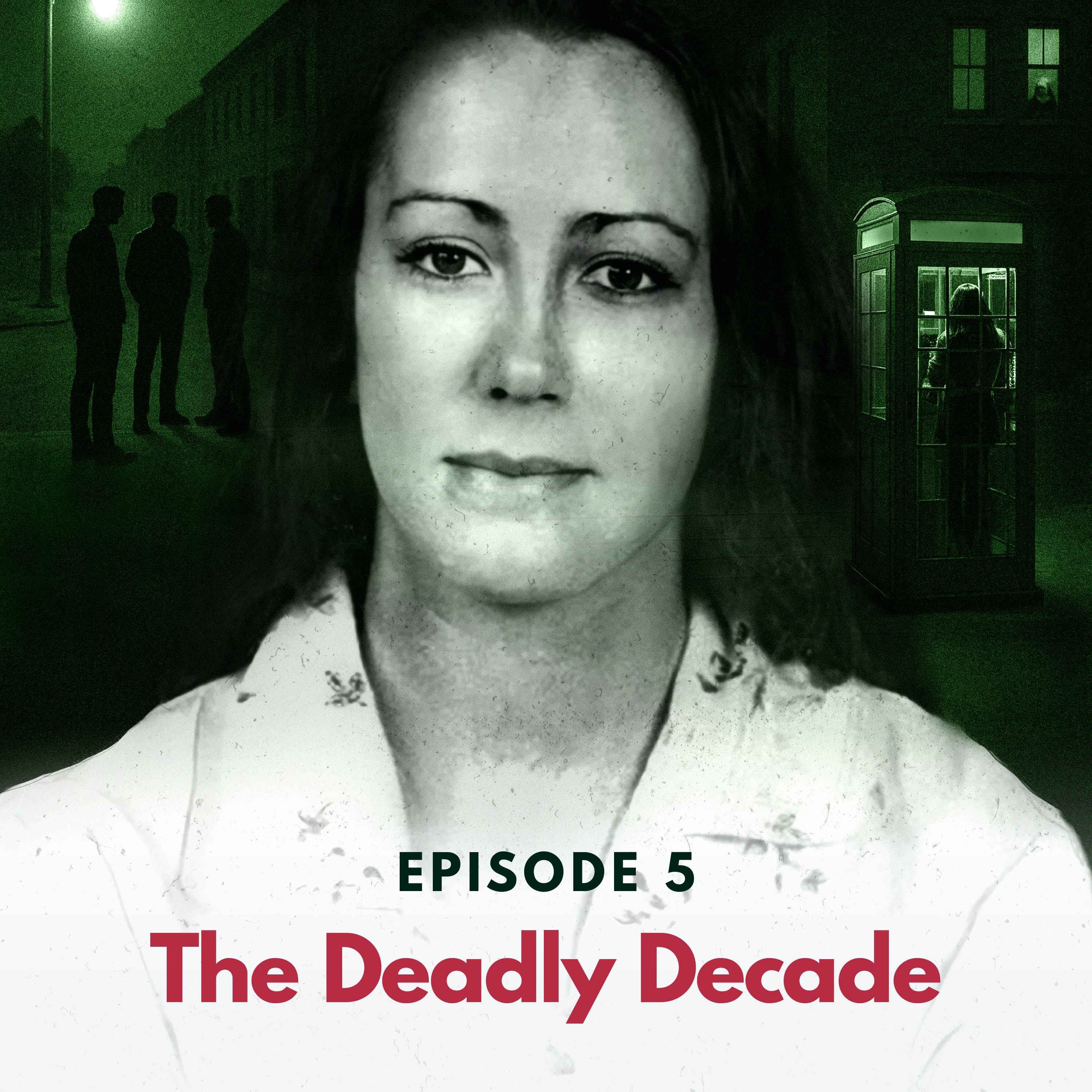
Gendered violence is a disturbing issue in Australia. According to an extensive report by the ABC earlier this year, 69 women were allegedly murdered by men in 2024, 23 of them fatally stabbed. The advocacy group Destroy the Joint puts that total even higher at 78. It's a reality so grim that Prime Minister Anthony Albanese declared Australia faced a national crisis of violence against women, with one woman being killed every four days. Now it's clear that most of the killers are well known to their victims and so can be quickly identified and charged. Yet this wasn't the case through a particularly violent decade for women in Victoria. From the time Julie Garcia soleil vanished in 1975 until 1985, something was terribly wrong. Like Julie, at least 19 other women were murdered and their killers have never been caught. I'm Helen Thomas and this is episode five of Julie's Gone A Deadly Decade. There are 20 cold cases that we know about, including Julie's from an inconsistent and often difficult to access public record. That statistic would no doubt be higher if we knew how many first nations women had been killed in this time frame. Ironically, the United Nations Decade of Women, a man has been charged in one of these matters. The double homicide of Susan Bartlett and Suzanne Armstrong in their Easy street home in Collingwood back in 1977. But decades later, the other cases remain cold, though some have at least been well documented. The so called Tainong Frankston murders, for instance, when four women and two teenagers were murdered between 1980 and 1981. Their bodies dumped in and around Tainong on the edge of the Mornington Peninsula. And the fatal stabbing of Maria James in her thornbury Bookshop in 1980. But little has ever been reported about Mary Ann Fagan, who was knifed to death in her Armidale home 13 months after the brutal Easy street killings. Or her ruler, Kipperodoo, who died in an elevator in her Richmond Housing Commission Block in 1981, choking on her own blood after being raped. Or Jenny Rose Ng, fatally stabbed in her flat on the same Housing Commission estate a year later. That same year, 1982, Gina Rosato's body was dumped 25 kilometres away from the restaurant she worked at in Fitzroy. Former federal independent MP Phil Cleary has been researching this violence since 1987, when his sister Vicki was fatally stabbed by Peter Keogh, who's now officially a person of interest in the Maria James murder.
- [04:08]
Phil Cleary
I would say the way the police investigated the killings of women were flawed, intrinsically flawed. The police force was dominated by men. It was not dominated by feminist thinking. There were no feminist threads. Feminism was on the march in the late 60s and 70s. At that time, women were asserting their independence in new ways. Ironically, women were putting themselves at risk more often than before because there was a world that was contemptuous of them, an underbelly of men who were contemptuous of their claim to equality and independence.
- [04:54]
Helen Thomas
Again, not much has been reported about most of these women's deaths, let alone the possible links between them.
- [05:01]
Phil Cleary
It's a systemic failure that's a product of a poor understanding of the nature of violence against women. Where does the violence come from? I mean, who are the woman killers? Helen, have we ever seen a report by government based on solid research to tell us who are the killers? We don't research them, so we shouldn't be surprised that there was a systemic problem in the way we examined crimes, understanding what kind of person might commit this crime. When Maria James was murdered in 1980, Peter Keogh was living in the area, had a shocking history of violence against women. No one thought to investigate as to his whereabouts on the day until they received a phone call two months later. When they got the phone call from his former parole officer, they didn't even take an official statement from him or his alibi. And the coroner criticised that. And you asked the question, why were the links not made? I think we didn't have a police force that was properly educated around this. Maybe it was a newer version of gendered violence, but again, we don't have the facts at all.
- [06:22]
Helen Thomas
Brian Williams, author of Somebody Knows Something, a book focused on the six so called Tainong Frankston murders in the early 80s, believes there's at least one potential link between those six murders and an earlier case.
- [06:35]
Acast Host
Certainly detectives at that time had articulated the idea that a Murder had occurred in 1975. Margaret Elliot, a woman who was kidnapped outside of Box Hill Hospital one night and found the next day in a nearby creek. Possibly we're looking at seven murders, but certainly six have been classified as the Tynon Frankston murders. It cuts across a couple of geographic areas. There.
- [06:59]
Helen Thomas
The bodies of Alison Rook, Bertha Miller, Catherine Hedlund, Anne Marie Sargent, Nara Mull Stevenson and Joy Summers were found in scrubland southeast of Melbourne. And for a time detectives believed they had identified their killer. Brian Williams refers to him as Person A who told police he often picked up women waiting for public transport in the region.
- [07:22]
Acast Host
He seemed to be the main suspect that the police honed in on. He was never really charged with anything at all in relation to these murders and denied them to the Davey's death. There were other suspects as well. It's now well over 40 years and no one has ever been charged with anything in relation to these cases at all.
- [07:42]
Helen Thomas
The true crime researcher is frustrated by investigators initial attitude about these murders, especially in relation to the teenage girls during that investigation.
- [07:51]
Acast Host
And it's not to be hypercritical, but there was enormous emphasis on what the victims were doing at the time. There was a preoccupation with the two teenage victims that they may have been hitchhiking. What I would say is teenagers hitchhiked all the time in those days. None of the victims were doing anything other than just innocently living through their lives at that time. They were just going about their daily life doing what they would normally do.
- [08:18]
Helen Thomas
So they weren't asking for it?
- [08:20]
Acast Host
No, that's probably what I was trying to say.
- [08:23]
Helen Thomas
That's the old phrase, isn't it? They were asking for it, weren't authors.
- [08:26]
Acast Host
Of their own misfortune, if that makes sense.
- [08:29]
Helen Thomas
Now there are some striking similarities about some of these cases. Eight of the women were fatally stabbed, four in their homes as young children slept nearby. Were these connections followed up? A couple of detectives certainly made brief comments almost in passing about how the brutal crime scene at Easy street reminded them of Julie Garcia Soleil's apartment 13 months later. What they found at Mary Ann Fagan's home brought Easy street back into focus, as did the vicious knifing of Naned Ellis and her laundry seven years later. But in the end, these cases were added to a list of ostensibly untraceable frenzied knife attacks in Melbourne in this era. On this terrible decade long register too are two women and a two year old girl who just disappeared. As we know, Julie Garcia Soleil in 75 and in 1980, 43 year old Louise Faulkner last spotted getting into a car on a St Kilda street with her young daughter Charmian. Yet as we mentioned, half a century after Julie vanished, only one case seems closer to being solved. In a dramatic sequence of events in 2024, Perry Karumbalis was arrested in Italy, extradited to Australia and charged with the murders of Suzanne Armstrong and Susan Bartlett in Easy street in 1977. In an upcoming committal hearing, the court will determine whether there's enough evidence to go to trial. But what happened to Julie on that winter's night 18 months earlier still remains unclear.
- [10:04]
Jude McCulloch
I was quite surprised at the number of unsolved homicides and I think it would be rare today to have that many unsolved homicides, especially seeing as some of them, well, most of them actually don't seem particularly sophisticated. They, they're quite brutal, but not really sophisticated. But then looking back at that decade, 1975 to 1985, when you think about the attitude to violence against women, when you think about what was happening in the Victoria police force then, I'm a little less surprised.
- [10:44]
Helen Thomas
Senior criminologist Jude McCulloch, emeritus professor and inaugural Director of Monash University's Gender and and Family Violence Prevention Centre, has had great practical experience within this legal arena.
- [10:57]
Jude McCulloch
I did work in community legal centres in the 1980s and it was definitely a time where it was a very unhappy road for women to report sexual assaults. For example, they'd often find the attitudes of the police were very shaming, disbelieving and ultimately felt like that they were being treated like criminals. So that extended to all sorts of violent crimes against women. There was very little accountability for police, police investigated police and inevitably there was found to be no substance to any complaints. So in terms of an investigation, for example, of a homicide, that was a poor investigation, there was no one really to oversight that or to complain to. And some of these, or many of these women would not have strong advocates in their favour. They weren't high profile, their families weren't necessarily around, they weren't prominent members of society.
- [12:05]
Helen Thomas
And the end result of this combination.
- [12:07]
Jude McCulloch
Of factors, if the police aren't investigating competently or aren't engaged dutifully in the investigation of a crime, like a vicious, brutal murder of a woman, it's very likely, in my opinion, that who's ever done those murders is likely to murder again, because those things generally aren't one off. Men who use violence against women tend to, whether it's an intimate partner relationship or whether they're strangers, they tend to be repeats. It's not always reported, it's not always known. But if you look into the background carefully, you'll see that there's the repeat violence. When it escalates to lethal violence and there's no consequences, why wouldn't it be repeated? Why wouldn't that result in not only more murders, but when they're for a whole decade, it may be certainly some of the cases you've looked at in detail, they seem to be very defective investigations. Why wouldn't those men go on and kill again?
- [13:16]
Helen Thomas
Margaret Elliott went missing after visiting her friend who'd just given birth at Box Hill Hospital. A day later, the 26 year old's body was found by a boy searching for his footy. She'd been dumped in a creek behind an old pavilion, beaten so badly it couldn't be established if she'd been sexually assaulted. Just as confronting was 12 year old Denise McGregor's abduction, rape and murder. Early one evening in 1978, as she walked home from a local milk bar in Pasco Vale. At the time, the pathologist likened her injuries to those suffered by plane crash victims. Elaine Jones was murdered while holidaying with her family just over the border in New South Wales early in 1982. The Melbourne woman failed to return after walking to a nearby store to get chocolates and cigarettes. The next morning, her husband and seven year old daughter took a dinghy onto the Murray and found her body in the river. Infamous murderer and rapist, Mr. Stinky was considered a suspect in this matter, but again, no charges laid. So what should we make of investigators failure to solve these killings? Should we accept their limited tools of detection? At the time, fingerprinting and blood typing essentially just weren't enough to do the job required without CCTV, DNA testing, GPS tracking or mobile phones. Jude McCulloch isn't so sure.
- [14:40]
Jude McCulloch
I think we'd be very shocked today to have this many unsolved homicides, especially as many of them or all of them appear so brutal. So I think it's partially true. But I also think, having looked closely at the evidence of the investigation around Easy street, that there do appear to have been things overlooked. And I feel confident that the homicide squad would have been very distracted given the conviction of two senior members of the Homicide Squad in the early 1970s and the beach inquiry that focused on the homicide squad. And from what I know, which is mainly from reading your book, Helen, I must say, about Easy street, it does seem like some basic investigative procedures were not followed through. Like for example, it's true there weren't mobile phones, true. There weren't CCTV cameras, it's true there wasn't advanced DNA at that stage, but there were still eyewitnesses, there were still neighbours, there were still people who knew things that the police didn't talk to or if they spoke to once they didn't go back to. It didn't seem like they were coordinating effectively, even on a basic level.
- [16:03]
Helen Thomas
Thank you for listening. We'll be back after a short break. Surely detectives working these cases were better than this? More dedicated, professionally astute true crime author Brian Williams.
- [16:20]
Acast Host
The police force at the time, we're talking, obviously, homicide squad, but were completely overwhelmed. You could actually hear the words coming out in the press statements and you could hear that in the statements they presented in, you know, inquests and things, that they were pretty exasperated in terms of where to go. All of these cases were initially considered missing person cases. The Tainong Frankston ones certainly were. The two teenagers who were involved in the Tainong murders, they were considered to be teenage runaways for a lot of the investigation. It was only when their bodies were found that, if you like, it was a case of reverse engineering from that point on and going back to try to find out what had happened. The other thing, of course, is that we have to remember that the police were relying on what we now call probably old fashioned policing methods. Even at that time, 1980, some of the technology that we now take for granted and that's used very extensively in investigations, wasn't available. So the detectives had this method where all they could really do is wait for leads from the public and then follow up. Each lead ended up being a slog in each case. Now, of course, what that does is it means they end up having lots and lots of suspects. They have to check out lots and lots of facts, lots of, lots of alibis, lots of people can't remember things. It puts them at a disadvantage in relation to that. But the fact there were so many cases on the books at that time made it even more stressful and even more difficult.
- [17:56]
Jude McCulloch
The other thing that was happening, which was long standing in the Victoria police force and something beach spoke about was he called it a brotherhood and us and their mentality. And people often talk about the brotherhood in relation to police corruption, how they all stick together, but the word I want to focus on is the brotherhood. There was no one in the homicide squad who was female until the early 90s, so it would have been a bastion of male ideals. And there's Still a lot of violence against women today, far too much. Men kill women all the time. But it's discussed, it's seen as the national crisis. Police spend a lot of their time working on those things. But back in the 70s and 80s, it wasn't talked about to the same extent. Police didn't feel like violence against women was part of their core business. The most common type of violence against women is by intimate partners. Police would see that as just a domestic that really had nothing to do with them.
- [19:00]
Helen Thomas
As we touched on, eight of the women murdered in this decade were fatally stabbed. Four of them, Suzanne Armstrong, Susan Bartlett, Mary Ann Fagan and Jenny Rose Ng, in their own homes, with children in other rooms.
- [19:15]
Jude McCulloch
I think it suggests to me how incredibly important it is and how incredibly tragic it is when the police don't do a proper investigation, as in 1977 around Easy street, they appeared to miss so many leads. So here we are speculating about three other cases that seem similar. And as I said before, a man who targets women and, and uses lethal violence is likely to do it again. So all we can do is speculate, which is the tragedy of it, because perhaps in some cases you can't solve a murder and it's not anybody's fault. But you'd have to say not every stone was turned over. In fact, there was a whole lot that weren't looked at at all. And so you certainly can't rule out that these were by the same person. I was involved in a project more recently where we looked at 10 years of homicides around Australia, and about 25% of them, a woman was killed and there was a child in the home. So it's not uncommon for men to kill women with children in the house.
- [20:31]
Helen Thomas
It's not uncommon for men to kill women with children in the house. That's an unsettling statement to say the least. But this distinguished criminologist has the data to back it up.
- [20:45]
Researcher / Academic (Monash University)
So we did some research at Monash University, myself and colleagues, and we looked at 10 years of sentencing judgment in the case of intimate partner homicide, where a male intimate partner or former intimate partner had killed his partner or former female partner. And we looked at a time period of 2006 to 2017, so 10 years. We looked at all the sentencing judgments around Australia, Bar Queensland, because we couldn't get them, and looked at the circumstances of the killing, who the victim was.
- [21:22]
Jude McCulloch
Who the killer was.
- [21:23]
Researcher / Academic (Monash University)
And we found that it wasn't uncommon for children to be present when the homicide occurred. And in fact, there were 23% of the cases where the sentencing judgment mentioned that the children were present. Sometimes they were in the same room, but they were in the same location, house, when the homicide occurred.
- [21:48]
Helen Thomas
That's a stunning statistic.
- [21:51]
Researcher / Academic (Monash University)
Yeah, one in four. And so this is particularly about intimate partner homicides. Not all of them took place in the home, but many did. But 23% of them, the children, either witnessed it or were present in the vicinity when the homicide occurred. So the statistics might be slightly different when the killer's unknown cause. I would say that that's more likely to happen in a public place, but not all the time, as you know from the homicides that you've investigated and are looking at closely. Often women are killed in their own home, even if it's by a person unknown.
- [22:31]
Helen Thomas
And as we know, the numbers of women being murdered in Australia aren't decreasing.
- [22:37]
Researcher / Academic (Monash University)
Back in the 80s, for example, there was no sense that violent crimes against women, and in particular homicides, were seen as really a pattern or very rarely seen as a pattern. But they were more likely to be seen as individual events, particularly intimate partner homicides. But just violence against women was taken a lot less seriously. So there wasn't accounting that there is now. But we can see with the counting, contemporary counting, it's going up year by year. And exactly why that's happening, I think it's a really important question, but I don't know the answer.
- [23:12]
Helen Thomas
Finding even basic information about these historic cases can be difficult, as Phil Cleary learnt.
- [23:19]
Phil Cleary
Let's just explain how difficult it is, Helen. There is no index on women murdered by an ex partner or a bloke. There's no specific category in at the public records office. They could be suicide, they could be just a death, whether the coroner's involved. So it's very hard to actually assemble a list of murders. It's very difficult. If you go back to the 60s, 70s, you have to be looking at newspapers. So let's go to the official records, Supreme Court records. I made a request for Supreme Court records so I could read the sentencing remarks of judges to better understand how they conceptualise crimes against women. And you know, what happened, Helen, I. I couldn't see them. It was too difficult, too complex, too hard to unearth them, you know, too bizarre for words. There was me trying to academically research the murder of women and there were a million obstacles put in front of me. So how could I go and specifically identify Indigenous first nations women? Nearly impossible. You'd have to just fall across it by accident.
- [24:29]
Researcher / Academic (Monash University)
One of the reasons why it's more difficult to get information in that area is one first nations women are less likely to report because of the history of being under serviced as victims and overserviced as potential offenders. The poor relationship between police and indigenous people generally because of the history, ongoing history of colonisation. Also second to that is that if disappearances or violence is reported, it's less likely, in my opinion, to be taken seriously. And I think that's well demonstrated. It's not given the same investigative resources or attention that the killing of non indigenous, non first nations people would be given. So that makes it much harder.
- [25:22]
Phil Cleary
Seriously, Helen, I've railed around this question for more than 30 years, haven't I? Since my sister's murder. The state's failure to advise, inform and comfort the families of murdered women is appalling. It's time governments did a proper examination of the murder of women historically and that includes the women you're looking at because that will better inform the way they examine preventative measures today. And educating men around the violence that has stalked women in historically. It is so necessary governments should be doing it.
- [26:05]
Helen Thomas
Gathering this information about women's murders so many years later is one problem, but following leads or failing to lies at the core of this desolate decade. Brian Williams suggests that as so many years pass, it becomes harder to find new details to track as too many changes are taking place around us.
- [26:26]
Acast Host
I've always believed that there's a window of time when things can be solved and probably by the time you reach the 40 year mark, you're starting to push that window out a bit because potential witnesses may have died. The world changes, you know, like buildings demolished freeways are built over the top of old building sites. The geography changes, if you like, you know, the buildings around it change. And I guess the urgency of it and the tragedy of it is that if it goes much longer than that, if it starts to hit, you know, the 50 year mark, whether we like it or not, it's probably moving now into almost an unsolvable situation because there's nobody left who can really provide the right information.
- [27:10]
Helen Thomas
But Phil Cleary refuses to be overwhelmed by the passage of time.
- [27:15]
Phil Cleary
We need to explore these killings to better understand the historical context of violence against women and the failures of the past. It puts violence against women in a historical context. It takes us to the heart of the violence if we can identify the man. But even if we can't, it still puts gendered violence front and center in the public consciousness and forces us to try to understand why men hurt and kill women. And also at the personal level, families are entitled to get some understanding of what had happened to their girl, their mother, their sister, their niece. As I speak to you, Helen, I think this is a dark part of Australian history. It needs to be properly explored. Let's just say there should be a study of the past 50 years of violence against women.
- [28:08]
Jude McCulloch
I used to teach in Miscarriages of Justice in criminology, and I thought about it in terms of wrongful convictions. And one of my students asked me, what about when people aren't convicted and they should have been, and I thought they were right. And it is right. So these cases, where cases are not solved, and potentially that's because there's been a failure of duty of care, there's been lack of professionalism, lack of focus, lack of concern. That's also a miscarriage of justice.
- [28:44]
Helen Thomas
Julie Garcia Soleil's murder must be one such case.
- [28:48]
Researcher / Academic (Monash University)
The case is now 50 years old, but the milestone in the investigation of the Easy street killings, which happened two years afterwards, indicates that it's possible to. To make progress. It could or should spur renewed vigour in relation to that investigation especially, there's still living relatives, and her body, as you point out, has never been found, which is a terrible hardship.
- [29:16]
Jude McCulloch
So it's important to keep Julie in.
- [29:19]
Researcher / Academic (Monash University)
The public domain and to continue to push for attention.
- [29:28]
Helen Thomas
Next time on Casefile Presents. Julie's gone.
- [29:32]
Jude McCulloch
The blood in the telephone booth, the stairwell, and the tea towel were from three different people.
- [29:39]
Helen Thomas
She was a bit of an innocent, I think.
- [29:42]
Acast Host
And.
- [29:43]
Jude McCulloch
And very trusty. Semen was located on the crotch area of the panties as well, which under modern circumstances would be considered a crucial discovery.
- [30:00]
Acast Host
ACAST powers the world's best podcasts.
- [30:03]
Jude McCulloch
Here's the show that we Recommend.
- [30:07]
Podcast Trailer Narrator
Galactic year 6967. 420-428-0085. The war for the spark rages on. Yet one last hope remains. Four ancient warriors are about to take to the stars and take the galaxy by storm.
- [30:26]
Phil Cleary
Hey, so here's what you're gonna do. You're gonna go to HTTPs they added that colon. Yeah. Gotta check on that.
- [30:34]
Acast Host
God, no. Don't we all.
- [30:35]
Phil Cleary
I wish I were dead.
- [30:37]
Acast Host
So do I.
- [30:40]
Podcast Trailer Narrator
Dungeons and Daddies Presents Grandpas and Galaxies. An improvised actual play Senior star citizen space Opera adventure. Coming February 10th to our solar system.
- [30:53]
Acast Host
Acast helps creators launch, grow and monetize their podcasts everywhere. Acast.
- [31:00]
Jude McCulloch
Com.