Loading summary
Transcript47 lines
- [00:00]
Advertiser 1
Ready to level up your everyday Quince makes premium essentials without the premium price tag. From quality clothing and stylish accessories to travel staples and high end home goods, Quince has it all. And by partnering directly with top artisans and ethical factories, Quince delivers high quality at half the cost of similar brands. Shop elevated essentials without the markup at quints. Go to quint.com LevelUp for free shipping and 365 day returns. Quince.com LevelUp Summer's here and you can now get almost any anything you need delivered with Uber Eats. What do we mean by almost? You can't get a well groomed lawn delivered, but you can get chicken Parmesan delivered. Sunshine?
- [00:39]
Advertiser 2
No?
- [00:39]
Advertiser 1
Some wine? Yes, get almost almost anything delivered with Uber Eats. Order now. Alcohol in select markets. See app for details.
- [00:59]
Helen Thomas
It'S almost impossible to comprehend how hard it's been for Julie Garcia Soleil family since she vanished that night in Melbourne way back in 1975. Bad enough that for more than 40 years they had to struggle with knowing she'd vanished with no explanation about what had happened, no narrative to cling to. Then, almost 50 years later, they were forced to face what was missed by detectives in those crucial first few days after she disappeared. As we know, her sister Gayle tried to believe that for some reason, Julie had just stepped away or been forced to live and work somewhere in Australia, alone but alive. Her mother too, asked police repeatedly whether Julie could have been taken into so called white slavery, a term for international sex trafficking that was in the news at the time. They were both trying to make sense of a terrible truth. The unimaginable had become real. Julie was lost to them. Five decades later, Ruth has come to terms with that reality. Yet she still yearns to bring Julie home to bury her finally back in California.
- [02:12]
Ruth Garcia Soleil
I want the police never to close the case. Never. It's like you and I have talked about this, Helen. I don't want this case to be closed.
- [02:28]
Helen Thomas
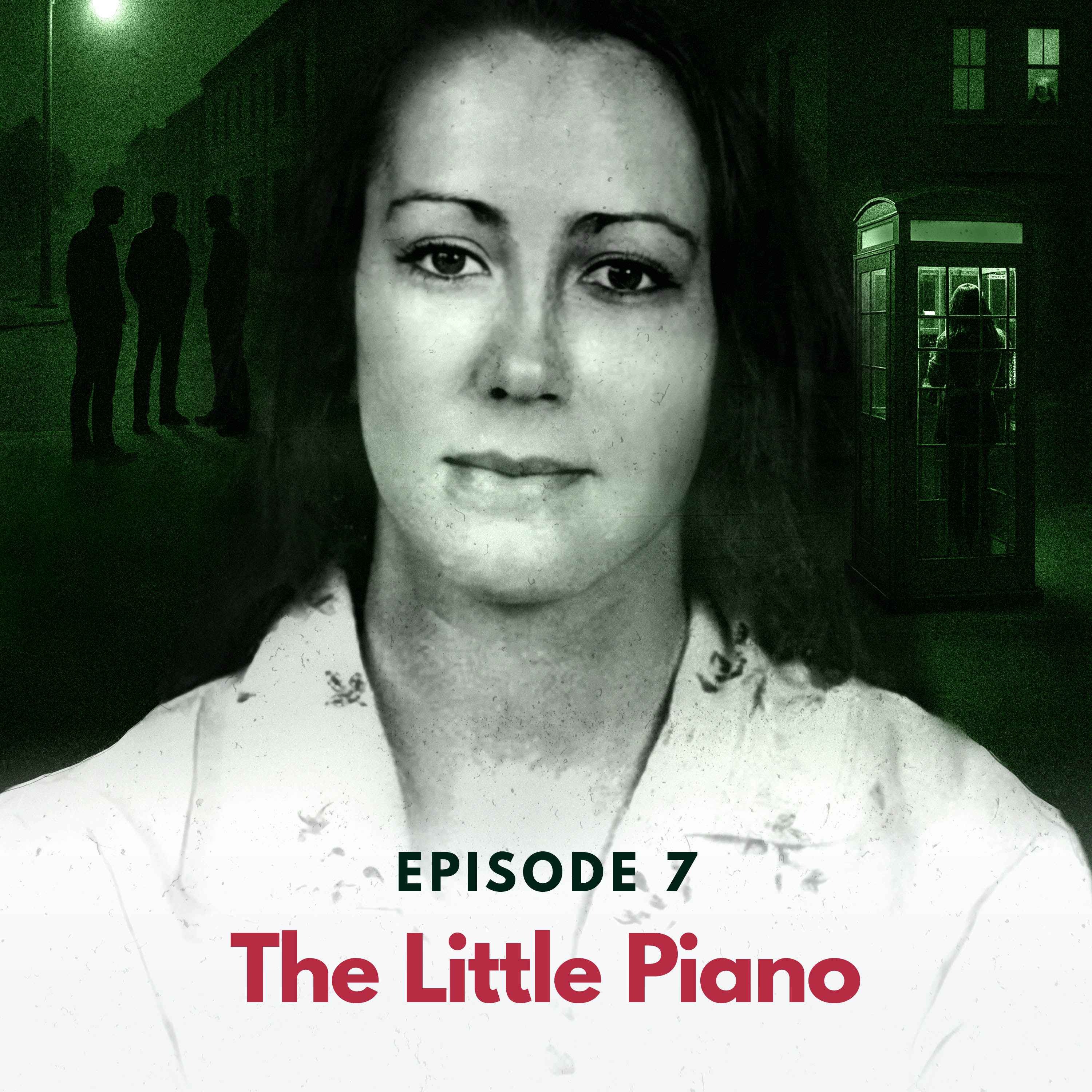
And in the dead file, I'm Helen Thomas and this is the final episode of Julie's Gone the Little Piano. As hard as it's been for Ruth to accept what happened to her daughter half a century ago, she's well aware that finding her body becomes less likely as the years pass. So she was deeply touched when, after a short service that she took part in via Zoom, a plaque was placed on the grounds of a small Lutheran chapel in Melbourne late last year commemorating Julie's life. Pastor James Winderlich conducted the ceremony at St. John's Southgate on the edge of the city.
- [03:13]
Pastor James Winderlich
For me, it's tied up with the whole idea of human dignity, that human beings. We go through various stages of life, and one of the stages, one of the most important and critical parts of our lives is the end of our life. And for those people around about those who have died, it's really important to acknowledge the presence of that person, who that person was, and to provide them with a dignified and fitting end to this part of their life anyway. So for me, it was a privilege to be able to participate in that. For Julie and for her mother, Ruth, I believed that Ruth should have complete control and custody of what we were doing. It wasn't something that we were going to impose on her. It was something that she needed to be guiding herself because of her relationship with her daughter and the care that she continued to show her daughter even after such a long period of time.
- [04:00]
Helen Thomas
Ruth chose the inscription for the plaque, and it reads, and God said, I have heard your prayers. I have seen your tears, and I will heal you. And he did.
- [04:12]
Pastor James Winderlich
I think the most profound experience for me was Ruth's voice. Julie's mum was able to speak and to speak into the space of that memorial that we held, and she had full control of what was going on. And for me, that was the most powerful thing. Everything else we did around that event, well, that was okay. But for me, the most important thing was Ruth's voice. She was able to speak of her loss. She was able to speak about her daughter and tell us in her own way and on her own terms, who her daughter still is and remains for her. And she was able to, in some way, give her daughter a farewell.
- [04:48]
Helen Thomas
Pastor James also planted a young Japanese maple tree in the chapel's private garden and says visitors have already come to pay their respects to the young American.
- [04:58]
Pastor James Winderlich
Well, somewhat to my surprise, our community at St. John's have really owned it, and they're quite proud of the fact that Julie's plaque is here. But then I've also been further surprised that out of the blue, people have come and knocked on the door and they've said, we've heard about this. We'd like to go and see the plaque and spend time with the plaque. People completely unknown to me have turned up and simply want to spend time in the garden with the plaque in their own contemplation and dealing with things in their own way.
- [05:23]
Helen Thomas
That's amazing, isn't it, really, when you think about it? Because, you know, it's often said that certainly when Julie disappeared, there wasn't a missing persons unit or squad anywhere in Australia, probably anywhere in the world. Now there is. And yet so many of these young people, old people, whoever go missing, are just forgotten by the. Well, you get the sense that they're forgotten by the wider community. And yet from what you say, perhaps more should be made to give people a chance to remember them?
- [05:51]
Pastor James Winderlich
I think so. I think those memorials are very important because when a person goes missing in this particular way, it's not a police concern and it's not just a legal concern, but those issues become foregrounded in the whole process. But this person is lost to a community, it's lost to a very wide community, and I think that somehow needs to be acknowledged as well.
- [06:14]
Helen Thomas
Lauren o', Keefe, founder and CEO of Australia's Missed Foundation, a charity supporting families of long term missing people, was in the US last October and was with Ruth at her home for the Service.
- [06:27]
Advertiser 2
For almost 50 years, Ruth has felt relatively forgotten by the Australian community, the police and everyone else. So for her to realise that despite the passage of time, there are still numerous people, yourself, Pastor James, our organisation, people that attended the service on that day, that means more than we can ever possibly express to someone in Ruth's position. So she was thrilled. It was incredibly moving for her to have the opportunity to honour Julie's memory in that way and to know that both, you know, Julie wasn't forgotten, but that Ruth wasn't forgotten. People still care. So, yeah, for Ruth it was very important and I think the idea that these relative strangers had coordinated this for her and for Julie and accommodated her, Pastor James livestreamed it so that she could watch it and that I was able to be there in person next to her. She was holding the order of service that we'd designed and printed for her. She got to see these tangible pictures of the plaque and she was involved. And that again, in itself is incredibly important to someone in her position.
- [07:43]
Helen Thomas
Like most who've come to know Ruth Garcia Soleil and have dealt with her in relation to Julie's case over the decades, Resolute is perhaps a perfect description of the woman she is.
- [07:54]
Advertiser 2
She's very strong. I only knew of her through you and I could tell that she was a sassy character. But meeting her in person and knowing that, you know, she's physically, she's got some challenges at the moment, but she was really very aware of everything that was going on. She wanted to talk about the details of the times, the two or three times that she'd come to Melbourne back in the 70s, dealing with the police, dealing with the media, those experiences were still very sharp in her mind and those associated emotions were still very raw for her, which is not surprising. So it was, yeah, a real privilege to be able to experience that with her.
- [08:32]
Helen Thomas
Last July, on what would have been Julie's 69th birthday, one of the most senior detectives in Homicide and Missing Persons rang Ruth to reassure her that that her daughter's case was still open and active, that new interviews had been and would continue to be conducted. After so long, not hearing anything from anyone within the Victorian police force, his call was reassuring and gave Ruth a glimmer of hope that she might be able to lay Julie to rest. At 93, she's well aware that time is not on her side. The detective also told her that he planned to talk to John Grant again. As we know, Grant is the only one of the three men who visited Julie on that first night in July 1975 who's still alive. Casefile presents can report that this did happen. The senior detective spoke to him last year. But, quote, as a result of this discussion, the investigation is not able to be taken any further at this time, unquote. Again, no one has ever been charged with any crime in relation to Julie's disappearance. So what else can be done? How long does investigation in a case like this continue? In one of the answers to a list of questions I submitted in writing to Homicide via the Police Media Office, it seems this is at the discretion of the Coroner. The Coroner has within their remit time frames of 50 years where a matter is deemed to be forensically relevant, and a further discretion for relevance for matters between 50 to 100 years. Outside of 100 years, the coroner determines matters are no longer of forensic relevance in criminal investigations. The limit is not as clearly defined, but will depend upon the availability of any person charged with respect to the matter and any witnesses to appear at a trial, and the availability of exhibits and other evidence to tender at any trial. I also asked if Julius was one of the oldest active cases on their books. The answer we have active cases from 1960 to 2024. Julie's disappearance is approaching the first threshold for forensic relevance set by the coroner. However, we have other investigations that currently sit in the discretionary period that are active investigations. I wondered, too, about the impact these cases had on detectives, professionally and personally, and the response was that it was fair to say that investigators carry a part of each case with them, regardless of outcome. Compassion for the families makes us vulnerable to transfer of grief. We're well supported. But each case leaves a mark. The effect on our people is palpable but insignificant when weighed against the ongoing and all consuming effect on the families that they deal with. It gives us comfort if we can provide some answers where there were none before, even if the ultimate question remains open. And what about others touched by Julie's disappearance, those we don't often think about in this prism, for instance, the families of the men who visited her the night she vanished. One of John Power's grandchildren contacted me out of the blue last year after reading Murder on Easy street and realising there were questions she felt she needed to ask about her late grandfather. She says she loved him with all her heart, yet still wants to find out the truth about what happened to Julie Garcia Soleil, to help if she can. But in the end she decided she didn't want the interview we'd conducted to be made public, which wasn't really surprising. So what can happen next? Could a second coroner's inquest help move an old case like Julie's forward criminologist, Jude McCulloch?
- [12:29]
Jude McCulloch
I'm actually not sure what's required, but it seems like most of them seem to come about with public exposure. Like, I'm thinking of Maria James. Interesting things did come out of that. It appeared like Peter Keogh, who was a violent man with a violent history, who was convicted of murder in 1987, might be a reasonable suspect for that case. So these second inquests can be useful, it seems to me, although it didn't solve that case, but it was, I think, worthwhile because they're important for the people who are left behind, doesn't matter how old they are, for them to be resolved and sometimes getting to things, being back in history when there's been like perhaps a miscarriage of justice, where police haven't done their job, for example, people hold onto that and are not prepared to admit mistakes. But when people get to the end of their careers, towards the end of their life, they might reflect on things in quite a different way and be prepared to be more frank about what's happened and why. And that goes potentially for the people involved in the killings as well.
- [13:42]
Ruth Garcia Soleil
When this happened to me, as time went on and the wars that we've been in, a lot of men are killed in action and their people never find out how they died. That got me to thinking about missing in action. The parents who have to live with this missing in action and so many. It happened too. And now I know what it feels like.
- [14:18]
Helen Thomas
Thank you for listening. We'll be back after a short break.
- [14:24]
Advertiser 3
Ready to elevate your everyday Quince has the luxe staples insiders swear by, minus the markup. From 100% European linen styles and 14 karat gold jewelry to gorgeous leather bags and elevated home finds, Quint has it all. And by partnering directly with top artisans and ethical factories, Quints delivers premium quality at half the cost of similar brands. Discover everyday luxury without the markup at quints. Go to quince.com styleupgrade for free shipping and 365 day returns. Quince.com styleupgrade Summer's here and you can.
- [15:00]
Advertiser 1
Now get almost anything you need delivered with Uber Eats. What do we mean by almost? You can't get a well groomed lawn delivered, but you can get chicken parmesan delivered. Sunshine?
- [15:08]
Advertiser 2
No?
- [15:09]
Advertiser 1
Some wine? Yes, get almost almost anything delivered with Uber Eats. Order now. Alcohol in select markets. See app for details.
- [15:18]
Helen Thomas
As traumatic as having someone missing in action must be, there's at least a certain honour attached to such status. Fifty years ago, just being missing didn't have the same significance, nor was what their families went through understood. Now there's a phrase that helps describe it. Ambiguous loss. Lauren O' Keefe says it was coined in the late 1990s by an American professor, Dr. Pauline Boss.
- [15:45]
Advertiser 2
You know, I only myself heard it maybe five, six years ago in that chaotic first few, whether it be days, weeks or months, you feel like surely resolution is just around the corner. And 90% of missing persons cases in Australia are resolved very quickly. Usually, you know, they're found safe and well organically, even without police intervention. So 90%, 90% within the first month and overall it's around the 98%. But there is that 1 to 2% of cases that are criminal in Australia. And of course you don't always know straight out that that's the case. But for those, the police response has to be immediate, otherwise you can find yourself almost 50 years down the track, still without resolution.
- [16:31]
Helen Thomas
Lauren has a deeply personal understanding of this trauma. Her brother was missing for five years before his body was finally found. As agonising as that must have been, she and her family were spared the Garcia Soleils ordeal of not being told that the Victorian coroner was looking into Julie's disappearance in 2017.
- [16:52]
Advertiser 2
I think it's unconscionable. But it does happen, sadly. And I would imagine that in these older cases, especially when there's geographical barriers, that it may happen more often than outside of that. So it shouldn't happen, of course. But missing persons is one of those really challenging areas where police, if there's no hard evidence or sufficient evidence, there's not a lot more that they can do. And that's really challenging for families to understand because we're raised to believe that, you know, if something goes wrong in life, police are there to fix it for you. And then when you realize that's not actually the case, or as simple as that sounds, it's really distressing and it's really disheartening. And then to have to endure that sort of continual disillusionment for decades must wear you down.
- [17:45]
Helen Thomas
So if 150 people go missing in Australia every day now, how many were disappearing back in 1975? As we've heard, there's no reliable public record to check, and even Lauren o' Keefe can't be sure.
- [17:59]
Advertiser 2
I wouldn't know back then, but as far as just in the last, you know, three years, it's grown by more than 35%. And there are lots of factors to that. Of course, you know, reporting is different now, and people do expect that this is all just lumped with police, but they simply do not have the resources. It has to be shared across every level of government, the media, the corporate sector, the emergency services and the community. Sadly, I think early days, the assumption and the reality, actually, as someone with lived experience, you hope that they will just come home safe and well and life will go back to normal. And then as months turn into years and then perhaps decades, you just hope that one day you're going to have resolutions so that you can die at peace and that the burden isn't passed down through, through the next generations of your family. Because the not knowing, it's not a natural part of life to not know. Human beings aren't great with uncertainty in any sort of context, but this is a very special type of torment.
- [18:58]
Helen Thomas
But there are ways of coping. And Ruth Garcia Soleil has found a unique one.
- [19:04]
Ruth Garcia Soleil
One Christmas I bought. I don't know if they still sell them, but. But they were like little grand piano. It was just a toy. And I bought that for the girls for Christmas and the other two just sort of clinked on it for a while. But Julie, she started to play on that little piano, trying to get little tunes that she could recognize. And I kept thinking, I've got to get her into piano lessons. I think this child is going to be a good pianist. And so that's how it began. And so by the age of six or seven, I had found a very good teacher, Mrs. Dawson. And Julie was with her for years and, of course, many recitals, which taught Julie good posture and presenting herself to the public with a nice dress or outfit. And it was just so wonderful to go, as she was growing up, to the different recitals, not just listening to her at the recitals, but at home all the time, playing at the piano.
- [20:33]
Helen Thomas
Julie became a talented pianist, and her love of playing has led to an annual scholarship being set up by her mother at Cal Poly Humboldt, a university not far from her home in Northern California. Ruth has lived there among the redwoods, the ash, the pines and wildflowers for 30 years now and says being there has helped her heal a great deal. What also fortifies her is being involved in choosing the winner of the Julie Garr Cisalay Scholarship, an endowment that grew from community support within the family's hometown of Stockton.
- [21:08]
Ruth Garcia Soleil
The first time I got back to America, I think I did tell you about the husband and wife that started contributions. They put, like, little jars in different stores and that for contributions, because I had to borrow twice to go to Australia. I brought Julie home alive. I'd have the money. If I brought her body back, I'd have the money. And it turned into the scholarship, the money that the people of Stockton contributed.
- [21:48]
Helen Thomas
The piano scholarship in Julie's name has been going for 21 years. And Ruth asks just one thing of each student who receives it.
- [21:57]
Ruth Garcia Soleil
Oh, this scholarship is magnificent. In my life, I was the first person to start a piano scholarship at Humboldt State University, and it's only for piano, nothing else. And it's been the most rewarding thing in the world. So many. So many young, wonderful kids. And the only thing I ask is that each student, every year, a fresh student, write me a letter. I just need to see on paper why they love the piano.
- [22:47]
Helen Thomas
Daniela Miniver, professor of music and director of the keyboard division, says the students are genuinely thrilled to respond to Ruth's request.
- [22:56]
H
Listen, this scholarship has changed life, like, literally, because it has had such a positive impact on every student. Most of the scholarships that we give, they have names, but they are not associated with live donors. And so having Ruth coming to concerts or writing her letters or talking to the students on the phone has been incredibly sweet and, I would say inspirational for the students because she's such a big supporter of music, piano, and the students love writing those letters to her. I mean, seriously, they love writing those letters. Kaylin one was writing a letter, like, nine pages. I said to her, what is Ruth gonna do with nine pages? This is like writing a book. And then we got it down to four. The truth of the matter is this scholarship, it's not a lot of money. It's $1,000 per year. But actually it's enough for the students to buy books or to buy music. $500 per semester can take those students far.
- [24:09]
Helen Thomas
The first recipient of Julie's scholarship is now a professor at Humboldt University. Another is a doctorate student in Texas, while the current holder hails from China. But Daniela Miniver agrees that while the grant is vitally important to her students, it's even more meaningful to Ruth.
- [24:29]
H
All very important, very important. And she guards that scholarship like she guards her life. She supports the students. She used to come to the concert. She listens to their recording. They send her postcards. I told Ruth that Julie is gonna live through those students, you know, through their concerts, through their teaching, just giving to the world, giving back to their community. So in every student who receives Garcia de la Scholarship, Julie is part of it. And the students are gonna take the name for the rest of their lives.
- [25:09]
Ruth Garcia Soleil
When I was able. I can't anymore. But when I was able. They had a master class once a year that a outstanding piano teacher came to the university and one of the students is picked out. And then the master would. As the student is playing, the master is saying, no, it goes this way. But it's a beautiful, beautiful interaction with student and teacher. And to sit there and see this, it's the harmony, the beauty of the tones and the piano. And it's. It's for her. It's for her. Yeah, yeah, she's there with me.
- [26:19]
Helen Thomas
Thanks for listening to Casefile Presents. Julie's gone. It was produced by Bec Petraitis with audio production and original score by Mike Migus and artwork by Paulina Zymanska. As the show's reporter and writer, I'd like to thank everyone who gave their time to be interviewed for this series. And of course, we remember Julie Garcia Soleil and continue to hope she finds justice and peace.
- [26:49]
Advertiser 3
Ready to elevate your everyday. Quint's has the luxe Staples Insider swear by minus the markup. From 100% European linen styles and 14 karat gold jewelry to gorgeous leather bags and elevated home finds, Quince has it all. And by partnering directly with top artisans and ethical factories, Quince delivers premium quality at half the cost of similar brands. Discover everyday luxury without the markup at Quinte's. Go to quince.com styleupgrade for free shipping and 365 day returns. Quince.com style upgrade.
- [27:24]
Advertiser 1
Summer's here and you can now get almost anything you need delivered with Uber Eats. What do we mean by almost? You can't get a well groomed lawn delivered, but you can get chicken Parmesan delivered? Sunshine?
- [27:33]
Advertiser 2
No.
- [27:34]
Advertiser 1
Some wine? Yes. Get almost almost anything delivered with Uber Eats. Order now. Alcohol and select markets. See app for details.