Loading summary
Transcript53 lines
- [00:00]
A
We all prefer things a certain way, like groceries. If you want groceries just how you like them, you gotta try Instacart. They have a new preference picker that lets you pick how ripe or unripe you want your bananas. Shoppers can see your preferences upfront, helping guide their choices. Because when it comes to groceries, the details matter. Instacart get groceries just how you like.
- [00:25]
B
Acast Powers the world's best podcasts. Here's a show that we recommend.
- [00:33]
C
Hey, everybody, I'm Naomi Ekparigan. And I'm Andy Beckerman. We're a real life couple and a real life couple of comedians, and we're the hosts of the podcast Couples Therapy. We're the only comedy relationship podcast ever. Yeah, I said it. And we're so good. We've been written up in both the New York Times and we made Grindr's list of top podcasts. Yes, we're giving you that high, low appeal trust. On the show, we talk to guests like Bob the Drag Queen, Angelica Ross, Bowen Yang, Janelle James, Danny Pudi, Darcy Carden, Paul F. Tompkins, and more. All about love, mental health, and everything in between. And we answer your relationship questions. We are two unlicensed comedians just trying to help you out. So open your hearts, loosen your butts, because we got a lot of laughs and a lot of real talk just for you. Download Couples Therapy wherever you get your podcasts.
- [01:25]
B
ACAST helps creators launch, grow and monetize their podcasts everywhere. Acast.com.
- [01:42]
D
For half a century, Ruth Garcia Soleil really had just one wish. She wanted her daughter Julie to come home. But as decade after decade after decade passed and it became clear Julie had been murdered In Melbourne in 1975, Ruth was forced to reimagine that homecoming. She became determined to lay Julie to rest before she died. That was what mattered now. She'd say she wanted to bury her daughter on home soil even more than she wanted justice for her murder. Neither wish was granted. Several weeks after this podcast was released, Ruth Garcia Soleil passed away in Northern California. Julie's body has never been found. Yet there's still a chance it could be, and her mother's dedication and her DNA could hold the key.
- [02:38]
E
If I'm missing, for example, my mum provides a sample. We would share half of our DNA, so it's a good comparison, so that in future, if my remains are found, then my DNA can be compared to my mum and we should be able to identify me that way. Siblings, on the other hand, although share the same biological parents, may not necessarily inherit the same pieces of DNA from both parents. So some siblings will have a lot of DNA in common and some will have very little.
- [03:10]
D
So in Julie's case, her mum's DNA, Drew's DNA is critical.
- [03:14]
E
Yes, Mother's DNA would be best.
- [03:17]
D
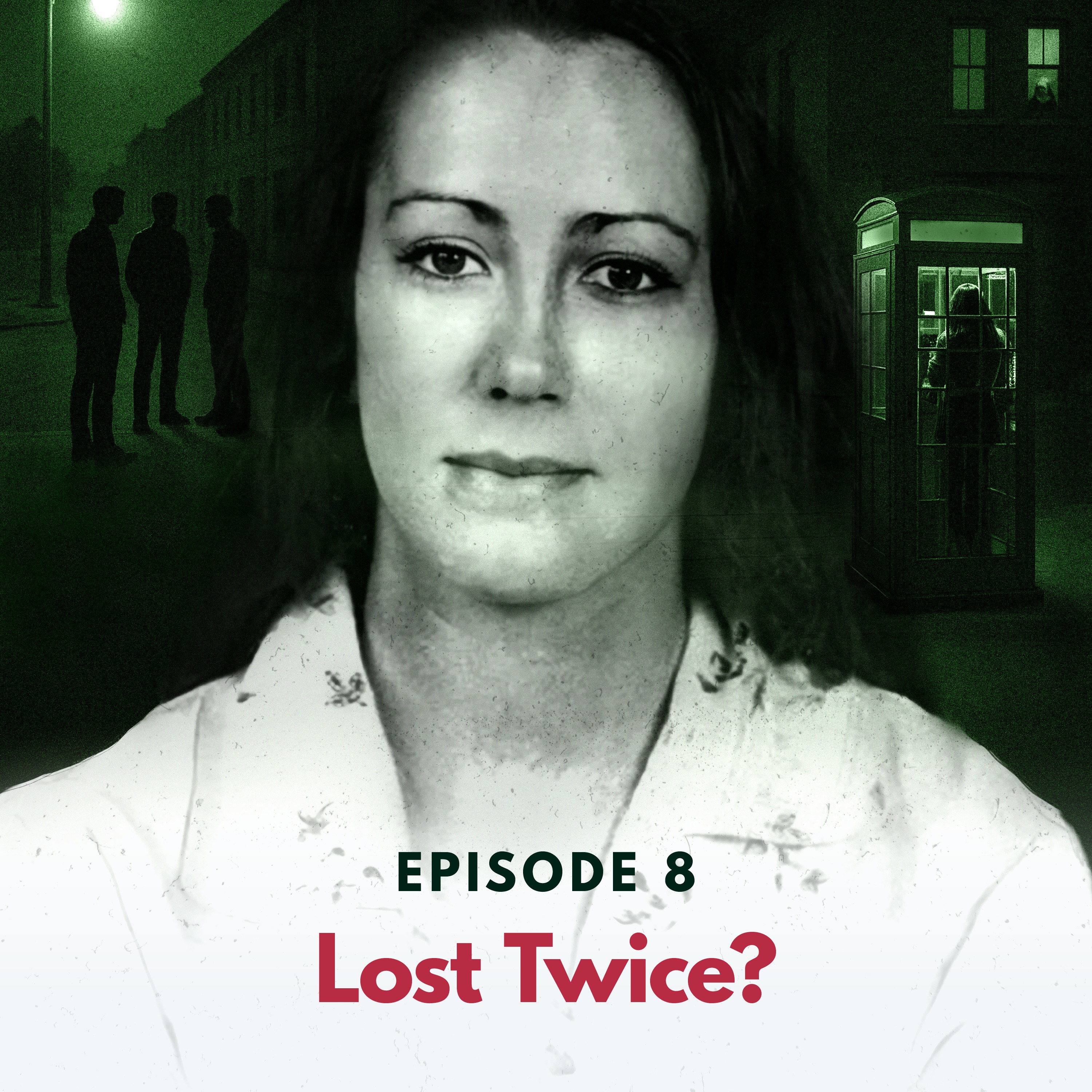
I'm Helen Thomas and welcome again to To Julie's Gone Episode eight Lost Twice. As we know, Julianne Garcia soleil disappeared in July 1975, and her case quickly slipped from public attention. But in recent months, it's come back into focus and her vanishing, her murder has been widely discussed. It was mentioned several times. For instance, at the recent committal hearing of Perry Karumbalis. He will stand trial in Victoria's Supreme Court, charged with the double homicide of Suzanne Armstrong and Susan Bartlett in Easy street, Collingwood, in 1977. He is pleading not guilty to both counts of murder. The two SUEs were killed 18 months after Julie disappeared. And as the committal hearing heard, one of the men who visited her the night she went missing was staying next door to Susan and Suzanne the night they were fatally stabbed in Easy Street. We know, too, that the Victorian Homicide Squad reopened Julie's case in 2003. What I didn't know what's only just come to light, is that her mother, Ruth, was asked to provide a DNA sample for the homicide team via her local Californian police. And of course she did. So. Hello, you have reached the Eureka Police Department.
- [04:46]
F
If this is an emergency, please hang up and dial 91 1.
- [04:51]
D
Detective Neil Hubbard, stationed in Eureka, California, by then, Ruth Garcia Soleil's hometown, executed what's known as an agency assist, that is he collected the DNA sample from Ruth and sent it to his counterparts in Melbourne, Australia. Yet in the three years Ruth and I spoke about Julie's case, she never mentioned this. Did she forget? Her memory was strong and pretty precise through most of our conversations, even as her physical health declined. Perhaps because she'd heard nothing about her DNA sample being used at all, she thought nothing had come of it, and so it wasn't worth mentioning. Whatever the reason, the fact that she'd provided it for the ongoing search for Julie just didn't come up. Even as we discussed the case being reopened more than 20 years ago, many times, and more generally, the impact that DNA evidence was having around the world, Ruth understood how important it could be. And longtime friend and neighbour Diane Johnson certainly recalls discussing the fact that Ruth's DNA sample had been taken.
- [05:59]
G
I do remember her bringing that up. DNA was new to her, but it did give her hope. This made her feel much Better in regards to what was being done with the case. She knew that it was something that she had done.
- [06:15]
D
In 2003, Diane describes the persistent grief that Ruth felt about her daughter. And Ken Theobold, Ruth's first cousin, is adamant that Julie was never far from Ruth's mind.
- [06:29]
H
Not knowing what happened to Julie was tough on everybody, obviously Ruth for sure, and that never went away for her. It's just a tough, tough situation for the family and it would be glad to close the book on that.
- [06:46]
D
For all of us hearing this, it's reassuring to know that Ruth Garcia Soleil's DNA is in the Australian system and has been for decades. Significant too that according to Victorian police media, her DNA is not only quote on the national database, it's routinely run as a matter of course. DNA identification is extremely well governed and any hits would be expeditiously reported to the Victorian Missing Person Squad. Dr. Dadna Hartman manages the molecular Biology laboratory at the Victorian Institute of Forensic Medicine. It specialises in identifying unknown deceased persons as well as cases reported to the coroner where specific ID is needed to identify people.
- [07:35]
E
Our lab is tasked with assisting coroners with the identification of deceased persons. Now, that could be someone who we've got an idea who they are, but, but we need to confirm that using scientific means and that can be dental records, fingerprints or DNA. And the lab, as the name suggests, uses DNA techniques to help in that identification work. I guess there are two types of cases. There are the cases that are reported to the coroner where there is a believed to be identity of the person. So we've got a pretty good idea of who they are. But we need to confirm that for those cases it's usually a one to one comparison of the deceased, their DNA profile to a DNA profile from a family member. And we could do those comparisons and say, yes, the DNA supports the proposition that these two people are biologically related. Now, those cases don't go in any database. It's a, you know, one to one comparison stays within the case. We have another set of cases where it's unknown, so remains are located, but we don't have a clue as to who this individual person might be. So these are our unidentified human remain cases and for these we generate a DNA profile and all other forensic evidence that we can gather to help us in the identification. There is a DNA database for missing persons, so we upload these unidentified human remain profiles in the hope that they would match a reference sample that's been provided by families of missing persons. So if we get a match, then it may be that we've located that missing person for that family. So there is a database, but it's mainly for missing person cases.
- [09:19]
D
But the senior biologist says not all unidentified human remains in Victoria are on that database, especially if the remains were found before the year 2000.
- [09:29]
E
Not all unidentified. All cases that have been reported to the coroners are on the database, unfortunately. And that's because, I guess prior to when we established the database, let's say, you know, early 2000s, prior to that, when remains were found, often there was a forensic examination, but a sample wasn't collected for DNA purposes and those remains would have been interred as an unknown Jane or John Doe. So for some of the older cases, we don't have a sample for DNA analysis.
- [09:59]
D
And is it still possible to get samples?
- [10:01]
E
It would be, but that would require exhuming those remains and recovering a sample in the hope that you can then get a DNA profile. And that's not an easy task. The more historical cases, they would have been buried. So they're in a cemetery. It's all well documented where they're located. It's only so since the late 2000s that if a case was reported to the coroner's court, a sample would have been collected for the purposes of DNA and then those remains would have been again buried.
- [10:32]
D
So in the case of Julie Garcia Soleil, she went missing Initially back in 1975, if her remains had been found between then and 2000, she would be buried. Those remains would be buried, potentially, yes.
- [10:48]
E
So if they were located, like I said, In 70s or 80s or 90s, there's a potential that those remains were buried without a sample being taken for DNA.
- [11:02]
D
Thank you for listening. We'll be back after a short break. Victoria Police Media concurs, explaining by email that, quote, not all bodies have had their DNA profiles obtained and therefore aren't uploaded to the national database. There was no such thing as DNA profiling in 1975. So many bodies were buried without any DNA taken. Exhuming a body is expensive. So a coroner requires credible information before allowing an exhumation. And there's no likelihood that mass exhumations of unidentified bodies would take place, unquote. But what if Julie was one of the long term unidentified whose remains were buried by Victorian authorities at some stage before 2000 without a DNA profile having been created, or for that matter, her dental records being checked? Police Media says that, quote, the database indicates there are dental records available. However, there's no record of antemortem DNA being collected, which was not uncommon for A missing person of that vintage, unquote. So is there a chance that Julie's been lost twice? First when she went missing from her apartment in north Melbourne in 1975, and then again sometime through the next 25 years. And if burial records do indicate that a body recovered in that timeframe shares Julie's characteristics, is this a direction worth pursuing? The Victorian Institute of Forensic Medicine's Dadna Hartman believes so.
- [12:39]
E
It's always worthwhile asking the question. I mean, we may not get very far in terms of the number of cases that fit that descriptor for her case, you know, looking for a female this age of unidentified remains that have been reported between a period of time. So there may only be a handful of cases that you could then do further investigation to either include or exclude them as possibilities. It may not give you the outcome that you're looking for, but I think it's still a worthwhile question to ask.
- [13:12]
D
Police also seem open to looking at the possibility that Julie's body or her remains were buried between 1975 and 2000. Victoria Police Media has told Casefile Presents that, quote, the homicide and missing person squads consider all reasonable potential scenarios when investigating suspicious deaths and missing persons. If there was evidence to suggest that an unidentified deceased and buried person was Julie Garc Iseley, exhumation and DNA testing would be considered. Ultimately, that is a matter for the coroner. An investigation is only reopened if new credible evidence comes to light, unquote. Clearly, even with the most credible new evidence, this would be a long shot and an expensive one. Yet those close to the case believe it should be considered as a next step. While I haven't been able to contact Ruth Garcia Soleil's youngest daughter, Laurie, I raised the matter with her cousin Ken Theobold, and his initial response was, you bet I do.
- [14:20]
H
And I truly believe Ruth would have no problem with that. I don't believe anybody in the family would have a problem with that. But I know having Julie exhumed, I know Ruth would not have a problem with that at all.
- [14:35]
D
He's happy, too, to liaise with Victorian detectives and the coroner as the family representative, if necessary.
- [14:43]
H
Oh, yes, by all means, as long as I'm around and from that level of the family, I am the youngest at this point. From Ruth's standpoint, I'm pretty well it so would love to talk to them anytime.
- [14:58]
D
Ruth's old neighbour, Diane Johnson, also thinks that looking back at official records of unidentified persons buried before 2000 could prove positive.
- [15:07]
G
Absolutely. I think the case of Julie and the others out there, knowing that DNA samples are widely used, now that the possibilities are there, I would think that is something that I would hope for. I'm going to want to know. I think others are going to want to know. I feel as though Ruth would want us to continue so absolutely. To bring Julie home, to bring this forward. It is part of what Ruth was holding onto all along.
- [15:38]
D
Diane obviously knew her friend well and holds close the lighter times they shared over decades.
- [15:44]
G
Living in Eureka, it was often with my family. We would catch salmon and crabs and we'd take meals up to her. She was retired when she moved up here. When we first met her and we were surprised, she was quite the pioneer, very resilient, doing her own painting and had a lot of crafts and quilting projects she would do. So we always felt that she was special to us. So we saw her often for all these years. I do miss her.
- [16:17]
H
Well, she was very important and we'd chat periodically, my wife and I, and it was always a wonderful time. It would take an hour, hour and a half, I'm sure you could believe, to chat with Ruth. And there was a lot of laughter, just great conversations all the time, family things to remember. So, yeah, we always had a great chat multiple times a year. We miss her. We'll miss those chats.
- [16:52]
D
Now. The question I've been asked most while reporting this case is as stark as it is poignant. How did Ruth prevail for so long not knowing what had happened to Julie? To be honest, Ruth's spirit, her resolve to find out exactly what had happened to her daughter, was such that I never needed to ask that question. But in one of many conversations, Ruth, almost in passing, she revealed at least one source of that resilience. I'd asked her what she could see out her window.
- [17:23]
F
When I'm looking out my window, all of the trees around my house, they're beautiful. It's redwoods, it's ash, it's pine. I have about five different huge wild lilac trees around my house. I can wake up, I look out my window and there they are. On the ground we have a three petal wild flower that looks like an orchid. God sent me out here for a purpose, and I have healed a great deal out here because of the beauty of nature.
- [18:10]
D
I'm sensing too that you feel that Julie and Gail are very close to you there.
- [18:15]
F
Yeah. Oh, yeah.
- [18:18]
D
Ruth still seemed delighted that she found her home and refuge quite by accident some 30 years ago.
- [18:24]
F
And you know, Helen, I just took a ride with my two dogs, one Sunday afternoon, and I was going to go out to the beach, let them run. But I came up this long hilly road and I saw a curve to my left and I thought, oh, I'll take that. Let's see, I see a few houses. I kept going and going. And then I saw another road by a great big red barn. And that's what I turned on and kept going. This country road that got narrower. Then I started to climb the hill and then I saw a For Sale sign. And I stopped. And this was a dump. But I walked in. Nobody was here. It was empty. And I walked in and I looked around, walked around. I said I could do something with this. Look what's around me. So I made an offer and take it from there. Here I am.
- [19:39]
D
Over the last year, the plaque honouring Julie Garcesley at St. John's Lutheran Church in Melbourne has been visited by a diverse array of people wanting to pay their respects. They stand and reflect near the little Japanese maple that was planted in the chapel's private gardens after the special service officiated by Pastor James Winderlich. Given this ongoing connection to the case, Pastor James is adamant that a new search for Julie's body must be the way forward.
- [20:08]
I
Yeah, I do think that is the next step. Because in all of this, Ruth has invited many of us into a very painful experience, a painful life experience that she's had, and we've become involved in that. She's asked us to partner with her and to support her in that. And now that Ruth has died, I think many of us feel as though we still want to honour Ruth's wishes in respect of remembering Julie and if possible, giving Julie the burial that she deserves. That's my motivation, and I think that's the motivation of many other people who are involved in this very personal story of Ruth's. So I would certainly support the continuing exploration of where Julie might be and trying to find Julie and if at all possible, to get Julie home, to be buried in her homeland, in her home soil in a way that aligns with Ruth's wishes.
- [20:56]
D
Ruth Garcia soleil died on September 9, 2025, not far from her little cabin on the hill, not far from her redwoods, her ash and wild lilac trees. This episode of Julie's Gone is dedicated to her memory. And if you've any information you believe can help in this continuing search for Julie Garcia Soleil, please contact Victoria police or reach out to us at Casefile Presents.
- [21:23]
F
Anyway, we'll see what the future brings. Okay? All right, kid. Bye.
- [21:29]
G
Bye.
- [21:43]
B
Acast powers the world's best podcasts. Here's a show that we recommend.
- [21:52]
J
La Brega is back. This season, we're spending time with the people and symbols that represent Puerto Rico.
- [21:58]
E
We're proud boricuas.
- [21:59]
G
And what does that mean?
- [22:01]
F
And we are still in the fight.
- [22:06]
J
We're telling stories about champions from a place worth fighting for. Stories that will inspire you no matter where you're from.
- [22:14]
F
Wow.
- [22:15]
J
This is La Brega campeones. Listen early and ad free with Futudo. Plus.
- [22:22]
B
Acast helps creators launch, grow and monetize their podcasts everywhere. Acast.com.