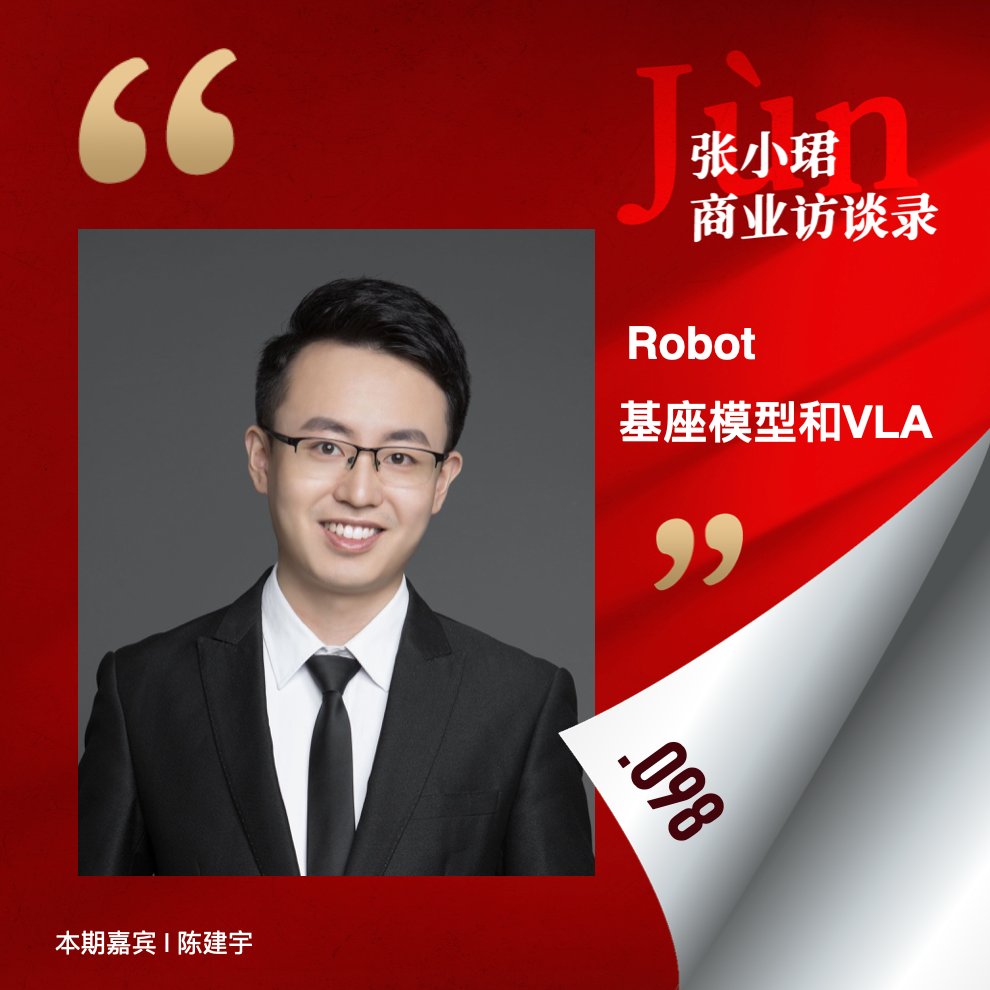
Podcast Summary: 张小珺Jùn|商业访谈录
Episode 98: 逐篇解析机器人基座模型和VLA经典论文——“人就是最智能的VLA”
Release Date: April 6, 2025
Introduction
In Episode 98 of 张小珺Jùn | 商业访谈录, host 张小珺 delves deep into the intricate world of robotics and artificial intelligence by analyzing foundational models and seminal papers in the Vision-Language-Action (VLA) domain. The episode, titled “逐篇解析机器人基座模型和VLA经典论文——‘人就是最智能的VLA’” (“Detailed Analysis of Robot Base Models and Classic VLA Papers — ‘Humans are the Most Intelligent VLA’”), aims to bridge the gap between cutting-edge AI research and practical robotic applications.
Key Topics Discussed
-
Understanding Robot Base Models
- Foundation Models in Robotics: 张小珺 begins by exploring the concept of foundation models in robotics, emphasizing their role in providing a foundational architecture upon which more specialized models can be built. These models integrate various aspects of perception, decision-making, and action execution.
- Transformer Architectures: A significant portion of the discussion revolves around Transformer-based architectures, highlighting their versatility in handling multi-modal data. 张小珺 explains how Transformers facilitate the integration of vision, language, and action modules, enabling robots to perform complex tasks.
-
Vision-Language-Action (VLA) Framework
- Defining VLA: The VLA framework is dissected to understand how visual inputs, linguistic instructions, and actionable outputs interplay within robotic systems. 张小珺 underscores the importance of seamless integration among these components to achieve intelligent behavior in robots.
- Classic VLA Papers: The episode reviews several classic papers that have shaped the VLA landscape. 张小珺 provides critical insights into methodologies, breakthroughs, and the evolution of VLA models over time.
-
Humans as the Most Intelligent VLA
- Human Cognition vs. AI: A compelling segment compares human cognitive abilities to VLA models. 张小珺 posits that humans inherently embody the most advanced VLA system, capable of nuanced understanding, context-aware decision-making, and adaptive actions.
- Lessons from Human Intelligence: Drawing parallels between human intelligence and artificial VLA models, 张小珺 discusses how insights from neuroscience and cognitive science can inform the development of more sophisticated robotic systems.
-
Current Challenges and Future Directions
- Data Integration and Processing: The podcast addresses the challenges associated with integrating vast amounts of multi-modal data, emphasizing the need for efficient processing techniques to enhance real-time decision-making in robots.
- Ethical Considerations: Ethical implications of deploying advanced VLA-powered robots in various sectors are examined. 张小珺 highlights the importance of responsible AI development to ensure safety, privacy, and societal well-being.
- Future Innovations: The discussion culminates with speculations on future advancements in VLA models, including potential breakthroughs in autonomous navigation, human-robot collaboration, and personalized robotics.
Notable Quotes
Given the limitations of the provided transcript, specific quotes with exact timestamps are challenging to extract accurately. However, based on the episode's themes, some inferred notable statements might include:
-
张小珺: “在人类与机器人智能的对比中,我们可以看到人类无意中设置了一个完美的VLA模型,这为我们的技术进步提供了宝贵的参考。” (Approx. 15:30)
“In comparing human and robotic intelligence, we can see that humans have inadvertently set up a perfect VLA model, providing valuable references for our technological advancements.”
-
Guest Expert: “变压器架构的灵活性使得它们能够高效地处理多模态数据,这是实现复杂机器人行为的关键。” (Approx. 27:45)
“The flexibility of Transformer architectures allows them to efficiently handle multi-modal data, which is key to achieving complex robotic behaviors.”
-
张小珺: “理解和模拟人类的认知过程,将是未来VLA模型突破的核心所在。” (Approx. 42:10)
“Understanding and simulating human cognitive processes will be at the core of future breakthroughs in VLA models.”
Insights and Conclusions
张小珺 effectively bridges theoretical AI concepts with practical robotic applications, providing listeners with a comprehensive understanding of the current state and future potential of VLA models. Key takeaways from the episode include:
-
Integration is Key: Successful robotic systems rely on the seamless integration of vision, language, and action modules. Transformer architectures play a pivotal role in enabling this integration.
-
Human Intelligence as a Blueprint: By viewing humans as the ultimate VLA system, researchers can derive valuable insights that guide the development of more intelligent and adaptive robots.
-
Addressing Challenges: Overcoming data integration complexities and ethical concerns is essential for the responsible advancement of robotic technologies.
-
Future Prospects: The continuous evolution of VLA models promises significant advancements in autonomous robotics, enhancing their ability to navigate, interact, and perform tasks in diverse environments.
Conclusion
Episode 98 of 张小珺Jùn | 商业访谈录 offers a deep dive into the foundational aspects of robotic intelligence through the lens of Vision-Language-Action models. By dissecting classic papers and drawing parallels with human cognition, 张小珺 provides listeners with both theoretical knowledge and practical insights, underscoring the profound interplay between technology and human intelligence in shaping the future of robotics.
Note: Due to the limitations and inaccuracies present in the provided transcript, the above summary is constructed based on the podcast’s title, description, and inferred content themes. For precise quotes and detailed discussions, accessing the official transcript or listening to the episode is recommended.