Loading summary
Transcript31 lines
- [00:01]
A
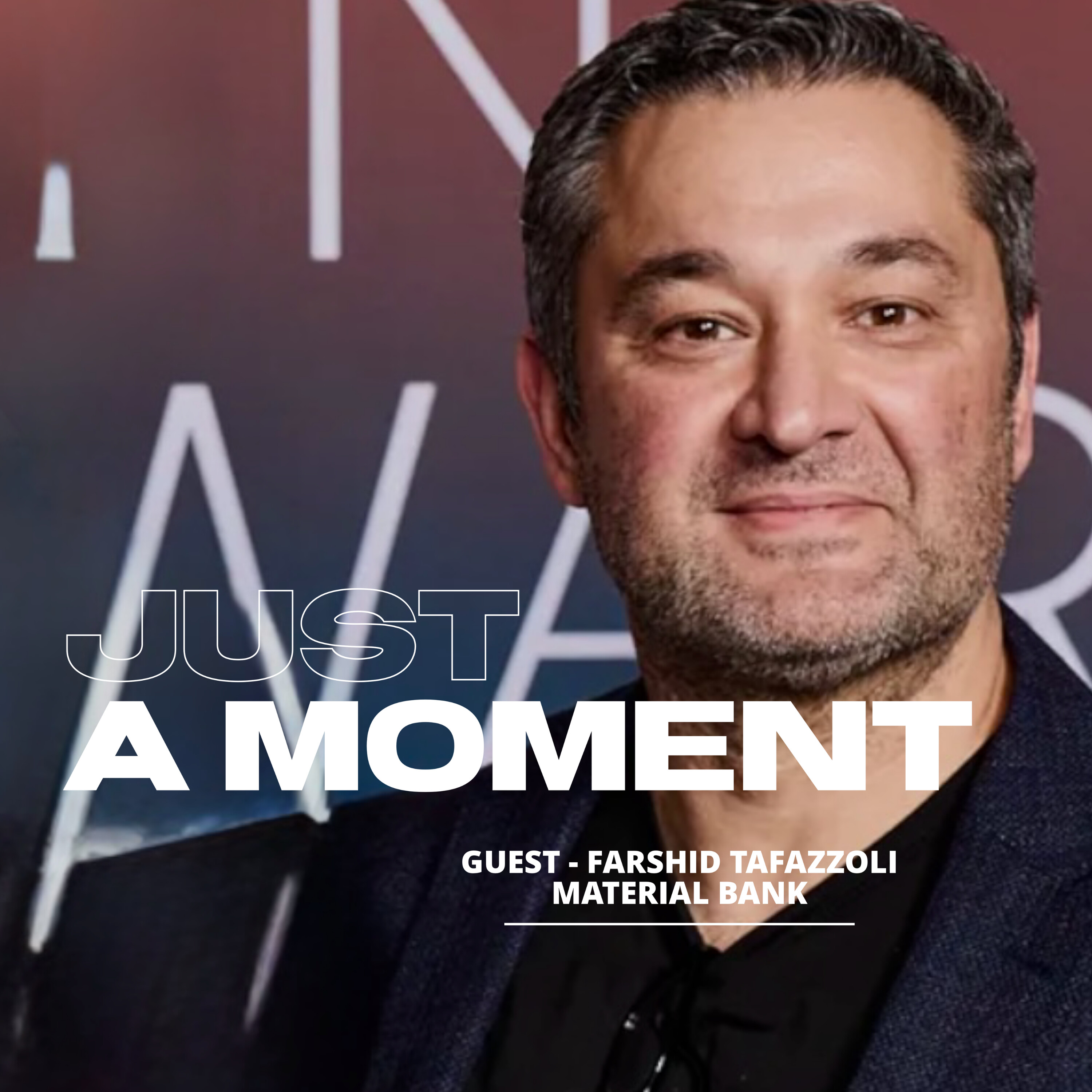
Hi, I'm Brant Menzwar and welcome to my show. Just a moment. As a former world touring musician turned keynote speaker and author, I've experienced my share of life altering moments that have both broken me and propelled me forward. How you leverage those moments or push through them will define your destiny. Each week on my show I'll provide tools on how to maximize those moments as well as interview some of the most successful entrepreneurs, entertainers and athletes on how the power of a single moment changed their lives life. Join me to learn how to change what's possible for your life. It'll take just a moment. Today's guest is Farshin Tapazol. He Left school at 16, built one of Wall Street's earliest electronic brokerages only to co found material the robotics powered platform that has completely reimagined how architects and designers source materials across 37 different countries. He's a builder, an investor and someone who is consistently better. This is story.
- [01:05]
B
I'm Farshid Afizoli and this is my moment. I was born in Tehran, Iran and immigrated by just pure chance to the U.S. i was six years old. You're just starting to have very early memories in the us. It was just a beautiful country, just the beginning of life. So it was a lot of excitement. My father was a quality control engineer and my mother worked in a bank. If you grow up in certain cultures, you're sort of explained the rules very simply. There's not much deviation from that. You have very set paths that you can go without your parents telling you that they would be upset if you went in a different direction. It was just a known. There are four clearly delineated options. Choice A is to be a lawyer, B is a doctor, C is an engineer. And there is always that fourth choice. Your parents make it commonly available to you. And that was a loser, straight A's for the parents. There was not much of a choice on that one. It's just this underlying message that's there. And I grew up in one of those households in one of those cultures. I think that the dream was for my parents who reminded us that they emigrated here. They would tell us they got stuck in this country, which turned out to be the greatest gift in the entire world. There isn't a bigger patriot at that time. It was very challenging. During the time that we had come here, a revolution took place in our birth country, if you will. It just became a much more serious tone than I think a typical childhood may have. You had a number of very negative events, including a US hostage crisis event that made it very challenging. The community who went through that time period all remember it vividly. Especially now as history is starting to bring that country and those types of events back to the forefront, it pulls on you.
- [03:00]
A
Farshid's parents wanted security for him. He wanted something bigger, total financial freedom earned on his own terms, no matter the cost.
- [03:11]
B
I wanted to break out and make money. I looked at earning as this pathway to freedom, if you will. So I started working really rather young, about 13. I just wanted to figure out what else I could do. So I had a little folder of business ideas I would make with hindsight, silly items inside of it. But I was just looking for what can I do to maybe indirectly take more control of whatever that situation was that was challenging. I was in college rather young. I was 16. I was going to school on Tuesdays and Thursday nights in Florida at a local college. That allowed me to take 16 credits between two nights. Essentially I was working full time and waited tables, which I think is just a fantastic experience for anyone to get to wait tables, especially as a teenager. That was to not only just pay for school and academics and everything else. I had left home at that age with $1,200 and certainly didn't have a backup. I didn't have a safety net, if you will. The first place I was at for a very short period of time was really funny. I lowered my rent by offer to clean the pool once a week, which was a comedy show. I could possibly be the worst pool cleaner in history. I was focused on biochemistry. I didn't feel I needed the education and I felt like it was really truly holding me back. But I had the family pressure of there wasn't a discussion, I had to finish that, that degree. But life was moving very rapidly at that time. I had ended up maybe a year later, maybe 17ish, landing on a job that was related to Wall Street. And I ended up meeting a mentor who changed my life and gave entire different pathway, which was not one of the four selected options that my parents originally offered to me. I was still in school and I looked at it and said, I'm going to school only at nights. I've packed my credits. I'm well ahead of the other kids. I'm at least two and a half years ahead of them in time. There was no formal risk reward analysis done for anyone who's been 17 years old, you felt like, yeah, I'm going to do this. It pulled every ounce of me. It was just so exciting to go to work and to work with an incredibly accomplished individual. He was considered one of the top investors of that era and just an apprentice. With him in a topic that just touched the nerve of pure enjoyment was magical. And so I didn't want to leave work. I wanted to just continue doing that in many hours. There weren't enough hours for me in a day, to be candid.
- [05:48]
A
A chance encounter while working a computer job introduced him to one of the best institutional investors of his era. And suddenly the world cracked open. The academic foundation his parents had fought so hard to build hadn't caged him at all. It had launched him.
- [06:05]
B
There was a computer store that I basically worked in, and it would fix computers. I had both hardware and software background. And I ended up from there meeting someone who asked me if I was interested in taking on side work. Just asking if you want more ink. So I never said no. And it was through a relationship from there that led to this path. It was unbelievable. So I basically, I did the work and I said, what is this? I'm just curious. It wasn't working before, but can you explain to me what this was? It was just full of prices that when you would bring it up, the prices would flash all over the place charts, and it was mesmerizing. And so he explained to me what it was that led to doing some side work. And then he basically paid me, which was a lot of money. It was a lot for me at that time. It was a lot of money for the side work that I had done. And I didn't plan it or anything going into it, but when he handed me the check, I instantly just handed it back and said, no, I don't want to. I can't take that, but I would love if you would teach me the business instead. And I think he was equally shocked. I don't know if it was the brightest move in hindsight. It was at that moment. It was. It was a lot of. A lot of time and effort. But what happened is that he said, why don't you take the money? And my only response was, this way, no matter how bad I am, you won't fire me, and you'll give me a full chance to learn. It was just like the seas parted and I knew this is what I wanted to do at that particular moment. And it was just so much more exciting than biochemistry. In essence, you're balancing the dreaded phone call to your parents. If you continue going down that path versus knowing that I'm a few years ahead. The phone call was basically, I'm not going to go down this path. I hit the fallopian lottery with my parents. They're just amazing. And your relationship with your parents evolves over time and changes. But one of them, who shall not be named, hung up, and the other one stayed on and was just inquiring and we made the pivot. When I said in a very humble way, look, I made X over this last year. This is something that's very exciting to me. And in fact, I'm. I'm buying a small house. And so it suddenly turned with maybe some surprise of what that that road looked like and maybe some early fruits that were showing. But that was what turned it for that one parent. I was rationalizing and saying, listen, I'm not really behind. I'm not. This is not going to put me behind. So all that time and pushing of getting me to accelerate through school was. It's paying off. It's just giving me this new pathway. If you made the right decisions, coming up with a strategy, putting capital on the line, it gave me that complete control, if you will. I saw a pathway then.
- [08:58]
A
At 17, everything changed in an instant. One moment stopped him cold and wiped out nearly everything he had built. But sitting in the wreckage, something unexpected happened. The fear just left. And what felt like his lowest point turned out to be the moment that set him free.
- [09:18]
B
This led up to this moment. And I would describe this as being able to identify a clear pathway that I was genuinely excited about. I'm gonna say 17. Somewhere around that age, it was learning how life worked here as a young teenager. Figuring out what bills are that are due, figuring out real responsibilities that are there, identifying what it is. And we spend a lot of time thinking about and planning things out. And it's just a serious tone, and you put a lot of pressure on yourself at that time. So you just want to make sure that you don't make any mistakes, because you're just not sure if a mistake of any kind will knock you off course. I came home and I went inside of my apartment, and I heard a little bit of noise, but I didn't even really know what it was. And I went to go and open my bedroom door, and suddenly the door slammed back on me, and my heart dropped. I could hear noise on the other side. Two. Two people apparently had broken in, and they were pushing back, and the other one was getting the mattress to put up against the door. I ran out of there, got out of there very quickly. I would say 90% of my net worth was stolen, which was two computers that I had and just one small room of items that. That I had been able to accumulate during that time. And I remembered it just caused me to stop and pause and think about what I'm trying to do, where I'm at, focused on just trying to improve the surroundings that I had and to be protective. It caused you to realize the seriousness of how quickly things can be lost and of just thinking more about what you really want to accomplish in a short time period. I had no fear. It didn't even bother me that I lost 90%. I think I. I think what it caused me to think about is that we spoke about a pathway, removing the ceiling, but I always thought about if I'm that close to the floor, that's when you should be taking your risks. That's the revelation. You have nothing to lose at that age. Hitting reset and losing 90% of your net worth until you figure out that pathway. That's the greatest moment. And you don't know it yet, but as you sit there and start to either live life and go through or you look at it and really, truly evaluate it, that's the only moment you can do that. Because over time, life starts to bring on these additional pressures and challenges that make it very difficult and will make it slower for you to get off that floor and to work your way back. So it caused what I would say is this ability for me to just lose fear.
- [12:16]
A
Farshid, welcome to Just a Moment. We've been trying to make this happen for a minute, and I'm so happy that you're finally here.
- [12:22]
B
Thank you for having me, Brent. And between our two calendars, it is pretty challenging, but I appreciate and thank you for your patience, and I'm excited to be here today.
- [12:31]
A
Oh, listen, we've known each other for just a short time, but I always love getting a chance to connect and hear some of these stories from your past, because I'm just fascinated. And the path that you've taken has been so untraditional in a lot of ways, but yet you've reached this level of success now. And I think it's. I want to continue to have this conversation about what you learned after this moment of losing almost everything you had, that sort of fearlessness. How has that fed the rest of your career as you've gotten more responsibility, family, like all these things now that are piling up. Do you find the risk, reward factor? Are you still on the higher side to go? Yeah, maybe I'd still gamble a little bit on that. Or has it made you more Conservative.
- [13:19]
B
So there is a process you go through that just causes you to evaluate that everyone has a different risk profile. And it's not just a different risk profile that they're born with, but it's a risk profile that evolves because of age. So when I say because of age, we. If you ever observe a one year old, a two year old, they have no fear of anything, they'll jump off of a couch onto a glass table. They're live on suicide watch, for lack of better word, during certain times. But the moment that they get hurt, then their behavior starts to change. And by 3, 4, 5, they've gotten injured in a number of different paths and ways. And there's one way where you go through natural injuries, and then there's another way of getting natural injuries, which is just responsibilities that you have. But both over time lower your overall risk profile. And so if you're just cognizant about where your risk profile is, you have the ability to make that adjustment up and down, any point, and to evaluate it.
- [14:18]
A
I'm wondering for you has, I mean, because you, you started school a little early, right? You got a jump start, if you will, in your career, that Most people at 18 are not buying a house, most people are trying to figure out how to get beer at the local college party. Has the definition of success changed for you as you've gotten older?
- [14:40]
B
I would say the definition has changed. I think you have a scoreboard. I think you come to realize that we don't control much in life. I think we start off thinking that we control a lot. And for me, the definition of success, maybe it starts off where it's a certain dollar or dollars to be able to maybe purchase anything that you want to purchase or to provide a certain level of comfort to your family. But I think it evolves over time. And my definition, I would say, is if you get to work with people that you truly admire, so people that you truly admire are people that you grow with. They're people that you learn from, that are at the top of their game. So if you again, work with people that you truly admire, you work on something that you just genuinely love, and then the last part of it, you get to do that as long as you want to. That to me, is the greatest definition of success. And from that, if you stay inside of that framework, the original scoreboard, if that's dollars or what have you, those will continue to work towards that same
- [15:45]
A
direction as somebody who works internationally. So that you are dealing with different cultures, different levels of expectation what do you think right now in the state of the world as we look in our country, with the rise of AI, with the job situation where you got a lot of kids coming out of school who are unable to find jobs, you got AI coding taking the place of almost every entry level encoder. Now that there is, when you look at the challenges that, that we have here in the States, is it similar to the challenges that you have in Europe and other places or are they completely different challenges that, that you look at on both sides?
- [16:31]
B
Yeah, look, I think the challenges are going to be the very same thing for the youth in terms of their segment. And everything is really based on what seat you're sitting in. Right. I think, I think right now the plumber is sitting more comfortably than, than if you will, the software engineer doctorates. The number one thing that I believe is just to work hard. You can put me in, in an environment and it doesn't even matter to me if there are people that are just far brighter. I have to control what I can control, which is the level of effort and how hard I work. And so that was just a determination that I made that worked for me. And this is with a lot of hindsight where many years of look back where I put the same pressure that you, who's listening may be thinking about what am I going to do? How am I going to get there? All the good items are taken, the incomes are hard, buying a house is impossible. You can go through all the challenges. I am just naturally inclined to be very optimistic. I will never doubt that I can work hard to achieve whatever it was, and that's what you control, is to work hard. So I would say instead of focusing on these things that are there, and we've had it before as a country, we had over 75% of the country displaced by a tractor that came about. Now the difference this time versus prior times and eras is that the speed at which it's taking place doesn't necessarily give somebody the ability to, to go and retrain for an entirely different job. But I also don't buy that and I think these are excuses as well. So what I would say is that the, these are tools and skill sets, AI that you should be all over. And it is not as if these are available only for people who are paying. No, there's a free version and you can learn just as strong with the free as you can with the other. So what you're talking about is just basically a free version that others will use and if they're using it, you better know how to use it. And the only element that still to this day works, the first element, is just working harder than they do. So I just, I. I find it inexcusable if you allow somebody to work harder than you. And so that's a dial you control. And how do you do it? I think it starts with waking up earlier so that you can do more things. Going to bed later so you can do more things. And yes, it won't give you this work life balance. But I don't even know who came up with this term. It's not somebody who worked hard and achieved because there's not one person I've met who will sit there and just work hard at something so that they do work on improving themselves and investing in themselves that is going to have that.
- [19:27]
A
I think, at least for me, work life balance is for people who hate what they do.
- [19:33]
B
Yeah.
- [19:34]
A
That's why they want balance. But if you love what you do.
- [19:37]
B
Yeah.
- [19:37]
A
There's no need for the balance. Right. Because it's your life. It is your life. It's. It's the same with us, with Sherry and I, we absolutely love what we do. We work from the second we get up and we don't really want to go to bed. Like, we just. We love what we do and are constantly trying to find ways to expand and do new things and engage with new people and find new pathways. That's part of the fun is that adventure, right?
- [20:05]
B
Exactly. And people will describe the need for a balance. And yes, family is of the utmost importance. But I think if the typical person saw maybe what high achievers, people who have reached where they want to lead and be, you won't find that level of balance. It's. To me, you can do it all and you can push to do it all and enjoy it as well. It doesn't have to be stressful. Stress is really just more related to inaction or trying to address something that that's left unresolved.
- [20:45]
A
So we always like to shift just before we end to a moment that if we could revisit knowing what we know now. I'm sure you've got a bunch, but is there one or two that stick out in your head this, that says, gosh, I could have gone back and maybe tried something different now that I know different, that know better.
- [21:02]
B
Yeah, I am all gas and no breaks, and you have to stop and say, will I look back in my 80s when I'm forced to slow down and would I rather have it that I stopped and just pushed as hard as I could during the years that I could, or would I rather have slowed down, smelt the proverbial flowers, if you will. And so I don't have that moment. I genuinely don't have that. I don't look at life that way. I look at life as just maximizing every single piece, knowing that I'm going to make a lot of mistakes. And there are plenty of mistakes that I can look back at. But I also find that the mistakes led to things that. That ultimately were improvements or of learning moments that that sort of came about from there. So I hate to not give you an answer on this one, but I don't. I don't have that. I look at it as. I've just been so fortunate and so lucky. And I think the part that you have to look at are the things that you can control. I can't control health. And as long as I have health, I can control all of the other aspects of effort and maximizing what's there. And I'd rather not look back with regret while I have had health as being on my side, than to stop and say, gosh, I wish I had done something differently.
- [22:31]
A
I think it's funny that it's interesting to me that if you're always on the gas, which I would consider myself somebody as well, who's always on the gas, the only thing that makes doubt or regret better is time and distance from it. That's the only way you can really feel better about something is that it's so far behind you that either you've had enough things happen to blur that memory or you're so far past it now you're thinking about other things. I think that's honestly one of the best parts about being on the gas, is that there's never anything in your rearview mirror for very long. Right. Because you're always moving forward as fast as you can.
- [23:09]
B
When you take a look at things in a little bit different light, too, I think perspective is really important. So when you grow up in an immigrant household, your one text or one WhatsApp away from people describing challenges of things that you take for granted every day. So there is an entire world where there is somebody who's sending a text because they can't get that cancer drug for their child, can't get common medicine that we take for granted, that we can walk into a CVS or a Walgreens and get. And I think those are the types of things that just basically remind you whether. And believe me, I don't want to be reminded. I'd rather just have my blinders on and go about. But I think those are the things that bring humility and appreciation for everything that that one has, friends, family, health and all of the other dynamics. So it would be almost a form of complaint sitting there and saying, gosh, I wish I could change this. Others don't have those luxuries. Those items appear like luxuries to others.
- [24:18]
A
Agreed? Agreed. Listen brother, I know it took a minute, but I am so thankful that we were able to finally sit down, spend a little time with us here. If people want to continue to follow along, what's the best way for them to do that for you? Is it LinkedIn? Is it? What's the best way for them to.
- [24:34]
B
Of course, yes. Connect with me on LinkedIn. Always happy to see somebody putting in a maximum effort and giving giving it a shot. You'll look back with no regrets. And remember, we have every excuse, but working hard is something that we control.
- [24:49]
A
It's the truth. That's the truth. Thank you so much for spending this time with us and I look forward to us getting together again soon.
- [24:57]
B
Awesome. Great. Great to be here. Look forward to continuing our discussions.
- [25:03]
A
Thank you for joining us on this episode of Just a Moment. Make sure to subscribe to our podcast and tell a friend or two about it to help spread the word so everyone can find a moment that inspires them. Don't forget to leave us a review and check us out on the web@justamomentpodcast.com Just a Moment is produced by Natalie Von Rose and Brandt Menzo. For more inspiring shows like this, visit surroundpodcasts.com.