Loading summary
Transcript33 lines
- [00:01]
A
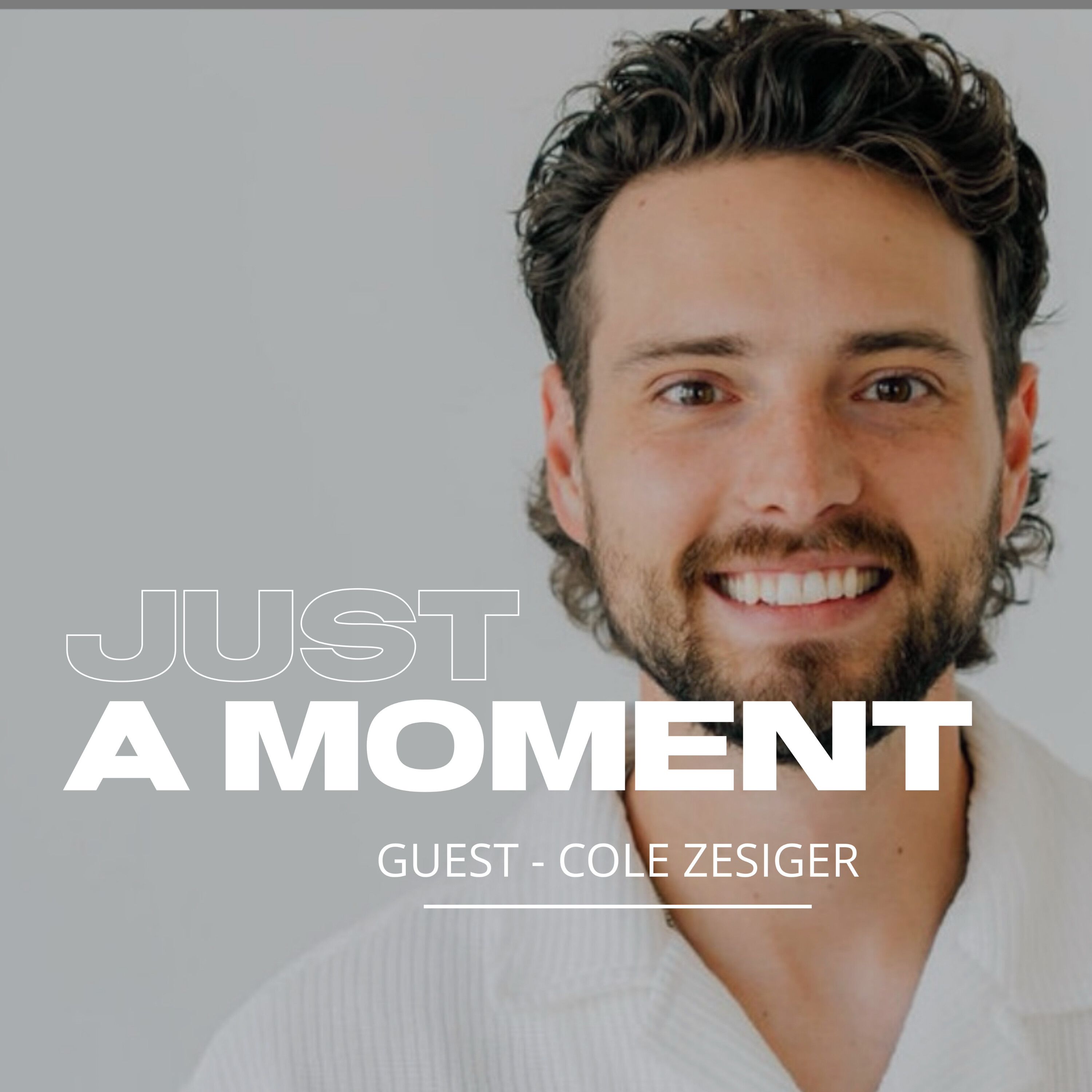
Hi, I'm Brant Menzwar and welcome to my show, Just a moment. As a former world touring musician turned keynote speaker and author, I've experienced my share of life altering moments that have both broken me and propelled me forward. How you leverage those moments or push through them will define your destiny. Each week on my show, I'll provide tools on how to maximize those moments, as well as interview some of the most successful entrepreneurs, entertainers and athletes on how the power of a single moment changed their life. Join me to learn how to change what's possible for your life. It'll take just a moment. Today's guest is Cole Zeziger, a powerful voice in modern relationships whose raw honesty has earned him a massive following. As a breakup and connection coach, he's guided thousands, all while owning his own highs and heartbreaks in real time. But along the way, he discovered a hard truth. His pursuit of perfection was the very thing stealing his happiness. This is his moment.
- [01:07]
B
I'm Cole Zeziger and this is my moment. I grew up in Centerville, Utah, so it was deep in the Church of Jesus Christ of Latter Day Saints. Everyone I knew was a member. My family's been members for a good amount of time, so that was my background. I was the oldest of four siblings until I was about 20. Then they had another one. So there's a big gap there. And I always felt like I had to be pretty perfect. I had to achieve really high. I felt like I couldn't mess up because then it gave the other siblings permission to mess up. My dad was close to being a state champion wrestler, but then he got injured. So it like became his mission to make me really good at wrestling. So when I was really little, like five to seven, I would never lose, ever. And I got, I think I got first in every tournament I ever entered. And then finally when I was like seven, I lost. And it was because I was sick. I got like third place in a state tournament and I couldn't take it. And I quit wrestling. I remember I like locked myself in the bathroom and I was like, I'm not going to do this anymore. And my parents were like, okay, you can quit, but you've got to save up and pay us the $45 that we paid to sign you up. So I saved up money and did that so that I could quit. I had done great at being perfect. It wasn't until I was about 24 or 25 that I finally learned to start accepting myself the way that I was. It's still hard because, like, Even now, I feel like I have to have really lofty goals to feel good enough in some ways. But, yeah, definitely before it was be perfect and be perceived as perfect for other people.
- [02:44]
A
Cole's quest for perfection was largely tied to his desire to live up to his father's success when his religious community provided an opportunity for him to follow directly in his father's footsteps. However, his mission trip was far from what he had initially hoped for.
- [03:01]
B
A lot of my life, I just wanted to be like my dad. So he went to Chile on his and spoke Spanish. As a kid, I wanted to go to Chile, but then at some point, I was like, I don't want to be exactly like him. So let's hope for Argentina. I really wanted to go somewhere in South America and speak Spanish, so I took four years of Spanish. Throughout high school, I was pretty okay. You don't choose where you go at all. I just opened a letter, and it said I'd be going to the Philippines and speaking Tagalog, because I didn't know how to say Tagalog at that point. I got on a plane about a month after opening that. I was not really prepared at all to go. I just did because I knew I was the oldest and I had to go. I didn't even know what was packed in my suitcase until I arrived in a hotel in the Philippines because my mom had packed it all. And I remember the guy who was supposed to be like, my bunk mate in the hotel room ended up, like, not leaving. So I was just by myself. So the first night, everyone had a buddy except for me. And I remember I got up there, I opened my suitcase, I saw all the stuff my mom packed me for the next two years. And I just looked out the window, and I was like, what the heck am I doing? This is insane.
- [04:05]
A
Difficulties continued to plague Cole on his mission. Isolation, loneliness, language barriers, and acute homesickness haunted him at every opportunity. There was, however, a light at the end of the tunnel.
- [04:19]
B
Perfectionism and shame. That was my rocket fuel at the beginning, which isn't good, but it worked. But after four months, I just accepted that I was going to be there. My mission was pretty strict. They had a rule that you could only email your family once a week anyway, like every mission could. It's different now. Now they can call every single week. When I was there, you could email once a week, and you could call four times the entire two years. Once on Mother's Day and once on Christmas for an hour only. So you had four hours of calls in Two years to really focus you on what you're doing. It was crazy. But in my mission, it was even stricter because they wanted us to, like, really care about what we were doing. So in that email time, once a week, you could only send your family one email and then get one back. You couldn't even reply back and forth. That was one of the rules. I just disobeyed that order for the entire first four months. I was like, I don't care. Like, I want to keep talking to my family. And at that time, I decided, I'm going to follow it. I'm going to actually be here. I'm going to do my best. And I remember when that happened, I started to really care about the people because at the beginning, I was just prideful about my culture and thinking America was the best and the only way to go. So I didn't really like the Philippines at the beginning. It was so different from where I came from that I just looked for all these flaws. But that moment when I decided, I'm going to immerse myself, I'm actually going to be here, I would write down five things that I loved about the Philippines every day in my little notebook, and I started to really love people there. And that's when it really changed. Changed. My biggest memory of the last day was I was walking home and I had just come from nine parties that they threw for me. Nine separate families threw a party and made all this food. We were going to explode from eating so much. But I remember I. I was walking home and there was this cockroach walking by me, which they're these, like two and a half inch long ones that can fly and land on you sometimes. But I was walking and he was, like, walking with me. And I remember thinking, I'm even going to miss you. There's something called AP or Assistant to the President, which is like the highest, like, hierarchical leadership thing you can get. If you think about being seen and perfectionism, that's pretty much what my goal was. I wanted to baptize a lot of people and be ap. That was like, my goal of success and my dad had. So I was just like, I've got to do that. I've got to measure up to my dad. And by the end, it was more that I did everything I could do. I really wanted to look back and feel like I didn't waste any time. So that that was my definition of success in the end was love the people and make sure I didn't waste a single day.
- [06:56]
A
Though Cole had come to love his life in the Philippines. The time came for him to return to the US the culture shock hit hard. Religious contemplation gave way to confrontation with modern life. Cole struggled to adjust, especially as another expectation in the quest for perfection was piled on. Finding a partner in finding one quickly.
- [07:22]
B
When you're a missionary, you don't listen to music or watch tv. You like just read the scriptures and talk to people about Jesus. That's like all you do. So it was weird immersing back into the regular world. They actually have a training book on how to do it because it is like whiplash. After that, I was just determined to get married. I followed the classic Utah thing you're supposed to do. There's this dating app called Mutual which is essentially Hinge, but for members of the church in Utah, pretty much it had just come out. So people were using it a lot. And I just did that like religiously. I went on a date every single day, like five or six a week. I was hyper, anxiously attached to. So really I think at that point, if someone would have been like pretty and really liked me, good to go, I was probably awkward. This is like Cole's learning how to date phase. I remember I went to a party like three days after I got back from the Philippines and literally I introduced myself to everybody because I spent two years doing that. I went up and shook all the girls hands and introduced myself as Cole Zeziger because you're Elder Zeziger on your mission. So I would say my whole name. So I was awkward. About four months in to this thing, I maxed out the app because I just went so hard swiping on it. So I like extended my range. And my first wife, she was in Texas, so I matched with her on there. And she was going to school at byu Idaho and I was going to go to a different school near Provo. And I just decided, you know what, I'm going to switch and I'll go to school there to date her. It was really fast. Fast was the dating word. Before I met her, we spoke on FaceTime every single night, sometimes for nine hours. I tallied it up one time and before we met, we talked on FaceTime for 120 hours. And I arrived to a girlfriend that I had made online like Kip Dynamite. We got married really fast. We matched on March 4, got engaged July 1 and married Aug. 4. So five months after the dating app match really quick.
- [09:31]
A
As it turned out, quick and young weren't the greatest ingredients for making a lasting Marriage match cracks formed quickly, and in a matter of months, things started to unravel.
- [09:44]
B
We didn't have very similar goals for the future, specifically where we would live, because if you get married super fast, you don't talk about anything that much, then you have different goals. But I really wanted to live by my family. I like Utah. I like the culture. I like dirt biking. I like snowmobiling and longboarding and hiking and fishing. And her family was from Texas, so she really wanted us to live in Houston. And that was something we never agreed on. So that was something that was big. And then it got to the point where we had, like, tensions between us and our family. So she would go and visit her family, and I wouldn't go anymore. And then, same thing with me, going visiting my family. We also had made these interesting concessions where I was trying to get into medical schools around the country, and we decided I was not allowed to go to Baylor or the University of Utah, so we would not be near either family. That was our compromise, was just we both lose when we would fight and stuff. It was a lot of yelling, and it was just not that good. I didn't really know anything different, though. I'd only been married that one time, and I didn't really have any serious relationships before that either. It was my first one. So everyone had always told me marriage was hard growing up. So I was just like, this is what it is, and divorce is not an option. It's not a thing. So we just yell at each other, and I guess we won't like each other's families that much. And that's just how it's gonna go. And I don't think I ever would have left, ever. Partly because of anxiety, not wanting to be alone, and partly because of those values, I was never gonna get divorced, ever.
- [11:13]
A
Until he did. Cole's world was toppled upside down when his wife made a decision he never saw coming.
- [11:21]
B
It's February 12, 2021. She comes home and she's crying. And I just assumed she had a bad day at work. She's a second grade teacher at that time. And I go downstairs. I was studying for the MCAT to get into medical school. And she asked me a question. She says, would you ever move to Texas? And I say, no, as I've always said. And then she says, okay, then I want a divorce. And I didn't consider it real at that time still. So we pretty much just argued and fought as we usually did, and went to sleep. And in the morning, it's Saturday. Now she goes on a drive for about 11 hours, and she's just gone all day long, and I'm freaking out. So I just lay on the couch and watch Malcolm in the Middle all day because that was like a comfort show for me when I was little. I didn't call her. I didn't want to bug her. She comes home and I'm like, how's your drive? And she's, it was good, but we're still getting divorced. I still hadn't told anybody because, again, I want to be perceived as perfect. She goes on another drive, and I finally break, and I'm like, this is actually happening. This is the worst thing ever. So I call her like 60 times, and she just rejects every single call. So finally I call my parents, and I'm like, I need help. This is crazy. My wife's leaving. I don't know what to do. They talk to me for a while and they're like, just give her space. I'll come get you. So I go home and pretty much am just destroyed now her mom texts my mom about all my stuff on that Saturday. So it had been about a week, and me and my dad go and pick it up, and everything in the entire townhome was boxed up, already sealed, and they stacked it up by the door. And her mom was there. She'd flown in from Texas to, like, be with her and my ex wife. She had a new haircut, new outfit, looked really pretty. Her mom had taken her to do all this stuff, and she was just, like, really mad glaring at me. And every inch of me is erased from the house completely. Like, my office was like a makeup room now. My closet was a towel closet now. No pictures of me. I didn't exist in there. And then I just left. And that was the last time I ever saw her.
- [13:36]
A
Blindsided and hurt, Cole had to move on fast in order to keep going. But just when he seemed to get everything back on the track to perfection, rejection after rejection laid him lower than he had ever felt before.
- [13:52]
B
My thought, which this just shows the psychology that I had all throughout growing up, was I need to quickly get back to perfect. I knew I was going to go into medical school, and I just thought, I need to get another wife as soon as possible because I'm not going to be in dating mode if I'm really studying, because I want to be a. An eye surgeon, and that's really hard to be. So I need to get a wife now. So I got on a dating app that same one, three days after Moving back and getting separated. And I swiped, I got 10 matches and I asked my little brother which one is the prettiest one. He's like, that one. I'm like, okay, I'll marry that one. And I went on a date with her and she became my girlfriend. I only went on one date, so she was my girlfriend now. And I immediately felt way better. I felt like I didn't have any sadness anymore. I was amazed that I could just be over my ex wife that fast. We dated for a while and it got to the point where we were about 10 months into the relationship. We started talking about getting married in the future and all that kind of stuff. I waited a lot longer that time. And as soon as we talked about that, I was like, something switched in my brain that is saying, marriage is scary. Don't do that again. So I got super distant to the point where she ended up breaking up with me too. And in the background of all this, I had applied to 25 medical schools. I did really good on all the stuff I was supposed to do good on. Like I got a 3.9 GPA. I got 97th percentile on the MCAT test. I was an adjunct professor for anatomy. I worked in an eye doctor office for two years. I had leadership in a non profit, all this kind of stuff. But I got rejected from 25 out of 25 medical schools. So then I invested five grand on application coach. And they were like, you're going to get into any school you want in the nation with your scores. All my scores were average for Harvard or Johns Hopkins. All that applied again with their help. 25 out of 25 rejected. So 50 out of 50 schools did not let me in. So at this point I was divorced. I was living with my parents because I moved back in there after my wife left me. And I was just in limbo waiting to get into medical school. My girlfriend left me. I didn't make any friends in the meantime because I just had my girlfriend. I focused everything on her. I got rejected from every medical school and my degree pretty much only did that. I have a college degree in pre med, so I could only be a doctor, but I couldn't get into school. So absolutely everything went wrong. I lost absolutely everything that I had built and I felt like I had nowhere to go.
- [16:29]
A
Cole's moment came at his ultimate low when he shifted from a mindset of desperation to a mindset of healing. And started to do things not just for the sake of seeming perfect to others, but because it was something that Felt authentic and fulfilling to him.
- [16:47]
B
At first, I just got really into how to get your ex back content on YouTube because I thought, you know what, like my second run at perfection failed, so I've just got to get it back. But at one point, I watched a video that said be become her best option. And for some reason, that actually got me to do stuff for me. Instead of just doing things to get her back, I moved to somewhere where I didn't know anybody. I just determined I was going to make a life that I really liked. So I talked to as many people as I could. I made as many new friends as I could. I started new things. I did jiu Jitsu and singing lessons and Muay Thai, and I played guitar, like in front of these big stages. I went on 11 trips just building all that stuff. Ended up making me feel like my life was really stable and I really liked it. So at that same time, I started making videos on TikTok too. Basically based on what I wished someone would tell me when I was going through my breakup. And after six months of that, that grew to a hundred thousand followers on TikTok. I basically realized that I had to fix myself. I had to learn what was wrong. It wasn't everybody else's problem. I had to be humble, I had to be not perfect, and I had to fix what was wrong. So I learned a lot about being critical of others, perfectionism. I went to two years of therapy during that time, read a lot of books, and it pretty much changed everything. Feeling lost in the noise of social media, Inspo cuts through the clutter, connecting you directly with real insights from real experts and industry leaders. It's a new social network dedicated to knowledge sharing, industry insights, and thought leadership. Get the latest from top minds in your field or build your own thought leadership portfolio on Inspo, already trusted by thousands of professionals worldwide. Be part of the conversation and download Inspo Experts today on the App store or visit www.inspo.exper.
- [18:53]
A
Cole. Welcome to Just a moment, brother.
- [18:57]
B
Thank you, man.
- [18:59]
A
Let me first say you're as close to a Disney prince as I think I've ever met. If you flew by me on a magic carpet, I'd be like, yeah, that's right. I think you've missed your calling. You should be out there showing people the world.
- [19:15]
B
I auditioned in sixth grade to be Aladdin and I didn't make it. I was one of the. Was one of the thieves.
- [19:22]
A
They just pegged you completely wrong. Yeah, that was your part, brother. I'm telling you, this Story, this moment, what you went through, you've lived your life to this point. You've got this obsession with perfection. You are trying to be the best version of yourself. You experience rejection in several different parts of your life, right? So you've got the relationship rejection, you've got the med school rejection, you have to face. But now you realize that there's some work to do, that it might not be you trying to create the environment of what perfect looks like, but now you've got to do some work on yourself to actually have a shot at being the best that you can be. And I'll say this too, you're a little bit older than, say, the Gen Z force that's coming in now. One of my big sort of challenges to people who are managing Gen Zers is they've never really been taught how to lose. Because Gen X, which is my generation, we didn't have technology like there is today. So you got home and you got kicked outside until the streetlights came on, because that's how you knew it was time to go home. There was a lot of autonomy and a lot of lifting yourselves up by the bootstraps. You only got a trophy when you won. This is the big thing for me. You have to learn to want to win. It's not about always winning. You want to win. As long as you want to win, you can build off of that. But if you're always rewarded for participating, then there's no real desire. Why win? I'm still going to get rewarded even if I don't win. And so for you, honestly, even during your mission and coming out of that, into being early 20s, you're experiencing losing in a really strong way that you can't deny, right? Like, how do you dive into, say, this is the parts of myself that I think I need to work on now so that this doesn't happen again.
- [21:37]
B
Part of it that helped a lot was sharing on TikTok because I would share how I wasn't perfect. And it helped me just ease my way into breaking the pattern of like, pushing everything under the rug. Because that's what I did. Pretty much. I would either win or I would not try. Basically, up until I was like 20, that was the system, win or don't try. Now, millions of people were seeing that I lost it. It gave me permission to. It didn't immediately shift from I want to get my ex back to I want to work on myself. It was a mixture of that. So at the beginning, I was focusing on anxious attachment, getting better from that because I really wanted my ex girlfriend back. And because also I didn't want to go through breakups again. I didn't want to feel super anxious all the time. I didn't want to need to be perfect. Both of those were competing at the beginning. I just wanted her back. And it slowly shifted to, I want to enjoy being who I am. And you can't really enjoy being who you are with that perfectionistic mindset. Because I could never get that. And if that was the baseline for me liking myself, then I was just never going to. And that's basically what I experienced. I would feel good when I won things growing up, but not really good. Like, really proud of myself. It would be good as in, like, good enough. Like, I. I got to zero. I'd either be negative one or zero. And here, once I just got to where I can be imperfect and still like myself. Because I've shown myself, even if I sucked at all these things and I failed so many times, I still could be enough. I started feeling better. So one big example, this was right after that breakup. I was trying to figure out what I wanted to do with my life. So I was selling decks. I went on Facebook, Marketplace, looking for jobs. And I saw this one. And at a company called Western Timber Frame, that you'd go to people's houses and then you'd go as like a closer and design a deck for them or a big pergola pavilion thing. They were really expensive, but they were really high quality. So it would be like 20,000 to $100,000 for one of these things. And I remember I sold my first one and I was like having a really hard time because I wanted to call my ex girlfriend and tell her because a lot of what I judged my worth on was external validation if my girlfriend thought I was cool. But I couldn't. Cause she broke up with me, didn't like me anymore. So I ended up seeing this YouTube video that said, you need to build this relationship that you care about your own validation and talk to yourself. So I literally was driving my truck and I was talking to myself and I said, cole, like, this is so awesome. You just failed at absolutely everything in the world. And instead of quitting and curling up into a ball, you learned how to be a salesman. And now you just convince someone to buy a $50,000 deck and you don't know anything. Decks. It's really awesome. I'm proud of you and I love you. That was a big difference, is I was now allowed to fail and be imperfect. And still like myself.
- [24:27]
A
Yeah, listen, that's an incredibly powerful message and one that I think is needed as there are lots of young adults who experience that level of rejection or that level of loss and they never recover. Right. Like they take a different path.
- [24:43]
B
Victimhood is the most. That's the scariest one. Now, like I specifically on social media you can get a lot of views by validating people's victimhood by saying all these things about your ex was a narcissist or they hurt you in this way. Not to say there aren't actually narcissists, but people over identify with it and they look for all the reasons why they can't succeed and why the world's against them and then they sit in it. And I think that's the direct opposite of how you can use your breakup or your divorce to actually get better. So I got lucky. I didn't find any of that stuff that was a good thing about my perfectionism was I took too much accountability. So I didn't fall for that one as much, the victimhood one. But that's a scary one. I think that's what gets most people stuck.
- [25:25]
A
It's a great shifting point when we talk about being a victim. Let's talk about a moment you'd like to go back and maybe revisit. Right. We love to do this. This isn't about regret. This is about you're much wiser today, I would hope, than you were back then. Knowing what you know now, what's the moment you'd go back to and maybe approach a little differently.
- [25:49]
B
So the biggest thing was how I treated my ex wife. I would be super nitpicky and critical of her. And that was one of the things that led to our relationship breaking down. And I didn't realize why I did it until way after because I did it in the second relationship too with the second girl. So same thing. So I learned later that we have two buckets that we apply to the world. We have one for everybody else and then we have one for ourselves. And what this bucket is, it's what's like permissible expectation wise. So for me, I was really compassionate towards everybody else. Very good at forgiving. Like I taught people on my mission who were murderers and I love them and I'd figure out ways to love them. But for myself, if I did something like not even bad, I would be really harsh. So totally different buckets that the world can do all this stuff and I can only do this stuff. Everybody has those. But when you start to include someone in your life that's very intimate, like your partner, they get forced from the other person bucket into your bucket. So if you are really critical of yourself and you don't like yourself very much, you're not going to be able to treat them any differently. You have to treat them like you treat, treat yourself. So that was one reason that I criticized so much that I didn't learn until later and that I wish I knew back then is because I had such high expectations to just be okay. My wife had to live under those two, which isn't fun. The second thing I learned was this is more of an anxious attachment style thing. So for those listeners who don't know what anxious attachment style is, it's basically you believe that love is conditional. You've got to earn it. It's always going to get away from you. You don't intrinsically deserve it. So you're hyper vigilant. You're always asking if it's going to be there. You're always thinking someone else is going to leave. But one of the big things is you have a hard time communicating what you actually need in a relationship because you're afraid if you do that then people are going to leave you because you're too much. So I wasn't good at communicating when I needed something so it would just build up and then leak out as criticism too. So instead of saying I need you to do this so that I'll enjoy the relationship more and we can be closer together, it was like I'd say a little passive aggressive remark that means the same thing thing but is totally out of context and ends up just making the other person feel bad. So those two things are big things that I work on really hard now, which I'm still not perfect. I do the passive aggressive thing sometimes, but I'm a lot better now. And that's something I wish I could revisit because it, I think it really hurt her self esteem, really made her feel like she wasn't good enough.
- [28:27]
A
So what are you actively doing today that lets you experience a different result when it comes to that stuff?
- [28:36]
B
There's this book called the Compound Effect. It's by Darren Hardy. It's a cool self help book. In it he talks about he gave a gift to his wife one Thanksgiving that he looked for something that he loved about her every day and wrote it in a journal and then gave it to her. So that's one thing I'm trying to do right now is just focus on things that I love about her every single day. And I'm treating being in love with her as something that's my job, my responsibility, that if I fall out of love with her, that's my fault. So I'm actively working to stay in love with her. And then the other one is actually the passive aggressive comment thing. I didn't realize that until like two weeks ago. So I'm focusing on if something bothers me and it's multifaceted. If something bothers me and it's something that I feel like is legitimate, I try to bring it up. But also I pay attention to try to pick my battles and not just bring up stuff all the time. So I'm trying to stay in the middle of that. But that's something I'm actively practicing is bring up stuff enough that I feel good in the relationships, I don't have to feel it building up and have the passive aggressive things. But also don't bring up stuff too much that it's just like you're talking all the time. I saw a thing a couple days ago on Instagram that said that couples who communicate their feelings too often get divorced 32% more than people who don't. Because marriage is not therapy. It's not just talking about your feelings all the time or always checking in. You have to actually live life and make memories and connect. So I'm balancing it between those two. But yeah, still working on that.
- [30:08]
A
Some wise words there, brother. If people want to continue to follow your journey, I know you've got a book coming out soon. What's the best way for them to do so?
- [30:17]
B
Yeah, so I'm on Instagram @CoachCole Zeziger and TikTok and YouTube @Just Cole Zeziger and I talk about ways that you can overcome heartbreak if you want to get the book. It comes out February 10th and it's about my journey. But also I've coached about 2,000 clients by this point, so it's got stories from all of them. But taking you from when you feel completely helpless to where you can get to where you really enjoy the life that you're living, to either reconcile in a healthy way or move on and start dating again.
- [30:47]
A
That's amazing. Listeners should be on the lookout. We're going to do some fun collabs, I think, as your book comes out, to get people the help that they really need to find that relationship that works for them. So, brother, thank you so much for being on Just a Moment and sharing your moment with us.
- [31:04]
B
I loved it, man. Thank you.
- [31:06]
A
Thank you for joining us on this episode of Just a Moment. Make sure to subscribe to our podcast and tell a friend or two about it to help spread the word so everyone can find a moment that inspires them. Don't forget to to leave us a review and check us out on the web@justamomentpodcast.com Just a Moment is produced by Natalie Von Rose and Brandt Menswear. For more inspiring shows like this, visit surroundpodcasts.com.