Loading summary
Transcript28 lines
- [00:01]
A
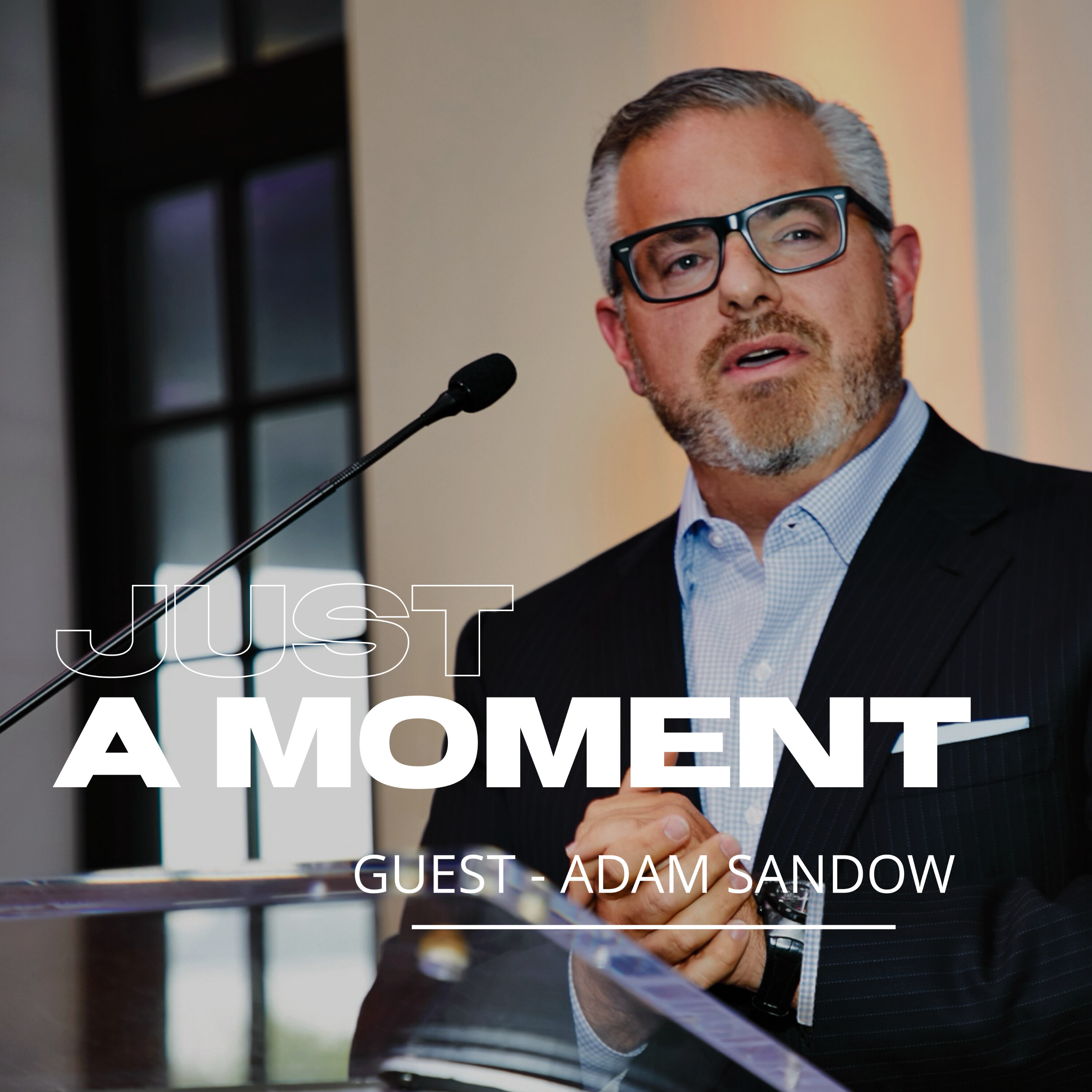
Hi, I'm Brant Menzwar and welcome to my show. Just a moment. As a former world touring musician turned keynote speaker and author, I've experienced my share of life altering moments that have both broken me and propelled me forward. How you leverage those moments or push through them will define your destiny. Each week on my show, I'll provide tools on how to maximize those moments as well as interview some of the most successful entrepreneurs, entertainers and athletes on how the power of a single moment changed their life. Join me to learn how to change what's possible for your life. It'll take just a moment. Today's guest is the media mogul and industry defining entrepreneur, Adam Sandow. As the CEO of Material bank and founder of Sandow Media, Adam has stayed at the cutting edge of the print media world. His story proves that risk taking, self determination and knowing when to pivot in a moment can change everything. This is his story.
- [01:02]
B
I'm Adam Sandow. This is my moment. I was born actually in Montreal, Canada, was there for the first six years of my life. But my parents, the moment they could, they packed up and went from freezing cold Montreal right to Miami. It was an incredible novelty to come home from school and jump in a swimming pool. They were both entrepreneurs. My father was always his whole life in the printing business. My mother worked with him and then she got more into the graphic design and kind of agency world. So she was the creative graphic design company. My father was the printing company. And I grew up learning design and printing from watching my parents. My parents were always relatively liberal, never pushing us. They wanted us to follow our own paths. I was honestly a terrible student, but my teachers would say we think the kid's brilliant, but he just doesn't pay attention. And I was busy daydreaming. Later I was diagnosed with dyslexia. There are some parents that just pushed the kids straight A's and everything else. I was never that kid, but I was really creative and really driven in my own way. I had friends that had incredibly disciplined, very tough parents and they were maniacs. And then here I was with all the freedom in the world and I was pretty straight laced.
- [02:17]
A
Adam's interest in creative pursuits mixed with the family business early on, so cementing a sharp aesthetic eye that would soon pair with a seemingly innate business sense.
- [02:28]
B
I loved drawing floor plans and I thought, I'm going to be an architect. And I loved architecture. Again, very young kid, maybe 10, 12, I remember my father brought me home these green plastic architectural templates and graph paper and I would Sketch floor plans and these extravagant, beautiful homes. I always liked nice things. But really quickly, probably 13 years old, I just became obsessed with business. I always had little enterprises, little businesses. I think my earliest one was literally selling custom sticker sheets. My father brought me a dot matrix printer. This is in the 80s, and I was selling custom stickers. So in school, I was not paying attention. I was busy taking orders for my custom sticker sheets at a dollar sheet. Business is hard, and they had good times and bad times and ups and downs and. But both of my parents were always entrepreneurs, and I had this incredible respect. My parents were their own people. My father was his own man. He didn't come home and say, yeah, the boss was tough on me today. He would say, yeah, business is tough, but I'll figure it out. That gave me this very clear path of, I'm going to be an entrepreneur. And so from those early days, having these little, tiny, silly businesses all the way up to starting to build actual real companies in high school, it was the only thing I ever wanted to do.
- [03:48]
A
Adam saw potential around every corner, Even in his high school days. His unique talent for problem solving and seeing things from a new perspective helped both him and his business prospects come out ahead.
- [04:01]
B
I happened to go to a really good public high school called Palmetto Senior in South Miami. In fact, Jeff Bezos was there a few years before I was. It just happened to be an excellent school, Great diversity of kids and really great teachers. And I grew a lot there. I got involved in clubs. There was actually a club called Future Business Leaders of America. I was still focused on business. I would think about it all the time, and what could I build? What could I start? The company I ended up starting is really the root of what I even do today. But before that, when I was looking at ways to either make money or be innovative, I remember distinctly there was a fundraiser. We were trying to raise money for our club, and the club happened to have a lot of people in it, and I was the president of it. And the fundraisers are typically selling candy bars and all these silly things. I remember that my father happened to come home one day and say, we're doing a really big project for one of their biggest customers, and it required a lot of hand work. It required collating by hand, and he needed to get it done quickly. And I said, I've got a really good idea. And I went to the principal and I said, I've got an idea to make a lot of money. And in a short period of time, can I Take over the cafeteria after hours. He said, sure. And we got every member of the club to go after school into the cafeteria. And my father brought the truck into the school. We set up 150 stations, and in the span of five hours, we had collated the entire project. And the money we made was more than we could have ever made selling chocolate bars. So that was me literally in 10th grade going, I'm going to take over the cafeteria. I'm going to bring in my father's project. And we raised in five hours what would take a couple of weeks. So I was always thinking like that. And I got known around school as someone that could make those things happen. My real entrepreneurial roots when I started to have a real business was when I was a senior in high school and Apple just invented the Macintosh and the laser printer. There was a computer store right near my house. This was back when the laser printers were $10,000 and no one knew what they were. I remember going home that night with a printout of that laser printer. And I showed my father, and I said, you have a typesetting department in your print company, and it uses film, and it's complex and it's messy. I said, look at the sheet of paper. You could type a line of. Of anything and format it and print it out, and it's print ready. And I said, anyone can do this. You don't need specialized people. And I was amazed. He was amazed. And I was able to buy that little computer from the store. I remember driving home, my car was full of accessories. I was so excited. But I couldn't afford the laser printer, so I made a deal with the store. I said, I'll pay you a dollar a sheet if I could come here and print out the sheets. And they said, sure. And I started a typesetting business. And my first customer when I was in high school was Kinko's. If you remember, Kinko's are still around. But back then when you had a resume, you had to go to a place like Kinko's for them to make it nice. They my first customer. And I. I think I got paid $25 to. To typeset a resume. And we got so busy that I ended up finding speed typists. And I said, look, I don't want to type this thing. You type it, put it on a disk, and I'll format it. And they were my first customer. And honestly, what I have today goes back to those early days of starting that little graphic design typesetting business when I was in High school. It was because I saw the disruption coming of what you'd call desktop publishing, which, you know. But in the mid-80s, that was revolutionary. I was able to catch that little wave and started my company.
- [07:45]
A
With his high school days over, Adam moved on to a college degree for a time. But in the literal and metaphorical heat of Miami, his entrepreneurial hot streak only got hotter.
- [07:58]
B
I started as a freshman at University of Miami and had my business, and my business started to really grow and I started to do other things. I am a incredibly impatient person, and when I feel like I've conquered something, I want to go on to the next thing. Very quickly, my little typesetting business quickly turned into a media company. We started a newspaper on Miami beach. Back again in the 80s, when Miami beach was just going through this renaissance. Miami Vice had popularized south beach, and it was the place where a lot of the cool New Yorkers and people back in the day would come down. So south beach was this incredible area, and I started a newspaper and I said, how hard is it? If I can do graphic design, I'll design my own newspaper. And I could sell ads. How hard is it to sell ads? And I went and I sold some ads. I still remember the first ad I sold. It was $700 for a full page. It was a big deal back then, and I had a newspaper. I was off with lots of employees and as a freshman doing all kinds of things. I ended up, even about a year later, owning a bar for many years on Miami beach. I was 19. I legally couldn't drink in the bar, but I owned a bar. We were one of the first bars on Ocean Drive. Back when Ocean Drive was just in Miami beach, just starting to become popular. And I had it for many years. I had an unstoppable appetite to candidly create businesses, create wealth. I knew that if I didn't do it, that it wasn't just going to come to me. I wasn't a trust fund recipient, so I knew if I didn't make it happen, it wouldn't happen for me. I am curious about an incredibly diverse array of things. And when you are focused on wanting to build, when you love business, when you're creative and you've got curiosity, you start to look at lots of things. I'm always looking at, how can we innovate this? How can we grow, what can we buy, what can we build? So I think it's just pre wired into the DNA. However it got there, it's the way my brain's wired.
- [09:55]
A
When you have massive success in your life. More than one moment can be a major turning point. As Adam's businesses were growing, school had started to take a back seat. Hoping for a solution, he got some advice that clarified his course of action. The flexibility he demonstrated served him well when his true moment arrived and he pivoted his business into something more profitable than ever before.
- [10:20]
B
After a couple of years of running my businesses and being a student, it was just getting to be a lot. I loved the school, but I was like a lot of college kids. They kept making you take these prerequisites, and I would sit in these classes, and I'd say, boy, I don't know if this is the best use of my time. I'm like, I'm gonna go talk to the dean and get credit. So I don't take these prerequisites because I've got a business. I'm here in business school. I said, he is gonna love me because I've got 20 employees, multiple businesses. They're gonna love it. I went into his office, and it was just coded in football stuff. And I'm like, oh, okay. I think I'm in trouble. I went in there excited. I'm like, look, dean, I've got these businesses, and this. I'm paying for school. And what can the school do to help me where I don't take these prerequisites because I love business? And he leaned back in his chair, and he said, son, you gotta be a businessman or a student. You just can't do both. I'm like, huh? I didn't think of that. I'm like, okay, I'm dropping out, and I'm leaving, and I'll go be a businessman. Thanks for the advice. And my 20s, I found myself building a really nice custom publishing company. And we were doing magazines for all kinds of people. Cruise lines, hotels, things like that. I got a contract with someone that had a contract with a cruise line, and they were making a book for the cruise line. He said, I'll sell the ads, and you just make the magazine. And we did. And I put a lot of care into the book. The book comes off the printer. I bring them to him, and I'm so proud of it. And he looks. He said, I got Adam. This is fantastic. What a great job you did. Let's go to dinner. Went to dinner. And I said, tell me about your side of the book. You sold ads? He says, yeah, we sell ads in the book. And I said, that's great. It's a great business. I said, how much money did you make selling ads? He said, I only sold 400,000 of ads. And I said, $400,000? I said, I charged you 60 and I made good money. There was an epiphany. I don't remember what else we talked about that night, but I left going, I'm no longer making books for anyone. I'm going to go get the contracts and sell my own ads. So we pivoted and started our own magazines where we owned the magazines, we sold the ads, and that was the beginning of my media business. And that foundation of those early days of that little laser printer all the way to my first real magazine really gave way to all of the companies that I own today.
- [12:49]
C
Feeling lost in the noise of social media, Inspo cuts through the clutter, connecting you directly with real insights from real experts and industry leaders. It's a new social network dedicated to knowledge sharing, industry insights and thought leadership. Get the latest from top minds in your field or build your own thought leadership portfolio on Inspo, already trusted by thousands of professionals worldwide. Be part of the conversation and download Inspo Experts today on the App store or visit www.inspo.x.
- [13:19]
A
Adam Sandow, welcome to Just a moment. This is a pivotal moment for us in our podcast, being with the mothership and having the captain of the mothership here with us. So thank you so much for joining us.
- [13:31]
B
Absolutely. Happy to be here.
- [13:33]
A
Your entire story from the time that you were a little kid is such an incredible story of being curious and finding a way to make curiosity a business and you continue to do that today. The world has changed and technology now has made the world so much smaller in so many ways. What's your advice to the young entrepreneur who says, I have this desire, but I have no idea which direction to go?
- [14:01]
B
I think a lot about this and I have some pretty strong views on that. There are two kinds of entrepreneurs and one is not better than the other. There are people that say, I don't want to work for anyone. I want to be my own boss and I'm going to figure out how to make money. There are so many ways to make money, right? Amazon resellers are one TikTok shops. It's amazing to watch and there's lots of content about how I can make money and I think that is something that was never available when I was a kid. There were certainly not these outlets to turn on revenue, to have distribution like the Amazon platform and sell things. If I'm giving advice to people, I think you have to be very careful. The challenge with those is that a lot of those, let's call them arbitrages, those easier things don't last. Amazon is extraordinarily brilliant for allowing a global platform of sellers. But really what they do is they let everyone do the long tail work. They find out really what's selling and then they decide we're going to maybe put that above you. And that's the power of Amazon, right? So you can make a living. But is it long term? And here's what I have had. This has just been in my brain. It's been something that I have focused on from the day I started and that is I only want to focus on businesses, on entrepreneurial things that are long term. There's easier money to just turn things on and it's never been easier to start a business. It's also never been harder because there are so many amazing tools. There are short term things you can do and I've done plenty of those when I started my business. And then there are long term things to do to build long term businesses. Think long term. It's harder by the way, but you want to build things, you want to put your energy into things that you can build on over a long period of time and build a great company. And you've got to make sure that you've got a really good business model. I'm fascinated by business models. There's so many incredibly smart business models out there and you can apply them to other businesses. I certainly think it's the greatest thing in the world to be an entrepreneur. Entrepreneur. It's very hard, it's really hard honestly to do it over 10, 20, 30, 40 years. It's very tough. But think long term, don't think short term. You can do some short term things to get the money in the house and do it that won't last. Remember there was a company called Turo that rents cars and people started buying cars and going, I'm in the car rental business. This is easy, I'll buy five rentals. That's the kind of short term thinking I think sometimes I worry about. Because when it's that good and there is an arbitrage to be made, it gets filled quickly. Whether it's private equity coming in, whether it's people with more resources and then you get a glut and then you get a prices crash. All those things. Go back to think long term, don't think short term. As an entrepreneur, if you want to build a lasting business, I love that.
- [16:59]
A
And I agree with you wholeheartedly. Especially the younger generations. They're watching the videos of people saying this is how I made $30,000 last month. And they're only looking at the short term because idea of generating money is not the same as generating wealth. I don't know, that's taught like it needs to be. The other thing that I'm curious of your opinion on, I grew up a child of the 80s myself with you. We weren't bombarded by different forms of media coming to us telling us what we should think or what we should do. We had to go out and be creative ourselves. But the thing that we were allowed to do back then that I just don't see today is we were allowed to fail. And we were allowed to learn from our failures so that we understood what it felt like when it hurts like hell when you don't get what you want. And I think we have an entire generation of kids now coming up into the workforce who've never been allowed to lose. What is your opinion on allowing and encouraging this younger group of kids now coming into the workforce to lose and to experience failure?
- [18:11]
B
I think failure is one of the most powerful teaching aids as long as you learn from your mistakes. As a young entrepreneur, especially when I'm starting out, I would take huge risks. And before I, I was married and had kids, my downside was I'm going to my parents house because I screwed up my business, I'm going home and I'll get back on my feet. I think when you have kids and you, you have responsibility, suddenly failure is not an option. But I think you're absolutely right. I think that the generation today is extraordinarily fortunate and also at a disadvantage because everything is coming through social media. It is wrong more times than it's right. It's jaded. It's all those things that everyone knows about social media. I think with AI now you absolutely do not know what's real. I saw something on social media, I fact checked it on Perplexity. Perplexity gave me the wrong answer that was scripted from a social media post. We are in such a different world today. I think all the time. If I was a kid with a phone and I saw these guys, I'm in a Lamborghini and I figured out how to arbitrage Amazon and I sold $30,000 of hair curlers. I look at that now and I'm like, amazing that you made that. That arbitrage hole will be closed in six weeks and there'll be another one. Maybe, but that's not A business. To your point, as a kid, I think I may have been enamored by that, and it would have motivated me, just like when I was reading the Forbes 400 and just hearing these stories of families and entrepreneurs. And I would be so motivated by that stuff. So I think it's hard for kids today because it all sounds easy. I saw a girl lying in bed eating potato chips, and she said, I'm going to show you how with one Airbnb, I don't need to work anymore. Now, her video wasn't, I'm building an empire. It was, no, I figured out how to quit my job because I figured out one great place for an Airbnb so I don't have to work. And I think it sends out the absolute worst messages in the world where a young kid goes, I don't want to work. Like, it never lasts. So I think that taking risks, failing, trying things, learning from your mistakes, especially when you're young, especially when you can fail five times and have a blanket, if you're lucky enough to have parents that will give you a couch to sleep on, that is what I think made a lot of people in the 80s. We need that.
- [20:30]
A
Agreed. Agreed. We always like to pivot before we finish with talking about a moment we'd like to revisit and maybe approach differently. I'm curious. Listen, you can't be an entrepreneur and not have some moments you want to go back to and try again. But is there one that stands out in your head as one that you're like, gosh, I wish I'd have another shot at that Now, I can tell.
- [20:53]
B
You, almost every setback I've ever had, there's a benefit to it. I try and always do that.
- [20:58]
C
Right.
- [20:58]
B
If I do a deal and it doesn't work, what did that yield me? We acquired Worth Magazine days before the financial crisis, right? Not the best time to acquire Financial magazine. But in buying Worth magazine, we figured out, how do we reach the richest people in the world? And we had this idea to build a distribution company that controlled all the distribution of magazines in private airports today. That's an incredible business, and it's such an amazing part of our business. I would have never had that idea had I not bought Worth and gone through all the headache of a financial magazine in that great financial crisis. For me, when I've had setbacks, nothing is ever perfect. I try and take learnings from it, and I always try and go back and go, here's the positive of what it is. I think looking back, the One thing, if I was going back in time, I think focusing on simplicity is something that I am bringing into every company that I own, that I start, that I buy more than I ever have. I think that simplicity is something that is talked about but very rarely executed. And there's so many great examples of companies that have embraced simplicity and companies that have taken simplicity and destroy their companies over it. So I think going back, if I speaking to my 20 year old self, I would really focus on, okay, keep things simple, don't over complicate them, don't let things get complicated. I think it's the reason Apple is Apple today, right? They created a product that is simple. The Macintosh was simple. The IBM PC was not. Some of the great companies in the world have built amazing businesses by focusing on simplicity. So that's a big one for me.
- [22:40]
A
I guess the last question I've got for you is what's that curious factor that you're going, maybe this is the next frontier. I know everybody's focused on AI. It's impossible to escape it at this point. But is there another frontier that you see out there now that's a big opportunity for you.
- [22:57]
B
Moving forward, I try and focus on guiding my companies and building businesses that are AI and robotic proof. And you can't forget robots when you talk about AI. What's amazing is we've had that ChatGPT moment, right? We have a billion users now. Everyone in the world has gone to ChatGPT and say, Write me a song in the tune of this with lyrics of that. And it's magic and it's a novelty and AI is going to change the world. Everyone knows that. I think in many ways. But I think what people aren't paying attention to yet is robotics. And the advancements of robotics are going to really change the face of the world in ways we can't yet imagine. When you have someone and there's a lot of robotics companies today, but when you've got Elon Musk saying we're going to make a billion robots at $20,000 a piece and if you've seen the advancements they've made in the dexterity of the hands and things, those things worry me. I try and focus on businesses that are both AI and robotic proof, meaning there's physical moats. There's a reason where I won't wake realize a robotic company or Google or OpenAI has taken my business and make it a free feature on their website. Because that happens, right? I think we're going into an incredibly exciting world I think we have to be very aware of all the things that are out there. I think robotics are going to be incredible. I think that there's some exciting things coming. I think there's going to be a lot of opportunities. I have a infinite curiosity about everything, not just about my world or what's in my lane. And I talk to people often and they have a narrow view on the world, into what they care about or interest them, and they don't go wider. And some of the advice I try and give people is be curious because there's so many interesting things out there, especially when you've got this incredible device, a supercomputer in your pocket, you've got these incredible podcasts. I strongly try and advise people to go way outside their lane every month, take a trade magazine from a different industry you know nothing about and read it.
- [25:06]
A
I think it's definitely counterintuitive to where we are as a nation, for sure. That I think part of the divide and the reason that we have these extremes growing every day on both sides is that we're not curious anymore. We only want to stay in our lane. We only want to double down in our lane. We're not interested in anything else. And I think this is one of the benefits of traveling outside of the U.S. right? If you never had that opportunity, you don't understand that when you go to other countries, in my experience, my wife's experience, they're much more in tune with what's happening in the world. Not just what's happening in their country, but when we come here, it's very much not even just what's happening in our country. It's what's happening in my state, what's happening in my city, what's happening in my neighborhood. We're obsessed, but we don't open the blinders enough to get more of a worldview. The work that we do, it's about building bridges to connect values, right? The two strongest forms of connection known to man are shared values and suffering. And if you are not going to provide opportunities to connect through shared values, then guess what? People are going to connect through suffering. What I love about what you do and what Sandow does is through your publications, through all the different organizations and companies that you own, you're really providing people an opportunity to connect through shared values. We're saying, gosh, here are the things that you're interested in, whether it's architect and design or it's one of the other fields. But the idea is you're giving people this opportunity to go, I'm passionate about this. I love this. And there are other people out there who feel the same. How much of that is driving what you're putting out right now as a, as an organization?
- [26:55]
B
I don't care what side of politics you're on. It's impossible to say that one side is wrong about everything or the other side is right about everything because they're absolutely not. And I personally will subscribe to the polar opposite media purposely because I want to hear both sides and I have seen people that I don't think I could have a thing in agreement with and they'll make a good point and it's insane, it's almost ignorant to go, well, they're wrong about everything and or they're right about everything. To truly be educated, if you don't really understand both sides of any issue and you don't listen and be reasonable on both sides, it's ignorant. And I think that's where the country is right now is we're just, you're right, you're left, it's all or nothing. That is a horrible way to be. It is not productive. It's not going to ever work. You've got to be open minded and be aware. I just don't think people are. I try and always listen to both sides, but not enough people do. It goes back to curiosity, it goes back to being open minded on things. It goes back to listening to other points of view.
- [28:03]
A
It is always listen. Adam, thank you so much for joining us on Just a Moment. It's been a pivotal moment for us having you here and just can't thank you enough for your time today.
- [28:13]
B
All right, great to meet you.
- [28:15]
A
Thank you for joining us on this episode of Just a Moment. Make sure to subscribe to our podcast and tell a friend or two about it to help spread the word so everyone can find a moment that inspires them. Don't forget to leave us a review and check us out on the web@justamoment podcast.com just a moment is produced by Natalie Von Rose and Brandt Menzoar. For more inspiring shows like this, visit surroundpodcasts.com.