Loading summary
Transcript27 lines
- [00:01]
A
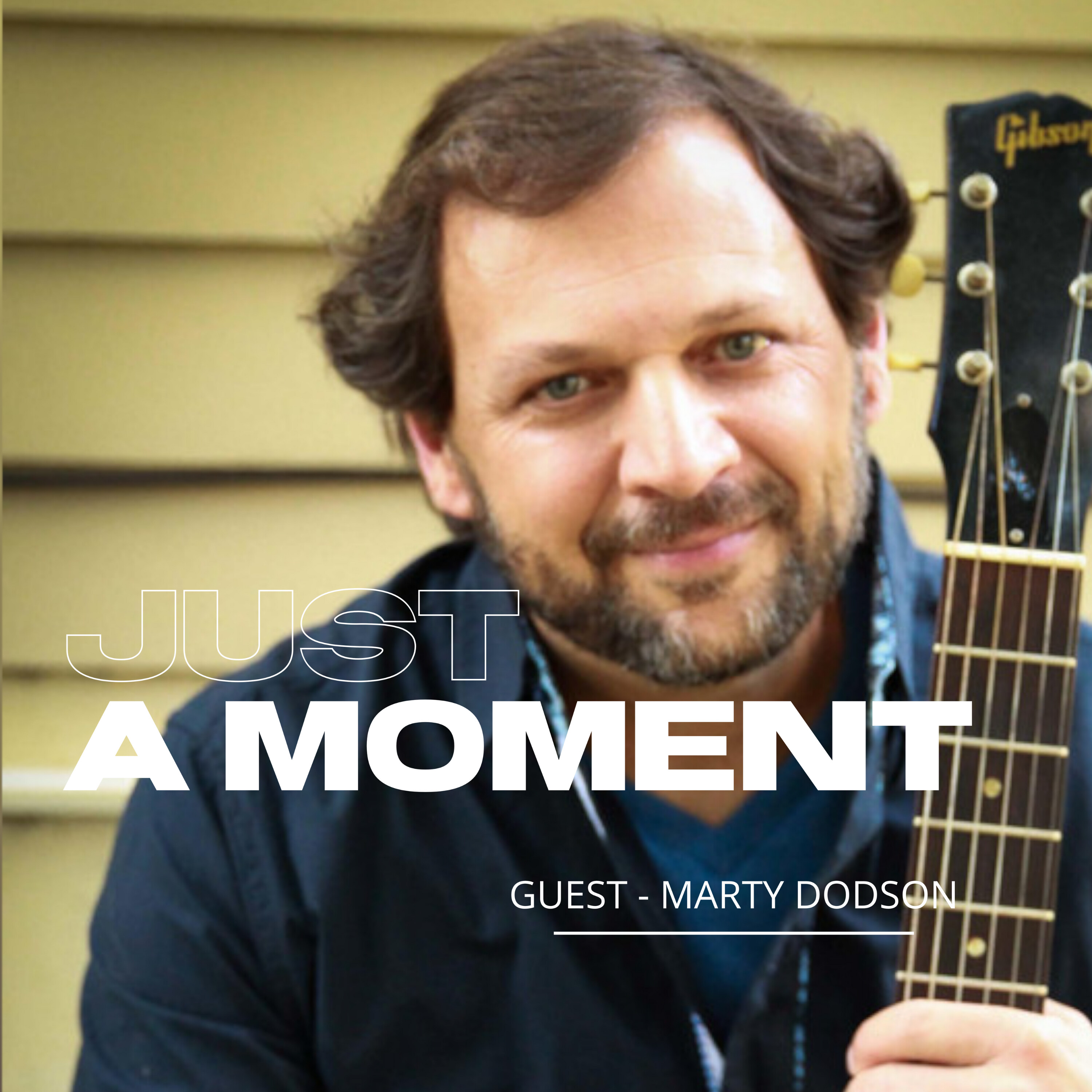
Hi, I'm Brant Menzwar and welcome to my show, Just a moment. As a former world touring musician turned keynote speaker and author, I've experienced my share of life altering moments that have both broken me and propelled me forward. How you leverage those moments or push through them will define your destiny. Each week on my show, I'll provide tools on how to maximize those moments as well as interview some of the most successful entrepreneurs, entertainers and athletes on how the power of a single moment changed their life. Join me to learn how to change what's possible for your life. It'll take just a moment. Today's guest has a discography that has gone every shade of metal a record can go. Marty Dodson has been writing number one hits in Nashville for decades. However, his path to success started far off. From a high note, from pain to triple platinum. This is his story. Marty, you're on.
- [01:01]
B
I'm Marty Dodson and this is my moment. I was born in California. My dad got out of the Air Force when I was about five months old and then we moved around a little bit, but we wound up in Nashville when I was five, so I count that as home. My dad was an industrial engineer, but he was also addicted to prescription medication, so he didn't work a lot. He worked off and on because he would get fired at jobs and things like that. My mom was a registered nurse, so she supported the family of one brother. He's a computer programmer. We led polar opposite lives. So when we were growing up, I would be outside playing with friends, filming my own movies and things like that. And he would be inside messing on the computer because of the drug addiction stuff in the family. I felt in a way, at 12 years old or so, I was the man at the house. I had to take care of mowing the grass and all the things that a dad might typically do in that regard, was responsible for my brother a lot because my dad wasn't capable of watching him and my mom was working and things like that. I felt a lot of responsibility on me and so therefore I tried to not cause any trouble. So I was very compliant, made great grades, just tried to be easy on my mom.
- [02:09]
A
Marty's academic abilities translated into creative prowess and quickly became an emotional outlet for the struggles he faced at home.
- [02:18]
B
One of my grandmothers, she lived in Michigan and she would send me blank notebooks and ask me to fill them up with my poetry or writing. So I would write short stories and I would write poetry and then I would send them to her and she would get them published in her little town newspaper. When I was 11, I got my first guitar, and I really loved that. I loved writing songs. I found a spot on the stairwell going down to our basement that had natural reverb. And so I would sit on the fourth step and play my guitar and write songs, and that kind of became my voice. I felt like in my family, there was a lot of things that were out of control. And so my songs and my writing were my way to express my voice so I could express my anger toward my dad, or I could express the crush I had on the little girl up the street that I was checking to talk to, all those kind of things.
- [03:08]
A
Though Marty had a passion and talent for songwriting, it wasn't the first path he followed. His university days set him on a practical course, which satisfied him for a time before he was sent spiraling.
- [03:21]
B
I didn't even know, really, that being a songwriter was a job that you could do. I knew that everybody working on our air conditioner or installing our cable in Nashville was trying to be in the music business. I didn't really know how it all worked. And so when I went to college my first semester, they had a commercial music class, and I took that, and it was fun, but it was also taught by a realtor. And I'm like, okay, this guy's not even making a living with music, so maybe that's just not a thing. So I really gave it up for a long time, and I finished my degree in college. I was working as a youth minister in college and just kept getting offered jobs to do youth ministry after that. So I wound up doing that for about 10 years, and then waking up one day saying, this is not what I chose to do. I just fell into this. And it was easy to keep doing it at an early midlife crisis. It was really something I wrestled with because I thought, I'm doing good things, I'm helping people. And so maybe it's selfish of me to want something different for myself or to get out of it. But also, at some point, I started having the realization that a lot of my job is putting on a good pizza party for the teenagers so the parents can go out to dinner, and that's not life changing for them. And so I started evaluating what percentage of my time is actually spent doing something that makes a big difference that somebody's going to remember in 10 years. And it was a very small percentage that I came up with. And so that's when I started trying to figure out what else I would do and at that point I had three young children. And so I was having to spend time away in the evenings with other people's kids, missing time with my kids. So I read a book called what Colors yous Parachute on finding your passion and then finding out how to make a living with your passion. And when I finished that book, I thought if I could have done anything, I would have been a songwriter. So let me see if I can figure that out. I had a conversation with my now ex wife about what things would look like. And she said maybe if you want to try the songwriting thing, give it a couple years. And she was a pharmacist. She had been working part time because my salary was not very great as a youth minister. And so she was able to work more hours and make up for the income we lost. And then I did some part time jobs, edited a magazine and I helped build computers for people sometimes and stuff like that. So it was just tag team parenting. And when she was working, I was home with the kids. When she was off, I was trying to write and make connections and do all those things. So it was a really intense time in a lot of ways and a lot of pressure and it didn't happen in two years. And that caused some conflict. So yeah, it was just trying to figure out how to make things work.
- [06:05]
A
As Marty's moment to shine rapidly approached, he had to make a drastic mindset shift so that his desire to pursue his dreams became a need.
- [06:15]
B
I was on vacation last week and I'm reading a book called Not Nice. And basically it's about stopping people pleasing. And it talks about the level of commitment that you have toward what you're doing. And it starts at trying. What the author was saying was, when you're trying, that's great, but when you hit that first big obstacle, you're going to quit. But the other end of the spectrum was whatever it takes. And so this moment was my moment where I shifted from trying to whatever it takes. And that's why it was so pivotal for me. After I'd been trying the songwriting for about two years, a friend from church asked if he could take me to lunch. So we went to lunch. Turned out to be really an intervention. And I still don't know if my ex wife talked to him and said, would you please get him to do this? But he offered me a job at his company. And it was making more money than I had ever made. It was benefits, lots of security, but it was writing manuals for small appliances like toasters and things like that and I really had to do some soul searching because I go, okay, on one hand, I've got this family that this could be much more secure thing for. But I also have this dream. And if I'm going to chase the dream and turn this down, I've got to do whatever it takes. And so I decided to turn it down. And at that moment, I put a nail in the wall at the end of our hallway, right by our bedroom that was going to be empty until I got a gold record to put on it. Every day when I walked down the hallway, I would see this empty nail, and I'd be reminded on that day, I believed I could do it. Because I turned down that job. I had enough belief in myself that I knew I could do it. On the days when I was doubting and I had something almost happen and it fell through, I could look at that nail and go, okay, are you still willing to do whatever it takes? Do you still have that kind of belief or not? I think just that shift of mindset to the whatever it takes model gave me a determination level that I had never had. I learned not to judge my progress by outside forces, but to look at inside things to see. So instead of comparing myself to other people in our office that were getting songs recorded and being more successful, I'm looking at my songs going, okay, your songs are way better than they were a year ago. I think in some ways, the nail inspired this holy fear in me of being a failure at that. I didn't want to have to take that nail out of the wall someday and throw it away and know that I had not done it. I've read somewhere that a lot of times we don't make change until the fear of staying the same becomes greater than the fear of failure. And I think that's where I was. I was like, I want to stay the same, and so I'm going to risk failing. And maybe that hurts, but I don't think it's gonna hurt more than staying where I'm at.
- [09:08]
A
After five years of trying, Marty's new all or nothing mindset finally bore fruit with a song that became a mega hit.
- [09:17]
B
It was called I've gotta find you'd. It was on a Lone Star. A country band had this record. They were on the verge of losing their record deal, and they put out one song, and it tanked. And they said, okay, we're gonna put out one more. See what happens? And they put out a song called Amazed that was monstrous. And so, ironically, I wound up getting in quick succession, I got, like, a gold record for that song on that album. I got a platinum record, I got a double platinum, and I got a triple platinum, and I think now it's 4 or 5 platinum. So I was able to hang that gold record on the wall and get that particular monkey off my back. I think in my mind, I thought, okay, maybe another year or two at the most. I'd already been doing it two years, and just the intestinal fortitude it took to keep on believing was challenging in some senses. If I had known that, I don't know if I would have done it. But if I could go back and say anything, I would say, buckle up and do what it takes. Keep on.
- [10:16]
A
Years later, Marty has the benefit of hindsight to look back and has a clear mindset and solid advice that might benefit someone trying to break through in Nashville or any with lofty dreams.
- [10:27]
B
I think you have to realize that Nashville didn't call and request that you come. There's not going to be anybody going, hey, I'm so glad you're here. We don't have enough singers or enough songwriters, and so you have to earn your way into the circle. And the circle is not trying to keep talented people out, but the circle is trying to keep people out that think they deserve it. With little work and looking back on my career, most of the people I wrote with in the beginning are not in the music business anymore, and it's not because I was more talented. I believe I outworked them, most of them. And I just. I didn't give up. I didn't let colossal disappointment cause me to just throw in the towel. And I've seen a lot of people do that. They'd be, like, so close, and then something disappointing happens, and they're like, okay, I'm done. So I think just understanding that there's going to be people way more talented than you here, there's going to be people way less talented. But what's going to be the determination of your success is going to be how hard you work, because you know you can have less talent and work harder and pass those people by.
- [11:33]
A
Welcome to just a moment. It is so great to have you here. Marty and I go back a long ways. We've written many songs together. And let me say this straight up front, bud. When my son died, and I was in a really, really bad place, and I've never had a chance to thank you for this. You reaching out and asking, you want to write some songs together? You want to. To do some Licensing stuff together was a lifeline for me that pulled me out of a really dark place. So I've never had the chance to thank you for that, but thank you so much for doing that.
- [12:06]
B
You're welcome.
- [12:07]
A
It means everything to me. I love you, and I'd go to the ends of the earth for you. And it is something that is not that I. That do not take lightly because it was a major factor in getting me out of a really bad spot. So thank you for that. First of all, the nail on the wall. I do not have the balls to hammer a nail on the wall and wait for my Go record right now. I wish I did. Maybe if I had that fortitude, we would have gone a little bit further in the music business. We did it for almost 20 years, somehow finding a way to make a living at it, yet not having anybody know who we were. And so it was a weird place. But being able to work with people like yourself who just are incredible. You're incredible at what you do. I think your psychology de comes in so much into what you do today in the songs that you write, but also in the working with artists and working with other songwriters. Would you agree that happens a lot?
- [13:04]
B
Yeah, absolutely. One of my publishing deals, after we signed the deal, the publisher said, no, I don't want you using any of that psychology on me. And I said, too late. And he was like, what did you do? Oh, I love it.
- [13:16]
A
One of the things we love to do here, after revealing this incredible moment, which honestly should be inspiration for anybody who wants to be a song songwriter, we always like to talk about a moment we wish we could get back. And sometimes that moment is something we'd like to do differently. Sometimes that moment is just an incredibly powerful moment that we want to relive because it was so incredible. But I'm curious for you, is there a moment. I'm sure there are lots in one way, of regrets and that sort of thing, but is there a moment that stands out that you'd love to have another shot at?
- [13:47]
B
I'm not big on regrets, so there's not a lot of things that have done that I would like to do over. But there's a period in my life that I would wish I could change in a way. One point, I read a book called no More Christian Nice Guy, and I thought, that's an odd title. But the point of the book was that if you grow up in Christian tradition, a lot of times people, especially men, are taught that you're supposed to be passive. You're supposed to turn the other cheek and all of these traits. And I realized I had done a really great job of that at the expense of my family. And so the way that had played out was in publishing deals. Up to that point, I had taken the approach of like, I'm nobody. I don't have much leverage. I can't negotiate a better thing for my family here. And so I had just taken whatever was given to me instead of standing up for myself and demanding what I felt like I was worth. And I think a lot of it was devalued impression of what I was worth. Who am I? I'm just a beginning songwriter. I'm a beginning songwriter that they believed in enough to spend money on me and to sign me. So there's some leverage I have somewhere I don't have to just take whatever horrible deal they give me. And so I began applying that to amazing results. I went into a publisher one time, I had a big hit song, and I didn't know any of my publishing, which means the publisher got a lot of money from that song. And I went in and I said, hey, I made you a lot of money, a lot more than I've cost you. So can we talk about a copub deal? Which would mean I would, on the next hits, get more money. And he said, no, we'll wait until your deal's up and then we'll renegotiate. And I said, no, we'll negotiate now or I'll quit riding for you. And he said, okay. And it really took him back that I would stand up on myself because I'd never done that. And I began doing that in my relationship with my ex wife. And one of the things I realized is that when you start changing the dynamic, other people don't like it a lot of times. So my wife did not like me standing up for myself. She liked to be able to manipulate me or push me around into what she wanted me to do. And so that caused conflict, and it caused some conflict at times at work. But what I realized was that every time I stood up for myself, not in an ugly way, but I just stood up for myself. I came out ahead of where I started. And that period of my life when I was just letting other people push me around and dictate what I did is what I would change.
- [16:23]
A
So I'm curious because I'm sure there are a lot of people who want to do that, but when they attempt to do that, emotions get involved and it makes it hard to maybe get your point. Across without being emotional about that. I think this is one of your superpowers and I don't know if it's the Southern Nashville gentleman in you that just is even keel. And nobody knows if you're incredibly upset or incredibly happy because you're able to play it either way. What, what is your advice for somebody who wants to stand up for themselves but may be afraid that the emotions will take over and put them in a worse place?
- [16:59]
B
I'm a type 8 enneagram and I think anger can be my first emotion no matter what I'm feeling. It may be that I'm hurt, it may be that I'm sad, but anger is what I feel. And that book helped me understand I don't have to be angry when I present my standing up for myself. I can be calm and do it, but I don't have to back off of it. And other people get angry. So if I would stand up to my ex wife, she might blow up. She was a person who would throw things and scream. But if I could just stay calm and say, I'm not going to participate in our relationship in that way anymore. I want to have calm, reasonable discussions and you're not going to blow up so that I change my mind and I give in to what you're going to do. So you go do what you need to do. I'm going to be here doing what I need to do and I'm going to stick to what I told you. And just learning to present it in that more matter of fact way I think was helpful. And also understanding that I can't control anybody's response. All I can control is what I do.
- [18:07]
A
I guess I'm curious how it works with you now. The young Marty writer who comes in with maybe a little bit of success and starts to learn to speak up for themselves. Fast forward a couple of decades and now we've got 10 number ones and we've got all this success. What's the difference of that guy walking into a room now? Because you're pretty much on your own now, right? You're not in the traditional publishing deal like, like a lot of people are, especially when they first get to Nashville where they're writing for somebody else. You're writing for yourself now and get to pick and choose who you want to write with, who you want to partner with, who you want to pitch the songs to. How does that manifest itself in your life now? Knowing that wasn't what existed for most of your career up until you made this change?
- [18:50]
B
I think it gives me a lot more peace, a lot more calm confidence. I have seen what standing up for myself looks like, and not just professionally or relationally, but emotionally. And saying, hey, you're not going to treat me this way, or, hey, when you quit screaming, we can have a conversation, but I'm not going to sit here and listen to that. That kind of thing. I've just seen the benefits of that to the point that it doesn't bother me anymore or frighten me to stand up for myself. So if I got a cut on a huge legacy artist one time and the producer called and said, I think you should give me 15% of your publishing because I did a cool guitar solo on it. And I was like, no, you copied 85% of our production, so if you want to give me 85% of production money, you can have 15% of publishing money. And he just said, we're not going to do that, and hung up. And nothing happened. Just those kinds of things. It's become easier to just go, no. One of the most important things I can do is keep myself emotionally, physically, spiritually healthy. And part of that is that I've got to be my own advocate. My first publisher, one time, I was complaining about one of our song pluggers. They're the ones that go out and try to place the songs and get an artist to do them. And I was complaining that he had not gotten me any activity or cuts. And he said, marty, nobody's going to work harder to make you successful than you. So you get out there and pitch your songs and see if you can get them cut. And when I started doing that, I'm like, oh, this is hard. It's a hard job. And that just that attitude of owning my feelings, owning what I need, and not feeling guilty to. To say, here's what I need, or here's what I'm going to tolerate.
- [20:39]
A
That's amazing, bud. Listen, if somebody wants to continue to follow your journey, what's the best way for them to do that?
- [20:45]
B
I think if I'm Instagram is probably the best way. And it's at Marty Dsongs. So M A R T Y D S O N G S on Instagram. I'm on Facebook, I'm on LinkedIn. I think just under Marty Dotson on those places, but those are the best places. And then I have a podcast on YouTube called Songtown on songwriting, if anybody's interested in songwriting.
- [21:07]
A
Fantastic. Listen, bud, I look forward to many more songs written together, and I can't thank you enough for joining us here on Just A Moment.
- [21:15]
B
Thanks for having me.
- [21:16]
A
Thank you for joining us on this episode of Just a Moment. Make sure to subscribe to our podcast and tell a friend or two about it to help spread the word so everyone can find a moment that inspires them. Don't forget to leave us a review and check us out on the web at justamomentpodcast. Com. Just A Moment is produced by Natalie Von Rose and Brandt Menswaer. For more inspiring shows like this, visit surroundpodcasts. Com.