← Just A Moment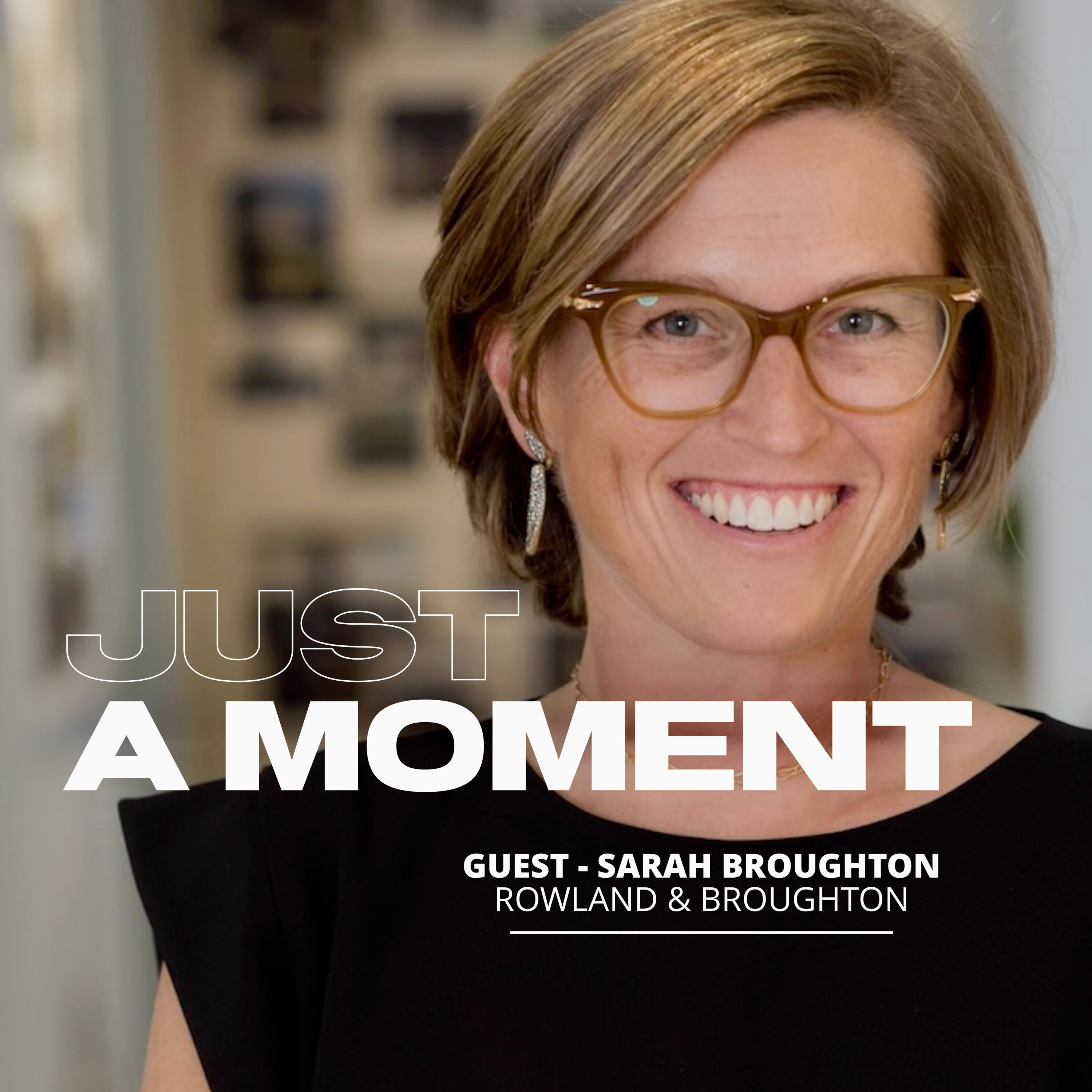
Loading summary
Transcript55 lines
- [00:01]
Brant Menzwer
Hi, I'm Brant Menzwer and welcome to my show. Just a Moment. As a former world touring musician turned keynote speaker and author, I've experienced my share of life altering moments that have both broken me and propelled me forward. How you leverage those moments or push through them will define your destiny. Each week on my show, I'll provide tools on how to maximize those moments as well as interview some of the most successful entrepreneurs and entertainers and athletes on how the power of a single moment changed their life. Join me to learn how to change what's possible for your life. It'll take just a moment.
- [00:39]
Podcast Host
Today's guest is Sarah Broughton, a Colorado.
- [00:42]
Brant Menzwer
Based globetrotting powerhouse and co founder of Roland and Broughton architecture and interior design firm. In her story, a thirst for adventure, inspiration and innovation mixed with a fierce sense of tenacity, grit and respect for one's roots. This is her story.
- [01:00]
Sarah Broughton
I'm Sarah Broughton and this is my moment. I'm originally from Portland, Oregon, where I lived the first 18 years of my life. I'm the youngest of three children. My siblings are five and seven years older than me, so I was definitely on my own a lot. I was fortunate enough to have two parents that were together their entire lives. So had a very nice solid family, just a very supportive environment. I was never told that there was something that I couldn't do. I was encouraged to beat to my own drum and forge my own path, which I'm incredibly appreciative of. I come from a really old Pacific Northwest family. My grandfather had a lumber mill along the Columbia river with a nine mile flume that connected the upper mill to the lower mill and that was built in the 20s. It operated till the 80s. So the huge entrepreneurial spirit, engineering spirit, the can do attitude, I think always stuck with me. And then we were very close with my mom's parents who had less entrepreneurship but very dedicated loyal workers and just a lot of grit.
- [02:10]
Brant Menzwer
Art manifested itself as a love of Sarah's at an early age. In retrospect, she sees the inspiration her environment had on shaping her love for not only art itself, but but architecture as well.
- [02:22]
Sarah Broughton
I would take classes at night at the Oregon School of Arts and Crafts at the Portland Art Museum. And so I was always trying to grow and expand my knowledge about art and my making, photography, ceramics, life drawing. So that was something that I was constantly doing throughout middle school and high school. Looking back now through my career, I was always drawing floor plans. I was always very curious about space and obviously Legos. I took over the entire Guest bedroom with full cities of Legos. But that was always something. I was very spatially aware. And growing up in a city like Portland, Oregon, is pretty fantastic. We spent a lot of time Downtown, and Ian McCarr had designed these amazing park blocks. And it has the largest urban forests coming into its city. So there's this great mashup of great urban design and nature. And so that's something that super influenced me in my career. So it's been a good combination. I also was lucky to grow up in a 1920s English Tudor house, which was super formative for me today, even when we're designing homes, because there was such a rigor to the plan and every room had multiple ways of getting in and out of it. There's great porosity, great floor plan, just great tradition of that time. 1920s was a great time for home design. And so that's something also that stuck with me.
- [03:47]
Brant Menzwer
The idyllic nature of her upbringing, while inspiring, would be shattered when Sara got to college.
- [03:53]
Podcast Host
She would face new challenges and start.
- [03:55]
Brant Menzwer
A new journey altogether.
- [03:57]
Sarah Broughton
At school, I got injured from playing tennis. I had a pretty bad rotator cuff injury, so that was a real setback. I was playing Nashville. Tennis was definitely part of my identity and who I was. So that's where I really focus back into art and really leaned into a lot of these courses. And I had good success at it. It's something that comes naturally to me. Obviously, you have to work at it. Probably the most formative thing for me is in high school, my dad has financially gone through some really rough patches, and I was picking up the phone for creditors calling. Since I was the youngest child, I was the one at home really seeing what was going on. And then when I went to University of Colorado, I was getting notices that my college tuition hadn't been paid. So I had to roll up my sleeves, go to banks, and put myself through college. And that was something that I think was one of my bigger struggles in life, but also one of my biggest gifts, where I really had to not rely on people pretty early age and still love them and love the background that they gave me and all the opportunities. But now it's my time at age 18, to really do it on my own. I feel very fortunate that I had that opportunity to do that.
- [05:08]
Brant Menzwer
Beyond financial woes, freshman year would come with additional challenges. The rigors of her coursework. In an unexpected accident.
- [05:17]
Sarah Broughton
First Architecture Studio. I was like, this is intense. I don't think I'm ready for this. I need to be a freshman in College, and I need to have fun and do that and get that out of my system. So I did. So I put the architecture degree on hold. I took electives and just really enjoyed living in the dorms, being in college, making a great group of friends. And then the summer between my freshman year and my sophomore year, we had gone to Grateful Dead concerts in Las Vegas, and we were driving back in the middle of the night and we actually flipped our car and got into a really serious car accident. Everyone lived, but that was a real change. Like, that was something that was unexpected. I was gonna be living with my boyfriend at the time in Nantucket for the summer, washing windows, living with his parents. So I ended up living at home and just recuperated and took long walks and gardened and worked at Outward Bound. So that was a big pivot. And then when I came back sophomore year, I was really dedicated and focused. I was like, okay, that was a life altering event that just happened. I think I want to be an architect. Had a ton of fun, loved architecture school. The studio culture was really intense and really beautiful all at the same time. You're going through this amazing program together. You're growing, you're learning, you're getting critiqued. So I just. I ate it up. I embraced every moment of it and felt like I had a talent at it. So started the first studio sophomore year, and I immediately met John Roland, my husband. So I've been with John since I've been 19 years old, which is crazy. We've been married 26 years. We've been together 32 years. And so that was college.
- [06:57]
Brant Menzwer
After school, Sarah's adventures were only beginning, and she'd be heading a lot farther from her Oregon home than Colorado. Architecture would take her to some of the biggest and most competitive cities in the world at some of the most chaotic periods of the 90s and early 2000s.
- [07:15]
Sarah Broughton
So after school, I did an internship at EDAW, which is now Aecompany and down in Denver. So I would take the bus to Denver from Boulder and I would do a couple days a week of internship at edaw. And they at the time had a summer internship program where you applied. You would get placed in different offices. And so I applied and I got placed in their Sydney, Australia office. John came too. John worked at another office. And we both were on competing teams for the 2000 Olympic Village. We spent four months there, and then we were coming back to the United States and we were like, where do we want to go? And so he reached out to who he had Working with. And he said, you really need to go to Cooper Robertson in New York City. They are doing the best master planning right now in the country. They had just done Battery Park City. They had done Celebration with Robert Stern. They did watercolor, et cetera, et cetera. So we packed up the car, drove across the country, landed in Hoboken, where we lived the whole time we were there. Lived on the floor of our friends for two weeks while John started his job and I applied for jobs. And I first started working in New York with Sidi Nilsen. She's an amazing landscape architect and at the time was working on the west side highway, all the parks on the piers. So I was doing illustrations of all those parks. And it's so amazing to see them today and how they've just transformed New York City. I had thought I really wanted to be a landscape architect. That was something that was really interesting to me. But then I realized pretty soon in that I can do landscape really easily. While being the architect, I quickly pivoted and got a job with Clement and Halsban. I worked with them for a little bit over three years. And it was amazing, just working on great projects. Living in Hoboken, taking the PATH train into Chelsea every day. John was taking Lincoln Tunnel. Poor guy had to go through Port Authority. And you know, that was not the way it was in the 90s. No way where he worked. If you left work after midnight, you had to take a car service because of the amount of prostitutes and drugs going on. The 90s was a cool time to be in New York. It's always a cool time to be in New York. We were hustling, we were like really cutting our teeth and we were working hard. It was great to be around other like minded people who really were practicing to get good. And definitely the kind of firms that we were working in, that was the ethos at that time. But everyone was doing it, so you had community around it. So it was fun. And again, have lifelong friends from that experience of working so intensely together.
- [09:50]
Brant Menzwer
But the fast and gritty life of New York city in the 90s started to grind on the young couple. Their dreams and ambitions needed more land and more space to breathe than could be found in the clustered streets of Manhattan. Their expansive era needed to happen Westward.
- [10:08]
Sarah Broughton
After being in New York for three and a half years, it was really John, he was over it. He was like, I need to leave. I need to get back to nature. This is not what I want to be doing. This urban concrete grind on a daily basis. So we researched and determined that Aspen, Colorado would be the best place for us to come. Coming back to a mountain town. We were not licensed at the time. And at that time, the architecture license exams were nine exams and you couldn't take them remotely. So the only place you could take them was in Denver. Came here, started working for great firms, got licensed, did our exams. And what we learned from that experience is how can we be in control of our destiny a little bit more. And so it really pushed us to think about starting our own firm. In 2003, we started Roland Broughton from our one bedroom condo, from our kitchen table. And our big mantra in the beginning was build a portfolio. We cannot rely on the work of the firms where we just were. We need to show people what we can do on our own. So we just were cranking out condo remodels and just getting great work done. So we went down to Denver and we bought a live work loft. At the time that was kind of an unknown thing. And even it was hard for banks to even give loans on that. They didn't really understand them. But we found this great live work condo and immediately hired three people and it was cool. It's really important. You want to grow and then you want to sustain. Then you want to grow and you want to sustain. If you just grow, it's going to be challenging. So we've really had those moments of investing, of growth and then you have to sit with it for a while and you got to try it out, you got to see is this working. And also at the end of the day, we treat every client like it could be our last and we treat them like they're our only client. And so we're heavily involved. Even though we have a team of almost 50 people today, we are heavily involved with our projects to make sure that our clients are getting the best design with unparalleled service. So how do you make that a norm? It takes incredible focus and grit and follow through and communication and anticipation, all the things. So yeah, so for the last 23 years, we've just been incrementally growing to where we are today.
- [12:27]
Brant Menzwer
Beyond creating new projects, Sierra is equally interested in paying homage and respect to the architects of the past.
- [12:35]
Sarah Broughton
So historic preservation has always been a really important thing for us. We do a lot of historic projects. We believe in it, we believe in legacy, we believe in stewardship. We feel we're here for a short time. So it's our job to make it better. And for the next generation of I was on Aspen's Historic Preservation Commission for eight years. I was chair of it for two. And so getting involved early in our careers with these commissions. John was on planning and zoning. He's been on master planning commissions. Was also very formative because it teaches you how to be a quick study. You have to know the code and you have to learn how to speak with people in a succinct manner that is kind yet firm.
- [13:18]
Brant Menzwer
Sarah's moment is seemingly small, but as so often is the case, what seems to be a little moment from the outside looking in is in fact something that had a huge ripple effect. All it took was one person saying yes to believing in Sarah's company for a rolling snowball of successes to pick up speed.
- [13:40]
Sarah Broughton
I remember, well, when we were first starting out at our kitchen table, we had a client, he was like banging his fist on our kitchen table and going, we're gonna remember when we were sitting at your kitchen table working together. And that was like, wow, that's like cool belief in us, right? I remember we were talking to another client at the time and he said, the biggest advice I'm gonna give you is invest in yourselves and in your business. Really. Years and years ago, we made a choice that we want clients that mentor us as much as we mentor them. And that is an approach. And when you go in with that kind of open heartedness and humility, it's an awesome relationship to have. And again, we are so lucky to work with amazing people that are accomplished in their fields, accomplished in life, and they're willing to share if you ask them. There's a huge humility to myself and to John and to the practice that we have that we bring in to every day. But that's coupled with a great confidence with what we do because we know we do good work, we know we have a trusted process, we know we're going to exceed expectations, we're going to delight you. And so I think it's a good combination to always have. I asked John this morning, I go, john, what made you confident in me as a partner? Because I actually have never asked him this as a business partner. And he just said, he goes, I just know that you are so enthusiastic to grow. Like you don't approach anything without a complete growth mindset on everything that you're doing. And I think that comes across as very genuine to our work.
- [15:25]
Podcast Host
Sarah, welcome to just a moment.
- [15:29]
Sarah Broughton
Thank you, Brandt. I'm so excited to be here and thank you for including me when I.
- [15:33]
Podcast Host
Get a recommendation from somebody that I love and respect. It always moves to the top of the pile. Our friend John Jantz is so amazing. And he was like, you've got to meet Sarah.
- [15:44]
Sarah Broughton
John is amazing.
- [15:45]
Podcast Host
He really. He truly is. And I took a deep dive into your work, what you do, how you do it. And I just. There's a couple of things, even in your moment here that you talked through in these several moments that you've had some interesting things for me that you said in the growth, this idea. I think that people think if they're looking at a graph, they just want it to be this. Just this consistent line that just goes up and just to infinity. It never really does anything. But this concept of going up and stabilizing and then going up and stabilizing. My wife has always said to me, one of the things she loves most is, I'm a rising tide.
- [16:26]
Brant Menzwer
Right?
- [16:26]
Podcast Host
I want to help other people. I want to make sure that if I make it to that next level, I want to pull some people up with.
- [16:32]
Sarah Broughton
Absolutely.
- [16:33]
Podcast Host
And she says, here's the challenge, is that your first instinct when you get to the next level is to reach down and pull someone else up. But if you don't take enough time to steady your feet, the chances that they pull you back down are far greater than you moving forward. And so you've got to give enough time to stabilize. And then when you reach down, you can pull up a group of people.
- [16:54]
Brant Menzwer
Not just a single person.
- [16:56]
Podcast Host
And it sounds to me like that's how you have approached your growth as well, where you've got to have a little bit of a solid foundation at that next level before you try to help raise the community, if you will.
- [17:08]
Sarah Broughton
Yeah, no, it's super important. It was. It was literally a graph that we saw super early in the formation of our firm. And it just resonated because that's not instinctual at all. To me, when you're an entrepreneur, you are. You're generating a ton of ideas. You're going a mile a minute. And so you really need to surround yourself with people who help you steady. Like I said, it's not instinctual. So we have been very deliberate about that. I remember multiple years ago, we decided to steady with profitability or even go down a little bit with it, because we really wanted to focus on our culture, and that was a very deliberate decision. And just go, okay, we need to slow. Slow our roll right now, and we need to really shore up our team, like you're saying, and really work on that. Doesn't come easy. We definitely have to bring in experts to help us do that. And. And every time we do, we're more thankful with that process. But life doesn't push you to that, especially in this day and age with tech and just these startups. And we're in a service industry where it's a very different animal, Especially being in Aspen.
- [18:20]
Podcast Host
You have to have Da Vinci level creativity and you need Ritz Carlton level service. Those are not the same worlds. How have you married those things? Because the creativity is so important when you are in a community of people. I don't want to say looking to outdo each other, but to a certain extent, everybody there has reached a certain level of success that they have this expectation of fit and finish no matter what the product is. But then that service component that you have to be able to produce on or one bad experience could turn into tanking the entire firm. Because, you know, that level of wealth have a lot of influence.
- [19:08]
Sarah Broughton
There's two things I think that are incredibly important. One is anticipation, and the other is being perceptive. So at our level and what we do, we have to be anticipating constantly. That takes energy, that you have to be rested, you have to be thinking for people constantly. And that is something that we talk about on a daily basis with our team. So in order to be a good anticipator, you have to be looking for things that are not obvious and you need to be looking around corners and you need to be thinking about, you know, you gotta have your ear to the ground. And so that I think with those two combinations, and it's something that, humbly, I will say I'm very good at and I coach our team at that. And John's very good at that also. That is an awesome combination when you can figure it out, because no one's perfect, nothing's perfect. And Lord knows, the construction process is far from perfect. Nor is the design process. The design process is gray and it's highly competitive. The world has great designers and you pick up any magazine, you pick up any Instagram, anything. And it can be overwhelming. And so you just. We say this to our team all the time. What's ours to do, what is ours to do and stay true to our design ethos and what our process and what we think is the right response to the set of problems or the set of opportunities that are being presented to us. And that takes discipline. We are timeless designers and architects and that is really important to us. And it goes back to that stewardship and legacy. And so for us, that means doing things in a timeless way. There's an incredible amount of resources that go into our projects. And so we also have an obligation to. To make sure that whatever resources going in can stand the test of time, can get better with age, can wear well. So these are all the considerations that we have going on as we're designing projects.
- [21:15]
Podcast Host
What about the lack of the younger generation going into the trees? Right. This is going to be. I can't even imagine. My wife has worked in commercial interior space for 30 years and working at some of the mills that she has worked on. The carpet mills.
- [21:34]
Sarah Broughton
Yeah, yeah. Down in Georgia, for sure.
- [21:36]
Brant Menzwer
Yeah.
- [21:36]
Sarah Broughton
Yeah.
- [21:37]
Podcast Host
There was like two people who knew how to run those machines, and they were 70 years old because it was old technology that is still really good and does really good.
- [21:47]
Sarah Broughton
Yeah.
- [21:48]
Podcast Host
But there's not a lot of people going in saying, I want to learn how to do these things. Even the bricklaying and all of the things that are. It's really an art in so many ways that unless we get to a point where robotics is a different level, what do you think the impact of the lack of a younger generation being willing to get into the trades is going to have?
- [22:12]
Sarah Broughton
It's going to be massive. And that goes into what we were just talking about with the same issue in the architecture field. There's a huge cliff that's about to happen where people are not going into architecture degrees. I'm. I'm the Colorado AI National Council member and we had our meeting on Friday, and it's cool. There's, like, architects from all over the world that are part of this and we talk a lot about that. And I'm all for throw it open, get everyone involved. Because when you have an architecture degree, it's about critical thinking and it applies to everything. It really does. And. But how do we get people who want to get the degree and keep them in the profession? But the profession can be widespread. It doesn't need to be this classic Capital A, and it's not. And so I think everything needs to be shaken up right now in terms of how we approach it, what we think about it, how it's done, anything that will entice people to enter the profession. I also think that we need to remember that nothing comes for free. And I think it's really easy to get swayed by what? In media, things are quick money, and that is such a small percentage. And the majority of people are doing the grind. They're working. And so figure out what you're passionate about, figure out where you have some aptitude and do it. Because you're going to be successful and you're going to be happy. As John and I, our driving thing is to do something we're super passionate about that gets us out of bed excited every day that we can make an impact in our communities and now have a team of people with us. That's what drives us.
- [23:53]
Podcast Host
Just before we end here, we like to talk about maybe going to a moment that I never want to say. Regret. Right. Because people will say, oh, I don't have any regrets.
- [24:02]
Brant Menzwer
Which is bullshit.
- [24:02]
Podcast Host
Everyone has regrets. I get the sentiment. Right. But the truth is, if you've lived enough life to experience certain things, you learn that, gosh, maybe if I would have handled this particular scenario go a different way, I would have gotten a different outcome. Not saying that's what you want. You don't want to change your life. That's not what I'm saying. I'm saying that maybe it would have been more impactful or maybe you had a better result. Is there a moment for you that sort of sticks out in your head as going back and saying, man, I wish I would have maybe tried something different to achieve a different level of result?
- [24:38]
Sarah Broughton
Yeah. I think for me, starting with running, leading a team, and I got leadership coaching pretty early on, I probably would have gotten it even earlier. And. Because I'm demanding and so is John. And we have high expectations of ourselves and we're ambitious about what we want to be achieving and. And that sometimes can come across and it's. That could be hard. And I work hard on how to manage and lead all types of people. So I think I would have done that sooner and probably done it more often.
- [25:12]
Brant Menzwer
Yeah.
- [25:12]
Sarah Broughton
These are challenging moments and. And the world's less forgiving these days. Right. And we talk a lot about grace and how critical grace is not only internally but also with our clients. Our clients have bad days, have grace to them and. Or maybe we've done something to frustrate them. Have grace around that and own it and just own it, but let them know how you're changing and what you're going to do about it. So I think any kind of coaching is really critical and having that sooner and more often. That's something that I've been talking a lot about in my role with AIA is we have too big of a dichotomy between education and what happens professionally. Yeah. And I do believe that college and university should be about critical thinking, should be about really honing your design skills and really exercising that muscle. But layering in a few of These pragmatic things about look at everything has a budget, there's a time that you have to do it in, I think would really benefit our students because they would come in more prepared. And. But we know that that part of our job is to educate people on how to be professionals, and that's really important. And we always say we hope people spend their entire career with us. We actually have eight partners over the last five years. We've been bringing in partners internally, which has been fantastic because we really want there to be wealth generation. We want to be sharing this, and that's been really positive. So they're learning what it's like to be partners. And I think that giving people those opportunities is really important. But you also have to be a good mentee and a good mentor. It goes two sides. If I just sum up what my parents taught me, they taught me how to be a community member and how to be a citizen. And I think that is what I bring with me today in all my interactions. And so with that, you are understanding, you have grace, you try to be perceptive. Right? We're talking about anticipate. Really look for the feedback in the face, in the physical gestures, because it's there. If you don't know how you're doing at any time, you're not listening.
- [27:20]
Podcast Host
Listen, there's been so many nuggets. I think we could have about three episodes here with you. It's been so great. If people want to continue to follow your work, what's the best way for them to do that online?
- [27:30]
Sarah Broughton
So we have our website at www.rowlandbroughton.com and we're also on Instagram. You can see us there and just reach out.
- [27:40]
Podcast Host
Listen, thank you so much, Sarah, for joining us on Just a Moment. Thank you for sharing your moment with us.
- [27:45]
Sarah Broughton
Thank you, Bryant. Have a great day.
- [27:48]
Brant Menzwer
Thank you for joining us on this episode of Just a Moment. Make sure to subscribe to our podcast and tell a friend or two about it to to help spread the word so everyone can find a moment that inspires them.
- [27:59]
Podcast Host
Don't forget to leave us a review.
- [28:01]
Brant Menzwer
And check us out on the web@justamomentpodcast.com Just a Moment is produced by Natalie Von Rose and Brandt Menzoar. For more inspiring shows like this, visit surroundpodcasts.com.