← Kennedy Saves the World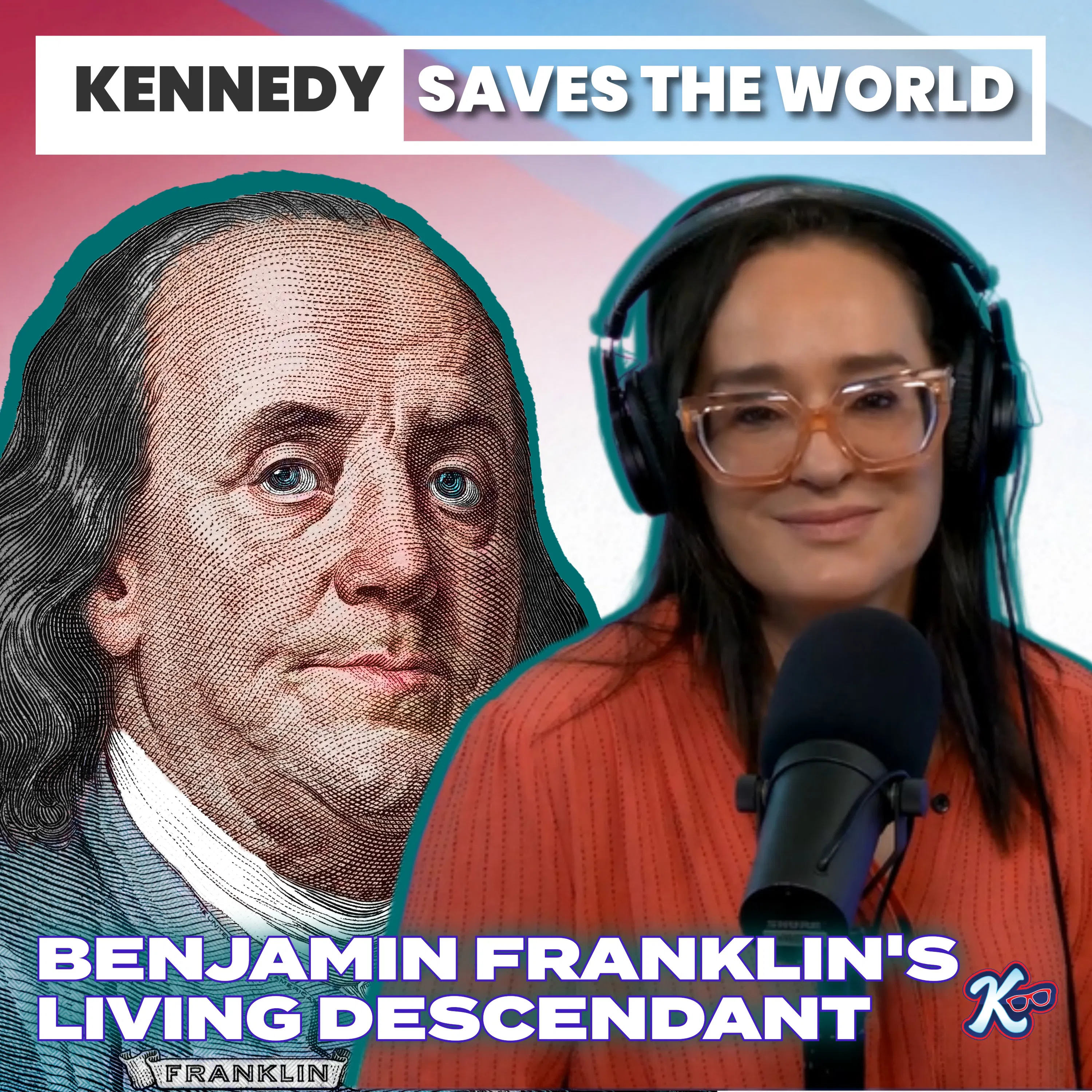
Loading summary
Transcript40 lines
- [00:00]
Mark Skousen
Foreign.
- [00:10]
Kennedy
Hello and welcome to this episode of Kennedy Saves the World. It is a book club episode and I have a really fun historical biography for you to dive into this summer. And this book is so great because you can take up sections, you can take up chunks, you can read the whole thing cover to cover and be completely satisfied and filled with knowledge. On the greatest American. Now who do you think that would be? For me hearing the title of that book, I would say maybe Ulysses S. Grant or my grandfather. But no, the greatest American is Benjamin Franklin, according to one of his direct descendants, Mark Skousen. For those of you who have ever attended Freedom Fest, you can thank Dr. Skousen for that honor because he is the founder of Freedom Fest, he is an economist, he is a professor, he is a best selling author, and he is deeply obsessed with Benjamin Franklin and rightly so. The subtitle benjamin Franklin, the world's most versatile Genius. Not light words written by one of the greatest thinkers I know. Mark Skousen, welcome to Kennedy Saves the World.
- [01:28]
Mark Skousen
Well, thank you. You said I was obsessed with Franklin. I should tell you, Franklin was famous for saying he that boasts of his ancestors does but advertise his own insignificance.
- [01:42]
Kennedy
That's really, that's very interesting because, you know, the fact that you are a direct descent and you have studied Benjamin Franklin your entire life, you and your wife actually completed his autobiography in 2006, the latter years of his life where he wasn't writing as much. Does he still continue to fascinate you?
- [02:07]
Mark Skousen
Well, I think I've pretty. He's endlessly fascinating, there's no question about that. And I see so many opportunities in today's world where you could apply what Frank Franklin learned 200 and some years ago. So, yeah, I think he's a pretty fascinating person. And you know, I wondered, could you call him the greatest American? Well, I came up with 22 careers that he had as a printer, a publisher, a diplomat, postmaster general, humorist, inventor, the list goes on and on. So no matter what the situation is, I, I've looked at all of the issues of today and probably the only issue that I can't find anything that Franklin wrote about was the transgender issue. But other than that.
- [03:02]
Kennedy
No, I think I, I think he liked the traditional version of the woman.
- [03:08]
Mark Skousen
Yeah.
- [03:08]
Kennedy
Who used she, her pronouns, he. So I, I didn't know what a prolific lover he was until I read your book.
- [03:17]
Mark Skousen
Yeah. In fact, that one, chapter 77 about the hard to govern passions of Ben Franklin was one of my favorite articles that I wrote. Actually, this book is. Is not a regular biography. There's been many good biographies already written on Franklin. Walter Isaacson, HW Brands and so forth. Mine is, as you say, eight short, 80 short chapters on Franklin's various aspects of his life. And I originally wrote these columns for Newsmax magazine had a. They have a newsletter called the Franklin Prosperity Report. And the one chapter, the one column they rejected and he said, no, we can't publish this was, guess what? On Franklin's sex. His views about sex and women. And there's always been this debate, was he a ladies man or was he a womanizer? And you know, there's this salacious nature.
- [04:16]
Kennedy
What's the difference? So what is a ladies man? Just someone who is a flirt and a womanizer is someone who uses women and discards them.
- [04:25]
Mark Skousen
Yeah, I think you could make that distinction. And he. Franklin still, despite his diplomatic skills, he still had a lot of enemies. And John and Abigail Adams thought he was. He was definitely a womanizer.
- [04:39]
Kennedy
And I mean, Abigail in particular. Abigail was just grossed out by Benjamin Franklin's flirtatiousness that she witnessed at a dinner in France.
- [04:51]
Mark Skousen
Even. Yeah, even though Franklin was. Was a widower at the time, he was single. But they did not like them putting his arm, their arms around him and kissing him and stuff like that, especially in public. The Adams were very puritanical, there's no question about that. But even. But Franklin was known to. He confesses his hard to govern passions and his errata in life, his eroticism errata, if you will. He did have, however, the history does show that he only had one illegitimate child. Not numerous illegitimate children, but he had three generations. His son had an illegitimate child, his grandson had an illegitimate child. And even my ancestor, through Louis Bates Jr. Is an illegitimate child of Franklin. So there was a whole series of hard to govern passions by the Franklin family.
- [05:58]
Kennedy
Well, there are, you know, we can't always choose our genetic code. But it was interesting because Franklin, you know, as you write, didn't shy away from it. And he tried to counsel young men on the ways. You know, first he was like, if. If you have high sex drive, just get married. It is the natural state of things. It's the smartest thing you can do. You will have a partner in love and in life. And you know, it wasn't like he was counseling young men to be a bunch of horn dog libertines. But then he, he gives some, some pretty frank advice on how to choose a mistress.
- [06:36]
Mark Skousen
Yes, he. It was an anonymous pamphlet. He did not reveal his name, but 100 years later, they put his name on it because they knew he had written it. And he basically said, listen, if you can't get married, then if you're going to choose a mistress, choose an older lady because they're, they're. There's. They're experienced and, and they will appreciate having sex again. So.
- [07:02]
Kennedy
And he said, they're better conversationalists.
- [07:04]
Mark Skousen
Yeah.
- [07:05]
Kennedy
And in the dark, all cats are gray.
- [07:08]
Mark Skousen
Yes. These are, These are great lines that I reveal in the book. And you can see why a conservative organization like Newsmax decided to censor this. This column that I wrote. But it's in the book, chapter 77. But I would also go beyond that to say that Franklin wasn't just seeing women as sexual objects. The salons that the women ran in France were intellectual, and there were great debates on the topics of the day. And Franklin was very much accepting of that and appreciated the intelligence of women. So he's definitely the most modern of the founders. You know, he went from being a slave owner, small number of servants, if you will, to an abolitionist. He changed his. He was very skeptical about religion. And at the end of his life, he saw that God had governed in the affairs of men and interfered so that the Americans would win the revolution against the mightiest military power in the world. I really admire Franklin for constantly willing to change his mind on various topics. And there's a lot, you know, that's a good lesson to learn in life. Do you want to just be your own? Do you never change your views? You always have a certain way of perspective? Or you're like Franklin, where you hear new evidence and you say, maybe I need to change my mind. We need more of that today.
- [08:45]
Kennedy
And, you know, you point that out throughout the book, and that's really fascinating. And that seems to be what follows from living a long life. You know, when you die after, you know, well into your ninth decade, you are more likely, if you are as philosophically and intellectually as engaged as he was, you're more likely to come face to face with facts that challenge your own positions. And there is something very respectable about that. But you also sort of take apart the arguments against him from, you know, people I'm sure you respect, like Murray Rothbard, who had a few major issues with Franklin.
- [09:30]
Mark Skousen
Yeah, Murray Rothbard wrote this book called Conceived in Liberty, and it's a four volume, five volume set the history of America from his perspective. And I think he was kind of a. I don't think he was a very good historian, to be honest with You. There's a lot of detail there, but the big. He misses a lot of the big picture. I mean, he considers George Washington a terrible general because he lost all of these wars, but he completely ignores the big wars, the important ones that he won that turned the tide of the country. And he calls Franklin an opportunist, a lecture. I mean, he has all of these extremely negative terms over bloated, ego, etc. Etc. And the evidence just does not support it. There's no other historian that I know of who thinks that Charles Lee, General Charles Lee, should have replaced George Washington. Charles Lee was a complainer. He did not work with other people. He was never successful. He was actually arrested early and never did really fight much of a war and stuff like that. But, I mean, I don't understand. Sometimes Murray just goes off the deep end as an economist. He's a great economist, and I learned a lot from him. He was my mentor in many ways when it comes to economics. But his views on politics and history really go astray from what most historians think are critical. So I have this chapter 80. This is the final chapter of the book called Ben Franklin and His Critics. And I go through all of the critics, the arguments about his womanizing, about his politics, his opportunism, his crony capitalism. He's an inflationist. But, you know, there's another example on inflation. When the British prohibited gold and silver as coin in the colonies, that they couldn't mint their own gold and silver, he favored fiat money, paper money, schedule. And he said, in modest amounts, it's very positive for the economy. But at the end of his life, after he saw the Continental become practically worthless and the difficulties the French had with their hyperinflation and so forth, he concluded that too much of fiat money, too much of paper money is really bad. Although. Although he was very clever in one thing. He said, for all of you tax evaders out there who refuse to pay for this revolution to liberate our country, we're going to make you pay indirectly by depreciating the currency. That was pretty clever line.
- [12:28]
Kennedy
Don't go anywhere more. Kennedy saves the world, right after this.
- [12:32]
C
It's the Will Cayne Show. Watch it live at noon Eastern Monday through Thursday on foxnews.com or on the Fox News YouTube channel. Miss a show? Get the podcast five days a week at foxnewspodcasts.com or wherever you download your favorite podcasts.
- [12:46]
Kennedy
I mean, but he, he had a lot of clever economic policies like fund matching, you know, so as you Point out when you raise money for a charitable organization and the idea that your employer will match that, that's from Benjamin Franklin's brain.
- [13:07]
Mark Skousen
Yeah. So I have quite a bit about charitable giving and fundraising. I have a chapter on fundraising because Franklin was the fundraiser extraordinaire. And that's one thing I have not inherited from Ben Franklin is the ability to raise money for everything under the sun. I was president of FEE for a year and didn't work out, and I was told because I wasn't very good at fundraising. But Franklin, he tried to raise £2,000 to create the first hospital in Philadelphia. He went to the legislature and said, could you fund this? And they said, no way. And they said, well, I'll tell you what, if I can raise £2,000, will you match that? Well, they didn't think he could do that. No way. So they said they agreed to that. And sure enough, Franklin raised the £2,000. And so that was the first matching fund. So he's really the father of matching funds as well as numerous other inventions. I should mention, you know, that Franklin. The only reason we know Franklin today is because he was America's first scientific American. And, you know, he inventor of the lightning rod, the Franklin stove, the bifocals. I don't know. I don't think your glasses are bifocals. But he did.
- [14:27]
Kennedy
They are progressives.
- [14:28]
Mark Skousen
They're, ah. Oh, progressives. Yes. It's an improvement. Franklin would love that. By the way, Franklin loved technology. He would be, of all the founding fathers, the most comfortable with all the technology. He'd be texting, he had the cell phones, he'd have the hdtv. He'd be streaming. He would be doing all of these kinds of things. He loved technology. What he wouldn't like is big government and deficit spending and the national debt and the welfare system and stuff like that. But as far as the standard of living, he would love to be. And in fact, he said, I would love to have. I was born too early. I wanted to live two to 300 years later. That would be now. And he would love to be alive today.
- [15:15]
Kennedy
Yes, I think he would love the innovations. And you pointed out, you know, one of the, one of the questions in your quiz at the beginning of the book, which patents did Benjamin Franklin hold? And he didn't really believe in patents. And then you quote Elon Musk.
- [15:32]
Mark Skousen
Yeah. Who doesn't carry patents for the Tesla technology? There is this debate, you know, among libertarians, to what extent is intellectual property rights. Should it be. Should you have Patents and trademarks and stuff like that. And there are some who say yes, some would say no. Franklin said, listen, this is, this is for everybody, so I'm not going. He could have taken out patents on his, on his works and he decided not to.
- [16:03]
Kennedy
And how did his family, did they prosper? Did that his descendants, illegitimate and otherwise, did they prosper after his death?
- [16:14]
Mark Skousen
No, not really. Nobody really inherited much other than property. They inherited property. He had several properties. He was never given a pension by the way, by the federal government for all of the work that he did. Never got any additional property like some others did. He was kind of depressed about how he was treated when he came back as ambassador. But his, you know, his grandson Benny was a, a notorious publisher, the Agora, and ran into trouble with John Adams and John Adams threatened to jail him. This is when there was a debate about free press. And so he did inherit the machinery to run printing press and stuff like that and some land and so forth. But as the generations went down and there were quite a few children that Sally Bates, his daughter had, that's where most of ancestors, including myself come from. There's really nothing that we inherited except both of us are left handed and few similarities there.
- [17:32]
Kennedy
And intellectually curious and lovers of economic freedom. Well, you bring up Adams and as you point out, Franklin got along well with Washington and Jefferson. I hope he got along with Hamilton because I love the musical. But he and Adams were kind of like mortal foes.
- [17:54]
Mark Skousen
I'm glad you brought up Hamilton because Franklin was actually a defender of central banking and the commercial society. He was not like Jefferson, who was anti paper money completely and so forth. Franklin, Franklin's very modern in that sense. He would like the current financial arrangements, banking, big banking and stuff like that. But with John Adams, they really disagreed pretty vehemently when they were both in Paris as commissioners. And Franklin loved the French people, the French loved him. But Adams, both John and Abigail did not understand the French culture did not raise a single livre, the French currency at the time. It was all Franklin who raised all the money, all the ammunition. Sent two generals, French generals, Russian generals over to help the Americans. And because of that, at the bank, at the Battle of Yorktown, the final battle, George Washington won. Half the troops were French and all the uniforms were French. Half the ships were French. A lot of people think that without that, without the French assistance, which was all due to Franklin, not Adams, not the Lees, Arthur Lee, not Ralph Ishon, they sent a bunch of commissioners over because they didn't trust Franklin who was 70 years old. But it turned out that Franklin did it all. He raised all the money, and then he was in charge of the Treaty of Paris. So Franklin deserves to be the grandfather of our nation for sure.
- [19:50]
Kennedy
Well, that's why John Adams is not the greatest American. It is Benjamin Franklin. Mark Skousen, you can get the book now, and I hope everyone enjoys it, as I always enjoy talking to you, but especially about your latest work. So thank you so much for taking the time.
- [20:07]
Mark Skousen
Hey, my pleasure, Kennedy. We'll see you next year at Freedom Festival.
- [20:11]
Kennedy
You know it. It's going back to Vegas, baby.
- [20:12]
Mark Skousen
Yes, that's right. Can't wait. All right.
- [20:15]
Kennedy
You're the best. Thank you so much, my friend. This has been Kennedy Saves the World along with Mark Skousen. I'm Kennedy. Listen ad free with a Fox News podcast plus subscription on Apple Podcasts and Amazon Prime. Members can listen to this show ad free on the Amazon music app. Oh, go ahead and leave me a review while you're there. I'd love to hear what you have to say. You've been listening to Kennedy Saves the World on the FOX News Podcast Network.
- [20:44]
Mark Skousen
Hey, I'm Trey Gowdy, host of the Trey Gowdy Podcast. I hope you will join me every Tuesday and Thursday as we navigate life together and hopefully find ourselves a little bit better on the other side.
- [20:55]
C
Listen and follow now@foxnewspodcast.com.