Loading summary
Transcript71 lines
- [00:01]
Experian
You know that one friend who somehow knows everything about money? Yeah. Now imagine they live in your phone. Say hey to Experian, your big financial friend. It's the app that helps you check your FICO score, find ways to save and basically feel like a financial genius. And guess what? It's totally free. So go on, download the Experian app. Trust me, having a BFF like this is a total game changer.
- [00:37]
Kennedy
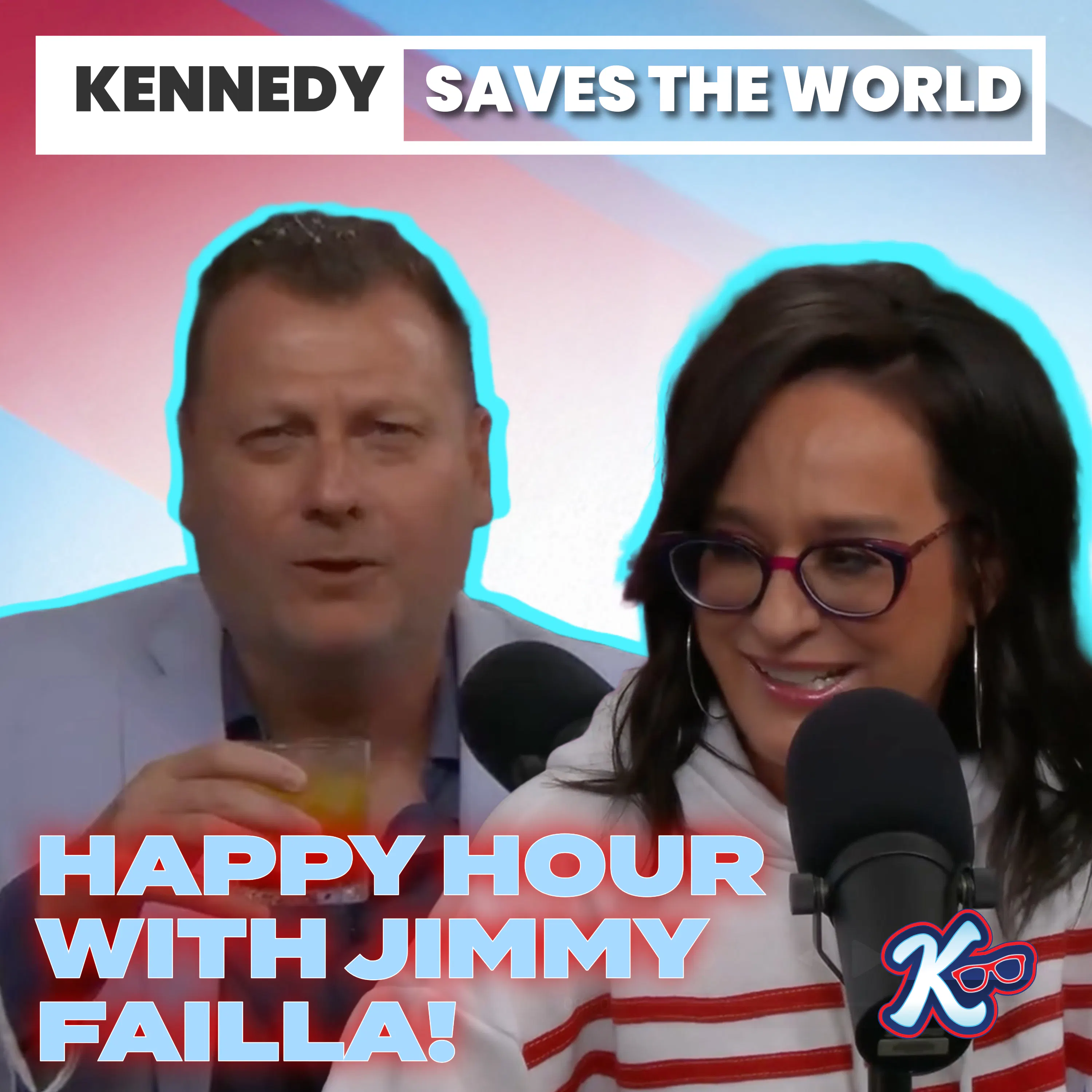
Hello and welcome to this episode of Kennedy Saves the World. I was very excited to have a very, very special guest for this week's happy hour. But Jenny Fela couldn't make it.
- [00:47]
Jim
Unreal. Unreal. And I love Jenny, but you know why? Who's happy that you couldn't make it? I am. Do you know why really quick?
- [00:53]
Kennedy
No.
- [00:54]
Jim
Jenny broke a cooktop. You know the cooktops on the stove. She had a can coming out of the stove. Drop that, cracked it. She's getting a new one delivered today. Okay. Which, you know, no big deal. But then you think about it. On my end, I am now holding on to any time. Oh, like the time you broke the cooktop, you know what I mean? So I got it. In a long term marriage that's called couples currency. And I now have a little couple's currency.
- [01:17]
Kennedy
I had one of those when my sexy teenage boyfriend broke the car hitting a pothole.
- [01:24]
Jim
Yeah.
- [01:24]
Kennedy
On the Taconic Parkway. So forever I thought I had. Well, remember when you broke the car? But then he went and got a brand new car.
- [01:31]
Jim
He got a new car.
- [01:32]
Kennedy
A way better car.
- [01:33]
Jim
All right. But it worked out.
- [01:34]
Kennedy
Anyone has ever seen.
- [01:35]
Jim
It worked out for you. I needed the ammo. Cuz from now on, whenever she brings up the male prostitute, I could be like, yeah, well at least I didn't bring the cooktop, you know. So anyway, good to see you.
- [01:44]
Kennedy
Cheers to you, Jim.
- [01:45]
Jim
How about it?
- [01:45]
Kennedy
Yep.
- [01:46]
Jim
Happy everything this is.
- [01:51]
Kennedy
Oh yeah.
- [01:52]
Jim
Oh, this is tasty.
- [01:53]
Kennedy
It's a Long island speedball. This is.
- [01:54]
Jim
Is that what this is called?
- [01:55]
Kennedy
Yeah, that's what I just named it. Which actually is probably something else far more nefarious and interesting. But it's smashed watermelon with peach, mango, no fizz green tea Celsius. So it's got an upper component to it.
- [02:10]
Jim
Yeah, yeah.
- [02:10]
Kennedy
With Grey Goose vodka.
- [02:11]
Jim
Now let me tell everybody something about your drinks, cuz that's a misleading name. A Long island speedball. All of your drinks end with the same name, which is arguing with a parking meter. You know what I mean? This is a punching a police horse.
- [02:21]
Kennedy
I'll have you know, Officer, if your horse has a coming looked at me.
- [02:28]
Jim
Kennedy. Kennedy is the official cocktail maker of the bumper sticker, Take me drunk, I'm home. You know, that whole thing, you drink it, son.
- [02:39]
Kennedy
Yeah, you can hardly taste the Grey Goose.
- [02:41]
Jim
No, this is good stuff. You did it again.
- [02:42]
Kennedy
Only your liver will know for sure. So, Stephen Gobert, the Late show was canceled.
- [02:49]
Jim
I know. Oh, is it ever.
- [02:50]
Kennedy
So I don't know if you are like me. I mean, you have a late night show. It is a weekly right now, but you are very much in the middle of the modern day late night wars. I was always fascinated by the Late Shift, which is the book by Bill Carter which documented the cutthroat competition to replace Johnny Carson after he unceremoniously quit without telling NBC at an upfront, which is where the network meets with its advertisers. And this used to be a really big deal. So Johnny Carson in 1991 met with the advertiser, goes, oh, yep, well, guess what, I'm quitting.
- [03:29]
Jim
Yep.
- [03:30]
Kennedy
And NBC was blindsided. They did not have a successor named for him. Letterman assumed it was going to be him since he was hosting Late Night with David Letterman after the Tonight Show. But then that's when the fireworks really began. And Jay Leno had some very sharp elbows, which people did not credit him with before that.
- [03:50]
Jim
Yeah, they knew about the sharp chin, but they didn't know about the elbows. And I love the movie. The movie is actually streaming right now. It's always either on HBO or it's on Showtime. I've probably seen it 65 times. It's like my favorite movie in the world because it's such a period piece. But it also speaks to the significance of what Late Night was. You see Late Night back then, Johnny Carson used to win with 48 million viewers. Now whoever wins this week is going to win with three or four. You know what I mean? If that.
- [04:17]
Kennedy
It's usually like between 1 and 2 million.
- [04:20]
Jim
So the cultural significance of the Tonight show was it was the biggest entity in television. 60 Minutes, people would probably argue on the news side, but back then, if you just went on the Tonight show, if you had a good set and you were a comic, you were now selling out comedy clubs around the country for like the next 25 years. So it really mattered to not only be on it, but to obviously be the pilot of the show. So for that reason, it got really cutthroat. But the reason it had that reach and it had that gravity for the people competing is because back then Late night was common culture.
- [04:50]
Kennedy
Yes.
- [04:50]
Jim
Okay. What Colbert is ultimately guilty of, and this I really resent and I may be talking about this on Fox and Saturday night, tomorrow night is I have a Carson sot where he talks about the importance of not trying to weaponize a late night show. He says you can get to this place of like self assurance where you really start to think you know better than the people and you alienate that good time vibe because it now, even if it's funny, it's professorial. And the whole hook of late night and the whole hook of comedy is you're giving people permission to kind of tune out emotionally because they're in the presence of clowns, you dig? Like, we're not supposed to be giving you lectures on the economy. We entered a profession where we get paid in drink tickets. Like there's no reason for it to have become what it did. And that's what ultimately ate him off.
- [05:34]
Kennedy
But that's what your show has always stayed true to. And I know you haven't been on the air for decades, but you know, that was your mission statement for your show. Yep, that right there. Which is what it's, it's shocking that, that so many shows have gotten away from that.
- [05:50]
Jim
Yep.
- [05:51]
Kennedy
Don't go anywhere more Kennedy saves the world right after this.
- [05:55]
Stephen Gobert
Starting a business can seem like a daunting task unless you have a partner like Shopify. They have the tools you need to start and grow your business. From designing a website to marketing to selling and beyond. Shopify can help with everything you need. There's a reason millions of companies like Mattel, Heinz and Allbirds continue to trust and use them. With Shopify on your side, turn your big business idea into sign up for your $1 per month trial@shopify.com specialoffer the.
- [06:24]
Kennedy
Other reason that the Tonight show was so important was because at that time, people didn't have iPhones, people didn't have androids, they didn't have the Internet at all. So whatever you turned off at night is what you woke up to in the morning. And that's why the Today show was so phenomenally popular, because they had this tee up with the Tonight show and people would just, you know, whatever was on their tv, that's what they would leave on in the morning as they were getting ready and having breakfast. And that's what made the whole venture so profitable. Obviously media has changed so much. But is it interesting to you that the network still invest hundreds of millions of dollars to and these late night franchises which have diminishing returns.
- [07:09]
Jim
It's the end. They're never going to be able to make TV at the scale they used to. And I think this was that cold wake up call. They had 200 staffers. So think about that. Gutfeld beats him every night with probably 15.
- [07:21]
Kennedy
Yeah.
- [07:21]
Jim
In that range, would you say we do a Saturday night show with six people? But if you're doing a Saturday night show at the network level, you'd have 200 people, which is crazy. They didn't need that. I think, you know, in another world, maybe they felt like they did. But where they are now is it's impossible to be profitable at that scale because you're not going to get the engagement. You know, if 3 million viewers doesn't justify like Letterman would have gotten 10 or 12 million viewers when he was on. So that 200 model comes from the Letterman thing he inherited. Yes, but he ran that into the ground. What's interesting to know about Colbert really quick is he was going to be canceled his second year on the air because he was tanking because he was making that transition from the fake Bill O'Reilly character to an actual late night host. Nobody was buying it. CBS had the super bowl that year. They were his lead in and they handed off to a live Sunday night post Super Bowl Colbert, and it tanked. And the thing that actually saved him was Donald Trump coming down the escalator. But it's the same thing that actually killed him.
- [08:21]
Kennedy
Yes.
- [08:22]
Jim
You know, and that's what happened. He alienated too many people and it became, I would say, activism masquerading as comedy.
- [08:27]
Kennedy
Yeah. And when you live in that bubble where you assume that everyone buys into your activism. You, you know, think of the number of people that you're alienating. That's half of your potential audience. And so, you know, Gutfeld does a show that's skewing further.
- [08:43]
Experian
Right.
- [08:44]
Kennedy
But still has a good time. Like there's still a joy in that show. And that's why he's beating these other shows because you know, Jimmy Kimmel is guilty of the same thing Colbert's been guilty of. So why wouldn't ABC look at this and go, it's a smarter model.
- [08:58]
Jim
Oh, they're gonna. That's the, this is the first domino to fall. Like if you look, NBC scaled back to Tonight Show. They don't do a Friday. They're only Monday through Thursday. They re air on Friday. My prediction is they'd probably wax up Myers first. There's nobody watching it. And he really is like an activist and he Refused to do the post Covid, like, re enhancement. He still does the shirt. He still does it the way you might go to a sound check. He doesn't have a jacket on. He's gonna be a button down shirt. And it's just, Trump, Trump, Trump, Trump, Trump, Trump, Trump, Trump. And it's just too predictable. And that's the bigger problem with, like, partisan activist comedy. Okay. Is comedy, as you know, is a trap door for people to fall down the chute. They can't see the door opening under their feet. But if 99 out of 100 punchlines are Trump, they start, the door actually gets creaky. Like, they hear it opening. Like, you got to put some WD40 on this thing. And that's the problem. So if they. They're not going to replace it. This is obviously dead. CBS said they're not going to try. But if the people on the other shows want to, you know, engage in this exercise in self preservation, it's really not even about coming back to the middle. It's about not taking yourself seriously. Yes, you. Nobody turns on a TV at 11:30 at night to be told how to fix the world.
- [10:07]
Kennedy
And what's a lecture where they're supposed to laugh? And, you know, at least with Gutfeld, like, jokes are back.
- [10:13]
Jim
Yeah.
- [10:14]
Kennedy
Like things you're not supposed to.
- [10:15]
Jim
And he makes fun of himself. That's the whole point where comedians were clowns. We're here because we had broken childhoods in some capacity or we weren't tall enough to get on the rides at Six Flags in others. Now, I'm not going to name names on that one. I'm just saying. Okay. And I don't ever knock him. Like, even in my show, I remember this. I wouldn't have a show if it wasn't for the success of his show. So, I mean, in theory, when you think about that, there should be a lot of pressure when you follow in the footsteps of Greg Gutfeld. But luckily in his case, they're a size three. So you're going to be all right.
- [10:46]
Kennedy
What does CBS do from here? What do you think?
- [10:48]
Jim
I wonder what they're going to air because they canceled the James Corden hour, too. That had become at midnight and that tanked a fat one. I think they're going to go back to, like, the Ted Koppel model.
- [10:58]
Kennedy
Oh, yeah.
- [10:59]
Jim
And do so. I know, but do something new, Susie. And if they're smart, maybe go to the west coast and engage that sector.
- [11:05]
Kennedy
Of the Trace Gallagher. The Trace Gallagher model.
- [11:08]
Jim
Don't you dare I love it.
- [11:09]
Kennedy
They're not going to steal them. They'll never get them.
- [11:11]
Jim
Never.
- [11:12]
Kennedy
Michael. Dead hands. All right, Jim, go have a great weekend.
- [11:14]
Jim
You're the best.
- [11:15]
Kennedy
See you Monday. This has been Kennedy Saves the World along with Jimmy Kayla.
- [11:18]
Stephen Gobert
I'm Kennedy.
- [11:21]
Kennedy
Listen ad free with a Fox News podcast plus subscription on Apple Podcast and Amazon Prime. Members can listen to this show ad free on the Amazon music app. Oh, go ahead and leave me a review while you're there. I'd love to hear what you have to say. You've been listening to Kennedy Saves the World on the Fox News Podcast network.
- [11:43]
Will Kane
It's the Will Kane Show. Watch it live at noon Eastern Monday through Thursday on foxnews.com or on the Fox News YouTube channel. And don't miss a show. Get the podcast five days a week at foxnewspodcasts.com or wherever you download your favorite podcasts.