Loading summary
Transcript61 lines
- [00:00]
A
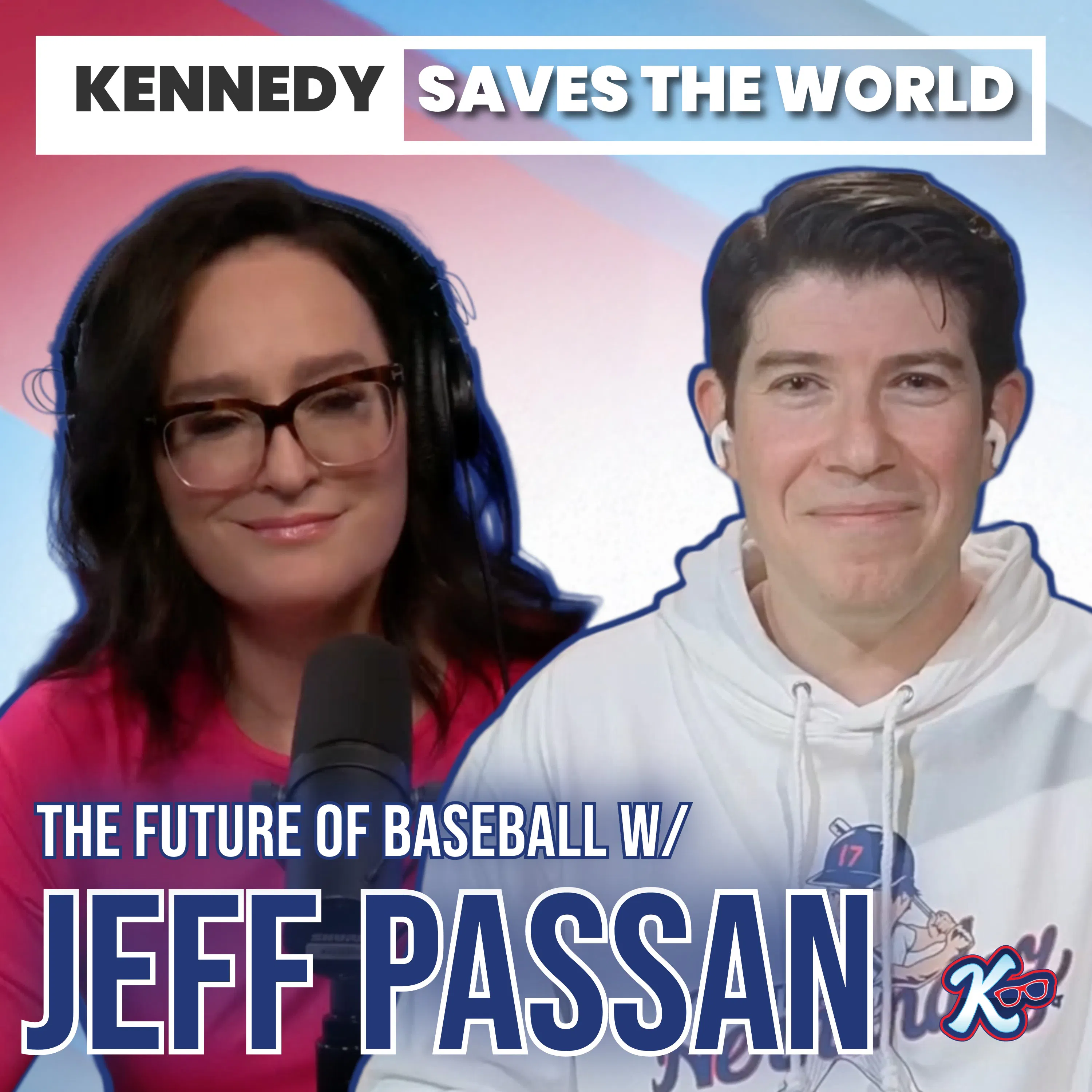
Welcome to Kennedy Saves the World. Here's a conversation I had with baseball expert and world renowned journalist Jeff Passon. And we recorded this before the passing of Yankees legend John Sterling. And the Sterlingisms will live in baseball infamy, especially in Yankees fans hearts forever. Here's my conversation with Jeff. With all that is dividing us and it feels like there are so few elements of culture that are not eclipsed by toxic politics. And I would put baseball in that category. I love baseball. I love the Yankees. I love going and seeing major league baseball, even some minor league games. But my guest today has dedicated his life to covering baseball. He started back in 2004 for the Kansas City Star. He is one of the most notable and trusted names covering, reporting on and analyzing baseball. Jeff Passon is here. He's got a brand new podcast called Sources Tell Jeff Passen. Welcome to Kennedy Saves the World.
- [01:23]
B
Kennedy, I would love to save the world with you and I appreciate you having me on. Thank you.
- [01:28]
A
How does baseball save the world? What is it about baseball that you love so much that you see it as a unifying and important force in our country and in our world?
- [01:41]
B
I think it's a very egalitarian game. You do not need to be 6 foot 8 and weigh 250 pounds and look like a Greek God to play baseball. You can be Jose Altuve at 5 foot 6 or Aaron Judge at 6 foot 7 and anywhere in between, you can be a fat guy, you can be a skinny guy, you can be smart. You can be kind of dumb too. But as long as you can swing a bat or as long as you can throw a ball extraordinarily hard, you can be out on a big league field. And more than that, it's the stories that come from baseball. I think the reason that it has as rich of a history as it does is because it's a game that is made to tell stories. It's a game that's made for moms and dads and their children to go sit down and get away from the world and just enjoy the green grass and the smells and the crack of the bat and all the things that you tend to associate baseball with. And at a time right now where we have lost our romanticism, I think that baseball is still a very romantic game. And that's among many other reasons. One, that its popularity endures.
- [02:54]
A
Yes. And people still have that longing for something that is uniting, that something that is pure, that, you know, something that embraces the flag in this country and, you know, a goodness and a simplicity and Only the way that baseball can. And it's very interesting because you talk about some of the stories in baseball. What is it about this sport that naturally attracts people in ways that maybe the NFL or NBA just can't touch?
- [03:25]
B
I think for a while, baseball almost fell out of favor because of this, because it's a game that demands your attention, and games were stretching three hours long because it's a game that has 162 different contests across the season. Whereas in the NFL, you got 17. In the NBA, you've got 81 or 82. In hockey, you've got 81 or 82. Like, baseball takes commitment. And to be a baseball fan means being there every day, because it's almost like if you look at the season like a book and you have 162 chapters, if you skip one or two of those chapters, you might not really understand what's going on, so you need to almost wholly embrace it. And that was tough for a while. But the pitch clock has come along, and I think.
- [04:15]
A
Do you like the pitch clock?
- [04:16]
B
I adore the pitch. I like the pitch clock more than my children. Yes. Because it saves me time. They spend my money. It's. It's nice because I don't feel like anything substantive has been lost. Like, that's the thing. They just cut out dead time. They cut out guys futzing around in between at bats. They cut out pitchers trying to get a psychological advantage by just standing there and staring at the hitter. And all of a sudden.
- [04:47]
A
I'm a big fan of mixing metaphors. And they're not icing the kicker with the pitch clock.
- [04:52]
B
No, no. By. By no means are they. Look, it took a little time for guys to get adjusted, and that's all well and good. When we have something fundamentally change in any sport, it's a big deal. But especially in baseball, when this was a game that they bragged about not having a clock. And it turns out not having a clock can be kind of disadvantageous when there is a generation coming up that has the attention span of a flea and they want to be engaged at all moments and have something interesting going on. And baseball just lacked the action that I think now is brought to the forefront, because the pitch clock has allowed it to be that much more of a focus rather than just sitting there and staring at men who are staring at each other.
- [05:41]
A
Yeah, sounds like my prom night. So, Jeff, are we going to see umpires fall by the wayside?
- [05:53]
B
No, I don't think so. As much as, like, this dystopian World in which there's like Rosie the Robot from the Jetsons standing back there calling balls and strikes has. Has been dreamt of. I, I think they're. Listen, I understand that there are better ways to call strikes and balls than just by the human eye. And I think Major League Baseball, with the automated ball strike system that's been introduced this year in the big leagues, has figured that out.
- [06:25]
A
Like, I like it.
- [06:26]
B
It's awesome.
- [06:27]
A
I love watching the challenges.
- [06:28]
B
It's awesome. The challenges are great because they engage everybody who's in the stadium. Like, you know, when you hear the pitch has been challenged, immediately your head snaps up and looks at the Jumbotron out there and we have become somehow riveted by a picture of a ball floating three dimensionally through the air with a little tail behind it. And is it going to go in the box or is it not? It's almost like that screensaver where you've got the little DVD logo bouncing around and you're just waiting for it to hit the corner and you know it's never going to, but you're just like, is it going to? Is it going to? Is it going to?
- [07:08]
A
Is it going?
- [07:09]
B
No. Well, with abs, it answers that question really within 10 seconds. And it's a tremendous little production that baseball has put together to engage fans during the game without really asking a whole lot of them. And, and when we're in the midst of our entertainment, Kennedy, is that not what we really want? We want something that is given to us on a plate where we don't have to think about it, we don't have to process it. All we have to do is crane our neck in one direction and just feed us the little dopamine hits. And that's what ABS is. It's a couple of dopamine hits every game that you're getting.
- [07:48]
A
Yeah. So the game is faster, the game is more engaging. And, you know, you just, you go to the NFL and it looks like they have sort of disengaged the fans with some of the new rules. I want to talk a little bit about Ohtani because you broke the story about his gambling interpreter. How did you find that out?
- [08:12]
B
It was Tisha Thompson, actually, my colleague. I want to give her credit. I, you know, I got a tip. Oh, my God. It was months before we wound up writing the story. And the tip said, shohei Ohtani has a gambling addiction.
- [08:27]
A
And.
- [08:28]
B
Yeah, and, and here's the thing, being a reporter, you hear something like that that's pretty straightforward. And stories like this tend to have nuance. And so, you know, Tish is on our investigative team and I've worked with her in the past and she's brilliant at what she does. And so I reached out to her and said, hey, there's something that you might be able to find a lot easier than I can here. And she went digging and wound up talking with Ippe Mitsuhara, Shohei Ohtani's interpreter. And in the midst of that conversation, he said some things that were a little bit fishy and a little bit curious. And it was, it was announced to the Dodgers when they were in Japan actually opening the season that there was going to be a story coming out about Ippe. And it turns out in that moment, according to the account that Shohei Ohtani's team and Shohei Ohtani have given, that's when he figured out that his interpreter, who was later convicted and is in prison right now, was stealing money from him. So.
- [09:39]
A
Oh, no.
- [09:40]
B
Oh, it was, it was a wild story. And listen, there are still all sorts of conspiracy minded people who believe that Ohtani was the one who was engaging in the gambling. There is no.
- [09:52]
A
Is that why he took such a low salary? So he couldn't spend his extra millions every year? He's like, no. 1 million a year. You keep the extra 30 until it's not worth anything.
- [10:03]
B
Do you know how much money he makes in endorsements? He's doing just fine. He would have it whether he wants to spend it on. On cars or on trips to Disney World or on. Well, hopefully not on gambling, but whatever Shohei Otani wants, I think he's going to be okay. Even though he's getting just. You're right. $2 million a year in payment right now, despite a $70 million salary. When you said there is something, Kennedy, that can bring America together, I believe the answer to that is the Los Angeles Dodgers.
- [10:37]
A
Yeah. Because they just pay to bring America together. Don't go anywhere more Kennedy saves the world right after this.
- [10:46]
B
America hates the Dodgers right now. Honestly, it's not like anything I've seen in the game since the Yankees in the late 90s when they were the ones who were outspending everyone and they were the ones who were going out and winning championships every year.
- [10:58]
A
Everyone wants their team to do that. Everyone wants their team absolutely. To have just a massive payroll and get the very best players and power hitters and insane pitchers. But, you know, the Yankees have better pitching right now than pretty much anyone with their star pitchers still sidelined.
- [11:18]
B
Yeah. Garrett Cole coming back from Tommy John Surgery right now. Carlos Radon, $162 million man out as well. But Max Freed has been phenomenal. Cam Schlitler has been one of the best pitchers in baseball this year. And this from a guy.
- [11:33]
A
I don't even know her.
- [11:38]
B
If you were saying the name Schlitler every day, would you slip, like, just once? I feel like you would unquestionably slip at one point.
- [11:50]
A
It took me a long time to learn how to say the city. Phuket.
- [11:55]
B
Yes. Well, what did you say before that exactly? And. And which is better? I like Phuket. Sounds nice. That's a good time.
- [12:09]
A
I mean, that's the place if you're. If you're traveling that far east, wouldn't you rather go to it?
- [12:16]
B
That's not even a question. Absolutely.
- [12:20]
A
All right, so where are we going this season? Because it feels like things are almost too good.
- [12:31]
B
In terms of the Yankees or just baseball? Baseball, yeah. Things are great right now. I mean, I've been covering this game for 23 years, and baseball is in the best spot right now that I have ever seen it. And yet the collective bargaining agreement expires on December 1st.
- [12:49]
A
And do you think we're going to have another strike?
- [12:52]
B
It's not going to be a strike. I. It is going to be a lockout now. Yeah, it's. Is it going to happen? Am I absolutely certain? No. I mean, miracles happen, right? That's what it's going to take. At this point, though, I don't know, man.
- [13:10]
A
I feel like everyone. Any sector that can sit it out and make more money, they're going to do that. I mean, that's just the era that we're in. We're in the era of there's a whiff of socialism that is so pervasive. And even if you're a rich ball player and not all of them are rich, you know, the idea that you have been treated unfairly and to kind of withhold your services until justice has been meted out is. It's attractive. Not to fans.
- [13:44]
B
Yeah, not to fans. I. All of this, Kennedy, is going to come down to just how firm Major League Baseball is in pursuing a salary cap. And here's the thing. We've seen a salary cap in the NFL. We see a salary cap in the NBA, in the NHL. Like, there are restrictions in place there. And to baseball players who have fought off salary caps for decades now, this was an enormous issue back in the last really long work stoppage in 1994 that ended up killing the World Series that year. MLB owners have been waiting three decades to pursue this again, and they just so happen to be pursuing it at a time when, yes, the Dodgers are spending more than everybody. Not a whole lot more than the New York Mets, not, not a ton more than the Yankees or the Phillies or some of the other teams up in that echelon financially. But, yeah, the Dodgers spend more than everyone else, and they happen to be winning every year. And that's a recipe for major league owners to say, okay, let's do what we can to try and squeeze this out of the players. And the players are fighting it because they're saying, hey, why should we be restricted on what we're able to earn? Because you guys can't get your business right. You know, if owners are, if owners are claiming and, and crying poor and saying that, you know, this is not a business with a lot of cash flow and we need to increase that. Well, that's what the television contracts after the 2028 season are going to do for the sport. Kennedy I think baseball's in such a great place right now that all they need to do is just keep the momentum going forward, ride the wave of Ohtani, look at the Dodgers as what they are, which is the villain that every story needs, and wait until all of the national television and a lot of the local television deals expire at the end of the 2028 season and they have a chance to cash in and solve a lot of those cash flow problems that these organizations have. It's just a question of are they going to cut off their nose to spite their face, which is what any sort of work stoppage that ends up in games lost would be doing. It would be insulting the fans and who have glommed onto your product these last couple years and really enjoy and love and appreciate baseball.
- [15:54]
A
Who is the best player in baseball right now?
- [15:56]
B
Sh Otani. And it's not particularly close.
- [15:59]
A
Yeah, I know. I still, I feel bad for the Angels.
- [16:04]
B
Do you.
- [16:04]
A
You know, they had two of the best players like the game.
- [16:09]
B
They totally did like they, they did. They had Mike Trout still in his prime and Shohei Ohtani firmly in his prime playing together, and they didn't even make the playoffs. And, and that's the, that's the saddest part of the whole thing, but also how some of it has to be on the organization itself. You know, Ohtani is not any different because he's a Dodger. And yet the Dodgers have figured out how to leverage the Ohtani ness of everything into more than $1 billion in revenue last year, most ever by a baseball team. A ridicul is, you know, but by a fantastic television contract, local TV contract. But beyond that, they just know how to do business. And the Angels, they did not.
- [16:56]
A
No. It's sad. Speaking of Japanese players, would Ichiro, in his prime on the Dodgers, been as good as Ohtani?
- [17:05]
B
Nope. But Ichiro is awesome. And my. Do. Do you know that? Do you know the Ichiro All Star story?
- [17:13]
A
That's what I was just gonna ask you. So please tell me in. In your words, the Ichiro All Star inspirational speech.
- [17:22]
B
Ichiro Suzuki, he would, you know, he would sort of play act that he wasn't able to speak English. It's kind of like what Ohtani does now. Like, Ohtani can speak English fine, but somebody.
- [17:39]
A
It's like me at home pretending I can't open a pickle jar. Like, if I really worked at it, I could get that baby open. But it's a lot easier to go.
- [17:46]
B
All you need is a towel. Like, come on, it's not that hard. Bang it with a fork a couple of times. So Ichiro would act like, you know, he can't speak a whole lot. And somebody in the clubhouse would say, ichiro, it's time for you to give an inspirational speech. And guys would look around the club. I was like, what? What does. Does he speak English? What's going on here? And he would launch into the most profane, like, incredible tirade about how we need to go kick these pieces in the National League and just going off, like, bleeps everywhere if you were in the room almost at some points, like, got a little too over the top and uncomfortable for people. But it was Ichiro, so nobody really cared. My favorite Ichiro mom, when he did an interview with Bob Costas, and Bob Costas asked him, what is your favorite English expression? Have you seen this? It's.
- [18:45]
A
It's something like a monkey in a sack.
- [18:49]
B
Close, close. I live in Kansas City, so this. This hits home. August in Kansas City is hotter than two rats and a wool sock. And after he says this, Constance is losing his mind. And Ichiro looks at him and says, I had a bad teammate. And you know what? I disagree with that. You had the best teammate, Ichiro. Thank you.
- [19:16]
A
I think you had a great teammate.
- [19:17]
B
The best teammate.
- [19:18]
A
I mean, you are a wordsmith. You know the importance of really drawing an effective picture for the consumer of your analysis. Jeff Passon, thank you so much for your time. I cannot wait to engage in your latest venture, which is your new podcast, co produced by the glorious Peyton Manning and of course, all of your work on ESPN and beyond.
- [19:42]
B
Thank you, Kennedy.
- [19:46]
A
Blame all this has been Kennedy Saves the World along with Jeff Passen, I'm Kennedy. Listen ad free with the Fox News Podcast plus subscription on Apple Podcasts and Amazon Prime. Members can listen to this show ad free on the Amazon Music app. Oh, go ahead and leave me a review while you're there. I'd love to hear what you have to say. You've been listening to Kennedy Saves the World on the Fox News Podcast Network.