
Podcast
Kinwise: AI Insights for Educators
Hosted by Lydia Kumar · EN
AI is reshaping education—fast. The question is: how do we use it well?
Kinwise: AI Insights for Educators is a podcast about how teachers, schools, and districts are actually using AI in real classrooms.
Kinwise is an AI-powered instructional coaching platform for teachers. Through this podcast, we explore the real stories, decisions, and challenges shaping AI in education today.
Each episode features conversations with educators, leaders, and innovators navigating:
• Real classroom use cases (what’s working and what’s not)
• Practical strategies for teachers and school leaders
• Ethical questions about AI, learning, and human development
• How schools are preparing students for an AI-powered future
Season 1 explored AI and the future of work.
Season 2 focuses on AI in education: how teaching, learning, and leadership are changing right now.
If you're a teacher, school or district leader, or education professional trying to use AI with clarity and purpose, this podcast is for you.
Subscribe and learn more at https://kinwise.ai
15episodes
Episodes
Newest firstAll episodes

Who Are You Becoming? AI, Identity, and Education with Sandra Jin
Jun 2300:34:39Tap to summarizeIn this episode of Kinwise: AI Insights for Education Leaders, host Lydia Kumar sits down with Sandra Jin, Senior Director of Innovation and AI Strategy at Leading Educators. Sandra has spent nearly a decade designing professional learning grounded in three tenets: agency, advocacy, and belonging. This conversation is about what it looks like to bring AI into schools in a way that honors what educators and students need, and Sandra's grounding question: who are you becoming through how you use AI? Key Takeaways for Education Leaders -Emotional weight is the starting point. When teachers resist AI, it's about expertise, identity, and the fear that what made them great is being taken away. Understanding what's underneath that reaction changes the entire conversation. -The VATT framework gives teachers a "why." Leading Educators uses a simple lens to help educators make technology decisions: is this AI use helping you do more, do better, or do new? -One rural teacher's lesson shows what AI can actually do. A STEM teacher at Holbrook USD was worried AI would erode students' thinking. She designed a lesson where students had to defend a pulley system plan to a Gemini-built bot, evaluate the bot's response, and justify every revision. -Rural districts are leading the way. In the RAISE Collaborative, having the superintendent, school leader, and teachers in the same room working on the same problem eliminated the buy-in struggle that slows larger systems down. Momentum that would take months elsewhere happened in weeks. -Data infrastructure is unglamorous but foundational. AI has become a mirror for the disorganized systems schools have patched together for years. The practical path forward: start where data is already clean, build something small, and expand from there.
Transcribe →
From the DMV Line to the Governor’s Office
Jun 1200:36:36Tap to summarizeIn this episode of Kinwise: AI Insights for Education Leaders, host Lydia Kumar sits down with the Pine Lakers, Aankan Das, Gillian Keith, Prakyath Shankar, and Cooper Brown, second-place finishers in North Carolina's first-ever AI Solve-a-Thon and students at Pine Lake Preparatory School in Mooresville. What began as a resume builder turned into a real working app, real conversations with state officials, and a real shot at changing how North Carolinians experience the DMV. Key Takeaways for Education Leaders A real problem makes all the difference. Prakyath's frustrating four-hour DMV visit became the spark for the entire project. When students are solving problems they've actually lived, the motivation is built in. Vibe coding has a low floor and a high ceiling. The team started with Playlab because it was accessible, then leveled up to Base44 for more advanced development. The platform even guided them on which AI model to use for which task . Working with government is slow, but possible. As the only Solve-a-Thon team tackling a government agency, the Pine Lakers have had to think differently about implementation. Rather than waiting for a full rollout, they've been sharing code segments and ideas with DMV officials, letting their work shape a larger ongoing initiative. Blocking AI doesn't make students safer, but it does make cheating more appealing. As Gillian said: framing AI as the enemy just drives students toward unethical use. The teacher who connects students to opportunities changes everything. Ms. Riley came up in nearly every answer. Her approach, independent thinking, creative project choice, mental check-ins, and a sharp eye for matching students to outside opportunities, is a model for what AI-integrated teaching can look like. These students are thinking about AI's future more clearly than most adults. From job displacement to data privacy to environmental concerns, the Pine Lakers arrived at nuanced, grounded perspectives.
Transcribe →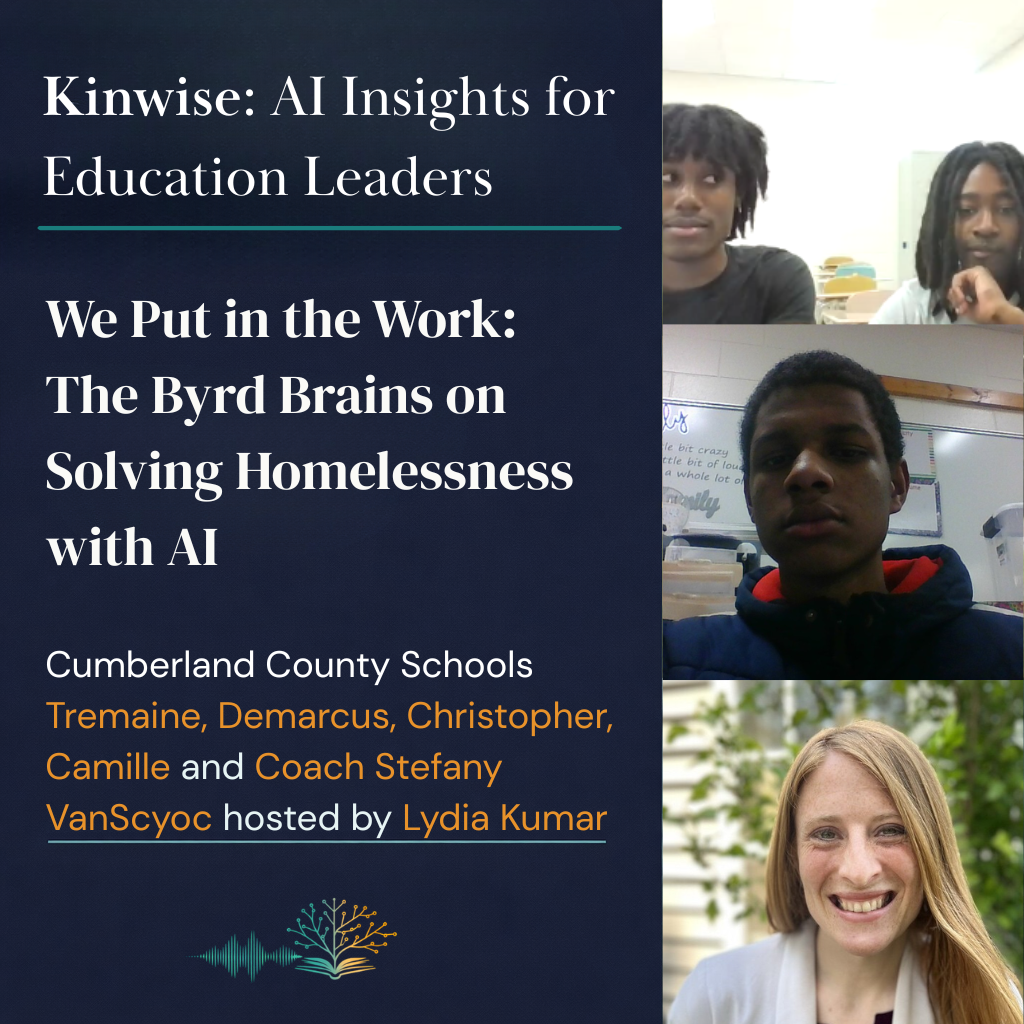
We Put in the Work: The Byrd Brains on Solving Homelessness with AI
Apr 2900:31:07Tap to summarizeIn this episode of Kinwise: AI Insights for Education Leaders, host Lydia Kumar sits down with three members of the Byrd Brains to learn about how they build the Jade Book. Key Takeaways for Education Leaders -The most powerful solutions come from lived experience. Chris Butler experienced homelessness three times, including during COVID while sleeping in a car. That personal stake shaped how the Byrd Brains built the Jade Book. -AI hallucination is a real problem students can learn to solve. The team discovered their app was generating fake shelter listings and developed a systematic back-testing process to verify every resource before publishing. -Collaboration across schools is possible. Chris attends a different school than his teammates and joined the team remotely through SparkNC. The team met in person for the first time only after making the top ten. Remote collaboration is a real-world skill students need to practice. -Students need more AI instructors, not just AI policies. Tremaine made the point directly: his school has one AI instructor, and that makes all the difference. Teachers who encourage AI use rather than ban it create entirely different learning environments. -When students are given real problems, they build real things. The Jade Book has already attracted interest from companies and organizations wanting to make it a real product.
Transcribe →
Student-Built, Community-Tested: The AI App Connecting North Carolinians to Critical Resources
Apr 1600:31:24Tap to summarizeIn this episode of Kinwise: AI Insights for Education Leaders, host Lydia Kumar sits down with Satviki and Anwita, the first-place winning team from the NC AI Solve-a-Thon, and their coach Nina Darnell, Spark Lab leader for Cabarrus County Schools. Together they built NC Connect Link, an AI-powered app that helps people across North Carolina find jobs, housing, food, healthcare, and legal aid in one place. Key Takeaways for Education Leaders -They built for real people. Satviki and Anwita designed NC Connect Link for people who are stressed, in a hurry, and not necessarily comfortable with technology, adding natural language input, multilingual support, and typo handling based on real user feedback. -Customer discovery is a learnable skill. The team reached out to libraries, local organizations, school teachers, and administrators to test their app before the competition and kept iterating until the last minute based on what they heard. -AI was a teammate, not a shortcut. They used Claude and ChatGPT to debug code and think through problems. -Students don't have to wait to make a difference. As Satviki put it: "We don't have to wait until we're older to make a real difference. We can start whenever our curiosity begins." -The app is still growing. NC Connect Link has expanded from major urban cities to all of North Carolina, rural and urban, and the team is working toward an App Store and Google Play launch by end of summer.
Transcribe →
NC’s AI Solve-a-Thon Proved Students Are Ready. Are We?
Apr 800:36:19Tap to summarizeIn this episode of Kinwise: AI Insights for Educators, host Lydia Kumar sits down with Vera Cubero and Matthew Mayo, the NC DPI leaders who designed and ran North Carolina's first-ever AI Solve-a-Thon. Together they built a statewide student competition where teams spent months identifying real community problems and building actual AI-powered solutions and what students produced exceeded every expectation. Key Takeaways for Education Leaders The Solve-a-Thon was built around empathy. Students were asked to identify real problems in their communities. AI literacy is the floor. While many schools are still debating whether to introduce AI, students are already building with it. The goal now is fluency: the discernment and human agency to use these tools responsibly. Instructional redesign is no longer optional. If the end product is indistinguishable from what AI alone could produce, it's time to start evaluating the process. When students are given real challenges, they exceed what we thought was possible. One student told his coach he had learned more in four months than in his entire school career.
Transcribe →
Ethical Ed Tech: Priten Soundar-Shah on Slowing Down AI Decisions in Schools
Mar 2500:32:08Tap to summarizeIn this episode of Kinwise Conversations in AI, host Lydia sits down with Priten Soundar-Shah, educator, philosopher, and author of the forthcoming Ethical Ed Tech, to challenge the question most schools are asking about AI. Instead of starting with "Does this tool work?", Priten argues schools need to build ethical reasoning skills first, drawing on a framework adapted from bioethics to help educators make values-driven decisions at every level. Key Takeaways for K-12 Leaders -Ethics is a skill, not a policy. Ethical decision-making requires vocabulary, heuristics, and protected time. -Classroom teachers are the most consequential AI decision-makers. Like doctors who know their patients, teachers hold relational and pedagogical knowledge no district policy can replicate. -Top-down policies produce compliance. Without educator buy-in, the result is checkbox behavior. -Slow down to lead. Define your highest-priority problem before entering any sales conversation. Don't let vendors set your agenda.
Transcribe →
Place-Based AI: Grounding Technology in the Real World
Mar 400:32:38Tap to summarizeIn this episode of Kinwise Conversations, host Lydia Kumar sits down with Steven Priest, Digital Learning Consultant at the Wyoming Department of Education, to dismantle the myth that rural districts are lagging in the AI revolution. Priest, a former agriculture teacher and principal, brings a unique "place-based" perspective to digital transformation, arguing that Wyoming’s high-trust, low-bureaucracy environments have allowed them to outpace national averages in AI policy adoption. Key Takeaways for K-12 Leaders -Agility Over Scale: Rural districts are leading AI policy adoption (56% in Wyoming vs. 31% nationally) because their smaller size fosters high trust and the ability to "fail forward" without excessive red tape. -Mission-Driven Adoption: AI implementation must be grounded in an organization’s existing mission and vision; without this strategic anchor, AI becomes a "shiny object" rather than a tool for progress. -The "Durable Skills" Currency: As AI handles more technical tasks, the value of human-centered skills, critical thinking, empathy, and adaptability, becomes the primary goal of modern curriculum design. -Unplugging to Connect: Strategic leadership in AI includes knowing when to disconnect. "Place-based AI" uses technology as a hook to ground students in their physical reality, fostering a sense of purpose. -Teacher Retention through Efficiency: AI’s greatest immediate value may be reclaiming 5-7 hours of teacher time per week, offering a powerful lever for addressing burnout and the educator shortage.
Transcribe →
Cloning the Coach: Friction, Feedback, and the 22% Jump
Feb 1800:40:19Tap to summarizeScott Kern, a veteran AP US History teacher at North Star Academy, didn't enter the AI world looking for a shortcut. Instead, he sought a way to solve the "great sadness" of teaching: the fact that there is only one of him and thirty students who all need a mentor at the exact same moment. By building custom "feedback bots" that mirror his own instructional voice, Scott managed to do scale his presence, leading to a career-high pass rate on the AP exam. In this episode, we dive into the vital distinction between "logistical friction" (the stuff we want to automate) and "academic friction" (the productive struggle where learning actually happens). Scott shares the philosophy behind his school's new "AI Driver’s License" pilot and explains why the first week of an AI literacy course should involve no technology at all. Key Discussion Points: -The "Cloned" Educator: How Scott used custom bots to provide 1-on-1 coaching to every student simultaneously, resulting in a 22% increase in AP pass rates. -Process Over Product: Moving the grading focus from the final essay to the number of meaningful revisions a student makes alongside an AI coach. -The AI Driver’s License: Why North Star Academy is teaching seniors to be "drivers rather than passengers" by focusing on ethos and agency over specific prompting tools. -The Historian’s Perspective: Looking at the exponential pace of AI change through the lens of human history and previous technological pivots.
Transcribe →
The Pocketbook Problem: Why We Need Diverse Architects in the Age of AI
Feb 400:39:24Tap to summarizeIf you walked into a high school classroom and saw a teacher running daily stand-ups and communicating via Slack, you might think you’d stumbled into a tech startup. For Ivanna Gutierrez, that blur between education and industry is exactly the point. A former software consultant turned educator, Ivanna experienced a surreal "full circle" moment when she returned to teach at the very high school she graduated from, even finding her own name scribbled in the textbooks. Now, as the Director of High School & Career Related Programs at the Dottie Rose Foundation, she is on a mission to ensure that girls and underrepresented students don't just survive computer science classes, but thrive in them. Key Discussion Points: -The "Pocketbook Problem" in Design: Ivanna uses the lack of storage for purses in cars as a prime example of why we need diverse creators: if you aren't at the table, your needs, and your perspective, aren't in the product. -Corporate Realism in the Classroom: Why treating students like employees (using Slack, stand-ups, and "Googling it") prepares them for the workforce better than traditional rote memorization. -Bridging the Confidence Gap: Addressing the heartbreaking reality that many girls opt out of STEM by 5th grade, and how mentorship can interrupt that narrative. -AI as a "Soundboard," Not a Solution: How to teach students to use generative AI for debugging and brainstorming without sacrificing the development of deep logical thinking skills. -Beyond the Code: The critical importance of "soft skills," networking, personal branding, and portfolio building, in an era where technical skills are increasingly automated. -Consumer vs. Creator: The vital shift students must make to ensure they are shaping the tools of tomorrow rather than just being shaped by them.
Transcribe →
Re-Architecting Education for a Pro-Human AI Future with Babak Mostaghimi
Jan 2800:42:14Tap to summarizeJoin us for an inspiring conversation with Babak Mostaghimi, Founding Partner at LearnerStudio and the former Assistant Superintendent who led Gwinnett County Public Schools' pioneering AI readiness initiative. Babak guides us through the necessary shift from using AI merely to make broken systems faster, to using it as a tool that unlocks human potential. He shares LearnerStudio’s "Three Horizons" model of innovation, explaining why schools are stuck in an industrial past and how we can re-architect them for a future focused on life, career, and democracy. Key Discussion Points: -Pro-Human AI: Babak’s argument against using AI solely for efficiency, "Nobody likes the current system. Why are we making it faster?" and the case for using tools to unlock creativity and connection. -The Three Horizons Model: A framework for understanding education's evolution from the industrial model (Horizon 1) to the efficiency/equity movement (Horizon 2), and finally to a learner-centered ecosystem (Horizon 3). -Marie Kondo-ing the Curriculum: The necessity of clearing out antiquated content standards to create the psychological safety and time for relationship-driven, real-world learning. -Snorkeling vs. Scuba Diving: Why AI readiness cannot be a niche magnet program but must be a universal skill set that allows every student to navigate ("swim"), explore ("snorkel"), or deeply master ("scuba dive") the technology. -Agency in Action: Real-world examples of students and teachers taking control, including a 7th grader using the Inkwire tool to investigate food insecurity and educators designing bespoke feedback agents with PlayLab.The Three Horizons of Learning: A Conversation with Babak Mostaghimi
Transcribe →