Loading summary
Transcript59 lines
- [00:01]
A
Welcome to the kitesurf 365 podcast.
- [00:03]
B
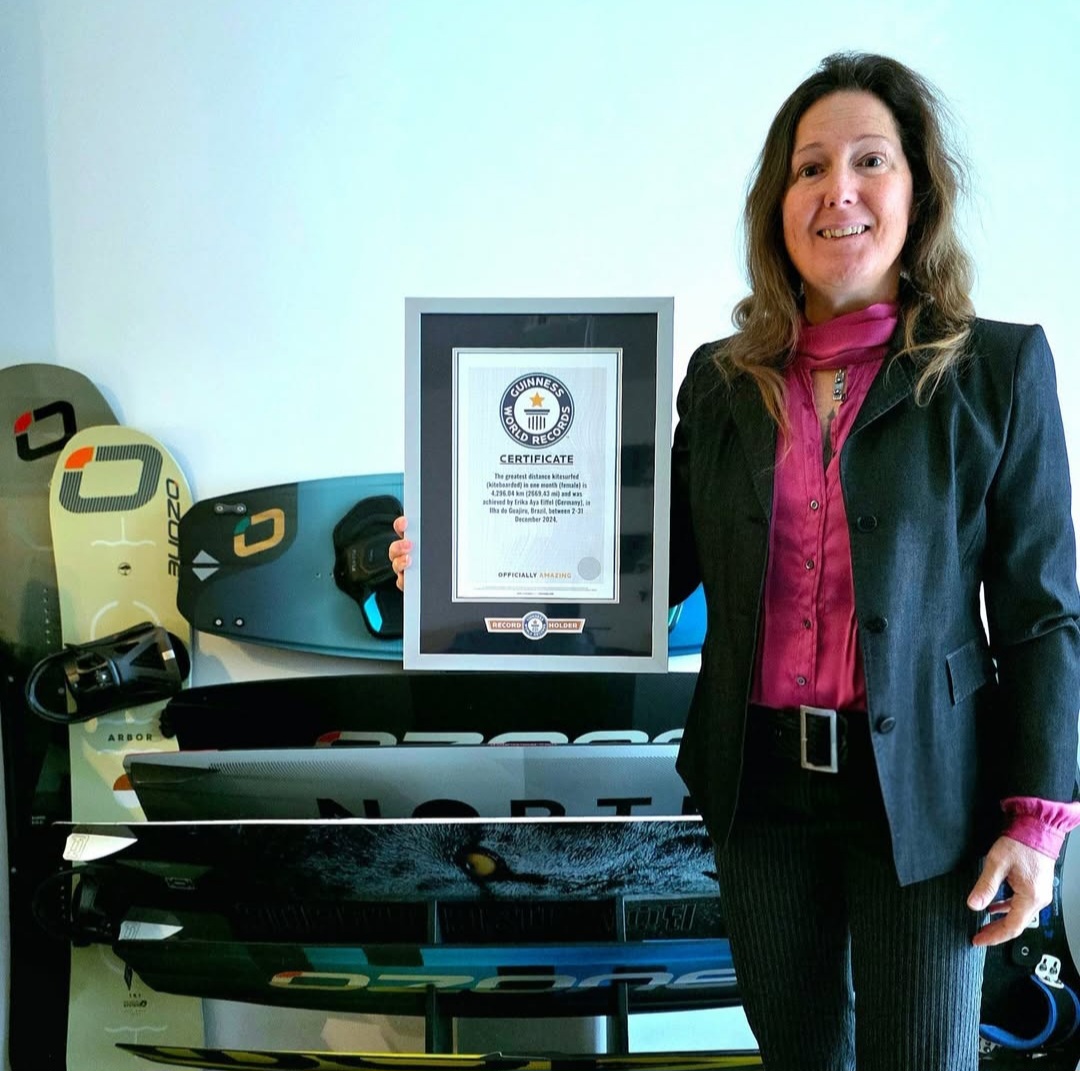
Welcome back to the show. I hope you all had a great weekend. Today's guest is a good friend of mine, Aya Eiffel, or Ayakiteboarding. She's an elite endurance kite surfer. She's got multiple Woo records and she stepped up a game by setting a Guinness World record for the most kilometers kite in 30 days. I'm not going to tell you the number. You need to go check it out because there is a small discrepancy as there is with all these records. Don't forget to follow me at Kite Surf 365 for all the latest episodes. Ladies and gentlemen, a kite boarding.
- [00:42]
C
A congratulations on your Guinness World Record. Do we say Guinness Book World Records or just is it Guinness World Records?
- [00:49]
A
Guinness World Record, yeah.
- [00:51]
C
But it's all. It's all about the book, right? The book is the. The main focus, focal figure of this record. Of this record.
- [00:57]
A
Actually, to be honest, when Guinness World Records are broken, they don't automatically go in the book. At the end of the year, editors get together and they decide who's the most interesting, who has the most interesting record. And they're the ones that actually get to go in the book. So I actually won't know that until the end of the year. And they'll notify me if I actually got in the book or not.
- [01:15]
C
Wow.
- [01:16]
A
I am officially on the online book. So you can go to Guinness World Records. You could type in, say for example, kiteboarding. And all the records that have been broken in kiteboarding will pop up and scroll down and there's mine for the greatest distance kite boarded in a single month, which by Guinness standards is 30 days. And I hold that record, which the.
- [01:37]
C
Record is 4,296.04 km in 30 days. Let's talk about that record in a bit. But let's talk about Guinness. How did this company get the rights to hold records? Do you know the background of this company? Have you done any research into this yourself?
- [01:53]
A
I haven't actually. I know they have different categories for records. You know, they have people that collect stuff and they have the greatest collections and superstars, rock stars that have the most platinum records and things like that. Athletes have won the most championships and stuff in that sense can apply for Guinness World Records. But then there's also those of us that have to actually step the record first and then apply. You can't apply first unless you're like a collector. So for athletes, if you want to do something like I've done, you actually have to contact Guinness first. You have to tell them what you want to do, and then you have to sort out a lot of guidelines. And that's only if they actually accept your application first. So, for me, when I decided to set this record, basically step by step, I went in, I contacted Guinness and I said, I, I would like to do this. It's an online formula you fill out. And then I had to wait ages to get a response back. And if you want to get like a priority response from Guinness, you have to Pay, I think, £500. It's crazy, isn't it?
- [03:02]
C
It's crazy. There's a lot of hoops you have to jump through before you can start. When did you start planning this record? And how long has this been on your mind?
- [03:10]
A
Actually, I planned to do this record. I'd say around 20, 23 is when I came up with the idea. I think it was around the time that I was working on my around the world record. And, you know, everyone was like, oh, yeah, you've got all these Woo records. But, you know, it's like some people, they're like, well, it's just a Woo record. I'm like, yeah, but a Woo record in kiting really does mean something if you're on the top of that leaderboard. Believe me, it means something. So I basically said, okay, well, then I'm going to go for the greatest records that are officially known around the world, and that is a Guinness World Record. So I looked into it and I thought, whoa, there's a lot of stuff involved in this. And I wasn't so sure if this was something I was actually going to be able to do. Then after I contacted Guinness and I found out that we've got to set all these guidelines and they were asking for ridiculous things. They wanted me to film the entire event, like 30 days. Like, I'm not gonna, like, ride with a GoPro on my helmet and be changing it every hour, the battery, just to make sure I record everything. So they had all these ridiculous expectations of me to do it. And I was, well, I don't know about this. And then obviously I had to think about my body. Can I actually ride for 30 days straight? You're doing ultra marathon sessions every day. I mean, I knew I could do that for several days in a row, but 30 days? Yeah, okay. I probably had kited for three weeks straight, but doing normal sessions, but ultra marathon sessions for 30 days. So what I did is the end of 2023, when I had this idea, I said the best thing for me to do is do a trial run, see if I actually can do it. I mean, you don't want to go through all this stuff with Guinness and then find out your body can't take it. So I did a trial run, actually at the same spot I did the record, which was an 80 degree Giru in Northeast Brazil. And the water there is peri tidal dependent. So you have a lot of planning. You have to do around the tide, and you have to contend with chop. Because the big deal about this record is that it has to be done on a commercially available twin tip, so it can't be done on a hydrofoil, which means you eliminate all the chop in your knees and your hips. So I was doing this on a twin tip. So I did this trial run in December of 2023 at Domar in Itokujiru. And two days after I did the record, which was I did for 31 days because I didn't understand that the record was always supposed to be 30. I thought it was supposed to be I was 31. So I did. 31. Came off the water. Two days later, my right knee gave out. And I thought, ooh, I had done, like, almost 3200km in 31 days. So I was only averaging a little over a hundred kilometers per day, and my right knee gave out. So I knew then I was gonna have to train specifically strengths, train my knees and my hips to make sure that I could actually do this. And when I realized that, okay, I could at least break the 3,000 kilometer mark, which was basically set by Gibbous, that said, if I'm not breaking a record, I'm setting a record. I can't just go out there, like, do like five kilometers, say, oh, I got the record. Because I officially applied for it. The deal was set that I had to break 3,000 kilometers, at least doing 100 kilometers a day for 30 days. So, okay, now I know I can do it barely, but I can do it. And then I started doing the planning. So this was December 2023. I made the official application in January of 2024, and it took until November to get the approval. With setting all the guidelines and then also setting up the logistics. Because you have to have witnesses, two witnesses for every session you do. You have to have written statements from every single person. You have to film the start, middle, and end of each session. So that meant I had to have a GoPro make sure it was accessible for when I was launching, when I was landing. And right in the middle just. I had to show, I had to show everything. Everything had to be signed off. So that took a while to do. And then I actually did the record in December, one year later. December 2024 is when I actually did it.
- [07:50]
C
Let's talk about this record. We'll come back to some of the Guinness Book of Records that currently stand. You talked about conditioning your body. You're talking about in the gym strengthening all those sort of like the ankles, knees, hips, the, you know, the stuff that you're going to be putting a lot of pressure on. How much of your training was conditioning versus getting on the water? Because know, you, you like to put your work in, in the water, right? So how did you balance that that year between getting accepted and after your trial to actually doing it?
- [08:21]
A
Before I ever got on the water, I usually did close to an hour's worth of training before I ever would even go on the water for that whole year. Um, very, very difficult. Then by the time I got to the water, I was quite exhausted. But then I knew that if I could make it through that session with one hours of training beforehand, that would help me when I actually got to the record part of it. Uh, yeah, it was intense because I don't know if people know I am actually 53 years old, so I'm not a spring chicken anymore. And I feel it on my body. And you know, I'm, I've been a professional athlete most of my life. I'm a five time world champion in different sports. So I know about discipline, I know about training, I know about nutrition. All these things that have been drilled into me from coaches in the past and stuff. And I basically had to kind of redevelop a training program for myself because I don't actually have a trainer. And then I came up with this training program that I would do every time I, every morning before I'd go out for a session that would actually strength train my lower back, my hips, my knees, my shoulders, and very, very importantly, my core. Pipeboarding involves a lot of core strength and people say, oh yeah, you only need it if you're jumping. But no, when you're riding for long distances, you definitely need to have an incredible amount of core strength to keep everything in check. Because, mind you, again, not doing this on a hydrofoil, I'm doing this on a commercially available twin tip. Every single piece of chop is going into these knees and these hips, so I have to contend with that. And when you're out there, hours and hours and hours. It's one thing doing a weekend marathon, right. But 30 days is something else.
- [09:57]
C
I had the feeling I. That you were doing this as a downwinder. For some reason, I thought you were traveling down the coast. So you were literally going back and ford in that lagoon every day for 30 days. Back and forth, back and forth.
- [10:09]
A
Exactly right. I can't. I can show you the GPS data. Oh, that'd be hilarious. The 30 days. It looks like it's a picture from a coloring book because you can see where all of my GPS tracks. I have literally filled in this lagoon. It is completely filled. I don't think there's a meter that I have not kited in that lagoon from, like, a million tacks going back and forth.
- [10:35]
C
Let's just go through a typical day, right? We don't need to talk about day one or day 30. I guess all the days were the same. How did a normal day start for you? During that one month challenge, I would.
- [10:45]
A
Wake up before sunrise, and then I would coordinate with my team that I had there, which the main person there, his name was Ari, and he owns a posada there in Iliro Gojiru. And he would basically be the guy that would get my kite gear and everything ready for me. Um, and in that time, I was kind of doing my last bit of nutrition that I would need to go before going on the water, doing my stretching, my light warming up. Not like a warmup session like I would do normally for training, but just a sort of a light, get the blood flowing and stuff like that. And then I would launch pretty much at sunrise, so long as the tide permitted, because sometimes at sunrise, there was no water in the lagoon. So in that case, Ari would drive me down to the open ocean, and I would have to just go out to open sea and hide there, which I try to avoid, obviously, because the chop is quite hard after many hours. So if I could go in the lagoon, I would. So I'd start off right around sunrise, and, you know, I'd have my witnesses out there to. To watch me. And I would go and I would go and I would go and I would go. And that session, normal session, I would go probably about four hours in the first session. Then I would come off the water and have a little break, eat my breakfast, try to digest if I could, and then launch and go back out. And again, be title dependent could mean I have to drive somewhere to do that that time. So my days were never exactly the same. It was all depending on the tide. So then I go out for a second session, and that second session also would probably be about four to five hours. And if I had enough kilometers, then I would stop there. And if not, then I would take a break and go for a third session. And that third session would go literally up until Lark. My goal was to do basically, at first, the goals. Well, to put it this way, the goals kind of changed. I know I wanted to do 3,000 kilometers, which, you know, is a hundred per day, but I also didn't want to just set the record. I wanted to, like, set the bar high. So I said to myself, okay, I want to do at least maybe like 120, 130 kilometers per day. So I started off in that area, and I would try to do, like, 150 or more just to make sure that I had, like, a little reserve in case I didn't feel well or something happened. I was building up a reserve. So every day I'd go out and do a little extra. But then I realized that, wait a minute, I think I could do 150 per day. So I kind of upped it to 150. Said, okay, I'm gonna go 150 per day. And each time I go out again, I'm wearing. I'm wearing two GPS devices. I'm looking at my speed. I'm pacing the entire time. So although you think you're getting bored on the water, you're actually not because you're constantly looking at your walk and you're constantly doing the math in your head, okay, if I do this speed for another 20 more minutes, I can get this many more kilometers. Da, da, da. And you're constantly doing this the whole time. So I would do that. And I think, okay, I can get this many in this session and then take my break, do this much in the next session and such and such. And each time I would try to do a reserve and build up this reserve, which was, for me, a very good thing, because I also have a physical handicap. To say. One can say I've got two tumors that I'm battling with. I opened up about it on my Instagram. I don't need to go into so much the details here, other than just it's a sickness that I've had for four years. I work around, and occasionally it does cause me an intense amount of pain. And that pain is so excruciating that I do have to stop. So that was also another reason I wanted to do these reserved kilometers, just in case I call my two tumors Tom and Jerry. In case Tom and Jerry is ready to wreak havoc.
- [14:53]
C
By the way, to anyone out there who thinks I'm laughing at Aya. I've known Aya for many years. She, she's totally happy with me laughing about that. Aya, just let me jump in there. So you averaged around about. Well, I probably overall, I guess what, 140 something a day. If you, you know, you, you took, you, you're talking about it. What was your highest day and what was your lowest day? Because obviously you're talking through, you know, there's a lot of challenges that you're facing.
- [15:15]
A
The record shows this many kilometers, but in reality I did 4820.99 kilometers.
- [15:25]
C
Why do they take 600ks off you?
- [15:27]
A
They took 525km off of me. There's a disparity between the way that Guinness was reading my GPS data compared to the way mine is being read in my viewing platforms. So basically I filed an appeal with Guinness and that is going to take some time to do. They recognize that there is an issue here and they said, you know what, we're going to close the case on this record. So you've got the record, so you should be proud. But what we're doing is we're going to open up another application process for you. You reapply resubmit the GPS data because I had two copies of my data from two different devices. So I'm going to resubmit data, they're going to reprocess all of that, check it all again, and hopefully I can get back hopefully at least 500 of what I lost. So actually, Adrian, I did 160 kilometers a day. That was my average. As far as my lowest day, I think my lowest day was around a hundred. And then my highest day, I did just over 200 a few times. So yeah, I, I didn't do the same kilometers every single day. It's not even possible because sometimes my sessions were shorter, sometimes they were longer. So. But I was stuck to a 12 hour day. So this is something that, if you remember Blue Worlds, Blue worlds, people were going overnight. That's something I actually couldn't do at this spot. You can't tighten the evenings, so I had to know that sunrise to sunset, that was my window to go out, get as many kilometers as possible, which that's put also a lot of pressure on you.
- [17:01]
C
Let me ask you about the mental side of what you do. You know, you can easily go down the rabbit hole of Instagram stories and I ended up looking at some SAS guy talking about, you know, training for Special Forces. And he was talking about, you know, it's not the biggest, the toughest, just the people who can be mentally the hardest, who can keep on pushing and, and the body, like you said, you know, the body will want to quit way before it will actually quit. And it's breaking through that. How do you A, keep yourself getting to that stage and B, the motivational side of that, because, you know, I've done stuff in the gym, like let's say a 20 minute row, which is, doesn't pales in comparison from what you do. But for the last six or seven minutes of that row, my mind is thinking, I'm making excuses. I could just stop now. You don't need to do those extra forms. One, just stop at 15. It's a round number. I'll do 16. How do you get over that? And what, what's that process in your head? Because I'm sure you're being faced with that all the time as well.
- [18:01]
A
This is a very, very, very good question, Adrian. And it's something that's very underestimated. I mean, people hear me doing all about, they hear about me doing all these records and stuff like that, but nobody really asked me much about this part of it. And this is actually the hardest part of it. Anybody can train their body up for these kind of things, but you have to be extremely comfortable inside your own head. That is the first bit of advice I can give to anybody that wants to do any type of endurance sports, because you are inside your head all the time when you're doing it. You can do things like listen to your podcast, put your loophones on, listen to Kite Surf365. When you're out there, you can listen to music, but even that over time actually does start to, to irritate. You can do an hour, you can do a couple hours of listening to music or podcasts, but then at some point you just don't want to hear anything in your ears. Um, for me, I have to really listen to my body because in any endurance sports it goes in waves. You'll be at points where you go, oh, I can do this all day long. This is super easy, you know, and then you start going down and down and down and your body starts reporting in. Everything is reporting in. Your knees, your shoulders, everything. The clothes you're wearing start rubbing the, you know, the salt on your face starts burning your skin. You know, the wind in your ears is just making, making, giving you tinnitus. You're. I. There's just so many little things, and those get magnified over time. And you have to, like, be so in tune with your body that when you're down in that load, everything starts to hurt. You need to be able to tell if this is a good pain or if it's a bad pain. And I think that is a big difference because I am in a lot of pain at times when I'm riding, but I know in my body that this pain. I know it's weird to say, but it's a good pain. A pain that I know is temporary, and as soon as I get through it, it'll be good again because it's always in waves. I don't go out and ride for 10, 12 hours, and the entire session's in pain, but I will ride in those hours and have bits of the session that are actually in pain. So you have to know what is a good pain and what is a bad pain to be able to get through it. And generally speaking, when you're in that trough, you will eventually start. Come out, coming out of it, but you have to keep this dialed the whole time you're in that low, because otherwise it will just consume you. So being comfortable inside your own head is something that's super, super important, and understanding every single bit of your body is. Is important. So, I mean, when I go out there, I try not to be too bored. So I actually, on transitions, I will do little jumps or rotations and things like that. You know, you try to, like, find something to focus on on the water. Like, maybe there's a sea animal. You know, I've seen turtles. I've seen, you know, jellyfish, all kinds of different little creatures out there on the water. And I like, each time I'd ride past, I'd, like, look at that and give myself a focal point that it gives me. It kind of pulls me outside of my head a little bit to. To help distract from some of the. The stuff that is kind of weighing me down in the session. So, yeah, there's a lot of little tips and tricks about getting through the. The bad points, but once you get through that, you get. You can actually get to the point, what's called a high. And it really does feel like, you know, everyone talks about this runner's high. You've maybe heard this term before, but my kiter's high, you do get that. And you're in this point. You're like, oh, my gosh, I can just. I literally can do this all day long. And you obviously know that's temporary as well. So you have to like, be inside of yourself and enjoy that moment while you have it because it's, it's, it's gonna start to go back down again. So if you can get through these waves in your session, then yeah, it's, and it's amazing, it feels amazing. When you land, when you, when you, when you, when you park and you land your kite and you, you start walking and you feel your legs kind of wobbling and you just know that you, you've done something. When you lay in your bed that night and you can still feel your body moving, you know that you've, you've done it, you're, you're just so ingrained.
- [22:30]
C
Did you have to take pain pills? And I, and I'm only asking because I know that a lot of guys during the woo worlds, they, they do dip into that. I know, I think woo going to the 48 hour format on the long form has probably reduced that. But you and I both know endurance kiters who have gone to that stage where it's just pain pills every day. Right. So you didn't have to get to that route.
- [22:51]
A
No. And I actually, well, technically, yes, I should have, maybe could have even taken pain pills to alleviate it, but I wouldn't, I didn't take any type of chemical sustenance to, against the pain that I had out there. And I will tell you why, I'll tell you why it's really important because as I was saying, you have to be very, very in tune with your body. You need to know the difference between in good and bad pain. And if your body is in pain and you cannot feel it, how do you analyze it? So for me, it's important to feel that pain and know, okay, my knees are starting to hurt. Am I actually doing damage to my knees? Well, I'm not going to know that. If I pop a bunch of pain pills and I mask that pain, I could be absolutely destroying myself and I wouldn't, wouldn't even know it. So for me, it's very important not to take any type of pain medication and not to mask the way my body is feeling.
- [23:49]
C
Tell me about the amount of food you were eating and your recovery at night. Were you sleeping well every night? I mean, was it literally just shower, fall in the bed, fuel up as much as you can and sleep till the alarm went off and, or did you get to this? Because I know you can get to a stage where you're that tired and I've been There that you actually can't sleep, which is even more crazy. How was your refueling recovery processes between each day?
- [24:15]
A
Yeah, I mean, you pretty much said it pretty good. I mean, you do get in such a routine that you come off the water and you're just absolutely exhausted and you eat what you can and you just collapse into bed. But it doesn't get that way in the beginning. To be honest, I learned a lot about this record in that I should have maybe done a few days ahead on the record to get my body, you know, set to the routine.
- [24:42]
C
Conditioned.
- [24:42]
A
Yeah, conditioned because, you know, I flew there and I actually had to start the record one day late because my flight was canceled. And that kind of set things off poorly because I actually did want to do a couple training days before going out on the water, and I couldn't do that. I had one day to kind of warm up, and then I started. But I think, to be honest, I would have liked to have had maybe three or four days. I say this because the first days I was so excited that I couldn't sleep. I was just like, I can't believe I'm actually doing this record. After all this preparation. Over a year preparation, about three years of strength training, and I'm finally doing it. And so I would have my big dinner. I. I'd go to bed, wind down, and I just lay there, and my eyes are like this.
- [25:28]
C
Like, it's the worst feeling too.
- [25:29]
A
And I just couldn't do it. So it was like three or four days like this. And I thought, you know, what if I could have just like, done three or four days in the beginning, got that out of my system. Because that sleep deprivation in the first few days actually kind of hurt me going into the end of the first week. So, yeah, I come off the water, like you said, eat. Really, really, really eat a lot. And then I always have water next to my bed, and I. I sleep very light anyways. So oftentimes I'm up and I would just take the water and I drink. So I'm drinking water throughout the entire evening. This is a technique that I have done since I was an ultra marathon runner, is I do most of my hydrating on the cellular level. I would do that over the evening before the event. So it's not that I'm constantly, constantly chugging water on the. On the water. I'm actually doing the hydrating before I go on the water. So, yeah, then when I get out of the water, it's not as I don't need as much let's talk about your gear.
- [26:29]
C
Did you have any gear failure? I mean, I know you are with Ozone Germany. Did. Did the gear all hold up? You didn't have with the gear? Because, I mean, a gear failure could be a massive problem.
- [26:39]
A
The biggest problem with gear is choosing the right gear, the right size kite, the right size board. And I don't mean just the right size kite and right size board, like just enough to go out and ride. It has to be very dialed. I had six different twin tips, and I had like six, I think six different kites, all seven different kites. And when you choose that kite to go out for your session, you have to have the exact size paired up with the exact size board. Because when you're riding, you get your body in a riding position that you need to stay in, because I'm going also at speed. And if you are overpowered or underpowered, you're changing your body position. You know, if you're overpowered, your arms are way out here, and you have to ride the entire session like that. And you can depower to a degree, but then you lose the. The ability with your. Your kite. You can't hold your kite in the same part of the wind window. You want to have the kite and the board have matched up so that when you're in your position, you're in that comfortable position that you can hold that for hours on end. So I didn't have any gear failures. I had failures in the choice of gear. Sometimes I would grab the wrong size kite, go out and realize. And then I'd have to go in. I'd lose time because I'd have to go in and change everything. I mean, I can't have a bunch of kites just pumped up, waiting for me to switch because it's too hot in Brazil. So when I did have to change a kite, I'd have to go through and run back, grab the gear, get all that, da, da, da. And of course, my team did a really great job in helping me with that. But it gets in your head too. If you're out there with the wrong size gear, your board maybe is too small or too big. The kite, I again, I typically try to choose the same size kite, keep with the kite size, and just change only the board. But that didn't always work. So no, you know, failure, just failure in choice of what gear I would take out. As far as sizes go.
- [28:38]
C
Did you find that as the month went through, you got better at making those choices, like the mistakes you made early on and Then at the end you're like, no, no, I need to take the. The 13138 today or the 136.
- [28:49]
A
Yeah, yeah, most definitely. Most definitely. I mean, I was like an absolute pro when it came down. I mean, it's like, oh, yeah, you know, I knew exactly what I needed, so, yeah, that's exactly it.
- [29:00]
C
Was there any funny stories along the way? Did you have any funny events that happened? I'm sure there was lots of horror stories. But let's talk about some positive stuff. Some good times out there when people joined you and, and rode with you and sort of kept you entertained.
- [29:12]
A
Oh, yeah. I had so much support out there, it's crazy. I mean, when I was out there at sunrise, there wouldn't be anybody out there except for my witnesses. But outside of that, the lagoon was actually quite full. And like, the first week, not a lot of people really knew what was going on. But it didn't take long and everybody knew that I was out there going for this record. And it's like every kiter that would pass me would be like, yeah, awesome. And it was such a great feeling to have that much support from people. And then, um, I've been known as mama kiteboarder on the water for years because I'm always doing board taxis for people. That did not change. And people were so surprised that despite the fact that I'm going for a Guinness World Record, I would always stop and rescue kite boards for people.
- [30:03]
C
Nice, nice.
- [30:04]
A
And I'm like, I don't get it. Why, why are you stopping? And like, because some. They've lost a kite board and I'm going to help and their state. I'd rescue like six kite boards in a day. And they're like, you know, you'd have more kilometers if you didn't do that. I'm like, yeah, but then I wouldn't be mama kiteboarder anymore. And to me, mama kiteboarder is more important than any record because, you know, I like helping people.
- [30:21]
C
Aya, let me put you on the spot here. Do you know off the top of your head how many Guinness World Records there actually are? I've got them in front of me. I'm just going to put you to the test. Do you know the exact number of.
- [30:31]
A
Guinness Records World for kiteboarding or for Guinness Records for.
- [30:35]
C
For kiteboarding? Pardon?
- [30:37]
A
I think there's like 22 or something.
- [30:39]
C
Oh, really? Oh, okay. I googled it. Said there's nine.
- [30:42]
A
Nine. Well, when I, when I say kiteboarding, that also includes kite surfing and hydrofoiling and all kinds of different. All the different categories of.
- [30:49]
C
Yeah, this, these are Kite surfing, kite boarding. I'll go through. Longest distance kite surfing in 24 hours. 673.8km by Nick Levy in the US longest journey kite surfing by a male 2780.16 by Brian Kiss von Solly in Australia. Longest journey kite surfing by a FEMA Female 1016.10km by Nika Balus in Spain. Longest journey kites. A lot of long stuff here. Longest journey kite serving by a team 4509.1km by Stuart Edge and Islay Simonetti most consecutive 360 rotations in the air kite surfing seven rotations by Renault Romeo. I'm pretty sure Jamie should go for that. Jamie should go for that for sure. Or at least put it in.
- [31:33]
A
Jamie's broken that 10 times over.
- [31:35]
C
Most people riding kite surfing board simultaneously. Largest parade of Kite Surfers 884 participants. Greatest distance kite surfed in one month. Female 4296.04 IR Kiteboarding yourself and fastest crossing of the English Channel on a kiteboard 2 hours 18 minutes by Sam Branson from the UK. Guys, I think some of these can be beaten. I'm. I'm pretty sure, like, I mean, I'm pretty sure Jamie can go for more rotations than Renault. But maybe you're right. Maybe people just can't be bothered going through the process. But I mean, it seems like if you want to get out there and by all means go for this, but be prepared. You have to be prepared. You know, you can't just turn up and do it.
- [32:15]
A
No, you can't. Well, that's a mistake that I think some people made and I actually kind of thought the same thing. Like, I thought you could just like go out there, do all this stuff and then just basically go and register and say, okay, I've done this much and here's my GPS data done. It doesn't work like that at all. This is so much planning, literally January to November. I mean, that's how long it took to get all the guidelines and logistics sorted with Guinness. Now, like I said, there is an express service, so if you have money, you could pay and they'll address your application faster, like if you're on a time deadline or whatnot. But you do have to pay a lot of money for that. And I said to myself, you know what, I'm patient. I know I can do this. I will just take the time. And when I did the Record. I did it in December of 2024. Had to then submit all of my data, which I had 222 video files that I had to send. I think I had something like 63 gigs worth of data that I had to send to them. 62 GPS files. Just then I had piles of witness statements and all the contact information for everybody. I just. This, this data that I had to send to them took I think 14 hours to upload or something like that. So I got all the data sent to them and I submitted this early last year and only just now got the record. So it took that long for them to sort through everything and get it done. There is also another way that you can do this with Guinness. You can actually hire an official from Guinness to come to your event. You have to pay for everything, obviously, and they come to your event and they run all of it for you. So you don't have to do all that stuff. They do it, but you have to pay out of the nose for that.
- [34:08]
C
What's next? You have all the major distant records on. Woo. You now have a Guinness World Record. Do you want to go for some of these other Guinness World Records? I mean, there's a couple ones here that I think, you know, are right in your warehouse. Any of these long distance 1. Is that the plan to have a little bit of a break and, and start piling these ones up as well?
- [34:27]
A
Yeah, I definitely want to do some more of these records now that at least I understand how to do them. I think that I could go with this, but I want to wait till this appeal is done first. Because the one thing that really was a shock for me is when I got the approval from Guinness and I looked and I saw the amount of kilometers and I thought, wait, what Disappointing. Can't be right? And I was gutted. I was absolutely gutted. I was talking to my family on the phone and I was in tears and they're like, wait, why are you crying? You should be crying for joy because you've got this record. I said, yeah, but you don't understand. I mean, I lost like three and a half days of writing from this. And I just felt like gutted that, you know, everything that I did I didn't get all the credit for. And I thought, geez. And then when I contacted them and I said, hey, you know, and they said, okay, well, yeah, okay, we got this issue, but just resubmit the application. I was like, okay. So that gave me some hope. So I'm happy with this certificate. I'VE hear. I'm happy that, you know, I have it, but I am going to push the appeal. Once that appeal is done, then I will reconsider if I think it's worth trying to go for another distance record. Because I've already talked to Guinness. I said, how can I avoid this discrepancy in the past because I don't want to be going out looking at my GPS watch knowing that I have to add 12.2% or delete 12.2% of my session every time I go. And that's the actual value of my kilometers. I mean, that would be heartbreaking. So I don't want to have to go through that again. So if I can get stuff sorted out with this appeal, then I know that, yes, it is possible. But if they say, no, we can't do it, then I honestly, Adrian, I think I'd be less inclined to do any more Guinness records because it's just literally losing 12% of my effort is, is heart wrenching. But to ask what I would do otherwise. I actually would like to, I really would like to do some type of large crossing, like a channel crossing or some type of like long distance thing around an island. I mean, I want to do something that's hard. I don't want to do something that just anybody can jump on a kite board and do. I want it to be something that is absolutely pushing me to the end. I want it to push me up to those highs and lows. That's what I kind of like. Endurance athletes, they, they love that. I mean, if it, if it was easy, I wouldn't want to do it. Give me ideas because maybe somebody out there has this amazing idea for me to go and do something incredible with my endurance padboarding.
- [36:56]
C
Last question for me. I, before I let you go, when you finished the challenge, was it a celebration or more relief? Because 30 days of, you know, 12, 13, 14 hours on the water, every day you want to celebrate, but your body's also like, I just need a break now.
- [37:13]
A
Honestly, I was kind of like a zombie on the very last day. The Domar in Brazil. Domi Sembler, he owns the posada there and he's also the head chef there. And he baked this really nice cake for me and, and, and did some ice cream and then they, they put like the number of kilometers again. I said, I did, you know, 4000, 4820.99. And they put that figure on the, on the thing. They put it on a plate and they brought it out towards me. And then I had my twin tip in my arm and. And they brought it out and I, I put the smile up for the camera and everything like that. And I remember in my head at the same time thinking, oh, I just want to go to sleep right now. But it was, it was, it was like a zombie thing. And because my record started a day later than I wanted, I wanted to start on December 1st and go to December 30th and be finished and then have New Year's Eve, you know, not, not like this. But it basically came to the 31st. I had to do from the 2nd to 31st. 31st. I was such a zombie, I couldn't even stay up for new years.
- [38:18]
C
Oh, yeah, look. Congratulations. Unbelievable performance. I mean, I've known you for many years now, and your dedication to the sport and, and in particularly endurance riding is. Is second to none. So I'm looking forward to hearing what's next. It's going to be super cool. If you can do a large ocean crossing with a team, I think that would be awesome. I mean, yeah, let's. Let's bounce some ideas around. Go for another one.
- [38:42]
A
Let's do it. Let's do it.
- [38:43]
C
Thanks, Aya.
- [38:44]
A
All right, take care.
- [38:45]
B
Hey, guys. I hope you enjoyed that episode. Don't forget, if you want to support the show, the easiest way is to support us for free. Rate us on Spotify, share them in your local WhatsApp group, or just simply tell your friends. If you want to support us more regularly, head over to Portrait Kite and check out all the madness there. Portrait is an independent media company trying to tell the stories of kite boarding the way we believe they should. All the projects there are funded by people just like you. And if you believe in what we do, you want to support us more, head over to Portrait Kite. The podcast guys will always be free. And if you want to find more episodes just like this one, use the search button at kiteser365 to search your favorite writer or topic. And we'll be back this Thursday with the Megapod.