← Know What You Believe with Michael Horton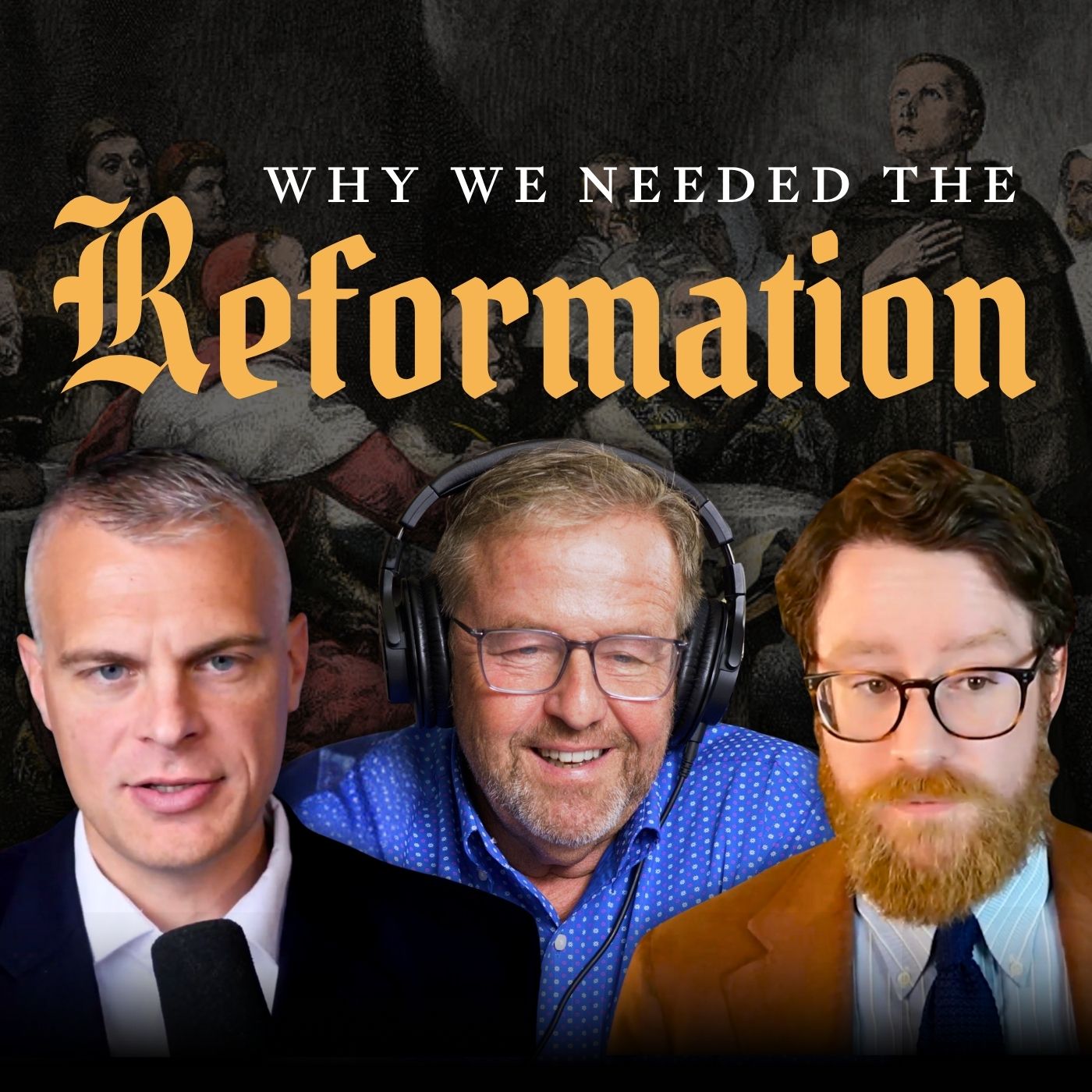
Know What You Believe with Michael Horton
Justified by Faith and Works? Defending Sola Fide with Gavin Ortlund & Jordan B. Cooper
00:44:50
Loading summary
Transcript62 lines
- [00:00]
Host/Announcer
At Sola Media, we're committed to helping Christians deepen their faith through clear, Christ centered teaching rooted in the riches of the Reformation. Every podcast, article and resource we produce is offered free of charge, and it's only possible because of generous monthly supporters. When you become a partner Today, you'll receive two remarkable books as our Rediscovering the Holy Spirit by Dr. Michael Horton and Praying with Jesus by Pastor Adriel Sanchez. We believe these books can guide you into a clearer understanding of the Spirit's work and a richer prayer life. To become a partner and receive these two books, visit solamedia.org partner.
- [00:46]
Dr. Michael Horton
You don't have to have perfect understanding of all the technicalities of justification to be justified. I think sometimes this discussion kind of lands upon people like that, as though we're thinking it becomes, in effect, a justification by faith in justification. And what we ultimately want to direct people to, of course, is Christ Himself and the disposition of the heart to him.
- [01:12]
Jordan Cooper
Yeah, I think that Paul is doing exactly what you're talking about there in Galatians. He's fleshing out what it looks like in a legalistic environment. You get backbiting, you get envy, you get slander, you get all that stuff in a church that is characterized by the Gospel he has just preached. Over these chapters, all that remains is love. We're not justified by love, but the justified love. Hello and welcome to another program of Know what yout Believe. And it's a pleasure to have my friends Jordan Cooper and Gavin Ortland on with us again to talk about Protestant apostolic apologetics. In this program, we're going to be talking about justification, really the heart of the Reformation. And before we get to the Reformation, it's worth pointing out Romans 3:28, for we hold that one is justified by faith apart from works of the law. And then James 2:24, you see that a man is justified by works and not by faith alone. So, first of all, brothers, let's define the approach of the Roman Catholic Church, particularly after the Council of Trent, on justification vis a vis the Reformation view.
- [02:46]
Dr. Michael Horton
Go ahead, Dr. Cooper.
- [02:47]
Gavin Ortlund
Yeah, sure. So we're talking about the Roman Catholic doctrine of justification after the Council of Trent. I just think it's important first to note that there really is no definitive definition of the doctrine of justification at any council prior to Trent. There are things relevant to justification that were decided at councils like the condemnation of Pelagianism and things like that, but no official definition until the Reformation. So according to the Council of Trent, justification is a transformative process. It is a transformative process whereby the individual enters into a state of grace through baptism. And justification is something that is infused. There's an infusion of grace into the soul and the grace of justification. In Roman Catholic Tridentine theology, justification is a process and it can be increased through merit. So there is an increase in justification.
- [03:49]
Jordan Cooper
So a beginning justification, then an increase in justification by your meritorious cooperation, and then finally a final justification.
- [03:57]
Gavin Ortlund
Yes, yes, precisely, precisely. Certainly Rome sometimes talks about justification. Yes, by faith, even apart from works. If we're speaking about just initial entrance into the state of grace, something like that. But justification is generally a cooperative effort that requires faith that is formed by love. So there's an increase in justification through merit. The Reformation holds that justification is a forensic declaration. It is a forensic declaration. It's a judicial statement, declaration over the sinner, that for the sake of Christ, one is declared perfectly just or righteous. And so there's a positive and negative element of this. In the positive sense, the sinner is declared perfectly righteous for the sake of Christ and his merit. And then in the negative sense, there is a non imputation of sins. So the sins of the individual who believes are not credited or counted against them. The Reformation as a whole. Protestants as a whole certainly believe in a transformative process. However, we don't equate that with justification.
- [05:06]
Jordan Cooper
Yeah, Isn't that what it really comes down to? The Catholic Catechism says justification is not only the remission of sins, but also the sanctification and renewal of the interior man.
- [05:20]
Gavin Ortlund
Right.
- [05:20]
Jordan Cooper
And you point out helpfully there, Jordan, that's not denied. The latter isn't denied by Reformation Christians. It's affirmed under the doctrine of sanctification. It's just not justification.
- [05:33]
Gavin Ortlund
Yeah, exactly. So Luther makes this distinction between the two kinds of righteousness, and so he's going to distinguish between what he calls a passive righteousness and then an active righteousness. The language of passive refers to the posture of the individual who is considered righteous. We are passive before God. We don't earn that righteousness, we don't merit that righteousness. Christ has merited it for us. We come before God passively and we receive the gift that is the righteousness of Christ that covers us, through which we are declared righteous.
- [06:04]
Jordan Cooper
And don't you think that there is sometimes a misunderstanding in Protestant circles that we are justified by faith, as if faith were the meritorious ground rather than Christ? Really, Justification through faith alone is another way of saying by Christ alone.
- [06:25]
Gavin Ortlund
Yeah, I think that that's exactly right. It's really important to clarify what the relation between faith and justification is. Because it's not that God looks at faith and sees faith as a work that then he rewards with a verdict of righteousness, or it's not that. And this would be a more maybe nominalist take on justification, which Rome often claims is the Reformation view, But it's not where God kind of maybe relaxes his law and says, you know, instead of all of these conditions of the law of the Old Covenant, now you've got just this one condition you have to meet, and that is faith and faith, or maybe faith and repentance. And if you meet that condition, therefore, God has now declared that you're righteous because you filled the obligations that he's given to you in the New Covenant.
- [07:08]
Jordan Cooper
Which a lot of Protestants believe.
- [07:11]
Gavin Ortlund
Yeah, there are some Protestants that do believe that, I think, particularly within certain strands of Puritanism, which I'm sure you're more of an expert in than I am. So the way that Luther would see this is that faith justifies because it grasps Christ. And so what is righteous about faith is not the act of faith itself, unlike what someone like contemporary scholar Robert Gundry is going to say about God. Just credits faith as righteousness because faith is righteous. No, but faith is that which justified, because faith is that which receives Christ. It is what brings us into communion with Christ. And in that communion with Christ that we have in faith, we receive Christ's gifts that he gives to us, and that includes his righteousness. So I am justified by Christ's righteousness. And so really, to say, yes, that we are justified through faith alone is to say, really, that we are justified by Christ alone. And so faith is by no means the meritorious cause. Christ is the meritorious cause of our justification. Faith is simply that which brings us into what Christ has done for us.
- [08:19]
Dr. Michael Horton
It might help our viewers a little bit to define some terms, not assuming any background knowledge. So someone's coming into this discussion the term forensic. Maybe they watched Law and Order and they've heard this word, but in this context, it means having to do with courts of law. So the doctrine of justification is located in the legal aspect of our relation to God. One way we relate to God as His creatures is that he is our judge. And I actually find this pastorally helpful to remember at the front end here that one aspect of human existence is I will stand on Judgment Day, and there is a legal dimension to my relationship with my Creator. That is not the only dimension, but that is one valid dimension that's very clear in Scripture. And Justification speaks to that to help hearts understand this. When we stand before God on Judgment Day, we believe justification is really good news and it brings us the salvation we precisely need. And so we want hearts to understand. That's what we're talking about here. Another comment in the realm of defining terms might be to say that some of the disagreements about justification, both within different Protestant groups and then also Protestant to non Protestant groups, such as Roman Catholics, do relate to terminology, though not all. I don't think we're going to say they all do, but some do. And so we want to understand the term. You know, even at the beginning we mentioned the James verse and the Galatians verse. If you don't work hard at definition of terms, it can sound like James and Paul are just flatly contradicting each other. But I think we would say that they're using terms in different ways. So sometimes the word justification can be used more as show who is authentically a Christian in a human way. Other times it can be used to refer to the actual process of being made righteous in God's sight. And another key term is the word faith, because sometimes the word faith means a disposition of trust to God that includes virtues like, you know, faith working through love, for example, and it's a more full orbed definition. But other times it just means bare intellectual assent. And, and I think that's a key piece in harmonizing James and Paul because he says even the demons believe. So James cannot be using the verb believe to refer to faith working through love. It must be more of a bare intellectual assent. I just think it's good to put out onto the table these terms. We're going to have to be sensitive to this because otherwise it's like an American and a Brit arguing whether football is the best sport.
- [10:53]
Gavin Ortlund
Yeah, I think something that's really important when we're reading passages in Scripture is to recognize that the apostles, when they're writing the New Testament, don't have a comprehensive systematic theology in front of them. And by that I don't mean that their theology isn't consistent or can't be systematized. What I mean is that they don't have an agreed upon definition of terms in the same way that we do. And so when we use the term justification, we are generally in theology using it in its Pauline form in that context. But that doesn't mean necessarily that James is using the term in precisely that same way. And we always have to be careful in reading the New Testament because oftentimes we can import kind of later terms that we identify with one specific thing, with the use of a term in another passage. It really has nothing, you know, nothing to do with that at all. So I think we have to be really, really careful when doing that. Yeah.
- [11:43]
Jordan Cooper
And besides Paul, I think of Jesus very clearly contrasting the Pharisee who had confidence in himself that he was righteous with the tax collector who said, God be merciful to me, a sinner. And Jesus says he went home justified that day rather than the other. And similarly, Paul contrasts catacrema condemnation with dikaiosunes justification. So whatever justification is, it has to be the opposite of condemnation. And as you said, Gavin, these are forensic terms, these are legal terms. And we'll often hear from evangelicals as well as Roman Catholics. You know, you guys talk about this legal stuff. It's a relationship. And I often tell people, yeah, marriage is a relationship, but you got married one day, you know, how do you know that you're really a full son or daughter if you don't live with your birth parents, you live with different parents, you've been adopted, it's a legal adoption that gives you that security that you're going to inherit everything they have. And so can we say, yeah, if it's not legal, it's not secure. And so it is actually good news that we have a legal relationship to God. And the good news is that the one who will preside at Judgment Day is the same one who fulfilled the law in our place, died in our place, carried our curse for breaking the law, and imputes that to us. So we already know what that verdict is on Judgment Day.
- [13:42]
Dr. Michael Horton
Isn't it a happy thought, Mike? Just related to what you just said there, Romans 8:34. I've just been thinking lately about the intercession of Christ, the one Paul says, who is it that condemns Christ? Jesus, who died for us, was raised and is now interceding for us. What a thought. The judge is the very one who is currently our advocate and intercessor in heaven. I hope our viewers will feel the tremendous comfort of the gospel, and in particular this aspect of the gospel justification. This is tremendously good news.
- [14:17]
Jordan Cooper
It's interesting. Calvin, along these lines, wrote a really honest letter to Cardinal Sadoleto. Cardinal Satellato was trying to get Geneva to come back to Rome, and the city council asked Calvin to compose the letter of response. And it's one of his most precious writings, very honestly. At one point he says, I have found Cardinal Sadaleto in this whole business that the people who can't Accept the doctrine of justification as the Scriptures teach it. Have never really had a crisis of conscience. I mean, it's almost a psychological, very existential point he's making, that he had a crisis of conscience. Calvin was often called by his friends the accusative case. And Luther. Good grief, he was such an accuser of himself. It's people who really have felt the sting of the curse who flee to Christ.
- [15:29]
Gavin Ortlund
Yeah, yeah. If I could add something to that, you know, as we're talking about this idea of the burdened conscience, I just want to say this idea is not something that's new with, you know, Luther or Calvin. So there's a quote that I'd like to read from St. Ambrose, and he's speaking to this. Exactly. This is in one of his mystagogical lectures. It's called On Jacob and the Happy Life. Speaking of, you know, Jacob, the. The patriarch, he says this. We ought not have any distrust whatever over the continuance of God's generosity. So long and continuous has it been and so abundant that God first predestined us and then called us those who he called. He also justified those who he justified. He also glorified, quoting Romans 8. Can he abandon those who he has honored with his mighty benefits even to the point of their reward amid so many benefits from God? Ought we to be afraid of certain plots of our accuser? But who would dare to accuse those who, as he sees, have been chosen by the judgment of God? God the Father himself who has bestowed his gifts? Can he make them void? Can he exile from his paternal love and favor those who he took up by way of adoption? But fear exists that the judge may be too harsh. Think upon him you have as your judge, for the Father has given every judgment to Christ. Can Christ then condemn you when he has redeemed you from death and offered himself on your behalf? And when he knows that your life is what was gained by his death, will he not say what profit is there in my blood if I condemn the man whom I myself have saved? Moreover, you are thinking of him as a judge. You are not thinking of him as an advocate. But can he give a sentence that is very harsh when he prays continually that the grace of reconciliation with the Father be granted us? I think it's just a beautiful. It's a beautiful statement, and it's a statement that could be found in Luther. But this is the kind of comfort that we find here in the doctrine of justification. You know, it's not this. This picture that we often get from you know, Roman Catholic arguments against the Protestant doctrine is that this is just this impersonal, you know, judicial thing where we're just totally separated from Jesus. But this is here what Ambrose is talking about. This is what we're talking about, that it is because we have an advocate who is also our judge, that we know that we stand before him righteous and that there is no fear.
- [17:49]
Dr. Michael Horton
You know, just both of you are saying this, but the point that you made A moment ago, Dr. Horton, about the crisis of conscience, I think is such an important, helpful sort of angle of entry to this whole arena, because I think almost everyone can relate to that, if not everyone. I think we experience that differently. But I actually think a lot of secular people, we might think, oh, well, as Western culture has become more secular, we're less obsessed with law and righteousness. But I don't think so. I think it manifests differently.
- [18:22]
Jordan Cooper
How many Facebook collects do you have?
- [18:24]
Dr. Michael Horton
Yeah, yeah. Oh, once you start to see it, you can't unsee it. All of the manifestations of our deep insecurity with respect to this whole arena, this is a deep, fundamental human need. I think there are so many forms of justification by works. And you can be an atheist who has no thoughts of God and spirituality and still be. Your whole life is defined by justification by works. You're trying to make yourself right through what you accomplish and what you do. I just love what we're saying about the comfort that this doctrine brings.
- [19:05]
Host/Announcer
The five SOLAs of the Reformation brought essential truths of salvation and purpose into clear focus. These truths are just as critical to Christian life today as they were 500 years ago. Rediscover their meaning and relevance. In our newest booklet, the five Essential Truths for a Modern Reformation. Inside, you'll explore each of the five grace alone, faith alone, Christ alone, scripture alone, and God's glory alone, and why they still matter today. Support our work with the gift of any amount and we'll send you a copy. Visit solamidia.org offers to get yours today.
- [19:49]
Dr. Michael Horton
You know, it might be helpful just to identify one of the points of difference between Protestants and Roman Catholics that plays into this very point, and that is the formal cause of justification, which is one of those areas where even where there's been ecumenical progress. And you guys can correct me if I'm wrong on this. To my awareness, this has not been resolved. This is one of those remaining issues that just. Is there, like a sticking point? And this has to do with that intrinsic element that our justification, our righteousness, actually consists of. Think of this as the essence of our righteousness, that which actually guarantees the verdict on Judgment Day. And I just want our viewers to understand the good news that it is to have an imputed righteousness, not just an infused righteousness that is perfect. Think of it like this. If you have a crisis of conscience, you know that feeling of guilt before God. We all know that. To think on Judgment Day, I don't want to stand on any other righteousness than the perfect righteousness of Christ.
- [20:48]
Jordan Cooper
Your sanctification's imperfect.
- [20:50]
Dr. Michael Horton
Yep, exactly. If it's up to me, I mean, the work of God in my soul is good. I thank God for his Holy Spirit. I want to grow more like Jesus every day. That's essential. Protestants do not deny the process of transformation. But what I'm going to stand on on Judgment Day is not that it can't be that I need the perfect righteousness of Christ.
- [21:11]
Jordan Cooper
Yeah, absolutely. It's interesting, too, that the Westminster Confession singles out this point, the formal cause so clearly when it says that we are justified not by anything done by us or anything wrought within us, even by the Holy Spirit, but simply for the sake of Christ and his righteousness imputed to us. That's what we're talking about. So basically, Rome, and we could say Orthodoxy as well, Eastern Orthodoxy. It's not the Reformation view that's reductionistic, but the Roman and modern Eastern Orthodox view, because we actually say, in Christ, in union with Christ, I'm chosen, redeemed, called justified, being sanctified one day, glorified, the whole enchilada, I get it all in Christ. You can't separate Christ's benefits. But Rome collapses sanctification into justification or justification into sanctification, so that there really isn't justification, there's only sanctification. That is, if you cooperate with it sufficiently. Finally perfected when you face judgment. But we know that that's why purgatory is there, because we're not going to be able to confidently stand before God with a perfect righteousness without further purgation. That can't be comforting to people.
- [23:00]
Dr. Michael Horton
Yeah. You know, if someone was asking for biblical support for this idea, I think one of the passages we could point them to is in Romans 4, in the language of crediting. But another passage I'd love to throw on the table, because it's been the most nourishing to me personally with respect to this doctrine is Zechariah 3, which is very obscure. It's one of these night visions in Zechariah. Very obscure. But it's where Joshua, the high priest, is covered in filthy clothes, and he's being accused. And then the angel of the Lord says, take away his unclean clothes and his sin is specifically referenced. That's the. Oftentimes clothing is a symbol for righteousness in Scripture, and he's clothed in clean garments to silence the accuser. This is, I think, a wonderful image, though. There's a lot also going on in this passage, and our viewers can understand clothing as a great metaphor for the imputation of Christ's righteousness. Think of this sense of being covered. Think of this sense of perfection that is not within you, and yet it is yours by an act of the grace of God. And so this is a great passage to study and reflect upon to help us grow in our understanding of this truth.
- [24:12]
Jordan Cooper
Could it be. We could go into the exegetical arguments in a moment, but as we're kind of defining the differences here, maybe, Jordan, you can give us something from the Book of Concord that you think really summarizes the Lutheran version of justification.
- [24:30]
Gavin Ortlund
Yeah, yeah, man. It's not like I have the Formula of Concord memorized, unfortunately. You know, I wish I did here, but. Yeah, I mean, the doctrine of justification is discussed, you know, several places in the Lutheran Confessions, from the Augsburg Confession Article four to the small cult articles. The Formula of Concord probably is the clearest of all of these because there was actually a debate that arose by a guy named Andreas Osiander who taught that justification was transformative to some degree. But the definition that is given in the Formula of Concord defines justification as that forensic declaration, and it highlights those two elements of justification. As I said, there's the positive and the negative. The positive is the imputation of righteousness, and then the negative is the non imputation of sin. The Formula of Concord actually also uses adoption synonymously with justification there, too, which I think is kind of interesting in terms of how those things are used. Maybe one more clarification there is that when we're talking about the positive righteousness, and I know there's some debate among different traditions about this, but at least in the Formula of Concord in the Lutheran Confessions, that righteousness is defined as containing both the active and passive of obedience of Christ. And so that means that this righteousness includes both Christ's active fulfillment of the law, his positive fulfillment of the requirements of righteousness under the law, as well as his suffering on our behalf, taking the penalty of the law upon himself.
- [26:04]
Jordan Cooper
Doesn't that really get to the heart of the criticism? We often hear that it's a legal Fiction?
- [26:11]
Gavin Ortlund
Yes.
- [26:12]
Jordan Cooper
Justification isn't real.
- [26:14]
Gavin Ortlund
Yeah.
- [26:14]
Jordan Cooper
It's God just winking and saying, okay, I'm going to declare you righteous, even though you aren't really righteous, when in.
- [26:24]
Gavin Ortlund
Fact.
- [26:26]
Jordan Cooper
I am really righteous because Christ fulfilled all righteousness for me. His merits really are mine.
- [26:35]
Gavin Ortlund
Yeah, yeah, no, that's exactly right. So when people use this legal fiction kind of language, this is often framed within a medieval nominalist framework. And you had certain theologians, like Gabriel B. Beale being probably the primary example, who would say that essentially God did just decide what the standards were for the sinner to enter into a state of grace. So God just kind of decided. For Biel, it was that essentially you would do your best, really. And if you did your best, God counted that as good enough, and therefore you entered into a state of grace. So there was this kind of Everybody gets a trophy. Yeah, yeah, exactly. But it's kind of this arbitrary. God just determines whatever the standard is. It could really be anything. God could just kind of ignore your sin and declare you righteous if you want to be. But that's not at all what we're saying, because. Yes, exactly. We're saying that this is not a legal fiction. This is a reality. And it's a reality of a penalty that Jesus paid, of a positive righteousness that Jesus himself fulfilled. So it's anything but a fiction, because it's real and it's real in Christ. Yeah.
- [27:35]
Dr. Michael Horton
A question I'd love to ask you both is, am I right in thinking that on the one hand, we appreciate the emphasis of the reformers. I think this area we're talking now, we do have a lot of common ground between Lutheran and Reformed traditions and learn so much from each other. And we appreciate the emphasis on justification as absolutely central. And yet at the same time, we want to allow in real life for misunderstandings of certain parts of justification to happen to a genuine believer. We look back at the medieval tradition and we find coming out of Augustine, that the alternative definition of justification is widespread through Augustine's influence. And. And I think I would tend to make the argument that there actually is some confusion and it's not totally clear. This is just not one of those doctrines that is sort of worked through and contested over and brought to crystal clarity prior to the Reformation. And so you just. Even in one single theologian, you can find disparate statements that are not always easy to harmonize with each other.
- [28:39]
Jordan Cooper
Well, and part of it was Augustine didn't. No Greek and Jerome's translation, the Latin vulgate for justification, which today Roman Catholic exegetes agree is a completely judicial, declarative term was translated used to ficare to make righteous, not to declare righteous. So it's an honest mistake if you don't read Greek.
- [29:04]
Gavin Ortlund
The point that say Martin Chemnitz makes in his examination of the Council of Trent when he looks at the Church Fathers on justification, he makes the argument about Augustine and some other as well who follow Augustine's definition of justification that you know, they, he, they may not agree with us in terminology, but they do in essence. And I think that's really the, the question that we have to get at. And I think it is unfortunate when we just focus looking at the Fathers on the question of how are they defining and using that specific term justification? The question is what is the concept that, that they're identifying there? And Augustine, for example, defines concupiscence as sin. That leads to quite a different view of, of grace than one finds in the post Tridentian Church. I think that's very relevant. So questions of things like do they have a doctrine of penance? Do they have a conception of the treasury of merit? All of these things are related to justification very much so as it develops in the late medieval period. So we have to ask a lot more, I think, than just the question of how did they specifically define the term justification. And I think Augustine's not that clear. And if you look at someone like John Chrysostom, he doesn't seem to be very clear in how he uses the term either. Sometimes it seems forensic and sometimes it doesn't. But honestly, you find the same thing even in Luther, especially early Luther, but even later in life. Sometimes Luther just uses the, throws out the term justification and seems to be saying regeneration or sanctification. He's just not always being as precise with his terms. So we have to get, I think beyond the just question of what specifically did this father mean by this term used in this place to say what are the broader concepts that they're functioning with?
- [30:39]
Jordan Cooper
Yeah, in my book on justification, it really struck me to start, I wanted to start out with because I was struck by what I found in a lot of the Church Fathers. I wanted to start out with the Great Exchange. Not a definition of justification, consensus. But what is just really, let's get to the heart of it. What is justification? And there was a consensus on the Marvelous Exchange. It was a term that went back to the third century, an actual phrase because of course it's in the Bible. But this marriage analogy that we get, Jesus gets all of our debts as we come into the marriage, and we get all of his riches. And that is a major theme. So major that Luther can even say what all I'm saying here about the great exchanges, it's in Bernard, it's in the church.
- [31:46]
Gavin Ortlund
Father.
- [31:46]
Jordan Cooper
Well, it's in the Bible. And Calvin quotes Bernard of Clairvaux. I think it's 26 times in his treatment of union with Christ in the Institutes. So you really can find precedents for a view that was not affirmed at the Council of Trent, but was affirmed by the Reformers. If you're not just doing a word search.
- [32:10]
Gavin Ortlund
Yeah, I think that's right. And if you look at that Epistle to Diagnitus, that first evidence that we have of that metaphor being used and some of the earliest Christian literature we have, he is pretty specific that in this great exchange, Christ's righteousness is a covering. Like he says that explicitly that it's a covering. And so he's not just speaking in terms of an infusion of righteousness or something like that. I think understanding that union with Christ context in the marriage metaphor is really key for Luther's understanding of justification. It's all over the place. And it seems that a lot of the development of Luther's doctrine of justification is simply a reiteration of Bernard of Clairvaux.
- [32:50]
Dr. Michael Horton
Dr. Horton, you were the one who put me onto John Chrysostom on this topic. When I read through your book on justification, I was really impressed with a lot of these passages you were citing. Now, to Dr. Cooper's point, you find different kinds of statements in someone like John Chrysostom, especially because he's preaching. And so the text, you know, as you pointed out, a lot of the modern day Roman Catholic scholars will yield that Paul does use the term justification in a forensic sense. So when Chrysostom. And I would just love to encourage people to read, they're online, you can find them Chrysostom's homilies on Romans. It's amazing how he's defining justification in ways that are very friendly to what will come about in the Reformation, even though he'll speak at other times, when he's preaching on other texts. And he's not always perfectly coherent, but it's amazing. I would be curious for us to hit this James 2 challenge a little more, if you guys are open to that. And just, you know, we would want to go to Paul, of course, because I would say there's some passages in Paul that are just so massively favorable to what comes into greater focus in the Reformation, but we do have this text in James that superficially in the wording poses some tough questions. How do you guys think about that?
- [34:01]
Jordan Cooper
I think the context makes all the difference. It's not words alone that mean things. It's what we mean by the words we use in. In certain contexts. And I think that Paul is talking about how we actually inherit everlasting life, how we are justified and adopted. And I think you're absolutely right, Gavin. To say it would be impossible for James to be saying, the devils have faith, but they just don't have enough works. James is saying that kind of faith that cannot save is mere intellectual assent. And here are people running around saying, you know, maybe quoting Romans and Galatians. People running around saying, safe and secure from all alarm, and yet they don't love their neighbors. Jerusalem is being surrounded by Roman armies and people are dying. Rich people are oppressing poor people in the community, and Christians seem to be living just like everybody else. And so he's basically saying, oh, you raised your hand, you walked down an aisle, you said a prayer. Good. I mean, that's not faith that can't justify you.
- [35:27]
Gavin Ortlund
Yeah, I think just the context of the epistle of James is obviously so different from, you know, Romans or Galatians. It's just evident that James is not about soteriology. I mean, that's not the primary point of the book. That's not the genre of the book. It's essentially a piece of New Testament wisdom literature. And there is strangely no explicit mention of the cross in James. And James is really dealing with behavior in the church. I mean, that's evident throughout the entire book. But here he specifically, you know, highlights how you demonstrate. I mean, he says, I will show you my faith by my works. And he's giving specific examples in a congregation of how, you know, people are act as hypocrites. You know, they say, you know, go and be fed and don't actually feed anybody. They don't actually help anybody. The context seems pretty evident. And I think it's really. We get hung up on that word justification, because that's the phrase that. That's the term that he uses. But we do have, even in Scripture, other places where justification is not tied. This kind of explicit soteriological definition that we tend to give in dogmatics, like when Jesus says, wisdom is justified by her children. This is to say that wisdom is vindicated. You know, that there is a wise person or a wise saying, when it actually bears some fruit to demonstrate the wisdom. And so we know that the term has that meaning. And that's why I've said, really, you know, we could translate the term in the same way there to say vindicated, because that's what Jesus is talking about. And so I think what James is really, really saying is that Abraham was vindicated by his works. And oftentimes when people talk about James, then they go back to Luther and say Luther just throughout the book of James, because of this, because he just clearly couldn't deal with this. But just quickly on this point, just because it gets brought up. I was just reading through Luther's disputation concerning justification this morning, and in this disputation, Luther just very explicitly says there is a justification by works. He says there is. He says there is a justification by works. And he distinguishes between an external and internal justification. And essentially he says that, well, outwardly, nobody will see my faith. All they have to judge me on is what I produce. God knows the hearts, what he calls the internal justification, but people don't know that. And so there has to be also a justification that is by works. So we shouldn't be ashamed of the language that. That James uses, as long as we are defining our context. Yeah.
- [38:04]
Jordan Cooper
And in fact, he says, show me your faith by your works, not show me that you're justified or you are justified because of your works, but show me your faith by your works. Yes.
- [38:16]
Gavin Ortlund
And we see all this language in Paul of before God. Right. That language is used all throughout Romans, and we don't see that kind of language reiterated in the book of James.
- [38:24]
Dr. Michael Horton
And now, just to help our viewers understand, and when James is interpreted accurately in light of the context he's addressing, as you both have brought out, and then his definition of the terms justification and faith or believe, that is something that is fully consistent with all of our historic Protestant confessions and traditions, we absolutely affirm the necessity of good works as the fruit of salvation and growth in Christ, this transformative process. So, in fact, we can criticize contemporary Protestants to the extent that we fall away from this sometimes, sometimes that is underemphasized in Protestant traditions and something that we want to reassert and go back to our own traditions and recover even as we insist upon justification by faith alone. We'll hear this all the time that, you know, James is quoted. But then people really don't wrestle with the alternative texts in Paul. And so if people are thinking there's no biblical basis for justification by faith alone, what we will want to do is go to Galatians and Romans and just draw out the specific language, Philippians 3.
- [39:30]
Jordan Cooper
Not having a righteousness which is my own, which comes from the law, but a righteousness which is Christ's given to me by faith.
- [39:40]
Dr. Michael Horton
Yeah, yeah, but we want our viewers to understand Protestants believe in the necessity of good works and everything James is saying there. And James and Paul are actually consistent with each other.
- [39:53]
Gavin Ortlund
Yeah. And we also believe in the necessity of the indwelling of God within the believer who changes and transforms us. Luther makes this distinction between Christ as a favor and gift, and he says Christ is the favor of God toward us, so that God looks at us mercifully. God looks at us forgiven and righteous, but also Christ is given to us as a gift. Luther uses this language. He says that Christ is present in faith itself, so that in faith we actually have Christ dwelling within our hearts. And that is, he does perform this transformative work, but the transformative work is simply not perfect. And it's not going to be perfect until we depart from this life. We have both of these realities, and we need to hold on to both of those realities simultaneously.
- [40:42]
Jordan Cooper
It's not only Paul and James, but Paul and Paul. The other passage that people will often turn to in criticizing the Reformation doctrine is where Paul says in Galatians, he uses the phrase faith working by love, or faith working through love. That's what really counts. This is the same Paul who says earlier in the letter, but we know that a person is not justified by works of the law, but through faith in Jesus Christ. So we have believed in Christ Jesus in order to be justified by faith and not by works of the law, because by works of the law, no one will be justified. I mean, that's the whole argument of Galatians to this point. Why does Paul then turn as he's talking about the fruit of the Spirit and about not living like the pagans, but loving each other and not backbiting and so forth. Faith working through love sounds to many Roman Catholics like it's their view of justification.
- [41:49]
Dr. Michael Horton
I think it's helpful to remember, I think it's a quip from Calvin that we're justified by faith alone, but not by a faith that is alone. And I might be slightly paraphrasing that. But the idea is, yes, faith alone is the instrument, but that is not the only thing happening in your life. And that faith, if it is a true faith, will produce all manner of virtues. The only thing I want to say, I know we're near the end of our time. I want to get this in before the time is over, is to encourage our listeners that, that you don't have to have perfect understanding of all the technicalities of justification to be justified. I think sometimes this discussion kind of lands upon people like that, as though we're thinking it becomes, in effect, a justification by faith in justification. And what we ultimately want to direct people to, of course, is Christ himself and the disposition of the heart to him.
- [42:44]
Jordan Cooper
Yeah, I think that Paul is doing exactly what you're talking about there in Galatians. He's fleshing out what it looks like in a legalistic environment. You get backbiting, you get envy, you get slander, you get all that stuff in a church that is characterized by the gospel he has just preached over these chapters, all that remains is love. We're not justified by love, but the justified love. You want to talk about fulfilling the law, Love each other. I love the line from Berkauer. He says that in Reformed theology, grace is the essence of theology, gratitude is the essence of ethics.
- [43:31]
Gavin Ortlund
Yeah, If I could just. One final point on that. 19th century Lutheran theologian named Ernst Sartorius makes this point, which I think is helpful. He says it's not technically true that we're not justified by love, we're just not justified by our own love. Right. And he says that we're not downplaying the reality of love. In fact, we're saying everything goes back to God's love for sinners. And in the same way that God's love is ultimately what delivers the verdict of justification to us, so our lives in faith, faith are to be transformed by that love, so that God's love is reflected in our lives. So by saying that love doesn't justify in terms of my love doesn't justify, he's in no way to downplay the reality, the reality of love.
- [44:17]
Jordan Cooper
Folks, look out for the next program, the next edition on Gavin's channel, RuthUnites and Brothers. Look forward to talking to you again next time.
- [44:36]
Host/Announcer
This is a production of Solomedia. This podcast is made possible by generous listeners like you. If you enjoy the show and want to help us continue this work, consider giving today@solamedia.org donate.