← Know What You Believe with Michael Horton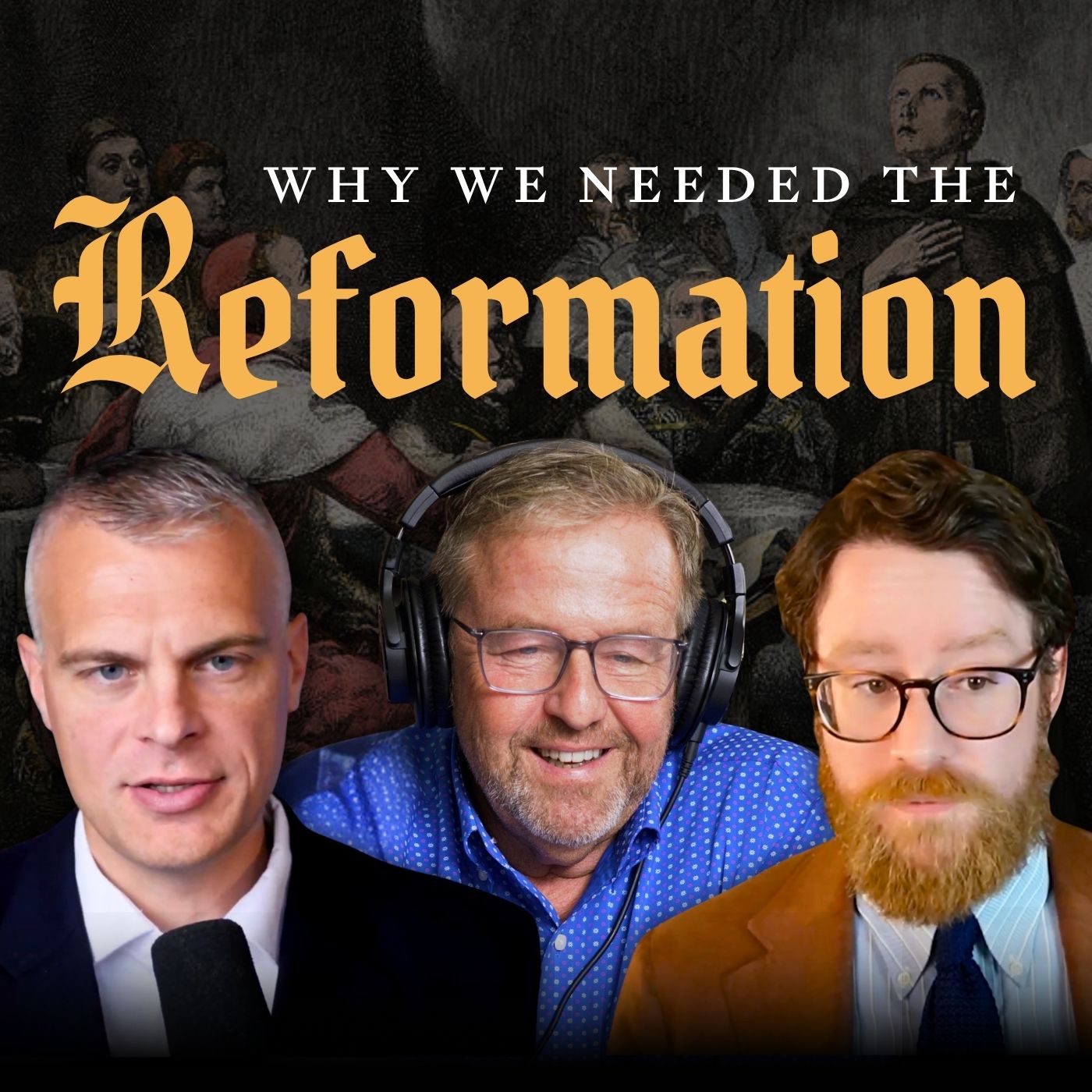
Loading summary
Transcript34 lines
- [00:00]
Sola Media Announcer
In a world drowning in confusion and false teaching, faithful voices have never been more critical. For 35 years, Sola Media has stood as that voice, helping Christians to know what you believe and why you believe it. But we're not just looking back. We're looking ahead to the millions who still need to hear the gospel proclaimed clearly and offended boldly. Will you join us in this critical work? Your generous support will help us expand our apologetics content to reach seekers and strengthen believers, enhance our digital platform to engage younger generations where they are, and strengthen partnerships that multiply our gospel impact. To fuel another 35 years of reformation in hearts, homes and churches, visit solarmedia.org reformation and give today hey listeners, and welcome to episode three of our six part series, defending the Protestant Apologetics for Today with Gavin Ortland and Jordan Cooper. As you'll hear in the introduction, this episode is being hosted on Jordan Cooper's YouTube channel, Just n Sinner. To watch the full video version, head over to his channel and subscribe.
- [01:20]
Jordan Cooper
Hello and welcome to the Just and Sinner podcast. Today on the channel I'm playing a video this is a discussion that is the third part in a multi part discussion about Protestantism and the Reformation and challenges that are being faced or asked about the Reformation today. So I am joined by Michael Horton and Gavin Ortland. If you want to see the other parts of this discussion, which you certainly should, before you watch this third part, I would recommend that you check out both of their channels and subscribe and I'll put links to these below. So in this part of the discussion, we're going to start delving into the challenge that is often levied toward Protestants. That is that Luther was driven in his theology, whether it's his doctrine of justification or his perception of grace or human cooperation, that he was driven by philosophical nominalism. Now for those who maybe are watching this, who don't know much about nominalism, I'll put a link to a video where I explain a little bit about what nominalism is. Probably is a little bit helpful to jump in here to watch that before you jump in here, if you don't know, but a late medieval philosophical school that gained some prominence during the time just prior to and during the time of the Reformation. So this challenge essentially says that Martin Luther was trained by nominalists, which he was, and that this nominalist training of Martin Luther then kind of stands behind his formulation of the doctrine of justification. And essentially this leads to this idea that Rome claims that justification and Protestant sense is a legal fiction. Right? So the argument is going to be that nominalism has these categories to talk about the nature of God's will, where God can decree something to just be the case, and then it is the case because of God's decree, essentially. And the way that this is maybe most often discussed is in moral law, right? So you have this idea among some of the nominalists, like William of Ockham, who says, well, God's moral law is essentially defined by God's decree rather than God's nature. So some would say that what is right and wrong is right and wrong because it reflects something that's true about God's nature. Another view would say that that which is morally right and wrong is simply right or wrong because God has decreed it so. And so the argument here is that Luther essentially said God could decree that you're just or righteous even though you're not. And so then it just becomes a legal fiction. God is legally declaring something that's not actually true. And this seems to make God kind of deceptive or something else. So let's take that whole thing apart a bit, but let's talk a little bit about maybe what nominalism was in a little bit more depth and how this relates to justification. Now, I know, Mike, I know in your two volumes on justification and the historical volume, you have a very extensive overview of some of these nominalist categories in relation to justification. So maybe I'll turn it over to you to explain some of that.
- [04:23]
Michael Horton
Well, I know we'll be talking about justification down the road more directly, but it really relates to this whole question of the relation of nature and grace here. First of all, two things. Doctrinally, there is no necessary correlation between an arbitrary decree and justification. God is not making an arbitrary decision to say, this person, though he's really a sinner, I'm going to call him righteous. It's not an arbitrary decree. God is making that decree based on the fact that Jesus Christ's righteousness is imputed to us. Now, of course, we've said before, Luther didn't come to that all at once, and he's growing and everything. But you would expect if he was trained by nominalist teachers, he would be most nominalist at the beginning. And, Jordan, I would love for you to hear your thoughts on this. Luther, if any, was a medieval spiritualist early on, he was an Augustinian. Beyond Augustine, he was kind of in the Meister Eckhart Waters, the German theology and everything. He was more Neoplatonic than anything else. And then his 1519 treatise. So right after the 95 theses, he excoriates the Scholastic. Well, who's he going after? Thomas Aquinas? No, he's going after his nominalist teachers. So historically and doctrinally, this thing doesn't have legs.
- [06:04]
Jordan Cooper
This is just really evident when you read the writings of Luther and read who he is critiquing. And I think sometimes people do read that term, the Scholastics, and assume Thomas Aquinas. And at times that's what Luther's talking about, but most of the time it's really not. It does tend to be the nominalists. And, yeah, if you look at Luther's early spiritual formation, you're right that it was largely German mystics that he was reading. Not just German mystics. He was reading some others that were mystics as well, but John Tauler. Yes, in that kind of Meister Eckhart school. So it was very Neoplatonic. You actually see this evidenced in Luther's very famous Heidelberg Disputation. If you look at the philosophical theses, which aren't studied nearly as much as the theological ones, Luther is actually. He's heavily critical of Aristotle, but he's critical of Aristotle because he's not enough of a realist. And Luther praises Plato over Aristotle. And so, if anything, Luther's kind of much more in the opposite direction than the nominalist. A very strong idea of a kind of ontological participation that, yes, is definitely stronger in his earlier than in his later career. And I think in his later career, he just doesn't really talk very much philosophy at all, honestly. But I think you have a hard case to make that Luther was drawing so significantly on nominalists. Yeah. Gavin, I don't know how much you're familiar with these kinds of discussions, but I'd love to hear your thoughts on this.
- [07:29]
Gavin Ortland
I was just thinking, oh, man, I could just happily sit here and listen to you guys talk. This isn't my wheelhouse, but I'm familiar enough. I won't speak with authority and everything that I say, but I can at least highlight some of the things I'm aware of and also just from a pastoral angle, some of the implications that come out. But one thing, I mean, I wonder if you both would be sympathetic to this idea that a better framework for Luther's understanding of justification than nominalism would be the doctrine of union with Christ. The declaration of righteousness unto a sinner on the basis of faith in Christ is defined by and understood in relation to that sinner's incorporation into Christ as a spiritual reality. And years ago, and I won't be able to recall all of the beautiful ways he teased it out. Richard Gaffin wrote a book that I read that talks about union with Christ as the hub and all the other aspects of the Ordu Salutis, or the order of salvation as the spokes, one of which is justification. Now, Dr. Cooper, please, you may want to push back on that in various ways, that's fine. But if you see that as the organizing framework, I think all sorts of things start to come into the picture where you see justification as a more organic reality and not arbitrary and so forth. And I will say on the nominalism thing, you don't need to get too in the weeds before you can start to poke holes in this. In terms of just someone's training and background does not dominate their theology. They're allowed to protest in various ways. Luther is doing that. And if you, especially when this criticism is leveraged against Lutheranism or Protestantism as a whole, all we need to do is just look at the wider angle lens and see how later Protestants, later Lutherans will just more fully develop the doctrine of justification. And it's clearly not in a nominalist framework in all the different directions that it goes. So I don't think this criticism is one that I find real impressive, but I'll have a lot more to listen to in this video than to say.
- [09:31]
Jordan Cooper
Yeah, if you say that about union with Christ, honestly, I think Mike might have more disagreements with you than I would on that. So I listened to you two talk about that. But yeah, there's some debate about Luther's idea of union with Christ, but I think, and how it relates to justification. So there's what's called the Finnish interpretation of Luther with Tuoma Monarma was the kind of primary proponent of this initially in the 70s, and he made the argument essentially that this ontic, what he calls a real ontic union with Christ was the basis for justification in Lutheran. And when you do look at early Luther and his reception of mysticism and participatory mysticism, particularly this bridal union language of Bernard of Clairvaux, I do think that these two things are very deeply related and that I do believe that it does come much more. His idea of justification comes much more out of a consideration of what it means to be united to Christ. And especially in Bernard's language of the bride and groom, where the bride and groom exchange everything that is theirs with the other. I think that really does stand behind a lot of Luther's formulation of justification and something that I find maybe odd about the nominalist accusations is that on the one hand you have these arguments that Luther was so forensic he must have been nominalist. But on the other hand, you have a lot of people in Luther scholarship that make the argument that Luther wasn't always very forensic in the way that he used the term justification. To be clear, I think Luther believed in a forensic justification, but I do think Luther was even a little bit loose with some of his language in a way that Melanchthon was a bit more precise there. But that is just to say that Luther wouldn't have had a looseness of the language there at all, I think, if he was operating from that nominalist framework. Mike, I'll let you respond to this. I know these are things that you've written a lot.
- [11:29]
Michael Horton
You can see why Osiander came out of Luther. I mean, Osiander, who kind of taught this view that the Finnish interpretation is attributing to Luther, that was condemned by the orthodox Lutherans, as it was by Calvin, even added another section to the Institutes just on condemning Osiander's view. So Calvin clearly did not believe justification was based on union with Christ. It was based on Christ's life, death, resurrection, and the imputation of that righteousness to us. So the forensic always grounds the transformative. And Calvin quotes Bernard of Clairvaux, and he probably developed his fondness for Bernard through reading Luther, but He quotes him 18 times in book 3 of the institutes when he's talking about union with Christ. So it's obviously a very important. It's sort of the conceptual umbrella for election, redemption, justification, sanctification, glorification. But Calvin's pretty clear that we are not justified by anything that happens within us or even in our relation to Christ, but strictly in his gift of righteousness, which we receive through faith, not discounting union with Christ at all, but just making sure that it's not because we're united. We've experienced this mystical union, and now on that basis. That's why the Westminster Confession says we are justified not by anything done by us or within us, but solely for the imputed righteousness of Christ alone.
- [13:20]
Gavin Ortland
Just a quick closing lid on this piece. One of the Scriptures that Gaffin and others point to is Romans 4:25, where Christ's resurrection is referred to as his own justification. So from that framework, the union is not at all the consequence of this is not at all a righteousness that is within us, but it's precisely because we are united to Christ that it is external to us. It's his righteousness and in union with him, we then have it imputed to us. So that's how they're. He's cashing out the relations there. But so I. I need to stop talking and let you guys talk more.
- [13:56]
Jordan Cooper
Yeah, yeah. Oh, man. We should just have a whole discussion about this. This is a. It's an important topic. It's a fun one to discuss, too. Just if I could say one last thing about. About this as we're on it. There's a distinction that's made among the later of the Lutheran orthodox. And so I get this from David Hollatz, but he's not the first one, but he makes a distinction between these two different kinds of union with Christ. And so most of the time when Lutheran theologians talk about union, most of the time we're talking about a participatory union, something that is ontological. It changes us as a transformative union. But hall, as makes this distinction to say there's also what he calls the formal union of faith. And the formal union of faith is a kind of legal union, so that there is a sense in which all the redemptive benefits that we receive are grounded in the person and work of Christ himself. So that Jesus, resurrection, he was justified. And Lutheran theologians have referred to this sometimes as a universal justification. So as he was justified in some way, all humanity is justified in him. And then this formal union of faith is to say that in faith I am united to Jesus and thereby receive his verdict of justified. And then in that, there then becomes this. As a result of that, there is this transformative union. But to bring this back to the topic that we're really discussing here, this then brings up another point that we want to discuss about the nature of what grace is. Right. Because even in just what I talked about here, we have two different elements of even union with Christ that could be described. One is a forensic element, and then the other is a participatory element. This then brings up the question of exactly what grace is, because within not just historic, you know, Roman theology at the time of or in response to the Reformation, but today, grace is inherently transformative. So let's talk a little bit about how it is that we view grace. And I'm going to start maybe with Gavin this time and say how. What is your perception of grace? How do you define grace?
- [15:59]
Gavin Ortland
Yeah, well, one thing we maybe want to clarify is in our affirmation of sola gratia. And also the same will be true when we speak about sola fide. We're not denying the need for a human response. So with this word cooperation, sometimes I think there's a concern of a Protestant view being caricatured, as though we don't believe in the necessity of response or. Or the necessity of growth, growth in holiness, obedience to God. We can point to a lot of passages in the New Testament that make very clear one who is truly born again will follow God, will love God, will obey God's commandments, delight in doing God's will, so on and so forth. But we would say that these responses do not contribute to merit. And so ultimately our salvation is fully of grace in that sense. There will be some points of overlap with our Catholic friends, with other traditions as well, but there are points of difference here as well. So maybe that's an initial clarification.
- [17:06]
Michael Horton
I think even before we talk about grace, we've got to settle what we think about nature. We have different views of nature going on here, but that was exposed by different views of grace. So that part of this is, you know, the. Really, we don't disagree on very much. But boy, when we disagree over grace and justification, that's going to mess with all sorts of areas, and it did with nature. Calvin, for example, emphasized that Adam and Eve sinned of their own free will. And we have that in our Confessions. They sinned of their own free will. So we believe in free will in that sense. The natural ability to choose to obey God or reject God, that belongs to humans as humans. The problem is sin, not God's sovereignty. The problem is sin. Sin has bound the will so that it doesn't choose what is right. But we still have the natural ability. We just don't have the moral ability. Everybody wills, just like Adam and Eve willed. Everybody has will. Everyone still has reason. Everyone still has. You know, none of these things were destroyed by the Fall. They were corrupted. They were turned in a bad direction. But Calvin really also emphasizes that. And here he's loath to disagree with Augustine, but he does on a couple of points, and this is one. He completely rejects the idea of concupiscence, especially the way the medieval tradition had interpreted it. That is this idea that there are these passions that we have that are not sinful in themselves, they're not sins in themselves, but they pull us down towards sin. Thomas Aquinas called the bodily senses the bodily passions, kindling wood of sin. Calvin explicitly goes after that and says, don't they know that Adam declared war from the very citadel of his soul, the highest part of his soul, his mind? This is where the mutiny began. His Body just followed, but it was his soul that carried out the mutiny. So there's a very high view in the Reformed tradition, a very high affirmation of human nature as natural, of creation as created, and even human nature after the Fall as still created in the image of God, but incapable of being inclined towards anything that would lead to merit.
- [19:59]
Jordan Cooper
Yeah, so this would get to the idea of the Donum superaddy. Right. Which is really a primary difference between our, between our traditions. And as I'm currently working on a project on the subject of virtue, and as I'm looking through historic sources and the Lutheran and the Roman Catholic tradition, it seems like that's really the, that's kind of the key point of divergence. There is what is nature as created and there is the concern of those who are from the Reformation traditions that to say that there needs to be a super added gift added to nature for nature to actually function properly seems to imply some kind of flaw within creation itself.
- [20:46]
Sola Media Announcer
The five SOLAs of the Reformation brought essential truths of salvation and purpose into clear focus. These truths are just as critical to Christian life today as they were 500 years ago. Rediscover their meaning and relevance. In our newest booklet, the five Essential Truths for a Modern Reformation, Inside you'll explore each of the five SOLAs. Grace alone, faith alone, Christ alone, Scripture alone, and God's glory alone, and why they still matter today. Support our work with a gift of any amount and we'll send you a copy. Visit solamedia.org offers to get yours today.
- [21:30]
Jordan Cooper
So how then does that, that difference, which I feel like many people think of this, they hear this and they probably think, well, that's kind of a abstract kind of thing, right. That doesn't feel very, very meaningful maybe. Why does that matter?
- [21:45]
Michael Horton
Because if you don't have an affirmative view of human beings as created, then you're going to have big misunderstandings about human nature as fallen and human nature as redeemed.
- [21:59]
Jordan Cooper
So how would both of you then define grace?
- [22:02]
Gavin Ortland
I would say in this context it's the belief that salvation is entirely the gift of God. So we are not contributing anything to this reality. We are fully in the position of the receiver. We are not meeting God halfway on the football field at the 50 yard line, but we're also not meeting him at the one or the two yard line. It is entirely his work which we simply receive. You know, you just asked about abstract and so forth. If people are wondering for where the consequences will lie and how this will play out, one very tender area I think is with assurance of salvation. And where we look to, to find that assurance, I think in a day to day experience as a Christian, the reality is we are all going to have ups and downs. And if there is any sense of it depending upon me now, my actions are relevant to this reality. I must receive it, I must respond to it, but I must have faith in Jesus. I must believe in Jesus. But if there's any sense that the salvation itself is something I'm actually contributing to, that will play out in all kinds of ways. But I think one deep one is a deep unsettledness and anxiety, even if unarticulated. And I think one consequence of the Protestant emphasis upon God's grace is a sense of freedom, that this is not up to me. This is God's work and it is full and complete and perfect and sufficient in Christ, and therefore I'm looking to him and receiving it. And there's lots of ways we could tease out in terms of why that is the case, why does this result in a greater sense of assurance? But it's wonderful to think about and I think that's very relevant to the world today. In my work on YouTube, I tend to think the amount of anxiety in the world is epidemic. It is just skyrocketing. And I think that the theological issues we're talking about are relevant to that. This is not just an abstraction that doesn't touch those needs of the human heart.
- [24:03]
Michael Horton
Yeah, I think the Reformed tradition really took over from Luther the definition of grace as favor and gift on account of Christ. God's favor and gift on account of Christ. So, for example, when looking at the apologetics angle again, when the Reformation is criticized for this nominalistic tendency, they seem to see in the tradition as saying something like, you know, there's only a decree of justification. We can tell them, look, this is Luther's own definition and it's not his own. He gets this from Scripture. He really does. It's not only God's favor on account of Christ, and it's not on account of nothing, it's on account of Christ, but also it's God's gift. So we do believe that there is. Call it an infusion if you want. We do in some of our Reformed dogmatics, in the Canons of Dort, we don't deny sanctification. We don't deny that the Holy Spirit infuses new life into us and that we are spiritually dead, but now we're alive in Christ, that we are organically united to Christ, so that we bear the fruit of the Spirit all over the Scriptures. It's not just justification by another's righteousness, but Christ's holiness and righteousness also imparted to us. And I'm going to be a little polemical here. It's Rome that is reductionistic. It's Rome that says there is really only favor if you make proper use of the gift. The Reformation says God's favor is because of Christ and the gift is because of Christ.
- [26:07]
Jordan Cooper
Yeah. And our theologians in the Lutheran tradition do at times use the infused grace language as well. It's not that common, but it is used. Oftentimes we talk about cooperating grace or indwelling grace, often speaking about exactly the same thing here. But the caricature is often that we really only believe in this idea of grace is the favor of God, which certainly it is, but that there's nothing else to it than that. And certainly across the magisterial Reformation as a whole, everybody affirms the reality of this indwelling grace that is truly transformative. And at least in our Confessions, there is even language of synergy that's used to talk about that, that there is cooperation with God's grace in. But not in the context of justification, but in the context of new obedience. And this then gets to another challenge that I often hear, a question that's often asked, and I hear this from Roman Catholics some, but I feel like I hear it more so from the Eastern Orthodox. And that is because the east has such a thoroughgoing doctrine of synergy or synergism, even more so than Rome does. They often challenge this. This idea that we need to speak about grace as if it's, you know, in competition somehow with human effort. At least that's how they see it. So when we say things like, well, it has to be by grace alone, they would say, well, why can't it be both grace alone and human works and human cooperation? And what they're going to do then is go back to this nominalist thesis to say that in nominalism, and this is true, this is part of the nominalist. What I think is a problem with nominalism, and I think there are many of them, but one of them is that the centrality of the will in nominalist dynamics do seem to posit almost a competition of wills, as if it's, God does this much and you have to do this much. And I think that's actually part of what Luther's criticizing when he's criticizing the nominalists. And this is very different from a More classical view, which would say that God is the efficient cause of all things and we are secondary causes. So there's no action of mind which is devoid of God's causality in the first place. So there's no such thing as an autonomous action. And so there's no competition. Right, between my working and God's working. But the argument is that that nominalist idea is what drives this Protestant desire to say grace alone, and therefore not by human merits. How do we respond to that?
- [28:37]
Gavin Ortland
You know, a starting point might just be to say that this sense of an antithesis between grace and human effort can be defended on the basis of the New Testament. There's language like this. So if we wanted to say this is just reducible to a nominalistic impulse or something like that, I think we'd have to try to explain this in some way. Romans 11, 6. If it is by grace, it is no longer on the basis of works, semicolon. Otherwise grace would no longer be grace. So something is being contrasted there. Now you can say that the works Paul has in mind are something different, but clearly there's a sense of antithesis. Ephesians 2, 8, 9 would be another passage. So that would be where I'd probably start the conversation here.
- [29:21]
Michael Horton
Yeah, I think there again we have to ask, what is their view of nature that they want to protect? The east wants in its. I mean, this is a gross generalization, but in a world the backdrop of Roman astrological fatalism, determinism, Stoic fatalism, and frankly the Gnostics, there is this desire that is wholly orthodox, to affirm nature as nature and to affirm human freedom. Over against pagan fatalism. You know, they're not reacting against Augustinianism, they're reacting against paganism. And so I think there's a lot of that there. And then in Christ, especially with Maximus, confessor in Christ, you have the union of God and man, and therefore of divine sovereignty and human responsibility. God's choice, human choice united in one person. And there again, I think that we could say from the Reformation traditions, amen to that. The problem is addressing the Fall with equal seriousness, realizing that the Fall we were dead in trespasses and sins. It's not just dead in body. The whole purpose of salvation is to give us the gift of immortality. It's that we were dead in trespasses and sins. We were under the wrath of God, under his judgment. We need to be justified and we need to be delivered from the powers of hell and the Devil. We also need to be delivered from the fear of death and the reality of death. We need all of this. And again, the danger I feel is that Eastern Orthodoxy also is reductionistic, making us choose between the legal and the transformative, just as Rome forces that choice, rather than saying, hey, our problem is a lot bigger than you think, and Christ is a greater savior than one particular aspect of that redemption.
- [31:53]
Jordan Cooper
Yeah, yeah. And I think that it's unfortunate that we have this seeming divide that people perceive between the forensic and then the participatory or transformative or whatever kind of language you want to use, because I think both of those realities are so evidently both biblical, but also present within. Within the tradition. And I think it's an unfortunate thing about at least modern Eastern polemics, because I don't necessarily think it's true about the Eastern tradition as a whole, but at least in modern Eastern polemics, they're set against each other, as if you've got to pick, you know, you get this one kind of redemption or another when the reality is like, we. We have many problems that we need to be redeemed from, and Christ does all of those things for. And. And in us. So one kind of last, maybe comment to make before you just move, then. I know we're coming to the. Toward the end of our time, and I want to ask about the question of virtue here for a minute. We can end there. But just want to make one quick just kind of comment on this nominalist issue, and that is that the nominalist thesis, I think, can be pretty evidently clearly demonstrated to just simply be a falsehood, just by the fact that the post Reformation theologians who were the ones who most adamantly defended justification through faith alone, were realists, very adamantly defenders of metaphysical realism. Like, they weren't nominalists, whatever you do. No, none of them. None of them at all. So whatever you do with Luther, it's like, even if Luther, say, was a nominalist, I don't think that thesis holds well. Nobody else who followed him was. And nominalism and the issues with nominalism and voluntarism, these all, at least within the Lutheran Church, they come into Germany through the influence of largely Descartes and, and Thomas Hobbes and some others at the end of the 17th century. And when that happens, those ideas are all opposed by all the Lutheran orthodox. So I don't know the Reformed Orthodox in that era quite as well, but yeah, so it's the same. There's the same affirmation of realism there across the Reformation traditions. What I think the criticism wants to do is it wants to say nominalism is the reason for a lot of our cultural ills today. And then it wants to blame that on the Reformation, when the rise of nominalism did not come out of any of the confessional Reformation traditions at all. And the most adamant proponents of nominalism after the Reformation were Jesuits, at least those who were involved in any church tradition much at all. I don't think Descartes was very personally devoted to one faith or another. But with that then I do want to just move quickly to this last subject. And that is the question of the subject of virtue. And a lot of young people that I talk to who are looking into the Roman tradition especially are really captivated by St. Thomas Aquinas, especially his treatment of the virtues. And the reason is they feel like the perception is that Protestantism just doesn't have a really thorough conception of the moral life. And maybe that's because of our centralizing on grace and justification. So just want to ask both of you this question as we end here. Does Protestantism, does the Reformation disincentivize striving after virtue or the virtuous life?
- [35:10]
Gavin Ortland
I think we'll say no.
- [35:11]
Michael Horton
Yeah, we'll say no until the.
- [35:15]
Jordan Cooper
A little more than a one word answer, but wow.
- [35:17]
Michael Horton
No until the last hundred years or last 150 years. Yeah. I think that Karl Barth and Dietrich Bonhoeffer represent, as you would argue, I'm sure Jordan, represent a typically modern and we might even say nominalist. I think that's fair rejection of the whole Thomistic tradition. And part of the problem is we even have in our conservative reform circles during the 20th century even where they'd be very critical of Barth and antipathy towards Reformed Scholasticism.
- [35:56]
Jordan Cooper
It's in Lutheranism, it's the same thing.
- [35:58]
Michael Horton
Okay. And so you basically are, if you're going to say that then you know, you're essentially going to divest yourself of the realist roots of our tradition and virtue ethics is all over. David Van Drunen, one of my colleagues here is writing a three volume series on Reformed ethics. That sounds similar to what you're doing on the Lutheran side, Jordan, trying to.
- [36:32]
Jordan Cooper
I'm very interested in this. Yeah, yeah.
- [36:33]
Michael Horton
Trying to rehabilitate some of these sources. Part of it is a lot of conservatives and non conservatives in the Reformed tradition have haven't read these sources, but now that's beginning to happen. And so there's kind of a renaissance here. And that includes their works of metaphysics, their works of even physics, their works on ethics. And there was a Large majority of Reformed Scholastics who tilted at least towards Aristotle and the kind of Aristotle, kind of Neoplatonized Aristotle that Aquinas represents. There was a lot. Aquinas was in high favor among the Reformed Orthodox, and that would include a lot of what he and Aristotle had to say about virtue. We really need to recover a lot of this because we are, I dare say we're pygmies on the backs of giants. And we really have got to recover a sense of the depth and richness of our traditions. It's no wonder people want to leave Protestantism. Who wouldn't want to leave Protestantism if you don't know, you know, if there's nothing beyond the shallowness of online barking at each other and shallow sermons and moralizing. And who wouldn't leave Protestantism, but that you don't have to. We need a Protestantism that is actually more Catholic in the best sense of the word.
- [38:08]
Jordan Cooper
Yeah, yeah, that's fantastic.
- [38:11]
Gavin Ortland
And just going back to historic Protestant voices and retrieving them is a critical area of need that we all see. We're talking about that here in this area. The way I've thought about this from a pastoral angle is Christians today often think of sanctification in very generic terms. And we don't think about the specific virtues 1. And of course, so we're saying there's historic counterbalancing forces of that. We get that in our own traditions. Reformed and Lutheran and other. Richard Baxter would be person, I think is fascinating to engage on this. I think Jonathan Edwards is a really interesting figure to engage on this. They're going to pull you in different directions. I think more recently, a good example of a more historic approach to thinking through different specific virtues is C.S. lewis's mere Christianity. I'm always amazed at this that he's got this tiny little popular level book. I mean, the amount of time he spends establishing, like the Incarnation and things like this, it's so compact. But then you get to book three of Mere Christianity originally, these radio addresses, and it's all about different virtues and vices, love, charity, hope. But then he goes on to others, and then he's got. My favorite chapter in the whole book is on the great Sin. And he opened my eyes to understand the nature of pride. So it's not just virtues, it's understanding particular vices as well. So that is there in Protestantism, but it's one area among so many where contemporary Protestants have often fallen away from our own roots. And I know a common passion we all have is to go read our own traditions, go back and retrieve our own originating resources, and there's a lot of richness there to be recovered.
- [39:56]
Jordan Cooper
All right, well, thanks so much for joining me for this conversation. And once again, I'll remind you this is the third in the series, so if you're just watching this one, make sure you catch up on the other two. I'll put links below.
- [40:14]
Sola Media Announcer
This is a production of Sola Media. This podcast is made possible by generous listeners like you. If you enjoy the show and want to help us continue this work, consider giving today at solarmedia. Org. Donate.