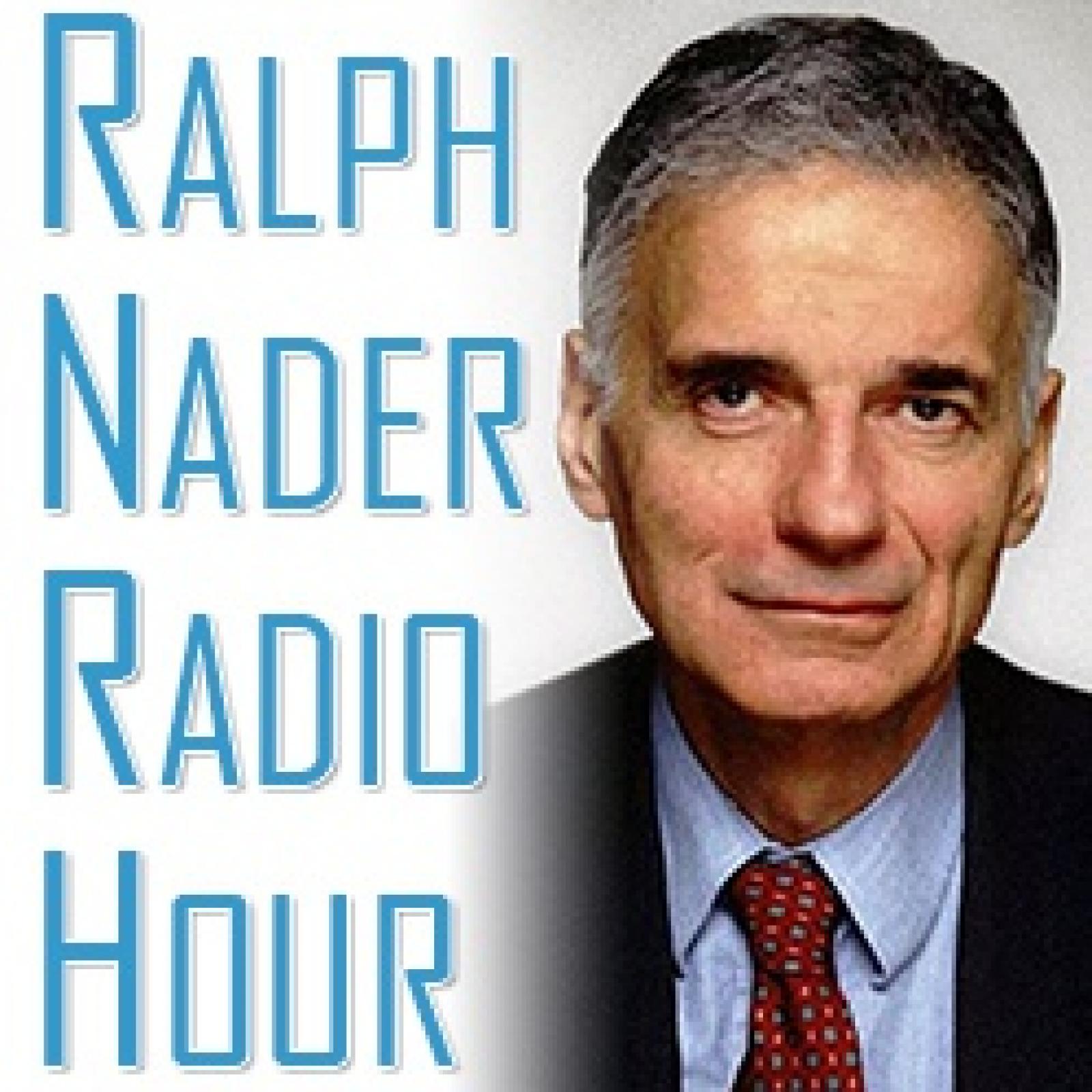
Loading summary
Transcript92 lines
- [00:02]
Robert Reich
Or call 1-844-277-4663 and learn how your gift of property can make a meaningful difference.
- [00:19]
Derek Shearer
This is sean lee, and you're listening to kpfk 90.7 fm los angeles, 98.7 fm in santa barbara and worldwide@kpfk.org I'm tom morello and you're listening to the ralph nader radio hour. Stand up.
- [00:34]
Ralph Nader
Stand up. You've been sitting way too long.
- [00:41]
Steve Scrovan
Welcome to the Ralph Nader Radio Wire. My name is Steve Scrovan, along with my co host, David Feldman. How's it going, David?
- [00:48]
David Feldman
Hello, Steve.
- [00:49]
Steve Scrovan
And our intrepid producer, Hannah Feldman. Hello, Hannah.
- [00:53]
Robert Reich
Hello, Steve.
- [00:54]
Steve Scrovan
And the man of the hour, guess who that is. Ralph Nader. Hello, Ralph.
- [00:59]
Ralph Nader
Hello, everybody.
- [01:01]
Steve Scrovan
With the midterm elections coming up and all signs pointing to a blue wave, unless, of course, Donald Trump invokes the Insurrection act to stop the elections, the question becomes, what will we the people win if the Democrats win in November? What is their agenda? What do they stand for? Will it be a progressive economic plan or the same old neoliberal policies that got us into this mess in the first place? That's the topic of today's program. Our two guests today have some concrete proposals for America's economic future. First up, we welcome back to the program Professor Robert Reich, Emeritus professor for Public Policy at UC Berkeley, who has served in three national administrations, including as Secretary of Labor under President Bill Clinton. A few weeks ago, we read excerpts from his Ten Point Plan. Today he's here to help us flesh it all out. Our second guest also has a plan. Derek Shearer was a senior policy advisor to Bill Clinton during the 1992 presidential campaign. He helped write the campaign's economic program, Putting People First. Last year, he co authored A Bold Economic Program for America which responds to the Trump administration's economic policies and the resulting harm to average Americans. We'll speak to Derek Shearer about the details of his bold program and how it addresses the underlying problems with our economy. As always, somewhere in the middle. We'll check in with our intrepid corporate crime reporter, Russell Mokhiber. But first, let's find out how to make America affordable again.
- [02:31]
David Feldman
David Robert Reich is Emeritus professor of Public Policy at UC Berkeley. He has served in three national administrations, including as Secretary of Labor under President Bill Clinton. Mr. Reiche has written 18 books, including the System, who Rigged it and How We Fixed It, Super Capitalism, and coming Up Short, A Memoir of My America. Is co founder of Inequality Media, co founder of the Economic Policy Institute, and co founding editor of the American Prospect. Welcome back to the Ralph Nader Radio Hour.
- [03:07]
Robert Reich
Robert reichstag, well, thank you very much, Dave, and I'm so delighted to be here. And Ralph, you are and have always been one of my heroes, and I'm delighted to talk to you. I just wanted to amend David's kind introduction by saying that on the end of August, I don't know when you're going to air this, but at the end of August, my memoir comes out in paperback. It's called Coming Up Short.
- [03:36]
Ralph Nader
Yes, it'll be quite a memoir because you have a long history of interacting, especially with Democratic Party and the role that you had as secretary of labor, where you believe you were pretty much sidelined by Clinton and Bob Rubin and other corporatists in the administration. Secretary of the Treasury Rubin. So we look forward to your paperback version. Coming Up Short.
- [04:00]
Robert Reich
Coming Up Short. And I also am very short.
- [04:03]
Ralph Nader
I know that I wanted you to say that. I remember once we shared a platform with a business audience. It was very skeptical of your role at the Federal Trade Commission with Mike Perchuk, who was the chairman at the time. And you made the point that regulation is good for competition, it's good for efficiency, it's good for consumers. And then you looked out at the audience and you said, do I look like big government?
- [04:31]
Robert Reich
Yes.
- [04:32]
Ralph Nader
Do you remember that?
- [04:33]
Robert Reich
I've used that several times, and it does tend to get a laugh from people who are sympathetic. But I think that these days corporate America is even more dug in than it was then in the Federal Trade Commission days in the 1980s for sure,
- [04:50]
Ralph Nader
as I tried to point out in my recent response to the Powell memorandum of 1971, chronicling the intensification, deep and broad, of corporate control over our country. In December, you put out a pledge for Democrats to make America affordable again, and you directed it not just to the public but also to the Democratic Party leadership. And a couple weeks ago we asked what was their response. After all, you know, you've written books, they're selling, you have a huge media following, former Secretary of Labor, former director of Common Cause, and you answered very briefly. You said, no, none, nada. So you put it out again in July and probably haven't had any response yet. How do you account for the lack of response by people like Jeffries, the Democratic National Committee, the dccc? How do you explain that?
- [05:51]
Robert Reich
Well, in fairness, I really am not a major figure, a political figure. There is no reason for them to respond. And secondly, there's no Democratic Party. I mean, it's not as if there's somebody who represents the Democratic Party. I mean, Chuck Schumer and Jeffries, yes, to some extent, but they have their own particular interests and their own concerns and their own, you know, they're just kind of. There is no Democratic Party spokesperson as such. So even if I were a major political participant, even if I were somebody who would expect a response, I'm not sure, Ralph, that there would be a Democratic response. But that's beside the point. I think the real point is that Democrats have an opportunity now to talk to the working class about, and not just the working class, the middle class, too, about prices, about affordability in ways that are terribly important and meaningful and that really could get prices down or at least stop the onslaught of inflation. And also that are very, very consistent with what we believe as, as Democrats, as progressives, as people who want to see the nation move back toward its pursuit of social justice.
- [07:04]
Ralph Nader
What our experience in Washington is that the Democratic leaders like Jeffries and Schumer are not interested in a comprehensive contract for the American people or as you put a pledge to the American people. Partly they don't like mandates. They want to win the election on Wall Street's terms with minimum issues being focused on affordability at the present time is their big word. And not to disrupt the military industrial complex because they know the Democrats have voted with the Republicans again and again year after year for more money for the military budget than the generals have asked for. Just to be specific, can you go through your 10 reforms, which you call a pledge to make America affordable. Again, go through the bold type. It's not going to bore you listeners because you'll see how relevant it is to where people live, work and raise their families. Go through the 10 and then we'll discuss the impact that it should have.
- [08:06]
Robert Reich
Okay, I'll try to make it very. I'll do a dramatic reading. I'll try to make it very exciting. Number one, we eliminate Trump's across the board tariffs because they're import taxes. They're raising the prices of just about everything American consumers buy. Number two, we'll get energy prices down by ending Trump's war in Iran and shifting to renewable sources of energy. I mean, this is what we're seeing now is absurd. Trump's war has increased gas prices across the country by at least a dollar a gallon. It's accomplished nothing but give Iran bargaining leverage to close the strait, which was open before the war. Number three, we'll bust up monopolies. I mean, another big major source of High prices is monopolies, especially in high tech and healthcare and food and finance. And so it's very important to vigorously enforce antitrust, anti monopoly laws so corporations don't have the power to raise prices. Number four, a fight for stronger unions. I mean, the thing is, Ralph, workers need more bargaining power in order to get higher wages. And part of the big answer here is stronger unions. Number five, raise the national minimum wage at least $20 an hour. Nobody who works full time should be in poverty. So raise it even higher for employees of big corporations that pay their top executives more than 200 times the typical worker. Number six, make housing more affordable. And one way to do that is stop private equity firms from buying up large tracts of housing, including on prices, which is what they're doing. Get rid of zoning laws that keep housing prices high and raise taxes on big corporations that drive up housing prices where they are located or have major facilities and use the funds for more affordable housing. Number seven, cut health care costs by making Medicare available to everyone. Medicare for all. Just give everybody the option of buying into Medicare. It would bring health care costs down. Number eight, get working families help with child care and elder care. I mean, both of these, child care and elder care are essential for working families and, and they now pay a large portion of their income to provide care for family members. Number nine, give working families paid family leave. I mean, when I was in the administration, one thing we did was get 12 weeks of unpaid leave. And that's been useful, but inadequate. It's just not enough. Every other advanced country provides paid leave. We're the richest country in the world. We should do it, too. And finally, number 10, raise taxes on the wealthiest Americans to pay for all of this. Since Ronald Reagan, the rich have paid far lower taxes while accumulating a near record portion of total income and wealth in the country. It's only fair that they pay more so that the rest of America can afford what Americans actually need. And I'm specific about this, we raised the top marginal tax rate to 70%. That's what it was before Reagan. And also impose a half a percent tax on wealth in excess of $100 million and eliminate the cap on income subject to Social Security taxes so that the ultra rich are actually contributing to the maintenance of Social Security, which is otherwise in some danger. And Ralph, these 10 steps are crucial for making America affordable again. Every Democrat who's running for office should pledge to seek every one of these 10 things.
- [11:48]
Ralph Nader
And I might say they're supported by more than liberal voters. They come in with very substantial support from conservative families who want the same thing for their children and their economic security.
- [12:00]
Robert Reich
Every single point I made on every 10 of these is supported by a majority of Americans.
- [12:07]
Ralph Nader
Does this mean that you support the California initiative by the labor union SEIU to tax the super rich in California, one time a wealth tax. A one time wealth tax which Governor Newsom is strongly opposed to?
- [12:23]
Robert Reich
Well, I'm very much in favor of it because it's first of all, California, like most states, in fact like every state, has been suffering because of cuts in Medicaid, which is vitally important to working class and poor people in California and everywhere else. And those cuts in Medicaid, why was Medicaid cut? It was cut in order to help pay for big tax cuts for the wealthy by Donald Trump and his two tax cuts, his second tax cut, big tax cut, most of the benefits went to very wealthy Americans. It's only fair. And you start in California. I mean, it should be national. But you start someplace and you start in California. We've got a lot of very, very, very wealthy people, billionaires in California. You know, this is a rounding error. They would hardly even see it. And the least they can do is help pay for the Medicaid costs that a lot of poor people in California now cannot bear because Medicaid costs are now, you know, they're just not available to a lot of people because of that huge tax cut to the wealthy.
- [13:25]
Ralph Nader
You know, if you look at how under taxed these super billionaires, Silicon Valley people like Mark Zuckerberg and others over the years, this initiative by SEIU is just partial, very partial payback. A one time wealth tax. How do you deal with the flight from California? They moved to Nevada or they moved to Florida, which is a problem afflicting wealth taxes beyond property taxes.
- [13:53]
Robert Reich
Well, the empirical evidence, and I just look at the evidence, Ralph. For example, Massachusetts raised its tax, its top tax on people, the very wealthiest in Massachusetts people, the Chamber of Commerce in Massachusetts, the very wealthy said, you can't do this because we're going to lose wealthy people from Massachusetts. It never happened. In fact, there are more wealthy people in Massachusetts now than there were then. They're very high wealth and Massachusetts got the benefits of that tax. Now, if you're asking me should this be a national program, should we have a wealth tax nationally? Of course we should. You can bet that the right, the apologists for wealth in this country are going to say, oh no, no, no, don't do that because wealthy people will leave the country. I Mean, what they always do reflexively is say if you do that, we'll leave. And I say in California the same thing I would say about a national wealth tax. If they want to leave, let them leave. But they're not going to leave because there are so many advantages to, to staying in California in terms of this is where a lot of the high tech talent actually is. This is where the infrastructure for high tech is already. The climate. As I talk to you, I'm looking at a beautiful day out here. You know, who wants to leave California? And if you are a billionaire and you are just so intent on leaving California because of this one very, very minor tax, then frankly, goodbye.
- [15:23]
Ralph Nader
Yeah, well, some of them, like Elon Musk, they're going to go to the fascist state of Texas. But you're right, most of them want to stay where the talent is. The climate is where are you on the stock transaction tax? You know, for purposes of our listeners, people in New York, for example, pay about 8% when they go into a store. Sales tax, state and New York City sales tax. But if someone is buying or selling $100 million of ExxonMobil stock, they don't pay anything. And so there's New York State is debating now ending the rebate of between 15 and 20 billion dollars a year coming from a 110 to 1% sales tax just on stock transactions, not on bonds or derivatives. And believe it or not, since 1981 they had a deal with Wall street where they rebate electronically every day, maybe 40, 50, $60 million a day. So there is a movement building up to keep the rebate, although Mandami has not come out either way on it, surprisingly enough. Where are you in a stock transaction tax? England has it, Japan has it, Kenya has it.
- [16:35]
Robert Reich
It's just logical. It's just logical. You know, I'm old enough to remember when this country was not based on finance, when we actually had industry, when most people and most of the economy was based on non financial transactions. Well, these financial transactions don't build an economy anyway. So if there's a 110 of 1% tax on financial transactions, when you have a sales tax and you have other taxes that so many average working people are paying, well, it just makes absolute sense. It's just common sense.
- [17:11]
Ralph Nader
Well, Bob, you know, I know people will say about your pledge, how's he going to pay for it? And you've just pointed out you're going to raise taxes on the undertax super rich and the giant corporations, half of whom, by the way, who made tens of billions of dollars in corporate profits last year in the US Paid no federal income tax whatsoever, according to a Washington progressive think tank. Let me ask you the question. The critics may have friendly critics, I may say they say all well and good, but how can you deal with this without dealing with the monstrous, bloated military budget that Trump wants to add $500 billion more to, which is way over 50% of the entire federal government's operating expenditures. That doesn't include Medicare and Medicaid operating expenditures. And how are you going to do this if hundreds of billions of taxpayer dollars float out of Washington every year on corporate welfare subsidies, handouts, bailouts, you name it. What would be your answer?
- [18:15]
Robert Reich
We have to start somewhere. And these 10 items have a lot of political backing. A majority of Americans want them, a majority of Americans need them. Let's start with them. Now in terms of paying for them. Yes, let's first of all tax the people who are the wealthiest in America who have never been as wealthy. I mean, we've never had billionaires before in this country. We've never had people who are taking home as much of the national income and wealth as we've had now in terms of the top. So let's start there. But of course, you know, it's absurd to have the military expenditures we now have and also the degree of corporate welfare in terms of subsidies and tax breaks and special benefits for corporations. So that let's, let's do that as well. It's not one or the other. I'm saying let's start with the lowest hanging fruit.
- [19:06]
Ralph Nader
You know, here's an item I just happened to catch on npr, which is completely ignored by the mass media and the independent media, while Trump is asking for another hundred billion here for the Iran war, billions for aid to the Israeli mass murder in Gaza, and 500 billion overall. He's just gone berserk. Listen to this fact. It's pretty stunning on npr. Senator Kaine from Virginia, who's quite reliable when he makes statements, he said the following relating to the Iran war. Quote, a war that is a bad idea and it's illegal, is by the very definition of it, unaffordable. One item that I'm asking about, said Senator Kaine, is the reconciliation bill last year gave 153 billion extra dollars to the Pentagon over their appropriated level. And as of early July this month, he says, quote, 89 billion of that was still unobligated. If you need more money, why not go to the unspent money from last year first rather than coming back to Congress and asking for another $70 billion, end quote. Senator Kaine from Virginia, I mean, that should be in the headlines.
- [20:27]
Robert Reich
Absolutely.
- [20:27]
Ralph Nader
What's your reaction to that?
- [20:29]
Robert Reich
Senator King is absolutely correct. If it's unobligated money already, it's just free floating money. Why don't you go there first before you even ask for any additional money? The military budget. And Ralph, you know this better than I do, but I'm going to say it anyway because maybe some people listening don't know this. If you're talking about fraud, waste and abuse, if you're talking about bloat in government, the first place you look is the military budget because nobody knows a lot of where that money goes. It is just going into the pockets of military contractors. There are no competitive bids. There's just so much corruption and so much self dealing. I mean, that's where you really should go to cut back on fraud, waste
- [21:19]
Ralph Nader
and abuse to bolster your argument. And I think 99% of the people would support this. The Pentagon has been in violation of federal law since 1992 requiring submitting an audited budget to the Congress like every other department agency do. So they have an unaudited budget where we're told the Air Force doesn't even know where spare parts are. All over the world at over 100 bases, they don't know where anything is. Someone close in Congress to the army, officials in the Pentagon told me they don't even know where army personnel are. It's a completely unaudited budget which is illegal under federal law. And every Secretary of defense has pledged, until he says to work for an audited budget, which they say is going to take five years and hundreds of millions of dollars paid to outside accounting firms. So it's much worse than even you described.
- [22:17]
Robert Reich
Well, it's worse even than you just described, Ralph, because we are using, or at least the excuse for this extra money is a war that is being lost, a war that should never have been fought, a war that is driving up oil prices and gas prices and fertilizer prices and therefore food prices for Americans and for everybody around the world. A war that is actually spreading right now even as we talk to Yemen and Saudi Arabia and throughout the Middle East. A war that is a war of choice that Donald Trump started and never explained to the American people why he started it. And he never explained to the American people what his exit strategy is going to be. So you've got this absurd use of taxpayer money and he just keeps on asking for more and more and more. I mean, it is the responsibility of Congress. And I think a lot of Republicans in Congress are now coming around to saying this, to say, no, we are not going to allow this. In fact, we are not going to even justify this war and we're going to vote against it if we ever get the War Powers Resolution our back. I mean, again, Ralph, we're not talking about something that is just progressives talking about. You know, I talk a lot to people in red states, people who are supporting Trumpers, who call themselves maga. And when I talk about the war, their eyes roll and they say, this is. This should never be. This should never have been. We are against it. We've been against it from the beginning.
- [23:49]
Ralph Nader
It's important, Bob, to note that things are so bad in Washington that it's hard to avoid understatement. Almost everything we say is understated as to what's going on. And with Trump, it's only going to get worse, more violent, much worse domestically and abroad. And he's in the process of stealing the election. If Jeffries and Schumer can start using his false assertion of stealing the election from the Republicans, it's busily violating Constitution, federal statutes, stealing the election. That affects everything we believe in and propose.
- [24:25]
Robert Reich
Exactly. I am a believer, though, Ralph, in the common sense of the American people. Now, if that makes me naive, if that makes me gullible, so be it. But I think at the end of the line, kind of at the bottom line here, is that the American people will make a decision, starting with the midterm elections coming up in just, I think, what, 96 days? Something like that. And those elections are going to be critical in terms of trying to constrain Trump and the people, the sycophants and lapdogs behind him, and Hegseth and Robert F. Kennedy Jr. And all these people who are ripping the social contract to shreds. And I think that the one way that, and this brings us back to my pledge, my affordability pledge for Democrats. I think one way the Democrats can be sure to get the House back and maybe even possibly The Senate in 96, 97 days, is to pledge to make America affordable again. And using these 10 particular steps that are widely, widely supported, a majority wants them. They will actually bring prices down and they will stop the takeover that we have been seeing under Trump by corporate America, by the tariffs, by the war, by a lot of other things that he's done, and by monopolization.
- [25:55]
Ralph Nader
Well, what you're saying may indeed come True, in November. But the Democratic Party over the years has been a real burden on the voters. First they wrote off half the country, creating a red state, blue state. Imagine writing off competitive races in Texas and other Southern states, mountain states. And right after 2000 election, when Gore lost to Bush, you wrote an op ed for the Washington Post, in effect saying the Democratic Party's dead. Dead. And in 1970, Kenneth Galbraith, a loyal Democrat who started with others Americans for Democratic Action, he warned the Democratic Party of straying from their mission for working families into the realm of corporate influence and corporate money. So it should be an easy win in both houses in November because there are 12 Democratic senators up and 20 Republican senators up. The problem is that most of the Republican senators are in safe states where there's no competition by the Democratic Party in some states that hardly exist, like Wyoming and Idaho. So you want to share these remarks at all on the Democratic Party itself being an obstacle to winning big over the Republicans?
- [27:12]
Robert Reich
I agree so much with what you say, Ralph, and it makes me very sad. I think more sad than angry. I mean, Ken Galbraith was saying that in 1970, as you pointed out. Ken and I, dear friend, I miss him terribly. He and I would have long talks about the Democratic Party and why it was becoming corporate. And it all had to do with money. Obviously, the Democratic Party started in the 70s and 80s to drink the same trough as the Republican Party in terms of corporate money and money coming from the very, very wealthiest Americans. And that money, if you start drinking at the same trough, then how do you bite the hands that feed you? How do you criticize corporations and the wealthy? How do you talk about increasing taxes on the wealthy? How do you talk about increasing taxes on big corporations and regulations on big corporations if you're taking their money, the fact is you can't. But here's what gives me hope. You have a rising tide in America of progressive candidates all over America. Even, you know, you mentioned Texas, Ralph. Well, Talarico is really a good candidate. He could become senator in Texas. I think that there's a very good chance we're seeing good people. You know, Sherrod Brown in Ohio, who had been a senator in Ohio. There are many other people in states that have turned Republican but now are having second thoughts because of the war, because of the tariffs, because of inflation, even the Trump administration's refusal to release the Jeffrey Epstein files in their entirety. All of these so called red states are now just having a little bit of buyer's remorse when it comes to the Republican Party. So I think the progressive Democrats now have a very good chance.
- [29:15]
Ralph Nader
Well, Talarico in Texas should easily win against the crook who's opposing him, Attorney General who's impeached by his own party in the House in Texas, and he got away with it in the Senate because it had to have a super majority. The problem is that Talaria is going all over Texas county after county where there's no Democratic Party infrastructure to get out to vote. So he's really going uphill. It's like the Democrats have to be 8, 9% ahead of the Republicans in area after area in order to win.
- [29:50]
Robert Reich
That's true. I'm not going to argue with you about the failure of the Democratic Party to develop and nurture infrastructure in every state. That's what they should be doing. That's what they should have been doing. The notion, and I've been having these arguments with Democrats, leading Democrats now for, oh, I don't know, I think it's 40 years, you know, that even when I was in government, the notion was that the Democrats should go after the suburban swing vote. Well, that's ludicrous. First of all, there's not a suburban swing vote. You ought to go after every vote you can everywhere in America. And you ought to have a basic economic plank, such as I gave you at the beginning of this discussion, that really will help average people. It'll help average working people. It will make prices and the cost of living affordable again for average working people. This is what Democrats, you know, under Franklin D. Roosevelt, this is what Democrats used to do, used to care about
- [30:54]
Ralph Nader
and must do it again, as you've written, and others. They abandoned the working class, the Reagan Democrats, so called, and that sunk them in one election after another. And they keep looking at their navel to figure out how to connect with the working class. You connect with the working class by adopting your pledge. That's the way you connect to your working class. But they want the money from Wall street and there's a conflict as to do they want the money more or do they want the votes more?
- [31:24]
Robert Reich
Yeah, this is why I'm encouraged, Ralph, by the progressive wing of the Democratic Party, because you've got people, you know, not just. I'm not just talking about Mamdani and aoc. You have, you have progressives. Whether they call themselves Democratic socialists or whatever they call themselves, they are progressives and they are making young people excited again. That's where the energy is in politics today. It's in the progressive side of the Democratic Party. And if we had an old Republican Party like it used to be, you know, I remember the day you do, too, I'm sure, where there were progressives in the Republican Party too. And when I say progressive, I'm talking about people who understand the importance of helping the working class and the poor in this country get ahead. That's all. I mean, we don't have to get into esoteric discussions about what's the meaning of Social Democrat. No, we're just simply talking about helping people whose incomes are, you know, below, let's say, $75,000 a year. That's the median income in this country. People who are lower middle class, working class and poor, just helping them get ahead. The whole structure of the economy has become so grotesquely out of shape, out of what it should be with the advent of this small group of billionaires who are running more and more of the country, who are backing Trump, who, you know, Elon Musk, getting Trump elected in 2024 by putting a quarter of a billion dollars into Trump's own election. Well, that should not be allowed.
- [33:05]
Ralph Nader
Yeah. You point out in one of Your substacks the 29 year old former corporate lawyer that toppled Congresswoman Jeanette in Colorado, right?
- [33:15]
Robert Reich
Yeah.
- [33:16]
Ralph Nader
You point out she was born the year that the incumbent was elected.
- [33:20]
Robert Reich
That's right. That's right. And so some of these incumbents, I am not an ageist. I mean, I'm getting up there, I'm going to catch up with you pretty soon. And I don't have anything against elderly people being active. In fact, I want them to be active. I want them to be active in politics. It's just that we've got a lot of older Republicans and older Democrats who need to just step aside and allow these young people to take control and take and have authority and take over. Because people ask me what is giving me courage and what is giving me hope in this bleak time. And what I tell them is the young people, people I teach, the people I work with every day, young people who have energy, enthusiasm, who are progressive to their core, who care about the future of this country and who are going to be inheriting the mess that we've left them and certainly the mess that Trump and his regime is leaving them.
- [34:21]
Ralph Nader
Well said. We're out of time, unfortunately. We've been talking with Robert Reich, Former Secretary of Labor has a very popular substack. If you want more from Robert Reich's thoughts and observations and recommendations, you can pick up his book coming out in paperback next month, titled Coming Up Short and you want to give the substack once more before we conclude?
- [34:46]
Robert Reich
BOB oh sure. I'll do it several times. It's Robert Reich. R O B E R T R E e I c ht.com and I would love it if anybody listening join me on that substack. That's where I write every day. And I also am part of a group. I founded a group co founded a group called Inequality Media. And Inequality Media puts out lots of videos and we have movies that we made and it has become something that I'm very proud of. So the website for that Inequality media,
- [35:23]
Ralph Nader
it's all1word.org inequalitymedia.org I've not seen that. That'd be good to look at. Anyway, thank you very much. All this will be continued. Thanks for your good work out of Berkeley, California. Robert Reich.
- [35:38]
Robert Reich
Well, thank you Ralph and thank all of you for your great work.
- [35:43]
Steve Scrovan
We've been speaking with Robert Reich. We will link to his work@ralphnaderradiohour.com when we come back. We continue our exploration of a winning, effective and dare I say, bold economic agenda. But first, let's check in with our corporate crime reporter, Russell Mokhiber.
- [35:59]
Derek Shearer
From the National Press building in Washington, D.C. this is your Corporate Crime Reporter Morning minute for Friday, August 7, 2026. I'm Russell Mokhyber. Some AI companies aren't just reading books, they're destroying them. As developers race to build more powerful AI models and lawsuits are over copyright mount, a cottage industry has sprung up to supply them with millions of physical books that are stripped apart, scanned into training data sets and discarded or shredded. That's according to a report from yahoo. Finance and 404media.AI companies are using intermediaries to acquire books at industrial scale anonymously. Companies specializing in bulk sweet sourcing advertise their ability to locate hundreds of thousands of titles while promising confidentiality for AI clients, reflecting the sensitivity surrounding the practice. For the corporate Crime reporter, I'm Russell Mokiver.
- [36:55]
Steve Scrovan
Thank you, Russell. Welcome back to the Ralph Nader Radio Hour. I'm Steve Scrovan along with David Feldman, Hannah and Ralph. Our next guest has a bold economic program for America.
- [37:04]
David Feldman
DAVID Derek Shearer served as the U.S. ambassador to Finland from 1994 to 1997. Previously, he worked in government at the national, state and local levels, including the founding board of Directors of the National Consumer Cooperative bank in 1978 and Deputy under Secretary of Commerce for economic affairs in 1993. During the 1992 presidential campaign, Ambassador Scheer was a Senior policy advisor to Bill Clinton and helped to write the campaign's economic program, Putting People First. Welcome to the Ralph Nader Radio Hour. Ambassador Derek Shearer.
- [37:45]
Derek Shearer
Thank you, David. It's a pleasure to be here.
- [37:48]
Ralph Nader
Welcome, Derek. We've known each other for a long time and I came across a few months ago a very comprehensive, bold economic plan for America that you authored with a couple of your economic colleagues. And it didn't get much press like most progressive proposals, but it was directed to the Democratic Party where you've been advising for years and a very loyal Democrat. Our listeners are always looking to answer the question what does the Democratic Party stand for? And your plan partially answers it. So why don't you summarize your plan, which after I read it, looks like it's pretty much supported by majority of the American people.
- [38:32]
Derek Shearer
Well, that's also one of the points is that we do think that the major issue facing most Americans is economic and of course their economic security, their family welfare, their economic future. And I would argue this has almost always been the case. It goes back to my experience in local politics and state politics and then in the Clinton campaign where our consultant James Carville said, it's the economy, stupid. And mainly we ran on that. We put together a program called Putting People First. And I think one of the major reasons that Bill Clinton won was because he emphasized economic issues. So I've always been one that felt you shouldn't run on foreign policy issues, with exceptions like the middle of the Vietnam War, and that you should emphasize kind of kitchen table, family oriented issues that affect real people's lives. So I've been doing that a long time, some success, some failures, but I've always done it within the Democratic Party. And I have argued for a long time, going back to the previous century that third parties don't work in the United States for better or worse. We have a two party system, but it's a very open system. I mean, you've seen how MAGA people could take over the Republican Party. The Democratic Party in the primary system has always been open to anybody who wants run. And so we've had a number of progressives get elected at different levels in that way. I could argue that we've had fairly progressive presidential candidates in some cases. But we face a lot of obstacles and opposition which we can talk about, especially corporate power, which you know well, Ralph.
- [40:28]
Ralph Nader
So yeah, I want you to lay the basis and we'll talk about the items that you have written in summary form as part of your bold economic program. And then we'll talk about the areas you excluded and why, as a pragmatic approach. Yeah, go ahead.
- [40:46]
Derek Shearer
Yeah, I'm going to run down the basics. One which is essential, and I don't understand why Biden didn't do this, which is to raise the federal minimum wage to what we call a living wage. Federal minimum wage hasn't been raised in almost 20 years. We would raise it to $20 over time. And there are a lot of benefits to increasing people's wages, which also means they pay more taxes, they pay more Social Security, they can purchase more things. But it's also a view of it should be a basic human right to have a living wage. We want to increase the capacity of families to take care of one another. So we produce a proposal for a universal childcare allowance for anybody making less than $400,000 a year. We have a number of proposals to increase the housing supply, although that's not controlled totally at the national level. It's a state and local issue. There are a lot of ways in which the federal government can encourage the production of more affordable housing. We want the Social Security system, one of the great achievements of the New Deal, to be solvent, and there's fairly simple ways to do that. Various senators of Democratic senators have introduced bills to do that, which is you increase the contributions of the wealthiest Americans. It's not a problem in math, it's just a problem in politics to do it. We would, of course, roll back Trump's tariffs, which are an absurdity, and also tariffs that are aimed at our major allies like Canada and Mexico, that make no sense either economically or in foreign policy. And we would increase education and training because with the rise of AI, what kind of jobs people are going to be able to get and how they get them is going to be even more dependent on the quality of their education. So we would provide for universal, free community college education. So I'll stop right there. I'll just run through some of them. We do this as a very detailed Ralph. We've consulted with leading economists, progressive economists, on all of these proposals. But the point of our program is not that it should be endorsed in its entirety. It's almost meant to be a discussion document to show what is possible, that this can be done. It doesn't require some dramatic change in the way the government operates. It just demands a change in priorities. And some new laws, like Senator Warren's Affordability and Accountability act on corporations, going back to proposals that you proposed in the previous century to federal chartering of large corporations. And we've been meeting with candidates, with political consultants, with other progressive think tanks like EPI and CAP in D.C. and discussing the fine points of our programs, but also encouraging them to say, if you think we are wrong about this or we should take a different approach, let's hear it. Because what we want is not people to say you have the bible of economic reform, but that you have the right path, that candidates should be running on a progressive, comprehensive economic reform program in the coming midterms, and whoever runs for president should be running on this kind of program.
- [44:25]
Ralph Nader
But the problem is the Hakeem Jeffries and Chuck Schumer are not running on your program. They are running on a repeated theme of affordability. And they give examples. High rents, high grocery prices, high fuel. But they assiduously avoid the cause of affordability in contemporary America, which is Trump. So they're allied with Trump against impeachment. Jeffries has clamped down. We have a lot of evidence on this, on all Democrats telling him not to sign on John Larson's HR 1155, 13 articles of impeachment. He put out a Dear Colleague letter. Only two came forward, one of them being Steve Cohen, who not running for reelection from Tennessee. So the critics of what you're putting forward are not directing their criticism against your issues like paid child care and minimum wage increase, raising frozen Social Security budgets, frozen for over 45 years and so on. They're basically saying that you can't separate these from the huge drains on the public budget and the taxpayer of the bloated military budget, totally out of control, the corporate welfare budget, hundreds of billions of dollars a year shoveled out and subsidies, handouts, giveaways, bailouts, you name it, most recently for resurrecting the nonsensical nuclear power industry. And they're more silent than they should be on restoring Trump's tax cuts. In fact, in 2019, when they took over the Congress, as you know, Richard Neal, the head of the House Ways and Means Committee's first statement was he wasn't going to go after Trump's tax cuts, which create huge deficits and drain money away from the domestic necessities. The American people, you've just pointed out. So discuss the military budget, corporate welfare, and you mentioned higher taxes on the very rich. But I didn't hear much on the very big corporations, half of whom are making huge profits in the US and paying no federal income tax.
- [46:39]
Derek Shearer
We also increase taxes on CEOs, which, you know, the ratio now of CEO, top CEO of big companies to the lowest paid workers, up over 400 to 1. So we do address those questions.
- [46:53]
Ralph Nader
Okay. I'm just referring to what you said. Just.
- [46:56]
Derek Shearer
Well, I understand. A few minutes. I'm just telling you. Okay, this is.
- [46:59]
Ralph Nader
Okay, we'll set, we'll set that aside. You've done the corporate tax. Let's do corporate welfare in the military budget.
- [47:06]
Derek Shearer
Well, in corporate welfare, as I say, we are supporting Senator Warren's Accountability act, which would put workers on boards of directors of major corporations and also make them have federal charters. But here's my point and I agree with you about these issues, Ralph, especially the military budget. But you can't get to those issues until you are actually in the government. And if we don't win back the House and at least have a shot at winning back the Senate, talking about these issues while Trump and the MAGA Republican Party controls the government and might continue to control it is, you know, makes us feel good, but it doesn't change anything thing. And what I've learned about the so called leaders of the party is you don't really expect them to lead. They will follow when they see where the voters are going and they'll also follow when they see if there is a presidential candidate who takes off on these kinds of issues. And so, you know, we know Hakeem Jeffries. I'm glad he's talking about affordability because at least he's talking about economic issues. He's put together teams of people to look at different bills that they would introduce if they can win the majority in the November elections. I'm in touch with some members of Congress, we're working closely, particularly good one, Jamie Raskin and others, to push these kinds of proposals that we have. But I don't expect the leadership to lead on these issues. So you know, I don't rail against them because what I'm doing, and I'm doing it with a lot of different people out there, including a lot of young people, is trying to find good candidates, provide them with economic ideas to run on and then hope that we win back the House and that these kinds of then elected officials who share our viewpoint become the Democratic Party. I mean, that's how you do these things. If we don't win these elections, then we're just kind of crying in the wilderness. You know, I have a lot of thoughts about Trump and one of the things, and in fact I was going to mention it to you as you might think about it, but our mutual friend Jeff Cowan and I have talked about the importance of an accountability project and especially getting together initially some very good legal minds to say what are the legal options after 2028 to go after all the corruption and crime that's been taking place? I mean, what is the legal position? What if Trump pardons everybody? You know, what can you do about that? So I'm, you know, I'm working on a number of fronts. I think accountability is one that we should talk more about. I don't, I believe that the whole impeachment thing is a dead end. It's not going to go anywhere politically right now. So that doesn't interest me. But the accountability question, there are a lot of very decent Republicans who believe in the rule of law who've come forward. A lot of them are working with an old friend of yours, Ann Bloom, who used to be the chief litigator for Public Citizen, and she's been talking, she's a good friend of ours. And how many Republicans have come forward to work with them? Judges, lawyers who are just appalled by what goes on? And all this work is kind of going sub rosa below the press. It doesn't need to be front and center at the New York Times as long as it's going on.
- [50:58]
Ralph Nader
How can people get a hold of your bold economic program for America?
- [51:03]
Derek Shearer
Okay, it is up and it can be freely downloaded on the website of the Institute for Labor and Education at UC Berkeley.
- [51:12]
Ralph Nader
Let's go to Steve.
- [51:13]
Steve Scrovan
Derek, you worked in the Clinton administration in the 90s, helped him with his put people first agenda. But I can imagine a lot of our listeners would be saying, wait a minute, the Clinton administration concluded the NAFTA deal. They were all about free trade and the neoliberal policies that arguably laid the groundwork for a right wing populist like Trump to come along and prevail. What have you learned from those Clinton years and is what has changed in your outlook from that?
- [51:46]
Derek Shearer
Well, I could recommend a very good book by Nelson Lichtenstein on the Clinton administration that discusses the, I would say, hopes and aspirations that President Clinton had, but then the reality of what actually happened. But in my case, I was not included in the economic team. I was sent off to Finland as an ambassador. And the president selected Robert Rubin and Larry Summers and Lloyd Benson. Bob Reich was given a token position as labor secretary, but as he later wrote, he was basically hidden away in the Cabinet. So I would not say that the Clinton administration tried to do all of the things that even we had in our Putting People first program, like nafta, for example. My advice on NAFTA had been, and I had drafted our original Proposal which had very strong labor and environmental ties. And I said, don't pass it unless you pass it with Democratic votes. If you're going to pass a version of nafta, it has to be supported by labor and Democrats. And the administration did the different thing. They went and got Republican votes to pass it because they felt the pressure, I would say, of what you call the Reagan view of the world and the Wall Street's view of the world. And that's been true. It was true of Obama as well. And every effort I made to suggest progressive economists like Jamie Galbraith or Barry Bluestone others should be in those governments didn't happen. The power of money in Wall street, as Ralph well knows, is very great. And so, and we write about this. If you read our program, we also explain the Reagan revolution, the neoliberal sort of consensus that's now crashed with Trump, and we're trying to replace it with our program.
- [53:51]
Ralph Nader
Let's go to Hannah.
- [53:53]
Robert Reich
How much of this program could we
- [53:55]
David Feldman
accomplish by saying president, go off in
- [53:58]
Ralph Nader
president and let congressional candidates, even senatorial candidates, try and enact these policies?
- [54:05]
Derek Shearer
Well, if you look at the periods when we've had great and significant reform, we've also had presidents, one's fdr, we know about the New Deal, but also Lyndon Johnson. I mean, some of the great things, some of the things that Ralph referred to, especially the Civil Rights act, but other great improvements in our government were done with a president who knew how to play politics, knew how to lead, knew how to twist arms to get things done. We see how government, by an executive who is opposed to all these things, operates and guts governments. So, I mean, you can't do it if you have an executive who's going to oppose you. I mean, I suppose you could pass things in a Congress with a weak executive, but the best outcome would be if we had a New Deal or a Great Society situation where we win back the House and Senate and we have a president who is inclined to agree and lead. And it's an interactive process. So the more that Congress pushes and the more that individual senators lead, then the more the White House is willing to do things. And it's also important that the citizens be mobilized. I mean, Social Security was not just a policy idea. Social Security has its basis in a dentist in Long beach who came up with a program, give seniors money, but they had to spend it by the end of the month. And clubs were formed across the United States to support this idea. It ultimately becomes, in the New Deal, the Social Security Act. So you have to have organized citizenry. And you know, I know Ralph and I agree about all of this and civic action and groups. And it's an iterative process between the Congress, the executive and the citizenry.
- [56:06]
Ralph Nader
We've been talking with Derek Sherer, a multiple advocate of progressive public policies, a thinker and a doer, and the author with two other economists of a bold economic program for America, very relevant in an election year. Thank you very much, Derek.
- [56:26]
Derek Shearer
Thanks, Ralph. Hang in there.
- [56:29]
Ralph Nader
We will.
- [56:30]
Steve Scrovan
We've been speaking with Derek Shearer. We will link to his work@ralphnaderadiohour.com I want to thank our guests again, Robert Reich and Derek Shearer. For those of you listening on the radio, that's our show for you podcast listeners, stay tuned for some bonus material we call the Wrap up featuring Francesco de Santis with in case you haven't heard, a transcript of this program will appear on the Ralph Nader Radio Wire substack site soon after the episode is posted.
- [56:55]
David Feldman
Subscribe to us on our Ralph Nader Radio Hour YouTube channel and for Ralph's weekly column. It's free@nader.org for more from Russell Mokheimer, it's@corporatecrimereporter.com charter your copy of the Capitol Hill Citizen Democracy Dies in Broad Daylight. It's at Capitol HillCitizen.com or find it on substack.
- [57:17]
Steve Scrovan
And remember to continue the conversation after each show. You can go to the comments section@ralphnaderradiohour.com and post a comment, A question question on this week's episode, the producers of
- [57:26]
David Feldman
the Ralph Nader Radio Hour are Jimmy Lee Wirt, Hannah Feldman, and Matthew Marin. Our executive producer is Alan Minsky.
- [57:34]
Steve Scrovan
Our theme music, Stand Up, Rise up, was written and performed by Kemp Harris. Our proofreader is Elizabeth Solomon.
- [57:40]
David Feldman
Join us next week on the Ralph Nader Radio Hour. Thank you, Ralph.
- [57:44]
Ralph Nader
Thank you. And if listeners want to spread this word every week, try to get your local radio station to pick up the Ralph Nader Radio Hour, as dozens around the country have already done so. Step up, Step up.
- [58:16]
Robert Reich
I think that we should step up,
- [58:19]
Ralph Nader
Rise up, Down, Laugh. The radio program Making Contact is now produced by KPFK and Pacifica Radio, and we're looking for volunteers to join our team. The station needs people who want to help book guests, conduct interviews or script the show, especially bilingual English Spanish speakers, people who have experience with audio editing and someone who's skilled at enhancing interviews with archival footage, music and sound effects. If you'd like to join this exciting transition and be a part of Making Contact's future. Please email makingcontactpfk.org that's Making Contactpfk.org.
- [59:18]
Robert Reich
There are so many ways to support the programs you love on monthly gifts, vehicle donations and now real estate donations. Maybe it's a cabin you never visit, a lot you're not using, or a house that's more work than it's worth. These kinds of gifts can do more than clear your plate. They can power the public radio you depend on. Your property donation may offer you tax advantages while helping fund the stories and voices you count on every day. Learn more about giving land or real estate to kpfk@kpfk.org realestate or call 1-844-277-4663.