← Kwik Brain with Jim Kwik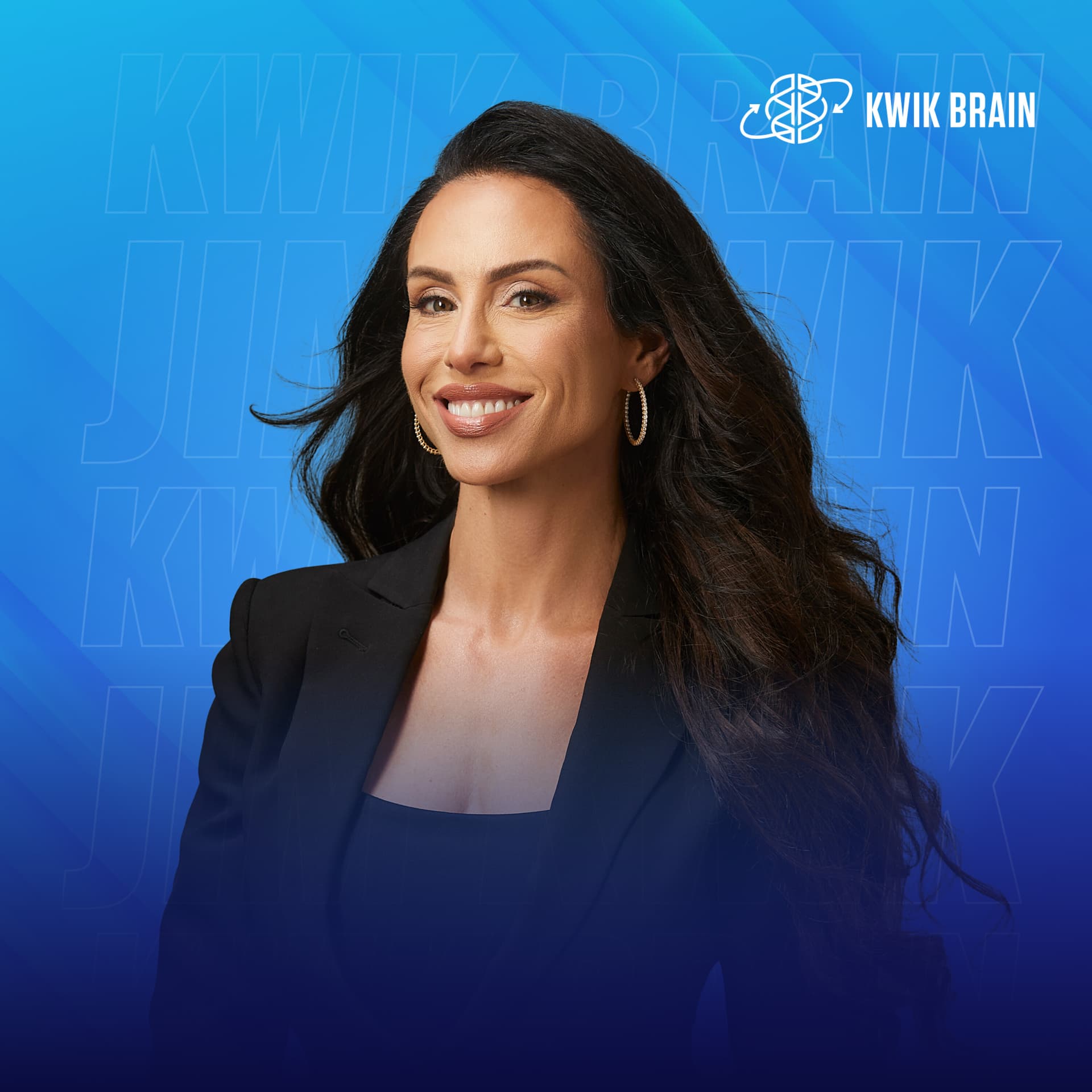
Kwik Brain with Jim Kwik
How Muscle Health Powers Longevity, Metabolism & Brain with Dr. Gabrielle Lyon
00:19:55
Loading summary
Transcript29 lines
- [00:00]
A
Welcome to Kwik Brain Bite Sized brain hacks for busy people who want to learn faster and achieve more. I'm your coach, Jim Kwik. Free your mind. Let's imagine if we could access 100% of our brain's capacity.
- [00:15]
B
I wasn't high, wasn't wired, just clear.
- [00:18]
A
I knew what I needed to do and how to do it. I know kung fu. Show me. Welcome back, Kwik Brains. I am your host and your brain coach, Jim Kwik. Today we are going to learn and discover how to reboot your metabolism, build strength and extend your life by learning how to build healthy and well developed muscles. When we think about muscles, we tend to think about strength or aesthetics. But in reality, muscles account for so much more than that. As the body's largest endocrine organ, muscle actually determines everything about the trajectory of health and aging. After years of watching patients cycle through her practice, Dr. Gabriel Lyon and noticed a pattern that revealed a shared core issue. Too little muscle rather than too much fat. And it's not just about the muscle being small. It's about having healthy and properly developed muscles. Dr. Lyon is a leading and revolutionary scientist leading a movement centered on skeletal muscle health as a key to longevity, addressing widespread issues like obesity, heart disease and diabetes. She is the author of the best selling book which I'm showing here, Forever Strong A A New Science Based strategy for Aging. Well, welcome to the show, Dr. Lyon.
- [01:38]
B
Thank you so much for having me.
- [01:40]
A
I've been looking forward to this. Our community has, our team, our team, our entire team has read Forever Strong. So I'm gonna thank you for your research. Thank you for bringing your work to light.
- [01:51]
B
Nothing gives me more pleasure and especially when I think about your people and why they come to you, which is all about cognitive function, how to think better and to think longer.
- [02:05]
A
I've really enjoyed your interviews in prep for this, not only reading the book, but listening to some of your conversations with our mutual friends. And what I wanted to discuss is cognitive function relation to muscle. So maybe we could start there. How does muscle directly influence brain health, brain performance? Can maintaining muscle mass improve cognitive function as we age? I know you have an extensive background in geriatrics and other areas that you've done research on. What's the conclusion there?
- [02:40]
B
One thing that we often don't think about is a large part of our brain is dedicated and for movement, full body movement. So it would make sense that the better you move, the more intensity at which you move, the better thinker that you are. And actually in my fellowship in geriatrics and Nutritional Sciences. My project was looking at body composition and brain function. And one of the things that we saw, which was so profound and really is at the root of the message, is that when an individual has a good healthy body composition, the better their brain function is. Conversely, if someone is more overweight, the lower the their brain volume. The number one thing someone can do for their brain is to have healthy skeletal muscle. And the way in which you use that muscle, people will think about endurance exercise. Endurance is wonderful for the heart. There's a whole host of positive reasons why that's amazing. But one thing that people often overlook is this idea of moving with high intensity, which is simply moving faster than you'd like to. And as you go through, say, a period of sprinting or whether you're doing it on the treadmill, on an Airdyne bike, you pick, it could be a rower. That. That actually seems to have pretty significant influences on the speed at which someone thinks.
- [04:14]
A
Amazing. I love this. I get goosebumps. I call them truth bumps. I'm curious, what are your key dietary recommendations for optimizing musc health? Like how. How does this differ across various life stages or ages, from young adults to those in their senior years? Does it change?
- [04:34]
B
It does change. And that is an excellent question. When you are young, you have a ton of dietary flexibility. For example, any high schoolers listening to this or college students, they're at their prime. I know that when I was in high school, I might have been on the Twinkie and French fry diet, but I had a lot of flexibility. And what happens is when you are young, as it relates to muscle and brain, you are developing. And our muscle is very primed for development early on. And as we age, something changes in skeletal muscle and it becomes more anabolically resistant. That is a term that simply means that it is more resistant to stimulus. And the two main drivers of stimulus for muscle are resistance training, exercise contraction, and dietary protein. We end up requiring more dietary protein as we age, which is counterintuitive. People think, well, I'm not growing, so I must not need as much protein. We have to recognize that the current guidelines on protein, which are 0.8 grams per kilogram or roughly 0.37 grams per pound, is a minimum to prevent a muscular deficiency. That does not take us into optimal living, optimal aging, allow us to have optimal muscle strength so that we can prevent a fall like your great aunt. What I Recommend is either 1.6 per kg or closer to 1 gram per pound. Ideal body weight, which certainly I can recognize is on the higher end, but there is no downside. And the body requires dietary protein at a discrete meal. For example, that would be five ounces of a chicken. It could be lean yogurt, it could be lean beef, it could be fish at one time to stimulate skeletal muscle tissue.
- [06:44]
A
I mean, this is something I'm very interested, being in my. In my 50s and having two young children, being strong, be able to. My. My father, when he was my age, was. I was 28 years old. And so this is definitely part of movement, is. Is something that's very key to our. To our family. Going back to nutrition, I'm wondering, because protein, I think a lot of people got that. Aha. Are there other common misconceptions about diet and muscle growth that you encounter? And how do you address these in your practice? Because I find that even when I was. When I'm teaching, sometimes I have to dissolve some of those lies, those limited ideas that people entertain. That's absolutely not true. Are there other ones besides protein that are common misconceptions related to diet and muscle growth?
- [07:37]
B
Yes. Number one, women are always afraid of getting too bulky. You know me in person, Jim. I am 5 foot 1 and I'm maybe 110 pounds. I have spent a lifetime trying to get bulky. All women will put in a tremendous amount of effort to build and maintain muscle mass. They will not get bulky from resistance training and adding dietary protein. Other misconceptions surrounding diet, specifically to dietary protein, because we're seeing a swing. It's interesting. Sometimes there's a demonization of saturated fat, sometimes there's a demonization of sugar. It seems to have moved rapidly to dietary protein. And these things that you hear are protein, it's bad for the kidneys. This is not true. In fact, if anything, if you have healthy kidneys, it can improve its function. You hear that dietary protein is bad for bone, when in fact, those individuals who want healthy bone require dietary protein because bone is built on protein. Another misconception is sometimes you might hear that you can only absorb 30 grams of protein at a meal. Also not true. You absorb all the protein that you eat. Those are the. Probably the three biggest misconceptions.
- [09:10]
A
Yeah, I think most of our audience have heard these repeatedly and take them as fact. Some people also, in addition to their diet, get their nutrition through supplements. And I'm just curious your personal view. Are there any specific supplements that you recommend, Recommend for maintaining or improving muscle health that also could benefit potentially cognitive health?
- [09:32]
B
And again, I've been very interested in this because this has been my area of study, the connection between brain and muscle. And what's fascinating is something like creatine. Creatine is a carny nutrient and it's only found in animals. It's very difficult to eat enough to be effective. And and when I say it's found in animal proteins, it's found in lean red meats, is one of the primary sources of creatine. Creatine, if someone takes 5 grams of creatine is good for muscle. Creatine has probably been one of the most well studied supplements. From an energy, power and force production standpoint it can certainly help with strength. But at 10 grams or 12 grams it seems to have positive benefit on cognitive function, which is fascinating.
- [10:25]
A
Is that spread out over or are you doing the 10 grams at one time in the morning or do you do like 5 and 5 or does it matter?
- [10:33]
B
Whatever is easiest for an individual.
- [10:35]
A
And it's very affordable too, right? It's something very simple and that everyone could, could add.
- [10:40]
B
Creatine monohydrate is very affordable. It's very well studied and it is a simple thing that people could do. And what is so wonderful about creatine is it shows that brain and mind muscle connection that if something is good for muscle, oftentimes it's good for brain. Another really important supplement, this is what we always recommended in memory and aging clinic is fish oil. Fish oil can have positive effects on skeletal muscle from an inflammatory standpoint it can help lower inflammation. It might even aid in muscle growth, depending. I think that the research is still coming out on that. But we do know that it's good for muscle and we also know that it's critical for brain function. Those fish oils, things like DHA and EPA are critical for brain health from young to old. And it's very difficult to eat enough omega 3 fatty acids. But when you supplement you know exactly what you're getting. And that is another supplement that's very, very fascinating.
- [11:50]
A
I love it. These are the essentials. Creatine, when I started adding it also not only for my workouts when I was traveling and I've noticed that if I'm sleep deprived it helps to mitigate some of the negative effects of lack of sleep. So that that's been a nice, nice benefit. Let's talk about exercise. I'm curious, could you share your thoughts on and maybe people are a little bio individual but do you find that there are better types of exercise for enhancing both brain function and muscle growth? And how often should one engage in These activities. Do you want to be able to remember confidently the information that you hear on this podcast? Do you want to improve your memory to easily and confidently be able to remember names and faces, client information, give a speech without notes, learn another language, remember what you read and so much more? There's a solution and I call it your quick recall. In just 15 minutes a day for 30 days, I've designed the ultimate course how to unlock your quick recall. Just go to quickbrain.com recall Enter Podcast 15 for your immediate discount as a thank you for listening to our show.
- [13:08]
B
Absolutely. There is a relationship when we think about again, when we think about overall metabolic health. Overall metabolic health comes from overall healthy muscle. The strength of the muscle, the mass of the muscle, the quality of the muscle. And when we think about very specific exercises. Number one, if I were to do a hierarchy, I would say at the bottom of that hierarchy, everybody needs to be strong. The stronger that you are, the greater your ability to survive nearly any injury or illness. A third of cancer patients die. Do you know what they die from? Loss of skeletal muscle mass.
- [13:51]
A
Wow.
- [13:52]
B
Stronger that you are, the greater your survivability, the stronger that you are. Midlife, you have a twofold opportunity to survive and live to potentially 100. How should somebody think about doing resistance training? At the minimum, it should be two days a week. In an ideal world, it should be three days a week. Compound movements, things that involve your entire body. And again for people listening to this, you're not going to get bulky and you know when you pick up a toddler, toddler is easily 40 pounds yet we're afraid to pick up a 40 pound weight in the gym and we shouldn't be because it has to translate. We're not training to get better at exercise, we're training to get better at life and resistance training. This is three days a week, full body exercises, compound movements, thinking about movements that have functional crossover. Specific example of that would be a farmer's carry. You can get two kettlebells and pick em up and walk them around your block.
- [15:07]
A
Good stuff. I'm curious, I like to ask a lot of my friends this to conclude the episode. Is there one thing that you're currently learning about or studying that has you particularly excited? And the part two for that out of my own personal curiosity. Besides, you know, where you're, what you're studying that currently and that just lights us up because that's, you know, our community loves to learn. Looking ahead, what are, is there anything that's exciting, maybe exciting developments or Potential breakthroughs in muscle centric medicine that could significantly impact public health. Is there something on the horizon that you're. You're optimistic about?
- [15:49]
B
Yes, and I will say that I do research here at Baylor and I work with a team, and I am very interested in andrology research, and that is the research of androgens, testosterone, and other anabolic agents. And I believe that that's actually the way of the future. An individual could go into the primary care office and receive a medication to make them less overweight, and nobody thinks twice about it. If I say, give me a medication that's going to allow me to lose weight, there's very little stigma against that. But if someone goes into their doctor and say, I've been struggling, struggling, I'm older, I have sarcopenia, give me a medication to help me become stronger, there's a lot of stigma associated with that, and it's not correctly placed. The forefront of muscle health will be an integration of diet, exercise, very particular hormone replacement. And then in addition to that, there are technologies coming out that allow for supramuscular contraction, meaning that the ability for me to contract my bicep or the ability for me to contract my quad is limited by my ability. There are technologies coming out that will allow for skeletal muscle contraction that is supraphysiological, more intense than anyone could ever do on their own, and that seems to have tremendous influence on overall markers of health. And eventually they are going to use that technology for brain health as well, and that's really what is going to be coming at the forefront. We are going to be facing a new epidemic that we've never had before. With the use of GLP1s and the agents that are coming out. We are in a position that we have never been in before. There has never been anything more effective available to the population. Because of this, without using it appropriately, we accelerate aging. You could, in 10 weeks, accelerate muscle aging by 20 years. We have to be prepared to answer that.
- [18:08]
A
Wow, you gave in a lot of. I think you blew people's minds, and we definitely have to have you back. I want to. I want to thank you, Dr. Lyon, for sharing your profound insights and expertise with us today. It's. You made it clear that muscle health is not just about physical strength, but is fundamentally linked to our brain health and our overall longevity. And I hope everyone listening today, you know, this conversation has illuminated the critical role muscle plays in our health and how it supports cognitive function as we age. Dr. Lang gave us very generous, a wealth of knowledge on optimizing muscle health through nutrition, exercise, these lifestyle choices that could directly benefit our physical and our mental well being. If listeners want to go, obviously they should go get your book. I'm holding it here forever strong. Where can they learn more about your work, connect with you? Where can they go deeper with you?
- [19:04]
B
Yes, well, I have dedicated my life to being able to bring scientific information to the public. We have a top medical podcast called the Dr. Gabrielle Lyon show where I bring on world experts that people have never heard of. These are people that are in the trenches doing research and we are interviewing them and taking that and translating it so that people can learn directly from the experts. People can apply on our website@drgabriellon.com I have a full medical practice myself. I see patients. We have a wonderful team, Dr. Lisa Hunt, a tremendous staff of nutritionists and doctors to make this information accessible.
- [19:50]
A
Thank you so much for the work you do. We'll put links to your practice practice, to the book, to your social media as we always do in our show notes. I recommend everyone go to jimquick.com notes as always, you can find more ways to fuel your brain's health and performance on our YouTube channel. This is where we'll put the extended version. If you're listening to this on audio, make sure you go to the extended version. Watch it on YouTube. Join over 1.8 million subscribers there. And make sure you hit the subscribe button and leave a comment under this episode. I read every single comment and let us know what you think. Dr. Lain, thank you again so much. We can't wait to have you at our limitless live conference. It would be absolutely mind blowing.
- [20:29]
B
Thank you so much for having me.
- [20:31]
A
This is your brain coach, Jim Kwik. Until next time, everyone be limitless.