
Podcast
Landless in Los Angeles
Hosted by Ruth @roofless · EN
Survival, justice and belonging for The Unhoused, 100% made in public
By Ruth @roofless, host of weekly X Displacement Spaces (Sundays 7pm PST), an ongoing discussion for and about global displacement and local housing and homelessness
roofless.substack.com
roofless.substack.com
20episodes
Episodes
Newest firstAll episodes

PITfalls of the 2026 “Point-In-Time” Count
1w ago00:18:06Tap to summarizeThis article was written by Ruth, who lives on the streets of LA.🆘 Councilwoman Nithya Raman has targeted me for yet another sweep on Monday, 8/3 🚜 Thanks for reading roofless! Subscribe for free to receive new posts and support my work.🚐 If you can help move my belongings into a van on Sunday 8/2 after 5pm, I would really appreciate it! 📦 ✍️ Edited by Zachary Ellison, who was displaced by the Eaton Fire. 🔥 On Tuesday, Wednesday and Thursday, January 20th–22nd, five-thousand volunteers put on high-visibility vests and set out to count the unsheltered of the Greater Los Angeles area.To use a pandemic metaphor, the counters were hoping to observe more evidence that the “curve” of homelessness in LA is still “flattening,” like those reductions seen in the 2024 and 2025 counts.Six months after carrying out the 2026 Greater Los Angeles Count of homelessness, also called the Point-In-Time “PIT” count, the results are in.The counters did, in fact, observe a reduction in visible shelters, because the number of vehicles and tents went down for the fourth year in a row.10,761 dwellings were counted.Although the total number of dwellings (tents + vehicles) is slowly but surely decreasing, the number of makeshift shelters, which can include a sleeping bag, shopping cart, umbrella, tarp, or anything else used to survive outdoors, is on the rise.Despite the decline in the number of dwellings counted in the City, unsheltered homelessness increased.In the entire Greater LA “Continuum of Care,” which includes the County and City of LA, but excludes Glendale, Pasadena and Long Beach, 10,483 presumed unsheltered people were counted outside in 2025 and 11,084 were people observed in 2026, a +6% increase.“Multipliers” move goalposts.The dwelling “multiplier” has been increased every year since 2023. In 2025, it was raised to 1.75 from 1.71 in 2024 and in 2023, it was 1.56. The 2026 demographic survey determined that more people are living in each dwelling, so the “multiplier” was increased to 1.86 estimated people per dwelling.The decision to increase the multiplier is allegedly backed up by demographic survey data, which has not been released for 2026. The 2025 demographic survey data and questionnaire are available through Economic Roundtable.More people living in dwellings have been a trend over at least the last four years…Year • Multiplier(estimated number of people per dwelling)2023 • 1.562024 • 1.712025 • 1.752026 • 1.86[Slide 22]In 2019, 2020 and 2022 (2021 was cancelled due to COVID-19), multipliers were calculated for each of the five dwelling types and each of the eight Service Planning Areas, and a separate set of multipliers were calculated to represent members of families living in dwellings, as opposed to individuals. For these years, total of 80 different multipliers were calculated. In 2023, this nuanced technique was replaced by one universal multiplier (1.56 people per dwelling). If one must have an unsheltered neighbor, is it not better that they at least have a tent or vehicle of their own?Un-ShelteringTents and vehicle dwellings are targets for constant removals, such as the 9,800 “Milestone Goals.” Also called the “encampment reduction plan,” these sweeps were secretly ordered by City Council in an illegal amendment to the LA Alliance for Human Rights’ settlement with the City.I wrote about the Alliance and their “Milestone” removal “goals” earlier this month, as I was being removed by City workers myself:During the week of the 2026 PIT Count, I was personally targeted for an encampment removal in Council District 4. Because of this, I almost certainly did not get counted, nor did my neighbors.I am again being removed, for the fifth time this year! LA Family Housing is supposed to be helping me get a voucher while the City repeatedly attempts to sabotage with sweeps this monumental personal progress toward housing.Phoenix Tso at Los Angeles Public Press referred to the modest “uptick” in homelessness as “bad news” and a “regression,” while also drawing a connection to “encampment sweeps.”The 2025 PIT didn’t detect displacement after #LAFires.The 2025 PIT was supposed to occur on January 23–25, 2025, but it was delayed to February 18th–20th because of the Palisades and Eaton fires. Therefore, the 2026 PIT was conducted only eleven months after the 2025 PIT.But how is it possible that after the physical destruction of over 12,000 structures and deaths of two dozen housed people, the 2025 PIT showed a reduction in homelessness? Is our annual counting ritual useless for detecting displacement due to disasters?300 fewer people experiencing homelessness (“PEH”) in LA County died in 2024 compared to 2023, a reduction of nearly one death per day.On paper, numerical reductions look the same whether people exit homelessness to permanent housing or permanent death. County data released in March shows fewer people dying on the streets compared to prior years, for the first time since 2014, which seems worth celebrating.The latest report by the Department of Public Health - Center for Health Impact Evaluation has the freshest data available concerning deaths of people on the streets of Los Angeles County. From Data to Action • Lives Lost: Mortality Trends and Prevention Opportunities For People Experiencing Homelessness in LA County, 2015-2024 was released by “DPH-CHIE” on March 10th.Paris Barraza wrote an article for USA Today covering CHIE’s newest findings on the same day the report was released, noting the remarkable 21% reduction in drug overdose deaths. This is likely the intended consequence of tripling naloxone (Narcan) distribution between 2021 and 2023, as noted in the 2025 press release of the report which contained death data for PEH from 2023.Age• The number of adults (18-54) experiencing homelessness decreased by 1.1%.• The number of older adults (55+) experiencing homelessness increased by 13.5%.Age group • 2025 • 2026Children (0-17 years) • 6,428 • 5,605Adults (18-54 years) • 45,718 • 45,225Older Adults (55+ years) • 15,631 • 17,746[Slide 31]LAHSA’s 2026 PIT press release notes a reduction of homeless children and families, but a 13.5% increase in the number of older adults (55+) experiencing homelessness. While an elderly homeless population is not exactly something for our City to be proud of, if it’s indication that the streets are slightly less deadly, then it’s bittersweet news, especially considering that LA’s unsheltered population was struggling to make it to age 50, even before the onset of the pandemic.Overdoses are declining while vehicular killings of PEH have skyrocketed 248% in a decade.Until March 2027, when the CHIE report containing last years’ deaths is going to be released, the most recent data about mortality among PEH in LA County is from 2024, when a total of 2,208 deaths were recorded, nearly six per day.While it is a shocking statistic, and double what it was before the pandemic, it is still a measured improvement compared to the 2,508, or seven per day, from the prior report containing 2023 deaths, released in March of last year.Who oversees the preparation of PEH death data?Over 2,000 people who died homeless in LA County from January 1st, 2000 to May 28th, 2007 were recorded in a report by the Los Angeles Coalition to End Hunger and Homelessness, Dying without Dignity: Homeless Deaths in Los Angeles County 2000-2007. The names of the deceased make up the last thirteen pages of the 44-...
Transcribe →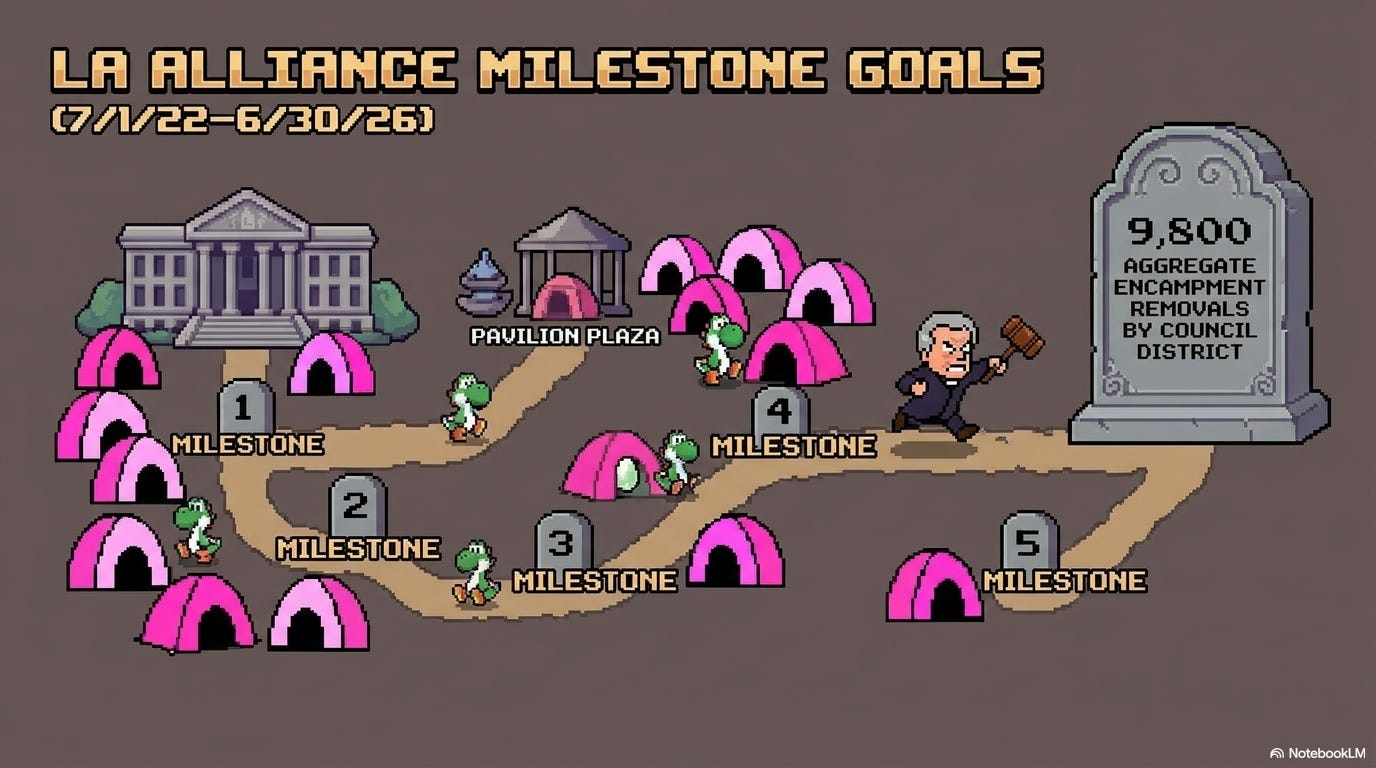
ROBBING HOODS: For forcing destruction of 9,800 dwellings, #LAAlliance got $7M
Jul 1100:21:43Tap to summarizeHomeless people of Los Angeles “audited” #LAAllianceforHumanRights.We discovered a back-dated amendment to the City’s 2022 settlement agreement which essentially put bounties on our dwellings.For the City and County of LA to comply with LA Alliance for Human Rights’ 2022 settlement agreement, the City and County must make certain data available to court monitors selected by U.S. Judge David O. Carter.Thanks for reading roofless! Subscribe for free to receive new posts and support my work.Among the Alliance court’s chosen monitors are:* Carter’s “Special Master” (a terrible title, in my opinion), former Santa Ana Councilwoman, Michele C. Martinez, of Emergent P4 Advisors. Martinez has been on the City’s payroll since 2022, earning a total of $713,135.57 so far. It’s unclear if MCM is being paid additionally by the County, but she is monitoring compliance by both the City and County;* Carter’s other “Special Master,” retired Judge Thomas M. Goethals, of Alternative Dispute Resolution “ADR,” Inc., is monitoring compliance by the City;* retired Judge Jay Ghandi, of Philips ADR Enterprise “PADRE,” was monitoring the County’s compliance for $200,000/year, offering the first year free. However, Ghandi recused himself after he lost his home in the #LAFires and decided to take legal action against the City;* most recently, Nardello & Company were appointed to monitor compliance of a new 2026 agreement between Alliance and the City for $150,000/year, through 2029.In the context of the Alliance court, the City’s data is expected to reflect adherence to certain commitments, such as the number of new “beds” opened in accordance with the agreements. The data itself must prove to be accurate, as the job of the monitors is to verify data and author periodic reports.2024 Amendment & AuditIn 2024, the Alliance agreement was quietly changed to order the destruction of nearly 10,000 homeless constituents’ tents and vehicle dwellings. It was at this time that the City was forced to purchase an outside “audit*” of homelessness spending. One of these things got significantly more media attention than the other (the “audit” overshadowed the “sweeps”).*Alvarez & Marsal’s $2.91M “audit” was not a forensic one, so “audit” is in quotation marks.Full disclosure: Zachary Ellison and I spoke to “A&M” for approximately one hour in late 2024 to inform our reporting on LA Alliance and to consult on their “audit.” We were asked about Inside Safe intakes and the City’s “Interim Housing - Homeless Services” account. I had published a Substack article about how the IHHS account had been converted into an LAPD overtime slush fund that October.2024 Alliance AwardAnother element of the amendment between the City and LA Alliance that got little attention was Alliance’s $725k fee for changing the original settlement. The City had already paid Alliance $1.8M to settle the case. Alliance was also paid $2.4M for the 2023 County settlement and an amendment, and Alliance have been paid additionally since. A recent appeal to the Ninth Circuit Court of Appeals resulted in yet another $2.2M settlement between the City and Alliance and the Intervenors. For all we know, this litigation may only just be getting started.All Alliance Awards = $6,825,000If you were keeping track, Alliance got nearly $7M in attorney fees, with the total amount potentially still growing, and all of it paid by LA taxpayers, by order of the court. The cumulative $6.825M total does not include Alliance’s 2025 $6M fee request, which included a multiplier that was rejected by the court.Alliance’s award amounts also do not account for the cost of the $2.91M A&M “audit,” mediators’ pay (Nardello is making $150k/year through 2029 and MCM has been paid a total of $713k by the City since 2022); intervenors’ attorneys (LAFLA were paid $300k out of the total $2.2M award in an agreement which settled an appeal by the City against Alliance earlier this year), or any defense attorneys. The City’s special counsel, Gibson, Dunn & Crutcher LLP, claim to make up to $2,650/hour, but offer the City their services at a discount, charging “only” $1,295/hour.According to documents obtained per a California Public Records Act request, LA County paid attorney Brandon Young of Manatt, Phelps & Phillips LLP $1.02M to participate in the Blue Ribbon Commission on Homelessness. The Blue Ribbon Commission also included Gibson, Dunn & Crutcher LLP’s Theano D. Evangelis Kapur, who currently defends the City against Alliance, and successfully argued against the rights of homeless people in the City of Grant’s Pass, Oregon at the U.S. Supreme Court in 2024.…with advocates like these, who needs enemies? Yes, the City and County are paying some of the most expensive attorneys in the universe to fight Alliance, who the City and County are also paying, by order of the court. The City is additionally awarding intervenors, monitors, “auditors”, mediators such as Richard T. Copeland, who the City paid several thousand dollars in May 2022, according to City Controller Kenneth Mejia’s open data.A runaway train of a lawsuitWhen taxpayers are forced to pick up the tab for every side of runaway litigation, as in Alliance, there’s no possible justification for keeping the public in the dark about the substance of a settlement. Unhoused people are left unknowing about where in the City we are allowed, when our possessions will be subject to immediate destruction, and who to call to try to access housing. An entity like Alliance, which claims to be about accountability, should be illuminating the public on their objective findings, much like the City Controller does.In closed sessions and private meetings, Alliance attorneys illegally implemented a Court-enforced scheme to destroy dwellings. City Council approved the 2024 modification of their agreement with Alliance in closed session, in violation of the Ralph M. Brown Act, shielded from public participation, feedback or publication. The Milestones amendment is back-dated to July 1st, 2022, perhaps indicating that it was an unpublished component of the original settlement? How can a settlement demand removals occur two years before the agreement allegedly existed? Was the City paying for monitoring of additional items which were not in the original agreement? Why would the Alliance Court not want unhoused people to be aware of impending removals? Who came up with the “Milestones” agreement, and when? Who was aware of this removal plan, and for how long? What do/did the alleged unhoused plaintiffs in LA Alliance think of this plan? Was the “sweeps” mandate intended all along? Are there any other secret agreements the public should know about, such as arrest quotas? What else occurs in these closed sessions? How can we trust the Court or the City?Despite the motivational “Milestones” label, removals are sudden displacements where peoples’ belongings are summarily destroyed on-the-spot.I’m not here to talk about the Fourth Amendment.—City worker Danté (refused to provide his last name or his supervisor) in May 2023 at an unnoticed encampment removal in CD4In May 2023, City workers, who refused to identify themselves or their supervisors by name, were recorded at a surprise “sweep” saying theyaren’t here to talk about the Fourth Amendment.The unidentified City workers then violated the Fifth by claiming theydon’t have to give notice.andThis is your notice.The City workers proceeded to destroy a Jackery solar power station, which enables off-grid phone charging and other survival and sentimental items.At the time of this removal, which occurred in the period between the 2022 settlement and the 2024 amendment, the affected unhoused people had a matter of minutes to prepare. Their requests for reasonable accommodations, such as more time, or a designated location where their things could be retrieved, which is supposed to be part of the City’s standard operating procedure for removals, all fell on uncaring ears.How Alliance manipulated City leadership into adopting a political agenda favored by a handful of business interests, principally funded by Spring Street developer Izek Shomof, and aligned with heavy policing, is something the public can only imagine. We are sometimes informed by glimpses behind the curtain, like we got in 2022, when the...
Transcribe →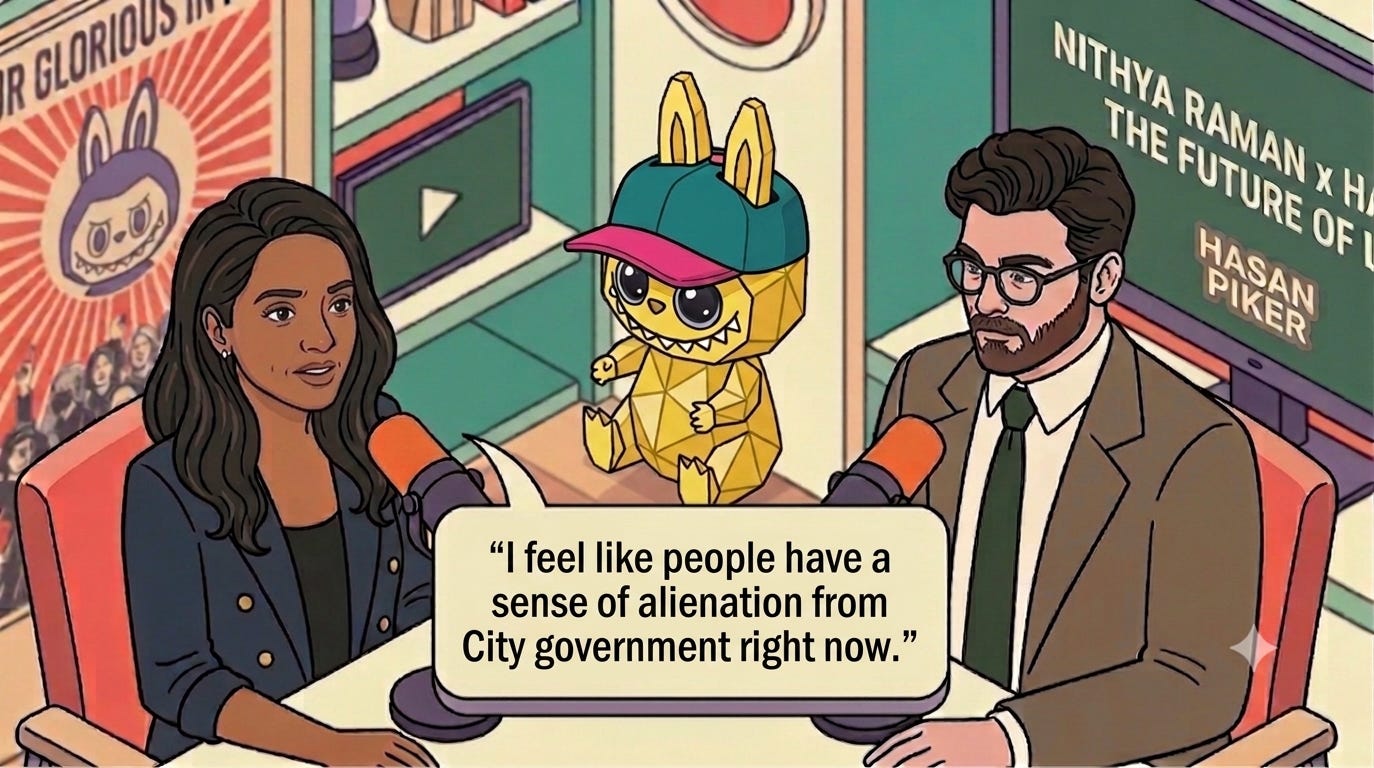
“like, I really believe in government!” #LAMayor Challenger NITHYA RAMAN makes Runoff
Jun 3000:10:26Tap to summarizeWith her face framed by giant Labubus, and possibly a Funko figurine wearing a colorful hat, Mayoral candidate and District 4 Councilwoman Nithya Raman sat side-by-side with popular Los Angeles-based Twitch streamer Hasan Piker to promote the Council District 4-elect’s late decision to launch her own Mayoral Campaign.UPDATES:* Last updated 9 hours ago: The New York Times has the latest analysis on the LA Mayor’s race, called on 6/8 by Associated Press. NYT claim >95% of the votes have been counted, AP claim 99%.* Posted 1 day ago: Nithya Raman appears on Talk Easy podcast (discussed below)* Published 2 days ago: The Los Angeles Times announce LA County’s certification of 2,227,461 ballots, 24 days after the polls closed on 6/2.Nithya Raman believes in government.Raman was primarily up against current Mayor Karen Ruth Bass, who Raman endorsed in this race last year, before deciding to run against her. Raman also endorsed Bass when she entered the 2022 Mayor’s race after representing Los Angeles as Speaker of the House in the State Assembly and the U.S. House of Representatives continuously since 2004.Thanks for reading roofless! Subscribe for free to receive new posts and support my work.“Like, I really believe in government.”In the 2022 election, community organizer and LAUSD mom Gina Viola* ran from outside the establishment and finished nearly tied with CD14 (Metro) City Councilman Kevin de León.*Full disclosure: I did graphics for Gina Viola’s Mayoral campaign.Together, Viola and the disgraced de León, as third and fourth runners-up, got 14.65% of the votes in the primary. In the runoff, Bass would end up defeating billionaire developer-career commissioner Rick Caruso.This election, The Hills’ villain Spencer Pratt, Pastor Rae Huang, Adam Miller, Juanita Lopez and Griselda “Pinche Grizzly” Diaz (as a write-in) filled out the ballot. Pastor Huang’s platform was the most refreshing, with thoughtful positions such as a hard pivot from interim to permanent housing and a promise to make Metro even more affordable. Meanwhile, “Grizzly” Diaz claims the City rejected over 100 of the 600 signatures she gathered to qualify for the ballot, and is still crying foul on Instagram.Hasan Piker: “CAN WE TRUST HER?”Particularly adept at unseating Democratic incumbents from the left, Raman’s demeanor on Hassan’s stream wasn’t as energetic as she may have been in 2020. Piker and Raman refrained from mutually stroking their progressive egos like the challenger Councilwoman and host did six months ago, on Evan Lovett’s LA in a Minute.“Yes, I do think Israel has the right to exist.”—CD4 Nithya Raman, Mayoral Candidate on Hasan PikerHasan Piker clearly did his homework, and is acutely aware of local politics, bringing challenging questions right out of the gate, and he kept up this pace. Nithya’s answers were delivered in her quiet, self-assured way, but their substance failed to connect with the audience at many turns.Nithya Raman believes in [the Zionist Entity].In response to Piker’s pointed question about the Zionist Entity, in which Raman was given the opportunity to specifically condemn its current state, she did not take the opportunity to align with a nuanced anti-Zionist statement. Raman instead chose to validate the Entity by claiming it has rights, which no state officially has, because only humans have rights.The chat booed. 👎Coming from the candidate most closely conflated with Zohran Mandami, Raman’s response was a global disappointment. Raman didn’t bother making promises, such as pledging to have Benjamin Netanyahu arrested if he should arrive at LAX, like Mandami did in NYC, a move that was universally popular, even if the promise isn’t one he will be able to keep. Raman agreed with Piker describing the Entity as an apartheid. She sheepishly trudged on…at the end answering “YES” to Piker’s “Free Palestine?”Nithya Raman believes in police (not ICE).Perhaps Raman’s approach on Piker was more strategic than it was inspiring. She may have been speaking only to people with the ability and intention to actually vote in Los Angeles, ignoring the temptation to go for more widespread likability.Probably due to a mix of racism, misogyny, and nepotistic advantage, neither Bass nor Raman are unanimously considered “likable” compared to former Mayor Eric Garcetti and California Governor Gavin Newsom. Unlike both establishment suits, neither Bass nor Raman have expressed a desire to run for higher office, and Bass, who held her elected seats in the State Assembly and U.S. House of Representatives continuously for 18 years, had said in 2022 that she intends on retiring soon.“I do believe ICE should be abolished. Absolutely…”“This is a City of immigrants.”Raman’s answers again frustrated when she invoked her status as an immigrant but said she would not be participating in foreign policy as Mayor. The point about jurisdiction may be true, but it feels like a cop-out to people who are disturbed by ongoing genocides in Palestine, Sudan and the Congo, like constituent Khaum Shaikh who expressed this sentiment in a 2023 written public comment in response to an item about rent control. For those looking for assurances that our electeds won’t govern us into a genocide of our own, even “progressive” LA leaders disappoint.“I think we have to enforce laws that are in place to protect Angelenos.”Speaking of cops, or cop-outs, Raman received backlash after initially taking office for voting in favor of installing LAPD in public housing outside of her district after aligning with 2020’s calls to defund LAPD. Raman then issued an apology but left the vote intact, leaving people even more confused about what she stands for, and what goes on behind the scenes with City Council, and we finally got some answers about the latter question with the #Fedtapes leak in 2022.In an interview posted on YouTube yesterday, Raman explained to host Sam Fragoso on Talk Easy that she jumped into the running at the last minute, “flabbergasting” Mayor Bass, who took it as betrayal. There’s been no talk about who will step up to govern Council District 4 if Nithya Raman gets elected. Maybe that’s because there’s been no phone-in public comment at City Hall since the end of 2024, and no one has promised to restore it. “I feel like people have a sense of alienation from City government right now.”On a personal note, I spoke to people who witnessed pre-dawn LAPD raids on encampments in CD4 followed by Sanitation operations on Election Day, 6/2. I am also in possession of written announcements of encampment removals which were posted on 6/2 with the removals scheduled to occur on 6/3 (they did not occur) preventing some unhoused constituents from voting for any candidate.Maybe people wouldn’t feel so alienated by City government if City departments weren’t actively destroying their vehicles and belongings, and if they knew they could make themselves heard…if not to their leaders, then at least to each other.“The market will not provide housing for everybody…that’s where the government needs to step in…”“I love public housing…I support efforts to shelter people in housing that is dignified.”I plan on comparing data for Karen Bass’ Inside Safe program and Nithya Raman’s Highland Gardens Roadmap in an upcoming article about the LA Mayors’ candidates homelessness strategies. Let me know what questions you have in a comment! 👇 Written by Ruth from the streets of LA…🆓🇵🇸🇸🇩🇨🇩Edited by Zachary Ellison, who was displaced by the Eaton FireEdited by Zachary Ellison, who was displaced by the Eaton FireIllustrations made from prompts on the free version of Gemini for iOS.Thanks for reading roofless! Subscribe for free to receive new posts and support my work. This is a public ep...
Transcribe →
🆕 Inside Safe AUDIT
Jun 18, 202500:12:32Tap to summarizeI’m Ruth and I live outside in Los Angeles.This article follows-up on one I wrote in October 2023:🔗 All data is linked at the end of the article, so you can check it out and draw your own conclusions! Please let me know what you think in a comment.66% of people who enrolled in Inside Safe are indoors.4,994 Participant Statuses:* 3,305 indoors* 1,606 outside* 83 deceasedNearly 5,000 people enrolled in Inside Safe by New Years’ Eve and an additional 346 people enrolled in January. As of January 31, 5,340 participants have enrolled in the Inside Safe program “ISP”.21%* 12% of Inside Safe participants moved into permanent housing.As of the end of last year, 609 people had moved from Inside Safe to permanent housing “PH”:Thanks for reading roofless! Subscribe for free to receive new posts and support my work.* 288 people are on subsidies like Section 8 housing choice vouchers “HCVs”,* 283 moved to permanent supportive housing “PSH” units, like those built and financed through the City’s Measure HHH, as they become available. PSH units are subsidized by Project-Based vouchers “PHVs”.* 38 people got market-rate “MR” (unsubsidized) housing. It’s unclear if the Inside Safe program “ISP” assisted these participants in securing private leases.In addition to the 12% who are permanently housed, 54% of Inside Safe participants are sheltered.* 2,552 participants enrolled in ISP are in interim housing “IH”/shelter.* 1,846 Inside Safe participants are in hotels and motels (37%):* 1,432 people are staying in motels that have booking or occupancy agreements with the City.* 414 participants are in The Mayfair Hotel, a City acquisition in Eunisses Hernandez’ District 1* 448 people are housed with Time-Limited Subsidies “TLS”*, which are also called Rapid Re-Housing “RRH” (9%). *TLS typical duration = two years. I’m uncomfortable calling this subpopulation “permanently housed” like the City does. In 2013, the U.S. Housing and Urban Development Department “HUD” re-classified people on this kind of subsidy as “housed”, which made homeless counts appear to improve. Unfortunately, many households on TLS end up homeless again, like 300 families Byrhonda Lyons and Jeanne Kuang reported on in Calmatters a year and a half ago.* 204 people are in Interim Housing “IH” - “other IH” (4%). There is no explanation on what this housing is. Maybe it is “halfway” housing by the Office of Diversion and Re-entry “ODR”, SHARE! nonprofit, market-rate housing, or something else?Additional “sheltered” statuses:194 participants had other outcomes (4%) but many of them still probably need housing:* 89 people are incarcerated,* 31 people accepted transportation out of LA through “reunification” programs* 15 people are in medical or psychiatric hospitals, and* 5 people are in substance abuse treatment facilities,* 21 people are in A Bridge Home “ABH” congregate shelters,* 33 people are in “villages” of Pallet Shelter tiny structures.32% of enrollees are on the street, with one-third in touch with providers.* 1,714 out 5,320 participants “returned to homelessness”* 586 remain in touch with service providers* 61 people enrolled for zero days (1%).I wrote more about serious issues in Inside Safe here:Total enrollments +494% in 22 months.* March 2023 • 1,077* January 2025 • 5,320Enrollments have been tightly controlled to stay within budget constraints while focusing on highly-visible “encampments”. One of the top issues I encounter is qualified unhoused people who want to access ISP, but can’t. The bottleneck in “throughout” is lack of available housing and subsidies for permanently exiting participants.I am not enrolled in Inside Safe. My neighborhood was targeted for an Inside Safe operation last year, but it got cancelled. I wrote about it here: 49% of participants have documents; await housing placements.* 2,441 Document-ready (Avg. 411 days)* 2,553 Not yet documented (Avg. 136 days)The longer people stay enrolled, naturally, the more get their documents and they are less likely lose them.Participants spent 1,767,138 nights enrolled in Inside Safe in the first two years.Average enrollment: 355 nights (≈ 1 year)According to the data I obtained from the City Administrative Officer “CAO” Matt Szabo, 16 participants have been in Inside Safe for over two years continuously, which isn’t a great sign that housing placements are moving along expeditiously.But the fact remains: the program has retained them, as Mayor Bass promised. In Project Roomkey, hotels were constantly being “demobilized” to switch service providers, removing participants, and cause staff to have to seek unemployment. Inside Safe seems to be a more stable environment.83 people are known to have passed away (2%).🕯0.8% Annualized Program Mortality83 Inside Safe participants were known to have perished as of the end of 2024 (1.7%). That means the mortality rate of the first two years of Inside Safe is 1,662 per 100k. In 2023, the annualized mortality rate of people experiencing homelessness “PEH” in Los Angeles County was 3,326 per 100k, using figures from the Department of Public Health “DPH” and Los Angeles Homeless Services Authority “LAHSA”’s point-in-time “PIT” count. Inside Safe seems to significantly improve mortality, slashing rates for participants to levels closer to that of the general housed population.Disappearing Dwellings* 3,465 tents in 2020* 2,589 tents in 2025* *draftAfter reaching an all-time high of 3,465 tents in 2020 (this was technically a pre-pandemic count because it was in January), the number of tent-dwellings has been slowly but surely decreasing. The draft 2025 count, obtained from LAHSA through CPRA, indicates fewer than 2,600 tents City-wide, coming directly from tally sheets collected by point-in-time “PIT” volunteers. It is unclear if or when it will be publicly released. Meanwhile, other homeless populations, like people in emergency shelters, are on the rise.I wrote about LAHSA’s choice to withhold 2023’s dwellings counts here:I don’t celebrate reductions in makeshift shelters because, to me, tents represent survival and independence. 1,846 people are in Inside Safe motels and The Mayfair, with most having given up their survival supplies to redeem that opportunity, and their continued status indoors probably depends a lot on the Mayor getting re-elected.Outside Safe?Homeless victims of homicide:* 2022: 92 (per LAPD data via my CPRA).* 2023: 56 (per LAPD Homicide Report).* 2024: 8* (using MO code 1218) *preliminary from open data; not completeA sustained reduction in homicides with homeless victims is cause for applause. My 2024 data isn’t complete, but the difference of 36 fewer homicides in 2023 compared to 2022 is confirmed and significant. Inside Safe participants are technically still homeless until permanently housed, but their sheltered status likely contributes to safer conditions. I wrote about 2022’s 92 homicides with unhoused victims here:In November 2022, voters in the City of LA saw Karen Bass as the leader equipped to address the top issue of homelessness over her well-connected, wealthy competitor, Rick Caruso, who had the endorsement of the LA Police Protective League “LAPPL”, on which he is a commissioner. Maybe this achievement is what earned Mayor Karen Bass an endorsement from the police for her re-election, over Los Angeles Police Protective League Commissioner-challenger Rick Caruso.Considering Bass’s considerable achievements in public safety and shelter, it makes sense for Caruso’s own co-commissioners to endorse the incumbent mayor so early. But gaining the support of LAPPL is not the same as keeping the favor of the voting majority. What more would people like to see from the Mayor and her Inside Safe program before they feel confident re-electing her?What can you do?* Ask your council person what is delaying the opening of Homekey acquisitions* Introduce your neighborhood council to residents and staff at City-run shelters* Demonstrate around vacant housing units to demand immediate occupancy* Identify affordable rentals to facilitate “throughput” of shelter participantsRaw ISP participant status data:* Click here for January 2025 PDF* Click here for December 2024 data* Click here for October 2024 PDF* Click here for August 2024 PDF* Click <a target="_blank" href="https://docs.go...
Transcribe →
“The HACKLA” 2 • Reclaimer Benito Flores
May 27, 202500:15:56Tap to summarize70-year-old Benito Flores uses a square frame in his tidy, green front yard as a mini-billboard to oppose state violence:“KEEP FAMILIES TOGETHER.”—Reclaimer Benito Flores’ signPRESS RELEASEMr. Flores has no rent debt.He has no behavioral issues.He has a codified right to purchase the home he’s occupied for over five years, which he would like to rightfully own.With all of these factors in his favor, as far as eviction cases go, Benito is easy to defend.His lease agreement with the housing authority says he will vacate the premises eventually.But the Housing Authority promised permanent housing placements, and they haven’t delivered.What will it take to redeem his right to buy?Thanks for reading roofless! Subscribe for free to receive new posts and support my work.Affordable Sales ProgramBy law, Surplus Residential Property is disposed according to Government Code Article 8.5 [54235-54238.9]. A current low/moderate-income occupant (like Mr. Flores) has the highest priority for purchase, second only to a current occupant who is a former owner of the home.The law hasn’t stopped Los Angeles County Sheriff’s Department. This week, they extracted three similarly-situated neighbors from their Caltrans homes on Shelley Street in El Sereno’s sleepy 710 Corridor.If Benito is removed from the home, he will become a former tenant, and lose his priority to purchase the property at an affordable price. How shameless can the City, County and State be to work together to come between a peaceful elder and his legal right to own his dwelling?710 CorridorHow 600 homes in El Sereno and South Pasadena got condemned by the State Department of Transportation “Caltrans” just to be seemingly forgotten for decades is the type of nonfiction that sounds more like Los Angeles lore. Homeowners in the Caltrans Corridor were forced to accept buyouts through a legal freeway expansion process that began with the State acquiring the properties through eminent domain in the 1950s and 60s. Plans changed and changed again, and the 710 stub never got connected to the rest of the highway system as planned. The “just compensation” homeowners were paid didn’t replace single-family homes they were forced to relinquish. Many of them had to downsize and/or leave the State altogether. Renters would’ve had to seek leases elsewhere, and some would not be able to afford similar accommodations, especially when were competing with other desperate, displaced neighbors. Local landlords took advantage by raising rents. Families, many of whom were immigrants, some living with multiple generations under the same roof, resented loss of the stability they carved-out in El Sereno. Without support of neighbors, marginalized households’ economic injuries didn’t heal the same as they might’ve for more resilient, privileged households, who actually benefit from redevelopment. Generational resentments toward the State over the harm their families endured for this failed freeway project was passed down family trees.Even though the property transfers were fully legal, and most homeowners were compensated with real checks in amounts considered “fair”, the former residents of El Sereno missed the homes they knew, the neighbors they had, and the community to which they belonged. They told their children, grandchildren, nieces and nephews, and for decades, the houses sat like time capsules, portals to better days and living reminders of when they were doing better, things were less expensive and life was simpler. March 2020 • COVID-19Slowly, some displaced descendants eventually returned to their old homes in the Corridor, accompanied by other local families needing adequate housing for themselves and their children during the pandemic.They call themselves Reclaimers.Former owner-occupants are legally recognized by law as having the highest priority to purchase back their homes at a reasonable price. Next in line are low-income occupants like Mr. Flores. Then, occupants who make up to 150% median income. Occupants with incomes 150% median or less are to be offered the homes at lower, affordable prices. Finally, public and private “housing related entities”, current tenants and former tenants get a chance to buy the homes at fair prices. All of this happens before the public has a chance to bid on the dwellings at an auction.11/26/20 • ThanksgivingOn Thanksgiving in 2020, everything was calm in the 710 Corridor until the police showed up to break up a community gathering of reclaimers and remove new occupants of surplus homes by force.When homeless families and elders occupied these government-owned homes during the pandemic, they began the hard work of improving long-neglected properties, allowing children to socially distance in their own bedrooms. As reclaimers and their network of neighbors were enjoying dinner, California Highway Patrol “CHP” violently extracted a mother and hogtied her teenage child in the middle of the street that splits the corridor.Earlier that day, the reclaimers had been thankful to be thriving in a global pandemic. Now, red-and-blue strobes illuminated an eerie, mostly-empty residential street, animating an advancing army. The onslaught of uninvited State police were ironically forgoing their own families’ festivities for overtime tearing their fragile households apart. The feast was forgotten and fear rightfully froze them. Even their new Councilman, the now- embattled Kevin de León, officially called the images of the CHP raid that circulated in the media “heartbreaking”. They were.The dizzying lights, shiny guns, clipping walkee-talkees, and shock of instant separation…it all felt devastatingly familiar.Witnessing the Reclaimers’ roller coaster of re-housing and immediate displacement play out on social media, I was instantly triggered by the similarities to my first ejection from stable housing. When I was in middle school, police detained my dad and told my mother, brother and I to leave our home indefinitely. We had just moved in that year, and it was a school night, and I had homework and planned to hang out with my friends that weekend.I wanted to support and protect these brilliant, resilient strangers, the Reclaimers, but didn’t know how.My For more on-the-ground perspectives from the Thanksgiving CHP raid, listen to the Thanksgiving 2020 Special of iheartradio’s “We The Unhoused” podcast (Episode 36) by clicking on the image below.WTU is produced by host Theo Henderson, who once lived in a public park in the City of Los Angeles, and Jamie Loftus.The people have spoken…WTU was a double-winner in the 2025 Webby Awards! Thank you for voting in support of Theo’s well-deserved wins.Full disclosure: I am honored to have spoken as a guest on WTU a handful of times, including last year with my sometimes-Substack co-writer, Zachary Ellison and most recently about my partner J’s legal woes.2021 HACLA LeaseMr. Flores and other reclaimers signed agreements with the Housing Authority of LA that said they would vacate the premises in a few years, so the homes could be returned to Caltrans. But, for their end of the deal, the Housing Authority promised to help Reclaimers secure permanent housing, and it didn’t follow through for many.Benito fears that if he leaves, the “offer of a lifetime” which he is clearly entitled to, by law, will never come. That’s why he won’t leave.Broken promisesNow, the Housing Authority was moving the goalposts, telling media all they technically have to do to live up to their end of the bargain was pass along referrals. If those referrals were full, unaffordable, inappropriate, or otherwise unavailable, well, that wasn’t their problem. That was basically the illuminating position of LA’s Housing Authority. One reclaimer, Ruby, did get a sustainable permanent supportive housing unit and another family got a Section 8 apartment. But there were dozens of reclaimers in several homes, and one single-room occupancy “SRO” unit plus one apartment wasn’t enough housing for all of them.HACLA never did come to the table with suitable replacements or federal vouchers for the rest. But the press covered the individual successes without questioning why universal offers weren’t made to all reclaimers, or why their right to purchase under Roberti wasn’t being acknowledged at all.It felt wrong to me for the City’s Housing Authority to threaten to remove 70-year-old Benito from his reclaimed, government surplus home of five years without making good on HACLA’s promise to permanently house him elsewhere. It wasn’t simply knowing the diabetic sores on his feet wouldn’t heal on the streets, or the understanding that he would never find a place in Los Angeles on his fixed income of Social Security.I found it deeply offensive that the Housing Authority would move in a way that is likely cause injury to elder Benito, in order to protect emptiness, enforce displacement, embrace waste and buckle down on the racist redlining restrictive real estate policies of decades past…all while we are in a homelessness state of emergency in the City and County. Seven people are dying on the streets of Los Angeles per day. When Mr. Flores moved in, the same statistic was three daily deaths.May 2022 • 710 cancelledThe highway extension ultimately got cancelled for good in 2022. It should have been good n...
Transcribe →
The HACKLA
Apr 28, 202500:24:47Tap to summarizeI’m Ruth roofless. I’ve been unsheltered in the City of Los Angeles continuously since 2017. I write about corruption and housing policy from the streets and host live Displacement X Spaces discussions on Sundays at 7pm PST on Twitter, where I’m @rooflesser.Federal Housing Choice Vouchers “HCVs”, also called “Section 8” are our country’s #1 “safety net” against mass homelessness. In the City of Los Angeles, a planned opening of the decade-long waitlist for housing subsidies turned into a trap that left applicants, including my partner and I, in even worse shape than we were in before. After applying for Section 8, our private data was in the hands of professional hackers demanding a ransom, making us virtual hostages.Thanks for reading roofless! Subscribe for free to receive new posts and support my work.2017 Lottery“We are very pleased to be opening our Section 8 waiting list after 13 years…”—Douglas Gunthrie 10/2/17When we applied for Section 8 in October 2022, J and I had been living together in the City of LA’s outdoor public spaces, such as under the highway and underground in storm drains continuously since October 2017, which also happens to be the previous time the City’s Section 8 waiting list opened. Before 2017, the City’s Section 8 waiting list had been closed since October 2004.The 2017 occasion, celebrated by Mayor Eric Garcetti and HACLA President and Chief Executive Officer “CEO” Doug Gunthrie, seems like it was nearly identical to the 2022 opening.“The application for the waiting list lottery is scheduled to open starting Monday, October 16, 2017 at 6:00 AM until Sunday, October 29, 2017 at 5:00 PM. Applications are available only online through hacla.hcvlist.org.”There doesn’t appear to be much public information about the 2004 event. But on August 4th, 2017, LA Sentinel’s Sentinel News Service reported CVP Associates, Inc. (CVP) won a competitive bidding process to handle an estimated 600k incoming applicants and manage the City’s Section 8 waitlist. CVP seems to be Customer Value Partners, Inc. (CVP), a consulting firm that boasts partnerships with Amazon Web Services “AWS” and Google Cloud.“At the end of the application period, HACLA will use a computer-randomized lottery to select up to 20,000 applicants for placement on the Section 8 Waiting List. As funding is available, HACLA will contact applicants for program eligibility determinations.“—HACLA.org 10/2/17 announcementAnirudh Kulkarni is the founder and CEO of CVP and previously worked as a founder at Answerthink $HCKT . CVP acquired Atlas Research (Atlas) in 2021. Atlas, founded in 2008, boasts the U.S. Department of Veteran’s Affairs “VA” as a client, where it won a role in fulfilling a 10-year, $1B Veterans Health Administration’s “VHA” Integrated Healthcare Transformation “IHT” contract.2019 VASH cut off“A preference for assistance will be given to applicants who live or work in the City of Los Angeles and to applicants who are veterans or have a household member who is a veteran, released from such military service under conditions other than dishonorable.”—HACLA.org 10/11/22 statementLast year, I wrote about how the U.S. Housing and Urban Development Department Veterans Affairs Supportive Housing “HUD-VASH” vouchers for veteran families evaporated in 2019 in “Somehow at some point”, which was originally published by CityWatchLA.When Heidi Marston left the Veterans Administration “VA” for LA’s Homeless Services Authority “LAHSA” in February 2019, a program in Echo Park that had helped veterans utilize vouchers shut down and reopened as a LAHSA family shelter. Since that happened, the HACLA has not met HUD’s VASH utilization requirement of 70% or higher, and therefore the City of Los Angeles has been effectively cut off from receiving new HUD-VASH vouchers. The HACLA received only one allotment of 250 vouchers since 2019, or 50 vouchers per year, on average.The HACLA and LACDA, LA County’s Development Authority, combined, used to get over 800 vouchers per year, on average. Had the HACLA managed to lease-up more veteran households on VASH in 2019, Los Angeles could have received enough vouchers for every homeless veteran in LA to have permanent housing on the private market by now, assuming there was enough physical housing.“The opening of HACLA’s Section 8 Wait List lottery will help thousands of families who struggle to pay for housing on a fixed-income.”—Doug Gunthrie, The HACLA’s then-president and CEOToo often, government departments like the VA and our PHA seem to work with each other to deprive beneficiaries of entitlements. For example, until recently, veterans’ benefits counted as “income”. This caused veteran families to be ineligible for subsidized housing, and may have contributed to the low HUD-VASH utilization rate.Since the government is responsible for paying many “fixed incomes” like VA benefits, Social Security, disability and welfare, public housing authorities “PHAs”should be the voice of their tenants and applicants. PHAs could lobby for higher payments that allow recipients of benefits to afford rent without having to rely on multiple bureaucracies. 2021 3,365 EHVs“Rental subsidy programs reduce poverty, housing instability and homelessness...”Until 2021, Section 8 had never specifically sought to relieve recipients of homelessness by bringing people from the street indoors. Then 2021’s American Rescue Plan “ARP” funded 70k HUD Emergency Housing Vouchers “EHVs” targeting unsheltered households. Los Angeles received more than 5,000 with 3,365 coming to the HACLA on July 1st, 2021, and they had to be assigned to a household for leasing by September 30th, 2023. EHV applications were not accepted by HACLA directly and had to come from LAHSA, subjecting them to gatekeeping of nonprofit service providers, whose workers claim they are housing insecure themselves.Ultimately, the vouchers got leased up, but not quickly enough, causing Los Angeles to forfeit its chance at getting another allotment. EHVs are supposed to expire on September 30th, 2030.Last month, the U.S. Housing and Urban Development Department “HUD” sent a letter to public housing authorities around the country explaining that final payments would be made this month and they will likely last through the end of 2025. It explains that the funds don’t technically expire until September 30th, 2035, but that no more money will come in after this last payment, so landlords are going to stop getting paid, possibly in 2026, and people are going to be evicted.✉️ Read the letter from HUD.2022 LAUSD ransomOn March 10th, 2022, LA Unified School District “LAUSD” released a memo about multi-factor authentication “MFA”, but failed to implement it for six months. On Labor Day, September 5th, 2022, LAUSD was subject of a ransomware attack. Later that week, it decided to finally implement MFA. Ransom negotiations went on for about a month, with LAUSD flatly refusing to pay and the hackers eventually publishing a limited amount of data, giving the appearance that they were exaggerating the amount of information they possessed. It could be said that this attack led to positive changes within the department, and the solution was a practical one which isn’t likely to open a new “back door” for hackers.2022 Lottery“It’s been five years since we last opened our Section 8 waiting list and the need for rental assistance has grown…Our goal, with the reopening of HACLA’s Section 8 Waiting List Lottery is to help thousands of families who are struggling financially to find stable housing.”In October 2022, my partner J and...
Transcribe →
#UnitedtoHouseLA SPEECHLESS after Ava’s public comment
Mar 15, 202500:10:51Tap to summarizeThis is a public episode. If you would like to discuss this with other subscribers or get access to bonus episodes, visit roofless.substack.com
Transcribe →
A tale of two Venice parking lots
Mar 6, 202500:03:33Tap to summarizeThis is a public episode. If you would like to discuss this with other subscribers or get access to bonus episodes, visit roofless.substack.com
Transcribe →
Venice “A Bridge Home”
Mar 2, 202500:05:12Tap to summarizeThis is a public episode. If you would like to discuss this with other subscribers or get access to bonus episodes, visit roofless.substack.com
Transcribe →
Advocating for Ava
Feb 17, 202500:12:50Tap to summarizeI’m Ruth and I’ve been living in public in the City of Los Angeles for around eight years. I’m one of Ava’s many advocates (including Ava herself!) trying to facilitate her transition into sustainable, dignified housing.For those who participate in the 2025 Greater Los Angeles Count, which has been delayed for one month because of the #LAfires, Ava V. may be a mark on a tally sheet or a tap in an app. But to others in Venice Beach, she’s a longtime neighbor, friend and empowered tenant.Ava has rented at her building near Muscle Beach for the past 20 years.She has already been evicted.Thanks for reading roofless! Subscribe for free to receive new posts and support my work.Her days in her apartment are numbered. Despite the existence of many vacant affordable units on the Westside, Ava doesn’t have a place lined up and will be falling onto the street for the first time. She, like many, have found the process of accessing deeply affordable housing prohibitively convoluted.Ava spends most of her time enrolling in services, pursuing assistance, and seeking applications for affordable housing units, especially those targeted at older, low-income tenants with disabilities. She has done dozens of “intakes”, hoping each would be able to help.Over the past year, Ava has called 211, which only had help for families with minor children, LA’s Homeless Services Authority “LAHSA”, and the City’s Housing Rights Center, who said:“Try 211.”Neighbors supporting neighborsAva’s athletic neighbor in Venice Beach, Danny Slant extended a hand and made her story a feature on his YouTube channel, a slight deviation from his usual content. He had an open-hearted conversation with Ava and set her up with a GoFundMe. It did little to put a dent in her rent debt but warmed her heart, fed her over the holidays and made her feel seen. Danny calls Ava “a unicorn” because she’s such an upstanding neighbor who never causes commotion. He doesn’t want to see her on the streets or forced out of the neighborhood.Even if Ava’s fundraiser had raised enough to purchase an RV for several thousand dollars, she’d still have nowhere on the Westside where she’d be allowed to park. Slant’s other videos show vehicle dwellers being displaced and threatened with parking violations and poverty tows. Police enforcement makes downsizing into a vehicle seem impossible, but high costs make maintaining a life indoors prohibitively expensive, too.How did an incumbent tenant find herself in this untenable situation?Ava saw her financial hardship coming from a mile away after she went through a breakup and downsized from a “1BR” into a “0BR” unit in her rent-controlled building. She made the opposite move many years prior to accommodate her partner, occupying three different units at the same address over the past two decades.Ava applied for General Relief, Medi-Cal and CalFresh from Los Angeles County’s Department of Public Social Services “DPSS” and was quickly approved for their full suite of benefits. It adds up to Last year, Ava had sought Social Security for long-documented health struggles (she has over 200 pages of records) that make it hard for her to maintain employment and income. Her 3-day notice to “pay or quit” and SSI denial came in last year on top of more bills: bad news on top of bad news. She is appealing the disability denial with the help of an advocate and a lawyer who will eventually pay himself out of the proceeds of her approval, whenever that finally happens. If she could make a similar deal with her landlord, she’d be okay.According to the overdue Sheriff’s notice to vacate on her door, Ava was to vacate her unit with her things before Monday November 11th, Veteran’s Day. She’d have been more than willing to leave, if only she knew where she was going.Solidarity in struggleBefore dawn on Tuesday, November 12th, peer advocate Vera C. took a bus to Santa Monica wearing a red jacket to identify herself when meeting Ava for the first time and as a show of solidarity with the tenant struggle. The same morning, activists were packing a downtown courtroom in support of a Filipina Housing for Juanita tenant who was facing her landlord. In October, Mohawk Tenants packed City Hall and got City Council to close an abusive “renoviction” loophole.Requesting a StayDressed in red, both Mohawk and Juanita supporters were successful in securing their immediate demands. Ava and Vera hoped they would be, too. At the self-help area of the Courthouse, Ava and Vera requested a 30-day stay of execution on the Sheriff’s notice to vacate, which had been posted the prior Wednesday, November 6th.As it turns out, Sheriffs seem to be at least several months behind on eviction enforcement, basically granting an automatic “30+-day stay” for everyone. Indeed, Ava’s eviction is just one instance in a huge system that has limits. One limit is LASD’s physical ability to carry out long lists of removals on behalf of landlords. The “eviction machine” presents quite a logistical challenge, like Santa making it to all of the “nice” households in one evening. This sad fact morphed into a silver lining because the removals ahead of hers kept Ava inside over the holidays. It also reminded that no matter how lonely her situation felt, she was not alone in her struggle.Not homeless enoughA staffer in City councilwoman Traci Park’s Westside (CD11) office was one of several people to say Ava’s not “homeless enough” for assistance, despite her having already been evicted. The U.S. Housing and Urban Development Department “HUD” defines four categories of homeless and considers Ava to be either literally homeless (Category 1) or imminently homeless (Category 2).For the record, I consider Ava to be homeless, and I am what they consider “chronic” and “unsheltered”. As fond as I have become of Ava, I don’t want her outside with me, if we can help it. It is really frustrating when I get told there is assistance for people like her but not for people like me, and she gets told that there is assistance for people like me but not for people like her. It feels like there isn’t actually assistance for anyone.Sheltered homelessness is increasing because of evictions.At the same time sheltered homelessness is on the rise, the number of makeshift dwellings and tents is slowly going down. This is a consequence of “sweeps”, not an effective re-housing system, which would produce similar results without depriving people of their means to survive on the streets.You can’t resist shelters that don’t exist!Calling homeless people “shelter resistant” requires there to be an open shelter for them to resist, and on the Westside, there are none. When I was speaking to CD11’s homeless deputy, she made remarks about Ava’s perceived “shelter resistance”. But Ava is not wrong in her impression that congregate shelter will expose her to infectious disease, violence, and theft. Sleeping in a row of bunkbeds in a shelter with dozens of others does not get Ava any closer to securing affordable housing versus what she can access on the street through outreach.Venice’s 154-bed, $8.6M Garcetti-era “A Bridge Home” (ABH) shelter shut down after operating for three years, and there was no plan in place to replace the beds before it closed. In this sense, CD11’s office staff seemed more resistant to maintaining shelter than Ava was in trying it.Temporary accommodations* Ramada Inn at 3130 Washington Blvd has 33 units that were supposed to be converted into housing by December 2024, according to Circle the News. However, the opening has been delayed indefinitely and it has actually been vacant since 2022. With nearly $20M spent so far on the acquisition and conversion, a new motel could have been developed for the cost.* Cadillac Hotel at 8 Dudley Ave was operating as a County-funded Project Roomkey, but it has since returne...
Transcribe →