← Leap Academy with Ilana Golan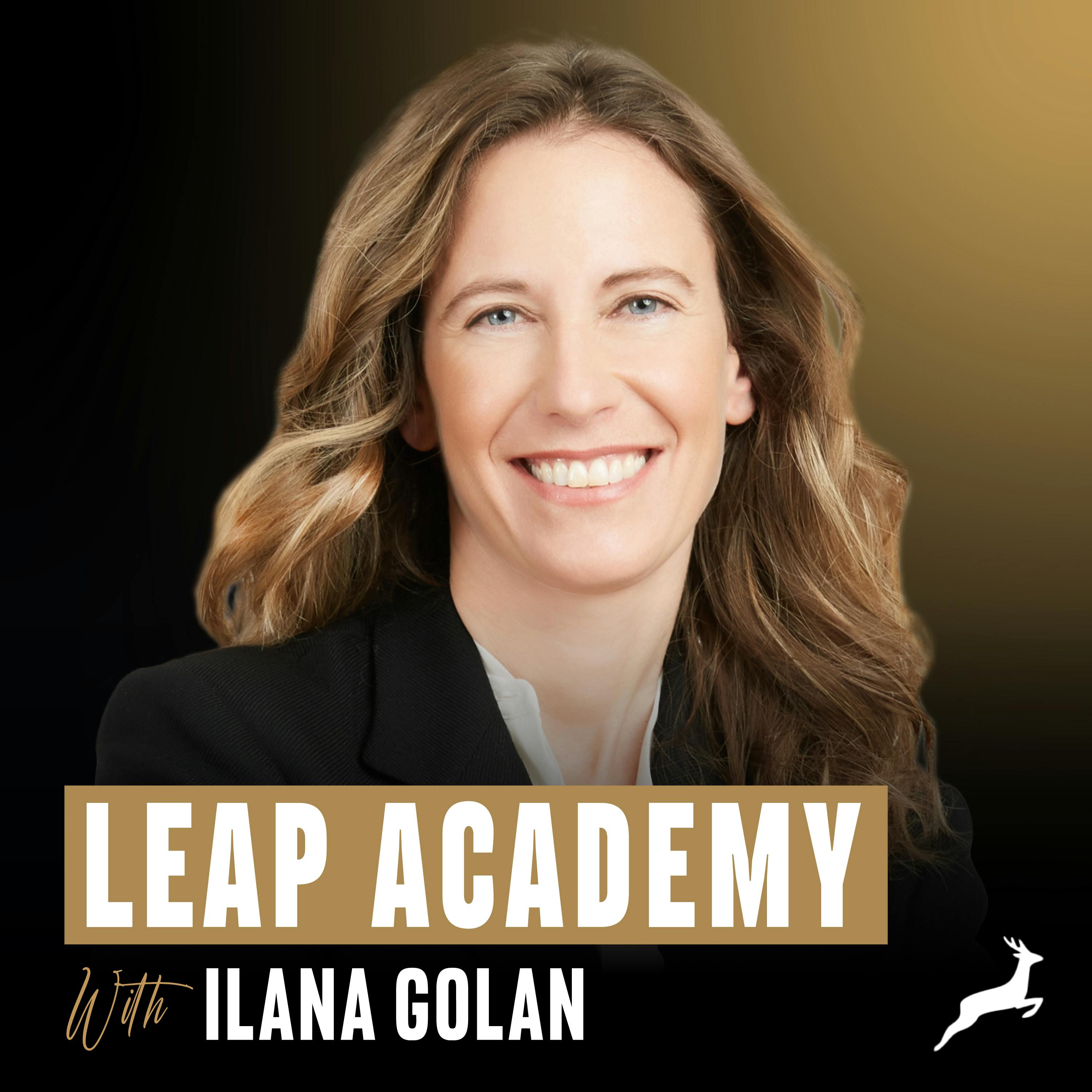
Leap Academy with Ilana Golan
The Reinvention Queen: Guy Kawasaki Interviews Ilana Golan on Leaping Across Careers
00:45:28
Loading summary
Transcript95 lines
- [00:00]
A
Wow. This show is going to be incredible. So buckle up and I'm sure you're going to enjoy it. But before we get started, I want to ask you for a favor. See, it's really, really important for me to help millions of people elevate their career, fast track to leadership land, dream roles, jump to entrepreneurship, or create portfolio careers. And this podcast is all about enabling this for millions of people to see a map of what it actually takes for big leaders to reach success. So subscribe and download so you never miss it. Plus, it really, really helps me continue to bring amazing guests. Okay, so let's dive in.
- [00:47]
Every week, I get to interview some of the top entrepreneurs and business leaders from around the world. But it's not often that I get to share my own story. Recently, I had an incredible opportunity to be on the Remarkable People podcast with the one and only Guy Kawasaki, where I opened up about my own journey from Israeli Air Force to becoming a Silicon Valley executive and entrepreneur. And in this conversation, Guy and I talk about the importance of reinvention, especially now in this era of change. Hey, he even calls me the reinvention Queen. I'll gladly take that. We discussed personal branding and how critical this is now more than ever, in order to leap again and again and how to open new opportunities when it's so hard to rise above the noise. And Guy, in his own beautiful way, also gets me to talk about topics I never speak about. So if you want to be amused or inspired, or maybe you want to reinvent yourself, grow your brand, and leap to your full potential, lean in, get ready. You won't want to miss this conversation with Guy Kawasaki. Let's get started.
- [01:49]
Foreign.
- [01:53]
B
This is Guy Kawasaki. This is the Remarkable People podcast. And we have a remarkable woman on today. Her name is Ilana Golan. And we're going to talk about reinvention and, well, actually, a lot of things. I'm going to try to put her on the spot as much as I can. So just a little bit of background. Lana is a former Israeli Air Force flight instructor, and now she's a Silicon Valley entrepreneur, investor, and career reinvention coach. She founded something called the Leap Academy to help people reinvent themselves. And basically, she empowers these people to change their lives. So welcome to the show, Elana.
- [02:40]
A
Thank you so much, guys. So fun to see you here. And we had you on my podcast, which was really incredible. And I've seen you for the first time in startup grind, and you've been like a mentor idol since. So thank you for Having me on.
- [02:55]
B
The show, the first question I have to ask you is, how did you become of F16 flight instructor? I mean, that's not your typical career path.
- [03:06]
A
I guess not, but. Oh, well, I'll say a few things. So, first of all, in Israel, we have a mandatory military service, so it was a little more typical where I came from. And after a few very hard tests, I somehow got into the Air Force. And they did this like, very long, almost pilot school type thing for us. But again, at that time, guy women were not allowed to become pilots. And that's important to distinguish. And so we did a lot of the training with the guys, but at some point, it was very, very clear that they didn't want women beyond the enemy lines. And the only option that they give, and we were like a handful of women out of, like, hundreds of men, but the only option that was really open for us is to go be trainers. So even though we studied and we practiced on the plane and we practiced on simulators and all of that, at the end of the day, we could only be flight instructors. It was one of the most incredible, incredible roles that I can think of. I probably had at age 19, 20, more responsibility than I had at 40. And I learned a ton and I failed a ton. And it was an incredible ride.
- [04:24]
B
Wait, so I don't understand something. So you were teaching pilots, but you could not be a pilot yourself? So you've never flown a combat mission?
- [04:36]
A
Never flown a combat mission. Yeah, Somebody broke the barrier. So right after me, an incredible lady actually sued the Air Force for not allowing them, for basically not being able to have an equal opportunity. And one of the cases that they took was that I became the first woman to ever become a commander in my squad. So I was essentially in charge of all the training of all F16 pilots in our squad. And that was the first ever woman. So she took that case into court and sued the Air Force, and she won. However, she won the equal opportunity, but she didn't get to be a pilot. And after her, they basically opened up the floodgates, and now we have literally women pilots, women commanders. It's incredible. So I guess we all stood on the shoulders of people before us, and I'm really, really proud of that, since.
- [05:36]
B
I very seldom talked to F16 flight instructors. Can you just give us the gist when we all watch Top Gun and Maver and all that? It's all of that all. Or is that how it is accurate?
- [05:49]
A
It's actually so accurate. It's actually mind blowing. We Were watching it when we were training as well. So it's actually. The simulator is spot on. Kelly McGillis, that was my role, so I don't look like her. And I don't know if Top Gun Tom Cruise is there, but that was very similar. So we were literally figure out kind of the mission, what the person didn't train on. We would figure out the mission, we were executed together, we would give them feedback. It was pretty much the same thing.
- [06:21]
B
Wow. I once flew in an F15E. I hope that's the right plane. It's the plane where there's somebody in the front and somebody in the back.
- [06:31]
A
Yeah, yeah, yeah, yeah.
- [06:32]
B
So I went to Elmendorf Air Force Base in Alaska and I got a ride on that. And I tell you something, it is a life changing experience to be in an F15. I gotta ask very simply, what does it mean to reinvent yourself? You're the reinvention queen.
- [06:52]
A
Yes. I think the way I was looking at it, guy, I was leaping in my career again, again, again, from Air Force to engineering to all the different roles in engineering like tech, sales and product and VP and now entrepreneurship. And one of the things that I realized is that first, the things that I studied at age 20, which is electric engineering, where is that now? But really I kept needing to relearn things. And I think the interesting thing is that we're going into an era that we're going to need to reinvent themselves every year or two. People are not in the same place in the same industry, in the same responsibility, the same function for 40 years. That's gone. So we're going to need to reinvent themselves every year or two. And there's literally a system that works every single time. I just needed to get better at the same steps, to start leaping faster and higher instead of getting stuck all the time. So it's been a life changing experience, guy.
- [07:53]
B
But when you say reinvention, are we talking about fine tuning or to use a computer metaphor, are we talking about reformatting the hard disk and purging memory?
- [08:07]
A
It can be both, but maybe not purge the memory. But the way I would look at it is. So reinvention can definitely be people put you in a box, I'll start over. Like people put you in a bucket. Right. And if I was the geeky engineer, that's what I'm known for. And to now get people to see me as a leader, that's actually, you know, a little bit of like, how do I get people to see me as not Just a person that will write the code, but actually the person that can lead. And then how do I get people to see me as the product or how do I get people to see me as a different sales or marketing, et cetera? So there could be also in. Within your corporate, you're going to need to reinvent the different responsibility, different functions. But also when you move to entrepreneurship or all the opportunities that exist today, advisory board seats, there's endless opportunities investor, and you've done a lot of these things. How do you get people to see you in that light? And how do you get the opportunities that you want for yourself? So it could be a pretty big jump, but it could be also just a slight promotion and just going faster at the pace that you really think that is the best version of yourself, if that makes sense.
- [09:20]
B
If I understand this right, this is about reinventing yourself to take advantage of opportunities and take advantage of change. But is there a concept of reinvention of you fundamentally? Well, let's take an extreme example. Like what if somebody came to you and said, everybody thinks I'm an arrogant asshole. You gotta help me reinvent myself? Is this like something you say, no, I cannot help you, or I'm being not exactly facetious. There are some people who should be reinvented from assholes. So what do you tell those people?
- [09:59]
A
There's probably people even in our political environment that I probably couldn't reinvent them. But I will just say, look, at the end of the day, I do believe that even people who are misbehaving or to some extent assholes, what you say, I think a lot of it has come from just not being happy with themselves. And again, some people are born assholes. Like, there's not much I can do about it. But I do believe that a lot of times we get nasty when we're unhappy. And I can tell you from my experience that if you want rags to riches or riches to rags stories, I, at some point a decade ago, I almost lost everything I had in my life. And I was a fraction of who I could be. I took it out on my family, I took it out on everybody around me. And it was because I was not happy. And I don't think I was an asshole. But to some extent I was like, I was just grumpy. I was not happy with myself. I felt like a loser, I felt like a failure. And I needed to reinvent myself from the ashes. So I think there's like, sometimes if you are just starting to feel better about yourself, you're going to be a better version of yourself and others will see it.
- [11:17]
B
Step me through the process. Give me a linear. Like, step one is this. Step two is this. Step three is this. Step four is this. Walk me through how people do this.
- [11:25]
A
Yeah. So the very first thing is that you want to try to figure out what on earth do you want to do with your life? The people that come to us many times feel like they should have been further on, they should have been further along, they should have more seat at the table, they should be more accomplished, and they don't know how and what. And I think today was the endless plateau of opportunities. They don't even know how do I even get started? How do I know what's even on the menu? And this was me. I had blinders on. All I could see is that director role or VP role that I wanted. Like, I didn't even know what are the options? And when you understand that there's more options. The first thing is to understand what it is that you want to do and what do you want to be known for. And that's sometimes really hard, Guy, because we are wired based on what society expects and what people wants us to be and what's cool to be and not necessarily what we really want. So the first step is to understand. The second step is to start aligning your story with what it is that you want to do next. Because again, if I talk about all these cool algorithms that I'm engineering, nobody's going to sign up to Leap Academy. So I need to align my story, again, with complete integrity, but according to what I want to be, not according to who I've been. And once you align that story now you want to start having ambassadors that will bring opportunities your way. Because the truth is, Guy, and you know it better than all of us, all the coolest opportunities come from the hidden market, not on a job board. So if you want people to start seeing you not as who you've been, but who you want to become so that they bring you the right opportunities, how do you get that done based on personal branding? How do you build, by the way, personal branding in the era of AI, when there's millions of pieces of information, how do you rise above the noise? How do you get out of the people pile? How do you create those ambassadors to bring those opportunities? How do you close the opportunities, et cetera?
- [13:29]
B
But what if you're dealing with a system like, yeah, I want to reinvent myself. Why can't I be CMO or CEO or CXO or cto, but it's all white males at that level in my company. It's systematic.
- [13:46]
A
Tell me about it.
- [13:47]
B
Yeah. So yes. So now it may not be a matter of reinventing myself, unless you're advocating gender change. So now what do you do when the system is stacked against you?
- [13:58]
A
So I live and breathe in a very male dominant environment since the Air Force and then in tech and engineering and vp. So I've been in a very male dominant all my life, guy. And the truth is, I'm not going to sugarcoat it, it is going to be harder for women. I remember somebody meeting me at that point. I already invested with pretty prominent big venture capitalists like Jason Kokanis and others. And I, you know, my startup already raised capital from people like Oren Zev and Oren Dabrowski and you probably know some of them, et cetera. And so I already raised capital, I already invested with people. And I remember somebody looking at me at some point. I was in some kind of a meeting and I was on a panelist and I was talking as the investor and I remember he came to me and he said, that's so funny. I saw you in the park with your kids. I didn't even think of asking you what do you do? And the truth is, it's true, it is going to be harder for women because the instinct and it's not anybody's fault, it's not the men's fault, it's not the women's fault, it's nobody's fault. Like the instinct is not to look at me and say, oh my God, you probably a kick ass business person. That is not the instinct and that's okay. It's ours to keep on breaking those ceilings and keep showing templates of what's possible and to create those possibilities. And I think the more we are out there and the more we are breaking those ceilings, it's going to become more normal. But it's also for us as women to tell the better story and to stop being ashamed and to stop trying to hide and to stop trying to be humble. Because the humble doesn't open doors and personal brand does matter. So if you start creating that for yourself, more people will see you in that light and more people will bring you opportunities.
- [15:52]
Hey, are you running a business online or creating an impressive portfolio career? Look, you're going to have to build trust with your customers and with your network and you can only do that by using a professional looking domain and a professional email. By far the easiest way to get Your domain is with GoDaddy and there's never been a better time. Visit GoDaddy.com.
- [16:16]
And you can get a domain and professional email plan for just 99 cents a month for a year. That's such a tiny investment for a lot of credibility. So choose a domain that's right for you and for your brand and align a professional email to match. Go to GoDaddy.com GDnow and seriously look legit. That's GoDaddy.com GDnow new customer purchases only products Auto renew separately. See terms on site. If you're feeling stuck, underpaid or unappreciated, or you're simply ready to take your career in life to the next level, I have the perfect solution for you. We have a program that helps you fast track and leap your reputation and career. Become the best version of yourself, get the dream role you deserve, move up to leadership, jump to entrepreneurship, or even build a portfolio career. This program helps hundreds a year and it will help you gain the income, influence and impact that will transform the second part of your life. Watch our free training today@leapacademy.com free training. The link is in the show notes. Now back to the show.
- [17:25]
B
Okay, so specifically for women, I want you to get the most tactical advice. How do I reinvent myself as a kick ass woman who should be in the executive suite?
- [17:38]
A
It's a great question. So one of the things that I don't like, if that's okay to say, is there's a lot of women's group and that's a very comfortable place to be. But guess what? The people that will get you in the room are not the women. So stop being in women's groups. That's not gonna help you. You want the men to be your ambassadors. You want them to think about you when you're not in the room. And so you need to stop getting into those comfortable, oh, let me be in this women group and let me wind to each other. That's not going to get you there. So what you really want to create is that really kick ass brand and you want the guys and the men to see it because they're the ones that are going to be in the C suite and the boards and the C level, whether we like it or not. Now the other thing that I will say is that there are very specific things that actually put you in an elevated place. Right. If I get off a stage of I was, I don't know, TechCrunch Disrupt, right, that puts you in a different Stage, You've been on many stages, right? The minute you get off the stage, you already are elevated compared to others and it creates that pattern. Interrupt, if you will, for people to say, wait, wait, wait, I didn't think of her in that context. Why did I not think of her in that context? Panels, podcasts, stages, whatever, like boards, advisory. There's endless ways to present yourself in a way. Like I mentored in some of the biggest startup accelerators like Google and Single neural data university, etc. And just being positioned as somebody that can sit with C level and move the needle on their companies already puts you in a different phase versus somebody that just raises their hand to another project in the company. The more you can break the pattern of where people see you and where they put the template that they put you in, the more you can elevate yourself and get the opportunities that you deserve.
- [19:38]
B
Obviously, many people think that the barrier for women is the masculine, the male mentality. But do you also think that women present a similar problem to other women?
- [19:50]
A
Can I be honest?
- [19:52]
B
No, you gotta be honest.
- [19:53]
A
I gotta be like really blunt here. Let's go. So sometimes I think women are more chauvinist than any men that I've ever run into. And if I'm being really honest, my podcast talks to the biggest leaders of our time and I cannot get the women to say yes. I talk to Richard Branson and Gary Vee and you and president of Starbucks and president of Shopify and you know, like, I can go on and on with accolades. I don't understand why the men say yes and the women ghost me. I cannot understand that.
- [20:28]
B
Wait, wait, so you're telling me that if you reach out to a female CEO, they ghost you? They don't want to be in your podcast again?
- [20:38]
A
I don't. As much as I like diversity and equality, I want to put a focus like, I am not trying to lower the standards for women. This is not what I'm trying to do. I'm trying to get equal opportunity for women. And there's enough really kick ass women influencers, CEOs that led big companies or they have millions of followers and we cannot get them to say yes to a podcast. What say? I do not know. That's a great question, guy. So yes, I think that women are just as biased as men. So I don't think that it's one versus the other. I think we all need to break the templates of what's best possible and to get more success stories and to put them more out there. And again, it's all about pattern interrupts, right? Or it's all about patterns of success. And if women right now in the average, you know, are not a pattern success, you don't create that pattern in them. So I think it's normal. There's no blaming here. There's just about, oh, great, how do we fix it? And Leap Academy is 50, 50. Our clients are exactly 50, 50. I don't believe in all men, all women. Bring it in. And it's interesting how it's pretty consistent. For five years, it's 50 50. And we've been one of the fastest growing companies in America, private companies in America for two years in a row. 50 50.
- [22:07]
B
If you're listening to this podcast and you're thinking, maybe I need to reinvent myself, is the primary signal that you are not getting your fair share of opportunities? Like, what should be the signal? It's just, yeah, I gotta go get reinvented.
- [22:23]
A
I think you're not your full potential when you're around 40, 50, 60, you know, if you're full potential or you're not, if you maximized everything that you want out of life and out of career and out of your status and possibilities and impact. And if you're living your best life and I think if you're tossing and turning like I did at 3 in the morning, and you're like, I've been on this horse of success, why on earth am I not further along? And you feel like you fell off this horse of success. Yeah, let's go back on. Because the truth is when you're more successful, you're happier, you're creating bigger impact, your teams are happier, your companies are happier. We're creating a better society, a better world. So, yeah, let's get on with it. But I will say, Guy, it's for driven people. Like, if somebody has never been successful in their life, I'm not gonna make them successful. There's no magic wand. There's no get rich quick. There's no magic bullet. There's just a very systematic engineered approach that I wish actually was taught in schools and colleges. Like, I believe my son needs to learn. Because today, you know, adaptability and AQ is probably, which is essentially reinventing and leaping is one of the most inspiring, important skills for the future of work. Why is this not taught everywhere? This should not be a proprietary, exclusive thing that is taught in Leap Academy. That should be, we should disrupt the whole professional education which doesn't exist today. Like, what can you do? Go to an mba? It's good. You get create connections. But is this really the thing that will meet you where you are and take you higher? Probably not.
- [24:00]
B
Okay, so I'm going to put you on the spot and I'm going to.
- [24:03]
A
Ask go for it.
- [24:04]
B
To do some case study and analysis. All right, so pretend that these people came to you or pretend that you're reaching out to them, offering your services for them to reinvent themselves for greater opportunity. So test case number one. Kamala Harris. What do you tell Kamala Harris to do?
- [24:27]
A
I think the question does she want to go back to politics or not? I think the first thing is, what does she want to do? Does she really want to get to the front forefront or she wants to write a book about it? She wants to now be a model for women that will want to follow her, that she want to create more of a name brand for her as somebody that did try to break the barrier, she did raise a ton of capital. She did do an incredible campaign. Like, I think there's a lot to learn from her. So I think the question is, first of all, Kamala, what do you want to do? And by the way, come to the podcast. Yes.
- [25:04]
B
Well, if it makes you feel any better, I have not been able to get her on my podcast either.
- [25:09]
A
So I feel a little better.
- [25:12]
B
Okay, so now what if Benjamin Netanyahu came to you and said, help me reinvent myself.
- [25:19]
A
Get out of the government, dude.
- [25:23]
B
Get out of the government.
- [25:25]
A
Oh, my God. I think that Israel has never been in a lower place in its existence. And I do blame the whole government and mainly Benjamin Netanyahu for where we are as a country, as what's going on with our neighbors. Again, he does what's known to be very successful in terms of leading by hate, and he creates a lot of hate inside Israel. Honestly, I think the biggest problem with Israel is not even external. It's what's going on internal. There's so much hate right now going on based on what we're doing out there in Gaza and other places. Like, there is so much hate going on inside of Israel that I don't know how easy it is to recover. And he created that hate. And again, good leaders, quote, unquote, know that they're going to be more successful if they create a lot more hate inside their organization. And he did a phenomenal work in us hating each other. And it breaks my heart because Israel was the startup nation. We were insanely proud of what we achieved. I think I'm still very proud of what we created in A very short amount of time with such a small. I mean, again, the Jewish population is what, 15 million? We're 8 million in Israel. We're actually 6 million, probably Jewish people in Israel. Like, it's insane what we created with 2, you know, 2 million Arabs living in Israel with incredible coexistence, which I think a lot of people don't understand. And my two best bosses in the world in intel were Arabs. We live in coexistence in Israel. But what's happening outside is breaking my heart. But again, we are dealing with terrorists too, right? Hamas is a terrorist organization. Like, I want to make sure that that's very clear. And it breaks my heart where we are right now. So. Yes.
- [27:20]
B
Well, this is somewhat facetious because this is not a person, but what if, quote, unquote, America came to you and said, we need to reinvent America? What would you do?
- [27:32]
A
I think it depends. Trump will say they want to make America great again. I say that too, just in a different direction. But if I'm being really honest, I think that this very similar, maybe different outcomes, different circumstances. I think Trump and Benjamin Netanyahu have a lot of similar agendas in the sense of, if I create enough hate, I will be able to stay in power. So I don't agree with any of that if I'm being really honest. So, yeah, that's not my type. I want people to be empowered and inspired to do more and to become their full potential, not to create so much hate that everything collapses.
- [28:16]
B
So when I was preparing for this interview, I thought, well, let's see what AI would do with reinvention. Okay, you're gonna love this. So I went to chat GPT, and I said, how should Elon Musk reinvent himself? Okay, all of you listeners, I suggest you do this too. It is the most fascinating thing. So I'm gonna read you basically the answers of ChatGPT. I asked it, how should Elon Musk reinvent himself? So point number one is lead with humility instead of provocation.
- [28:57]
Spot on. Second bullet. Replace chaos with consistent execution.
- [29:03]
A
Two for two, that hurts.
- [29:05]
B
Three, rebuild trust with transparency. Three for three. Four, empower others to lead.
- [29:14]
A
Slam dunk right there.
- [29:16]
B
Okay? And the last one was bring more empathy to the mission. I don't know how you can claim that ChatGPT is not sentient after you read that answer. So now I read that answer. I said, so, Guy, don't be a chicken shit. If you're willing to ask about Elon Musk, why don't you go ask about yourself. So I asked ChatGPT, how should Guy Kawasaki reinvent himself? And I'm going to tell you the answer. The first answer is shift from evangelist to elder. Okay. Second, build a school of thought, not just a podcast.
- [29:58]
Number three, lead into radical candor. Now, this one, I'm not so sure. I need to reinvent myself to this. I'm pretty.
- [30:07]
A
You're pretty Candor already.
- [30:09]
B
I think I can check that box. Fourth one is focus on post achievement mission. I forget who I stole this from, but I stole it from somebody smart. I used to tell people that there's three stages of life. First, you're underpaid and overworked, and then you're overpaid and underworked, and then you pay back. And I used to tell this all over. And then I heard somebody say, there are three stages in life. First you learn, then you earn, and then you return. That is so brilliant. So now I say that if you're the person who's invented those three terms like that, my hat's off to you. I don't know who did it. But, you know, one of the things I learned from Steve Jobs is you gotta know what to steal. I hear a lot of things. I don't steal that many. Okay, so now and then, the last thing it said for Guy to reinvent himself is to turn signal. Signal, the secure messaging app?
- [31:13]
A
Yeah.
- [31:13]
B
Turn signal into a movement to help society.
- [31:18]
A
Wow. Okay.
- [31:19]
B
And I gotta say, I was so blown away, I got in touch with Madison. Madison. Let me tell you what it said I should do. But for those of you who are curious, I'm telling you, you will be fascinated. Go put anybody's name in there and see what ChatGPT says is necessary for reinvention. And if after you do that, you don't believe chatgpt. Essential. I give up. I give up. It's not my problem at this point. Now, are there any cases where you tell people, you know what, you should be comfortable in your skin. You don't need to reinvent yourself?
- [31:54]
A
I don't know if it's, you don't need to reinvent, but I did tell people that it's not the right time. So I remember there was somebody that came to me, she was eight, eight months pregnant or seven months pregnant. And she's like, I need you. I need you. I'm not happy where I am. And I'm like, you know what? Things change once you have a baby. It was her first. And I'm like, have the baby wait three months. And if you still think that way, let's come back. And she did come back. But I think in terms of timing, the timing does matter. And I think there's also an element of, do I actually have the capacity to really do the work again? There's no magic bullet. There's no magic wand. There's just very engineered process. And it starts with defining what you want. And again, sometimes we don't know what we want. And if you have a very big life change, that will change again. Life is in phases. Different phases bring different things from us. And you called it learn, earn, return. But I think it's like even every few years it changes.
- [33:00]
B
So, Alana, you just opened up a massive door right then, which is. So here is someone talking about reinvention. And she brings up an example of a woman getting pregnant and postponing her reinvention. And that's the problem that you would never say to a man, well, not that men can have babies, but you would never say to a man, you're expecting a baby, you should postpone your reinvention until three months after your baby comes. Right.
- [33:35]
A
It's definitely going to change the women view on life and priorities a lot more than the men. That's true. That's just realistically true. And I just wanted to make sure it was complete integrity that she still wants more. Because the truth is, let me be honest, Guy, like, the first two years of my kid's life, it was very comfortable to be in a place where I could create probably one PowerPoint a week. And I was considered a star. Let me tell you, it was comfortable. I was sitting close to this kindergarten again. I was very dedicated, I was very hard working. But at the end of the day, my priorities were definitely a mix. And I'm not gonna lie about it. But I will say that when my second one was five months old, I got sick and tired of my career being on hold. I was just like, what on earth did happen? Let's go. And I went all in on work.
- [34:28]
B
So you're telling me you started to lean in?
- [34:32]
A
I started to lean in all the way.
- [34:34]
B
Yeah.
- [34:34]
A
But maybe a little too much, if you ask my husband. I left home for about 17 years of work. But, yeah, it bothered me that I put everything in the backseat for so long and I wanted to go up to be all in again. Yeah. And to create the possibilities that I do, I deserve.
- [34:53]
B
So let's take it as a given that in the process of your life, you will have to reinvent yourself. Okay.
- [35:01]
A
Many times.
- [35:02]
B
So now Knowing that you have to reinvent yourself at least several times. What would you tell young people to prepare yourself for this so that when you have to reinvent yourself, it's not nearly as hard or slow?
- [35:18]
A
Oh, such a good question, Guy. I'll say a few things. I do think that a level of adaptability, call it learning, call it adapting, call it being very agile, curiosity, like, these things will matter. I will say that one of the things that blindsided me is the personal branding piece. I did not think of building a personal brand. I gave a thousand percent or more to the company that I was with. I was flying all night, I was doing all the things, and I still remember it was actually a very humbling experience. You'll appreciate that, guy. But at some point I was raising capital and I remember going to the same investor a couple times and I was like, what else do you need to see? Because clearly I'm coming here again and again, you're giving me your time, but what are you missing? And they're like, look, Ilana, the truth is we're very impressed with what you're building. Was very impressed with you. But we googled your name, we checked you on LinkedIn. You're non existent. We don't even know how to validate this type of information. And at that point, it was heartbreaking. A little bit like, I couldn't give them the phone numbers of the boards that the companies that I was with, right? But I was like, why did I not build anything? There was nothing, guy. There was no Instagram, there's no Twitter. There's still barely LinkedIn, barely existed. Like, why did I not build myself on the journey? And the truth is, I was impressed with you of how you leaned into building that personal brand and creating that evangelist when it was really early on, like, people didn't even understand the power of it. And I completely missed the boat on it. And now I will say to anybody young, the only thing that will help you leap again again is your own personal brand. That's the only insurance policy you have. So build it.
- [37:07]
B
Lana, to be honest with you, if during that process, when you came to that conclusion, you needed a personal brand because of this interaction with this vc. If we knew each other back then and you called me up and said, guy, what's your advice? I would tell you that VC is an idiot. That VC is an idiot. Because, okay, so you're telling me that when they could fund Mark Zuckerberg, they said, oh, Mark, we looked you up on LinkedIn. You weren't in LinkedIn, you didn't have a Twitter. How about Steve Wozniak? Oh, yeah, he didn't go to college. How about Steve Jobs? We looked at his LinkedIn. Oh, attended Reed College one year. So all these people who have been very successful, you could make the case that none of them had personal brands. So that's one thing I will tell you, that VC is an idiot, but that's a redundant statement. VC idiot. But anyway, so the next thing I would tell you is that people think that Guy Kawasaki has this personal brand. And to some extent, that is true. But if they think that I consciously built the personal brand, they would be wrong. Because I have this theory that a personal brand is not something you build, it's something that forms organically. And the way it forms organically is you do good shit. So the way to ultimately build your personal brand is to do good shit. And everything falls from that because I.
- [38:36]
A
So maybe this is where we won't someone like, yeah, we don't agree on that, but let's go.
- [38:40]
B
Oh, that's okay. Like, I. I refuse to believe that Jane Goodall or Steve jobs or Neil DeGrasse Tyson or Stephen Wolfram or Margaret Atwood ever sat down and said, how can I build a personal brand for myself? I don't think that discussion ever happens.
- [38:58]
A
I don't know. And I'll be really honest. I think that, first of all, the era changed. So in 2007, we all became a media company, whether we like it or not. And that was not the case previously. So previously you needed to work really, really hard, and eventually somebody would see your results and somebody would write about it in the press, and it would be really, really cool. The times has changed. And the truth is, if nobody hears from you, the assumption is that you don't have anything smart to say. But it's also the best, the most incredible way to control the narrative. And I'm not saying talk about things that didn't exist, but I'm talking about being very intentional and very strategic with how you position yourself out there. And I do believe that right now, with the world of influencers, et cetera, there is a big play there. And if you're not leveraging it, I think you are leaving a lot of money and a lot of opportunities and a lot of impact on the table.
- [40:01]
B
How about we agree that there is not a singular path to success?
- [40:07]
A
We do agree on that. But again, I look even at Richard Branson or others, I don't know if he meant to do all these adventures for personal branding, but that became his personal brand. And it's very intentional, right? You do need to get out of people's pile. Whether we like it or not. How do you get out of the people's pile? So one option is to be part of really cool companies, right? That really helps. Some of it is to be born to fame. But if you're not any of these, and you're like me, came from a small village in Israel and trying to win your place here and to create something for yourself in a network that doesn't exist, in a language that is second language, et cetera, et cetera, you do have to do a little more than the average. And just working behind the scenes away from the spotlight is not going to get you there.
- [40:55]
B
My last question for you. Who is in the Ilana Golan hall of Fame for personal branding or for reinvention? When you, you know, who do you hold up as a. This is what you should do. This is how you know you can change your brand or reinvent yourself. Who's the hero in your book? Who's in your hall of fame?
- [41:16]
A
I think it's everybody that has been on my podcast. There's a reason why I approach them because each one is inspiring me in a different way. You inspire me in one way. Richard Branson is the biggest mentor for me. I think what Sahil Bloom did in such a short time and built such an incredible brand for himself very, very fast is incredible. So I think each person inspires me in a different way. I love what I get to do because I get to just witness those changes in people as well and just create that for thousands of people a year. And I think that's just incredible to watch.
- [41:54]
B
I'm going to tell you my favorite Richard Branson story. Tell me this must be 15 or 20 years ago, and he and I were both speaking to the same conference in Moscow, which I'll never go to Moscow again. But anyway, so he and I were in Moscow and I go into the speaker ready room and I'm sitting there and then in comes Richard Branson. And someone introduces me to Richard Branson. And I never met him before. I didn't know him, but apparently he knew of me. And so he says to me, guy, do you fly on Virgin? I said, richard, I am global services. On United. I fly only United. I don't want to lose my global services status. And Ilana, I swear to God, he drops to his knee, he lifts up my shoes and he starts polishing it with his sleeve.
- [42:54]
A
That's so, Richard.
- [42:55]
B
And that's the day I started flying Virgin America.
- [43:02]
A
The best story.
- [43:03]
B
Yeah. Richard Branson. I should have him on my podcast. I didn't.
- [43:08]
A
He's an incredible human and he pushes me to my core for sure.
- [43:13]
B
All right, I am going to let you go and go help other people reinvent themselves. I thank you for being on my podcast. It's been most interesting.
- [43:24]
A
And go surf. And go do.
- [43:29]
B
Literally. I am gonna go surf right now.
- [43:32]
A
See, I knew that. I knew that. I already know you. You're living the dreams.
- [43:38]
B
I'm reinventing myself as a surfer. How's that?
- [43:42]
A
See, that's something.
- [43:45]
B
Thank you, Madison, for being the co producer with Jeff C. And Shannon Hernandez on sound design and Tessa Nysmer on research. So this is the Remarkable People team Alana. All we want to do is help people be remarkable. So until next time, mahalo and aloha.
- [44:07]
A
I hope you enjoyed this as much as I did. If you did, please share it with friends now. Also, if you're feeling stuck or simply want more from your own career, watch this 30 minute free training@leapacademy.com training. That's leapacademy.com training. See you in the next episode of the Leap Academy with the Ilana Golan Show.