Loading summary
Transcript78 lines
- [00:00]
A
Hi, I'm Darina, co founder of Quo. You might know us as openphone. My dad is a business owner, and growing up, he always kept his ringtone super loud so he'd never miss a customer call. That stuck with me. When we started Quo, our mission was to help businesses not just stay in touch, but make every customer feel valued, no matter when they might call. Quo gives your team business phone numbers to call and text on your phone or computer. Your calls, messages, and contacts live in one workspace so your team can stay fully aligned and reply faster. And with our AI agent answering 24. Seven, you'll really never miss a customer. Over 90,000 businesses use Quo. Get 20% off@quo.com tech that's Q U O.com tech and we can port your existing numbers over for free. Quo. No missed calls, no missed customers.
- [00:58]
B
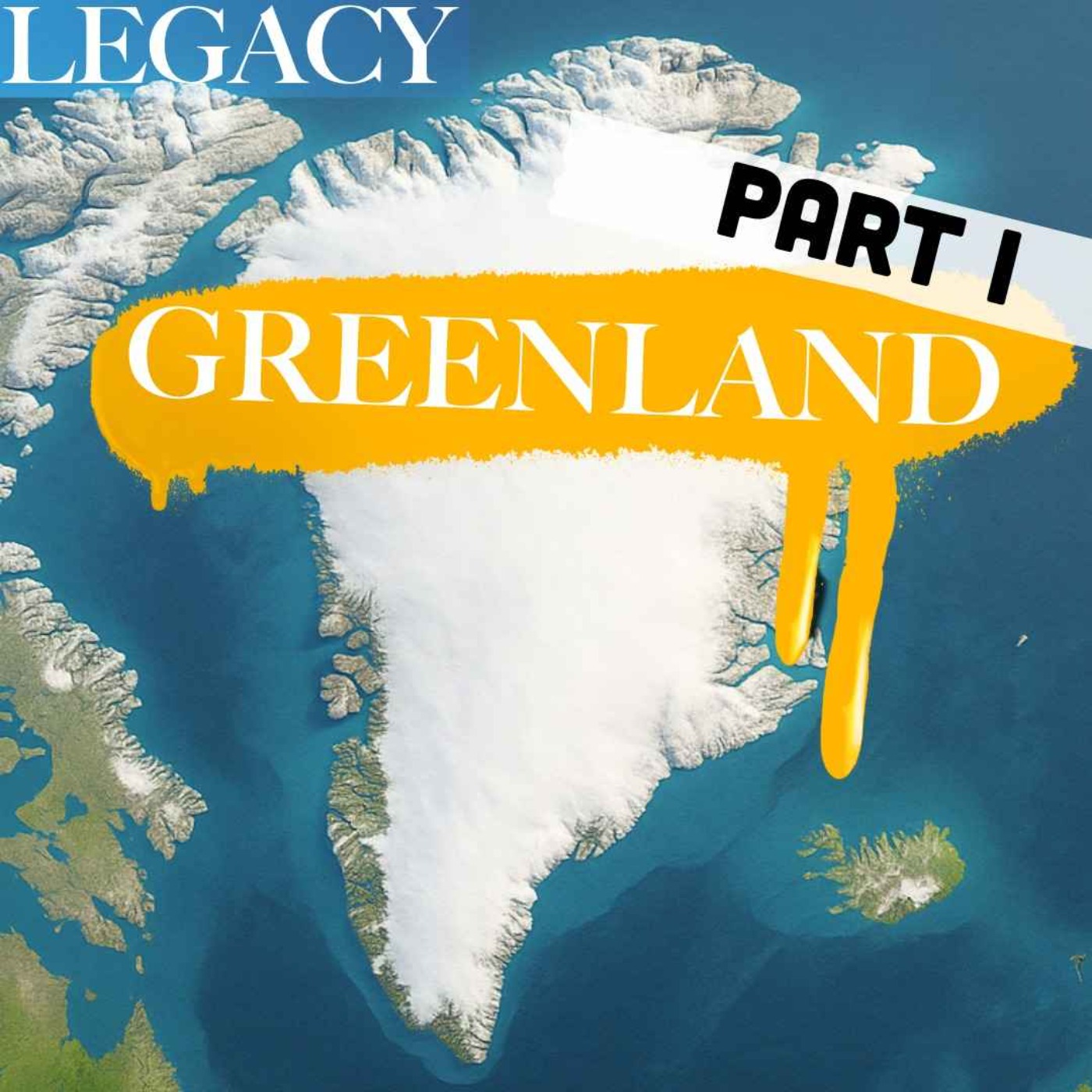
Hello, and welcome to a new episode of Legacy. And this is a bit of a departure effort because we're not talking about a person or a potato or a crop. We're talking about a giant island. The country is called Khalet Numat, which means, of course, Greenland.
- [01:17]
C
And when you think of Greenland, I'm actually curious, Peter, what comes to mind? Because for, for me, historically in my life, it's been the most interesting part of a London to New York flight. You know, you just get to that bit where you see the inflight map and you are so curious. What's down below? That is the closest I've come to green and looking out the window on the plane, hoping to see a glacier or a polar bear. But, you know, I think for many of us, there hasn't been that much familiarity with Greenland beyond the indigenous cultures that have lived there for centuries. The glaciers, the wilderness, the nature, the isolation. But lately, Greenland has definitely penetrated both the news cycle and the global imagination, I would say. Is that fair?
- [02:03]
B
Yeah, absolutely. I mean, I haven't had the same experience as you, Afra, because I never get a window seat on a plane, so I've never been able to look out the window. So every now and again, I nudge the person next to me, saying, what does Greenland look like from up here?
- [02:14]
C
Is that because you're really tall? Do you always go for an aisle seat?
- [02:17]
B
Because I'm normally polite, so I normally ask the person next to me, can you see a polar bear or a glacier? Or what can you tell me about indigenous cultures? But you're right. Greenland has been amazingly front and center of geopolitics, particularly since the start of 2025, mainly because of a thawing Arctic, but above all, because of the decisions and intelligence presentations that have been given to Donald Trump in the White House about the geopolitical significance of Greenland, we're going to talk about exactly why that is. But this episode, we're going to talk about the extraordinary history of Greenland, not just today, but from the past as well, about its unique role in geopolitics and why, what happens to the world's largest island. Please don't email us and tell us about Australia or Madagascar, and we will talk about that too, but we're going to talk about Greenland. And so, welcome to another episode of Legacy.
- [03:15]
C
Wait, why will people email us angrily? Because they'll contest.
- [03:18]
B
They'll say Australia's a bigger island and the Mercato. Whatever.
- [03:21]
C
Well, let's just deal with that quickly. Greenland is the largest island. Is that because Australia is a continent, so it doesn't count as an island?
- [03:28]
B
Yes. And despite what it seems, I don't get to choose what's a continent, but I get lots of people who will often get in touch with me very angrily, like I could make a ruling one way or another. Trying to tell me about Greenland, Because I've written a little bit about Greenland in the last couple of years and it's a really important place for historians because of the ice cores that can get drilled out of the glaciers, so we can measure lots of stuff from the past. So when you write about Greenland, I've stopped writing it's the world's biggest island because honestly, it gets people very over busy with their keyboards telling me about Australia, and I can't really help them with that.
- [04:03]
C
This is a bit of a diversion, but maybe one day we'll look at what makes people angry, because I write a lot of stuff about race and identity and gender. But let me tell you, the thing that I've written about that has triggered them. Largest number of complaints has been. You'll never guess, Peter. Netball.
- [04:18]
B
Really?
- [04:18]
C
I wrote something about netball that literally made me public enemy number one in certain sections of society. So maybe Greenland is your netball.
- [04:27]
B
Did you have a very provocative line about netball that.
- [04:30]
C
I didn't think it was provocative until I got the complaints.
- [04:34]
B
We might have to do an episode of Legacy on netball. I know everybody who's listening to this is now going to be googling to see what it is that Apha wrote about netball. So change your email address and don't answer the phone.
- [04:44]
C
Foreign.
- [04:53]
B
I'm Peter Frankopone. I'm Afwa Hersh and this is Legacy, the show that looks at the most extraordinary people, places, ideas and movements in history and asks how and why they matter today.
- [05:15]
C
This is greenland.
- [05:25]
B
So of course afwa, it's wrong to call Greenland a country because it's part of Denmark, but you've flown over Greenland a few times in your window seat where you're sipping a cocktail, maybe looking for the polar bears, as I've been trying to work out how to let people jump over me to get into the aisle. But have you ever been there? Have you ever thought about going there? Have you come close to coming to going there?
- [05:46]
C
I've been to Denmark, of which Greenland is a part and we'll get to that. I've never been to Greenland. I would love to go to Greenland. I am fascinated by Nordic cultures, I'm fascinated by indigenous cultures. I'm super curious to visit the Arctic. But I do have one major weakness and that is I have a very low tolerance threshold for the cold. So if I'm really honest, the two reasons I've never been to Greenland one, are that it's not actually particularly accessible as a tourist destination. I don't know anyone in Greenland to visit. And three, I am a bit scared about being really cold.
- [06:22]
B
So if we were going to do a live show in Nuuk, we need to have electric blankets for you.
- [06:27]
A
Yes.
- [06:27]
B
And we'd have to have hospitable hosts who'd look after us. And of course you have a Nordic background too, afwa, as a Nordic born and bred in Norway. So that, that also means you're home amongst friends.
- [06:39]
C
Yes. I did once do some filming in a very cold location and I don't know if listeners know, but you can buy these kind of like self warming heat pads. I think they're really designed to get put in your gloves, but I thought it'd be really clever to plaster them all over my body under my clothes because they're just like really thin little pads anyway, big mistake. They turn into flaming hot like buttons of iron and I started to burn all over my body. So I had to then kind of undress in public in a really cold place and remove them. So that's one thing that we won't be doing. If listeners really want us to do a live show from Greenland, they're gonna have to show us a lot of love. Okay.
- [07:17]
B
So so far we've worked out Greenland is the world's biggest island. It's not a country. And don't insert hot pads all over yourself that the instructions tell you literally not to do. Let's start with with Greenland itself and effort. Tell us about how big Greenland actually is.
- [07:31]
C
It is really big. And as we already asked, please don't troll us for pointing out that it is the world's largest island. It is. It's almost 10 times larger than the UK. It's 4 times the size of Spain, 3 times larger than Texas, and it is really far north. Two thirds of the island lie within the Arctic Circle. And that means that the northern part of Greenland is less than 500 miles from the North Pole.
- [07:57]
B
And Greenland is attached geologically. It's part of north of the North American plate as an extension of Canadian shield. That's that rough plateau of the Canadian north that's made up of hard pre Cambrian rocks. And it's very close to Canada too. I mean, it's at its closest point. It's separated only by 26 km, which is less than Dover and Calais are separated. So it's really part of that northern American hemisphere, even though it's been part of Denmark for a very long period of time.
- [08:27]
C
And that's actually really fascinating to me because it's kind of culturally. Well, it's formally culturally been assimilated into Europe. But as you said, Peter, it's geographically American. So while Canada is only 16 miles away from the western part of Greenland, the closest European country is iceland, which is 200 miles away. So it's much, much closer to America than it is to Europe. And that's a relevant feature in the kind of contemporary discussion about Greenland that we'll be getting to. I have been to Iceland a few times. I love Iceland.
- [08:58]
B
The country.
- [08:59]
C
The country. Iceland. Yes, Peter. Not the supermarket.
- [09:02]
B
Yeah, okay.
- [09:03]
C
And by the way, if I was Icelandic, I might be offended by the suggestion that the two are in any way equivalent.
- [09:09]
B
But I mean, Iceland is not actually that icy in the same way that Greenland's not actually that green.
- [09:13]
C
No. Well, we'll get to that. The reason that Greenland is called Greenland is actually a really early piece of travel pr, which I find fascinating. But we'll come back to that because first I just want to kind of talk about the way we think about Greenland if we are not Greenlandic. And partly that's through popular culture. There are a few famous books, movies about Greenland. Have you ever had the pleasure of encountering any of those, Peter?
- [09:38]
B
I have. Well, in fact, I've done a bit of work on some of those early PR books in the Middle Ages. And in fact, the movie by starring Gerard Butler is an absolute cracker. We watched that in Lockdown. That was one of our kind of do we love a good disaster movie?
- [09:53]
C
So that's Greenland 2020, an American apocalyptic survival disaster thriller.
- [09:59]
B
I'm a big fan of this by.
- [10:00]
C
Rick Roman War and written by Chris Sparling. It's got really good reviews.
- [10:05]
B
It's great. You've got a. If you haven't seen it, you've got a comet hurtling towards earth and I'm going to give you a clue. It doesn't just hurtle towards Earth. Possibly there's an impact. And then Greenland is the place where people have to escape to. So I'm going to guess in the planning meeting or all the Hollywood executives I know, you'll know what these meetings, what they're like. Afwa, they'd have said, wouldn't it be great if you know, LA survives and they go, that's too expensive to film. Let's pick somewhere that's reasonably obscure. And also above all hasn't had a film made about it before. So Greenland sort of ticked that box. And in fact it wasn't really filmed in Greenland, was it?
- [10:39]
C
It's so typical. So the one movie that Hollywood decided to make about Greenland a sounds like it's using Greenland basically as a backdrop for a story that's about America, as most Hollywood movies are. And two, it was filmed in Georgia. I mean, what a ripoff. And then when they needed things to look arctic, they shot them in Iceland instead. That's a bit of a diss in my opinion.
- [10:59]
B
And what about books, afwa, I know that you're very diligent and you'll have read around. What about how Greenland appears in novels and in literature?
- [11:06]
C
Well, there are a few quite highly regarded novels. A Pulitzer Prize winning author, Jane Smiley, I think actually the book she wrote about Greenland, it was long listed for the Booker Prize. It's called the Greenlanders, an enthralling novel in the epic tradition of the old Norse sagas. I haven't read that, but it is supposed to be very good. And a book I have read that I found completely captivating. An African in Greenland, and that's by a Togolese man called Tete Michael Pomasier, who tells his incredible life story where he grew up in quite a small village in Togo, which is a West African country next to Ghana, and he went to a French school. But at 16 he ran away to fulfill his lifelong dream of living in Greenland. And I just think it's really worth reading. If you are interested, go and look it up. It is in print. I also did an Instagram post about it. He's still alive. He wrote this book in the 50s, I believe, and, you know, during colonial times, managed to find his way alone. A young African teenager, basically, like hitchhiking and working to save money to pay his way from Togo to France, from France to Denmark, from Denmark to Greenland, where he really lives not just in Nuuk, but in remote villages and gets to know Greenlandic culture. Not always a completely flattering take on Greenlandic culture, but I think it's fair from the gaze of somebody from such a different place. And one of the things I loved about his take on Greenlandic culture is that he's also from a culture with its own very strong indigenous traditions. And so there's a way in which he relates to some Greenlandic practices. And he's really able to see the commonality between these ancient cultures that are much closer to living off the land and, you know, believing in the supernatural and having these family structures. But he also finds, as you would expect, quite a lot of difference as someone from the equator living close to the North Pole. So it's really cool. That really should be a movie, in my opinion.
- [13:06]
B
Well, let's. Let's go back to the beginning. I mean, I'm very interested for. In the way in which humans establish themselves in niches or niches or niches. If you're American, that are environmentally difficult, it makes sense that humans will want to live where there's plenty of water, where it's easy to grow crops, where life is easy, it's a decent climate. The communities that establish themselves in places that are either extremely hot or extremely cold, where life is quite tough. It's always been very interesting to me about why those decisions get made, as well as the survival tactics and how those societies develop, the sort of mechanics and the rhythms of how people live and in what way, how do the communities work compared to other places on Earth. And Greenland is a kind of very unusual location because it doesn't support large populations for, I guess, some good reasons. But explain where people come from, why do they start to settle and when do they start to settle in Greenland?
- [14:01]
C
So, and just before I do that, I'm just going to do a quick language explainer. So the indigenous population of Greenland are collectively known as Inuit. That's probably a name people have heard, but the name of an individual member of the Inuit society is Inuk. So that's why sometimes you hear Inuk and sometimes you hear Inuit. And when I was growing up, and I suspect when you were growing up, Peter, the word Eskimo was often used to describe people of Inuit heritage. And that's something that was very widespread in the 80s and 90s, but it's now regarded as a pejorative term. And it actually derives from the word ayaskimu, which means someone who laces snowshoes. But I think because it was used in a very colonial context and often by people who had a derogatory view of the culture, it's not really acceptable to use now. So, talking of the Inuit, they are believed to have migrated to Greenland from islands north of North America, including Siberia and Beringia, about 4, 4000 years ago. This was the first time I'd heard of Beringia, Peter, but I bet you know about it.
- [15:07]
B
Well, I had to. Well, I didn't have to write a book about geology and climate and the natural world, but I, you know, history for most of us starts probably with the ancient Egyptians. You know, nobody starts before then. And then, in fact, in the European world, we'd go from Egypt, then jump to Greece. So the history that we look at is sort of maybe 3,000 years old, maybe 4,000 years old. So thinking about some of these big, big pieces that get put together about how geology works, how our world has been shaped, those geological plates that link between Barinkia, that's basically, it's the land mass that connected Russia, northern Russia and Canada together. And those communities that you mentioned, Inuit, it's an overheader for lots of different kinds of indigenous peoples. And again, a bit like labels, like Eskimo underneath, there's lots of complexity about what societies actually look like and where. But these, the populations who start to settle in Greenland are obviously trying to find ways to first of all survive. So availability of fish stocks, availability of meat and protein, exploitation of things like walruses for their teeth, for their tools, and the ability to survive in small communities is what sets up the peoples who are living in the Arctic Circle from four or maybe even 5,000 years ago. And the ways in which the groups have to learn how to hunt and trap and to get reliable food resources explain the ways in which their societies start to develop. And broadly speaking, obviously there's change that goes across decades and centuries. But because those great drivers are not there in places that are environmentally exposed, like Greenland, you don't have the same rhythms of change like you do in, let's say, Mesopotamia or the Indus Valley or in the Nile, where you have agglomeration of peoples, you have demographic growth, you have people coming in, migrating from further away, you have the growth of cities and of writing scripts Inuit cultures. There's a much lower burn of how those societies get changed over centuries. Did I talk too much? Can't I just let it go? I wish I would stop thinking so much.
- [17:23]
D
Take a breath, you're not alone. Counseling helps you sort through the noise with qualified professionals. Get matched with a therapist online based on your unique needs and get help with everyday struggles like anxiety or managing tough emotions. Visit betterhelp.com randompodcast for 10% off your first month of online therapy and let life feel free. Better. The holidays are about family and quality time, right? But while we're carving roast beef, our dogs are stuck with dry kibble mystery meat. And yes, they notice it's time to make the switch to sundaes. Sundaes is clean, whole food based food made for the dogs we love. It's air dried and made in a human grade kitchen using the same ingredients and care you'd use to cook for yourself and your family. Every bite of sundaes is clean and made from real meat, fruits and veggies with no kib, no weird ingredients and no fillers. Because your dog deserves food made with care, not in the interest of cost cutting. And the best part? You just scoop and serve. No freezer, no thawing or prep, no mess. Just nutrient rich, clean food that fuels their happiest, healthiest days so you get more of them to share together. Sunday's holiday sale is going on right now. Go to sundaysfordogs.com acast50 and get 50% off your first order. Or you can use code acast50 at checkout. That's 50% off your first order at sundaysfordogs.com accast50 don't miss out on Sunday's best sale of the year at sundaysfordogs.com Acast50 or use code Acast50 at checkout.
- [19:14]
B
So one of the things about indigenous communities is that because you don't have large pulses of migration, you don't have new arrivals. It means that societies, they develop and they change in different kinds of ways. So unlike places like Mesopotamia or the Nile or even parts of Europe where you suddenly have lots of ideas bouncing as new arrivals come in and pressures of war, societies, they do change over decades and centuries, but things really shift dramatically when you suddenly start to have a whole bunch of new arrivals. Tell us Afwa, do you know a lot about the Vikings and the Norsemen? A group of people you know and interested in?
- [19:50]
C
I love that you say I know them. Yeah, I was born among the Norsemen.
- [19:53]
B
Peter, have you watched Vikings on Netflix. It's a terrific series.
- [19:58]
C
I have watched Vikings on Netflix. I've also watched the Northman. Is that what it's called?
- [20:02]
B
Yeah.
- [20:03]
C
Which I had mixed views about. Maybe a subject for another day. But the Norsemen, the Vikings were huge influence on Greenland. One you could argue, actually his legacy is very, very visible today in the politics and the culture. So these Norse colonists essentially came from Iceland and they sailed up the fjords on the west coast of Greenland and they were looking for suitable places to keep domestic sheep and cattle. They were trying to expand, find living space, farming land. And a lot of what we know about Inuit and Greenlandic culture in this early period actually comes from Icelandic sagas, because they were storytellers who recorded many of their stories in written forms, which were written and oral forms, but which survive today. And that is how Greenland got its name. Peter And I'm fascinated by this. I don't know about you, but I get about 500 emails a day from PR people trying to spin some new piece of legislation or some new idea or some new product. And. And I feel like I have the Norsemen to blame for this reality because they got it in about 980ad, I.
- [21:14]
B
Would say the settlers who come from Iceland, from Scandinavia, are. It's true they're looking for places for their cattle, but probably the shift of fish stocks through a long period of climate change and global warming is driving fish further and further north. So one of the reasons why their settlement is to try to establish communities that can access the fish and also walrus. Walrus is incredibly important because the hide of a walrus is really tough. So most ropes are made out of walrus skin. In the Middle Ages in Europe, and also walrus. I've never, and I hope I never will, I'm sure I never will hunt a walrus, but my understanding is that it's easier to kill a walrus than it is to kill an elephant. And so walrus teeth and their ivory makes quite a good substitute for elephant ivory. So as Christian art starts to expand and there's a demand for more and more ivory in Europe, having access to these raw materials is what is helping to drive it. What the challenge is that most people are quite happy living at home. So you need two motivations to move. Well, unless you're being forced to move, one is that you're going to make a lot of money, or the other one is the place you're going is a kind of paradise. So Eric the Red, he commissions and helps other, other Viking leaders, Norse Leaders commission sort of propaganda books that say, this place, by the way, it's like Happy Valley. Everybody's got a great place to live. The views are great, it's wonderful weather. The problem is that that turns out that's not actually really true, is it, afwa?
- [22:41]
C
Well, it's by any standards. And I don't think this is, you know, insulting the country or the people. It is a foreboding landscape. It's very far north. It's quite barren in places. It's volcanic, it's arctic. And it is one of the reasons that some people love to visit it is it's dramatic, but it's not a kind of green and pleasant land. It's a real force of nature. And so it's not the easiest place for a family, for example, to think that they might settle and farm. So by calling it Greenland, Eric the Red and other Norse propagandists were hoping it would encourage people to see it as a much more accessible, approachable place for them to start a new life. And it's so fascinating to me that that early propaganda sticks. And, you know, this is one of the reasons why I always used to want to look out my of my plane window flying over Greenland, because it's the kind of juxtaposition of the name and the visual reality that you see even from 30,000ft doesn't really match. And I guess you could say the same of Iceland. Like, Iceland is not covered in ice. These names have a way of simplifying the experience. But there is ice in Iceland, whereas there's not a ton of stuff that's green in Greenland.
- [23:56]
B
Those Norse or Viking communities, they perhaps don't flourish, but they do okay for a few hundred years. BY around about 1400, things have obviously started to change, partly because the settlers and the people with Scandinavian ancestry tend not to want to adopt the lifeways or the tools that indigenous peoples use that obviously have been developed over thousands of years to catch fish and to keep predators away. And also, those relationships between the settlers and indigenous peoples is not always a happy one. You've got prejudice on the side of the settlers and on the side of the indigenous peoples. No particular desire to cooperate beyond perhaps trading few supplementary materials that you might benefit from. But probably one of the changes is again, perhaps climate related. There's some pushing back of fish stocks, perhaps through overfishing and overkilling of walruses, but also through changing habits. So in Europe, I mentioned about ivory, as that starts to become less popular and other types of materials get used, it's possible that the kind of those raw materials of Greenland means that there's less of a reason to be wanting to settle there. So by the kind of late 1300s, early 1400s, things become tricky. And in fact, in the 1470s, the king of Denmark, Christian the First, writes to the colonial settlers to find out what's going on. Could somebody please give him some information, let him know they're all okay. But in fact they can't even get there, the envoys, because the weather is so bad. So these colonies, they sort of peter out and they become one of the kind of great famous unsettler colonies where things don't really seed properly and Europeans by and large semi retreat until the last Scandinavians are seen around about the 1540s, then it's kind of game over.
- [25:42]
C
But this really captures the medieval Nordic imagination, this idea of these lost colonies and the question of whatever happened to them. You know, this was settled land they were writing, they were connected with Denmark and Iceland. And then suddenly they kind of, as you said, Peter, lose contact and disappear. And there are all these rumours and myths about what happened to them. In 1342, the Bishop of Skalholtz writes that the inhabitants of Greenland have departed towards the land opposite, which is probably the other side of the Davis Strait. There's evidence that some of the people from the Nordic colonists in Greenland went to North America. And that feeds into all of this kind of historiography about the idea that there were Nordic Viking settlers in North America centuries before Columbus. Even in the early 1900s, writers were describing what they called Eskimo tribes on the North American continent with Scandinavian features that is white skin and red blonde hair. And there's this kind of romanticizing of these missing Norsemen from Greenland, where they end up and what happened to them. And the reality is that no one actually knows, Peter, what, what happened to those, those colonists?
- [26:53]
B
No, I think it's a kind of retreat withdrawal and you know, lack of success. And that's not completely unusual in history. But things then change in the kind of age of great European expeditions to discover or to colonize new parts of the world. Starting with Columbus going west into the Atlantic and then Vasco da Gama in the same decade finding a sea route around the southern tip of Africa through to India and Asia. Suddenly we're in a different world of much bigger ocean going ships, funding being made available for all sorts of crackpot ideas to go and find new territories to that will rival the Spanish colonies in terms of their wealth and so on. And so Greenland becomes part of a imagination again of somewhere that could be found and colonized. So a man called John Davis in the 1580s reaches Nuuk. And again, those so called discoveries by Europeans about, about places that people lived for centuries, they start to become geopolitical prizes. They become places where people will compete. So in the 1580s, Christian IV, an ambitious Danish king, gets annoyed that it's the French and the Dutch who are started to sail into and the English of course, who started to sail into the waters of Greenland and thinks that this should be the Danes who reassert the Scandinavian connections to this land that has had a long history of Scandinavian settlements. So he sends ships, he equips them, sends them out to Greenland in the early 1600s. There is always a tension with this sort of stuff because not just it's about colonialism, but you're trying to, it's not just about discovery. In fact, it's not really about discovery or curiosity or intellectual pursuits. It's about what raw materials can you get hold of. Otherwise these expeditions are expensive. So the Danish settlement of Greenland and its colonization is not, is never quite the same thing as how other peoples in Europe do things in other parts of the world.
- [28:50]
C
It's a heady mix of romanticism, of competition and of kind of raw exploitation. And you know, this idea that the Norsemen were there first is one of the reasons that the Danes feel aggrieved, that they're left out of the race to colonize both Greenland and dominate the waters around it. And there's real wealth at stake. You know, the amount of money that's made from whaling, from trading, and they're trading with the Inuit as well. Beads, cloth, iron. There's a sense that this is a kind of jewel in a Danish crown that Denmark really wants to assert over rival powers. And so by the 1720s and a new king, Frederick IV is both intensifying economic activity in Greenland, but he's also still using this idea that there might be these lost brothers, these Danish, Icelandic Norsemen somewhere in the interior and they're sending missionaries to go and find them, which of course also conveniently gives them a way to start trying to convert the local population. And as we know, this is the colonial playbook as far as Europeans practiced it. It's, it's, you do these kind of land grabs, you extract resources, but you also try and start to condition the indigenous population so that they are assimilating into your own values and that makes them easier to control. It also helps promote the idea back home in Denmark, in this case, that this is actually not an exploitative mission. This is for the good of the Inuit. You're helping them find their own spiritual salvation. So really, in a way, and you know, back to the book I read about Michel Tete, an African in Greenland, it was interesting through his eyes how much he recognized the pattern of colonialism. Completely different context, the French in Togo in West Africa, but it was the same idea of sending missionaries to convert people, of dominating the land and of profiting out of the resources. So by the 1700s, we're into Greenland becoming part of this modern global pattern of European colonizing indigenous lands.
- [30:56]
B
And the real driver of that is whale, whale bone, whale meat and whale oil. And as the industrial revolution kicks off, the availability of whale oil is incredibly important for lubrication of, of industrial production. So those, those three elements you just mentioned, afwa, of Christianity, civilization and commerce, is the kind of European playbook. But you know, that's also the playbook in with Islamic expansion, for example, in the seventh and eighth centuries, you know, so finding a way in which you can explain to your population back at home why they need to get on boats and move a long way from home. It fits as a sort of sequence to what the Vikings and the Norsemen were saying too. You've got to have an explanation about why are you going. So it's got to be either profit or your norms or your superior culture. But if you can blend that all together, then you can have a rationale for what you're actually trying to do. But the final analysis, it's got to be paying its way for imperial expansion and for colonialism to work, because you can have lots of do gooding missionaries who really believe in spreading the word of God, but it costs money to run expeditions. So you need to have an economic underpinning of it. And for Greenland, it's the role that they play in the whaling industries that helps open up the Faroe Islands, helps open up Iceland, helps open up Greenland to something that it hasn't been before. And it's the same, by the way, in Canada, the east coast and the east coast of northern United States in Maine. That scale of that whaling industry in the 18th century is absolutely enormous. But the Danes, like you said, they have an explanation of, say we're looking for our ancestors who must be knocking about somewhere. It just helps convince people that it might be worth their while. Go to take a look. But what other reasons are there for how. And who else is having a look at Greenland at this time?
- [32:40]
C
Well, there Are things, as we were saying, common across all these European colonial adventures? But there are things that are unique, and some of them we're seeing resurface now, which we'll get to. So there's this idea from the early 1800s that there might be all this untapped mineral wealth in Greenland. So in 1806, a German mining expert, Carl Ludwig Giessek, arrives, looking for copper ore. And there's also the allure of the Arctic, which is a kind of separate strain in European colonial adventures. So if you think of Africa, you've got the search for the source of the Nile, you know, all these kind of romantic expeditions, looking for these kind of much fated natural phenomenon in Greenland. It's the Arctic, and you have all these explorers who want to reach the North Pole. And, you know, the issue that I still have about the language of this is that these explorers are trying to be the first to discover the North Pole in this case, which is something that the Inuit had been frequently traveling to for centuries, if not millennia. And one of the problems is that Inuk culture is oral. They are recording their history, their stories, through this oral storytelling which we've talked about before, Peter, which gets passed on from generation to generation, and actually, you could argue, is in many ways more resilient than written storytelling, because you can't destroy a book. It lives on in people who remember it, often with a great kind of professionalism attached to remembering the details correctly. But the Europeans are coming along and documenting things, and this helps them claim this monopoly over the narrative. And there are actually a very few Inuk who also learn to read and write in European languages. One of them is Hans Hendrick, who publishes a book about his five expeditions to the Arctic in 1853, which is really worth having a look at. But he's one of very few Inuk voices in this kind of European chorus of exploration and adventure and this preoccupation with reaching the North Pole. I mean, I've never really understood why it is so attractive to people, I have to say. It is predominantly men of European heritage, Peter. It's definitely a specific phenomenon. Why? Why is it such a big part of the imagination to get to the North Pole and plant your flag there?
- [34:58]
B
It's a good question, and I probably have a sort of historian's answer and then a kind of armchair philosopher's view. I think that the second one is probably more tempting, which is that Europeans want to be the first. One of the things about oral cultures, of course, there's huge range of different oral Cultures, they're never the same. And in fact, even within tribal groupings and indigenous groupings, there's huge variation. But one of the things that oral traditions tend to do is that you're prioritizing the experiences of the group. And in the European tradition, we're about single individuals. That's individual achievement. So who's the first person that climbs Everest? Who's the first person that reaches this? Who's the first person that does that? And I think that's just a different type of societal structure. Now if I was being historian, I'd say that's neither no better nor no worse. That's just how societies evolve. And that while we might turn our nose up at the kind of relentless competition of Europeans wanting to be competitive and to be the first to do something, you know that there, there are plus sides and minus sides of that. So I think it's just the different types of structure and the way in which you call record history is what's important. So it's really important that you have writers, for example, like Hans Hendrick, who are able to put the record straight to go. Look, son, I know you might think you're the first person to be here, but actually there are lots of us who manage to do this beforehand. And by the way, it's also not a competition. Where that becomes tricky though is that you embed ideas about race. If you have these two different systems of how you live and what your history even looks like, then I don't want to say it's not surprising. But in the 20th century, and there are ideas about how you should forcibly sterilize, how you should instruct and embed civilization to people who you think are racially inferior to you. You see things that are completely horrific. And Greenland is one of the kind of worst examples of that in history because of the sheer number of experiments that are done on people who are supposedly under the protection of the Danish state. Boost Mobile is now sending experts nationwide to deliver and set up customers new phones. Wait, we're going on tour? We're delivering and setting up customers phones. It's not a tour, not with that attitude. Introducing store to door switch and get a new device with expert setup and delivery. Delivery available for select devices purchased@boostmobile.com.
- [37:26]
C
Okay, so let's take a step back. So when the Danes begin colonizing Greenland, they see the indigenous population essentially and this is not that different to how they saw Africans as a project, essentially this kind of primitive people to be molded into something that made sense to them in terms of their culture and their norms. So this is from the 1970s and this is how scholars in that era, so for many people listening within living memory, were talking about Denmark's responsibilities to Greenland. It is generally believed that either with their cooperation or without it, the Greenlanders should be activated, technified and industrialized. In short, be cast into a European mould and made a participator of all the blessings of a modern Scandinavian welfare society. Now, even just kind of putting to one side the paradoxical language of making somebody participate in blessings, which is a contradiction in terms to me, even if you think that sounds good, this is what it really meant. So we had the spiral case, which is notorious in Greenland, where in the 1960s and 70s Danish physicians, under the direction of government officials, inserted IUDs, these are contraceptive devices, into thousands of Greenlandic Inuit women, often without their consent. This was aimed at controlling Greenland's birth rate, partly to reduce costs, partly because of a kind of fear of population growth among these, in the Danish gaze, primitive people. And it's rightly been condemned as a form of forced sterilization and a grotesque violation of human rights. And you know what I find remarkable is this wasn't in the 1700s, during the era of transatlantic enslavement, or even during the 1800s when these kind of social Darwinian ideas about the hierarchy of species were prevalent. This is right in the late 20th century. And it was actually only in 2022 that the Danish and Greenlandic governments launched a two year investigation into this forced sterilization and contraceptive campaign. And as we speak, it's still ongoing.
- [39:39]
B
And then on top of that you had forced abduction of children, sort of proto elites who were going to be retrained to go and run Greenland as well, trained Danish officials taken away without consent. Then again in 2022, Denmark's Prime Minister Mette Fredriksen publicly apologized in front of six of these children to say that what had happened, what they'd been subjected to, was terrible. It was inhumane, unfair and heartless. We've seen a relocation and destruction of village cultures in the 1970s where fishermen were made to move against their will and move to apartment blocks on the outside of outskirts of Nuuk in an effort to reorganize fishing activities. And so apparently to make them more efficient. And amongst the social problems that spread today, well, of course it spread very mixed feelings about Denmark in the first place, which we'll talk about, of course, but also it's led to all sorts of problems with alcoholism in particular. So According to the most recent Greenland Population Health survey, from about five or six years ago, 35% of young people age 15, 34 engage in heavy episodic drinking and drinking vast amounts of booze to try to dull the pain. So these kinds of systemic social problems don't just appear from nowhere, but it's to do with the ways in which people have been treated, the lack of opportunities, the ways in which they're also been told how to do things and made to do things against their will. So, I mean, it's pretty brutal.
- [41:06]
C
And also relocated and reconditioned out of indigenous structures which, you know, built community, gave people a role with meaning, had their own kind of rituals. You know, when you eradicate those traditions and assimilate people into a kind of individualistic European idea of life, with people living in these kind of like, faceless council estates and towns and occupations designed in a way that don't foster community, people have to find new coping mechanisms for a life that, you know, isn't familiar to them or their ancestors. And I think the rates of alcoholism, the rates of poverty and social exclusion in Greenland are complicated picture. I've read quite a bit about it. I know it's a combination of these colonial structures that have been devastating for many parts of culture and psychology, but also the ways people internalize that. And, you know, the reality is this is a formidable part of the world to live in. You know, they have night for practically three months of the year. In winter, it's extremely cold. And, you know, for millennia, people had their own ways of navigating and coping with. They had spiritual as well as hunting practices that made that way of life make sense. And one thing that I think we can say with confidence is that when Denmark colonized Greenland, which it did formally until 1953, and from then on, it, Greenland became actually part of Denmark. I haven't seen anything that indicates that those Danish colonizers thought carefully or in a sophisticated way about the value of the indigenous culture and traditions, how to preserve the things that were psychologically and in terms of identity, meaningful for the population. That's not how European colonialism went. It went on the presumption that to do things in a way that was done in the European imperial motherland was better and more sophisticated and desirable. And so all of the things that are lost in that process inevitably have these detrimental consequences.
- [43:08]
B
Look, I've got lots of my colleagues who work on green and Icelandic cultures based in Denmark, and there's a, you know, a general horror in a lot of these countries today about not just what those legacies are, but how recent they've been. So until the late 20th century, if you were a Danish civil servant and required to work in Greenland, you were paid by law more than someone who was born in Greenland. So that kind of discrimination was constant even in 2023. So very recently, a UN report was incredibly critical of Denmark's treatment of indigenous Greenlanders. 90%, by the way, are Inuit. And the report says that Greenland still faces numerous social challenges that relate to poverty and lack of adequate housing, appropriate quality education and scarce mental health support. And put that into context, Greenland has one of the highest suicide rates in the world. I mean, all that kind of discrimination is always bad. But in Greenland, the population is so small, it's only 50,000 people. So when you have this kind of two tiers of population, then of course those divisions are incredibly obvious to absolutely everybody. So the division within Greenland, I think has been really painful to watch. And like I said, I think Scandinavian peoples tend to be left leaning, quite conscientious about what they think about equalities in the world. And to have seen at this how their governments have treated other people until so recently, I think has been a real shock over the last 10 or 15 years, but it is starting to put itself right. But ironically, and we're going to talk in our next episode about Donald Trump, one of the things that Trump has said is that the Danes haven't treated Greenland and Greenland as well. And I'm going to be interested to hear whether you think that Donald Trump gets a tick for that particular viewpoint, because it's quite hard to. It's quite hard to argue with.
- [44:57]
C
I'm going to say something controversial and I don't say it with any intent to offend any of my Nordic friends and colleagues, but I do, as an observer of European ideas, culture, colonialism, relationship with colonies and former colonies, I do think that there is a little bit of complacency in Nordic countries. And the reason for that is that Nordic countries, you know, this is a statement of fact, tend to have more progressive politics, more redistributive taxation, better welfare services. They think of themselves as very forward leading, more redistributive and fair societies, and they're rightly proud of that. I interviewed Mette Fredriksen, the Danish Prime Minister, earlier this is year, and she talked with great pride about how Denmark is a high welfare society. As a smaller population, they pride themselves on making sure that there is a real welfare safety net, that there is a significant amount of national resource put into health and education, and I think that they get props for that. However, I think it makes it harder for them, for Nordic countries, all of them, not just Denmark, to reconcile some of the parts of their very recent history that are incompatible with that narrative. So I think, you know, Britain, France, we know that we have problems. I mean, on the whole, we're seeing a backlash against that too. But I think Denmark has found it a little harder to accept that it's also capable of great racism, discrimination and frankly, very inadequate public services towards Greenland, which is officially part of Denmark. So if you take health, there are so few health facilities in Greenland that patients still have to be flown to Copenhagen for serious conditions. So 57,000 inhabitants in Greenland, an area four times the size of Spain, and yet there aren't adequate health facilities on the island for its local population. So I think there is this difficulty in confronting the scale and the truth of the problems in Greenland and how much Denmark is culpable for that. And I know steps have been taken lately and Mette Frederickson is one of the leaders who's done more to acknowledge and confront that history. But I still think, you know, and I speak to a lot of black Nordic people in Norway in. In Sweden and, and in Denmark, and they tell me that they envy us in Britain because much as I think our conversation about colonial wrongs is pretty far back here, they say we're streets ahead of the conversation there. We're just getting people to acknowledge there's even a conversation that needs to be had can be a real uphill struggle.
- [47:30]
B
So, perhaps not surprisingly, lots of the discussions in Greenland today have been about the relationship with Denmark. So, as you said, Afwa Greenland was a Danish colony until 1953, then it became a formal part of Denmark. In 1979, it became an autonomous region. And in 2009, its powers were expanded to include all the areas except for international relations and defence. So two of the biggest political parties, the Democrats and the Nalaric, favor outright independence. But the Nalaric want it faster. They are the biggest force in the Greenlandic Parliament today. Denmark sends money every year, 600 million euros, which sounds like a lot, but, you know, in the grand scheme, I think it's tiny. But as you mentioned, AFWA healthcare is an issue, and so too is the fact that Greenland is mineral rich, and those minerals are becoming increasingly important in the transition from fossil fuels, but also to do with the melting of the Arctic, where Greenland has a strategic significance that's becoming more and more important. So that discussion between Copenhagen and Nuuk. The relationship between Danes and Greenlandic peoples of who there are some also connections. Of course, people marrying across between the two was already quite an important question in 2024. But the end of last year, AFWA things took on a completely different dimension and bit of a bolt from the blue.
- [48:49]
C
Yes, a bolt from the blue. A bolt from the maga blue. Donald J. Trump entered the chat and.
- [48:57]
E
I also have a message tonight for the incredible people of Greenland. We strongly support your right to determine your own future. And if you choose, we welcome you into the United States of America. We need Greenland for national security and even international security. And we're working with everybody involved to try and get it. But we need it really for international world security. And I think we're going to get it. One way or the other, we're going to get it. We will keep you safe, we will make you rich. And together we will take Greenland to heights like you have never thought possible before.
- [49:39]
C
We will get to that in our next episode. About Greenland.
- [50:00]
F
Hey, I'm Paige Desorbo and I'm always thinking about underwear.
- [50:03]
G
I'm Hannah Berner and I'm also thinking about underwear, but I prefer full coverage. I like to call them my granny panties.
- [50:09]
F
Actually, I never think about underwear. That's the magic of Tommy John.
- [50:14]
G
Same. They're so light and so comfy. And if it's not comfortable, I'm not wearing it.
- [50:18]
F
And the bras? Soft, supportive and actually breathable.
- [50:22]
G
Yes. Lord knows the girls need to breathe. Also, I need my PJs to breathe and be buttery, soft and stretchy enough for my dramatic tossing and turning at night. That's why I live in my Tommy John pajamas.
- [50:33]
F
Plus, they're so cute. Cute because they fit perfectly. Upgrade your drawer with Tommy John. Save 30% for a limited time at tommyjohn.comfort c site for details.