Loading summary
Transcript43 lines
- [00:00]
Afua Hersh
We will answer your call as soon as we can.
- [00:03]
Quo Business Phone System Advertiser
Are you still running your business with one creaky old phone system, missing calls, losing track of messages, and scrambling to keep up with your team. It's time to break up with the past and say hello to Quo. Quo is the number one business phone system with 4.7 stars across 3,000 reviews. On G2, Quo brings all your business phone calls and texts into one app for your team. No more juggling devices or being tied to a landline. Quo's built in AI, logs calls, creates summaries, automates follow ups, and can even answer and route calls. So you never miss an opportunity. Whether you're a solo operator or leading a growing team, Quo keeps you connected and helps you deliver standout customer experiences. Join over 90,000 businesses using Quo and see why it's the one business phone system for customer satisfaction. Let's level up your workflow with quo. Get started free plus get 20% off your first six months@quo.com tech. That's quo spelled q u o.com tech and if you have existing numbers with another service, Quo will port them over for free. Quo no missed calls, no missed customers.
- [01:20]
Peter Frankopan
Hello, and welcome to a new episode of Legacy. I'm Peter Frankerburn.
- [01:24]
Afua Hersh
I'm Afua Hersh.
- [01:25]
Peter Frankopan
And this is Legacy, the show that explores the lives, events and ideas that have shaped our world and asks whether they have the reputations that they truly deserve.
- [01:46]
Afua Hersh
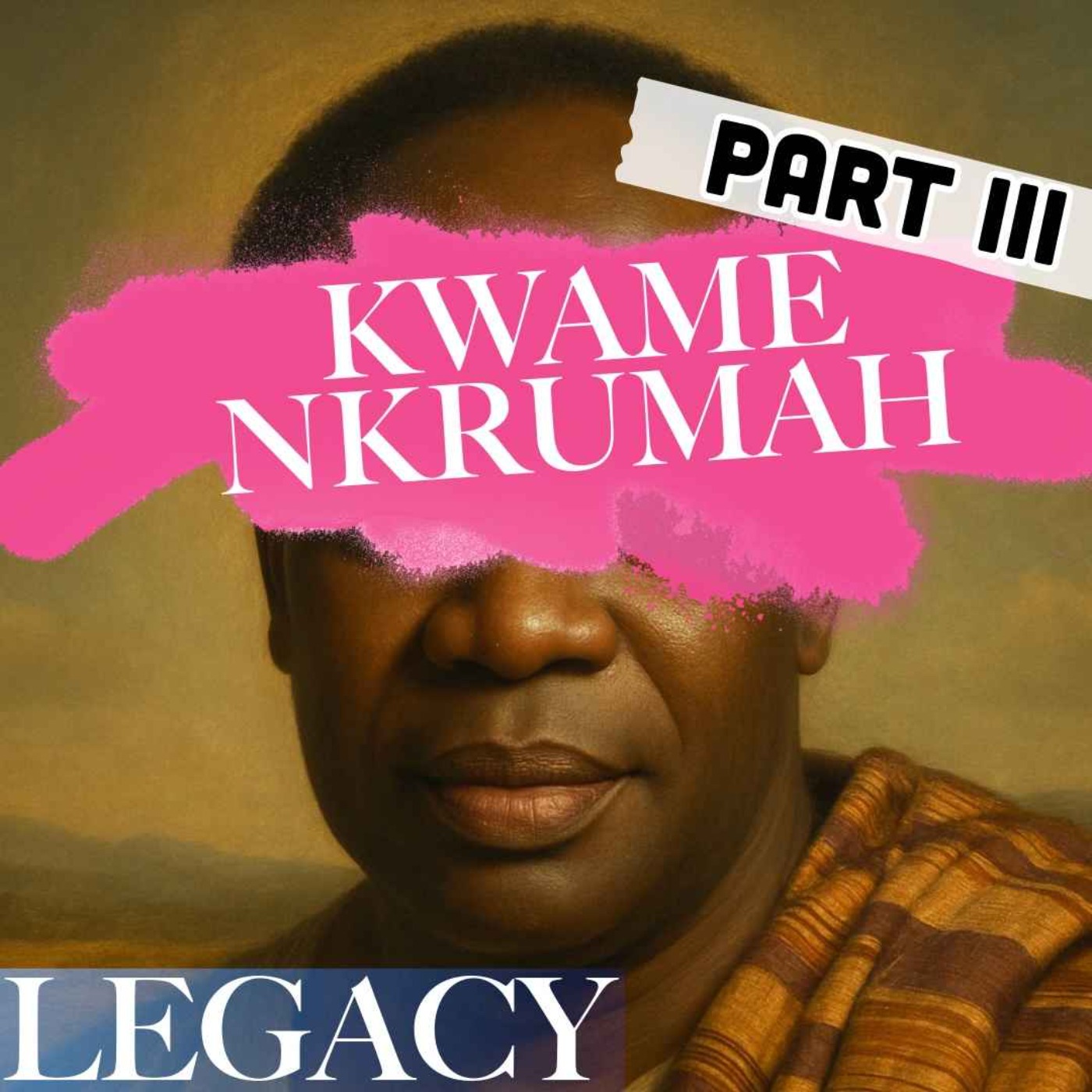
This is Kwame Nkrumah, Part three Pan Africanist.
- [01:57]
Peter Frankopan
Okay, Afra, I don't know how you would think about Victory Day 1945, but it must have been quite something to celebrate the news of the death of Hitler, the German surrender, the war in Europe is over. Just as everybody's thinking that the world is going to be a happy place. I mean, we'll leave Asia to one side that's got a few more months to run. But this is a time of real relief and hope and an idea that things can go back to normal. How does it look to Ghanaians and people from Gold coast and to Nkrumah?
- [02:27]
Afua Hersh
Well, there are 65,000 people from the Gold coast who've served during the war under the command of British officers in the Royal West African Frontier force. And actually 30,000 of them are probably still deployed because they have been sent to Burma. And if you go to Accra today, you can see the legacy of that. In fact, the military base in Accra is called Burma Camp, and there's a military graveyard for many of the servicemen who died in Burma. So it's been a big deal for people from the Gold Coast. But like most colonial experiences, there's a real asymmetry, because while people from the Gold coast have been massively affected by this war and have a huge sense of their service, people in Britain don't really see their service at all. They're not even included in the VE Day parades. They're not referred to as troops or soldiers, which is what they were, but as Africans. And so there are all these indignities they're experiencing. And it means that the jubilation at the end of the war is a bit of a bittersweet experience for many Africans because they haven't felt honoured for their service. They are about to struggle to get the kind of compensation and pensions they've been promised. And the end of the war doesn't mean this incredible new liberation. It means just a return to colonialism and exploitation, business as usual.
- [03:36]
Peter Frankopan
And, you know, Europeans of the same rank get paid more. When Europeans die, they get better burial rights and recognitions. And so there's a sort of dislocation. People in West Africa, as from other parts of the British Empire that are fought in the war, are proud of their service. The terrible loss of life, which unfortunately doesn't get mentioned in others, it should do. But you can see that Pan Africans like Nkrumah are not completely jubilant that one European country has managed to overthrow the other one. Or an empire belonging to Britain is going to be able to shortly knock out the Japanese Empire with the help of America. That is an empire in all but name and its sort of top rankings. But you know, that great imperial power doesn't give space for those who are interested in equality and be able to choose their own path. But at the end of the last episode, you mentioned Nkrumah finishing his doctorate. He doesn't quite manage to get that over the line. Tell us about what Nkrumah does when he comes back to London.
- [04:33]
Afua Hersh
What is going on with Nkrumah at this point? It's quite mysterious. So he's abruptly abandoned his PhD at Lincoln in the US before finishing it. He is supposed to be continuing or finishing it in London. He says his plans in London are to finish it quickly. He also wants to be called to the bar, so he's enrolled at the Inns of Court. And the only thing that's really clear about these plans is that he wants to be in the centre of all this anti imperial and colonial activity. Because London, this period, is known as the vortex of imperial rule. And where there's imperial Rule there is anti colonial agitation. So it makes sense for Nkrumah to be here. And I think more than the studies, it's quite clear that he plans to meet and socialise and strategize with key figures. So we mentioned CLR James, great Trinidadian theorist and Pan Africanist in the last episode. But there's also George Padmore, another Trinidadian. He's described as the London based guru who of colonial revolutionaries. He's had an interesting past in the Soviet Union which we'll probably come back to. And there are other key figures, some of whose names you might recognize. Jomo Kenyatta, he goes on to become the first president of Kenya after it fights for and gains independence. Richard Wright, famous American author. Raz Makonan, another Trinidadian. And at the same time you've got all of these Africans who've been moving around because of the war, you've got all of these African Americans, all these GIs in the UK. So it's a very dynamic black community in London. And it really irritates me when I watch movies of which there are hundreds, maybe thousands set in London during the Blitz and at the end of the Second World War that kind of erase this presence, you know. And even when there are depictions of London as a multicultural place, people say, you know, it's kind of political correctness gone mad. It's not. It was a genuinely diverse place. And not just that, but black culture was thriving. And nowhere more so than at the West Africa Students Union, which is this hub for all of the students, loosely defined, basically young, idealistic, dynamic Africans. They're all congregating at this building in Camden and they publish pamphlets and newspapers there, they have meetings, they throw incredible parties.
- [06:46]
Peter Frankopan
You make it sound great, but you know, these guys are really, really poor.
- [06:50]
Afua Hersh
Yeah, they are.
- [06:51]
Peter Frankopan
I mean, you say it's diverse and vibrant, so you could, you know, everyone's imagining everyone sort of high fiving each other, having a great drink, having, sitting around and talking about anti colonialism. But you know, this is a life struggle of finding enough to eat. I mean, Kruma's going around the dustbins of hotels and cafes to look for food. You know, he finds fish. I mean, actually I know fish heads in West Africa like can be super tasty.
- [07:12]
Afua Hersh
That's, that's a delicacy.
- [07:14]
Peter Frankopan
Yeah, what a treat. But you know, this is not a kind of happy time where everyone's thinking, wow, we've now got the wind in our sail. This is our moment. It's kind of, are we just a bunch of quite clever people who are going to spend the whole of our lives talking and not getting anything done. But there is the energy, but the worry that it's not actually going to get anywhere. You know, finding somewhere to live is difficult. You know, the crew gets turned away from by landlords who don't want him to come and live with him. So it's not exactly promising that we're going to see a future unfold in the next decade or so. That changes Africa, changes Britain, changes the world.
- [07:51]
Afua Hersh
And it's worth saying as well that, you know, while we always compare Britain and America and the US having this Jim Crow segregation regime that Britain didn't have, there was serious segregation and race discrimination in the UK at this point. We'd had African American units stationed in Britain during the Second World War who were obeying Southern rules about segregation. Black troops were not allowed to integrate with white troops. And this went all the way to Winston Churchill, who ultimately decided not to interfere with the American way of doing things because he didn't want to upset his crucial ally. But many British people were uncomfortable with the idea that they were supporting racial segregation. There were even African American soldiers who were executed in Britain because they were accused of interacting with white women or even assaulting white women. And there are some really controversial examples of those stories that are a whole story for another day. But, yes, as you said, you know, one of the ways this shows up in everyday life for someone like Nkrumah is this color bar that you're turned away when you're looking for a flat to rent. And you're probably not told it's because you're black. You're told that it's no longer available, but he has every door closed to him until he finds one kindly landlady who is willing to put him up. And then she. Her name's Florence Manley, later describes receiving complaints from her neighbours for having a colored man in her house and being ostracized by them. But she sticks by in Croomren and lets him stay and tells everybody what a lovely young man he is until eventually he's accepted. But, yes, you're right, Peter. I think it's a really hard time as well as a really, really dynamic time. And I think these things go hand in hand. If you study all these great social movements, it's often people who are experiencing real hardship and that hardship seems quite symbiotic with their drive to create change, you know, and that's not to sugarcoat it at all, but you can imagine, you know, if they were living in the lap of luxury, it might have taken the edge off their radicalism at the time.
- [09:45]
Peter Frankopan
And he does what any self respecting student would do, which you enroll for another PhD because that's going to allow you to kill plenty of time. So he enrolls for a PhD at University College London on knowledge and logical positivism with a very famous philosopher, A.J. ayer. I remember having to read his books when I was a teenager and it took me a while to understand what he was saying. But although, you know, feels like he's an academic, it's not enough for him to sit in the library spending time thinking and writing. He gets involved in intense political activity. And in fact Ayer says, look, I, you know, he has the self confidence having spent time in America, we all know what that can sound like, but actually his primary focus is the liberation of Africa. So Ayer is kind of happy to let him get on with it because you know, you can't stand in the way of someone who's got a mission to go for. So you mentioned he was enrolled at the bar as well. But everything takes second place to the idea of politics. Afraid, isn't it?
- [10:40]
Afua Hersh
I feel quite a personal connection to this part of the story because my grandfather was at the West African Students Union. He was in London at the same time he was mingling with, with these other fellow Ghanaians. He had been sent to Cambridge at the time on a colonial scholarship and he was doing his degree in English Literature. And you know, from letters that he wrote from his college in Cambridge, which my cousin, who's an incredible archivist, managed to dig up, you can really see the struggle. You know, as you were saying, they had less money than their other students. They were trying to juggle studying and doing justice to family members who'd help them get there. You know, if people have sponsored you to go and study, you don't want to flop, you don't want to neglect your studies and get a poor grade at the same time. You're in this vortex. It's incredible atmosphere. It feels like the entire future and the destiny of your people is at stake. So you're trying to do justice to your studies. You're also trying to kind of prove to white people that as an African you're their intellectual equal, which is an insane, insane burden to carry. This kind of black tax, as it's sometimes called that you have to constantly prove your worth, that you feel if you fail then it's going to let down your whole race by showing that you're actually not as good as your white peers. So there's all kinds of psychological pressures, not to mention the practical issues of not having food to eat, not having money for coal. You're African, you get cold easily. This is post war England. It's not a well heated, luxurious environment. And if you're from a tropical country where food is in abundance and the climate is warm, it's a bit of.
- [12:18]
Peter Frankopan
A shock on a reasonably mild day. But wrapped in a blanket, electric blanket no less.
- [12:24]
Afua Hersh
True, true Ghanaian over here.
- [12:26]
Peter Frankopan
I mean, I'm not going to, you know, it's not snowing outside. I mean, but, but also when we talk about these debates, you know, it can sound exciting and thrilling, but you know, as, as we all know, debate debates also mean people are disagreeing with each other all the time. You know, they're not necessarily sharing ideas. There's constant bickering about whose voices should be listened to and how and why. So it's great that as Peter Abrahams, the South African writer says, you know, it's a point of contact and there are socialist anti colonial ideas shared and enlarged. That also means that people are howling at each other and getting angry. And Nkrumah, he understands, I think we've had this from first two episodes. He understands it's not enough to just be a thinker. You've got to be able to organize. And one of the things he does in October 1945 is he organizes the 5th Pan African Congress in Manchester and Afra. I happen to know that you've got a particular connection with the Pan African Congress and its anniversary. Tell us about that.
- [13:20]
Afua Hersh
Oh, yeah. Well, the Pan African Congress was really the culmination of Nkrumah's organizing, not just at this period, but, you know, in his life thus far. It was one in a series of these monumentous congresses. The first happened, I think, in 1900. They happened, you know, sometimes every decade, sometimes every 20 years. But the, the idea was to really gather Africans who were in the struggle for liberation and equal rights. And the 5th Pan African Congress took place in Manchester in October 1945. And it was a huge accomplishment for Nkrumah and Padmore, all of the West Africa Students association members who brought not just their peers, but huge figures. W.E.B. du Bois, really one of the fathers of the Pan African Congress, was there in person. He was an old man at this point. Also, Amy Ashwood Garvey, the wife of, by now the late Marcus Garvey, many people who would go on to become the leaders of their country. Nnamdi Azikiwe became the first leader of Nigeria. Jomo Kenyatto became the first president of. Of Kenya. They were all there and as well as many other activists, intellectuals, politicians. It was a huge and monumentous occasion. And so much so that in 2020, there were celebrations to mark the 75th anniversary, which was, sadly, during COVID so it couldn't be in person. But it was such a moment of pride for me to speak at that anniversary, because I've grown up with the mythology of this congress. And, you know, we've all been to conferences and meetings, but if you look back with the benefit of hindsight, that was where the blueprint for independence from colonialism in Africa was created. As I said, so many of the people there went on to physically lead their countries to independence. And you can really look at that event as the beginning of the end for the British Empire in Africa. So, you know, it felt like a big deal to those there at the time. But its legacy is absolutely transformative.
- [15:15]
Peter Frankopan
Tell me, afraid, was the 75th anniversary, was it to reflect on what had happened in Manchester of 1945? Was it also about Pan Africanism today?
- [15:24]
Afua Hersh
Both, I think it was, you know, the sense of the erasure of so many of the great events in African history. How many people still aren't aware of that congress or the impact it had. But it was also to look at the legacy and how incomplete the project of decolonization that those men and women created has been. So if you just look at the resolutions the congress came up with in 1945, the total elimination of colonial rule throughout the African continent, an end to forced labor, the wealth of the African continent to be used by Africans, the democratic rights of Africans in South and East Africa to be upheld and for Africans to organize themselves. Now, formal colonialism ended. So I suppose the total elimination of colonial rule was achieved. Apartheid ended decades later, well into our lifetimes. But ultimately, you know, those formal systems, segregation, southern and east in Africa happened. But I would say the other three are very much ongoing because the wealth of the continent is still primarily owned by those outside Africa. Britain continues to own an area of land on the African continent five times the size of Britain. If you look at who owns the majority of wealth in Ghana, it's still extracted by big global mining giants. If you look at the situation in Congo, which actually in Crewma wrote a book in, in 1966 called the Problem of the Congo, it is scarily prophetic. It describes, you know, the state of violence and exploitation that everyone can acknowledge exists in Congo today. So you know, the formal boundaries of colonialism were dissolved. And that was very much the aim of this conference. But the actual liberation, self determination, the ability to control their own resources, to organize on their own terms. I think many of us who were at the 75th anniversary recognize that that is very much an ongoing struggle. And that's why actually it's sometimes useful to look back at this generation we're talking about within Kruma because, you know, they had the imagination to think about what that would look like. And sometimes you need to go back to the source, you know, to strip away all the practical problems and all of the depressing humanitarian disasters and think, what is the actual vision? You know, what is the ideal and how can we get back to it?
- [17:35]
Peter Frankopan
I think there are three major takeaways from that conference. One is the framing Bayern Krumer, who writes the declaration to the colonial peoples of the world that it's not just about Africa or Pan Africanism, it's about people who have been colonized everywhere. And I think that's sort of striking that we mentioned before, how global Nkrumah's perspective. I think that's one element that's important to see, that he sees what's happening and what the future is for Africa, not just in a local African context, even though of course, the enormous scale and size of Africa. But this is part of something about liberation more broadly. The second one is about the role of Marxism. I mean, the Krumen later claims that the conference adopted a Marxist socialist philosophy that he calls African socialism. That that has a kind of. Has a really important legacy that we're going to talk about too, in terms of the direction that Gold coast and Ghana take after independence under Grummer personally, that the elision of liberation with left wing ideology and specifically with Marx. But the third one is the Circle effort. That's a really important logistical institutional framework of what's going to take interesting, clever people and their ideas into something more practical. Tell us about the Circle.
- [18:43]
Afua Hersh
So this is where we see the pros and cons of Nkrumah's genius or organizing. After the conference, he establishes the West African National Secretariat or ones, and the point of that is to follow through on its resolutions. So anyone who's been to a conference, those, you know, if you, if you have conferences that need to be implemented, you need a body that's going to actually follow through and try and bring them about. And that's realistically many of the same people who've been in the West Africa Students Association. But it's this kind of secretariat to make sure that these aren't just pipe dreams, they're going to be implemented. But then there's a secret inner core to ones, and that's called the Circle. And that is an inner group whose goal is to prepare for revolutionary work on the African continent. So it's obviously more radical, it's more secretive, but also, and this is a very important point, its members are obliged to pay personal loyalty to Nkrumah. So this is not a group that's answerable or accountable to the wider Pan African Congress. This is a group that's answerable. Twinkruma and what he's doing is consolidating power here and giving himself his kind of own personal task force that immediately begins to alienate some of the other West Africans, Pan Africans who begin to be suspicious that this is a bit of a power grab by Nkrumah. And that's not the only problem either. The other problem is this allegation that the Circle, this inner group, is connected to the Soviet Union. And that matters because this is 1945, we are in the early stages of the Cold War. And the accusation that this whole movement has Soviet sympathies is going to become more and more relevant as time progresses.
- [20:39]
Quo Business Phone System Advertiser
Did I talk too much? Can't I just let it go?
- [20:45]
Afua Hersh
Well.
- [20:48]
BetterHelp Advertiser
Take a breath. You're not alone. Let's talk about what's going on. Counseling helps you sort through the noise with qualified professionals. And online therapy makes it convenient. See if it's for you, visit betterhelp.com randompodcast for 10% off your first month of online therapy and let life feel better.
- [21:09]
Monarch Finance Advertiser
Do you know your net worth or can you even list all your financial accounts? Believe it or not, most people can't. The problem is simple. When you don't track your finances, you leave hard earned money on the table by overspending and under saving. Monarch is the solution. An all in one personal finance tool that brings your entire financial life together in one clean interface on your laptop or phone in just minutes, you can link all your accounts to see a clear, complete picture of your financial health. With data, visualizations and AI driven insights, Monarch helps you spot patterns, cut wasteful spending and make better financial decisions without ever touching a spreadsheet. Monarch more than pays for itself. In fact, users save over $200 a month on average. That's why the Wall Street Journal named Monarch the best budgeting app of 2025. Get 50% off your first year when you use code power@monarch.com that's monarch.com promo code power monarch the modern way to manage money.
- [22:19]
Peter Frankopan
Even before the Second World War ends, particularly in Moscow, there's thoughts turning to what the post war is going to look like. And the Soviet Union had been quite good at building up networks, not only in Africa, but also in Asia, particularly South Asia, to try to loosen those ties of empires, not only because of Marxist doctrine, but also because that's a way of undermining your rivals. So there have been Soviet intelligence agents and of course British intelligence agents monitoring leaders from West Africa and the West African Students Union, et cetera, to try to anticipate what's going to happen. And the future of Africa has been something that's been thought about a lot, increasingly not only by Nkrumah and by others, but by thinking about what those structures will turn into. And there are some dark stories here. I mean, people like George Padmore you mentioned before, Afra, tell us a bit about him because he's been very involved in Soviet Communism. The ways in which the Soviet Union deals with African students leaders is a very dark story where much is promised and little is provided. But tell us a bit about Padmore and the role that he plays because he's so influential in the Kruger's story.
- [23:28]
Afua Hersh
Yeah, so basically, I think that the idea that these West African students, these Pan Africanists, are Soviet sympathizers or are kind of complicit in this Soviet plan, I think it's a massive simplification and basically untrue. But one of the reasons people have this suspicion is because of George Padmore. So we've mentioned him a few times. Trinidadian, who was very much at the heart of the London Pan Africanist scene. When Nkrumah arrived, he had spent time in Moscow deeply immersed in Soviet communism. So at one point it was absolutely true that he was part of the Soviet project. He'd been appointed head of the Negro Bureau of Red International Labor Uniforms, or Profintern. He'd helped to organize the first International Conference of Negro Workers. In 1930, he became editor of the Negro Worker. He's said to have had about 4,000 contacts across the colonized world promoting Marxist Leninist thinking on behalf of the Soviet system. But then in 1933, and this is the case that actually many of the Africans and black people who had been part of the Soviet system, he had a big falling out with Moscow. He was expelled from Comintern as a petty bourgeois nationalist. And he later said he'd been sent a series of directives from Moscow that told him to stop attacking French imperialism, then British imperialism than American imperialism, and that he'd refused to comply because he was a genuine anti imperialist. So by the time he gets to London, he's had this big falling out with the Soviets. And so while he still subscribes to many Marxist ideas, he still sees himself very much as a socialist and part of the left. His main mission is establishing a vibrant network of Pan Africanists, like minded anti colonial agitators. His, his mission is not to co opt them or recruit them to become Soviet assets.
- [25:15]
Peter Frankopan
No, but I think that there are lots of touch points that provide kind of common ground that can see where that attraction comes from. One is atheism, or move away from, you know, against Christianity. The structure of political power and discipline. The fact that the Soviet Union had run a revolution that had toppled elite powers, you know, that sounded and looked promising, sort of a similarity to what, what might be wanted in Gold coast in West Africa. You can see also that the ideas about supporting the many at the expense of the few was something that again found common ground. So there are these moments and elisions where you can see where Marxist ideology and Leninist teaching and discipline would come good. I'm not quite sure I'm as convinced as Padme might want us to be that he was told to stop talking against imperialism because from the Soviet point of view, the more people you have who are dissenters causing problems, whoever they are, it's a bonus. And the investment that the Soviet Union puts into infiltration into disruption is enormous. Both before the Second World War but also then afterwards. But Nkrumah definitely has sympathies with communism and with socialism and is instinctively drawn towards people's too. For example, he spends a lot of time with others who are being followed by intelligence services in England as potentially dangerous. The ideas that they have might bring the whole house of cards tumbling down. But Nkrumah is keen to not let that stand in his way. So he starts to publish pamphlets. After the end of the Second World War, he publishes a very famous pamphlet called Towards Colonial Freedom. It's privately funded with money that Nkrumah raises. But his publisher, Farley Press is owned by the Communist Party of Great Britain. So I mean that starts to set alarm bells going in the corridors of power in London too, and is seen as an involvement with communist circles. But do you think that Communism AFWA acquired such a negative connotation because of what happened? Because we now know what Stalin was doing at the same time, do you think there's a need to distance Pan Africanism from the Soviet Union.
- [27:20]
Afua Hersh
Yeah, I think the reality is that, you know, these Africans were in Britain at a time where most of the mainstream was hostile to the idea of independence. Britain was proud of its empire. Furthermore, at the end of the Second World War, it was completely dependent on its empire. You know, this is a period where Britain is shipping Ghanaian gold straight to America to repay its war debt. You know, it's literally extracting directly from the colonies to try and stabilize its finances. So it's not remotely interested in any debates about losing those colonies at the moment it needs them most. So the Pan Africanists are pushing wherever there are open doors and the left is the open door. People like Sylvia Pankhurst, who's the daughter of. Of Emmeline Pankhurst, the famous suffragette, although she fell out with her mother. And actually I met her son in Ethiopia because she ended up moving to Ethiopia, having a bit of a complicated relationship with Haile Selassie. But you know, these are the figures on the left who are interested in anti racism, interested in this global struggle against exploitation. So you can see there are lots of natural allegiances and certainly an interest in Marxist and socialist ideas. But. And Krumer would always emphasize that what he wanted wasn't Soviet socialism, but African socialism. And you know, that's as much a rejection of British colonial capitalism as it is an embrace of anything the Soviets are doing. Because if you think about the experience of Africans, they are unable to distinguish kind of Western capitalism from their own experiences of having been colonized. And so the expression of African socialism is really to stop. Differentiate their vision of the future from what they've had in the past. And so that famous publication you mentioned, Towards Colonial Freedom really sets out what this idea of African socialism looks like. And its central arguments are that the West African masses must mobilize. And if you remember in the first episode we were talking about this first generation of independence thinkers like Caseleigh Hayford, who wanted this kind of gentlemanly elite rule. They weren't interested in mobilizing the masses. They wanted to basically replace the British as the elite in charge. This is about mass mobilization, about the youth, the labor movements, women, everybody coming together to overthrow oppression. So that naturally aligns much more with the socialist idea of revolution. And then there's this political independence as a prelude to economic freedom. The awakening of national consciousness among colonized people and the emergence of a working class movement, which is not something that really existed in Africa, where you've got agrarian small scale and subsistence farming and trade based on these Quite hierarchical, traditional structures. To conceive of the kind of class system and a movement in that way is quite novel thinking. And Nkrumah is just trying to innovate a different vision for the future and work out how a country like the Gold coast can compete on the international stage without replicating the kind of model that it experienced before.
- [30:16]
Peter Frankopan
But how does he see things like capitalism and liberalism? How does he see the journey from political independence as a prelude to economic freedom? I mean, is this socialism or Marxism with West African characteristics? Is it a sort of complete. Should we see this as a different political philosophy altogether? I mean, how does he see the way in which communalism or communes in Africa should work together? How does he see those as being distinct?
- [30:45]
Afua Hersh
I think African socialism is a good name because what it's suggesting is that a return to what Nkrumah conceives as the kind of original, authentic African way of organizing. So there's this idea that Africans were already socialists before Europeans arrived. You know, before Marx had even conceived of his theories, before the Soviet revolution could ever have been imagined, Africans were living in a way that you could describe as a form of socialism. And that's mainly based on the fact that African societies are organized in very communal ways, not individualistic ways. There's no concept of private land ownership in traditional African societies. Land is held in trust for the community. There's not any emphasis on the private accumulation of wealth or excess. In fact, there's not really a culture of excess at all. You know, you live by the land, you avoid excess. There are lots of taboos around overexploiting natural resources or becoming excessively wealthy. At the same time, you've got these traditional hierarchies, kings, very powerful military nations like the Ashanti. And so there's a kind of intellectual gymnastics that needs to be applied to see Africa as a kind of place where some kind of working class egalitarianism can exist in spite of the very hierarchical class system. But what binds those ideas is communalism. So I think it's a misunderstanding to really look at African socialism through a European lens. And that's the flaw in the word socialism, right? It kind of invites those European ideas. Whereas really what we're thinking of here is just something completely different. But, you know, in your question, Peter, you go to the problem which we'll see play out, which is these ideas have not really been tested before, and they're not exactly the same as what Africa was like before colonization. And furthermore, Africa can't be the same as it was before colonization, because it's been irrevocably changed. So how do these ideas actually work on the ground in African societies? And how will Africans respond to them? And that's the question that Nkrumah is going to test with the rest of his life.
- [32:54]
Peter Frankopan
I mean, what's interesting, when I did some work on West African societies from antiquity through to the kind of, I guess we call them early Middle Ages, that. That's in itself a European concept and so on, but, you know, to just to give some kind of time framing to it and ideas about, as you mentioned, land ownership around ideas about towns and societies and the process in West Africa, not just in the 20th century or the early modern, you know, 19th, 20th century, this period we're talking about, but going back deep in time, lots of scholars of the region and in the region resist. You know, they say words like towns and cities. They don't really apply the ways in which societies work. They're just different. And you need to find a label that can have interesting conversations, that we can do, comparisons with other regions and even within regions. But I think that that different way in which we should be looking at different societies in different parts of the world, it's a real challenge for us as historians as well. So. And Kruma, I can. I understand exactly what the problem he's trying to deal with, as well as with the issue about what exactly is this and what is communalism as opposed to socialism, as opposed to labels and words that have all sorts of different kinds of baggage. But Kruma is testing these ideas. I mean, that's what makes him also particularly interesting. And he's testing them, not just in London, but also trying to think about what's happening back at home. So while Nakrum has been away, you have independence leaders in the Gold coast who've been trying to negotiate or demand greater levels of autonomy. Tell us a bit about those, though, Afra. Tell us about the elder statesmen in the Gold coast and what they think the future is going to look like.
- [34:27]
Afua Hersh
So there's a group of six. They're still called the Big six in Ghana. Everybody in Ghana knows who they are. And these are the gentlemen of the independence movement. They formed a political party called the United States Gold Coast Convention, or ugcc. And they are seizing this opportunity, like everyone at the end of the Second World War, to start demanding change. And again, like their predecessors, they want a kind of gentlemanly transition to African rule for the elite who they believe they are competent. These men are Oxbridge educated. They are fluent in Latin and Greek. They have had all of the advantages of being able to prove that they can speak the same language as their colonial overlords. And so they think it's their turn. They need, though, a young person to try and reach the masses, because if they're going to push for democracy, they're going to need to mobilize voters to support them. And there's a man called Ekoeje who my mum actually remembers visiting her house when she was a child because my grandfather knew him. He was a member of the London crew who'd already gone home back to the Gold coast. And when he met the big six, he told them that he had just the person. So the UGCC invited Kwame Nkrumah back to the Gold coast to work for them. And they had a brilliant plan. They were going to get this compliant young man to help with their project of a gentlemanly transition. He would be dynamic but easy to manage, young, able to reach a different generation. He was a complete asset to their vision.
- [36:03]
Peter Frankopan
What could possibly go wrong?
- [36:04]
Afua Hersh
What could go wrong?
- [36:06]
Peter Frankopan
So 1947, Kruma takes up their invitation and heads home. And we're going to look at that next time on Legacy, when we're going to see Kwame Ilkrumah bring about the changes that he's dreamed of and that he is still remembered for. Today. Legacy is hosted by me, Peter Frankopan.
- [36:23]
Afua Hersh
And me, A fu Hush.
- [36:43]
Superhuman AI Advertiser
The world is buzzing with AI tools. But instead of making things easier, they've made things overwhelming. There's a better way. Meet Superhuman, the AI productivity suite that gives you superpowers so you can outsmart the work chaos with Grammarly, mail and coda. Working together, you get proactive help across your workflow. No matter how you work, experience AI that meets you right where you are. Unleash your Superhuman potential today. Learn more@superhuman.com podcast that's superhuman.com podcast.