Loading summary
Transcript69 lines
- [00:00]
Peter Frankopan
Monday Sidekick.
- [00:02]
Monday Sidekick AI / Ad Announcer
The AI agent that knows you and.
- [00:03]
Peter Frankopan
Your business, thinks ahead and takes action. Ask at anything seriously.
- [00:08]
Monday Sidekick AI / Ad Announcer
Monday Sidekick, AI you'll love to use. Start a free trial today on Monday.com.
- [00:27]
Peter Frankopan
Hello, and welcome to a new episode of Legacy. I'm Peter Frankopan.
- [00:31]
Afua Haysh
I'm Afua Haysh.
- [00:32]
Peter Frankopan
And this is Legacy, the show that explores the lives, events and ideas that have shaped our world and asks whether they have the reputations that they truly deserve.
- [00:48]
Afua Haysh
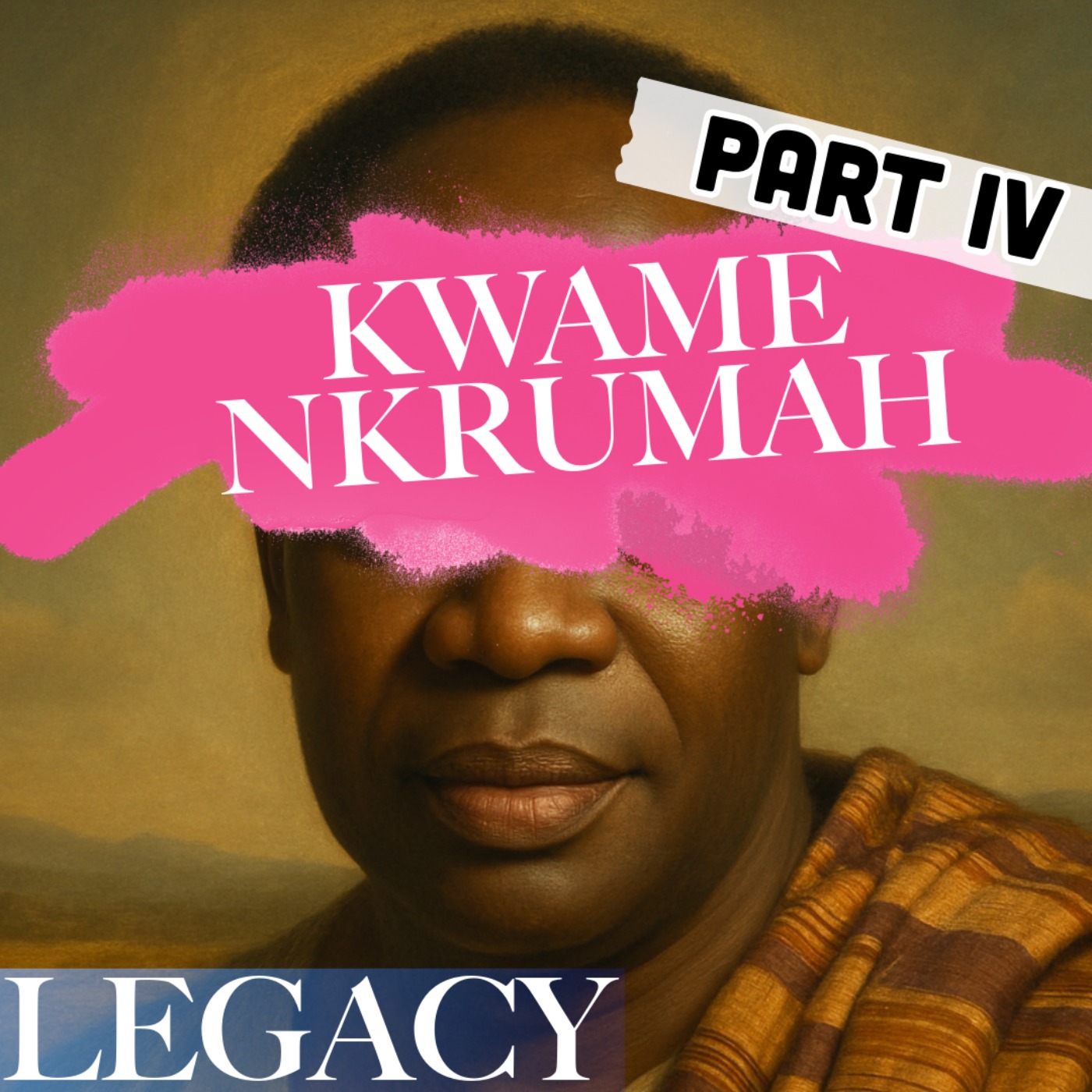
This is Kwame Nkrumah Part four Rise and four. Okay, Peter, let's just check in with where we are. We're back in the Gold Coast. It's 1947, just after the Second World War. There's tens of thousands of Ghanaian servicemen who fought for Britain in Burma, across Asia. They've come back to the Gold coast, you demanding the things they were promised from Britain and expecting some kind of change to the colonialism and limited opportunity they had before the war.
- [01:28]
Peter Frankopan
It's been happening in other parts of the former British Empire, too. You know, the Second World War, like all wars, is shattering both on human lives, but also on economies. And so the apparatus of an empire, suddenly you have an exhausted Britain which is struggling to hang on to its overseas appendages and the places that it's extracted from. And also because the empire's been going on for quite a long time, it's managed to get lots of all the good stuff out over the previous couple of hundred years. So suddenly there's a kind of change of attitude in Britain about what an empire looks like. You see, the independence movements in places like India start to bring about enormous shifts of people, geopolitics, you know, transformational. And so that process of what's going to happen in West Africa starts to become live, too, because the devastation that's been caused by the war to West Africans, to Indians, to people in Southeast Asia has been absolutely epic. So some of it is about what resources are required to keep an empire running. Britain's got quite a close eye on that. But local peoples in the Gandhi and India, of course. But then people like Nkrumah in West Africa have radically different visions about what that future is going to look like.
- [02:41]
Afua Haysh
So Nkrumah is stepping into this fray. He's had his own radicalization among African Americans, among West Indian and African students in London, at the Pan African Congress in Manchester. He is bursting with idealism, with hope, with a real determination to see change in real life. But for the moment, he's slightly constrained by the actual role he's come back to accept, which is as general secretary to the United Gold Coast Convention, which has basically made up of wealthy and highly educated elites in the Gold Coast. They're barristers, doctors, businessmen, and they're known as the big six. Obet Chebe Lamptey Ekoedje, William Aforiata, J.B. dankwa and Edward Okafo Addo, whose son, in fact, will become another president in Ghana. And I worked for him. He was the president in Ghana until, I think, 2024. So they are this historic elite and they think Nkrumah is going to be an obedient young fellow who's going to help them demand this very gentle transition to African rule in the Gold coast colony. But spoiler alert, that is not quite what happens.
- [03:51]
Peter Frankopan
Peter well, it's not quite what happens because Nkrumah probably is responsible for organizing a boycott of European goods in Accra in February 1948. And Nkrumah is certainly held responsible by the British colonial authorities who blame Nkrumah and the Big Six for not doing enough to dampen spirits and perhaps being even behind it too. And Nkrumah is put in prison, and that's a turning point for him because his focus shifts to how do you mobilize the masses who are the real agents of transforming the country into a modern state. And although Ukruma is summoned to come and give evidence in front of the Watson Commission, which is convened by the colonial authorities, it's a turning point insofar as this is all just going through the motions to keep an apparatus in place whose time has been so. Akruma is thinking much more widely about what dramatic and direct action looks like.
- [04:40]
Afua Haysh
What we enter now is this kind of cycle where being imprisoned, being penalized, only makes Nkrumah double down. He now starts to think about how he can imitate some of Gandhi's ideas with this positive action campaign. So in 1950, he starts to organize strikes, boycotts, all these non violent methods of challenging British rule. And crucially, he's got this incredible constituency of former servicemen who'd fought for Britain in the war and are very angry themselves because the pensions they were promised haven't been paid. So you've already got this kind of beginnings of mass mobilization. But Nkrumah's genius is that he's able to widen that. He's able to get the market, women who are a huge force in the Ghanaian economy and a formidable, already organized base of power, as long as people from all different walks of life to rally behind him. As he starts to become more radical and more organized, the British choose the absolute worst response from their perspective. They double down on attacking him. They imprison him again. While they do so, his popularity grows exponentially. He becomes this prisoner, this martyr, a little bit like what happens to Gandhi in India. He becomes this figure that people believe in even more. They see the sacrifice he's paying, they believe in his integrity, and they are furious with the British for clamping down on their demands. So Britain looks back at that as kind of the worst strategy it could have implemented.
- [06:03]
Peter Frankopan
But I suppose the British think they've got no other choice. So you've got a governor in Gold coast who is a sort of colonial figure from central casting, who previously has served as governor of Sarawak in what's out Malaysia, in Brunei, in Basutoland, in what's now South Africa. And he's more or less literally parachuted into Gold coast. And to become the administrator, to do the best he can in the circumstances and. And the day after Nkrumah's released from prison, he invites him to come and see him and appoints him to come and be a leader of government business in what's known as the diarchy, power sharing with British colonial administrators.
- [06:40]
Afua Haysh
Well, Arden Clarke's quite a strategist. He realizes that cracking down on Nkrumah has not been the right approach. So he thinks that by giving him the kind of semblance of some power, the ability to also organise local councils and have some kind of formal representation might call quell these demands. But you're right, Peter, what the British really intend at this moment is no radical change, but just enough to pacify demands for some kind of representation. And the history of how Europeans interact in the African continent goes back centuries. And one of the things that they've done is try and co opt local rulers. So in any African society, even today, where you've got, you know, parliamentary systems that are based on Westminster or Paris and France Francophone colonies, you've also got traditional rulers. You know, every village has a king, and that king is a sub king of a paramount king. And you know, the whole society is organized in this hierarchy. And those rulers have incredible power in the day to day lives of their subjects. They have a huge amount of cultural and historical legitimacy. So what Europeans have done in the past is try and co opt them, knowing that if they can get kings on board, the kings will keep their subjects compliant. And Nkrumah dislikes this system because he's had this kind of Marxist influence, he's had this American influence where he believes in democracy and equal rights. He wants something that looks much more like mass participatory democracy rather than the slightly feudal idea of kings controlling their subjects. And that all being co opted into this agreement that really lets the British continue to run things. So there's this kind of strategic game of chess being played between Britain and Nkrumah at this point where they give him some kind of concession and he then uses it to further his own plans for mass democracy. And this comes to a head in 1953 when Nkrumah delivers an incredibly famous speech called Motion of Destiny. And here he says all of the reforms so far, like a local government ordinance, that means local councils can collect revenue from kings. None of this is enough. The only thing that's going to be enough is an act of independence for the Gold coast to become a sovereign country. But he concedes it can remain within the Commonwealth.
- [08:54]
Peter Frankopan
So Nkrumah is hugely powerful, but it doesn't mean that everybody's uniting behind him. Maybe there's another political party, the National Liberation Movement, that sees the future in very different kinds of ways, has real strong support from the Ashanti region, which is a major cocoa producing area. Already the way in which Nkrumah has been speaking has been alienating people like JB Dankro, who's been calling communism naked and unashamed. And of course, the traditional leadership groups in Gold coast in the different areas hear what Nkrumah is saying about liberation for the masses. And that doesn't really reflect too positively on their own status and power. So it's very, very noisy, the buildup towards what becomes independence, to the point that when a third general election is held, Nkrumah is in fact protesting against that because he doesn't want there to be a rocking of the boat. But does it look like independence is guaranteed to happen after in this period? Is it something that everybody recognizes it's coming and the question is, what will it look like?
- [09:55]
Afua Haysh
I think there is an acknowledgement that it's no longer sustainable for the Gold coast to remain a colony in the way it has been before. But these battles for power are very deeply contested in a very real way. And you know, I think the thing that's important to understand is that the Gold coast is essentially a conservative society. Conservative with a small seat. You know, this is a place where monarchy has real power in daily life. There's a huge respect for the authority of elders, for the authority of regents and spiritual leaders. So, you know, colonialism actually found that a very convenient system to preserve because it allowed the British to just sit above the hierarchy and maintain power. But these ideas about general elections, about mass participation, about equality, are very, very threatening to the traditional power order. And actually, you know, the Ashanti Henny, the king of the Ashanti, is more interested in maintaining his position, his control, his kind of cultural security than he is in this kind of radical change that will maybe encourage his subjects to rise up and overthrow him. So there's a lot going on, but at the same time, Nkrumah's message is completely seductive. And he's offering people of the Gold coast to have a stake in the 20th century on their own terms, to be part of this kind of global tide of democratic change, to have a voice. And, you know, as anyone who's ever voted knows, that's such a powerful idea. And if you've never had it before, if you've been part of this system that doesn't even pretend to be transparent, that doesn't even bother to offer you a blueprint for. For future progress or success or economic advancement, you will gravitate towards that like nothing else. And that's exactly what happens. Because while he hasn't wanted an election, an election happens in July 1956, and Nkrumah's party, the Convention People's Party, or CPP, wins it unequivocally.
- [11:55]
Peter Frankopan
And aful, you mentioned a couple of times in previous episodes about Ghana or Gold coast being matrilineal and the importance of women in societies. But the success of Nkrumah and of the Convention People's Party and towards independence is heavily influenced by local women. Tell us a bit about who they are and why they're supporting what Nkrumah is standing for.
- [12:18]
Afua Haysh
Yeah, it's one of the things that most bothers me how women played a really seminal role in this movement. And their names are not well known, even in Ghana. Many people haven't heard of Mabel Ellen Dove, for example, who was a journalist. She had a newspaper column in Newly Independent Gardener. She played a huge role in the CPP during independence. There were other women. Letitia Quai, Sophia Doku, Harakujo Amarankrumah. And they weren't just kind of organizing women's ministries. You know, this patronizing role that women are sometimes given with the kind of tokenistic approach. They were at the heart. They were intelligence operatives, fundraisers, propagandists. They were really advancing the mission. And Nkrumah was a feminist. He self identified as one. And, you know, I don't know whether that came from his kind of Marxist, socialist background. He'd been obviously around people like Sylvia Pankhurst, who was the descendant of a suffragette and a feminist socialist, but also his relationship with his mother and, you know, his background in this matrilineal society where the power of women was respected. And he said, there is a great responsibility resting on the shoulders of women. All women of Africa and African descent. They must realize that men alone cannot complete the gigantic task we have set ourselves. The time has come when the women of Africa and African descent must rise up in their millions to join the African crusade for freedom. And I think it's important to say as well that while, you know, one of his first acts was to allow women to be elected to parliament, he wasn't just focused on elite women. He mobilize market women. As we were saying earlier, people in that movement became really key to fundraising. You know, and you think of a market women, you think of kind of, you know, a lady with a little stool. Market women in Ghana are formidable. Some of them have actually been able to make so much money, they've been buying properties in London and some of the first Africans to have bank accounts in the uk. You know, they were incredibly effective organizers. They knew and understood the power of markets, the power of financing, and they also had the ability to mobilise other women who maybe wouldn't have participated in formal politics. So Nkrumah was very, very savvy in being able to get the market women on his side. But I think it also reflected his genuine respect for women and determination that there couldn't be a meaningful struggle for independence if it didn't include women at its heart.
- [14:41]
Peter Frankopan
So that process of the election in 1956 sets the pathway towards Gold coast becoming the first West African colony to become independent. You mentioned about Nkrumah being incredibly savvy. I mean, in fact, Charles Arden Clark, the British governor, he says that Nkrumah has two voices, one in official discussions, that conciliatory and pragmatic. And then a party rallies. Much more charismatic, much more forceful, and much more tricky if you're an administrator, because he's setting out demands that the British aren't quite ready to give completely over. But still, Basil Davidson's book Black Star, which is the definitive biography you mentioned a couple of times to Afwa, describes meeting Nkrumah in 1952 and describes him as hugely charismatic, magnetic, thoughtful, and determined to free Africa from colonial and neo colonial clutches. But this period of the 1950s, see Nkrumah go from being a clever man who's trying to finish doctorates to being a party secretary to being the Leader of a nation.
- [15:43]
Afua Haysh
So, Peter, my mother was actually there that day.
- [15:46]
Peter Frankopan
Wow.
- [15:46]
Afua Haysh
March 1957. I think she was six years old.
- [15:49]
Peter Frankopan
Gosh.
- [15:49]
Afua Haysh
And, you know, even though, as I was saying earlier, my family has a complicated relationship with Nkrumah and his legacy, I don't know anyone who isn't emotional about that day. You know, the sight of the British flag being lowered and the Black Star flag being raised, you know, this newly written national anthem, it was such an evocative experience. And even the flag is so loaded with meaning, so it's still called the Black Star. And if you look at it, the symbolism tells its own story. So the colors are the African liberation colors, which were designed by Marcus Garvey. Black, which represents the skin color of the people. It's almost reclaiming blackness as a source of strength and unity instead of a source of oppression. But the oppression of colonialism is referenced in the red, which. Which is the blood of suffering from colonialism and slavery. Then you've got gold, the wealth of the land. Acknowledging that this is a country abundant in wealth and opportunity. And green, because this is a fertile continent that produces so much food, has this history of incredible natural diversity and power. So the colors of the flag are really symbolic. And then there's this star at the center, the lodestar. And a lodestar is a star that's used to guide the course of a ship. And so in this context, Nkrumah is seeing the star of Ghana as the symbol of African freedom. This star that the rest of the continent will now be able to follow on its own path towards freedom. And so you can just see this Pan Africanist ideology throughout. He's not just thinking about his country. He's thinking about all black people and what this moment of independence means to them. And then there's the name Ghana, Peter, which I'm. I'm obsessed with the fact that he chose the name Ghana.
- [17:35]
Peter Frankopan
Well, I mean, it's a new start. You know, there's no question about that. Ghana in the Slinky language means warrior king. I don't know. Alfred. Do you think that's because that's how Nkrumah saw himself? Do you think that's how he saw Gold coast or Ghanaian people? Do you know, it's quite an interesting choice of name. Obviously reflects back to the, you know, ancient way in which this part of the world has been known in Arab geographies and so on.
- [17:59]
Afua Haysh
But it's not even this part of the world, because the ancient kingdom of Ghana was absolutely nowhere near modern day. Ghana.
- [18:06]
Peter Frankopan
Right.
- [18:06]
Afua Haysh
Thousands of kilometers away. So it was much more in the Sahelian region around the Sahara desert, close to modern day Mali. And it was a medieval kingdom. Its capital, Kumbay Saleh, was a major trading hub for the trans Sahara camel caravans, which I know you know a lot about because I also read about. Love the camels in the Silk Road.
- [18:24]
Peter Frankopan
Yeah.
- [18:24]
Afua Haysh
So it's so interesting to me, you know, Nkrumah could have chosen a kingdom, closest home. There were many ancient civilizations on the African continent. I do wonder whether this was a bit of a safe distance because, you know, in Ghana you've got all these different kingdoms, these different ethnic groups, the Ashanti, the Ga in the north, you've got Hausa, Fulani rule. You've got different kingdoms in places like Wa and Yendi that in some places are still kind of contesting their role in the modern state today. So I guess in a way it's easier to choose a kind of foreign idea rather than the competing local ones. But I think there was a real ideology there as well, that Nkrumah is also reminding the world that Africa is not the dark continent. It's not a place with no history. As the Oxford professor Hugh Trevor Roper famously said, this is one of the world's cradles of civilization. And Nkrumah wants everybody to know that. So he's associating Ghana, modern day Ghana, with one of those histories by referencing ancient Ghana. So it's no longer the Gold coast, it is now Ghana. And this is a huge moment for the whole African continent.
- [19:31]
Peter Frankopan
So it's the pinnacle of Nkrumah's political career. He's led his country to independence, to self governance, the first black country to become independent of colonial rule. The question is, is this going to deliver the promised economic paradise and the miracle that Nkrumah has been dreaming about for the whole of his life?
- [20:00]
Monday Sidekick AI / Ad Announcer
AI.
- [20:02]
Peter Frankopan
Had the time of my life A I never felt this way before.
- [20:09]
Afua Haysh
From building timelines to assigning the right people and even spotting risks across dozens of projects, Monday Sidekick knows your business, thinks ahead and takes action. One click on the star and consider it done.
- [20:21]
Peter Frankopan
And I owe it all to you.
- [20:25]
Afua Haysh
Try Monday Sidekick AI you'll love to use on Monday.com.
- [20:30]
Monday Sidekick AI / Ad Announcer
Want to upskill on one of the most effective ad channels out there? With ACOS Ads Academy, you can learn everything you need to plan and run podcast advertising campaigns completely free. Whether you're new to audio or ready to sharpen your skills, our self paced courses fit your schedule and finish with an industry recognized certification so if you want to grow your expertise and stand out in a competitive industry, head to go.acast.com academy.
- [21:07]
Afua Haysh
There'S one aspect of Nkrumah's life we haven't talked about much, Peter, and that's his love life. I'm always interested in people's love lives. As you know, I'm a complete romantic. Unfortunately, even I can't really find anything romantic about the marriage he now undergoes one year after independence. It's basically an arranged marriage. He hasn't even met his wife to be until the wedding day. And that's not because of a Ghanaian tradition. That's because he strategically decided that it would be good for him to marry an Egyptian woman. Because he's on this Pan African project of trying to reassert the links between quote, unquote, sub Saharan Africa. You know, I hate that term, but you know, the countries traditionally associated with black Africa with Egypt and the other countries of the Levant of North Africa. He marries a woman named Fatih Helen rizq. She's a 26 year old Egyptian woman. It's basically arranged by Nasser, who's his ally and comrade in Egypt at the time. But it's a massive shock to basically everyone who knows him, including to his wife. Yeah, she was a little surprised, I suppose, to find herself in Christianborg, which is an old Danish castle in Accra where their marriage happened. But so few people knew about this before it happened that they were really surprised. And I think that he was so focused on wanting to unite Arab Africa with black Africa. He was so focused on the project ahead of him that you don't get the impression that kind of romance and love were really big priorities for him. I also think, you know, as, as a kind of informal student of Ghanaian men. There is definitely, and other people from other cultures will relate to this. There's something about the love affair between a man and his woman in my culture. Man and his women between a man and his mother. In my culture.
- [22:53]
Peter Frankopan
That's an important correction.
- [22:54]
Afua Haysh
That is.
- [22:56]
Peter Frankopan
Gosh, we need to, we need to get Sigmund Freud back in there for that one. When you said man and his woman, I thought you correct yourself. I thought you were going to definitely go, man and his wife. Okay, man and his mother. Gosh, I'm now on the edge of my seat. Yeah, go on, tell me about the. In Ghanaian culture.
- [23:11]
Afua Haysh
I have loads of theories about the relationship between Ghanaian men and their mothers. And I suspect anyone who's Jewish, probably anyone Indian, maybe anyone Arab will recognize this. I mean, just to pick a few other cultural identities.
- [23:26]
Peter Frankopan
But we're going to get a lot of email for the. For the Ask Us Anything, in My Opinion podcast. We're going to have a lot of.
- [23:34]
Afua Haysh
Questions, really look up to their mothers. The matrilineal system is not what it sounds like. Because one of the consequences is that as a man, in traditional societies, in especially a can culture, when you get married as a man, your main responsibility is not to your wife, it's to your mother and to your siblings that you share from your mother. So a man in Ghanaian society will look after his sister's children. That's one of the reasons that uncle is such a. An important figure. Whereas your wife and her children will be living with your wife's mother, and her brothers will be the main men in their daily life. So the matrilineal system binds children to the mother rather than to the spouses they might go on to marry. And it's not the Western idea of a nuclear family. It's a communal system where you live in a compound with your mother, your sisters, their children. So, you know, if he'd have stayed in the village, Nkrumah would have stayed living with his mother, and he would have visited his wife and the children he had with his wife. And, you know, I think that that culture encourages a certain kind of relationship, particularly between sons and their mothers, because as a woman, the main man in your life is your mother's brothers and your own brothers. And as a man, the main woman in your life is your mother and your sisters. And I think you can see that in Nkrumah's relationships with women, where he has relationships with women, but they're just not the main event. But the one thing you will always notice is that he keeps his mother close. She often lives with him when he travels, she goes there. You know, people who write about his life describe her often being close by, and it's almost this kind of spiritual relationship. You know, he doesn't talk about Pan Africanism and political ideas and intellectual blueprints for economic liberation with her. He doesn't need to. She's his mother. She occupies a huge part of his heart. That's my interpretation, based on what I've observed in my own family and others, as well as really studying this matrilineal system, because I think it plays out in different ways.
- [25:34]
Peter Frankopan
So anyway, on behalf of Ghanaian men listening, when you say he keeps his mother close, does that also sometimes mean she keeps him on her radar and is constantly keeping an eye on where he is? So Is it him saying, I love my mother, she's gotta be nearby, or is his mother also hovering and wanting to be involved all the time?
- [25:53]
Afua Haysh
I don't get the impression she's a particularly controlling mother because I think he's moving so much out of her world. The people that he's moving with are not people that, you know, she really necessarily speaks the same language as. And she seems like quite a kind of self contained person from what I've read. It's more that she's there. She's a presence and not just a physical presence. It feels like she's a spiritual presence. She's grounding him to his roots, to his culture. So I don't think she's there creating a nightmare for the daughter in law. It's not that kind of situation. And by the way, you know, the children of that marriage are very much alive and well. In fact, Sameer Nkrumah, one of Nkrumah and Fatih's daughters, is herself a politician who continued the legacy of the Convention People's Party that he founded. In fact, when I lived in Ghana, sometimes people mistook me for her because she's half Egyptian, half Ghanaian. And you know me as a someone who's half Ghanaian, half British, but with some Jewish heritage. I guess, like there is a bit of a similarity in how we look. People can, can look her up if they want to, see if they agree. But anyway, so I, it was weird that people sometimes would mistake me for her and she's actually significantly older than me. But I wasn't even offended because she looks so young. You know, Ghanaians age really well. It's one of my aspirations that I inherited that part. Anyway, I digress.
- [27:06]
Peter Frankopan
Talking about aging really well, okay, let's do independent Ghana. So 1957, it's the first sub Saharan state to become independent. It's a beacon of hope and resurgent. It's got a charismatic leader, it's challenged. Myths of black Inferiority offers a claim to the dignity, self respect for black people in West Africa, but also globally. Nkrumah calls for African Americans to return to Africa to assist in the continent's development. And he reiterates that repeatedly during his career. And this is a cause of huge celebration. But this joy is not going to last for too long. Let's start to talk through what is it that starts to go wrong, what starts to go right from the beginning.
- [27:48]
Afua Haysh
And actually you can get this perspective also from some of the African Americans who took up the call to go to this newly free black African country, you know, Maya Angelou, W.E.B. du Bois, Malcolm X visited Richard Wright. And so many of the Greats in 20th century African American culture were there. And they were there at the heyday, this moment of hope. But they were many of them there at the beginning of this decline. And the decline really starts in the early 1960s. As we mentioned way back in the first episode. Ghana has essentially had a monoculture with its economic model. It's heavily dependent on the two commodities of gold and cocoa. And especially cocoa is something that, you know, local people farm. There are whole regions of Ghana that are essentially cocoa farmers. And when Nkrumah was rising to independence, cocoa was booming. Prices were an all time high. That meant that there was more money in the coffers for big plans, you know, these infrastructure plans and Crema's emulating these kind of Soviet ideas of these five seven year plans. But in the 1960s, the cocoa price collapses. In 1964 it dropped from 400 CDs a tonne to 350 cedis a tonne to 276 CDs a tonne. This is almost half of its price. And that caused absolute chaos for the Ghanaian economy. And because Nkrumah had promised all these big infrastructure plans to all of these Ghanaians who were excited about radical transformation, he was borrowing and the budget deficit became completely out of control.
- [29:30]
Peter Frankopan
And those kinds of things, they can happen quickly. I mean, that price fall of about 40%, it's devastating. But you're particularly devastating the poorest communities because you know so much more. Part of your wealth depends on the land. So in 1957, Ghana has sterling reserves of about 200 million pounds. That starts to dissolve incredibly quickly. The way you handle that process of economic challenge, you can sometimes make bad things worse. So there are austerity measures. We saw what that did to many societies around the world after global financial crisis. Increased taxation that then strangles business. That leads to high levels of centralization by Nkrumah who thinks that everyone's coming after him personally rather than actually. How do you solve these problems? So you start to get what looked like an economic paradise and a modern industrialization started to look like, well, not a failed state, but one that is disillusioned, where people feel that their dreams are not being met and in fact being slowly shattered. And you see things like the price of bread start to rise. You find life becoming unbearable for those on low income, those who are wage earners. And then as often happens, states become leaky and they become increasingly corrupt. And then people Start to accuse each other of siphoning off cash. And then they do siphon off cash. So some of this starts to be a really poison, toxic challenge that Akruber has to deal with. And he himself isn't on the thick end of that, is he? Afwan? He's not one of those leaders who lines his own pockets.
- [31:00]
Afua Haysh
He's actually quite an ascetic figure. He, you know, way before it was popular. Kind of watches his sugar intake and is very moderate in what he eats. He barely drinks. He goes for walks in the morning. His only indulgence is that he loves animals. And always keeps a kind of menagerie of animals in the garden. That he lives in a simple house. He's not interested in material wealth at all. His big flaw is that he becomes very, very distrustful of people around him. There's some legitimacy in that. You know, as he becomes more unpopular, there are plots against him. There are assassination attempts, many assassination attempts. And that only fuels his distrust. But as we saw earlier in London after the Pan African Congress. When he created this inner circle called the Circle. He has this tendency to hunker down with a few trusted advisors. To be secretive with those he believes he can rely on. And that really becomes a paranoia fueled effort. That alienates many of the other potential allies he does have in Ghana at that time. It's a mixed picture because there's a legitimate sense of being under threat. And we haven't even talked yet about the role that the US and the USSR and Britain are playing. And what their perspective on his ambitions are. But, you know, even putting that to one side. His tendencies to succumb to paranoia and distrust Are very corrosive in what was a very hopeful political environment.
- [32:30]
Peter Frankopan
And that word you use, Afro, I think paranoia. You know, I think that any leader in any society can wake up every day and it's more and more and more bad news. And as you say, you then lean in on a very small group of people. Who sometimes don't tell you what you need to hear. And also you then start to develop slightly offbeat theories about what you think is responsible. So in Krumer's case, he thinks that Western imperial interests are busy to do a deliberate economic squeeze on Ghana. And that cocoa prices are being artificially depressed. Then the IMF refused to give credit guarantees in 1965. He understands that as a deliberate attempt to bring his government down. There are ideas that the British somehow are trying to sort of engineer the fall not just of Krumer. But also to show this is what independence can do. And he believes all of that. And of course that makes him extremely mistrustful. He then centralizes powers so that everything is deemed an emergency measure. And I think totalitarian is probably too strong, but he's certainly monopolistic in how he deals with the media. He shuts down newspapers. You know, he's got these ideas that everything has to be done in his way. And that's incredibly divisive, particularly for someone who's been promising to empower people across the political and social, economic spectrum.
- [33:47]
Afua Haysh
I don't know if totalitarianism is too strong a word, Peter. I mean, he's now at this point beginning to arrest and imprison his enemies. And, you know, one of the most tragic manifestations of this is his former friend and mentor, J.B. dankwa, one of the big six, who actually invited him back to, to the Gold coast, you know, helping set off this whole chain of events that led to independence. You know, in Ghana, there's this huge culture of respect for your elders, even if you disagree with them, even if you fall out with them. And Nkrumah has JB Dankwa arrested, he's sent to prison without trial, and he then dies during his incarceration. You know, it's a really tragic story and one that there's still a huge amount of bitterness towards Nkrumah for in Ghana today. My own family left Ghana during this period. My grandfather, who had been in the UK and now came back and worked for Nkrumah, establishing teacher training colleges all around the country. So when my mum was born, she and her siblings moved every couple of years to different parts of Ghana, you know, the north, the west, establishing teacher training facilities as part of Nkrumah's vision to create a genuinely world class education system that met the needs of Ghanaians rather than imitating colonial education. But my grandfather ended up falling out of favor as well and ending up on some kind of blacklist. So it was incredible, you know, in my own family, the change from believing in Nkrumah as the person who would lead Ghana to this promised land. He promised an economic paradise and a modern industrialized nation. Now, as the 60s are progressing, it's becoming a nightmare where people fear for their lives, they're fleeing the country, they're finding themselves imprisoned. It's a really complicated legacy for me. I feel the personal tragedy of that. But I also think you can recognise that some of Nkrumah's paranoia was real. So there have been documents declassified in the last 10 years alone that show that actually it's true that the intelligence services of Britain and America certainly were beginning to think about how they could remove Nkrumah. They didn't want his vision to succeed. They worried it would play in to Soviet aspirations for control of the continent. And there's actually an incredible book about the whole picture across Africa at this time called White Malice by an academic called Susan Williams that we've talked about before, Peter. But it details in meticulous detail, having combed the archives, what we now know for sure about the role that the global superpowers played in trying to break this new nation. So you look at it from Nkrumah's perspective. He's never done this before. No one's ever done this before. He's carrying the weight. He feels alone. He doesn't even know who in his inner circle he can trust. And he believes that the only way to protect his vision for Ghana, as, you know, cocoa prices collapse and the country becomes bankrupt, is to really hunker down, crack down on his enemies, and kind of forge forward alone. And it's a very tragic story that we can all see, actually led to his demise and caused decades of problems for Ghana. But I also have some sympathy for this kind of young visionary trying to pull off this basically impossible idea.
- [36:51]
Peter Frankopan
But you know, that one party state that Nkrumah turns Ghana into is not the trajectory that the other 17 states that are admitted into the United nations in 1960 follow. So it's right there are the strange way that the Cold War plays out with particularly the United States and the Soviet Union competing with each other, looking for influence, looking for cracks here and there. But Nkrumah, I think his personality, that fact that he's so driven, the fact that his marriage is one that is obviously one that doesn't mean a huge amount to him, because what matters is his political vision means that those seeds all start to sort of come together. So in 1962, he becomes obsessed that the CIA is plotting to overthrow him and gives visitors copies of books denouncing CIA conspiracies, and at that point asks for the kgb, who asks for the Soviet Union to help oversee his personal security, and gets officers from the Stasi in East Germany to train a new national security Service and to start running a whole network of informers across Ghana. So that's all happened incredibly quickly. And I suppose what you're saying is right, Afra. I suppose if you were trying to see it from his side, constant assassination attempts, you know, by 1966, he's survived seven assassination attempts. But, you know, I suppose there's a point where you have to recognize you're part of the problem, possibly the problem. So Nkrumah's unwillingness to share power or to diversify or to reckon that maybe there's a different way of doing things is also what's driving him to make things worse and worse rather than to sort of put the brakes on and see if there's a way in which this can be stopped.
- [38:22]
Afua Haysh
And just to be clear, I'm not defending totalitarianism at all, you know, and I think, really, I think there's no excuse for violating human rights, for detaining and convicting people without trial, for having people killed. You know, these are all things that happened in that era. And it's. That's inexcusable in any event, let alone from someone so idealistic who I think genuinely believes so profoundly in a better vision for what Ghana could become.
- [38:51]
Peter Frankopan
But tell us AFU about the culmination in February 1966 and the coup where Nkrumah is overthrown by a military plot. Talk us through what happens and why.
- [39:01]
Afua Haysh
So 1966 is really the end of the dream. There is a couple. Kruma is abroad in Vietnam. At the time, military officers take advantage of his absence to depose him. The coup is codenamed Operation Colchop. All the coup operators, there were four police personnel and four military people, and they were all trained in Britain. There's now actually direct evidence that Britain was involved in orchestrating this coup. But, you know, at the time, the other suspicious events were the fact that the US ambassador left Accra just before the coup, leaving the country with no US ambassador, which actually gave the CIA station chief Howard T. Bain, a free hand. He proposed that the CIA sponsor a coup. There's lots more detail in the book White Malice about how this went down. But Nkromah is outside the country when he's removed, and it's absolutely devastating. He can't go home. His dream is over. And so he seeks shelter with a friend, an ally, Sekou Toure, who has won independence in Guinea. He's one of the relatively few francophone independence leaders who shares Nkrumah's vision for Pan Africanism. Because others, like Cote d' Ivoire are very skeptical about kind of federating power. They want their own sovereign independence. They're very suspicious of Pan Africanists ideas as a way of diluting their own rule. But Sekou Toure is a firm ally of Nkrumah and he walks the walk as well as talking the talk, he invites Nkrumah to Ghana, he puts him up, he gives him a villa which I've seen in Conakry, this kind of pink villa covered in Borgon villa. And this is where Nkrumah spends the rest of his life. He's writing. He wrote some of his most prophetic books including Challenge in the Congo which we mentioned earlier. But as you said Peter, it's a kind of self fulfilling prophecy because as he's become more suspicious, we now know legitimately of Britain and America that they want to depose him, that they're involved in a coup. This drives him more towards the Soviet Union. There's no evidence that in the absence of that he would have naturally allied himself with the Soviets. In fact he was very active in the Non Aligned Movement which advocated that newly independent countries should avoid taking sides to avoid being co opted into these Cold War battles. So the Soviets kind of as a result of everything that's happened are now really the power that he trusts. But I think, and there is a credible theory that they may have had a role in his ultimate demise.
- [41:33]
Peter Frankopan
Well, we know that his trusted cook is murdered, probably poisoned. Nkrumah's British publisher is convinced that Nkrumah himself is being poisoned too. I mean it's interesting, you know, when he goes to guinea he's given the honorary title of co President, so he's still highly regarded even though he's been deposed. But all of this I think lends Nkrumah to still think about how he can make a difference. So he writes some of his most famous works including Challenging Congo While he's in Exile. And he's still thinking about what the post colonial world will look like. But I mean there's no question Nkrumah, with the chances that he had, the opportunities he had in Ghana, it's a legacy that all went terribly badly wrong for him personally and all the things that he'd been promising for the Ghanaian people.
- [42:23]
Afua Haysh
And what happens now is that having been more aligned with the Soviet Union as he became more alienated from the US and the uk, this is the era, as you can probably tell us more about Peter, of the Sino Soviet split, where China and the Soviet Union had been allies in this new Cold War. But as China falls out with the Soviet Union, Nkrumah starts to be interested in whether China would be a better partner for him and his dream, which he hasn't given up on, of Ghana becoming a viable state, that he could have a role. And so there are theories that like as he became more of a threat to the Soviet Union during this period, exploring this relationship with China, that that may have created an incentive to remove him. But as you're saying, Peter, his British publisher, June Milne, who's written incredibly about this time where she used to go and visit him in guinea, noticed that his cook was murdered. This was someone he really trusted. And then after his cook was murdered, Nkrumah's health begins to mysteriously deteriorate. And I think till now there are many questions about exactly what it was that was wrong with him. And the timing that this happens after his cook disappears seems rather suspicious. And actually at the end of his life, when he's now seriously ill, it's Bucharest where he's taken by the Soviets. So they have this kind of bodily control of him. He's really at the mercy of their care. And it's in Bucharest that He dies in 1972, allegedly of stomach cancer.
- [43:52]
Peter Frankopan
And you don't want to die in Soviet era Bucharest in 1972. I mean, it's a gray drab, you know, this the, the age of Ceausescu and, and seeing what these other states that have also notionally become free, what they are actually what the realities are. So I think that those painful, dashed dreams are really how we think about Nkrumah. The kind of the promising opportunities, what things could have been like. And then the sort of set of circumstances that left very painful and difficult legacies. I mean, as it happens, Kofi Busier, who, the leader who took over from Nkrumah, is deposed in a coup himself and deposed by another military general in another coup that unleashes a cycle of chaos and violence and instability that plagues Ghana for the next 30 years. And in fact, many of Macrumor's most scary predictions turn out to be very prophetic. Like you mentioned about the CIA orchestrating coups. We know that was happening at the time in the Cold War. And so he wasn't always the master of his own destiny. There were dark forces to try to contend with too. But I wonder what you think Afua about the legacy of Nkrumah in the round you're looking back today from the first, as we reach the end of the first quarter of the 21st century. Colonial independence in itself is the great achievement is what happens next. Is that part of Nkrumah's story? Is that something that we need to judge by a separate yardstick? Was he responsible for all those mistakes and flaws?
- [45:22]
Afua Haysh
I think that the best legacy we can give Nkrumah is that optimism about revolution for Africans has never died. And actually, June Milne says that even while he was dying this incredibly painful, alleged stomach cancer, he remained boundlessly optimistic that Africa could experience genuine liberation. It could shake off the neo imperialist powers as he described them, also very prophetically. And I just want to read from what Amilcar Cabral, who was from Guinea Bissau, a Lusophone, Portuguese speaking, West African country, said at his funeral, because I think it's really beautiful. Let no one come and tell us that Nkrumah died from cancer of the throat or any other sickness. He was killed by the cancer of betrayal. But we Africans strongly believe that the dead remain living at our side. We are societies of the living dead. Nkrumah will rise again. Each dawn in the heart and determination of freedom fighters. In the action of all true African patriots. Nkrumah's immortal spirit presides and will preside at the judgment of history on this decisive phase in our people's lives, in lifelong struggle against imperialist domination and for the genuine progress of our continent. So, you know, I think, Peter, we can debate the wrongs of Nkrumah's leadership, of which there really are many. And you know, as I said earlier, I was so personally affected by them in my own family story. In fact, we couldn't go back to Ghana until the 1990s because the coup cycle that you described after Nkurima's couple just continued. And there was not democratic rule again in Ghana until 1994. And in 1995, a 14 year old me was able to visit the country of my mother's heritage for the first time. So.
- [47:10]
Peter Frankopan
So given your own personal story and the chaos that unfolded for the decades afterwards and the role that Nkrumah obviously played in that, just explain to our listeners why you think it was that he was voted African man of the Millennium in 1999. Was that a kind of sympathy for what he was trying to achieve and didn't? Is that turning a blind eye to the things that went wrong? How does he get such high popularity scores in the contemporary age?
- [47:36]
Afua Haysh
Yeah, and that was 1999. I think Nkrumah's never been more popular than he is now. There's a way in which a new generation have kind of used social media to really bring his ideas back to life. And they land different in this era. And that's partly because he was prophetic. The things he was warning about, you know, that if Africa achieved political independence but didn't shake off the corporate ownership of its resources, the control of Bretton woods institutions over its economies, and these things all Played out. We watched them play out, you know, structural adjustment in the 80s and 90s. These programs of the World bank and the IMF were absolutely catastrophic. African countries are still paying off the debt as a result of those programs. If you go to a West African country today, you will find most big industries still owned by European and American and increasingly Chinese interests. You will find that political parties and even governments are often kind of receptacles for aid budgets. You know, they have so much of their policy dictated by donors who have made their money exploiting African resources. Powers not residing within African countries. In spite of all the formal architecture of independence. This is exactly what Nkrumah predicted. And this is why he pioneered this idea of African socialism. Not because he wanted to align with Marxism or Sovietism necessarily, but just because he knew that there needed to be a different model, that globalized capitalism kind of pioneered by the imperial powers could never, ever do justice to Africans. And I think as more and more people have become disillusioned with those models, they look back to, to someone like Nkrumah who, way ahead of his time, with incredible clarity, set out that vision. And, you know, maybe he was ahead of his time because he tried to implement this vision in the 1950s and 60s. And he was a lone voice. He was the only one who had an independent African country in that part of Africa. He was right at the beginning of the Cold War. You know, he was right at the beginning of the Non Aligned Movement. He was trying to do things that till today, no one has been able to pull off. And I just want to add that, you know, right now there is a leader in Burkina Faso, which is just to the north of Ghana, called Ibrahim Trore, who's another young revolutionary, visionary leader. And he's saying many of the things that Nkrumah said. And people are very, very concerned that he too will be deposed in a coup because the kind of global power system can't tolerate Africans really seeking political solutions that are in their own interest. They need to be client States of America and Europe and increasingly China. So if Nkrumah had lived in the era of social media, maybe there would have been more eyes on what was happening in Ghana. But as it was, all of these nefarious acts were able to flourish in the darkness. But I don't want to take agency away from him. He was able to implement many of the things he wanted to. He made some really big bad choices. And there was this pretty impressive attempt to sabotage what he was doing from the outside. And all of those things are true.
- [50:44]
Peter Frankopan
Listen, Afwa, it's been a pleasure doing this one. I know how much the history of Ghana means to you and of Gold coast to talk through the life of increment. I know you were nervous that we would do him justice and the story of Ghana and the Ghanaian people justice. It's been, you know, I can't think anybody I could do that better with than learning from you. And you know, with your Akan heritage. It's been fantastic to have a chance to talk through Nkrumah. I've learned so much as well in thinking about part of West Africa that I know something about but should know more. But to hear about Nkrumah's life and his legacy, what an amazing opportunity to do that in such detail. So that's our end of our fourth episode on Kwame Nkrumah. I hope you're going to join us on future episodes, but this is Legacy, hosted by me, Peter frankopone and me, Afwa Hash. Acast powers the world's best podcasts. Here's a show that we refer to.
- [51:53]
Monday Sidekick AI / Ad Announcer
Correct.
- [51:55]
Jessie Ware
Hello, this is Jessie and Lenny Ware from Table Manners, a podcast direct from our dining table where we talk all things food, family, growing up and everything in between.
- [52:06]
Afua Haysh
And everything in between.
- [52:07]
Jessie Ware
This season we've had Reese Witherspoon reveal the greatest cookie recipe. We had Gary Oldman, who's freshly knew, we did some singing with Gloria Estefan and Jeremy Allen White has shared the some culinary stories with us. And it's not just this series. We've had plenty of other brilliant guests where you can listen back to all the episodes. People like Cher, Dolly Parton, Kate Winslet, Saul McCartney, John Legend, Benny Blanco and Selena Gomez. We've had them all and we fed them very well. Come and listen to Table Manners, the podcast with me, Jesse Ware and Lenny.
- [52:39]
Peter Frankopan
Wear ACAST helps creators launch, grow and monetize their podcasts everywhere.
- [52:47]
Monday Sidekick AI / Ad Announcer
Acast.com.